T-RFLP Method: A Powerful Tool for Microbial Community Profiling in Biomedical Research
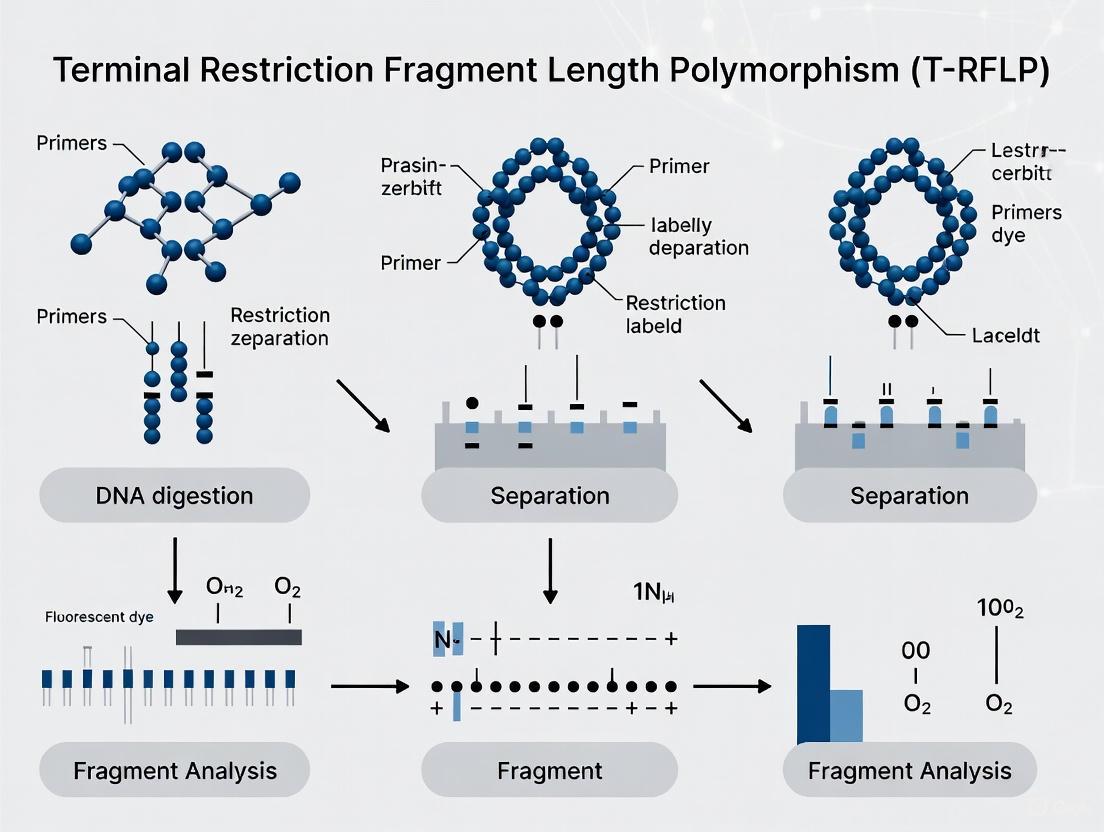
Terminal Restriction Fragment Length Polymorphism (T-RFLP) is a robust, high-throughput, and cost-effective fingerprinting technique widely used for the rapid analysis of microbial community structure and dynamics.
T-RFLP Method: A Powerful Tool for Microbial Community Profiling in Biomedical Research
Abstract
Terminal Restriction Fragment Length Polymorphism (T-RFLP) is a robust, high-throughput, and cost-effective fingerprinting technique widely used for the rapid analysis of microbial community structure and dynamics. This article provides a comprehensive resource for researchers and drug development professionals, covering the foundational principles of T-RFLP, detailed methodological protocols and diverse applications, common troubleshooting and optimization strategies, and a critical validation against next-generation sequencing. By synthesizing current research and methodological advancements, this guide aims to empower scientists to effectively leverage T-RFLP for swift and reliable microbial community screening in clinical, pharmaceutical, and environmental contexts.
Understanding T-RFLP: Core Principles and Workflow
What is T-RFLP? Defining the Basic Concept and Workflow
Terminal Restriction Fragment Length Polymorphism (T-RFLP) is a robust, high-resolution, culture-independent molecular technique widely used for microbial community analysis. This fingerprinting method provides a rapid, reproducible approach for profiling complex microbial populations based on variations in the length of terminal restriction fragments from conserved genetic markers. Originally described in the mid-1990s, T-RFLP has evolved into a sophisticated analytical tool that bridges the gap between traditional microbiology and modern genomic approaches, offering researchers a cost-effective method for comparing microbial community structures across diverse environmental and clinical samples. This application note details the fundamental principles, standardized workflow, key applications, and methodological considerations of T-RFLP analysis to support researchers in implementing this powerful technique.
Basic Concept and Historical Development
Terminal Restriction Fragment Length Polymorphism (T-RFLP or sometimes T-RFLP) is a molecular biology technique designed for profiling microbial communities based on the position of a restriction site closest to a labelled end of an amplified gene [1]. The method involves digesting a mixture of PCR-amplified variants of a single gene using restriction enzymes and detecting the size of the resulting terminal fragments through fluorescence-based detection systems [2].
The technique was first described by Avaniss-Aghajani et al. in 1994 and later refined by Liu et al. in 1997, who employed amplification of the 16S rDNA target gene from DNA of both isolated bacteria and environmental samples [1]. This development represented a significant advancement in molecular ecology, providing researchers with their first efficient tool for comparative analysis of complex microbial communities without the need for culturing.
Relationship to Other Molecular Techniques
T-RFLP belongs to a family of molecular fingerprinting methods developed to generate profiles of unknown microbial communities, alongside other techniques such as Denaturing Gradient Gel Electrophoresis (DGGE), TGGE, ARISA, ARDRA, and PLFA [1]. While these methods all serve the general purpose of microbial community analysis, T-RFLP offers distinct advantages in reproducibility, digital data output, and potential for phylogenetic identification when combined with appropriate database comparisons [3].
Unlike conventional RFLP (Restriction Fragment Length Polymorphism), which visualizes all restriction fragments, T-RFLP specifically detects only the terminal fragments through fluorescent labeling, significantly reducing pattern complexity while enhancing resolution [1] [4]. This key distinction makes T-RFLP particularly suitable for analyzing complex communities where multiple terminal restriction fragments (T-RFs) can be separated and quantified with high precision.
Theoretical Foundation and Principles
Fundamental Biochemical Principles
The T-RFLP technique leverages several well-established molecular biology principles. The method depends on the presence of sequence polymorphisms in conserved genetic markers (typically the 16S rRNA gene for bacteria and archaea) that alter restriction enzyme recognition sites [1]. These sequence variations directly impact the lengths of DNA fragments produced when enzymes cleave at specific recognition sequences.
The analytical separation capitalizes on the relationship between DNA fragment size and migration distance through a separation matrix during electrophoresis. Smaller fragments migrate more rapidly than larger fragments when subjected to an electric field, enabling precise size determination through comparison with internal standards [2]. Fluorescence detection provides quantitative data based on the principle that fluorescence intensity correlates with fragment abundance, allowing for both qualitative presence/absence determinations and semi-quantitative assessment of relative abundances within microbial communities [5].
Microbial Community Representation
In T-RFLP analysis, each terminal restriction fragment (T-RF) theoretically corresponds to a unique "operational taxonomic unit" (OTU) or phylogenetic group within the microbial community [1]. The fluorescence intensity (peak height or area) associated with each T-RF provides an estimate of the relative abundance of that particular OTU within the total community [6]. This representation enables researchers to compare microbial community structures across different samples, treatments, or time points.
However, this approach contains an important limitation known as "peak convergence" - where multiple distinct bacterial taxa may share terminal restriction fragments of identical size, resulting in their representation as a single peak on the electropherogram [1]. This compression of diversity means that T-RFLP profiles typically display 20-50 distinct peaks, each potentially representing multiple distinct sequences, thereby introducing some degree of bias and oversimplification of the true microbial diversity [1].
T-RFLP Workflow: Step-by-Step Protocol
Complete Experimental Procedure
The following workflow diagram illustrates the comprehensive T-RFLP procedure, from sample preparation to data analysis:
DNA Extraction and Purification
The initial step involves extracting total community DNA from environmental or clinical samples using standardized extraction protocols. The DNA extraction method should be optimized for the specific sample type, as differential lysis of microbial cells can introduce bias in community representation [7]. For soil samples, commercial kits such as the FastDNA SPIN Kit have been successfully employed, typically using 0.2-0.5 g of starting material [8]. DNA quantity and purity should be determined by spectrophotometry (A260/A280 ratio of approximately 1.8-2.0) [8].
PCR Amplification with Labeled Primers
Amplify target genes using fluorescently labeled primers. The most common target is the 16S rRNA gene for bacterial communities, though functional genes (e.g., pmoA for methanotrophs) or other markers can be used [1]. A typical 50 μL reaction contains:
- 0.2 μg/μL bovine serum albumin
- 160 μM each dNTP
- 3 mM MgCl₂
- 0.05 U/μL Taq DNA polymerase
- 1X PCR buffer
- 0.4 μM each primer (one fluorescently labeled) [5]
Common fluorescent dyes include 6-FAM, HEX, ROX, and TAMRA, with 6-FAM being the most widely used [1]. Thermal cycling conditions typically include initial denaturation at 95°C for 3 minutes, followed by 22-35 cycles of denaturation (94°C for 30 seconds), annealing (55°C for 30 seconds), and extension (72°C for 30 seconds), with a final extension at 72°C for 7 minutes [5].
PCR Product Purification
Purify amplified products to remove excess primers, nucleotides, and enzymes that might interfere with subsequent digestion. Commercial purification kits such as the Promega PCR Preps Wizard kit are commonly used, with elution performed using 19 μL of sterile water heated to 55-65°C [5].
Restriction Enzyme Digestion
Digest purified PCR products using frequent-cutting restriction enzymes (typically 4-base cutters). A standard reaction contains:
- 5 μL purified PCR product (approximately 600 ng)
- 5 μL restriction enzyme master mix containing 1.5 U/μL restriction enzyme and 1X reaction buffer [5]
Commonly used enzymes include HaeIII, RsaI, and MspI. Incubate reactions for 3 hours at the enzyme-specific optimal temperature (typically 37°C), followed by enzyme denaturation at 65°C for 16 minutes [5]. Using multiple restriction enzymes in parallel reactions enhances resolution and reduces the possibility of different sequences producing coinciding fragment lengths [1].
Fragment Separation and Detection
Separate restriction fragments using capillary or polyacrylamide gel electrophoresis on an automated DNA sequencer. The system detects only the fluorescently labeled terminal fragments, ignoring internal fragments [1]. Include internal size standards in each run to ensure accurate fragment size determination. Capillary electrophoresis provides higher resolution than traditional gel-based systems and enables digital data output for subsequent analysis [3].
Data Analysis and Interpretation
The output of T-RFLP analysis is an electropherogram where the x-axis represents fragment sizes and the y-axis represents fluorescence intensity [1]. Data analysis involves several critical steps:
- Noise Filtering: Apply baseline fluorescence thresholds to distinguish true peaks from background noise. This can be done by setting a minimum peak height threshold or using statistical methods [6].
- Peak Alignment: Account for slight variations in fragment size determination between runs by grouping similar fragments within a size tolerance window (typically 0.5-2 bp) [6].
- Normalization: Standardize peak heights or areas to account for variations in total DNA concentration loaded between samples [5].
- Data Transformation: Convert electropherograms into data matrices suitable for statistical analysis, typically creating sample × T-RF tables with peak heights or areas as values [1].
Table 1: Common Data Analysis Approaches for T-RFLP Profiles
| Analysis Method | Description | Applications |
|---|---|---|
| Pattern Comparison | Visual or computational comparison of electropherogram patterns | Rapid screening for major differences between communities |
| Multivariate Statistics | Ordination, cluster analysis, principal component analysis | Identifying relationships between multiple samples and environmental variables |
| Database Comparison | Matching T-RF sizes to in-silico digests of known sequences | Tentative phylogenetic identification of community members |
| Clone Library Correlation | Linking T-RFs to sequences from clone libraries | Validating peaks and obtaining phylogenetic information |
Advanced statistical analyses commonly applied to T-RFLP data include cluster analysis (Ward's method, UPGMA), redundancy analysis (RDA), principal component analysis (PCA), and Monte Carlo permutation tests [5] [3]. These methods help identify significant patterns and relationships within complex datasets.
Essential Reagents and Equipment
Table 2: Key Research Reagent Solutions for T-RFLP Analysis
| Reagent/Equipment | Function/Purpose | Examples/Specifications |
|---|---|---|
| Fluorescently Labeled Primers | PCR amplification of target genes with fluorescent tags | 6-FAM, HEX, TAMRA labeled 16S rRNA gene primers |
| Restriction Enzymes | Cleavage of amplified genes at specific sequences | 4-base cutters: HaeIII, RsaI, MspI; 3-hour digestion at 37°C |
| DNA Polymerase | Amplification of target genes from community DNA | Taq DNA polymerase with appropriate buffer systems |
| DNA Extraction Kits | Isolation of total community DNA from samples | FastDNA SPIN Kit for soil, Ultraclean Soil DNA Kit |
| PCR Purification Kits | Removal of enzymes, primers, nucleotides after amplification | Promega PCR Preps Wizard Kit |
| Capillary Electrophoresis System | Separation and detection of fluorescently labeled fragments | Automated DNA sequencers with laser-induced fluorescence detection |
| Size Standards | Accurate determination of fragment sizes | Internal DNA ladder with known fragment sizes |
Applications and Case Studies
T-RFLP has been successfully applied across diverse research areas, demonstrating its versatility as a microbial community analysis tool:
Environmental Microbiology
In soil microbial ecology, T-RFLP has been used to characterize community responses to various environmental factors, including heavy metal contamination [3], agricultural management practices [8], and soil type variations [5]. The method's sensitivity allows detection of changes in microbial community structure in response to environmental perturbations, making it valuable for monitoring ecosystem health and recovery.
Food and Beverage Industry
T-RFLP has been applied to profile microbial communities during food production processes, including the characterization of bacterial communities in cheese ripening [2] and wine fermentation [2]. These applications demonstrate the technique's utility in quality control and process optimization in food production systems.
Biomedical and Pharmaceutical Research
In pharmaceutical research, T-RFLP has been used to identify medicinal plants such as Glycyrrhiza species through PCR-RFLP approaches [9]. The technique's ability to distinguish closely related species makes it valuable for authentication of herbal medicines and ensuring product quality in drug development.
Advantages, Limitations, and Methodological Considerations
Advantages of T-RFLP
The continued use of T-RFLP in microbial ecology reflects several significant advantages:
- High Reproducibility: Automated fragment separation and detection provide highly reproducible results for repeated samples [1]
- Digital Data Output: Results are generated in numerical format, facilitating data storage, comparison, and statistical analysis [1]
- High Throughput Capability: The technique allows simultaneous analysis of multiple samples, making it suitable for large-scale studies [6]
- Semi-Quantitative Nature: Fluorescence intensity provides information about relative abundance of different community members [5]
- Potential for Phylogenetic Identification: T-RF sizes can be linked to known sequences through database comparison [1]
Limitations and Challenges
Despite its utility, T-RFLP has several important limitations that researchers must consider:
- Peak Convergence: Multiple distinct sequences may produce T-RFs of identical size, leading to underestimation of diversity [1]
- PCR Biases: DNA extraction and amplification introduce biases in community representation [1]
- False Peaks: Artifactual peaks may result from incomplete digestion or single-stranded DNA formation [1]
- Resolution Limits: Complex communities may contain more distinct populations than can be resolved as separate T-RFs [1]
- Database Dependence: Phylogenetic identification depends on comprehensive reference databases [2]
Technical Considerations and Optimization
To maximize data quality, several methodological aspects require careful attention:
- DNA Extraction Efficiency: Combine or optimize extraction methods to avoid biased lysis of different microbial groups [7]
- Restriction Enzyme Selection: Use multiple enzymes to enhance resolution and reduce peak convergence [1]
- Fluorescent Dye Selection: Consider mobility differences between dyes during capillary electrophoresis [7]
- Replication: Include analytical replicates to assess reproducibility and enable statistical analysis [5]
- Normalization Methods: Apply appropriate data transformation (e.g., Hellinger transformation) before statistical analysis [5]
T-RFLP remains a valuable technique for microbial community analysis, particularly in studies requiring high-throughput sample processing or comparative analysis of multiple communities. While next-generation sequencing technologies provide more comprehensive community characterization, T-RFLP offers advantages in cost-effectiveness, rapid analysis, and data simplicity that maintain its relevance in environmental and applied microbiology.
The technique continues to evolve, with recent developments including multiplex approaches that simultaneously analyze multiple microbial groups [8] and improved bioinformatics tools for data analysis [6]. When appropriately implemented with attention to its methodological considerations, T-RFLP provides robust insights into microbial community structure and dynamics across diverse research applications.
Terminal restriction fragment length polymorphism (T-RFLP) is a powerful, culture-independent molecular technique that generates genetic fingerprints of microbial communities, providing critical insights into their composition and structure without requiring laboratory cultivation of organisms [5] [10]. This method has become an essential tool in microbial ecology, environmental monitoring, and clinical diagnostics due to its high sensitivity, reproducibility, and throughput capabilities [11] [12]. The technique is particularly valuable for revealing the extensive uncultured diversity present in complex environments like soil and aquatic systems, where traditional culture-based methods capture only a small fraction of the actual microbial diversity [5]. By combining fluorescent labeling, restriction enzyme digestion, and high-resolution capillary separation, T-RFLP enables researchers to perform comparative analyses of microbial communities and test hypotheses about community responses to environmental changes, pharmaceutical interventions, or other experimental variables [5] [13].
The fundamental principle underlying T-RFLP is the sequence heterogeneity within conserved genes, most commonly the 16S rRNA gene in bacterial communities [11]. This technique involves PCR amplification using a fluorescently labeled primer, followed by restriction digestion and separation of the terminal fragments, yielding a profile where each peak theoretically represents a distinct microbial taxon or operational taxonomic unit (OTU) [5]. The application of T-RFLP has expanded beyond microbial ecology to include identification of protozoan pathogens like Cryptosporidium, demonstrating its versatility as a diagnostic tool [12]. For drug development professionals, T-RFLP offers a rapid method for assessing how therapeutic interventions alter microbial communities, potentially identifying biomarkers for drug efficacy or toxicity.
Theoretical Foundations
Principles of Fragment Separation
The separation mechanism in capillary electrophoresis, the final analytical step in T-RFLP, relies on the differential migration of DNA fragments under the influence of an applied electric field [14]. The electrophoretic mobility (μₚ) of a DNA fragment determines its migration velocity and is described by the equation: μₚ = q/(6πηr), where q represents the net charge of the ion, η is the viscosity of the separation matrix, and r is the Stokes radius of the analyte [15]. This relationship demonstrates that for DNA fragments of identical charge (which is proportional to length), the smaller fragments migrate faster due to their smaller hydrodynamic radius, enabling size-based separation.
In addition to electrophoretic mobility, electroosmotic flow (EOF) significantly impacts analyte migration in CE [14]. EOF arises from the negatively charged silanoate groups on the fused silica capillary interior at pH >3, which attract a double layer of cations from the buffer solution. When voltage is applied, these mobile cations move toward the cathode, creating a bulk flow that carries all analytes regardless of charge. The velocity of electroosmotic flow (u₀) is defined as u₀ = μ₀E, where μ₀ is the electroosmotic mobility and E is the electric field strength [14]. The electroosmotic mobility is further defined as μ₀ = εζ/η, where ε is the dielectric constant of the buffer, ζ is the zeta potential at the capillary wall, and η is the buffer viscosity [15]. The total velocity of an analyte (u) in CE is therefore the sum of its electrophoretic velocity and the electroosmotic flow velocity: u = uₚ + u₀ = (μₚ + μ₀)E [14]. This combined effect enables the separation of terminal restriction fragments by size with single-base-pair resolution, which is critical for accurate T-RFLP analysis [13].
Workflow Visualization
The following diagram illustrates the complete T-RFLP workflow, from sample preparation to data analysis:
T-RFLP Experimental Workflow
Research Reagent Solutions
The successful implementation of T-RFLP methodology requires specific reagents and materials optimized for each step of the process. The table below details essential research reagent solutions and their functions in the T-RFLP workflow:
Table 1: Essential Research Reagents for T-RFLP Analysis
| Reagent/Material | Function | Specifications |
|---|---|---|
| Fluorescent Primers | Targets conserved genes (e.g., 16S rRNA) with 5' fluorophore for fragment detection [5] [16] | Typically 6-FAM, VIC, HEX, or NED labels; 0.4-0.6 μM in PCR [5] [16] |
| Restriction Enzymes | Cleaves PCR amplicons at specific sequences to generate terminal fragments [5] [17] | Frequent-cutters (e.g., RsaI, MspI); 1.5-3 U/μL in reaction [5] [17] |
| DNA Polymerase | Amplifies target gene regions from community DNA [5] [12] | Thermostable; with proofreading for accuracy; 0.05-1 U/μL [5] [12] |
| Capillary Electrophoresis Matrix | Medium for size-based separation of terminal fragments [13] [14] | Polymer matrix providing single-base resolution; compatible with fluorescence detection [13] |
| Size Standards | Reference for accurate fragment size determination [12] | Fluorescently labeled DNA fragments of known sizes (e.g., LIZ500) [12] |
Quantitative Data Analysis in T-RFLP
The quantitative interpretation of T-RFLP data requires careful consideration of data transformation and statistical approaches to ensure accurate community comparisons. Research has demonstrated that the method of data analysis significantly impacts the sensitivity and reliability of T-RFLP for detecting differences between microbial communities [5] [18].
Table 2: Statistical Methods for T-RFLP Data Analysis
| Analysis Method | Application Context | Performance Characteristics |
|---|---|---|
| Hellinger Distance | Hypothesis testing of community differences [5] | More sensitive than Euclidean distance; effective with relative peak height data [5] |
| Jaccard Distance | Detection of presence/absence differences [5] | Highly sensitive in redundancy analysis; requires >10,000 fluorescence units [5] |
| Redundancy Analysis | Testing specific hypotheses about environmental effects [5] | More effective than cluster analysis for detecting differences between similar samples [5] |
| Cluster Analysis (Ward's Method) | Exploratory data analysis to find natural groups [5] | Effective at differentiating major groups within sets of profiles [5] |
| Cluster Analysis (UPGMA) | Identifying potential outliers in datasets [5] | Slightly reduced error rate in clustering replicates; more sensitive to outliers [5] |
The selection of appropriate data transformation methods is equally critical. Analysis of relative peak height or Hellinger-transformed peak height more effectively clusters replicate profiles compared to raw peak height data [5]. This transformation reduces the influence of analytical noise and variations in total fluorescence between runs. Additionally, detection limits for T-RFLP have been established at approximately 1% of total DNA for individual species in mixed templates, enabling identification of minority populations within complex communities [12].
Detailed T-RFLP Protocol
Step-by-Step Experimental Procedure
DNA Extraction and Purification
- Extract community DNA from environmental or clinical samples using appropriate extraction kits (e.g., Mo Bio Ultraclean soil DNA kit for soil samples) [5]. Include a bead-beating step (10-30 minutes) to ensure efficient cell lysis [5].
- Quantify DNA using fluorescence methods and adjust concentration to 0.1-10 ng/μL for PCR amplification.
PCR Amplification with Fluorescent Primers
- Prepare PCR reaction mixture containing: 0.2 μg/μL bovine serum albumin, 160 μM each dNTP, 3 mM MgCl₂, 0.05 U/μL Taq DNA polymerase, 1× PCR buffer, 0.4 μM unlabeled reverse primer, and 0.4-0.6 μM fluorescently labeled forward primer (e.g., HEX-labeled 8-27F for bacteria) [5].
- Perform PCR with the following cycling conditions: initial denaturation at 95°C for 3 minutes; 22-35 cycles of 94°C for 30 seconds, 55°C for 30 seconds, and 72°C for 30 seconds; final extension at 72°C for 7 minutes [5] [12].
- Verify amplification success by agarose gel electrophoresis before proceeding to restriction digestion.
Restriction Enzyme Digestion
- Purify PCR products using commercial PCR purification kits (e.g., Promega PCR Preps Wizard kit) to remove excess primers and dNTPs [5].
- Prepare restriction digest mixture containing: approximately 600 ng purified PCR product, 1.5 U/μL restriction enzyme (e.g., RsaI), and 1× appropriate reaction buffer [5].
- Incubate at enzyme-specific temperature (typically 37°C) for 3 hours to ensure complete digestion, followed by enzyme inactivation at 65°C for 15-20 minutes [5] [17].
Capillary Electrophoresis
- Prepare samples by adding 1 μL digested product to 9.9 μL deionized formamide and 0.1 μL internal size standard (e.g., LIZ500) [12].
- Denature samples at 95°C for 5 minutes and immediately place on ice until loading [12].
- Perform capillary electrophoresis using instruments such as ABI Prism 3130xl with the following parameters: 8.5 kV voltage, 40-second injection time, 60°C capillary temperature, and 100-minute run time [12].
- Set detection parameters appropriate for the fluorophore used (e.g., 6-FAM excitation/emission) [13].
Protocol Visualization
The following diagram details the restriction enzyme digestion process, a critical step in T-RFLP analysis:
Restriction Digestion Process
Applications in Research and Drug Development
T-RFLP has diverse applications across microbial ecology, clinical diagnostics, and pharmaceutical development. The technique's ability to provide rapid, high-throughput community analysis makes it particularly valuable for comparative studies and screening applications.
In environmental microbiology, T-RFLP has been successfully used to examine bacterial communities in soils from different geographical regions, agricultural management practices, and bioremediation systems [5] [11]. These analyses have revealed how microbial communities respond to environmental changes, with statistical methods like redundancy analysis effectively detecting significant differences between similar samples [5]. The method has also been adapted for studying specific phylogenetic groups within complex communities using group-specific PCR primers, enabling targeted analysis of functionally important microbial taxa [11].
In clinical and pharmaceutical contexts, T-RFLP has proven valuable for pathogen identification and microbial community dynamics in host systems. Researchers have developed T-RFLP assays for specific detection and differentiation of Cryptosporidium species (C. hominis and C. parvum) in human fecal samples, providing a rapid, cost-effective alternative to DNA sequencing for routine diagnostics [12]. This application demonstrates the method's sensitivity in detecting minority populations, with a detection limit of 1% of total DNA for individual species in mixed infections [12]. For drug development professionals, T-RFLP offers a powerful tool for assessing how therapeutic interventions alter microbial communities, potentially identifying microbial biomarkers for drug efficacy or adverse effects.
Alternative Methodologies
While standard T-RFLP uses fluorescently labeled primers and capillary electrophoresis, alternative approaches have been developed to address specific limitations. The physical capture method of T-RFLP replaces the fluorescent label with a biotinylated primer and uses streptavidin-coated beads to isolate terminal restriction fragments [11]. This method allows direct sequencing of T-RFs to confirm species identity, addressing a significant limitation of conventional T-RFLP where T-RF size alone may not sufficiently discriminate between taxa [11].
Comparative studies have demonstrated that physical capture T-RFLP generates similar community profiles to fluorescent T-RFLP and reveals virtually identical relationships between ecosystems in ordination analyses [11]. However, this method has reduced resolution compared to capillary electrophoresis, detecting approximately 24 T-RF band classes versus 38 classes with fluorescent T-RFLP in one study [11]. Despite this limitation, physical capture T-RFLP provides a valuable alternative for laboratories without access to capillary electrophoresis instrumentation and enables definitive identification of T-RFs through sequencing.
Troubleshooting and Optimization
Successful implementation of T-RFLP requires careful attention to potential technical challenges. One common issue involves incomplete restriction digestion, which can be addressed by ensuring optimal enzyme-to-substrate ratios, using appropriate reaction buffers, and verifying enzyme activity through control reactions [17]. Another significant consideration is the potential for multiple bacterial taxa to generate terminal restriction fragments of identical size, which can lead to misinterpretation of community composition [11]. This limitation can be mitigated by using multiple restriction enzymes or through sequencing-based verification of key T-RFs.
Data analysis presents additional challenges, particularly in determining appropriate peak inclusion thresholds and normalization methods. Research indicates that analysis of relative peak height or Hellinger-transformed data produces more accurate clustering of replicate profiles than raw peak height data [5] [18]. Additionally, consistent total fluorescence between profiles (e.g., >10,000 fluorescence units) is essential when using presence-absence metrics like Jaccard distance [5]. Statistical methods should be selected based on research objectives, with redundancy analysis recommended for hypothesis testing and cluster analysis for exploratory data analysis [5] [18].
For drug development applications, standardization of protocols across samples and batches is particularly critical to ensure reproducible results. Including internal controls and replicate analyses throughout the experimental process helps control for technical variability and provides greater confidence in biologically significant findings.
Terminal Restriction Fragment Length Polymorphism (T-RFLP) is a molecular biology technique for profiling microbial communities based on the position of a restriction site closest to a fluorescently labelled end of an amplified gene [1]. This method provides a genetic fingerprint of the composition of a microbial community without requiring cultivation of organisms, thereby revealing the vast uncultured diversity present in most environmental samples [5]. The technique functions on the fundamental principle that sequence variations among different microbial species result in differential restriction enzyme recognition sites, which in turn produce terminal restriction fragments (T-RFs) of varying lengths that serve as proxies for different operational taxonomic units (OTUs) within the community [1] [19].
The method was first described in 1994 and has since been applied to various marker genes including the 16S rRNA gene for general bacterial communities and functional marker genes like pmoA for analyzing methanotrophic communities [1]. T-RFLP has remained relevant despite the emergence of newer sequencing technologies because it provides a rapid, cost-effective community screening method suitable for analyzing large numbers of samples, making it valuable for comparative community analyses and monitoring microbial community dynamics across various environments [6] [20].
The Molecular Principle of Differentiation
Fundamental Mechanism
The core principle of T-RFLP differentiation lies in the genetic polymorphisms that exist between different microbial taxa. While multiple microorganisms may share the same target gene (typically the 16S rRNA gene for phylogenetic studies), their DNA sequences contain subtle variations. These sequence differences affect the presence and positioning of restriction enzyme recognition sites within the amplified gene region [1].
When a restriction enzyme (typically a 4-base cutter) cleaves the fluorescently labelled PCR products, it does so at specific recognition sequences. Microbes with different sequences will have restriction sites at different positions relative to the labelled primer, resulting in T-RFs of different lengths. The length of the T-RF is therefore a direct reflection of the distance between the labelled primer and the first restriction site encountered in the amplified sequence [1] [19]. Each unique T-RF length theoretically represents a unique microbial operational taxonomic unit (OTU) in the sample, though there are limitations to this assumption which will be discussed later [19].
Theoretical Example of Fragment Differentiation
The following diagram illustrates how genetic differences between bacterial species produce different terminal restriction fragments during T-RFLP analysis:
Key Determinants of T-RF Sizes
The specific size of each terminal restriction fragment is determined by several genetic factors:
Primer binding site conservation: The fluorescently labelled primer binds to a conserved region of the target gene, establishing the fixed starting point from which the T-RF length is measured [1].
Restriction site polymorphism: The presence or absence of restriction enzyme recognition sites in the gene sequence creates fundamental differences between microbial taxa [1] [21].
Sequence insertions/deletions: Even when the same restriction sites are present, insertions or deletions in the gene sequence alter the distance between the primer binding site and the restriction site, resulting in different T-RF lengths [21].
Single nucleotide polymorphisms (SNPs): Point mutations can create or eliminate restriction enzyme recognition sites, thereby changing the T-RF profile [21].
The combination of these genetic variations ensures that different microbial taxa typically produce different T-RF lengths, enabling community differentiation based on the T-RF profile pattern [1] [19].
Experimental Workflow and Protocols
Comprehensive T-RFLP Workflow
The following diagram outlines the complete T-RFLP procedure from sample collection to data analysis:
Detailed Step-by-Step Protocol
DNA Extraction and PCR Amplification
Protocol Objective: To extract community DNA and amplify the target gene with fluorescently labelled primers.
Materials and Reagents:
- DNA extraction kit (e.g., Ultraclean Soil DNA Kit, FastDNA SPIN Kit for Soil) [5] [20]
- PCR reagents: Taq DNA polymerase, dNTPs, MgCl₂, reaction buffer [5]
- Fluorescently labelled primers: Typically target 16S rRNA genes (e.g., 8-27F labelled with HEX, 6-FAM, or other fluorophores) [5] [1] [19]
- Thermal cycler
Procedure:
- Extract genomic DNA from environmental samples (e.g., 0.2-0.3g soil or digester content) using appropriate DNA extraction kit [5] [20].
- Optimize the amount of DNA template for PCR (typically 0.4-2μL) to obtain strong amplification without nonspecific products [5].
- Prepare PCR master mixture containing:
- 1× PCR buffer
- 3 mM MgCl₂
- 160 μM each dNTP
- 0.4 μM each primer (forward primer fluorescently labelled)
- 0.05 U/μL Taq DNA polymerase
- 0.2 μg/μL bovine serum albumin (BSA) [5]
- Perform PCR amplification using appropriate cycling conditions:
- Perform PCR in triplicate and pool replicates for subsequent steps [5].
Restriction Digestion and Fragment Analysis
Protocol Objective: To digest amplified products and separate terminal restriction fragments for detection.
Materials and Reagents:
- Restriction enzymes (e.g., HaeIII, HhaI, MspI, RsaI, AluI, Hin6I) [5] [19] [20]
- Appropriate restriction buffers
- PCR purification kit (e.g., GenElute PCR Clean-up Kit) [19]
- DNA sequencer with capillary electrophoresis capability (e.g., GenomeLab GeXP, Applied Biosystems sequencers) [1] [6] [20]
Procedure:
- Purify pooled PCR products using PCR purification kit according to manufacturer's instructions [5] [19].
- Quantify purified PCR product concentration using spectrophotometer [19].
- Set up restriction digest reaction containing:
- 500 ng purified PCR product
- 1× restriction buffer
- 0.1 μg/μL acetylated BSA
- 20 U restriction enzyme [19]
- Incubate restriction reaction at 37°C for 3 hours followed by enzyme denaturation at 65°C for 16 minutes or 95°C for 15 minutes [5] [19].
- Desalt digested products if using capillary electrophoresis [1].
- Separate restriction fragments using capillary electrophoresis with internal size standards [1] [20].
- Detect fluorescently labelled terminal fragments using automated DNA sequencer [1].
Key Research Reagent Solutions
Table 1: Essential Research Reagents for T-RFLP Analysis
| Reagent Category | Specific Examples | Function and Application Notes |
|---|---|---|
| DNA Extraction Kits | Ultraclean Soil DNA Kit, FastDNA SPIN Kit for Soil | Efficient lysis and purification of microbial community DNA from complex matrices [5] [20]. |
| Fluorescent Primers | HEX-labelled 8-27F, 6-FAM labelled primers, VIC-labelled 1087r | Provide fluorescent labels for detection of terminal fragments; different dyes enable multiplexing [5] [1] [19]. |
| Restriction Enzymes | HaeIII, HhaI, MspI, RsaI, AluI, Hin6I | Four-base cutters that generate appropriately sized fragments for differentiation; enzyme choice affects resolution [5] [19] [20]. |
| PCR Components | Taq DNA polymerase, dNTPs, MgCl₂, BSA | Amplification of target genes; BSA helps overcome PCR inhibition in complex samples [5] [19]. |
| Purification Kits | GenElute PCR Clean-up Kit, Wizard PCR Preps | Remove enzymes, salts, and unused primers that interfere with downstream steps [5] [19]. |
Data Analysis and Interpretation
From Raw Data to Community Insights
Data Processing Workflow:
- Peak Detection and Sizing: Software (e.g., GeneMapper) identifies peaks and assigns fragment sizes based on internal standards [6].
- Noise Filtering: Application of baseline threshold (typically 50-100 fluorescence units) to remove background noise [6] [20].
- Alignment: T-RFs across samples are aligned using binning methods (typically ±1-2 bp tolerance) to account for run-to-run sizing variations [6].
- Normalization: Conversion of raw peak heights to relative abundances to account for differences in total DNA loaded [5] [6].
- Data Transformation: Application of Hellinger or square root transformation to reduce the influence of dominant species [5].
Statistical Analysis Methods
Table 2: Quantitative Data Analysis Methods for T-RFLP Profiles
| Analysis Type | Specific Methods | Application and Purpose | Performance Notes |
|---|---|---|---|
| Cluster Analysis | Ward's method, UPGMA | Identify natural groupings of samples based on community similarity [5]. | Ward's method better at differentiating major groups; UPGMA more sensitive to outliers [5]. |
| Ordination Methods | Principal Component Analysis (PCA), Redundancy Analysis (RDA) | Visualize relationships between samples in reduced dimensionality [5] [18]. | RDA more effective for detecting differences between similar samples when environmental variables are available [5]. |
| Distance Metrics | Hellinger distance, Jaccard distance, Euclidean distance | Quantify dissimilarity between microbial community profiles [5]. | Hellinger transformation of relative peak height recommended for hypothesis testing; Jaccard distance sensitive for presence/absence analysis [5]. |
| Diversity Indices | Shannon-Wiener, Simpson, Richness | Measure alpha-diversity within individual samples [6]. | Can be calculated from normalized T-RF data, though with lower resolution than sequencing methods [20]. |
Critical Considerations in Data Interpretation
Several factors must be considered when interpreting T-RFLP data:
Multiple Enzymes Enhance Resolution: Using 2-3 different restriction enzymes significantly improves community resolution as different enzymes target different sequence variations [1] [22].
Pseudoterminal Restriction Fragments: Artifact peaks can form due to single-stranded DNA annealing, creating false T-RFs; this can be mitigated using Mung bean exonuclease treatment prior to digestion [1].
Differential Fluorescence: The same quantity of DNA from different taxa may produce different fluorescence intensities, making absolute quantification challenging [1].
Fragment Length Limitations: Longer fragments may show reduced fluorescence detection due to diffusion during electrophoresis, potentially underestimating abundance of taxa with longer T-RFs [18].
Database Matching: T-RF sizes can be compared to in silico digests of sequence databases for putative identification, though this provides limited phylogenetic resolution [1].
Applications and Method Validation
Research Applications Across Fields
T-RFLP has been successfully applied to diverse research areas:
Anaerobic Digestion Monitoring: Comparative studies have validated T-RFLP against Illumina sequencing, showing similar β-diversity clustering patterns, making it suitable for rapid monitoring of microbial community dynamics in full-scale digesters [20].
Microbial Source Tracking: Bacteroidales-TRFLP has demonstrated >88% correct identification of fecal sources in blind samples, with performance improving to >92% when combined with universal bacterial TRFLP [23].
Soil Microbial Ecology: T-RFLP effectively differentiates microbial communities across soil types, management practices, and spatial gradients, successfully capturing major community shifts [5].
Multiplex Community Analysis: M-TRFLP enables simultaneous analysis of multiple taxonomic groups (e.g., bacteria, archaea, fungi) in a single analysis, providing more comprehensive community assessment [19].
Comparison with Next-Generation Sequencing
Table 3: T-RFLP Performance Compared to High-Throughput Sequencing
| Parameter | T-RFLP Method | Next-Generation Sequencing | Implications for Research |
|---|---|---|---|
| Cost per Sample | Low to moderate | High | T-RFLP enables analysis of more replicates and larger experiments with the same budget [20]. |
| Turnaround Time | 1-2 days | Several days to weeks | T-RFLP permits rapid community screening and faster decision-making [20]. |
| Taxonomic Resolution | Low (OTU level) | High (species/strain level) | T-RFLP suitable for community-level comparisons but not detailed taxonomic identification [20]. |
| Richness Detection | Lower | Higher | T-RFLP captures dominant community members but may miss rare taxa [20]. |
| Data Complexity | Low | High | T-RFLP analysis requires less computational resources and expertise [20]. |
| Reproducibility | High | Moderate to high | T-RFLP shows excellent reproducibility between technical replicates and laboratories [19] [23]. |
Technical Validation and Quality Control
Quality Assurance Measures:
- Replication: Include triplicate PCR amplifications and pool products to minimize PCR bias [5].
- Positive Controls: Use defined microbial mixtures to validate T-RF detection and sizing [19].
- Negative Controls: Include no-template PCR controls to detect contamination [19].
- Internal Standards: Use fluorescent size standards in every run to ensure accurate fragment sizing [6] [20].
- Threshold Setting: Apply consistent noise filtration thresholds (e.g., 50-100 fluorescence units) across all samples [6].
- Cumulative Fluorescence: Ensure all profiles have cumulative peak heights >10,000 fluorescence units for reliable statistical analysis [5].
Studies have demonstrated that with proper standardization, T-RFLP profiles show high reproducibility between laboratories, with almost identical profiles in terms of peak presence and relative intensity when standardized protocols are followed [19] [23].
The principle of differentiation in T-RFLP—that genetic sequence variations among microbes manifest as different terminal restriction fragment sizes—provides a robust foundation for comparative microbial community analysis. While the technique offers lower resolution than modern sequencing approaches, its cost-effectiveness, high throughput, and technical reproducibility make it particularly valuable for studies requiring analysis of large sample sets, time-series monitoring, or initial community screening [6] [20]. The method continues to evolve with improvements in multiplexing capabilities [19], statistical analysis methods [5] [6], and bioinformatic tools, maintaining its relevance in the microbial ecologist's toolkit.
When applying T-RFLP, researchers should select restriction enzymes based on the specific microbial groups of interest, incorporate appropriate statistical methods for their experimental design, and recognize both the power and limitations of this fingerprinting approach for revealing microbial diversity through the differential migration of terminal restriction fragments.
Advantages and Inherent Limitations of the T-RFLP Technique
Terminal Restriction Fragment Length Polymorphism (T-RFLP) is a robust, high-throughput molecular technique widely used for the rapid assessment of microbial community structure and dynamics in diverse environments [2]. This method differentiates microbial populations based on the size variations of fluorescently labeled terminal restriction fragments, providing a community fingerprint or profile [2] [24]. As an extension of traditional Restriction Fragment Length Polymorphism (RFLP), T-RFLP combines the principles of polymerase chain reaction (PCR), restriction enzyme digestion, and capillary electrophoresis to generate data suitable for analyzing complex microbial communities from various samples, including food, environmental, and clinical specimens [2] [25].
The technique's applicability within drug development and broader microbiological research stems from its ability to provide rapid, sensitive comparisons of microbial diversity and population shifts in response to environmental variables, treatments, or disease states [2] [26]. This application note details the core principles, advantages, inherent limitations, and standard protocols of T-RFLP, providing researchers with a foundational understanding for its implementation in scientific inquiry.
Principles of T-RFLP
The T-RFLP technique is underpinned by a sequence of molecular procedures designed to produce a profile of a microbial community. The fundamental steps are outlined below and visualized in Figure 1.
Figure 1. T-RFLP experimental workflow. The diagram illustrates the key steps from nucleic acid extraction to data analysis.
First, total genomic DNA is extracted directly from the sample of interest, bypassing the need for culture and allowing for a culture-independent assessment of the community [2]. A target genetic region, most commonly the 16S rRNA gene for bacteria or the 18S rRNA gene for fungi, is then amplified via PCR using universal primers. Crucially, at least one of these primers is fluorescently labeled at its 5' end with a dye such as fluorescein amidite (6-FAM) [2] [24].
The resulting PCR products are a mixture of amplicons representing the microbial community. These amplicons are subsequently digested with one or more frequently cutting restriction enzymes (e.g., AluI, HaeIII) [2] [27]. The digestion produces a mixture of restriction fragments from each amplicon. However, only the fragments that retain the labeled terminal section—the Terminal Restriction Fragments (T-RFs)—will be detected later.
The digested products are separated by size using high-resolution capillary electrophoresis. As the fragments pass a laser detector, the fluorescently labeled T-RFs are excited and detected, generating an electropherogram. This electropherogram displays a series of peaks, where each peak corresponds to a T-RF of a specific size (in base pairs), and its height or area can reflect the relative abundance of that particular phylotype in the community [2] [26]. The resulting T-RFLP profile, consisting of T-RF sizes and their abundances, serves as a fingerprint for the microbial community.
Advantages of the T-RFLP Technique
T-RFLP offers several compelling advantages that make it a valuable tool for microbial ecologists and researchers requiring community profiling.
Table 1: Key Advantages of the T-RFLP Technique
| Advantage | Description | Research Implication |
|---|---|---|
| High Throughput | Amenable to the rapid analysis of a large number of samples [26]. | Enables comprehensive studies with robust, statistically significant datasets. |
| High Sensitivity & Resolution | Highly sensitive in discriminating between different microbial communities based on terminal fragment size [2]. | Capable of detecting subtle shifts in community structure in response to stimuli. |
| Culture-Independence | Does not require the cultivation of microorganisms [2]. | Provides a more comprehensive view of the microbial community, including non-culturable organisms. |
| Semi-Quantitative Data | Peak height or area in the electropherogram can be used as a measure of the relative abundance of specific populations [2]. | Allows for comparative analysis of taxon abundance between samples. |
| Reproducibility | When standardized, the method generates highly reproducible results [24]. | Essential for reliable and comparable data within and between research studies. |
The technique is particularly powerful for comparative community analysis. Researchers can efficiently investigate and compare changes in community structure or microbial diversity in response to time, different processing conditions, or medical treatments [2]. Furthermore, the digital output of fragment sizes facilitates the creation of large, sharable databases and the application of robust multivariate statistical analyses to interpret complex datasets [26].
Inherent Limitations and Challenges
Despite its utility, T-RFLP is subject to several inherent limitations that researchers must consider when designing experiments and interpreting data.
Table 2: Key Limitations of the T-RFLP Technique
| Limitation | Description | Impact on Research |
|---|---|---|
| Pseudo-Quantitative Nature | Relative abundance data can be skewed by PCR biases (e.g., preferential amplification) and variations in DNA extraction efficiency [2]. | May not accurately reflect the true absolute abundance of organisms in the original sample. |
| Dependence on Reference Databases | Accurate prediction of microbial taxa requires a pre-existing library of T-RF profiles from known species [2]. | Unknown or unsequenced organisms in a sample cannot be definitively identified. |
| Underestimation of Diversity | Multiple distinct taxa can produce T-RFs of the same length (sequence homology), leading to an underestimation of true diversity [2]. | The complexity of the microbial community is simplified, and some members remain hidden. |
| Overestimation of Diversity | Incomplete or non-specific digestion by restriction enzymes can create spurious peaks, artificially inflating diversity estimates [2]. | Can lead to incorrect conclusions about community richness. |
| Technical and Analytical Challenges | Sizing errors due to random fluctuations, purine content, and fluorophores can cause T-RF drift, complicating peak alignment across samples [26]. | Requires careful data processing and specialized software (e.g., T-REX) for robust analysis [26]. |
A significant challenge is the inability to directly sequence unknown profiles of interest because the DNA is fragmented and labeled [2]. While using a more species-specific gene target can mitigate some issues related to sequence homology, this limits the broad, community-wide scope of the analysis [2]. Furthermore, the initial setup can be time-consuming if a relevant reference database does not exist, as building one can require extensive cloning and sequencing efforts.
Detailed Experimental Protocol
The following protocol provides a standardized methodology for T-RFLP analysis of bacterial communities via the 16S rRNA gene.
Research Reagent Solutions
Table 3: Essential Reagents and Materials for T-RFLP
| Item | Function/Description |
|---|---|
| DNA Extraction Kit | For isolation of high-quality, high-molecular-weight community DNA from the sample matrix (e.g., soil, food, biofilm). |
| Universal 16S rRNA Primers | e.g., 8F (5'-AGA GTT TGA TCC TGG CTC AG-3') and 519R (5'-GWA TTA CCG CGG CKG CTG-3'). The forward primer (8F) must be 5'-end labeled with a fluorescent dye (e.g., 6-FAM). |
| PCR Master Mix | Contains heat-stable DNA polymerase, dNTPs, MgCl₂, and reaction buffer for robust amplification. |
| Restriction Enzymes | Frequent-cutting enzymes (e.g., HaeIII, MspI, AluI). The choice of enzyme(s) depends on the desired resolution and target taxa [2]. |
| Size Standard | Fluorescently labeled DNA ladder for precise sizing of T-RFs during capillary electrophoresis. |
| Capillary Electrophoresis System | An automated genetic analyzer (e.g., Applied Biosystems series) for high-resolution fragment separation and detection. |
Step-by-Step Procedure
Community DNA Extraction: Extract total genomic DNA from your samples using a commercially available kit. Assess the quality and quantity of the DNA using spectrophotometry and gel electrophoresis. The DNA must be of sufficient purity for PCR amplification.
Fluorescent PCR Amplification:
- Reaction Setup: Prepare a 50 µL PCR reaction containing: 1X PCR buffer, 2.5 mM MgCl₂, 200 µM of each dNTP, 0.2 µM of each fluorescently labeled forward primer and unlabeled reverse primer, 1.25 U of DNA polymerase, and ~10-50 ng of community DNA template.
- Thermocycling Conditions: Initial denaturation at 95°C for 5 min; followed by 30 cycles of denaturation at 95°C for 30 s, annealing at 55°C for 30 s, and extension at 72°C for 1 min; with a final extension at 72°C for 7 min.
PCR Product Purification: Purify the amplified PCR products using a commercial PCR purification kit to remove excess primers, dNTPs, and enzymes that could interfere with the subsequent restriction digest. Verify amplification success and purity via agarose gel electrophoresis.
Restriction Enzyme Digestion:
- Reaction Setup: For each purified PCR product, set up a 20 µL digestion reaction containing: 1X restriction enzyme buffer, 10 U of restriction enzyme (e.g., HaeIII), and ~100-200 ng of purified PCR product.
- Incubation: Incubate the reaction at the enzyme's optimal temperature (e.g., 37°C for HaeIII) for a minimum of 3 hours to ensure complete digestion.
Purification of Digested Products: Purify the digested DNA to remove salts and enzymes that could disrupt capillary electrophoresis. Ethanol precipitation or column-based purification methods are suitable.
Capillary Electrophoresis and Detection:
- Sample Preparation: Resuspend the purified digested DNA in a formamide-based loading buffer containing a pre-determined amount of internal size standard.
- Loading and Run: Denature the samples at 95°C for 5 min, then immediately place on ice. Load the samples onto the capillary electrophoresis instrument and run according to the manufacturer's protocols for fragment analysis.
- Data Export: The instrument's software will generate an electropherogram for each sample. Export the raw data, which includes fragment sizes (in base pairs) and peak heights/areas.
Data Processing and Analysis
Raw T-RFLP data requires processing before biological interpretation. The workflow for this analysis is complex and can be expedited with specialized software like T-REX [26]. The logical flow of data analysis is summarized in Figure 2.
Figure 2. T-RFLP data analysis workflow. The process involves filtering raw data, aligning peaks, and creating a data matrix for statistical analysis.
- Noise Filtering and Baseline Threshold: Apply a baseline threshold to distinguish true T-RF peaks from background noise. This can be a fixed threshold or, more effectively, a variable threshold determined on a sample-by-sample basis to account for differences in signal-to-noise ratio [26].
- Peak Alignment (Binning): Due to minor sizing errors, the same T-RF might be assigned slightly different sizes in different samples. An alignment (binning) process groups T-RFs with similar sizes across all samples into operational taxonomic units (OTUs). This can be done manually or using automated algorithms in software like T-REX or T-Align [26].
- Data Matrix Construction: Create a sample-by-T-RF (presence/absence, height, or area) data matrix. Peak height or area is often relativized (expressed as a percentage of the total peak area for a sample) to enable comparison between samples [26].
- Statistical Analysis: Analyze the final data matrix using multivariate statistical methods. The Additive Main Effects and Multiplicative Interaction (AMMI) model has been demonstrated as a robust method for analyzing T-RFLP data, as it effectively handles main effects and interactions [26]. Other methods include Principal Component Analysis (PCA) and cluster analysis.
T-RFLP remains a powerful and widely used technique for the rapid, high-throughput fingerprinting of microbial communities. Its strengths of sensitivity, reproducibility, and comparative power make it highly valuable for monitoring dynamic changes in microbial populations in contexts ranging from food safety and fermentation processes to environmental bioremediation and host-microbiome interactions in drug development [2]. However, its inherent limitations, particularly its pseudo-quantitative nature and dependence on reference data, necessitate careful interpretation of results. Researchers should view T-RFLP not as a tool for absolute taxonomic identification or complete diversity capture, but rather as an excellent method for generating hypotheses and screening for significant community shifts, which can then be explored in greater depth with next-generation sequencing technologies. When performed with meticulous attention to protocol standardization and robust data processing, T-RFLP provides a reliable and efficient window into the structural composition of complex microbial ecosystems.
Executing T-RFLP: From DNA to Data in Diverse Applications
Terminal Restriction Fragment Length Polymorphism (T-RFLP) is a robust, PCR-based genetic fingerprinting technique widely used for profiling microbial community structure based on variations in the 16S rRNA gene [1] [28]. This method provides a rapid, reproducible, and high-throughput "snapshot" of microbial diversity, making it a valuable biosensor for monitoring ecological status in various environments, including soil and clinical samples [7] [8]. T-RFLP remains a necessary tool in microbial ecology, offering a cost-effective alternative to next-generation sequencing (NGS) for studies focused on community dynamics and comparative analysis [8].
The technique involves PCR amplification of a target gene using a fluorescently labeled primer, followed by restriction digestion of the amplicons and separation of the terminal restriction fragments (T-RFs) via capillary electrophoresis [1]. The resulting electropherogram, with fragment sizes on the x-axis and fluorescence intensity on the y-axis, serves as a DNA fingerprint of the microbial community, where each peak theoretically corresponds to a unique microbial taxon [1].
The following diagram illustrates the comprehensive T-RFLP workflow, from sample collection to data analysis:
Materials and Reagent Solutions
Research Reagent Solutions
| Item | Function/Application | Specification Notes |
|---|---|---|
| FastDNA SPIN Kit | Extraction of high-quality community DNA from complex samples. | Effective for soil and fecal samples; reduces inhibitors [8]. |
| Fluorescently Labeled Primers (e.g., 6-FAM, HEX) | PCR amplification; allows detection of terminal fragments. | 6-FAM is most common; dye type can affect fragment mobility [7]. |
| Restriction Endonucleases (e.g., HaeIII, MspI) | Digests PCR amplicons to generate terminal fragments. | Four-cutter enzymes are ideal; choice affects resolution [1] [7]. |
| DNA Size Standard | Accurate sizing of terminal fragments during electrophoresis. | Essential for precise fragment length determination. |
| GeneMarker Software | Automated sizing and quantification of T-RFs from electropherograms. | Outputs data compatible with T-REX for further community analysis [28]. |
| Mung Bean Exonuclease | Eliminates pseudo T-RFs from ssDNA. | Added prior to digestion to reduce artifacts [1]. |
Detailed Step-by-Step Protocol
Step 1: DNA Extraction
Objective: To obtain high-quality, inhibitor-free community DNA representative of the microbial population.
- Procedure:
- Use 0.5 g of homogenized sample (e.g., soil sieved through a 2-mm mesh) [8].
- Extract genomic DNA using a commercial kit (e.g., FastDNA SPIN Kit for soil) according to the manufacturer's instructions.
- Quantify the DNA concentration and assess purity using a spectrophotometer (e.g., NanoDrop). Acceptable 260/280 nm ratios are typically between 1.8 and 2.0 [8].
- Critical Considerations:
- Bias Minimization: The DNA extraction method can significantly bias lysis of different cell types. Using a combination of extraction methods is recommended for a more accurate diversity assessment [7].
- Replication: Perform extractions in multiple replicates to account for sample heterogeneity.
Step 2: PCR Amplification
Objective: To amplify the target gene (e.g., 16S rRNA) from the community DNA using a fluorescently labeled primer.
- Procedure:
- Reaction Setup: Prepare a PCR mixture as outlined in Table 2.
- Thermocycling Conditions: Use the program detailed in Table 2.
- Verification: Confirm successful amplification and estimate product concentration via agarose gel electrophoresis.
- Critical Considerations:
- Primer Selection: Primers targeting the 16S rRNA gene are standard for bacteria and archaea, while the ITS region is targeted for fungi [8].
- Multiplexing: For simultaneous analysis of multiple microbial groups (e.g., bacteria, archaea, fungi), a multiplex PCR can be optimized. This uses multiple primer sets in a single reaction, reducing time and cost [8]. Optimal conditions may require different primer concentrations for each group (e.g., 0.5 µM for bacteria and 1 µM for archaea and fungi) [8].
- PCR Bias: The number of PCR cycles should be minimized to reduce amplification biases. The use of replicate PCR reactions is advised [7].
Table 2: Standard PCR Setup and Cycling Conditions
| Component | Final Concentration | Volume/Role |
|---|---|---|
| PCR Buffer (10X) | 1X | - |
| dNTP Mix | 200 µM each | - |
| Forward Primer (labeled) | 0.5 - 1 µM | Concentration varies [8] |
| Reverse Primer | 0.5 - 1 µM | - |
| DNA Template | 2 - 4 ng | Varies with sample [8] |
| DNA Polymerase | 1.25 U | - |
| Nuclease-free Water | To final volume | - |
| Total Volume | 50 µL | - |
| Cycling Step | Temperature | Time | Cycles |
|---|---|---|---|
| Initial Denaturation | 95 °C | 5 min | 1 |
| Denaturation | 95 °C | 30 sec | 25-35 |
| Annealing | 55-65 °C* | 30 sec | 25-35 |
| Extension | 72 °C | 1 min | 25-35 |
| Final Extension | 72 °C | 10 min | 1 |
| Hold | 4 °C | ∞ | - |
*Annealing temperature is primer-specific and must be optimized.
Step 3: PCR Product Cleanup
Objective: To remove excess primers, dNTPs, and enzymes that could interfere with the subsequent restriction digestion.
- Procedure: Use a commercial PCR purification kit according to the manufacturer's instructions. Elute the purified DNA in nuclease-free water or the provided elution buffer.
Step 4: Restriction Digestion
Objective: To digest the purified amplicons into terminal restriction fragments (T-RFs) using a frequent-cutting restriction enzyme.
- Procedure:
- Reaction Setup: Prepare a digestion mixture as shown in Table 3.
- Incubation: Incubate for a minimum of 3 hours at 37°C (or the temperature optimal for the chosen enzyme).
- Enzyme Inactivation: Following incubation, heat-inactivate the enzyme as per its specifications (e.g., 65°C for 20 minutes).
- Critical Considerations:
- Enzyme Selection: The choice of restriction enzyme (e.g., HaeIII) is critical as it determines the resolution of the community profile. Using multiple enzymes on separate aliquots of the same sample enhances resolution [7] [8].
- Complete Digestion: Incomplete digestion can lead to artefactual peaks. Ensure complete digestion by optimizing incubation time and enzyme units [7].
Table 3: Restriction Digestion Reaction Setup
| Component | Quantity | Notes |
|---|---|---|
| Purified PCR Product | 100 - 200 ng | - |
| Restriction Enzyme (e.g., HaeIII) | 10 U | 4-cutter enzyme is preferred [7] |
| Corresponding Buffer (10X) | 1X | - |
| BSA (if required) | 100 µg/mL | - |
| Nuclease-free Water | To 20 µL | - |
Step 5: Fragment Analysis
Objective: To separate, detect, and size the fluorescently labeled T-RFs.
- Procedure:
- Sample Preparation: Mix 1-2 µL of the digested product with an appropriate internal size standard and formamide according to the sequencer's requirements.
- Denaturation: Denature the samples at 95°C for 5 minutes and immediately place them on ice.
- Capillary Electrophoresis: Load the samples onto an automated DNA sequencer (e.g., ABI PRISM). The system will separate the fragments by size and detect the fluorescent signal of the terminal fragments.
- Critical Considerations:
Data Analysis and Interpretation
The following diagram outlines the primary pathways for analyzing the raw data generated by the sequencer:
1. Data Pre-processing: The initial analysis of electropherograms involves several critical steps to ensure data quality [29]:
- Noise Reduction: Set a fluorescence threshold to discriminate true peaks from baseline noise. This can be based on variability in replicate profiles or statistical methods [29] [7].
- Peak Alignment: Due to imprecise fragment sizing, T-RFs across different samples that represent the same fragment must be aligned into "bins" using objective algorithms [29].
- Consensus Profiling: For replicate runs of the same sample, a single consensus profile is generated by including only peaks that are reproducible across replicates [29].
2. Profile Normalization: To enable comparison between samples, T-RF profiles must be normalized to account for differences in the total amount of DNA loaded. This can be done by expressing the height or area of each peak as a percentage of the total peak height or area for that profile [29] [7].
3. Community Analysis: The normalized data, structured in a "sample by species" table, can be analyzed using various methods [1] [7]:
- Multivariate Statistics: Techniques like Principal Component Analysis (PCA) or cluster analysis are used to visualize similarities and differences between microbial communities from different samples.
- Diversity Indices: Calculate measures of microbial richness and evenness from the peak data.
- Peak Identification: Use specialized software (e.g., T-REX, TRiFLe) to compare T-RF sizes against in-silico digests of known sequences in databases, allowing for tentative phylogenetic assignment [1] [8].
Troubleshooting and Best Practices
Table 4: Common Technical Challenges and Proposed Solutions
| Technical Challenge | Impact on Analysis | Recommended Solution |
|---|---|---|
| Partial cell lysis during DNA extraction | Skews community representation | Use a combination of extraction methods; optimize lysis conditions [7] |
| PCR bias and artifacts | Non-representative amplification | Minimize cycle number; use replicate reactions; consider group-specific primers [7] |
| Incomplete restriction digestion | Appearance of artefactual peaks | Ensure complete digestion by checking enzyme activity and incubation time [7] |
| Presence of pseudo T-RFs | False, reproducible peaks | Treat PCR products with Mung Bean Exonuclease prior to digestion [1] |
| Low peak height with long fragments | Underestimation of abundance | Use peak area instead of peak height for analysis [7] |
| Imprecise T-RF sizing | Misalignment during analysis | Use molecular weight for comparison; apply multiple binning windows [7] |
Terminal Restriction Fragment Length Polymorphism (T-RFLP) is a robust, culture-independent molecular technique widely employed for microbial community fingerprinting and comparative analysis [1]. The method provides a high-throughput approach for assessing microbial diversity and community structure across various environments, including soil, anaerobic digesters, and the human gastrointestinal tract [5] [30] [20]. The reliability and resolution of T-RFLP profiles are fundamentally dependent on two critical experimental choices: the selection of appropriate PCR primers and restriction enzymes. This application note provides a detailed guide to these selection processes, framed within the context of optimizing T-RFLP for microbial community analysis, and includes standardized protocols for implementation.
Technical Principle of T-RFLP
The T-RFLP technique involves several sequential steps to generate a community fingerprint. The process begins with the extraction of total genomic DNA from an environmental sample. Subsequently, a target gene—typically the 16S rRNA gene for bacteria and archaea, or the ITS region for fungi—is amplified using PCR with one or two fluorescently labelled primers [2] [1]. The resulting amplicons are then subjected to digestion with one or more restriction enzymes, which cleave the DNA at specific recognition sites [1]. The digested products are separated by capillary or polyacrylamide electrophoresis, and only the terminal restriction fragments (T-RFs), which carry the fluorescent label, are detected [2] [1]. The output is an electropherogram where the x-axis represents T-RF sizes (in base pairs) and the y-axis represents fluorescence intensity. The profile of T-RF sizes and their abundances serves as a fingerprint of the microbial community present in the sample [1].
Figure 1: The T-RFLP Workflow. The diagram outlines the key steps in generating a T-RFLP profile, highlighting the two critical experimental choices: primer selection and restriction enzyme selection.
Primer Selection for T-RFLP Analysis
Core Principles for Primer Selection
The selection of PCR primers is a primary factor determining the scope and specificity of the microbial community analysis. Primers must target a phylogenetically informative gene region with sufficient variability to distinguish between different taxa, while maintaining conserved regions for broad amplification across the target group [30]. The 16S rRNA gene is the most common target for bacterial and archaeal community analysis, while the internal transcribed spacer (ITS) region is typically used for fungal communities [8]. Primers are designed to amplify a specific region of this gene, and one primer must be labelled at its 5' end with a fluorescent dye, such as 6-FAM, HEX, or Cy5 [30] [1] [20].
Established Primer Pairs
Extensive research has been conducted to identify optimal primer pairs for various applications. The table below summarizes several well-characterized primer sets used in T-RFLP analysis.
Table 1: Commonly Used Primer Pairs in T-RFLP Analysis
| Target Group | Primer Name | Sequence (5' to 3') | Target Gene Region | Key Application Notes | Reference |
|---|---|---|---|---|---|
| Bacteria | 8-27F | AGAGTTTGATCCTGGCTCAG | 16S rRNA | A classical general bacterial primer; may miss some Bifidobacterium species. | [5] [30] |
| Bacteria | 516f | TGCCAGCAGCCGCGGTA | 16S rRNA | Offers good coverage; suitable for use with 1510r. | [30] |
| Universal | 1392-1406R | ACGGGCGGTGTGTACA | 16S rRNA | A universal reverse primer often paired with forward primers like 8-27F. | [5] |
| Archaea | Ar109f | ACKGCTCAGTAACACGT | 16S rRNA | Specific for archaeal communities; requires archaeal-specific reverse primer. | [20] |
| Fungi | ITS1-F | CTTGGTCATTTAGAGGAAGTAA | ITS1 | Fungal-specific primer targeting the internal transcribed spacer region. | [8] |
The choice of primer pair can significantly impact the resulting community profile. For instance, the combination of 516f and 1510r has been demonstrated to be effective for analyzing human fecal microbiota, providing clear differentiation between individuals while maintaining minimal variability between technical replicates [30]. In-silico analysis using tools like the T-RFLP Analysis Program (TAP-TRFLP) available through the Ribosomal Database Project (RDP) is highly recommended to predict the theoretical T-RFs generated from a database of known sequences and to evaluate the resolving power of a chosen primer-enzyme combination before empirical testing [30].
Restriction Enzyme Selection
Criteria for Enzyme Selection
The restriction enzyme is the second critical tool that defines the resolution of a T-RFLP analysis. The enzyme's recognition site determines the number and sizes of the terminal fragments, thereby influencing the complexity and interpretability of the fingerprint [30] [1]. Ideal restriction enzymes are those with 4-base pair recognition sites (4-bp cutters), as they cut DNA more frequently, generating a higher number of fragments and thus providing greater community resolution [1]. The selection should aim to maximize the number of distinct T-RFs generated from the expected microbial populations to avoid "collisions," where different taxa produce T-RFs of identical size [1].
Empirical and In-Silico Evaluation
The performance of restriction enzymes can be evaluated both empirically and through in-silico simulations. Research has shown that using multiple enzymes on the same sample can greatly enhance the resolving power of the technique and help overcome the limitation of fragment convergence [30] [1]. For example, in a study of human intestinal microflora, digesting amplicons with RsaI plus BfaI or with BslI allowed the detection of 8 and 14 predominant operational taxonomic units (OTUs), respectively, with results consistent with computer simulations [30].
Table 2: Performance of Selected Restriction Enzymes in T-RFLP
| Restriction Enzyme | Recognition Site | Key Application Context | Observed Performance | Reference |
|---|---|---|---|---|
| HaeIII | GGCC | Multiplex T-RFLP for soil bacteria, archaea, fungi. | Identified as an optimal enzyme for multiplexed analysis of diverse groups. | [8] |
| RsaI | GTAC | Human intestinal microflora analysis (with 516f/1510r). | Used in combination with BfaI; detected 8 predominant OTUs. | [30] |
| BslI | CCNNNNNNNGG | Human intestinal microflora analysis (with 516f/1510r). | Detected 14 predominant OTUs; provided different resolution than RsaI/BfaI. | [30] |
| MspI | CCGG | Bacterial community analysis in anaerobic digestion. | Used in a standardized protocol for bacterial T-RFLP profiling. | [20] |
| AluI | AGCT | Archaeal community analysis in anaerobic digestion. | Standard enzyme for archaeal assay in a full-scale anaerobic digestion study. | [20] |
Integrated Experimental Protocol
Sample Preparation and DNA Extraction
- Soil Sample Handling: Sieve soil (0.5 g) through a 2-mm mesh to remove stones and plant debris [8].
- DNA Extraction: Extract genomic DNA using a commercial kit (e.g., FastDNA SPIN Kit for Soil). Validate DNA quality and quantity using a spectrophotometer (e.g., NanoDrop). A 260/280 nm ratio of ~1.8 is indicative of pure DNA [8] [20].
- DNA Storage: Resuspend the purified DNA in TE buffer or nuclease-free water and store at -20 °C until PCR amplification [30].
Fluorescent PCR Amplification
Reaction Setup:
- Template DNA: 10 ng of purified community DNA [30].
- Primers: 0.1–0.6 µM of each primer, with the forward primer 5'-end labelled with a fluorescent dye (e.g., HEX, 6-FAM, Cy5) [5] [30].
- PCR Mix: 1X PCR buffer, 1.5–3.0 mM MgCl₂, 200 µM of each dNTP, 0.5–1.0 U of heat-stable DNA polymerase (e.g., HotStarTaq) [5] [30].
- Total Reaction Volume: 20–50 µL.
Thermocycling Conditions:
- Initial Denaturation: 95 °C for 3–15 minutes.
- Amplification Cycles (25–30 cycles):
- Denaturation: 94–95 °C for 30 seconds.
- Annealing: 50–55 °C for 30 seconds (temperature must be optimized for the specific primer pair).
- Extension: 72 °C for 30–60 seconds.
- Final Extension: 72 °C for 7–10 minutes [5] [30].
- Post-PCR Analysis: Verify amplification success and specificity by running 5 µL of the PCR product on a 1.5% agarose gel [30].
Restriction Digestion and Fragment Analysis
- Purification: Purify PCR products using a commercial PCR purification kit (e.g., Wizard SV Gel and PCR Clean-Up System) to remove excess primers and dNTPs [5] [30].
- Digestion Reaction:
- Enzyme Inactivation: Heat-inactivate the enzyme (e.g., 65 °C for 16 minutes) if required [5].
- Fragment Separation: Desalt the digested products and separate them via capillary electrophoresis on an automated DNA sequencer (e.g., ABI PRISM series) [1] [20]. Include an internal size standard in each sample.
Advanced Application: The Multiplex T-RFLP Approach
To increase throughput and reduce costs, a multiplex T-RFLP (M-T-RFLP) approach can be employed to simultaneously analyze multiple microbial groups (e.g., bacteria, archaea, and fungi) in a single reaction [8]. This involves combining several group-specific primers in a single PCR reaction, provided the amplification conditions can be standardized.
Figure 2: The Multiplex T-RFLP (M-T-RFLP) Workflow. This approach allows for the simultaneous analysis of multiple taxonomic groups in a single, consolidated process by using primers labelled with distinct fluorescent dyes.
Protocol for M-T-RFLP [8]:
- Primer Concentrations: Optimize primer ratios to balance amplification efficiency. A working example is 0.5 µM for bacterial primers and 1.0 µM for both archaeal and fungal primers.
- PCR Conditions: Use a universal annealing temperature that works for all primer sets. The template DNA amount can be standardized to 4 ng per reaction.
- Restriction Enzyme: Select a single enzyme that provides good resolution for all target groups, such as HaeIII.
- Validation: Compare M-T-RFLP profiles with those generated from individual (single-plex) analyses to ensure similarity. The Jaccard similarity coefficient between single and multiplex approaches has been reported to range from 0.773 to 0.850 for bacteria and fungi, confirming the method's reliability [8].
Research Reagent Solutions
Table 3: Essential Reagents and Kits for T-RFLP Analysis
| Reagent/Kits | Function/Description | Example Product/Brand |
|---|---|---|
| DNA Extraction Kit | For isolating high-quality, PCR-ready genomic DNA from complex samples. | FastDNA SPIN Kit for Soil [8] [20] |
| Fluorescently Labelled Primers | PCR primers with a 5' fluorophore for amplification and subsequent fragment detection. | 6-FAM, HEX, Cy5 labelled primers [30] [1] |
| High-Fidelity DNA Polymerase | For accurate and efficient amplification of the target gene with minimal bias. | HotStarTaq DNA Polymerase [30] |
| Restriction Enzymes | Enzymes for digesting PCR amplicons to generate terminal fragments. | HaeIII, RsaI, MspI, AluI [5] [8] [20] |
| PCR Purification Kit | For cleaning amplified DNA prior to restriction digestion. | Wizard SV Gel and PCR Clean-Up System [5] |
| Automated Sequencer | Instrument for high-resolution separation and detection of fluorescent T-RFs. | GenomeLab GeXP System; ABI PRISM sequencers [1] [20] |
Data Processing and Statistical Analysis
Raw data from the sequencer, typically in the form of fragment sizes and peak heights/areas, must be processed to generate a robust community profile. Key steps include:
- Noise Filtering: Applying a baseline threshold to distinguish true peaks from background noise. This can be a fixed threshold or a variable one calculated per sample [26].
- Peak Alignment (Binning): Aligning T-RFs across samples to account for minor sizing errors (T-RF drift), which can be achieved manually or with software like T-ALIGN or T-REX [26] [1].
- Data Matrix Construction: Formatting the data into a sample-by-T-RF table with peak height or area as the abundance value for subsequent statistical analysis [26] [1].
For statistical interpretation, multivariate analyses such as cluster analysis (e.g., UPGMA, Ward's method) and ordination (e.g., Redundancy Analysis) are highly effective [5]. It is recommended to use Hellinger-transformed or relative peak height data for these analyses, as they provide more reliable clustering and are better at detecting differences between communities than raw peak height data [5]. Free, specialized software like T-REX (T-RFLP analysis EXpedited) integrates these processing and analysis steps, facilitating peak alignment, data matrix construction, and direct application of multivariate models [26].
The powerful utility of T-RFLP as a sensitive tool for differentiating microbial communities is firmly dependent on the judicious selection of primers and restriction enzymes. As demonstrated in comparative studies, T-RFLP continues to provide a reliable and swift alternative for microbial community screening, capturing essential ecological patterns observed with more complex next-generation sequencing methods [20]. By adhering to the detailed protocols and selection criteria outlined in this application note, researchers can design robust T-RFLP assays capable of delivering high-quality, reproducible data for a wide range of microbiological investigations.
Terminal Restriction Fragment Length Polymorphism (T-RFLP) is a robust, high-throughput molecular fingerprinting technique that provides a culture-independent method for analyzing microbial community structure, diversity, and dynamics. As a sensitive biosensing approach, T-RFLP generates reproducible genetic profiles of complex microbial communities in a cost-effective manner, making it particularly valuable for comparative analysis of multiple samples in clinical and environmental studies [8] [22]. The method involves PCR amplification of target genes (typically the 16S rRNA gene for bacteria and archaea) using fluorescently labeled primers, followed by restriction enzyme digestion and capillary electrophoresis to separate the terminal restriction fragments (T-RFs). The resulting electrophoregram pattern of peaks with different sizes and intensities serves as a unique fingerprint characteristic of the tested microbial communities [5] [8].
In clinical microbiology and human microbiome research, T-RFLP has emerged as a valuable tool for rapid assessment of microbial diversity shifts associated with health and disease states. While next-generation sequencing (NGS) technologies provide more comprehensive taxonomic resolution, T-RFLP remains relevant as a rapid diagnostic "snapshot" tool that can detect meaningful changes in microbial community structure in response to various conditions, treatments, or interventions [31] [8]. The development of multiplex T-RFLP approaches now enables simultaneous analysis of multiple microbial groups (bacteria, archaea, and fungi) in a single reaction, significantly reducing costs and processing time while maintaining analytical effectiveness [8].
Application in Neuropsychiatric Disorder Research
Microbiome Profiling for Geriatric Patients with Neuropsychiatric Conditions
Recent research has explored the crucial relationship between gut microbiome composition and neuropsychiatric disorders in elderly populations, with T-RFLP and other profiling methods contributing to this understanding. The gut-brain axis represents a bidirectional communication pathway where gut microbes produce metabolites, neurotransmitters, and immune modulators that significantly influence brain function and development [32]. Studies have identified distinct microbiota imbalances in both psychiatric and neurodegenerative diseases, suggesting potential biomarkers for diagnosis and prognosis [32].
A comprehensive scoping review of microbiome profiling in geriatric neuropsychiatric conditions identified 31 studies employing microbiome-based predictive models, primarily focusing on Alzheimer's disease, Parkinson's disease, depression, and schizophrenia [32]. Most studies utilized 16S rRNA gene sequencing and machine learning models, with findings demonstrating that gut microbiota data can enhance predictions of neuropsychiatric conditions. However, limitations included small, non-diverse cohorts and lack of methodological standardization across studies [32].
Table 1: Microbiome-Based Predictive Models for Neuropsychiatric Conditions
| Disease Focus | Number of Studies | Primary Sequencing Method | Model Types | Performance (AUC Range) |
|---|---|---|---|---|
| Alzheimer's Disease & MCI | 12 | 16S rRNA (8 studies), Shotgun metagenomics (4 studies) | Random Forest, Machine Learning | 0.77 - 0.96 |
| Parkinson's Disease | 9 | 16S rRNA (6 studies), Shotgun metagenomics (3 studies) | Random Forest, Other ML algorithms | 0.68 - 0.94 |
| Depression | 6 | 16S rRNA (5 studies), Shotgun metagenomics (1 study) | Various predictive models | 0.72 - 0.89 |
| Schizophrenia | 4 | 16S rRNA (3 studies), Shotgun metagenomics (1 study) | Classification algorithms | 0.75 - 0.91 |
Gut-Brain Axis Connections in Specific Disorders
Research on Alzheimer's disease has revealed specific bacterial genera associated with AD pathology, with some studies identifying significantly lower levels of Firmicutes in AD patients [32]. For Parkinson's disease, gastrointestinal symptoms like constipation frequently appear decades before motor symptoms, supporting the hypothesis that α-synuclein pathology may originate in the enteric nervous system before spreading to the brain via the vagus nerve [32]. Psychiatric conditions including depression, bipolar disorder, and schizophrenia demonstrate transdiagnostic gut microbiota patterns characterized by reduced butyrate-producing bacteria and increased pro-inflammatory, lactic acid-producing, and glutamate- and GABA-metabolizing bacteria [32].
T-RFLP Protocol for Clinical Microbiome Analysis
Standard T-RFLP Protocol for Bacterial Community Profiling
The following protocol describes the steps for generating T-RFLP profiles of bacterial communities from clinical samples (e.g., stool, saliva, or tissue biopsies) targeting the 16S rRNA gene [5] [22].
Sample Preparation and DNA Extraction:
- Collect clinical samples using appropriate sterile collection methods and store at -80°C until processing
- Extract microbial DNA using specialized kits designed for complex samples (e.g., FastDNA SPIN Kit for Feces)
- Quantify DNA concentration and purity using spectrophotometry (NanoDrop) with acceptable 260/280 nm ratios of 1.8-2.0
- Adjust DNA concentrations to working aliquots of 5-20 ng/μL for PCR amplification
PCR Amplification with Fluorescently Labeled Primers:
- Prepare 50-75 μL PCR reaction mixtures containing:
- 0.2 μg/μL bovine serum albumin (BSA)
- 160 μM each deoxynucleoside triphosphate
- 3 mM MgCl₂
- 0.05 U/μL Taq DNA polymerase
- 1X PCR buffer
- 0.4 μM each primer (forward primer fluorescently labeled with HEX, FAM, or other fluorophores)
- 0.4-2 μL DNA template (optimized for each sample)
- Use universal bacterial primers targeting 16S rRNA gene:
- Forward: 8-27F (5'-AGAGTTTGATCCTGGCTCAG-3') with fluorescent label
- Reverse: 1392-1406R (5'-ACGGGCGGTGTGTACA-3')
- Perform PCR amplification with the following cycling conditions:
- Initial denaturation: 95°C for 3 minutes
- 22-30 cycles of:
- Denaturation: 94°C for 30 seconds
- Annealing: 55°C for 30 seconds
- Extension: 72°C for 30 seconds
- Final extension: 72°C for 7 minutes
- Confirm amplification success by agarose gel electrophoresis
- Purify PCR products using commercial purification kits (e.g., Promega PCR Preps Wizard kit)
- Elute purified DNA in 19-50 μL sterile water or elution buffer
Restriction Enzyme Digestion:
- Prepare restriction digest mixture containing:
- 5 μL purified PCR product (approximately 100-600 ng)
- 1.5 U/μL restriction enzyme (RsaI, HaeIII, or MspI)
- 1X appropriate reaction buffer
- Incubate at enzyme-specific temperature (37°C for RsaI and HaeIII) for 3 hours
- Denature enzymes at 65°C for 16-20 minutes
Fragment Analysis and Data Processing:
- Separate terminal restriction fragments by capillary electrophoresis on genetic analyzer systems
- Use internal size standards for accurate fragment size determination
- Analyze electropherograms using specialized software to identify T-RF sizes and peak heights
- Apply data normalization methods (relative peak height or Hellinger transformation) for comparative analysis
- Perform statistical analysis including cluster analysis and redundancy analysis
Multiplex T-RFLP for Simultaneous Detection of Multiple Microbial Groups
The multiplex T-RFLP approach enables simultaneous analysis of bacteria, archaea, and fungi in a single reaction, significantly enhancing throughput for clinical applications [8].
Multiplex PCR Optimization:
- Combine three primer sets in a single reaction:
- Bacteria: 16S rDNA gene target (e.g., 8-27F/1392-1406R)
- Archaea: 16S rDNA gene target (e.g., Arch21F/Arch958R)
- Fungi: Internal transcribed spacer (ITS1) target (e.g., ITS1F/ITS4)
- Optimize primer concentrations (typically 0.5 μM for bacteria, 1 μM for archaea and fungi)
- Use 4 ng DNA template from clinical samples
- Adjust cycling conditions to accommodate all primer sets
Pooling and Multiplexing Approaches:
- Pooling Approach: Perform individual PCR reactions for each microbial group, then combine PCR products for restriction digestion and fragment analysis
- Full Multiplexing Approach: Conduct all stages (PCR, restriction, analysis) simultaneously for all microbial groups
- Use different fluorescent labels for each microbial group to distinguish signals during fragment analysis
Table 2: Multiplex T-RFLP Conditions for Simultaneous Microbial Group Analysis
| Parameter | Bacteria | Archaea | Fungi |
|---|---|---|---|
| Target Gene | 16S rDNA | 16S rDNA | ITS1 |
| Primer Concentration | 0.5 μM | 1.0 μM | 1.0 μM |
| Optimal DNA Template | 4 ng | 4 ng | 4 ng |
| Restriction Enzyme | HaeIII | HaeIII | HaeIII |
| Jaccard Similarity Coefficient | 0.773-0.850 | 0.208-0.905 | 0.773-0.850 |
Research Reagent Solutions for T-RFLP Analysis
Table 3: Essential Research Reagents for T-RFLP Clinical Microbiome Studies
| Reagent/Material | Function | Application Notes |
|---|---|---|
| FastDNA SPIN Kit for Feces | Microbial DNA extraction from complex clinical samples | Optimized for difficult-to-lyse microorganisms; includes inhibitors removal |
| Fluorescently Labeled Primers | PCR amplification with fluorescent tags for detection | HEX, FAM, or TET labels; universal bacterial primers (8-27F/1392-1406R) |
| Restriction Enzymes (HaeIII, RsaI, MspI) | Digest PCR amplicons to generate terminal fragments | 4-base cutters; optimal concentration 1.5 U/μL; 3-hour incubation |
| BSA (Bovine Serum Albumin) | PCR enhancer to reduce inhibition from complex samples | Use at 0.2 μg/μL in PCR reactions to improve amplification efficiency |
| Capillary Electrophoresis System | High-resolution separation of T-RFs | Genetic analyzers with fragment analysis software; internal size standards required |
| PCR Purification Kits | Cleanup of amplified products before restriction digest | Remove excess primers, enzymes, and dNTPs that interfere with digestion |
Data Analysis and Statistical Approaches
T-RFLP Profile Processing and Normalization
Effective analysis of T-RFLP data requires careful processing to ensure accurate representation of microbial community structures [5]. The following approaches are recommended:
Peak Selection and Alignment:
- Include peaks with heights above threshold values (typically >50 fluorescence units)
- Align T-RF sizes across samples using internal size standards
- Bin fragments with similar sizes (typically ±1-2 bp) to account for minor electrophoretic variations
Data Transformation Methods:
- Relative Peak Height: Express each peak height as percentage of total profile height
- Hellinger Transformation: Square root of relative abundance for improved statistical properties
- Presence/Absence: Binary transformation for Jaccard distance calculations
Table 4: Statistical Methods for T-RFLP Data Analysis in Clinical Studies
| Statistical Method | Application Context | Advantages | Limitations |
|---|---|---|---|
| Cluster Analysis (Ward's Method) | Exploratory data analysis; finding natural groups | Effective at differentiating major groups within sets of profiles | May be sensitive to outliers |
| UPGMA | Identifying potential outliers; clustering replicate profiles | Reduced error rate in clustering replicates; sensitive to outliers | Less effective at differentiating major groups |
| Redundancy Analysis | Hypothesis testing; detecting differences between similar samples | More effective than cluster analysis for detecting subtle differences | Requires predefined environmental or clinical variables |
| Jaccard Distance | Presence/absence analysis; highly sensitive differentiation | Maximum sensitivity when cumulative peak heights >10,000 units | Loses quantitative abundance information |
Integration with Clinical Metadata
For meaningful clinical interpretations, T-RFLP data must be integrated with patient metadata and clinical outcomes:
- Correlate specific T-RF patterns with disease severity, progression, or treatment response
- Identify microbial biomarkers associated with specific clinical phenotypes
- Develop predictive models using machine learning approaches combining microbiome and clinical data
- Validate findings in independent cohorts to confirm diagnostic or prognostic value
Comparative Analysis with Next-Generation Sequencing
While T-RFLP provides a rapid, cost-effective method for microbial community analysis, it's important to recognize its position relative to more comprehensive sequencing approaches [31].
Table 5: T-RFLP vs. NGS for Clinical Microbiome Studies
| Characteristic | T-RFLP | 16S rRNA Amplicon Sequencing | Shotgun Metagenomics |
|---|---|---|---|
| Taxonomic Resolution | Genus/Phylum level | Species/Genus level | Species/Strain level with functional potential |
| Throughput | High (multiple samples per run) | Very High | Moderate to High |
| Cost per Sample | Low | Moderate | High |
| Processing Time | 1-2 days | 3-7 days | 5-10 days |
| Data Complexity | Low to Moderate | High | Very High |
| Quantitative Accuracy | Good for dominant taxa | Good | Good |
| Clinical Application | Rapid screening; longitudinal monitoring | Comprehensive diversity analysis | Functional potential assessment |
Challenges and Future Perspectives
Despite its utility, T-RFLP application in clinical settings faces several challenges that require consideration:
Technical Limitations:
- Limited phylogenetic resolution compared to full-length 16S sequencing or shotgun metagenomics
- Potential for multiple bacterial taxa to share identical T-RF sizes (database ambiguity)
- Sensitivity to PCR and restriction digestion biases
- Difficulty detecting rare community members below detection threshold
Methodological Advancements:
- Development of multiplex approaches for simultaneous analysis of multiple microbial domains
- Improved database matching algorithms for better taxonomic assignment
- Integration with other molecular methods for comprehensive community analysis
- Standardization of protocols for enhanced reproducibility across laboratories
Clinical Translation Challenges:
- Establishment of standardized reference ranges for clinical interpretation
- Validation in large, diverse patient cohorts
- Integration with host factors and clinical metadata
- Demonstration of clinical utility for diagnostic, prognostic, or predictive applications
Future applications of T-RFLP in clinical microbiology may focus on rapid screening applications, longitudinal monitoring of microbiome changes during interventions, and as a cost-effective tool for large-scale epidemiological studies where comprehensive sequencing may be prohibitively expensive. As microbiome research continues to evolve, T-RFLP maintains its position as a valuable tool in the microbial ecologist's toolkit, particularly when rapid, reproducible, and cost-effective community analysis is required [5] [8].
Terminal Restriction Fragment Length Polymorphism (T-RFLP) is a well-established, culture-independent fingerprinting method widely used for microbial community analysis in diverse environments, from soil ecosystems to bioreactors [5] [33]. Despite its advantages—being automated, highly reproducible, and providing quantitative data—traditional T-RFLP has been limited to the analysis of a single taxonomic group per assay (e.g., bacteria, archaea, or fungi) [19]. This single-taxon approach presents a significant hindrance to a comprehensive understanding of microbial ecosystems, where biotic interactions between different microbial kingdoms are crucial for determining ecosystem processes [8] [19].
The innovative approach of Multiplex T-RFLP (M-T-RFLP) addresses this limitation by enabling the simultaneous analysis of two or more microbial taxa within a single, consolidated reaction [8] [19]. This application note details the methodology, validation, and implementation of M-T-RFLP, framing it within the broader context of T-RFLP method research. By significantly reducing the time and cost associated with complex community profiling, M-T-RFLP emerges as a powerful tool for obtaining higher-resolution snapshots of microbial communities, thereby facilitating more robust ecological interpretations and the identification of multi-taxonomic bioindicators for environmental monitoring [8].
Principle and Workflow of Multiplex T-RFLP
The fundamental principle of T-RFLP involves PCR amplification of a phylogenetic marker gene (e.g., 16S rRNA for bacteria and archaea, or the ITS region for fungi) using a fluorescently labelled primer, followed by restriction enzyme digestion of the amplicons [5] [34]. The terminal restriction fragments (T-RFs) are then separated by capillary electrophoresis, generating a profile of peaks where each peak theoretically represents a unique operational taxonomic unit (OTU) within the community [19] [6]. The fluorescence intensity of each peak is proportional to the abundance of that OTU in the original sample [19].
M-T-RFLP builds upon this principle by incorporating multiple primer sets, each specific to a different taxonomic group and ideally labelled with a distinct fluorescent dye, into a single PCR reaction (multiplex PCR) or by pooling individually amplified PCR products prior to the restriction digestion and fragment analysis steps [8] [19]. The subsequent capillary electrophoresis detects the fluorescently labelled T-RFs from all targeted taxa simultaneously, generating a composite fingerprint. The use of different fluorophores allows the software to distinguish and assign T-RFs to their respective taxonomic groups based on the dye color [19].
The following workflow diagram illustrates the two primary approaches to M-T-RFLP and highlights its key advantage: parallel processing.
Figure 1: A comparison of conventional single T-RFLP and the two main M-T-RFLP approaches (Pooling and Full Multiplexing). M-T-RFLP significantly streamlines the workflow by reducing the number of reactions required.
Application Note: Methodology and Protocol
This section provides a detailed, step-by-step protocol for implementing M-T-RFLP, optimized for the simultaneous analysis of bacterial, archaeal, and fungal communities in soil samples. The protocol can be adapted for other sample types with appropriate DNA extraction methods.
Stage 1: DNA Extraction and Primer Selection
- DNA Extraction: Extract genomic DNA directly from environmental samples (e.g., 0.5 g of soil) using a commercial kit, such as the FastDNA SPIN Kit or the UltraClean Soil DNA Isolation Kit, following the manufacturer's instructions [8] [19]. Quantify and assess the purity of the DNA using a spectrophotometer (e.g., NanoDrop). A 260/280 nm ratio of ~1.8 is generally acceptable.
- Primer Selection: Choose primer pairs that are specific to the taxonomic groups of interest and produce amplicons of distinguishable sizes if using the pooling approach. The use of primers labelled with different fluorophores (e.g., FAM, VIC, NED, PET) is essential for differentiating taxa during fragment analysis in a single run [19].
Table 1: Example Primer Sets for M-T-RFLP Analysis of Three Domains
| Target | Primer Name | Sequence (5' to 3') | Fluorescent Label | Target Gene | Amplicon Size (approx.) | Reference |
|---|---|---|---|---|---|---|
| Bacteria | 63f | AGGCCTAACACATGCAAGTC | - | 16S rRNA | Variable | [19] |
| 1087r | CTCGTTGCGGGACTTACCCC | VIC | [19] | |||
| Archaea | Ar3f | TTCCGGTTGATCCTGCCGGA | - | 16S rRNA | Variable | [19] |
| AR927r | CCCGCCAATTCCTTTAAGTTTC | NED | [19] | |||
| Fungi | ITS1f | CTTGGTCATTTAGAGGAAGTAA | FAM | ITS | Variable | [19] |
| ITS4r | TCCTCCGCTTATTGATATGC | - | [19] |
Stage 2: PCR Amplification and Optimization
Two strategies can be employed: the Pooling Approach (individual PCRs followed by mixing of products) and the Full Multiplexing Approach (a single PCR containing all primer sets) [8].
Pooling Approach (Recommended for initial optimization):
- Individual PCRs: Perform separate PCR reactions for each taxonomic group.
- Reaction Mix (50 µL): 1x PCR buffer, 2.0 mM MgCl₂, 250 µM of each dNTP, 0.5-1.0 µM of each primer (see optimization note below), 20 µg Bovine Serum Albumin (BSA), 2.5 U DNA polymerase (e.g., Biotaq), and 2-4 ng of soil DNA template [8] [19].
- Thermocycling Conditions: Initial denaturation at 95°C for 5 min; 30 cycles of 95°C for 30 s, 55°C for 30 s, 72°C for 1 min; final extension at 72°C for 10 min [19].
- PCR Product Purification: Purify the individual PCR products using a commercial PCR clean-up kit (e.g., GenElute PCR clean-up kit) [19].
- Pooling: Quantify the purified products spectrophotometrically and pool them in equimolar ratios (e.g., 500 ng of each product combined) [19].
- Individual PCRs: Perform separate PCR reactions for each taxonomic group.
Full Multiplexing Approach:
- Multiplex PCR: Perform a single PCR reaction containing all three (or more) primer sets.
- Reaction Mix (50 µL): As above, but with adjusted primer concentrations. Optimal conditions reported include 0.5 µM for bacterial primers and 1.0 µM for archaeal and fungal primers to balance amplification efficiency [8]. The template DNA amount is typically 4 ng [8].
- Thermocycling Conditions: Use the same profile as for individual PCRs.
- PCR Product Purification: Purify the multiplex PCR product as described above.
- Multiplex PCR: Perform a single PCR reaction containing all three (or more) primer sets.
Optimization Note: Primer concentrations may require empirical optimization to ensure balanced amplification of all target groups. Doubling the concentration of fungal ITS primers has been reported necessary to achieve strong amplification in multiplex reactions [19].
Stage 3: Restriction Digestion and Fragment Analysis
- Restriction Digestion:
- Reaction Mix (20 µL): 500 ng of the pooled or multiplexed PCR product, 1x appropriate reaction buffer, 0.1 µg/µL acetylated BSA, and 20 U of a frequent-cutting restriction enzyme (e.g., HaeIII, HhaI, MspI, or RsaI) [8] [19].
- Incubation: Incubate at 37°C for 3 hours, followed by enzyme inactivation at 65°C for 15-20 min or 95°C for 15 min [5] [19].
- Fragment Analysis:
Validation and Performance Metrics
The M-T-RFLP method has been rigorously validated against conventional single T-RFLP analyses. Studies consistently show that the genetic profiles generated by M-T-RFLP are highly similar to those obtained from individual analyses, confirming the method's reliability [8] [19].
Table 2: Validation Data Comparing Single and Multiplex T-RFLP Approaches
| Study | Target Taxa | Similarity Metric | Similarity Range / Value | Key Conclusion |
|---|---|---|---|---|
| Singh et al. (2006) [19] | Bacteria, Archaea, Fungi | Profile Consistency (Peak presence & intensity) | Almost Identical | M-T-RFLP is highly reproducible and robust for soil samples. |
| Institute of Agrophysics (2020) [8] | Bacteria, Archaea, Fungi | Jaccard Similarity Coefficient | 0.773 - 0.850 (Bacteria & Fungi) 0.208 - 0.905 (Archaea) | The multiplexing approach significantly reduces cost and time while maintaining proper effectiveness. |
The Jaccard similarity coefficient, which compares the presence and absence of T-RFs between two profiles, is a common metric for such comparisons [8] [5]. The variability observed for archaeal communities underscores the importance of optimization but does not negate the overall utility of the method [8].
The Scientist's Toolkit: Essential Research Reagents
Successful implementation of M-T-RFLP relies on a suite of specific reagents and bioinformatics tools. The following table details the key components.
Table 3: Essential Reagents and Tools for M-T-RFLP Research
| Item Category | Specific Example(s) | Function / Application in M-T-RFLP |
|---|---|---|
| DNA Extraction | FastDNA SPIN Kit, UltraClean Soil DNA Kit | Efficient lysis and purification of microbial community DNA from complex environmental samples. |
| PCR Reagents | Biotaq DNA Polymerase, BSA, dNTPs | Robust amplification of target genes from complex DNA templates; BSA helps inhibit PCR inhibitors common in soil. |
| Fluorescent Primers | 63f (VIC), ITS1f (FAM), AR927r (NED) | Domain-specific amplification and labeling of T-RFs for simultaneous detection and differentiation. |
| Restriction Enzymes | HaeIII, HhaI, MspI, RsaI (4-base cutters) | Generate taxon-specific T-RF profiles from amplified genes. Enzyme choice impacts resolution. |
| Fragment Analysis | ABI DNA Sequencer, GeneMarker Software | High-resolution size separation, detection, and quantification of fluorescent T-RFs. |
| Bioinformatics Tools | RDP TAP T-RFLP, T-REX, TRIFLe, "Tools for T-RFLP" Excel Macro | In silico prediction of T-RFs, noise filtering, alignment of T-RF sizes, and multivariate statistical analysis. [34] [6] |
Data Analysis and Interpretation
The raw data from the sequencer consists of fragment sizes (in base pairs) and their corresponding peak heights or areas. Analysis involves several critical steps to ensure robust comparisons between samples [6]:
- Noise Filtering: Application of a baseline threshold (e.g., removing peaks with fluorescence below 50-100 units or below 0.5-1% of total profile fluorescence) to eliminate background noise and minor artifacts [5] [6].
- Alignment (Bin Creation): Due to slight run-to-run variations in fragment size determination, T-RFs across multiple samples that are of nearly identical size must be aligned into operational taxonomic units (bins). A typical alignment window is ±1 or ±2 bp [6] [33].
- Normalization: The data is normalized to account for differences in the total amount of DNA loaded between samples. Common methods include converting peak heights or areas to relative abundances (percentage of total fluorescence in a profile) [6] [33].
- Statistical Analysis: The final data matrix (samples x OTUs) can be analyzed using multivariate statistics like Principal Component Analysis (PCA) to visualize sample groupings [33] or Redundancy Analysis (RDA). Cluster analysis (e.g., UPGMA, Ward's method) can also be employed [5]. The Hellinger distance transformation is often recommended before performing PCA or RDA on this type of community data [5].
Specialized software such as T-REX or the "Tools for T-RFLP data analysis" Excel macro can automate these data processing steps, which is essential for handling large datasets objectively [6].
Multiplex T-RFLP represents a significant methodological advancement in the field of microbial ecology. By enabling the simultaneous, high-throughput analysis of multiple taxonomic groups, it provides a more holistic and cost-effective view of microbial community structure and dynamics. Its high reproducibility and robustness, as validated against established single-taxon T-RFLP, make it a reliable biosensing tool for monitoring ecological status [8]. While next-generation sequencing (NGS) offers deeper taxonomic resolution, M-T-RFLP remains a vital technique for rapid community fingerprinting, especially in studies involving large numbers of samples where cost and speed are primary considerations [8]. Integrated within a broader thesis on T-RFLP methodologies, M-T-RFLP stands out as an efficient and powerful strategy for deciphering the complex interactions within microbial ecosystems.
T-RFLP Troubleshooting: Overcoming Technical Challenges for Robust Data
Terminal Restriction Fragment Length Polymorphism (T-RFLP) remains a valuable tool for microbial community analysis, offering a robust, reproducible, and cost-effective alternative to next-generation sequencing for many applications [7]. Despite its advantages, the technique is susceptible to several methodological pitfalls that can compromise data integrity. These challenges primarily arise during three critical stages: DNA digestion, PCR amplification, and data analysis. Incomplete digestion can lead to artifactual peaks, PCR bias may distort true community representation, and peak impreciseness can hinder accurate phylogenetic assignment [7] [35]. This application note details these common pitfalls and provides optimized protocols to help researchers obtain authentic microbial community profiles.
Pitfall 1: Incomplete Digestion and Artefactual Peaks
The Problem
Incomplete restriction enzyme digestion of fluorescently labeled PCR products generates fragments that do not represent true terminal restriction sites, leading to artefactual peaks in T-RFLP profiles. These "pseudo-T-RFs" can significantly overestimate microbial diversity [35]. Research indicates that 50% of bacterial and 78% of archaeal clones from environmental samples can be affected by such additional peaks when using common restriction enzymes like MspI and AluI [35].
The formation of pseudo-T-RFs is primarily attributed to partially single-stranded amplicons, whose restriction sites remain inaccessible to restriction enzymes due to transient secondary structures [35]. Incomplete digestion can also occur under suboptimal enzyme concentration or reaction conditions [7].
Recommended Solutions and Protocols
Solution 1: Mung Bean Nuclease Treatment
Principle: Mung Bean Nuclease specifically digests single-stranded DNA, eliminating the partially single-stranded amplicons responsible for pseudo-T-RF formation [35].
Optimized Protocol:
- Purify PCR Products: Use a commercial PCR purification kit (e.g., Qiagen MinElute) following amplification. Elute in nuclease-free water.
- Determine DNA Concentration: Measure purified amplicon concentration photometrically.
- Set Up Digestion: Combine the following reagents:
- 75 ng of purified amplicons (from environmental DNA) or 50 ng (from clonal amplicons)
- 1× Mung Bean Nuclease Reaction Buffer
- 10–20 units of Mung Bean Nuclease
- Nuclease-free water to a total volume of 20 µL
- Incubate: 37°C for 30 minutes.
- Terminate Reaction: Heat-inactivate at 70°C for 5 minutes.
- Proceed to Restriction Digestion: Use the entire reaction volume for the subsequent restriction enzyme digestion step [35].
Solution 2: Ensure Complete Restriction Digestion
Principle: Providing optimal conditions for restriction enzymes ensures complete digestion of double-stranded DNA templates.
Optimized Protocol:
- Purify PCR Products: Remove excess salts, primers, and dNTPs that might inhibit restriction enzymes.
- Use Sufficient Enzyme: Employ 2.5–5 units of restriction enzyme per 50–75 ng of purified PCR product.
- Extend Incubation Time: Digest for a minimum of 3 hours at the enzyme's optimal temperature (typically 37°C).
- Include BSA: Add 1 µg of Bovine Serum Albumin (BSA) to the reaction if recommended for the enzyme, as it stabilizes some restriction enzymes.
- Verify Digestion: Include a control reaction with a DNA fragment of known sequence to confirm complete digestion [7] [35].
Table 1: Strategies to Overcome Incomplete Digestion and Artefactual Peaks
| Problem | Cause | Solution | Key Protocol Parameters |
|---|---|---|---|
| Pseudo-T-RFs | Partially single-stranded amplicons | Mung Bean Nuclease treatment | 10-20 units enzyme, 37°C for 30 min, before restriction digestion [35] |
| Incomplete Digestion | Suboptimal enzyme activity | Optimized restriction digestion | 3-hour incubation, sufficient enzyme units (2.5-5 U/50-75 ng DNA), include BSA [7] |
| Artefactual Peaks | Inaccessible restriction sites | Purification of PCR products | Use commercial kits to remove contaminants inhibiting enzymes [7] |
Pitfall 2: PCR Bias and Community Profile Distortion
The Problem
The PCR amplification step prior to digestion can systematically bias the representation of microbial community members. This distortion arises from several factors:
- Differential Lysis: Cells with tough walls (e.g., spores) may lyse inefficiently during DNA extraction, under-representing those taxa [7].
- Multi-template Amplification: Variation in primer binding efficiency and amplification kinetics between different templates favors some sequences over others [7].
- Gene Copy Number: The uneven distribution of 16S rRNA gene copies among bacterial species means abundance data is skewed towards taxa with higher copy numbers [7] [36].
- PCR Cycle Number: Excessive PCR cycles (e.g., 35+ cycles) can exacerbate stochastic biases and increase the formation of spurious products, directly inflating the number of T-RFs observed [36].
Recommended Solutions and Protocols
Solution 1: Optimized DNA Extraction and PCR Amplification
Principle: Combining extraction methods and optimizing PCR conditions minimizes systematic and random biases.
Optimized Protocol:
- DNA Extraction:
- PCR Setup:
- Template DNA: Use 0.4–2 µL of genomic DNA extract or a standardized mass (e.g., 4 ng) [5] [8]. The amount should be titrated to produce a strong band on an agarose gel without nonspecific product.
- Primers: Use a concentration of 0.4–0.6 µM for labeled primers. Note that dyes like 6FAM and HEX can cause mobility shifts during electrophoresis; consistent dye use is critical [7] [5].
- PCR Cycles: Limit the number of cycles to the minimum required for detectable amplification (typically 22–30 cycles) to reduce "PCR drift" and the generation of artefacts [5] [36].
- Replicates: Perform PCR amplification in triplicate and pool the products to average out random amplification biases [5].
Solution 2: Use of Group-Specific Primers
Principle: Targeting specific phylogenetic groups with specialized primers reduces the complexity of the template mixture, thereby reducing competition and bias during amplification [7] [37].
Table 2: Strategies to Mitigate PCR and Community Analysis Biases
| Problem | Cause | Solution | Key Protocol Parameters |
|---|---|---|---|
| Uneven Community Representation | Differential cell lysis | Combine DNA extraction methods | Use mechanical (bead-beating) and chemical/enzymatic lysis in parallel [7] |
| Amplification Bias | Multi-template PCR, high cycle number | Optimize PCR conditions & use replicates | Limit cycles (22-30 cycles), use triplicate PCRs, standardize template concentration [7] [5] [36] |
| Skewed Functional Diversity | 16S rRNA gene lacks functional data | Target functional genes (e.g., alkB) | Use degenerate primers for functional genes; validate with in silico enzyme selection (e.g., HpyCH4V for alkB) [37] |
| Overestimated Richness | 16S profiles include non-targets | Combine 16S and functional T-RFLP | Perform parallel analyses with 16S rRNA and functional gene primers for a complementary view [37] |
Pitfall 3: Peak Impreciseness and Data Analysis Challenges
The Problem
The accurate translation of electropherogram peaks into meaningful biological data is fraught with challenges:
- Size Impreciseness: The observed fragment size from capillary electrophoresis can deviate from the in silico predicted length due to fluorescent dye effects and analytical variability, leading to incorrect phylogenetic assignments [7].
- Baseline Noise: Low fluorescence signals can be difficult to distinguish from instrument noise, resulting in either missing true peaks or including false ones [5].
- Multiple Enzymes and Databases: A single enzyme is often insufficient to resolve all populations, and in silico databases may not contain all relevant T-RFs from the environment [7] [38].
Recommended Solutions and Protocols
Solution 1: Robust Data Normalization and Binning
Principle: Applying consistent data transformation and fragment grouping criteria minimizes technical variability between samples.
Optimized Protocol:
- Set Fluorescence Threshold: Do not rely on visual inspection alone. Use a standardized minimum peak height threshold based on baseline fluorescence. Peaks below this threshold should be excluded [7] [5].
- Normalize Data: Use relative peak area (calculated by dividing individual peak area by the total peak area in the profile) instead of raw peak height for similarity analysis. This corrects for run-to-run variations in total DNA loading [7] [5].
- Apply Binning: Use a multiple binning window approach to group T-RFs of similar size that likely represent the same organism. A bin window of ±1 or ±2 bp can accommodate run-to-run sizing variations [7] [5].
Solution 2: Enhanced Resolution and Assignment
Principle: Using multiple data sources and analytical techniques cross-validates results and improves resolution.
Optimized Protocol:
- Use Multiple Enzymes: Perform separate digestions with multiple restriction enzymes (e.g., BstUI, MspI, HhaI). Enzymes with the highest fidelity in resolving unique sequences should be selected in silico where possible [7] [38].
- Generate Clone Libraries: Construct a 16S rRNA gene clone library from the sample. Sequence clones and digest them in vitro to create a sample-specific reference of T-RF sizes for accurate peak identification [7] [35].
- Statistical Analysis: For community comparison, use Hellinger-transformed data or Jaccard distance in redundancy analysis (RDA) and cluster analysis (e.g., Ward's method). These methods are more sensitive for detecting differences between complex samples [5].
Table 3: Key Solutions for Data Analysis Challenges in T-RFLP
| Problem | Cause | Solution | Key Protocol Parameters |
|---|---|---|---|
| T-RF Size Impreciseness | Dye mobility effects, analytical variation | Multiple binning windows | Bin T-RFs using a window of ±1 or ±2 bp to group fragments from the same OTU [7] [5] |
| Unreliable Relative Abundance | Variable DNA loading between runs | Data normalization | Use relative peak area for similarity analysis, not raw peak height [7] [5] |
| Poor Phylogenetic Resolution | Single enzyme use | Multiple single digestions | Use ≥2 high-fidelity enzymes (e.g., BstUI, MspI) identified via in silico analysis [7] [38] |
| Unidentified T-RFs | Missing database entries | Sample-specific clone library | Sequence clones and correlate in vitro T-RF patterns with sequence data [7] [35] |
The Scientist's Toolkit: Essential Research Reagents and Materials
Table 4: Key Reagents and Materials for Robust T-RFLP Analysis
| Item | Function in T-RFLP Protocol | Key Considerations |
|---|---|---|
| Fluorescently Labeled Primers (e.g., 6FAM, HEX) | PCR amplification; generates labeled terminal fragments for detection. | Consistency in dye use is critical due to mobility differences. 6FAM/HEX labeled fragments migrate faster than rhodamine labels [7]. |
| High-Fidelity Restriction Enzymes (e.g., BstUI, MspI, HaeIII, HpyCH4V) | Digests amplified products to generate T-RFs. | Select 4-base cutters. Enzyme choice is critical; validate in silico for target gene. BstUI and MspI show high fidelity for 16S rRNA [7] [38]. |
| Mung Bean Nuclease | Digests single-stranded DNA amplicons to eliminate pseudo-T-RFs. | Apply after PCR purification and before restriction digestion [35]. |
| DNA Size Standard (e.g., GeneScan 500 ROX) | Accurate sizing of T-RFs during capillary electrophoresis. | Required for precise fragment length determination on automated sequencers [39]. |
| PCR Purification Kit | Removes excess primers, dNTPs, and enzymes post-amplification. | Essential for obtaining clean template for restriction digestion, preventing inhibition [5] [35]. |
| Automated Capillary Electrophoresis System | High-resolution separation and fluorescence detection of T-RFs. | Provides the data output (electropherogram) for community fingerprinting [40]. |
Workflow Diagram: Optimized T-RFLP Protocol
The following diagram summarizes the integrated workflow, highlighting critical steps and solutions to major pitfalls.
Successful T-RFLP analysis that accurately reflects microbial community structure requires diligent attention to its key technical challenges. By implementing the described protocols—including Mung Bean Nuclease treatment, optimization of PCR conditions, use of multiple high-fidelity restriction enzymes, and robust data normalization—researchers can effectively mitigate the pitfalls of incomplete digestion, PCR bias, and peak impreciseness. These refined methodological approaches ensure that T-RFLP remains a powerful, reliable, and accessible tool for high-throughput microbial community profiling in the modern research landscape.
Optimization Strategies for DNA Extraction and PCR Amplification
The reliability of any molecular biology technique, including Terminal Restriction Fragment Length Polymorphism (T-RFLP), is fundamentally dependent on the quality and purity of the extracted DNA and the efficiency of subsequent PCR amplification. T-RFLP is a powerful, high-throughput fingerprinting method used to analyze microbial community structure and dynamics in diverse environments, such as soil [37]. However, its sensitivity to PCR inhibitors and suboptimal DNA yield can lead to biased community profiles and underestimated diversity. This application note details optimized protocols for DNA extraction and PCR amplification, framed within T-RFLP-based research, to ensure sensitive, reproducible, and accurate analysis of complex samples.
Optimized DNA Extraction Protocol
The "HotShot Vitis" (HSV) method, a modified HotSHOT protocol, exemplifies a rapid, reliable, and low-chemical-risk DNA extraction technique specifically optimized for challenging plant tissues, which are often rich in PCR inhibitors like polysaccharides and polyphenols [41]. Its efficiency makes it particularly suitable for processing the large sample sets common in T-RFLP studies.
Workflow: HotShot Vitis DNA Extraction
The following diagram illustrates the streamlined HSV protocol:
Reagent Composition
- Alkaline Lysis Buffer (pH 12): 60 mM NaOH, 0.2 mM disodium EDTA, 1% (w/v) PVP-40, 0.1% (w/v) SDS, 0.5% (w/v) sodium metabisulfite (Na₂S₂O₅). PVP and sodium metabisulfite are critical for binding and neutralizing polyphenolic compounds [41].
- Neutralization Buffer (pH 5): 40 mM Tris-HCl. This buffer neutralizes the alkaline lysate, precipitating contaminants and preparing the DNA for PCR [41].
Performance Evaluation
The HSV method was benchmarked against established CTAB and commercial silica membrane kit methods, demonstrating comparable performance for downstream molecular applications with significant advantages in processing time [41].
Table 1: Comparative Analysis of DNA Extraction Methods for T-RFLP Preparation
| Method | Processing Time | Cost per Sample | DNA Yield | Inhibitor Removal | Best Use Case |
|---|---|---|---|---|---|
| HotShot Vitis (HSV) | ~30 minutes [41] | Low | High [41] | Effective for polyphenols [41] | High-throughput T-RFLP; inhibitor-rich samples |
| CTAB | ~2 hours [41] | Low | High [41] | Good, but labor-dependent [41] | High-quality DNA when time is not limiting |
| Silica Membrane Kit | ~40 minutes [41] | High | Variable, often lower [41] | Excellent for salts/phenols | Applications requiring high purity; low inhibitor risk |
Optimized PCR Amplification for T-RFLP
The sensitivity and resolution of T-RFLP are highly dependent on the specificity and efficiency of the initial PCR amplification. Key optimization strategies include primer selection, reaction setup, and cycle condition refinement.
Primer Design and Selection
For T-RFLP, primers are typically labeled with a fluorescent dye (e.g., 6-FAM) on the forward primer. The selection of target genes is crucial:
- Phylogenetic Markers: The 16S rRNA gene is commonly used to profile overall bacterial community structure [37].
- Functional Markers: Genes coding for specific enzymes, such as the alkB gene for alkane monooxygenase, provide insights into functional community dynamics and can be more sensitive for monitoring specific degraders [37].
PCR Reaction Optimization
A robust PCR protocol is essential for generating sufficient product for T-RFLP analysis while minimizing bias.
Table 2: Research Reagent Solutions for T-RFLP Workflow
| Reagent / Material | Function / Role in Experiment | Application Notes |
|---|---|---|
| Fluorescently Labeled Primer | Allows detection of terminal restriction fragments during electrophoresis. | Use a 5'-end label (e.g., 6-FAM, HEX). Protect from light. |
| High-Fidelity DNA Polymerase | Reduces PCR errors and minimizes amplification bias in complex communities. | Essential for accurate representation of microbial diversity. |
| PCR Additives (e.g., BSA, PVP) | Binds to and neutralizes common PCR inhibitors co-extracted from samples. | Critical for analyzing samples from soil, plants, or feces [41]. |
| Restriction Enzyme (e.g., HpyCH4V) | Cuts PCR products to generate fluorescently labeled terminal fragments. | Select based on in silico analysis for highest theoretical richness [37]. |
The following workflow outlines the steps from PCR to data analysis in a T-RFLP experiment:
Detailed PCR Protocol:
- Reaction Mix (25 µL):
- 1X PCR Buffer (with MgCl₂)
- 200 µM of each dNTP
- 200 nM of each fluorescently labeled forward primer and reverse primer
- 0.5-1.0 U of high-fidelity DNA Polymerase
- 0.1-0.4 µg/µL BSA (if inhibitors are suspected)
- 10-50 ng of template DNA from the HSV extraction.
- Thermocycling Conditions:
- Initial Denaturation: 95°C for 5 min.
- Amplification (35-40 cycles):
- Denaturation: 94°C for 45 s.
- Annealing: Primer-specific Tm (e.g., 60°C for 16S rRNA genes) for 45 s [42].
- Extension: 72°C for 60 s.
- Final Extension: 72°C for 10 min.
Post-PCR Purification and Restriction Digestion
- Purification: Use commercial PCR purification kits to remove excess primers, dNTPs, and enzymes that can interfere with the restriction digest.
- Restriction Digest: Digest the purified amplicons with a carefully selected restriction enzyme. In silico evaluation of available sequences is recommended to choose an enzyme that provides the highest theoretical T-RF richness and best resolves the community of interest. For example, HpyCH4V was identified as optimal for alkB gene analysis [37].
- Digest Setup: 5 µL purified PCR product, 1X restriction enzyme buffer, 5-10 U of restriction enzyme, incubate at enzyme-specific temperature for 3-4 hours.
Implementing the optimized "HotShot Vitis" DNA extraction and the detailed PCR amplification protocols provides a solid foundation for robust T-RFLP analysis. The HSV method offers a rapid, cost-effective solution for obtaining high-quality, inhibitor-free DNA from complex samples. Coupled with a carefully optimized PCR that utilizes functional or phylogenetic markers and appropriate restriction enzymes, this integrated approach minimizes bias and enhances the sensitivity and resolution of T-RFLP profiles. This allows researchers to reliably monitor subtle changes in microbial community structure and function, thereby generating more accurate and meaningful biological insights.
Terminal Restriction Fragment Length Polymorphism (T-RFLP) is a robust molecular fingerprinting technique widely employed for profiling microbial communities. The method involves PCR amplification of a target gene (typically the 16S rRNA gene) using fluorescently labeled primers, followed by restriction enzyme digestion and separation of the terminal fragments via capillary electrophoresis [1]. Despite its precision and high-throughput capability, T-RFLP analysis is susceptible to specific data artifacts that can compromise interpretation if not properly managed. Two of the most pervasive challenges are baseline noise, which can lead to the misidentification of false peaks, and unmatched terminal restriction fragments (T-RFs), often resulting from sizing errors during electrophoresis [1] [43]. These artifacts introduce ambiguity, reduce reproducibility, and can lead to inaccurate assessments of microbial community structure and diversity. This application note provides a detailed protocol for identifying, managing, and correcting these critical artifacts to enhance the reliability of T-RFLP data.
Quantitative Characterization of Artifacts
A critical first step in artifact management is establishing objective thresholds to distinguish true signals from noise. The following table summarizes key quantitative parameters and recommendations derived from methodological studies.
Table 1: Quantitative Thresholds and Parameters for Artifact Management in T-RFLP Analysis
| Parameter | Recommended Value/Range | Function | Impact of Deviation |
|---|---|---|---|
| Peak Detection Threshold (Fluorescence Units) | 50 - 100 [43] | Distinguishes true T-RFs from background noise. | Low threshold (<50) increases false positives; very high threshold (>100) causes signal loss. |
| T-RF Size Alignment Tolerance (Base Pairs) | ± 0.5 bp [43] | Maximum allowed size variation for considering T-RFs identical across samples. | Larger tolerance merges distinct taxa; smaller tolerance creates false diversity. |
| Minimum Total Fluorescence (per Profile) | >10,000 units [5] | Minimum total signal for reliable analysis using presence-absence (Jaccard) metrics. | Profiles below this threshold yield unreliable presence-absence data. |
| Restriction Enzyme Fidelity (Richness Detection at 50 OTUs) | ≤70% [38] | The maximum percentage of operational taxonomic units (OTUs) a single enzyme can detect in a diverse community. | Overestimation of community richness if multiple enzymes are not used. |
Experimental Protocols for Artifact Resolution
Protocol 1: Baseline Noise Reduction and Peak Selection
This protocol aims to eliminate false peaks arising from background fluorescence and instrumental noise.
Materials:
- Raw T-RFLP data exported from fragment analysis software (e.g., GeneMapper, PeakScanner).
- T-REX (T-RFLP Analysis EXpedited) web-based software [26].
- Or, the "Tools for T-RFLP data analysis" Excel template with integrated macros [29].
Method:
- Data Upload: Import the tab-delimited raw data file containing sample names, T-RF sizes, peak heights, and peak areas into your chosen analysis tool (T-REX or the Excel template) [26] [29].
- Set Analysis Range: Define the T-RF size range for analysis. A typical range is 50-500 bp, as fragments outside this range may be difficult to size accurately and are less informative [38].
- Apply Baseline Threshold: Implement a variable baseline threshold instead of a fixed absolute value. The method of Abdo et al. calculates a noise threshold based on the standard deviation of peak areas, effectively filtering noise on a per-sample basis [26] [29].
- Alternative Method: Manually set a Peak Detection Threshold (PDT) between 50 and 100 fluorescence units. A PDT of 100 is highly effective at increasing reproducibility between replicate profiles by aggressively removing low-intensity noise [43].
- Generate Consensus from Replicates: For each experimental condition, analyze multiple technical replicates (recommended: ≥3). Create a consensus profile by retaining only those T-RFs that appear in the majority of replicates (e.g., 2 out of 3). This step is highly effective at eliminating random, non-reproducible noise peaks [1] [29].
Protocol 2: Fragment Alignment and Management of Unmatched T-RFs
This protocol addresses T-RF sizing errors and ensures homologous fragments across different samples are grouped correctly.
Materials:
- T-RF profiles after initial noise reduction (from Protocol 1).
- Software with alignment functions (T-REX, T-Align, or the Excel Tools for T-RFLP) [26] [29].
Method:
- Initial Binning: Use an automated alignment algorithm to bin T-RFs with similar sizes. A common approach is to group T-RFs with sizes within a ± 0.5 bp window [43].
- Alignment Correction: Employ a novel correction method to address systematic run-to-run variations in T-RF size estimation [43].
- Calculate the average size difference for a set of strong, conserved peaks present across all samples.
- Apply this calculated shift as a correction factor to the entire T-RF profile to align it with a reference or the dataset average.
- Handle Unmatched Fragments: T-RFs that do not align with any others after correction should be critically evaluated.
- Check their fluorescence intensity; unmatched T-RFs with low peak heights are likely residual noise and can be removed.
- For prominent, consistently unmatched T-RFs, consider the possibility of a genuine, rare organism. These can be retained for analysis but flagged accordingly.
- In-silico Validation (Optional): Use database tools like the T-RFLP Analysis Program (TAP) on the Ribosomal Database Project (RDP) website to perform in-silico digestion of known sequences. This helps predict T-RF sizes and can provide phylogenetic context for unmatched fragments that persist after alignment [34].
Protocol 3: Data Normalization and Matrix Construction
This final protocol ensures that differences in T-RF profiles reflect biological variation rather than technical inconsistencies in DNA loading or PCR efficiency.
Materials:
- The aligned and noise-filtered T-RF data.
Method:
- Select Data Type: Decide whether to use peak height or peak area. Peak height data is less affected by overlapping peaks and has been shown to more accurately reflect the ratios of defined sample concentrations [29] [43].
- Normalize Data: Apply the total fluorescence normalization procedure. This method involves dividing the height (or area) of each individual T-RF by the total fluorescence (the sum of all heights or areas) for that sample, expressing each T-RF as a relative proportion or percentage of the total community [5] [43].
- Construct Data Matrix: Format the normalized data into a two-way sample-by-species (T-RF) matrix, where cells contain the relative abundance of each T-RF in each sample. This matrix is the essential input for subsequent multivariate statistical analysis [1] [26].
- Statistical Transformation: Prior to multivariate analysis like ordination, apply a data transformation. The Hellinger transformation (square root of the relative abundances) is highly recommended, as it improves the performance of statistical methods by reducing the weight of dominant peaks and allowing for more sensitive detection of differences between similar communities [5].
Workflow Visualization for Artifact Management
The following diagram illustrates the logical flow of the integrated protocol for managing T-RFLP data artifacts, from raw data to a finalized dataset ready for statistical analysis.
Research Reagent Solutions Toolkit
The following table details essential reagents, software, and databases critical for implementing the artifact management protocols described above.
Table 2: Key Research Reagents and Resources for T-RFLP Artifact Management
| Item | Function/Description | Example & Specification |
|---|---|---|
| Fluorescent Dye | Labels the 5' end of PCR primers for fragment detection. | 6-carboxyfluorescein (6-FAM), HEX; purity >95% [1]. |
| Restriction Enzyme | Cuts PCR amplicons to generate terminal fragments. | High-fidelity 4-base cutters (e.g., HaeIII, HhaI, MspI); use 1.5 U/μL concentration [1] [38] [8]. |
| Size Standard | Enables accurate base-pair sizing of T-RFs during electrophoresis. | ROX-labeled standards (e.g., GS2500, GS600 LIZ); run with every sample [1]. |
| Data Analysis Software | Processes raw data: thresholding, alignment, normalization. | T-REX (web-based) [26] or "Tools for T-RFLP" (Excel macro) [29]. |
| In-silico Tool | Predicts T-RF sizes from sequences; aids enzyme selection & peak identification. | TAP-T-RFLP on the RDP website [34]. |
Terminal Restriction Fragment Length Polymorphism (T-RFLP) is a robust, DNA-fingerprinting method widely used for microbial community analysis [7] [29]. Despite being a high-throughput technique, its effectiveness hinges on the reproducibility of results, which can be compromised by inherent technical biases and procedural inconsistencies [7]. This protocol details the standardized procedures and replicate strategies essential for generating reliable and reproducible T-RFLP data, framed within the broader context of T-RFLP method research.
Technical Challenges and Standardized Solutions
The path to reproducible T-RFLP data is fraught with technical challenges at various stages. The table below summarizes the primary challenges and their corresponding standardized solutions.
Table 1: Key Technical Challenges in T-RFLP and Standardized Solutions for Reproducibility
| Analysis Step | Technical Challenge | Standardized Solution | References |
|---|---|---|---|
| DNA Extraction | Partial cell lysis; sample-to-sample DNA variation | Optimize and use a combination of extraction methods | [7] |
| PCR Amplification | PCR bias; uneven marker gene distribution | Use replicates; optimize amplification; employ group-specific primers | [7] |
| Restriction Digestion | Incomplete digestion; excess baseline noise; poor resolution | Ensure complete digestion; purify amplified and digested DNA | [7] |
| Capillary Electrophoresis | Variation due to loaded DNA amount; dye mobility differences | Standardize DNA quantity; use the same dye type; run replicates | [7] |
| Data Analysis | Impreciseness in T-RF length; poor peak resolution | Use multiple enzymes; apply binning windows; utilize peak area | [7] |
Detailed Experimental Protocols
Protocol 1: Nucleic Acid Extraction and Amplification
Objective: To obtain unbiased community DNA and amplify the target gene with minimal PCR artifacts.
Community DNA Extraction:
- Procedure: Do not rely on a single extraction method. For diverse communities and habitats, use a combination of different DNA extraction methods to avoid underestimating bacterial ribotypes [7]. Homogenize samples thoroughly before aliquoting for DNA extraction.
- Replicates: Extract at least three replicate DNA samples from each homogenized environmental sample (e.g., soil, water) to account for extraction variability.
PCR Amplification:
- Primers: Use fluorescently labeled primers (e.g., 6-FAM, HEX). Note: DNA fragments labeled with different dyes exhibit variations in mobility during electrophoresis. Consistency in the dye used across a study is critical for reproducibility [7].
- Reaction Setup: Perform PCR amplification in triplicate for each DNA extract. The reaction mixture should be optimized and may contain:
- 0.2 μg/μl bovine serum albumin (BSA)
- 160 μM of each deoxynucleoside triphosphate
- 3 mM MgCl₂
- 0.05 U/μl Taq DNA polymerase
- 1X PCR buffer
- 0.4 μM of each primer (forward labeled, reverse unlabeled) [5]
- Thermocycling Conditions: An example protocol for amplifying the 16S rRNA gene includes an initial denaturation at 95°C for 3 minutes, followed by 22 cycles of 94°C for 30 s, 55°C for 30 s, and 72°C for 30 s, with a final extension at 72°C for 7 minutes [5]. The number of cycles should be kept to the minimum required to obtain a visible product to reduce PCR bias.
Protocol 2: Post-Amplification Processing and Electrophoresis
Objective: To generate terminal restriction fragments (T-RFs) and separate them with high resolution.
Purification of Amplicons:
- Procedure: Pool the triplicate PCR reactions for each sample. Purify the pooled amplicons using a commercial PCR purification kit to remove primers, enzymes, and salts that may interfere with downstream digestion [5].
Restriction Digestion:
- Enzyme Selection: Use frequently cutting restriction enzymes (4-base cutters) like RsaI or HaeIII for better resolution [7] [5].
- Digestion Reaction: Use approximately 600 ng of purified PCR product in a reaction containing 1.5 U/μl of restriction enzyme and 1X reaction buffer. Incubate for 3 hours at 37°C, followed by enzyme denaturation at 65°C for 16 minutes [5].
- Critical Consideration: Incomplete digestion can lead to artefactual peaks. Ensure complete digestion by using fresh enzymes and adhering to the recommended incubation time [7].
Capillary Electrophoresis:
- Sample Preparation: Prior to loading, standardize the amount of digested DNA across all samples. Variations in the amount of DNA loaded are an inherent source of variability [7].
- Electrophoresis: Separate the T-RFs using an automated DNA sequencer. Include an internal size standard in each run.
- Replicates: For statistical robustness and to assess technical variation, perform capillary electrophoresis in at least duplicate for each digested sample [7] [29].
Workflow Diagram: T-RFLP with Critical Control Points for Reproducibility
The following diagram visualizes the entire T-RFLP workflow, highlighting the stages where standardization and replication are most critical to ensure reproducible results.
Data Analysis and Normalization
Despite high-throughput data generation, T-RFLP data analysis requires careful normalization and statistical treatment to ensure comparisons are biologically meaningful [7] [29].
Peak Processing:
- Noise Filtering: Apply a baseline fluorescence threshold to discriminate true peaks from background noise. This can be based on variability and percent similarity of T-RFs in replicated profiles [7] [29].
- T-RF Alignment: Due to imprecise sizing, the same T-RF may have slightly different sizes across profiles. Use an alignment algorithm (e.g., with a binning window of ± 1-2 bp) to group identical T-RFs [29].
Data Normalization:
- Purpose: To remove variations caused by differences in the total amount of DNA analyzed across samples.
- Methods: Normalize the data by converting peak height or area to relative abundance (dividing each peak's value by the total signal for the profile) [7]. Using peak area is often recommended over peak height, as peak height decreases with increasing fragment size, which can lead to underestimation of the abundance of longer T-RFs [7] [29].
Statistical Analysis:
The Scientist's Toolkit: Essential Research Reagents
Table 2: Key Research Reagent Solutions for T-RFLP Analysis
| Reagent / Material | Function | Considerations for Reproducibility |
|---|---|---|
| Restriction Endonucleases | Cuts amplified DNA at specific sequences to generate T-RFs. | Use 4-base cutters (e.g., RsaI, HaeIII) for frequent cutting and better resolution [7]. |
| Fluorescently Labeled Primers | Allows detection of terminal fragments during electrophoresis. | Dyes like 6-FAM and HEX affect fragment mobility; use the same dye throughout a study [7]. |
| DNA Size Standard | Used to accurately determine the size (in base pairs) of T-RFs. | Must be included in every capillary electrophoresis run for precise and comparable fragment sizing [29]. |
| PCR Purification Kit | Removes excess primers, salts, and enzymes after amplification. | Purification before digestion prevents interference and ensures complete, reproducible digestion [5]. |
| Automated DNA Sequencer | Separates T-RFs by size via capillary electrophoresis and detects fluorescent signals. | Standardize the amount of DNA loaded per sample to minimize run-to-run variability [7]. |
T-RFLP in the Modern Lab: Validation and Comparison with NGS
Within microbial ecology research, selecting an appropriate method for profiling microbial communities is a critical first step that directly impacts the quality and interpretability of research data. For researchers and drug development professionals investigating microbiomes—whether in clinical, pharmaceutical, or environmental contexts—the choice between established and emerging technologies presents a significant challenge. Terminal Restriction Fragment Length Polymorphism (T-RFLP) represents a robust, traditional fingerprinting technique, while 16S rRNA amplicon sequencing encompasses a suite of next-generation sequencing (NGS) technologies offering varying depths of resolution [44] [20] [45].
This application note provides a structured comparison of these methodologies, framing them within a comprehensive experimental workflow. We benchmark performance across key operational parameters including resolution, throughput, cost, and analytical complexity, supported by quantitative data from contemporary studies. The protocols and decision framework presented herein aim to equip scientists with the practical information necessary to select the optimal profiling method for specific research questions and resource constraints in drug development and biomedical research.
T-RFLP: A Community Fingerprinting Approach
Terminal Restriction Fragment Length Polymorphism (T-RFLP) functions as a molecular fingerprinting technique that provides a rapid profile of microbial community structure based on genetic variation. The method leverages length polymorphisms in fluorescently labeled terminal restriction fragments from the 16S rRNA gene [20].
The fundamental workflow begins with PCR amplification of target 16S rRNA genes using a fluorescently tagged forward primer. The amplified products are then digested with one or more restriction enzymes, yielding fragments of different lengths. These terminal fragments are separated by capillary electrophoresis, with detection of the fluorescently labeled fragments generating a profile of peak heights and positions that correspond to the predominant bacterial taxa in the sample [20]. While this approach captures the dominant community structure, its resolution is limited by the number of distinct fragment lengths detectable within the analytical window.
16S rRNA Amplicon Sequencing: A High-Resolution Alternative
16S rRNA amplicon sequencing utilizes next-generation sequencing platforms to achieve base-pair resolution of microbial communities. This approach involves amplification of specific variable regions (e.g., V4, V3-V4) or the nearly full-length 16S rRNA gene, followed by high-throughput sequencing and bioinformatic processing [44] [46] [47].
The method exists in two primary forms: short-read sequencing (e.g., Illumina MiSeq) targeting specific hypervariable regions, and long-read sequencing (e.g., PacBio, Oxford Nanopore) covering the entire 16S rRNA gene [46] [47] [48]. The resulting sequence data undergoes quality filtering, clustering into Operational Taxonomic Units (OTUs) or denoising into Amplicon Sequence Variants (ASVs), followed by taxonomic classification against reference databases [49]. This process enables characterization of microbial communities with superior taxonomic resolution compared to T-RFLP.
Comparative Performance Benchmarking
Method Capabilities and Limitations
Table 1: Key Characteristics of T-RFLP and 16S rRNA Amplicon Sequencing
| Parameter | T-RFLP | 16S rRNA Amplicon Sequencing |
|---|---|---|
| Taxonomic Resolution | Limited to dominant populations; species-level identification rarely possible [20] | High resolution to genus level; potential for species-level with full-length sequencing [47] [48] |
| Throughput | Moderate; suitable for routine monitoring of multiple samples [20] | High; massively parallel sequencing of hundreds of samples simultaneously [44] |
| Richness Detection | Lower observed richness due to technique limitations [20] | Higher richness; detects rare taxa in addition to dominant populations [20] |
| Reproducibility | High for tracking community changes over time [20] | Platform and protocol-dependent; requires careful standardization [50] [45] |
| Cost per Sample | Lower initial investment and per-sample costs [20] | Higher sequencing and computational costs [44] |
| Analysis Complexity | Low; minimal bioinformatics requirements [20] | High; requires specialized bioinformatics expertise [44] [49] |
| Experimental Turnaround | Rapid (hours to 1-2 days) [20] | Longer (days to weeks including data analysis) [44] |
| Quantitative Capability | Semi-quantitative based on peak heights [20] | Semi-quantitative with limitations from gene copy number variation [45] |
Quantitative Benchmarking Data
Table 2: Experimental Performance Comparison from Contemporary Studies
| Performance Metric | T-RFLP | 16S Amplicon Sequencing | Reference |
|---|---|---|---|
| Observed Richness (in AD plants) | Lower | 1.5-2x higher | [20] |
| Community Structure | Similar β-diversity patterns with same key drivers (pH, temperature) | Similar β-diversity patterns with same key drivers | [20] |
| Platform Consistency | N/A | High correlation between Illumina and Ion Torrent (AMR gene analysis) | [51] |
| Species-Level Identification | Not achievable | Varies by platform: ~87.5% with short-read, improved with long-read | [44] [47] |
| Error Rates | Technique-specific artifacts | Platform-dependent; ~0.1-1% base substitution rates | [49] [47] |
Experimental Protocols
Detailed T-RFLP Protocol for Microbial Community Analysis
Sample Preparation and DNA Extraction
- Sample Collection: Collect 200 mg of sample material (e.g., digester content, soil, or bacterial biomass) in sterile conditions. For pharmaceutical applications, follow Grade A/B area sampling protocols [52].
- DNA Extraction: Use the FastDNA SPIN Kit for Soil or equivalent. Start with 200 mg of material, following manufacturer's instructions with the following modifications:
- Include a bead-beating step for 45 seconds at 6 m/s for complete cell lysis
- Validate DNA quality by 1% agarose gel electrophoresis
- Perform control PCR amplification with universal bacterial primers (e.g., P338F and P518R) to confirm absence of PCR inhibitors [20]
PCR Amplification and Restriction Digestion
- Fluorescent PCR: Amplify the 16S rRNA gene using primer pairs:
- Bacteria: 27F (Cy5-labeled) and 926MRr
- Archaea: Ar109f (Cy5-labeled) and Ar912r
- PCR Reaction Setup:
- 25 μL reaction volume
- 1X PCR buffer
- 1.5 mM MgCl₂
- 200 μM dNTPs
- 0.2 μM each primer
- 1 U DNA polymerase
- 10-50 ng template DNA
- Thermal Cycling Conditions:
- Initial denaturation: 95°C for 3 min
- 30 cycles of: 95°C for 30s, 55°C for 30s, 72°C for 60s
- Final extension: 72°C for 10 min
- Hold at 4°C
- PCR Product Purification: Use magnetic bead-based clean-up system; quantify with fluorometric method
- Restriction Digestion:
- Digest 150-200 ng purified PCR product with:
- Bacteria: MspI and Hin6I restriction enzymes
- Archaea: AluI restriction enzyme
- Incubate at 37°C for 3 hours followed by enzyme inactivation at 65°C for 20 minutes [20]
- Digest 150-200 ng purified PCR product with:
Fragment Analysis and Data Processing
- Capillary Electrophoresis: Separate fragments using GenomeLab GeXP Genetic Analysis System or equivalent
- Injection parameters: 2.0 kV for 30 seconds
- Separation voltage: 6.0 kV for 35 minutes
- Capillary temperature: 50°C
- Data Analysis:
- Process raw data using GeXP analysis software (version 10.2)
- Include internal size standards in each run
- Consider only peaks with >50 fluorescence units and >35 bp fragment length
- Normalize peak heights to total peak area per sample
- Export data matrix for statistical analysis [20]
Standardized 16S rRNA Amplicon Sequencing Protocol
Library Preparation and Sequencing
- Primer Selection:
- PCR Amplification:
- Triplicate 25 μL reactions per sample to mitigate PCR bias
- KAPA 3G kit with 35 cycles for Illumina; 30 cycles for Nanopore
- Pool triplicate reactions before purification
- Library Preparation:
- Illumina: Normalize amplicon concentrations, tag with dual indices using Nextera XT Index Kit
- Nanopore: Use 16S Barcoding Kit SQK-RAB204 with native barcoding
- Sequencing:
Bioinformatic Processing Workflow
- Quality Control:
- Illumina: FastQC (v0.11.9) for quality assessment
- Primer removal using cutPrimers (v2.0)
- Read Processing:
- Paired-end merging: USEARCH fastq_mergepairs
- Quality filtering: maximum expected error threshold of 1.0
- Deduplication: unique.seqs command in mothur
- OTU/ASV Generation:
- Taxonomic Classification:
- Standalone RDP Classifier v2.6 against SILVA database (v138)
- Confidence threshold of 80% for taxonomic assignments [20]
Essential Research Reagent Solutions
Table 3: Key Research Reagents and Materials for Microbial Community Profiling
| Reagent/Material | Application | Function | Example Products |
|---|---|---|---|
| DNA Extraction Kits | Both methods | High-quality, inhibitor-free DNA extraction | FastDNA SPIN Kit for Soil, QIAamp Fast DNA Stool Kit [20] [46] |
| Restriction Enzymes | T-RFLP | Digestion of amplified products for fragment generation | MspI, Hin6I (Bacteria); AluI (Archaea) [20] |
| Fluorescent Primers | T-RFLP | PCR amplification with fluorescent labeling for detection | Cy5-labeled 27F/Ar109f primers [20] |
| 16S Amplification Primers | 16S Sequencing | Target-specific amplification of variable regions | 515F/806R (V4); 341F/785R (V3-V4) [20] [46] |
| PCR Master Mixes | Both methods | High-fidelity amplification with reduced bias | KAPA 3G Kit, LongAmp Taq 2X Master Mix [46] |
| Sequencing Kits | 16S Sequencing | Platform-specific library preparation and sequencing | Illumina MiSeq v3, Nanopore SQK-RAB204 [46] [47] |
| Taxonomic Databases | 16S Sequencing | Reference for taxonomic classification | SILVA, GreenGenes2, GTDB [46] |
Application Contexts and Decision Framework
Ideal Applications for T-RFLP
T-RFLP remains particularly valuable in research scenarios where tracking temporal changes in dominant community members is the primary objective, rather than comprehensive diversity assessment. Its rapid turnaround time and lower operational complexity make it ideal for:
- High-frequency monitoring of microbial community dynamics in anaerobic digesters, where it successfully captures population shifts in response to operational parameters [20]
- Pilot studies and preliminary investigations where resource constraints prohibit large-scale sequencing
- Industrial applications requiring rapid microbial quality control in pharmaceutical manufacturing environments [52]
- Educational settings where the principles of microbial community analysis are being taught without requiring advanced bioinformatics infrastructure
When to Implement 16S rRNA Amplicon Sequencing
16S rRNA amplicon sequencing is the preferred approach when research questions demand higher taxonomic resolution or comprehensive diversity assessment:
- Pathogen identification in clinical diagnostics where species-level resolution is crucial for patient management [44]
- Pharmaceutical contamination investigation requiring precise identification at species level for root cause analysis [52]
- Discovery-phase research aiming to characterize novel microbial diversity or identify rare taxa
- Multi-site studies where data standardization and cross-comparison are prioritized [50] [45]
- Longitudinal studies requiring stable, reproducible taxonomic units (ASVs) that can be tracked across studies [49]
Emerging Trends and Integration Approaches
The methodological landscape continues to evolve with emerging technologies enhancing both approaches:
- Long-read sequencing platforms (PacBio, Nanopore) now enable full-length 16S rRNA gene sequencing, significantly improving species-level classification [47] [48]
- Improved error-correction algorithms like DADA2 and Deblur enhance the accuracy of ASV inference from Illumina data [49]
- Hybrid approaches utilizing T-RFLP for routine monitoring with periodic 16S sequencing for in-depth characterization offer a cost-effective strategy for long-term studies
- Standardization initiatives seeking to establish uniform protocols for 16S rRNA gene sequencing to improve reproducibility across poultry and other microbiota studies [50] [45]
The choice between T-RFLP and 16S rRNA amplicon sequencing represents a fundamental methodological decision that should align with specific research objectives, resources, and analytical requirements. T-RFLP provides a robust, cost-effective solution for tracking dominant community changes, particularly in industrial monitoring and resource-limited settings. In contrast, 16S rRNA amplicon sequencing delivers superior taxonomic resolution and comprehensive diversity assessment at a higher operational and computational cost, making it essential for discovery-phase research and clinical applications.
For drug development professionals and researchers, the decision framework presented in this application note offers a structured approach to method selection. As sequencing costs continue to decrease and bioinformatic tools become more accessible, 16S rRNA amplicon sequencing is increasingly becoming the standard for comprehensive microbiome studies. However, T-RFLP maintains relevance in applications where rapid, reproducible community fingerprinting provides sufficient insight for process monitoring and industrial quality control.
Terminal Restriction Fragment Length Polymorphism (T-RFLP) is a robust, high-throughput DNA fingerprinting method widely used for the comparative analysis of microbial community composition across a large number of samples [6] [20]. This technique enables researchers to assess subtle genetic differences between strains and provides crucial insights into microbial community structure and function without the need for cultivation [53]. The power of T-RFLP analysis lies in its ability to characterize diversity among homologous populations of amplification products, making it ideal for swift microbial community screening in various environments, including anaerobic digestion systems [20].
Beta-diversity analysis represents a cornerstone of microbial ecology, measuring the variation in community composition between different samples or environments. In T-RFLP analysis, beta-diversity assessment allows researchers to determine how microbial communities differ across various conditions, treatments, or time points. Studies have demonstrated that T-RFLP-based beta-diversity analysis reveals similar clustering patterns to more complex next-generation sequencing methods, with pH and temperature consistently identified as key operational parameters determining microbial community composition [20]. This correlation highlights the reliability of T-RFLP for capturing essential community patterns despite its simpler and more cost-effective nature compared to sequencing approaches.
Key Principles and Data Structure
Fundamental Principles of T-RFLP
The T-RFLP technique leverages the phylogenetic information contained within the 16S rRNA gene, utilizing restriction fragment length polymorphisms to distinguish between different microbial phylotypes [34]. The method involves several critical steps: DNA extraction from environmental samples, PCR amplification of the 16S rRNA gene using fluorescently labeled primers, restriction enzyme digestion of amplification products, and separation of the terminal restriction fragments (T-RFs) using automated sequencing technologies [34] [20]. The resulting T-RF profiles serve as DNA fingerprints representing the microbial community structure, with each T-RF corresponding to specific microbial taxa present in the sample.
The terminal aspect of T-RFLP refers to the detection of only the fluorescently labeled end fragments, which significantly simplifies the resulting profile compared to traditional RFLP. This simplification enables higher throughput and more straightforward data interpretation while maintaining the ability to discriminate between different microbial phylotypes. Computational analyses have demonstrated that in silico digestions of ribosomal databases can resolve approximately 29% of phylotypes, highlighting the technique's discriminatory power [34].
Data Structure and T-RF Profiles
T-RFLP data typically consists of fragment sizes (in base pairs) and their relative abundances (measured as peak heights or areas) for each sample [6]. The data structure can be represented as a matrix where rows correspond to samples, columns correspond to T-RF sizes, and cell values represent the abundance of each T-RF in each sample. This matrix forms the basis for subsequent beta-diversity calculations and multivariate statistical analyses.
Table 1: Essential Components of T-RFLP Data Structure
| Component | Description | Measurement Unit |
|---|---|---|
| T-RF Size | Length of terminal restriction fragment | Base pairs (bp) |
| Peak Height | Intensity of fluorescent signal for each T-RF | Fluorescence units |
| Peak Area | Integrated area under each T-RF peak | Relative fluorescence units |
| Analysis Range | Valid fragment size range for analysis (e.g., 35-600 bp) | Base pairs (bp) |
| Noise Threshold | Minimum peak height/area for considering a T-RF valid | Baseline units |
The complexity of T-RF profiles varies considerably depending on the microbial community being analyzed. Simple communities may yield fewer than 20 distinct T-RFs, while complex environments like soil can generate hundreds of fragments [34]. The reproducibility of T-RFLP profiles is generally high when standardized protocols are followed, making the technique suitable for comparative studies of microbial community dynamics over time or across environmental gradients.
Comparative Analysis of Microbial Community Profiling Techniques
T-RFLP vs. Next-Generation Sequencing
The advent of high-throughput 16S rRNA gene amplicon sequencing has provided unprecedented depth in microbial community analysis, yet T-RFLP remains a valuable technique for specific applications [20]. Comparative studies have revealed that while sequencing methods detect higher richness due to their greater resolution, T-RFLP effectively captures the essential patterns of community organization and beta-diversity.
Table 2: Comparison of T-RFLP and Illumina Sequencing for Microbial Community Analysis
| Parameter | T-RFLP | Illumina Sequencing |
|---|---|---|
| Richness Estimation | Lower | Higher |
| Community Organization | Comparable patterns | Comparable patterns |
| Beta-Diversity Clustering | Similar profile | Similar profile |
| Key Driving Factors | pH, temperature | pH, temperature |
| Operational Costs | Lower | Higher |
| Analysis Speed | Faster | Slower |
| Data Complexity | Lower | Higher |
| Phylogenetic Resolution | Limited | High |
Research on anaerobic digestion systems has demonstrated that both bacterial and archaeal T-RFLP profiles show similar clustering patterns to Illumina-based profiles when analyzing the same set of samples [20]. This correlation holds true across different distance measures and is independent of phylogenetic identification depth, confirming that T-RFLP reliably captures the essential elements of microbial community structure necessary for beta-diversity assessments.
Correlation Strength in Beta-Diversity Patterns
Multiple studies have quantitatively assessed the correlation between T-RFLP and sequencing-based beta-diversity analyses. In full-scale anaerobic digestion systems, the temporal dynamics and projected clustering in beta-diversity profiles based on T-RFLP data distinctly align with those derived from Illumina sequencing [20]. The similarity in clustering patterns persists despite differences in alpha-diversity metrics, indicating that T-RFLP effectively captures the relative differences between communities even if it underestimates absolute diversity.
The robustness of T-RFLP for beta-diversity analysis stems from its ability to detect the most abundant and potentially influential members of microbial communities. Since these dominant taxa often drive community responses to environmental parameters, their representation in T-RF profiles provides sufficient information for meaningful comparative analyses. This makes T-RFLP particularly valuable for studies requiring high sample throughput or rapid assessment of community changes in response to experimental manipulations.
Experimental Protocols for T-RFLP Analysis
Sample Collection and DNA Extraction
Proper sample collection and DNA extraction are critical for obtaining representative T-RFLP profiles. Samples should be collected using sterile equipment and stored appropriately (-20°C for DNA analysis) to preserve nucleic acid integrity [20]. For DNA extraction, the FastDNA SPIN Kit for Soil or equivalent methods have proven effective for various sample types. DNA quality should be validated through agarose gel electrophoresis and PCR amplification using universal 16S rRNA gene primers to confirm the absence of inhibitors [20].
PCR Amplification and Restriction Digestion
PCR amplification targets the 16S rRNA gene using primer sets specific to bacterial or archaeal domains:
- Bacterial Assay: Primers 27F (5'-AGRGTTTGATCMTGGCTCAG-3') and 926MRr (5'-CCGTCAATTCCTTTRAGTTT-3') [20]
- Archaeal Assay: Primers Ar109f (5'-ACKGCTCAGTAACACGT-3') and Ar912r (5'-GTGCTCCCCCGCCAATTCCT-3') [20]
The forward primer is fluorescently labeled with Cy5 or other compatible fluorophores. PCR reactions should be performed in triplicate to account for amplification variability, followed by purification of pooled products to remove excess primers and nucleotides [20].
Restriction digestion employs 4-base cutters such as:
- Bacterial profiles: MspI and Hin6I
- Archaeal profiles: AluI [20]
Typically, 150-200 ng of purified PCR product is digested according to enzyme manufacturer specifications, followed by enzyme inactivation if required for subsequent steps.
Fragment Separation and Data Collection
Restriction fragments are separated using automated sequencing systems such as the GenomeLab GeXP Genetic Analysis System or equivalent capillary electrophoresis platforms [20]. Internal size standards are essential for accurate fragment size determination. The resulting electrophoregrams are analyzed using platform-specific software (e.g., GeXP analysis software version 10.2) to identify T-RFs and their relative abundances based on peak height or area [20].
Computational Analysis of T-RFLP Data
Data Preprocessing and Quality Control
Raw T-RFLP data requires careful preprocessing before beta-diversity analysis. Key steps include:
- Noise filtering: Application of a baseline threshold to distinguish true T-RFs from background noise [6]
- Analysis range definition: Restricting analysis to fragments within a valid size range (typically 35-600 bp) [34] [6]
- Peak alignment: Adjusting for minor variations in fragment size estimation between runs [6]
Tools for T-RFLP analysis in Excel provide macros for automated data preprocessing, including application of noise baseline thresholds and analysis range restrictions [6]. The maximum number of fragments per profile is typically set to 1500, though this parameter can be adjusted based on dataset complexity [6].
Normalization and Alignment Strategies
Normalization addresses variations in total DNA concentration loaded between samples, ensuring comparability. Multiple normalization approaches exist:
- Total signal normalization: Scaling each profile to the same total peak height or area
- Reference standard normalization: Using internal standards to adjust for technical variability
- Relative abundance transformation: Converting peak data to percentage of total signal
Alignment corrects for minor size variations of the same T-RF across different samples. This can be achieved through:
- Size tolerance windows: Grouping T-RFs within a specified size range (e.g., ±1-2 bp)
- Reference-based alignment: Aligning to a reference set of T-RFs from all samples
- Algorithmic approaches: Using clustering algorithms to group similar T-RFs
Table 3: Key Parameters for T-RFLP Data Analysis
| Parameter | Typical Setting | Considerations |
|---|---|---|
| Noise Threshold | 50-100 fluorescence units | Depends on signal intensity |
| Size Tolerance | ±1-2 bp | Affects OTU distinction |
| Analysis Range | 35-600 bp | Platform-dependent |
| Normalization Method | Relative abundance | Affects distance measures |
| Peak Data Type | Height or area | Technical considerations |
The T-RFLP Analysis Program (TAP) provides a web-based resource for in silico restriction digestions of the entire Ribosomal Database Project, facilitating experimental design and phylogenetic interpretation of results [34]. This tool allows researchers to simulate T-RFLP analysis with different primer and enzyme combinations, optimizing experimental parameters for specific research questions.
Beta-Diversity Calculation and Statistical Analysis
Distance Measures for Beta-Diversity
Beta-diversity in T-RFLP data is quantified using distance measures that compare the composition of T-RF profiles between samples. Common distance measures include:
- Bray-Curtis dissimilarity: Based on abundance data, sensitive to dominant taxa
- Jaccard distance: Presence-absence based, emphasizes community membership
- Sørensen-Dice index: Similar to Jaccard but gives more weight to shared taxa
These distance measures generate a dissimilarity matrix that serves as input for subsequent multivariate statistical analyses, including ordination and hypothesis testing.
Multivariate Statistical Methods
Several multivariate techniques are commonly applied to T-RFLP-derived distance matrices:
- Principal Coordinates Analysis (PCoA): Visualizes similarity between samples in low-dimensional space
- Non-metric Multidimensional Scaling (NMDS): Ordination technique that preserves rank-order relationships between samples
- Permutational Multivariate ANOVA (PERMANOVA): Tests for significant differences between pre-defined groups
- Mantel test: Correlates distance matrices with environmental variables
These analyses help identify patterns in microbial community structure and relate them to environmental parameters or experimental treatments.
The Scientist's Toolkit: Research Reagent Solutions
Table 4: Essential Research Reagents for T-RFLP Analysis
| Reagent/Kit | Function | Application Notes |
|---|---|---|
| FastDNA SPIN Kit for Soil | DNA extraction from complex matrices | Effective for diverse sample types including sludge, soil, and fecal matter [20] |
| Cy5-labeled primers | Fluorescent labeling for fragment detection | 5' modification of forward PCR primer [20] |
| MspI restriction enzyme | 4-base cutter for bacterial community analysis | Recognition site: C↓CGG [20] |
| Hin6I restriction enzyme | 4-base cutter for bacterial community analysis | Recognition site: G↓CGC [20] |
| AluI restriction enzyme | 4-base cutter for archaeal community analysis | Recognition site: AG↓CT [20] |
| GenomeLab GeXP System | Capillary electrophoresis for fragment separation | Alternative platforms: ABI sequencers with capillary array [20] |
| T-RFLP Analysis Excel Template | Data preprocessing and analysis | Includes macros for normalization, alignment, and diversity calculation [6] |
Applications and Case Studies
Monitoring Anaerobic Digestion Communities
T-RFLP has proven particularly valuable for monitoring microbial community dynamics in anaerobic digestion (AD) systems, where rapid assessment of community changes can inform process control decisions [20]. Comparative studies of 25 full-scale AD plants demonstrated that T-RFLP-based beta-diversity analysis effectively captured essential community patterns correlated with operational parameters, particularly pH and temperature [20]. The technique's throughput and cost-effectiveness make it suitable for frequent monitoring of AD processes, enabling early detection of community shifts that might precede process instability.
Comparative Community Analysis Across Ecosystems
Beyond anaerobic digestion, T-RFLP has been successfully applied to compare microbial communities across diverse ecosystems, including soil, aquatic environments, and host-associated microbiomes [34]. The technique's sensitivity to dominant community members makes it well-suited for detecting major shifts in community structure in response to environmental perturbations, pollution gradients, or different management practices. The correlation between T-RFLP and sequencing-based beta-diversity patterns has been validated across these diverse ecosystems, supporting its continued application for comparative community analyses.
Troubleshooting and Technical Considerations
Common Technical Challenges
Several technical challenges can affect T-RFLP data quality and interpretation:
- PCR bias: Differential amplification of templates can distort relative abundance estimates
- Incomplete digestion: Partial restriction digestion can generate additional peaks
- Size homoplasy: Different taxa producing same-sized T-RFs can confound identification
- Platform sensitivity: Detection limits may exclude rare community members
Optimization Strategies
Addressing these challenges requires method optimization:
- PCR optimization: Template concentration, cycle number, and primer selection
- Digestion efficiency: Enzyme concentration, incubation time, and quality control
- Multiple enzymes: Using different restriction enzymes to improve resolution
- Technical replicates: Including replicates to assess data reproducibility
The TAP T-RFLP webtool provides valuable guidance for selecting optimal primer and restriction enzyme combinations based on in silico analysis of the ribosomal database [34]. This resource helps researchers design experiments that maximize phylogenetic resolution for their target microbial groups.
Terminal Restriction Fragment Length Polymorphism (T-RFLP) is a robust, semi-automated genetic fingerprinting technique that remains a powerful tool for specific research scenarios despite the rise of next-generation sequencing (NGS). This application note delineates the specific niche where T-RFLP provides distinct advantages over more expensive, comprehensive methods. We detail the experimental protocols for microbial community analysis and present empirical data validating its effectiveness for rapid, high-throughput comparative screening. Within a broader thesis on molecular microbial ecology, this work positions T-RFLP as an indispensable "first-pass" tool for detecting community shifts and comparing multiple samples under varying conditions.
In the era of high-throughput sequencing, one might assume that older fingerprinting techniques like T-RFLP are obsolete. However, effective research strategy involves matching the tool to the specific question, not merely using the most technologically advanced option available. T-RFLP is a PCR-based method that exploits variations in the position of restriction enzyme sites within a target gene (e.g., the 16S rRNA gene) to generate a profile of a microbial community [2]. The critical innovation is the use of a fluorescently labeled primer, ensuring that only the terminal restriction fragment (T-RF) from each amplicon is detected and quantified via capillary electrophoresis [1] [2]. The result is a digital, numerical electrophoregram output of fragment sizes and intensities, which serves as a reproducible community fingerprint [3] [1].
The core strength of T-RFLP is not in providing deep phylogenetic identification, but in delivering a rapid, high-resolution snapshot of microbial community structure for comparative analysis. As noted in a seminal comparative study, T-RFLP and similar techniques "hold great potential for use in routine soil quality monitoring, when rapid high throughput screening for differences or changes is more important than phylogenetic identification of organisms affected" [3]. This note defines the specific applications where this speed, throughput, and cost-effectiveness make T-RFLP the superior choice.
Comparative Analysis: T-RFLP vs. Next-Generation Sequencing
The choice between T-RFLP and NGS is not a matter of which is "better" in an absolute sense, but which is more appropriate for the research objective. The table below summarizes the key operational differences.
Table 1: Technical and Operational Comparison between T-RFLP and NGS
| Feature | T-RFLP | Next-Generation Sequencing (e.g., Illumina) |
|---|---|---|
| Primary Strength | Comparative community fingerprinting; detecting shifts & differences | Comprehensive taxonomic identification & discovery |
| Throughput & Speed | High; data can be generated in hours to a few days [20] | Lower; involves complex, multi-day library prep and sequencing runs |
| Cost Per Sample | Low [8] [20] | High (instrumentation and consumables) |
| Data Output | Numerical fingerprint (electropherogram); limited data size [1] | Millions of DNA sequences; very large, complex datasets |
| Phylogenetic Resolution | Low to moderate; identifies dominant operational taxonomic units (OTUs) based on fragment size [2] [1] | High; can identify microbes to the species or strain level |
| Taxonomic Identification | Indirect; requires clone libraries or in-silico prediction for peak identification [2] [1] | Direct; based on DNA sequence comparison to databases |
| Quantification | Semi-quantitative; peak area reflects relative abundance of T-RFs [1] | Semi-quantitative; read count reflects relative abundance of taxa |
| Best Suited For | Time-series studies, treatment comparisons, monitoring, pilot studies | Discovering novel taxa, detailed taxonomic analysis, functional potential |
A 2018 study on anaerobic digestion microbiomes directly compared the two techniques, finding that while NGS revealed higher richness, the beta-diversity analysis—which compares differences between microbial communities—showed a similar clustering profile for both T-RFLP and Illumina data. This confirms that T-RFLP reliably captures the critical ecological patterns of community dynamics, which is often the primary research question [20]. The "swift" nature of T-RFLP makes it ideal for projects with large sample numbers or the need for rapid turnaround [20].
Key Application Niches for T-RFLP
High-Throughput Comparative Screening
T-RFLP excels in studies requiring the analysis of many samples to identify changes in community structure over time or across different conditions. This includes monitoring the impact of pollutants, land management, or process parameters in engineered ecosystems [3] [20]. Its speed and lower cost allow for robust replication and temporal sampling that might be prohibitively expensive with NGS.
Pilot Studies and Project Scoping
Before embarking on a large and expensive NGS project, researchers can use T-RFLP to screen a large set of samples to identify the most significant trends or the most interesting subsets of samples for deeper sequencing. This triage approach optimizes resource allocation.
Diagnostic and Forensic Applications
The technique has been successfully adapted for diagnostic identification of specific pathogens. For instance, a validated T-RFLP protocol can distinguish between the morphologically identical parasites Cryptosporidium hominis and C. parvum in human fecal samples, providing a rapid, reliable, and cost-effective alternative to more complex molecular methods for routine diagnostics [12].
Microbial Community Dynamics and Stability Assessment
When the research goal is to track the relative stability or disruption of a microbial community—rather than catalog every member—T-RFLP provides more than sufficient resolution. Studies on anaerobic digesters have used it to successfully relate microbial community dynamics to functional stability and to identify the main operational parameters (e.g., pH, temperature) driving community composition [20].
Experimental Protocol: Bacterial Community Analysis via T-RFLP
The following section provides a detailed, step-by-step protocol for characterizing bacterial community structure using T-RFLP, compiled from established methodologies [8] [20].
Research Reagent Solutions and Essential Materials
Table 2: Key Reagents and Equipment for T-RFLP Analysis
| Item | Function / Explanation | Example / Specification |
|---|---|---|
| DNA Extraction Kit | Isolation of high-quality, PCR-amplifiable genomic DNA from complex samples. | FastDNA SPIN Kit for Soil [8] [20] |
| Fluorescently Labeled Primer | PCR amplification with a 5' label allows for subsequent detection of terminal fragments. | 27F (5'-Cy5 labeled) for Bacteria [20] |
| High-Fidelity DNA Polymerase | Reduces PCR errors that could create artificial T-RF peaks. | AccuTaq or similar [12] |
| Restriction Enzyme | Cuts amplified DNA at specific sequences to generate fragments. | MspI or HaeIII (4-base cutters) are common [8] [20] |
| Capillary Electrophoresis System | High-resolution separation and detection of fluorescently labeled T-RFs. | GenomeLab GeXP, ABI Prism 3130x1 [20] [12] |
| Internal DNA Size Standard | Precise sizing of the terminal restriction fragments. | LIZ500, ROX [12] |
Workflow Diagram
Diagram 1: T-RFLP Experimental Workflow
Detailed Step-by-Step Methodology
Step 1: DNA Extraction and Purification
- Starting Material: Use 0.2-0.5 g of soil, sludge, or other environmental sample [8] [20].
- Protocol: Employ a commercial kit designed for environmental samples to efficiently lyse cells and purify DNA from humic acids and other PCR inhibitors.
- Quality Control: Verify DNA quality and concentration using a spectrophotometer (e.g., NanoDrop) and confirm the absence of PCR inhibitors via a test amplification with universal 16S rRNA gene primers [20].
Step 2: PCR Amplification with Labeled Primers
- Primers: Use a fluorescently labeled (e.g., 6-FAM, Cy5) forward primer and an unlabeled reverse primer targeting the 16S rRNA gene. Common bacterial primers are 27F (labeled) and 926R [20].
- Reaction Mix (50 µL):
- Cycling Conditions:
- Initial Denaturation: 94°C for 3 min
- 35 Cycles: 94°C for 45 s, 56°C for 45 s, 68°C for 1 min
- Final Extension: 68°C for 7 min [12].
- Clean-up: Purify the PCR product using a commercial PCR purification kit to remove excess primers and enzymes.
Step 3: Restriction Digestion
- Enzyme Selection: Choose a frequent-cutting restriction enzyme (e.g., HaeIII, MspI). Using multiple enzymes in parallel increases resolving power [2] [1].
- Digestion Setup:
Step 4: Fragment Analysis and Detection
- Sample Preparation: Mix 1 µL of digested product with 9.9 µL of highly deionized formamide and 0.1 µL of internal size standard (e.g., LIZ500) [12].
- Denaturation: Heat the mixture to 95°C for 5 minutes and immediately place on ice.
- Capillary Electrophoresis: Run the samples on an automated genetic analyzer (e.g., ABI Prism sequencer) using the appropriate settings for the labeled dye and fragment size separation [12].
Step 5: Data Processing and Statistical Analysis
- Peak Analysis: Use software (e.g., GeneMapper, GeXP) to size the T-RFs and determine their peak heights or areas. Set a minimum threshold for peak detection to exclude background noise [1] [20].
- Data Matrix: Create a data table with samples as rows and T-RF sizes (or Operational Taxonomic Units, OTUs) as columns, with peak areas as values.
- Statistical Analysis: Perform multivariate statistical analyses (e.g., Principal Component Analysis - PCA, cluster analysis) on the data matrix to visualize and test for significant differences between sample communities [3] [1].
T-RFLP remains a relevant and powerful technique within the molecular ecologist's toolkit. Its defined niche lies in applications demanding speed, high throughput, and cost-effectiveness for comparative analysis, rather than exhaustive taxonomic cataloging. When the research question is focused on detecting change, comparing treatments, or monitoring community dynamics across many samples, T-RFLP provides a reliable, robust, and statistically powerful solution. It serves as an excellent bridging technique between physiological data and deep genomic analysis, offering a "swift microbial community screening" that is more than adequate for a wide range of ecological and industrial questions [20].
Terminal restriction fragment length polymorphism (T-RFLP) is a robust, high-throughput genetic fingerprinting technique widely used for comparative analysis of microbial community structure, diversity, and dynamics [28] [5]. This PCR-based method involves amplifying a target gene (typically the 16S rRNA gene for bacteria) using a fluorescently labeled primer, followed by restriction enzyme digestion and capillary electrophoresis to separate the terminal restriction fragments (T-RFs) [28] [6]. The resulting T-RF profiles serve as DNA fingerprints representing the microbial composition in environmental samples.
While T-RFLP provides powerful data on microbial communities, the analysis of these datasets presents significant challenges, including distinguishing true peaks from noise, aligning T-RFs across multiple samples, normalizing data, and making phylogenetic assignments [6] [26]. This article explores specialized web-based bioinformatics tools designed to address these challenges, enabling researchers to efficiently process T-RFLP data and extract meaningful biological insights.
Web-Based Tools for T-RFLP Data Analysis
Table 1: Web-based tools for T-RFLP data analysis and their primary functions
| Tool Name | Primary Function | Key Features | Access |
|---|---|---|---|
| T-REX [26] | Integrated T-RFLP data processing and analysis | Noise filtering, T-RF alignment, data matrix construction, AMMI analysis | Web-based, free |
| PAT (Phylogenetic Assignment Tool) [54] | Phylogenetic assignment of T-RFs | Compares T-RF profiles to database of known sequences, supports multiple digest data | Web-based, free |
| Tools for T-RFLP in Excel [6] | Flexible T-RFLP data analysis | Macro-enabled template for normalization, alignment, consensus profiles | Excel-based, free |
| REPK [55] | Restriction enzyme selection | Identifies optimal enzyme combinations for maximizing resolution | Web-based, free |
| GeneMarker [28] | Fragment analysis software | T-RFLP analysis module with peak identification and sizing | Commercial software |
Quantitative Comparison of Tool Capabilities
Table 2: Functional comparison of T-RFLP analysis tools
| Analysis Step | T-REX [26] | PAT [54] | Excel Tools [6] | GeneMarker [28] |
|---|---|---|---|---|
| Peak Detection | Variable threshold | Not primary function | Baseline threshold application | Primary function |
| Noise Filtering | Yes | Implied in matching | Yes (user-defined) | Yes |
| T-RF Alignment | Yes (binning) | Implied in matching | Yes (multiple methods) | Limited |
| Normalization | Yes | Not primary function | Yes (multiple methods) | Limited |
| Phylogenetic Assignment | Limited | Primary function | No | No |
| Data Export | Multiple formats | Tab-delimited files | Excel-compatible | Multiple formats |
| Statistical Analysis | AMMI, diversity indices | Match statistics | Association coefficients, diversity | Basic statistics |
Protocols for T-RFLP Data Analysis
Protocol 1: Comprehensive T-RFLP Analysis Using T-REX
Principle: T-REX provides an integrated workflow for processing raw T-RFLP data through statistical analysis, addressing multiple challenges in T-RFLP data handling [26].
Materials:
- Raw T-RFLP data files (exported from GeneMapper, PeakScanner, or similar software)
- Label file describing experimental design factors
- Computer with internet access
- Web browser
Procedure:
- Data Upload and Labeling:
- Create a new project in T-REX
- Upload the raw data file (tab-delimited format)
- Upload the label file containing experimental attributes for each sample
- Define replicate samples within the project
No Baseline Threshold Determination:
- Navigate to the "Baseline Threshold" section
- Select method for noise filtering (variable percentage or standard deviation-based)
- Apply threshold to distinguish true peaks from background fluorescence
- Review filtered peaks and adjust parameters if necessary
T-RF Alignment (Binning):
- Access the "T-RF Alignment" tool
- Set binning parameters (typically ± 0.5-2 bp depending on data quality)
- Execute alignment algorithm to group similar T-RFs across samples
- Review alignment results and adjust bin size if needed
Data Matrix Construction:
- Select data type (binary, peak height, or peak area)
- Choose relativization method if using peak height or area data
- Construct the two-way data matrix (samples × T-RFs)
Statistical Analysis:
- Calculate data matrix complexity metrics (sample heterogeneity, interaction effects)
- Perform AMMI analysis if interaction effects are substantial
- Export results for further analysis or visualization
Notes: T-REX allows users to work as guests or create accounts for saving projects. The typical analysis flow follows the sequence above, but tools can be accessed in any order [26].
Protocol 2: Phylogenetic Assignment Using PAT
Principle: The Phylogenetic Assignment Tool (PAT) enables researchers to assign taxonomic identities to T-RFs by comparing experimental data to a database of predicted T-RF sizes from known sequences [54].
Materials:
- T-RFLP data from multiple restriction enzyme digests
- Database of predicted T-RF sizes (default or custom)
- Computer with internet access
Procedure:
- Data Preparation:
- Ensure T-RFLP data files are in tab-delimited format (six-column output from sequencers)
- Label corresponding samples with identical Lane IDs across different digest files
- Prepare database file if using custom sequences (tab-delimited text format)
Data Input:
- Access PAT web interface
- Upload data files for each restriction enzyme digest
- Specify enzyme names for each uploaded file
- Set size tolerance for matching (typically 0.5-2 bp)
Database Selection:
- Use default 16S rRNA gene database or upload custom database
- Verify that database contains T-RF predictions for the enzymes used
Phylogenetic Assignment Execution:
- Run the assignment algorithm, which uses a filtering approach:
- Step 1: Creates collections of possible matches for each T-RF in the first digest
- Step 2: Filters collections by comparing to T-RF lengths in subsequent digests
- Step 3: Retains only species matching T-RF lengths across all digests
- Review output files for phylogenetic matches
- Run the assignment algorithm, which uses a filtering approach:
Result Interpretation:
- Examine primary output file containing phylogenetic matches
- Review unmatched fragments file to assess assignment completeness
- Analyze match statistics to evaluate assignment confidence
Notes: PAT significantly increases the specificity of phylogenetic inferences by requiring consistent matches across multiple restriction enzyme digests. The default database uses the 8F primer and tetrameric restriction enzymes, but users can submit custom databases for different primers, enzymes, or genes [54].
Statistical Analysis of T-RFLP Data
Data Pretreatment Considerations
Before statistical analysis, T-RFLP data requires careful preprocessing to ensure meaningful results. Key considerations include:
Data Type Selection: T-RFLP data can be analyzed as binary (presence/absence), peak height, or peak area. For soil microbial communities, binary or relativized peak height data are often recommended for ordination analysis [56]. Binary data reduces the influence of potential PCR biases, while relativized peak height (each T-RF height divided by total profile height) accounts for differences in total DNA concentration.
Normalization Methods: The Tools for T-RFLP in Excel provide multiple normalization options, including total peak area, maximum peak height, and square root transformations [6]. The choice of normalization method can significantly impact downstream analyses.
Ordination Method Selection
Table 3: Comparison of ordination methods for T-RFLP data analysis
| Method | Best For | Data Type | Advantages | Limitations |
|---|---|---|---|---|
| AMMI [26] [56] | Datasets with interaction effects | Relativized peak height/area | Captures main and interaction effects; unique solutions | Complex interpretation |
| PCA (T-RF-centered) [56] | General exploratory analysis | Relativized peak height/area | Simple implementation and interpretation | Sensitive to rare T-RFs |
| DCA [56] | Datasets with long gradients | Binary or relativized | Handles non-linear responses; reduces arch effect | Complex interpretation |
| NMS with Sørensen/Jaccard [56] | High heterogeneity datasets | Binary | Robust to outliers; makes few assumptions | Computationally intensive |
Based on comparative studies, AMMI, T-RF-centered PCA, and DCA are the most robust ordination methods, typically producing consistent results across different T-RFLP datasets [56]. For datasets with high sample heterogeneity (beta diversity > 2), NMS with Sørensen or Jaccard distance provides the greatest sensitivity for detecting complex gradients.
Analysis of Variance for T-RFLP Data
ANOVA can provide valuable insights into the distribution of variation within T-RFLP datasets. Studies have shown that in T-RFLP data:
- T-RF main effects typically account for the majority of variation (reflecting differences in T-RF commonness)
- Environment main effects are generally small
- T-RF × Environment interactions account for intermediate levels of variation [56]
Larger variation due to T-RF × Environment interactions indicates greater differences in microbial communities between environments or treatments, providing an objective assessment of community dissimilarity.
Research Reagent Solutions
Table 4: Essential research reagents and materials for T-RFLP analysis
| Reagent/Material | Function | Examples/Alternatives |
|---|---|---|
| Fluorescently Labeled Primers | PCR amplification with fluorescent tag for detection | HEX, FAM, or TET-labeled 8-27F primer [5] |
| Restriction Enzymes | Digestion of amplified fragments | RsaI, HhaI, MspI [54]; selected using REPK [55] |
| DNA Size Standards | Accurate fragment sizing | Internal size standards for capillary electrophoresis [28] |
| DNA Polymerase | PCR amplification | Taq DNA polymerase with appropriate buffer [5] |
| DNA Purification Kits | Cleanup of PCR products | Promega PCR Preps Wizard kit [5] |
| Sequence Databases | Phylogenetic assignment | RDP, MiCA, or custom databases [54] |
Workflow Visualization
Figure 1: Integrated workflow for T-RFLP data analysis using web-based tools
Figure 2: PAT filtering algorithm for phylogenetic assignment
Web-based bioinformatics tools have dramatically improved the efficiency, objectivity, and depth of T-RFLP data analysis. Tools like T-REX, PAT, and Excel-based macros address the major challenges in T-RFLP data processing, from initial noise filtering and peak alignment to sophisticated statistical analysis and phylogenetic assignment. By following the protocols outlined in this article and selecting appropriate statistical methods based on dataset characteristics, researchers can maximize the biological insights gained from T-RFLP profiling of microbial communities. The continued development and refinement of these bioinformatics resources will further enhance the utility of T-RFLP in microbial ecology, environmental monitoring, and related fields.
Conclusion
T-RFLP remains a highly relevant and reliable technique for rapid microbial community profiling, particularly in studies requiring high sample throughput at a lower cost than NGS. Its strength lies in providing a robust 'snapshot' of community dynamics and structure, validated by strong correlations with NGS data for beta-diversity analysis. While its phylogenetic resolution is lower, strategic application—especially for monitoring community shifts over time or across conditions—makes it an invaluable tool. Future directions involve further methodological refinements to reduce biases and the continued development of T-RFLP as a swift biosensor for diagnostic and biomonitoring applications in clinical and pharmaceutical research.
References
- 1. Terminal restriction fragment length polymorphism [https://en.wikipedia.org/wiki/Terminal_restriction_fragment_length_polymorphism]
- 2. Terminal Restriction Fragment Length Polymorphism [https://www.sciencedirect.com/topics/agricultural-and-biological-sciences/terminal-restriction-fragment-length-polymorphism]
- 3. comparison of T-RFLP and RISA based on descriptive ... [https://www.sciencedirect.com/science/article/abs/pii/S0167701204003677]
- 4. Restriction Fragment Length Polymorphism (RFLP) [https://www.genome.gov/genetics-glossary/Restriction-Fragment-Length-Polymorphism-RFLP]
- 5. Terminal Restriction Fragment Length Polymorphism Data ... [https://pmc.ncbi.nlm.nih.gov/articles/PMC143601/]
- 6. Tools for T-RFLP data analysis using Excel | BMC Bioinformatics [https://bmcbioinformatics.biomedcentral.com/articles/10.1186/s12859-014-0361-7]
- 7. Technicalities and Glitches of Terminal Restriction ... [https://pmc.ncbi.nlm.nih.gov/articles/PMC4039717/]
- 8. Methodological Aspects of Multiplex Terminal Restriction ... [https://www.mdpi.com/1424-8220/20/11/3292]
- 9. Development of a low-cost, simple, and rapid identification ... [https://pmc.ncbi.nlm.nih.gov/articles/PMC12620321/]
- 10. Terminal restriction fragment length polymorphism (T-RFLP) [https://www.sciencedirect.com/science/article/pii/S1369527499800563]
- 11. Evaluating the physical capture method of terminal ... [https://www.sciencedirect.com/science/article/abs/pii/S0038071706004184]
- 12. Terminal Restriction Fragment Length Polymorphism for ... [https://pmc.ncbi.nlm.nih.gov/articles/PMC2612217/]
- 13. What are the applications of capillary electrophoresis? [https://www.thermofisher.com/us/en/home/life-science/sequencing/sequencing-learning-center/capillary-electrophoresis-information/capillary-electrophoresis-applications.html]
- 14. Capillary electrophoresis [https://en.wikipedia.org/wiki/Capillary_electrophoresis]
- 15. Capillary Electrophoresis [https://chem.libretexts.org/Bookshelves/Analytical_Chemistry/Supplemental_Modules_(Analytical_Chemistry)/Instrumentation_and_Analysis/Capillary_Electrophoresis]
- 16. 5' Fluorescent Labeled Single Primer [https://www.thermofisher.com/order/custom-oligo/fluorescent-labeled-primers]
- 17. Protocols Restriction Digest of Plasmid DNA [https://www.addgene.org/protocols/restriction-digest/]
- 18. Terminal Restriction Fragment Length Polymorphism Data ... [https://pmc.ncbi.nlm.nih.gov/articles/PMC201242/]
- 19. Use of Multiplex Terminal Restriction Fragment Length ... [https://pmc.ncbi.nlm.nih.gov/articles/PMC1636152/]
- 20. Terminal restriction fragment length polymorphism is an “ ... [https://www.nature.com/articles/s41598-018-34921-7]
- 21. Restriction fragment length polymorphism [https://en.wikipedia.org/wiki/Restriction_fragment_length_polymorphism]
- 22. Terminal restriction fragment length polymorphism (T-RFLP ... [https://pubmed.ncbi.nlm.nih.gov/24515360/]
- 23. Bacteroidales terminal restriction fragment length ... [https://www.sciencedirect.com/science/article/abs/pii/S0043135413005435]
- 24. Advantages and limitations of potential methods for the ... [https://pmc.ncbi.nlm.nih.gov/articles/PMC4711429/]
- 25. Restriction Fragment Length Polymorphisms (RFLP) Analysis [https://www.thermofisher.com/us/en/home/life-science/sequencing/fragment-analysis/restriction-fragment-length-polymorphism-rflp-analysis.html]
- 26. T-REX: software for the processing and analysis of T-RFLP data [https://pmc.ncbi.nlm.nih.gov/articles/PMC2702334/]
- 27. Restriction Fragment Length Polymorphism (RFLP) [https://microbenotes.com/restriction-fragment-length-polymorphism-rflp/]
- 28. T-RFLP [https://www.softgenetics.com/products/genemarker/t-rflp/]
- 29. Tools for T-RFLP data analysis using Excel - PMC [https://pmc.ncbi.nlm.nih.gov/articles/PMC4228162/]
- 30. Application of New Primer-Enzyme Combinations to ... [https://pmc.ncbi.nlm.nih.gov/articles/PMC143637/]
- 31. Current progresses and challenges for microbiome ... [https://www.frontiersin.org/journals/cellular-and-infection-microbiology/articles/10.3389/fcimb.2024.1377012/full]
- 32. The usefulness of microbiome profiling for geriatric patients ... [https://pmc.ncbi.nlm.nih.gov/articles/PMC12537868/]
- 33. Terminal Restriction Fragment Length Polymorphism Analysis ... [https://journals.plos.org/plosone/article?id=10.1371/journal.pone.0129397]
- 34. Terminal Restriction Fragment Length Polymorphism ... [https://pmc.ncbi.nlm.nih.gov/articles/PMC92192/]
- 35. Formation of Pseudo-Terminal Restriction Fragments, a ... [https://pmc.ncbi.nlm.nih.gov/articles/PMC154551/]
- 36. (PDF) An evaluation of terminal-restriction fragment length ... [https://www.academia.edu/17114600/An_evaluation_of_terminal_restriction_fragment_length_polymorphism_T_RFLP_analysis_for_the_study_of_microbial_community_structure_and_dynamics]
- 37. Evaluating T-RFLP protocols to sensitively analyze the ... [https://www.sciencedirect.com/science/article/abs/pii/S1164556314001010]
- 38. Fidelity of Select Restriction Endonucleases in Determining ... [https://pmc.ncbi.nlm.nih.gov/articles/PMC169154/]
- 39. Quantitative Molecular Assay for Fingerprinting Microbial ... [https://pmc.ncbi.nlm.nih.gov/articles/PMC1065124/]
- 40. Terminal Restriction Fragment Length Polymorphism [https://www.sciencedirect.com/topics/biochemistry-genetics-and-molecular-biology/terminal-restriction-fragment-length-polymorphism]
- 41. An optimized DNA extraction protocol for reliable PCR-based ... [https://pmc.ncbi.nlm.nih.gov/articles/PMC12532460/]
- 42. Optimization of the real-time PCR platform method using ... [https://www.nature.com/articles/s41598-025-16972-9]
- 43. Impact of T-RFLP data analysis choices on assessments of ... [https://bmcbioinformatics.biomedcentral.com/articles/10.1186/s12859-014-0360-8]
- 44. Advantages and Limitations of 16S rRNA Next-Generation ... [https://pmc.ncbi.nlm.nih.gov/articles/PMC7602188/]
- 45. Do we need a standardized 16S rRNA gene amplicon ... - PMC [https://pmc.ncbi.nlm.nih.gov/articles/PMC12207820/]
- 46. Benchmarking 16S rRNA Gene-Based Approaches to ... [https://pmc.ncbi.nlm.nih.gov/articles/PMC12367389/]
- 47. Comparative evaluation of sequencing platforms: Pacific ... [https://www.frontiersin.org/journals/microbiology/articles/10.3389/fmicb.2025.1633360/full]
- 48. A long-read sequencing approach to high-resolution ... [https://www.nature.com/articles/s41598-025-96558-7]
- 49. The unresolved struggle of 16S rRNA amplicon sequencing [https://environmentalmicrobiome.biomedcentral.com/articles/10.1186/s40793-025-00705-6]
- 50. Do we need a standardized 16S rRNA gene amplicon ... [https://www.sciencedirect.com/science/article/pii/S0032579125004845]
- 51. Comparative analysis of two next-generation sequencing ... [https://www.sciencedirect.com/science/article/pii/S2213716522002089]
- 52. Challenges in the Identification of Environmental Bacterial ... [https://www.mdpi.com/2673-8856/5/3/33]
- 53. Terminal restriction fragment length polymorphism (T-RFLP) [https://www.sciencedirect.com/science/article/abs/pii/S1369527499800563]
- 54. Web-Based Phylogenetic Assignment Tool for Analysis of ... [https://pmc.ncbi.nlm.nih.gov/articles/PMC262325/]
- 55. An analytical web server to select restriction endonucleases ... [https://www.hsls.pitt.edu/obrc/index.php?page=URL1191357789]
- 56. Analysis of T-RFLP data using analysis of variance and ... [https://www.sciencedirect.com/science/article/abs/pii/S0167701208001723]