Taq vs. High-Fidelity DNA Polymerases: A Strategic Guide for Precision in Research and Diagnostics
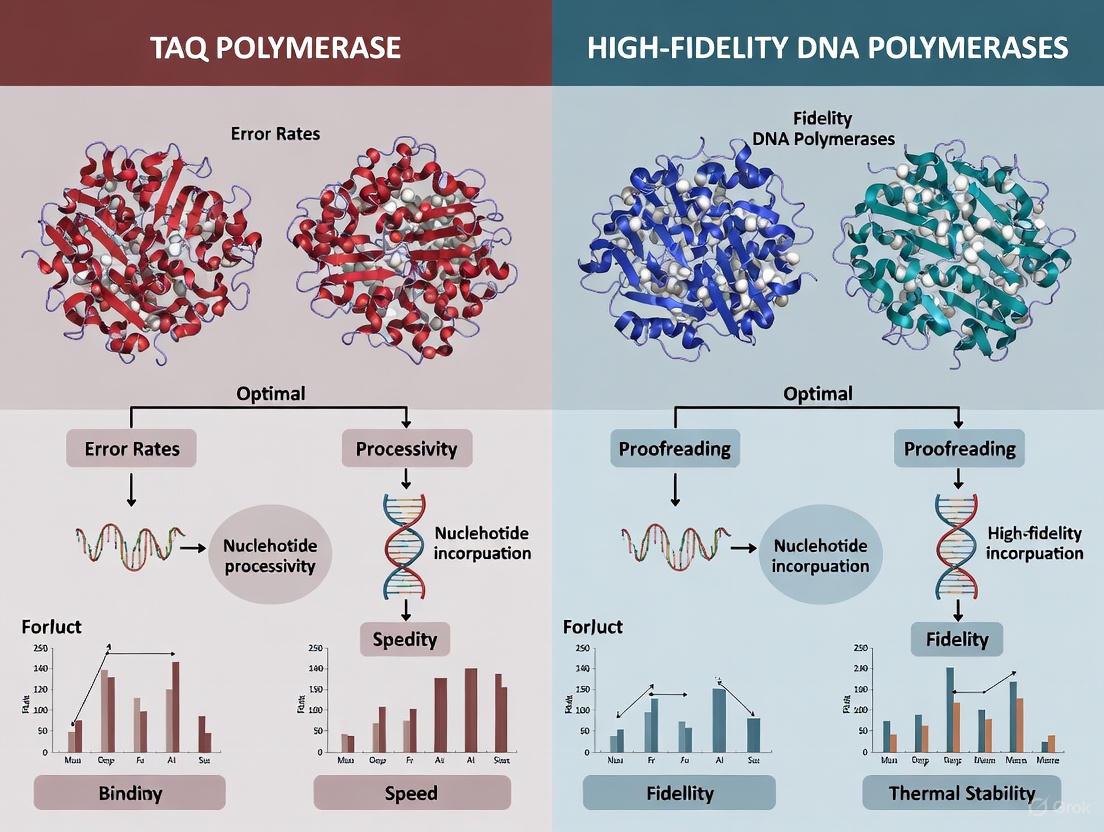
This article provides a comprehensive comparison between Taq and high-fidelity DNA polymerases, crucial for researchers and professionals in drug development.
Taq vs. High-Fidelity DNA Polymerases: A Strategic Guide for Precision in Research and Diagnostics
Abstract
This article provides a comprehensive comparison between Taq and high-fidelity DNA polymerases, crucial for researchers and professionals in drug development. We explore the foundational mechanisms of polymerase fidelity, including the critical role of 3'→5' proofreading exonuclease activity. The content details methodological applications across next-generation sequencing, molecular cloning, and diagnostics, supported by troubleshooting guidance to mitigate PCR errors. A rigorous validation section presents quantitative error rate comparisons, empowering scientists to make informed enzyme selections that ensure data integrity, optimize experimental outcomes, and enhance the reliability of biomedical research.
The Building Blocks of Fidelity: Understanding DNA Polymerase Accuracy and Error Mechanisms
DNA polymerase fidelity, defined as the accuracy with which an enzyme incorporates nucleotides during DNA replication, is a cornerstone of reliable genetic analysis and manipulation [1]. For researchers in drug development and biomedical science, selecting the appropriate polymerase is not merely a technical detail but a critical decision that directly impacts the validity of experimental results, from cloning and sequencing to the detection of genuine genetic variants [2]. The core of this selection often involves a direct comparison between the historically prevalent Taq DNA polymerase and a newer generation of high-fidelity DNA polymerases. This guide provides an objective, data-driven comparison of these enzymes, detailing their error rates, the mechanisms behind their accuracy, and the experimental protocols used to quantify their performance, thereby offering a scientific basis for informed reagent selection.
Mechanisms of DNA Polymerase Fidelity
The accuracy of DNA polymerases is governed by a multi-step process that ensures the correct nucleotide is incorporated into the growing DNA strand.
A primary differentiator between polymerases is the presence of a 3'→5' exonuclease activity, also known as proofreading. This domain provides a critical corrective function. When a mismatched nucleotide is incorporated, it causes a structural perturbation and slows polymerization. This delay allows the polymerase to backtrack, moving the nascent DNA strand into the exonuclease domain where the incorrect nucleotide is excised. The chain is then repositioned for a new attempt at correct incorporation [1] [3]. This proofreading ability is a key feature of high-fidelity enzymes but is absent in standard Taq polymerase, explaining a significant portion of their fidelity difference.
Quantitative Comparison of Polymerase Fidelity
Direct comparison of polymerase error rates reveals orders of magnitude differences in accuracy, which have profound implications for experimental outcomes.
Table 1: DNA Polymerase Error Rates and Fidelity Comparison
| DNA Polymerase | Proofreading Activity | Error Rate (errors/bp/doubling) | Fidelity Relative to Taq | Key Characteristics |
|---|---|---|---|---|
| Taq | No | 1.0 x 10⁻⁴ to 2.8 x 10⁻⁴ [1] [2] | 1x [1] | Standard for routine PCR |
| AccuPrime Taq HF | Yes | ~1.0 x 10⁻⁵ [4] | ~9x Taq [4] | Blend with proofreading enzyme |
| KOD | Yes | ~1.2 x 10⁻⁵ [1] | ~12x Taq [1] | Naturally high-fidelity |
| Pfu | Yes | ~5.1 x 10⁻⁶ [1] | ~30x Taq [1] | Archaeal, thermostable |
| Phusion | Yes | ~3.9 x 10⁻⁶ [1] | ~39x Taq [1] | Engineered high-fidelity |
| Q5 | Yes | ~5.3 x 10⁻⁷ [1] | ~280x Taq [1] | Ultra high-fidelity, engineered |
The practical consequence of these error rates is best illustrated by calculating the percentage of correct PCR products. After 30 cycles of PCR amplifying a 1 kb fragment, the probability that any given product molecule is error-free is only about 31.6% for Taq polymerase, meaning nearly 70% of molecules contain at least one error. In stark contrast, under the same conditions, ~96% of Phusion polymerase products and ~99.9% of Q5 polymerase products are error-free [1] [5].
Table 2: Impact of Polymerase Choice on Experimental Outcomes
| Experimental Context | Finding | Interpretation |
|---|---|---|
| Heteroplasmy Detection (Bumblebee COI gene) [2] | Taq polymerase generated significantly more singleton haplotypes per individual (90% were singletons) compared to Q5 polymerase. Most substitutions were A→G/T→C transitions. | Taq errors mimic true biological heteroplasmy, leading to overestimation of variation. High-fidelity polymerase (Q5) provides a more accurate profile. |
| Large-Scale Cloning (94 unique targets) [4] | Error rates for Pfu, Phusion, and Pwo were >10x lower than Taq polymerase and produced broadly similar mutation spectra dominated by transitions. | For projects involving hundreds of clones, high-fidelity polymerases drastically reduce the number of mutated sequences that require re-screening. |
Experimental Protocols for Measuring Fidelity
Several methodologies have been developed to quantify DNA polymerase fidelity, each with its own throughput, cost, and detection limit considerations.
Blue/White Colony Screening (lacZ Assay)
This method, a modification of the Barnes and Kunkel assays, uses a functional reporter gene for phenotypic screening [4] [1].
- Workflow: A portion of the lacZ gene is amplified by PCR. The products are cloned into a plasmid vector and used to transform E. coli. The transformed bacteria are plated on media containing a chromogenic substrate (X-gal).
- Mutation Detection: Colonies containing an error-free PCR insert produce functional β-galactosidase enzyme, resulting in blue colonies. Colonies with a mutation in the lacZ insert that disrupts the gene's function form white colonies.
- Advantages/Limitations: This is a high-throughput and cost-effective method. However, it only detects mutations within the specific ~349 base region of the lacZ gene that disrupts function, missing mutations in other parts of the amplicon and providing limited information on the types of errors [1].
Direct Sequencing of Cloned PCR Products
This method provides a direct and comprehensive readout of all mutations in a PCR product.
- Workflow: PCR products are cloned into a plasmid, and individual bacterial colonies are picked. The plasmid DNA from each colony is Sanger sequenced [4] [2].
- Mutation Detection: The sequenced inserts are aligned to the known, original template sequence. Any discrepancies (base substitutions, insertions, or deletions) are identified as polymerase errors.
- Advantages/Limitations: This method captures all types of mutations across the entire sequenced region, providing detailed mutational spectra. Its main limitations are lower throughput and higher cost relative to colony screening, especially for very high-fidelity polymerases where many clones must be sequenced to find a single error [4] [1].
Next-Generation Sequencing (NGS)
NGS approaches push the limits of fidelity measurement by generating massive datasets for statistical power.
- Workflow: PCR products are prepared for NGS, often using platforms like Illumina or PacBio. For Illumina, molecular barcoding is used to distinguish true PCR errors from sequencing errors [1].
- Mutation Detection: Millions of sequencing reads are aligned to the reference template. A consensus-building algorithm identifies mutations that are present in the PCR product.
Advantages/Limitations: NGS provides extremely deep sequencing, allowing for statistically robust measurement of very low error rates. The PacBio SMRT sequencing platform offers a key advantage: it can sequence individual PCR molecules repeatedly to generate a highly accurate consensus without a cloning step, achieving a background error rate as low as 9.6 x 10⁻⁸,
making it suitable for quantifying the highest-fidelity polymerases [1].
The Scientist's Toolkit: Essential Research Reagents
Successful and accurate PCR requires a suite of optimized reagents. The following table details key components for fidelity-critical experiments.
Table 3: Essential Reagents for High-Fidelity PCR
| Reagent / Solution | Function / Rationale | Considerations for Fidelity |
|---|---|---|
| High-Fidelity DNA Polymerase | Engineered enzyme with high intrinsic accuracy and 3'→5' proofreading exonuclease activity. | Core determinant of error rate. Examples: Q5, Phusion, Pfu [1] [3]. |
| Optimized Reaction Buffer | Provides optimal pH, ionic strength, and co-factors (e.g., Mg²⁺) for polymerase activity. | Mg²⁺ concentration can significantly influence fidelity; vendor-recommended buffers should be used [4]. |
| Balanced dNTP Mix | Equimolar solution of dATP, dGTP, dCTP, and dTTP serves as nucleotide substrates. | Imbalanced dNTP pools can increase error rates by promoting misincorporation [6]. |
| Hot-Start Enzyme Formulation | Polymerase is inactivated at room temperature (e.g., by antibody binding), preventing non-specific priming before PCR begins. | Reduces nonspecific amplification and primer-dimer formation, improving yield and specificity without directly altering fidelity [3]. |
| Template DNA | The DNA sequence to be amplified. | High-quality, intact template minimizes background errors. The amount used is kept low to maximize the number of amplification doublings for accurate fidelity assessment [4]. |
The choice between Taq and high-fidelity DNA polymerases is a fundamental one with a clear scientific basis. Data from multiple, robust assay systems consistently shows that high-fidelity enzymes like Q5, Phusion, and Pfu can reduce error rates by 10-fold to over 200-fold compared to Taq polymerase [4] [1]. This translates directly to a higher yield of correct clones, more reliable sequencing results, and reduced false positives in variant detection. While Taq polymerase remains suitable for routine applications like genotyping, the use of high-fidelity polymerases is indispensable for cloning, synthetic biology, and any research where sequence integrity is paramount. As new methods like PacBio SMRT sequencing push the boundaries of measurement [6], and engineered enzymes continue to improve [7], the standard for PCR accuracy will only rise, further enabling precision in genetic research and drug development.
In the realm of molecular biology, the fidelity of DNA replication is paramount. This article objectively compares the error rates of standard Taq DNA polymerase, which lacks proofreading activity, with various high-fidelity DNA polymerases that possess 3'→5' exonuclease activity. Supported by experimental data, we demonstrate that proofreading-capable polymerases can reduce error rates by up to 280-fold, a critical advantage for applications ranging from cloning to next-generation sequencing and sensitive diagnostic assays. The underlying mechanisms, practical implications for experimental outcomes, and specific reagent solutions are detailed to guide researchers in selecting the optimal polymerase for their specific fidelity requirements.
The discovery of the polymerase chain reaction (PCR) revolutionized molecular biology, but early applications were hampered by high error rates during DNA amplification. The inherent fidelity of a DNA polymerase—its accuracy in copying a DNA template—varies dramatically between enzymes and is primarily determined by the presence or absence of a proofreading function. Proofreading activity refers to the 3'→5' exonuclease activity intrinsic to many DNA polymerases, which serves as a first line of defense in correcting polymerase errors and maintaining genetic stability [8] [9]. For researchers in drug development and basic research, the choice between standard Taq polymerase and high-fidelity alternatives has profound implications for experimental success, particularly in cloning, mutant detection, and next-generation sequencing applications where even single-nucleotide errors can compromise results.
Molecular Mechanisms: How Proofreading Activity Corrects Errors
The Proofreading Process
DNA polymerases ensure accurate replication through a multi-step process of molecular checkpoints. The geometry of the polymerase active site selectively favors correct Watson-Crick base pairs, slowing incorporation of mismatched nucleotides. For polymerases with proofreading capability, an additional correction step occurs: when a mismatch is incorporated, the DNA is transferred from the polymerase's polymerization domain to its N-terminal 3'→5' exonuclease domain. Here, the incorrectly incorporated nucleotide is excised, after which the DNA returns to the polymerization domain to continue synthesis with the correct nucleotide [9] [10]. This proofreading mechanism reduces the error rate of DNA replication by approximately 100- to 1000-fold, providing essential genomic stability [11].
Visualizing the Proofreading Mechanism
Quantitative Comparison of DNA Polymerase Fidelity
Experimental Approaches for Measuring Fidelity
Polymerase fidelity has been measured using various methodologies, each with strengths and limitations. Early approaches utilized phenotypic selection systems such as the lacZα gene assay in M13 bacteriophage, where errors during DNA synthesis result in bacterial colony color changes [10]. While high-throughput, these methods could not resolve all single-base errors. More recent approaches employ direct sequencing of cloned PCR products, with next-generation sequencing platforms like PacBio SMRT sequencing providing vast datasets (millions to billions of nucleotides) to achieve statistical significance in error rate quantification [4] [10]. The SMRT sequencing approach has demonstrated a background error rate of 9.6 × 10⁻⁸ errors/base, making it sufficiently sensitive to quantify the fidelity of proofreading polymerases [10].
Comparative Error Rates of Common DNA Polymerases
Direct comparisons of DNA polymerases under standardized conditions reveal substantial differences in fidelity. Research sequencing over 98 million nucleotides demonstrated that proofreading polymerases consistently outperform non-proofreading enzymes.
Table 1: Error Rates and Fidelity of Common DNA Polymerases [10]
| DNA Polymerase | Proofreading Activity | Substitution Rate (errors/base/doubling) | Accuracy (bases per error) | Fidelity Relative to Taq |
|---|---|---|---|---|
| Taq | No | 1.5 × 10⁻⁴ | 6,456 | 1× |
| Deep Vent (exo-) | No | 5.0 × 10⁻⁴ | 2,020 | 0.3× |
| KOD | Yes | 1.2 × 10⁻⁵ | 82,303 | 12× |
| Pfu | Yes | 5.1 × 10⁻⁶ | 195,275 | 30× |
| Phusion | Yes | 3.9 × 10⁻⁶ | 255,118 | 39× |
| Deep Vent | Yes | 4.0 × 10⁻⁶ | 251,129 | 44× |
| Q5 | Yes | 5.3 × 10⁻⁷ | 1,870,763 | 280× |
Additional studies using direct sequencing of cloned PCR products from 94 unique DNA targets confirmed these trends, finding error rates for Pfu, Phusion, and Pwo polymerases to be more than 10-fold lower than that observed with Taq polymerase [4]. The same study reported that Taq polymerase exhibited error rates of 3.0-5.6 × 10⁻⁵, while proofreading enzymes showed significantly improved fidelity [4].
Mutation Spectra of Proofreading vs. Non-Proofreading Polymerases
Beyond the error rate frequency, the types of mutations generated differ between polymerase classes. Non-proofreading polymerases like Taq tend to produce a broader spectrum of errors, including transitions, transversions, and frameshift mutations. In contrast, high-fidelity enzymes with 3'→5' exonuclease activity predominantly generate transition mutations, with little bias observed for the type of transition [4]. This difference in error specificity may influence experimental outcomes in sequence-dependent applications.
Experimental Evidence: Case Studies in Diagnostic Applications
Enhanced Sensitivity in Mutation Detection Assays
The fidelity advantage of proofreading polymerases translates directly to improved performance in diagnostic applications. A compelling example comes from PNA clamp PCR, a technique used to detect tumor-specific point mutations in the presence of a large excess of wild-type DNA. Researchers demonstrated that the sensitivity of this assay was limited by errors introduced by Taq DNA polymerase in the PNA-binding site, which were subsequently amplified during PCR [12].
When the researchers developed a PNA clamp PCR assay using the high-fidelity Phusion DNA polymerase, sensitivity improved approximately 10-fold. The assay could significantly detect mutant DNA diluted 20,000-fold in wild-type DNA, compared to only 2,000-fold dilution when Taq polymerase was used [12]. This enhancement highlights how polymerase errors can limit assay sensitivity when detecting rare mutations, and how high-fidelity enzymes overcome this limitation.
Table 2: Polymerase Performance in PNA Clamp PCR Detection of K-ras Mutations [12]
| Parameter | Taq DNA Polymerase | High-Fidelity DNA Polymerase (Phusion) |
|---|---|---|
| Detection Limit | 1 mutant in 2,000 wild-type copies | 1 mutant in 20,000 wild-type copies |
| Statistical Significance (P-value) | P = 0.039 | P = 0.025 |
| Replication Errors in PNA-binding Site | Frequent | Greatly Reduced |
| Suitable for Rare Mutation Detection | Limited | Highly Suitable |
Novel PCR Methods Leveraging Proofreading Activity
Innovative PCR methodologies have been developed specifically to leverage the unique properties of high-fidelity DNA polymerases. Researchers created a novel quantitative PCR method mediated by high-fidelity DNA polymerase that utilizes an HFman probe and only one primer [13]. This system takes advantage of the 3'→5' hydrolysis activity of high-fidelity DNA polymerases, which can remove fluorescently labeled bases from the 3' end of probes, generating detectable signals [13].
This method demonstrates better adaptability to sequence-variable templates than conventional TaqMan probe-based qPCR, particularly beneficial for quantifying highly variable viruses like HIV-1. The method showed a good correlation coefficient (R² = 0.79) with the COBAS TaqMan HIV-1 Test in clinical samples, while offering greater tolerance for primer/probe-template mismatches [13].
Research Reagent Solutions: Essential Materials for High-Fidelity PCR
Successful implementation of high-fidelity PCR requires specific reagents and conditions optimized for proofreading polymerases.
Table 3: Essential Research Reagents for High-Fidelity PCR Experiments
| Reagent | Function | Considerations |
|---|---|---|
| High-Fidelity DNA Polymerase (Q5, Phusion, Pfu) | DNA amplification with proofreading | Select based on error rate, processivity, and application requirements |
| Phosphorothioate-modified Primers | Block exonuclease degradation of primers | 2-3 phosphorothioate bonds at 3' end inhibit 3'→5' exonuclease activity [9] |
| MgCl₂ Optimization | Cofactor for polymerase activity | Concentration affects fidelity; typically 1-3 mM, varies by polymerase [13] |
| Balanced dNTP Mix | Nucleotide substrates | Imbalances can increase error rates; use validated concentrations |
| HF Buffer Systems | Optimal reaction conditions | Specific to each polymerase; affects processivity and fidelity |
| Template DNA | PCR substrate | Quality and quantity impact amplification efficiency and fidelity |
Experimental Protocols for Fidelity Assessment
Direct Sequencing Approach for Error Rate Determination
Principle: This protocol determines polymerase fidelity by directly sequencing cloned PCR products, allowing interrogation of error rates across diverse DNA sequences [4] [10].
Procedure:
- Template Preparation: Select a diverse set of plasmid templates (e.g., 94 unique targets with varying GC content and length) [4].
- PCR Amplification: Perform PCR with test polymerases using minimal template (e.g., 25 pg/reaction) to maximize doublings. Use 30 amplification cycles with vendor-recommended buffers [4].
- Cloning and Sequencing: Clone purified PCR products into a suitable vector system. Sequence individual clones using Sanger or next-generation sequencing.
- Data Analysis: Calculate error rates by dividing total mutations observed by total bases sequenced. Account for the number of template doublings using the formula: Error rate = (number of mutations observed) / (total bp sequenced × number of doublings) [4].
Applications: This method provides comprehensive mutation spectra and accurate error rates, especially when using high-throughput sequencing platforms [10].
PNA Clamp PCR Sensitivity Assessment
Principle: This protocol compares polymerase performance in detecting rare mutations against a background of wild-type DNA [12].
Procedure:
- Sample Preparation: Create dilution series of mutant DNA (e.g., from LS174T cell line with K-ras mutation) in wild-type DNA, spanning 1:100 to 1:100,000 ratios [12].
- PNA Clamp PCR: Set up reactions with wild-type-specific PNA oligomers to suppress amplification of wild-type alleles. Use identical primer sets and reaction conditions with different test polymerases.
- Quantification: Perform real-time PCR monitoring. Compute ΔCt = Ct(+PNA) - Ct(-PNA) for each sample to correct for varying template amount and quality [12].
- Statistical Analysis: Compare detection limits and statistical significance using t-tests with the ΔCt values [12].
Applications: This method directly evaluates polymerase performance in diagnostic applications requiring high sensitivity for mutation detection.
The presence of 3'→5' exonuclease proofreading activity in high-fidelity DNA polymerases provides a substantial advantage over standard Taq polymerase, reducing error rates by up to 280-fold. This fidelity enhancement translates directly to improved outcomes in molecular applications ranging from basic cloning to sophisticated diagnostic assays. The selection of an appropriate polymerase should be guided by the specific fidelity requirements of each application, with proofreading enzymes offering essential benefits for projects where sequence accuracy is critical. As PCR methodologies continue to evolve, particularly in diagnostics and next-generation sequencing, the proofreading advantage remains a fundamental consideration for researchers and drug development professionals seeking reliable, reproducible molecular results.
The faithful replication of genetic material is a cornerstone of life, and DNA polymerases are the central enzymes responsible for this precise task. These enzymes must select the correct deoxynucleoside triphosphate (dNTP) from a pool of structurally similar molecules, maintaining the Watson-Crick base-pairing rules with an accuracy that can approach one error per billion nucleotides incorporated [14] [15]. This remarkable fidelity is not uniform across all DNA polymerases; significant differences exist, most notably between standard polymerases like Taq DNA polymerase and modern high-fidelity DNA polymerases such as Q5 or Phusion. The mechanisms underlying this discrimination are rooted in two fundamental principles: geometric selection based on molecular shape and fit, and kinetic selection governed by the rates of conformational changes and chemical catalysis [16] [15]. Understanding these mechanisms is critical for researchers and drug development professionals who rely on precise DNA manipulation for applications ranging from molecular cloning and next-generation sequencing to diagnostic assay development. This guide provides a comparative analysis of Taq and high-fidelity DNA polymerases, focusing on the structural and kinetic bases for their differing accuracies, supported by experimental data and detailed methodologies.
Structural Basis for Fidelity: Geometric Selection in the Active Site
The Universal "Right-Hand" Architecture and Induced Fit
DNA polymerases share a common architectural motif, resembling a right hand with "palm," "fingers," and "thumb" subdomains [17]. The palm domain contains the catalytic core, while the fingers and thumb are crucial for DNA binding and processivity. A critical mechanism for fidelity is an induced-fit process. Upon binding a correct dNTP, the enzyme undergoes a large-scale conformational change from an "open" to a "closed" state [14]. This transition precisely positions the incoming nucleotide, the template base, and the catalytic residues for efficient chemistry. The closed state allows the polymerase to "check" the geometry of the nascent base pair within a tight steric pocket. A correct Watson-Crick pair has an optimal shape that fits this pocket, while incorrect pairs exhibit distortions that are sterically excluded [16] [15].
Comparative Structural Analysis of Correct vs. Incorrect Nucleotide Incorporation
Structural studies of polymerases bound to mismatched nucleotides reveal how fidelity is compromised. In some high-fidelity polymerases, a mismatched nucleotide can induce an intermediate "ajar" conformation [18]. In this state, the template base is displaced, misaligning the incorrect nucleotide relative to the primer terminus and preventing efficient catalysis. Studies of DNA polymerase β with mismatches under low-fidelity conditions (using Mn2+) show that the enzyme can still adopt a closed conformation, but to accommodate the mismatch, the template strand shifts significantly, pulling the coding base away from the active site. This repositions the primer terminus away from the incoming nucleotide, thereby deterring misincorporation [19]. This suggests that while low-fidelity enzymes may still undergo structural transitions with incorrect nucleotides, the resulting active site geometry is non-productive.
Table 1: Structural Features Governing Fidelity in DNA Polymerases
| Structural Element | Role in Fidelity | Manifestation in Taq Polymerase | Manifestation in High-Fidelity Polymerases (e.g., Q5, Phusion) |
|---|---|---|---|
| Geometric Selection Pocket | Checks steric and hydrogen-bonding compatibility of the nascent base pair. | Standard selectivity pocket present. | Often a more constrained active site, enhancing discrimination against mismatches. |
| Conformational Change (Open to Closed) | Commits the enzyme to catalysis only after correct nucleotide binding. | Undergoes conformational transition. | The transition may be more stringent, with higher energy barriers for incorrect nucleotides. |
| O Helix & Active Site Residues | Position the nucleotide and catalytic metals; kinks can signal mismatches. | Standard architecture. | May have residues that are more sensitive to geometric distortions, leading to the "ajar" state [18]. |
| Proofreading Domain (3'→5' Exonuclease) | Excises misincorporated nucleotides after insertion. | Absent in Taq polymerase. | Present in many high-fidelity polymerases (e.g., Q5, Phusion, T4). |
The following diagram illustrates the key conformational states a high-fidelity polymerase undergoes during nucleotide selection, highlighting the pathway that leads to the rejection of incorrect nucleotides.
Diagram 1: Nucleotide selection pathway in high-fidelity DNA polymerases. The "ajar" intermediate acts as a kinetic checkpoint against incorrect nucleotides.
Kinetic and Thermodynamic Principles of Fidelity
The Kinetic Mechanism of Nucleotide Incorporation
The incorporation of a nucleotide is a multi-step process that can be described by the following kinetic scheme [14]: E • DNA_n_ + dNTP ⇌ E • DNA_n_ • dNTP (collision complex) → E' • DNA_n_ • dNTP (closed complex) → E • DNA_n+1_ + PP_i_ Where E represents the enzyme. The specificity constant, k~cat~/K~m~, defines the enzyme's efficiency and selectivity for a particular substrate. For correct nucleotides, the initial collision complex (governed by dissociation constant K~d~) is rapidly converted to a tightly bound closed complex through a conformational change. The chemical step of bond formation is typically fast. The key to specificity lies in the differential rates of the forward and reverse steps for correct versus incorrect nucleotides [14].
Kinetic Partitioning: Correct vs. Incorrect Nucleotides
For a correct nucleotide, the conformational change is fast and efficiently leads to chemistry. Once the closed complex forms, the nucleotide is effectively "committed" to incorporation because the rate of the reverse conformational step (k~-2~) is much slower than the chemical step (k~3~). This results in a high specificity constant [14].
For an incorrect nucleotide, the story is different. The misaligned geometry leads to a much slower rate for the forward conformational change and/or the chemical step. Furthermore, the reverse reaction (the "opening" of the enzyme and release of the incorrect nucleotide, k~-2~) becomes significantly faster than the chemical step. This kinetic partitioning favors the release of the incorrect nucleotide before it can be incorporated, leading to a low specificity constant and high fidelity [14]. The induced-fit mechanism thus serves as a kinetic proofreading step, where the free energy of binding is used to drive a conformational change that tests the correctness of the substrate.
Table 2: Kinetic Parameters for Nucleotide Incorporation by High-Fidelity T7 DNA Polymerase
| Parameter | Description | Value for Correct Nucleotide | Value for Incorrect Nucleotide | Implication for Fidelity |
|---|---|---|---|---|
| K~d,app~ | Apparent dissociation constant for dNTP binding. | ~28 µM [14] | Significantly higher | Correct nucleotides bind more readily. |
| k~pol~ | Maximum rate of nucleotide incorporation. | ~300 s⁻¹ [14] | Drastically slower | Correct nucleotides are incorporated rapidly. |
| k~cat~/K~m~ | Specificity constant (efficiency). | ~24 µM⁻¹s⁻¹ [14] | Many orders of magnitude lower | The enzyme is highly efficient only with correct dNTPs. |
| Rate-Limiting Step | The slowest step in the incorporation pathway. | Conformational change & chemistry are well-tuned [14] | Chemistry is slow relative to nucleotide release | Incorrect nucleotides are released before incorporation. |
Experimental Analysis of Polymerase Fidelity
Key Methodologies and Protocols
Understanding the kinetic and structural principles of polymerase fidelity requires robust experimental methods. The following are key protocols used in the field:
Rapid Chemical Quench-Flow Kinetics: This is the gold standard for measuring pre-steady-state kinetic parameters like k~pol~ and K~d,app~.
- Protocol: A solution of enzyme-DNA complex is rapidly mixed with a solution containing dNTPs and Mg2+ in a reaction chamber. After a precisely controlled time (milliseconds to seconds), the reaction is quenched by injecting a strong acid (e.g., HCl) or EDTA. The quenched samples are then analyzed, typically by denaturing polyacrylamide gel electrophoresis, to quantify the amount of extended DNA primer. By repeating this at various time points and dNTP concentrations, the individual rate constants for binding, conformational change, and chemistry can be resolved [14].
Fluorescence-Based Stopped-Flow Kinetics: This method allows real-time observation of conformational changes.
- Protocol: A fluorophore (e.g., attached to the fingers subdomain of the polymerase or using the intrinsic fluorescence of a base analog like 2-aminopurine in the DNA template) is used as a reporter. The enzyme-DNA complex and dNTP/Mg2+ solutions are rapidly mixed, and the fluorescence change is monitored. A rapid fluorescence change often reports on the protein conformational change (open to closed), while a subsequent slower phase may report on the chemical step. This allows direct measurement of the rates of conformational dynamics [14].
X-ray Crystallography of Ternary Complexes: This provides atomic-level snapshots of the polymerase at work.
- Protocol: Crystals of the polymerase bound to a DNA primer-template duplex are grown. These binary complex crystals are then soaked in a solution containing an incoming dNTP (or a non-hydrolysable analog like dAMPCPP) and catalytic metal ions (Mg2+ or Mn2+). Mn2+ is sometimes used to facilitate the binding of incorrect nucleotides for structural studies [19]. The diffraction data collected from these crystals are used to solve the three-dimensional structure, revealing the precise geometry of the active site with correct or incorrect nucleotides [18] [19].
A Representative Experimental Workflow
The diagram below outlines a typical integrated workflow for studying polymerase fidelity, combining kinetic and structural approaches.
Diagram 2: Integrated experimental workflow for studying polymerase fidelity.
Comparative Performance: Taq vs. High-Fidelity Polymerases
Quantitative Fidelity and Functional Comparisons
The structural and kinetic principles directly translate into measurable performance differences between polymerase families. The benchmark for fidelity is often the error rate, expressed as the number of errors per base pair synthesized.
Table 3: Functional Comparison of Taq and High-Fidelity DNA Polymerases
| Characteristic | Taq DNA Polymerase | High-Fidelity DNA Polymerase (e.g., Q5, Phusion) |
|---|---|---|
| Fidelity (Error Rate) | ~1 error per 2.4x10⁴ to 6x10³ bases (∼1X Taq) [16] [20] | Q5: 280X Taq; Phusion: 39-50X Taq [16] [20] |
| 3'→5' Exonuclease (Proofreading) | No [16] [20] | Yes [16] [20] |
| Primary Fidelity Mechanism | Geometric selection only (pre-insertion) [15] | Geometric selection + kinetic proofreading (post-insertion) [16] |
| Processivity (nucleotides/binding event) | ~50 nucleotides [16] | Often higher, especially in engineered chimeric enzymes [16] |
| Typical Applications | Routine PCR, genotyping, quick checks. | Next-generation sequencing, molecular cloning, mutagenesis, gene synthesis, diagnostics [21] [20] |
The Critical Role of Proofreading
The presence of a 3'→5' exonuclease (proofreading) activity is a major differentiator. After a misincorporation event, a high-fidelity polymerase can sense the distortion in the DNA and transfer the primer strand from the polymerase active site to the exonuclease active site. The incorrect nucleotide is excised, and the corrected primer is then transferred back for continued synthesis [16]. This post-insertion editing provides a second, powerful checkpoint that can improve overall fidelity by 10 to 100-fold. Taq polymerase's lack of this activity means that once an error is made, it is permanently fixed in the DNA product.
The Scientist's Toolkit: Essential Reagents for Fidelity Research
Table 4: Key Research Reagent Solutions for Polymerase Fidelity Studies
| Reagent / Material | Function / Description | Example Use in Fidelity Research |
|---|---|---|
| High-Fidelity Polymerase (e.g., Q5, Phusion) | Engineered enzyme with high accuracy and proofreading activity. | The subject of study or a tool for generating high-quality DNA for downstream applications like cloning [20]. |
| Taq DNA Polymerase | A standard polymerase without proofreading activity. | Used as a comparator to illustrate the impact of proofreading and differences in intrinsic geometric selection [22] [16]. |
| Non-Hydrolysable dNTP Analogs (dAMPCPP, dUMPNPP) | dNTP analogs where a bridging oxygen is replaced, preventing the chemical step. | Essential for trapping and solving crystal structures of ternary complexes (polymerase-DNA-dNTP) [18] [19]. |
| Divalent Metal Ions (Mg²⁺, Mn²⁺) | Catalytic cofactors. Mg²⁺ is physiological. Mn²⁺ often decreases fidelity. | Used to modulate fidelity in experiments; Mn²⁺ can be used to promote misincorporation for structural studies of mismatches [19]. |
| Fluorescent Dyes & Quenchers | Report on conformational changes (e.g., via FRET). | Incorporated into primers, templates, or the polymerase itself to monitor open/closed transitions in stopped-flow kinetics [22] [14]. |
| Rapid Quench-Flow Instrument | Apparatus for mixing and quenching reactions on millisecond timescales. | Critical for obtaining pre-steady-state kinetic parameters (k~pol~, K~d~) that define nucleotide selection efficiency [14]. |
The mechanisms of nucleotide selection by DNA polymerases represent a sophisticated interplay of structural geometry and reaction kinetics. Taq DNA polymerase relies primarily on a single checkpoint—geometric selection in the active site—to achieve good, but not exceptional, fidelity. In contrast, high-fidelity DNA polymerases employ a multi-layered strategy: enhanced geometric discrimination, optimized kinetic partitioning that favors the release of incorrect nucleotides, and a powerful proofreading function to excise errors that escape the first two barriers. For researchers in drug development and biotechnology, this comparison is not merely academic. The choice of polymerase directly impacts the reliability of results in critical applications like NGS-based variant detection, the construction of accurate plasmid vectors for protein expression, and the development of sensitive diagnostic assays. Understanding these underlying principles empowers scientists to select the right enzyme for their fidelity needs and to correctly interpret the experimental data they generate.
In polymerase chain reaction (PCR) and various molecular biology applications, the fidelity of a DNA polymerase—defined as its ability to accurately replicate a DNA template without introducing errors—is a critical performance characteristic. The replication error rate, often quantified as errors per base per duplication, can vary by orders of magnitude between different enzymes [3]. These differences carry significant implications for applications ranging from basic cloning to sensitive diagnostic assays and emerging technologies like DNA-based digital information storage [7]. This guide provides a systematic comparison of fidelity characteristics between traditional polymerases like Taq and modern high-fidelity alternatives, summarizing quantitative error data, elucidating measurement methodologies, and presenting the distinct error profiles that define each enzyme type.
DNA Polymerase Fidelity: A Quantitative Comparison
The fidelity of DNA polymerases is primarily determined by their intrinsic proofreading capability, which is mediated by a 3'→5' exonuclease activity that can remove misincorporated nucleotides [3]. Polymerases lacking this activity, such as Taq, typically exhibit significantly higher error rates.
Table 1: Error Rates of Common DNA Polymerases
| Polymerase | Proofreading Activity | Error Rate (errors/bp/duplication) | Fidelity Relative to Taq | Primary Applications |
|---|---|---|---|---|
| Taq | No | 1.3 × 10⁻⁴ to 2.0 × 10⁻⁴ [23] [2] | 1x [23] | Routine PCR, genotype screening [23] |
| OneTaq | Yes (Medium) | Not Reported | 2x [23] | Routine PCR, colony PCR [23] |
| Pfu | Yes | ~1.0 × 10⁻⁶ [4] | ~10x [4] [3] | High-fidelity PCR, cloning |
| Phusion | Yes | ~4.0 × 10⁻⁷ to 9.5 × 10⁻⁷ [4] [23] | 39-50x [23] | High-fidelity PCR, cloning [23] |
| Q5 | Yes | 5.3 × 10⁻⁷ [2] | 280x [23] | High-fidelity PCR, cloning, SNP analysis [23] |
| 9°N | Yes | Manages substitution errors effectively [7] | Not Reported | DNA-based digital information storage [7] |
Table 2: Observed Mutation Spectra of Select Polymerases
| Polymerase | Predominant Mutation Type | Example from Experimental Data |
|---|---|---|
| Taq | A→G / T→C transitions | 61.4% of errors in a COI gene amplification study [2] |
| High-Fidelity Enzymes (Pfu, Phusion, Pwo) | Predominantly transitions, with little bias for type [4] | Broadly similar mutation types among high-fidelity enzymes [4] |
| Encyclo, SD-HS, KTN | A→G / T→C transitions | Dominant pattern in linear amplification [24] |
| Kapa HF, SNP-detect, TruSeq | C→T / G→A transitions | Dominant pattern in linear amplification [24] |
Methodologies for Measuring polymerase fidelity
Established Experimental Protocols
Accurately quantifying polymerase error rates requires sensitive methods capable of detecting very rare mutations. Several established protocols are used:
Cloning and Sequencing: This traditional method involves cloning PCR products into a plasmid vector, transforming bacteria, and Sanger sequencing individual clones to identify mutations. The error rate is calculated from the number of mutations, total bases sequenced, and number of template doublings [4] [2]. While considered a direct approach, its scalability is limited as sequencing a large number of clones is laborious and costly [4] [24].
Reporter Gene Assays (e.g., lacZ): These assays use a PCR-amplified fragment of a reporter gene (like lacZ), which is then cloned. Functional loss of the reporter gene, detectable via colorimetric screening (e.g., blue/white colony screening), indicates a mutation. The mutated genes are subsequently sequenced to determine the nature of the error [3]. A limitation is that only mutations within a specific, short region of the gene lead to a detectable color change [4].
High-Throughput Sequencing with Unique Molecular Identifiers (UMIs): This modern, highly sensitive method involves tagging individual template DNA molecules with a random nucleotide sequence (UMI) before amplification. After PCR and sequencing, reads sharing the same UMI are grouped, and a consensus sequence is built for each original molecule. This powerful approach corrects for errors introduced in later amplification rounds and by sequencing itself, allowing for precise attribution of errors to the first PCR step [24].
Emerging and Innovative Methods
The field continues to advance with new methodologies offering deeper insights:
Long-Read Sequencing without PCR Amplification: Recent work has utilized Pacific Biosciences (PacBio) long-read sequencing on products synthesized without prior PCR amplification. This approach avoids biases introduced by PCR and allows for direct measurement of error rates and detailed mapping of enzyme-specific error profiles across different DNA polymerase families (A, B, C, and D) [6].
Comparative Application Studies: Some studies measure fidelity indirectly but practically by comparing the performance of different polymerases in specific applications. For example, one study amplified a mitochondrial COI gene and observed that Taq polymerase generated a significant number of singleton haplotypes (likely PCR errors) compared to the high-fidelity Q5 polymerase, which could lead to overestimation of heteroplasmy in genetic studies [2].
Visualizing Workflows and Error Profiles
UMI-Based Fidelity Assay Workflow
The following diagram illustrates the sophisticated UMI-based method for quantifying PCR errors, which combines unique molecular barcoding with high-throughput sequencing to achieve exceptional resolution [24].
Polymerase Substitution Error Profiles
Different DNA polymerases exhibit distinct preferences for the types of nucleotide substitutions they introduce. The following chart summarizes the dominant error profiles for several polymerases as revealed by linear amplification studies [24].
The Scientist's Toolkit: Key Research Reagents
Table 3: Essential Reagents for DNA Polymerase Fidelity Research
| Reagent | Function in Experiment | Example Use Case |
|---|---|---|
| High-Fidelity DNA Polymerase | Enzymes with 3'→5' exonuclease (proofreading) activity for high-accuracy amplification. | Q5, Phusion, and Pfu polymerases used as high-fidelity benchmarks [4] [23] [2]. |
| Non-Proofreading DNA Polymerase | Enzymes without proofreading activity, serving as a low-fidelity control. | Taq polymerase is the standard for baseline fidelity comparison [4] [2]. |
| Plasmid Vector with Reporter Gene | Serves as a clonable substrate for detecting mutations via phenotypic screening. | The lacZ gene system allows for blue/white colony screening of functional loss [3]. |
| Unique Molecular Identifiers (UMIs) | Random nucleotide tags for tracking individual molecules through amplification steps. | Used in NGS-based fidelity assays to distinguish PCR errors from sequencing errors [24]. |
| Competent E. coli Cells | For transforming plasmid DNA containing cloned PCR products. | Essential for the cloning and sequencing and lacZ reporter gene assay methods [4] [2]. |
Precision in Practice: Strategic Application of Taq and High-Fidelity Enzymes Across Workflows
The pursuit of genomic accuracy is a cornerstone of reliable next-generation sequencing (NGS). The choice of DNA polymerase in the library amplification step is not a mere technical detail but a critical determinant of data integrity. This guide delves into the experimental evidence demonstrating why high-fidelity polymerases, with their superior error-correcting capabilities, are indispensable for NGS library preparation, especially for applications requiring the highest sensitivity, such as liquid biopsy and rare variant detection.
The Fundamentals of Polymerase Fidelity
Fidelity refers to the accuracy with which a DNA polymerase copies a template strand, defined as the error rate per base synthesized [25]. In practical terms, fidelity is often expressed relative to Taq DNA polymerase. For example, Q5 High-Fidelity DNA Polymerase has a fidelity 280 times greater than that of Taq polymerase [26] [25].
The primary mechanism behind high fidelity is the 3´→5´ exonuclease (proofreading) activity. Polymerases lacking this activity, like standard Taq, cannot correct misincorporated nucleotides. In contrast, proofreading polymerases can detect an incorrect base, pause synthesis, and excise the mistake before continuing, drastically reducing error rates [25]. The following diagram illustrates this critical proofreading function.
Quantitative Fidelity: Taq vs. High-Fidelity Polymerases
Experimental data from multiple studies provides a clear, quantitative comparison of error rates across various polymerases. The following table summarizes fidelity measurements obtained via PacBio Single-Molecule Real-Time (SMRT) sequencing, a method with an exceptionally low background error rate (~9.6 × 10⁻⁸), making it ideal for quantifying the performance of ultra-high-fidelity enzymes [25].
Table 1: DNA Polymerase Fidelity Measurements via SMRT Sequencing
| DNA Polymerase | Substitution Rate (Errors/Base/Doubling) | Accuracy (Bases per 1 Error) | Fidelity Relative to Taq |
|---|---|---|---|
| Taq | 1.5 × 10⁻⁴ | 6,456 | 1X |
| Deep Vent (exo-) | 5.0 × 10⁻⁴ | 2,020 | 0.3X |
| Kapa HiFi HotStart | 1.6 × 10⁻⁵ | 63,323 | 9.4X |
| KOD | 1.2 × 10⁻⁵ | 82,303 | 12X |
| PrimeSTAR GXL | 8.4 × 10⁻⁶ | 118,467 | 18X |
| Pfu | 5.1 × 10⁻⁶ | 195,276 | 30X |
| Phusion | 3.9 × 10⁻⁶ | 255,119 | 39X |
| Deep Vent | 4.0 × 10⁻ ⁻⁶ | 251,129 | 44X |
| Q5 High-Fidelity | 5.3 × 10⁻⁷ | 1,870,763 | 280X |
Data compiled from [25].
The data shows that proofreading polymerases like Q5 and Phusion reduce errors by one to three orders of magnitude compared to Taq. The absence of proofreading activity, as seen with Deep Vent (exo-), results in an error rate even higher than Taq.
Experimental Evidence: Impact on NGS Error Rates and Sensitivity
Barcoded NGS and Error Correction
While molecular barcoding (Unique Molecular Identifiers, UMIs) is a powerful technique for error correction, the polymerase used in the initial barcoding step still significantly impacts final sensitivity. A 2019 study evaluated this by using five polymerases of varying fidelities in the initial 3-cycle barcoding PCR of the SimSenSeq protocol [27].
- Key Finding: After barcode correction, error rates progressively dropped as polymerase fidelity increased. The highest-fidelity polymerases, Phusion and Platinum SuperFi, yielded significantly lower consensus error rates than the lower-fidelity enzymes [27].
- Implication: Although barcoding itself has the largest impact on error reduction, using a high-fidelity polymerase in this step provides an additional layer of error suppression, enabling more confident detection of low-frequency variants.
Sensitivity for Low-Frequency Variant Detection
The same study demonstrated the practical consequence of this error suppression on detection sensitivity. Using the high-fidelity Platinum SuperFi polymerase, they were able to reliably detect mutant alleles at a 0.0625% Variant Allele Frequency (VAF), which corresponds to approximately 15 mutant copies in the background of wild-type genomes [27]. This level of sensitivity is crucial for applications like liquid biopsy for cancer, where tumor-derived DNA is extremely rare in the bloodstream.
Beyond Fidelity: The Critical Issue of Amplification Bias
In NGS, fidelity is not the only concern. Amplification bias—where certain DNA fragments (e.g., those with high or low GC content) are amplified more efficiently than others—leads to uneven coverage, missing regions in assembled sequences, and inaccurate quantification [28] [29].
A comprehensive 2024 study tested over 20 different high-fidelity enzymes for short-read Illumina library preparation across genomes with diverse GC content [29]. The findings were striking:
- Performance Variation: Both library yield and genome coverage uniformity varied dramatically between different commercial enzymes.
- Superior Performers: The study identified three enzymes—Quantabio RepliQa Hifi Toughmix, Watchmaker Library Amplification Hot Start Master Mix (2X) ‘Equinox’, and Takara Ex Premier—that consistently provided performance closely mirroring that of PCR-free datasets. These enzymes significantly outperformed others, including the previously widely adopted Kapa HiFi, in minimizing bias and ensuring even coverage [29].
This research underscores that not all high-fidelity enzymes are equal, and selection should be based on bias minimization in addition to raw fidelity metrics.
The Scientist's Toolkit: Essential Reagents for NGS Library Prep
Table 2: Key Reagents for NGS Library Preparation
| Reagent / Tool | Core Function | Application Note |
|---|---|---|
| High-Fidelity DNA Polymerase | Amplifies adapter-ligated DNA fragments with minimal errors. | Select enzymes with proofreading activity (e.g., Q5, Phusion) and low demonstrated bias (e.g., Quantabio RepliQa) [29] [25]. |
| DNA Fragmentation Enzyme (e.g., Tn5 Transposase) | Randomly fragments DNA and can simultaneously add adapter sequences in a "tagmentation" reaction. | Offers ultra-fast library construction, though some sequence bias has been noted [30]. |
| T4 DNA Polymerase | Performs end-repair of fragmented DNA, creating blunt ends for adapter ligation. | A core component of the end-repair step in enzymatic library prep workflows [30]. |
| T4 Polynucleotide Kinase (PNK) | Phosphorylates the 5' ends of DNA fragments, a prerequisite for adapter ligation. | Works in concert with T4 DNA Polymerase during end-repair [30]. |
| Taq DNA Polymerase | Adds a single 'A' nucleotide to the 3' ends of blunt-ended fragments (A-tailing). | Enables TA cloning strategy for ligation to adapters with a complementary 'T' overhang [30]. |
| T4 DNA Ligase | Joins the A-tailed DNA fragment to the adapter by sealing nicks in the double-stranded DNA. | Critical for the final enzymatic step of building the sequencing library [30]. |
| Magnetic Beads (e.g., AMPure XP) | Purifies and size-selects DNA fragments after each enzymatic step and post-PCR. | Allows for cleanup and selection of library fragments within the desired size range [29]. |
The experimental evidence is clear: the use of high-fidelity DNA polymerases in NGS library preparation is a non-negotiable practice for generating high-quality, reliable data. The dramatically lower error rates of proofreading enzymes like Q5 and Phusion, quantified at up to 280 times greater accuracy than Taq, are essential for minimizing background noise [25]. Furthermore, the selection of a polymerase must also consider its amplification bias, as this directly impacts coverage uniformity and the false-negative rate [28] [29]. For sensitive applications like detecting rare mutations in liquid biopsies, where variant alleles can be present below 0.1%, employing a high-fidelity polymerase in conjunction with barcoding strategies is the gold standard, providing the error suppression necessary for confident variant calling [27]. Therefore, investing in a rigorously tested, high-performance, high-fidelity polymerase is not an area for compromise; it is a foundational investment in the integrity of any NGS study.
In molecular cloning and mutagenesis, the accurate replication of DNA sequences is not merely convenient—it is fundamental to the success and validity of downstream analyses. The integrity of cloned inserts directly impacts protein expression, functional characterization, and the reliability of scientific conclusions. At the heart of this process lies the choice of DNA polymerase, which varies dramatically in its ability to faithfully copy template DNA. DNA polymerase fidelity—the accuracy with which an enzyme incorporates nucleotides complementary to the template strand during DNA synthesis—ranges over several orders of magnitude among commercially available enzymes [31]. This guide provides an objective, data-driven comparison between traditional Taq DNA polymerase and modern high-fidelity DNA polymerases, equipping researchers with the experimental evidence needed to select the optimal enzyme for their specific cloning applications.
The mechanisms governing polymerase fidelity involve both selective nucleotide incorporation and proofreading activity. High-fidelity DNA polymerases achieve remarkable accuracy through a combination of optimized polymerase active sites that preferentially select correct nucleotides and 3´→5´ exonuclease (proofreading) activity that removes misincorporated nucleotides before chain extension continues [31]. This dual mechanism contrasts with non-proofreading enzymes like Taq DNA polymerase, which lack the exonuclease domain and consequently exhibit significantly higher error rates that can compromise sequence integrity in cloning projects [4] [31].
Quantitative Fidelity Comparison of DNA Polymerases
Comprehensive Error Rate Analysis
Multiple studies employing different methodological approaches have consistently demonstrated substantial fidelity differences between Taq and high-fidelity DNA polymerases. Error rates are typically expressed as errors per base pair per duplication event, providing a standardized metric for cross-enzyme comparison.
Table 1: DNA Polymerase Fidelity Measurements by Different Methodologies
| DNA Polymerase | Proofreading Activity | Error Rate (errors/bp/duplication) | Fidelity Relative to Taq | Measurement Method |
|---|---|---|---|---|
| Taq | No | 1.5 × 10⁻⁴ | 1X | PacBio SMRT Sequencing [31] |
| Taq | No | 3.0 × 10⁻⁵ | 1X | Direct Clone Sequencing [4] |
| Q5 High-Fidelity | Yes | 5.3 × 10⁻⁷ | 280X | PacBio SMRT Sequencing [31] |
| Phusion | Yes | 3.9 × 10⁻⁶ | 39X | PacBio SMRT Sequencing [31] |
| Pfu | Yes | 5.1 × 10⁻⁶ | 30X | PacBio SMRT Sequencing [31] |
| KOD | Yes | 1.2 × 10⁻⁵ | 12X | PacBio SMRT Sequencing [31] |
| Pwo | Yes | >10X lower than Taq | >10X | Direct Clone Sequencing [4] |
The data reveal that proofreading-enabled high-fidelity DNA polymerases reduce errors by approximately one to three orders of magnitude compared to Taq DNA polymerase. Q5 High-Fidelity DNA Polymerase demonstrates exceptional fidelity with an error rate of approximately 5.3 × 10⁻⁷, representing a 280-fold improvement over Taq DNA polymerase [31]. This level of accuracy means that instead of one error per 6,456 bases synthesized (as with Taq), Q5 introduces approximately one error per 1,870,763 bases synthesized [31].
Mutation Profile Differences
Beyond overall error rates, the type and distribution of polymerase errors significantly impact cloning outcomes. Different polymerases exhibit distinct mutational signatures that can inform enzyme selection for specific applications.
Table 2: Mutation Profiles of Selected DNA Polymerases
| DNA Polymerase | Predominant Mutation Types | Notes on Mutation Bias |
|---|---|---|
| Taq | Transition and transversion errors | Higher overall mutation frequency across all categories [4] |
| High-Fidelity Enzymes (Pfu, Pwo, Phusion) | Primarily transition mutations | Similar mutation types but at significantly reduced frequency [4] |
| Proofreading-Deficient Variants | All error types dramatically increased | Deep Vent (exo-) shows 125-fold higher errors than proofreading version [31] |
Independent research examining 94 unique DNA targets found that high-fidelity enzymes like Pfu, Pwo, and Phusion polymerases all produced error rates more than 10 times lower than Taq polymerase, with comparably low error rates among themselves [4]. This study also confirmed that transition mutations predominate in high-fidelity enzymes, with little bias observed for the type of transition [4].
Experimental Protocols for Fidelity Assessment
Pacific Biosciences SMRT Sequencing Fidelity Assay
Recent advancements in sequencing technology have enabled more precise fidelity measurements. The Pacific Biosciences single-molecule real-time (SMRT) sequencing platform provides a high-throughput, direct method for quantifying DNA polymerase fidelity without amplification artifacts [32] [31].
Diagram 1: SMRT sequencing workflow for fidelity measurement (76 characters)
Protocol Details:
- Polymerase Primer Extension: DNA polymerases of interest perform primer extension on a defined template (e.g., lacZ amplicon) under standardized reaction conditions [31].
- SMRT Bell Library Preparation: Extended products are prepared for sequencing using PacBio's SMRTbell library preparation method, which does not require PCR amplification [32].
- PacBio Sequencing: Libraries are sequenced on the PacBio platform, generating long reads from individual DNA molecules [32] [31].
- Circular Consensus Sequencing (CCS): The same DNA molecule is sequenced repeatedly through circularization, achieving extremely high accuracy through consensus generation [32].
- Error Identification and Rate Calculation: Sequencing reads are compared to the reference sequence to identify polymerase-derived errors, calculating error rates per base per doubling after accounting for background errors (approximately 9.6 × 10⁻⁸ errors/base for SMRT sequencing) [31].
This method's key advantage is its ability to directly sequence PCR products without molecular indexing or an intermediary amplification step, providing unprecedented accuracy in fidelity measurement [31]. The background error rate for this fidelity assay is exceptionally low (9.6 × 10⁻⁸ errors/base), making it particularly suitable for quantifying the fidelity of proofreading polymerases that push the limits of conventional measurement techniques [31].
Direct Clone Sequencing Fidelity Assessment
Traditional direct sequencing of cloned PCR products remains a valuable method for assessing polymerase fidelity across diverse sequence contexts, especially for large-scale cloning projects.
Protocol Details:
- Multi-Template PCR Amplification: Amplify a diverse set of plasmid templates (e.g., 94 unique targets with varying GC content and length) using the polymerase under evaluation [4].
- Cloning of Products: Purify PCR products and clone into an appropriate vector system (e.g., Gateway cloning system) [4].
- * Colony Selection and Sequencing*: Randomly select clones and perform Sanger sequencing of the inserted fragments [4].
- Mutation Analysis: Compare sequences to the known template to identify mutations, calculating error rates after accounting for the number of template doublings during PCR [4].
This approach benefits from interrogating a large DNA sequence space, as polymerase errors are known to be strongly dependent on sequence context [4]. The method directly sequences clones without phenotypic selection, enabling detection of all mutation types across the entire amplified region [4].
Mechanisms Underlying Fidelity Differences
Structural and Functional Basis of High-Fidelity DNA Synthesis
The remarkable accuracy of high-fidelity DNA polymerases stems from both structural specialization and enzymatic proofreading capabilities. These enzymes employ a multi-step verification process to ensure correct nucleotide incorporation.
Diagram 2: High-fidelity polymerase mechanism (55 characters)
Key Fidelity Mechanisms:
- Geometric Selection: The polymerase active site has a specific geometry that preferentially accommodates correct Watson-Crick base pairs, aligning catalytic groups for efficient incorporation of complementary nucleotides [31].
- Kinetic Proofreading: Incorrect nucleotides create sub-optimal geometry in the active site, slowing incorporation and increasing the opportunity for dissociation before the polymerase progression [31].
- 3´→5´ Exonuclease Activity: High-fidelity polymerases contain a proofreading domain that recognizes mispaired bases at the 3' end of the growing chain. The polymerase translocates the nascent chain to the exonuclease domain, where incorrect nucleotides are excised before synthesis resumes [31].
- Processivity Enhancement: Some high-fidelity enzymes (e.g., Q5) are fused to DNA-binding domains like Sso7d, improving processivity and robustness without compromising accuracy [33].
The critical importance of proofreading activity is demonstrated by comparing exonuclease-proficient and deficient polymerase variants. For example, Deep Vent DNA polymerase exhibits a 125-fold decrease in error rate compared to its exonuclease-deficient counterpart (4.0 × 10⁻⁶ vs. 5.0 × 10⁻⁴ errors/base/doubling) [31].
Research Reagent Solutions for Cloning Applications
Essential Materials for High-Fidelity DNA Amplification
Table 3: Key Research Reagents for Molecular Cloning and Fidelity Assessment
| Reagent Category | Specific Examples | Function and Application Notes |
|---|---|---|
| High-Fidelity DNA Polymerases | Q5 High-Fidelity, Phusion, Pfu, KOD | Ultra-low error rate amplification for cloning; selected based on project-specific fidelity requirements [33] [31] |
| Standard-Fidelity Polymerases | Taq DNA Polymerase | Suitable for applications where sequence accuracy is not critical; provides cost-effective amplification [4] |
| Cloning Systems | Gateway Cloning System | Enables high-throughput recombinational cloning of PCR products into destination vectors [4] |
| Fidelity Assessment Tools | PacBio SMRT Sequencing, Sanger Sequencing | Direct measurement of polymerase error rates and mutation profiles across diverse sequence contexts [32] [4] [31] |
| Optimized Buffer Systems | Q5 Reaction Buffer, GC Enhancers | Specialized formulations that maintain polymerase stability and performance across challenging templates [33] |
Practical Guidance for Polymerase Selection
Application-Specific Recommendations
The optimal polymerase choice depends heavily on the specific requirements of the cloning project and downstream applications. Consider these evidence-based guidelines:
- For routine cloning of average-length inserts (<5 kb) where maximum fidelity is desired, Q5 High-Fidelity DNA Polymerase provides an optimal balance of exceptional accuracy (280X Taq) and robust performance across varying GC content [33].
- For long-range PCR (>5 kb) or high-GC content templates, polymerases with enhanced processivity (e.g., KOD) may provide better coverage despite moderately higher error rates than other high-fidelity options [31].
- For diagnostic applications or other scenarios where ultimate fidelity is not critical, standard Taq DNA polymerase offers a cost-effective solution, particularly when combined with sequencing verification of critical clones [4].
- For large-scale cloning projects involving hundreds or thousands of targets, the significantly lower error rates of high-fidelity enzymes dramatically reduce the burden of downstream sequence verification [4].
When designing cloning workflows, researchers should consider that the quoted fidelity measurements represent averages across diverse sequence contexts. Actual error rates may vary depending on specific template sequences, reaction conditions, and the number of amplification cycles [4]. For critical applications, empirical verification of polymerase performance with target-specific sequences is recommended.
The expanding market for high-fidelity DNA polymerases—projected to reach $500 million by 2025 with an 8% CAGR—reflects growing recognition of their importance in ensuring data integrity across genomics, diagnostics, and therapeutic development [21]. Continuous innovation in enzyme engineering continues to push the boundaries of achievable fidelity while improving performance across diverse experimental conditions [21].
In the realm of molecular diagnostics, polymerase chain reaction (PCR) assays serve as fundamental tools for detecting pathogens, genetic markers, and infectious diseases. However, researchers and clinicians face a persistent challenge: balancing the competing demands of amplification fidelity against practical requirements such as inhibitor resistance, speed, and multiplexing capability. While high-fidelity DNA polymerases minimize sequencing errors crucial for genetic analysis, they may lack the robustness required for direct amplification from complex clinical samples like blood. Conversely, polymerases engineered for practical diagnostic applications may sacrifice some fidelity for enhanced resistance to PCR inhibitors. This guide objectively compares the performance of various DNA polymerases and multiplex assay platforms, providing experimental data to inform selection for specific diagnostic applications. The analysis is framed within the broader context of fidelity comparisons between standard Taq and high-fidelity DNA polymerases, enabling professionals to make evidence-based decisions that optimize diagnostic outcomes.
DNA Polymerase Fidelity: Mechanisms and Measurement
Defining Polymerase Fidelity
Polymerase fidelity refers to the accuracy with which a DNA polymerase copies a template sequence, measured by the number of errors introduced per base synthesized [34]. This accuracy is maintained through multiple mechanisms. The polymerase active site geometrically selects for correct nucleotides, ensuring proper Watson-Crick base pairing. Additionally, many high-fidelity enzymes possess a 3'→5' exonuclease (proofreading) domain that detects and removes misincorporated nucleotides before further chain elongation [34]. Fidelity comparisons are typically expressed as either absolute error rates (errors per base per doubling) or relative to Taq DNA polymerase (1X fidelity) [34].
Experimental Methods for Quantifying Fidelity
Researchers employ several methodologies to measure polymerase error rates, each with distinct advantages and limitations:
- Blue/White Colony Screening: This method utilizes amplification of the lacZ gene, where errors cause loss-of-function and white colony phenotype. While high-throughput, it only detects mutations within specific regions affecting function (~349 bases of 1.9 kb target) [34] [4].
- Sanger Sequencing: Provides direct readout of all mutations by sequencing cloned PCR products but has limited throughput due to cost constraints [4].
- Next-Generation Sequencing (NGS): Illumina platforms offer vast sequencing data but have a lower detection threshold (~1×10⁻⁶ errors/base) near the error rate of high-fidelity polymerases [34].
- Single-Molecule Real-Time (SMRT) Sequencing: PacBio SMRT sequencing directly sequences PCR products without intermediary amplification, achieving a background error rate of 9.6×10⁻⁸ errors/base, making it suitable for quantifying proofreading polymerase fidelity [34].
The following diagram illustrates the experimental workflow for determining polymerase fidelity using these key methods:
Figure 1: Experimental Workflow for Polymerase Fidelity Measurement
Comparative Performance of DNA Polymerases
Blood Inhibitor Resistance: A Practical Diagnostic Challenge
Direct PCR from blood samples presents particular challenges due to potent PCR inhibitors such as heme and immunoglobulins. A 2013 study systematically compared six commercially-available "direct PCR" DNA polymerases using dried blood eluted from filter paper—a common sample storage and transport method in field diagnostics [35]. The researchers employed a nested PCR technique to detect Plasmodium falciparum genomic DNA, evaluating performance in the presence of inhibitory blood components at concentrations from 5% to 40% [35].
Experimental Protocol: Blood samples from healthy volunteers were spotted onto filter paper, eluted in TE buffer or PBS-based elution buffer with detergents, and heated [35]. The eluate (1-8 µL, representing 5%-40% blood content) was added to 20 µL PCR reactions containing 2 ng purified P. falciparum genomic DNA [35]. Nested PCR targeting the small-subunit rRNA gene was performed according to each manufacturer's recommended conditions [35]. PCR products were analyzed by gel electrophoresis and quantified via densitometry, with >80% of control amplification considered indicative of blood component resistance [35].
The results demonstrated striking differences in inhibitor resistance among the tested polymerases, as summarized below:
Table 1: Blood Inhibitor Resistance of Direct PCR DNA Polymerases
| DNA Polymerase | Vendor | Resistance to 40% Blood Eluent | Performance with Detergents | Relative Performance |
|---|---|---|---|---|
| KOD FX | Toyobo | Yes (83.8%-111.1% product yield) | Maintained performance with mild detergents | Superior |
| BIOTAQ | Bioline | Yes (43.0%-85.5% product yield) | Not reported | Superior |
| Hemo KlenTaq | New England Biolabs | Limited at 40% concentration | Not reported | Moderate |
| Phusion Blood II | Thermo Fisher Scientific | Limited at 40% concentration | Not reported | Moderate |
| Mighty Amp | Takara Bio | Limited at 40% concentration | Not reported | Moderate |
| KAPA Blood | KAPA Biosystems | Limited at 40% concentration | Not reported | Moderate |
| GoTaq Flexi (Control) | Promega | No amplification even at low concentrations | Not reported | Poor |
This study identified KOD FX as the most resistant polymerase, maintaining amplification efficiency even at the highest inhibitor concentrations and in the presence of mild detergents [35]. This characteristic is particularly valuable for serological studies aiming to simultaneously detect antibodies and DNA in the same eluents [35].
Comprehensive Fidelity Benchmarking Across Polymerases
Fidelity varies significantly among DNA polymerases, with important implications for diagnostic applications requiring sequence accuracy. Recent studies utilizing advanced sequencing technologies have provided comprehensive fidelity comparisons:
Table 2: DNA Polymerase Fidelity Comparison by SMRT Sequencing
| DNA Polymerase | Substitution Rate (errors/bp/doubling) | Accuracy (1 error per X bases) | Fidelity Relative to Taq | Proofreading Activity |
|---|---|---|---|---|
| Q5 High-Fidelity | 5.3×10⁻⁷ (± 0.9×10⁻⁷) | 1,870,763 | 280X | Yes |
| Phusion | 3.9×10⁻⁶ (± 0.7×10⁻⁶) | 255,118 | 39X | Yes |
| Deep Vent | 4.0×10⁻⁶ (± 2.0×10⁻⁶) | 251,129 | 44X | Yes |
| Pfu | 5.1×10⁻⁶ (± 1.1×10⁻⁶) | 195,275 | 30X | Yes |
| PrimeSTAR GXL | 8.4×10⁻⁶ (± 1.1×10⁻⁶) | 118,467 | 18X | Yes |
| KOD | 1.2×10⁻⁵ (± 0.2×10⁻⁵) | 82,303 | 12X | Yes |
| Kapa HiFi HotStart | 1.6×10⁻⁵ (± 0.3×10⁻⁵) | 63,323 | 9.4X | Yes |
| Taq | 1.5×10⁻⁴ (± 0.2×10⁻⁴) | 6,456 | 1X | No |
| Deep Vent (exo-) | 5.0×10⁻⁴ (± 0.1×10⁻⁴) | 2,020 | 0.3X | No |
Data from PacBio SMRT sequencing demonstrates that Q5 High-Fidelity DNA Polymerase exhibits the highest fidelity, with an error rate approximately 280-fold lower than Taq polymerase [34]. The critical importance of proofreading activity is evidenced by the 125-fold difference in error rates between Deep Vent (exo+) and Deep Vent (exo-) [34]. Another study using direct sequencing of cloned PCR products across 94 unique DNA targets confirmed these trends, reporting error rates of >3.0×10⁻⁵ for Taq compared to ~1.0×10⁻⁶ for high-fidelity enzymes like Pfu and Phusion [4].
Multiplex PCR Assays: Performance and Practical Considerations
Comparative Performance of Respiratory Virus Detection Platforms
Multiplex PCR assays that simultaneously detect multiple pathogens offer significant practical advantages for diagnostic laboratories. A 2013 comparison of four multiplex PCR assays for respiratory virus detection found remarkably similar performance despite different technological approaches [36].
Experimental Protocol: The study tested 213 respiratory specimens using four platforms: xTAG RVP Fast (Abbott), Fast-track Respiratory Pathogen (Fast-track Diagnostics), Easyplex Respiratory Pathogen 12 (Ausdiagnostics), and an in-house multiplex real-time PCR assay [36]. Nucleic acids were extracted using the M2000sp platform (Abbott), eluted, and aliquoted into four 96-well plates to prevent freeze-thaw damage [36]. All assays were performed according to manufacturers' instructions with appropriate internal controls [36]. The positive percentage agreement between assays ranged from 93-100%, suggesting that practical considerations may outweigh performance differences for many laboratories [36].
Table 3: Comparison of Multiplex PCR Assays for Respiratory Pathogen Detection
| Assay Characteristic | xTAG RVP Fast | FTD Respiratory | In-house RT-PCR | Easyplex Respiratory |
|---|---|---|---|---|
| Manufacturer | Abbott Molecular | Fast-track Diagnostics | Laboratory-developed | AusDiagnostics |
| PCR Technology | Conventional PCR | Real-time PCR | Real-time PCR | Multiplex Tandem PCR |
| Detection Method | Liquid bead array | Multiplex dye-labeled probes | Multiplex dye-labeled probes | DNA dye binding |
| Post-PCR Handling | Required | None | None | None |
| Automation | Yes | No | No | Yes |
| Samples per Run | 96 | 12 | 12 | 6 |
| Turn-around Time (ex. extraction) | 4.0 hours | 2.5 hours | 2.5 hours | 2.0 hours |
| Hands-on Time | 7.5 minutes | 5.8 minutes | 6.6 minutes | 3.6 minutes |
| Regulatory Status | FDA-cleared | CE-marked | Laboratory-developed | Research Use |
The study concluded that with comparable clinical performance (positive percentage agreement of 93-100%), selection factors shift to practical considerations including throughput, technical requirements, cost, and workflow integration [36]. This highlights the balance between performance and practical utility in diagnostic settings.
High-Consequence Infectious Disease Detection
For high-consequence infectious diseases (HCIDs), rapid, accurate diagnosis is critical for patient management and infection control. A recent evaluation of the BioFire FilmArray Global Fever Panel against conventional diagnostics demonstrated the potential of multiplex PCR to accelerate diagnosis, particularly in contexts requiring biosafety containment [37].
The study tested 82 patients and 3 simulated patients with HCIDs, finding an overall sensitivity of 85.71% compared to reference methods [37]. The assay performed perfectly for certain pathogens (Crimean-Congo hemorrhagic fever virus, dengue virus, Ebola virus, Marburg virus), showed excellent detection of Plasmodium spp. (95.65%), but had limitations for Salmonella enterica serovar Typhi and Paratyphi (0/2 and 0/1 detected, respectively) [37]. The <1 hour processing time offers significant advantages for rapid patient triage and reducing undue isolation [37].
Integrated Selection Framework for Diagnostic PCR
Decision Pathway for Polymerase and Assay Selection
The following diagram integrates fidelity requirements with practical diagnostic considerations to guide selection of appropriate polymerase and assay formats:
Figure 2: Decision Pathway for Diagnostic PCR Configuration
Essential Research Reagent Solutions
The following table catalogs key reagents and their functions in diagnostic PCR based on the cited studies:
Table 4: Essential Research Reagents for Diagnostic PCR
| Reagent Category | Specific Examples | Function in Diagnostic PCR |
|---|---|---|
| Blood-Direct DNA Polymerases | KOD FX (Toyobo), Hemo KlenTaq (NEB), Phusion Blood II (Thermo Fisher) | Enable PCR amplification directly from blood samples without DNA purification via inhibitor resistance [35] [38] |
| High-Fidelity DNA Polymerases | Q5 High-Fidelity (NEB), Phusion (Thermo Fisher), Pfu (Various) | Provide accurate DNA amplification for applications requiring correct sequence (cloning, NGS, SNP analysis) [34] [38] [4] |
| Standard Taq Polymerases | GoTaq (Promega), Hot Start Taq (NEB) | Offer balanced performance for routine amplification with lower fidelity but often higher processivity [35] [38] |
| Multiplex PCR Master Mixes | Multiplex PCR 5X Master Mix (NEB), Various commercial mixes | Optimized buffer formulations enabling simultaneous amplification of multiple targets [38] |
| Nucleic Acid Extraction Kits | M2000sp (Abbott), Miracle-AutoXT (Intronbio) | Isolate PCR-quality DNA/RNA from clinical samples (blood, respiratory specimens, tissues) [36] [39] |
| Inhibition Resistance Additives | BSA, Tween-20 | Enhance polymerase resistance to inhibitors in complex sample matrices [35] |
Diagnostic PCR requires careful balancing of fidelity requirements with practical diagnostic constraints. High-fidelity DNA polymerases like Q5 and Phusion offer exceptional accuracy for applications where sequence integrity is paramount, while blood-direct polymerases like KOD FX provide robust amplification from challenging clinical samples. Meanwhile, multiplex PCR platforms demonstrate that with comparable clinical performance, practical considerations like throughput, automation, and workflow integration often drive selection decisions. The experimental data and comparisons presented in this guide provide researchers, scientists, and drug development professionals with evidence-based resources to optimize their diagnostic PCR strategies, ultimately enhancing diagnostic accuracy and efficiency across diverse applications.
The accurate detection of heteroplasmy—the coexistence of more than one mitochondrial DNA (mtDNA) variant within a cell or individual—is crucial for research in cancer, aging, neurodegenerative diseases, and population genetics [40] [41]. The fidelity of DNA polymerases used in polymerase chain reaction (PCR) amplification directly impacts the reliability of heteroplasmy detection, as polymerase errors can be misinterpreted as genuine low-frequency biological variants [2] [42]. This case study objectively compares the performance of traditional Taq polymerase and high-fidelity alternatives in mtDNA heteroplasmy analysis, providing experimental data and methodologies to guide researchers in selecting appropriate enzymes for their specific applications.
The fundamental challenge stems from the fact that mtDNA exists in hundreds to thousands of copies per cell, and heteroplasmic variants can occur at frequencies as low as 1% or less [43] [41]. While next-generation sequencing (NGS) technologies theoretically offer the sensitivity to detect these low-level variants, the error rate of the polymerase used for library preparation can create false positive signals that obscure true biological findings [44] [2]. Consequently, understanding and minimizing technical artifacts through polymerase selection is paramount for data integrity in mtDNA studies.
Understanding Polymerase Fidelity: Mechanisms and Measurement
Mechanisms of Fidelity
DNA polymerase fidelity refers to the accuracy with which an enzyme copies a DNA template, maintaining sequence integrity by inserting correct nucleotides that maintain Watson-Crick base pairing [45]. This accuracy is maintained through multiple mechanisms:
- Geometric Selection: The polymerase active site preferentially selects correct nucleotides and aligns catalytic groups for efficient incorporation. Incorrect nucleotides create sub-optimal architecture that slows incorporation, allowing time for dissociation before chain elongation [45].
- Proofreading Activity: Some high-fidelity polymerases contain a 3´→5´ exonuclease domain that detects and removes mispaired nucleotides from the 3' end of the growing DNA strand before permanent incorporation. This proofreading activity provides additional protection against errors [45].
Quantifying Fidelity
Polymerase error rates are typically expressed as errors per base per duplication, spanning several orders of magnitude across different enzyme classes [45]. Table 1 compares the documented error rates of commonly used DNA polymerases, illustrating the substantial differences in fidelity that can impact heteroplasmy detection.
Table 1: Error Rates of Common DNA Polymerases
| DNA Polymerase | Proofreading Activity | Error Rate (errors/base/doubling) | Relative Fidelity (compared to Taq) |
|---|---|---|---|
| Taq | No | 1.8 × 10⁻⁴ to 2.7 × 10⁻⁴ | 1X [45] |
| Deep Vent (exo-) | No | 5.0 × 10⁻⁴ | 0.3X [45] |
| KOD | Yes | 1.2 × 10⁻⁵ | 12X [45] |
| Kapa HiFi HotStart | Yes | 1.6 × 10⁻⁵ | 9.4X [45] |
| PrimeSTAR GXL | Yes | 8.4 × 10⁻⁶ | 18X [45] |
| Pfu | Yes | 5.1 × 10⁻⁶ | 30X [45] |
| Deep Vent | Yes | 4.0 × 10⁻⁶ | 44X [45] |
| Phusion | Yes | 3.9 × 10⁻⁶ | 39X [45] |
| Q5 | Yes | 5.3 × 10⁻⁷ to 1.4 × 10⁻⁶ | 193X-280X [45] |
Experimental Evidence: Polymerase Performance in Heteroplasmy Detection
Case Study 1: Bumblebee COI Gene Amplification
A direct comparison between Taq and Q5 high-fidelity polymerases in amplifying a 676 bp fragment of the cytochrome C oxidase I (COI) gene from Bombus morio bumblebees revealed striking differences in apparent heteroplasmy detection [2].
Experimental Protocol:
- DNA Source: Total DNA extracted from six bumblebee individuals
- Amplification Target: 676 bp COI gene fragment
- Polymerases Compared: Platinum Taq (error rate: 2.28 × 10⁻⁵) vs. Q5 High-Fidelity (error rate: 5.3 × 10⁻⁷)
- PCR Conditions: 35 amplification cycles for both enzymes using manufacturer-recommended protocols
- Cloning and Sequencing: ~48 colonies per sample were picked, and inserts were sequenced to identify variants
Results and Interpretation: Amplification with Taq polymerase resulted in a significant increase in singleton haplotypes (90% of intraindividual haplotypes) with star-like network topology, indicating likely amplification artifacts rather than true biological variants [2]. The substitution pattern showed 61.4% A→G/T→C transitions, consistent with the known error profile of Taq polymerase (57-66% of errors) [2]. Additionally, a higher number of non-synonymous substitutions and indels were observed with Taq, further supporting the conclusion that these were amplification errors rather than true heteroplasmy, which typically shows synonymous changes that preserve protein function [2].
In contrast, Q5 polymerase generated significantly fewer singleton haplotypes and variants, with most changes representing likely genuine heteroplasmy. The statistical analysis showed no significant difference between the number of intraindividual haplotypes and the expected number of sequences with amplification errors when using Taq, suggesting that the observed variants were likely technical artifacts rather than biological truth [2].
Case Study 2: Systematic Evaluation of Polymerases in mtDNA Mixture Model
A comprehensive study evaluating three different polymerases using artificial two-person mtDNA mixtures provided quantitative data on sensitivity and specificity in heteroplasmy detection [44] [42].
Experimental Protocol:
- Mixture Design: DNA from two individuals mixed at five ratios (1:2, 1:10, 1:50, 1:100, 1:200) to simulate 50% to 0.5% heteroplasmy
- Polymerases Tested: Clontech LA Advantage (CLAA), LongAmp Taq (NEB), and Herculase II Fusion (HERK)
- Library Preparation: Two approaches - amplification of total DNA mixtures and mixing of pre-amplified PCR products
- Sequencing: Illumina MiSeq platform with ~8900× mean coverage
- Variant Calling: mutserve variant caller with 1% threshold
Results and Interpretation: The HERK polymerase demonstrated superior performance with significantly fewer false positive variants (mean = 0.3 per sample) compared to CLAA (mean = 15) and NEB (mean = 9.2) [44]. All polymerases showed comparable results for detecting variants at the 1% level when averaging across expected sites, though position-specific deviations occurred depending on genetic loci [44]. This study highlights that polymerase choice significantly impacts variant detection accuracy, especially near the 1% heteroplasmy threshold relevant for clinical and research applications.
Impact on Data Analysis and Biological Interpretation
Concordance Across Variant Callers
The choice of polymerase also affects downstream bioinformatic analysis. A benchmarking study evaluating four mtDNA-specific variant callers (Mutserve, mitoCaller, MitoSeek, and MToolBox) found very low concordance (2.8% to 3.6%) for heteroplasmic variants at thresholds of 5% and 1% [43]. This discordance is exacerbated when using lower-fidelity polymerases, as the resulting error profiles complicate accurate variant identification across different algorithms.
Among the tested callers, Mutserve demonstrated the best overall performance using synthetic benchmark datasets, providing researchers with a validated option for heteroplasmy detection [43]. However, the study emphasized that regardless of variant caller selection, polymerase choice remains a fundamental factor influencing data quality.
Bioinformatic Processing Considerations
The same benchmarking study investigated whether bioinformatic preprocessing could mitigate polymerase-derived errors [44]. Read trimming and duplicate removal resulted in coverage reductions of 3% and 14.6% respectively, but showed no significant improvement in variant detection accuracy for the MiSeq data analyzed [44]. This finding underscores that bioinformatic processing cannot fully compensate for errors introduced during the amplification stage, making initial polymerase selection critical.
Research Reagent Solutions Toolkit
Table 2: Essential Reagents for mtDNA Heteroplasmy Studies
| Reagent Category | Specific Examples | Function and Application Notes |
|---|---|---|
| High-Fidelity DNA Polymerases | Q5 (NEB), Herculase II Fusion, Phusion | Ultra-high fidelity amplification for heteroplasmy detection; essential for low-frequency variant studies |
| Standard Fidelity Polymerases | Taq, Platinum Taq | Routine amplification where maximum fidelity is not critical; lower cost option |
| Library Preparation Kits | KAPA HiFi HotStart ReadyMix, Illumina Nextera XT | Preparation of sequencing libraries; note that transposome-based methods may introduce specific biases |
| Variant Callers | Mutserve, mitoCaller, MitoSeek, MToolBox | Specialized algorithms for identifying homoplasmic and heteroplasmic mtDNA variants from NGS data |
| Reference Materials | rCRS (NC_012920.1), artificial heteroplasmy mixtures | Gold-standard references for alignment and method validation |
Experimental Design and Workflow Considerations
The experimental workflow for reliable heteroplasmy detection involves careful planning at each step to minimize artifacts and maximize data integrity. The following diagram illustrates a recommended workflow with critical decision points:
Figure 1: Recommended workflow for mtDNA heteroplasmy studies, highlighting critical decision points where polymerase selection and experimental validation significantly impact results.
Methodology for Reliable Heteroplasmy Detection
Based on the examined studies, the following methodological approach ensures robust heteroplasmy detection:
DNA Quality Assessment: Use high-quality DNA extracts with minimal degradation. Verify quality using fluorometric methods and electrophoretic analysis.
Polymerase Selection: Select high-fidelity polymerases with proofreading activity (e.g., Q5, Herculase II Fusion) for applications requiring detection of heteroplasmy below 5%. Reserve standard Taq polymerases for qualitative applications where maximum sensitivity to low-frequency variants is not required.
PCR Optimization: Follow manufacturer-recommended protocols with minimal cycle numbers (typically 25-35 cycles) to reduce error accumulation. Include appropriate negative controls to detect contamination.
Artificial Mixture Controls: Implement DNA mixtures at known ratios (e.g., 1%, 5%, 10%) as process controls to validate detection thresholds and polymerase performance in each experimental run [44] [46].
Bioinformatic Analysis: Utilize specialized mtDNA variant callers (e.g., Mutserve) with parameters optimized for your specific polymerase and sequencing platform. Implement duplicate removal and quality filtering, though recognize these cannot fully compensate for amplification errors.
Independent Validation: For critical findings, confirm heteroplasmy using alternative methods such as digital PCR or cloning with Sanger sequencing, which provide orthogonal verification of variant presence and frequency.
The selection of DNA polymerase directly and significantly impacts the reliability of mtDNA heteroplasmy detection. High-fidelity polymerases with proofreading activity, such as Q5 and Herculase II Fusion, demonstrably reduce false positive rates and improve the accuracy of variant calling, particularly at the biologically relevant threshold of 1-5% heteroplasmy [45] [44] [2].
For research where detecting genuine low-frequency heteroplasmy is critical—such as in studies of cancer biomarkers, mitochondrial disease progression, or aging—the use of high-fidelity polymerases is strongly recommended despite their higher cost. The potential for Taq-derived errors to generate false biological conclusions outweighs the economic savings in these applications. However, for standard genotyping or haplogroup analysis where high-frequency variants are of interest, standard Taq polymerase may remain sufficient.
Future directions in mtDNA research should include standardized validation using artificial heteroplasmy controls and reporting of polymerase selection in methodologies to improve reproducibility across studies. As sequencing technologies continue to evolve toward higher sensitivity, the role of polymerase fidelity will become increasingly critical in distinguishing biological truth from technical artifact in the complex landscape of mitochondrial genetics.
Beyond the Basics: Mitigating PCR Errors and Optimizing Reaction Conditions
In the meticulous world of genetic research and drug development, the accuracy of DNA amplification is not merely a technical detail—it is a fundamental prerequisite for obtaining reliable biological insights. The central challenge researchers face lies in distinguishing true biological variation from artificial mutations introduced during the polymerase chain reaction (PCR) process. These polymerase-generated errors can masquerade as single nucleotide polymorphisms (SNPs), create misleading structural variants, and ultimately compromise the integrity of scientific conclusions, particularly in sensitive applications like somatic variant detection in cancer or viral quasi-species analysis. This guide provides a comprehensive, data-driven comparison between standard Taq and high-fidelity DNA polymerases, delivering the experimental evidence and methodological framework necessary for researchers to make informed enzyme selections and accurately interpret their genetic data.
The fidelity of a DNA polymerase defines its accuracy in copying a DNA template, quantified as the error rate—the number of misincorporated nucleotides per base per duplication event [47]. Different polymerase families exhibit dramatically different intrinsic fidelities. Family A polymerases like Taq possess only polymerase activity, while Family B proofreading enzymes also contain a 3'→5' exonuclease domain that enables corrective proofreading [48]. This proofreading activity acts as a molecular quality control mechanism: when a mismatched nucleotide is incorporated, the resulting structural perturbation causes synthesis to stall, allowing the primer strand to be transferred to the exonuclease domain where the incorrect nucleotide is excised before polymerization resumes [47] [49]. This process improves fidelity by 2-3 orders of magnitude compared to polymerases lacking this corrective capability [49].
Mechanisms of Polymerase Fidelity: A Structural Perspective
Fundamental Mechanisms Ensuring Replication Accuracy
DNA polymerases achieve remarkable replication accuracy through multiple specialized mechanisms that operate during and after nucleotide incorporation. The initial accuracy stems from the polymerase's ability to sense the proper geometry of correct Watson-Crick base pairs within its active site, which precisely aligns catalytic groups for efficient nucleotide incorporation [47] [49]. When an incorrect nucleotide binds, it creates a suboptimal architecture in the active site complex, significantly slowing the incorporation rate and increasing the opportunity for the incorrect nucleotide to dissociate before the polymerization reaction occurs [47].
For polymerases equipped with proofreading capability, a second layer of protection exists. The 3'→5' exonuclease domain confers additional protection by enzymatically removing misincorporated nucleotides from the 3' end of the growing DNA strand before they become permanently embedded in the replicated sequence [47]. The structural perturbation caused by mispaired bases is detected by the polymerase, which then transfers the 3' end of the growing DNA chain into the proofreading domain where the incorrect nucleotide is excised, after which the chain returns to the polymerase active site for addition of the correct nucleotide [47] [49].
The following diagram illustrates this crucial proofreading mechanism used by high-fidelity DNA polymerases:
Structural Basis of Fidelity Differences Between Polymerase Families
The structural organization of DNA polymerases provides insight into the fidelity differences between enzyme families. Family A polymerases (including Taq) and Family B polymerases (including high-fidelity enzymes like Pfu, Q5, and Phusion) both contain polymerase and exonuclease domains but exhibit distinct architectural features that influence their accuracy [49]. All replicative polymerase families share a common overall architecture composed of five subdomains: N-terminal domain (NTD), exonuclease domain (exo), and the polymerase domain (pol) which contains palm (with catalytic residues), fingers (binding incoming dNTP), and thumb (binding primer-duplex DNA) subdomains [49].
The structural basis for the higher fidelity of proofreading polymerases lies in the precise coordination between their polymerase and exonuclease active sites. While Taq DNA polymerase and its variants generally exhibit an average error rate of approximately 1 in 10,000 nucleotides, proofreading enzymes from DNA polymerase family B typically achieve error rates of 1 in 100,000 to 1 in 1,000,000 nucleotides [48]. This dramatic difference stems from the presence of the 3'→5' exonuclease activity in Family B enzymes, which provides the proofreading capability absent in standard Taq polymerase [48].
Comparative Fidelity Analysis: Taq Versus High-Fidelity DNA Polymerases
Experimental Approaches for Measuring Polymerase Fidelity
Researchers have developed several methodological approaches to quantify DNA polymerase fidelity, each with distinct advantages and limitations. The following table summarizes the key experimental protocols used in fidelity assessment:
Table 1: Methodologies for Assessing DNA Polymerase Fidelity
| Method | Principle | Key Steps | Advantages | Limitations |
|---|---|---|---|---|
| lacZ-based Blue/White Screening [47] [50] | Functional assay based on loss-of-function mutations in β-galactosidase gene | 1. Amplify lacZ gene with test polymerase2. Clone products3. Transform E. coli4. Score white (mutant) vs. blue (functional) colonies | High-throughput; cost-effective for large sample numbers | Only detects mutations in 349 critical bases of 1.9 kb gene; phenotypic expression variability |
| Sanger Sequencing of Cloned Products [4] [47] | Direct sequencing of individual cloned PCR products | 1. Amplify target sequence2. Clone products3. Pick individual colonies4. Sanger sequence inserts5. Align to reference sequence | Identifies all mutation types; no sequence context restrictions | Lower throughput; higher cost per base analyzed |
| Next-Generation Sequencing [47] [3] | Deep sequencing of PCR products to identify low-frequency errors | 1. Amplify target with barcoded primers2. Perform NGS3. Bioinformatic analysis to identify errors | Extremely high sensitivity; comprehensive sequence context analysis | Library preparation errors; computational challenges for error identification |
The experimental workflow for a comprehensive fidelity assessment typically combines multiple methods, as visualized below:
Quantitative Comparison of DNA Polymerase Fidelity
Direct comparative studies reveal substantial differences in error rates between commonly used DNA polymerases. A comprehensive study analyzing 94 unique DNA targets through direct sequencing of cloned PCR products found that Taq polymerase exhibited error rates of 3.0-5.6 × 10⁻⁵ errors per base per duplication [4]. In contrast, proofreading enzymes including Pfu, Phusion, and Pwo demonstrated error rates more than 10-fold lower than Taq [4].
Table 2: Experimentally Determined Error Rates of Common DNA Polymerases
| DNA Polymerase | Error Rate (errors/bp/doubling) | Fidelity Relative to Taq | Experimental Method | Source |
|---|---|---|---|---|
| Taq | 1.3-5.6 × 10⁻⁵ | 1× | Sanger sequencing | [4] [47] |
| Taq | 1.5-1.8 × 10⁻⁴ | 1× | PacBio SMRT sequencing | [47] |
| AccuPrime-Taq HF | ~1.0 × 10⁻⁵ | ~5× | Sanger sequencing | [4] |
| KOD Hot Start | ~1.2 × 10⁻⁵ | 12× | PacBio SMRT sequencing | [47] |
| Pfu | 5.1 × 10⁻⁶ | 30× | PacBio SMRT sequencing | [47] |
| Pfu | ~1-2 × 10⁻⁶ | 6-10× | Literature values | [4] |
| Phusion Hot Start | 3.9 × 10⁻⁶ | 39× | PacBio SMRT sequencing | [47] |
| Phusion (HF buffer) | 4 × 10⁻⁷ | >50× | Literature values | [4] |
| Q5 High-Fidelity | 5.3 × 10⁻⁷ | 280× | PacBio SMRT sequencing | [47] |
| Deep Vent | 4.0 × 10⁻⁶ | 44× | PacBio SMRT sequencing | [47] |
The dramatic impact of proofreading activity is clearly demonstrated by comparing exonuclease-proficient and -deficient versions of the same polymerase. Deep Vent DNA polymerase exhibits an error rate of 4.0 × 10⁻⁶ (44× higher fidelity than Taq), while the exonuclease-deficient Deep Vent (exo-) variant shows a 125-fold higher error rate of 5.0 × 10⁻⁴ (0.3× the fidelity of Taq) [47].
Different fidelity measurement methods can produce varying absolute error rates while maintaining consistent relative rankings between enzymes. For example, Taq polymerase demonstrated error rates of 1.3 × 10⁻⁴ by Sanger sequencing and 1.8 × 10⁻⁴ by SMRT sequencing in controlled comparisons—different absolute values but the same order of magnitude [47]. This consistency across methodologies strengthens confidence in comparative fidelity assessments.
Research Reagent Solutions for Fidelity Assessment
Table 3: Essential Reagents for DNA Polymerase Fidelity Studies
| Reagent/Category | Specific Examples | Function in Fidelity Assessment |
|---|---|---|
| DNA Polymerases | Taq, Q5, Phusion, Pfu, KOD | Test enzymes for comparative fidelity measurement; represent different fidelity classes |
| Template Systems | lacZ plasmid, M13mp2 gapped DNA | Provide standardized templates with functional readouts for mutation detection |
| Cloning Systems | Gateway cloning, restriction enzyme-based cloning | Enable separation and individual analysis of PCR products for error identification |
| Bacterial Strains | lacZ-complement E. coli strains | Facilitate blue/white screening for functional gene disruption by mutations |
| Sequencing Technologies | Sanger sequencing, Illumina, PacBio SMRT | Provide direct mutation identification at different throughput levels and sensitivities |
| Specialized Buffers | HF buffer, GC buffer, vendor-specific formulations | Control reaction conditions that may influence polymerase accuracy and performance |
Discussion and Research Implications
Practical Considerations for Polymerase Selection
The choice between standard and high-fidelity DNA polymerases represents a critical experimental design decision with significant implications for data interpretation. For routine PCR applications where absolute sequence fidelity is not paramount, Taq polymerase remains suitable due to its robust performance, rapid extension rates (~150 nucleotides/second), and cost-effectiveness [48] [3]. However, for applications including cloning, sequencing, site-directed mutagenesis, and especially next-generation sequencing library preparation, high-fidelity polymerases with proofreading capability are essential to minimize the introduction of artifactual mutations [48] [3].
Researchers should recognize that polymerase fidelity represents just one consideration in experimental design. High-fidelity enzymes typically exhibit slower extension rates (~25 nucleotides/second) compared to Taq polymerase, potentially requiring longer extension times during thermal cycling [48]. Additionally, the strong exonuclease activity of proofreading enzymes can lead to primer degradation during reaction setup if the enzyme lacks hot-start configuration, potentially causing nonspecific amplification [48]. Modern hot-start formulations, achieved through antibody-mediated inhibition or chemical modification, effectively prevent this issue by maintaining polymerase inactivation until the initial high-temperature denaturation step [3].
Distinguishing True Biological Variation from PCR Artifacts
To confidently distinguish true biological variation from polymerase-generated errors, researchers should implement several verification strategies. Technical replication using different DNA polymerases provides a powerful approach—genuine biological variants should appear regardless of the amplification enzyme, while polymerase-specific errors will not consistently manifest across different enzyme systems. For critical applications, employing ultra-high-fidelity enzymes like Q5 (280× Taq fidelity) substantially reduces the background error rate, increasing confidence in identified variants [47].
Molecular barcoding strategies, increasingly used in next-generation sequencing applications, enable bioinformatic discrimination of true variants from amplification errors by tracking individual template molecules through unique molecular identifiers (UMIs) [47]. Additionally, establishing experiment-specific error thresholds based on the known error rate of the selected polymerase allows researchers to set appropriate variant calling thresholds that account for expected technical artifacts.
The mutation spectrum of polymerase errors also provides distinguishing characteristics. Studies have revealed that the three high-fidelity enzymes (Pfu, Phusion, and Pwo) display broadly similar types of mutations, with transition mutations predominating and little bias observed for the type of transition [4]. Understanding these characteristic error profiles aids in recognizing artifact patterns in sequencing data.
The systematic comparison between Taq and high-fidelity DNA polymerases reveals dramatic differences in accuracy that directly impact research reproducibility and data interpretation. Proofreading enzymes consistently reduce error rates by 10- to 280-fold compared to standard Taq polymerase, making them indispensable tools for applications requiring high sequence fidelity. Through appropriate experimental design, including careful polymerase selection based on project requirements and implementation of verification strategies for identified variants, researchers can effectively distinguish true biological variation from technical artifacts. As genetic analyses become increasingly sensitive and quantitative, with applications spanning basic research through clinical diagnostics, the critical importance of polymerase fidelity in ensuring data integrity will only continue to grow.
In polymerase chain reaction (PCR) technologies, the accurate amplification of DNA sequences is paramount for successful downstream applications, from basic research to drug development. DNA polymerase fidelity—the accuracy with which a polymerase copies a DNA template—varies significantly among different enzymes and is typically expressed as error rates per base per duplication [51]. Standard Taq DNA polymerase exhibits an error rate of approximately 1.3-1.8×10⁻⁴, meaning it introduces roughly one error for every 6,456 bases synthesized [51]. For many applications, particularly those requiring precise DNA sequences such as cloning, single nucleotide polymorphism (SNP) analysis, and next-generation sequencing (NGS) library preparation, this error rate is unacceptably high and can compromise experimental results [51].
The fundamental challenge in conventional PCR arises during reaction setup at room temperature, where polymerase retains partial enzymatic activity. This can lead to non-specific priming and primer-dimer formation as the enzyme extends primers that bind non-specifically to template DNA or to each other [52] [53]. These artifacts are then amplified throughout subsequent PCR cycles, reducing target yield and potentially generating false-positive results. Hot-start technology addresses this critical limitation by temporarily inhibiting polymerase activity until high temperatures are reached, thereby preventing pre-amplification artifacts and significantly enhancing both specificity and yield [52] [53].
Understanding Hot-Start Technology: Mechanisms and Formats
Hot-start technology encompasses several biochemical approaches to inhibit DNA polymerase activity during reaction setup, with antibody-mediated inhibition being one of the most common methods. In this mechanism, a neutralizing antibody binds specifically to the DNA polymerase, forming a complex that blocks its enzymatic activity at ambient temperatures [52] [53]. This antibody-polymerase complex remains inactive during reaction setup and initial denaturation steps. During the first high-temperature denaturation step of PCR (typically ≥94°C), the antibody denatures irreversibly and dissociates from the polymerase, restoring full enzymatic activity for the remainder of the amplification cycles [52] [53]. This simple yet effective mechanism ensures that polymerase activity is only available when stringent hybridization conditions minimize non-specific primer binding.
The following diagram illustrates the molecular mechanism and workflow of antibody-mediated hot-start PCR:
Figure 1: Mechanism of Antibody-Mediated Hot-Start Technology
Beyond antibody-based methods, other hot-start implementations exist, including chemical modifications, enzyme inhibitors, and physical separation approaches. However, antibody-mediated hot-start remains popular due to its reliability, compatibility with room-temperature setup, and rapid activation during the initial denaturation step [53]. This technology has been successfully incorporated into various polymerase types, ranging from standard Taq enzymes to high-fidelity proofreading polymerases, making it adaptable to diverse research needs and applications.
Comparative Performance Analysis: Hot-Start vs. Conventional Polymerases
Fidelity Comparisons Across Polymerase Families
The fidelity of DNA polymerases varies dramatically between enzyme families, with proofreading enzymes generally offering significantly higher accuracy than non-proofreading counterparts. Proofreading DNA polymerases possess 3'→5' exonuclease activity that enables them to detect and remove misincorporated nucleotides during DNA synthesis, thereby dramatically reducing error rates [51]. The following table provides a comprehensive comparison of fidelity metrics across commercially available DNA polymerases:
Table 1: DNA Polymerase Fidelity Comparison
| DNA Polymerase | Proofreading Activity | Error Rate (errors/base/doubling) | Accuracy (bases per error) | Fidelity Relative to Taq |
|---|---|---|---|---|
| Taq | No | 1.5×10⁻⁴ | 6,456 | 1× |
| Q5 High-Fidelity | Yes | 5.3×10⁻⁷ | 1,870,763 | 280× |
| Phusion | Yes | 3.9×10⁻⁶ | 255,118 | 39× |
| Deep Vent | Yes | 4.0×10⁻⁶ | 251,129 | 44× |
| Pfu | Yes | 5.1×10⁻⁶ | 195,275 | 30× |
| KAPA HiFi HotStart | Yes | ~2.8×10⁻⁷* | ~3,600,000* | ~100× |
| KOD | Yes | 1.2×10⁻⁵ | 82,303 | 12× |
| PrimeSTAR GXL | Yes | 8.4×10⁻⁶ | 118,467 | 18× |
| Deep Vent (exo-) | No | 5.0×10⁻⁴ | 2,020 | 0.3× |
Note: Error rate calculated from manufacturer's claim of 100× higher fidelity than Taq and 2× higher than Phusion [54].
The data reveal that high-fidelity proofreading enzymes such as Q5 High-Fidelity DNA Polymerase can provide up to 280-fold higher accuracy than standard Taq polymerase [51]. Notably, the presence of 3'→5' exonuclease activity dramatically impacts fidelity, as demonstrated by the 125-fold difference in error rates between Deep Vent (exo+) and Deep Vent (exo-) polymerases [51].
Hot-Start vs. Non-Hot-Start Performance Metrics
Hot-start technology provides significant practical advantages beyond theoretical fidelity measurements. The following table compares key performance characteristics between hot-start and conventional polymerases:
Table 2: Performance Comparison: Hot-Start vs. Conventional Polymerases
| Performance Characteristic | Hot-Start Polymerases | Conventional Polymerases |
|---|---|---|
| Non-specific amplification | Significantly reduced | Common |
| Primer-dimer formation | Minimized | Frequent |
| Reaction setup temperature | Room temperature permitted | Often requires ice-cold setup |
| Activation requirement | Initial denaturation (≥94°C) | Immediately active |
| Sensitivity | Enhanced (detects low template amounts) | Reduced due to non-specific competition |
| Specificity | High, single-band amplification often achieved | Variable, multiple bands common |
| Optimal yield | Higher with complex templates | Lower, particularly for difficult targets |
| Multiplex PCR capability | Excellent | Limited |
Hot-start polymerases demonstrate clear advantages in applications requiring high specificity, such as multiplex PCR, where multiple primer pairs must work simultaneously without interference [53]. The technology also enables more robust amplification of difficult templates, including those with high GC content, through specialized buffer systems that can be utilized without concern for pre-activation artifacts [53].
Experimental Approaches for Assessing Polymerase Performance
Methodologies for Fidelity Measurement
Several established experimental approaches exist for quantifying DNA polymerase fidelity, each with distinct advantages and limitations. The classical blue/white colony screening method, based on amplification of the lacZα gene and subsequent colorimetric assessment in bacterial colonies, provides a high-throughput but indirect measurement of error rates [51]. More direct approaches include Sanger sequencing of cloned PCR products, which allows identification of all mutation types but with limited throughput [51] [4].
Contemporary methods leverage advanced sequencing technologies for unprecedented accuracy in fidelity assessment. PacBio Single-Molecule Real-Time (SMRT) sequencing enables direct sequencing of PCR products without molecular indexing or intermediary amplification steps [51]. This approach sequences the same molecule multiple times to derive a highly accurate consensus sequence, achieving a background error rate of just 9.6×10⁻⁸ errors/base—making it suitable for quantifying the fidelity of proofreading polymerases [51]. Similarly, barcoded Illumina sequencing can process millions of reads simultaneously, though with a higher error floor of approximately 1×10⁻⁶ errors/base [51].
The following diagram illustrates a modern experimental workflow for assessing polymerase fidelity using high-throughput sequencing approaches:
Figure 2: Experimental Workflow for Polymerase Fidelity Assessment
Specificity and Yield Assessment Protocols
Standardized experimental protocols for evaluating hot-start polymerase performance typically involve comparison with non-hot-start versions under identical reaction conditions. A standard protocol involves setting up parallel reactions with identical template DNA (often human genomic DNA at 300 pg), primer pairs, and buffer conditions, with one reaction containing hot-start polymerase and the other containing conventional polymerase [53]. Reactions are assembled at room temperature to test the hot-start capability, followed by PCR amplification with identical cycling parameters.
Amplification products are then analyzed by agarose gel electrophoresis to visualize non-specific amplification and primer-dimer formation [53]. Yield comparisons can be quantified using dsDNA-specific fluorescent dyes to measure the fold-amplification based on known input template quantities [4]. For challenging templates, such as those with high GC content, specialized buffers like the 5X Phoenix Hot Start Taq GC Buffer can be employed to assess polymerase performance under demanding conditions [53].
Research Reagent Solutions: A Comparative Guide
Selecting appropriate polymerases and companion reagents is crucial for experimental success. The following table outlines key commercial hot-start polymerase systems and their optimal applications:
Table 3: Research Reagent Solutions: Hot-Start DNA Polymerases
| Product Name | Hot-Start Mechanism | Proofreading Activity | Key Features | Optimal Applications |
|---|---|---|---|---|
| Synthego Hot-Start High-Fidelity | Antibody | Yes | 50× higher fidelity than Taq; robust 5-10 kb amplification | Cloning, NGS library amplification |
| Q5 Hot Start High-Fidelity (NEB) | Proprietary | Yes | 280× higher fidelity than Taq; multiple master mix formats | High-fidelity PCR, cloning, NGS |
| Phoenix Hot Start Taq (QIAGEN) | Antibody | No | 72-hour room temperature stability; wide Mg²⁺ tolerance | Routine PCR, multiplex PCR, real-time PCR |
| KAPA HiFi HotStart ReadyMix (Roche) | Antibody | Yes | 100× higher fidelity than Taq; excels with GC-rich templates | Amplicon sequencing, complex template amplification |
| Takara Ex Taq HS | Antibody | Yes (blend) | 4.5× higher fidelity than Taq; high yield for long targets | High-yield PCR, long amplicons (up to 20 kb) |
| Phusion Hot Start Flex | Proprietary | Yes | 50× higher fidelity than Taq; multiple buffer options | High-fidelity PCR, cloning, difficult templates |
Specialized formulation options include ready-to-use master mixes that provide maximum convenience for high-throughput applications, GC-enhanced buffers for challenging templates, and quick-load formulations that allow direct gel loading without additional loading dyes [56] [55] [57]. For specialized applications, enzymes such as Q5U Hot Start High-Fidelity DNA Polymerase can incorporate uracil-containing nucleotides, enabling applications with bisulfite-converted templates or carryover contamination prevention [56].
Hot-start technology represents a critical advancement in PCR methodology, effectively addressing the fundamental limitation of non-specific amplification that plagues conventional polymerase formulations. Through temporary inhibition of polymerase activity during reaction setup, hot-start enzymes significantly enhance amplification specificity, sensitivity, and yield across diverse template types and application scenarios.
When combined with the intrinsic fidelity advantages of proofreading polymerase families, hot-start formulations such as Q5 Hot Start and KAPA HiFi HotStart provide researchers with powerful tools for applications demanding exceptional accuracy, including cloning, NGS library preparation, and SNP analysis. The experimental data clearly demonstrate that proper polymerase selection—considering both fidelity characteristics and hot-start capability—can reduce error rates by several orders of magnitude compared to standard Taq polymerase.
As molecular biology applications continue to evolve toward more sensitive and precise analyses, particularly in diagnostic and drug development contexts, the implementation of high-fidelity hot-start polymerases will remain essential for generating reliable, reproducible results. The comprehensive comparison data and methodological frameworks presented in this guide provide researchers with evidence-based criteria for selecting optimal polymerase systems for their specific experimental requirements.
In the fields of molecular research and drug development, the accuracy of DNA replication during Polymerase Chain Reaction (PCR) is paramount. The fidelity of a DNA polymerase—its ability to accurately copy a DNA template without introducing errors—is a critical determinant for the success of downstream applications such as cloning, sequencing, and functional gene analysis. While Taq DNA polymerase laid the foundation for PCR technology, its inherent lack of proofreading activity has driven the development of advanced high-fidelity DNA polymerases with error rates up to 280 times lower. Achieving maximum accuracy, however, extends beyond merely enzyme selection; it requires the fine-tuning of buffer composition and cycling parameters to create an optimal environment for high-fidelity synthesis. This guide objectively compares the performance of Taq versus high-fidelity polymerases and provides the experimental data and methodologies needed for researchers to systematically optimize their PCR protocols for superior accuracy.
DNA Polymerase Fidelity: Mechanisms and Quantitative Comparison
Mechanisms of Polymerase Fidelity
DNA polymerase fidelity is governed by two primary mechanisms: nucleotide selectivity and proofreading activity.
- Nucleotide Selectivity: The polymerase active site is geometrically constrained to favor the incorporation of correct nucleotides that form proper Watson-Crick base pairs. When an incorrect nucleotide binds, the sub-optimal architecture of the active site slows incorporation, increasing the chance for the incorrect nucleotide to dissociate before the polymerization proceeds [58].
- Proofreading Activity (3'→5' Exonuclease): Many high-fidelity enzymes possess a separate 3'→5' exonuclease domain. When a mispaired nucleotide is incorporated, it causes a perturbation that signals the polymerase to move the growing DNA chain into this proofreading domain. The incorrect nucleotide is excised, and the chain is returned to the polymerase active site for the incorporation of the correct base [58] [3]. Taq DNA polymerase lacks this proofreading activity, which is a fundamental reason for its higher error rate [59].
This mechanism is illustrated in the following fidelity workflow:
Quantitative Fidelity Comparison of Common DNA Polymerases
The fidelity of various DNA polymerases has been quantitatively measured using advanced sequencing technologies, providing a clear basis for comparison. The following table summarizes key performance data for several commercially available enzymes, with Taq as the baseline.
Table 1: Fidelity and Characteristics of Common DNA Polymerases
| DNA Polymerase | Proofreading Activity | Error Rate (errors per base per doubling) | Relative Fidelity (vs. Taq) | Primary Applications |
|---|---|---|---|---|
| Taq | No | 1.5 × 10⁻⁴ [58] | 1X [60] [58] | Routine PCR, genotyping |
| Q5 High-Fidelity | Yes (++++)) | 5.3 × 10⁻⁷ [58] | 280X [60] [58] | Cloning, NGS, SNP analysis |
| Phusion High-Fidelity | Yes (++++)) | 3.9 × 10⁻⁶ [58] | 39-50X [60] [58] | High-fidelity PCR, cloning |
| Pfu | Yes (++++)) | 5.1 × 10⁻⁶ [58] | 30X [58] | High-fidelity PCR |
| OneTaq | Yes (++)) | ~7.5 × 10⁻⁵ (est.) | ~2X [60] | Routine PCR, colony PCR |
| KOD | Yes | 1.2 × 10⁻⁵ [58] | 12X [58] | GC-rich, long-range PCR |
Experimental Protocols for Assessing PCR Fidelity
PacBio SMRT Sequencing Fidelity Assay
To accurately quantify the error rates of high-fidelity polymerases, next-generation sequencing methods are required. A definitive protocol utilizes Pacific Biosciences Single-Molecule Real-Time (SMRT) sequencing.
- Principle: This method sequences PCR products directly without an intermediary cloning or amplification step. It achieves high accuracy by sequencing the same molecule multiple times to derive a consensus sequence, effectively filtering out sequencing errors. The background error rate for this assay is exceptionally low, at 9.6 × 10⁻⁸ errors per base, making it suitable for quantifying the fidelity of proofreading enzymes [58].
- Workflow:
- Amplification: A target amplicon (e.g., a segment of the lacZ gene) is amplified from a virtually error-free plasmid template using the polymerase under test.
- Library Preparation & Sequencing: The PCR products are prepared for SMRT sequencing without an indexing amplification step.
- Data Analysis: The circular consensus sequences (CCS) are aligned to the reference sequence. True replication errors are identified as consistent mismatches in the consensus, distinguishing them from random sequencing noise. The error rate is calculated as the number of substitutions per base per doubling event [58].
- Key Findings: This assay demonstrated that the presence of a 3'→5' exonuclease (proofreading) domain can improve fidelity by over 100-fold, as seen when comparing Deep Vent (44X Taq) to the exonuclease-deficient Deep Vent (exo-) (0.3X Taq) [58].
Standard Curve Analysis for Buffer and Polymerase Performance
The impact of different polymerase-buffer systems on quantitative PCR can be assessed by analyzing amplification efficiency and detection probability.
- Experimental Protocol:
- Template Dilution: A standardized DNA (e.g., Yersinia enterocolitica DNA) is serially diluted over a range of at least 8 log units (e.g., from 1 mg/ml to 1 fg/ml).
- PCR Setup: Independent triplicate reactions for each dilution are run using the different polymerase-buffer systems to be compared.
- Data Collection: The crossing point (Cp) or quantification cycle (Cq) for each reaction is determined.
- Standard Curve Generation: The Cp values are plotted against the logarithm of the initial DNA concentration. The slope of the resulting line is used to calculate the amplification efficiency (E) using the formula: E = (10⁻¹/ˢˡᵒᵖᵉ) - 1. An optimal efficiency of 1 (100%) corresponds to a slope of -3.32 [61].
- Interpretation: This method reveals how buffer composition affects PCR performance. Studies have shown that systems like Tth polymerase with optimized buffers can maintain a broad detection window of 8 log units, whereas standard Taq may be limited to 6 log units. The repeatability of the standard curve (intralaboratory variability) also differs significantly between enzymes [61].
Optimizing Buffer Composition for Enhanced Accuracy
The chemical environment provided by the PCR buffer is a critical, yet often overlooked, factor in maximizing fidelity.
Key Buffer Components and Their Functions
Table 2: Key Buffer Components and Their Impact on PCR Fidelity
| Buffer Component | Function | Effect on Fidelity | Optimization Consideration |
|---|---|---|---|
| Mg²⁺ | Essential cofactor for polymerase activity; stabilizes dNTPs and primer-template binding [59]. | Critical concentration; too low causes no product, too high reduces specificity and fidelity [62]. | Optimize in 0.5 mM increments from 1.5-2.0 mM (standard) up to 4 mM [62]. |
| dNTPs | Building blocks for DNA synthesis. | High concentrations can reduce fidelity by promoting misincorporation [62]. | Use 200 µM of each dNTP for balance of yield and fidelity; 50-100 µM can enhance fidelity for some applications [62]. |
| KCl | Modifies ionic strength, promotes primer annealing. | Indirect effect via influence on primer stringency. | Typical concentration is 50 mM; part of overall buffer formulation. |
| Tris-HCl | Maintains pH of the reaction (typically ~8.3-8.8). | Ensures optimal enzyme activity. | Standard concentration is 10-20 mM. |
| Stabilizers & Additives | e.g., Tween 20, BSA; can enhance enzyme stability and combat inhibitors. | Can widen detection window and improve reliability [61]. | Adding BSA and Tween 20 to a basic Tris/KCl/MgCl2 buffer was shown to widen the detection window for Tth polymerase from 5 to 8 log units [61]. |
The Role of Additives and "Direct PCR" Enzymes
Inhibitors in complex samples like blood can severely impact accuracy and yield. "Direct PCR" polymerases are engineered for resistance.
- Performance Comparison: A study comparing six direct PCR enzymes for detecting Plasmodium falciparum in dried blood eluents found that KOD FX and BIOTAQ polymerases were the most resistant, functioning effectively in reaction mixtures containing up to 40% blood eluent. When a mild detergent (Tween 20) was included in the elution buffer, only KOD FX retained the original amplification efficiency [35].
- Buffer Additives: For standard polymerases, additives like BSA can bind to inhibitors, while betaine or DMSO can help denature GC-rich templates that are prone to secondary structures, thereby improving the accuracy of amplification by reducing polymerase stalling and misincorporation [63] [3].
Fine-Tuning Cycling Parameters for Optimal Fidelity
Thermal cycling conditions must be tailored to the specific polymerase and template to maximize accuracy.
Denaturation and Annealing
- Initial Denaturation: A temperature of 94–98°C for 1–3 minutes is standard. For GC-rich templates (>65%), longer times or higher temperatures may be needed. However, standard Taq polymerase has limited thermostability at these temperatures; highly thermostable enzymes like Pfu (half-life >2 hours at 95°C) are superior for problematic templates [63] [3].
- Annealing Temperature: This is the most critical parameter for specificity. It should be calculated based on the primer Tm.
- Calculation: The simplest formula is Tm = 4(G + C) + 2(A + T). More accurate methods account for salt concentration [63].
- Optimization: Start 3–5°C below the lowest Tm of the primer pair. If nonspecific products are observed, increase the temperature in 2–3°C increments. The use of specialized buffers that allow a universal annealing temperature (e.g., 60°C) can streamline this process [63].
Extension and Cycle Number
- Extension Time: This is dependent on polymerase speed and amplicon length.
- Cycle Number: Typical cycles are 25–35. Using the minimum number of cycles necessary to obtain sufficient product is crucial for maximizing fidelity, as errors accumulate with each cycle [63] [62]. More than 45 cycles is not recommended due to plateau effects and accumulation of nonspecific products [63].
Essential Research Reagent Solutions
The following table details key reagents and their roles in setting up high-fidelity PCR experiments.
Table 3: Essential Research Reagents for High-Fidelity PCR
| Reagent / Solution | Function / Description | Example Use-Case |
|---|---|---|
| High-Fidelity DNA Polymerase | Engineered enzymes with proofreading (3'→5' exonuclease) activity for low-error amplification. | Q5 or Phusion for cloning and NGS library prep [60] [58]. |
| Hot-Start DNA Polymerase | Polymerase inhibited at room temperature by antibodies or chemicals, activated by heat. Reduces nonspecific amplification during reaction setup [3]. | Platinum Taq Hot-Start or Q5 Hot Start for high-specificity applications and room-temperature setup [60] [3]. |
| MgCl₂ Solution | Source of Mg²⁺ cofactor; concentration requires precise optimization [59] [62]. | Titrating MgCl₂ from 1.5 to 4.0 mM to eliminate spurious bands or boost yield [62]. |
| PCR Optimizer / Additive Kit | A cocktail of agents (e.g., betaine, DMSO, glycerol) to aid in amplifying difficult templates. | Amplifying GC-rich regions or overcoming secondary structures [63]. |
| dNTP Mix | Equimolar mixture of dATP, dTTP, dCTP, and dGTP. | Use at 200 µM each for standard PCR; lower concentrations (50-100 µM) can enhance fidelity [62]. |
| 10X Standard PCR Buffer | Typically contains Tris-HCl (pH 8.3-8.8), KCl, and sometimes MgCl₂ and stabilizers. | Provides the optimal ionic and pH environment for the polymerase reaction [61] [62]. |
| Direct PCR Kit | Includes a specialized polymerase and buffer for amplification directly from crude samples. | KOD FX for PCR from blood or soil without prior DNA purification [35]. |
The pursuit of maximum accuracy in PCR is a multi-faceted endeavor. While the choice between Taq and a high-fidelity polymerase is fundamental—with modern proofreading enzymes offering orders of magnitude greater accuracy—this selection alone is insufficient. The full potential of a high-fidelity enzyme is only realized through the meticulous optimization of its chemical and physical environment. By systematically fine-tuning Mg²⁺ concentration, dNTP levels, and buffer additives, and by carefully designing thermal cycling protocols that govern denaturation, annealing, extension, and cycle number, researchers can achieve the highest standards of replication fidelity. This comprehensive approach to optimization ensures that results from critical applications in drug development and biomedical research are built upon a foundation of unwavering DNA sequence accuracy.
In molecular biology, the accuracy of DNA replication during Polymerase Chain Reaction (PCR) is paramount, particularly for downstream applications such as cloning, sequencing, and functional genomics. The fidelity of a DNA polymerase—its accuracy in copying a DNA template—is often the determining factor between experimental success and failure. This is especially true when facing technically challenging templates, including those with high GC-content, long amplicons, or complex secondary structures. These challenges can cause polymerases to stall, introduce errors, or fail amplification entirely.
The research landscape is broadly divided between traditional enzymes like Taq DNA polymerase and modern high-fidelity DNA polymerases. Taq polymerase, isolated from Thermus aquaticus, revolutionized PCR but possesses a moderate error rate, typically in the range of 1.0 x 10⁻⁴ to 2.0 x 10⁻⁵ errors per base per duplication [2] [64]. High-fidelity polymerases, many with 3'→5' proofreading exonuclease activity, can reduce this error rate by 10- to 300-fold, dramatically improving the accuracy of amplified products [64] [3]. This guide provides a objective comparison of these enzyme classes, supported by experimental data, to equip researchers with strategies for navigating the most stubborn template challenges.
DNA Polymerase Fidelity: A Quantitative Comparison
Fidelity, or the error rate, is a quantifiable measure of a polymerase's replication accuracy. It is typically expressed as the number of errors introduced per base pair per duplication event. Lower error rates signify higher fidelity. Proofreading activity, conferred by a 3'→5' exonuclease domain, is a key differentiator. When a mismatched nucleotide is incorporated, this activity excises the error before polymerization continues, drastically improving accuracy [64] [3].
Table 1: Error Rates and Fidelity of Common DNA Polymerases
| DNA Polymerase | Proofreading Activity | Error Rate (errors/bp/duplication) | Relative Fidelity (vs. Taq) | Primary Source/Type |
|---|---|---|---|---|
| Taq | No | ~1.5 x 10⁻⁴ [64] | 1X [64] | Family A (Bacterial) |
| Platinum Taq | No | 2.28 x 10⁻⁵ [2] | ~6.6X* | Engineered Taq |
| KOD | Yes | ~1.2 x 10⁻⁵ [64] | 12X [64] | Family B (Archaeal) |
| Pfu | Yes | ~5.1 x 10⁻⁶ [64] | 30X [64] | Family B (Archaeal) |
| Phusion | Yes | ~3.9 x 10⁻⁶ [64] | 39X [64] | Engineered |
| Q5 | Yes | ~5.3 x 10⁻⁷ [64] | 280X [64] | Engineered |
*Calculated relative to the Taq error rate provided in [64].
The data, largely derived from advanced sequencing methods like PacBio SMRT sequencing, reveal a clear hierarchy. Non-proofreading polymerases like Taq exhibit the highest error rates. Naturally occurring proofreading enzymes from archaea like Pyrococcus furiosus (Pfu) and Thermococcus kodakarensis (KOD) offer a significant improvement. The highest fidelities are achieved by engineered enzymes like Q5, which demonstrates an error rate nearly three orders of magnitude lower than Taq [64]. The practical implication of these differences is profound: in a 1 kb amplification over 25 cycles, Taq could generate a population where a significant proportion of products contain mutations, whereas high-fidelity enzymes like Q5 or Phusion would produce predominantly error-free sequences [4].
Confronting Template-Specific Challenges
High GC-Rich Content and Secondary Structures
GC-rich templates (≥60% GC content) present a formidable challenge due to the strong triple-hydrogen bonding between G and C bases, which confers high thermostability. This results in incomplete denaturation, allowing templates to rapidly re-form stable secondary structures (e.g., hairpins) that block polymerase progression [65]. Furthermore, these regions often promote non-specific primer binding and primer-dimer formation.
Comparative Polymerase Performance: Standard Taq polymerase frequently stalls at these secondary structures. However, certain polymerases and reagent systems are specifically optimized for this task.
- Specialized Polymerase Formulations: Enzymes like OneTaq and Q5 are often supplied with specialized GC buffers or separate GC Enhancers. These additives, which may include DMSO, betaine, or glycerol, work by reducing the formation of secondary structures and increasing primer annealing stringency, thus facilitating amplification of templates with up to 80% GC content [65].
- Enhanced Processivity: Polymerases engineered with a processivity-enhancing domain exhibit a higher affinity for the template and can incorporate more nucleotides per binding event. This allows them to "power through" regions of stable secondary structure that would stall less processive enzymes [3].
Experimental Protocol for GC-Rich Amplification:
- Polymerase Selection: Begin with a high-fidelity, processive polymerase known for robust performance on GC-rich targets (e.g., Q5, OneTaq) [65].
- Use a GC Enhancer: Incorporate the manufacturer's recommended GC Enhancer at the suggested starting concentration (e.g., 5-10% v/v).
- Optimize Thermocycling: Implement a higher denaturation temperature (e.g., 98°C) and/or a longer denaturation time to ensure complete melting of the template. A temperature gradient PCR can be used to empirically determine the optimal annealing temperature (Ta) [65].
- Magnesium Titration: If problems persist, perform a Mg²⁺ concentration gradient (e.g., 1.0 mM to 4.0 mM in 0.5 mM increments) as Mg²⁺ is a critical cofactor that can influence both polymerase activity and DNA strand dissociation [65].
Long Amplicon Amplification
The successful amplification of long DNA fragments (e.g., >5 kb) demands a polymerase with high processivity and thermostability. Processivity determines how far the enzyme can synthesize before dissociating from the template, while extreme thermostability is required to maintain enzyme activity over extended extension times.
Comparative Polymerase Performance:
- Taq Polymerase: Possesses good innate processivity but lacks proofreading. Errors introduced early in the amplification process become permanent and are exponentially amplified, making it suboptimal for long, accurate amplifications [66].
- Archaeal B-Family Polymerases: Native enzymes like Pfu are highly thermostable (half-life >2 hours at 95°C vs. ~40 minutes for Taq) and possess high fidelity due to proofreading [3]. However, their native polymerization rate can be slower than Taq.
- Engineered High-Fidelity Blends: Many commercial "Long-Range" PCR systems overcome these limitations by using optimized blends of enzymes. A common strategy is to combine a polymerase with high processivity (for efficient elongation) with a proofreading enzyme (to correct errors), enabling the faithful amplification of fragments up to 20 kb or longer [3].
Experimental Protocol for Long Amplicon Amplification:
- Enzyme Selection: Choose a polymerase system specifically designed for long-amplicon PCR.
- Template Quality: Use high-quality, intact genomic DNA. Avoid degraded or heavily fragmented samples.
- Cycle Adjustment: Reduce the number of amplification cycles (e.g., 25-30 cycles) to minimize the accumulation of errors.
- Extension Time: Calculate and provide a sufficient extension time (e.g., 1-2 minutes per kb, depending on the polymerase's speed).
- Multi-Step PCR: For very long targets, a two-step PCR protocol (combining annealing and extension into a single step) can sometimes improve yield.
The following decision tree outlines a logical strategy for selecting a polymerase based on template characteristics and experimental goals:
Diagram 1: A strategic workflow for selecting a DNA polymerase based on fidelity requirements and template characteristics.
Experimental Data and Methodologies for Fidelity Assessment
Direct comparisons of polymerase fidelity require robust and quantitative assays. Early methods relied on phenotypic selection, such as the blue/white colony screening of a cloned lacZ PCR product. Mutations in the lacZ gene lead to loss of function and white colonies, providing an estimate of error frequency [4] [64]. However, this method only surveys a small portion of the sequence and is low-throughput.
Modern fidelity assessments increasingly use sequencing-based approaches for direct and comprehensive measurement:
- Sanger Sequencing: Cloned PCR products are sequenced to identify mutations. While accurate, its low throughput makes it statistically challenging to quantify the very low error rates of high-fidelity enzymes [64].
- Next-Generation Sequencing (NGS): Platforms like Illumina allow for the sequencing of millions of PCR products, providing vast datasets for error analysis. However, the library preparation process itself can introduce errors, setting a lower detection limit [64].
- Single-Molecule Real-Time (SMRT) Sequencing: This method (e.g., PacBio) sequences individual PCR molecules without an intermediary amplification step. By generating a highly accurate consensus sequence for each read, it provides a gold standard for fidelity measurement with a very low background error rate (~9.6 x 10⁻⁸), making it ideal for characterizing ultra-high-fidelity enzymes like Q5 [64].
Table 2: Key Reagent Solutions for PCR Fidelity Research
| Reagent / Material | Function in Experimental Workflow | Example Use Case |
|---|---|---|
| lacZ Plasmid Template | A well-characterized DNA template used in fidelity assays. Mutations are easily detected via blue/white screening. | Barnes assay for initial, high-throughput fidelity screening [64]. |
| Competent E. coli Cells | Used for transformation and cloning of PCR products to isolate individual molecules for sequencing. | Sanger sequencing-based fidelity measurement [4] [2]. |
| PacBio SMRTbell Libraries | Prepared from PCR amplicons for direct sequencing on the PacBio platform, avoiding E. coli cloning biases. | Gold-standard measurement of polymerase error rates without cellular propagation [64]. |
| GC Enhancer / Additives | Chemical mixtures that disrupt DNA secondary structures and improve primer stringency. | Amplification of challenging GC-rich templates [65]. |
| Hot-Start DNA Polymerase | An enzyme inhibited at room temperature to prevent non-specific amplification during reaction setup. | Improves specificity and yield in all PCR types, ensuring that fidelity measurements are not skewed by amplification of off-target products [3]. |
The experimental workflow for a comprehensive, sequencing-based fidelity assessment, integrating multiple methods from the search results, can be visualized as follows:
Diagram 2: A consolidated experimental workflow for assessing DNA polymerase fidelity using modern sequencing technologies.
The choice between Taq and high-fidelity DNA polymerases is fundamental and must be dictated by the experimental objectives. For applications where speed and cost are prioritized over absolute sequence accuracy, such as routine genotyping or qualitative detection, Taq polymerase remains a viable and effective tool. Its well-characterized performance and robustness for simple templates ensure its continued place in the molecular biology laboratory.
However, for the vast majority of modern research applications—including cloning, next-generation sequencing, site-directed mutagenesis, and the analysis of complex, challenging templates—the evidence strongly supports the use of high-fidelity DNA polymerases. Engineered enzymes like Q5 and Phusion provide an unparalleled combination of extreme accuracy, robust performance on GC-rich sequences, and the ability to generate long amplicons, effectively overcoming the key limitations of earlier-generation enzymes.
The future of DNA polymerase development is focused on engineering novel enzymes for emerging applications, such as the synthesis of chemically modified nucleic acids (XNA) [67] and further enhancing the ability to bypass DNA lesions [68]. As new polymerase reagents continue to emerge, grounded in a rigorous quantitative understanding of their fidelity and performance characteristics, they will undoubtedly unlock new possibilities in genetic engineering, diagnostics, and therapeutic development.
The Data-Driven Decision: Quantitative Error Rate Comparisons and Selection Criteria
The fidelity of a DNA polymerase is a critical performance metric that refers to the accuracy with which the enzyme can copy a DNA template sequence, defined as the ratio of correct to incorrect nucleotide incorporations [69]. In practical terms, this is most frequently expressed as an error rate—the number of mistakes (mutations) made per base pair per duplication event [69]. For researchers in fields ranging from functional genomics to drug development, selecting an appropriate DNA polymerase requires a clear understanding of the substantial fidelity differences between standard polymerases like Taq and modern high-fidelity enzymes. These differences directly impact experimental outcomes, influencing everything from cloning efficiency to the reliability of sequencing results. This guide provides a objective, data-driven comparison of polymerase fidelities, detailing the experimental methodologies used to quantify error rates and the biochemical mechanisms that underlie these performance differences.
Quantitative Fidelity Comparison
The error rates of DNA polymerases span several orders of magnitude, primarily distinguished by the presence or absence of proofreading activity. The data below, consolidated from multiple fidelity assays, provides a direct performance comparison.
Table 1: DNA Polymerase Error Rates and Fidelity
| DNA Polymerase | Proofreading Activity | Reported Error Rate (errors/bp/doubling) | Fidelity Relative to Taq |
|---|---|---|---|
| Taq (standard) | No | ~1.5 × 10⁻⁴ to ~3.0 × 10⁻⁵ [69] [4] | 1X |
| PCRBIO Taq | No | ~5.0 × 10⁻⁶ (1 error/2.0 x 10⁵ nt) [70] | N/A |
| KOD Hot Start | Yes | ~1.2 × 10⁻⁵ [69] | 12X [69] |
| Pfu | Yes | ~5.1 × 10⁻⁶ [69] | 30X [69] |
| Deep Vent | Yes | ~4.0 × 10⁻⁶ [69] | 44X [69] |
| Phusion Hot Start | Yes | ~3.9 × 10⁻⁶ [69] | 39X [69] |
| Q5 High-Fidelity | Yes | ~5.3 × 10⁻⁷ [69] | 280X [69] |
The data demonstrates a clear fidelity hierarchy. Standard non-proofreading polymerases like Taq occupy the lowest tier, with error rates typically around 10⁻⁴ to 10⁻⁵. In a mid-range tier, many traditional high-fidelity enzymes with 3'→5' exonuclease (proofreading) activity, such as Pfu and Phusion, exhibit error rates clustered around 10⁻⁶. The highest fidelity tier, represented by enzymes like Q5, achieves error rates approaching 10⁻⁷, making them approximately two to three orders of magnitude more accurate than standard Taq [69].
Mechanisms Governing Fidelity
The substantial differences in error rates are not arbitrary but are governed by specific, evolved biochemical mechanisms that ensure accurate DNA replication.
Base Selection and Incorporation
The first and most fundamental mechanism is accurate base selection. The geometry of the polymerase active site is designed to favor the incorporation of correct nucleotides that form proper Watson-Crick base pairs with the template. When an incorrect nucleotide (dWTP) binds, it creates a sub-optimal architecture in the active site. This significantly slows the rate of incorporation, increasing the chance that the wrong nucleotide will dissociate and be replaced by a correct one (dRTP) before the enzyme proceeds [69]. This kinetic checkpoint is the primary fidelity mechanism for all DNA polymerases and is responsible for an accuracy of about 10⁻³ to 10⁻⁵ [71].
Proofreading (3'→5' Exonuclease Activity)
The second major mechanism, which defines high-fidelity polymerases, is proofreading. Enzymes like Q5, Pfu, and Deep Vent possess a dedicated 3'→5' exonuclease domain. When a mispaired nucleotide is incorporated, it causes a structural perturbation that is detected by the polymerase. The growing DNA chain is then transiently moved from the polymerase active site to the exonuclease domain, where the incorrect nucleotide is excised. The DNA is then shifted back to continue synthesis with the correct nucleotide [69]. The critical contribution of proofreading is starkly illustrated by comparing the exonuclease-proficient Deep Vent (error rate: 4.0 × 10⁻⁶) to its exonuclease-deficient variant, Deep Vent (exo-), which has an error rate of 5.0 × 10⁻⁴—a 125-fold decrease in accuracy [69].
The following diagram illustrates the sequential fidelity mechanisms employed by high-fidelity DNA polymerases:
Figure 1: DNA Polymerase Fidelity Mechanisms. The process begins with nucleotide binding and selection. Incorporation of a correct nucleotide (green path) allows synthesis to continue. Incorporation of an incorrect nucleotide (red path) triggers proofreading excision (blue path) before returning to correct synthesis.
Experimental Protocols for Fidelity Measurement
Quantifying polymerase error rates requires sophisticated assays capable of detecting very rare mutation events. The evolution of these methods has allowed for increasingly precise fidelity measurements.
Historical and Phenotypic Screening Assays
Early fidelity assays were based on phenotypic screening. The pioneering Kunkel assay and a later modification by Barnes utilized the lacZα or lacZ gene in M13 bacteriophage [69]. After the polymerase of interest copied the gene, the DNA was introduced into bacteria. The functional lacZ gene produces an enzyme that metabolizes a substrate to form blue colonies. Most replication errors inactivate the gene, resulting in white colonies [69]. The ratio of white to blue colonies provides an indirect, quantitative measure of the error rate. However, this method is limited because it only detects mutations within a specific, short region of the gene that affects the phenotype, potentially missing many errors [69] [4].
Direct Sequencing-Based Assays
The drop in sequencing costs has enabled more direct and comprehensive methods. The current gold standard involves cloning PCR products and performing Sanger sequencing on individual clones [69] [4]. This method allows for the identification of all mutation types (substitutions, insertions, deletions) across the entire sequenced amplicon. To calculate the error rate, the number of observed mutations is divided by the total number of base pairs sequenced, with a correction for the number of template doublings that occurred during PCR [4]. This method was used in a 2014 study that sequenced 94 unique DNA targets to compare six different polymerases, providing a broad view of fidelity across diverse sequence contexts [4].
Next-Generation Sequencing (NGS) Assays
For ultra-high-fidelity enzymes, whose error rates approach the background of traditional sequencing, even more sensitive methods are required. Next-generation sequencing platforms, particularly PacBio Single-Molecule, Real-Time (SMRT) sequencing, have pushed these limits [69]. A key advantage of this method is that it sequences the same molecule multiple times to generate a highly accurate consensus sequence, effectively eliminating sequencing errors from the measurement. This approach has reported a background error rate as low as 9.6 × 10⁻⁸, making it capable of robustly quantifying the fidelity of proofreading polymerases like Q5 [69]. The workflow for these advanced assays is summarized below:
Figure 2: Workflow for Polymerase Fidelity Assays. PCR products are generated and then analyzed via either cloning followed by Sanger sequencing or direct preparation for next-generation sequencing (NGS). Both paths lead to mutation identification and final error rate calculation.
The Scientist's Toolkit: Essential Research Reagents
The following table details key reagents and materials required for performing rigorous polymerase fidelity testing, based on the cited experimental protocols.
Table 2: Key Reagents for Fidelity Measurement Experiments
| Reagent/Material | Function in Experiment | Example from Search Results |
|---|---|---|
| High-Fidelity DNA Polymerase | The enzyme being tested for replication accuracy. | Q5, Phusion, Pfu, KOD [69] |
| Standard DNA Polymerase (Control) | Reference enzyme for fidelity comparison. | Taq DNA Polymerase [69] [72] |
| Template DNA | A well-defined DNA sequence (e.g., lacZ, plasmid) to be amplified. | lacZ gene in M13 phage or plasmid [69] |
| Primers | Oligonucleotides designed to amplify the target template. | Specific primers for the lacZ or other target gene [69] [4] |
| Cloning Vector & Competent Cells | For phenotypic assays and Sanger sequencing; to propagate individual PCR products. | E. coli with a suitable plasmid system [69] [4] |
| dNTPs | The nucleotide substrates (dATP, dCTP, dGTP, dTTP) for DNA synthesis. | Included in reaction buffers or sold separately [72] |
| Optimized Reaction Buffer | Provides optimal pH, salt, and co-factors (like Mg²⁺) for polymerase activity. | 10x PCR Buffer, often supplied with MgCl₂ [72] |
| Specialized Additives | To overcome amplification challenges (e.g., high GC-content). | Q-Solution [72] |
The objective data presented in this guide underscores a clear and significant fidelity gap between standard Taq polymerase and modern high-fidelity enzymes. This difference, which can be as large as 280-fold, is a direct consequence of the proofreading mechanism inherent to high-fidelity polymerases. For the research and drug development professional, this comparison is not merely academic. The choice of polymerase has direct, practical consequences for experimental success. In high-throughput cloning, next-generation sequencing library prep, and functional mutagenesis studies, the use of an ultra-high-fidelity polymerase is no longer a luxury but a necessity to minimize downstream validation work and ensure the integrity of results. When designing experiments where sequence accuracy is paramount, selecting a polymerase with a characterized, low error rate is a critical first step.
In molecular biology, the fidelity of DNA polymerases—their accuracy in copying DNA sequences—is a critical performance metric. High-fidelity DNA polymerases are engineered to minimize errors during amplification, which is paramount for applications such as cloning, next-generation sequencing (NGS), and genetic diagnostics, where inaccuracies can compromise results [73]. This guide provides a objective, data-driven comparison of leading commercial high-fidelity enzymes, contextualized within the broader research theme of Taq versus high-fidelity polymerase performance. It is designed to assist researchers, scientists, and drug development professionals in selecting the most appropriate enzyme for their specific experimental needs, based on quantifiable performance metrics and detailed experimental methodologies.
Quantitative Fidelity Comparison of DNA Polymerases
The error rate of a DNA polymerase is typically expressed as the number of mistakes made per base pair per duplication event. Lower error rates signify higher fidelity. The table below summarizes the documented error rates and relative fidelity of various commercial polymerases, with Taq polymerase serving as the baseline for comparison.
Table 1: Comparative Fidelity Metrics of DNA Polymerases
| DNA Polymerase | Substitution Rate (Errors/bp/doubling) | Accuracy (1/Error Rate) | Fidelity Relative to Taq | Primary Source |
|---|---|---|---|---|
| Taq | 1.5 × 10⁻⁴ | 6,456 | 1X | [73] |
| Q5 High-Fidelity | 5.3 × 10⁻⁷ | 1,870,763 | 280X | [73] |
| Phusion Hot Start | 3.9 × 10⁻⁶ | 255,118 | 39X | [73] |
| Pfu | 5.1 × 10⁻⁶ | 195,275 | 30X | [73] [4] |
| Deep Vent | 4.0 × 10⁻⁶ | 251,129 | 44X | [73] |
| KOD Hot Start | 1.2 × 10⁻⁵ | 82,303 | 12X | [73] |
| PrimeSTAR GXL | 8.4 × 10⁻⁶ | 118,467 | 18X | [73] |
| Pwo | >10X lower than Taq | N/A | >10X | [4] |
Key Insights from Fidelity Data
- The High-Fidelity Benchmark: Q5 High-Fidelity DNA Polymerase demonstrates a clear superiority in fidelity, with an error rate nearly 300 times lower than that of Taq polymerase. This makes it an exceptional choice for applications where sequence integrity is non-negotiable [73].
- Impact of Proofreading Activity: The data from Deep Vent polymerase and its exonuclease-deficient version (Deep Vent (exo-)) highlights the critical role of 3'→5' proofreading activity. The presence of the proofreading domain provided a 125-fold decrease in the error rate, underscoring that this feature is a major contributor to the high accuracy of many modern enzymes [73].
- Performance Spectrum: While all listed enzymes are marketed as "high-fidelity," there is a significant performance spread of over an order of magnitude in error rates. Enzymes like Pfu, Phusion, and Deep Vent offer robust, high-fidelity performance, whereas others like KOD may be more suitable for applications where ultra-high accuracy is less critical [73] [4].
Experimental Protocols for Fidelity Determination
Understanding the methods used to generate fidelity data is crucial for interpreting and comparing the results. The evolution of these assays has progressively allowed for more accurate and statistically robust measurements.
Historical and Sequencing-Based Fidelity Assays
Early methods relied on phenotypic selection or Sanger sequencing:
- Barnes Assay (lacZ-based): This method involved amplifying the entire lacZ gene via PCR, followed by cloning and transformation into bacteria. Functional loss of β-galactosidase activity, resulting from mutations in the gene, was detected by a color change on agar plates from blue to white. The frequency of white colonies provided an indirect measure of the error rate [73] [4].
- Sanger Sequencing of Cloned Products: A more direct method involved sequencing individual cloned PCR products. This allowed for the detection of all types of mutations within the sequenced region. However, the high cost and low throughput of traditional Sanger sequencing limited the total number of bases that could be practically sequenced, making it difficult to obtain statistically significant data for very high-fidelity enzymes [73] [4].
Advanced Next-Generation Sequencing (NGS) Fidelity Assays
To overcome the limitations of earlier methods, advanced sequencing techniques are now employed:
- PacBio Single-Molecule Real-Time (SMRT) Sequencing: This platform is particularly well-suited for fidelity measurement. It enables the direct sequencing of PCR products without an intermediary cloning or amplification step that could introduce its own errors. A key advantage is its ability to sequence the same molecule multiple times to generate a highly accurate consensus sequence, thereby distinguishing true polymerase errors from sequencing errors. The background error rate for this assay is exceptionally low (~9.6 × 10⁻⁸), making it capable of quantifying the fidelity of proofreading polymerases with high precision [73].
- Barcoded Illumina Sequencing: While providing vast amounts of data, this method may have a lower detection threshold for error rates (around 1 × 10⁻⁶) due to the potential for index hopping and amplification biases during library preparation. This threshold is near the actual error rate of some high-fidelity enzymes, which can limit the resolution of the measurement [73].
The following diagram illustrates the core workflow of a modern fidelity assay using SMRT sequencing.
Figure 1: Workflow for high-fidelity polymerase testing using SMRT sequencing.
The Scientist's Toolkit: Essential Research Reagents
A typical fidelity assay or high-fidelity PCR experiment requires a suite of specific reagents and components. The table below details these essential items and their functions.
Table 2: Key Reagent Solutions for Fidelity Testing and High-Fidelity PCR
| Reagent / Component | Function / Description |
|---|---|
| High-Fidelity DNA Polymerase | Engineered enzyme with 3'→5' exonuclease (proofreading) activity for accurate DNA synthesis. Examples: Q5, Phusion, Pfu [73] [4]. |
| Optimized Reaction Buffer | Proprietary buffer supplied by the manufacturer. Contains salts, Mg²⁺, and other additives at optimal concentrations for enzyme performance and fidelity [74]. |
| dNTP Mix | Equimolar solution of deoxynucleoside triphosphates (dATP, dCTP, dGTP, dTTP). High-purity dNTPs are crucial for minimizing replication errors. |
| Template DNA | High-purity, well-characterized DNA for amplification. In fidelity assays, a plasmid like pUC19 with a target gene (e.g., lacZ) is often used [73] [4]. |
| Primers | Oligonucleotides designed to flank the target sequence. Must be high-quality and specific to ensure efficient and accurate amplification. |
| Cloning Vector & Host Cells | For fidelity assays based on phenotypic selection (e.g., the lacZ system). The PCR product is cloned into a vector and transformed into competent E. coli cells [73]. |
| NGS Library Prep Kit | Commercial kit for preparing PCR products for sequencing on platforms like Illumina or PacBio [73]. |
Market Context and Application in Drug Development
The demand for high-fidelity DNA polymerases is growing robustly, with their market segment projected to increase at a CAGR of 8% from 2025 to 2033 [21]. This growth is largely driven by their indispensable role in modern pharmaceutical and diagnostic development.
- Next-Generation Sequencing (NGS): In NGS library preparation and other sequencing applications, high-fidelity polymerases are essential for reducing sequencing errors, which improves data quality and decreases the need for costly downstream validation [74] [21].
- Gene Editing and Biologics Development: For CRISPR-Cas9 workflows and the development of advanced therapeutics like gene therapies and personalized medicines, accurate amplification of target sequences is critical. High-fidelity polymerases help ensure the success of precise genome modifications and the correct assembly of genetic constructs [74] [75].
- Molecular Diagnostics: The high accuracy of these enzymes is crucial for PCR-based diagnostic tests for infectious diseases and genetic disorders, as it reduces the risk of false positives or negatives caused by amplification errors [76] [74].
The comparative data clearly establishes that high-fidelity DNA polymerases offer a substantial advantage in accuracy over traditional Taq polymerase, with error rates improved by up to two orders of magnitude. Among the leading commercial options, Q5 High-Fidelity DNA Polymerase currently sets the benchmark for lowest error rate. The choice of enzyme, however, should be guided by the specific requirements of the application, balancing factors such as fidelity, speed, processivity, and cost. As the field advances, the integration of AI and machine learning in enzyme engineering is poised to further accelerate the development of next-generation polymerases with even greater accuracy and specialized functionalities [77] [78] [21]. For critical applications in drug development and clinical diagnostics, investing in the highest fidelity enzymes available is a prudent strategy to ensure data integrity and experimental success.
The fidelity of a DNA polymerase refers to its accuracy in copying a DNA template, defined as the ratio of correct to incorrect nucleotide incorporations [71]. For researchers, scientists, and drug development professionals, selecting the appropriate polymerase is crucial, as errors introduced during amplification can lead to erroneous results in sequencing, false conclusions in functional genomics, and costly setbacks in diagnostic and therapeutic development. The foundational goal in measuring fidelity is to quantitatively compare the error rates of different polymerases, most commonly contrasting standard Taq DNA polymerase with various high-fidelity enzymes [79]. The error-prone nature of Taq DNA polymerase, which lacks 3'→5' exonuclease proofreading activity, is well-established. In contrast, high-fidelity DNA polymerases possess this proofreading capability, which allows them to excise misincorporated nucleotides, resulting in error rates that can be orders of magnitude lower [22] [79]. This comparison is not merely academic; it has direct implications for the integrity of research and commercial applications. The global DNA polymerase market, projected to reach USD 420 million in 2025, reflects this demand, with the high-fidelity segment itself experiencing rapid growth driven by applications in next-generation sequencing (NGS), molecular cloning, and diagnostics [76] [21]. This guide provides a comprehensive, objective comparison of the key methodologies used to quantify DNA polymerase fidelity, detailing their protocols, applications, and how they have evolved from classical genetic assays to modern, ultra-sensitive sequencing technologies.
Established Methodologies for Measuring DNA Polymerase Fidelity
The measurement of DNA polymerase fidelity has evolved through several distinct methodological phases, each with its own strengths, limitations, and appropriate contexts for use. The following sections provide a detailed examination of these key techniques.
The LacZ-Based Mutation Reporter Assay
The lacZ assay is a classical genetic approach that has served as a benchmark for fidelity measurement for decades. Its principle is based on detecting loss-of-function mutations in the bacterial lacZ gene, which codes for β-galactosidase [79] [80].
- Experimental Protocol: The workflow begins with amplifying a plasmid or phage vector containing the lacZ gene using the DNA polymerase under test. The resulting PCR products are then cloned into an appropriate vector and transformed into E. coli. Transformed bacteria are plated on agar containing a chromogenic substrate like X-Gal. Colonies containing a functional β-galactosidase enzyme (blue colonies) indicate an error-free lacZ gene, while colonies with an inactivating mutation (white colonies) indicate a polymerase error. The mutant frequency is calculated as the ratio of white colonies to total colonies analyzed [79]. To determine the absolute error rate and the mutation spectrum (the types and locations of errors), the lacZ gene from mutant plaques must be sequenced [80].
- Key Data and Comparison: This assay provides a functional readout of polymerase errors that is easy to visualize and quantify. It has been extensively used by manufacturers to report fidelity in relative terms compared to Taq. For example, Q5 High-Fidelity DNA Polymerase is reported to be ~280 times more accurate than Taq, while Phusion High-Fidelity DNA Polymerase is reported to be 39 times more accurate [79]. A major limitation is that the assay is laborious, time-consuming, and provides a limited sequence context for error detection (only mutations that inactivate the lacZ gene are captured) [80].
Gel-Based Enzymological Assays
Gel-based assays offer a more direct, biochemical approach to studying the nucleotide incorporation kinetics of DNA polymerases. These methods bypass the need for bacterial culture and focus on the initial polymerization event.
- Experimental Protocol - Direct Competition Assay: This method involves setting up a polymerase reaction where the primer-template complex is presented with both the correct (dRTP) and an incorrect (dWTP) nucleotide at equal or biased concentrations. The reaction is initiated, often in the presence of a trap to prevent multiple bindings, and quenched after a short time. The products are separated by high-voltage electrophoresis to resolve primers extended by a single nucleotide. The fidelity is directly calculated as the ratio of the moles of correct product to the moles of incorrect product incorporated [71].
- Experimental Protocol - Steady-State and Pre-Steady-State Kinetics: As an alternative to direct competition, kinetic parameters can be measured in separate reactions. For a given primer-template, the velocity of nucleotide incorporation is measured as a function of dNTP concentration. These data are fitted to a Michaelis-Menten curve to derive kcat and Km parameters. The fidelity is then calculated indirectly as the ratio of catalytic efficiencies: (kcat/Km)~R~ / (kcat/Km)~W~ [71]. Pre-steady-state kinetics, conducted with polymerase in excess over DNA, allows for the measurement of the intrinsic nucleotide incorporation rate (k~pol~) and dissociation constant (K~d~), with fidelity expressed as (k~pol~/K~d~)~R~ / (k~pol~/K~d~)~W~ [71].
- Key Data and Comparison: A systematic study comparing direct competition with kinetic measurements for a proofreading-deficient Klenow Fragment (KF-) found quantitative agreement between all methods [71]. Gel-based assays provide precise, nucleotide-specific fidelity data but are technically demanding and low-throughput, typically analyzing only a single incorporation site per experiment.
The workflow below illustrates the key steps and decision points in the lacZ and gel-based fidelity assay methods:
Comparative Analysis of Classical Methods
The table below summarizes the core characteristics of the lacZ and gel-based fidelity assays.
Table 1: Comparison of Classical Fidelity Measurement Methodologies
| Method | Principle | Key Output | Advantages | Limitations |
|---|---|---|---|---|
| lacZ Reporter Assay [79] [80] | Detection of loss-of-function mutations in a reporter gene after amplification and bacterial transformation. | Mutant frequency; Mutation spectrum (with sequencing). | Functionally relevant; Can survey a long sequence (~3 kb); Well-established and widely referenced. | Low-throughput and laborious; Requires cloning; Limited to mutations that inactivate the gene. |
| Gel-Based Direct Competition [71] | Direct visualization of correct vs. incorrect nucleotide incorporation at a single defined site. | Incorporation ratio (R/W); Absolute fidelity value. | Direct and model-independent; Provides kinetic parameters; Avoids bacterial transformation bias. | Technically demanding; Low-throughput (single site per experiment); Requires specialized equipment. |
| Enzyme Kinetics [71] | Measurement of catalytic efficiency (k~cat~/K~m~) for correct and incorrect nucleotides in separate reactions. | Fidelity calculated from (k~cat~/K~m~)~R~ / (k~cat~/K~m~)~W~. | Provides mechanistic insight into incorporation steps; Highly precise for specific mispairs. | Indirect and model-dependent; Does not account for all factors in a full PCR reaction. |
The Next-Generation Sequencing (NGS) Revolution
The advent of Next-Generation Sequencing (NGS) has transformed the field of fidelity measurement, enabling a comprehensive, high-resolution analysis that was previously impossible. NGS allows for the direct sequencing of millions of DNA molecules generated by a PCR amplification, providing a deep and quantitative view of all errors present in the population.
NGS Workflows for Fidelity Assessment
A standard NGS-based fidelity workflow begins with the amplification of a target gene or a set of targets using the polymerase under evaluation. The critical innovation is the use of Unique Molecular Identifiers (UMIs) or barcodes. Before amplification, each template molecule is tagged with a unique random sequence. All copies derived from that original molecule will share the same UMI, allowing bioinformatic identification and grouping of read families. This step is crucial for distinguishing true polymerase errors during the initial amplification from errors introduced during later sequencing steps and for correcting for PCR duplicates [81] [82]. After amplification, the products are prepared into an NGS library and sequenced at high depth. The resulting data is processed through a bioinformatic pipeline that clusters reads by UMI, generates a consensus sequence for each original template, and compares these consensus sequences to the known reference sequence to identify mutations. The final output is a precise mutation frequency and a complete mutation spectrum (e.g., rates of A→G, C→T transitions, insertions, deletions, etc.) [82] [80].
NGS in Action: Case Studies and Applications
The power of NGS is demonstrated in its ability to characterize mutagenesis with unprecedented depth. In one landmark study, researchers used NGS to analyze 3,872 lacZ mutants from transgenic mice, a scale unfeasible with Sanger sequencing. This deep sequencing not only confirmed that the mutagen Benzo[a]pyrene primarily induces G:C → T:A transversions but also identified novel mutational hotspots and improved the sensitivity of the assay by 50% through accurate correction for clonally expanded mutations [80]. The technology is also driving regulatory science forward. Error-corrected sequencing (ECS) technologies, a category of NGS methods, are now being endorsed by the International Workshops on Genotoxicity Testing (IWGT) for inclusion into OECD test guidelines. ECS enables the ultra-sensitive detection of mutation frequency and spectra and can be seamlessly integrated into standard 28-day toxicity studies, advancing the 3Rs (Replacement, Reduction, and Refinement) in animal testing [82]. The application of NGS extends beyond characterizing mutagens to directly evaluating the enzymes themselves, including reverse transcriptases (RTs). NGS-based methods like PRIMER IDs, CIRC-SEQ, and SMRT-SEQ are being used to determine RNA-dependent DNA synthesis error rates for various viral and non-viral RTs, providing critical data for both virology and biotechnology [81].
The following diagram illustrates the core workflow of an NGS-based fidelity experiment, highlighting the key step of UMI tagging that enables error correction:
Comparative Performance Data of DNA Polymerases
The ultimate value of these fidelity measurement methodologies lies in their ability to generate reliable, comparative data for informed decision-making. The following table synthesizes fidelity data for commercially available polymerases, as typically reported by manufacturers using the methods described above.
Table 2: Comparative Fidelity of Selected DNA Polymerases
| Polymerase | Reported Fidelity (Relative to Taq) | Proofreading Activity | Typical Error Rate | Common Applications |
|---|---|---|---|---|
| Taq DNA Polymerase | 1X (Baseline) | No | ~1 error per 2-8 x 10³ bases [79] | Routine PCR, genotyping, qPCR [76]. |
| Platinum Taq HiFi | 6X [79] | No | - | PCR requiring higher fidelity than Taq. |
| KOD DNA Polymerase | 12X [79] | Yes | - | High-temperature PCR, complex templates [79]. |
| PfuUltra High-Fidelity | 19X [79] | Yes | - | High-fidelity PCR, cloning. |
| PfuUltra II Fusion HS | 20X [79] | Yes | - | High-fidelity and high-speed PCR. |
| AccuPrime Pfx | 26X [79] | Yes | - | High-fidelity, long-range PCR. |
| Phusion High-Fidelity | 39X [79] [83] | Yes | - | High-fidelity PCR, NGS library prep. |
| Q5 High-Fidelity | ~280X [79] | Yes | ~1 error per 1.5 x 10⁶ bases [79] | Demanding applications (NGS, cloning, gene synthesis). |
It is critical to note that fidelity is not the only performance metric. Efficiency and specificity are also key practical considerations. A study comparing four high-fidelity polymerases (AccuPrime Taq, Platinum Pfx, Q5, and KOD FX Neo) for detecting and genotyping dengue virus in field-caught mosquitoes found significant performance differences. Q5 was initially selected for broad screening, but Pfx showed the highest efficiency for amplifying the C/prM junction and the partial NS5 gene, while AccuPrime was most efficient for the complete E gene [83]. This underscores that the optimal polymerase can depend on the specific sample type and genomic region being targeted.
The Scientist's Toolkit: Essential Reagents and Technologies
Selecting the right tools is fundamental to successful fidelity assessment or any application requiring high-fidelity amplification. The following table details key reagents and solutions central to this field.
Table 3: Key Research Reagent Solutions for Fidelity Assessment
| Reagent / Technology | Function / Description | Example Use-Case |
|---|---|---|
| High-Fidelity DNA Polymerase Master Mixes | Ready-to-use solutions containing a proofreading polymerase, dNTPs, Mg²⁺, and optimized buffer. | Simplifies workflow, reduces contamination risk, and ensures consistent performance in PCR for NGS library prep or cloning [76]. |
| TaqMan Probes & RT-HOS Systems | Fluorescently-labeled probes for real-time detection of specific amplification. Reverse Transcription-Hairpin Occlusion System (RT-HOS) integrates primer and probe functions. | Enables specific, one-pot miRNA multiplex RT-qPCR with high specificity, capable of discriminating closely related sequences [22]. |
| Unique Molecular Identifiers (UMIs) | Short random nucleotide sequences used to tag individual RNA/DNA molecules before amplification. | Critical for error-corrected NGS (ECS); allows bioinformatic distinction of PCR duplicates from original molecules and correction of sequencing errors [81] [82]. |
| lacZ Reporter Plasmid/Bacteriophage | A vector containing the E. coli lacZ gene used in transgenic rodent models or in vitro assays. | The core reagent for the classical lacZ mutation reporter assay to determine mutant frequency [79] [80]. |
| Specialized NGS Library Prep Kits | Kits optimized for specific NGS platforms and applications (e.g., Illumina, PacBio). | Essential for preparing amplified DNA for sequencing in NGS-based fidelity studies; often include protocols for UMI incorporation [81] [82]. |
The journey of DNA polymerase fidelity measurement, from counting blue and white bacterial colonies to sequencing millions of molecules, reflects the broader technological evolution in the life sciences. Each method—from the genetically intuitive lacZ assay and the kinetically precise gel-based methods, to the comprehensively powerful NGS—offers a different lens through which to view polymerase accuracy. For the contemporary researcher, the choice of method involves a trade-off between throughput, resolution, cost, and technical complexity. While classical methods remain valuable for specific applications and provide the foundational data for commercial polymerase specifications, NGS-based approaches are increasingly becoming the gold standard for their unparalleled sensitivity and ability to deliver a complete mutational spectrum.
Looking forward, several trends are poised to shape the field. The development of ultra-high-fidelity enzymes with even lower error rates continues, driven by demands in gene synthesis and therapeutic applications [21]. The integration of artificial intelligence and machine learning is accelerating the design and optimization of novel polymerases with tailored properties [21]. Furthermore, as error-corrected sequencing technologies mature and gain regulatory acceptance, their integration into standard toxicity and mutagenicity testing will become more widespread, enabling more sensitive safety assessments of new chemicals and drugs [82]. For scientists and drug development professionals, understanding these methodologies is not an academic exercise but a practical necessity for designing robust experiments, selecting the right enzymatic tools, and accurately interpreting genomic data in an era increasingly defined by precision.
The fidelity of a DNA polymerase—its ability to accurately replicate a DNA template without introducing errors—stands as a cornerstone of successful molecular biology research. The discovery and development of high-fidelity polymerases has for many years been a key focus at leading biotechnology institutions [84]. Maintaining sequence integrity during DNA replication is critical for the accurate transfer of genetic information from one generation of cells to the next [84]. This fundamental requirement becomes even more crucial in applications whose outcome depends upon the correct DNA sequence, including cloning, single nucleotide polymorphism (SNP) analysis, and next-generation sequencing (NGS) applications [84]. Within the broader thesis of comparing Taq versus high-fidelity DNA polymerases, this guide provides an objective framework for researchers to select the optimal polymerase based on application requirements, cost considerations, and throughput needs.
The selection process begins with understanding that different polymerases offer varying levels of accuracy, speed, and specialized functionalities. While Taq DNA polymerase serves as the workhorse for routine PCR with an error rate of approximately 1 in 3,300 to 1 in 6,456 nucleotides [84] [48], high-fidelity DNA polymerases like Q5 and Phusion can reduce error rates by up to 280-fold compared to Taq [84] [85]. This dramatic difference in accuracy stems from both intrinsic selectivity and the presence of 3'→5' exonuclease activity (proofreading) in high-fidelity enzymes [84] [48]. The following sections provide a comprehensive comparison of polymerase performance characteristics, experimental data on fidelity measurements, detailed methodologies for fidelity assessment, and a structured decision framework to guide researchers in selecting the most appropriate polymerase for their specific experimental needs.
Polymerase Performance Characteristics and Quantitative Comparison
Key Properties Affecting Polymerase Performance
DNA polymerases vary across several critical properties that directly impact their performance in different experimental contexts. Understanding these properties enables researchers to make informed decisions when selecting enzymes for specific applications:
3'→5' Exonuclease (Proofreading) Activity: This property represents one of the most significant differentiators between polymerase types. Enzymes possessing 3'→5' exonuclease activity can detect and remove misincorporated nucleotides during DNA synthesis, providing a crucial mechanism for enhancing replication accuracy [84] [48]. Proofreading polymerases include Q5, Phusion, Pfu, and Deep Vent, while Taq DNA polymerase lacks this capability [85] [48]. The presence of proofreading activity typically increases fidelity by 10- to 100-fold compared to non-proofreading enzymes [84].
5'→3' Exonuclease Activity: This activity enables the removal of nucleotides ahead of the polymerization site and is present in Taq DNA polymerase but absent in many high-fidelity enzymes [85] [48]. This property can be advantageous for specific applications like probe-based quantitative PCR.
Processivity and Extension Rate: Processivity refers to the number of nucleotides a polymerase can incorporate per binding event, while extension rate measures the speed of nucleotide incorporation. Family A polymerases like Taq typically exhibit faster extension rates (~150 nucleotides/second) compared to Family B proofreading enzymes (~25 nucleotides/second) [48]. This difference becomes a significant consideration in applications requiring rapid cycling or amplification of long templates.
Strand Displacement and Nick Translation: These properties refer to the enzyme's ability to displace downstream DNA during synthesis and to translate nicks in duplex DNA, respectively. These capabilities are particularly important for isothermal amplification methods and specific DNA manipulation techniques [85].
Terminal Transferase Activity: Also known as "A-addition" activity, this property results in the non-templated addition of a single adenosine nucleotide to the 3' end of PCR products [86] [48]. This feature makes Taq polymerase ideal for TA cloning but necessitates blunt-end cloning strategies when using high-fidelity enzymes that lack this activity [48].
Quantitative Fidelity Comparison of Common DNA Polymerases
Experimental data from multiple sources provides a quantitative basis for comparing polymerase fidelity. The following table summarizes error rates and relative fidelity for commonly used DNA polymerases, with Taq DNA polymerase serving as the reference standard (1X) [84]:
Table 1: Polymerase fidelity measurements using PacBio SMRT sequencing
| DNA Polymerase | Substitution Rate (per base per doubling) | Accuracy (bases per error) | Fidelity Relative to Taq |
|---|---|---|---|
| Taq | 1.5 × 10⁻⁴ | 6,456 | 1X |
| Q5 High-Fidelity | 5.3 × 10⁻⁷ | 1,870,763 | 280X |
| Phusion | 3.9 × 10⁻⁶ | 255,118 | 39X |
| Deep Vent | 4.0 × 10⁻⁶ | 251,129 | 44X |
| Pfu | 5.1 × 10⁻⁶ | 195,275 | 30X |
| PrimeSTAR GXL | 8.4 × 10⁻⁶ | 118,467 | 18X |
| KOD | 1.2 × 10⁻⁵ | 82,303 | 12X |
| Kapa HiFi HotStart | 1.6 × 10⁻⁵ | 63,323 | 9.4X |
| Deep Vent (exo-) | 5.0 × 10⁻⁴ | 2,020 | 0.3X |
Data derived from PacBio SMRT sequencing demonstrates that high-fidelity polymerases like Q5 can provide up to 280-fold greater accuracy than standard Taq polymerase [84]. The critical importance of proofreading activity is evident when comparing Deep Vent (44X Taq fidelity) with its exonuclease-deficient version, Deep Vent (exo-), which shows reduced fidelity (0.3X Taq) [84]. This comparison highlights how the removal of the 3'→5' exonuclease domain dramatically increases error rates by 125-fold [84].
Polymerase Selection Guide by Application Requirements
Different experimental applications demand specific polymerase properties. The following table matches common research applications with appropriate polymerase types and their key characteristics:
Table 2: Polymerase selection guide by application
| Application | Recommended Polymerase Types | Critical Properties | Example Products |
|---|---|---|---|
| Cloning, Site-Directed Mutagenesis | High-Fidelity with Proofreading | Low error rate, blunt ends | Q5, Phusion, PrimeSTAR GXL [85] [87] |
| Routine PCR, Genotyping | Standard Taq, Hot-Start Variants | Reliability, A-tailing | Taq, Hot Start Taq [85] [88] |
| Long-Range PCR (>5 kb) | Specialized Long-Range Blends | Processivity, stability | LA Taq, LongAmp Taq [85] [89] |
| Quantitative PCR | Hot-Start Taq Variants | 5'→3' exonuclease, hot-start | Hot Start Taq, Takara Ex Taq [87] [48] |
| Direct PCR from Blood/Crude Samples | Inhibitor-Resistant Formulations | Resistance to PCR inhibitors | KOD FX, Hemo KlenTaq, Terra PCR Direct [85] [87] [35] |
| Multiplex PCR | High-Specificity Blends | Specificity, uniform amplification | Titanium Taq, Multiplex Master Mixes [85] [87] |
| Next-Generation Sequencing Library Prep | Ultra High-Fidelity | Extreme accuracy, blunt ends | Q5, NEBNext Ultra II [85] [87] |
| Fast PCR Protocols | Rapid-Cycling Enzymes | Fast extension, quick activation | PrimeSTAR Max (5 sec/kb) [87] |
This application-based selection guide demonstrates how different experimental priorities dictate polymerase choice. For example, long-range PCR applications require specialized enzyme blends like LA Taq, which combines Taq DNA polymerase with a proofreading enzyme to enable amplification of templates up to 48 kb while offering higher fidelity than Taq alone [89]. For direct PCR from blood samples, inhibitor-resistant polymerases like KOD FX demonstrate superior performance, maintaining amplification efficiency even with 40% blood eluent in the reaction mixture [35].
Experimental Protocols for Fidelity Assessment
Methodologies for Measuring Polymerase Fidelity
The assessment of DNA polymerase fidelity has evolved significantly, with modern methods employing sophisticated sequencing technologies to precisely quantify error rates. The pioneering work of Thomas Kunkel utilized portions of the lacZα gene in M13 bacteriophage to correlate host bacterial colony color changes with errors in DNA synthesis [84]. While these phenotypic selection assays were high-throughput, they could not resolve single-base errors and depended on phenotypic expression [84]. Later, Wayne Barnes adapted this approach using 16 cycles of PCR to copy the entire lacZ gene and portions of two drug resistance genes, with subsequent ligation, cloning, transformation, and blue/white colony color determination [84]. While this method offered improvements, only 349 bases of the 1.9 kb lacZ gene produced a color change upon mutation, obscuring accurate detection of polymerase error rates [84].
As a more direct readout of fidelity, Sanger sequencing of individual, cloned PCR products offered the advantage that all mutations could be detected [84]. As sequencing costs decreased over time, the number of targets and reads increased the accuracy of error detection. At New England Biolabs, a modification of the Barnes assay utilizing a 1000 amino acid open reading frame was used to determine mutation rates using both the blue/white selection method after 16 PCR cycles and by Sanger sequencing after 25 PCR cycles [84]. Comparing the data sets from Taq indicated that the two methods generated similar results, with error rates of approximately 1 in 3,500 nucleotides from 215,000 nucleotides sequenced [84].
Next-generation sequencing platforms subsequently overcame previous throughput limitations by providing vast sequencing data on the order of millions to billions of read nucleotides, allowing measurement of a statistically significant number of polymerase errors [84]. However, the lower threshold for determining polymerase error rates by barcoded Illumina sequencing was reported as 1 × 10⁻⁶ errors/base, which is still within range of the error rate for high-fidelity polymerases [84]. More recently, PacBio single-molecule (SMRT) sequencing assays have been utilized to accurately and directly sequence PCR products to capture the various types of errors generated during PCR [84]. With SMRT sequencing, PCR products can be directly sequenced without molecular indexing or an intermediary amplification step, and accuracy is achieved by sequencing the same molecule multiple times and deriving a highly accurate consensus sequence for each read [84]. This method has demonstrated a background error rate of 9.6 × 10⁻⁸ errors/base, making it appropriate for quantifying the fidelity of proofreading polymerases [84].
Experimental Evidence: Case Study in Mutation Detection
The practical implications of polymerase fidelity are clearly demonstrated in studies comparing the performance of different enzymes in sensitive detection applications. A 2008 study examining the detection of tumor-specific point mutations in the K-ras gene provides compelling experimental evidence of how polymerase selection affects assay performance [12]. This research utilized peptide nucleic acid (PNA) clamp real-time PCR, a sensitive method for detecting mutations in the presence of a large excess of wild-type DNA [12].
The researchers discovered that the sensitivity of PNA clamp PCR was limited by the low fidelity of Taq DNA polymerase [12]. Replication errors introduced by Taq polymerase in the PNA-binding site were amplified during PCR due to the resulting mismatches between PNA and DNA [12]. To reduce the frequency of polymerase-induced errors, they developed a PNA clamp PCR assay based on a high-fidelity DNA polymerase (Phusion HS) [12]. The results demonstrated that the sensitivity of the assay increased approximately 10-fold, significantly detecting mutant DNA diluted 20,000-fold in wild-type DNA compared to its detection at only 2,000-fold dilution when Taq polymerase was used [12].
This case study illustrates the very real consequences of polymerase selection in diagnostic applications. The authors concluded that replication errors caused by Taq polymerase must be taken into consideration for PNA clamp PCR and for other methods based on selective PCR amplification, and that these assays can be substantially enhanced by high-fidelity DNA polymerases [12].
Diagram 1: Decision pathway for polymerase selection based on application requirements. This flowchart guides researchers through key questions to identify the optimal polymerase type for their specific experimental needs.
The Scientist's Toolkit: Essential Research Reagent Solutions
Successful polymerase selection and implementation requires access to appropriate supporting reagents and materials. The following table details essential research reagent solutions for polymerase-based experiments:
Table 3: Essential research reagents for polymerase experiments
| Reagent/Category | Function/Purpose | Examples & Notes |
|---|---|---|
| High-Fidelity DNA Polymerases | Accurate amplification for cloning, sequencing | Q5 (280X Taq fidelity), Phusion (39-50X Taq fidelity) [84] [85] |
| Standard Taq DNA Polymerases | Routine PCR, genotyping, colony PCR | Taq DNA Polymerase (1X fidelity), Hot Start variants [85] [86] |
| Specialized PCR Buffers | Optimize performance for specific templates | GC Buffers (GC-rich targets), Mg²⁺-free/-plus options [89] |
| Direct PCR Kits | Amplification without DNA purification | KOD FX, Hemo KlenTaq, Terra PCR Direct [85] [87] [35] |
| dNTP Mixes | Nucleotide substrates for DNA synthesis | 10 mM mixes, quality affects fidelity and yield [86] |
| PCR Master Mixes | Pre-mixed formulations for workflow efficiency | 2X Master Mixes with standard or GC buffers [85] [87] |
| Cloning Kits | Compatible with polymerase terminal characteristics | TA Cloning kits (Taq), Blunt-end kits (proofreading enzymes) [48] |
| Positive Control Templates | Validation of PCR performance | Human/genomic DNA sets, plasmid controls [89] |
This toolkit encompasses the essential components needed to implement the polymerase selection decisions guided by the framework in Diagram 1. Particularly important are the specialized PCR buffers that can dramatically impact amplification success, especially for challenging templates like GC-rich sequences [89]. Additionally, the choice between individual enzyme components and pre-formulated master mixes represents a significant workflow decision, with master mixes offering convenience and reproducibility at a potentially higher per-reaction cost [85] [87].
This decision framework establishes a systematic approach for selecting the appropriate DNA polymerase based on application requirements, cost considerations, and throughput needs. The critical comparison between Taq and high-fidelity DNA polymerases reveals critical trade-offs between speed, cost, and accuracy that must be balanced against experimental objectives. The quantitative fidelity data presented here provides researchers with evidence-based criteria for enzyme selection, particularly for applications where sequence accuracy profoundly impacts downstream results.
The experimental evidence clearly demonstrates that high-fidelity polymerases provide substantial benefits for applications requiring exact sequence replication, with enzymes like Q5 offering up to 280-fold greater accuracy than standard Taq polymerase [84]. Meanwhile, specialized polymerase formulations address specific challenges such as long-template amplification, inhibitor-resistant direct PCR, and high-throughput workflows. By applying the decision pathway and consulting the performance data compiled in this guide, researchers can make informed choices that optimize experimental outcomes while appropriately allocating resources.
As polymerase engineering continues to advance, the landscape of available enzymes will undoubtedly evolve, offering ever-improving combinations of fidelity, speed, and specialized capabilities. Nevertheless, the fundamental principles outlined in this framework—matching enzyme properties to application requirements, understanding fidelity trade-offs, and selecting appropriate supporting reagents—will remain essential for strategic experimental design in molecular biology research.
Conclusion
The choice between Taq and high-fidelity DNA polymerases is a fundamental decision that directly impacts the validity and reproducibility of molecular biology research and diagnostic assays. While Taq polymerase remains a robust and cost-effective solution for routine amplification, high-fidelity enzymes are indispensable for applications where sequence integrity is paramount, such as cloning, NGS, and genetic variant detection. The growing market for high-fidelity polymerases, projected to reach USD 2.58 billion by 2033, underscores their critical role in advancing precision medicine, genomics, and drug development. Future directions will focus on engineering novel enzymes with even greater accuracy, speed, and compatibility with complex workflows, further empowering researchers to unlock new discoveries with confidence. Selecting the appropriate polymerase is not merely a technical step but a strategic one, ensuring that the foundation of genomic data is built upon the highest standard of accuracy.
References
- 1. What does DNA polymerase fidelity mean? [https://www.neb.com/en-us/tools-and-resources/feature-articles/polymerase-fidelity-what-is-it-and-what-does-it-mean-for-your-pcr?srsltid=AfmBOoqk_nyzXRWc3V1iw9pjVhh54qsWKYJoDvXa4lPicXMNnoUjOdyk]
- 2. Fidelity of DNA polymerases in the detection ... [https://pmc.ncbi.nlm.nih.gov/articles/PMC7720943/]
- 3. DNA Polymerase—Four Key Characteristics for PCR [https://www.thermofisher.com/us/en/home/life-science/cloning/cloning-learning-center/invitrogen-school-of-molecular-biology/pcr-education/pcr-reagents-enzymes/dna-polymerase-characteristics.html]
- 4. Error Rate Comparison during Polymerase Chain Reaction ... [https://pmc.ncbi.nlm.nih.gov/articles/PMC4150459/]
- 5. PCR Fidelity Calculator | Thermo Fisher Scientific - US [https://www.thermofisher.com/us/en/home/brands/thermo-scientific/molecular-biology/molecular-biology-learning-center/molecular-biology-resource-library/thermo-scientific-web-tools/pcr-fidelity-calculator.html]
- 6. An Innovative Method for Measuring DNA Polymerase ... [https://www.pasteur.fr/en/innovative-method-measuring-dna-polymerase-fidelity]
- 7. High-Fidelity DNA Polymerase for DNA-Based Digital ... [https://pubmed.ncbi.nlm.nih.gov/40665906/]
- 8. 5' exonuclease activity of DNA polymerases: a kinetic ... [https://pubmed.ncbi.nlm.nih.gov/12459442/]
- 9. FAQ: What does exonuclease activity mean for a DNA ... [https://www.neb.com/en-us/faqs/2023/07/25/what-does-exonuclease-activity-mean-for-a-dna-polymerase?srsltid=AfmBOop8Pal-YjRVVyFrazxCrkjZyuX5J_fA-HfN5_kiKSot5cYS5PSs]
- 10. What does DNA polymerase fidelity mean? [https://www.neb.com/en-us/tools-and-resources/feature-articles/polymerase-fidelity-what-is-it-and-what-does-it-mean-for-your-pcr?srsltid=AfmBOoqssiDmrvv5w9e6AVAW45wgYN8ig5k8X9H-DcPwc6u2XVbtLdkX]
- 11. What Is the Proofreading Activity of DNA Polymerase ... [https://www.letstalkacademy.com/proofreading-activity-dna-polymerase-3prime-5prime-exonuclease/]
- 12. High-Fidelity DNA Polymerase Enhances the Sensitivity of ... [https://pmc.ncbi.nlm.nih.gov/articles/PMC2438201/]
- 13. A novel quantitative PCR mediated by high-fidelity DNA ... [https://www.nature.com/articles/s41598-017-10782-4]
- 14. The kinetic and chemical mechanism of high-fidelity DNA ... [https://pmc.ncbi.nlm.nih.gov/articles/PMC3047511/]
- 15. Structural Insights into the Origins of DNA Polymerase ... [https://www.sciencedirect.com/science/article/pii/S0969212603000510]
- 16. Anatomy of a Polymerase - How Function and Structure are ... [https://www.neb.com/en-us/tools-and-resources/feature-articles/anatomy-of-a-polymerase-how-structure-effects-function?srsltid=AfmBOorhYmUp61FX6y6HHEUdTxFuZ5ZWw7krTdqtOM-Ra5jP8VH3MxYw]
- 17. Structural and Molecular Kinetic Features of Activities of DNA ... [https://pmc.ncbi.nlm.nih.gov/articles/PMC9224347/]
- 18. The Structure of a High Fidelity DNA Polymerase Bound to ... [https://www.sciencedirect.com/science/article/pii/S0021925820510533]
- 19. Structures of DNA Polymerase β with Active Site ... [https://pmc.ncbi.nlm.nih.gov/articles/PMC2399898/]
- 20. DNA Polymerase Selection Chart [https://www.neb.com/en-us/tools-and-resources/selection-charts/dna-polymerase-selection-chart?srsltid=AfmBOoqj8hmH-vpbJtXp_nKyBl6wO2Kc8tlUWhSznJgZo0aFh51gKF1l]
- 21. High Fidelity DNA Polymerase Analysis 2025 and ... [https://www.archivemarketresearch.com/reports/high-fidelity-dna-polymerase-331804]
- 22. A novel high-fidelity DNA polymerase-driven or Taq ... [https://www.sciencedirect.com/science/article/abs/pii/S0925400525013358]
- 23. DNA Polymerase Selection Chart [https://www.neb.com/en-us/tools-and-resources/selection-charts/dna-polymerase-selection-chart?srsltid=AfmBOorvKf6DYmYdXY5LUoRQA3-YOOIS4_CqxuixCzPyFAnmwkNFnCUH]
- 24. A high-throughput assay for quantitative measurement of ... [https://www.nature.com/articles/s41598-017-02727-8]
- 25. What does DNA polymerase fidelity mean? [https://www.neb.com/en-us/tools-and-resources/feature-articles/polymerase-fidelity-what-is-it-and-what-does-it-mean-for-your-pcr?srsltid=AfmBOooCQndMKE_zJtV1nyKhHuTNipR-O4eJKulYkb7pzoB-xGoub6_o]
- 26. DNA Polymerase Selection Chart [https://www.neb.com/en-us/tools-and-resources/selection-charts/dna-polymerase-selection-chart?srsltid=AfmBOoppP_XgQVZ2yzSbp6Gm3GI3QPUW7NaxmLqecdNl_0qmTONMdDDq]
- 27. Impact of Polymerase Fidelity on Background Error Rates ... [https://pmc.ncbi.nlm.nih.gov/articles/PMC6401092/]
- 28. Polymerases for NGS Library Preparation [https://www.neb.com/en-us/applications/dna-amplification-pcr-and-qpcr/specialty-pcr/polymerases-for-ngs-library-preparation?srsltid=AfmBOopwwmB9BxmsXGmYrP5CVTHKdgiZWdR0cCzpGFeNWSTguEVDSLjO]
- 29. Identifying the best PCR enzyme for library amplification in NGS [https://pmc.ncbi.nlm.nih.gov/articles/PMC11092157/]
- 30. Comprehensive Overview of NGS Library Preparation Workflow [https://www.yeasenbio.com/blogs/ngs/comprehensive-overview-of-ngs-library-preparation-workflow]
- 31. What does DNA polymerase fidelity mean? [https://www.neb.com/en-us/tools-and-resources/feature-articles/polymerase-fidelity-what-is-it-and-what-does-it-mean-for-your-pcr?srsltid=AfmBOoqPlhj5VcSnCxduW17yjqUWo9BOp2HAhKrEMMmTj0uvlVHHJJI4]
- 32. The A, B, C, D's of replicative DNA polymerase fidelity [https://pmc.ncbi.nlm.nih.gov/articles/PMC12634111/]
- 33. Q5® High-Fidelity DNA Polymerase [https://www.neb.com/en-us/products/m0491-q5-high-fidelity-dna-polymerase?srsltid=AfmBOopCJYvk5geD_4-FXgabnYl4r4962TmOY1MC0wOrZGr6jQfrdG3e]
- 34. What does DNA polymerase fidelity mean? [https://www.neb.com/en-us/tools-and-resources/feature-articles/polymerase-fidelity-what-is-it-and-what-does-it-mean-for-your-pcr?srsltid=AfmBOorCuf79P5NMWc5USDRi6TtY94_yzS47ooL6PDyXNrqVcx8qSCjz]
- 35. COMPARISON OF SIX COMMERCIALLY-AVAILABLE DNA ... [https://pmc.ncbi.nlm.nih.gov/articles/PMC4105087/]
- 36. Comparison of four multiplex PCR assays for the detection of ... [https://pmc.ncbi.nlm.nih.gov/articles/PMC7119551/]
- 37. Comparative Evaluation of a multiplex PCR panel for high ... [https://www.sciencedirect.com/science/article/pii/S1201971225003698]
- 38. DNA Polymerase Selection Chart [https://www.neb.com/en-us/tools-and-resources/selection-charts/dna-polymerase-selection-chart?srsltid=AfmBOoomiyFtwVLa-g5BUij2tL8dDKwv42prnvx-4bOQZQqJpfkvIGub]
- 39. Performance of three multiplex real-time PCR assays for ... [https://www.frontiersin.org/journals/veterinary-science/articles/10.3389/fvets.2024.1421427/full]
- 40. Performance of mitochondrial DNA mutations detecting early ... [https://pmc.ncbi.nlm.nih.gov/articles/PMC2572633/]
- 41. MitoRS, a method for high throughput, sensitive, and accurate ... [https://bmcgenomics.biomedcentral.com/articles/10.1186/s12864-017-3695-5]
- 42. Analyzing Low-Level mtDNA Heteroplasmy—Pitfalls and ... [https://www.mdpi.com/1422-0067/22/2/935]
- 43. Benchmarking the Effectiveness and Accuracy of Multiple ... [https://www.frontiersin.org/journals/genetics/articles/10.3389/fgene.2022.692257/full]
- 44. Analyzing Low-Level mtDNA Heteroplasmy—Pitfalls and ... [https://pmc.ncbi.nlm.nih.gov/articles/PMC7832847/]
- 45. What does DNA polymerase fidelity mean? [https://www.neb.com/en-us/tools-and-resources/feature-articles/polymerase-fidelity-what-is-it-and-what-does-it-mean-for-your-pcr?srsltid=AfmBOoo2CAfYKMh9ZEddbslIyJymOrm5ChsHJ7xP62hrTJaXetTJi5-z]
- 46. Pervasive non-random mitochondrial DNA heteroplasmy in ... [https://bmcecolevol.biomedcentral.com/articles/10.1186/s12862-025-02436-1]
- 47. What does DNA polymerase fidelity mean? [https://www.neb.com/en-us/tools-and-resources/feature-articles/polymerase-fidelity-what-is-it-and-what-does-it-mean-for-your-pcr?srsltid=AfmBOorpCXNB8Ck_hAdNT2xq25AU41K06wY32QPNfJxvGGhKJmXXhwrl]
- 48. DNA polymerases used in PCR [https://www.qiagen.com/us/knowledge-and-support/knowledge-hub/bench-guide/pcr/introduction/enzymes-used-in-pcr]
- 49. Fidelity of DNA replication—a matter of proofreading - PMC [https://pmc.ncbi.nlm.nih.gov/articles/PMC6153641/]
- 50. How is Fidelity Measured? [https://www.neb.com/en-us/products/pcr-qpcr-and-amplification-technologies/q5-high-fidelity-dna-polymerases/q5-high-fidelity-dna-polymerases/how-is-fidelity-measured?srsltid=AfmBOoqwzXaSPsdRgkSAIAJJE8GECiY5V_gE6Rkti9vEaauhx06Dx9Jp]
- 51. What does DNA polymerase fidelity mean? [https://www.neb.com/en-us/tools-and-resources/feature-articles/polymerase-fidelity-what-is-it-and-what-does-it-mean-for-your-pcr?srsltid=AfmBOornrP05eHNMgv6ihF6g0ISytE6l6Uj2E1u50Hr8RE2pLG25g3op]
- 52. Hot-Start DNA Polymerase, High Fidelity [https://www.synthego.com/products/pcr-enzymes-reagents/hot-start-dna-polymerase-high-fidelity/]
- 53. Phoenix Hot Start Taq DNA Polymerase [https://www.qiagen.com/us/products/discovery-and-translational-research/enzymes-for-molecular-biology/phoenix-hot-start-taq-dna-polymerase]
- 54. KAPA HiFi HotStart ReadyMix [https://rochesequencingstore.com/catalog/kapa-hifi-hotstart-readymix/]
- 55. Ex Taq DNA polymerase hot start version [https://www.takarabio.com/products/pcr/high-yield-pcr/ex-taq-products/ex-taq-polymerase-hot-start?srsltid=AfmBOopMAW3YZ9KtbFqdC6od-yXHHcgzzDZV1WNBk_cYM-WeUuXPTOA6]
- 56. FAQ: What are the differences between the numerous Q5 ® ... [https://www.neb.com/en-us/faqs/2023/07/24/what-are-the-differences-between-the-numerous-q5-polymerase-products-available?srsltid=AfmBOoqw7Zpz9lE4he1o8Dq-Rup7B5hhfSz3pqND9lpvTVlWz71QmC3N]
- 57. DNA Polymerase Selection Chart [https://www.neb.com/en-us/tools-and-resources/selection-charts/dna-polymerase-selection-chart?srsltid=AfmBOoo0M2cIhYxTzwFqSmi8wc_Cz7tPcApGK9e1DvdjpjT8Slai7ZXX]
- 58. What does DNA polymerase fidelity mean? [https://www.neb.com/en-us/tools-and-resources/feature-articles/polymerase-fidelity-what-is-it-and-what-does-it-mean-for-your-pcr?srsltid=AfmBOoqBwhUUpQIYihosxV7f5xj6RB5tVaq5-FZN3Po3Ao6J0uHI20dk]
- 59. What are the limitations of Taq polymerase? [https://www.aatbio.com/resources/faq-frequently-asked-questions/What-are-the-limitations-of-Taq-polymerase]
- 60. DNA Polymerase Selection Chart [https://www.neb.com/en-us/tools-and-resources/selection-charts/dna-polymerase-selection-chart?srsltid=AfmBOor19BsaakOWpGHF8b8_4Okdzn6oSXugHsKff7fhWQhncVmzQwNo]
- 61. Impact of DNA Polymerases and Their Buffer Systems on ... [https://pmc.ncbi.nlm.nih.gov/articles/PMC321720/]
- 62. Guidelines for PCR Optimization with Taq DNA Polymerase [https://www.neb.com/en-us/tools-and-resources/usage-guidelines/guidelines-for-pcr-optimization-with-taq-dna-polymerase?srsltid=AfmBOoqnUW1pFNNfuRdtS52JhOgKxSbBtAcf-idcg8L_SrXkqVjUVPgQ]
- 63. PCR Cycling Parameters—Six Key Considerations for ... [https://www.thermofisher.com/us/en/home/life-science/cloning/cloning-learning-center/invitrogen-school-of-molecular-biology/pcr-education/pcr-reagents-enzymes/pcr-cycling-considerations.html]
- 64. What does DNA polymerase fidelity mean? [https://www.neb.com/en-us/tools-and-resources/feature-articles/polymerase-fidelity-what-is-it-and-what-does-it-mean-for-your-pcr?srsltid=AfmBOorIfXgNUues4eFc5CQVfmuBtam26AMxRVaM61tNMOsH6MpL9iLf]
- 65. Four tips for PCR amplification of GC-rich sequences [https://www.neb.com/en-us/nebinspired-blog/four-tips-for-pcr-amplification-of-gc-rich-sequences?srsltid=AfmBOor3khER0qFTFiqgs3r4v-In4j1wzhZ-z7dzMbdgTTgTRMytVVYv]
- 66. DNA polymerases as useful reagents for biotechnology [https://pmc.ncbi.nlm.nih.gov/articles/PMC4148896/]
- 67. CAREER: Development of DNA polymerases capable ... [https://ui.adsabs.harvard.edu/abs/2018nsf....1752924L/abstract]
- 68. Beyond the Lesion: Back to High Fidelity DNA Synthesis [https://www.frontiersin.org/journals/molecular-biosciences/articles/10.3389/fmolb.2021.811540/full]
- 69. What does DNA polymerase fidelity mean? [https://www.neb.com/en-us/tools-and-resources/feature-articles/polymerase-fidelity-what-is-it-and-what-does-it-mean-for-your-pcr?srsltid=AfmBOoo_t-UpkpCOEYoycGth-CAzh6bAhHIuuB8PB5FTXIzD5tyyON7o]
- 70. What is the error rate of PCRBIO Taq DNA Polymerase? [https://pcrbio.com/resources/faqs/pcrbio-taq-dna-polymerase-mixes/what-is-the-error-rate-of-pcrbio-taq-dna-polymerase/]
- 71. DNA Polymerase Fidelity: Comparing Direct Competition of ... [https://pmc.ncbi.nlm.nih.gov/articles/PMC2803633/]
- 72. Taq DNA Polymerase [https://www.qiagen.com/us/products/discovery-and-translational-research/enzymes-for-molecular-biology/taq-dna-polymerase]
- 73. What does DNA polymerase fidelity mean? [https://www.neb.com/en-us/tools-and-resources/feature-articles/polymerase-fidelity-what-is-it-and-what-does-it-mean-for-your-pcr?srsltid=AfmBOoogouOms5oN71ZBAFXGeE1b_TMtiV20HiUJgS2GIrp74rqtHOdn]
- 74. DNA Polymerase Market Growth, Trends & Forecast 2035 [https://www.futuremarketinsights.com/reports/dna-polymerase-market]
- 75. Restriction Enzymes Market Size, Share, Trends [https://www.fortunebusinessinsights.com/restriction-enzymes-market-113309]
- 76. DNA Polymerase Market Size Forecasts USD 420 Million ... [https://www.biospace.com/press-releases/dna-polymerase-market-size-forecasts-usd-420-million-in-2025]
- 77. The Autonomous Lab: AI Platforms Redefining Enzyme ... [https://www.ailurus.bio/post/the-autonomous-lab-ai-platforms-redefining-enzyme-engineering]
- 78. A generalized platform for artificial intelligence-powered ... [https://www.nature.com/articles/s41467-025-61209-y]
- 79. How is Fidelity Measured? [https://www.neb.com/en-us/applications/dna-amplification-pcr-and-qpcr/pcr/high-fidelity-pcr/how-is-fidelity-measured?srsltid=AfmBOoqpR_KeHjMofPvhf0eYsogxLp7VwIxiRpfoQhlgcEtpiu3Gd05H]
- 80. Characterizing Benzo[a]pyrene-induced lacZ mutation ... [https://bmcgenomics.biomedcentral.com/articles/10.1186/s12864-015-2004-4]
- 81. Next-Generation Sequencing Methods to Determine the ... [https://pmc.ncbi.nlm.nih.gov/articles/PMC11861041/]
- 82. APPLICATION OF ERROR-CORRECTED SEQUENCING ... [https://www.sciencedirect.com/science/article/abs/pii/S027323002500217X]
- 83. Efficiency comparison of four high-fidelity DNA ... [https://www.sciencedirect.com/science/article/pii/S2452316X16302782]
- 84. What does DNA polymerase fidelity mean? [https://www.neb.com/en-us/tools-and-resources/feature-articles/polymerase-fidelity-what-is-it-and-what-does-it-mean-for-your-pcr?srsltid=AfmBOoqJJ6ljfYB62RwPgo8EF4jB3xvxGSMrrhlg9XDN3TGnl3iecaKr]
- 85. DNA Polymerase Selection Chart [https://www.neb.com/en-us/tools-and-resources/selection-charts/dna-polymerase-selection-chart?srsltid=AfmBOoraGpDMVTg7FsI9NQ_PTKWJAfYBOmsR5auARiUXbrHLVfUvxcv5]
- 86. Taq DNA Polymerase, concentrated [https://www.genscript.com/enzyme/E00012-_i_Taq_i_DNA_Polymerase_concentrated.html]
- 87. Most popular polymerases [https://www.takarabio.com/products/pcr/most-popular-polymerases?srsltid=AfmBOopJFyyYkDZWQ78Mz6yzQ-p4opJkPq0B1eiGIefoe8Qvxdavc3tq]
- 88. Azura Taq DNA Polymerase [https://azuragenomics.com/products/azura-taq-dna-polymerase]
- 89. LA Taq DNA polymerase—for long-range PCR [https://www.takarabio.com/products/pcr/long-range-pcr/la-taq-products/la-taq-dna-polymerase?srsltid=AfmBOoppEVuEOv97FrMcz_D8BIDLgOLE9LiOgKBuRHXFwNFSxnB_HnE8]