Stable Isotope Probing in Microbial Ecology: Techniques, Applications, and Biomedical Implications
This article provides a comprehensive overview of Stable Isotope Probing (SIP), a powerful cultivation-independent tool that links microbial identity to function in complex environments.
Stable Isotope Probing in Microbial Ecology: Techniques, Applications, and Biomedical Implications
Abstract
This article provides a comprehensive overview of Stable Isotope Probing (SIP), a powerful cultivation-independent tool that links microbial identity to function in complex environments. We explore the foundational principles of SIP, from its inception to modern single-cell and quantitative methods. The content details diverse methodological approaches—including DNA-SIP, RNA-SIP, Protein-SIP, and single-cell techniques like Raman microspectroscopy and NanoSIMS—and their specific applications in studying contaminant degradation, host-microbe interactions, and microbial dormancy. Critical guidance on troubleshooting experimental design and overcoming challenges such as cross-feeding is included. A comparative analysis validates the strengths and limitations of various SIP techniques, providing a framework for method selection. Tailored for researchers, scientists, and drug development professionals, this review synthesizes how SIP technologies elucidate microbial activities with direct relevance to clinical diagnostics, pathogen physiology, and therapeutic development.
Unveiling Microbial Black Boxes: The Foundational Principles of Stable Isotope Probing
Stable Isotope Probing (SIP) is a powerful cultivation-independent technique that enables researchers to directly link microbial identity with specific metabolic functions within complex communities. By introducing substrates enriched with stable isotopes (e.g., 13C, 15N, 2H, 18O) into an environmental sample, active microorganisms that assimilate the substrate incorporate these heavy isotopes into their biomolecules (DNA, RNA, proteins, lipids). Subsequent analysis of these labeled biomarkers allows for the precise identification of the microbes responsible for the metabolic process of interest [1] [2]. This approach has revolutionized microbial ecology by moving beyond compositional surveys to functional analyses, answering the critical question: "Who is doing what?" in environments ranging from soils and wastewater to the human gut [1] [2] [3].
The core principle rests on tracking the fate of the isotope label. Microorganisms that are metabolically active in processing the provided substrate will incorporate the heavy atoms into their newly synthesized cellular components. The labeled biomolecules can then be separated from unlabeled ones and characterized using advanced genomic, proteomic, or spectroscopic techniques [2]. This direct link makes SIP an indispensable tool for elucidating ecological interactions, identifying key players in biogeochemical cycles, and understanding host-microbiome relationships [1] [2] [4].
Core SIP Methodologies and Workflows
Several SIP methodologies have been developed, each with unique advantages regarding sensitivity, taxonomic resolution, and throughput. The choice of biomarker—nucleic acids or proteins—dictates the required analytical pipeline and the type of information obtained.
Nucleic Acid-Based SIP
Nucleic acid-based SIP, particularly DNA-SIP and RNA-SIP, involves the extraction of genetic material from a sample after incubation with an isotopically labeled substrate. Due to the incorporation of heavier atoms (e.g., 13C instead of 12C), the newly synthesized DNA or RNA of active microorganisms has a higher buoyant density.
- Workflow: The extracted nucleic acids are subjected to ultracentrifugation in a density gradient (e.g., cesium chloride). This physically separates the "heavy," labeled DNA/RNA from the "light," unlabeled material [2]. The heavy fractions are then collected and analyzed, typically via 16S rRNA gene amplicon sequencing or metagenomics, to identify the active microbial taxa [1].
- Key Consideration: This approach requires a relatively high level of isotope enrichment (typically >20 atom% for DNA, >10 atom% for RNA) to achieve effective separation [3]. A known limitation is the "cross-feeding" effect, where primary consumers of the substrate are identified, but also secondary consumers that assimilate labeled byproducts or cellular debris, which can complicate the interpretation of food webs [1].
Protein-Based SIP (Protein-SIP)
Protein-SIP offers a highly sensitive alternative that bypasses the need for physical separation by density centrifugation. It uses high-resolution tandem mass spectrometry (LC-MS/MS) to detect the incorporation of stable isotopes directly into peptides [3] [4].
- Workflow: Proteins are extracted from the microbial community and digested into peptides. These peptides are analyzed by LC-MS/MS. The mass spectra of a given peptide from an active microbe will show a shift in its isotopic distribution pattern toward higher mass-to-charge (
m/z) ratios. The degree of this shift is used to quantify the Relative Isotope Abundance (RIA) [3]. Peptide identification links this metabolic activity to specific taxa and potential functions. - Key Advantages:
- Ultra-high sensitivity: Detects isotope incorporation as low as 0.01 atom%, allowing for very short incubation times and minimal substrate addition [4].
- High taxonomic resolution: Can often achieve species- or even strain-level resolution [3].
- Functional insights: Identifies not only who is active, but also which specific enzymes and pathways are being expressed [3].
Table 1: Comparison of Key Stable Isotope Probing (SIP) Methodologies
| Feature | DNA-SIP | RNA-SIP | Protein-SIP |
|---|---|---|---|
| Biomarker | DNA | RNA | Proteins/Peptides |
| Sensitivity | Low (>20 atom% 13C) [3] |
Medium (>10 atom% 13C) [3] |
Very High (0.01-10 atom%) [4] |
| Taxonomic Resolution | Species to Genus level | Species to Genus level | Species to Strain level [3] |
| Functional Resolution | Low (inferred from identity) | Medium (inferred from identity) | High (direct identification of enzymes) |
| Throughput | Medium | Medium | High (with modern algorithms) [4] |
| Key Challenge | Cross-feeding, high label requirement [1] | RNA stability, high label requirement | Computational complexity of data analysis |
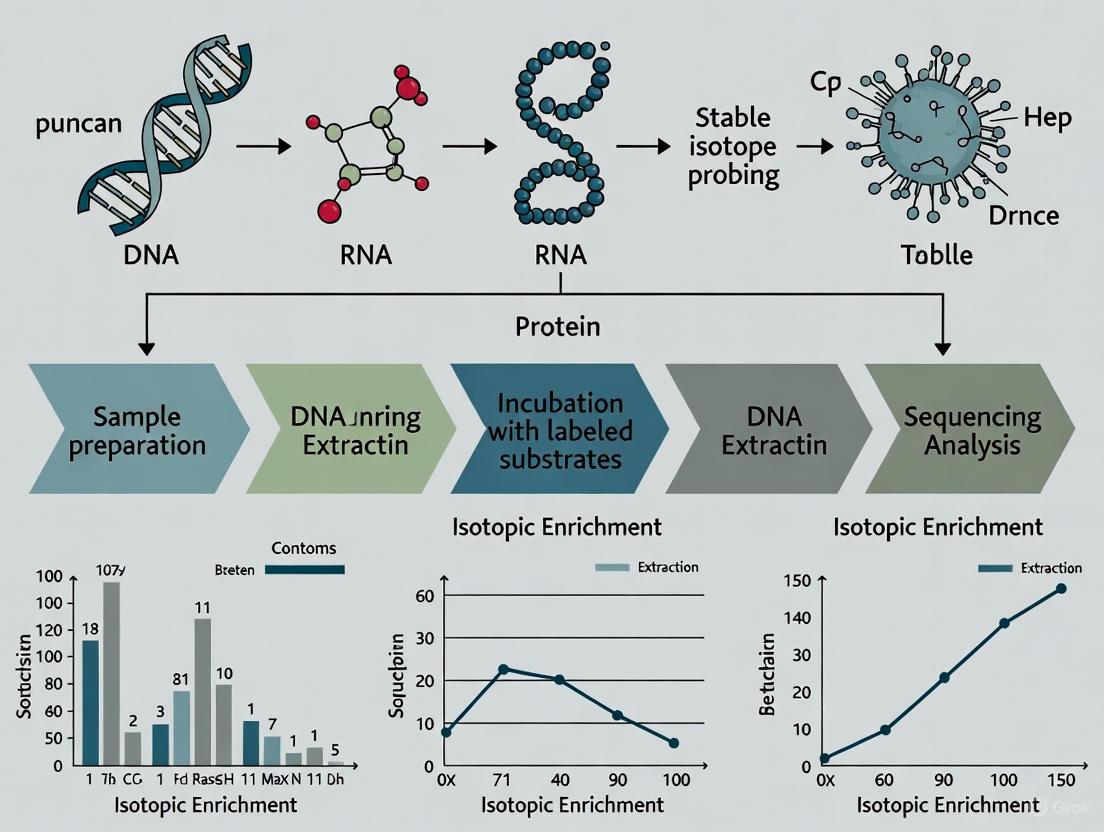
The following workflow diagram illustrates the primary pathways for applying these core SIP methodologies.
Advanced Protein-SIP Protocols
Given its high sensitivity and resolution, Protein-SIP is at the forefront of SIP technology. Below is a detailed protocol for a typical Protein-SIP experiment, highlighting critical steps and recent advancements.
Sample Incubation and Protein Extraction
- Incubation Setup: Inoculate the environmental sample (e.g., soil, water, gut microbiota contents) into a suitable medium containing the isotopically labeled substrate (e.g.,
13C-glucose,15N-ammonium). The concentration and incubation time should be optimized to achieve low levels of labeling (<10%13CRIA) for maximum sensitivity [4].- Critical: Include a parallel control with an unlabeled substrate to generate reference spectra.
- Protein Extraction: Terminate the incubation and harvest cells. Extract total protein using a robust disruption method (e.g., bead-beating, sonication) followed by precipitation with chilled acetone or TCA to purify and concentrate proteins.
- Protein Digestion: Redissolve the protein pellet and digest it into peptides using a sequence-specific protease, most commonly trypsin.
Mass Spectrometry and Data Analysis
- Liquid Chromatography-Tandem Mass Spectrometry (LC-MS/MS): Separate the complex peptide mixture using liquid chromatography and analyze with a high-resolution mass spectrometer (e.g., Orbitrap instrument). The instrument acquires both MS1 spectra (for peptide isotopic distributions) and MS2 spectra (for peptide sequence identification).
- Peptide Identification: This is a crucial step that can be performed via two primary routes:
- Database-Dependent Search: Compare acquired MS2 spectra against a protein sequence database. This can be a metagenome-derived database (the gold standard for unknown communities) or an unrestricted reference database (e.g., NCBI nr) [3].
- De Novo Peptide Sequencing: A powerful, database-independent alternative where peptide sequences are inferred directly from MS2 spectra using algorithms like Casanovo [3]. These de novo identified peptides can then be used to construct a sample-specific peptide database for SIP analysis, eliminating the need for prior genomic knowledge [3].
- Isotope Incorporation Quantification: Use specialized software (e.g., Calis-p 2.1 [4]) to analyze the MS1 spectra. The software compares the isotopic pattern of each peptide from the labeled sample to its unlabeled counterpart from the control, calculating the Relative Isotope Abundance (RIA) with high precision.
Table 2: Key Reagents and Software for Protein-SIP
| Category | Item | Function / Description |
|---|---|---|
| Stable Isotopes | 13C-labeled substrates (e.g., glucose, acetate) |
Track carbon assimilation pathways [2] |
15N-labeled substrates (e.g., ammonium, nitrate) |
Track nitrogen assimilation and cycling | |
Heavy water (2H2O or H218O) |
General activity marker for all growing microbes [2] [4] | |
| Laboratory Reagents | Trypsin (protease) | Digests proteins into peptides for MS analysis [3] |
| LC-MS grade solvents (acetonitrile, water) | Ensure high sensitivity and low background noise in LC-MS/MS | |
| Software Tools | Calis-p | Quantifies isotope incorporation; known for ultra-sensitivity (0.01% label) [4] |
| Sipros | Early Protein-SIP algorithm for database-dependent analysis [4] | |
| Casanovo | State-of-the-art de novo peptide sequencing algorithm [3] | |
| Unipept | Infers taxonomy from de novo sequenced peptides [3] |
Application Notes and Experimental Design
Choosing the Right Label and Substrate
The experimental question dictates the choice of the isotopic label and the chemical form of the substrate.
13Cor15N-labeled specific substrates: Used to trace the assimilation of a particular compound (e.g.,13C-cellulose to identify cellulolytic bacteria,15N-ammonium to identify nitrifiers) [1].2H2OorH218O(heavy water): Serves as a general activity probe. As water is universally incorporated during biosynthesis, it labels all actively growing microorganisms, irrespective of their specific carbon or nitrogen sources [2]. This is ideal for measuring growth rates under different conditions.- Position-specific
13Clabeling: Using a substrate where the13Catom is in a specific molecular position can help map metabolic pathways, as the label may be routed through different biochemical routes [1].
Overcoming the Cross-Feeding Challenge
Cross-feeding—where labeled metabolites from primary consumers are utilized by secondary feeders—can blur the trophic picture. Several strategies can mitigate this:
- Shorter incubation times limit the opportunity for complex food webs to develop.
- Pulse-chase experiments (pulse with labeled substrate, then chase with unlabeled) can help distinguish primary consumers from secondary consumers.
- Single-cell SIP techniques like Raman microspectroscopy and NanoSIMS provide unparalleled resolution by measuring isotope incorporation per cell, directly visualizing metabolic interactions between different cells [1] [2].
Stable Isotope Probing has fundamentally transformed our ability to link microbial identity to function in complex environments. While DNA- and RNA-SIP provide accessible entry points, the field is moving toward the ultra-sensitive and high-resolution capabilities of Protein-SIP. The development of faster and more sophisticated algorithms, such as Calis-p 2.1, and the emergence of database-independent methods like de novo peptide sequencing, are making these powerful techniques more accessible and widely applicable [3] [4]. By carefully selecting the appropriate SIP method and experimental design, researchers can now accurately pinpoint the active key players in any microbiome, quantify their metabolic contributions, and decipher the intricate functional networks that underpin ecosystem health and stability.
Stable Isotope Probing (SIP) has revolutionized microbial ecology by transforming microbial communities from black boxes into functionally resolved systems. This powerful methodology links microbial identity with metabolic function in complex environments by tracking the incorporation of stable isotopes into microbial biomarkers. The technique has evolved dramatically from its initial applications in bulk community analysis to sophisticated single-cell approaches that reveal physiological heterogeneity at the finest taxonomic scales. This evolution has paralleled advances in analytical instrumentation, with technological innovations continually expanding the frontiers of what can be discovered about microbial ecophysiology. The journey from bulk to single-cell analysis represents a paradigm shift in how researchers investigate microbial activity, moving from community-level generalizations to precise measurements of individual cell functions within their spatial contexts. This historical progression has opened new avenues for understanding microbiome dynamics in diverse environments from soils and oceans to host-associated ecosystems.
The Foundation: Bulk Stable Isotope Probing
Principles and Early Applications
Bulk SIP emerged in the late 1990s as a cultivation-independent method for linking microbial identity with specific metabolic functions in complex communities. The fundamental principle involves introducing a substrate enriched with a stable isotope (such as ^13^C, ^15^N, or ^18^O) into an environmental sample. Microorganisms that metabolize the substrate incorporate the heavy isotope into their cellular components, including DNA, RNA, phospholipid fatty acids (PLFAs), and proteins. These labeled biomarkers can then be separated from their unlabeled counterparts based on density differences [5] [2].
Early SIP methodologies primarily focused on nucleic acids, particularly DNA-SIP, where isopycnic centrifugation in density gradient media such as cesium chloride (CsCl) separated ^13^C-labeled DNA from unlabeled ^12^C-DNA [6]. The "heavy" fraction, enriched with labeled DNA, was subsequently analyzed using molecular techniques including 16S rRNA gene sequencing and metagenomics to identify the active microorganisms that assimilated the substrate [2]. This approach provided a significant advantage over traditional methods by selectively targeting the functionally active portion of microbial communities rather than the total community composition.
Methodological Framework
Table: Key Biomarkers Used in Bulk SIP Approaches
| Biomarker | Isotopes | Separation Method | Analysis Techniques | Primary Applications |
|---|---|---|---|---|
| DNA | ^13^C, ^15^N | CsCl density gradient centrifugation | 16S rRNA gene sequencing, metagenomics | Identifying microbial populations metabolizing specific substrates |
| RNA | ^13^C | CsCl density gradient centrifugation | RT-PCR, metatranscriptomics | Active community members with high ribosomal content |
| Phospholipid Fatty Acids (PLFAs) | ^13^C, ^2^H | Chromatographic separation | Gas chromatography-mass spectrometry (GC-MS) | Functional guilds based on lipid biomarkers |
| Proteins | ^13^C, ^15^N | Density gradient centrifugation or chromatography | Metaproteomics, peptide sequencing | Protein expression and metabolic pathways |
The original DNA-SIP protocol involves multiple critical steps that established the foundation for subsequent methodological developments. Environmental samples are incubated with an isotopically labeled substrate, after which DNA is extracted and mixed with CsCl solution to achieve an average density of approximately 1.725 g/mL [6]. Following ultracentrifugation at high speeds for extended periods (typically 36-72 hours), the density gradient is fractionated, and the DNA in each fraction is quantified. The density distribution of taxonomic markers (e.g., 16S rRNA genes) is compared between labeled and unlabeled treatments to identify actively metabolizing populations [6].
The Quantitative Shift: qSIP and High-Throughput SIP
Bridging Bulk and Single-Cell Analysis
As SIP matured, researchers recognized limitations in conventional approaches, particularly their qualitative nature and inability to quantify isotope incorporation for individual taxa. These limitations prompted the development of quantitative SIP (qSIP), which introduced mathematical frameworks to measure isotope incorporation into the DNA of specific microbial taxa [6]. Unlike traditional SIP that simply categorizes microorganisms as "labeled" or "unlabeled" based on arbitrary density thresholds, qSIP calculates the degree of enrichment for each taxon by measuring its change in buoyant density in response to isotope exposure [6].
The qSIP methodology involves collecting numerous density fractions across the entire gradient range—typically 12-24 fractions per gradient—rather than just "heavy" and "light" fractions [6]. For each fraction, DNA quantification and 16S rRNA gene sequencing are performed, generating density curves for each taxon in both labeled and unlabeled treatments. The shift in buoyant density (ΔBD) for each taxon is then calculated using the equation:
ΔBD = BD~labeled~ - BD~unlabeled~
where BD represents the weighted mean buoyant density of a taxon's DNA. This density shift is then converted to atom percent excess of the heavy isotope using established calibration models [6]. This quantitative approach enables researchers to measure a continuum of microbial activity levels rather than simple binary classifications.
High-Throughput Automation
The significant labor requirements and low throughput of traditional SIP protocols led to the development of semi-automated pipelines that maintain quantitative precision while dramatically increasing processing capacity. The High-Throughput SIP (HT-SIP) pipeline represents a major advancement, reducing hands-on labor to approximately one-sixth of manual SIP methods while allowing 16 samples to be processed simultaneously [7].
Table: Evolution of SIP Methodologies and Their Characteristics
| SIP Approach | Era | Resolution | Key Innovation | Throughput | Quantitative Capability |
|---|---|---|---|---|---|
| Bulk DNA/RNA-SIP | 1990s-2000s | Community | Linking identity with function via density separation | Low | Qualitative/Low |
| PLFA-SIP | 1990s-2000s | Functional groups | Lipid biomarkers as functional proxies | Medium | Semi-quantitative |
| qSIP | 2010s | Taxonomic | Mathematical models for taxon-specific enrichment | Medium | High |
| HT-SIP | 2020s | Taxonomic | Automation of fractionation and processing | High | High |
| Single-Cell SIP | 2010s-present | Single-cell | Imaging and spectroscopy of individual cells | Low | High |
The HT-SIP workflow incorporates automated fractionation systems connecting isocratic pumps and fraction collectors to standard ultracentrifuge rotors [7]. This automation significantly improves reproducibility compared to manual fractionation and enhances DNA recovery through the addition of non-ionic detergents to gradient buffers. The pipeline has demonstrated robustness across diverse sample types, from agricultural soils to hyphosphere microhabitats, even with challenging low-DNA inputs (as little as 350 ng) and low isotopic enrichment (1.8 atom% ^13^C) [7].
Diagram 1: High-Throughput SIP (HT-SIP) workflow showing the semi-automated pipeline from sample processing to data analysis.
The Single-Cell Revolution: SC-SIP
Technological Foundations
The emergence of Single-Cell Stable Isotope Probing (SC-SIP) represents the most recent evolutionary leap in SIP technology, enabling researchers to probe metabolic activity at the level of individual microbial cells. SC-SIP bypasses the limitations of bulk and quantitative approaches by combining stable isotope labeling with advanced imaging techniques, primarily Raman microspectroscopy and nanoscale secondary ion mass spectrometry (NanoSIMS) [5]. These technologies provide spatially resolved tracking of isotope tracers within individual cells, cellular components, and metabolites, revealing physiological heterogeneity that is obscured in ensemble measurements [5].
Raman microspectroscopy detects isotope incorporation by measuring the shift in vibrational frequencies of chemical bonds when heavy isotopes replace their lighter counterparts. For example, the ^13^C-^12^C bond vibrates at a different frequency than ^12^C-^12^C, creating a detectable signal shift in the Raman spectrum known as the "Raman shift" [5]. This label-free approach requires no chemical fixation or staining, preserving cellular viability and enabling subsequent analyses. NanoSIMS offers higher sensitivity and spatial resolution (down to ~50 nm) by generating secondary ions from the sample surface and separating them based on mass-to-charge ratios [5]. This allows precise quantification of multiple isotopes simultaneously at subcellular resolutions, though it requires vacuum conditions and more extensive sample preparation.
Methodological Advancements and Applications
SC-SIP encompasses diverse labeling strategies that enable creative experimental designs for investigating microbial physiology. Common approaches include tracking ^13^C-labeled carbon sources (e.g., ^13^C-CO~2~, ^13^C-glucose), ^15^N-labeled nitrogen compounds (e.g., ^15^N-ammonium, ^15^N-amino acids), and ^2^H (deuterium) from heavy water (D~2~O) [5]. Whole-cell pre-labeling strategies, often employing pulse-chase designs, facilitate studies of trophic interactions including predation, necrotrophy, and saprotrophy by measuring isotope transfer from pre-labeled cells to consumer organisms [5].
The application of SC-SIP has revealed remarkable physiological heterogeneity in diverse microbial systems. In clinical contexts, SC-SIP with heavy water labeling demonstrated that Staphylococcus aureus and Pseudomonas aeruginosa in cystic fibrosis biofilms exhibit growth rates at least two orders of magnitude lower than laboratory cultures, with significant cell-to-cell heterogeneity in growth rates [5]. These findings have important implications for understanding chronic infections and antimicrobial treatment strategies. In environmental microbiology, SC-SIP has illuminated microbial activities in spatially structured contexts, such as the degradation of fungal hyphae by Bacillus subtilis in soil microcosms, where attached bacteria showed higher metabolic activity than planktonic cells under wetting-drying cycles [5].
Diagram 2: Single-cell SIP (SC-SIP) technologies showing the two primary analytical platforms and their characteristics.
Applications and Protocols
Detailed SC-SIP Protocol for Microbial Activity Assessment
Principle: This protocol uses D~2~O labeling combined with Raman microspectroscopy to assess metabolic activity and growth rates of individual bacterial cells in complex communities [5].
Reagents and Materials:
- Heavy water (D~2~O, 99.9 atom% D)
- Phosphate-buffered saline (PBS)
- Anodisc filters (0.2 μm pore size)
- Calcium fluoride (CaF~2~) slides for Raman analysis
Procedure:
- Sample Preparation: Mix environmental samples (e.g., sputum, soil suspension, or water) with D~2~O to achieve 20-30% final concentration in D~2~O.
- Incubation: Incubate samples under conditions mimicking natural environment (temperature, atmosphere, time) appropriate to the research question (typically 24-48 hours).
- Fixation: Preserve samples with 2% paraformaldehyde for 15 minutes at room temperature.
- Filtration: Concentrate cells by filtering appropriate volume through Anodisc filters.
- Washing: Rinse filters three times with sterile PBS to remove residual D~2~O.
- Mounting: Transfer filters to CaF~2~ slides for Raman analysis.
- Raman Analysis:
- Focus laser beam (typically 532 nm or 785 nm) on individual cells.
- Acquire Raman spectra in the spectral window of 1800-2300 cm^-1^ to detect the C-D (deuterium) vibration band at ~2040 cm^-1^.
- Measure the C-H vibration band at ~2940 cm^-1^ as an internal standard.
- Data Analysis: Calculate the C-D/C-H band ratio for each cell as a measure of deuterium incorporation, which correlates with metabolic activity and growth rate.
Applications: This protocol has been successfully applied to measure in situ growth rates of pathogens in cystic fibrosis sputum, determine metabolic activity of dormant cells, and assess physiological heterogeneity in microbial populations [5].
Essential Research Reagent Solutions
Table: Key Research Reagent Solutions for SIP Experiments
| Reagent/Material | Function/Application | Technical Specifications | Considerations |
|---|---|---|---|
| Cesium Chloride (CsCl) | Density gradient medium for nucleic acid separation | Ultra-pure grade, density ~1.885 g/mL | Corrosive; requires proper handling and disposal |
| Heavy Water (D~2~O) | Metabolic activity marker for SC-SIP | 99.9 atom% D | Biological effects at high concentrations; typically used at 20-30% |
| ^13^C-labeled Substrates (e.g., glucose, acetate) | Carbon source for metabolic tracing | 98-99 atom% ^13^C | Chemical and isotopic purity critical for interpretation |
| ^15^N-labeled Compounds (e.g., ammonium, nitrate) | Nitrogen source for metabolic tracing | 98-99 atom% ^15^N | Choice depends on microbial N preferences |
| TE Buffer | DNA preservation and dilution | 10 mM Tris, 1 mM EDTA, pH 8.0 | Maintains DNA integrity during processing |
| Non-ionic Detergents | Improve DNA recovery in HT-SIP | e.g., 0.1% Triton X-100 | Concentration optimization required for different samples |
| Gradient Buffer | Maintains pH and ionic strength | 200 mM Tris, 200 mM KCl, 2 mM EDTA, pH 8.0 | Prevents DNA degradation during centrifugation |
Comparative Analysis and Future Perspectives
The evolution from bulk SIP to single-cell analysis has progressively enhanced our ability to dissect microbial community functioning with increasing resolution. Each technological advancement has addressed specific limitations of previous approaches while introducing new capabilities. Bulk SIP provided the first cultivation-independent method for linking microbial identity with function but obscured the considerable physiological heterogeneity inherent in microbial populations. Quantitative SIP introduced mathematical rigor and the ability to measure gradients of activity across taxa but still operated at the population level. Single-cell SIP now enables researchers to observe microbial metabolism at its most fundamental unit—the individual cell—while preserving spatial context and revealing previously hidden biological variation.
The complementary strengths of these approaches suggest a future where integrated, multi-scale SIP applications become standard in microbial ecology. Combining qSIP's throughput with SC-SIP's resolution could provide unprecedented insights into the relationships between microbial biodiversity and ecosystem functioning. Emerging technologies such as high-resolution Raman-activated cell sorting and coupling SIP with other 'omics approaches (metagenomics, metatranscriptomics, metaproteomics) promise to further expand SIP's applications [5] [2]. Additionally, the ongoing development of more accessible and automated platforms will likely democratize these powerful techniques, enabling broader adoption across environmental microbiology, clinical research, and biotechnology.
As SIP methodologies continue to evolve, they will undoubtedly play an increasingly central role in addressing fundamental questions in microbial ecology and applying this knowledge to challenges ranging from climate change and ecosystem sustainability to human health and disease.
Application Notes: The Role of Stable Isotopes in Microbial Ecology
Stable Isotope Probing (SIP) is a powerful set of techniques that allows researchers to move beyond cataloging microbial diversity to actively identifying which organisms are metabolically active and what substrates they are consuming in complex communities [8]. By introducing substrates enriched with stable isotopes (e.g., 13C, 15N, 18O, 2H) into an environmental sample, these isotopes are incorporated into the biomass of active microorganisms. This incorporation provides a physical label that can be tracked to link microbial identity with specific metabolic functions [1] [9]. This approach is particularly valuable for moving from correlation to causation in microbiome studies, enabling a direct investigation of microbial activities and their contributions to biogeochemical cycles, host health, and contaminant degradation [1] [2].
The choice of isotope and labeled substrate is a critical experimental decision that dictates the biological questions one can address. The four isotopes highlighted here offer complementary insights:
- 13C is most frequently used to trace the fate of specific organic carbon substrates.
- 15N is applied to study nitrogen assimilation from various sources.
- 18O, often introduced via H218O, serves as a general activity marker.
- 2H, commonly from 2H2O (heavy water), is a versatile tracer for anabolic activity and growth [2] [5].
Recent technological advances are pushing the boundaries of SIP. Quantitative SIP (qSIP) has been developed to move beyond qualitative identification, allowing for the measurement of isotopic enrichment and metabolic rates for individual microbial taxa within a community [6]. Furthermore, Single-Cell SIP (SC-SIP) techniques, utilizing tools like Raman microspectroscopy and NanoSIMS, enable the resolution of isotope incorporation at the single-cell level, revealing population heterogeneity and spatial organization of microbial activity [5]. The field is also moving towards greater reproducibility and data sharing, with initiatives to establish minimum information standards (MISIP) for SIP experiments to ensure that datasets are Findable, Accessible, Interoperable, and Reusable (FAIR) [8].
Table 1: Key Stable Isotopes and Their Incorporation in Microbial Ecology Studies
| Isotope | Common Substrate Forms | Target Biomarkers | Example Incorporation Data | Primary Application |
|---|---|---|---|---|
| 13C | [13C]glucose, 13CO2, 13C-labeled organic pollutants [1] [6] [10] | DNA, RNA, PLFAs, Proteins [11] [6] | 5.61 μg 13C g-1 DM in PLFAs of sponge tissue [11] | Tracing carbon flow in metabolic networks and food webs [6] [10] |
| 15N | 15NH4+, 15N2, 15N-labeled amino acids [2] [5] | DNA, RNA, Proteins [9] [5] | Not quantified in results | Identifying microbes involved in nitrogen fixation, nitrification, and assimilation [9] [5] |
| 18O | H218O [6] | DNA [6] | Used to calculate atom fraction excess in DNA [6] | Measuring general microbial growth and DNA synthesis in situ [6] |
| 2H (D) | 2H2O (D2O), organic-D compounds [11] [5] | PLFAs, DNA, Proteins [11] [5] | 5.43 ng 2H g-1 DM in sponge-specific PLFAs [11] | Probing anabolic activity, lipid biosynthesis, and growth rates [11] [5] |
Table 2: Comparison of SIP Methodologies and Their Characteristics
| Methodology | Spatial Resolution | Isotope Sensitivity | Key Advantage | Limitation |
|---|---|---|---|---|
| Nucleic Acid SIP (DNA/RNA-SIP) | Population-level | Moderate (requires ~0.0001 at.-% for IRMS) [9] | Links function to genetic identity; enables metagenomic analysis [8] [2] | Laborious lab work; requires density gradient centrifugation [8] |
| Phospholipid-Derived Fatty Acid (PLFA)-SIP | Population-level | High (via IRMS) [9] | Broad biomarker range; provides phylogenetic and metabolic info [11] | Lower phylogenetic resolution compared to DNA-SIP [9] |
| Single-Cell SIP (Raman, NanoSIMS) | Single-cell | Low to Moderate (Raman: >25 at.-%; SIMS: >0.1 at.-%) [9] | Reveals cell-to-cell heterogeneity; no need for cell extraction [5] | Requires expensive instrumentation; complex data analysis [5] |
| Quantitative SIP (qSIP) | Taxon-level | High (computational) [6] | Quantifies isotope enrichment per taxon; accounts for GC content [6] | Computationally intensive; requires multiple density fractions [6] |
Detailed Experimental Protocols
Protocol 1: DNA-based Quantitative SIP (qSIP) with 13C and 18O
This protocol describes a method for quantifying the assimilation of 13C from an organic substrate and 18O from water into microbial DNA, allowing researchers to distinguish between direct substrate utilization and general growth stimulated by other carbon sources [6]. This is particularly useful for studying phenomena like the priming effect in soils.
I. Materials and Reagents
- Soil or other environmental sample (e.g., 1 g aliquots)
- 13C-labeled substrate (e.g., [13C]glucose, 99 atom %)
- H218O (97 atom %)
- FastDNA Spin Kit for Soil (MP Biomedicals) or equivalent
- Saturated Cesium Chloride (CsCl) solution
- Gradient buffer (200 mM Tris, 200 mM KCl, 2 mM EDTA)
- OptiSeal ultracentrifuge tubes (Beckman Coulter)
- Isopropanol
- Qubit dsDNA HS Assay Kit (Invitrogen)
II. Experimental Procedure
- Sample Incubation:
- Prepare sample treatments in replicate (e.g., n=3). Key treatments include:
- Natural abundance control (H2O, natural glucose).
- 18O-enriched water only.
- 13C-glucose with natural abundance water.
- 13C-glucose with 18O-enriched water.
- Adjust samples to optimal moisture content (e.g., 60% water holding capacity for soil).
- Incubate for a defined period (e.g., 7 days at room temperature) [6].
- Prepare sample treatments in replicate (e.g., n=3). Key treatments include:
Nucleic Acid Extraction:
- Extract total DNA from approximately 0.5 g of sample using the FastDNA Spin Kit, following the manufacturer's instructions.
- Quantify the extracted DNA using a fluorometric method (e.g., Qubit assay) [6].
Isopycnic Centrifugation and Fractionation:
- Mix ~5 μg of DNA with a saturated CsCl/gradient buffer solution to a final volume of ~2.6 ml and a target density of 1.73 g cm-3 in an OptiSeal tube.
- Centrifuge in an ultracentrifuge (e.g., Beckman Optima Max) with a TLA-100 rotor at 127,000 x g for 72 hours at 18°C.
- After centrifugation, fractionate the gradient into multiple fractions (e.g., 150 μl each) using a fraction recovery system.
- Measure the density of every fraction with a digital refractometer.
- Recover DNA from each fraction by isopropanol precipitation and resuspend in sterile deionized water [6].
Quantitative Analysis:
- Quantify the amount of DNA and the number of 16S rRNA gene copies (via qPCR) in each density fraction.
- Sequence the 16S rRNA genes from each fraction to determine taxonomic composition.
- For each taxon, generate a density curve from the sequence data and qPCR data across all fractions.
- Calculate the change in buoyant density for each taxon between the labeled and control treatments. This density shift is then used to compute the atom percent isotope enrichment for each microbial taxon [6].
DNA-qSIP Experimental Workflow
Protocol 2: PLFA-SIP with Triple Isotope Labeling (13C, 15N, 2H)
This protocol is adapted from a pilot study on marine sponges and is designed to simultaneously track different metabolic processes by using substrates labeled with different isotopes. The distinct incorporation patterns of 13C and 2H into microbiome- versus host-specific biomarkers can help disentangle complex feeding and metabolic interactions [11].
I. Materials and Reagents
- 13C- and 15N-enriched inactivated bacteria (as a labeled food source)
- 2H2O (deuterated water)
- Artificial seawater
- Glass incubation chambers
- Lipid extraction solvents (e.g., methanol, chloroform)
- Solid phase extraction columns for lipid separation
- Gas Chromatography-Isotope Ratio Mass Spectrometry (GC-IRMS) system
II. Experimental Procedure
- Experimental Setup:
- Collect organisms (e.g., sponges) and acclimate them to laboratory conditions.
- Prepare incubation medium with 1% (v/v) 2H2O in artificial seawater.
- Add 13C- and 15N-enriched bacteria as a substrate to the medium.
- Conduct incubations for a set duration (e.g., 12 hours), monitoring oxygen levels continuously [11].
Sample Harvesting and Bulk Analysis:
- At the end of the incubation, collect and process the organism tissue.
- A subsample of the tissue is homogenized and analyzed by elemental analyzer-IRMS (EA-IRMS) to determine the bulk incorporation of 13C, 15N, and 2H [11].
PLFA Extraction and Analysis:
- Extract total lipids from another tissue subsample using a mixture of chloroform, methanol, and buffer via the Bligh and Dyer method.
- Separate phospholipids from other lipid classes using solid-phase extraction.
- Subject the phospholipid fraction to mild alkaline methanolysis to liberate fatty acid methyl esters (FAMEs) from the PLFAs.
- Analyze the FAMEs using GC-MS for identification and GC-IRMS for measuring 13C and 2H incorporation into individual PLFAs [11].
Data Interpretation:
- Identify specific PLFAs that serve as biomarkers for different microbial groups (e.g., bacteria) and the host.
- Compare the isotope enrichment in bacterial-specific PLFAs (e.g., branched-chain and saturated FAs) versus host-specific PLFAs.
- High 13C in bacterial PLFAs indicates direct consumption of the labeled bacterial substrate. High 2H in host-specific PLFAs indicates high host anabolic activity, fueled by the assimilation of deuterium from the heavy water [11].
PLFA-SIP with Triple Isotope Labeling
The Scientist's Toolkit: Research Reagent Solutions
Table 3: Essential Reagents and Materials for Stable Isotope Probing
| Reagent/Material | Function/Application | Example Use Case |
|---|---|---|
| 13C-Labeled Substrates (e.g., Glucose, Acetate, Bicarbonate) | Tracing carbon flow through specific metabolic pathways and food webs. | Identifying microbial taxa that degrade 13C-glucose in soil [6]. |
| 15N-Labeled Substrates (e.g., NH4+, NO3-, N2, Amino Acids) | Studying nitrogen fixation, nitrification, denitrification, and nitrogen assimilation. | Pinpointing microbes involved in the nitrogen cycle in marine environments [9]. |
| H218O (18O-Water) | A general activity probe for DNA synthesis and microbial growth; labels all actively growing organisms. | Measuring growth rates of uncultured soil microbes in their native environment [6]. |
| 2H2O (Heavy Water) | A versatile tracer for anabolic activity; incorporated into biomass (e.g., lipids, DNA) during synthesis. | Measuring growth rates of pathogens in cystic fibrosis sputum [5]. |
| Cesium Chloride (CsCl) | Forms the density gradient for separating labeled from unlabeled nucleic acids in DNA/RNA-SIP. | Isopycnic centrifugation to isolate 13C-DNA from microbial communities [6]. |
| FastDNA Spin Kit for Soil | Efficiently extracts PCR-quality DNA from difficult environmental samples rich in inhibitors. | Standardized DNA extraction for SIP meta-analyses [6]. |
| GC-IRMS System | Measures isotope ratios (13C, 2H, 15N, 18O) in specific biomolecules (e.g., PLFAs, gases). | Quantifying 13C and 2H incorporation into specific phospholipid fatty acids [11]. |
Stable Isotope Probing (SIP) has revolutionized microbial ecology by transforming our ability to link microbial identity with function in complex systems. This powerful approach enables researchers to track the assimilation of isotopically-labeled substrates into microbial biomass, providing direct insights into metabolic activities within intact communities. The field has evolved from bulk community analyses to sophisticated single-cell techniques that preserve spatial context and capture profound physiological heterogeneity among microbial populations [5]. These advances are bridging critical knowledge gaps from ecosystem-scale processes down to the functional dynamics of individual cells, with significant implications for environmental science, medicine, and drug development.
The fundamental principle underlying SIP is that microorganisms incorporating stable isotopes (e.g., ¹³C, ¹⁵N, ¹⁸O, or D) from labeled substrates become isotopically "heavier," enabling their separation and identification. Modern SIP methodologies now span multiple molecular biomarkers including DNA, RNA, proteins, and lipids, each offering unique insights into microbial activity [12]. The recent development of quantitative SIP (qSIP) and single-cell SIP (SC-SIP) approaches has further enhanced our ability to make precise measurements of isotope incorporation at fine taxonomic resolution and even at the level of individual cells [6] [5].
Technical Approaches: From Bulk to Single-Cell Resolution
Comparison of SIP Methodologies
Table 1: Key Stable Isotope Probing (SIP) Technologies and Their Applications
| Method | Core Technology | Spatial Resolution | Key Applications | Limitations |
|---|---|---|---|---|
| DNA-/RNA-SIP | Isopycnic centrifugation + sequencing | Population level | Identifying active substrate utilizes in communities [6] | Requires sufficient biomass; GC content bias [6] |
| Quantitative SIP (qSIP) | Density gradient fractionation + qPCR/sequencing | Taxon-specific | Quantifying isotope incorporation rates of individual taxa [6] | Computationally intensive; multiple fractions required |
| Single-cell SIP (SC-SIP) | Raman microspectroscopy/NanoSIMS | Single-cell | Cellular activity, spatial structuring, physiological heterogeneity [5] | Specialized equipment needed; lower throughput |
| Protein-SIP | MS-based proteomics | Functional group level | Linking specific metabolic pathways to activity [12] | Complex sample processing; database dependent |
| Chip-SIP | rRNA microarrays + NanoSIMS | Single-cell (phylogenetic) | Linking phylogeny and function via hybridization [12] | Limited to known sequences; probe design critical |
Quantitative Framework: From Density Shifts to Isotopic Enrichment
The emergence of qSIP represents a significant advancement over traditional qualitative SIP by enabling precise measurement of isotope incorporation. qSIP quantifies the baseline density of DNA from individual taxa without isotope exposure, then measures the change in DNA density caused by isotope incorporation during experimental conditions [6]. This density shift (Δρ) translates quantitatively to isotopic enrichment through mathematical modeling that accounts for the influence of nucleic acid composition on density [6].
The mathematical relationship can be expressed as:
Δρ = ρlabeled - ρunlabeled
Where ρlabeled is the buoyant density after isotope exposure and ρunlabeled is the baseline density. This density shift correlates directly with the atom fraction of the heavy isotope in the DNA of each taxon, enabling calculation of isotopic enrichment [6].
Application Notes: Insights into Microbial Physiology and Ecology
Resolving Physiological Heterogeneity in Host-Associated Microbiomes
SC-SIP approaches have revealed remarkable physiological heterogeneity in clinical settings. In studies of cystic fibrosis (CF) sputum, single-cell analysis of Staphylococcus aureus and Pseudomonas aeruginosa demonstrated growth rates at least two orders of magnitude lower than laboratory cultures, with significant cell-to-cell heterogeneity [5]. This finding has profound implications for antimicrobial treatment strategies, as bacterial physiology and growth rate dramatically influence antibiotic susceptibility [5].
Research on Chlamydia's biphasic lifestyle overturned long-held beliefs about its metabolic capabilities. When extracellular chlamydia were incubated with ¹³C-labeled phenylalanine, Raman microspectroscopy detected amino acid uptake and protein synthesis, challenging the paradigm that extracellular "elementary bodies" exist in a completely dormant state [5]. Similarly, studies of Leishmania mexicana in infected mice revealed mixed populations of active and quiescent cells within granulomas, plus metabolically inactive cells in the surrounding mesothelium—a potential mechanism for surviving drug treatment [5].
Elucidating Microbial Interactions and Ecosystem Processes
SIP techniques have illuminated complex microbial interactions in both environmental and host-associated systems. Research on the priming effect—where organic amendments stimulate decomposition of native soil organic matter—demonstrated that ¹³C-glucose addition indirectly stimulated bacteria to utilize other substrates for growth [6]. This was evidenced by greater ¹⁸O assimilation from labeled water into DNA than expected based on glucose-derived carbon alone [6].
Spatially explicit microbial activities have been visualized using SC-SIP in model systems. In transparent soil microcosms containing the fungus Mucor fragilis and the bacterium Bacillus subtilis, a combination of ¹³C- and D₂O-labeling revealed that hyphae-attached bacteria were more metabolically active than planktonic cells under wetting-drying cycles [5]. This indicates that surface attachment may be selectively advantageous in fluctuating environments, demonstrating how ecological hypotheses about spatially structured microbial activities can be tested using SC-SIP [5].
Table 2: Isotope Tracers and Their Applications in Microbial Ecology
| Isotope Tracer | Common Form | Target Processes | Detection Methods | Notable Applications |
|---|---|---|---|---|
| ¹³C | ¹³CO₂, ¹³C-bicarbonate, ¹³C-labeled organic compounds | Carbon fixation, heterotrophic metabolism | NanoSIMS, Raman, GC-MS, density centrifugation | Identifying autotrophs, tracking specific carbon sources [5] [6] |
| ¹⁵N | ¹⁵N-ammonium, ¹⁵N-nitrate, ¹⁵N-amino acids | Nitrogen assimilation, nitrification, denitrification | NanoSIMS, density centrifugation | N-cycling populations, amino acid utilization [5] |
| ¹⁸O | H₂¹⁸O | Cellular growth, DNA synthesis | Density centrifugation (qSIP) | Universal growth marker in diverse environments [6] |
| D (²H) | D₂O | General metabolic activity, lipid synthesis | Raman, GC-MS | Growth rate measurements in complex samples [5] |
Experimental Protocols
Protocol: Quantitative SIP (qSIP) for Soil Microbial Communities
Principle: This protocol quantifies isotope incorporation into microbial DNA by measuring taxon-specific density shifts after stable isotope incubation [6].
Materials:
- Soil samples (or other environmental matrices)
- Isotope tracers (e.g., ¹³C-glucose, H₂¹⁸O)
- FastDNA Spin Kit for Soil (MP Biomedicals)
- Saturated CsCl solution
- Gradient buffer (200 mM Tris, 200 mM KCl, 2 mM EDTA)
- OptiSeal ultracentrifuge tubes (Beckman Coulter)
- Ultracentrifuge with TLN-100 rotor
- Fraction recovery system
- Digital refractometer
- Qubit dsDNA HS Assay Kit and fluorometer
- qPCR reagents for 16S rRNA gene quantification
Procedure:
Sample Preparation and Incubation
- Sieve soil (2-mm mesh) and adjust to 60% water holding capacity
- Pre-incubate for 1 week at appropriate temperature
- Add isotope solutions:
- Treatment 1: Natural abundance water (control)
- Treatment 2: ¹⁸O-enriched water (97 atom %)
- Treatment 3: Natural abundance glucose + water
- Treatment 4: ¹³C-enriched glucose (99 atom %) + natural abundance water
- Treatment 5: Natural abundance glucose + ¹⁸O-enriched water
- Incubate for 7 days (or appropriate duration)
DNA Extraction and Quantification
- Extract DNA from approximately 0.5 g soil using FastDNA Spin Kit
- Quantify DNA using Qubit dsDNA HS Assay
- Store at -40°C until density centrifugation
Density Gradient Centrifugation
- Add 5 μg DNA to 2.6 ml saturated CsCl + gradient buffer solution
- Transfer to 3.3 ml OptiSeal ultracentrifuge tubes
- Centrifuge at 127,000 × g for 72 hours at 18°C
Fraction Collection and Density Measurement
- Collect 150 μl fractions using fraction recovery system
- Measure density of each fraction with digital refractometer
- Precipitate DNA from CsCl using isopropanol
- Resuspend DNA in 50 μl sterile deionized water
Molecular Analysis and Quantification
- Quantify DNA in each fraction using Qubit assay
- Quantify bacterial 16S rRNA gene copies in each fraction by qPCR
- Sequence selected fractions for taxonomic analysis
Data Analysis and Isotope Incorporation Calculation
- Calculate taxon-specific densities in labeled and unlabeled treatments
- Determine density shift (Δρ) for each taxon
- Convert density shifts to isotope composition using appropriate models
Protocol: Single-Cell SIP Using Raman Microspectroscopy
Principle: This protocol detects isotope incorporation in individual cells using Raman microspectroscopy, enabling spatial resolution of metabolic activity [5].
Materials:
- Microbial cultures or environmental samples
- Isotope tracers (e.g., D₂O, ¹³C-labeled substrates)
- Raman microscope with appropriate lasers (e.g., 532 nm, 785 nm)
- Microscope slides and coverslips
- Filters for sample concentration (if needed)
- Heavy water (D₂O) or ¹³C-labeled compounds
Procedure:
Sample Labeling
- Incubate samples with isotope tracer (e.g., 30-50% D₂O for growth rate measurements)
- Include controls with natural abundance isotopes
- For time-course experiments, collect samples at multiple time points
Sample Preparation for Raman Analysis
- Concentrate cells if necessary (centrifugation or filtration)
- Wash cells with appropriate buffer to remove external label
- Apply cells to microscope slides and allow to air dry
- Alternatively, analyze wet samples for live cell imaging
Raman Measurements
- Calibrate Raman spectrometer using silicon standard
- Focus laser on individual cells
- Acquire spectra with appropriate integration time (typically 1-10 seconds)
- For D₂O labeling, analyze C-D band in the "silent region" (2040-2300 cm⁻¹)
- For ¹³C labeling, analyze shifts in carbon-related bands
Data Analysis
- Pre-process spectra (background subtraction, normalization)
- Quantify peak heights or areas for relevant isotopic bands
- Calculate isotopic fraction at single-cell level
- Correlate with spatial information when available
The Scientist's Toolkit: Essential Research Reagents and Materials
Table 3: Key Research Reagent Solutions for SIP Experiments
| Reagent/Material | Function | Application Notes | Example Sources/Formats |
|---|---|---|---|
| ¹³C-labeled substrates | Carbon source tracking | Available as specific compounds (glucose, acetate) or CO₂; purity critical for interpretation | Cambridge Isotopes, Sigma-Aldrich; 99 atom % common |
| H₂¹⁸O | Universal growth marker | Labels DNA through water oxygen incorporation; non-specific but comprehensive | 97-99 atom %; used in qSIP for overall growth assessment [6] |
| D₂O (Heavy water) | General metabolic activity probe | Incorporates into biomass during synthesis; detected via C-D bonds in Raman | 30-50% concentration typical for growth rate measurements [5] |
| CsCl solution | Density medium for centrifugation | Forms gradient for nucleic acid separation; purity affects gradient formation | Molecular biology grade; saturated solutions ~1.9 g/ml |
| Nucleic acid extraction kits | Biomass recovery from complex matrices | Soil-specific kits often include bead beating for cell lysis | FastDNA Spin Kit for Soil, others optimized for environmental samples [6] |
| qPCR reagents | Quantitative gene abundance | 16S rRNA gene targets for bacterial abundance; specific functional genes | Broad-coverage bacterial primers; SYBR Green or TaqMan chemistry |
| Sequenceing reagents | Taxonomic identification | 16S rRNA amplicon sequencing most common; shotgun for functional potential | Illumina platforms standard; appropriate barcoding required |
Future Perspectives and Concluding Remarks
The evolving landscape of SIP technologies continues to push the boundaries of what's possible in microbial ecology. The integration of multiple isotopic labels (e.g., ¹³C with ¹⁵N or ¹⁸O) enables researchers to trace complex metabolic pathways and cross-feeding relationships within microbial communities [5] [1]. Emerging applications in contaminant biodegradation demonstrate how SIP can identify microbes capable of co-metabolic degradation of environmental pollutants, with significant implications for bioremediation strategies [1].
The combination of SIP with other advanced techniques—including microfluidics, high-resolution microscopy, and meta-omics analyses—promises even deeper insights into microbial activities in their native contexts. As these methods become more accessible and standardized, they will increasingly support drug development efforts by elucidating pathogen physiology in host environments and identifying novel antimicrobial targets [5].
The progression from bulk SIP to quantitative and single-cell approaches has fundamentally transformed our ability to resolve microbial activity across scales. These techniques now provide unprecedented insights into the physiological heterogeneity, spatial organization, and metabolic interactions that underlie microbiome function in environments ranging from soils to human organs. As stable isotope probing continues to evolve, it will undoubtedly remain an essential tool for linking microbial identity to function in an increasingly precise and quantitative manner.
In the field of microbial ecology, meta-omics technologies (including metagenomics, metatranscriptomics, and metaproteomics) have revolutionized our ability to characterize microbial communities by revealing their genetic blueprint, transcriptional activity, and protein expression. However, these approaches face a fundamental limitation: they cannot definitively link microbial identity to specific metabolic functions, particularly in complex environmental samples where thousands of microbial taxa coexist. This gap between genetic potential and demonstrated function represents a critical challenge in accurately interpreting microbiome data.
Stable Isotope Probing (SIP) addresses this limitation by enabling researchers to track the assimilation of isotopically-labeled substrates into microbial biomass, thereby providing direct evidence of metabolic activity. When combined with meta-omics approaches, SIP transforms our ability to identify which microorganisms are actively participating in specific biogeochemical processes, nutrient cycling, or pollutant degradation. This powerful integration allows researchers to move beyond correlative inferences to establish causative relationships between microbial taxa and their ecological functions, offering a more complete understanding of microbial community dynamics in diverse environments from soils and oceans to host-associated ecosystems.
Fundamental Principles of Stable Isotope Probing
Stable Isotope Probing operates on a straightforward yet powerful principle: when microorganisms consume substrates enriched with heavy stable isotopes (such as ^13^C, ^15^N, or ^18^O), these heavy isotopes become incorporated into their biomolecules, including DNA, RNA, proteins, and lipids. This incorporation creates a measurable increase in the density of the biomolecules, which can be separated from their lighter counterparts using density gradient centrifugation [13].
The DNA-based Stable Isotope Probing (DNA-SIP) technique, specifically, involves several critical stages. First, an environmental sample is incubated with a substrate enriched with a stable isotope (e.g., ^13^C). During incubation, active microorganisms that can metabolize the substrate incorporate the heavy isotope into their newly synthesized DNA. Following incubation, nucleic acids are extracted and subjected to isopycnic centrifugation in a density gradient medium, typically cesium chloride (CsCl). This process separates DNA based on its buoyant density, resulting in distinct "heavy" (labeled) and "light" (unlabeled) DNA fractions. The heavy DNA fraction, enriched from active microorganisms that consumed the substrate, can then be analyzed using various molecular techniques to identify the active microbial populations [14] [13].
Table 1: Common Stable Isotopes and Their Applications in Microbial Ecology
| Stable Isotope | Target Substrates | Applications in Microbial Ecology | Incorporation Time |
|---|---|---|---|
| ^13^C | ^13^C-glucose, ^13^C-acetate, ^13^C-methane | Carbon cycling, autotroph identification, pollutant degradation | 2-7 days |
| ^15^N | ^15^N-ammonium, ^15^N-nitrate, ^15^N$_2$ | Nitrogen fixation, nitrification, denitrification | 3-14 days |
| ^18^O | H$_2$^18^O | Identification of growing microorganisms, taxon-specific growth rates | 1-3 days |
| ^2^H (Deuterium) | D$_2$O | General metabolic activity, cell sorting | 3-10 days |
Comparison of SIP with Meta-Omics Approaches
Each meta-omics approach provides a different layer of information about microbial communities, and SIP serves as a complementary technique that adds functional validation to these molecular inventories. Metagenomics reveals the collective genetic potential of a microbial community by sequencing all available DNA, thus cataloging which metabolic pathways could be present. Metatranscriptomics captures the RNA transcripts being produced, indicating which genes are being actively transcribed. Metaproteomics identifies and quantifies the proteins present, showing which metabolic enzymes are actually synthesized. However, none of these approaches can definitively demonstrate whether particular microorganisms are actively transforming specific substrates in complex environments [14].
SIP bridges this gap by directly linking specific microorganisms to the utilization of labeled substrates, effectively identifying which community members are metabolically active under particular conditions. This functional validation is crucial for moving beyond correlations to establish causative relationships in microbial ecology. The integration of SIP with meta-omics creates a powerful framework where metagenomics can predict potential functions, metatranscriptomics can indicate gene expression, and SIP can confirm which microorganisms are actively participating in specific metabolic processes.
Table 2: Comparison of Meta-Omics Approaches and Their Integration with SIP
| Technique | Target Molecule | Information Provided | Key Limitations | How SIP Complements |
|---|---|---|---|---|
| Metagenomics | DNA | Genetic potential, taxonomic composition, metabolic pathways | Cannot distinguish active from dormant community members | Identifies which taxa actively incorporate isotopes from specific substrates |
| Metatranscriptomics | RNA | Gene expression patterns, regulatory mechanisms | mRNA stability, post-transcriptional regulation not captured | Confirms that transcriptional activity translates to metabolic function |
| Metaproteomics | Proteins | Functional enzyme presence, post-translational modifications | Technical challenges in protein extraction and identification | Links protein synthesis to actual substrate utilization |
| Metabolomics | Metabolites | End products of metabolic activity, metabolic fluxes | Snapshots of pools, challenging to connect to specific taxa | Provides labeled substrates to trace metabolic pathways through specific organisms |
Application Notes: Integrated Workflows and Experimental Design
DNA-SIP with Metagenomic Sequencing
The combination of DNA-SIP with metagenomic sequencing represents one of the most powerful approaches for linking microbial identity to function. This integrated workflow begins with the incubation of environmental samples with ^13^C-labeled substrates, followed by density gradient centrifugation to separate ^13^C-labeled "heavy" DNA from ^12^C-containing "light" DNA. The heavy DNA fraction, representing actively metabolizing microorganisms, is then subjected to metagenomic sequencing, enabling the reconstruction of genomes from active community members and the identification of specific genes involved in substrate utilization [14].
This approach has been successfully applied to identify novel methane-oxidizing bacteria in peat soils, nitrifying communities in agricultural soils, and hydrocarbon-degrading microorganisms in contaminated environments. For example, research using DNA-SIP with ^13^C-methane revealed novel methanotrophic bacteria in Movile Cave that were previously undetected by conventional molecular methods [14]. Similarly, studies incorporating ^13^CO~2~ have identified autotrophic nitrifying communities in agricultural soils, challenging previous assumptions about the dominance of certain ammonia-oxidizing archaea in these environments [14].
Quantitative SIP (qSIP) for Microbial Growth Measurements
Quantitative Stable Isotope Probing (qSIP) represents an advancement that enables researchers to measure taxon-specific growth rates and substrate assimilation in complex microbial communities. Unlike traditional SIP which provides a binary classification (labeled vs. unlabeled), qSIP quantifies the degree of isotope incorporation by measuring the density shift of individual microbial taxa. This approach combines SIP with high-throughput sequencing and quantitative analysis of isotope incorporation, allowing for more precise measurements of microbial activity [14].
qSIP has been particularly valuable for studying microbial growth under natural conditions. For instance, researchers have used H$_2$^18^O qSIP to measure taxon-specific growth during litter decomposition in freshwater ecosystems and in soils following rainfall events after dry periods. This approach revealed that a relatively small subset of the microbial community responds rapidly to rewetting, contributing significantly to the observed CO~2~ pulses from seasonally dried soil [14]. The quantitative nature of this method provides unprecedented resolution for understanding how environmental changes affect specific microbial populations.
RNA-SIP for Tracking Active Gene Expression
RNA-based Stable Isotope Probing (RNA-SIP) offers several advantages over DNA-SIP, including faster detection of isotope incorporation due to higher turnover rates of RNA compared to DNA. This approach is particularly useful for identifying active participants in rapidly changing environments or for studying processes where quick microbial responses are expected. RNA-SIP followed by metatranscriptomic analysis can reveal not only which microorganisms are active but also which genes are being expressed during substrate utilization [14].
Applications of RNA-SIP have provided insights into the functional responses of microbial communities to environmental perturbations, the identification of active degraders of organic pollutants, and the dynamics of plant-microbe interactions in the rhizosphere. The faster labeling of RNA (typically within hours compared to days for DNA) makes this approach ideal for capturing transient metabolic activities and rapid microbial responses to changing conditions.
Experimental Protocols
DNA-SIP Protocol for Complex Microbial Communities
Materials and Reagents:
- Environmental samples (soil, sediment, water, etc.)
- ^13^C-labeled substrate (appropriate for process of interest)
- Centrifuge tubes suitable for ultracentrifugation
- Cesium chloride (CsCl) solution
- Gradient fractionation system
- DNA extraction kit
- SYBR Gold nucleic acid stain
- Refractometer
Step-by-Step Procedure:
Sample Incubation:
- Prepare microcosms with environmental samples and add ^13^C-labeled substrate at environmentally relevant concentrations.
- Include control microcosms with ^12^C-native substrate to account for natural isotope abundance.
- Incubate under conditions that mimic the natural environment (appropriate temperature, moisture, etc.) for a predetermined period based on process rates (typically 3-28 days).
Nucleic Acid Extraction:
- Terminate incubation by freezing at -80°C or immediately process for nucleic acid extraction.
- Extract total community DNA using a standardized protocol (e.g., bead beating followed by column purification).
- Quantify DNA concentration using fluorometric methods.
Density Gradient Centrifugation:
- Prepare CsCl solution in gradient buffer to achieve a final density of approximately 1.725 g/mL.
- Mix DNA samples with CsCl solution in ultracentrifugation tubes.
- Perform isopycnic centrifugation at approximately 180,000 × g for 36-48 hours at 20°C.
Gradient Fractionation:
- Fractionate the density gradient by collecting approximately 12-15 fractions from each tube.
- Measure the density of each fraction using a refractometer.
- Precipitate DNA from each fraction and purify.
Molecular Analysis:
- Quantify DNA distribution across fractions using fluorometry.
- Analyze selected fractions by PCR amplification of marker genes (e.g., 16S rRNA gene for bacteria/archaea) followed by sequencing.
- Compare taxonomic composition between heavy (labeled) and light (unlabeled) fractions to identify active microorganisms.
Quantitative SIP (qSIP) Protocol
Additional Materials:
- High-sensitivity DNA quantification method (e.g., Qubit, PicoGreen)
- Platform for high-throughput sequencing
- Bioinformatics tools for calculating atom percent isotope composition
Procedure Modifications for qSIP:
Isotope Labeling and DNA Extraction:
- Follow the same incubation and DNA extraction procedures as standard DNA-SIP.
Density Gradient Centrifugation and Fractionation:
- Increase the number of fractions collected (typically 18-24 fractions per gradient) to improve density resolution.
- Precisely measure the density of each fraction.
Quantitative Analysis:
- Quantify DNA in each fraction with high precision using fluorometric methods.
- Amplify and sequence marker genes from each fraction.
- Calculate the atom percent isotope composition for each taxonomic unit based on its distribution across the density gradient.
- Determine the degree of isotope incorporation for each taxon using computational approaches that compare ^13^C-labeled and ^12^C-control treatments.
Data Analysis and Interpretation
Quantitative Data from SIP Experiments
The integration of SIP with meta-omics generates rich quantitative datasets that require specialized analytical approaches. Key quantitative measurements include isotope incorporation rates, relative abundance shifts in labeled versus unlabeled fractions, and statistical comparisons between treatment and control conditions. Proper interpretation of these data is essential for drawing accurate conclusions about microbial activity.
Table 3: Key Quantitative Metrics in SIP-Meta-omics Integration
| Metric | Calculation Method | Biological Interpretation | Considerations and Limitations |
|---|---|---|---|
| Atom Percent Excess (APE) | (Atom % sample - Atom % natural abundance) | Degree of isotope incorporation into biomass | Varies by element and microbial growth rate |
| Labeling Ratio | Relative abundance in heavy fraction / Relative abundance in light fraction | Indicator of substrate utilization preference | Affected by microbial growth rates and cross-feeding |
| qSIP Growth Rate | Based on density shift over time using quantitative models | Taxon-specific growth rates under experimental conditions | Requires multiple time points and appropriate modeling |
| Differential Abundance | Statistical comparison (e.g., DESeq2, edgeR) between labeled and unlabeled fractions | Identification of significantly enriched taxa in heavy DNA | Must account for multiple comparisons and effect size |
Addressing Technical Challenges in SIP
Despite its powerful applications, SIP faces several technical challenges that researchers must address during experimental design and data interpretation. Cross-feeding, where labeled metabolites are consumed by secondary microorganisms rather than the primary degraders, can complicate the identification of true substrate utilizers. This can be mitigated through time-series experiments that track the progression of labeling through microbial networks.
The sensitivity of SIP varies depending on the element being labeled, the specific substrate, and the growth rate of microorganisms. For instance, ^15^N-DNA-SIP requires special consideration due to the narrower density shift compared to ^13^C-DNA-SIP [14]. The development of carrier DNA approaches has helped improve sensitivity for detecting slowly growing microorganisms [14].
Bioinformatics pipelines for analyzing SIP-metagenomic data continue to evolve, with tools now available for calculating atom percent isotope composition of genomes from metagenomic data, detecting statistically significant enrichments in heavy fractions, and visualizing isotopic labeling patterns across microbial phylogenetic trees.
The Scientist's Toolkit: Essential Research Reagents and Materials
Successful implementation of SIP experiments requires careful selection of reagents and materials. The following table outlines essential components for DNA-SIP workflows and their specific functions in the experimental process.
Table 4: Essential Research Reagents and Materials for DNA-SIP Experiments
| Category | Specific Items | Function/Purpose | Selection Considerations |
|---|---|---|---|
| Stable Isotopes | ^13^C-labeled substrates (e.g., ^13^C-glucose, ^13^C-acetate, ^13^C-bicarbonate); ^15^N-labeled compounds (e.g., ^15^NH~4~Cl, K^15^NO~3~); H~2~^18~O | Tracing element flow through microbial communities | Purity (>98% isotope enrichment); chemical form appropriate for target process; solubility in application matrix |
| Nucleic Acid Extraction | Bead beating kit; Phenol:chloroform:isoamyl alcohol; Commercial soil DNA extraction kits; RNase A | Isolation of high-quality, high-molecular-weight DNA from complex samples | Efficiency for difficult-to-lyse taxa; compatibility with downstream applications; reproducibility between samples |
| Density Gradient Media | Cesium chloride (CsCl); Alternative media for RNA-SIP (e.g., cesium trifluoroacetate) | Formation of density gradient for separation of labeled and unlabeled nucleic acids | Purity and solubility; viscosity; compatibility with biological molecules; safety considerations |
| Ultracentrifugation | Ultracentrifuge and rotors; Polyallomer or thick-walled polycarbonate tubes; Tube sealer | Physical separation based on buoyant density | Tube material compatibility with CsCl; maximum relative centrifugal force; rotor capacity and type (fixed-angle vs. vertical) |
| Fractionation & Detection | Fractionation system; Refractometer; Syringe pump; DNA quantification reagents (e.g., PicoGreen) | Collection of density fractions and measurement of density/DNA distribution | Precision of fraction collection; sensitivity of DNA detection; accuracy of density measurements |
| Molecular Biology Reagents | PCR reagents; Barcoded primers for high-throughput sequencing; DNA purification kits | Amplification and preparation of samples for sequencing | Specificity for target genes; compatibility with sequencing platform; minimization of amplification bias |
Workflow Visualization
SIP-Meta-omics Integration Workflow
This workflow diagram illustrates the integrated approach of combining Stable Isotope Probing with meta-omics technologies. The blue nodes represent core SIP experimental steps, while the yellow nodes indicate parallel meta-omics analyses that can be integrated at the data analysis stage (red nodes). The green nodes mark the beginning and end of the experimental process, culminating in the identification of active microorganisms with their functional roles validated through isotope labeling.
The integration points highlight how meta-omics data (genetic potential from metagenomics, gene expression from metatranscriptomics, and protein synthesis from metaproteomics) inform the interpretation of SIP results, creating a comprehensive understanding of microbial structure and function. This synergistic approach moves beyond what either methodology could achieve independently, enabling researchers to distinguish actively metabolizing microorganisms from dormant community members and precisely link specific taxa to biogeochemical processes.
A Practical Toolkit: SIP Methodologies and Their Transformative Applications
Stable Isotope Probing (SIP) is a powerful cultivation-independent technique that links microbial taxonomic identity to specific metabolic functions in complex environments. First introduced in 2000, nucleic acid-based SIP enables researchers to identify microorganisms that actively assimilate substrate-derived carbon, nitrogen, or other elements by tracking the incorporation of stable isotopes into their DNA or RNA [15]. This approach has revolutionized microbial ecology by providing a means to bypass cultivation requirements and directly link phylogeny to function in situ. The fundamental principle underlying SIP is that when microorganisms metabolize a substrate enriched with a stable isotope (e.g., ¹³C, ¹⁵N, or ¹⁸O), the heavy isotope becomes incorporated into their biomolecules, including nucleic acids. This incorporation increases the buoyant density of DNA or RNA, allowing for physical separation from nucleic acids of inactive organisms via isopycnic centrifugation [15] [6].
The application of nucleic acid-based SIP has generated substantial insights into microbial community structure and function across diverse ecosystems. By linking microbial identity to substrate utilization, SIP has helped identify key players in biogeochemical cycling, contaminant biodegradation, and symbiotic relationships [1] [16]. The technique has evolved significantly since its inception, with methodological refinements improving its resolution, sensitivity, and quantitative capabilities. These advances have positioned SIP as an indispensable tool in the microbial ecologist's toolkit, enabling researchers to move beyond descriptive community analyses to mechanistic studies of microbial interactions and ecosystem functioning [17].
Comparative Analysis of Nucleic Acid-Based SIP Approaches
Table 1: Comparison of DNA-SIP, RNA-SIP, and Quantitative SIP (qSIP) approaches
| Feature | DNA-SIP | RNA-SIP | qSIP |
|---|---|---|---|
| Target molecule | DNA | RNA (primarily rRNA, but also mRNA) | DNA |
| Time required for labeling | Longer (requires cell division) | Shorter (does not require replication) | Longer (requires cell division) |
| Sensitivity | Lower (requires ~20 atom% ¹³C enrichment for DNA) | Higher (detects activity in <1 hour) | High (quantifies isotopic enrichment) |
| Taxonomic resolution | High (allows for genome binning) | High (based on rRNA sequences) | High (taxon-specific quantification) |
| Functional information | Indirect (via metagenome-assembled genomes) | Direct (via mRNA sequencing) | Indirect |
| Throughput | Lower | Higher | Moderate |
| Quantitative capability | Semi-quantitative | Semi-quantitative | Fully quantitative |
| Primary applications | Identifying microbial populations involved in specific processes | Tracking active members and functional gene expression | Measuring isotope incorporation rates of individual taxa |
| Technical challenges | Cross-feeding effects, GC content effects | RNA stability, limited mRNA recovery | Computational complexity, requires multiple fractions |
Table 2: Isotopes used in SIP and their applications in microbial ecology
| Isotope | Labeled substrates | Detection sensitivity | Primary applications |
|---|---|---|---|
| ¹³C | Glucose, acetate, methane, phenol, toluene, benzoate | ~20 atom% for DNA-SIP; ~10 atom% for RNA-SIP; 0.01 atom% for Protein-SIP | Substrate-specific assimilation, carbon flow pathways, trophic relationships |
| ¹⁵N | Ammonium, nitrate, amino acids | Similar to ¹³C | Nitrogen cycling, nitrogen fixation, nitrification, denitrification |
| ¹⁸O | H₂¹⁸O | Varies by method | General metabolic activity, growth rates |
| ²H | D₂O | Varies by method | General metabolic activity, growth rates |
The choice between DNA-SIP and RNA-SIP depends on the research question, with each method offering distinct advantages and limitations. DNA-SIP requires genomic replication for label incorporation, thus targeting growing populations, and enables subsequent metagenomic analyses including genome binning of active taxa [16]. In contrast, RNA-SIP does not require cell division, offers faster labeling, and provides insights into rapidly responding active community members. RNA-SIP also enables the recovery of labeled mRNA, allowing for direct links between taxonomy and gene expression [18]. Quantitative SIP (qSIP) represents a recent advancement that quantifies isotopic enrichment for individual taxa, overcoming limitations of traditional binary ("heavy" vs "light") classification [6].
The sensitivity of SIP approaches varies significantly based on the target molecule. Protein-SIP offers the highest sensitivity, detecting isotope incorporation as low as 0.01 atom%, while nucleic acid-based methods typically require higher enrichment levels (10-20 atom%) [19] [3]. The introduction of qSIP has improved quantitative capabilities by accounting for the influence of genomic GC content on DNA buoyant density, enabling more accurate measurements of isotope incorporation [6]. This is particularly important for comparing isotope assimilation across taxa with different genomic characteristics.
DNA-SIP: Detailed Protocols and Methodologies
Experimental Workflow for DNA-SIP
The DNA-SIP workflow involves multiple critical steps from sample preparation to data analysis. The process begins with incubation of an environmental sample with an isotope-labeled substrate, followed by nucleic acid extraction, isopycnic centrifugation, fractionation, and molecular analysis of density-resolved fractions [16] [6].
Table 3: Key reagents and equipment for DNA-SIP experiments
| Category | Specific items | Purpose/Function |
|---|---|---|
| Isotope-labeled substrates | ¹³C-glucose, ¹³C-acetate, ¹³CH₄, ¹⁵N-ammonium | Target substrates for microbial assimilation |
| Centrifugation reagents | Cesium chloride (CsCl), gradient buffer (Tris-HCl, KCl, EDTA) | Formation of density gradient for nucleic acid separation |
| Nucleic acid extraction | Commercial kits (e.g., FastDNA spin kit for soil), phenol-chloroform | Isolation of high-quality DNA from complex samples |
| Centrifugation equipment | Ultracentrifuge, fixed-angle or vertical rotors, OptiSeal tubes | Isopycnic separation of labeled and unlabeled DNA |
| Fractionation system | Fraction recovery system, syringe pump | Collection of density-resolved fractions after centrifugation |
| DNA quantification | Qubit fluorometer, dsDNA HS assay kit | Accurate quantification of DNA in density fractions |
| Molecular analysis | qPCR equipment, sequencing platforms | Analysis of taxonomic composition and functional genes |
Step-by-Step DNA-SIP Protocol
Sample Incubation: Incubate environmental samples (e.g., soil, sediment, water) with isotope-labeled substrate under conditions mimicking the natural environment. Include controls with unlabeled substrate to account for natural isotope abundance. Incubation duration varies from hours to weeks depending on the expected metabolic rates [16] [6].
DNA Extraction: Extract total community DNA using commercial kits or standard protocols. The MP Biomedicals FastDNA spin kit for soil has been successfully used in various DNA-SIP studies. Ensure DNA quality and quantity using spectrophotometric or fluorometric methods [6].
Density Gradient Preparation: Prepare CsCl solutions with a final density of approximately 1.725 g/ml in gradient buffer (200 mM Tris-HCl, 200 mM KCl, 2 mM EDTA). Add 1-5 μg DNA to the CsCl solution in a 3.3 ml OptiSeal ultracentrifuge tube [6].
Isopycnic Centrifugation: Centrifuge samples at approximately 127,000 × g for 72 hours at 18°C using a Beckman TLN-100 rotor or equivalent. These conditions allow DNA molecules to reach their equilibrium position in the density gradient [6].
Fraction Collection: Collect 150-200 μl fractions from the centrifuged gradient using a fraction recovery system. Precisely measure the density of each fraction using a digital refractometer. Typical density ranges for fractions are 1.65-1.75 g/ml [6].
DNA Recovery and Purification: Separate DNA from CsCl by isopropanol precipitation. Wash DNA pellets with 70% ethanol and resuspend in sterile deionized water or TE buffer [6].
Molecular Analysis: Analyze DNA from each fraction using qPCR targeting 16S rRNA genes or key functional genes. Subsequently, perform amplicon sequencing of selected fractions to identify labeled populations. For deeper insights, metagenomic sequencing of heavy fractions enables genome binning of active organisms [16].
Critical Considerations for DNA-SIP
DNA-SIP experiments require careful optimization of several parameters. Incubation time must be sufficient for isotope incorporation but not so long that cross-feeding (where labeled metabolites are consumed by non-target organisms) becomes significant [1]. Substrate concentration should be ecologically relevant to avoid stimulating non-representative microbial activity. The amount of DNA loaded into gradients affects separation resolution, with 1-5 μg typically optimal [6].
GC content significantly influences DNA buoyant density, with high-GC DNA naturally denser than low-GC DNA. This can complicate distinguishing isotope labeling from natural density variations. Quantitative SIP (qSIP) addresses this by measuring density shifts for individual taxa relative to unlabeled controls [6]. The SIPSim modeling toolkit helps predict accuracy and aids experimental design by simulating how parameters like community richness, evenness, and isotope enrichment affect detection sensitivity and specificity [20].
RNA-SIP: Detailed Protocols and Methodologies
Experimental Workflow for RNA-SIP
RNA-SIP follows a similar principle to DNA-SIP but targets RNA molecules, providing faster detection of active microorganisms since RNA synthesis occurs without cell division. A significant advantage of RNA-SIP is the potential to recover both rRNA for taxonomic identification and mRNA for functional insights [18].
Sample Incubation and RNA Extraction: Incubate environmental samples with isotope-labeled substrates as described for DNA-SIP. Extract total RNA using appropriate kits (e.g., RNA PowerSoil Total RNA Isolation Kit). Include DNase treatment to remove contaminating DNA. Assess RNA quality using bioanalyzer or agarose gel electrophoresis [18].
Density Gradient Centrifugation: Prepare cesium trifluoroacetate (CsTFA) gradients with a starting density of 2.0 g/ml in gradient buffer (0.1 M Tris-HCl, 0.1 M KCl, 1 mM EDTA). Add 1 μg RNA to the gradient medium. Centrifuge at 125,000 × g for approximately 60 hours using a vertical rotor [18].
Fraction Collection and RNA Recovery: Collect 7-10 fractions from each gradient. Measure density by weighing known volumes. Recover RNA by isopropanol precipitation, wash with 70% ethanol, and resuspend in nuclease-free water [18].
RNA Quantification and Analysis: Quantify RNA in each fraction using RT-qPCR targeting 16S rRNA with universal primers. For transcriptome-SIP, subject selected fractions to rRNA depletion followed by RNA-seq library preparation and sequencing. This enables identification of both labeled microbial populations and expressed functional genes [18].
Applications of RNA-SIP in Microbial Ecology
RNA-SIP has been successfully applied to study microbial communities in diverse environments. In a study of hydrocarbon-degrading microbes from a BTEX-contaminated aquifer, RNA-SIP with ¹³C-toluene under microoxic conditions identified Rhodocyclaceae as the primary degraders [18]. Transcriptome analysis revealed strong labeling of phenol hydroxylase and catechol 2,3-dioxygenase transcripts, providing insights into the metabolic pathways employed.
The method has also been used to study methane-oxidizing communities in Arctic cryosols, where combining RNA-SIP with metagenome-assembled genomes revealed novel methanotrophs within the Chloroflexi phylum [16]. This demonstrates the power of RNA-SIP to identify previously uncultured microorganisms involved in key ecosystem processes.
Methodological Advancements in RNA-SIP
Recent improvements in RNA-SIP have enhanced its sensitivity and applications. The development of transcriptome-SIP, which combines total RNA-SIP with calculation of transcript-specific enrichment factors, enables a targeted approach to process-relevant gene expression in complex microbiomes [18]. Linear amplification of RNA recovered from gradient fractions has been used to increase template amounts for sequencing, potentially improving mRNA ratios in sequencing results [18].
The integration of RNA-SIP with other omics approaches (metagenomics, metaproteomics) provides a more comprehensive understanding of microbial community functioning. For instance, protein-SIP has emerged as a complementary approach that offers higher sensitivity in detecting isotope incorporation (down to 0.01 atom% excess) while maintaining good taxonomic resolution [19] [3]. GroEL-SIP, which targets the GroEL chaperonin as a taxonomic marker protein, enables activity-based identification using sample-independent databases, reducing the need for metagenome sequencing [19].
Data Analysis and Interpretation
Analytical Approaches for SIP Data
The analysis of SIP data has evolved significantly with the advent of high-throughput sequencing. Several computational approaches have been developed to identify labeled taxa from sequencing data of density gradient fractions:
Heavy-SIP: The earliest approach identifies sequences that occur in "heavy" fractions of labeled gradients but are absent from corresponding fractions of unlabeled controls. Statistical tests (t-tests, Fisher's exact test) are used to compare sequence abundance between heavy and light fractions [20].
HR-SIP (High-Resolution SIP): Analyzes sequence composition across multiple high-density fractions using differential abundance quantification with DESeq2 to compare labeled and control gradients [20].
qSIP (Quantitative SIP): Calculates the weighted average buoyant density for each taxon in both labeled and control treatments. Isotope incorporators are identified using permutation tests to detect significant density shifts [6].
SIPSim: A modeling toolkit that simulates DNA-SIP data and evaluates how experimental parameters (isotope enrichment, number of labeled taxa, community characteristics) affect analysis accuracy [20].
The choice of analysis method depends on experimental design and the specific research question. HR-SIP offers robust statistical testing for differential abundance, while qSIP provides quantitative measures of isotope incorporation for individual taxa. For studies aiming to quantify biomass contributions or element flow rates, qSIP is particularly valuable [6].
Technical Challenges and Limitations
Despite its power, nucleic acid-based SIP faces several technical challenges. Cross-feeding, where labeled metabolites are consumed by non-target organisms, can complicate data interpretation. Shorter incubation times can mitigate this but may not allow sufficient isotope incorporation [1]. The inherent density variation due to GC content necessitates careful controls and analytical approaches that account for this effect [6].
Sensitivity remains a limitation, particularly for DNA-SIP which requires approximately 20 atom% ¹³C enrichment for detectable density shifts [20]. This can miss microorganisms with slow growth rates or those that incorporate label minimally. RNA-SIP offers higher sensitivity but introduces challenges related to RNA stability and the low proportion of mRNA in total RNA [18].
For complex environmental samples, the limited amount of RNA that can be loaded into gradients (typically <1 μg) restricts downstream analyses. Linear amplification methods have been employed to address this but may introduce biases [18]. Despite these challenges, ongoing methodological improvements continue to expand SIP applications across diverse microbial systems.
Nucleic acid-based SIP continues to evolve with technological advancements. The integration of SIP with other single-cell techniques, such as Raman-activated cell sorting and microfluidics, promises higher resolution analyses of microbial activity [17]. These approaches can overcome limitations of bulk analyses by revealing functional heterogeneity within microbial populations.
The application of SIP to human-associated microbiomes and biotechnology systems represents an emerging frontier. In food fermentations, SIP can identify key microorganisms responsible for flavor compound formation, enabling better process control [21]. In drug development, understanding microbe-drug interactions through SIP could reveal mechanisms of action and resistance.
Computational methods for SIP data analysis will continue to improve, with machine learning approaches offering potential for more accurate identification of labeled populations. Standardization of protocols and data analysis pipelines will facilitate cross-study comparisons and meta-analyses.
In conclusion, nucleic acid-based SIP remains a powerful approach for linking microbial identity to function in complex systems. The complementary strengths of DNA-SIP and RNA-SIP, combined with emerging quantitative approaches, provide microbial ecologists with diverse tools to investigate the functional roles of microorganisms in situ. As methods continue to advance, SIP will play an increasingly important role in understanding and manipulating microbial communities for environmental, industrial, and health applications.
Protein-SIP and de Novo Peptide Sequencing for High-Resolution Activity Profiling
Protein-based Stable Isotope Probing (Protein-SIP) represents a powerful cultivation-independent approach that directly links microbial taxonomic identity to metabolic activity and substrate assimilation within complex communities. By tracking the incorporation of stable isotopes (e.g., (^{13}\text{C}), (^{15}\text{N}), (^{2}\text{H}), (^{18}\text{O})) into microbial proteins, researchers can identify active microorganisms participating in specific biogeochemical processes, elucidate metabolic pathways, and unravel trophic relationships [3] [22]. Traditional Protein-SIP relies on database-dependent peptide identification, which requires prior knowledge of community composition through metagenome sequencing or utilizes extensive reference databases that may inflate search space and require complex post-processing [3] [23].
The integration of de novo peptide sequencing with Protein-SIP overcomes these limitations by constructing sample-specific peptide databases directly from mass spectrometry data, eliminating the dependency on prior genomic information. This peptide-centric approach enables high-resolution activity profiling of microbial communities at up to species-level resolution, making it particularly valuable for exploratory studies or resource-limited settings where comprehensive metagenome sequencing is impractical [3] [23]. This protocol details the application of de novo peptide databases for Protein-SIP analysis, providing researchers with a robust framework for linking microbial identity to function in complex environments.
Theoretical Background
Principles of Protein-SIP
Protein-SIP exploits the natural preference of microorganisms for lighter isotopes while tracking the incorporation of heavier stable isotopes into protein biomass during growth on labeled substrates. When microorganisms utilize isotope-enriched substrates ((^{13}\text{C})-glucose, (^{15}\text{N})-ammonium, (^{2}\text{H}2\text{O}), or (\text{H}2^{18}\text{O})), the heavy isotopes become incorporated into their proteins, resulting in measurable mass shifts of the corresponding peptides detected by high-resolution tandem mass spectrometry (MS/MS) [3]. The degree of isotope incorporation, expressed as Relative Isotope Abundance (RIA), can be quantified from precursor ion peak shifts with remarkable sensitivity down to 0.01 atom% isotope enrichment, significantly surpassing the detection limits of nucleic acid-based SIP methods [3].
Compared to DNA-SIP, which requires >20 atom% (^{13}\text{C}) enrichment and density gradient centrifugation for separation, Protein-SIP provides substantially higher sensitivity and can characterize communities at species-level resolution, sometimes even distinguishing strain-level variations [3] [24]. The technique directly targets functional molecules (proteins), enabling simultaneous assessment of taxonomic identity and metabolic activity while providing insights into individual biological processes within microbial communities [3].
De Novo Peptide Sequencing Fundamentals
De novo peptide sequencing refers to the process of determining peptide amino acid sequences directly from MS/MS spectra without relying on protein sequence databases. The methodology leverages the fact that peptide fragmentation in tandem mass spectrometry follows predictable patterns, primarily generating b-ions (N-terminal fragments) and y-ions (C-terminal fragments) when using collision-induced dissociation (CID) [25].
The core principle involves calculating mass differences between consecutive fragment ions along the peptide backbone to determine amino acid residues. For example, a mass difference of 129 Da between y7 and y6 ions corresponds to a glutamic acid (E) residue, while a difference of 113 Da indicates a leucine (L) residue [25]. However, several challenges complicate this process:
- Incomplete fragmentation leading to missing ions
- Spectral noise interfering with true fragment peaks
- Ambiguous mass assignments for isobaric amino acids (e.g., leucine/isoleucine, lysine/glutamine)
- Modified residues introducing unexpected mass shifts
Recent advances in artificial intelligence and machine learning, particularly deep learning models, have dramatically improved the accuracy and efficiency of de novo sequencing algorithms, making them competitive with traditional database search approaches [3] [26]. State-of-the-art algorithms like Casanovo and PepNet now achieve high confidence peptide identifications, enabling their application to Protein-SIP studies [3].
Comparative Analysis: Database Approaches for Protein-SIP
Table 1: Comparison of different database strategies for Protein-SIP analysis
| Database Type | Prior Knowledge Required | Resource Intensity | Taxonomic Resolution | Limitations | Ideal Use Cases |
|---|---|---|---|---|---|
| Metagenome-derived | Metagenome sequencing data | High (specialized expertise, time-consuming) | High (species to strain level) | Incomplete genome assembly, unassembled reads, incomplete bins | Well-characterized communities with available metagenomes |
| Unrestricted reference (e.g., NCBI nr) | None | Moderate (extensive computational resources) | Low to moderate | Inflated search space, complex post-processing, database bias | Preliminary analyses when no metagenome available |
| De novo peptide databases | None | Low to moderate | High (up to species level) | Requires high-quality MS/MS spectra, limited by de novo algorithm accuracy | Exploratory studies, resource-limited settings, complementary validation |
Table 2: Performance benchmarking of de novo sequencing algorithms in Protein-SIP applications
| Algorithm | Peptide Identification Rate | Resistance to Isotope Interference | Quality Score Reliability | Recommended Quality Threshold | Advantages |
|---|---|---|---|---|---|
| Casanovo | High (6,956-15,824 unique peptides at 1.07-5% (^{13}\text{C}) RIA) | Effective up to ~10% (^{13}\text{C}) RIA | High (effective separation of true/false positives) | High scores for optimal specificity | Superior performance, fewer false positives |
| PepNet | Moderate | Effective up to ~10% (^{13}\text{C}) RIA | Moderate | Requires careful optimization | Compatible with diverse sample types |
| RefineNovo | High (amino acid precision: 0.907) | Not specifically tested | High (structured curriculum learning) | Adaptive based on model confidence | Implements curriculum learning, iterative refinement |
Experimental Protocols
Sample Preparation and Labeling
Materials Required:
- Stable isotope-labeled substrates ((^{13}\text{C}), (^{15}\text{N}), (^{2}\text{H}), (^{18}\text{O}))
- Microbial culture or environmental sample
- Lysis buffer (e.g., 50 mM Tris-HCl, 2% SDS, pH 8.0)
- Protease inhibitors
- Protein quantification assay
Procedure:
- Experimental Setup: Incubate microbial communities with isotope-labeled substrates under conditions mimicking natural environments. For (^{13}\text{C})-labeling, use substrates with sufficient atom percent enrichment (typically >10%) to ensure detectable incorporation [3] [24].
- Incubation Duration: Determine appropriate incubation times through time-course experiments to capture active metabolic processes while minimizing cross-feeding effects.
- Protein Extraction: Harvest cells by centrifugation and resuspend in lysis buffer with protease inhibitors. Lyse cells using bead-beating, sonication, or French press based on cell wall characteristics.
- Protein Purification: Precipitate proteins using cold acetone or TCA/acetone precipitation. Quantify protein concentration using a compatible assay (e.g., BCA or Bradford).
- Quality Assessment: Verify protein integrity and concentration using SDS-PAGE or similar methods before proceeding to digestion.
Protein Digestion and Peptide Preparation
Materials Required:
- Reduction agent (e.g., dithiothreitol, DTT)
- Alkylation agent (e.g., iodoacetamide, IAA)
- Sequencing-grade modified trypsin
- Solid-phase extraction cartridges (e.g., C18)
Procedure:
- Reduction: Add DTT to 5 mM final concentration and incubate at 56°C for 30 minutes to reduce disulfide bonds.
- Alkylation: Add IAA to 15 mM final concentration and incubate in darkness at room temperature for 30 minutes to alkylate cysteine residues.
- Digestion: Add trypsin at 1:50 enzyme-to-protein ratio and incubate at 37°C for 12-16 hours.
- Digestion Quenching: Acidify samples with trifluoroacetic acid (TFA) to pH <3 to stop digestion.
- Peptide Cleanup: Desalt peptides using C18 solid-phase extraction cartridges according to manufacturer's instructions.
- Peptide Quantification: Measure peptide concentration using spectrophotometric methods before MS analysis.
Liquid Chromatography-Tandem Mass Spectrometry (LC-MS/MS)
Materials Required:
- Nanoflow liquid chromatography system
- High-resolution tandem mass spectrometer (Q-TOF, Orbitrap, or similar)
- LC-MS grade solvents (water, acetonitrile)
- Analytical column (e.g., C18, 75μm ID, 25cm length)
Procedure:
- Chromatographic Separation: Load peptides onto a trapping column followed by separation on an analytical column using a gradient of 2-35% acetonitrile in 0.1% formic acid over 120 minutes.
- Mass Spectrometry Acquisition: Operate mass spectrometer in data-dependent acquisition (DDA) mode with the following parameters:
- MS1 Resolution: 120,000
- MS1 Scan Range: 350-1500 m/z
- MS2 Resolution: 30,000
- Dynamic Exclusion: 30 seconds
- Normalized Collision Energy: 28-32%
- Quality Control: Include a quality control sample (e.g., HeLa digest or similar standard) to monitor instrument performance.
De Novo Peptide Sequencing and Database Construction
Materials Required:
- De novo sequencing software (Casanovo, PepNet, PEAKS, or similar)
- High-performance computing resources
Procedure:
- Data Preprocessing: Convert raw MS files to open formats (e.g., mzML) using vendor converters or ProteoWizard.
- De Novo Sequencing: Process MS/MS spectra using selected de novo algorithm with recommended parameters:
- For Casanovo: Use default parameters with quality score threshold ≥0.8
- For PEAKS: Use standard workflow with PTM and amino acid mutation options enabled
- Database Construction: Compile all high-confidence de novo sequenced peptides into a FASTA-formatted database. Remove redundant sequences while preserving variants.
- Database Validation: Assess database completeness by searching a subset of spectra against the de novo database and comparing identification rates to reference databases when available.
- Taxonomic Annotation: Infer taxonomic information for de novo sequenced peptides using tools like Unipept [3] or BLASTP against reference databases [3].
Protein-SIP Data Analysis
Materials Required:
- Protein-SIP analysis software (e.g., custom Python pipeline [3])
- Statistical analysis environment (R, Python)
Procedure:
- Peptide Identification: Search MS data against the de novo peptide database using database search algorithms (e.g., MS-GF+, MaxQuant) with appropriate FDR control (typically 1% at PSM level).
- Isotope Incorporation Quantification: Calculate Relative Isotope Abundance (RIA) from precursor ion isotopic distributions using tools like:
- SIPPER or SIPSim for RIA calculation
- Custom R or Python scripts for peak fitting
- Statistical Analysis: Identify significantly labeled peptides using appropriate statistical tests (e.g., t-tests with multiple testing correction) comparing labeled vs unlabeled conditions.
- Taxonomic and Functional Assignment: Map labeled peptides to taxonomic groups and functional categories using:
- Data Integration: Correlate isotope incorporation patterns with taxonomic assignments and functional annotations to identify active microbial populations and their metabolic roles.
Workflow Visualization
Workflow Diagram Title: De Novo Enhanced Protein-SIP Workflow
The Scientist's Toolkit: Essential Research Reagents and Materials
Table 3: Essential research reagents and materials for de novo peptide sequencing-enhanced Protein-SIP
| Category | Specific Product/Technology | Application Purpose | Key Considerations |
|---|---|---|---|
| Stable Isotopes | (^{13}\text{C})-labeled substrates (glucose, bicarbonate), (^{15}\text{N})-ammonium, (^{2}\text{H}2\text{O}), (\text{H}2^{18}\text{O}) | Metabolic labeling of active microorganisms | Purity >98%, appropriate concentration to achieve ≥10% (^{13}\text{C}) or ≥30% (^{15}\text{N}) incorporation |
| Protein Digestion Enzymes | Sequencing-grade modified trypsin | Specific protein cleavage C-terminal to Lys and Arg | Quality critical for reproducible digestion; avoid chymotryptic activity |
| Chromatography Systems | Nanoflow UHPLC systems (Waters, Thermo Fisher) | High-resolution peptide separation | Use C18 columns (75μm ID) with extended gradients (120+ min) for complex samples |
| Mass Spectrometers | High-resolution instruments (Orbitrap, Q-TOF) | Accurate mass measurement and MS/MS fragmentation | Resolution >120,000 (MS1) and >30,000 (MS2) recommended |
| De Novo Software | Casanovo, PepNet, PEAKS Studio | Database-independent peptide identification | Casanovo shows superior performance for labeled samples; implement quality score filtering |
| Protein-SIP Analysis Tools | Custom Python pipeline [3], Unipept, BLASTP | Isotope quantification and taxonomic assignment | Python pipeline available at: https://git.ufz.de/meb/denovo-sip |
Applications and Case Studies
Defined Microbial Community with (^{13}\text{C})-Labeled E. coli
In a controlled experiment with a defined microbial community containing (^{13}\text{C})-labeled Escherichia coli cells, de novo peptide databases successfully identified 6,956-15,824 unique peptides in samples with 1.07-5% (^{13}\text{C}) RIA, demonstrating robust performance in partially labeled samples [3]. The de novo approach detected similar quantities of labeled peptides compared to sample-matching genome-derived databases while additionally identifying labeled peptides missed by the canonical approach [3]. As (^{13}\text{C}) RIA increased beyond 25%, both de novo algorithms and conventional database searches showed reduced peptide identification rates, highlighting the importance of using unlabeled reference samples for database construction in highly labeled experiments [3].
Anammox-Dominated Continuous Reactor
In time-course data from an anammox-dominated continuous reactor fed with (^{13}\text{C})-labeled bicarbonate, de novo peptide databases enabled species-level resolution of active anammox bacteria and their metabolic activities [3]. The approach successfully tracked carbon assimilation patterns across different community members, demonstrating its utility for monitoring specialized microbial processes in engineered systems.
Human Distal Gut Model
In a model of the human distal gut simulating high-protein and high-fiber diets cultivated in either (^{2}\text{H}2\text{O}) or (\text{H}2^{18}\text{O}), de novo peptide databases effectively identified actively growing microorganisms under different dietary conditions [3]. The peptide-centric approach enabled assessment of activity related to individual biological processes and revealed diet-specific substrate utilization patterns among gut microbiota.
Troubleshooting and Optimization Guidelines
Table 4: Common challenges and solutions in de novo peptide database-enhanced Protein-SIP
| Challenge | Potential Causes | Solutions | Preventive Measures |
|---|---|---|---|
| Low peptide identification rates | Insufficient protein amount, poor digestion efficiency, suboptimal MS parameters | Optimize protein extraction protocol, extend digestion time, optimize LC gradient | Include quality control samples, standardize protocols |
| Reduced de novo performance in labeled samples | Isotope peaks causing signal interference, algorithm confusion | Use unlabeled references for database construction, apply quality score filtering | Implement reference samples in experimental design |
| Limited taxonomic resolution | Short peptide sequences, conserved regions, database limitations | Use longer gradient separations, combine multiple enzymatic digestions | Employ complementary approaches (e.g., metagenomics) |
| Inaccurate isotope quantification | Spectral interference, low signal-to-noise ratio, improper peak fitting | Implement advanced peak fitting algorithms, increase MS1 resolution | Include calibration standards, validate with control peptides |
| High false discovery rates | Overly permissive quality thresholds, algorithmic limitations | Implement stringent quality filters (Casanovo ≥0.8), use decoy databases | Regular algorithm updates, benchmark against known standards |
The integration of de novo peptide sequencing with Protein-SIP represents a significant advancement in microbial ecology research, enabling high-resolution activity profiling of complex microbial communities without prior knowledge of their composition. This peptide-centric approach provides a powerful alternative or complement to metagenome-derived databases, particularly in exploratory studies or resource-limited settings [3]. By directly linking taxonomic identity to metabolic activity at up to species-level resolution, the methodology offers unprecedented insights into microbial community functioning across diverse ecosystems from engineered bioreactors to mammalian gastrointestinal tracts.
The modular Python pipeline provided by Klaes et al. (https://git.ufz.de/meb/denovo-sip) makes this approach accessible to researchers, facilitating its adoption in microbial ecology studies [3]. As de novo sequencing algorithms continue to improve through advances in artificial intelligence and machine learning, particularly through innovations like curriculum learning implemented in RefineNovo [26], the accuracy and applicability of this methodology will further expand, opening new possibilities for understanding microbial interactions in complex environments.
Single-cell stable isotope probing (SC-SIP) encompasses advanced techniques that utilize Raman microspectroscopy or nanoscale secondary ion mass spectrometry (NanoSIMS) to enable spatially resolved tracking of isotope tracers in individual cells, cellular components, and metabolites [5]. These methods are uniquely suited for illuminating single-cell activities in complex microbial communities and for testing hypotheses about cellular functions generated from meta-omics datasets [5]. SC-SIP techniques provide unprecedented capabilities to resolve isotope abundances on a fine spatial scale, are compatible with complementary imaging approaches, and can even be used to identify individual cells based on their function for sorting and further analysis [5]. By combining stable isotope labeling with single-cell analysis, researchers can directly link microbial identity to metabolic activity within heterogeneous populations and complex environments, bridging critical knowledge gaps in microbial ecology and therapeutic development.
Technology Comparison: Raman Microspectroscopy vs. NanoSIMS
Principle of Operation and Technical Specifications
Raman microspectroscopy is a non-destructive vibrational spectroscopic method that obtains information on the molecular composition of a sample through light scattering interactions [27]. When combined with stable isotope labeling, Raman can detect spectral shifts resulting from the incorporation of heavy isotopes such as deuterium ( [5]) or [17]C into cellular biomass. The technique provides whole-organism fingerprinting capable of distinguishing bacteria or their life stages based on characteristic Raman spectra [27].
NanoSIMS (nanoscale secondary ion mass spectrometry) represents a high-resolution analytical technique that generates quantitative maps of elemental and isotopic composition at the submicron scale [27]. This method uses a focused primary ion beam to sputter secondary ions from the sample surface, which are then separated by a mass spectrometer according to their mass-to-charge ratio [28]. NanoSIMS offers exceptional sensitivity for detecting isotope incorporation at the single-cell level, with the capability to analyze multiple isotopes simultaneously.
Table 1: Technical Comparison of Raman Microspectroscopy and NanoSIMS
| Parameter | Raman Microspectroscopy | NanoSIMS |
|---|---|---|
| Spatial Resolution | ~0.5-1 μm | ~50-100 nm |
| Detection Limit | ~0.1 atom% for [17]C | ~0.01 atom% isotope enrichment |
| Sample Preparation | Minimal, live cells possible | Extensive, requires fixation and high vacuum |
| Throughput | Relatively high | Low |
| Multiplexing Capacity | Moderate | High (up to 7 masses simultaneously) |
| Tissue Compatibility | Compatible with thick samples | Limited to surface analysis |
| Quantitative Accuracy | Semi-quantitative | Highly quantitative |
| Key Isotopes | [5]H, [17]C, [28]N | [5]H, [17]C, [28]N, [29]O, S |
Comparative Performance and Correlation
A 2025 comparative study directly analyzed 543 Escherichia coli cells grown in heavy water ( [5]H₂O) using both Raman and NanoSIMS, demonstrating that these techniques yield highly comparable measurements of deuterium incorporation [28]. The correlation between techniques varies based on the specific mass ratios analyzed via NanoSIMS. The study found that the ¹²C²H/¹²C¹H and ¹²C²²H/¹²C²¹H mass ratios provide targeted measurements of C-H bonds but may suffer from biases and background interference, while the ²H/¹H ratio captures all hydrogen with lower detection limits, making it suitable for applications requiring comprehensive ²H quantification [28].
The research also demonstrated that using an empirical approach to determine Raman wavenumber ranges via the second derivative improved data equivalency of ²H quantification between Raman and NanoSIMS, highlighting its potential for enhancing cross-technique comparability [28]. Despite its higher mass resolution requirements, the use of C²²H/C²¹H may be a viable alternative to C²H/C¹H due to lower background and higher overall count rates [28].
Table 2: Quantitative Correlation Between Raman and NanoSIMS for Deuterium Incorporation
| NanoSIMS Mass Ratio | Correlation with Raman | Advantages | Limitations |
|---|---|---|---|
| ²H/¹H | High | Comprehensive hydrogen detection, lower detection limits | Less specific to metabolic pathways |
| ¹²C²H/¹²C¹H | Moderate to High | Targeted measurement of C-H bonds | Potential biases and background interference |
| ¹²C²²H/¹²C²¹H | Moderate to High | Lower background, higher count rates | Higher mass resolution requirements |
Experimental Protocols and Workflows
Sample Preparation for Complex Matrices
The application of NanoSIMS and Raman microspectroscopy to investigate soil microorganisms requires specialized sample preparation due to the dispersal of microorganisms within a high load of background soil particles [27]. An effective pipeline combines cell detachment with separation of cells and soil particles followed by cell concentration:
Sample Collection and Homogenization: Collect fresh soil samples (approximately 30 g) and homogenize in 100 mL 1× phosphate-buffered saline (PBS, pH 7.4) by passage through a 2-mm sieve [27].
Cell Detachment Treatments: Aliquot soil slurry into clean flasks and apply one of the following treatments:
- 0.35% wt/v polyvinylpyrrolidone (PVP)
- Combination treatment: 0.5% v/v Tween 20, 3 mM sodium pyrophosphate, and 0.35% wt/v PVP
- Sonication for three 10-second pulses at 60-65% power
- 0.5% v/v Tween 20 alone
Stir soil slurries at room temperature for 30 minutes to detach particle-associated cells [27].
Density Gradient Separation: Mix treated soil suspension with an equal volume of Nycodenz density gradient medium and centrifuge to separate cells from soil particles [27].
Cell Concentration: Collect the cell fraction with reduced soil particle load and concentrate to yield high cell density suitable for single-cell analysis [27].
This procedure generates a cell fraction with considerably reduced soil particle load and of sufficient small size to allow single-cell analysis by both NanoSIMS and Raman microspectroscopy [27].
Stable Isotope Labeling Strategies
SC-SIP employs various stable isotopes to probe different metabolic processes:
Heavy Water Labeling: D₂O serves as a general activity marker that labels all biosynthetic processes through deuterium incorporation into macromolecules [5]. Typical concentrations range from 10-30% D₂O in growth media [28].
Carbon Substrate Probing: [17]C-labeled compounds (e.g., [17]C-bicarbonate for autotrophs, [17]C-cellulose for heterotrophs) enable tracking of specific carbon assimilation pathways [27].
Nitrogen Metabolism: [28]N-labeled nitrogenous compounds (dinitrogen gas, ammonium, or amino acids) reveal nitrogen fixation and assimilation [5].
Dual-Labeling Approaches: Simultaneous use of multiple isotopes (e.g., D₂O and [28]N-ammonium) allows researchers to disentangle complex metabolic processes and estimate relative contributions of different substrates to bacterial growth [5].
Single-Cell Enzyme Activity Detection
Recent advances enable detection of single-cell enzyme activity through SIP-mass spectrometry approaches. For Cathepsin D (CTSD) activity detection in breast cancer cells:
Substrate Design: Prepare a pool of stable isotope-labeled substrate peptides (PEP1: non-labeled, PEP2: Val-¹³C₅,¹⁵N labeled, PEP3: Val-¹³C₅,¹⁵N and Leu-¹³C₆,¹⁵N labeled) with distinct mass differences but identical chemical and biological behavior [29].
Cell Loading: Introduce the substrate peptide mixture into single cells via microinjection or permeabilization [29].
Enzymatic Reaction: Allow CTSD to cleave substrate peptides for a defined period (single-time-point measurement) [29].
Mass Spectrometry Analysis: Detect product peptides (PEP4, PEP5, PEP6) using multiple reaction monitoring (MRM) transitions with LC-MS/MS [29].
Kinetic Analysis: Calculate enzyme activity from the ratio of product to substrate peptides across different isotope-labeled variants at a single time point [29].
This approach overcomes limitations of multiple-time-point measurements that compromise normal cellular functions and enables high-resolution detection of enzymatic heterogeneity within cell populations [29].
The Scientist's Toolkit: Research Reagent Solutions
Table 3: Essential Research Reagents for SC-SIP Experiments
| Reagent/Category | Specific Examples | Function/Application | Technical Notes |
|---|---|---|---|
| Stable Isotopes | D₂O, ¹³C-bicarbonate, ¹³C-cellulose, ¹⁵N-ammonium | Metabolic labeling of active cells | D₂O: 10-30% final concentration; General activity marker [5] |
| Cell Detachment Solutions | PVP (0.35% wt/v), Tween 20 (0.5% v/v), Sodium pyrophosphate (3 mM) | Detach microbial cells from soil particles | Combination treatment most effective for diverse soils [27] |
| Density Gradient Media | Nycodenz | Separate cells from soil particles after detachment | Critical for reducing background in complex samples [27] |
| Fixation Agents | Formaldehyde (4% vol/vol) | Preserve cellular structure for NanoSIMS | Required for vacuum-compatible samples; not needed for live-cell Raman [27] |
| Peptide Substrates | Custom isotope-labeled peptides (PEP1, PEP2, PEP3) | Enzyme activity detection in single cells | Enable single-time-point SIP-MS assays [29] |
| Database Resources | De novo peptide databases, Unipept, NCBI nr | Peptide identification in Protein-SIP | Enable species-level resolution without prior genomic data [3] |
Advanced Applications and Integrated Approaches
Protein-Based Stable Isotope Probing
Protein-SIP represents a powerful approach that can directly link individual taxa to activity and substrate assimilation with species-level resolution [3]. This method involves:
Protein Extraction and Digestion: Extract proteins from environmental samples and digest into peptides using trypsin or similar proteases [3].
High-Resolution Tandem MS: Analyze peptides using high-resolution mass spectrometry to obtain accurate mass measurements [3].
Database Matching or De Novo Sequencing: Identify peptides through either:
- Database-dependent searches using metagenome-derived or unrestricted reference databases
- De novo peptide sequencing to construct sample-specific databases without prior knowledge of community composition [3]
Isotope Incorporation Quantification: Calculate relative isotope abundances (RIA) from shifts in precursor ion peaks, detecting isotope enrichment down to 0.01 atom% [3].
De novo peptide databases enable Protein-SIP of microbial communities without prior knowledge of composition and can be used complementarily to metagenome-derived databases or as a standalone alternative in exploratory or resource-limited settings [3].
Cross-Domain Interaction Analysis
The combination of quantitative SIP (qSIP) with cross-domain co-occurrence network analysis enables identification of interacting fungi and bacteria in complex environments like soil [30]. This integrated approach:
In-Field Labeling: Utilize whole plant ¹³CO₂ labeling to trace carbon flow through microbial communities [30].
Hyphosphere Sampling: Employ sand-filled ingrowth bags with mesh sizes that allow fungal hyphae but not roots to penetrate, trapping hyphae-associated bacteria [30].
qSIP Analysis: Quantify ¹³C enrichment in bacterial and fungal taxa to identify active participants in carbon cycling [30].
Network Construction: Build cross-domain co-occurrence networks to hypothesize interaction patterns between isotopically-enriched fungi and bacteria [30].
This powerful combination allowed researchers to detect network links between fungal OTUs of the genus Alternaria and bacterial ASVs of the genera Bacteriovorax, Mucilaginibacter, and Flavobacterium, providing empirical evidence of their direct interactions through carbon exchange [30].
Single-cell SIP techniques using Raman microspectroscopy and NanoSIMS provide powerful, complementary approaches for spatially resolved analysis of microbial activity and function. The continuing development of these technologies, along with improved sample preparation methods and integration with multi-omics approaches, is expanding our capacity to monitor and manipulate microbiomes for applications spanning microbial ecology, biotechnology, and therapeutic development. As these tools become more accessible and automated, they promise to unlock the functional potential of microbial communities across environmental and engineered systems, providing unprecedented insights into cellular heterogeneity and function at the fundamental level of individual cells.
Within the broader context of stable isotope probing (SIP) in microbial ecology research, quantitative Stable Isotope Probing (qSIP) represents a significant methodological advancement. Traditional SIP techniques effectively identify active microbial taxa that assimilate labeled substrates but often lack the precision to quantify the degree of isotope incorporation and subsequent growth rates for individual taxa. The qSIP technique bridges this critical gap by transforming SIP from a primarily qualitative tool into a quantitative framework that enables researchers to measure isotope enrichment with fine taxonomic resolution, directly linking microbial identity to functional activity and metabolic output in complex environments [31]. This protocol details the application of qSIP for measuring taxon-specific isotope incorporation and growth, providing a standardized approach for researchers and drug development professionals seeking to elucidate the functional roles of microorganisms within their respective ecosystems.
Principles and Applications of qSIP
Core Principle of qSIP
The foundational principle of qSIP involves exposing a microbial community to a substrate enriched with a stable isotope (e.g., 13C, 18O, 15N). Following incubation, DNA is extracted and subjected to isopycnic centrifugation. Unlike standard DNA-SIP, where DNA is simply separated into "labeled" and "unlabeled" fractions, qSIP collects DNA in multiple density fractions across the entire gradient [31]. Each fraction is then sequenced, and the resulting data are used to generate taxon-specific density curves for both labeled and non-labeled control treatments.
The shift in a taxon's buoyant density between the control and labeled treatment is calculated and directly translates to its isotopic enrichment [31]. This calculation accounts for the intrinsic influence of nucleic acid composition (e.g., GC-content) on buoyant density, thereby isolating the effect of isotope tracer assimilation. This allows for the precise quantification of how much label an individual microbial taxon has incorporated, moving beyond mere presence/absence of activity.
Key Research Applications
The quantitative nature of qSIP opens avenues for sophisticated ecological inquiry and practical applications, particularly in contaminant biodegradation and microbial interactions:
- Elucidating Contaminant Biodegradation: qSIP is instrumental in identifying microbes capable of co-metabolic degradation of environmental contaminants. It helps quantify the contribution of specific taxa to the degradation process and assess the impact of ecological interactions within the community on this function [1].
- Quantifying Cross-Domain Interactions: By combining qSIP with network analysis, researchers can empirically verify and quantify interactions such as carbon transfer from fungi to bacteria in the hyphosphere. A recent study used 13C-qSIP to reveal links between Alternaria fungi and bacteria like Mucilaginibacter and Flavobacterium, providing direct evidence of their interaction through C exchange [30] [32].
- Measuring Microbial Growth Dynamics: The method can be used to measure taxon-specific growth rates in complex communities. For instance, using 18O-water as a universal tracer, qSIP quantifies the incorporation of 18O into newly synthesized DNA, serving as a robust proxy for microbial growth [31].
Table 1: Quantitative Insights from qSIP Studies
| Study Focus | Labeled Substrate | Key Quantitative Finding | Citation |
|---|---|---|---|
| Bacterial-fungal interactions | 13CO₂ (plant-fixed) | 54 bacterial ASVs and 9 fungal OTUs were significantly 13C-enriched; 70% of enriched bacteria were motile. | [30] [32] |
| Bacterial growth in soil | 13C-glucose, 18O-water | Addition of glucose stimulated 18O assimilation from water beyond expectations, indicating indirect growth on other substrates. | [31] |
| Ultra-sensitive activity detection | 18O heavy water, 13C substrates | Protein-SIP with new algorithms detected isotope incorporation with extreme sensitivity (0.01 to 10% label). | [4] |
Experimental Protocol: A Step-by-Step Guide
This protocol outlines the procedure for a standard DNA-based qSIP experiment targeting carbon assimilation, adaptable for other isotopes like 18O or 15N.
Experimental Design and Incubation
- Treatment Setup: Establish replicate microcosms (e.g., soil, water, or gut microbiome samples). Include both experimental treatments (amended with the 13C-labeled substrate) and control treatments (amended with an identical amount of 12C-atom% natural abundance substrate).
- Substrate Addition: Introduce the substrate using a syringe pump for slow, continuous addition or a single pulsed injection, ensuring it is evenly distributed. The required amount of label depends on the expected growth and incorporation efficiency; consult literature for specific systems [1].
- Incubation: Incubate under conditions that mimic the natural environment as closely as possible (e.g., temperature, moisture, light). The incubation duration should be sufficient for detectable label incorporation but short enough to minimize secondary feeding (cross-feeding), typically ranging from hours to a few days.
Sample Processing and Density Gradient Centrifugation
- DNA Extraction: At the end of the incubation, preserve samples immediately (e.g., flash-freeze in liquid N2). Extract total community DNA from all treatments and controls using a standardized, high-yield extraction kit. Precisely quantify DNA using a fluorescent assay (e.g., Qubit).
- Density Gradient Preparation:
- Prepare a homogeneous mixture of extracted DNA (typically 1-3 µg) with a density gradient medium such as cesium trifluoroacetate (CsTFA) to a fixed initial density (e.g., 1.680 g mL⁻¹) in an ultracentrifuge tube [31].
- Load an equal mass of DNA from each sample into separate tubes.
- Isopycnic Centrifugation:
- Place tubes in a ultracentrifuge equipped with a vertical or fixed-angle rotor.
- Centrifuge at high speed (e.g., 177,000 × g) for a minimum of 36-48 hours at a constant temperature (e.g., 20°C) to establish a stable linear density gradient [31].
- Fractionation:
- Carefully retrieve the contents of each tube from the bottom, collecting a large number of sequential fractions (e.g., 20-30 fractions per gradient) into a 96-well plate using a fractionation system.
- Measure the density of every fraction using a refractometer.
- Precipitate and purify the DNA from each fraction.
Sequencing and Quantitative Analysis
- Amplicon Sequencing: Prepare amplicon libraries (e.g., targeting the 16S rRNA gene for bacteria/archaea or ITS for fungi) from the DNA of each density fraction. Sequence all libraries on a high-throughput platform in a single run to minimize batch effects.
- Bioinformatic Processing:
- Process sequence data using a standard pipeline (e.g., QIIME 2, DADA2) to infer amplicon sequence variants (ASVs) or operational taxonomic units (OTUs).
- Construct a table detailing the relative abundance of each taxon in every density fraction for all control and labeled gradients.
- qSIP Calculation:
- For each taxon in each treatment, model the molecular weight (a function of buoyant density) distribution across the fractions. This produces a taxon-specific density curve [31].
- Calculate the weighted mean density for each taxon in both the control and labeled treatments.
- The difference in weighted mean density (atom percent excess) is the quantitative measure of isotope incorporation for that specific taxon.
Figure 1: The core workflow of a quantitative Stable Isotope Probing (qSIP) experiment, from sample incubation to data analysis.
The Scientist's Toolkit: Research Reagent Solutions
Table 2: Essential Reagents and Materials for qSIP Experiments
| Item | Function/Description | Example & Notes |
|---|---|---|
| Stable Isotope Tracer | The labeled substrate that traces metabolic activity. | 13C-glucose, 18O-water, 13C-CO2, 15N-ammonium. Purity should be >98% [31]. |
| Density Gradient Medium | Forms the stable density gradient for nucleic acid separation. | Cesium trifluoroacetate (CsTFA). Alternatives include CsCl for older SIP methods. |
| Ultracentrifuge & Rotor | Provides the high centrifugal force required for isopycnic separation. | Requires equipment capable of ~177,000 × g with a vertical or fixed-angle rotor. |
| DNA Quantification Kit | Precisely measures DNA concentration before gradient preparation. | Fluorescence-based kits (e.g., Qubit dsDNA HS Assay) are preferred over absorbance. |
| DNA Extraction Kit | Isolates high-quality, high-molecular-weight DNA from complex samples. | Use kits optimized for environmental samples (e.g., soil, stool). |
| Refractometer | Precisely measures the density of each collected fraction. | Critical for calibrating fraction number with buoyant density. |
| High-Fidelity Polymerase | Amplifies target genes from minute amounts of DNA in density fractions. | Used for preparing amplicon libraries for sequencing. |
| Fractionation System | Precisely collects the density gradient into multiple discrete fractions. | Can be a manual micropipette system or an automated instrument. |
Data Analysis and Interpretation
The analysis phase is where quantitative metrics are derived. The primary output is the atom percent isotope enrichment for each taxon.
- Calculating Isotope Incorporation: The shift in the weighted mean buoyant density for a taxon (ΔMW) is converted to atom percent excess (APE) using a standard calibration [31]. This value represents the proportion of atoms in the taxon's DNA that originated from the labeled substrate.
- Accounting for GC Content: A key strength of qSIP is its ability to correct for the effect of genomic GC content on DNA buoyant density. This is achieved by using the taxon's density in the 12C-control as a baseline, ensuring that the measured density shift is due solely to isotope incorporation [31].
- Identifying Active Taxa: Taxa with an atom percent excess significantly greater than zero (determined via statistical comparison to the control or a defined threshold) are considered actively incorporating the substrate.
- Visualizing Results: Results can be visualized in several ways:
- Bar plots showing the atom percent excess for the most highly enriched taxa.
- Heat maps displaying the enrichment levels across a wide range of taxa and experimental conditions.
- Networks linking enriched taxa to illustrate potential metabolic interactions, as demonstrated in cross-domain fungal-bacterial studies [30].
Figure 2: The conceptual process of generating taxon-specific density curves from fractionated DNA and calculating the density shift indicative of isotope incorporation. The curve for an active taxon in the 13C-treatment (red) shifts to a higher buoyant density compared to its position in the 12C-control (blue).
Advanced qSIP Techniques and Comparisons
Protein-Based SIP (Protein-SIP)
An alternative to DNA-SIP is Protein-SIP, which tracks isotope incorporation into proteins, offering higher sensitivity and faster turnover detection. Recent advancements have led to ultra-sensitive algorithms (e.g., Calis-p 2.1) that can detect isotope incorporation as low as 0.01% label, drastically reducing substrate costs and enabling high-throughput applications [4]. Protein-SIP is particularly powerful when combined with metaproteomics, as it provides simultaneous information on taxonomic identity, isotopic enrichment, and expressed metabolic pathways [33] [34] [4].
Single-Cell SIP (SC-SIP)
For resolving activity at the finest biological scale, Single-cell SIP (SC-SIP) techniques such as Raman microspectroscopy and nanoscale secondary ion mass spectrometry (NanoSIMS) are used. These methods visualize isotope incorporation in individual cells, revealing physiological heterogeneity within populations and spatial structuring of activity in biofilms or host-microbe systems [5]. SC-SIP has been applied to study topics ranging from pathogen dormancy in cystic fibrosis biofilms to the metabolic activity of bacteria attached to fungal hyphae [5].
The identification of microorganisms responsible for degrading refractory organic pollutants remains a significant challenge in environmental microbiology and bioremediation. Refractory pollutants, characterized by their complex structures, toxicity, and persistence, include industrial chemicals, pharmaceuticals, pesticides, and hydrocarbons that accumulate in ecosystems and resist natural degradation [35] [36]. Within this context, stable isotope probing (SIP) has emerged as a powerful methodology that directly links microbial identity to specific metabolic functions in complex communities, providing critical insights that bridge microbial ecology with practical bioremediation applications [5] [1].
SIP enables researchers to identify active pollutant degraders without the biases and limitations associated with traditional cultivation-based methods. By introducing substrates labeled with stable isotopes (e.g., ^13^C, ^15^N, ^18^O) and tracking their incorporation into microbial biomarkers, SIP provides a direct functional link between phylogenetic identity and pollutant degradation capability [6]. Recent technological advances, including single-cell SIP (SC-SIP) and quantitative SIP (qSIP), have further enhanced our ability to resolve microbial activities at finer taxonomic and spatial scales, revealing considerable physiological heterogeneity within microbial communities engaged in bioremediation [5] [6]. This application note details standardized protocols for implementing SIP-based technologies to identify and characterize microbial degraders of refractory organic pollutants, with particular emphasis on methodological considerations for research and development professionals.
Core Principles and Methodological Framework
Theoretical Foundation of Stable Isotope Probing
Stable isotope probing operates on the principle that microorganisms actively metabolizing a specific substrate will incorporate stable isotopes from that substrate into their cellular components. The most commonly utilized isotopes include ^13^C (incorporated as ^13^CO~2~ or ^13^C-labeled organic compounds), ^15^N (from labeled nitrogenous compounds), and ^18^O (from H~2~^18^O) [5]. This isotopic enrichment increases the density of cellular biomarkers, which can be physically separated from their non-enriched counterparts using density gradient centrifugation.
The key biomarkers utilized in SIP include:
- DNA: Provides information on genetic potential and allows for direct linkage of metabolic function to phylogenetic identity via 16S rRNA gene sequencing or metagenomics.
- RNA: Offers higher sensitivity for identifying active communities due to faster turnover rates.
- Phospholipid-derived fatty acids (PLFAs): Provides phylogenetic information at higher taxonomic levels with rapid detection of metabolic activity.
For refractory organic compounds, SIP is particularly valuable because it can identify microorganisms capable of co-metabolic degradation, where contaminants are fortuitously degraded by enzymes intended for other substrates [1]. This is common with pollutants like chlorinated solvents, polycyclic aromatic hydrocarbons, and pharmaceuticals that may not serve as primary growth substrates.
Quantitative Advances in SIP Methodology
Traditional SIP approaches have been primarily qualitative, identifying which taxa incorporate isotope labels but providing limited information on the extent of incorporation. The development of quantitative SIP (qSIP) has transformed this landscape by enabling precise measurement of isotope incorporation levels for individual microbial taxa [6]. In qSIP, DNA is collected in multiple density fractions after isopycnic centrifugation, and each fraction is sequenced separately to produce taxon-specific density curves. The shift in density for each taxon in response to isotope labeling is calculated relative to its baseline density without isotope enrichment, effectively isolating the influence of isotope tracer assimilation from the inherent influence of nucleic acid composition on density [6].
This quantitative approach is particularly valuable in bioremediation contexts because it allows researchers to:
- Distinguish primary degraders from cross-feeders in a microbial community
- Quantify the relative contributions of different microbial taxa to pollutant degradation
- Measure the effects of environmental parameters on degradation rates
- Establish quantitative relationships between microbial abundance and pollutant removal
Experimental Protocols and Procedures
SIP-Mediated Identification of Pollutant Degraders: A Standard Workflow
Objective: To identify active microbial degraders of specific refractory organic pollutants in environmental samples using DNA-based stable isotope probing.
Materials and Reagents:
- ^13^C-labeled pollutant substrate (e.g., ^13^C-benzene, ^13^C-phenol, ^13^C-pesticide)
- Environmental samples (soil, sediment, or water)
- Mineral salts medium
- CsCl solution (density ~1.6-1.9 g/mL)
- Gradient buffer (200 mM Tris, 200 mM KCl, 2 mM EDTA)
- DNA extraction kit (e.g., FastDNA Spin Kit for soil)
- PCR reagents for 16S rRNA gene amplification
- Optional: Isopycnic centrifugation equipment, ultracentrifuge, fractionation system
Procedure:
Sample Preparation and Incubation:
- Prepare microcosms containing environmental samples (e.g., 1g soil or 10ml water) in appropriate vessels.
- Add ^13^C-labeled pollutant substrate at environmentally relevant concentrations (typically 0.01-50 mg/L depending on pollutant toxicity and solubility) [37].
- Set up parallel control microcosms with ^12^C-native substrate to account for natural isotope abundance.
- Incubate under conditions mimicking the natural environment (temperature, pH, oxygen status) for a predetermined period (typically 3-28 days).
Nucleic Acid Extraction and Density Gradient Centrifugation:
- Extract total nucleic acids from each microcosm using standardized protocols.
- Prepare density gradient solutions by mixing extracted DNA with CsCl and gradient buffer to achieve a final density of approximately 1.72 g/mL in ultracentrifuge tubes.
- Perform isopycnic centrifugation at 127,000 × g for 48-72 hours at 18°C [6].
- Fractionate the density gradient into multiple fractions (typically 12-20 fractions of 150-200 μL each).
- Measure the density of each fraction using a refractometer.
Nucleic Acid Recovery and Molecular Analysis:
- Recover DNA from each fraction by isopropanol precipitation.
- Quantify DNA in each fraction using fluorometric methods (e.g., Qubit dsDNA HS Assay).
- Perform 16S rRNA gene sequencing on selected density fractions, particularly those containing ^13^C-enriched "heavy" DNA.
- Analyze sequence data to identify microbial taxa predominantly present in heavy DNA fractions of ^13^C-treated microcosms compared to controls.
Troubleshooting Notes:
- Ensure appropriate labeling duration to allow for sufficient ^13^C incorporation without significant cross-feeding.
- Include multiple density fractions to capture taxa with varying GC content and levels of isotope incorporation.
- For compounds with low aqueous solubility, consider pulse-labeling strategies or use of carrier solvents at concentrations below toxicity thresholds.
Single-Cell SIP Using Raman Microspectroscopy and NanoSIMS
Objective: To assess metabolic activity and isotope incorporation in individual microbial cells within complex communities.
Materials and Reagents:
- Stable isotope tracers (e.g., D~2~O, ^13~C~- or ^15~N~-labeled compounds)
- Raman microspectroscopy system or NanoSIMS instrument
- Filter membranes (0.2 μm pore size)
- Phosphate buffered saline (PBS)
- Appropriate fixation reagents if required
Procedure:
Sample Labeling and Preparation:
- Expose environmental samples to stable isotope-labeled substrates under controlled conditions.
- For assessing general metabolic activity, use heavy water (D~2~O) at concentrations of 10-30% (v/v) [5].
- Collect samples at multiple time points to capture dynamics of isotope incorporation.
- Prepare cells for analysis by filtration onto membranes or deposition on appropriate surfaces.
Single-Cell Analysis:
- For Raman microspectroscopy: Analyze individual cells without additional staining. The C-D bond vibration in deuterium-labeled cells creates a distinct peak in the Raman spectrum (silent region, 2040-2300 cm⁻¹) that does not overlap with natural carbon-hydrogen vibrations [5].
- For NanoSIMS: Measure isotope ratios (e.g., ^12~C~/^13~C~, ^14~N~/^15~N~) at high spatial resolution, enabling visualization of isotope distribution within and between cells.
- Correlate isotopic measurements with phylogenetic identification using complementary techniques such as fluorescence in situ hybridization (FISH) or secondary ion imaging.
Applications in Bioremediation:
- Resolve cell-to-cell heterogeneity in metabolic activity within putative degrader populations
- Identify slow-growing or non-cultivable degraders that might be missed in bulk analyses
- Visualize spatial organization of degradation activity in biofilms or environmental matrices
Environmental Factor Optimization for Bioremediation Applications
The efficiency of pollutant degradation by microbial communities is influenced by numerous environmental factors that must be considered when designing SIP experiments and interpreting results. The table below summarizes key factors and their optimal ranges for enhancing bioremediation efficacy.
Table 1: Environmental factors affecting microbial degradation of refractory organic pollutants
| Factor | Optimal Range/Condition | Impact on Biodegradation | References |
|---|---|---|---|
| Temperature | 20-35°C (mesophilic) | Affects enzyme activity and membrane fluidity; too low slows metabolism, too high causes enzyme denaturation | [35] [38] |
| Oxygen Availability | Aerobic or anaerobic depending on degraders | Determines biochemical pathways; aerobic degradation typically faster for hydrocarbons | [38] [39] |
| pH | 6.5-8.0 (neutral to slightly alkaline) | Influences enzyme activity and nutrient availability; extremes inhibit microbial growth | [40] |
| Nutrient Availability | Balanced C:N:P ratio (~100:10:1) | N and P often limit degradation in contaminated environments; amendments can stimulate activity | [38] |
| Moisture Content | 25-85% water holding capacity | Affects nutrient diffusion and microbial mobility; too high limits oxygen transfer | [38] |
| Salinity | Varies by microbial community | High salinity causes osmotic stress; marine microbes require saline conditions | [35] |
| Pollutant Concentration | Below toxicity threshold | High concentrations may inhibit microbial growth; bioavailability decreases with aging | [36] [37] |
In addition to these factors, the bioavailability of pollutants significantly impacts their biodegradability. Aging and sorption to soil organic matter or mineral surfaces can reduce bioavailability, creating concentration thresholds below which biodegradation rates decrease substantially [36] [37]. SIP studies must therefore consider these limitations when designing experiments, particularly for hydrophobic pollutants that may have limited aqueous solubility.
Workflow Visualization and Experimental Design
The following diagram illustrates the integrated workflow for identifying microbial degraders of refractory pollutants using stable isotope probing, from experimental setup through data analysis.
SIP Workflow for Degrader Identification
For single-cell approaches, the workflow incorporates specialized analytical techniques as shown in the following diagram:
Single-Cell SIP Analysis Workflow
Essential Research Reagent Solutions
Successful implementation of SIP-based bioremediation studies requires specific reagents and materials optimized for tracking isotope incorporation and analyzing complex microbial communities. The following table details essential research reagent solutions and their applications.
Table 2: Essential research reagents for SIP-based bioremediation studies
| Reagent/Material | Function/Application | Key Considerations |
|---|---|---|
| ¹³C-labeled organic pollutants | Substrate for identifying specific degraders | Purity >98%; select labeling position based on degradation pathway; consider solubility limitations |
| D₂O (Heavy water) | General metabolic activity marker | Typically used at 10-30% (v/v); measures biosynthesis without specific substrate targeting |
| CsCl gradient solutions | Density medium for nucleic acid separation | Ultra-pure grade required; density range 1.6-1.9 g/mL; proper disposal required |
| DNA/RNA extraction kits | Nucleic acid isolation from complex matrices | Should be optimized for environmental samples; must preserve nucleic acid integrity |
| 16S rRNA gene primers | Taxonomic identification of active communities | Should target appropriate variable regions with minimal bias; suitable for sequencing platform |
| Nutrient amendments | Stimulation of microbial activity | Nitrogen (e.g., NH₄Cl) and phosphorus (e.g., KH₂PO₄) sources; optimize C:N:P ratio |
| AOC-restricted mineral medium | Low-background medium for controlled studies | Essential for yield measurements at low substrate concentrations; reduces confounding carbon sources |
For studies targeting specific refractory pollutant classes, the selection of appropriate isotope-labeled analogs is critical. For instance:
- Chlorinated compounds: Use ^13^C-labeled side chains or uniformly labeled aromatic rings
- Petroleum hydrocarbons: Position-specific ^13^C labeling to track breakdown pathways
- Pharmaceuticals: ^13^C-labeling on persistent structural elements
Additionally, AOC-restricted mineral media is particularly important for studying biodegradation at environmentally relevant concentrations (sub-μg/L to mg/L), as contaminating organic carbon in standard media can significantly impact microbial growth yields and substrate utilization kinetics [37].
Data Interpretation and Integration with Meta-Omics
Interpreting SIP data requires careful consideration of several analytical challenges. The phenomenon of cross-feeding—where labeled metabolites are incorporated by non-degrading community members—can lead to false positive identification of degraders. This can be mitigated through:
- Time-series sampling to identify primary utilizers before cross-feeding occurs
- Using multiple isotope labels simultaneously
- Applying kinetic modeling of isotope incorporation
- Coupling with metabolic pathway analysis
Integration of SIP with meta-omics approaches (metagenomics, metatranscriptomics, metaproteomics) provides a powerful framework for linking identity and activity with genetic potential and biochemical mechanism. For example:
- SIP-metagenomics: Allows recovery of genomes from active degraders and identification of catabolic genes
- SIP-metatranscriptomics: Reveals gene expression patterns in active community members
- SIP-metaproteomics: Identifies enzymes actually involved in pollutant degradation
Recent advances in quantitative SIP (qSIP) have enabled more precise measurements of isotope incorporation, transforming SIP from a qualitative to a quantitative tool [6]. This is particularly valuable for assessing the contributions of different microbial taxa to contaminant removal and for modeling biodegradation kinetics in natural and engineered systems.
For researchers investigating microbial ecology in the context of bioremediation, SIP-based approaches provide an unparalleled ability to link microbial identity with specific biogeochemical processes, offering critical insights for optimizing bioremediation strategies, monitoring restoration progress, and predicting ecosystem responses to environmental contamination.
Stable isotope probing (SIP) represents a powerful suite of techniques in microbial ecology that enables researchers to link microbial identity with metabolic function by tracking the incorporation of stable isotope-labeled substrates into microbial biomarkers [41]. This application note details how SIP methodologies can be strategically adapted to investigate pathogen physiology and metabolic activity within complex biofilm environments characteristic of cystic fibrosis (CF) lung infections. These persistent biofilms, often comprising multispecies communities including Pseudomonas aeruginosa and Staphylococcus aureus, contribute significantly to antibiotic resistance and disease progression in CF patients [42]. By circumventing the limitations of traditional culture-based methods, SIP techniques provide unprecedented insights into the functional metabolism of pathogens at single-cell and community-wide resolution, offering potential pathways for novel therapeutic interventions [43] [44].
The integration of SIP within a clinical research framework allows for the precise identification of metabolically active pathogens and their substrate utilization patterns, nutrient cycling, and trophic interactions within the CF lung microenvironment [41] [4]. This document outlines specific protocols and applications of DNA-SIP, RNA-SIP, Protein-SIP, and NanoSIMS, framing them within the broader context of microbial ecology research and highlighting their potential to transform our understanding of CF pathogen physiology.
Key Stable Isotope Probing Techniques & Applications
Table 1: Comparison of Key Stable Isotope Probing Techniques
| Technique | Target Biomarker | Resolution | Key Applications in CF Biofilm Research | Sensitivity | Throughput |
|---|---|---|---|---|---|
| DNA-SIP | DNA | Species/Strain Level [45] | Identifying pathogens assimilating specific carbon/nitrogen sources [46] | Moderate | Low to Moderate |
| RNA-SIP | RNA | Species/Strain Level [47] | Detecting active transcriptional profiles of pathogens under antibiotic stress [47] | High | Moderate |
| Protein-SIP | Proteins | Species Level [4] | Quantifying metabolic activity and substrate assimilation; assessing drug effects on protein synthesis [4] | Ultra-sensitive (0.01% label) [4] | High |
| NanoSIMS | Cellular Material | Single-Cell Level [42] | Imaging substrate uptake and metabolic heterogeneity within microcolonies [42] | High | Low |
Quantitative Data from SIP Applications
Table 2: Representative Quantitative Data from SIP Experiments
| Measured Parameter | Typical Value/Output | Relevant Technique | Clinical/Research Significance |
|---|---|---|---|
| Isotope Label Incorporation (Atom % Excess) | 13C: >20-30% for nucleic acid SIP [41]; Protein-SIP: Can detect 0.01-10% label [4] | DNA/RNA/Protein-SIP, NanoSIMS | Indicates level of substrate uptake and metabolic activity |
| Detection Limit for Activity | ~1% of community biomass for Protein-SIP after one generation [4] | Protein-SIP | Identifies minority active populations within a complex community |
| Centrifugation Conditions (for DNA-SIP) | ~177,000 g for up to 40+ hours [47] [45] | DNA-SIP | Critical for separating labeled ("heavy") from unlabeled ("light") DNA |
| Incubation Time with Label | Minutes to hours for Protein-SIP; days for DNA-SIP [45] [4] | All | Varies with technique sensitivity and microbial growth rate |
Experimental Protocols
Protocol 1: RNA-SIP for Active Pathogen Identification
Principle: This protocol uses RNA as a biomarker due to its rapid turnover, allowing for the identification of metabolically active pathogens in a CF biofilm sample after incubation with a stable isotope-labeled substrate (e.g., 13C-glucose). Labeled RNA is separated from unlabeled RNA via density gradient centrifugation [47].
Materials & Reagents
- CsTFA (Cesium Trifluoroacetate) Solution: Forms the density gradient for ultracentrifugation [47].
- Labeled Substrate (e.g., 13C-Glucose, 15N-Ammonium): The metabolic tracer for active pathogens [47] [41].
- RNA Storage Solution: Preserves RNA integrity post-extraction [47].
- RNase Inhibitor: Prevents degradation of RNA during handling [47].
- Formamide (Hi-Di): Used in density gradient preparation [47].
Procedure
- Biofilm Incubation: Resuspend CF sputum or in vitro biofilm samples in a physiologically relevant medium. Add the 13C-labeled substrate (e.g., 5 mM 13C-glucose). Incubate under microaerophilic conditions at 37°C for a defined period (e.g., 4-24 hours). Include a control with 12C-glucose [47] [41].
- Total RNA Extraction: Harvest biofilms by centrifugation. Extract total RNA using a commercial kit optimized for complex samples. Treat with DNase I to remove genomic DNA contamination. Assess RNA quality and quantity using spectrophotometry and agarose gel electrophoresis [47].
- Density Gradient Ultracentrifugation:
- Prepare the gradient mixture by combining the extracted RNA with a CsTFA solution and formamide to achieve a final density of ~1.78–1.82 g/ml.
- Load the mixture into ultracentrifugation tubes. Centrifuge in a vertical rotor (e.g., Sorvall WX Ultra 100) at ~177,000 g for at least 24 hours at 20°C [47].
- Fractionation:
- Collect the gradient in small fractions (e.g., 10-15 fractions of ~400 µl each) from the top or bottom of the tube using a fractionation system or syringe pump.
- Measure the density of each fraction using a refractometer [47].
- Downstream Analysis:
- Precipitate RNA from each fraction.
- Perform reverse transcription-quantitative PCR (RT-qPCR) with pathogen-specific primers (e.g., for P. aeruginosa or S. aureus) to identify which density fractions contain the heavy, labeled RNA of the target pathogen.
- For community-wide analysis, prepare sequencing libraries from heavy and light RNA fractions for high-throughput sequencing (e.g., RNA-Seq) to link metabolic activity with taxonomic identity and functional gene expression [43] [47] [48].
Protocol 2: Protein-SIP for Ultra-Sensitive Metabolic Tracking
Principle: This protocol leverages high-resolution mass spectrometry to detect minute amounts of stable isotopes incorporated into microbial proteins, enabling the high-throughput quantification of metabolic activity and substrate assimilation by individual species within a complex community, even with minimal label addition [4].
Materials & Reagents
- Low-Cost Labeled Substrate (e.g., 13C-Glucose, 15N-Nitrate): Protein-SIP reduces substrate cost by 50-99% compared to other SIP methods [4].
- Lysis Buffer: For efficient protein extraction from robust biofilms.
- Trypsin/Lys-C Mix: For protein digestion into peptides for LC-MS/MS.
- Calis-p 2.1 Software: Open-source algorithm for ultra-sensitive quantification of isotope incorporation from metaproteomics data [4].
Procedure
- Biofilm Incubation: Incubate the CF biofilm sample with a low concentration of the labeled substrate (e.g., 13C-acetate) for a short duration (minutes to hours) to track initial assimilation [4].
- Protein Extraction and Digestion: Lyse the biofilm cells mechanically or enzymatically. Extract total protein, reduce, alkylate, and digest into peptides using trypsin [4].
- LC-MS/MS Analysis: Analyze the peptides using standard high-resolution liquid chromatography-tandem mass spectrometry (LC–MS/MS) to acquire both identification and quantification data [4].
- Data Processing with Calis-p:
- Identify peptides and proteins using a standard metaproteomics pipeline against a database containing the genomes of relevant CF pathogens.
- Use the Calis-p 2.1 software to analyze the MS1 spectra from the identified peptides. The algorithm quantifies the isotope incorporation without requiring pre-defined mass shifts, making it highly sensitive for low-level labeling (0.01 to 10%) [4].
- Data Interpretation: The output provides the atom percent excess of the heavy isotope for proteins from each identified species. This allows researchers to determine which pathogens are actively assimilating the substrate and to what extent, even for low-abundance community members [4].
The Scientist's Toolkit: Key Research Reagent Solutions
Table 3: Essential Materials and Reagents for SIP Experiments in CF Biofilm Research
| Item | Function/Application | Example/Catalog Reference |
|---|---|---|
| Cesium Trifluoroacetate (CsTFA) | Forms density gradient for nucleic acid (RNA/DNA) separation in SIP [47]. | illustra CsTFA (Thermo Fisher) [47] |
| Stable Isotope-Labeled Substrates | Tracers for metabolic activity; 13C, 15N-labeled compounds relevant to CF lung (e.g., amino acids, mucin, nucleotides) [41] [46]. | 13C-Glucose, 15N-Ammonium Chloride (e.g., Cambridge Isotope Labs) |
| GlycoBlue Coprecipitant | Enhances visualization and recovery of minute RNA/DNA pellets during precipitation [47]. | GlycoBlue (Thermo Fisher) [47] |
| RNase Inhibitor | Protects labile RNA from degradation during extraction and handling [47]. | RNaseOUT (Thermo Fisher) [47] |
| SuperScript IV Reverse Transcriptase | Generates cDNA from RNA retrieved from SIP gradients for downstream molecular analysis [47]. | SuperScript IV First-Strand Synthesis System (Thermo Fisher) [47] |
| Calis-p 2.1 Software | Open-source algorithm for ultra-sensitive quantification of isotope incorporation in Protein-SIP data [4]. | https://sourceforge.net/projects/calis-p/ [4] |
Stable isotope probing techniques provide a powerful and versatile toolbox for moving beyond taxonomic censuses to a functional understanding of pathogen physiology in the complex and clinically challenging setting of cystic fibrosis biofilms. From the community-wide profiling offered by nucleic acid-based SIP to the ultra-sensitive, high-throughput quantification of Protein-SIP and the single-cell resolution of NanoSIMS, these methods enable researchers to identify key metabolic players, elucidate inter-species interactions, and quantify responses to therapeutics. The adoption of these microbial ecology tools in clinical research pipelines promises to uncover novel, metabolism-based therapeutic targets and diagnostic biomarkers, ultimately contributing to improved management and outcomes for CF patients.
Navigating Technical Challenges: A Guide to Optimizing SIP Experiments
Stable Isotope Probing (SIP) has revolutionized microbial ecology by creating a direct link between microbial identity and function, allowing researchers to identify microorganisms actively involved in specific metabolic processes within complex communities. The power of SIP lies in its ability to track the assimilation of stable isotope-labeled substrates into microbial biomarkers, most commonly DNA, but also RNA, proteins, or lipids. The effectiveness of these experiments hinges on several critical experimental factors that must be carefully balanced to ensure robust and interpretable results. This protocol focuses on three fundamental parameters: substrate concentration, incubation time, and isotope enrichment, providing a structured framework for researchers to optimize their SIP experimental designs, particularly when investigating microbial communities in environmental samples or host-associated ecosystems.
Technical Specifications and Comparative Analysis of SIP Methodologies
Table 1: Comparison of Major SIP Methodologies
| Methodology | Detection Basis | Spatial Resolution | Taxonomic Resolution | Sensitivity | Key Applications |
|---|---|---|---|---|---|
| Quantitative SIP (qSIP) | Density separation of labeled DNA via isopycnic centrifugation [6] | Bulk community | High (taxon-specific) [6] | Moderate | Quantifying isotope enrichment and growth rates of individual taxa in soils and complex environments [6] [30] |
| Protein-SIP | LC-MS/MS analysis of peptide mass spectra [4] | Bulk community | High (species-level) [4] | Ultra-high (0.01-10% label) [4] | Determining isotope incorporation and translational activity in microbiomes; high-throughput applications [4] |
| Single-Cell SIP (Raman/NanoSIMS) | Raman microspectroscopy or nanoscale secondary ion mass spectrometry [5] | Single-cell | Single-cell | High | Resolving cell-to-cell physiological heterogeneity, spatial structuring, and activity of uncultured organisms [5] |
Detailed Experimental Protocols
Protocol 1: Quantitative SIP (qSIP) for Soil Microbial Communities
This protocol, adapted from Hungate et al. (2015), details the procedure for quantifying isotope incorporation into the DNA of individual bacterial taxa in soil incubations [6].
1.1 Reagents and Materials
- Soil samples (e.g., from a ponderosa pine forest meadow, 0-15 cm depth) [6]
- Isotope tracers: 97% atom fraction H₂¹⁸O; 99% atom fraction ¹³C-glucose [6]
- FastDNA spin kit for soil (MP Biomedicals) [6]
- Saturated CsCl solution in gradient buffer (200 mM Tris, 200 mM KCl, 2 mM EDTA) [6]
- OptiSeal ultracentrifuge tubes (3.3 ml, Beckman Coulter) [6]
- Qubit dsDNA high-sensitivity assay kit (Invitrogen) [6]
1.2 Experimental Procedure Step 1: Soil Incubation and Labeling
- Sieve soil (2-mm mesh), air dry for 96 h, and store at 4°C [6].
- Add 1 g of soil to 15-ml Falcon tubes and adjust to 60% water holding capacity [6].
- Pre-incubate for 1 week, then air dry for 48 h prior to isotope addition [6].
- Apply isotope treatments (n=3 per treatment). For each gram of soil, add 200 μl of:
- Treatment 1: Natural abundance H₂¹⁸O
- Treatment 2: 97% H₂¹⁸O
- Treatment 3: Natural abundance glucose + natural abundance H₂O
- Treatment 4: 99% ¹³C-glucose + natural abundance H₂O
- Treatment 5: Natural abundance glucose + 97% H₂¹⁸O [6]
- Incubate samples for 7 days at room temperature, then freeze at -40°C until DNA extraction [6].
Step 2: DNA Extraction and Density Centrifugation
- Extract DNA from approximately 0.5 g soil using the FastDNA spin kit [6].
- Quantify DNA using Qubit fluorometer [6].
- For density separation, add 5 μg DNA to 2.6 ml saturated CsCl solution (final density ~1.73 g cm⁻³) in OptiSeal tubes [6].
- Perform isopycnic centrifugation in an ultracentrifuge with a TLN-100 rotor at 127,000 × g for 72 h at 18°C [6].
Step 3: Fraction Collection and Analysis
- Fractionate the density gradient into 150 μl fractions using a fraction recovery system [6].
- Measure density of each fraction with a digital refractometer [6].
- Precipitate DNA from CsCl using isopropanol and resuspend in 50 μl sterile deionized water [6].
- Quantify DNA in each fraction and determine bacterial 16S rRNA gene copies via qPCR [6].
- Sequence DNA from multiple density fractions to produce taxon-specific density curves for labeled and non-labeled treatments [6].
Diagram 1: qSIP workflow for quantifying isotope enrichment in microbial taxa.
Protocol 2: Ultra-Sensitive Protein-SIP for Microbiome Activity
This protocol leverages the high sensitivity of protein-based stable isotope probing for detecting low levels of isotope incorporation in complex microbial communities [4].
2.1 Reagents and Materials
- ¹³C-labeled substrates (e.g., glucose)
- LC-MS/MS system with high-resolution mass spectrometer
- Lysis buffer for protein extraction
- Calis-p 2.1 software (https://sourceforge.net/projects/calis-p/) [4]
2.2 Experimental Procedure
- Community Incubation: Incubate microbial communities with partially labeled substrates (e.g., ¹³C-glucose at <10% atom fraction for optimal sensitivity) [4].
- Protein Extraction: Harvest cells and extract proteins using standard metaproteomic protocols.
- LC-MS/MS Analysis: Analyze peptides using standard liquid chromatography-tandem mass spectrometry.
- Data Processing with Calis-p:
- Decouple peptide identification from label detection
- Compute isotopic content based on neutron abundance
- Apply rigorous noise filtering
- Estimate label incorporation without assumptions about spectrum shape [4]
- Quantification: Determine isotope assimilation for individual species, even for rare organisms comprising ~1% of the community after a single generation of labeling [4].
Critical Factors in Experimental Design
Table 2: Optimization Guidelines for Key SIP Parameters
| Parameter | Considerations | Recommended Ranges | Method-Specific Notes |
|---|---|---|---|
| Substrate Concentration | - Must be sufficient for detectable label incorporation- Should not significantly alter natural community structure or activity- Consider native substrate pools | 500 μg C g⁻¹ soil for glucose in soil qSIP [6] | - Protein-SIP can use 50-99% less substrate than other SIP approaches [4]- Lower concentrations often yield better sensitivity in Protein-SIP [4] |
| Incubation Time | - Balance between sufficient label incorporation and community stability- Should capture active processes without significant secondary growth | 7 days for soil bacteria with glucose [6]Minutes to 1/16 generation for Protein-SIP [4] | - Single-cell SIP can detect activity within hours in host-pathogen systems [5]- Protein-SIP enables measurements within minutes of label addition [4] |
| Isotope Enrichment | - Higher enrichment increases density shift but may be cost-prohibitive- Must consider natural abundance of isotopes | 97% H₂¹⁸O; 99% ¹³C-glucose for qSIP [6]0.01-10% label for optimal Protein-SIP sensitivity [4] | - Partial labeling (<10% heavy atoms for carbon) yields best results in Protein-SIP [4]- Dual labeling (e.g., D₂O + ¹⁵N-ammonium) enables estimating contributions of multiple substrates [5] |
The Scientist's Toolkit: Essential Research Reagents and Materials
Table 3: Key Research Reagent Solutions for SIP Experiments
| Reagent/Material | Function | Application Examples | Technical Notes |
|---|---|---|---|
| CsCl Gradient Solution | Forms density gradient for separation of labeled and unlabeled nucleic acids [6] | qSIP for soil and environmental samples [6] [30] | Final density ~1.73 g cm⁻³; requires 72h centrifugation at 127,000 × g [6] |
| ¹³C-labeled Substrates | Tracing carbon assimilation pathways and anabolic activity | ¹³C-glucose for identifying active heterotrophs [6]; ¹³CO₂ for autotrophs [30] | 99% atom fraction for qSIP [6]; lower enrichment sufficient for Protein-SIP [4] |
| H₂¹⁸O | Universal label for DNA synthesis and microbial growth; incorporates into DNA phosphate backbone [6] | Measuring growth rates and total microbial anabolism in diverse systems [6] [5] | 97% atom fraction; addition of labile C (e.g., glucose) stimulates ¹⁸O assimilation from water [6] |
| Calis-p 2.1 Software | Algorithm for sensitive quantification of isotopic content from metaproteomics data [4] | Protein-SIP for complex microbial communities | Enables decoupling of peptide identification from label detection; processes ~1Gb data/minute [4] |
| Sand-filled Ingrowth Bags | Traps fungi and hyphae-associated bacteria, amplifying fungal-bacterial interaction signals [30] | Hyphosphere studies in soil systems; cross-domain interaction networks | 50μm mesh allows fungal hyphae but not roots to penetrate; creates nutrient-poor environment to highlight interactions [30] |
Advanced Applications and Integrated Workflows
The combination of SIP with complementary techniques significantly enhances its power for elucidating microbial interactions. A prime example is the integration of qSIP with cross-domain co-occurrence network analysis to identify bacterial-fungal interactions in the hyphosphere [30]. This approach revealed that 70% of ¹³C-enriched bacteria associated with fungal hyphae were motile taxa, including potential predators, providing empirical evidence of carbon transfer from fungi to bacteria [30].
Diagram 2: Integrated workflow combining qSIP with network analysis.
For clinical applications, SC-SIP with heavy water labeling has been used to measure pathogen growth rates directly in patient samples, such as in cystic fibrosis sputum, revealing that in vivo growth rates can be orders of magnitude lower than those under laboratory conditions [5]. This has important implications for understanding treatment efficacy and pathogen physiology in natural environments.
The critical factors in SIP experimental design—substrate concentration, incubation time, and isotope enrichment—are deeply interconnected and must be optimized for the specific research question, microbial system, and SIP methodology employed. Quantitative approaches like qSIP and ultra-sensitive Protein-SIP have transformed SIP from a qualitative tool for identifying active taxa to a quantitative framework for measuring isotopic enrichment and metabolic activity of individual microbial population within complex communities. By adhering to the protocols and guidelines outlined here, researchers can design robust SIP experiments that yield meaningful insights into microbial function across diverse ecosystems, from soils and aquatic environments to host-associated microbiomes. The continuing refinement of these methodologies promises to further enhance our understanding of microbial interactions and their consequences for biogeochemical cycling and human health.
Stable Isotope Probing (SIP) has revolutionized microbial ecology by enabling researchers to link microbial identity with specific metabolic functions in complex communities. This powerful technique traces the incorporation of isotopically labeled substrates (e.g., (^{13}\text{C}), (^{15}\text{N})) into cellular biomarkers, thereby identifying active microorganisms catalyzing biogeochemical processes [49] [50]. However, a significant methodological challenge persists: cross-feeding, where isotopically labeled metabolites are released by primary substrate consumers and subsequently incorporated by secondary microorganisms [49]. This phenomenon can lead to erroneous identification of microbial populations directly responsible for the process of interest, as organisms connected to primary consumers via microbial food webs become isotopically labeled despite not initiating the metabolic process [49] [51].
The ecological implications of cross-feeding are profound. In microbial communities, cross-feeding represents a continuum of interactions—including commensalism, mutualism, and exploitation—that shape community structure and function [51] [52] [53]. While these interactions are fundamental to ecosystem dynamics, they introduce substantial uncertainty in SIP-based studies, particularly as incubation times increase [49]. This application note addresses this critical methodological challenge by presenting innovative approaches to distinguish primary utilizers from secondary consumers, thereby refining the accuracy of SIP in microbial ecology research.
Flow-Through Stable Isotope Probing (Flow-SIP)
Principle and Mechanism
Flow-Through Stable Isotope Probing (Flow-SIP) represents a technological advancement specifically designed to minimize cross-feeding effects in complex microbial communities. The foundational principle of Flow-SIP involves exposing a thin layer of microbial cells on a membrane filter to a continuous flow of medium containing isotopically labeled substrate [49]. This design achieves continuous removal of metabolites and degradation products released by primary consumers, thereby preventing their consumption by secondary microorganisms [49].
In a proof-of-concept experiment using nitrifying activated sludge communities, Flow-SIP successfully distinguished between ammonia-oxidizing bacteria (AOB) as primary consumers of (^{13}\text{C})-bicarbonate and nitrite-oxidizing bacteria (NOB) as secondary consumers that would typically incorporate label through cross-feeding [49]. The system's effectiveness stems from its ability to maintain a physical setup where metabolic by-products are constantly advected away from the microbial community, in contrast to batch systems where these products accumulate and become available for cross-feeding [49].
Experimental Protocol and Workflow
Materials and Reagents
- Membrane filter apparatus (0.22 µm pore size)
- Peristaltic pump and PharMed Ismaprene tubing (or alternative glass tubing)
- Mineral medium with defined composition
- Isotopically labeled substrate (e.g., (^{13}\text{C})-NaHCO(_3))
- Unlabeled electron donor (e.g., NH(_4)Cl for nitrification studies)
- Fixative for subsequent analysis (e.g., paraformaldehyde for FISH-nanoSIMS)
Procedure
- Sample Preparation: Subject environmental samples (e.g., activated sludge) to mild sonication to disrupt large flocs. Centrifuge and resuspend in appropriate buffer.
- Filter Setup: Deposit a thin, uniform layer of microbial cells onto a membrane filter using vacuum filtration.
- Flow Chamber Assembly: Assemble the flow chamber ensuring even medium distribution across the filter surface.
- Medium Preparation: Prepare mineral medium containing isotopically labeled substrate at ecologically relevant concentrations (e.g., 2 mM (^{13}\text{C})-NaHCO(_3) for autotroph studies).
- Flow Initiation: Initiate continuous medium flow at calibrated rate (e.g., 26 mL h(^{-1})) using a peristaltic pump. Maintain constant temperature appropriate for the microbial community.
- Incubation: Conduct incubation for predetermined duration (e.g., 24 h for nitrifier studies).
- Process Monitoring: Collect effluent periodically for chemical analysis (e.g., ammonium, nitrite, nitrate concentrations via colorimetric assays).
- Sample Harvesting: Terminate flow and carefully retrieve biomass from filter for downstream analysis.
- Post-Incubation Analysis: Process samples for nanoSIMS, FISH, or other molecular analyses as required.
The following workflow diagram illustrates the key stages of the Flow-SIP protocol:
Key Research Reagent Solutions
Table 1: Essential Research Reagents for Flow-SIP Experiments
| Reagent/Material | Specification | Function | Considerations |
|---|---|---|---|
| Isotopically Labeled Substrate | (^{13}\text{C}), (^{15}\text{N}), or (^{18}\text{O}) labeled compounds (>98% purity) | Tracer for microbial activity | Concentration should reflect environmental relevance |
| Membrane Filters | 0.22 µm pore size, material compatible with analytes | Support microbial layer while allowing metabolite passage | Material may affect cell viability; test compatibility |
| Peristaltic Pump Tubing | PharMed Ismaprene or glass | Maintain consistent flow rate without introducing inhibitors | Some polymers may leach compounds inhibitory to nitrifiers |
| Mineral Medium | Defined composition without organic carbon | Support targeted metabolic activity without supporting heterotrophs | pH and ionic strength should match natural environment |
| Fixatives | Paraformaldehyde (4%) for FISH; ethanol for DNA-SIP | Preserve cellular integrity and isotope labeling | Concentration and time affect biomarker quality |
Comparative Analysis of SIP Approaches
Methodological Comparison
Table 2: Quantitative Comparison of SIP Method Performance in Cross-Feeding Context
| Method | Reduction in Cross-Feeding | Temporal Resolution | Spatial Resolution | Technical Complexity | Primary Applications |
|---|---|---|---|---|---|
| Flow-SIP | Significant (NOB 13C reduced to ~2.0 atom%) [49] | Hours to days | Community to single-cell (with nanoSIMS) | High | Distinguishing trophic relationships in defined processes |
| Batch SIP | Limited (NOB 13C 4.9-13.3 atom%) [49] | Days to weeks | Population level | Moderate | Community profiling without cross-feeding concerns |
| Single-Cell SIP (SC-SIP) | Moderate (identifies cross-feeding visually) [50] | Hours to days | Single-cell | Very High | Spatial organization of metabolic interactions |
| Quantitative SIP (qSIP) | Moderate (quantifies assimilation rates) [50] | Days | Population level | High | Quantifying taxon-specific substrate assimilation |
NanoSIMS Validation of Flow-SIP Efficacy
The efficacy of Flow-SIP in minimizing cross-feeding was quantitatively demonstrated through nanoSIMS analysis following FISH identification of target microorganisms. In experiments with nitrifying communities:
- In batch incubations, NOB exhibited substantial (^{13}\text{C})-enrichment (4.9-13.3 atom%), indicating significant cross-feeding via nitrite produced by AOB [49].
- In Flow-SIP incubations, NOB (^{13}\text{C})-enrichment was dramatically reduced to ~2.0 atom%, statistically indistinguishable from background levels in non-nitrifying organisms [49].
- AOB maintained robust (^{13}\text{C})-incorporation (8.2-8.5 atom%) in Flow-SIP, confirming continued metabolic activity while cross-feeding was minimized [49].
This quantitative evidence validates Flow-SIP as an effective approach for distinguishing primary utilizers from secondary consumers in microbial communities characterized by metabolic interdependencies.
Alternative and Complementary Approaches
Single-Cell and Quantitative SIP Methods
While Flow-SIP directly addresses cross-feeding through experimental design, complementary methodological advances provide alternative approaches:
Single-Cell SIP (SC-SIP) integrates nanoSIMS, Raman microspectroscopy, and FISH to track isotopic incorporation at the single-cell level while preserving spatial context [50]. This enables visualization of cross-feeding relationships within the physical architecture of microbial communities, distinguishing primary and secondary consumers based on their spatial arrangement and isotopic enrichment patterns [50].
Quantitative SIP (qSIP) combines (^{18}\text{O})-H(_2)O and (^{13}\text{C})-labeled substrates with quantitative PCR and metagenomics to measure taxon-specific substrate assimilation rates [50]. This approach can statistically identify primary consumers based on higher incorporation rates and earlier labeling kinetics compared to secondary consumers [50].
The relationship between these techniques and their applications in studying microbial interactions is illustrated below:
Method Selection Guide
Table 3: Guidance for Selecting Appropriate Methods to Address Cross-Feeding
| Research Question | Recommended Method | Key Technical Considerations | Limitations |
|---|---|---|---|
| Identifying primary consumers in linear metabolic pathways | Flow-SIP | Optimize flow rate to balance metabolite removal and cell retention | Potential stress on sensitive organisms from continuous flow |
| Mapping spatial organization of metabolic interactions | SC-SIP (with nanoSIMS/FISH) | Requires specialized instrumentation and expertise | Low throughput, technically demanding |
| Quantifying assimilation rates across diverse community members | qSIP | Requires replication and careful statistical analysis | Does not prevent cross-feeding, but quantifies its effects |
| Tracking specific metabolic intermediates | Compound-Specific SIP | Requires analytical chemistry infrastructure (GC-MS, LC-MS) | Limited to known, extractable metabolites |
Flow-SIP represents a significant methodological advancement for distinguishing primary utilizers from secondary consumers in SIP experiments, effectively addressing the long-standing challenge of cross-feeding in complex microbial communities. By integrating continuous flow dynamics with SIP methodology, this approach minimizes metabolite-mediated cross-feeding while maintaining metabolic activity of primary substrate consumers.
The future of overcoming cross-feeding effects lies in the strategic integration of multiple approaches. Combining the preventive capacity of Flow-SIP with the analytical power of SC-SIP and the quantitative rigor of qSIP offers a comprehensive framework for elucidating trophic relationships in microbial systems. Furthermore, incorporating genome-scale metabolic modeling with experimental SIP data can predict cross-feeding networks and guide experimental design [53].
For researchers investigating microbial function in complex environments, the strategic application of these techniques will enable more accurate identification of keystone species and critical metabolic pathways, ultimately advancing our understanding of microbiome dynamics in environmental processes and host-associated ecosystems.
Addressing GC Content Bias in Nucleic Acid SIP with Quantitative Approaches
Stable Isotope Probing (SIP) is a powerful technique in microbial ecology that links phylogenetic identity to metabolic function by tracking the assimilation of isotopically labeled substrates into microbial nucleic acids [6]. However, a significant methodological challenge complicates its application: the inherent bias introduced by variations in genomic guanine-plus-cytosine (GC) content [54]. The density of DNA in cesium chloride (CsCl) gradients is influenced not only by isotope incorporation but also by its nucleotide composition. The relationship is described by the equation ρ = (0.098[G+C]) + 1.66, where ρ represents density in g ml⁻¹ and [G+C] is the mole fraction GC content [54]. This means that natural variation in genome G+C content can result in DNA density differences of up to 0.05 g ml⁻¹ in complex microbial communities, whereas the maximum density shift achievable with fully 13C-labeled DNA is only 0.036 g ml⁻¹ [54]. The problem is even more pronounced for 15N-DNA-SIP, where the maximum density shift is a mere 0.016 g ml⁻¹ [54]. This overlap can cause false positives (high-GC DNA misidentified as labeled) and false negatives (low-GC labeled DNA not reaching "heavy" fractions), fundamentally limiting the quantitative potential of conventional SIP [6] [54].
Quantitative Stable Isotope Probing (qSIP) has been developed to overcome this limitation. This modification transforms SIP from a qualitative tool identifying substrate utilizers into a quantitative technique that measures isotope incorporation and thus microbial activity for individual taxa within complex communities [6] [55] [56]. By accounting for the foundational density of each taxon's DNA, qSIP isolates the density shift attributable solely to isotopic enrichment, effectively neutralizing GC content bias [6].
Principles of Quantitative SIP (qSIP)
Core Conceptual Workflow
The qSIP methodology is built upon a fundamental revision of standard SIP procedures. Whereas conventional SIP typically sequences only "heavy" and "light" density fractions, qSIP involves collecting DNA in multiple density fractions after isopycnic centrifugation and sequencing each fraction separately [6]. This allows for the construction of taxon-specific density curves for both labeled and non-labeled treatments [6] [56]. The critical innovation lies in calculating the density shift for each taxon relative to its baseline density measured without isotope enrichment. This relative measurement accounts for the intrinsic influence of nucleic acid composition on density and isolates the effect of isotope tracer assimilation [6]. The magnitude of this density shift can then be translated into a precise measurement of isotopic enrichment, enabling true quantification of substrate use by microbial taxa [6].
Theoretical Foundation: Disentangling Density Influences
The following diagram illustrates the core logic of how qSIP overcomes the confounding effects of GC content.
The theoretical basis for qSIP is rooted in understanding the distinct contributions to DNA buoyant density. As illustrated in Table 1, the density shifts caused by isotope incorporation are small compared to the density range created by natural genomic GC variation. This overlap is the root cause of GC bias.
Table 1: Theoretical Buoyant Density of DNA in CsCl Gradients Under Different Conditions
| DNA Type | GC Content | Theoretical Density (g ml⁻¹) | Density Shift (g ml⁻¹) |
|---|---|---|---|
| Unlabeled DNA | 30% | 1.689 | Baseline |
| Unlabeled DNA | 80% | 1.738 | +0.049 |
| Fully 13C-Labeled DNA | 30% | 1.725 | +0.036 |
| Fully 15N-Labeled DNA | 30% | 1.705 | +0.016 |
Note: Density values are calculated based on equations and data from [54]. The table demonstrates that an unlabeled, high-GC genome (80% GC) has a higher density than a fully 13C-labeled, low-GC genome (30% GC).
The qSIP method resolves this by measuring, for each individual taxon, its baseline density in an unlabeled control and its shifted density in an isotope-treated sample. The difference between these two measurements represents the net effect of isotope incorporation, independent of the taxon's GC content [6].
Quantitative Data and Comparative Analysis
Impact of GC Content and Isotope Labeling
The confounding effect of GC content is not merely theoretical; it has direct consequences for the interpretation of SIP experiments. Table 2 provides a comparative analysis of how different DNA properties and labels influence buoyant density, highlighting the potential for misidentification.
Table 2: Comparative Analysis of DNA Buoyant Density Influences
| Factor | Density Shift Magnitude | Potential for Misidentification | Resolution Method |
|---|---|---|---|
| GC Content (30% vs 80%) | ~0.05 g ml⁻¹ [54] | High: Unlabeled high-GC DNA can co-migrate with labeled DNA. | qSIP baseline correction [6]. |
| Full 13C Incorporation | ~0.036 g ml⁻¹ [54] | Medium: Labeled low-GC DNA may not separate from unlabeled DNA. | qSIP multi-fraction sequencing [6]. |
| Full 15N Incorporation | ~0.016 g ml⁻¹ [54] | Very High: Shift is smaller than GC-induced variation. | Secondary bis-benzimide gradient [54]. |
| qSIP Correction | N/A | Eliminates GC bias by calculating net density shift per taxon. | Fundamental to the qSIP protocol [6]. |
Example: qSIP Application in Soil Ecology
The power of qSIP was demonstrated in a study examining soil microbial communities. Researchers exposed soil to 18O-water and 13C-glucose and used qSIP to quantify the assimilation of these isotopes into bacterial DNA [6]. The results revealed strong taxonomic variation in 18O and 13C assimilation. Furthermore, qSIP uncovered an ecological insight: the addition of glucose stimulated bacteria to assimilate more 18O from water than would be expected if they were only using the glucose for growth [6] [55]. This indicated that the added glucose indirectly primed the bacteria to utilize other native soil organic matter for growth—a phenomenon known as the priming effect. A qualitative SIP approach would have identified glucose utilizers but would have missed this nuanced, quantitative understanding of cross-feeding and stimulated growth on other substrates [6].
Detailed qSIP Experimental Protocol
The following diagram outlines the comprehensive qSIP workflow, from sample preparation to data analysis.
Step-by-Step Procedure
Step 1: Sample Incubation with Isotope Tracers
- Incubate 1 g of environmental sample (e.g., soil) under conditions mimicking the natural environment [6].
- For treatment groups, add isotopically labeled substrates (e.g., 97% 18O-enriched water or 99% 13C-enriched glucose). A typical application is 500 μg C 13C-glucose per gram of soil [6].
- Critical Requirement: Include a control treatment with the same substrate at natural isotopic abundance. This control is essential for establishing the baseline density for each taxon [6].
- Incubate for a defined period (e.g., 7 days for soil studies). After incubation, immediately freeze samples at -40°C or lower to halt biological activity [6].
Step 2: Nucleic Acid Extraction
- Extract high-molecular-weight DNA from all samples (labeled treatments and unlabeled controls) using a standardized kit, such as the FastDNA Spin Kit for Soil [6].
- Quantify the extracted DNA using a fluorescence-based method like the Qubit dsDNA HS Assay to ensure accurate concentration measurement [6].
Step 3: Isopycnic Centrifugation
- For each sample, combine 5 μg of DNA with a saturated CsCl solution in a 3.3-ml ultracentrifuge tube. The final density of the solution should be approximately 1.73 g cm⁻³, achieved by adjusting the CsCl concentration [6].
- Centrifuge the tubes in an ultracentrifuge (e.g., Beckman Optima Max) using a fixed-angle rotor (e.g., TLN-100) at 127,000 × g for 72 hours at 18°C to establish a stable density gradient [6].
Step 4: Density Gradient Fractionation and DNA Recovery
- After centrifugation, use a fraction recovery system to collect the DNA from the gradient in multiple small-volume fractions (e.g., 150 μl per fraction). This typically yields 20-25 fractions per gradient [6].
- Measure the density of every fraction using a digital refractometer [6].
- Separate DNA from the CsCl solution by isopropanol precipitation. Resuspend the purified DNA from each fraction in 50 μl of sterile deionized water [6].
Step 5: DNA Quantification and Sequencing
- Quantify the amount of bacterial 16S rRNA gene DNA in each density fraction using quantitative PCR (qPCR) with pan-bacterial primers [6].
- Key Step: Pool aliquots of DNA from each fraction to create a composite sample for each original community and sequence these composites to obtain taxonomic identifiers.
- Alternatively, sequence every fraction individually to maximize resolution, although this increases cost [6].
Step 6: Data Analysis and Isotope Quantification
- Use the qPCR data and sequencing results to generate taxon-specific density curves for both the labeled and unlabeled control treatments.
- For each operational taxonomic unit (OTU) or taxon, calculate the weighted mean density in the labeled treatment and in the control.
- The isotope-induced density shift for a given taxon is: Δρ = ρlabeled - ρcontrol.
- Translate this density shift into atom percent isotope enrichment using a standard calibration curve or model of isotope substitution in DNA [6].
The Scientist's Toolkit: Essential Reagents and Equipment
Table 3: Key Research Reagent Solutions for qSIP
| Item | Function / Application | Example / Specification |
|---|---|---|
| Isotope Tracers | To label actively metabolizing microorganisms. | 97-99% atom fraction 13C-glucose; 97% 18O-water [6]. |
| CsCl, UltraPure | To form the density gradient for isopycnic centrifugation. | Prepare a saturated solution to achieve a final density of ~1.73 g cm⁻³ [6]. |
| Digital Refractometer | To precisely measure the density of each collected fraction. | Essential for correlating DNA position with buoyant density (e.g., Reichert AR200) [6]. |
| DNA Extraction Kit | To obtain high-quality, high-molecular-weight DNA from complex samples. | FastDNA Spin Kit for Soil [6]. |
| Fluorometric DNA Quantification Kit | To accurately measure low concentrations of DNA in density fractions. | Qubit dsDNA HS Assay [6]. |
| qPCR Master Mix & Pan-Bacterial Primers | To quantify bacterial 16S rRNA gene copies in each density fraction. | Creates the taxon-density distribution curves [6]. |
| Bis-Benzimide | For 15N-SIP: Secondary gradient agent to separate labeled DNA from unlabeled high-GC DNA [54]. | Intercalates at A-T base pairs, decreasing DNA density in a GC-dependent manner [54]. |
Advanced Application: Combining 18O-water and 13C-substrates
A sophisticated application of qSIP involves using multiple isotopes to disentangle complex microbial interactions. As demonstrated in the soil study, combining 18O-water (a universal label for growth via water oxygen) with 13C-labeled specific substrates (e.g., glucose) allows researchers to distinguish between direct substrate utilization and secondary growth effects [6]. The protocol for this is an extension of the basic qSIP method, involving additional treatment groups:
- Treatment A: Natural abundance H2O.
- Treatment B: 18O-enriched H2O.
- Treatment C: 12C-glucose + natural abundance H2O.
- Treatment D: 13C-glucose + natural abundance H2O.
- Treatment E: 12C-glucose + 18O-enriched H2O [6].
By comparing treatments B vs. A, the effect of 18O alone is assessed. Comparing D vs. C isolates the effect of 13C-glucose. Critically, comparing E vs. C reveals how the addition of glucose influences the assimilation of oxygen from water into DNA, which quantifies the "priming effect"—the stimulation of growth on native soil organic matter by simple carbon additions [6]. This multi-tracer approach, made possible by the quantitative nature of qSIP, provides a powerful window into microbial food webs and cross-feeding interactions that are invisible to qualitative SIP.
Stable Isotope Probing (SIP) has emerged as a transformative methodology in microbial ecology, enabling researchers to directly link microbial identity with specific metabolic functions in complex environments [15] [57]. This technique involves introducing a substrate enriched with a stable isotope (e.g., ¹³C, ¹⁵N) into an environmental sample. Microorganisms that metabolize the substrate incorporate the heavy isotope into their biomolecules, which can then be separated and analyzed [57]. The core challenge faced by researchers lies in selecting the appropriate biomolecular target—nucleic acids (DNA/RNA), proteins, or lipids—as this decision fundamentally balances trade-offs between analytical sensitivity, taxonomic resolution, technical feasibility, and functional interpretation.
The selection of biomolecular tracer is not merely a technical choice but fundamentally shapes the biological questions that can be addressed. Nucleic Acid-SIP typically targets DNA or RNA, enabling direct phylogenetic identification through gene sequencing [15] [58]. Protein-SIP utilizes mass spectrometry to measure isotope incorporation into peptides, offering pathway-specific resolution [59]. Lipid-SIP analyzes isotope incorporation into phospholipid fatty acids (PLFAs) or other complex lipids, providing a sensitive measure of overall metabolic activity but limited taxonomic specificity [60] [57]. This application note provides a structured comparison of these three target biomolecules, supported by quantitative performance data and detailed protocols, to guide researchers in optimizing their SIP experimental design.
Comparative Analysis of SIP Biomolecules
Table 1: Comprehensive Comparison of SIP Biomolecular Targets
| Parameter | Nucleic Acids (DNA/RNA) | Proteins | Lipids |
|---|---|---|---|
| Taxonomic Resolution | High (Strain to Phylum level via 16S rRNA gene or WGS) [15] [61] | High (Species to Strain level via protein sequences) [59] [62] | Low (Functional or broad phylogenetic groups based on PLFA profiles) [57] |
| Functional Resolution | Low (Inferred from identity) | High (Direct measurement of enzyme expression and activity) [59] | Medium (Evidence of metabolic activity without pathway detail) [57] |
| Sensitivity | Medium (Requires significant biomass synthesis for density separation) [15] | High (Capable of detecting label in low-abundance proteins) [59] | Very High (Rapid turnover, requires little biomass) [60] [57] |
| Technical Complexity | High (Density gradient centrifugation, PCR biases, database dependence) [58] [43] | Very High (Advanced MS expertise, complex data analysis) [59] | Medium (GC-MS or NMR analysis, established protocols) [60] [63] |
| Cross-Feeding Susceptibility | High (Slow biomarker turnover can integrate signal over long periods) [57] | Low (Rapid protein turnover provides a more instantaneous activity snapshot) | Medium (Relatively rapid turnover but can incorporate metabolites) |
| Time Resolution | Days to weeks | Hours to days [59] | Hours to days [60] |
| Key Applications | Identifying microorganisms assimilating a specific substrate [15] [57] | Quantifying metabolic fluxes and pathway-specific activity [59] | Demonstrating in situ biodegradation of contaminants [57] |
Advanced Quantitative Frameworks: qSIP
The development of Quantitative Stable Isotope Probing (qSIP) has added a powerful dimension to nucleic acid-based approaches. Unlike traditional SIP that separates "heavy" labeled DNA from "light" unlabeled DNA, qSIP uses isopycnic centrifugation, quantitative PCR, and high-throughput sequencing across all density fractions [43]. It then models the DNA density curve (shifting with ¹³C or ¹⁵N incorporation) to calculate the isotope atom percent excess for individual microbial taxa. This allows researchers to move beyond binary activity assessments (active/inactive) to quantitatively estimate the growth rates and substrate assimilation of specific populations in a community [43].
Table 2: Quantitative Performance of Metagenomic Classifiers on Modern vs. Ancient DNA Simulations
| Classification Program | Classification Method | Relative Sensitivity | Impact of aDNA Damage Patterns | Best Use Case |
|---|---|---|---|---|
| Kaiju | Protein-level MEMs (Burrows-Wheeler Transform) | High (up to 10x more reads classified) [62] | Minimal [58] | Samples with evolutionarily divergent organisms [62] |
| Kraken | Nucleotide k-mer matching (k=31) | Medium [62] | Minimal [58] | Well-represented genomes in databases [58] [62] |
| CLARK | Discriminative nucleotide k-mers | Medium (k=20: High Sens, k=31: High Prec) [62] | Minimal [58] | Targeted classification at specific taxonomic ranks [62] |
| MetaPhlAn2 | Clade-specific marker genes | High (for community structure) [58] | Minimal [58] | Fast, accurate profiling of known community structure [58] |
| MALT | Hybrid k-mer & alignment extension | Medium [58] | Minimal [58] | Historical and ancient samples [58] |
Detailed Methodologies and Protocols
Protocol 1: DNA-Based Stable Isotope Probing
Principle: Microorganisms actively metabolizing a ¹³C- or ¹⁵N-enriched substrate incorporate the heavy isotope into their DNA, increasing its buoyant density. This "heavy" DNA is then separated from "light" DNA via isopycnic centrifugation for subsequent phylogenetic analysis [15].
Workflow:
Key Steps:
- Incubation & Labeling: Incubate the environmental sample with the ¹³C-enriched substrate of interest (e.g., ¹³C-benzene, ¹³C-methanol). An unlabeled (¹²C) control must be run in parallel [15] [57]. The incubation time must be optimized to be long enough for DNA replication but short enough to minimize cross-feeding.
- DNA Extraction & Purification: Extract total community DNA using a robust, high-yield method (e.g., bead-beating followed by column-based purification). DNA quality and quantity should be assessed via spectrophotometry and gel electrophoresis [15].
- Isopycnic Centrifugation: Mix the extracted DNA with a density gradient medium, such as cesium chloride (CsCl) or cesium trifluoroacetate (CsTFA). The typical final density is ~1.725 g/mL for CsCl with ¹³C-DNA. Ultracentrifugation is performed at high speed (e.g., 45,000 rpm in an ultracentrifuge) for at least 36-48 hours to reach equilibrium [15] [43].
- Fractionation & Recovery: The centrifuged gradient is fractionated into multiple fractions (e.g., 10-20). The buoyant density of each fraction is measured refractometrically. The "heavy" DNA fractions, which are denser than the corresponding fractions from the ¹²C control, are pooled and purified to remove the gradient salt [15] [43].
- Downstream Analysis:
- 16S rRNA Gene Sequencing: Amplify and sequence the 16S rRNA gene from the heavy DNA to identify the active microorganisms [15].
- Metagenomic Sequencing: Sequence the entire heavy DNA fraction to reconstruct genomes and identify functional genes involved in the metabolic process [58].
- qPCR: Quantify specific taxonomic or functional gene markers in the heavy fraction [57] [43].
Protocol 2: Protein-Based Stable Isotope Probing
Principle: This method uses high-resolution mass spectrometry (MS) to precisely measure the degree of stable isotope (e.g., ¹⁵N) incorporation into individual peptides, allowing for the simultaneous identification of active microorganisms and quantification of their metabolic activity at the protein level [59].
Workflow:
Key Steps:
- Sample Preparation & Digestion: Proteins are extracted from the sample via cell lysis, denatured, reduced, and digested into peptides using a sequence-grade protease like trypsin [59].
- Multidimensional Liquid Chromatography: The complex peptide mixture is separated using two-dimensional liquid chromatography (typically strong cation exchange followed by reverse-phase C18) to reduce sample complexity prior to MS analysis [59].
- High-Resolution Tandem Mass Spectrometry: Peptides are electrosprayed into a high-resolution mass spectrometer (e.g., LTQ-Orbitrap). The instrument acquires full scans followed by data-dependent MS/MS scans for peptide sequencing.
- Data Analysis with Sipros Algorithm: The raw MS/MS data is searched against a protein database using algorithms like Sipros [59]. Sipros searches the data at multiple hypothetical ¹⁵N atom% values (from 0% to 100%). It identifies peptide sequences by matching experimental MS/MS spectra with theoretical spectra and quantifies the ¹⁵N enrichment by analyzing the goodness of fit between expected and observed isotopic distributions of fragment ions [59]. This allows for the determination of the exact ¹⁵N atom% for thousands of proteins from multiple species simultaneously.
Protocol 3: Lipid-Based Stable Isotope Probing
Principle: Active microorganisms incorporate ¹³C from the labeled substrate into their membrane phospholipid fatty acids (PLFAs). The extracted PLFAs are then analyzed by Gas Chromatography-Mass Spectrometry (GC-MS) or Nuclear Magnetic Resonance (NMR) to detect the isotopic enrichment, providing a sensitive measure of total microbial metabolic response [60] [57] [63].
Key Steps:
- Labeling & Lipid Extraction: The sample is incubated with the ¹³C-substrate. Total lipids are extracted using a biphasic solvent system (e.g., chloroform:methanol:water) based on the Bligh and Dyer method.
- Fractionation (Optional): Complex lipids can be fractionated into different classes (e.g., phospholipids, glycolipids) using solid-phase extraction columns.
- Analysis by GC-MS or NMR:
- GC-MS: PLFAs are derivatized to fatty acid methyl esters (FAMEs) and analyzed by GC-MS. The ¹³C enrichment is determined by monitoring specific mass shifts (m/z) in the detected FAMEs [57].
- NMR: Bulk lipids can be analyzed directly. ¹H NMR provides a lipid profile, while ¹H-¹³C Heteronuclear Single Quantum Coherence (HSQC) NMR detects ¹³C incorporation with high sensitivity. A key innovation uses the natural abundance ¹³C in phosphatidylcholine headgroups as an internal standard to normalize and calculate the fractional ¹³C enrichment in other lipid subunits (e.g., glycerol backbone, fatty acyl chains) [60]. This allows for the global assessment of lipid biosynthesis from different ¹³C-labeled precursors (e.g., glucose vs. glutamine) [60].
The Scientist's Toolkit: Essential Research Reagents and Materials
Table 3: Key Research Reagent Solutions for SIP Experiments
| Reagent / Material | Function in SIP | Application Notes |
|---|---|---|
| ¹³C- or ¹⁵N-labeled Substrates | Isotopically-enriched probe to track metabolic activity [15] [57]. | Critical to use high isotopic purity (>98 atom%); choice of substrate (e.g., ¹³C-benzene, ¹⁵N-RDX) is question-dependent [57]. |
| Cesium Chloride (CsCl) | Density gradient medium for nucleic acid separation in isopycnic centrifugation [15]. | The standard for DNA-SIP; CsTFA is an alternative with different separation properties and is less corrosive. |
| Sequence-Grade Trypsin | Protease for digesting proteins into peptides for Protein-SIP MS analysis [59]. | Ensures specific cleavage and minimizes non-specific hydrolysis, which is crucial for reliable peptide identification. |
| Bio-Traps | Field-deployable devices containing stable isotope-labeled substrates for in situ SIP studies [57]. | Enable proof of biodegradation in actual environmental matrices (e.g., groundwater aquifers). |
| Sipros Software | Computational algorithm for identifying peptide sequences and quantifying their ¹⁵N/¹³C atom% from MS/MS data [59]. | Essential for the high-throughput, quantitative analysis required in Protein-SIP; operates on high-performance computing clusters. |
| CD3OD (Deuterated Methanol) | NMR solvent for lipid analysis; allows for signal locking and provides a deuterium signal for instrument calibration [60] [63]. | Maintains lipid solubility and is essential for acquiring high-resolution, reproducible ¹H and ¹³C NMR spectra. |
Application Scenarios and Decision Workflow
The following decision pathway provides a structured approach for researchers to select the optimal SIP method based on their specific research objectives and sample constraints.
Scenario 1: Elucidating In Situ Biodegradation of a Contaminant
- Challenge: Demonstrate that natural attenuation of benzene is occurring in an anaerobic aquifer and identify the microbes responsible.
- Recommended Approach: A combination of PLFA-SIP and DNA-SIP. PLFA-SIP with ¹³C-benzene amended Bio-Traps can first provide unequivocal proof of metabolic activity [57]. Subsequent DNA-SIP on the same samples can then be used to isolate the ¹³C-DNA, which is sequenced via 16S rRNA gene amplicon or metagenomic analysis to identify the specific phylogenetic groups involved in the process [15] [57].
Scenario 2: Quantifying Pathway-Specific Metabolic Fluxes in a Biofilm
- Challenge: Understand how different species in a multispecies acid mine drainage biofilm partition the use of different nutrient sources (e.g., ammonium vs. CO₂) during regrowth.
- Recommended Approach: Protein-SIP with ¹⁵N-ammonium and/or ¹³C-CO₂. This approach allows for the quantification of ¹⁵N or ¹³C incorporation into thousands of proteins across the community [59]. By tracking isotope flows into enzymes of specific pathways (e.g., ammonia assimilation, carbon fixation), researchers can quantify the metabolic contribution of different organisms and trace the movement of organisms and nutrients from established to regrowing biofilms with high resolution [59].
The strategic selection of biomolecular target—nucleic acids, proteins, or lipids—is the cornerstone of a successful SIP experiment. DNA-SIP remains the gold standard for directly linking phylogenetic identity to substrate utilization. Protein-SIP offers superior quantitative resolution for tracking metabolic fluxes at the pathway level. Lipid-SIP provides an exceptionally sensitive and rapid assay for confirming metabolic activity, ideal for initial screening and monitoring bioremediation. As computational tools and reference databases continue to advance, the integration of these complementary approaches within a single experimental framework—a multi-omic SIP strategy—represents the future of microbial ecology, promising a more holistic and quantitative understanding of microbial community function in any environment.
Strategies for Creating High-Quality Databases in Protein-SIP for Accurate Peptide Identification
In microbial ecology research, protein-based stable isotope probing (Protein-SIP) has emerged as a powerful technique for directly linking microbial taxa to their metabolic functions and substrate assimilation patterns within complex communities [3] [5]. The accuracy and taxonomic resolution of Protein-SIP depend critically on the quality of the protein sequence databases used to identify peptides from mass spectrometry data [3] [64]. Database construction strategies significantly influence which proteins can be identified and, consequently, what taxonomic and functional information can be derived from metaproteomics measurements [64]. This application note details evidence-based strategies for constructing high-quality databases to achieve accurate peptide identification in Protein-SIP experiments, framed within the broader context of stable isotope probing in microbial ecology research.
Database Construction Strategies
Three primary database construction strategies have been developed for Protein-SIP applications, each with distinct advantages, limitations, and optimal use cases, as summarized in Table 1.
Table 1: Comparison of Database Strategies for Protein-SIP
| Strategy | Description | Advantages | Limitations | Best For |
|---|---|---|---|---|
| Metagenome-Derived Databases | Protein sequences predicted from sample-specific metagenomic sequencing [3] [64]. | Considered the gold standard; enables high peptide identification rates and species-level resolution [3] [64]. | Resource-intensive (cost, time, bioinformatics); requires specialized expertise; databases often incomplete [3] [19]. | Comprehensive studies where highest resolution and sensitivity are critical and resources permit. |
| De Novo Peptide Databases | Sample-specific databases constructed directly from MS/MS data using de novo peptide sequencing, without prior genomic knowledge [3]. | Does not require prior community composition knowledge; functions as a standalone alternative or complementary approach [3]. | Requires unlabeled reference samples for sequencing; peptide-to-taxonomy linkage is indirect [3]. | Exploratory studies or resource-limited settings where metagenomic sequencing is not feasible [3]. |
| Targeted Marker Protein Databases (e.g., GroEL-SIP) | Uses a universal, sample-independent database focused on phylogenetic marker proteins like GroEL [19]. | Fast, cost-efficient analyses; simplified data processing; good for assessing activity of abundant bacterial families [19]. | Lower taxonomic resolution (typically family-level); limited to organisms in the database; potentially lower sensitivity [19]. | High-throughput screening of abundant community members or focused phylogenetic studies [19]. |
Metagenome-Derived Databases: The Gold Standard
Metagenome-derived databases are constructed from sequencing data obtained from the same sample as the proteomic analysis, ensuring a direct match to the microbial community [64]. The process involves extracting DNA from the environmental sample, conducting shotgun metagenomic sequencing, and then assembling the reads into contigs. Protein-coding sequences are predicted from these contigs and compiled into a sample-specific database [3] [64]. This strategy theoretically provides the most comprehensive representation of the community's protein repertoire, enabling high peptide identification rates and superior taxonomic resolution, often to the species level [3]. However, significant challenges include the substantial portion of metagenomic reads that often remain unassembled, the difficulty in confidently binning contigs into genomes, and the frequent incompleteness of resulting metagenome-assembled genomes [3]. Additionally, this process demands considerable resources and specialized expertise [19].
De Novo Peptide Databases: A Knowledge-Independent Approach
De novo peptide sequencing leverages advanced algorithms (e.g., PepNet, Casanovo) to infer peptide sequences directly from MS/MS spectra without reference databases [3]. The identified peptides are then compiled into a sample-specific database. As demonstrated in a defined community containing 13C-labeled Escherichia coli, state-of-the-art algorithms can successfully identify peptides in partially labeled samples, though peptide identifications decrease significantly at higher isotope incorporation levels (e.g., 25-99% 13C) [3]. This limitation is mitigated by using an unlabeled reference sample to create the database, which is then used to detect labeled peptides. Research shows this approach identifies a similar number of labeled peptides as metagenome-derived databases and can even detect some labeled peptides missed by the canonical approach [3]. The modular Python pipeline (https://git.ufz.de/meb/denovo-sip) facilitates the construction of de novo peptide databases and subsequent analysis [3].
Targeted Marker Protein Databases: The GroEL-SIP Approach
GroEL-SIP exemplifies a targeted strategy that uses a universal, sample-independent database focused on the GroEL protein, a conserved chaperonin that functions as a phylogenetic marker [19]. This method involves enriching GroEL proteins from samples to reduce complexity, followed by mass spectrometric analysis. Peptide identification is performed against a predefined GroEL database, and isotope incorporation is quantified for these specific peptides [19]. This approach links bacterial taxa to activity at approximately the family level. Its key advantage is the elimination of the need for sample-specific metagenome sequencing, enabling faster and more cost-effective analyses [19]. Validation studies using synthetic communities showed that the labeling ratio and relative isotope abundance (RIA) detected in GroEL peptides effectively mirrored the isotope incorporation into the whole proteome, confirming GroEL as a suitable proxy [19]. However, the resolution is typically limited to the family level, and its sensitivity depends on the database coverage of the taxa present [19].
Experimental Protocols
Protocol for Protein-SIP Using a Metagenome-Derived Database
This protocol outlines the steps for conducting a Protein-SIP experiment where a metagenome is generated for database construction.
- Sample Incubation & Labeling: Incubate the microbial community with a stable isotope-labeled substrate (e.g., 13C, 15N, 2H, 18O) or with unlabeled substrate for control [3] [5].
- Nucleic Acid and Protein Co-extraction: Harvest biomass and perform co-extraction of DNA and proteins to enable parallel metagenomic and metaproteomic analyses from the same sample material.
- Metagenome Sequencing and Database Construction:
- Subject extracted DNA to shotgun metagenomic sequencing.
- Assemble sequencing reads into contigs using an appropriate assembler (e.g., MEGAHIT, metaSPAdes).
- Predict open reading frames (ORFs) from the assembled contigs.
- Translate ORFs into protein sequences to create the sample-specific metagenome-derived database.
- Metaproteomics and Protein-SIP Analysis:
- Digest extracted proteins into peptides using a protease like trypsin.
- Analyze peptides via high-resolution tandem mass spectrometry (MS/MS).
- Search the resulting MS/MS spectra against the custom metagenome-derived database using search engines (e.g., MS-GF+).
- Quantify isotope incorporation from shifts in precursor ion peaks using SIP tools (e.g., MetaProSIP) to calculate relative isotope abundances (RIA) [3] [19].
Protocol for De Novo Database Construction and Protein-SIP
This protocol describes creating a sample-specific database via de novo sequencing, bypassing the need for genomic data.
- Sample Preparation and MS Analysis:
- Generate an unlabeled control sample and labeled experimental samples.
- Extract proteins from the unlabeled control, digest into peptides, and analyze using high-resolution MS/MS to obtain high-quality spectra for sequencing [3].
- De Novo Sequencing and Database Creation:
- Process the MS/MS data from the unlabeled control using de novo sequencing algorithms (e.g., Casanovo, PepNet).
- Apply a quality score threshold to filter high-confidence peptide identifications. Studies show that higher scores effectively separate true positives from false positives [3].
- Compile the confidently identified peptide sequences into a FASTA-formatted database.
- Protein-SIP Analysis of Labeled Samples:
- Acquire MS/MS data from the stable isotope-labeled experimental samples.
- Perform a database search against the custom de novo peptide database to identify peptides.
- Use SIP software to quantify isotope incorporation into the identified peptides, linking activity to taxa based on the peptide sequences [3].
Protocol for GroEL-SIP
This protocol leverages GroEL as a taxonomic and functional marker for rapid and cost-efficient analyses [19].
- Sample Incubation: Incubate the microbial community with a stable isotope-labeled substrate (e.g., 13C-benzoate, 2H2O, H218O) [19].
- Protein Extraction and GroEL Enrichment (Optional): Extract total protein from the sample. To increase sensitivity, an optional immunocapture step using GroEL-specific antibodies can be performed to enrich GroEL proteins, thereby reducing sample complexity [19].
- Proteolytic Digestion and LC-MS/MS: Digest the protein extract (or GroEL-enriched fraction) with trypsin and analyze the resulting peptides by LC-MS/MS.
- Database Search Against Universal GroEL Database: Search the acquired MS/MS spectra against a universal, sample-independent database of GroEL protein sequences [19].
- Taxonomic Assignment and Isotope Quantification:
Experimental Workflow and Logical Relationships
The following diagram illustrates the logical relationships and decision pathways for selecting and implementing the three primary database strategies in Protein-SIP.
The Scientist's Toolkit: Research Reagent Solutions
Table 2: Essential Research Reagents and Materials for Protein-SIP
| Item | Function/Application |
|---|---|
| 13C-, 15N-, 2H-, or 18O-Labeled Substrates | Tracers for probing substrate-specific or general metabolic activity within microbial communities [3] [5] [19]. |
| GroEL-SIP Database | A universal, sample-independent database of GroEL protein sequences for targeted proteotyping and SIP, enabling fast analysis without metagenomics [19]. |
| De Novo Sequencing Software (Casanovo, PepNet) | AI-powered algorithms for inferring peptide sequences directly from MS/MS spectra, enabling database construction without genomic references [3]. |
| Protein-SIP Data Analysis Pipeline (e.g., denovo-sip) | A modular computational tool (Python) for constructing de novo peptide databases and performing subsequent peptide-centric SIP data analysis [3]. |
| MetaProSIP Algorithm | A software tool for quantifying relative isotope abundances (RIA) and labeling ratios from mass shifts in peptide precursor ions [3] [19]. |
The selection of a database construction strategy is a critical determinant of success in Protein-SIP studies. Metagenome-derived databases offer the highest resolution but require substantial resources. De novo peptide databases provide a powerful alternative when genomic information is unavailable, enabling exploratory research. Targeted marker protein databases, such as GroEL-SIP, streamline the process for efficient analysis of abundant community members. The choice depends on experimental goals, available resources, and the required taxonomic resolution. As computational tools advance, these strategies will continue to enhance our ability to link microbial identity to function in complex ecosystems.
Benchmarking SIP Techniques: A Comparative Analysis for Informed Method Selection
Stable Isotope Probing (SIP) has revolutionized microbial ecology by enabling researchers to link microbial identity with substrate assimilation and metabolic activity in complex communities. A critical factor determining the applicability and success of any SIP experiment is its sensitivity, defined by the minimum isotope enrichment required to reliably detect incorporation into target biomolecules. This technical note provides a comparative analysis of isotope enrichment requirements across DNA-, RNA-, and Protein-SIP methodologies, framing this discussion within the broader context of selecting appropriate tools for microbial ecology research. Understanding these sensitivity parameters is fundamental to experimental design, as it influences incubation times, substrate costs, and the biological interpretations drawn from labeling data.
Quantitative Comparison of SIP Sensitivities
The choice of biomolecule for SIP analysis directly impacts the detection sensitivity, taxonomic resolution, and functional information obtained. The table below summarizes the key performance characteristics of each major SIP approach.
Table 1: Comparative Analysis of DNA-, RNA-, and Protein-SIP Methodologies
| Parameter | DNA-SIP | RNA-SIP | Protein-SIP |
|---|---|---|---|
| Typical Minimum Enrichment Requirement | > 20 atom% [3] | > 10 atom% [3] | 0.01 - 0.1 atom% [4] |
| Detection Method | Density gradient centrifugation & sequencing | Density gradient centrifugation & sequencing | High-resolution mass spectrometry |
| Taxonomic Resolution | High (species level) | High (species level) | High (species to strain level) [3] |
| Functional Insight | Metabolic potential via genomes | Metabolic potential & expression via metatranscriptomes | Direct measurement of expressed enzymes and pathways [3] |
| Key Advantage | Links taxonomy to function without prior knowledge | Faster turnover may provide quicker signal | Ultra-sensitive detection of activity; high taxonomic resolution |
| Primary Limitation | High enrichment required; potential for cross-feeding | RNA can be technically challenging to work with | Database quality is crucial for peptide identification [3] |
The data reveals a clear sensitivity hierarchy: Protein-SIP is the most sensitive, capable of detecting isotope incorporation as low as 0.01 atom%, followed by RNA-SIP (~10 atom%), with DNA-SIP requiring the highest enrichment, typically exceeding 20 atom% [3] [4]. This profound difference stems from their fundamental detection principles. DNA- and RNA-SIP rely on density gradient centrifugation to physically separate labeled ("heavy") from unlabeled ("light") nucleic acids, a process that requires a substantial mass difference. In contrast, Protein-SIP uses high-resolution mass spectrometry to detect minute shifts in the mass distribution of peptides, allowing for the quantification of very low levels of isotope incorporation [3] [4].
Detailed Methodological Protocols
DNA-/RNA-SIP Protocol
This protocol outlines the core steps for conducting DNA- or RNA-SIP experiments, which share a common workflow based on density gradient centrifugation.
- Step 1: Incubation. Incubate the environmental sample (e.g., soil, water, gut content) with the target substrate labeled with a stable isotope (e.g., ¹³C, ¹⁵N). Incubation time must be sufficient for target microbes to incorporate the label into newly synthesized DNA/RNA [65].
- Step 2: Nucleic Acid Extraction. Post-incubation, total nucleic acids are extracted from the sample using standardized kits or protocols. For RNA-SIP, additional steps are required to prevent degradation.
- Step 3: Density Gradient Preparation. The extracted DNA or RNA is mixed with a heavy salt solution, typically cesium trifluoroacetate (CsTFA) for DNA or cesium sulfate (Cs₂SO₄) for RNA, to form an isopycnic density gradient [65].
- Step 4: Ultracentrifugation. The mixture is subjected to ultracentrifugation at high speeds (e.g., ~180,000 x g) for a minimum of 36-48 hours. This process separates the nucleic acids into "light" (unlabeled) and "heavy" (labeled) bands based on their buoyant density [65] [66].
- Step 5: Fractionation and Analysis. The gradient is fractionated into multiple small volumes. The density of each fraction is measured, and the nucleic acids in each fraction are purified. The "heavy" fractions, containing DNA/RNA from active microbes, are then used for downstream applications like 16S rRNA gene amplicon sequencing, metagenomic sequencing, or metatranscriptomic analysis to identify the labeled organisms [65] [66].
Protein-SIP Protocol
Protein-SIP offers a highly sensitive, mass spectrometry-based alternative, with emerging methods streamlining database requirements.
- Step 1: Incubation and Protein Extraction. The microbial community is incubated with the labeled substrate. Proteins are then extracted and digested into peptides using a protease like trypsin [3] [19].
- Step 2: LC-MS/MS Analysis. Peptides are separated by liquid chromatography (LC) and introduced into a high-resolution tandem mass spectrometer (MS/MS). The MS/MS data provides both the mass of the peptide (MS1) and fragmentation data for identification (MS2).
- Step 3: Peptide Identification. This is a critical step with several established strategies:
- Metagenome-Derived Database Search: The gold standard, using a protein sequence database generated from sequencing the sample's metagenome [3].
- De Novo Sequencing: Algorithms like Casanovo and PepNet infer peptide sequences directly from MS/MS spectra without a reference database, which can then be used to build a sample-specific peptide database for SIP analysis [3].
- Targeted Proteotyping: Methods like GroEL-SIP use a universal, sample-independent database of a taxonomic marker protein (GroEL) to identify active taxa and quantify isotope incorporation, bypassing the need for metagenome sequencing [19].
- Step 4: Quantification of Isotope Incorporation. Software tools (e.g., MetaProSIP, Calis-p 2.1) analyze the MS1 isotope profiles of the identified peptides. The shift in the isotopic distribution compared to the unlabeled profile is used to calculate the Relative Isotope Abundance (RIA) and Labeling Ratio (LR) for individual peptides and, by extension, the microbes that produced them [3] [4].
The Scientist's Toolkit: Essential Research Reagents and Materials
Successful implementation of SIP requires specific reagents and tools. The following table lists key materials for planning and executing these experiments.
Table 2: Essential Research Reagents and Solutions for SIP
| Reagent / Material | Function | Application |
|---|---|---|
| ¹³C-, ¹⁵N-, ²H-, ¹⁸O-labeled substrates | Tracer compounds for tracking microbial substrate assimilation | All SIP techniques |
| Cesium Trifluoroacetate (CsTFA) | High-density salt for creating buoyant density gradients | DNA-SIP |
| Cesium Sulfate (Cs₂SO₄) | High-density salt suitable for RNA separation | RNA-SIP |
| Ultracentrifuge & Rotors | Equipment for high-speed centrifugation to separate labeled molecules | DNA-SIP, RNA-SIP |
| Fractionation System | Apparatus for collecting small volumes from the density gradient | DNA-SIP, RNA-SIP |
| Trypsin | Protease for digesting proteins into peptides for mass spectrometry | Protein-SIP |
| High-Resolution Mass Spectrometer | Instrument for accurate mass measurement of peptides and their isotopes | Protein-SIP |
| Protein Sequence Databases (e.g., NCBI nr, UniProt) | Reference for identifying peptides from mass spectra | Protein-SIP |
| Bioinformatics Software (e.g., MetaProSIP, Calis-p) | Tools for quantifying isotope incorporation from mass spectra | Protein-SIP |
Advanced Considerations and Future Directions
Mitigating Cross-Feeding with Flow-SIP
A significant challenge in SIP, particularly with long incubations, is cross-feeding, where labeled metabolites produced by primary consumers are assimilated by secondary consumers, obscuring the identification of primary degraders [49]. Flow-SIP has been developed to minimize this effect. In this technique, microbial cells are retained on a membrane filter while a continuous flow of medium containing the labeled substrate is applied [49]. This setup constantly removes metabolites and degradation products, preventing their consumption by secondary feeders. A proof-of-concept study using nitrifying communities showed that Flow-SIP effectively reduced ¹³C-incorporation by nitrite-oxidizing bacteria (NOB), which rely on the metabolite (nitrite) from ammonia-oxidizing bacteria (AOB), thereby isolating the primary consumers [49].
The Push for Standardization: MISIP
As SIP technologies mature and datasets grow, the need for reproducibility and data reusability has become paramount. A community-driven initiative has established the Minimum Information for any Stable Isotope Probing Sequence (MISIP) framework [8] [67]. This standard defines the essential metadata required to make SIP data Findable, Accessible, Interoperable, and Reusable (FAIR). Adhering to such standards ensures that the valuable data generated from these labor-intensive experiments can be used for future meta-analyses and computational modeling, maximizing their impact on the field of microbial ecology [8].
The selection of a SIP platform is a strategic decision dictated by the research question's sensitivity requirements and practical constraints. DNA-SIP remains a robust method for linking taxonomy to function without prior knowledge but demands high isotope enrichment. RNA-SIP offers similar resolution with potentially faster turnover. Protein-SIP stands out for its exceptional sensitivity, capable of detecting very low levels of activity, and provides direct functional insights through expressed proteins. Emerging methods like GroEL-SIP and de novo sequencing-based Protein-SIP are reducing the resource barriers to its adoption. As the field moves towards greater standardization and the development of techniques like Flow-SIP to address ecological complexities such as cross-feeding, SIP will continue to be an indispensable tool for unraveling the functional roles of microbes in their natural environments.
Within microbial ecology, stable isotope probing (SIP) has revolutionized our ability to link microbial identity with specific metabolic functions in complex environments. This Application Note details how varying levels of taxonomic resolution—from community-level profiles to single-cell and strain-level insights—can be integrated with SIP to provide a multi-scale understanding of microbial community structure and activity. The choice of resolution directly influences the biological questions that can be addressed, from ecosystem-level process rates to the functional heterogeneity of individual lineages.
Levels of Taxonomic Resolution in Microbial Ecology
The depth of taxonomic classification significantly shapes the interpretation of SIP experiments. The following table summarizes the core characteristics, associated technologies, and research applications for each level of resolution.
Table 1: Comparison of Taxonomic Resolution Levels in Microbial Ecology
| Level of Resolution | Core Technology Examples | Key Advantages | Ideal Research Applications |
|---|---|---|---|
| Community-Level | PLFA-SIP, Bulk DNA/RNA-SIP [5] [68] | Provides an overview of total community response; Identifies actively cycling microbial groups [5]. | Tracking bulk carbon/nitrogen fluxes in environmental samples (e.g., soil, water) [5] [1]. |
| Genus/Species-Level | MetaPhlAn, Woltka, JAMS, WGSA2 [69] [70] | Balances identity with function using standard meta-omics workflows; High accuracy with marker genes or k-mers [69] [70]. | Linking specific substrate utilization to taxonomic groups in host-associated or engineered systems [1] [8]. |
| Strain-Level | StrainPhlAn, PanPhlAn, StrainScan [69] [71] | Reveals functional heterogeneity and fine-scale adaptation within a species; Critical for linking genotype to phenotype [69] [71]. | Identifying probiotic vs. pathogenic strains; Tracking strain transmission and evolution; Understanding microdiversity [71]. |
| Single-Cell Activity | Raman microspectroscopy, NanoSIMS (SC-SIP) [5] | Measures metabolic activity and heterogeneity of individual cells; Provides spatial context within a sample [5]. | Studying host-pathogen interactions (e.g., in cystic fibrosis); Visualizing cross-feeding and symbiosis; Analyzing dormancy [5]. |
Integrating Taxonomic Resolution with Stable Isotope Probing
Stable Isotope Probing transforms microbial ecology by moving beyond cataloging "who is there" to understanding "what are they doing?" [8]. SIP involves introducing a substrate enriched with a heavy stable isotope (e.g., ^13^C, ^15^N, ^2^H) into a microbial community. Active microorganisms that metabolize the substrate incorporate the heavy isotope into their biomass, making their DNA, RNA, or other cellular components "heavier" [5] [68]. These labeled biomarkers can then be separated from unlabeled ones, allowing researchers to directly link isotope incorporation—and thus specific metabolic activity—with taxonomic identity [68] [8].
The choice of taxonomic resolution must align with the SIP method and the biological question. Bulk DNA-SIP is well-suited for community and genus/species-level insights after density gradient centrifugation and sequencing [68]. In contrast, Single-Cell SIP (SC-SIP) techniques like Raman microspectroscopy or nanoscale secondary ion mass spectrometry (NanoSIMS) bypass the need for separation and provide direct, spatially-resolved measurement of isotope incorporation into individual cells, enabling the direct observation of strain-level and single-cell activities [5].
Figure 1: A workflow integrating bulk and single-cell SIP approaches to achieve multi-scale taxonomic and functional insights from a single sample.
Experimental Protocols for High-Resolution SIP
Protocol: DNA-based Stable Isotope Probing for Species-Level Identification
This protocol is adapted for identifying microbes at the species level that assimilate a specific ^13^C-labeled substrate [68] [8].
- Incubation Setup: Incubate the environmental sample (e.g., soil, sediment, water) with the target ^13^C-labeled substrate (e.g., ^13^C-glucose, ^13^C-methane). A parallel control incubation with a ^12^C-unlabeled substrate is essential.
- Nucleic Acid Extraction: Terminate incubations at multiple time points to capture dynamic activity. Extract total genomic DNA from each sample using a standard kit, ensuring minimal shearing of DNA.
- Density Gradient Centrifugation:
- Mix the DNA sample with a cesium chloride (CsCl) solution to a pre-determined buoyant density.
- Perform ultracentrifugation at high speed (e.g., ~180,000 x g) for at least 36-40 hours. This separates nucleic acids by buoyant density (mass).
- Fraction Collection: Fractionate the centrifuged gradient from the bottom of the tube. The "heavy" DNA from active microbes that incorporated ^13^C will be in denser fractions than the "light" ^12^C-DNA.
- Quantification and Sequencing: Measure the DNA concentration and δ^13^C value in each fraction. Pool the heavy fractions, and proceed with shotgun metagenomic sequencing.
- Bioinformatic Analysis:
- Process raw sequencing data through a quality control tool like KneadData.
- Perform taxonomic profiling using a tool like MetaPhlAn 3 or 4, which uses marker genes to provide accurate species-level classification [69] [70].
- Compare the taxa in the ^13^C-heavy DNA fraction with the ^12^C-control to identify microbes that actively consumed the substrate.
Protocol: Single-Cell SIP (SC-SIP) with Raman Microspectroscopy for Strain-Level Activity
This protocol uses Raman to detect isotope incorporation in single cells, ideal for characterizing strain-level metabolic heterogeneity and activity in situ [5].
- Sample Labeling and Fixation: Incubate the microbial community (e.g., a biofilm or environmental slurry) with a stable isotope tracer. Common choices include D~2~O (heavy water) for general growth or ^13~C~-labeled compounds for specific pathways.
- Sample Preparation: For biofilms or solid samples, a thin smear on an aluminum-coated slide is suitable. For liquid cultures, cells can be concentrated and spotted onto a slide. Chemically fix the samples if necessary.
- Raman Microspectroscopy Measurement:
- Locate cells or areas of interest using the microscope's optical imaging.
- For each cell, acquire a Raman spectrum using a laser (e.g., 532 nm or 785 nm wavelength). The laser excites molecular bonds, and the resulting scattered light provides a biochemical "fingerprint."
- The key signature for SIP is the "Raman shift": incorporation of deuterium (from D~2~O) creates a distinct C-D vibration peak, while ^13^C incorporation causes a measurable shift in the peaks associated with C-C and C-H bonds.
- Data Analysis:
- Process spectra to remove background fluorescence and normalize.
- Quantify the intensity of the isotope-specific signal (e.g., the C-D peak) for each measured cell.
- Plot the distribution of isotope incorporation across the population. This reveals the degree of metabolic heterogeneity and identifies highly active sub-populations (putative strains) that would be averaged out in bulk analyses.
The Scientist's Toolkit: Key Research Reagents & Computational Tools
Successful high-resolution SIP requires a combination of wet-lab reagents and robust bioinformatic software.
Table 2: Essential Research Reagents and Computational Tools for SIP
| Category | Item | Function / Key Feature |
|---|---|---|
| Stable Isotopes & Reagents | ^13^C-labeled compounds (e.g., acetate, glucose, bicarbonate) | Tracer for carbon metabolism; Allows identification of specific substrate utilizers [5] [1]. |
| D~2~O (Heavy Water) | General metabolic activity tracer; Labels biomass via deuterium incorporation during synthesis [5]. | |
| Cesium Chloride (CsCl) | Forms the density gradient for separation of "heavy" and "light" nucleic acids in bulk SIP [68]. | |
| Bioinformatics Pipelines | bioBakery 3 (MetaPhlAn 3, StrainPhlAn 3) | Integrated suite for taxonomic, strain-level, and functional profiling from metagenomes; MetaPhlAn 3 uses marker genes for high accuracy [69]. |
| StrainScan | A k-mer-based tool designed specifically for high-resolution strain-level composition analysis from short reads, even in mixtures of highly similar strains [71]. | |
| Reference Databases | ChocoPhlAn 3 | A comprehensive database of systematically organized microbial genomes and gene families used by the bioBakery suite to improve profiling accuracy [69]. |
| Custom Strain Genomes | User-provided reference genomes in FASTA format are required for targeted strain-level analysis with tools like StrainScan [71]. |
Figure 2: A decision tree for selecting the appropriate SIP methodology and bioinformatic tool based on the primary research goal.
In microbial ecology, understanding the functional roles of individual microorganisms within complex communities is a fundamental challenge. The field has increasingly moved beyond simply cataloging "who is there" to probing "what are they doing" and "where are they active." Central to this evolution is the distinction between techniques that analyze communities as a whole (bulk analysis) and those that probe individual cells. This application note compares these paradigms within the context of stable isotope probing (SIP), a powerful approach for linking microbial identity to metabolic function in environmental samples.
Bulk analysis provides a population-averaged perspective, masking the significant physiological heterogeneity that exists even in clonal microbial populations [5]. In contrast, single-cell techniques resolve this heterogeneity, revealing rare but metabolically critical subpopulations and enabling the spatial mapping of activity within structured environments. The integration of stable isotope probing with single-cell resolution (SC-SIP) represents a particularly advanced approach for quantifying isotope enrichment in individual microbial taxa, transforming microbial ecology into a more quantitative discipline [6].
Technical Comparison: Bulk vs. Single-Cell Approaches
Fundamental Differences and Applications
Bulk and single-cell techniques answer fundamentally different biological questions, and their applications are often complementary.
- Bulk RNA Sequencing (RNA-seq) measures the average gene expression across a population of cells. It is ideal for differential gene expression analysis between conditions (e.g., diseased vs. healthy, treated vs. control), identifying RNA-based biomarkers, and obtaining global transcriptomic profiles for large cohort studies [72] [73]. However, it cannot resolve cellular heterogeneity and may mask rare but functionally important cell types or states [74] [75].
- Single-Cell RNA Sequencing (scRNA-seq) analyzes the gene expression profile of each individual cell. This allows for the characterization of heterogeneous cell populations, including the discovery of novel or rare cell types, reconstruction of developmental lineages, and the investigation of transcriptional noise and probabilistic cell fate decisions [72] [75]. Its primary limitation is the loss of native spatial context, as it requires tissue dissociation into a single-cell suspension [75].
Quantitative Comparison of Techniques
Table 1: Comparison of Bulk and Single-Cell Techniques in Microbial Ecology
| Feature | Bulk Community Analysis | Single-Cell Techniques |
|---|---|---|
| Resolution | Population-averaged | Individual cells |
| Heterogeneity Detection | Masks cellular heterogeneity | Reveals rare subpopulations and continuous cell states [75] |
| Spatial Context | Lost (sample homogenization) | Can be inferred or preserved with specialized methods (e.g., Spatial Transcriptomics, FISH) [75] |
| Typical SIP Approach | Density-gradient centrifugation of community nucleic acids (DNA-/RNA-SIP) [6] | Raman microspectroscopy or NanoSIMS (SC-SIP) [5] |
| Information Gained | Identity of active taxa consuming a labeled substrate | Single-cell activity, growth rates, and physiological heterogeneity [5] |
| Quantitative Capability | Qualitative or semi-quantitative identification of active taxa | Quantitative measurement of isotope enrichment for individual taxa (qSIP) [6] |
| Technical Complexity | Lower; established protocols | Higher; requires specialized instrumentation (Raman, NanoSIMS) and expertise [5] |
| Cost | Lower per sample | Higher per cell, though throughput is increasing [72] |
Experimental Protocols
Protocol 1: Quantitative Stable Isotope Probing (qSIP) for Bulk Analysis
Quantitative SIP refines conventional SIP to provide taxon-specific measures of isotope incorporation, bridging the gap between bulk and single-cell resolution [6].
Workflow Overview:
- Sample Incubation: Environmental samples (e.g., soil, water) are incubated with an isotope tracer (e.g., (^{18}\text{O})-water, (^{13}\text{C})-glucose).
- Nucleic Acid Extraction: Total DNA is extracted from both labeled and unlabeled control samples.
- Isopycnic Centrifugation: DNA is mixed with a cesium chloride (CsCl) solution and centrifuged at high speed (e.g., 127,000 × g for 72 h) to form a density gradient.
- Fraction Collection: The gradient is fractionated into multiple density fractions (e.g., 150 µL each).
- Density Measurement & DNA Quantification: The density of each fraction is measured with a refractometer, and DNA is quantified (e.g., via fluorometry).
- Molecular Analysis & Quantification: The 16S rRNA gene copies in each fraction are quantified by qPCR, and the fractions are sequenced. Taxon-specific density shifts are calculated to determine isotopic enrichment [6].
Figure 1: Workflow for quantitative Stable Isotope Probing (qSIP). This protocol allows for the quantification of isotope incorporation by individual microbial taxa within a community sample [6].
Protocol 2: Single-Cell Stable Isotope Probing (SC-SIP)
SC-SIP techniques use advanced imaging to track isotope tracers in individual cells, providing spatially resolved activity measurements.
Workflow Overview:
- Sample Labeling: Cells, microbial communities, or host-associated samples are incubated with stable isotope tracers (e.g., D(2)O, (^{15}\text{NH}4), (^{13}\text{C})-compounds). Pulse-chase designs or pre-labeled cells can also be used [5].
- Spatial Preservation: Samples are prepared for imaging. This may involve fixation for NanoSIMS or direct transfer to a substrate for Raman microspectroscopy, preserving spatial structure where possible.
- Isotope Imaging: The spatial distribution of isotope incorporation is analyzed.
- Raman Microspectroscopy: Measures the shift in vibrational energy of bonds involving heavy isotopes (e.g., C-D vs. C-H), providing a whole-cell biochemical fingerprint without destruction [5].
- Nanoscale SIMS (NanoSIMS): Uses a primary ion beam to sputter secondary ions from the sample surface, providing extremely high spatial resolution (down to ~50 nm) imaging of isotope ratios (e.g., (^{12}\text{C}) vs. (^{13}\text{C}), (^{14}\text{N}) vs. (^{15}\text{N})) [5].
- Correlative Imaging & Data Analysis: SC-SIP data is often correlated with other imaging techniques (e.g., fluorescence in situ hybridization (FISH) to link metabolic activity with phylogenetic identity). Isotope enrichment is quantified per cell [5] [76].
Figure 2: Generalized workflow for Single-Cell Stable Isotope Probing (SC-SIP). This approach tracks isotope incorporation in individual cells, often preserving their spatial context [5].
The Scientist's Toolkit: Essential Research Reagents and Materials
Table 2: Key Research Reagent Solutions for SIP Experiments
| Item | Function/Application | Example Use Case |
|---|---|---|
| Stable Isotope Tracers | To label biomolecules in active cells for tracking and identification. | (^{13}\text{C})-glucose to trace carbon assimilation; (^{18}\text{O})-water or D(_2)O to track growth and biomass synthesis [5] [6]. |
| Cesium Chloride (CsCl) | Forms the density gradient for isopycnic centrifugation in (q)SIP. | Separation of nucleic acids based on buoyant density, which increases with isotope incorporation and GC content [6]. |
| Fluorescently Labeled Oligonucleotide Probes (FISH) | For phylogenetic identification and spatial mapping of microbes in situ. | Correlative imaging with NanoSIMS or Raman to link metabolic activity (from SIP) with phylogenetic identity [76]. |
| Matrix Compounds (for MALDI-MSI) | Enables desorption/ionization of metabolites in spatial metabolomics. | CHCA or DHB matrix for co-crystallization with samples to detect lipids, peptides, and secondary metabolites via MALDI-MSI [76]. |
| FastDNA Spin Kit for Soil | Efficiently extracts PCR-quality DNA from difficult environmental samples. | Standardized DNA extraction for downstream qSIP analysis of soil microbial communities [6]. |
Application Notes & Integrated Workflows
Resolving Physiological Heterogeneity in Chronic Infections
SC-SIP has been used to investigate the in situ physiology of pathogens in cystic fibrosis (CF) lungs. By incubating freshly expectorated sputum from CF patients with heavy water (D(_2)O), researchers measured the incorporation of deuterium into pathogens like Staphylococcus aureus and Pseudomonas aeruginosa using Raman microspectroscopy. This approach revealed that the growth rates of these pathogens in vivo were orders of magnitude lower than under standard laboratory conditions and exhibited significant cell-to-cell heterogeneity [5]. This insight has profound implications for understanding treatment failure, as slow growth and dormancy are linked to antibiotic tolerance.
Decoupling Substrate Utilization in Complex Environments
qSIP can disentangle complex microbial processes like the priming effect—the increased decomposition of native soil organic matter (SOM) in response to fresh carbon inputs. By simultaneously applying (^{13}\text{C})-glucose and (^{18}\text{O})-water to soil microcosms, researchers can track two processes:
- (^{13}\text{C}) assimilation: Identifies taxa directly consuming the added glucose.
- (^{18}\text{O}) assimilation (from water into DNA): Serves as a universal tracer for growth resulting from the utilization of any substrate, including native SOM. This dual-labeling qSIP approach revealed that glucose addition stimulated growth (increased (^{18}\text{O}) incorporation) beyond what was supported by glucose-derived carbon alone, providing direct, taxon-specific evidence for the stimulation of SOM decomposition by specific microbial taxa [6].
Integrated Spatial Workflow for Host-Microbe Interactions
A powerful integrated workflow combines spatial metabolomics with phylogenetic identification to study host-microbe interactions in native tissue.
- Spatial Metabolite Mapping: Matrix-Assisted Laser Desorption/Ionization Mass Spectrometry Imaging (MALDI-MSI) is performed on a tissue section at resolutions as low as 5-10 µm to map the distribution of lipids, peptides, and other metabolites [76].
- Microbial Identification: On the same tissue section, 16S rRNA Fluorescence In Situ Hybridization (FISH) is performed with taxon-specific probes to visualize the spatial organization of the microbial community [76].
- Data Integration: Overlaying the MALDI-MSI and FISH data directly links microbial identity to localized metabolic activity, revealing, for example, the production of specific antimicrobial compounds or host-derived metabolites in proximity to a particular bacterial cluster [76].
This protocol preserves the spatial context critical for understanding microbe-microbe and host-microbe interactions that are lost in bulk homogenization or dissociative single-cell methods.
Stable Isotope Probing (SIP) is a powerful technique in microbial ecology that links microbial identity to metabolic function by tracking the incorporation of stable isotope-labeled substrates into microbial biomarkers [77]. This approach allows researchers to identify active microorganisms involved in specific biogeochemical processes within complex communities, circumventing the limitations of traditional cultivation-based methods that typically access only about 1% of environmental microbes [77]. The core principle of SIP involves exposing environmental samples to stable isotope-labeled substrates (e.g., 13C, 15N, or 18O), which are assimilated by metabolically active microorganisms into their biomass, particularly into biomarkers like phospholipid-derived fatty acids (PLFA), DNA, or RNA [77] [78]. These labeled biomarkers can then be separated from their unlabeled counterparts based on density differences and analyzed to identify the active microbial populations [6].
The development of SIP has evolved from qualitative approaches to more advanced quantitative methods, significantly enhancing our ability to make precise measurements of microbial activity and nutrient fluxes in various ecosystems. This evolution addresses critical limitations in conventional SIP, which provided primarily binary (labeled/unlabeled) identification of microorganisms utilizing specific substrates [6]. The emergence of quantitative SIP (qSIP) represents a methodological advancement that enables researchers to measure the degree of isotope incorporation by individual microbial taxa, transforming SIP from a qualitative identification tool into a technique capable of generating quantitative metabolic rates and tracking nutrient flows through complex microbial networks [6] [30].
Fundamental Differences Between Qualitative SIP and Quantitative SIP
The distinction between qualitative SIP and qSIP represents a significant methodological evolution in microbial ecology. Qualitative SIP operates as a diagnostic tool, providing a binary assessment of whether microorganisms have incorporated a specific isotope-labeled substrate. In contrast, qSIP provides quantitative measurements of isotopic enrichment for individual microbial taxa, enabling precise calculations of substrate assimilation rates and growth dynamics [6].
Methodological Framework and Data Output
Qualitative SIP traditionally involves sequencing DNA from predefined "heavy" and "light" density fractions after isopycnic centrifugation. Organisms disproportionately represented in the heavy fraction are interpreted as having utilized the labeled substrate [6]. This approach has three primary limitations: (1) it creates an artificial binary distinction between labeled and unlabeled organisms; (2) it conflates the influence of isotope incorporation with inherent variations in DNA density due to GC content; and (3) it may incompletely capture the labeled community, as low-GC organisms that incorporate the label might not shift sufficiently into the heavy fraction, while high-GC organisms that don't incorporate the label might be erroneously included [6].
Quantitative SIP (qSIP) addresses these limitations through fundamental methodological modifications. After isopycnic centrifugation, DNA is collected in multiple density fractions, and each fraction is sequenced separately. This enables the construction of taxon-specific density curves for both labeled and non-labeled treatments, from which the precise density shift for each taxon in response to isotope labeling is calculated [6]. Critically, qSIP expresses each taxon's density shift relative to that taxon's baseline density measured without isotope enrichment, effectively accounting for the influence of nucleic acid composition and isolating the specific effect of isotope tracer assimilation [6].
Table 1: Core Methodological Differences Between Qualitative SIP and qSIP
| Feature | Qualitative SIP | Quantitative SIP (qSIP) |
|---|---|---|
| Fraction Collection | Discrete "heavy" and "light" fractions | Multiple density fractions across entire gradient |
| Data Analysis | Binary comparison (heavy vs. light) | Taxon-specific density curves |
| GC Content Bias | Significant, not accounted for | Mathematically compensated |
| Output | Identification of labeled microorganisms | Isotopic enrichment values for each taxon |
| Quantitative Capacity | Limited to presence/absence | Precise measurement of assimilation rates |
| Cross-Domain Applications | Challenging due to GC variation | Enabled through density normalization [30] |
Applications and Research Outcomes
The methodological differences between qualitative SIP and qSIP translate directly to distinct research applications and analytical capabilities. Qualitative SIP has been successfully employed to identify microbial populations involved in various biogeochemical processes, including contaminant biodegradation [1] [77] and methane oxidation [77]. However, its binary output limits mechanistic interpretations of microbial interactions and metabolic rates.
Quantitative SIP enables researchers to move beyond identification to quantify the extent of substrate assimilation by individual taxa, track elemental fluxes through microbial networks, and measure taxon-specific growth rates [6] [30]. This quantitative capability has proven particularly valuable for investigating complex microbial interactions, such as fungal-bacterial relationships in the hyphosphere, where qSIP can precisely measure cross-domain carbon transfer [30]. Additionally, qSIP provides the resolution necessary to detect subtle variations in metabolic activity among closely related taxa and to quantify the contributions of specific microbial groups to ecosystem processes like soil carbon dynamics and contaminant degradation [6] [1].
Quantitative SIP (qSIP) Experimental Protocol
Sample Preparation and Isotope Labeling
The qSIP protocol begins with careful sample preparation and labeling strategies designed to ensure meaningful isotopic enrichment while maintaining ecological relevance. For soil incubations, as described in the foundational qSIP methodology, samples are typically sieved, adjusted to appropriate moisture content, and pre-incubated to stabilize microbial activity [6]. The labeling phase involves adding stable isotope-enriched substrates such as 13C-glucose (99 atom% 13C) or 18O-water (97 atom% 18O) at environmentally relevant concentrations [6]. For the specific investigation of cross-domain interactions, such as fungal-bacterial relationships in the hyphosphere, researchers have employed sophisticated in-field labeling approaches including whole plant 13CO2 labeling combined with sand-filled ingrowth bags that selectively trap fungi and hyphae-associated bacteria [30]. This approach amplifies the signal of specific microbial interactions separate from the bulk soil background. Critical considerations during this phase include determining appropriate isotope enrichment levels, incubation duration to ensure sufficient label incorporation without promoting excessive cross-feeding, and establishing proper controls with natural abundance isotopes.
Table 2: Essential Research Reagent Solutions for qSIP Experiments
| Reagent/Chemical | Specification | Function in Protocol |
|---|---|---|
| 13C-labeled Substrates | 99 atom% 13C (e.g., 13C-glucose, 13C-acetate) | Isotope tracer for carbon assimilation studies [78] |
| 18O-water | 97 atom% 18O | Universal label for DNA synthesis and growth measurement [6] |
| CsCl Solution | Molecular biology grade, density ~1.73 g·cm⁻³ | Forms density gradient for nucleic acid separation [6] |
| Gradient Buffer | 200 mM Tris, 200 mM KCl, 2 mM EDTA, pH 8.0 | Maintains pH and stability during centrifugation [6] |
| DNA Extraction Kit | Soil-specific kit (e.g., FastDNA Spin Kit for Soil) | Efficiently extracts high-quality DNA from complex matrices [6] |
| PCR Reagents | High-fidelity polymerase, dNTPs, primers | Amplifies target genes for sequencing analysis [6] |
| Quantitation Reagents | Fluorescent assays (e.g., Qubit dsDNA HS) | Precisely measures DNA concentration in density fractions [6] |
Density Gradient Centrifugation and Fractionation
The core separation process in qSIP relies on isopycnic centrifugation to resolve nucleic acids based on density differences resulting from isotope incorporation. The protocol involves adding approximately 5 μg of extracted DNA to an OptiSeal ultracentrifuge tube containing a saturated CsCl and gradient buffer solution, achieving a final density of approximately 1.73 g·cm⁻³ [6]. The samples are then centrifuged in a benchtop ultracentrifuge (e.g., Beckman Optima Max) using a TLN-100 rotor at 127,000 × g for 72 hours at 18°C to establish a stable density gradient [6]. Following centrifugation, the density gradient is fractionated into multiple aliquots (typically 150 μl each) using a fraction recovery system. The density of each fraction is precisely measured using a digital refractometer, creating a density profile across the gradient. DNA is subsequently separated from the CsCl solution through isopropanol precipitation, resuspended in sterile deionized water, and quantified using fluorescent assays. This meticulous fractionation into multiple density segments, as opposed to the simple heavy/light separation in qualitative SIP, is fundamental to the quantitative capabilities of qSIP, as it enables the construction of continuous density distributions for each taxon.
Molecular Analysis and Quantification
The analytical phase of qSIP involves comprehensive molecular analysis of each density fraction to determine taxon-specific density distributions. Bacterial 16S rRNA genes in each fraction are quantified using quantitative PCR (qPCR) with pan-bacterial primers [6]. Alternatively, for higher taxonomic resolution, each fraction can be subjected to 16S rRNA gene amplicon sequencing. The resulting sequence data is processed to determine the relative abundance of each operational taxonomic unit (OTU) or amplicon sequence variant (ASV) in every density fraction. For the quantification of isotope incorporation, sequence counts or qPCR results are normalized to the total DNA quantity in each fraction. These normalized abundance values are then used to generate density distributions for each taxon across the gradient. The difference in the mean density of each taxon between the labeled treatment and the natural abundance control is calculated, providing the density shift attributable to isotope incorporation [6]. This density shift is then converted to atom percent isotope enrichment using established mathematical models of isotope substitution in DNA, ultimately yielding quantitative measures of isotopic enrichment for individual microbial taxa.
Data Analysis and Interpretation in qSIP
Calculation of Isotopic Enrichment
The transformation of density shift data into isotopic enrichment values represents the quantitative core of qSIP. The density shift (Δρ) for each taxon is calculated as the difference between the mean density of that taxon in the labeled treatment and its mean density in the control treatment. This Δρ value is then converted to atom percent excess (APE) using the relationship derived from the known density increase per atomic percent isotope incorporation in DNA [6]. For 18O incorporation from H218O, the theoretical maximum enrichment is approximately 33 APE since oxygen atoms constitute about 33% of the mass of DNA [6]. The APE values provide a direct measure of the proportion of atoms in the DNA that originated from the labeled substrate, enabling cross-comparison between different taxa and experimental treatments. These calculations effectively isolate the influence of isotope assimilation from the inherent effects of GC content on DNA density, which is a significant limitation in qualitative SIP approaches. Statistical significance of enrichment for each taxon is typically determined using methods such as bootstrapping or Bayesian models to account for measurement variability and provide confidence intervals around enrichment estimates.
Applications in Microbial Ecology Research
qSIP has enabled unprecedented quantitative insights into microbial ecology by linking phylogenetic identity with metabolic activity and elemental fluxes. A prominent application has been in investigating fungal-bacterial interactions in soil ecosystems. By combining 13C qSIP with cross-domain co-occurrence network analysis, researchers have identified specific bacterial-fungal partnerships in the hyphosphere, revealing that approximately 70% of 13C-enriched bacteria associated with fungal hyphae were motile taxa, suggesting directed microbial interactions [30]. These approaches have detected network links between fungi of the genus Alternaria and bacterial genera including Bacteriovorax, Mucilaginibacter, and Flavobacterium, providing empirical evidence of direct carbon exchange between these domains [30]. qSIP has also been instrumental in studying the "priming effect" in soils, where the addition of labile carbon substrates stimulates decomposition of native soil organic matter [6]. By simultaneously tracking 13C from glucose and 18O from water, researchers demonstrated that glucose addition increased 18O assimilation into DNA beyond expectations based on glucose-derived carbon alone, revealing the indirect stimulation of bacteria utilizing native soil substrates for growth [6]. This dual-tracer approach exemplifies the power of qSIP to disentangle complex microbial metabolic processes in natural environments.
Table 3: Quantitative Data from Representative qSIP Applications
| Study Focus | Isotope Tracers Used | Key Quantitative Findings | Ecological Significance |
|---|---|---|---|
| Soil Priming Effect [6] | 13C-glucose, 18O-water | Glucose addition increased 18O assimilation >100% above expected | Revealed indirect stimulation of native SOM decomposition |
| Fungal-Bacterial Interactions [30] | 13CO2 (plant-fixed) | 70% of 13C-enriched hyphosphere bacteria were motile taxa | Identified specific cross-domain carbon transfer pathways |
| Predatory Bacterial Activity [30] | 13C from plant-derived carbon | Predatory bacteria grew 36% faster and assimilated C at 211% higher rate than non-predatory bacteria | Quantified trophic transfer in soil microbial food webs |
| Contaminant Biodegradation [1] | 13C-labeled contaminants | Identification of microbes capable of co-metabolic degradation | Enabled quantification of functional contributions to bioremediation |
Advantages and Limitations of qSIP
Technical Advantages Over Qualitative SIP
Quantitative SIP offers several significant advantages that extend beyond the capabilities of qualitative SIP approaches. The most fundamental advantage is the ability to measure isotopic enrichment for individual microbial taxa rather than simply categorizing them as labeled or unlabeled [6]. This quantitative capacity enables researchers to determine the relative contributions of different taxa to specific biogeochemical processes and to track elemental fluxes through microbial networks with unprecedented resolution. A second major advantage is the correction for GC content effects on DNA density, which eliminates a significant source of bias inherent in qualitative SIP where high-GC organisms might be erroneously identified as labeled simply due to their naturally higher DNA density [6]. Additionally, qSIP provides greater sensitivity in detecting label incorporation, particularly for low-GC organisms that might not shift sufficiently into traditional "heavy" fractions but still exhibit statistically significant density changes [6]. The method also enables cross-domain comparisons between microbial groups with different baseline DNA densities, such as bacteria and fungi, facilitating investigation of inter-domain interactions and nutrient transfers [30]. Finally, the continuous density sampling in qSIP captures the full spectrum of isotopic enrichment across the microbial community, revealing patterns of metabolic activity that would be lost in the binary classification of qualitative SIP.
Methodological Considerations and Limitations
Despite its significant advantages, qSIP presents several methodological challenges and limitations that researchers must consider. The technique requires substantial technical resources, including access to an ultracentrifuge, fractionation system, and specialized instrumentation for density measurement [6]. The process is labor-intensive and time-consuming, involving extensive sample processing, multiple density fractionations, and sophisticated computational analysis. qSIP also requires significant biological replication to achieve statistical power, particularly for detecting subtle enrichment patterns or comparing across treatments [6]. The sensitivity of qSIP can be limited by background variability in density measurements, potentially restricting detection of low levels of isotope incorporation [6]. Like all SIP approaches, qSIP remains susceptible to cross-feeding effects, where labeled elements are incorporated into secondary consumers rather than primary substrate utilizers, though the quantitative nature of qSIP can help identify such trophic transfers [30]. Additionally, the requirement for sufficient DNA from each density fraction can challenge applications to low-biomass environments, potentially limiting taxonomic resolution in some ecosystems. Researchers must carefully consider these limitations when designing qSIP experiments and may need to combine qSIP with complementary approaches such as metatranscriptomics or enzyme assays to fully contextualize the quantitative isotopic data.
Stable Isotope Probing (SIP) has revolutionized microbial ecology by enabling researchers to link phylogenetic identity to metabolic function in complex communities by tracking the incorporation of isotopically labeled substrates into microbial biomass [1]. However, SIP alone provides a functionally annotated but incomplete picture. The full potential of SIP is unlocked through integration with meta-omics and network analysis, creating a powerful synergistic workflow for robust ecological inference. This integrated approach moves beyond cataloging which microorganisms are present and metabolically active, toward understanding their interactions, ecological roles, and community-level dynamics [79] [32].
The central challenge in microbial ecology is the ecological inference problem—drawing correct conclusions about individual-level microbial behavior from aggregate, community-level data [80]. Combined SIP and network analysis workflows directly address this by providing constraints that ground co-occurrence networks in demonstrated metabolic function, reducing speculative inferences and building a more mechanistic understanding of microbial interactions [32].
Integrated Workflow Design
The foundational workflow for combining SIP with meta-omics and network analysis involves a sequential but iterative process where findings at one stage can inform the design of subsequent experiments. The overall framework connects wet-lab experiments with computational analyses to constrain ecological inference.
Workflow Diagram
Key Experimental Considerations
Table 1: Critical Factors in SIP Experimental Design
| Factor | Considerations | Impact on Ecological Inference |
|---|---|---|
| Isotope Selection | - 13C for carbon metabolism- 15N for nitrogen cycling- 18O for water utilization- Multi-isotope labeling | Determines which metabolic pathways and microbial functions can be tracked [1] |
| Labeling Strategy | - Pulse-chase vs. continuous labeling- Substrate position-specific labeling- In-situ vs. microcosm incubation | Affects detection of primary utilizers vs. cross-feeding relationships [32] |
| Incubation Duration | - Time-series sampling- Optimal incorporation window- Prevention of secondary labeling | Crucial for distinguishing primary consumers from opportunistic cross-feeders [1] |
| Fractionation Precision | - Isopycnic centrifugation conditions- Density resolution verification- Cross-contamination controls | Directly affects separation accuracy of labeled vs. unlabeled populations [32] |
Successful implementation requires careful consideration of the isotope enrichment level needed for detection, which varies by methodology (e.g., qSIP requires different threshold calculations than DNA-SIP) and the specific meta-omics applications planned downstream [32] [1]. Time-series experiments are particularly valuable for capturing dynamic interactions and reducing cross-feeding misinterpretations, where secondary consumers incorporate isotope label from primary consumers rather than the original substrate [1].
Core Methodologies and Protocols
Quantitative Stable Isotope Probing (qSIP) Wet-Lab Protocol
Principle: qSIP quantitatively measures isotope incorporation into microbial DNA (or other biomarkers) by combining density gradient centrifugation with molecular sequencing and isotopic abundance calculations [32].
Materials and Reagents:
- Isotopically-labeled substrates: 13C-glucose, 13C-acetate, 15N-ammonium salts, etc.
- Density gradient medium: Cesium chloride (CsCl) or iodixanol
- Lysis buffers: SDS-based or enzymatic lysis kits optimized for environmental samples
- Nucleic acid purification kits: Phenol-chloroform or commercial extraction kits
- Ultracentrifuge tubes: Beckman polyallomer or similar, compatible with high g-forces
Step-by-Step Procedure:
Sample Preparation and Labeling:
- Incimate environmental samples (soil, water, sediment) with isotopically labeled substrate
- Include parallel unlabeled controls for baseline measurements
- Conduct time-series sampling (e.g., 0, 6, 12, 24, 48, 96 hours) to capture dynamics
Nucleic Acid Extraction:
- Extract total community DNA using standardized protocols
- Quantify DNA concentration using fluorometric methods (e.g., Qubit)
- Assess quality via gel electrophoresis or Bioanalyzer
Isopycnic Centrifugation:
- Prepare density gradients using appropriate medium (CsCl for DNA-SIP)
- Load DNA samples and centrifuge at ~180,000 × g for 36-48 hours
- Fractionate gradients into 12-20 fractions using fractionation system
Density and DNA Quantification:
- Measure density of each fraction using refractometer
- Quantify DNA in each fraction using fluorometric assays
- Identify "heavy" and "light" fractions based on density shifts in labeled vs. control
Molecular Analysis:
- Amplify target genes (16S rRNA, fungal ITS, or functional genes) from each fraction
- Prepare sequencing libraries for high-throughput sequencing
Cross-Domain Network Analysis Protocol
Principle: Network inference identifies statistical associations between microbial taxa across domains (bacteria, fungi, archaea) and connects these patterns to SIP-defined functional groups [32].
Table 2: Network Analysis and Meta-Omics Integration Steps
| Step | Method/Software | Key Parameters | Output |
|---|---|---|---|
| Sequence Processing | QIIME2, mothur, DADA2 | Quality filtering, chimera removal, OTU/ASV clustering | Abundance tables, phylogenetic trees |
| Network Construction | SparCC, MENAP, CoNet | Correlation method, p-value threshold, bootstrapping | Association matrix, network topology files |
| Topological Analysis | Gephi, Cytoscape, igraph | Centrality measures, modularity detection, node attributes | Network visualizations, key player identification |
| SIP-Network Integration | Custom R/Python scripts | Overlay of 13C-enriched taxa, subnetwork extraction | Functionally-annotated network modules |
| Multi-Omics Data Integration | MixOmics, HUMAnN2, KEGG | Pathway analysis, ordination methods, multivariate statistics | Integrated metabolic models, interaction hypotheses |
Critical Computational Steps:
Association Network Calculation:
- Compute pairwise associations between microbial taxa using robust correlation methods (SparCC for compositionality)
- Apply appropriate multiple testing corrections (Benjamini-Hochberg FDR)
- Retain statistically significant associations above predetermined thresholds
SIP-Enhanced Network Annotation:
- Identify nodes (taxa) confirmed as primary substrate utilizers through SIP
- Annotate network edges connected to these functionally-defined nodes
- Extract subnetworks centered on SIP-active taxa for deeper analysis
Topological Metric Calculation:
- Calculate degree centrality to identify highly connected taxa
- Compute betweenness centrality to find potential connectors
- Perform modularity analysis to detect potential functional modules
The Scientist's Toolkit: Essential Research Reagents and Solutions
Table 3: Key Research Reagents for Integrated SIP Workflows
| Reagent/Solution | Function | Technical Considerations |
|---|---|---|
| 13C-Labeled Substrates | Tracing carbon flow through microbial networks | Position-specific labeling (e.g., 1-13C vs. U-13C) affects pathway resolution; purity >98% required [32] |
| Ultracentrifuge-Grade CsCl | Density medium for nucleic acid separation | Must be nuclease-free; density range 1.65-1.75 g/mL typically used for DNA-SIP [1] |
| DNA/RNA Shield | Preserves nucleic acid integrity during sampling | Critical for field applications; prevents degradation before processing |
| Mock Community Standards | Controls for sequencing and quantification bias | Should span density range; validates fractionation precision in qSIP [32] |
| Proteinase K & Lysozyme | Cell lysis and nucleic acid liberation | Enzyme cocktail optimization needed for different sample types (soil vs. water) |
| PCR-Free Library Prep Kits | Reduces amplification bias in metagenomics | Essential for quantitative applications; maintains relative abundance fidelity |
Data Integration and Ecological Inference Framework
The integration of SIP, meta-omics, and network analysis requires specialized statistical approaches to support robust ecological inference. A key advancement is addressing the method of bounds in ecological inference, which establishes deterministic constraints on possible interpretations of microbial interactions [80].
Data Integration Workflow
Advanced Analytical Approaches
Piecewise Regression for Ecological Gradients: Traditional symmetric models (e.g., second-order polynomials) often misrepresent species richness patterns along ecological gradients. Piecewise regression provides a robust alternative that is less sensitive to data transformation and better captures threshold effects and asymmetric responses commonly observed in microbial systems [81].
Deterministic-Statistical Inference Methods: Adapted from political science and epidemiology, these approaches combine:
- Deterministic bounds: Theoretically possible ranges for microbial interaction strengths based on physicochemical constraints
- Statistical estimation: Likelihood-based estimation of interaction parameters within these bounds
- Diagnostic validation: Methods to identify when statistical assumptions are violated [80]
This hybrid approach prevents ecologically impossible estimates (e.g., interaction strengths >100%) that can occur with purely statistical methods, while providing more precision than deterministic methods alone.
Application Notes: Fungal-Bacterial Interactions in Soil
A recent study exemplifies this integrated approach by investigating fungal-bacterial interactions in California grassland soil using qSIP combined with cross-domain co-occurrence networks [32].
Design: In-field whole plant 13CO2 labeling with sand-filled ingrowth bags to trap hyphae-associated bacteria, separating them from bulk soil background.
Key Findings:
- 54 bacterial ASVs and 9 fungal OTUs were significantly 13C-enriched
- Enriched taxa included saprotrophic/biotrophic fungi and motile (often predatory) bacteria
- 70% of 13C-enriched bacteria were motile
- Specific network links detected between Alternaria (fungus) and Bacteriovorax, Mucilaginibacter, Flavobacterium (bacteria)
- Strong co-occurrence between predatory Bdellovibrionota and fungi suggested carbon transfer across soil food web
Protocol Modifications for Hyphosphere Studies
Specialized Sample Collection:
- Use of ingrowth bags with 1μm mesh to permit fungal hyphae penetration while excluding roots
- Strategic placement in field to capture natural hyphal networks
- Time-course sampling aligned with plant photosynthetic activity
Cross-Domain Molecular Analysis:
- Dual DNA extraction optimized for both bacterial and fungal cells
- Separate but parallel 16S rRNA gene and ITS2 region sequencing
- Unified bioinformatic processing for cross-domain comparison
Network Inference Specifics:
- Construction of separate bacterial-fungal, bacterial-bacterial, and fungal-fungal networks
- Implementation of cross-domain SparCC correlations with taxonomic constraints
- Subnetwork extraction focused on SIP-enriched taxa and their direct partners
This application demonstrates how integrated workflows can move beyond correlation to reveal direct carbon exchange partnerships between specific fungal and bacterial taxa, providing mechanistic understanding of soil carbon dynamics.
Conclusion
Stable Isotope Probing has fundamentally transformed microbial ecology by providing an empirical link between microbial identity and function, moving beyond correlative inferences from sequencing data. The progression from bulk nucleic acid SIP to quantitative and single-cell methods has enabled researchers to dissect physiological heterogeneity, quantify elemental fluxes at the taxon level, and visualize metabolic interactions in spatially structured environments. For biomedical and clinical research, these advancements offer profound implications: the ability to profile the in-situ activity and dormancy of pathogens in chronic infections like cystic fibrosis can inform treatment strategies, while understanding microbial cross-feeding and metabolism in the human gut opens new avenues for therapeutic intervention. Future directions will likely involve further miniaturization and automation of SC-SIP, integration with other high-throughput omics for multi-layered functional insights, and the expanded use of SIP in clinical settings to diagnose active infectious states and monitor treatment efficacy, ultimately bridging the gap between microbial ecology and personalized medicine.
References
- 1. Advances and perspectives of using stable isotope probing ... [https://www.sciencedirect.com/science/article/pii/S2589914723000233]
- 2. Stable-Isotope Probing of Human and Animal Microbiome ... [https://pmc.ncbi.nlm.nih.gov/articles/PMC6249988/]
- 3. De novo peptide databases enable protein-based stable ... [https://environmentalmicrobiome.biomedcentral.com/articles/10.1186/s40793-025-00767-6]
- 4. Ultra-sensitive isotope probing to quantify activity and ... [https://microbiomejournal.biomedcentral.com/articles/10.1186/s40168-022-01454-1]
- 5. Single-cell stable isotope probing in microbial ecology [https://www.nature.com/articles/s43705-022-00142-3]
- 6. Quantitative Microbial Ecology through Stable Isotope ... [https://pmc.ncbi.nlm.nih.gov/articles/PMC4592864/]
- 7. HT-SIP: a semi-automated stable isotope probing pipeline ... [https://microbiomejournal.biomedcentral.com/articles/10.1186/s40168-022-01391-z]
- 8. Toward More Reproducible, Reusable Stable Isotope Probing ... [https://jgi.doe.gov/user-science/science-stories/toward-more-reproducible-reusable-stable-isotope-probing-experiments]
- 9. Applications and impacts of stable isotope probing ... [https://pubmed.ncbi.nlm.nih.gov/24715147/]
- 10. Parallel labeling experiments and metabolic flux analysis [https://pmc.ncbi.nlm.nih.gov/articles/PMC6474253/]
- 11. Combining 13C, 15N, and 2H tracers to measure feeding ... [https://www.sciencedirect.com/science/article/pii/S0022098125000437]
- 12. Stable Isotope Probing: Methods and Protocols [https://link.springer.com/book/10.1007/978-1-4939-9721-3]
- 13. 稳定性同位素核酸探针技术DNA-SIP原理与应用Principle ... [http://sciencechina.cn/scichina2/detail_s.jsp;jsessionid=F20B0A00BF23F2386E2504F654B7C13D?detailType=1&internal_id=4406169&CID=]
- 14. 稳定性同位素探针技术及其微生物生态学应用 ... [http://www.jwit.org.cn/oa/darticle.aspx?type=view&id=20250509]
- 15. - Stable as a tool in isotope | Nature probing microbial ecology [https://www.nature.com/articles/35001054?error=cookies_not_supported&code=75395c67-4aec-4d18-98c6-4f79a5282633]
- 16. DNA-SIP enrichment in concert with genome binning [https://www.nature.com/articles/s41598-021-04486-z]
- 17. Innovative chemical biology tools for monitoring activity in ... [https://www.sciencedirect.com/science/article/pii/S2590262825000656]
- 18. Transcriptome-Stable Isotope Probing Provides Targeted ... [https://www.frontiersin.org/journals/microbiology/articles/10.3389/fmicb.2018.02696/full]
- 19. PMC Search Update - PubMed Central [https://pmc.ncbi.nlm.nih.gov/articles/PMC11700628/]
- 20. SIPSim: A Modeling Toolkit to Predict Accuracy and Aid ... [https://www.frontiersin.org/journals/microbiology/articles/10.3389/fmicb.2018.00570/full]
- 21. Microbial function in food fermentations: Current research ... [https://pmc.ncbi.nlm.nih.gov/articles/PMC12590229/]
- 22. Stable-isotope probing as a tool in microbial ecology [https://pubmed.ncbi.nlm.nih.gov/10688198/]
- 23. De novo peptide databases enable protein-based stable ... [https://pubmed.ncbi.nlm.nih.gov/40859350/]
- 24. DNA-SIP 技术详解:从原理到土壤微生物实验实践 [https://blog.csdn.net/weixin_43367441/article/details/149429122]
- 25. de novo Sequencing Introduction | Bioinformatics Solutions Inc. [https://www.deepproteomics.cn/denovo-tutorial/]
- 26. [论文评述] Curriculum Learning for Biological Sequence ... [https://www.themoonlight.io/zh/review/curriculum-learning-for-biological-sequence-prediction-the-case-of-de-novo-peptide-sequencing]
- 27. Advancements in the application of NanoSIMS and Raman ... [https://pmc.ncbi.nlm.nih.gov/articles/PMC4629873/]
- 28. Comparing Raman and NanoSIMS for heavy water labeling of ... [https://pubmed.ncbi.nlm.nih.gov/40445204/]
- 29. Detection of single-cell enzyme activity by single-time-point ... [https://pubs.rsc.org/en/content/articlehtml/2025/sc/d5sc04171f]
- 30. Quantitative stable isotope probing (qSIP) and cross-domain ... [https://microbiomejournal.biomedcentral.com/articles/10.1186/s40168-025-02100-2]
- 31. Quantitative microbial ecology through stable isotope probing [https://experts.nau.edu/en/publications/quantitative-microbial-ecology-through-stable-isotope-probing]
- 32. Quantitative stable isotope probing (qSIP) and cross ... [https://pubmed.ncbi.nlm.nih.gov/40307843/]
- 33. Calculation of partial isotope incorporation into peptides ... [https://bmcresnotes.biomedcentral.com/articles/10.1186/1756-0500-3-178]
- 34. Protein-based stable isotope probing [https://pubmed.ncbi.nlm.nih.gov/21127489/]
- 35. Microalgae-based bioremediation of refractory pollutants [https://microbialcellfactories.biomedcentral.com/articles/10.1186/s12934-024-02638-0]
- 36. Bioremediation approaches for organic pollutants: A critical ... [https://www.sciencedirect.com/science/article/abs/pii/S0160412011001681]
- 37. Kinetics and Yields of Pesticide Biodegradation at Low ... [https://pmc.ncbi.nlm.nih.gov/articles/PMC3911073/]
- 38. Recent Strategies for Bioremediation of Emerging Pollutants [https://pmc.ncbi.nlm.nih.gov/articles/PMC9413587/]
- 39. Review Enhanced degradation of refractory organics by ... [https://www.sciencedirect.com/science/article/abs/pii/S0959652623028330]
- 40. Degradation kinetics of aromatic VOCs polluted ... [https://www.nature.com/articles/s41598-022-21356-4]
- 41. sciencedirect.com/topics/immunology-and-microbiology/ stable - isotope ... [https://www.sciencedirect.com/topics/immunology-and-microbiology/stable-isotope-probing]
- 42. Measuring Cyanobacterial Metabolism in Biofilms with NanoSIMS... [https://bio-protocol.org/en/bpdetail?id=2263&type=0]
- 43. Quantitative stable technique and its isotope in... probing applications [https://pubmed.ncbi.nlm.nih.gov/34313080/]
- 44. 分子生物学方法在环境微生物生态学中的应用研究进展 [https://www.ecologica.cn/stxb/ch/html/2016/24/stxb201506041132.htm]
- 45. DNA stable- isotope | Nature probing Protocols [https://www.nature.com/articles/nprot.2007.109?error=cookies_not_supported&code=2cc1ae57-6f0e-47cf-8f49-70ca519c1beb]
- 46. CN103966318A - 利 用 dna... - Google Patents [https://patents.google.com/patent/CN103966318A/zh]
- 47. .io/view/rna-stable- protocols - isotope -cnhvvb66.html probing [https://www.protocols.io/view/rna-stable-isotope-probing-cnhvvb66.html]
- 48. 高通量测序技术在微生物分子生态学研究中的应用 [https://ecoagri.ac.cn/cn/article/doi/10.13930/j.cnki.cjea.180695]
- 49. Flow-through stable isotope probing (Flow-SIP) minimizes ... [https://www.nature.com/articles/s41396-020-00761-5]
- 50. Advances and perspectives of using stable isotope probing ... [https://pmc.ncbi.nlm.nih.gov/articles/PMC10477051/]
- 51. Cross-feeding in the gut microbiome: Ecology and Mechanisms [https://pmc.ncbi.nlm.nih.gov/articles/PMC10125260/]
- 52. From metabolism to ecology: cross-feeding interactions ... [https://pmc.ncbi.nlm.nih.gov/articles/PMC3502068/]
- 53. Microbial Systems Ecology to Understand Cross-Feeding ... [https://www.frontiersin.org/journals/microbiology/articles/10.3389/fmicb.2021.780469/full]
- 54. Stable Isotope Probing with 15N Achieved by ... [https://pmc.ncbi.nlm.nih.gov/articles/PMC1907112/]
- 55. Quantitative microbial ecology through stable isotope probing [https://pubmed.ncbi.nlm.nih.gov/26296731/]
- 56. Quantitative microbial ecology through stable isotope probing [https://ecoss.nau.edu/quantitative-microbial-ecology-stable-isotope-probing/]
- 57. 7 Stable Isotope Probing (SIP) [https://projects.itrcweb.org/EMD_TechRegDraft/Content/7%20stable%20isotope%20probing%20Sip.htm]
- 58. Selection of Appropriate Metagenome Taxonomic ... [https://pmc.ncbi.nlm.nih.gov/articles/PMC6050634/]
- 59. Quantitative Tracking of Isotope Flows in Proteomes ... [https://pmc.ncbi.nlm.nih.gov/articles/PMC3069347/]
- 60. NMR Methods for Determining Lipid Turnover via Stable ... [https://pmc.ncbi.nlm.nih.gov/articles/PMC8065598/]
- 61. Taxonomic classification and abundance estimation using ... [https://www.sciencedirect.com/science/article/pii/S1872497320300284]
- 62. Fast and sensitive taxonomic classification for ... [https://www.nature.com/articles/ncomms11257]
- 63. Isotopomer analysis of lipid biosynthesis by high resolution ... [https://www.sciencedirect.com/science/article/abs/pii/S0003267009011441]
- 64. Considerations for constructing a protein sequence ... [https://www.sciencedirect.com/science/article/pii/S2001037022000253]
- 65. DNA stable isotope probing reveals hidden microbial ... [https://pmc.ncbi.nlm.nih.gov/articles/PMC12628814/]
- 66. Quantitative stable isotope probing (qSIP) and cross- ... [https://pmc.ncbi.nlm.nih.gov/articles/PMC12044819/]
- 67. SIPs with Standards - Joint Genome Institute [https://jgi.doe.gov/user-science/podcasts/sips-standards]
- 68. Methodological considerations for the use of stable isotope ... [https://pubmed.ncbi.nlm.nih.gov/17072677/]
- 69. Integrating taxonomic, functional, and strain-level profiling ... [https://elifesciences.org/articles/65088]
- 70. Mock community taxonomic classification performance of ... [https://www.nature.com/articles/s41597-023-02877-7]
- 71. High-resolution strain-level microbiome composition analysis ... [https://microbiomejournal.biomedcentral.com/articles/10.1186/s40168-023-01615-w]
- 72. Bulk vs. single cell RNA-seq: Experimental differences and ... [https://www.10xgenomics.com/blog/bulk-vs-single-cell-RNA-seq-experimental-differences-and-advantages-of-single-cell-resolution]
- 73. Statistical and Bioinformatics Analysis of Data from Bulk and ... [https://pmc.ncbi.nlm.nih.gov/articles/PMC7771369/]
- 74. Single-cell vs. bulk sequencing: Which one to use when? [https://lizard.bio/knowledge-hub/single-cell-vs-bulk-sequencing]
- 75. Advancements in single-cell RNA sequencing and spatial ... [https://www.frontierspartnerships.org/journals/acta-biochimica-polonica/articles/10.3389/abp.2025.13922/full]
- 76. unveiling host-microbe interactions with spatial metabolomics [https://pmc.ncbi.nlm.nih.gov/articles/PMC12322014/]
- 77. Stable isotope probing in the metagenomics era [https://pmc.ncbi.nlm.nih.gov/articles/PMC3578049/]
- 78. Microbial Ecology - Isotope Science / Alfa Chemistry [https://isotope-science.alfa-chemistry.com/microbial-ecology.html]
- 79. Integrating Systems and Synthetic Biology to Understand and ... [https://pmc.ncbi.nlm.nih.gov/articles/PMC8277735/]
- 80. Ecological inference - PMC [https://pmc.ncbi.nlm.nih.gov/articles/PMC33746/]
- 81. Robust methods are needed to resolve contradictions in ... [https://www.sciencedirect.com/science/article/pii/S1433831922000452]