PCR Additives for Difficult Templates: A Comprehensive Guide to Mechanisms, Optimization, and Validation
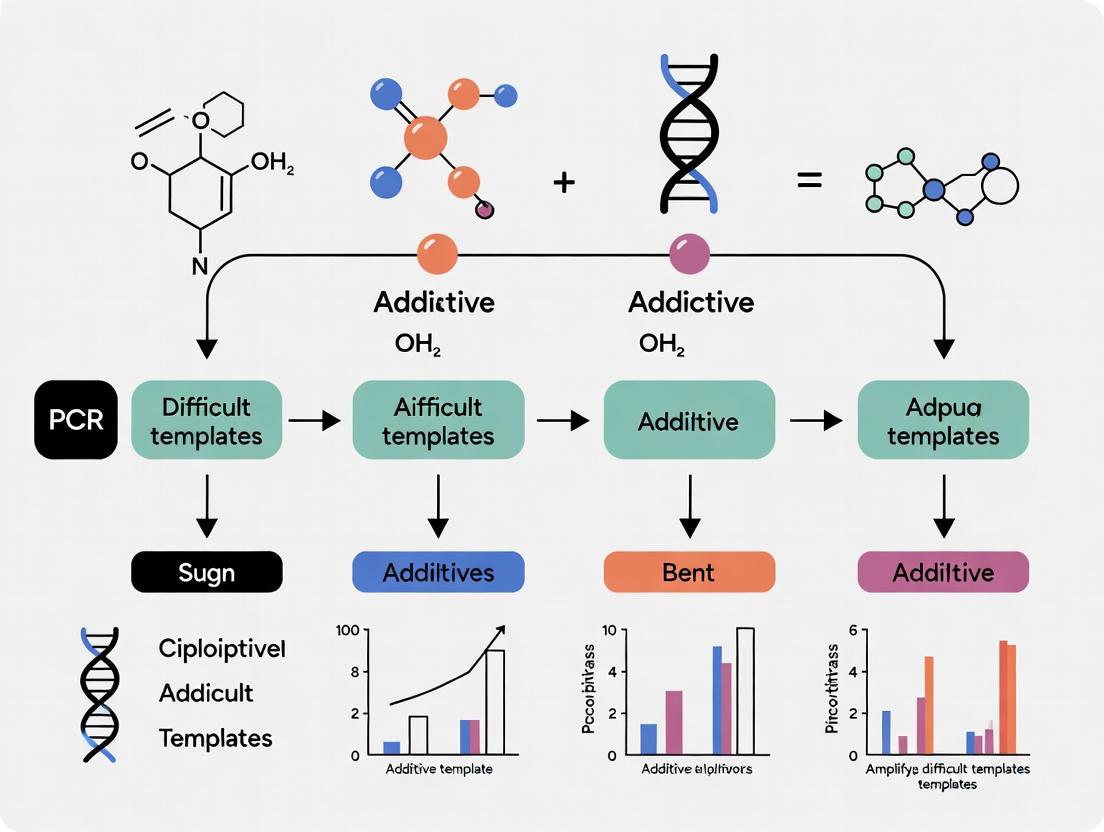
Amplifying difficult DNA templates, such as those with high GC content, complex secondary structures, or from inhibitor-rich samples, remains a significant challenge in molecular biology and bioanalysis.
PCR Additives for Difficult Templates: A Comprehensive Guide to Mechanisms, Optimization, and Validation
Abstract
Amplifying difficult DNA templates, such as those with high GC content, complex secondary structures, or from inhibitor-rich samples, remains a significant challenge in molecular biology and bioanalysis. This article provides researchers, scientists, and drug development professionals with a systematic framework for selecting and using PCR additives to overcome these hurdles. We explore the foundational mechanisms of common and novel enhancers, detail methodological applications for specific template types, present a step-by-step troubleshooting and optimization protocol, and discuss validation strategies for regulated environments. By comparing the efficacy of traditional agents like betaine and DMSO against newer alternatives and proprietary cocktails, this guide serves as an essential resource for improving PCR success rates in critical research and diagnostic applications.
Understanding Difficult Templates and How PCR Additives Work
In polymerase chain reaction (PCR) amplification, 'difficult' templates present unique challenges that can lead to amplification failure, reduced yield, or nonspecific products. These templates are characterized by high guanine-cytosine (GC) content (>60%), propensity to form stable secondary structures, and extended length [1] [2] [3]. The inherent stability of GC-rich sequences stems primarily from base stacking interactions rather than hydrogen bonding alone, making them remarkably resistant to denaturation at standard PCR temperatures [3]. This stability facilitates the formation of secondary structures such as hairpin loops that can block polymerase progression and prevent primer annealing [1] [2]. When combined with long amplicon targets, these factors create a perfect storm of technical challenges that require specialized approaches for successful amplification. Understanding the molecular basis of these difficulties is essential for selecting appropriate optimization strategies, whether for basic research, diagnostic applications, or drug development projects.
Molecular Mechanisms Underlying PCR Difficulties
Thermodynamic Stability of GC-Rich Regions
GC-rich DNA sequences pose significant challenges due to the triple hydrogen bonding between guanine and cytosine bases, compared to the double hydrogen bonding in AT base pairs [2]. This increased bonding creates exceptionally thermostable regions that require more energy for denaturation [2]. The stability is further enhanced by base stacking interactions, where the flat surfaces of nucleobases interact through van der Waals forces and polarizability [3]. This stacking is particularly efficient between G and C bases, creating regions that resist strand separation even at elevated temperatures. Consequently, organisms like Thermus thermophilus, which thrive in high-temperature environments, have evolved GC-rich genomes to maintain genetic stability [3]. In PCR applications, this stability translates to incomplete template denaturation during standard cycling conditions, resulting in failed amplification or significantly reduced yields.
Secondary Structure Formation and Polymerase Blockage
Beyond simple thermodynamic stability, GC-rich regions readily form complex secondary structures that impede amplification. Hairpin structures are particularly problematic, where a single DNA strand folds back on itself to create stable stem-loop configurations [1] [3]. These structures occur when complementary sequences within the same strand align, with GC-rich stems forming exceptionally stable configurations due to their triple hydrogen bonds. DNA polymerases frequently stall when encountering these structures, leading to truncated amplification products [2]. Additionally, primers designed for GC-rich targets themselves tend to form self-dimers, cross-dimers, and secondary structures that reduce their effective concentration and annealing efficiency [3]. The 3' ends of primers with high GC content are especially prone to mispriming due to these interactions, further compromising amplification specificity and efficiency.
Challenges in Long Amplicon Amplification
Amplification efficiency decreases significantly as amplicon size increases beyond 5kb, with yields dropping substantially for longer fragments [4]. This reduction occurs due to the accumulation of truncated products that cannot serve as suitable substrates for subsequent amplification cycles [4]. The probability of polymerase stalling increases with template length, particularly when complex secondary structures are present throughout the extended region. In standard PCR, this stalling results in shorter incomplete molecules that appear as smeared bands rather than discrete products on electrophoresis gels [4]. For GC-rich long templates, these challenges are compounded, as the polymerase must navigate both extensive secondary structures and the increased likelihood of dissociation over extended elongation distances.
Experimental Evidence: Systematic Analysis of Difficult Templates
Comparative Performance of PCR Enzymes
Table 1: Polymerase Performance Comparison for GC-Rich Amplification
| Polymerase | Fidelity Relative to Taq | Maximum GC% | Recommended Additives | Best Application |
|---|---|---|---|---|
| Standard Taq | 1x | ~60% | None | Routine amplifications |
| OneTaq | 2x | 80% | GC Buffer, High GC Enhancer | GC-rich templates |
| Q5 High-Fidelity | >280x | 80% | Q5 High GC Enhancer | GC-rich, long, or difficult amplicons |
| PrimeSTAR GXL | High | >77.5% | DMSO, Betaine | Lengthy GC-rich targets |
Research systematically comparing polymerase performance demonstrates that enzyme selection critically impacts success with difficult templates. In studies amplifying Mycobacterium bovis genes (GC content >60%), PrimeSTAR GXL polymerase with specific enhancers successfully amplified 51 GC-rich targets where conventional polymerases failed [1]. Similarly, New England Biolabs' internal testing revealed that while a 73% GC amplicon required OneTaq with GC Buffer and High GC Enhancer for robust amplification, an 80% GC amplicon did not require the enhancer, illustrating that GC percentage alone doesn't always predict amplification difficulty [5].
Quantitative Effects of Reaction Components
Table 2: Optimal Reaction Conditions for Difficult Templates
| Component | Standard PCR | GC-Rich PCR | Evidence Source |
|---|---|---|---|
| MgCl₂ Concentration | 1.5-2.0 mM | 1.5-3.0 mM (template-dependent) | Meta-analysis of 61 studies [6] |
| DMSO | Not typically used | 5-10% | EGFR promoter optimization [7] |
| Betaine | Not typically used | 0.5-2.0 M | GC-rich protocol development [1] |
| Annealing Temperature | Calculated Tm | 5-7°C above calculated Tm | EGFR promoter study [7] |
| Template DNA | 0.1-50 ng | ≥2 μg/ml for FFPE samples | FFPE tissue optimization [7] |
A comprehensive meta-analysis of 61 studies established quantitative relationships between MgCl₂ concentration and PCR efficiency, demonstrating a logarithmic relationship between MgCl₂ concentration and DNA melting temperature [6]. Within the optimal range of 1.5-3.0 mM, every 0.5 mM increase in MgCl₂ raised the melting temperature by approximately 1.2°C [6]. Template complexity significantly influenced optimal MgCl₂ requirements, with genomic DNA templates requiring higher concentrations than simpler templates [6]. Research on the EGFR promoter region (GC content up to 88%) further established that successful amplification required at least 2 μg/ml DNA concentration and 5% DMSO in addition to optimized MgCl₂ concentrations of 1.5-2.0 mM [7].
Alternative Additives for GC-Rich Amplification
While DMSO and betaine represent the most common additives for difficult templates, research has identified alternatives with potentially superior performance in certain contexts. A systematic evaluation of 104 GC-rich human genomic amplicons (60-80% GC content, 700-800 bp) found that 1,2-propanediol (0.816M) and ethylene glycol (1.075M) outperformed betaine (2.2M), successfully amplifying 90% and 87% of targets respectively compared to 72% with betaine [8]. Interestingly, betaine exhibited a PCR inhibitive effect in some reactions, failing even when the alternative additives succeeded [8]. The mechanism of action for these alternatives appears to differ from betaine, potentially through differential affinities to single-stranded versus double-stranded DNA that better facilitate denaturation of problematic sequences.
Methodologies: Optimized Protocols for Difficult Templates
Two-Step PCR with Slow Ramping
The two-step PCR protocol has demonstrated superior performance for amplifying lengthy GC-rich targets compared to conventional three-step approaches [1]. This method combines annealing and extension steps at higher temperatures while implementing reduced ramp speeds to facilitate proper primer binding and polymerase progression.
Protocol:
- Initial Denaturation: 98°C for 2-10 minutes
- Amplification Cycles (35-40 cycles):
- Denaturation: 98°C for 10-30 seconds
- Combined Annealing/Extension: 68°C for 1 minute per kb
- Final Extension: 68°C for 5-10 minutes
- Hold: 4°C
Critical Parameters:
- Use high-fidelity DNA polymerases with proofreading activity
- Incorporate enhancer mixtures (DMSO, betaine, or commercial formulations)
- Implement slow ramp rates between denaturation and annealing/extension steps (approximately 1-2°C per second)
- Adjust cycle number based on template difficulty (up to 45 cycles for extremely challenging targets) [1] [7]
This protocol was successfully applied to amplify Mycobacterium bovis genes up to 1794 bp with 77.5% GC content, where conventional methods consistently failed [1].
Enhanced Polymerase Formulations for Problematic Templates
Specialized polymerase formulations have been developed specifically to address challenging amplification scenarios:
Long-Range PCR Protocol: For fragments >5kb, a dual-polymerase approach combining non-proofreading and proofreading enzymes significantly improves yields [4]. The non-proofreading polymerase provides high processivity, while the proofreading enzyme (present at reduced concentration) removes misincorporated nucleotides that would otherwise terminate elongation [4].
GC-Rich Optimized Protocol: Commercial systems like OneTaq GC Buffer with High GC Enhancer or Q5 High GC Enhancer provide optimized conditions for problematic templates [2]. These systems incorporate proprietary additive combinations that reduce secondary structure formation and increase primer stringency simultaneously [2].
Hot-Start Methods: Hot-start PCR improves amplification specificity by preventing primer extension until elevated temperatures are reached [4]. This approach reduces nonspecific amplification and primer-dimer formation by maintaining polymerase inactivity during reaction setup [4]. Modern implementations use antibody-mediated inhibition or chemical modification that automatically reverses at initial denaturation temperatures, eliminating manual intervention requirements.
Research Reagent Solutions for Difficult Templates
Table 3: Essential Reagents for Challenging Amplifications
| Reagent Category | Specific Examples | Function | Application Notes |
|---|---|---|---|
| Specialized Polymerases | OneTaq DNA Polymerase, Q5 High-Fidelity DNA Polymerase, PrimeSTAR GXL | Enhanced processivity on structured templates, higher fidelity | Select based on GC content and length requirements [2] |
| PCR Additives | DMSO (5-10%), Betaine (0.5-2.0M), Ethylene glycol (1.075M), 1,2-propanediol (0.816M) | Reduce secondary structure formation, decrease melting temperature | Test multiple additives systematically; effects are target-dependent [1] [8] |
| Enhancer Systems | OneTaq High GC Enhancer, Q5 High GC Enhancer | Proprietary formulations to inhibit secondary structures | Commercial formulations often outperform individual additives [2] |
| Template Preparation | High-quality genomic DNA, FFPE-specific extraction kits | Provide sufficient template quantity and purity | FFPE samples require higher DNA input (≥2 μg/ml) [7] |
| Modified Nucleotides | 7-deaza-2'-deoxyguanosine | dGTP analog that improves yield of GC-rich regions | Does not stain well with ethidium bromide [2] |
Successful amplification of difficult templates requires a multifaceted approach addressing both the biochemical challenges of GC-rich sequences and the practical limitations of PCR technology. The experimental evidence consistently demonstrates that no single solution applies to all challenging amplifications, necessitating systematic optimization of enzyme selection, reaction components, and cycling parameters. The most reliable results emerge from combining specialized polymerase formulations with empirically determined additive concentrations and modified thermal cycling conditions. Researchers facing these challenges should implement a stepwise optimization strategy beginning with enzyme selection, proceeding through additive screening, and finally refining reaction conditions and cycling parameters. This systematic approach, supported by the growing repertoire of specialized reagents and protocols, has significantly expanded the range of templates accessible to routine PCR amplification, enabling research and diagnostic applications previously hampered by technical limitations. As our understanding of polymerase biochemistry and DNA thermodynamics advances, further refinements will continue to push the boundaries of amplifiable sequences, supporting increasingly sophisticated genetic analyses across diverse scientific disciplines.
The Essential Role of Magnesium Ions and Standard Buffer Components
In polymerase chain reaction (PCR) technology, the precise composition of reaction buffers plays a critical role in determining experimental success. While various specialized additives have been developed to overcome specific amplification challenges, magnesium ions (Mg²⁺) remain the fundamental component of any PCR buffer system. This review systematically compares the essential role of magnesium ions against alternative PCR enhancers, providing researchers with evidence-based guidance for optimizing reactions, particularly when working with difficult templates. Within the broader context of PCR additives research, understanding the mechanistic basis and optimal application of both standard and specialized components enables more rational protocol design and troubleshooting strategies for scientists in diagnostic development and basic research.
The Fundamental Role of Magnesium Ions in PCR
Magnesium ions serve as an indispensable cofactor for DNA polymerase activity, playing multiple essential roles in the PCR reaction mechanics. Functioning at the enzymatic level, Mg²⁺ catalyzes the formation of phosphodiester bonds between the 3′-OH group of the primer and the phosphate group of the incoming dNTP during DNA strand elongation [9] [10]. This catalytic function occurs directly at the enzyme's active site, making magnesium absolutely required for polymerase function. Beyond its catalytic role, Mg²⁺ also stabilizes the interaction between primers and DNA templates by neutralizing negative charges on the phosphate backbones of both DNA strands, thereby facilitating proper primer-template complex formation [9] [10]. This dual functionality makes magnesium concentration one of the most critical parameters for PCR optimization.
The optimal concentration range for MgCl₂ in PCR has been quantitatively established through systematic meta-analysis of numerous optimization studies. As summarized in Table 1, the efficient performance range falls between 1.5–3.0 mM for most applications, with specific template types influencing the exact requirement within this range [6]. This comprehensive analysis revealed a logarithmic relationship between MgCl₂ concentration and DNA melting temperature, with every 0.5 mM increase in MgCl₂ within the optimal range associated with an approximately 1.2°C increase in melting temperature [6]. This thermodynamic effect significantly impacts reaction specificity and amplification efficiency, necessitating precise optimization.
Table 1: Optimal Magnesium Chloride Concentrations for Different Template Types
| Template Type | Recommended [MgCl₂] | Key Considerations | Primary Effect |
|---|---|---|---|
| Genomic DNA | 2.0–3.0 mM | Higher complexity requires increased concentration | Enhanced primer binding and processivity |
| Plasmid DNA | 1.5–2.5 mM | Lower complexity allows reduced concentration | Balanced efficiency and specificity |
| GC-Rich Templates | 2.5–3.5 mM | May require elevated concentrations | Improved strand separation |
| Long Amplicons (>5 kb) | 2.0–3.0 mM | Balance between yield and fidelity | Enhanced polymerase processivity |
The interplay between magnesium ions and other reaction components introduces additional complexity to buffer optimization. Mg²⁺ binds to dNTPs in solution, effectively reducing the availability of both free magnesium and free nucleotides for the PCR reaction [9] [10]. This binding relationship necessitates balanced optimization of both components, as increasing dNTP concentrations will require proportional increases in MgCl₂ to maintain adequate free Mg²⁺ for polymerase function. The estimated Michaelis constant (Km) for dNTPs is approximately 0.010–0.015 mM, establishing the minimum free dNTP concentration required for efficient incorporation [10]. This delicate balance exemplifies the critical importance of magnesium homeostasis in PCR biochemistry.
Comparative Analysis of PCR Additives
Specialized Additives for Challenging Templates
While magnesium provides the foundation for PCR amplification, specialized additives have been developed to address specific amplification challenges, particularly with difficult templates. These enhancers operate through diverse mechanistic pathways to facilitate amplification of GC-rich sequences, long amplicons, or templates with complex secondary structures. Table 2 provides a comprehensive comparison of major PCR additive categories, their mechanisms of action, and optimal application contexts.
Table 2: Comparative Analysis of Major PCR Additives and Enhancers
| Additive | Mechanism of Action | Optimal Concentration | Primary Applications | Key Limitations |
|---|---|---|---|---|
| DMSO | Disrupts base pairing, reduces DNA melting temperature | 1–10% (v/v) | GC-rich templates (>65% GC), secondary structures | Can inhibit polymerase at higher concentrations |
| Betaine | Equalizes GC/AT stability, reduces Tm difference | 0.5–2.0 M | GC-rich templates, long amplicons | May inhibit specific reactions |
| Ethylene Glycol | Decreases DNA melting temperature | 1.075 M | GC-rich templates (superior to betaine for some targets) | Mechanism not fully understood |
| 1,2-Propanediol | Alternative DNA melting modifier | 0.816 M | GC-rich templates (90% success in one study) | Less established than traditional additives |
| Trehalose | Thermal stabilization of enzymes, inhibitor neutralization | Varies by application | Enzyme stabilization, inhibitor-containing samples | |
| BSA | Binds inhibitors, stabilizes proteins | 0.1–0.8 μg/μL | Inhibitor-rich samples (blood, soil), direct PCR | May interfere with downstream applications |
| Commercial Enhancer Mixes | Multiple mechanisms | Manufacturer specified | Complex templates, standardized protocols | Proprietary formulations |
The efficacy of these additives was quantitatively demonstrated in a study examining 104 GC-rich human genomic amplicons (60–80% GC content, 700–800 bp length). While only 13% of these difficult targets amplified without enhancers, success rates dramatically increased to 72% with betaine, 87% with ethylene glycol, and 90% with 1,2-propanediol [8]. This comparative performance highlights how additive selection can determine experimental success with challenging templates. Interestingly, the study also noted that betaine occasionally exhibited inhibitory effects in certain reactions, emphasizing the need for empirical optimization even with established enhancers [8].
Additive Selection Framework
Choosing the appropriate additive requires systematic consideration of the specific amplification challenge. For GC-rich templates (>65% GC content) which form stable secondary structures that impede polymerase progression, additives like DMSO, betaine, ethylene glycol, and 1,2-propanediol have proven most effective by reducing DNA melting temperature and destabilizing these structures [8] [11] [12]. For samples containing PCR inhibitors such as hematin (blood), humic acid (soil), or metal ions, protein-based additives like BSA or specialized agents like trehalose can neutralize these effects by binding inhibitory substances or stabilizing the polymerase [12] [13]. When amplifying long fragments (>5 kb) where polymerase processivity is limiting, betaine and trehalose can enhance enzyme stability and performance [11] [13]. For direct PCR applications without nucleic acid purification, combination approaches using BSA, detergents, and enzyme stabilizers are often necessary to overcome diverse inhibitors present in crude samples [11].
The following decision framework illustrates the logical relationship between template challenges and appropriate additive selection:
Experimental Comparison and Methodologies
Standardized Testing Protocol for Additive Evaluation
To objectively compare PCR additive performance, researchers should employ standardized experimental protocols that isolate specific enhancement effects. The following methodology provides a framework for systematic evaluation:
Template Preparation: Select a range of challenging templates including high-GC sequences (>70% GC), long amplicons (>5 kb), and inhibitor-containing samples. Use quantified DNA standards to ensure consistent input amounts (typically 1–10 ng for plasmid DNA, 10–50 ng for genomic DNA) [9] [10]. For metal inhibition studies, prepare stock solutions of metal ions (e.g., 40 mM CuSO₄, FeSO₄, ZnCl₂) in molecular-grade water and dilute to appropriate test concentrations [14].
Reaction Setup: Establish a master mix containing all standard PCR components: 1× reaction buffer, 0.2 mM each dNTP, 0.3–0.5 μM primers, 0.5–1 U DNA polymerase, and template DNA [9] [10]. Distribute equal aliquots to individual reaction tubes, then add test additives at predetermined concentrations. Include negative controls without additives and positive controls with known effective enhancers.
Cycling Conditions: Apply optimized thermal cycling parameters based on template characteristics. For GC-rich templates: initial denaturation at 98°C for 2 min; 30–40 cycles of denaturation at 98°C for 10–30 s, annealing at 60–68°C for 15–30 s, extension at 72°C for 30–60 s/kb; final extension at 72°C for 5–10 min [11]. For inhibitor testing, consider extending extension times or increasing cycle numbers to compensate for potential reaction slowdown.
Analysis Methods: Quantify results using multiple metrics: gel electrophoresis for amplicon specificity (1% agarose in TAE buffer, 120V for 35–40 min) [14]; qPCR for amplification efficiency (quantification cycle values and curve shapes) [15]; and spectrophotometry for yield quantification. Calculate enhancement factors relative to non-enhanced controls.
Magnesium Versus Metal Ion Interference
The critical importance of magnesium optimization becomes particularly evident when examining its interaction with inhibitory metal ions. A systematic study investigating nine common metal contaminants revealed that zinc, tin, iron(II), and copper demonstrated the strongest inhibitory properties, with IC₅₀ values significantly below 1 mM [14]. These metal ions interfere with PCR through multiple mechanisms, including competitive binding to DNA polymerase active sites (calcium competes with magnesium), formation of protein-DNA crosslinks, and direct DNA damage [14].
This competitive relationship between essential and inhibitory metal ions can be visualized as follows:
Counterstrategies for metal ion inhibition include magnesium concentration optimization (1.5–3.0 mM), use of metal chelators like EGTA specifically for calcium-induced inhibition, and selection of metal-resistant DNA polymerases such as KOD polymerase, which demonstrated superior resistance to metal inhibition compared to Q5 and Taq polymerases [14].
Research Reagent Solutions for PCR Optimization
Table 3: Essential Research Reagents for PCR Enhancement Studies
| Reagent Category | Specific Examples | Primary Function | Application Notes |
|---|---|---|---|
| DNA Polymerases | KOD, Q5, Taq | DNA strand elongation | KOD shows superior metal resistance [14] |
| Magnesium Salts | MgCl₂, MgSO₄ | Essential polymerase cofactor | Concentration critical (1.5–3.0 mM optimal) [6] |
| PCR Enhancers | DMSO, betaine, ethylene glycol | Modify DNA melting behavior | Concentration-dependent effects [8] [12] |
| Stabilizing Agents | BSA, trehalose | Protect enzyme activity | Trehalose stabilizes Taq polymerase [13] |
| Detergents | Tween-20, Triton X-100 | Improve mix homogeneity | Reduce surface tension, aid mixing [12] |
| Metal Chelators | EGTA, EDTA | Counteract metal inhibition | EGTA specifically reverses Ca²⁺ inhibition [14] |
The comparative analysis of magnesium ions and specialized PCR additives reveals a hierarchical optimization strategy for challenging amplification scenarios. Magnesium ions represent the non-negotiable foundation of PCR biochemistry, with concentration optimization (1.5–3.0 mM) providing the primary mechanism for enhancing reaction efficiency and specificity [6]. Specialized additives including DMSO, betaine, ethylene glycol, and trehalose serve as secondary enhancement tools that address specific template challenges such as high GC content, secondary structures, and inhibitor presence [8] [12] [13]. The most effective approach combines systematic magnesium titration with selective additive incorporation based on template-specific characteristics, supported by the use of enhanced DNA polymerases like KOD for particularly challenging conditions involving metal contaminants [14]. This structured optimization framework provides researchers with an evidence-based pathway to overcome even the most difficult amplification barriers.
Polymersse chain reaction (PCR) stands as one of the most pivotal techniques in modern molecular biology, yet amplification of difficult DNA targets remains a significant challenge for researchers. GC-rich sequences, long amplicons, and samples contaminated with inhibitors frequently lead to amplification failure or reduced efficiency. PCR enhancers—diverse chemical additives that modify the reaction environment—provide powerful solutions to these problems through three core mechanisms: destabilizing DNA secondary structures, stabilizing enzymatic components, and countering PCR inhibitors. This guide provides a systematic comparison of PCR enhancer performance, supported by experimental data, to inform researchers and drug development professionals in selecting optimal additives for their specific applications, particularly when working with difficult templates.
Core Mechanisms of Action
PCR enhancers overcome amplification barriers through distinct but sometimes overlapping biochemical pathways. Understanding these mechanisms provides a rational basis for selecting appropriate additives for specific challenges.
Destabilizing DNA Secondary Structures
Many PCR enhancers function primarily by altering the physical properties of DNA to prevent the formation of stable secondary structures that impede polymerase progression.
Betaine, also known as trimethylglycine, is particularly effective for GC-rich templates due to its DNA-destabilizing properties. As a zwitterionic osmolyte, betaine reduces the melting temperature (Tm) of DNA by neutralizing base stacking forces, thereby ensuring thorough denaturation of templates and preventing stable secondary structure formation [16] [17]. This mechanism is crucial for amplifying GC-rich regions where strong hydrogen bonding between guanine and cytosine bases creates particularly stable structures.
Dimethyl sulfoxide (DMSO) and formamide also function through Tm reduction, though their mechanisms differ. These polar solvents disrupt hydrogen bonding networks and base stacking interactions, effectively destabilizing DNA duplexes [18]. While beneficial for difficult templates, these additives can thermal destabilize enzymes and inhibit PCR when used at high concentrations [16].
Ethylene glycol (EG) and 1,2-propanediol (1,2-PG) represent another class of DNA-destabilizing agents. Research indicates these compounds may decrease DNA melting temperature through mechanisms distinct from betaine, potentially offering advantages for specific template types [8].
Stabilizing Enzymatic Components
Beyond DNA effects, several enhancers protect and stabilize the enzymatic components of PCR, particularly thermostable DNA polymerases.
Trehalose and sucrose, classified as "sweet enhancers," function as thermal stabilizers for DNA polymerases. These disaccharides form hydrogen bonds with enzyme molecules, creating a protective hydration shell that prevents thermal denaturation during high-temperature cycling [16] [17]. This stabilization extends the half-life of DNA polymerases at elevated temperatures, crucial for amplifying long fragments.
Glycerol similarly protects enzymes from degradation through its stabilizing effect, though at higher concentrations it may also reduce the stringency of primer annealing [18].
Nanoparticles represent a novel approach to enzyme stabilization. Gold nanoparticles (Au NPs), carbon nanotubes (CNTs), graphene, and other nanomaterials enhance PCR through multiple mechanisms including improved thermal conductivity, catalytic features, and interactions similar to single-stranded DNA-binding proteins (SSBs) [19]. Their high surface-to-volume ratios and dense surface electric charge enable unique interactions with PCR components.
Countering PCR Inhibitors
The third mechanism involves protection against diverse PCR inhibitors present in clinical, environmental, or forensic samples.
Protein-based additives including T4 gene 32 protein (gp32) and Bovine Serum Albumin (BSA) counteract inhibition by binding to inhibitory substances such as humic acids, polyphenols, and polysaccharides that would otherwise interfere with polymerase activity [18]. These proteins essentially sequester inhibitors, preventing their interaction with PCR components.
Betaine and trehalose again demonstrate multifunctionality, showing enhanced PCR efficiency in the presence of inhibitors such as blood and heparin [16].
Non-ionic detergents including Tween-20 help relieve inhibition in complex matrices like feces by counteracting inhibitory effects on Taq DNA polymerase, though the precise mechanisms remain under investigation [18].
Figure 1: Three primary mechanisms of PCR enhancers. Some additives like betaine function through multiple mechanisms.
Comparative Performance Analysis
Systematic comparison of PCR enhancers across different template types and challenging conditions provides valuable insights for evidence-based selection.
Performance Across GC Content Ranges
A comprehensive study evaluated nine enhancers across DNA fragments with moderate (53.8%), high (68.0%), and very high (78.4%) GC content, with results measured by quantitative PCR cycle threshold (Ct) values [16] [17]. Lower Ct values indicate more efficient amplification.
Table 1: Effect of PCR Enhancers on Amplification Efficiency Across Different GC Content Templates
| Enhancer | Concentration | 53.8% GC (Ct) | 68.0% GC (Ct) | 78.4% GC (Ct) |
|---|---|---|---|---|
| Control | - | 15.84±0.05 | 15.48±0.22 | 32.17±0.25 |
| DMSO | 5% | 16.68±0.01 | 15.72±0.03 | 17.90±0.05 |
| Formamide | 5% | 18.08±0.07 | 15.44±0.03 | 16.32±0.05 |
| Ethylene Glycol | 5% | 16.28±0.06 | 15.27±0.08 | 17.24±0.04 |
| Glycerol | 5% | 16.13±0.01 | 15.16±0.04 | 16.89±0.12 |
| 1,2-PG | 5% | 16.44±0.12 | 15.45±0.03 | 17.37±0.08 |
| Sucrose | 0.4 M | 16.39±0.09 | 15.03±0.04 | 16.67±0.08 |
| Trehalose | 0.4 M | 16.43±0.16 | 15.15±0.08 | 16.91±0.14 |
| Betaine | 0.5 M | 16.03±0.03 | 15.08±0.10 | 16.97±0.09 |
The data reveals several key patterns. First, most enhancers slightly reduced amplification efficiency for moderate GC-content templates (increased Ct values compared to control). However, for the challenging 78.4% GC template, all enhancers dramatically improved amplification (substantially lower Ct values). Betaine demonstrated balanced performance across all GC levels, while sucrose and trehalose showed particularly strong enhancement for high GC content with minimal negative impact on normal templates [16].
Enzyme Thermostabilization and Inhibitor Resistance
Beyond GC-rich amplification, enhancers were evaluated for Taq DNA polymerase thermostability and resistance to heparin inhibition [16].
Table 2: Enhancer Performance in Enzyme Stabilization and Inhibitor Resistance
| Enhancer | Thermostability | Heparin Resistance | Overall Performance |
|---|---|---|---|
| Betaine | Excellent | Excellent | Best overall |
| Sucrose | Good | Good | Minimal negative effect |
| Trehalose | Good | Good | Minimal negative effect |
| DMSO | Poor (destabilizes) | Moderate | Concentration critical |
| Formamide | Poor (destabilizes) | Moderate | Concentration critical |
| Glycerol | Moderate | Moderate | Moderate enhancement |
Betaine emerged as the top performer in both thermostabilization and inhibitor tolerance. Sucrose and trehalose showed similar stabilizing effects with the mildest inhibitory effect on normal PCR. Notably, DMSO and formamide actually thermal destabilize enzymes at higher concentrations, highlighting the importance of concentration optimization [16].
Wastewater Inhibitor Resistance
Evaluation of enhancers in wastewater samples—notoriously challenging due to diverse inhibitors—revealed distinctive patterns [18]. From eight approaches tested, only four successfully eliminated false negative results: 10-fold sample dilution, T4 gp32 protein addition, BSA addition, and commercial inhibitor removal kits. Among chemical enhancers, T4 gp32 protein at 0.2 μg/μl provided the most significant improvement for inhibitor-rich wastewater samples.
Experimental Protocols and Methodologies
To facilitate replication and standardization, we detail key experimental methodologies from cited studies.
Real-Time PCR Enhancement Protocol
The systematic comparison of enhancers across GC content ranges employed the following standardized protocol [16] [17]:
Template DNA:
- Moderate GC (53.8%): pBluescript II KS (-) plasmid (0.1 ng/μl)
- High GC (68.0%): Mouse Olig2 gene plasmid (0.1 ng/μl)
- Very high GC (78.4%): Mouse Olig2 gene plasmid (0.1 ng/μl)
Primer Design:
- 15-30 nucleotides in length
- Tm 55-70°C (within 5°C for primer pairs)
- 40-60% GC content with uniform distribution
- Avoidance of secondary structures and 3' end complementarity
Reaction Composition:
- FastSYBR Mixture in 20 μl reaction volume
- Primers: 0.4 μM each
- Template: 1 μl plasmid DNA
- Enhancers: At concentrations specified in Table 1
Thermal Cycling Conditions:
- Initial denaturation: 95°C for 1 minute
- 40 cycles of:
- Denaturation: 95°C for 15 seconds
- Annealing: 52°C (moderate GC) or 60°C (GC-rich) for 30 seconds
- Extension: 72°C for 30 seconds
- Melt curve analysis: 72°C to 96°C in 0.1°C increments
Data Analysis:
- Cycle threshold (Ct) values recorded in triplicate
- Melt curve analysis for amplification specificity
Inhibitor Resistance Assessment
The protocol for evaluating enhancer effects on inhibitor resistance methodology included [16]:
Template and Reagents:
- pBluescript II KS (-) plasmid (0.1 ng/μl)
- M13 forward and reverse primers (0.2 μM each)
- dNTPs (0.2 mM)
- Taq DNA polymerase (1 unit)
- Heparin inhibitor (0.0023 U or 0.0047 U)
Experimental Conditions:
- Thermostability: Preheating Taq polymerase at 95°C for 15-30 minutes with/without enhancers
- Inhibitor resistance: Adding heparin with/without enhancers
- Standard PCR program: Initial denaturation 95°C/3 min, 35 cycles of 95°C/30 sec, 55°C/15 sec, 72°C/30 sec, final extension 72°C/10 min
Figure 2: Experimental workflow for systematic evaluation of PCR enhancers.
The Scientist's Toolkit: Essential Research Reagents
Successful implementation of PCR enhancement strategies requires carefully selected reagents and methodologies. This toolkit summarizes key solutions for addressing amplification challenges.
Table 3: Research Reagent Solutions for PCR Enhancement
| Reagent/Category | Specific Examples | Primary Function | Optimal Concentration |
|---|---|---|---|
| DNA Destabilizers | Betaine, DMSO, Formamide, EG, 1,2-PG | Reduce DNA melting temperature, prevent secondary structures | Betaine: 0.5-1 MDMSO: 2.5-5%EG: 2.5-5% |
| Enzyme Stabilizers | Trehalose, Sucrose, Glycerol | Protect DNA polymerase from thermal denaturation | Trehalose: 0.2-0.4 MSucrose: 0.2-0.4 MGlycerol: 2.5-5% |
| Inhibitor Counters | T4 gp32 Protein, BSA, Tween-20 | Bind inhibitory substances in complex samples | gp32: 0.2 μg/μlBSA: 0.1-0.5 μg/μl |
| Nanomaterials | Gold Nanoparticles, Carbon Nanotubes, Graphene Oxide | Enhance thermal conductivity, interact with PCR components | Varies by type and size (see reference [19]) |
| Commercial Kits | Inhibitor Removal Columns | Remove polyphenolic compounds, humic acids, tannins | Manufacturer specifications |
Based on the comprehensive comparison of PCR enhancers, we recommend strategic selection based on specific application requirements:
For GC-rich templates, betaine (0.5-1 M) provides the most consistent performance across varying GC levels, while sucrose (0.4 M) offers strong enhancement with minimal negative effects on normal templates. For extremely GC-rich regions (>78%), optimized combinations such as 0.5 M betaine + 0.2 M sucrose or 1 M betaine + 0.1 M sucrose provide effective amplification while minimizing negative effects [16].
For inhibitor-rich samples like wastewater or clinical specimens, T4 gp32 protein (0.2 μg/μl) demonstrates superior performance, though simple 10-fold dilution or BSA addition also provide significant improvement [18].
For long amplicon amplification, enzyme-stabilizing additives like trehalose and sucrose are particularly valuable for maintaining polymerase activity throughout extended cycling.
The optimal enhancer concentration represents a balance between beneficial effects and potential inhibition. Researchers should employ systematic optimization when working with novel template types or sample sources. Furthermore, combination approaches often yield superior results to single additives, leveraging complementary mechanisms while minimizing individual limitations.
This comparative guide provides evidence-based recommendations, but researchers should consider empirical optimization for their specific experimental systems, as template, enzyme, and sample characteristics all influence enhancer efficacy.
The polymerase chain reaction (PCR) stands as one of the most pivotal techniques in molecular biology, enabling the amplification of specific DNA sequences from minimal starting material [4]. Despite its widespread application and robustness, amplification efficiency can be drastically reduced when dealing with "difficult" templates, particularly those with high GC content (exceeding 60%) [20] [21]. Such GC-rich sequences form stable secondary structures due to the three hydrogen bonds between G and C bases, preventing complete denaturation and impairing primer annealing and polymerase extension [21]. This challenge is frequently encountered in various research fields, from genetic identity testing and forensics to commercial in vitro diagnostics [4].
To overcome these amplification barriers, scientists routinely employ PCR additives—chemical agents that modify the reaction environment to facilitate more efficient and specific DNA amplification [22]. These additives work through distinct mechanisms, such as reducing secondary structure formation, minimizing non-specific priming, or neutralizing inhibitors [23]. Among the most widely used traditional additives are betaine, dimethyl sulfoxide (DMSO), formamide, and bovine serum albumin (BSA). This guide provides an objective comparison of these four key additives, presenting experimental data and protocols to help researchers and drug development professionals select the optimal reagents for their specific PCR challenges, particularly when working with recalcitrant templates.
Additive Mechanisms and Comparative Profiles
PCR additives enhance amplification through different biochemical mechanisms, which can be broadly categorized based on their primary mode of action. Understanding these mechanisms is crucial for rational additive selection and optimization.
Additives that reduce secondary structures: Betaine, DMSO, and non-ionic detergents primarily function by disrupting the stable secondary structures that form in GC-rich templates [22]. Betaine, an osmoprotective agent, improves amplification efficiency by interacting with negatively charged groups on the DNA strand, reducing electrostatic repulsion and thereby minimizing secondary structure formation [23]. It also increases PCR specificity by eliminating the base pair composition dependence of DNA melting, effectively equalizing the stability of AT and GC base pairs [22]. DMSO operates through a different mechanism, interacting with water molecules surrounding the DNA strand to reduce hydrogen bonding, which subsequently lowers the melting temperature (Tm) of DNA [23]. This effect allows DNA strands to denature at lower temperatures, facilitating primer binding to template DNA and DNA polymerase elongation [22].
Additives that reduce non-specific priming: Formamide belongs to this category, working by binding to the major and minor grooves of DNA, destabilizing the template double-helix and lowering its melting temperature [22]. This action promotes more specific binding of primers to template DNA, reducing the occurrence of non-specific amplification products that commonly plague difficult PCR reactions [23].
Additives that combat contaminants: BSA functions primarily as a protective agent in PCR reactions, binding and removing inhibitors such as phenolic compounds that may be present in the reaction system [23]. By neutralizing these potential inhibitors, BSA safeguards polymerase activity and stability. Additionally, BSA reduces the adhesion of reaction components to tube walls, thereby increasing overall PCR efficiency and yield [23]. Research has demonstrated that BSA can provide particularly strong enhancing effects when used in combination with organic solvents like DMSO or formamide for GC-rich templates, with the enhancing effect most pronounced in the initial PCR cycles [20].
The following workflow diagram illustrates the decision-making process for selecting and combining these additives based on template characteristics and desired outcomes:
Comparative Analysis of Additive Properties
The following table provides a detailed comparison of the key properties, mechanisms, and optimal usage conditions for the four PCR additives covered in this guide:
Table 1: Comprehensive Comparison of Traditional PCR Additives
| Additive | Primary Mechanism | Optimal Concentration | Key Applications | Advantages | Limitations |
|---|---|---|---|---|---|
| Betaine | Reduces secondary structure formation; equalizes base-pair stability [22] [23] | 1.0-1.7 M [22] | GC-rich templates; long amplicons [24] | Improves specificity; reduces base-composition bias [23] | May require concentration optimization for different templates |
| DMSO | Lowers DNA melting temperature; reduces secondary structure [22] [23] | 2-10% [22] | GC-rich templates; difficult secondary structures [21] | Well-characterized; widely available | Reduces Taq polymerase activity at higher concentrations [23] |
| Formamide | Binds DNA grooves; destabilizes double helix; reduces non-specific priming [22] [23] | 1-5% [22] | Specificity improvement; degenerate primers [25] | Enhances stringency; reduces false priming | Narrow effective concentration range [20] |
| BSA | Binds inhibitors; stabilizes enzymes; reduces tube adhesion [23] | 0.1-0.8 mg/mL [20] [23] | Inhibitor-containing samples; GC-rich templates with solvents [20] | Cost-effective; enhances solvent effects; protects polymerase | Heat-sensitive; may lose effectiveness after initial cycles [20] |
Experimental Data and Performance Comparison
Quantitative Performance Assessment
Independent research studies have systematically evaluated the performance of these PCR additives across various template types and amplification scenarios. The following table summarizes key experimental findings from the literature, providing objective data on additive efficacy:
Table 2: Experimental Performance Data of PCR Additives from Published Studies
| Additive | Template Characteristics | Amplicon Size | Performance Improvement | Study Findings |
|---|---|---|---|---|
| Betaine + DMSO + 7-deaza-dGTP | RET promoter (79% GC) [24] | 392 bp | Specific product obtained versus no amplification | Combination essential for specific amplification; individual additives insufficient [24] |
| BSA + DMSO | Azospirillum DNA (66-73% GC) [20] | 0.4-7.1 kb | 10.5-22.7% yield increase in first 15 cycles | BSA acts as co-enhancer with solvents; effect size dependent on fragment length [20] |
| Formamide | N-WASP gene (49% GC) [25] | 1518 bp | 86% specificity at optimal concentration | Improved specificity over DMSO; required lower annealing temperature (41°C) [25] |
| DMSO | Various GC-rich templates [21] | Variable | Concentration-dependent improvement | Effective but requires balance between structure reduction and polymerase inhibition [21] |
| BSA Alone | Inhibitor-free GC-rich DNA [20] | 0.4-7.1 kb | No significant effect | No detrimental impact but minimal benefit without inhibitors or solvents [20] |
Synergistic Effects and Additive Combinations
Research has demonstrated that combining additives with complementary mechanisms often yields superior results compared to individual additives. A particularly effective combination for GC-rich templates includes betaine, DMSO, and 7-deaza-dGTP, which was essential for amplifying extremely challenging sequences such as the RET promoter region (79% GC) and LMX1B gene region (67.8% GC) [24]. In these studies, the triple combination achieved specific amplification where individual additives or double combinations failed, producing clean, specific products confirmed by DNA sequencing [24].
Similarly, BSA has shown significant synergistic effects when used with organic solvents like DMSO or formamide. When added to PCR reactions containing these solvents, BSA further enhanced amplification yields of GC-rich DNA targets across a broad size range (0.4 kb to 7.1 kb) [20]. This co-enhancing effect was observed in various PCR applications, including site-directed mutagenesis and overlap extension PCR [20]. The diagram below illustrates the synergistic mechanisms when BSA is combined with organic solvents for amplifying GC-rich templates:
Research Reagent Solutions and Protocols
Essential Research Reagents
The following table catalogues key reagents and their specific functions in PCR enhancement protocols, providing researchers with a practical toolkit for experimental planning:
Table 3: Research Reagent Solutions for PCR Enhancement
| Reagent | Function/Application | Example Usage |
|---|---|---|
| Betaine (monohydrate) | Destabilizes DNA secondary structures; reduces GC-content bias [22] [23] | Amplification of GC-rich templates (1-1.7 M) [24] |
| DMSO (Molecular Biology Grade) | Reduces DNA melting temperature; improves template accessibility [22] | GC-rich templates (2-10%); enhances betaine effects [24] |
| Formamide (Ultra Pure) | Increases stringency; reduces non-specific priming [22] | Specificity improvement (1-5%); degenerate primers [25] |
| BSA (Molecular Biology Grade) | Binds inhibitors; stabilizes reaction components [23] | Inhibitor-containing samples (0.1-0.8 mg/mL); enhances solvent effects [20] |
| 7-deaza-dGTP | Reduces secondary structure by base analog substitution [24] | Extreme GC-rich templates (50 μM combined with betaine/DMSO) [24] |
| MgCl₂ | Essential polymerase cofactor; critical for enzyme activity [23] | Concentration optimization (1.0-4.0 mM) crucial for efficiency [26] |
| Hot-Start DNA Polymerase | Reduces non-specific amplification; improves specificity [4] | All challenging amplifications; prevents pre-cycling activity [4] |
Detailed Experimental Protocols
Protocol for GC-Rich Template Amplification Using Additive Combinations
Based on the method described by Musso et al. for amplifying the RET promoter region (79% GC content) [24]:
Reaction Setup:
- Prepare a 25 μL reaction mixture containing:
- 1× PCR buffer (supplemented with 2.5 mM MgCl₂)
- 200 μM of each dNTP
- 50 μM 7-deaza-dGTP (partial substitution for dGTP)
- 10 nmol of each primer
- 100 ng of genomic DNA template
- 1.3 M betaine
- 5% DMSO
- 1.25 units of Taq DNA polymerase
- Prepare a 25 μL reaction mixture containing:
Thermal Cycling Conditions:
- Initial denaturation: 94°C for 5 minutes
- 40 cycles of:
- Denaturation: 94°C for 30 seconds
- Annealing: 60°C for 30 seconds
- Extension: 72°C for 45 seconds
- Final extension: 72°C for 5 minutes
- Hold at 4°C
Product Analysis:
- Analyze 5 μL of PCR product by 1.2% agarose gel electrophoresis
- For confirmation, sequence the purified PCR product
This protocol successfully achieved specific amplification of a 392 bp fragment from the RET promoter region that failed to amplify with individual additives or double combinations [24].
Protocol for BSA-Enhanced PCR with Organic Solvents
Adapted from Farell and Alexandre's method for enhancing GC-rich template amplification [20]:
Reaction Setup:
- Prepare a 50 μL reaction mixture containing:
- 1× PCR buffer
- 1.5 mM Mg²⁺ (adjust if not present in buffer)
- 200 μM of each dNTP
- 20-50 pmol of each primer
- 10⁴-10⁷ molecules of DNA template
- 2.5% DMSO or 2.5% formamide
- 10 μg/μL BSA
- 0.5-2.5 units of DNA polymerase
- Prepare a 50 μL reaction mixture containing:
Thermal Cycling Conditions:
- Use standard cycling parameters appropriate for the specific template
- For fragments >2.5 kb, consider adding BSA supplementation at intervals during cycling to counteract heat denaturation of the protein
Optimization Notes:
- BSA concentration should increase with amplicon size up to 10 μg/μL
- The enhancing effect of BSA is most pronounced in the first 15 cycles
- BSA allows for reduced organic solvent concentrations, minimizing potential inhibitory effects
This protocol demonstrated significant yield improvements (10.5-22.7%) for GC-rich targets ranging from 0.4 kb to 7.1 kb when BSA was used in combination with organic solvents compared to solvents alone [20].
The comparative analysis of traditional PCR additives presented in this guide demonstrates that betaine, DMSO, formamide, and BSA each offer distinct advantages for addressing different PCR challenges, particularly with difficult templates such as GC-rich sequences. Betaine and DMSO show particular efficacy in disrupting secondary structures, while formamide excels in enhancing reaction specificity. BSA provides unique benefits through its ability to neutralize inhibitors and synergize with organic solvents.
Critical to successful implementation is the understanding that these additives often work most effectively in combination, with documented synergistic effects observed particularly between BSA and organic solvents, and in the powerful triple combination of betaine, DMSO, and 7-deaza-dGTP for extreme GC-rich templates. Researchers should approach PCR optimization systematically, considering template characteristics, potential inhibitors, and the specific amplification challenges when selecting and combining additives.
The experimental protocols and data presented provide a foundation for researchers to develop optimized amplification strategies for their specific applications. As PCR continues to be an indispensable tool in molecular biology, diagnostics, and drug development, mastering the use of these traditional additives remains essential for overcoming the persistent challenge of difficult templates.
A Practical Guide to Selecting and Applying PCR Enhancers
The polymerase chain reaction (PCR) is a foundational technique in molecular biology, but its efficiency can be drastically compromised by the characteristics of the DNA template itself. Difficult templates, particularly those with high GC content (>60%), strong secondary structures, long amplicons, or complex repetitive sequences, present formidable barriers to reliable amplification [27] [28]. These sequences hinder DNA denaturation and primer annealing, leading to poor reaction efficiency, low yield, or complete amplification failure. Overcoming these challenges is paramount for researchers in fields ranging from genetic identity testing to drug development, where the target genes of interest are often complex.
This guide provides a structured, evidence-based framework for selecting and using PCR additives to successfully amplify difficult templates. We objectively compare the performance of common and emerging additives, supported by experimental data, to equip scientists with a practical decision-making toolkit for optimizing their PCR protocols.
A Decision Framework for Selecting PCR Additives
The following diagram provides a visual guide to selecting the optimal PCR additive based on the primary challenge presented by your template. This logical workflow assists in making an informed initial choice, which can then be fine-tuned using the quantitative data in subsequent sections.
Comparative Performance Analysis of PCR Additives
Quantitative Comparison of Common Additives
The following table summarizes the optimal concentrations, mechanisms of action, and primary applications of the most widely used PCR additives, providing a quick-reference guide for researchers.
Table 1: Performance and Application of Common PCR Additives
| Additive | Common Working Concentration | Mechanism of Action | Primary Application | Key Experimental Findings |
|---|---|---|---|---|
| Betaine | 0.5 - 2.2 M | Equalizes stability of AT and GC base pairs; disrupts secondary structures [28]. | GC-rich templates [27] [28]. | In a study of 104 GC-rich amplicons, betaine enabled amplification of 72% (75/104), outperforming standard conditions [8]. |
| DMSO | 1 - 10% (v/v) | Lowers DNA melting temperature (Tm); interferes with base pairing [29]. | GC-rich templates, strong secondary structures [27] [29]. | Often used in combination with betaine for synergistic effects on very difficult templates [28]. |
| Ethylene Glycol | ~1.075 M | Lowers DNA melting temperature; mechanism distinct from betaine [8]. | GC-rich templates recalcitrant to other additives. | Rescued 87% (91/104) of GC-rich amplicons; sometimes effective where betaine failed [8]. |
| 1,2-Propanediol | ~0.816 M | Functions similarly to ethylene glycol; precise mechanism not fully understood [8]. | GC-rich templates. | Demonstrated the highest success rate, enabling amplification of 90% (94/104) of GC-rich amplicons [8]. |
| Formamide | 1.25 - 10% (v/v) | Denaturant that weakens base pairing, increasing primer annealing specificity [29]. | GC-rich templates. | Used to optimize reactions where specificity is a major issue [29]. |
| BSA | ~400 ng/μL | Binds to and neutralizes common PCR inhibitors present in samples [29]. | Inhibited reactions (e.g., from fecal matter, humic acids). | Alleviates inhibitor effects from ferric salts and organic extracts [29]. |
| 7-deaza-dGTP | Substituted for dGTP (e.g., 1:3 ratio) | Analog lacking N-7 position of guanine; prevents Hoogsteen base pairing responsible for secondary structures [30]. | Extreme secondary structures, hairpins. | A key component in specialized protocols (e.g., HairpinSeq) for sequencing through hard stops [30]. |
Magnesium Optimization: The Critical Cofactor
While not a typical "additive," magnesium ion (Mg²⁺) concentration is a fundamental parameter that interacts directly with additive function and must be optimized concurrently. Mg²⁺ acts as a cofactor for DNA polymerase and stabilizes the DNA double helix [10]. A recent meta-analysis established that the optimal MgCl₂ concentration for most PCRs lies between 1.5 and 3.0 mM [6]. This study quantified that every 0.5 mM increase in MgCl₂ raises the DNA melting temperature by approximately 1.2°C [6]. Furthermore, template complexity influences requirements; genomic DNA often requires higher Mg²⁺ concentrations than simpler plasmid templates [6]. This inverse relationship between Mg²⁺ and dNTP concentration is critical, as Mg²⁺ binds dNTPs, making them unavailable for polymerization [10].
Experimental Protocols for Validated Strategies
Standardized Protocol for Additive Screening
This protocol is adapted from methodologies used in comparative additive studies [8] [27] [29]. It provides a systematic approach for identifying the most effective additive for a specific difficult template.
- Master Mix Preparation: Create a master mix containing 1X PCR buffer, 200 µM of each dNTP, 1.5 mM MgCl₂ (as a starting point), 0.4-0.5 µM of each forward and reverse primer, 0.5-2.5 U of a robust hot-start DNA polymerase, and 10-50 ng of template DNA per 50 µL reaction [10] [31] [29].
- Additive Aliquoting: Dispense equal volumes of the master mix into separate PCR tubes. Add a single, optimized concentration of a different additive to each tube (e.g., 1 M Betaine, 5% DMSO, 1.075 M Ethylene Glycol, 5% Formamide). Include one tube with no additive as a negative control.
- Thermal Cycling: Run the following 3-step cycling protocol with a calibrated thermal cycler:
- Initial Denaturation: 98°C for 1 minute.
- Amplification Cycles (30-35 cycles):
- Denaturation: 98°C for 10-30 seconds.
- Annealing: 5°C below the primer Tm for 30 seconds.
- Extension: 72°C (or the optimum for the polymerase) for 15-60 seconds/kb.
- Final Extension: 72°C for 5 minutes [29].
- Product Analysis: Analyze the PCR products using agarose gel electrophoresis. Assess for yield, specificity, and the presence of a single band of the expected size.
Case Study: Amplifying GC-Rich Nicotinic Acetylcholine Receptor Subunits
A study focused on amplifying GC-rich nAChR subunits from invertebrates provides a robust model for a multi-faceted optimization strategy [27].
- Template Challenge: The target genes (Ir-nAChRb1 and Ame-nAChRa1) had overall GC contents of 65% and 58%, respectively, with likely localized regions of even higher GC content [27].
- Experimental Approach: The researchers employed a combinatorial strategy that did not rely on a single solution:
- Polymerase Selection: Tested multiple DNA polymerases, including specialized high-GC polymerases.
- Additive Screening: Evaluated organic additives like DMSO and betaine, both individually and in combination.
- Condition Optimization: Adjusted annealing temperatures and increased enzyme concentration to overcome amplification barriers [27].
- Conclusion: The successful amplification required a tailored protocol that integrated optimized reagents and cycling conditions, demonstrating that a single additive is rarely a universal solution [27].
The Scientist's Toolkit: Essential Research Reagent Solutions
Table 2: Key Reagents for PCR Additive Research and Application
| Reagent / Solution | Function / Application |
|---|---|
| Betaine (PCR Grade) | The standard additive for destabilizing GC-rich secondary structures; used as a benchmark in comparative studies [8] [27]. |
| DMSO (Molecular Biology Grade) | A versatile denaturant for lowering DNA Tm and improving amplification of structured templates [27] [29]. |
| High-GC Polymerase Mixes | Specially formulated enzyme blends (e.g., often containing a proofreading polymerase) designed for high processivity and resistance to GC-induced stalling [31]. |
| 7-deaza-dGTP | A specialized nucleotide used to disrupt Hoogsteen base pairing in extreme hairpin structures, often as a last resort before subcloning [30]. |
| Hot-Start DNA Polymerase | An enzyme engineered to be inactive at room temperature, critical for preventing non-specific amplification and primer-dimer formation during reaction setup, especially when using additives [4] [29]. |
| dITP (for Sequencing) | A nucleotide analog used in sequencing kits to reduce band compressions; however, its use is limited due to inaccurate incorporation at higher temperatures [30]. |
This framework establishes that successfully amplifying difficult templates requires a strategic and often combinatorial approach. The experimental data clearly shows that while traditional additives like betaine and DMSO are powerful, newer options like ethylene glycol and 1,2-propanediol can offer superior performance in specific contexts [8]. The most robust protocols integrate additive selection with precise Mg²⁺ optimization and the use of advanced polymerase systems.
Future developments will likely focus on creating more sophisticated proprietary enhancer cocktails that combine multiple mechanisms of action [28]. Furthermore, the use of machine learning to predict optimal reagent concentrations based on template sequence features represents a promising frontier for moving beyond empirical optimization toward a more predictive, data-driven paradigm for PCR design [6].
The polymerase chain reaction (PCR) is a foundational technique in molecular biology, yet the amplification of DNA templates with high guanine-cytosine (GC) content (>60-65%) remains a significant challenge for researchers and drug development professionals [32] [33]. These templates exhibit stronger hydrogen bonding and a pronounced tendency to form stable secondary structures—such as hairpins, knots, and tetraplexes—during the annealing step of thermal cycling [34] [32]. These structures hinder DNA polymerase activity and primer annealing, leading to PCR failure, truncated products, or low yield [35]. Overcoming this obstacle is often critical for cloning genes of pharmacological interest, such as nicotinic acetylcholine receptor subunits, and for genotyping GC-rich promoter regions in cancer research [32] [36].
This guide objectively compares the performance of the most common strategies for managing GC-rich templates: the additives betaine and dimethyl sulfoxide (DMSO), and high-fidelity DNA polymerases. We summarize experimental data on their efficacy and provide detailed methodologies to aid in selecting and optimizing the right approach for specific research applications.
Comparative Performance of PCR Additives
Chemical additives are a primary tool for facilitating the amplification of GC-rich sequences. They function as isostabilizing agents, modifying the melting behavior of DNA to discourage the formation of secondary structures [34] [33]. The table below summarizes the experimental performance of the most widely used additives.
Table 1: Performance Comparison of Common PCR Additives for GC-Rich Templates
| Additive | Common Working Concentration | Reported Performance and Key Findings | Study Context |
|---|---|---|---|
| DMSO | 5% - 10% [37] [36] | Highest PCR success rate (91.6%) for plant ITS2 DNA barcodes; specific concentrations (7-10%) critical to avoid nonspecific yield [37] [36]. | Amplification of GC-rich ITS2 region from plant samples [37]. |
| Betaine | 1 M - 2 M [37] [36] | Rescued reactions failing with DMSO; success rate of 75% for ITS2 barcodes. Can be inhibitive in some cases [8] [37]. | Amplification of GC-rich ITS2 region and EGFR promoter [37] [36]. |
| Ethylene Glycol | 1.075 M | Amplified 90% of 104 difficult human genomic targets, outperforming betaine (72%) [8]. | Screening of 104 human genomic amplicons (60-80% GC) [8]. |
| 1,2-Propanediol | 0.816 M | Amplified 87% of 104 difficult human genomic targets, outperforming betaine [8]. | Screening of 104 human genomic amplicons (60-80% GC) [8]. |
| DMSO + Betaine Combination | 5% + 1 M | No synergistic improvement observed for ITS2 amplification; combining them did not improve PCR over DMSO alone [37]. | Amplification of GC-rich ITS2 region from plant samples [37]. |
Alternative Additives and Polymerase Inhibitors
Beyond the common additives, research has identified other effective compounds and critical inhibitors to consider:
- 7-deaza-dGTP: This nucleotide analog incorporates into DNA and disrupts secondary structure formation, achieving a 33.3% success rate for difficult ITS2 amplicons. It is often used in combination with other reagents [37].
- Hydrogel Monomers: Integrating PCR with diagnostic hydrogels can be problematic. Monomers like PEGDMA and acrylamide strongly inhibit PCR, even at low concentrations, likely by covalently modifying the polymerase. This inhibition can be mitigated by additives like Tween 20 or by using excess polymerase [38].
High-Fidelity DNA Polymerases: A Focus on Fidelity
For applications requiring high accuracy, such as cloning, the choice of DNA polymerase is paramount. High-fidelity polymerases possess proofreading (3'→5' exonuclease) activity, which corrects misincorporated nucleotides during amplification [35]. The error rates of different polymerases have been directly measured by sequencing cloned PCR products from 94 unique DNA targets, providing a robust comparison.
Table 2: Error Rates of DNA Polymerases Measured by Direct Sequencing
| DNA Polymerase | Error Rate (Errors/bp/duplication) | Fidelity Relative to Taq | Notes |
|---|---|---|---|
| Taq | 3.0 - 5.6 × 10⁻⁵ | 1x | Baseline for comparison [39]. |
| AccuPrime-Taq HF | 1.0 × 10⁻⁵ | ~5x better | -- |
| KOD Hot Start | >10x lower than Taq | >10x better | Error rate comparable to Pfu and Pwo [39]. |
| Pfu | >10x lower than Taq | >10x better | Error rate comparable to KOD and Pwo [39]. |
| Phusion Hot Start | >10x lower than Taq | >10x better | Often cited as having one of the lowest error rates [39]. |
| Pwo | >10x lower than Taq | >10x better | Error rate comparable to Pfu and KOD [39]. |
Detailed Experimental Protocols
Optimized Protocol for GC-Rich Gene Synthesis (Jensen et al.)
A study on de novo synthesis of GC-rich tumorigenesis genes (IGF2R and BRAF) established an effective protocol using additives.
- Key Finding: DMSO and betaine greatly improved target product specificity and yield during the final PCR amplification step, though they provided no benefit during the initial gene assembly steps [34].
- Methodology:
- Assembly: Genes were assembled from overlapping oligonucleotides using either Polymerase Chain Assembly (PCA) or Ligase Chain Reaction (LCR). The LCR method proved superior for generating a stable template [34].
- Amplification: The assembled product was amplified using a high-fidelity polymerase mix (e.g., Advantage HF from Clontech).
- Additives: Either DMSO or betaine was included in the final PCR mixture. The study reported high compatibility with standard reaction components without requiring further protocol modifications [34].
Multipronged Optimization for nAChR Subunits (Karathey et al.)
A 2025 study on amplifying GC-rich nicotinic acetylcholine receptor subunits (Ir-nAChRb1, GC=65%; Ame-nAChRa1, GC=58%) highlights a comprehensive strategy.
- Approach: A multipronged optimization involving additives, polymerase selection, and cycling conditions was necessary [32].
- Methodology:
- Polymerase and Buffer: Tested high-fidelity proofreading enzymes like Phusion and Platinum SuperFi, often provided with proprietary GC enhancers [32].
- Additives: Evaluated DMSO (5%) and betaine (1 M), both individually and in combination, during the PCR amplification. In some cases, betaine was also tested during the cDNA synthesis step [32].
- Primer Design: Utilized longer primers and software (Primer-BLAST, Primer3) for careful design [32].
- Thermal Cycling: Adjusted annealing temperatures and employed touchdown or slowdown PCR protocols to improve specificity [32].
The following workflow synthesizes the key steps from these successful experimental approaches:
GC-Rich PCR Optimization Workflow
The Scientist's Toolkit: Essential Reagents for GC-Rich PCR
The following table catalogs key reagents required for implementing the protocols discussed in this guide.
Table 3: Essential Research Reagents for GC-Rich PCR
| Reagent / Solution | Function / Purpose |
|---|---|
| High-Fidelity DNA Polymerase (e.g., Phusion, Pfu, KOD) | Provides accurate amplification with proofreading activity to minimize errors in the final product [39] [32]. |
| DMSO (Dimethyl Sulfoxide) | Disrupts inter- and intrastrand secondary structure formation in GC-rich DNA, improving primer access and polymerase progression [34] [32]. |
| Betaine | An isostabilizing agent that equilibrates the melting temperature difference between AT and GC base pairs, reducing DNA secondary structures [34] [32]. |
| GC-Rich PCR Enhancer | Proprietary solutions (e.g., from Bento Bio) designed to modify nucleic acid melting behavior and enhance amplification of structured, GC-rich templates [33]. |
| dNTP Mix | Deoxynucleotide triphosphates (dATP, dTTP, dCTP, dGTP) are the building blocks for DNA synthesis. |
| MgCl₂ Solution | A critical cofactor for DNA polymerase activity; its concentration often requires optimization for difficult PCRs [35]. |
| 7-deaza-dGTP | A nucleotide analog that can be used to replace dGTP; it disrupts Hoogsteen base pairing that stabilizes secondary structures [37]. |
The amplification of GC-rich templates demands a systematic and often multi-factorial optimization strategy. As the experimental data shows, no single solution is universally superior. DMSO frequently delivers high success rates, but betaine or newer alternatives like ethylene glycol can rescue failed reactions. The choice of a high-fidelity polymerase is crucial for cloning applications where sequence accuracy is paramount. Ultimately, researchers must be prepared to test additives individually and in combination, adjust thermal cycling parameters, and consider primer redesign to achieve robust and specific amplification of these challenging targets.
The polymerase chain reaction (PCR) is a foundational technique in molecular biology, yet the amplification of difficult DNA templates—such as those with high guanine-cytosine (GC) content, complex secondary structures, or present in inhibitory samples—remains a significant challenge. While traditional additives like dimethyl sulfoxide (DMSO) and betaine have been used for decades, novel enhancers are emerging that offer superior performance and unique mechanisms of action. This guide provides an objective comparison of three such innovative categories: the organic reagents ethylene glycol and 1,2-propanediol, and various nanomaterials. We synthesize experimental data to help researchers and drug development professionals select the optimal enhancer for their specific application, particularly when working with recalcitrant templates.
Performance Comparison of Novel PCR Enhancers
The table below summarizes the key characteristics and performance data of the novel enhancers based on published studies.
Table 1: Performance Comparison of Novel PCR Enhancers
| Enhancer | Optimal Concentration | Key Mechanism of Action | Reported Performance Advantages | Key Considerations |
|---|---|---|---|---|
| Ethylene Glycol | 1.075 M [8] | Lowers DNA melting temperature (Tm), disrupts secondary structures [8] | Amplified 87% of 104 difficult GC-rich amplicons, outperforming betaine in some cases [8] | Mechanism distinct from betaine; can show an inhibitive effect if combined with betaine [8] |
| 1,2-Propanediol | 0.816 M [8] | Destabilizes DNA base pairing, decreases Tm [40] | Amplified 90% of 104 difficult GC-rich amplicons; produced "more specific and sharp bands" for ApoE gene [8] [40] | Performance is template-dependent; separate optimization is recommended [40] |
| PT Enhancer (1,2-Propanediol + Trehalose) | 1 M 1,2-Propanediol + 0.2 M Trehalose [41] | Lowers Tm and efficiently neutralizes PCR inhibitors in blood [41] | More efficient amplification of GC-rich templates than betaine; enabled qPCR in the presence of various DNA dyes and blood inhibitors [41] | A synergistic cocktail that enhances robustness for difficult qPCR applications [41] |
| Gold Nanoparticles (AuNPs) | Varies by size & surface charge (e.g., 60 nm positively charged) [42] | Thermal conductivity; adsorption to polymerase; facilitates product dissociation; specific interaction with primers containing palindromic sequences (e.g., GGATCC) [43] [42] | Improved specificity and efficiency; up to ~1.8x increase in qPCR amplification efficiency with specific primers; can shorten reaction time [43] [42] | Effect is highly dependent on nanoparticle properties (size, charge, concentration) and primer sequence [42] |
| Silver Flower-like Materials | Material-specific [44] | Localized Surface Plasmon Resonance (LSPR) enhances fluorescence signal in qPCR; high thermal conductivity [44] | Increased fluorescence signal by 20%; reduced CT value from 35 to 31 in SARS-CoV-2 detection; improved positive detection rate for low-concentration samples [44] | Applied to enhance signal detection in qPCR, rather than the amplification biochemistry itself [44] |
Experimental Data and Protocols
Head-to-Head Comparison of Organic Enhancers
A direct comparison of ethylene glycol and 1,2-propanediol against the traditional enhancer betaine was conducted on 104 randomly selected GC-rich (60-80%) human genomic amplicons [8]. The experimental protocol and results are highly informative for benchmarking their performance.
- Experimental Protocol: The researchers used final concentrations of 1.075M for ethylene glycol, 0.816M for 1,2-propanediol, and 2.2M for betaine. All amplification reactions were performed in triplicate to ensure accuracy on amplicons with lengths between 700-800 bp [8].
- Results: Only 13% (14/104) of the amplicons amplified without any additives. The success rates with enhancers were [8]:
- Betaine alone: 72% (75 amplicons)
- Ethylene Glycol alone: 87% (91 amplicons)
- 1,2-Propanediol alone: 90% (94 amplicons)
- Unexpected Finding: In several reactions, betaine exhibited a PCR-inhibitive effect. Some reactions that worked with ethylene glycol or 1,2-propanediol failed when betaine was added back into the reaction mixture [8].
Application in Gene Amplification: The ApoE Example
A separate study on amplifying the GC-rich ApoE gene provides a practical protocol and further evidence for the efficacy of 1,2-propanediol.
- Experimental Protocol: DNA was extracted from human whole blood. The PCR mixture included 1.5 μl of additive agents (1,2-propanediol, DMSO, or ethylene glycol). Amplification was performed for 35 cycles with denaturation at 94°C for 1 min, annealing at 64.2°C for 2 min, and extension at 72°C for 3 min [40].
- Results: Conventional methods and nested PCR showed non-specific and smear bands on agarose gels. In contrast, the addition of 1,2-propanediol resulted in "optimization and revealed more specific and sharp bands," outperforming other additives tested [40].
Nanomaterials in PCR: Insights from Gold Nanoparticles (AuNPs)
The impact of nanomaterials on PCR is complex and depends on their specific properties. Research on 60 nm positively-charged gold nanoparticles (60 nm- Au+) revealed a sequence-specific enhancement mechanism.
- Experimental Protocol: Mouse DNA was extracted via alkaline lysis. qPCR was performed with primers designed to contain specific palindromic sequences (GGATCC or ACCGGT) and their mutated counterparts [42].
- Results: The 60 nm- Au+ enhanced qPCR amplification efficiency by about 1.8 times compared to the control. Crucially, this enhancement effect disappeared when the palindromic sequences in the primers were mutated, demonstrating that the effect is not universal but specific to primer sequence [42].
Mechanisms of Action
The novel enhancers function through distinct biochemical and physical mechanisms to overcome barriers in PCR.
Diagram 1: Mechanisms of novel PCR enhancers in overcoming challenges of GC-rich templates.
Organic Reagents: Thermal Destabilization of DNA
Ethylene glycol and 1,2-propanediol are classified as cosolvents that enhance PCR primarily by destabilizing the DNA double helix [8] [40]. They disrupt the base pairing in DNA, which leads to a decrease in the melting temperature (Tm). This is particularly crucial for GC-rich templates, as the triple hydrogen bonds of G:C pairs make these regions more resistant to denaturation. By lowering the energy required for strand separation, these reagents ensure thorough denaturation of the template and prevent the formation of stable secondary structures that can block polymerase progression [8] [40]. Although their precise mechanism differs from that of betaine, they achieve a similar beneficial outcome of equalizing the melting temperatures of GC-rich and AT-rich regions [8].
Nanomaterials: Multi-Modal Enhancement
Nanomaterials enhance PCR through several physical and surface-mediated mechanisms, which are often concurrent [43]:
- Improved Thermal Conductivity: Nanoparticles like AuNPs and carbon nanotubes (CNTs) have high thermal conductivity, which facilitates faster heat transfer within the PCR tube. This leads to more rapid and uniform temperature cycling, potentially improving efficiency and yield [43].
- Surface Interactions and Polymerase Binding: Many nanomaterials, including AuNPs and functionalized CNTs, interact with PCR components. A leading theory is that they adsorb the DNA polymerase, effectively reducing its available concentration. At optimal nanoparticle concentrations, this adsorption mitigates non-specific binding and primer-dimer formation, thereby enhancing specificity. However, an excess of nanoparticles can fully inhibit the enzyme [43] [42].
- Facilitation of Product Dissociation: Some evidence suggests that nanomaterials can accumulate at the interface of double-stranded DNA and help facilitate its dissociation during the denaturation step, making templates more accessible [43].
- Signal Enhancement in qPCR: Specialized nanomaterials like silver flower-like structures function via Localized Surface Plasmon Resonance (LSPR). They enhance the local electromagnetic field, which boosts the fluorescence intensity of dyes used in qPCR, thereby improving detection sensitivity without necessarily altering the amplification biochemistry itself [44].
The Scientist's Toolkit: Essential Research Reagents
This table lists key reagents and their functions for researchers aiming to utilize these novel enhancers.
Table 2: Essential Research Reagents and Materials
| Reagent / Material | Function in PCR Enhancement | Example Application Context |
|---|---|---|
| Ethylene Glycol | Organic cosolvent that lowers DNA Tm to facilitate denaturation of GC-rich templates [8]. | Amplification of complex genomic regions with 60-80% GC content [8]. |
| 1,2-Propanediol | Organic cosolvent that destabilizes DNA duplexes, improving yield and specificity for difficult targets [8] [40]. | Rescuing amplification of specific GC-rich genes like ApoE where conventional PCR fails [40]. |
| Trehalose | Disaccharide that acts as a thermoprotectant for DNA polymerase and can neutralize PCR inhibitors [41] [17]. | Used in combination with 1,2-propanediol (as PT enhancer) for qPCR of samples containing inhibitors (e.g., from blood) [41]. |
| Gold Nanoparticles (AuNPs) | Nano-additive that improves thermal conductivity, interacts with polymerase, and enhances specificity/efficiency [43] [42]. | Enhancing qPCR efficiency, particularly with primers containing specific palindromic sequences [42]. |
| Silver Flower-like Material | LSPR-active nanomaterial that enhances fluorescence signal in qPCR detection [44]. | Increasing sensitivity and reducing CT values in diagnostic qPCR for pathogens like SARS-CoV-2 [44]. |
| Single-Walled Carbon Nanotubes (SWCNTs) | Nano-additive that can enhance specificity and efficiency of long-range PCR; effect depends on surface functionalization [43]. | Amplification of long DNA fragments (e.g., 14 kb) where standard protocols yield non-specific products [43]. |
The landscape of PCR enhancement is evolving beyond traditional additives. For researchers struggling with GC-rich templates, ethylene glycol and 1,2-propanediol present compelling, evidence-based alternatives to betaine, with head-to-head studies demonstrating higher success rates [8]. The PT enhancer cocktail is a powerful solution for challenging qPCR applications involving inhibitors [41]. Meanwhile, nanomaterials offer a highly customizable but more complex path to enhancement, leveraging thermal and surface properties to boost efficiency and specificity, though their effects are dependent on precise nanoparticle characteristics and even primer design [43] [42]. The choice of enhancer must be guided by the specific challenge: organic reagents for fundamental DNA denaturation issues, and nanomaterials for optimizing reaction kinetics, specificity, or signal detection.
The polymerase chain reaction (PCR) is a foundational technique in molecular biology, yet the amplification of difficult DNA templates often presents significant challenges. Such templates include those with high GC content, complex secondary structures, or those co-purified with potent PCR inhibitors from complex sample matrices like blood, soil, or plant tissue. To overcome these hurdles, researchers have long relied on PCR enhancers—additives that improve amplification efficiency, specificity, and yield.
While traditional, single-component additives like dimethyl sulfoxide (DMSO) and betaine are well-known, a class of specialized proprietary enhancer cocktails has been developed to provide robust, optimized solutions for the most challenging samples. This guide objectively compares the performance of these proprietary cocktails against conventional additives and alternative methods, providing a structured framework for researchers to select the optimal enhancer for their specific application.
Understanding PCR Enhancers and the "Difficult Template" Problem
PCR amplification can be inhibited by several factors related to the template DNA itself or the sample source.
- GC-Rich Sequences: DNA sequences with a GC content exceeding 60% form strong hydrogen bonds and stable secondary structures (e.g., hairpins), which hinder complete denaturation and primer annealing during thermal cycling [32].
- PCR Inhibitors: Crude clinical or environmental samples often contain substances that inhibit DNA polymerases. Common inhibitors include humic acids from soil, polyphenols from plants, bile salts from feces, and immunoglobulins or heparin from blood [45] [46] [47].
- Long Amplicons and Complex Templates: Amplifying long DNA fragments or templates with complex repeat regions is inherently challenging due to increased potential for polymerase dissociation and mis-annealing [28].
PCR enhancers work through various mechanisms to counteract these issues, such as lowering DNA melting temperatures, destabilizing secondary structures, stabilizing DNA polymerases, or binding directly to inhibitors [28].
Proprietary PCR Enhancer Cocktails
Proprietary enhancer cocktails are advanced, pre-optimized mixtures of multiple compounds designed to act synergistically against a broader range of amplification challenges than single additives.
A prominent family of such products is the PCR Enhancer Cocktail (PEC) series, which includes PEC-1, PEC-2, PEC-1 GC, PEC-2 GC, and PEC-P. These are specifically formulated for use with inhibitory templates and are often recommended for use with inhibitor-resistant mutant DNA polymerases like OmniTaq and Omni Klentaq [46] [47].
Table 1: Common Proprietary PCR Enhancer Cocktails and Their Applications
| Cocktail Name | Recommended Use Cases | Key Reported Advantages |
|---|---|---|
| PEC-P | Plant tissues, soil, fecal samples, phenolic inhibitors [45] [47]. | Effective against polyphenolic compounds; enables direct amplification from crude samples without DNA purification [47]. |
| PEC-1 / PEC-2 | Plasma, serum, whole blood [46]. | Formulated to permit amplification from heparin-treated and citrate/EDTA-treated blood, respectively. |
| PEC-1 GC / PEC-2 GC | GC-rich targets in combination with blood-derived samples [46]. | Contain elevated levels of specific components (e.g., L-carnitine) to address both inhibition and GC-content challenges. |
Key Components and Mechanisms
While full compositions are often proprietary, published research on similar enhancer formulations reveals common functional ingredients:
- L-Carnitine: An inner salt believed to contribute to the destabilization of DNA secondary structures, particularly in GC-rich templates [46].
- Non-Ionic Detergents (e.g., Brij58): Help to neutralize inhibitors by disrupting hydrophobic interactions and solubilizing proteins that may interfere with the polymerase [46].
- D-(+)-Trehalose Dihydrate: A disaccharide that acts as a stabilizer for DNA polymerases, especially under high-temperature cycling conditions, preserving enzyme activity [46].
- Heparin Sodium Salt: Included in some cocktails (e.g., PEC-2) to bind and neutralize specific inhibitors found in blood samples [46].
These components create a multi-mechanism attack on amplification barriers, providing a more universal solution than single-additive approaches.
Performance Comparison: Proprietary Cocktails vs. Alternatives
Comparative Data from Experimental Studies
Independent studies have quantitatively compared the performance of proprietary cocktails against standard PCR and other enhancement methods.
In a study targeting archaeological fish DNA, a notoriously challenging template due to degradation and environmental inhibitors, PEC-P was directly compared to standard PCR and "rescue PCR" (a method involving increased reagent concentrations) [45]. The results demonstrated the context-dependent superiority of PEC-P.
Table 2: Performance Comparison of PEC-P vs. Alternative Methods on Archaeological DNA
| Method | Success Rate (Full Concentration Eluates) | Statistical Significance (p-value) vs. Standard PCR | Key Findings |
|---|---|---|---|
| Standard PCR | 44.1% | (Baseline) | Performance varied significantly with template dilution. |
| PEC-P | 60.2% | p = 0.0277 | Significantly outperformed standard PCR for inhibited, full-concentration samples. |
| Rescue PCR | 40.9% | p = 0.6753 | Not significantly different from standard PCR in this study. |
The study concluded that while PEC-P showed the highest potential for inhibited samples, stochastic effects make it essential to test multiple methods [45].
For GC-rich templates, a multi-pronged optimization strategy is often most effective. Research on amplifying nicotinic acetylcholine receptor subunits (GC content up to 65%) found success by combining organic additives like DMSO and betaine with specialized high-fidelity DNA polymerases and adjusted thermal cycling parameters [32]. This suggests that for pure GC-rich problems, a tailored, component-based approach can be as effective as a proprietary cocktail, though more labor-intensive to optimize.
Advantages and Limitations of Proprietary Cocktails
Table 3: Advantages and Considerations of Proprietary Enhancer Cocktails
| Advantages | Limitations and Considerations |
|---|---|
| Pre-optimized Formulations: Saves time and resources on laborious optimization of individual additive concentrations [46] [47]. | Proprietary Compositions: The unknown makeup can complicate troubleshooting and publication, requiring reliance on manufacturer claims. |
| Synergistic Action: Multiple components target different inhibition mechanisms simultaneously, offering a broader spectrum of efficacy [28]. | Cost: Typically more expensive than traditional, common laboratory additives. |
| Simplified Protocols: Can enable direct amplification from crude samples (e.g., blood, soil), bypassing lengthy DNA purification steps [46]. | Specificity: No single cocktail is universally best; selection must be guided by sample type (e.g., PEC-P for plants, PEC-2 for blood) [47]. |
| Proven Efficacy: Validated in peer-reviewed studies for challenging applications like ancient DNA and clinical diagnostics [45] [46]. | Polymerase Compatibility: Some cocktails are not recommended for use with certain polymerases (e.g., AmpliTaq Gold) [47]. |
Essential Research Reagent Solutions
The following toolkit is essential for researchers working with difficult PCR templates.
Table 4: Key Reagent Solutions for Overcoming PCR Challenges
| Reagent / Solution | Function / Purpose |
|---|---|
| Proprietary Enhancer Cocktails (PEC-P, etc.) | Pre-mixed solutions to overcome inhibitors in specific sample types (fecal, soil, blood) without purification. |
| Traditional Additives (DMSO, Betaine) | Destabilize DNA secondary structures in GC-rich templates; often used in combination. |
| High-Fidelity DNA Polymerases (e.g., Phusion, Platinum SuperFi) | Engineered enzymes with proofreading activity and enhanced processivity for amplifying long or complex targets. |
| Inhibitor-Resistant Mutant Polymerases (e.g., OmniTaq) | Specially engineered Taq mutants with increased tolerance to a wide range of PCR inhibitors. |
| GC Enhancer Buffers | Commercial buffers supplied with some polymerases, often containing undisclosed components optimized for high-GC targets. |
| Rescue PCR Reagents | Standard PCR reagents (polymerase, dNTPs, Mg2+, buffer) used at increased concentrations to overcome inhibition. |
Experimental Workflow and Protocol Guidance
Based on the analyzed literature, the following workflow and protocols are recommended for systematically addressing difficult PCR templates.
Protocol 1: Using PEC-P for Inhibited Samples (e.g., Soil, Feces)
This protocol is adapted from methods used in studies of archaeological and environmental DNA [45] [47].
- Reaction Setup:
- Template: 2–5 µL of crude DNA extract or diluted sample.
- PCR Mix: 1X manufacturer's buffer, 200 µM each dNTP, 0.2–0.5 µM each primer, 1–2 U of inhibitor-resistant DNA polymerase (e.g., OmniTaq).
- Enhancer: Add PEC-P according to the manufacturer's recommendation (e.g., 1X final concentration).
- Total Volume: Adjust to 25 µL with nuclease-free water.
- Thermal Cycling Conditions:
- Initial Denaturation: 95°C for 5 min.
- Amplification (35–40 cycles): Denature at 95°C for 30 sec, Anneal at primer-specific Tm for 30 sec, Extend at 72°C (1 min/kb).
- Final Extension: 72°C for 5–10 min.
Protocol 2: Optimizing for GC-Rich Targets with Additive Combinations
This protocol follows the successful optimization for nicotinic acetylcholine receptor subunits [32].
- Reaction Setup:
- Template: 10–50 ng of genomic DNA or cDNA.
- PCR Mix: 1X HF buffer, 200 µM each dNTP, 0.5 µM each primer, 2 U of high-fidelity DNA polymerase (e.g., Phusion or Platinum SuperFi).
- Enhancers: A combination of DMSO (3–5% v/v) and Betaine (1–1.5 M).
- Total Volume: 50 µL.
- Thermal Cycling Conditions (Touchdown/Slowdown):
- Initial Denaturation: 98°C for 30 sec.
- Touchdown Phase (10 cycles): Denature at 98°C for 10 sec, Anneal starting at 5°C above calculated Tm and decrease by 0.5°C per cycle for 30 sec, Extend at 72°C (30 sec/kb).
- Standard Phase (25 cycles): Denature at 98°C for 10 sec, Anneal at final Tm for 30 sec, Extend at 72°C (30 sec/kb).
- Final Extension: 72°C for 5–10 min.
The choice between proprietary enhancer cocktails and traditional additive strategies is not a matter of one being universally superior. Instead, the decision should be guided by the specific nature of the PCR challenge.
- Proprietary cocktails (like the PEC series) offer a powerful, pre-optimized solution for samples compromised by potent PCR inhibitors, particularly from well-characterized sources like plants, soil, feces, and blood. Their primary advantage lies in their reliability and time-saving potential for these specific applications.
- Traditional additive approaches provide flexibility and cost-effectiveness for tackling fundamental template challenges like high GC content, allowing for fine-tuned optimization that can be tailored to a specific primer-template system.
The most effective strategy for a molecular biologist is to have both tools at their disposal. For routine challenges with known inhibitors, a proprietary cocktail is often the most efficient path to success. For novel, complex, or recalcitrant templates, a systematic approach combining additive classes, as outlined in the provided workflow, remains an indispensable component of the molecular research toolkit.
Systematic Optimization and Troubleshooting of Enhanced PCR
For researchers amplifying difficult DNA templates, particularly those with high GC content (>60%), the initial PCR results are often a source of frustration, presenting as blank gels, smeared bands, or undesired non-specific products [27] [48]. These challenges arise from the strong hydrogen bonding in GC-rich regions, which resist denaturation and promote the formation of stable secondary structures, ultimately hindering polymerase progression and primer annealing [27]. While a vast array of specialized PCR additives and polymerases is available, selecting the right combination is a complex, multi-faceted problem. This guide provides a systematic, evidence-based workflow for optimizing PCR, focusing on a direct comparison of additive efficacy and polymerase performance to equip scientists with a logical path to successful amplification of the most recalcitrant templates.
A Stepwise Optimization Workflow
Navigating PCR optimization requires a structured approach to efficiently diagnose and resolve issues. The following workflow diagram outlines a logical, step-by-step strategy, moving from fundamental checks to advanced fine-tuning.
Diagram 1: A systematic PCR optimization workflow. This flowchart guides users from initial failure through a logical sequence of troubleshooting steps, culminating in successful amplification. Key actions within critical steps are highlighted.
Step 1: Foundational Checks – Template and Primers
Before exploring advanced reagents, confirm the integrity of your core components.
- Template DNA: Ensure DNA is intact and free of inhibitors like phenol, EDTA, or heparin [49] [50]. For GC-rich targets, increasing the initial denaturation temperature (to 98°C) and time may be necessary to fully separate strands [50].
- Primer Design: Primers should be 18-30 nucleotides long, with a Tm within 5°C of each other and a GC content of 40-60% [49] [10]. Crucially, avoid stable secondary structures and ensure the 3' end is rich in G or C bases (but no more than three) for strong initiation of extension [49] [10] [31].
Step 2: Polymerase Selection – The Primary Engine
The choice of DNA polymerase is the most critical determinant for challenging amplifications. Using a standard Taq polymerase for a GC-rich template is a common pitfall. Table 1 compares the capabilities of different polymerase types.
Table 1: Comparison of DNA Polymerases for Difficult Templates
| Polymerase Type | Key Feature | Best For | Performance on GC-Rich Templates |
|---|---|---|---|
| Standard Taq | No proofreading; high speed | Routine screening, simple templates | Poor; often fails without extensive optimization [49] [48] |
| High-Fidelity (e.g., Q5, Pfu) | Possesses 3'→5' exonuclease (proofreading) activity | Cloning, sequencing, complex templates | Good to Excellent; many are specifically engineered for high GC content [49] [48] |
| Specialized Blends (e.g., OneTaq) | Mixture of polymerases with and without proofreading | Long-range PCR and difficult amplicons | Excellent; often supplied with proprietary GC enhancers [48] |
Recommendation: Begin optimization with a high-fidelity or specialized polymerase known to perform well on difficult templates, such as Q5 or OneTaq DNA Polymerase [48]. These enzymes are more processive and often paired with proprietary buffer systems designed to destabilize secondary structures.
Step 3: Systematic Additive Screening – The Game Changer
PCR additives function by either destabilizing secondary structures or increasing primer annealing stringency. Their efficacy is highly target-dependent, making empirical screening essential. Table 2 summarizes experimental data on the performance of common and emerging additives.
Table 2: Quantitative Comparison of PCR Additive Performance
| Additive | Typical Final Concentration | Proposed Mechanism | Reported Efficacy (on GC-rich targets) | Key Experimental Findings |
|---|---|---|---|---|
| DMSO | 2-10% [49] | Lowers DNA Tm, disrupts secondary structures [49] | Good | A widely used first-choice additive; helps resolve strong secondary structures [27] [51]. |
| Betaine | 1-2 M [49] | Homogenizes DNA stability, equalizes Tm of GC/AT pairs [49] | Good | Can dissolve secondary structures, but may show an inhibitory effect in some reactions [27] [8]. |
| Ethylene Glycol | 1.075 M [8] | Decreases DNA Tm, mechanism differs from betaine [8] | Superior (in some studies) | One study showed it rescued 87% of 104 difficult amplicons, outperforming betaine (72%) [8]. |
| 1,2-Propanediol | 0.816 M [8] | Similar to ethylene glycol, with high efficacy [8] | Superior (in some studies) | In the same study, it rescued 90% of amplicons, making it the top-performing additive tested [8]. |
| Commercial GC Enhancers | Manufacturer specified | Proprietary blends; often contain multiple enhancing agents [48] | Excellent | Provides a balanced, pre-optimized solution, avoiding the need to test individual additives [48]. |
Experimental Protocol for Additive Screening:
- Master Mix Setup: Prepare a standard master mix containing your selected high-fidelity polymerase, buffer, dNTPs, primers, and template.
- Aliquot: Dispense equal volumes of the master mix into 5-6 separate PCR tubes.
- Add Additives: To each tube, add a single additive to achieve the final concentrations listed in Table 2. Keep one tube as a no-additive control.
- Thermal Cycling: Run all reactions on the same thermal cycler. A gradient block can be used to simultaneously test different annealing temperatures.
- Analysis: Analyze the results on an agarose gel. Compare the yield and specificity of the target band against the control.
This screening method efficiently identifies the most effective additive for a specific target. Commercial GC enhancers, which are proprietary blends, can be tested as a single condition against the other additives.
Step 4 & 5: Fine-Tuning Reaction Conditions
After identifying the best polymerase-additive combination, further refine the reaction with precise adjustments.
Step 4: Optimize Mg²⁺ Concentration: Magnesium is an essential cofactor, and its optimal concentration is influenced by the presence of additives and the template itself [6] [48]. A meta-analysis identified an optimal range of 1.5–3.0 mM, with every 0.5 mM increase raising the DNA melting temperature by approximately 1.2°C [6]. Titrate MgCl₂ in 0.5 mM increments from 1.0 mM to 4.0 mM to find the concentration that maximizes yield without promoting non-specific amplification [48].
Step 5: Optimize Thermal Cycling Parameters:
- Annealing Temperature (Ta): Use a gradient PCR cycler to determine the ideal Ta. A temperature that is too low causes non-specific binding, while one that is too high reduces yield [49]. For high-GC templates, a higher Ta (e.g., 3-5°C below Tm) can improve specificity [48].
- Denaturation Temperature/Time: For GC-rich templates, increase the denaturation temperature to 98°C and/or extend the denaturation time to ensure complete strand separation [50].
- Cycle Number: Increase the number of cycles to 40 for low-yield reactions, but be aware that this can also increase non-specific products [51] [31].
The Scientist's Toolkit: Essential Research Reagents
Table 3: Key Reagent Solutions for PCR Optimization
| Reagent / Solution | Function / Application | Example Products |
|---|---|---|
| High-Fidelity DNA Polymerase | Engineered for high processivity and fidelity on complex templates; essential for GC-rich, long, or structured DNA. | Q5 High-Fidelity DNA Polymerase (NEB), OneTaq DNA Polymerase (NEB) [48] |
| Proofreading Polymerase | Contains 3'→5' exonuclease activity to correct misincorporated nucleotides; crucial for cloning applications. | Pfu DNA Polymerase [49] |
| Hot-Start Polymerase | Inactive at room temperature to prevent non-specific priming and primer-dimer formation prior to cycling. | GoTaq G2 Hot Start Taq (Promega), Hieff Ultra-Rapid II HotStart PCR Master Mix (Yeasen) [4] [31] |
| PCR Additives (Individual) | Used to screen and optimize reactions for specific difficult templates (see Table 2). | DMSO, Betaine, Ethylene Glycol, 1,2-Propanediol [27] [49] [8] |
| Commercial GC Enhancer | Proprietary, pre-mixed solutions designed to overcome amplification of GC-rich sequences without user formulation. | OneTaq High GC Enhancer (NEB), Q5 High GC Enhancer (NEB) [48] |
| MgCl₂ / MgSO₄ Solution | A cofactor for DNA polymerase; concentration requires precise titration for optimal yield and specificity. | Supplied with polymerase enzymes [10] [6] |
Optimizing PCR for difficult templates is not a matter of random trial and error but a systematic process of logical experimentation. The evidence shows that a single "best" additive does not exist; instead, success hinges on identifying the most effective combination for a specific target. The data indicates that while traditional additives like DMSO and betaine are effective, newer options like ethylene glycol and 1,2-propanediol can offer superior performance for a broader range of GC-rich amplicons [8]. For researchers seeking a streamlined workflow, beginning with a high-fidelity polymerase and its matched commercial GC enhancer is the most efficient strategy [48].
The ultimate recommendation is to adopt a multi-pronged approach: invest in a high-performance polymerase, systematically screen several classes of additives, and fine-tune the Mg²⁺ concentration and thermal profile. This disciplined, evidence-based workflow transforms PCR from an art into a reproducible science, ensuring success with even the most challenging templates.
Fine-Tuning Additive Concentration and Buffer Compatibility
The polymerase chain reaction (PCR) is a foundational technique in molecular biology, yet the amplification of difficult templates—such as those with high GC content, stable secondary structures, or complex backgrounds—remains a significant challenge. The strategic use of PCR enhancers and compatibility with specialized buffers are critical for success. This guide provides a systematic comparison of PCR additives, offering quantitative data on their optimal use and evidence-based protocols to enable researchers to overcome these common obstacles.
Comparative Analysis of PCR Additives
Table 1: Key Characteristics of Common PCR Additives
| Additive | Typical Working Concentration | Primary Mechanism of Action | Best Suited For | Key Considerations |
|---|---|---|---|---|
| DMSO | 2-10% [49] [52] | Lowers DNA melting temperature; disrupts secondary structures [49] [44] | GC-rich templates (>65% GC) [49] | Can inhibit PCR at high concentrations; generally used at 5% for GC-rich templates [53] |
| Betaine | 1-2 M [49] | Homogenizes DNA melting temperatures; destabilizes secondary structures [44] | GC-rich templates; long-range PCR [49] | Equalizes stability of GC- and AT-rich regions [49] |
| Formamide | 1-5% [25] | Lowers melting temperature; improves specificity [25] [44] | Templates prone to non-specific amplification [25] | Effective concentration is template-dependent [25] |
| Trehalose | Varies | Stabilizes DNA polymerase against thermal denaturation [52] | Protocols with long cycling times | Also acts as a lyoprotectant [52] |
| Sucrose | ~0.3 M [52] | Stabilizes polymerase; increases yield and specificity [52] | Short amplicons; general enhancement | Most effective among mono-/disaccharides for PCR enhancement [52] |
| BSA | 0.1-0.5 μg/μL | Binds inhibitors; stabilizes polymerase [44] | Crude samples with inhibitors (e.g., hematin, humic acid) | Counteracts a wide range of PCR inhibitors [44] |
| Silver Nanoflowers | Material-dependent | Enhances fluorescence via Localized Surface Plasmon Resonance (LSPR) [44] | qPCR sensitivity enhancement | Directly boosts detection signal; can reduce Cq values [44] |
Table 2: Buffer-Additive Compatibility and Performance Profile
| Additive | Compatibility with Standard Buffers | Compatibility with High-GC/KAPA2G Buffers | Impact on Specificity | Impact on Yield |
|---|---|---|---|---|
| DMSO | Good | Excellent; often used with GC Buffer [53] | Moderate improvement [25] | Can reduce yield at high conc.; optimizes yield at correct conc. [53] |
| Betaine | Good | Good | High improvement [49] | Significant increase for difficult templates [49] |
| Formamide | Good | Not Recommended | High improvement [25] | Variable; potency lower than DMSO or NMP [25] |
| KAPA Enhancer 1 | Not Applicable | Specific to KAPA2G system; do not combine with GC Buffer [53] | High improvement [53] | Significant increase for problematic assays [53] |
| Sucrose | Good | Likely Good | Moderate to high improvement [52] | Significant increase for short targets [52] |
Experimental Protocols for Additive Optimization
Systematic Additive Screening
A robust protocol for identifying the most effective additive for a specific difficult template involves a multi-additive screen.
- Reaction Setup: Prepare a master mix containing all standard PCR components (polymerase, dNTPs, standard buffer, primers, template). Aliquot the master mix into a 96-well plate. Add individual additives to each well to achieve the final concentrations listed in Table 1. Include a no-additive control.
- Cycling Conditions: Use a thermal cycler with a gradient function. Set the annealing temperature gradient to span 5-10°C below the calculated primer Tm. This controls for the fact that some additives, like formamide, lower the effective annealing temperature [25].
- Analysis: Analyze PCR products using agarose gel electrophoresis. The optimal condition will show a single, strong band of the correct size. For qPCR applications, the optimal condition is indicated by the lowest Cq value, highest amplification efficiency, and a single peak in the melt curve [54].
Magnesium Titration in the Presence of Additives
The concentration of magnesium ions (Mg²⁺) is a critical factor, as it acts as a cofactor for DNA polymerase and stabilizes nucleic acid interactions. Its optimal concentration can be influenced by the presence of additives.
- Protocol: Start with the standard MgCl₂ concentration provided in your buffer (often 1.5 mM). Set up a series of reactions where MgCl₂ is titrated (e.g., 0.5 mM, 1.0 mM, 1.5 mM, 2.0 mM, 2.5 mM, 3.0 mM, 3.5 mM, 4.0 mM) in the presence of your chosen additive at its preliminary optimal concentration [6] [53].
- Data Interpretation: The optimal Mg²⁺ concentration is typically in the range of 1.5-3.0 mM. A meta-analysis found that every 0.5 mM increase in MgCl₂ can raise the DNA melting temperature by approximately 1.2°C, which directly impacts reaction efficiency and specificity [6]. Genomic DNA templates often require higher concentrations than plasmid DNA [6].
Protocol for Amplifying GC-Rich Templates
The KAPA2G Robust PCR system provides a specific workflow for difficult templates, which can be adapted for other systems [53].
- Initial Setup: Use 1X GC Buffer. Include 4-5% DMSO. For a 25 μL reaction, use 1 unit of DNA polymerase (double the standard amount for GC-rich templates).
- Thermal Cycling:
- Initial Denaturation: 95°C for 5 minutes. For recalcitrant templates, this can be extended to 10 minutes.
- Cycling: 25-35 cycles of:
- Denaturation: 95°C for 30 seconds.
- Annealing: Use a temperature gradient starting at 3-5°C below the primer Tm.
- Extension: 68-72°C for 1 minute per kb. For difficult templates, extend to 45-75 seconds per kb.
- Final Extension: 72°C for 5 minutes (essential if products are to be cloned).
- Optimization: If amplification fails or is non-specific, try Buffer A with 1X KAPA Enhancer 1 instead of GC Buffer (do not combine them) [53].
Figure 1: A sequential workflow for optimizing PCR amplification of difficult templates. The process involves selecting an appropriate base buffer, systematically screening additives, fine-tuning Mg²⁺ concentration, and finally optimizing thermal cycling parameters.
The Scientist's Toolkit: Essential Research Reagent Solutions
Table 3: Key Reagents for PCR Optimization of Difficult Templates
| Reagent / Kit | Primary Function | Application Note |
|---|---|---|
| KAPA2G Robust PCR Kit | Provides specialized buffers (A, B, GC) and KAPA Enhancer 1 for challenging amplifications [53] | GC Buffer is formulated for high-GC templates; Enhancer 1 should not be used with GC Buffer [53] |
| DMSO (PCR-grade) | Additive to disrupt secondary structures in GC-rich DNA [49] | Use at 2-10%; typically 5% is a standard starting point for high-GC templates [53] [49] |
| Betaine (PCR-grade) | Additive to homogenize base-pair stability and assist with GC-rich and long amplicons [49] | Use at a final concentration of 1-2 M [49] |
| MgCl₂ Solution (25 mM) | Source of Mg²⁺ ions for fine-tuning reaction chemistry [53] | Titrate in 0.5 mM increments; optimal range is typically 1.5-3.0 mM [6] [53] |
| 7-deaza-dGTP | Nucleotide analog that destabilizes secondary structures by preventing Hoogsteen base pairing [30] | Substitute for dGTP in a 1:3 ratio with standard dNTPs for sequencing difficult templates [30] |
| Silver Flower-like Material | Nanomaterial that enhances fluorescence signal in qPCR via Localized Surface Plasmon Resonance [44] | Added directly to qPCR mix; shown to reduce Cq values and increase positive detection rates [44] |
Optimizing PCR for difficult templates is a multifaceted process that moves beyond empirical guesswork. As demonstrated by the quantitative data and protocols in this guide, success hinges on the systematic fine-tuning of additive concentration and a deep understanding of buffer compatibility. The synergistic combination of specialized buffers like KAPA2G GC Buffer, structure-disrupting additives like DMSO and betaine, and precise magnesium titration forms the cornerstone of robust assay development. By adopting this evidence-based and sequential optimization strategy, researchers can reliably amplify even the most challenging targets, thereby accelerating discovery and diagnostic pipelines in drug development and life science research.
Polymerase chain reaction (PCR) is a cornerstone technique in molecular biology, yet the amplification of difficult templates—such as those with high GC content, complex secondary structures, or from inhibitor-rich samples—remains a substantial challenge. The strategic formulation of additive cocktails provides a powerful approach to overcome these limitations. By leveraging synergistic effects between carefully selected compounds, researchers can significantly enhance PCR specificity, yield, and reliability. This guide objectively compares the performance of various PCR additives and cocktails, providing supporting experimental data and detailed protocols to aid in the selection and application of these formulations for demanding PCR applications.
The Challenge of Difficult Templates
Difficult PCR templates present unique obstacles that often cause standard amplification protocols to fail.
- GC-Rich Sequences: DNA templates with high GC content (>65%) form strong hydrogen bonds and stable secondary structures that prevent complete denaturation and primer annealing, leading to poor or failed amplification [55] [49].
- Inhibitor-Rich Samples: Complex biological samples like wastewater, soil, and feces contain substances such as humic acids, polyphenolics, and polysaccharides that co-purify with nucleic acids and inhibit polymerase activity [18] [56].
- Structural Complexity: Long templates (>5 kb) and those with uneven GC distribution pose challenges for polymerase processivity and complete strand extension [57].
- Multi-Template Reactions: Amplifying from samples containing multiple homologous sequences promotes formation of artifacts like chimeras and heteroduplex molecules, complicating accurate analysis [56].
Comparative Analysis of Common PCR Additives
The following table summarizes the performance characteristics, optimal concentrations, and primary mechanisms of common PCR additives, based on published experimental data.
Table 1: Performance Comparison of Common PCR Additives
| Additive | Optimal Concentration | Primary Mechanism | Reported Effectiveness | Key Applications |
|---|---|---|---|---|
| Betaine | 1.0 - 1.5 M | Homogenizes DNA thermal stability; reduces secondary structure [58] [49] | High | GC-rich templates, long PCR [57] |
| Dimethyl Sulfoxide (DMSO) | 2 - 10% | Lowers DNA melting temperature; disrupts secondary structures [55] [49] | Medium | GC-rich templates [18] |
| Bovine Serum Albumin (BSA) | 0.2 - 0.8 µg/µL | Binds and neutralizes inhibitors in the reaction [58] [18] | Medium to High | Inhibitor-rich samples (e.g., wastewater, blood) [18] |
| T4 Gene 32 Protein (gp32) | 0.2 µg/µL | Binds single-stranded DNA, prevents secondary structure, protects from inhibitors [18] | High | Inhibitor-rich samples, complex templates [18] |
| Tween-20 | 0.5 - 1.0% w/v | Detergent that counteracts inhibitory effects on polymerase [58] [18] | Medium (alone); High (in cocktails) | Drop-based PCR, complex samples [58] |
| Polyethylene Glycol (PEG) | 2.5% w/v | Excluded volume effect, macromolecular crowding [58] | Medium (in cocktails) | Drop stability in microfluidics [58] |
| Glycerol | 5 - 10% v/v | Stabilizes enzymes, lowers denaturation temperature [18] | Low (per study) | General stabilizer [18] |
| Formamide | 1 - 5% v/v | Destabilizes DNA helix, lowers melting temperature [18] | Low (per study) | Denaturant for high-GC DNA [18] |
Experimental Data on Additive Cocktail Performance
Cocktail 1: Formulation for Drop-Based RT-qPCR
A systematic screen identified an optimal cocktail for maintaining drop stability and preventing dye transport during off-chip drop reverse transcription quantitative PCR (OCD RT-qPCR) [58].
- Aqueous Phase Cocktail: 1% w/v Tween-20, 0.8 µg/µL BSA, 1 M Betaine.
- Oil Phase Additive: 3 wt% PEG-PFPE2 surfactant.
- Performance: This formulation enabled a method where drops are thermocycled in a standard qPCR machine and sampled at various cycles. The method detected influenza A virus (IAV) RNA down to a single viral genome copy per drop (0.320 cpd) and allowed multiplexed detection of IAV M gene RNA and cellular β-actin DNA [58].
Cocktail 2: Inhibitor Removal for Wastewater Samples
A comparative study evaluated eight different strategies to reduce inhibition in wastewater samples for viral detection [18].
- Most Effective Single Additive: T4 gene 32 protein (gp32) at 0.2 µg/µL.
- Other Successful Strategies: 10-fold sample dilution, addition of BSA, and use of a commercial inhibitor removal kit.
- Performance: The addition of gp32 enabled detection in previously inhibited samples. The optimized gp32-enhanced RT-qPCR protocol showed a 100% detection frequency for SARS-CoV-2 in wastewater and a good correlation with RT-ddPCR results (Intraclass Correlation Coefficient: 0.713, p-value <0.007) [18].
Cocktail 3: Suppression Thermo-Interlaced (STI) PCR for Long DNA
The STI PCR method combines chemical and physical strategies for amplifying long or complex genomic fragments [57].
- Chemical Suppression: Uses primers with a common 5′ tag to generate a stem-loop structure, repressing amplification of smaller non-specific products via PCR suppression (PS).
- Thermal Optimization: Employs nested thermo-interlaced cycling with varied temperatures to optimize strand extension of long sequences with uneven GC distribution.
- Performance: This combined approach produced a multiplier effect, allowing stable amplification of very long genomic fragments (up to 38 kb) from plant and human genomes and greatly increasing the length of de novo DNA synthesis [57].
Detailed Experimental Protocols
Protocol 1: Additive Screening for Inhibitor-Rich Samples
This protocol is adapted from methodologies used to overcome PCR inhibition in wastewater samples [18].
- Sample Preparation: Extract nucleic acids from the complex sample (e.g., wastewater, soil) using a standard kit.
- Inhibition Check: Run the extracted nucleic acid in a standard PCR/qPCR. A significantly delayed Cq or amplification failure compared to a clean control suggests inhibition.
- Additive Preparation: Prepare a master mix containing all standard PCR components (polymerase, buffer, dNTPs, primers). Aliquot the master mix into separate tubes.
- Additive Addition: Spike each aliquot with a single additive from Table 1 at its optimal concentration. Include a no-additive control and a dilution control (e.g., 10-fold diluted template).
- Thermocycling: Run the reactions under standard cycling conditions for the target.
- Analysis: Compare the Cq values, endpoint fluorescence (for probes), and overall amplification efficiency. The most effective additive will show the lowest Cq and most robust amplification curve compared to the inhibited control.
Protocol 2: Optimizing for GC-Rich Templates
This protocol utilizes a combination of additives and thermal cycling adjustments [55] [49].
- Base Formulation: Start with a master mix suitable for complex templates, potentially including a proofreading polymerase or a polymerase blend for long amplicons.
- Additive Cocktail: Incorporate a combination of 1 M Betaine and 2-5% DMSO into the master mix.
- Thermal Cycling Adjustments:
- Initial Denaturation: Increase to 98°C for 2-3 minutes to ensure complete denaturation.
- Cycling Denaturation: Use a higher denaturation temperature of 98°C for 10-20 seconds.
- Annealing Temperature: Utilize a gradient PCR block to empirically determine the optimal annealing temperature, as additives like DMSO lower the primer Tm.
- Extension: Allow for a longer extension time (e.g., 1-2 minutes per kb) due to the slower polymerase progression through structured regions.
- Validation: Analyze the product by gel electrophoresis for specificity and yield.
Visualizing the Additive Screening Workflow
The diagram below outlines the logical workflow for screening and validating PCR additive cocktails.
The Scientist's Toolkit: Essential Research Reagent Solutions
Table 2: Key Reagents for PCR Additive Formulation
| Reagent / Solution | Function / Application |
|---|---|
| Betaine (1-1.5 M stock) | Homogenizes base-pair stability; essential for GC-rich templates and long-range PCR. |
| DMSO (100% stock) | Disrupts DNA secondary structures; used for high-GC regions and complex templates. |
| BSA (10-20 mg/mL stock) | Non-specific protein that binds and neutralizes common inhibitors found in biological samples. |
| T4 gp32 Protein (commercial stock) | Single-stranded DNA binding protein that enhances amplification from inhibitor-rich samples. |
| Tween-20 (10-20% stock) | Non-ionic detergent that improves drop stability in microfluidics and counteracts inhibitors. |
| MgCl₂ (25-100 mM stock) | Essential polymerase cofactor; its concentration requires precise optimization for each new assay. |
| Proofreading Polymerase Blends | High-fidelity enzymes (e.g., Pfu, KOD) for applications requiring low error rates, such as cloning. |
| Hot-Start Polymerases | Enzymes activated by heat to prevent non-specific amplification and primer-dimer formation. |
The strategic design of additive cocktails provides a robust solution for overcoming the most persistent challenges in PCR. Experimental data demonstrates that no single additive is universally best; rather, success hinges on selecting synergistic combinations tailored to the specific template difficulty. For inhibitor-rich samples, T4 gp32 protein and BSA show high effectiveness, while for GC-rich and long templates, betaine and DMSO are foundational. The integration of chemical additives with optimized thermal cycling parameters, as exemplified by the STI PCR method, can produce multiplier effects, pushing the boundaries of PCR capability. By applying the systematic comparison and protocols outlined in this guide, researchers can reliably develop effective formulations to advance their molecular diagnostics and research applications.
Polymersse Chain Reaction (PCR) amplification of difficult templates, such as those with high GC content (>60-65%), remains a significant challenge in molecular biology. These templates are characterized by strong secondary structures, including hairpins and stable duplexes, that form due to the three hydrogen bonds between guanine and cytosine, making them thermodynamically harder to denature than AT-rich regions [59] [60]. Consequently, standard PCR protocols often result in no amplification, non-specific products, or inefficient yields, frustrating many researchers [59] [61]. Successful amplification requires an integrated strategy that simultaneously optimizes primer design, cycling conditions, and specialized reaction additives. No single parameter operates in isolation; rather, the synergy between these components determines experimental success. This guide objectively compares these integrated approaches, providing detailed methodologies and performance data to enable researchers to select the most effective strategies for their specific difficult templates.
Foundational PCR Principles and the Nature of Difficult Templates
Defining Difficult Templates
Difficult templates extend beyond merely GC-rich sequences and can be systematically classified into several categories based on their structural challenges. GC-rich regions are the most commonly encountered problem, where the high thermodynamic stability impedes complete denaturation [59] [60]. Various repeats, including di-nucleotide (e.g., AG, CA), tri-nucleotide (e.g., CCG, CCT), and direct or inverted repeats, can cause polymerase slipping or mispriming [59]. Hairpin structures, consisting of inverted repeats separated by at least three nucleotides, present particularly strong barriers to polymerase progression and are common in si/shRNA constructs and certain viral vectors [59]. Long homopolymer stretches, especially poly-A/T tails from reverse-transcriptase PCR products (often 20-100 bases long), and sequence motifs causing band compressions (e.g., 5′-YGN1–2AR motifs) further complicate sequencing and amplification efforts [59].
The underlying challenge across these template types is the formation of stable secondary structures that either prevent primer access or hinder polymerase progression during extension. Understanding this fundamental principle is crucial for developing effective countermeasures through integrated parameter optimization.
Core PCR Components and Their Interactions
The success of PCR amplification depends on the careful balance of several core components, each of which can be adjusted to overcome template difficulties:
- Template DNA: The amount and quality of input DNA significantly impact results. For plasmid DNA, 0.1-1 ng is typically sufficient, while 5-50 ng of genomic DNA may be required in a 50 µL reaction. Higher amounts increase nonspecific amplification, while lower amounts reduce yield [10].
- DNA Polymerase: Standard Taq polymerase has a half-life of approximately 40 minutes at 95°C and incorporates nucleotides at about 60 bases per second at 70°C. For difficult templates, high-fidelity or specialized polymerases with enhanced processivity are often beneficial [10].
- Primers: These should be 15-30 nucleotides long with a GC content of 40-60% and melting temperatures (Tm) between 55-70°C for the primer set, within 5°C of each other [62] [61] [10].
- dNTPs: The recommended final concentration for each dNTP is generally 0.2 mM. Higher concentrations may help when high Mg2+ is present, as Mg2+ binds dNTPs and reduces availability [10].
- Magnesium Ions: As a crucial cofactor for DNA polymerases, Mg2+ typically works optimally at 1.5-2.5 mM but may require optimization for specific templates [61].
The interdependence of these components means that adjusting one parameter often necessitates re-optimization of others. For instance, changing primer design affects optimal annealing temperatures, while modifying Mg2+ concentrations impacts polymerase fidelity and dNTP availability.
Integrated Parameter Optimization Strategies
Primer Design for Challenging Sequences
Strategic primer design provides the first line of defense against amplification difficulties. The following principles are particularly critical for difficult templates:
- GC Clamp: Incorporate a G or C base at the 3' end of primers to strengthen binding through enhanced hydrogen bonding. This "clamps" the primer ends and prevents fraying, significantly improving priming efficiency for structured templates [62] [61].
- Balanced Distribution: Avoid runs of identical bases (e.g., AAAAA or CCCCC) or dinucleotide repeats (e.g., ATATATAT), as these can promote slipping or secondary structure formation within the primer itself. Instead, aim for a balanced distribution of GC-rich and AT-rich domains throughout the primer sequence [62] [61].
- Secondary Structure Avoidance: Carefully screen primers for self-complementarity (more than 3 bases that complement within the primer) or inter-primer homology (complementarity between forward and reverse primers), both of which lead to primer-dimer formation instead of target amplification [62].
- Tm Considerations: While optimal primer Tms generally range between 65-75°C, for GC-rich templates, slightly higher Tm values may be necessary. Always ensure that primer pairs have Tms within 5°C of each other for synchronized binding [62] [63].
When designing primers for cloning difficult templates, additional considerations apply. Typically, 3-4 nucleotides should be added 5' of the restriction enzyme site to ensure efficient cutting, and cartridge purification is recommended as a minimum purification level to ensure primer quality [62].
Cycling Conditions and Thermal Parameters
Optimizing thermal cycling parameters is essential for dealing with templates that form stable secondary structures. The following adjustments to standard protocols have proven effective:
- Controlled Heat Denaturation: Incorporating a 5-minute controlled heat denaturation step at 98°C in low-salt buffer (10 mM Tris-Cl, pH 8.0) before thermal cycling dramatically improves results. For plasmids larger than 3.2 kbp, subtract 1 minute per multiple of 2.5 kbp from 7.5 minutes. However, templates with GC-rich regions or long poly-A/T tracts may require extended denaturation times up to 20-30 minutes [59].
- Initial Denaturation: For GC-rich templates, initial denaturation at 94-98°C for 1-3 minutes is recommended, with longer times (3-5 minutes) beneficial for complex genomic DNA versus simpler plasmid templates [63].
- Annealing Temperature Optimization: Calculate primer Tm using the nearest neighbor method, then empirically optimize by testing temperatures 3-5°C below the calculated Tm. For non-specific products, incrementally increase the temperature by 2-3°C; for low yield, decrease it similarly. The use of thermal cyclers with precise gradient capabilities facilitates this optimization [63].
- Extension Considerations: Standard extension times are 1 minute/kb for Taq polymerase and 2 minutes/kb for Pfu polymerase. For GC-rich templates or long amplicons, extended times may be necessary. When annealing temperature is within 3°C of extension temperature, two-step PCR (combining annealing and extension) can reduce overall cycle time [63].
- Cycle Number Determination: Typically, 25-35 cycles are sufficient. For very low copy numbers (<10 copies), up to 40 cycles may be used, but exceeding 45 cycles often generates nonspecific products as reaction components deplete and by-products accumulate [63].
Table 1: Optimized Thermal Cycling Parameters for Difficult Templates
| Parameter | Standard PCR | GC-Rich/Difficult Template | Experimental Basis |
|---|---|---|---|
| Initial Denaturation | 94-98°C for 1 min | 94-98°C for 3-5 min; potentially 20-30 min for severe structures | Improved yield of 0.7 kb GC-rich fragment with 3-5 min denaturation [63] |
| Denaturation per Cycle | 94-98°C for 10-30 sec | 98°C for 2 min | Essential for long (>5 kb) or GC-rich targets [63] |
| Annealing Temperature | Calculated Tm ± 5°C | Gradient optimization recommended | Critical for specificity; non-specific products require increased temperature [63] |
| Extension Time | 1 min/kb (Taq) | 2 min/kb or longer | "Slow" enzymes like Pfu require longer extension times [63] |
| Final Extension | 5-10 min at 72°C | 15-30 min at 72°C | Improved full-length replication and yield of GC-rich fragments [63] |
Additive Selection and Integration
PCR additives function primarily by destabilizing secondary structures or stabilizing polymerase activity. Their effectiveness depends on the specific template challenges:
- Betaine: Working at a final concentration of 0.5 M to 2.5 M, betaine equalizes the thermodynamic stability of GC and AT base pairs by excluding water from the DNA helix, effectively reducing the melting temperature of GC-rich regions without significantly affecting AT-rich areas [61] [8].
- Dimethyl Sulfoxide (DMSO): Used at 1-10% concentration, DMSO interferes with hydrogen bonding and base stacking, effectively lowering DNA melting temperature. This facilitates denaturation of stable secondary structures but may inhibit some DNA polymerases at higher concentrations [59] [61].
- Ethylene Glycol and 1,2-Propanediol: These newer additives at concentrations of 1.075M and 0.816M respectively, have shown superior performance to betaine in some applications, successfully amplifying 90% and 87% of 104 difficult human genomic amplicons tested compared to 72% with betaine alone [8].
- Other Additives: Detergents like NP-40/Tween-20, formamide (1.25-10%), and bovine serum albumin (10-100 μg/ml) can also enhance amplification of specific difficult templates by improving polymerase stability or preventing adsorption to tube walls [59] [61].
The integration of additives with cycling parameters is crucial. For instance, when using Tm-lowering additives like DMSO or ethylene glycol, annealing temperatures should be adjusted downward accordingly. Similarly, the benefits of extended denaturation at higher temperatures are amplified when used in conjunction with structure-disrupting additives.
Table 2: Performance Comparison of PCR Additives for Difficult Templates
| Additive | Recommended Concentration | Mechanism of Action | Success Rate | Considerations |
|---|---|---|---|---|
| Betaine | 0.5 M to 2.5 M | Equalizes GC/AT stability; reduces Tm disparity | 72% (75/104 amplicons) [8] | Standard approach; may show inhibitory effects in some cases |
| Ethylene Glycol | 1.075 M | Reduces DNA melting temperature; different DNA affinity than betaine | 87% (91/104 amplicons) [8] | Superior to betaine for majority of templates |
| 1,2-Propanediol | 0.816 M | Similar to ethylene glycol with potentially enhanced effect | 90% (94/104 amplicons) [8] | Highest success rate in comparative study |
| DMSO | 1-10% | Interferes with hydrogen bonding; lowers Tm | Varies by template [61] | May inhibit some DNA polymerases at higher concentrations |
| Commercial GC-Rich Solutions | Manufacturer specified | Proprietary buffer systems with multiple enhancers | Varies by kit | Optimized for specific polymerase systems |
Experimental Protocols and Workflows
Integrated Optimization Workflow
The following diagram illustrates the systematic approach to optimizing PCR parameters for difficult templates:
Systematic PCR Optimization Workflow
This workflow emphasizes the iterative nature of PCR optimization, where multiple parameters must be systematically addressed rather than in isolation.
Modified Protocol for GC-Rich Templates
Based on established methodologies with modifications for difficult templates [59] [61]:
Reaction Setup:
- Combine in a thin-walled 0.2 mL PCR tube:
- 10 mM Tris-Cl (pH 8.0): variable volume
- DNA template: 25-50 ng (adjust based on complexity)
- Primers: 20-50 pmol each (0.1-1 μM final concentration)
- Additives: Select from betaine (0.5-2.5 M), DMSO (1-10%), or ethylene glycol (1.075 M)
- Heat denature at 98°C for 5 minutes, then hold at 80°C
- Combine in a thin-walled 0.2 mL PCR tube:
Master Mix Addition:
- Prepare a master mix containing:
- 10X PCR buffer (supplemented if needed): 5 μL
- dNTPs (10 mM): 1 μL
- MgCl₂ (25 mM): variable (1.5-4 mM final)
- DNA polymerase: 1-2.5 units
- Sterile distilled water: to 50 μL final volume
- Add master mix to the heat-denatured template/primer mixture
- Prepare a master mix containing:
Thermal Cycling:
- Initial denaturation: 98°C for 3-5 minutes
- 25-35 cycles of:
- Denaturation: 98°C for 30-60 seconds
- Annealing: Temperature gradient testing recommended (start 3-5°C below Tm)
- Extension: 72°C for 1-2 minutes/kb (extend for GC-rich templates)
- Final extension: 72°C for 15-30 minutes
- Hold at 4°C
This protocol incorporates the critical heat denaturation step in low-salt buffer that has been shown to enable reading through difficult regions that otherwise produced no data with standard protocols [59].
Additive Screening Experimental Design
To systematically evaluate additive efficacy:
- Template Selection: Use a panel of known difficult templates with varying GC content (60-80%) and lengths (100-2000 bp) [8].
- Additive Preparation: Prepare stock solutions of betaine (5M), DMSO (100%), ethylene glycol (5M), and 1,2-propanediol (5M).
- Experimental Setup: Test each additive across a concentration range in duplicate or triplicate reactions:
- Betaine: 0.5, 1.0, 1.5, 2.0, 2.5 M
- DMSO: 1, 3, 5, 7, 10%
- Ethylene glycol: 0.5, 0.75, 1.0, 1.075 M
- 1,2-propanediol: 0.5, 0.65, 0.75, 0.816 M
- Combination Testing: Evaluate promising additives in combination, noting that some (like betaine) may show inhibitory effects when combined with others [8].
- Analysis: Score reactions for presence/absence of correct product, yield, and specificity. Compare with no-additive controls.
Commercial Kits and Reagent Solutions
Specialized PCR Kits for Difficult Templates
Several commercial kits have been specifically formulated to address challenges with difficult templates:
- Q5 High-Fidelity DNA Polymerase (NEB): Provides high fidelity and robust amplification of GC-rich templates through a specialized buffer system that dissolves secondary structures. Offers high processivity and low error rate [60].
- KAPA HiFi HotStart PCR Kit: Uses a unique enzyme blend that overcomes amplification barriers in GC-rich regions, offering exceptionally high fidelity suitable for cloning and sequencing applications [60].
- Phusion High-Fidelity PCR Kit: Designed for amplifying long and challenging targets with high fidelity and yield, performing well even with low template concentrations [60].
- Takara LA Taq with GC Buffer: Includes a specialized GC Buffer that disrupts secondary structures in GC-rich templates, with long-range capabilities for extended regions with complex structures [60].
- GC-RICH PCR System (Roche): Combines a thermostable DNA polymerase with a GC-RICH buffer and DMSO specifically formulated to reduce the melting temperature of GC pairs [60].
Research Reagent Solutions
Table 3: Essential Research Reagents for Difficult Template PCR
| Reagent/Category | Specific Examples | Function/Application |
|---|---|---|
| High-Performance Polymerases | Q5, KAPA HiFi, Phusion, LA Taq | Engineered for enhanced processivity through difficult secondary structures |
| Structure-Disrupting Additives | Betaine, DMSO, ethylene glycol, 1,2-propanediol | Reduce DNA melting temperature; destabilize secondary structures |
| Stability Enhancers | BSA, Tween-20, NP-40 | Stabilize polymerase activity; prevent adsorption to surfaces |
| Modified Nucleotides | 7-deaza-dGTP, dUTP (with UDG) | Reduce band compressions; prevent carryover contamination |
| Optimized Buffer Systems | Commercial GC buffers, isostabilizing components | Enhance primer-template duplex stability; universal annealing temperatures |
The integration of primer design, cycling parameters, and specialized additives provides a powerful multidimensional approach to overcoming PCR amplification challenges with difficult templates. The experimental data presented demonstrates that no single solution applies to all templates; rather, a systematic optimization workflow that addresses all parameters simultaneously yields the best results. The emergence of novel additives like ethylene glycol and 1,2-propanediol, with reported success rates of 87-90% compared to 72% for betaine alone, suggests continuing evolution in this field [8]. Furthermore, specialized polymerase formulations with enhanced processivity and proprietary buffer systems continue to push the boundaries of what templates can be successfully amplified. As molecular techniques advance toward more complex applications, including next-generation sequencing and CRISPR-based technologies, the ability to reliably amplify any template regardless of structural complexity becomes increasingly fundamental to research progress.
Polymerase chain reaction (PCR) is a foundational technique in molecular biology, yet scientists frequently encounter significant challenges that hinder amplification efficiency. The three most common pitfalls—inhibition, non-specificity, and low yield—often arise from complex template structures, suboptimal reaction conditions, or contaminating substances. These issues are particularly pronounced when amplifying difficult templates such as GC-rich sequences, long amplicons, or targets with stable secondary structures. This guide objectively compares the performance of various PCR additives and enzymatic solutions, providing experimental data to help researchers select the most effective strategies for their specific applications.
Understanding PCR Challenges and Mechanisms
The Root Causes of PCR Failure
PCR failures typically manifest as absent, faint, or non-specific bands but stem from distinct molecular mechanisms. Inhibition occurs when substances in the reaction mixture interfere with DNA polymerase activity. Common inhibitors include salts, detergents, phenolic compounds, or contaminants co-purified with nucleic acids [19] [22]. These substances can directly bind to the enzyme or chelate essential cofactors like magnesium ions.
Non-specific amplification results from primers binding to non-target sequences, producing unwanted amplification products. This frequently occurs when reaction setup occurs at room temperature, where primers can anneal to sequences with low homology before thermal cycling begins [55] [4]. The stringency of primer annealing is temperature-dependent, and lower temperatures facilitate mismatched hybridization.
Low yield often plagues amplification of complex templates, particularly GC-rich sequences (>60% GC content) that form stable secondary structures. The additional hydrogen bond in G-C base pairs (three versus two in A-T pairs) creates thermostable DNA regions that resist denaturation [64]. These regions can form hairpins and other secondary structures that block polymerase progression, resulting in incomplete or failed amplification.
Visualizing PCR Challenges and Solutions
The following diagram illustrates how these challenges manifest and where different solutions intervene in the amplification process:
Comparative Analysis of PCR Additives
Additives for Secondary Structure Disruption
GC-rich templates and sequences with stable intramolecular structures present particular challenges. Several additives function primarily as secondary structure disruptors:
Table 1: Secondary Structure-Disrupting Additives
| Additive | Mechanism of Action | Optimal Concentration | Effect on Specificity | Effect on Yield | Key Applications |
|---|---|---|---|---|---|
| DMSO | Disrupts secondary structures, lowers DNA Tm | 2-10% [22] | Variable | Increases for GC-rich templates [64] | GC-rich templates (>65% GC) |
| Betaine | Reduces base pair composition dependence of DNA melting | 1.0-1.7M [22] | Enhances by eliminating base pair dependence | Increases for GC-rich templates [22] | GC-rich templates, homogeneous melting |
| Ethylene Glycol | Reduces DNA melting temperature, mechanism differs from betaine | 1.075M [8] | Superior to betaine for some targets | Rescued 87% of GC-rich amplicons in one study [8] | GC-rich templates failing with betaine |
| 1,2-Propanediol | Reduces DNA melting temperature, distinct mechanism | 0.816M [8] | Superior to betaine for some targets | Rescued 90% of GC-rich amplicons in one study [8] | GC-rich templates, often superior to betaine |
| 7-deaza-dGTP | dGTP analog that reduces hydrogen bonding | Substitute for dGTP [64] | Enables amplification of extremely stable structures | Enabled entire rAAV ITR amplification [65] | Ultra-stable structures like rAAV ITRs |
Additives for Enhancing Specificity
Non-specific amplification remains a frequent challenge, particularly with complex templates or suboptimal primer design. The following additives primarily target specificity enhancement:
Table 2: Specificity-Enhancing Additives
| Additive | Mechanism of Action | Optimal Concentration | Effect on Specificity | Effect on Yield | Notes |
|---|---|---|---|---|---|
| TMAC (Tetramethyl ammonium chloride) | Increases hybridization specificity, increases Tm | 15-100mM [22] | Eliminates non-specific priming, reduces mismatches | May reduce yield slightly | Particularly useful for degenerate primers |
| Formamide | Binds DNA grooves, destabilizes double helix, lowers Tm | 1-5% [22] | Increases primer stringency | Variable, can be optimized | Reduces non-specific band formation |
| TMA Oxalate | Novel compound with counter ion effect | 2mM [66] | Maximum specificity (1.0 in study) | Increases efficiency (2.2 vs 1.0 control) [66] | Outperformed other TMA derivatives |
| TMA Hydrogen Sulfate | Specificity enhancement through unclear mechanism | 50mM [66] | Maximum specificity (1.0 in study) | Slight increase (1.2 vs 1.0 control) [66] | Requires higher concentration than TMA oxalate |
| Non-ionic Detergents (Tween-20, NP-40) | Reduces secondary structures, neutralizes SDS | 0.1-1% [22] | May decrease in some cases | Increases but may increase non-specificity [22] | Useful for SDS carryover contamination |
Comprehensive Additive Performance Comparison
A systematic study directly compared multiple additives for their effects on PCR efficiency and specificity:
Table 3: Comprehensive Additive Performance Comparison [66]
| Additive | Maximal Efficiency | Concentration for Max Efficiency | Maximal Specificity | Concentration for Max Specificity | 90% Inhibition Concentration |
|---|---|---|---|---|---|
| TMA Oxalate | 2.2 | 2mM | 1.0 | 2mM | 9mM |
| TMA Chloride | 1.9 | 5mM | 0.5 | 20mM | 35mM |
| Formamide | 1.4 | 0.5M | 0.8 | 1M | 2.0M |
| TMA Hydrogen Sulfate | 1.2 | 0.5mM | 1.0 | 50mM | 70mM |
| DMSO | 1.0 | <1.4M | 0.6 | 1.4M | 1.6M |
| Betaine Monohydrate | 1.1 | 100mM | 0.4 | 750mM | 900mM |
| Control (No Additive) | 1.0 | - | 0.2 | - | - |
Efficiency and specificity values are relative measures based on densitometric analysis of PCR products [66]. Specificity of 1.0 indicates only specific bands were observed.
Advanced Solutions and Experimental Approaches
Enzymatic and Novel Oligonucleotide Strategies
Beyond chemical additives, several advanced enzymatic and molecular strategies address PCR challenges:
Hot-Start PCR employs modified DNA polymerases that remain inactive at room temperature, preventing non-specific amplification during reaction setup. Activation occurs only after initial high-temperature denaturation. Methods include antibody-based inhibition, aptamer binding, or chemical modification [55] [4]. This technique significantly reduces primer-dimer formation and mispriming.
Polymerase Blends combine non-proofreading and proofreading enzymes to amplify long templates. The primary polymerase (e.g., Taq) provides processivity, while the secondary enzyme (e.g., Pfu) corrects misincorporated nucleotides that would otherwise cause polymerization arrest [4]. This approach enables amplification of fragments >5kb that fail with single enzymes.
Disruptor Oligonucleotides represent a novel approach for templates with stable secondary structures. These specially designed oligonucleotides contain three components: an anchor for template binding, an effector to disrupt secondary structure, and a 3' blocker to prevent polymerase extension [65]. Unlike chemical additives, disruptors specifically target problematic regions. They successfully enabled amplification of recombinant adeno-associated virus inverted terminal repeats (rAAV ITRs), which resisted amplification even with DMSO or betaine [65].
Nanoparticle-Assisted PCR utilizes various nanomaterials (gold nanoparticles, carbon nanotubes, graphene oxide) to enhance PCR performance through multiple mechanisms: improved thermal conductivity, catalytic activity, and single-stranded DNA-binding protein-like effects that prevent mispairing [19]. Optimal concentrations are critical, as low concentrations inhibit long fragment amplification while high concentrations inhibit small fragments.
The Scientist's Toolkit: Essential Research Reagents
Table 4: Research Reagent Solutions for Difficult PCR Templates
| Reagent Category | Specific Examples | Function | Application Notes |
|---|---|---|---|
| Specialized DNA Polymerases | OneTaq DNA Polymerase with GC Buffer, Q5 High-Fidelity DNA Polymerase | Engineered for high GC content, often supplied with proprietary enhancers | Some polymerases specifically optimized for GC-rich sequences up to 80% GC content [64] |
| PCR Enhancer Systems | OneTaq High GC Enhancer, Q5 High GC Enhancer | Proprietary mixtures containing multiple structure-disrupting additives | Often more effective than single additives; composition typically undisclosed |
| Hot-Start Systems | Antibody-mediated inhibition (Platinum Taq), Chemical modification | Prevent polymerase activity at room temperature | Critical for multiplex PCR and low-template reactions [55] |
| Novel Oligonucleotides | Disruptor oligonucleotides | Unwind intramolecular secondary structures via strand displacement | Effective for ultra-stable structures like rAAV ITRs where chemicals fail [65] |
| Nanoparticles | Gold nanoparticles (10-100nm), Carbon nanotubes (1-70nm) | Improve thermal conductivity, prevent mispriming through electrostatic interactions | Concentration-dependent effects; optimal size and concentration vary by material [19] |
Experimental Protocol: Systematic Additive Optimization
For researchers developing PCR assays for difficult templates, follow this systematic optimization protocol adapted from multiple sources:
Step 1: Baseline Establishment
- Set up a control reaction without any additives using standard conditions
- Use 0.1-1ng plasmid DNA or 5-50ng genomic DNA in a 50μL reaction [10]
- Employ 0.1-1μM primers with Tm within 5°C of each other [10]
- Include 0.2mM of each dNTP and 1.5-2mM MgCl₂ [10] [64]
Step 2: Initial Additive Screening
- Test categories of additives individually: structure-disruptors (DMSO, betaine) and specificity-enhancers (TMAC, formamide)
- Use mid-range concentrations: 5% DMSO, 1M betaine, 50mM TMAC, 3% formamide
- Maintain consistent template and primer concentrations across reactions
- Use a thermal cycler with gradient capability to simultaneously test annealing temperatures
Step 3: Response Curve Development
- For promising additives, create concentration gradients
- Test DMSO from 2-10%, betaine from 0.5-2M, TMAC from 15-100mM
- Include magnesium concentration optimization (1.0-4.0mM in 0.5mM increments) [64]
- Assess both specificity and yield through gel electrophoresis densitometry
Step 4: Combinatorial Optimization
- Combine the most effective additives from different categories
- Note that some additives (e.g., betaine and ethylene glycol) may show inhibitory effects when combined [8]
- Test different annealing temperature strategies, including touchdown protocols [55]
Step 5: Validation and Reproduction
- Confirm optimal conditions across multiple template preparations
- Verify specificity through sequencing of amplified products
- Document all parameters for future reproducibility
Successful amplification of difficult templates requires a systematic approach to troubleshooting PCR inhibition, non-specificity, and low yield. The experimental data presented demonstrates that additive performance is highly template-dependent, with no universal solution for all amplification challenges. TMA oxalate emerges as a particularly effective novel compound for enhancing both specificity and yield simultaneously [66], while newer approaches like disruptor oligonucleotides show remarkable efficacy for extremely challenging templates such as rAAV ITRs [65]. For GC-rich templates, ethylene glycol and 1,2-propanediol may outperform traditional betaine in many cases [8]. Researchers should prioritize systematic optimization based on their specific template characteristics, beginning with polymerase selection and simple additive screening before progressing to combinatorial optimization and specialized techniques.
Validating Method Performance and Comparing Additive Efficacy
Establishing Validation Criteria for Enhanced PCR Assays
Polymerase chain reaction (PCR) serves as an indispensable tool across diverse biological disciplines, but its application to complex or difficult DNA templates requires meticulous optimization and validation [56]. Difficult templates, characterized by high GC content, secondary structures, or inherent complexity, present significant challenges to standard PCR protocols, often resulting in poor amplification efficiency, low yield, or complete amplification failure [28]. The presence of PCR inhibitors in sample matrices further exacerbates these issues, demanding robust validation criteria to ensure assay reliability [67].
Within this context, PCR additives have emerged as crucial components for enhancing amplification performance. These chemical enhancers function through distinct mechanisms to facilitate the amplification of problematic sequences, yet their effectiveness varies considerably depending on the specific challenge presented by the template and reaction conditions [28]. This comparative guide provides an objective analysis of PCR additive performance, supported by experimental data, to establish validation criteria for enhanced PCR assays targeting difficult templates.
Comparative Analysis of PCR Additives
Mechanism-Based Classification of Enhancers
PCR additives enhance amplification through diverse molecular mechanisms, which can be systematically categorized to inform appropriate selection and validation strategies. The table below organizes common and emerging PCR enhancers according to their primary modes of action.
Table 1: Classification of PCR Additives by Mechanism of Action
| Additive Category | Representative Additives | Primary Mechanism | Suitable Template Challenges |
|---|---|---|---|
| GC-Rich Stabilizers | Betaine, Ethylene glycol, 1,2-propanediol | Decrease DNA melting temperature, dissolve secondary structures | High GC content (>60%), strong secondary structures |
| Inhibitor Counteractors | Bovine serum albumin (BSA), TMA oxalate | Bind inhibitors, stabilize polymerase activity | Complex samples (blood, soil, tissue) with contaminants |
| Kinetic Modifiers | Non-ionic detergents (Tween-20, Triton X-100) | Reduce surface tension, improve enzyme kinetics | Standard templates requiring efficiency enhancement |
| Polymerase Stabilizers | Trehalose, Glycerol, DTT | Protect enzyme activity at high temperatures | Long-range PCR, high-temperature applications |
| Multi-Mechanism Cocktails | Commercial proprietary mixes | Combine multiple enhancement mechanisms | Extremely challenging templates requiring synergistic effects |
Quantitative Performance Comparison
Rigorous comparison of additive efficacy requires standardized experimental evaluation under controlled conditions. The following data, compiled from multiple studies, provides quantitative performance metrics for common PCR enhancers when applied to challenging templates.
Table 2: Quantitative Performance Comparison of PCR Additives on GC-Rich Templates
| Additive | Optimal Concentration | GC-Rich Template Success Rate | Amplification Yield Improvement | Specificity Enhancement |
|---|---|---|---|---|
| Betaine | 1.0-2.2 M | 72% (75/104 amplicons) [8] | Moderate (1.1-1.4x) [28] | Low to moderate |
| Ethylene Glycol | 1.075 M | 87% (91/104 amplicons) [8] | High (1.5-2.0x) [8] | Moderate |
| 1,2-Propanediol | 0.816 M | 90% (94/104 amplicons) [8] | High (1.6-2.1x) [8] | Moderate |
| DMSO | 1-10% (v/v) | 60-70% (estimated) [28] | Moderate (1.2-1.5x) [28] | Variable |
| TMA Oxalate | 2 mM | Not specifically tested | 2.2x efficiency increase [66] | High (specificity = 1.0) [66] |
| Formamide | 0.5-1 M | 65-75% (estimated) [66] | 1.4x efficiency increase [66] | High (specificity = 0.8) [66] |
The data reveals significant differences in efficacy among common additives, with 1,2-propanediol and ethylene glycol demonstrating superior performance for GC-rich templates compared to traditional betaine [8]. Notably, TMA oxalate exhibits exceptional specificity enhancement, achieving a maximum specificity value of 1.0 (complete elimination of non-specific bands) at just 2 mM concentration [66].
Additive-Specific Validation Parameters
Establishing validation criteria for enhanced PCR assays requires defining additive-specific performance parameters. The following experimental data illustrates critical validation metrics for selected high-performing additives.
Table 3: Validation Parameters for Select PCR Additives
| Additive | Optimal Concentration Range | Inhibition Threshold | Effect on Tm Reduction | Compatibility with Polymerases |
|---|---|---|---|---|
| TMA Oxalate | 1-5 mM [66] | 9 mM (90% inhibition) [66] | Not reported | Broad compatibility |
| Betaine | 0.5-2.2 M [28] [8] | >3 M (varies) | Significant (~5-10°C) [28] | Broad compatibility |
| Ethylene Glycol | 0.5-1.5 M [8] | >2 M (estimated) | Moderate to significant | Broad compatibility |
| 1,2-Propanediol | 0.5-1.2 M [8] | >1.5 M (estimated) | Moderate to significant | Broad compatibility |
| DMSO | 3-10% (v/v) [28] | >15% (v/v) | Moderate (~3-6°C) | May inhibit some polymerases |
Experimental Protocols for Additive Validation
Standardized Workflow for Additive Screening
Diagram 1: Additive Screening Workflow
Protocol 1: Systematic Evaluation of Additive Efficacy
Objective: To quantitatively compare the efficacy of multiple PCR additives for amplifying difficult templates.
Materials:
- Template DNA: 5-50 ng of target DNA with documented amplification challenges (e.g., high GC content >70%) [10]
- Primers: Validated primer set with Tm 55-70°C, 40-60% GC content [10]
- PCR Components: DNA polymerase (1-2 units/50 μL reaction), dNTPs (0.2 mM each), MgCl₂ (1.5 mM baseline), reaction buffer [10]
- Test Additives: Betaine (2.2 M), ethylene glycol (1.075 M), 1,2-propanediol (0.816 M), DMSO (5%), TMA oxalate (2 mM), formamide (0.5 M) [66] [8]
- Equipment: Thermal cycler with gradient capability, electrophoresis system, spectrophotometer/fluorometer for quantification
Methodology:
- Reaction Setup: Prepare master mix containing all core PCR components, then aliquot into individual reactions
- Additive Incorporation: Add test additives at their optimal concentrations in separate reactions, including a no-additive control
- Thermal Cycling: Perform amplification using both standard and touchdown protocols (e.g., initial denaturation 95°C 2 min; 35 cycles of 95°C 30s, 55-65°C gradient 30s, 72°C 1 min/kb; final extension 72°C 5 min)
- Product Analysis: Evaluate amplification success via agarose gel electrophoresis, quantify yield using spectrophotometry/fluorometry, assess specificity by band intensity profiles
- Data Collection: Record presence/absence of target band, non-specific amplification, primer-dimer formation, and quantitative yield measurements
- Statistical Analysis: Perform triplicate experiments and calculate mean performance metrics with standard deviations
Validation Parameters:
- Amplification Efficiency: Calculate from standard curve or comparative Ct method for quantitative PCR
- Specificity Index: Ratio of target band intensity to total lane intensity [66]
- Yield Improvement: Fold-increase compared to no-additive control
- Reproducibility: Coefficient of variation across replicates
Protocol 2: Additive Combination Screening
Objective: To identify synergistic effects between multiple additives for extremely challenging templates.
Materials: As in Protocol 1, with expanded additive combinations.
Methodology:
- Initial Screening: Test individual additives at their reported optimal concentrations
- Binary Combinations: Combine top-performing additives in systematic pairs (e.g., betaine + TMA oxalate, ethylene glycol + BSA)
- Concentration Optimization: Using additive combinations, perform matrix testing with varying concentrations of each component
- Mechanistic Validation: Assess combination effects on melting temperature (Tm), polymerase processivity, and inhibitor resistance
- Specific Application Testing: Validate optimized combinations with the intended difficult template application
Analysis:
- Compare performance of additive combinations against individual additives
- Identify potential incompatibilities or inhibitory effects between additives
- Determine optimal concentration ratios for synergistic pairs
The Scientist's Toolkit: Essential Research Reagents
Successful validation of enhanced PCR assays requires access to specialized reagents and materials. The following table details essential components for establishing robust validation protocols.
Table 4: Essential Research Reagents for PCR Additive Validation
| Reagent Category | Specific Examples | Function in Validation | Usage Considerations |
|---|---|---|---|
| Challenge Templates | Genomic DNA with high GC regions, plasmid with secondary structures | Provide standardized difficult templates for additive testing | Characterize GC content, secondary structure potential beforehand |
| Specialized Polymerases | Engineered high-fidelity enzymes, proofreading polymerases, inhibitor-resistant variants | Enable amplification of challenging templates | Match polymerase characteristics to specific template challenges |
| PCR Additives | Betaine, DMSO, TMA oxalate, ethylene glycol, 1,2-propanediol, formamide, BSA | Enhance amplification efficiency and specificity | Test at optimal concentrations; avoid combinatorial inhibition |
| Quantification Tools | Fluorescent nucleic acid stains, qPCR systems, spectrophotometers | Provide objective measurement of amplification yield and efficiency | Use consistent quantification method across experiments |
| Inhibition Standards | Purified inhibitors (humic acid, heparin, hematin), complex biological samples | Assess additive capability to overcome PCR inhibition | Use clinically relevant inhibitor concentrations |
| Optimized Buffers | Commercial enhancement buffers, custom-formulated mixes | Provide optimized chemical environment for amplification | Note proprietary compositions when reporting results |
Advanced Applications and Troubleshooting
Application-Specific Additive Selection
Different PCR applications present unique challenges that require tailored additive selection strategies. The following diagram illustrates the decision process for matching additive types to specific application requirements.
Diagram 2: Additive Selection Decision Tree
Troubleshooting Common Additive-Related Issues
Even with optimized additives, researchers may encounter specific challenges that require additional troubleshooting:
Problem: Additive-Induced Inhibition
- Symptoms: Complete amplification failure at higher additive concentrations
- Solution: Perform concentration gradient testing to identify optimal range; consider alternative additives with similar mechanisms
Problem: Reduced Specificity
- Symptoms: Increased non-specific amplification despite additive inclusion
- Solution: Combine specificity-enhancing additives (e.g., TMA oxalate) with thermal cycling optimization; implement hot-start protocols
Problem: Template-Specific Variable Performance
- Symptoms: Additive works well with some templates but not others
- Solution: Develop template-specific additive cocktails; consider template pre-treatment methods
Problem: Reproducibility Issues
- Symptoms: Inconsistent performance across experimental replicates
- Solution: Standardize additive sourcing and preparation; include rigorous internal controls; verify additive stability and storage conditions
The establishment of rigorous validation criteria for enhanced PCR assays requires systematic evaluation of additive performance across multiple parameters. Based on comparative experimental data, optimal validation should assess amplification efficiency, specificity, yield improvement, and reproducibility using standardized challenging templates. The data presented herein demonstrates that while traditional additives like betaine remain useful, newer options such as TMA oxalate, ethylene glycol, and 1,2-propanediol offer significant advantages for specific applications [66] [8].
Future directions in PCR enhancement should focus on developing standardized validation panels comprising diverse template challenges, establishing quantitative performance metrics for direct comparison of additive efficacy, and exploring synergistic combinations that address multiple amplification barriers simultaneously. By adopting the systematic validation approach outlined in this guide, researchers can reliably select and implement PCR additives that effectively overcome the challenges posed by difficult templates, thereby advancing diagnostic, research, and drug development applications.
Polymerase chain reaction (PCR) is a cornerstone technique in molecular biology, yet the amplification of DNA templates with high guanine-cytosine (GC) content remains a significant challenge. GC-rich regions (typically defined as ≥60% GC content) form stable secondary structures due to the three hydrogen bonds between G-C base pairs, which can cause polymerase stalling, mispriming, and complete PCR failure [68]. To overcome these challenges, scientists routinely employ PCR additives, with betaine and dimethyl sulfoxide (DMSO) representing the classical organic reagents widely used for difficult templates.
This guide provides a systematic comparison of these established reagents against emerging novel solutions, presenting objective performance data and detailed experimental methodologies to inform researchers, scientists, and drug development professionals in their optimization strategies for challenging PCR applications.
Established Organic Reagents: Mechanisms and Performance
Individual and Synergistic Mechanisms
Betaine (N,N,N-trimethylglycine) functions as a destabilizer of DNA secondary structures by acting as a kosmotropic osmolyte. It equalizes the contribution of GC and AT base pairs to DNA duplex stability, effectively lowering the melting temperature (Tm) of GC-rich regions and preventing the formation of stable hairpins and secondary structures that impede polymerase progression [17]. Additionally, betaine enhances the thermostability of DNA polymerases and improves tolerance to PCR inhibitors commonly found in clinical samples [17].
DMSO (Dimethyl Sulfoxide) operates through different mechanisms, primarily by disrupting hydrogen bonding networks and reducing DNA thermal stability. It interferes with the formation of intramolecular secondary structures in single-stranded DNA templates, thereby facilitating primer annealing and polymerase extension through regions that would otherwise remain structured. However, DMSO can also inhibit polymerase activity, particularly at concentrations exceeding 10%, and offers limited benefits for extremely stable structures like adeno-associated virus (AAV) inverted terminal repeats (ITRs) [65].
The synergistic effect of combining betaine with DMSO and 7-deaza-dGTP has been demonstrated as particularly powerful. 7-deaza-dGTP is a guanosine analog that reduces hydrogen bonding capacity without compromising base pairing, further destabilizing secondary structures. This triple combination was shown to be essential for specific amplification of extremely GC-rich sequences (67-79% GC) from disease-related genes like RET, LMX1B, and PHOX2B, where individual additives failed to produce specific products [24].
Comparative Performance Data
Table 1: Quantitative Comparison of PCR Additive Performance
| Additive | Optimal Concentration | GC-Rich Improvement | Thermostabilization | Inhibitor Tolerance | Key Advantages |
|---|---|---|---|---|---|
| Betaine | 1.0-1.3 M | High | High | High | Excellent for GC-rich fragments; enhances enzyme stability [17] |
| DMSO | 5-10% | Moderate | Reduces stability | Limited | Reduces secondary structures; widely available [68] |
| 7-deaza-dGTP | 50 μM | High (in combination) | Not applicable | Not applicable | Reduces hydrogen bonding; effective in triple combinations [24] |
| Betaine + DMSO | 1.3 M + 5% | High | Moderate | Moderate | Broader efficacy than individual additives [24] |
| Betaine + Sucrose | 0.5 M + 0.2 M | High | High | High | Minimal negative effect on normal fragments [17] |
| Triple Combination | 1.3 M betaine, 5% DMSO, 50 μM 7-deaza-dGTP | Very High | Variable | Not reported | Essential for most challenging targets (67-79% GC) [24] |
Table 2: Amplification Success Rates Across Different GC-Rich Templates
| Template (GC Content) | No Additives | Betaine Alone | DMSO Alone | Triple Combination |
|---|---|---|---|---|
| RET promoter (79% GC) | Failed | Non-specific bands | Failed | Full success [24] |
| LMX1B region (67.8% GC) | Failed | Failed | Failed | Full success [24] |
| PHOX2B exon 3 (72.7% GC) | Failed (allele dropout) | Not tested | Not tested | Full success (both alleles) [24] |
| rAAV ITR (Ultra-stable) | Failed | Failed | Failed | Not tested |
| Mouse Olig2 (78.4% GC) | Not reported | High efficiency | Not reported | Not reported [17] |
Emerging Novel Reagent: Oligonucleotide Disruptors
Mechanism of Action
A novel class of reagents termed "disruptors" represents a paradigm shift from chemical additives to sequence-specific oligonucleotides that actively unwind problematic secondary structures [65]. These disruptors consist of three functional components:
- Anchor sequence: Designed to initiate specific binding to the template adjacent to the problematic secondary structure
- Effector sequence: Engineered to partially overlap with and disrupt intramolecular secondary structures through strand invasion
- 3' blocker: Prevents elongation of the disruptor by DNA polymerase, maintaining its disruptive function
The mechanism involves the anchor first binding to the template, followed by effector-mediated strand displacement that physically unwinds stable intramolecular structures, making the template accessible to PCR primers and polymerase [65].
Performance Advantages
Disruptors have demonstrated remarkable efficacy where traditional chemical additives fail. In particular, they have successfully enabled amplification and sequencing of recombinant adeno-associated virus (rAAV) inverted terminal repeat (ITR) sequences, which are notorious for their ultra-stable T-shaped hairpin structures (Tm = 85.3°C) that resist amplification even with DMSO or betaine [65].
Unlike chemical additives that may inhibit polymerase activity at higher concentrations, disruptors show no such negative effects within their effective concentration range. They represent a targeted approach that can be customized for specific problematic templates, offering a potentially universal strategy for challenging amplification targets [65].
Experimental Protocols and Methodologies
Standardized PCR Protocol for GC-Rich Amplification
Reaction Setup:
- Template: 100 ng genomic DNA or 0.1 ng plasmid DNA
- Primers: 0.2-0.4 μM each
- dNTPs: 200 μM each (with partial substitution of dGTP by 7-deaza-dGTP where applicable)
- MgCl₂: 2.0-2.5 mM (optimize in 0.5 mM increments)
- Polymerase: 1.25 units of Taq or high-fidelity polymerase (e.g., Q5 High-Fidelity)
- Buffer: 1X supplied buffer
- Additives:
- Total volume: 25 μL with nuclease-free water
Thermal Cycling Conditions:
- Initial denaturation: 95°C for 3-5 minutes
- 35-40 cycles of:
- Denaturation: 95°C for 30 seconds
- Annealing: 60-68°C for 30 seconds (optimize based on primer Tm)
- Extension: 72°C for 30-60 seconds/kb
- Final extension: 72°C for 5-10 minutes [24]
Disruptor Implementation Protocol
Disruptor Design:
- Design disruptors reverse-complementary to template sequences partially overlapping duplex regions of intramolecular secondary structures
- Include 3' modification (e.g., C3 spacer) to prevent polymerase extension
Reaction Setup:
- Include disruptors at 0.1-0.5 μM final concentration in standard PCR mix
- Chemical additives may be omitted as disruptors operate through different mechanisms
- Use standard thermal cycling conditions appropriate for the template [65]
Visualization of Mechanisms and Workflows
Diagram 1: Mechanism of Action of PCR Additives for GC-Rich Templates (This diagram illustrates how different reagents address the challenge of PCR amplification through distinct mechanisms, ultimately leading to successful amplification of difficult templates.)
The Scientist's Toolkit: Essential Research Reagents
Table 3: Key Research Reagent Solutions for GC-Rich PCR
| Reagent Category | Specific Examples | Function & Application |
|---|---|---|
| Chemical Additives | Betaine (1-1.3 M), DMSO (5-10%), 7-deaza-dGTP (50 μM) | Destabilize secondary structures; reduce hydrogen bonding; equalize base pair stability [24] [17] |
| Novel Oligonucleotides | Sequence-specific disruptors | Actively unwind secondary structures through strand invasion; effective for ultra-stable structures [65] |
| Specialized Polymerases | OneTaq GC-rich Polymerase, Q5 High-Fidelity Polymerase | Engineered for challenging amplicons; often supplied with GC enhancers [68] |
| Buffer Systems | GC enhancers, MgCl₂ optimization solutions | Provide optimized ionic environments; cofactor adjustment for specific templates [68] |
| Template Optimization | GC-rich specific plasmids, Control DNA | Positive controls for method validation; optimization standards |
The comparative analysis reveals distinct advantages for each class of reagents depending on the specific challenge. For conventional GC-rich templates (60-75% GC), betaine demonstrates superior performance as a single additive, particularly when considering thermostabilization and inhibitor tolerance. The historical combination of betaine with DMSO and 7-deaza-dGTP remains essential for the most challenging targets (75-90% GC), as evidenced by its success with disease gene promoters where individual additives fail.
The emerging disruptor technology represents a significant advancement for templates resistant to chemical approaches, particularly those with ultra-stable secondary structures like rAAV ITRs. While requiring custom design, disruptors offer a targeted solution that avoids potential polymerase inhibition associated with chemical additives.
For researchers facing difficult PCR amplification, a tiered approach is recommended: beginning with betaine optimization, proceeding to combination approaches for persistent challenges, and finally considering disruptor technology for the most refractory templates. The choice of polymerase and buffer system remains equally critical, with specialized polymerases often providing the foundation for successful amplification of GC-rich targets.
Polymerase chain reaction (PCR) technologies are foundational to modern molecular biology, yet their performance varies significantly across different challenging applications. While conventional end-point PCR provides basic qualitative analysis, advanced quantitative techniques are required for precise measurement and difficult templates. Quantitative real-time PCR (qPCR) monitors DNA amplification in real-time using fluorescence, enabling quantification based on the quantification cycle (Cq) and standard curves [69]. Digital PCR (dPCR), the third-generation PCR technology, partitions samples into thousands of individual reactions, using Poisson statistics to provide absolute quantification without standard curves [69] [70]. Long-range PCR extends amplification capabilities to larger DNA fragments, often requiring specialized enzyme systems and additives to overcome replication challenges. This guide objectively compares the performance characteristics of these technologies across demanding applications including copy number variation analysis, rare mutation detection, microbial quantification, and difficult template amplification, providing researchers with evidence-based selection criteria for their experimental needs.
Technology Principles and Workflows
Fundamental Operational Differences
The core operational differences between these PCR technologies stem from their detection methods and quantification approaches. qPCR relies on monitoring fluorescence intensity during amplification cycles in a bulk reaction, with quantification based on the cycle threshold (Cq) where fluorescence exceeds background levels [69]. This requires comparison to standard curves of known concentrations for relative or absolute quantification. In contrast, dPCR partitions the sample into thousands of nano-reactions, performing endpoint amplification and using binary detection (positive/negative partitions) with Poisson statistical analysis to calculate absolute target concentration [69] [70]. Long-range PCR shares methodological similarities with conventional PCR but employs specialized enzyme blends and buffer systems to process significantly longer DNA fragments, often exceeding 20 kb, through enhanced processivity and improved damage repair mechanisms.
The following diagram illustrates the core workflow differences between qPCR and dPCR:
Experimental Workflows for Challenging Applications
dPCR Workflow for Copy Number Variation Analysis
For copy number variation (CNV) analysis, dPCR provides exceptional precision through its partitioning approach. The protocol typically involves: (1) DNA extraction and quality assessment; (2) restriction enzyme digestion to improve target accessibility (commonly HaeIII or EcoRI); (3) preparation of PCR master mix with target-specific primers and probes; (4) sample partitioning into approximately 20,000 droplets or nanoplate wells; (5) endpoint PCR amplification; (6) fluorescence reading of each partition; and (7) absolute quantification using Poisson statistics [71] [72]. Critical optimization points include restriction enzyme selection (HaeIII often provides higher precision than EcoRI) and template concentration adjustment to fall within the dynamic range [72].
qPCR Workflow for Multiplex Detection
Multiplex qPCR enables simultaneous detection of multiple targets in a single reaction, commonly used in pathogen detection and gene expression analysis. The standard protocol includes: (1) DNA/RNA extraction; (2) primer and probe design with distinct fluorophores (e.g., FAM, VIC) for each target; (3) reaction optimization with potential primer limiting for competitive targets; (4) real-time amplification with fluorescence detection at each cycle; (5) Cq determination for each target; and (6) quantification relative to standards or reference genes [73]. A critical consideration is that targets may compete for reagents, potentially requiring primer concentration optimization to prevent more abundant targets from depleting reagents needed for less abundant targets [73].
Long-Range PCR Workflow for Difficult Templates
Long-range PCR targeting difficult templates (GC-rich regions, secondary structures) requires specialized approaches: (1) template denaturation in low-salt buffer (10 mM Tris-Cl, pH 8.0) at 98°C for 5-30 minutes depending on template size and complexity; (2) addition of PCR enhancers such as ethylene glycol (1.075M) or 1,2-propanediol (0.816M) to reduce melting temperature of GC-rich regions; (3) use of specialized enzyme blends with proofreading activity; (4) optimized thermal cycling with extended extension times; and (5) product verification [59] [8]. The controlled heat denaturation step is particularly critical for templates with high GC content or secondary structures [59].
Performance Comparison in Challenging Applications
Quantitative Performance Metrics
Table 1: Overall Performance Characteristics of PCR Technologies
| Performance Parameter | qPCR | dPCR | Long-Range PCR |
|---|---|---|---|
| Quantification Capability | Relative/absolute via standard curves | Absolute via Poisson statistics | Qualitative/Semi-quantitative |
| Precision | ++ (CV 6-13% in optimized assays) | +++ (CV 2-5% with optimized partitioning) | + (Variable based on template) |
| Dynamic Range | 5-6 logs | 4-5 logs (limited by partition count) | Limited by product size |
| Sensitivity | ++ | +++ (Detects rare targets <0.1%) | + (Dependent on template) |
| Multiplexing Capability | + (Limited by available fluorophores) | +++ (Multiple targets in partitions) | Not applicable |
| Tolerance to Inhibitors | + | ++ (Partitioning dilutes inhibitors) | Variable with additives |
| Throughput | +++ (96-384 well formats) | ++ (Increasing with automation) | + (Specialized optimization) |
| Cost Considerations | ++ (Lower instrument cost) | +++ (Higher instrument cost) | + (Specialized reagents) |
Table 2: Performance in Specific Challenging Applications
| Application Challenge | qPCR Performance | dPCR Performance | Long-Range PCR Solutions |
|---|---|---|---|
| Copy Number Variation | Moderate correlation with gold standard (r=0.57 in DEFA1A3 study) [71] | High concordance with PFGE gold standard (95%, r=0.90) [71] | Not typically applied |
| Rare Mutation Detection | Limited by background wild-type sequence | Excellent due to partitioning enrichment | Not typically applied |
| GC-Rich Templates | Challenging, requires optimized buffers | Challenging, benefits from partitioning | Additives essential: ethylene glycol, 1,2-propanediol, betaine [8] |
| Low Abundance Targets | Moderate (False negatives at <3 log10 Geq/mL) [74] | Excellent (Superior sensitivity for bacterial loads) [74] | Limited by amplification efficiency |
| Multiplex Pathogen Detection | 87.9% sensitivity in respiratory virus detection [75] | High precision (4.5% CV vs 8.5% for qPCR in periodontal pathobionts) [74] | Not typically applied |
Experimental Evidence in Challenging Applications
Copy Number Variation Analysis
In a direct comparison using the highly variable DEFA1A3 gene locus, dPCR demonstrated 95% concordance with pulsed-field gel electrophoresis (PFGE, the gold standard), while qPCR showed only 60% concordance with PFGE [71]. The dPCR method showed strong Spearman correlation (r=0.90, p<0.0001) with PFGE, with copy numbers differing only 5% on average from the gold standard. In contrast, qPCR showed moderate correlation (r=0.57, p<0.0001) with PFGE, differing by an average of 22% and systematically underestimating copy numbers, particularly at higher copy numbers [71]. This demonstrates dPCR's superior accuracy for CNV applications, especially at extreme copy number ranges.
Low Abundance Target Detection
For detecting periodontal pathobionts in subgingival plaque samples, dPCR showed significantly lower intra-assay variability (median CV%: 4.5%) compared to qPCR (p=0.020) [74]. The dPCR method demonstrated superior sensitivity, detecting lower bacterial loads, particularly for P. gingivalis and A. actinomycetemcomitans. Bland-Altman plots highlighted good agreement between the technologies at medium/high bacterial loads but significant discrepancies at low concentrations (<3 log10 Geq/mL), resulting in qPCR false negatives and a 5-fold underestimation of A. actinomycetemcomitans prevalence in periodontitis patients [74].
Multiplex Detection Performance
In respiratory virus detection, a study comparing conventional multiplex RT-PCR (mRT-PCR), real-time RT-PCR (rtRT-PCR), and Luminex xTAG RVP fast assay found sensitivities of 96.9%, 87.9%, and 68.3% respectively [75]. The monoplex real-time RT-PCR and in-house developed mRT-PCR demonstrated superior sensitivity and specificity compared to the suspension microarray system, highlighting that while multiplexing increases throughput, it can compromise sensitivity in qPCR formats. dPCR's partitioning approach naturally accommodates multiplexing without significant sensitivity loss, as demonstrated in the periodontal pathobiont study where a triplex dPCR assay maintained high precision across all targets [74].
Research Reagent Solutions for Challenging Templates
Table 3: Essential Reagents for Difficult PCR Applications
| Reagent Category | Specific Examples | Function/Application | Performance Considerations |
|---|---|---|---|
| PCR Additives for GC-Rich Templates | Ethylene glycol (1.075M) [8] | Reduces DNA melting temperature, improves GC-rich amplification | Successfully amplified 87% of difficult GC-rich templates vs 72% with betaine [8] |
| 1,2-propanediol (0.816M) [8] | Enhances amplification of GC-rich sequences | Successfully amplified 90% of difficult GC-rich templates [8] | |
| Betaine (2.2M) [8] | Reduces secondary structure formation | Traditional approach, but showed inhibitory effects in some reactions [8] | |
| DMSO, NP-40/Tween-20 detergents [59] | Destabilizes secondary structures | Helpful for specific template categories | |
| Restriction Enzymes for dPCR | HaeIII [72] | Improves target accessibility in dPCR CNV analysis | Provided higher precision than EcoRI, especially in QX200 system [72] |
| EcoRI [72] | Alternative for template digestion | Showed higher variability in precision measurements [72] | |
| Specialized Polymerase Systems | Long-range enzyme blends | Enhanced processivity for large fragments | Essential for amplification >5kb |
| Proofreading enzymes | Reduces error rate in long amplifications | Critical for accurate long-range PCR | |
| Fluorescence Detection Reagents | Hydrolysis probes (TaqMan) [69] [73] | Target-specific detection in qPCR/dPCR | Enables multiplexing with different fluorophores |
| EvaGreen dye [76] | Intercalating dye for qPCR/dPCR | Enables melting curve analysis, cost-effective | |
| Partitioning Media | Microfluidic oils & surfactants [70] | Stable droplet formation in ddPCR | Critical for partition integrity during thermal cycling |
| Nanoplate seals [74] | Prevents evaporation in chamber-based dPCR | Ensures consistent partition volumes |
Technology Selection Guidelines
Application-Specific Recommendations
Choose dPCR for: Absolute quantification requirements, copy number variation studies, rare variant detection (e.g., mutant alleles in wild-type background), low abundance targets in complex samples, and applications requiring high precision across multiple laboratories [69] [71] [74].
Select qPCR for: High-throughput screening applications, gene expression analysis with established reference genes, situations requiring broad dynamic range (>5 logs), and when budget constraints prioritize lower instrument costs [69] [73].
Utilize Long-Range PCR with specialized additives for: Amplification of GC-rich templates (>60-65% GC content), templates with strong secondary structures, long homopolymer stretches, and amplicons >5kb where standard PCR fails [59] [8].
Emerging Trends and Future Directions
dPCR instrumentation continues to evolve with decreasing costs and increasing automation, making the technology more accessible [69] [70]. Advanced microfluidic designs and multiplexing capabilities are further expanding dPCR applications in clinical diagnostics, particularly for liquid biopsy, noninvasive prenatal testing, and pathogen detection [70] [74]. Integration of dPCR with downstream sequencing applications provides powerful validation pathways, while combinatorial approaches using both qPCR and dPCR leverage the strengths of both technologies for comprehensive analysis pipelines.
Validation Considerations for Regulated Bioanalysis in Cell and Gene Therapy
In the development of Cell and Gene Therapy (CGT) products, robust polymerase chain reaction (PCR) analysis is indispensable for applications ranging from vector copy number quantification to transgene expression analysis. A significant technical challenge in this domain is the amplification of GC-rich DNA sequences, which are prevalent in viral vectors and regulatory elements. These difficult templates form stable secondary structures that hinder polymerase activity, leading to PCR failure, reduced yield, and non-specific amplification [32] [1]. The resulting data variability poses a substantial risk to the validity of bioanalytical data submitted for regulatory approval.
Within the current regulatory landscape, the FDA emphasizes the importance of robust analytical methods. Recent guidance documents, including the "Innovative Designs for Clinical Trials of Cellular and Gene Therapy Products in Small Populations," underscore the need for reliable data generation to support product licensure, especially for rare diseases with small population sizes [77] [78]. This article provides a comparative evaluation of PCR additive strategies for optimizing the amplification of difficult templates, presenting structured experimental data and protocols to support robust, validated bioanalysis for regulated CGT development.
Comparative Analysis of PCR Additive Performance
A range of low-molecular-weight organic compounds can enhance PCR efficiency by destabilizing DNA secondary structures, lowering template melting temperature, and stabilizing DNA polymerases [25] [52]. We systematically evaluated the performance of several common and novel additives using a challenging 1.8 kb GC-rich (77.5%) target from Mycobacterium bovis [1].
Table 1: Performance Comparison of PCR Additives for GC-Rich Amplification
| Additive | Optimal Concentration | Potency (Relative to Formamide) | Specificity (%) | Key Mechanism of Action |
|---|---|---|---|---|
| Betaine | 1 - 2 M | 1.18 [25] | 86 [25] | Reduces base stacking energy; homogenizes base pairing stability [32] [1] |
| Dimethyl Sulfoxide (DMSO) | 3 - 10% (v/v) | 1.10 [25] | 81 [25] | Interferes with hydrogen bonding; disrupts secondary structures [32] [1] |
| Formamide | 3 - 5% (v/v) | 1.00 (Reference) | 79 [25] | Lowers nucleic acid melting temperature; increases specificity [25] [1] |
| 2-Pyrrolidone | 0.5 - 2% (v/v) | 1.18 [25] | 86 [25] | Novel amide-based enhancer; effective in destabilizing DNA structures [25] |
| Sucrose | 0.2 - 0.3 M | N/A (Increases yield) [52] | High [52] | Stabilizes DNA polymerase against thermal denaturation [52] |
| Trehalose | 0.2 - 0.6 M | N/A (Increases yield) [52] | High [52] | Thermo-protectant for enzymes; maintains polymerase activity [52] |
The data demonstrates that no single additive is universally superior. Betaine and the novel amide 2-Pyrrolidone showed the highest potency and specificity for the long, GC-rich amplicon [25]. For shorter targets (<500 bp), sucrose provided highly specific and reliable amplification [52]. Many protocols benefit from using additive combinations, such as DMSO with betaine, to leverage synergistic effects [32].
Experimental Protocols for Additive Optimization
Standardized Workflow for PCR Enhancer Screening
The following diagram illustrates a systematic workflow for screening and validating PCR additives for difficult templates.
Detailed Protocol: Two-Step PCR for Long GC-Rich Targets
This protocol was optimized for a 1.8 kb gene with 77.5% GC content from M. bovis and successfully applied to 51 different GC-rich targets [1].
Reaction Setup:
- DNA Polymerase: PrimeSTAR GXL DNA Polymerase (or other high-fidelity, GC-insensitive enzyme) [1]
- Template: 50 ng genomic DNA
- Primers: 0.2 µM each, designed with a Tm of 52-58°C [1]
- dNTPs: 0.2 mM each
- Additives: 1 M Betaine combined with 3% DMSO [32] [1]
- Buffer: As supplied with the polymerase, supplemented with MgCl₂ to a final concentration of 2.0 mM
- Total Reaction Volume: 50 µL
Thermal Cycling Conditions (Two-Step PCR):
- Initial Denaturation: 98°C for 2 minutes
- 35 Cycles of:
- Denaturation: 98°C for 10 seconds
- Combined Annealing/Extension: 68°C for 1 minute per kb (e.g., 1.8 minutes for a 1.8 kb product)
- Final Extension: 68°C for 5 minutes
- Hold: 4°C
Critical Parameters:
- Two-Step PCR: Eliminates a separate, lower-temperature annealing step, favoring more specific primer binding and reducing mishybridization at GC-rich regions [1].
- Slow Ramp Rate: A reduced temperature transition rate (e.g., 1-2°C/second) between denaturation and extension steps can significantly improve the amplification of structured templates by allowing more time for the polymerase to resolve secondary structures [1].
- Polymerase Choice: Enzymes like PrimeSTAR GXL, Phire, or Platinum SuperFi, which are robust against PCR inhibitors and capable of amplifying complex templates, are recommended over standard Taq polymerase [32] [1].
Protocol for Additive Screening with a qPCR Master Mix
This protocol is adapted for use with commercial qPCR master mixes, which are commonly used in quantitative bioanalysis for CGT, such as vector genome titering.
Reaction Setup:
- Master Mix: 1X Luna Universal qPCR Master Mix (or equivalent) [79]
- Template: Serially diluted standard (e.g., 10^6 to 10^1 copies) and no-template control (NTC)
- Primers: 0.2 µM each
- Additive: Test additives (e.g., Betaine, DMSO) individually and in combination across a concentration gradient.
- Total Reaction Volume: 20 µL
Thermal Cycling Conditions:
- Initial Denaturation: 95°C for 2 minutes
- 40 Cycles of:
- Denaturation: 95°C for 15 seconds
- Annealing/Extension & Fluorescence Read: 60°C for 1 minute
- Melt Curve Analysis: 65°C to 95°C, increment 0.5°C
Data Analysis (Dots in Boxes Method): Post-run, calculate the following MIQE-guided metrics for each additive condition [79]:
- PCR Efficiency (%): Calculated from the standard curve slope (Efficiency = [10^(-1/slope) - 1] * 100). Ideal range: 90-110%.
- ΔCq: Cq(NTC) - Cq(Lowest Template). A value ≥3 indicates good specificity and sensitivity.
- Linearity (R²): ≥0.98 for the standard curve.
- Quality Score: A composite score (1-5) based on curve shape, reproducibility, and fluorescence signal [79].
Plot PCR efficiency (y-axis) vs. ΔCq (x-axis). Optimal conditions will appear as large, solid "dots" within the box defined by 90-110% efficiency and ΔCq ≥3 [79].
The Scientist's Toolkit: Essential Research Reagent Solutions
Table 2: Key Reagents for PCR Optimization in Regulated Bioanalysis
| Reagent / Solution | Function in PCR Optimization | Application Note |
|---|---|---|
| High-Fidelity DNA Polymerases (e.g., PrimeSTAR GXL, Phusion SuperFi) | Proofreading activity reduces errors; robust performance on complex templates. | Essential for amplifying long, structured targets and generating data for regulatory submissions [32] [1]. |
| PCR Enhancers (Betaine, DMSO, proprietary GC buffers) | Destabilize secondary structures, lower melting temperature, improve yield and specificity. | Screen multiple types and combinations; optimal concentration is template-dependent [32] [25] [1]. |
| qPCR Master Mixes with Validated Performance (e.g., NEB Luna) | Provide consistent baselines, high amplification efficiency, and robust precision. | Select mixes that are qualified for use under CLIA/CAP or other relevant regulatory frameworks [79] [80]. |
| Standardized Nucleic Acid Panels | Serve as well-characterized controls for assay validation and cross-experiment comparison. | Critical for establishing accuracy, precision, and linearity during analytical validation [79]. |
Regulatory Framework and Method Validation
The development of bioanalytical methods for CGT products is conducted within a stringent regulatory context. The FDA's recent draft guidance on "Innovative Designs for Clinical Trials of Cellular and Gene Therapy Products in Small Populations" highlights the necessity of generating robust clinical evidence to support effectiveness, for which reliable bioanalytical data are foundational [77] [81].
For a PCR-based assay to be considered valid for regulatory decision-making, it must undergo a comprehensive analytical validation. The "dots in boxes" high-throughput analysis method aligns with MIQE guidelines, which define key performance metrics that should be reported [79]. A validated method must demonstrate:
- Accuracy and Precision: Both intra- and inter-assay precision should be established, with coefficients of variation (CV) for Cq values typically not exceeding 5-10% in validated methods [79].
- Specificity: Confirmed via melt curve analysis or sequencing to ensure amplification of the correct target without primer-dimer or non-specific products [79].
- Sensitivity/Limit of Detection (LOD): Defined as the lowest concentration at which 95% of positive samples are detected, with a theoretical lower limit of 3 molecules per PCR based on Poisson distribution [79].
- Linearity and Dynamic Range: The assay should be linear over a defined range, preferably 5-6 orders of magnitude, with an R² coefficient of ≥0.98 [79].
- Robustness: The method should remain unaffected by small, deliberate variations in method parameters, such as the concentration of additives like DMSO or betaine [32] [1].
Furthermore, if an immunogenicity assay (e.g., for detecting anti-AAV antibodies) is used as a companion diagnostic to select patients for therapy, it is subject to device regulations. This may require an Investigational Device Exemption (IDE) and extensive validation to meet FDA and EU In Vitro Diagnostic Regulation (IVDR) standards [80].
Successful amplification of difficult templates is not merely a technical exercise but a critical component of ensuring data integrity in CGT development. A systematic approach involving the strategic selection of DNA polymerases, a screened panel of chemical enhancers like betaine and DMSO, and optimized cycling parameters is required to overcome the challenges posed by GC-rich sequences. The experimental data and protocols provided here offer a validated path toward robust PCR assay development.
This optimization is a prerequisite for the full analytical validation that regulators expect. By locking down a highly efficient and specific PCR method early in the development process, sponsors can generate the reliable, high-quality bioanalytical data needed to support the clinical trials and eventual licensure of transformative cell and gene therapies.
Conclusion
The strategic selection and optimization of PCR additives are paramount for successfully amplifying difficult templates, directly impacting the reliability and success of downstream applications in research and drug development. This guide synthesizes key takeaways: understanding the mechanistic action of additives allows for their rational application; a systematic, iterative optimization protocol is crucial for success; and the validation of enhanced methods ensures data integrity, especially in regulated environments. The future of PCR enhancement lies in the continued development of novel additives and refined proprietary cocktails, particularly those leveraging nanomaterial technology, offering promising avenues for achieving even greater sensitivity, speed, and robustness in nucleic acid amplification for biomedical and clinical research.
References
- 1. PCR procedures to amplify GC-rich DNA sequences of ... [https://www.sciencedirect.com/science/article/abs/pii/S016770122030837X]
- 2. Four tips for PCR amplification of GC-rich sequences [https://www.neb.com/en-us/nebinspired-blog/four-tips-for-pcr-amplification-of-gc-rich-sequences?srsltid=AfmBOoq2QejRHZVHoR9fLDhQM8NxKAbpS6B9jHwZquGncQZI06gbHF5X]
- 3. 5 easy tips to address problems amplifying GC-rich regions [https://bitesizebio.com/24002/problems-amplifying-gc-rich-regions-problem-solved/]
- 4. PCR Amplification | An Introduction to PCR Methods [https://www.promega.com/resources/guides/nucleic-acid-analysis/pcr-amplification/]
- 5. Understanding Variability in DNA Amplification Reactions [https://www.neb.com/en-us/tools-and-resources/feature-articles/understanding-variability-in-dna-amplification-reactions?srsltid=AfmBOorPExTcLvO_3ZufBq4dFjsPySsygfcRh7NOB9nTwqrxScTt4Le1]
- 6. Investigating concentration effects on reaction efficiency ... [https://www.sciencedirect.com/science/article/abs/pii/S0003269725001472]
- 7. Optimization of PCR Conditions for Amplification of GC‐ ... [https://pmc.ncbi.nlm.nih.gov/articles/PMC6807403/]
- 8. Better Than Betaine: PCR Additives That Actually Work [https://bitesizebio.com/2592/better-than-betaine-pcr-additives-that-actually-work/]
- 9. pcr实验组分详细-pcr反应体系 - 赛默飞 [https://www.thermofisher.cn/cn/zh/home/life-science/cloning/cloning-learning-center/invitrogen-school-of-molecular-biology/pcr-education/pcr-reagents-enzymes/pcr-component-considerations.html]
- 10. PCR Setup—Six Critical Components to Consider [https://www.thermofisher.com/us/en/home/life-science/cloning/cloning-learning-center/invitrogen-school-of-molecular-biology/pcr-education/pcr-reagents-enzymes/pcr-component-considerations.html]
- 11. PCR方法—常用的10种策略 [https://www.thermofisher.cn/cn/zh/home/life-science/cloning/cloning-learning-center/invitrogen-school-of-molecular-biology/pcr-education/pcr-reagents-enzymes/pcr-methods.html/1000]
- 12. PCR中的增强剂你了解吗? - 北京百奥创新科技有限公司 [https://bjbiocreative.biomart.cn/news/3228463.htm]
- 13. 海藻糖(Trehalose)特点及在分子实验中的应用 [https://www.yeasen.com/h5/solutiondetail/104]
- 14. Impact of metal ions on PCR inhibition and RT- ... [https://pmc.ncbi.nlm.nih.gov/articles/PMC7782418/]
- 15. 定量PCR基础知识 [https://www.sigmaaldrich.com/HK/zh/technical-documents/technical-article/genomics/qpcr/quantitative-pcr?srsltid=AfmBOor6f_HhEMbtqjZoQfm_EoGggb99dXvwNA0hbysn-ALPnoYEuJt4]
- 16. Sweet enhancers of polymerase chain reaction - PMC [https://pmc.ncbi.nlm.nih.gov/articles/PMC11521273/]
- 17. Sweet enhancers of polymerase chain reaction | PLOS One [https://journals.plos.org/plosone/article?id=10.1371/journal.pone.0311939]
- 18. Evaluation of PCR-enhancing approaches to reduce ... [https://www.sciencedirect.com/science/article/abs/pii/S0048969724069250]
- 19. Nanomaterials in PCR: exploring light-to-heat conversion ... [https://www.nature.com/articles/s41378-025-00898-3]
- 20. Bovine serum albumin further enhances the effects of organic ... [https://bmcresnotes.biomedcentral.com/articles/10.1186/1756-0500-5-257]
- 21. PCR enhancers. IV. Amplification of GC-rich templates - Biomics [https://biomicsj.ru/en/archive-of-issues/2025/volume-17,-no-2/articles/932.html]
- 22. Just What Do All These Additives Do? [https://bitesizebio.com/19420/just-what-do-all-these-additives-do/]
- 23. Enhancement of DNA amplification efficiency by using ... [https://www.bocsci.com/blog/enhancement-of-dna-amplification-efficiency-by-using-pcr-additives/?srsltid=AfmBOorFoNmUjXjaaujvO03AP8k-IDqN7OI8ecg5XyyxlIBcpz4iSPjB]
- 24. Betaine, Dimethyl Sulfoxide, and 7-Deaza-dGTP, a Powerful ... [https://pmc.ncbi.nlm.nih.gov/articles/PMC1876170/]
- 25. The enhancement of PCR amplification by low molecular ... [https://pmc.ncbi.nlm.nih.gov/articles/PMC55707/]
- 26. Top Ten Tips for Successful PCR [https://www.promegaconnections.com/top-ten-tips-for-successful-pcr/]
- 27. Optimizing PCR amplification of GC-rich nicotinic ... [https://www.sciencedirect.com/science/article/pii/S2405580825001396]
- 28. Types, mechanisms, and applications in long-range PCR [https://www.sciencedirect.com/science/article/abs/pii/S0300908422000499]
- 29. Optimizing PCR: Proven Tips and Troubleshooting Tricks [https://www.the-scientist.com/optimizing-pcr-proven-tips-and-troubleshooting-tricks-71660]
- 30. HairpinSeq – a sequencing protocol for difficult templates [https://www.seqme.eu/en/blog/article/HairpinSeq]
- 31. Free Guide: Top 5 PCR Optimization Tips - Yeasen [https://www.yeasenbio.com/blogs/molecular-biology/free-guide-top-5-pcr-optimization-tips]
- 32. Optimizing PCR amplification of GC-rich nicotinic ... [https://pmc.ncbi.nlm.nih.gov/articles/PMC12145843/]
- 33. 10x GC-Rich PCR Enhancer [https://bento.bio/resources/datasheets/10x-gc-rich-pcr-enhancer/]
- 34. DMSO and Betaine Greatly Improve Amplification of GC-Rich ... [https://journals.plos.org/plosone/article?id=10.1371/journal.pone.0011024]
- 35. Modified DNA polymerases for PCR troubleshooting | Journal of... [https://link.springer.com/article/10.1007/s13353-016-0371-4]
- 36. Effects of DMSO, glycerol, betaine and their combinations ... [https://www.sciencedirect.com/science/article/abs/pii/S0731708516302473]
- 37. DMSO and betaine significantly enhance the PCR ... [https://pubmed.ncbi.nlm.nih.gov/32433893/]
- 38. Inhibition of polymerase chain reaction by hydrogel ... [https://www.sciencedirect.com/science/article/abs/pii/S2352940725002409]
- 39. Error Rate Comparison during Polymerase Chain Reaction ... [https://pmc.ncbi.nlm.nih.gov/articles/PMC4150459/]
- 40. Polymerase chain reaction amplification of a GC rich ... [https://pmc.ncbi.nlm.nih.gov/articles/PMC3950804/]
- 41. 1,2-propanediol-trehalose mixture as a potent quantitative real ... [https://pmc.ncbi.nlm.nih.gov/articles/PMC3102612/]
- 42. The 60 nm gold nanoparticles improve qPCR amplification ... [https://www.sciencedirect.com/science/article/pii/S0304416524000035]
- 43. Application of Nanomaterials to Enhance Polymerase ... [https://pmc.ncbi.nlm.nih.gov/articles/PMC9781713/]
- 44. High-sensitivity qPCR detection method based on silver ... [https://pmc.ncbi.nlm.nih.gov/articles/PMC11836446/]
- 45. PCR enhancer cocktail-p and rescue PCR | PLOS One [https://journals.plos.org/plosone/article?id=10.1371/journal.pone.0234745]
- 46. Direct DNA amplification from crude clinical samples using a PCR... [https://pubmed.ncbi.nlm.nih.gov/20075207/]
- 47. PCR Enhancer Cocktail P [https://www.klentaq.com/products/pcr-enhancer-cocktail-p]
- 48. Four tips for PCR amplification of GC-rich sequences [https://www.neb.com/en-us/nebinspired-blog/four-tips-for-pcr-amplification-of-gc-rich-sequences?srsltid=AfmBOoqYzOOXoOadrkokpo-TUMXm4v42s6lZdFTVkMOsAilIcViDI0ya]
- 49. Optimizing PCR Reaction Conditions for High Fidelity and ... [https://www.labx.com/resources/optimizing-pcr-reaction-conditions-for-high-fidelity-and-yield/5579]
- 50. PCR Troubleshooting Guide | Thermo Fisher Scientific - US [https://www.thermofisher.com/us/en/home/life-science/cloning/cloning-learning-center/invitrogen-school-of-molecular-biology/pcr-education/pcr-reagents-enzymes/pcr-troubleshooting.html]
- 51. How to Amplify Difficult PCR Substrates [https://bitesizebio.com/9331/tips-for-amplifying-difficult-pcr-substrates/]
- 52. Enhancement of PCR efficiency using mono [https://www.sciencedirect.com/science/article/abs/pii/S0003269720303900]
- 53. General protocol for PCR on difficult templates Clinisciences [https://www.clinisciences.com/en/read/pcr-on-difficult-templates-kapa-839/general-protocol-for-pcr-on-difficult-1209.html]
- 54. High-Throughput Data Analysis for qPCR [https://www.neb.com/en-us/tools-and-resources/feature-articles/development-of-a-high-throughput-data-analysis-method-for-quantitative-real-time-pcr?srsltid=AfmBOopvEbLSfMDbHDKnrm5taHnaVDMG6tQpyqwCRDLAz9dAVVwZlzu6]
- 55. PCR Methods - Top Ten Strategies [https://www.thermofisher.com/us/en/home/life-science/cloning/cloning-learning-center/invitrogen-school-of-molecular-biology/pcr-education/pcr-reagents-enzymes/pcr-methods.html]
- 56. Multi-template polymerase chain reaction - PMC [https://pmc.ncbi.nlm.nih.gov/articles/PMC5121205/]
- 57. STI PCR: An efficient method for amplification and de novo ... [https://www.sciencedirect.com/science/article/pii/S1674205221004883]
- 58. Screening of Additive Formulations Enables Off-Chip Drop ... [https://pmc.ncbi.nlm.nih.gov/articles/PMC10016143/]
- 59. Fundamentals of Sequencing of Difficult Templates—An ... [https://pmc.ncbi.nlm.nih.gov/articles/PMC2291785/]
- 60. Best PCR Kits for Difficult Templates (High GC Content, ... [https://synapse.patsnap.com/article/best-pcr-kits-for-difficult-templates-high-gc-content-low-yield]
- 61. Polymerase Chain Reaction: Basic Protocol Plus ... [https://pmc.ncbi.nlm.nih.gov/articles/PMC4846334/]
- 62. PCR Primer Design Tips - Behind the Bench [https://www.thermofisher.com/blog/behindthebench/pcr-primer-design-tips/]
- 63. PCR Cycling Parameters—Six Key Considerations for ... [https://www.thermofisher.com/us/en/home/life-science/cloning/cloning-learning-center/invitrogen-school-of-molecular-biology/pcr-education/pcr-reagents-enzymes/pcr-cycling-considerations.html]
- 64. Four tips for PCR amplification of GC-rich sequences [https://www.neb.com/en-us/nebinspired-blog/four-tips-for-pcr-amplification-of-gc-rich-sequences?srsltid=AfmBOopB9CBVMu17krDJVNIP9RddyL2m8svQp-LoiX3J3HjLiytxghn_]
- 65. Disruptors, a new class of oligonucleotide reagents ... [https://www.sciencedirect.com/science/article/abs/pii/S0003269721000701]
- 66. New specificity and yield enhancer of polymerase chain ... [https://pmc.ncbi.nlm.nih.gov/articles/PMC102717/]
- 67. Validating Real-Time Polymerase Chain Reaction (PCR) Assays [https://pmc.ncbi.nlm.nih.gov/articles/PMC7834634/]
- 68. Four tips for PCR amplification of GC-rich sequences [https://www.neb.com/en-us/nebinspired-blog/four-tips-for-pcr-amplification-of-gc-rich-sequences?srsltid=AfmBOorey0xqKmKvTuWeX_aOE2EqNGHZn-VknmTNXw4cNoJaNRZQ8wGY]
- 69. dPCR vs qPCR vs end-point PCR [https://www.qiagen.com/us/knowledge-and-support/knowledge-hub/bench-guide/pcr/digital-pcr/digital-pcr-vs-quantitative-pcr-vs-end-point-pcr]
- 70. Digital PCR: from early developments to its future application ... [https://pubs.rsc.org/en/content/articlehtml/2025/lc/d5lc00055f]
- 71. Digital droplet PCR is an accurate and precise method to ... [https://www.nature.com/articles/s41598-025-20944-4]
- 72. Comparing the precision of two digital PCR applications for ... [https://www.nature.com/articles/s41598-025-13143-8]
- 73. Multiplex vs. Singleplex qPCR: What Do I Need To Know? [https://www.thermofisher.com/blog/behindthebench/multiplex-vs-singleplex-qpcr-what-do-i-need-to-know/]
- 74. Digital PCR outperforms quantitative real-time PCR for the ... [https://pmc.ncbi.nlm.nih.gov/articles/PMC12288185/]
- 75. Comparison of the conventional multiplex RT–PCR, real time ... [https://pmc.ncbi.nlm.nih.gov/articles/PMC7166673/]
- 76. Determination of Advantages and Limitations of qPCR ... [https://pmc.ncbi.nlm.nih.gov/articles/PMC8412922/]
- 77. Innovative Designs for Clinical Trials of Cellular and Gene ... [https://www.fda.gov/regulatory-information/search-fda-guidance-documents/innovative-designs-clinical-trials-cellular-and-gene-therapy-products-small-populations]
- 78. FDA Releases Three Biotherapies Guidance Documents [https://www.aabb.org/news-resources/news/article/2025/09/24/fda-releases-three-biotherapies-guidance-documents]
- 79. High-Throughput Data Analysis for qPCR [https://www.neb.com/en-us/tools-and-resources/feature-articles/development-of-a-high-throughput-data-analysis-method-for-quantitative-real-time-pcr?srsltid=AfmBOoo07vfHdaP7sZfAVDDNiL9GipfDSJTMnws8GMMvHI3tgwZftn0x]
- 80. Gene Therapy Assays: Regulatory Compliance with ... [https://www.precisionformedicine.com/blog/gene-therapy-assays-regulatory-compliance-unified-immunogenicity]
- 81. From the Editors — Cell Therapy Regulation in 2025 [https://www.isctglobal.org/telegrafthub/blogs/isct-head-office1/2025/10/07/from-the-editors-cell-therapy-regulation-in-2025-a]