Overcoming PCR Inhibition and Difficult Templates: A Comprehensive Optimization Guide for Researchers
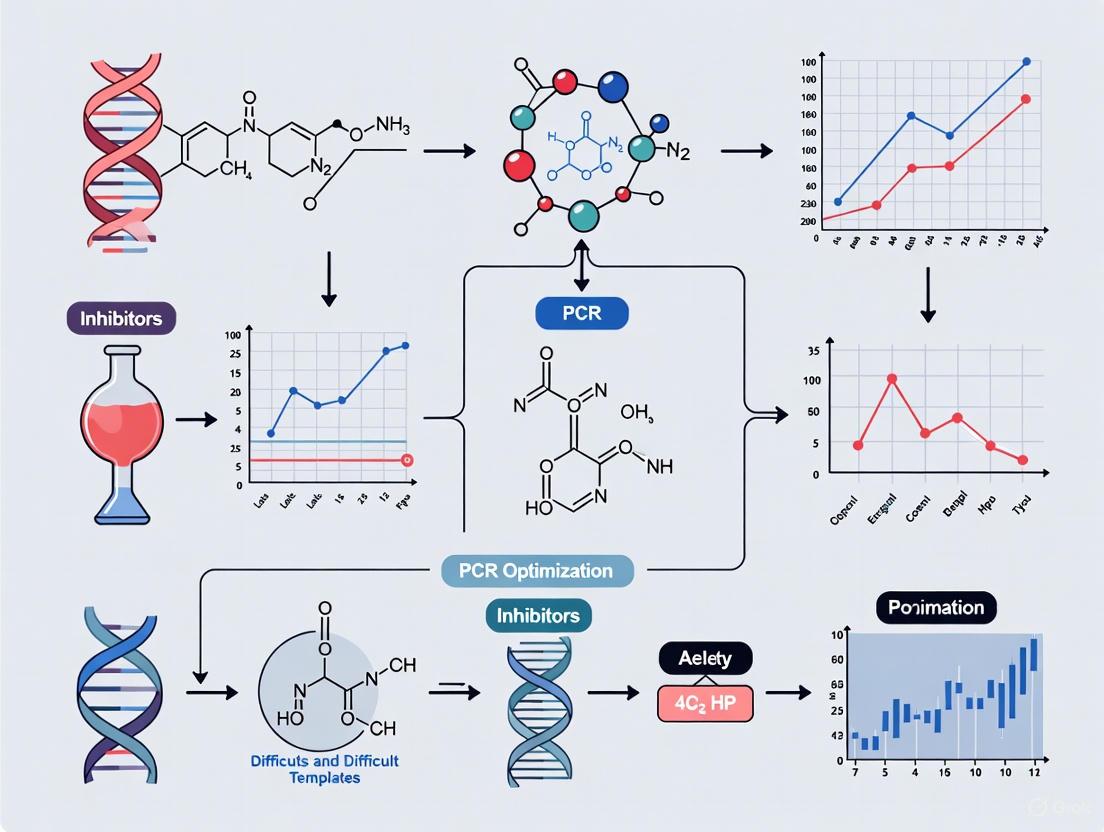
This article provides a systematic guide for researchers and drug development professionals facing challenges in PCR amplification due to inhibitors and difficult templates.
Overcoming PCR Inhibition and Difficult Templates: A Comprehensive Optimization Guide for Researchers
Abstract
This article provides a systematic guide for researchers and drug development professionals facing challenges in PCR amplification due to inhibitors and difficult templates. It covers the foundational science behind amplification failures, explores advanced methodological strategies for sample preparation and reagent selection, offers a detailed troubleshooting framework for optimization, and discusses validation techniques to ensure data reliability. By synthesizing current knowledge and practical solutions, this guide aims to equip scientists with the tools to achieve robust, specific, and efficient PCR results even with the most challenging samples in biomedical and clinical research.
Understanding the Enemies of Amplification: A Deep Dive into PCR Inhibitors and Difficult Templates
Polymerase chain reaction (PCR) is a cornerstone technique in molecular biology, enabling the amplification of specific DNA sequences. However, the presence of PCR inhibitors in various sample types can severely compromise reaction efficiency, leading to reduced sensitivity, false negatives, and inaccurate quantification. Understanding the sources and mechanisms of these inhibitors is essential for developing effective countermeasures and ensuring reliable results in research and diagnostics [1]. This guide provides a detailed overview of PCR inhibitors, presented in a troubleshooting format for researchers and scientists.
PCR inhibitors originate from a wide array of sources, including the sample matrix itself, reagents used in sample preparation, and components of the sample's biological origin. The table below summarizes the principal sources and examples of common inhibitors.
Table 1: Common Sources and Examples of PCR Inhibitors
| Source Category | Specific Sources | Example Inhibitors |
|---|---|---|
| Biological Samples | Blood, tissues, feces | Hemoglobin, immunoglobulin G (IgG), lactoferrin, bile salts [2] [1] |
| Environmental Samples | Soil, sediment, wastewater | Humic acid, fulvic acid, humin, tannins, heavy metals [3] [1] |
| Food Samples | Spices, dairy, meat | Complex polysaccharides, lipids, proteins, secondary metabolites [4] |
| Laboratory Reagents | Extraction chemicals | Phenol, EDTA, proteinase K, sodium dodecyl sulfate (SDS) [2] [5] |
How do PCR inhibitors exert their effects?
Inhibitors interfere with the PCR process through diverse mechanisms, primarily targeting the DNA polymerase enzyme, the nucleic acid template, or the fluorescence detection system. The diagram below illustrates the primary mechanisms of action and their effects on the PCR workflow.
The following table provides a more detailed breakdown of these mechanisms for specific inhibitors.
Table 2: Mechanisms of Action for Specific PCR Inhibitors
| Inhibitor | Primary Mechanism of Action | Impact on PCR |
|---|---|---|
| Humic Acid | Binds directly to DNA polymerase, blocking its active site; can also chelate Mg²⁺ and quench fluorescence [1] | Reduced amplification efficiency; inaccurate quantification in qPCR/dPCR |
| Hemoglobin / Hematin | Interacts with and inhibits DNA polymerase activity [5] [1] | Suppression of amplification, leading to false negatives |
| Heparin | Highly negatively charged; interacts with the positively charged DNA polymerase and Mg²⁺ cofactors [1] | Prevents polymerase from functioning and disrupts primer annealing |
| EDTA | Chelates Mg²⁺ ions, which are essential cofactors for DNA polymerase [2] [1] | Impairs enzyme activity and halts the extension step |
| Polysaccharides & Polyphenols | Can bind to nucleic acids, making the template inaccessible for polymerization [4] | Prevents primer annealing and elongation |
| Urea | Denatures DNA polymerase enzyme [5] | Disrupts enzyme structure and function |
What experimental strategies can mitigate PCR inhibition?
A multi-faceted approach is often required to overcome PCR inhibition, ranging from sample pre-treatment to optimization of the amplification reaction itself. The workflow below outlines a systematic strategy for dealing with inhibitory samples.
Detailed Methodologies for Key Strategies
A. Use of PCR Enhancers and Additives
Adding specific compounds to the PCR mixture can counteract inhibitors. The optimal type and concentration must be determined empirically [6] [3].
- Procedure:
- Prepare a standard PCR master mix.
- Aliquot the master mix into separate tubes.
- Add a different enhancer to each tube. Common enhancers and their tested concentrations include:
- Run the PCR with the same template and cycling conditions.
- Compare the amplification efficiency (e.g., Cq values, band intensity) to a control reaction without enhancers.
B. Sample Dilution
Diluting the nucleic acid extract reduces the concentration of inhibitors below a critical threshold.
- Procedure:
- Perform a standard DNA/RNA extraction.
- Prepare a series of dilutions (e.g., 1:2, 1:5, 1:10) of the extracted nucleic acids in nuclease-free water or TE buffer.
- Use each dilution as a template in parallel PCR or qPCR reactions.
- Identify the dilution that yields optimal amplification. Note that excessive dilution can also reduce the target concentration below the detection limit [3].
C. Advanced Polymerase and Platform Selection
Switching to inhibitor-tolerant enzyme formulations or digital PCR can provide a robust solution.
- Procedure for Evaluating Polymerases:
- Select several commercial DNA polymerases known for inhibitor tolerance (e.g., those blended with proteins that bind inhibitors or engineered for stability).
- Set up identical PCR reactions with the inhibitory sample template using each polymerase according to their respective optimized protocols.
- Compare the yield, specificity, and Cq values. Inhibitor-tolerant polymerases often maintain performance where standard Taq fails [5] [1].
- Consider Digital PCR (dPCR): For quantification, dPCR is often more resistant to inhibitors than qPCR because it relies on end-point measurement and partitioning, which effectively reduces the local concentration of inhibitors in positive partitions [3] [1].
The Scientist's Toolkit: Key Reagent Solutions
The following table lists essential reagents and materials used to combat PCR inhibition.
Table 3: Research Reagent Solutions for Overcoming PCR Inhibition
| Reagent/Material | Function in Overcoming Inhibition |
|---|---|
| Inhibitor-Tolerant DNA Polymerase | Specialized enzyme blends (e.g., containing affinity mutants or competitor proteins) designed to remain active in the presence of common inhibitors like humic acid or hematin [5] [1] |
| Bovine Serum Albumin (BSA) | Binds to and neutralizes a wide range of inhibitors, including polyphenols, tannins, and humic acids, preventing them from interacting with the polymerase or DNA [6] [3] |
| Dimethyl Sulfoxide (DMSO) | Destabilizes DNA secondary structures, which is crucial for amplifying GC-rich templates; also helps overcome inhibition by improving reaction stringency [6] [3] |
| T4 Gene 32 Protein (gp32) | A single-stranded DNA-binding protein that stabilizes denatured DNA, prevents secondary structure formation, and can relieve inhibition from complex matrices [3] |
| Inhibitor Removal Kits | Silica-based columns or chemical matrices specifically designed to bind and remove inhibitory compounds (e.g., humic substances, polyphenols) during nucleic acid purification [3] |
Frequently Asked Questions (FAQs)
Q1: My positive control amplifies, but my sample does not. Is this a sign of inhibition? Yes, this is a classic indicator of PCR inhibition. The successful amplification of the positive control confirms that your PCR reagents and thermal cycler are functioning correctly, pointing to an issue within the sample itself, likely the presence of inhibitors [7].
Q2: Why does diluting my DNA sample sometimes restore amplification? Dilution reduces the concentration of both the template DNA and the inhibitors. If the inhibitors are diluted below their effective concentration while the target DNA remains above the detection limit of the assay, amplification can proceed. This is a practical, though not always optimal, test for and solution to inhibition [3].
Q3: Are some PCR methods more susceptible to inhibitors than others? Yes. Quantitative PCR (qPCR) is highly susceptible because inhibitors can affect the amplification efficiency, which directly skews the quantification cycle (Cq) and leads to inaccurate results. Digital PCR (dPCR) is generally more tolerant because it is an end-point measurement and the partitioning step can reduce the local concentration of inhibitors in individual droplets or wells [1].
Q4: How can I confirm that my sample contains PCR inhibitors? You can perform a spike-in experiment. Take an aliquot of your sample DNA and add a known quantity of a control DNA template (with its own specific primers). Run a PCR targeting this control. If the amplification of the control is suppressed or delayed compared to a reaction where it is spiked into clean water, then your sample contains inhibitors [1].
Troubleshooting Guide: PCR Inhibition
The tables below summarize common symptoms, their causes, and recommended solutions to help you identify and overcome inhibition in your PCR experiments.
Table 1: Troubleshooting No or Weak Amplification
| Possible Cause | Specific Examples of Inhibitors | Recommended Solution |
|---|---|---|
| PCR Inhibitors in Template | Phenol, EDTA, heparin, hemoglobin, polysaccharides, humic acids, urea, ethanol, detergents (SDS) [8] [9]. | Dilute template 100-fold; purify template via ethanol precipitation or commercial clean-up kit; use inhibitor-tolerant polymerases [8] [9]. |
| Complex Template DNA | High GC-content (>65%) leading to secondary structures [8] [9]. | Use a polymerase formulated for high-GC templates; add PCR co-solvents like DMSO or GC Enhancer; increase denaturation temperature/time [8] [9]. |
| Suboptimal Reaction Components | Insufficient Mg2+ concentration; excess EDTA chelating Mg2+; unbalanced dNTP concentrations [8] [9]. | Optimize Mg2+ concentration (ensure it exceeds total dNTP concentration); use equimolar dNTP concentrations [8] [9]. |
| Insufficient Enzyme or Template | Low abundance target; enzyme quantity too low for conditions [8] [10]. | Increase number of PCR cycles (up to 40); increase amount of DNA polymerase, especially with additives; choose high-sensitivity enzymes [8] [10]. |
Table 2: Addressing Nonspecific Products, Smearing, and Errors
| Symptom & Cause | Underlying Reason | Solution |
|---|---|---|
| Nonspecific Bands / Primer-Dimers | Primers binding nonspecific sites; low annealing temperature; excessive primer concentration [8] [9]. | Increase annealing temperature; use hot-start DNA polymerase; optimize primer concentration (0.1-1 µM); use touchdown PCR [8] [9]. |
| Smearing | Over-cycling; excess template; poor primer design; contamination [9]. | Reduce number of cycles; decrease template amount; redesign primers; use nested primers; decontaminate workspace [9]. |
| High Error Rate (Low Fidelity) | Low-fidelity DNA polymerase; excess Mg2+; unbalanced dNTPs; over-cycling; UV-damaged DNA [8] [9]. | Use high-fidelity polymerase; optimize Mg2+ and use balanced dNTPs; reduce cycle number; limit UV exposure during gel extraction [8] [9]. |
Frequently Asked Questions (FAQs)
Inhibitors can originate from your sample or reagents. Common sources include:
- Sample-Derived: Hemoglobin (blood), heparin (anticoagulant), humic acids (plants, soil), polysaccharides (bacteria, plants), collagen (tissues), and melanin [9].
- Reagent-Derived: Phenol, EDTA, SDS, ethanol, or salts carried over from template purification protocols [8] [9].
- Contamination: Cross-contamination from previous PCR products (amplicons) or exogenous DNA from the lab environment [9].
My template has high GC content. How can I amplify it successfully?
GC-rich sequences (>65%) form stable secondary structures that polymerases cannot unwind. To overcome this:
- Use a specialized polymerase designed for high-GC templates [9] [10].
- Include additives or co-solvents like DMSO, formamide, or GC Enhancer in your reaction mix to help denature these structures [8].
- Adjust thermal cycler parameters: Increase denaturation temperature and/or time to ensure complete strand separation [8].
I suspect my reaction is contaminated. How do I decontaminate my workspace?
Contamination manifests as smearing or false-positive amplification in your negative (no-template) control [9].
- Physically Separate Work Areas: Maintain distinct, dedicated pre-PCR (reaction setup) and post-PCR (amplification, analysis) areas. Never bring equipment or reagents from the post-PCR area back to the pre-PCR area [9].
- Decontaminate Surfaces and Equipment: Wipe down workstations and pipettes with 10% bleach. Leave pipettes under UV light in a laminar flow hood overnight [9].
- Use Dedicated Reagents: Aliquot reagents for pre-PCR use only. Always include a negative control reaction to monitor for contamination [9].
How does a hot-start DNA polymerase prevent nonspecific amplification?
Nonspecific amplification and primer-dimers often form during reaction setup at low temperatures when non-hot-start polymerases are partially active. Hot-start polymerases are inactive at room temperature, either via an antibody or chemical modification. They only become active after a high-temperature activation step (e.g., 95°C for 2-5 minutes), preventing enzymatic activity during setup and ensuring specificity [8] [9].
The Scientist's Toolkit: Research Reagent Solutions
Table 3: Essential Reagents for Overcoming PCR Challenges
| Reagent / Material | Primary Function | Application Context |
|---|---|---|
| Hot-Start DNA Polymerase | Prevents nonspecific amplification and primer-dimer formation by remaining inactive until a high-temperature activation step [8] [9]. | Standard PCR to improve specificity; complex templates. |
| High-Fidelity DNA Polymerase | Reduces misincorporation of nucleotides due to 3'→5' exonuclease (proofreading) activity [8]. | PCR for cloning, sequencing, or mutagenesis where sequence accuracy is critical. |
| Inhibitor-Tolerant Polymerase | Engineered to maintain activity in the presence of common PCR inhibitors carried over from sample preparation [8] [9]. | Amplification from crude samples (e.g., blood, soil, plant tissue). |
| GC Enhancer / DMSO | Additives that lower the melting temperature of DNA, helping to denature GC-rich sequences and secondary structures [8] [9]. | Amplification of difficult templates with high GC content or stable hairpins. |
| PCR Clean-up Kit | Purifies DNA fragments or template to remove salts, proteins, and other enzymatic inhibitors [9]. | Post-amplification purification or template cleanup before PCR. |
Experimental Protocols & Methodologies
Detailed Methodology: Screening for Novel Polymerase Inhibitors
This protocol is adapted from recent research using computational and biochemical methods to identify SARS-CoV-2 RdRp inhibitors [11].
Objective: To identify small-molecule inhibitors targeting a viral RNA-dependent RNA polymerase (RdRp) through in silico docking and biochemical validation.
Workflow:
Key Steps:
- In Silico Docking:
- Target Preparation: Obtain the 3D crystal structure of the target polymerase complex (e.g., SARS-CoV-2 nsp12/7/8, PDB: 7BV2). Define binding sites: the orthosteric site (active site) and potential allosteric sites (e.g., Palm, Thumb domains) [11].
- Library Screening: Screen extensive libraries (e.g., >10,000 "Safe-In-Man" compounds for repurposing, >249,000 natural compounds) against the defined sites using molecular docking software [11].
- Hit Selection:
- Filter results based on docking score significance (e.g., >2 standard deviations above mean).
- Prioritize compounds with novelty (not previously reported as inhibitors) and favorable clinical safety profiles (e.g., passed Phase I trials) [11].
- Biochemical Validation (RTC Assay):
- Assay Setup: Use a purified polymerase complex. A common method is a primer-elongation assay with a Cy5-labeled RNA primer and an unlabeled RNA template, resolved by PAGE [11].
- Optimization: Determine optimal buffer pH, NaCl, and MgCl₂ concentrations, reaction time (e.g., 45 min at 37°C), and enzyme concentration [11].
- Inhibition Testing: Incolate candidate compounds with the polymerase complex and substrates. Calculate IC₅₀ values (concentration for 50% inhibition of enzymatic activity) [11].
- Cell-Based Validation:
- Test efficacy of hits in a cellular context using a viral replication assay (e.g., SARS-CoV-2 infected cells) to determine EC₅₀ values (concentration for 50% reduction in viral replication) [11].
Methodology: Machine Learning for DNA Polymerase Inhibitor Discovery
This protocol outlines a modern computational approach to discover and optimize small-molecule inhibitors, as demonstrated for human DNA polymerase η (hpol η) [12].
Objective: To use machine learning (ML)-enhanced QSAR modeling to predict the inhibitory activity of novel chemical compounds against a target DNA polymerase.
Workflow:
Key Steps:
- Dataset Curation:
- Compile a library of compounds with experimentally validated inhibition data (e.g., percent reduction in polymerase activity). Remove outliers to ensure data integrity [12].
- Descriptor Calculation and Feature Engineering:
- Convert chemical structures to SMILES format and generate 3D molecular models.
- Calculate a comprehensive set of molecular descriptors (1D-4D), including molecular weight, topological indices, dipole moment, and electronic properties like HOMO/LUMO energies [12].
- Model Training and Validation:
- Train multiple ML algorithms (e.g., Random Forest, XGBoost, Neural Networks) on a training subset (e.g., 80% of data).
- Use k-fold cross-validation (e.g., 5-fold) and hyperparameter optimization to ensure model robustness and prevent overfitting [12].
- Model Interpretation and Prediction:
- Use tools like SHAP analysis to identify which molecular descriptors (e.g., lipophilicity, specific atomic distances) are the strongest predictors of inhibition, guiding chemical optimization [12].
- Employ the best-performing model to screen virtual chemical libraries and prioritize novel compounds for synthesis and experimental testing [12].
Troubleshooting Guides and FAQs
No PCR Product or Low Yield
Q: My PCR reaction is failing to produce a visible product on a gel, or the yield is very low. What are the primary causes and solutions?
A: This common issue, often called "PCR failure," can stem from problems with the template, reagents, or cycling conditions. The table below outlines systematic solutions.
| Possible Cause | Recommended Solution | Supporting Experimental Protocol |
|---|---|---|
| Insufficient Template | - Increase template amount; for low-copy targets, use 10-100 ng of genomic DNA or up to 1 µg for complex genomes [13] [8].- Increase cycle number to 35-40 [14] [6]. | Protocol for Low-Copy Targets: Use a high-sensitivity polymerase. Set up a 50 µL reaction with 34-40 cycles. Include an initial denaturation at 98°C for 1 min, followed by cycles of 98°C for 10 s, 60°C for 15 s, and 72°C for 60 s/kb, with a final extension of 5 min [6]. |
| PCR Inhibitors Present | - Dilute template DNA 10- to 100-fold [14] [3].- Purify template using silica-column kits or ethanol precipitation [13].- Use an inhibitor-tolerant DNA polymerase blend [15] [16].- Add PCR enhancers like BSA (100-400 ng/µL) or TWEEN-20 (0.1-1%) to the master mix [6] [3]. | Inhibitor Removal Protocol: For a contaminated sample, perform ethanol precipitation: add 0.1 volumes of 3M sodium acetate (pH 5.2) and 2 volumes of 100% ethanol to your DNA sample. Incubate at -20°C for 1 hour, centrifuge at >12,000 g for 15 min, wash with 70% ethanol, and resuspend in nuclease-free water [8]. |
| Suboptimal Primer Design/Annealing | - Recalculate primer Tm and test an annealing temperature gradient starting 5°C below the lower Tm [13].- Ensure primers are 15-30 nucleotides long with 40-60% GC content [6].- Check for primer-dimer formation and re-design if necessary [16]. | Annealing Temperature Optimization Protocol: Design a gradient PCR with annealing temperatures ranging from 50°C to 70°C. Use a standardized reaction mix and analyze products on an agarose gel to identify the temperature that gives the strongest specific band [13] [8]. |
| Denaturation or Extension Issues | - For GC-rich templates, increase denaturation temperature to 98°C and/or time to 5 minutes initially [8] [6].- Ensure extension time is sufficient; generally 1 min/kb is standard, but increase for long amplicons [14]. | Enhanced Denaturation Protocol: For a stubborn GC-rich template, use a "long initial denaturation" step of 98°C for 3-5 minutes before cycling. During cycling, use a denaturation temperature of 98°C for 20 seconds [6]. |
Nonspecific Amplification and Multiple Bands
Q: My PCR produces multiple bands or a smear on the gel instead of a single, clean product. How can I improve specificity?
A: Nonspecific amplification occurs when primers bind to incorrect sequences. The key is to increase the reaction stringency.
| Possible Cause | Recommended Solution | Supporting Experimental Protocol |
|---|---|---|
| Annealing Temperature Too Low | - Increase annealing temperature in 2°C increments [14].- Use a touchdown PCR protocol [8] [14]. | Touchdown PCR Protocol: Start cycles 10°C above the calculated Tm, then decrease the annealing temperature by 1°C every cycle until a "touchdown" temperature is reached. Continue with the remaining cycles at this lower temperature. This ensures only the specific primer-template hybrids form initially [14]. |
| Excess Enzyme, Primers, or Mg²⁺ | - Optimize Mg²⁺ concentration in 0.2-1 mM increments [13].- Reduce primer concentration to 0.1-0.5 µM [8] [6].- Use a hot-start DNA polymerase to prevent activity at room temperature [13] [16]. | Mg²⁺ Optimization Protocol: Set up a series of reactions with a fixed template and primer concentration, varying the MgCl₂ concentration from 1.0 mM to 3.0 mM in 0.5 mM increments. Analyze the results by gel electrophoresis to find the concentration that gives the strongest specific product with the least background [13]. |
| Too Much Template | - Reduce the amount of template DNA by 2- to 5-fold [14]. | Template Titration Protocol: Set up identical reactions with template amounts of 10 ng, 25 ng, 50 ng, and 100 ng. Often, lower amounts of template reduce competition for primers and decrease nonspecific binding [14]. |
PCR-Induced Sequence Errors
Q: My sequenced PCR product contains mutations not present in the original template. How can I improve fidelity?
A: Sequence errors are often introduced by the DNA polymerase and can be minimized by using high-fidelity enzymes and optimizing reaction conditions.
| Possible Cause | Recommended Solution | Supporting Experimental Protocol |
|---|---|---|
| Low-Fidelity DNA Polymerase | - Use a high-fidelity polymerase with 3'→5' exonuclease (proofreading) activity, such as Q5 or Phusion [13] [6]. | High-Fidelity PCR Protocol: Use a proofreading polymerase according to manufacturer's instructions. A typical 50 µL reaction may contain 1X HF buffer, 200 µM dNTPs, 0.5 µM primers, 50 ng template, and 1 unit of polymerase. Cycle using a minimal number of cycles [13] [6]. |
| Unbalanced dNTPs or Excess Mg²⁺ | - Use fresh, equimolar dNTP mixes (200 µM of each dNTP) [13] [8].- Avoid excessive Mg²⁺ concentrations, as this can reduce proofreading efficiency [14]. | dNTP/Mg²⁺ Balancing Protocol: Prepare a master mix with balanced dNTPs and an optimized, minimal concentration of Mg²⁺ as determined by a prior optimization experiment. This reduces the chance of base misincorporation [14]. |
| Too Many Cycles | - Reduce the number of PCR cycles (e.g., from 35 to 25-30) to minimize accumulation of errors [17] [14]. | Cycle Minimization Protocol: Perform a PCR with a series of cycle numbers (e.g., 25, 28, 30, 35). Use the lowest number of cycles that still produces a sufficient yield for your downstream application [17]. |
Specialized Focus: Optimizing Challenging Templates
GC-Rich Regions
GC-rich templates (>60% GC content) form stable secondary structures that prevent efficient denaturation and primer annealing.
Solutions and Protocols:
- Use PCR Enhancers: Additives like DMSO (1-10%), formamide (1.25-10%), or glycerol help destabilize secondary structures by interfering with hydrogen bonding [8] [6] [3].
- Protocol: Add 3-5% DMSO to the master mix. Note that DMSO also lowers the effective primer Tm, so a slight decrease in annealing temperature may be needed.
- Choose a Specialized Polymerase: Use polymerases with high processivity, specifically formulated for GC-rich templates [13] [14].
- Apply a High Denaturation Temperature: Use a polymerase that remains stable at 98°C and employ a higher denaturation temperature throughout the cycling process [8].
- Utilize a GC-Rich Enhancer Solution: Some manufacturers provide proprietary GC enhancer solutions that can be added to the reaction [13].
Long Amplicons
Amplifying long DNA fragments (>5 kb) is challenging due to the increased likelihood of polymerase dissociation and the accumulation of replication errors.
Solutions and Protocols:
- Blend Polymerases: Use a mix of a high-fidelity, proofreading polymerase (e.g., Pfu) with a high-processivity polymerase (e.g., Taq). This combines accuracy with the ability to synthesize long stretches of DNA [6].
- Extend Extension Time: Increase the extension time to 1-2 minutes per kilobase to allow the polymerase to complete synthesis of long strands [14].
- Reduce Annealing and Extension Temperatures: Slightly lower temperatures (e.g., 68°C for extension) can help maintain polymerase stability and processivity over long periods [8].
- Optimize Template Quality: Ensure template DNA is high-molecular-weight and intact, as sheared DNA will not support long-range PCR.
Low-Copy Number Targets
Amplifying targets present in very few copies (e.g., single-copy genes in complex genomic DNA, or pathogens in early infection) requires maximizing sensitivity while avoiding false positives from contamination.
Solutions and Protocols:
- Increase Cycle Number: Run up to 40 cycles to increase the probability of amplifying rare targets [14] [6].
- Use a High-Sensitivity Polymerase: Select polymerases engineered for high sensitivity and robust performance with minimal template [8].
- Apply Nested PCR: Perform two consecutive PCRs. The first uses an outer primer pair to amplify a larger region. A small aliquot of this first reaction is then used as the template for a second PCR with primers that bind inside the first amplicon. This dramatically increases specificity and yield [14].
- Prevent Contamination: Use strict laboratory practices, including separate pre- and post-PCR work areas, aerosol-resistant pipette tips, and incorporating Uracil-DNA Glycosylase (UDG) to degrade PCR products from previous reactions [16] [14].
The Scientist's Toolkit: Essential Research Reagents
The following reagents are critical for successfully troubleshooting and optimizing PCR for difficult templates.
| Reagent Category | Specific Examples | Function in PCR Optimization |
|---|---|---|
| Specialized Polymerases | Q5 High-Fidelity, Phusion Flash, OneTaq Hot Start, PrimeSTAR GXL [13] [16] [14] | Provide high fidelity, inhibitor tolerance, processivity for long targets, or hot-start capability for improved specificity. |
| PCR Enhancers & Additives | DMSO, Formamide, Glycerol, BSA, Tween-20, Betaine [6] [3] | Destabilize secondary structures in GC-rich templates, protect enzyme activity, or bind to inhibitors present in the sample. |
| Hot-Start Enzymes | OneTaq Hot Start, Platinum Taq, Hot Start Taq [13] [8] [16] | Remain inactive until a high-temperature activation step, preventing nonspecific amplification and primer-dimer formation during reaction setup. |
| dNTPs & Buffers | Balanced dNTP Mix (200 µM each), Mg²⁺-Free Buffers, GC Enhancer Buffers [13] [14] [6] | Provide optimized co-factors (Mg²⁺) and nucleotide building blocks. Specialized buffers are formulated for specific challenges like high GC content. |
Experimental Workflow and Pathway Diagrams
The following diagram illustrates the logical decision-making pathway for selecting the right optimization strategy based on the observed PCR problem.
This workflow provides a systematic approach for researchers to diagnose and resolve the most common PCR issues associated with difficult templates.
Frequently Asked Questions (FAQs)
What makes GC-rich DNA sequences so difficult to amplify?
GC-rich sequences (typically defined as over 60% GC content) present two major biochemical challenges that hinder amplification:
- Thermal and Structural Stability: Guanine (G) and cytosine (C) form base pairs with three hydrogen bonds, unlike adenine (A) and thymine (T) pairs, which form only two. This results in greater thermostability, requiring more energy (higher temperatures) to denature the double-stranded DNA [18] [19]. This increased stability is also significantly contributed to by base-stacking interactions between adjacent GC pairs [19].
- Formation of Stable Secondary Structures: GC-rich regions readily fold into stable intramolecular secondary structures, such as hairpin loops. These structures can form faster than the primers can anneal to the template. When the DNA polymerase encounters these structures, it can stall, resulting in truncated, incomplete amplification products [18] [20].
Besides GC-content, what other template features can cause PCR failure?
Several other template characteristics can lead to amplification failure or poor yield:
- Long Amplicons: Amplifying long DNA targets requires polymerases with high processivity and may need extended extension times [8].
- PCR Inhibitors: Substances co-purified with the template DNA can inhibit the polymerase. Common inhibitors include:
- Degraded Template: Sheared or nicked DNA template may not amplify efficiently [8].
My gel shows multiple bands or a smear. Is this related to secondary structures?
Not necessarily. While secondary structures can cause a smear of truncated products, multiple bands or smears are most often a sign of non-specific amplification [22] [8]. This occurs when your primers anneal to incorrect, off-target sites on the DNA template. This is typically addressed by:
- Increasing the annealing temperature to enhance primer stringency [18] [8].
- Using a hot-start DNA polymerase to prevent enzyme activity during reaction setup at lower temperatures [8] [23].
- Optimizing Mg²⁺ concentration, as excess Mg²⁺ can reduce specificity [18] [8].
What is a "primer-dimer," and how does it form?
Primer-dimer is an amplification artifact where the two primers anneal to each other via complementary 3' ends and are extended by the polymerase. This results in a short, non-target product that can be seen on a gel as a low molecular weight band [24] [23]. It consumes reagents and competes with the desired amplification, reducing yield. It is promoted by low annealing temperatures, high primer concentrations, and primers designed with complementarity at their 3' ends [24] [23].
Troubleshooting Guide: Optimizing PCR for Difficult Templates
Step 1: Reagent Optimization
The choice of polymerase and buffer system is the most critical factor for amplifying challenging templates.
Table 1: Polymerase and Buffer Systems for Difficult Templates
| Reagent | Function & Mechanism | Example Products |
|---|---|---|
| Specialized Polymerase Blends | Engineered for high processivity and affinity to unwind stable templates; often have higher tolerance to inhibitors [18] [8]. | OneTaq DNA Polymerase, Q5 High-Fidelity DNA Polymerase, AccuPrime GC-Rich DNA Polymerase [18] [19]. |
| GC Enhancer / Additives | Chemical additives that destabilize secondary structures by reducing the melting temperature of GC-rich DNA, helping to keep the template accessible [18] [19]. | OneTaq High GC Enhancer, Q5 High GC Enhancer, DMSO, Betaine, Formamide [18]. |
| Magnesium Ion (Mg²⁺) Optimization | Mg²⁺ is an essential cofactor for polymerase activity. Its concentration must be optimized; too little reduces activity, and too much promotes non-specific binding [18] [24]. | Typically tested in 0.5 mM increments from 1.0 mM to 4.0 mM [18]. |
Step 2: Cycling Condition Modifications
Adjusting the thermal cycler protocol can help overcome thermodynamic barriers.
Table 2: Modified Cycling Parameters for GC-Rich Templates
| Parameter | Standard Approach | Optimization for GC-Rich Templates |
|---|---|---|
| Initial Denaturation | 94-95°C for 2-5 minutes. | 98°C for 5-10 minutes for complete denaturation of stable structures [19]. |
| Denaturation Cycle | 94-95°C for 15-30 seconds. | 98°C for 10-20 seconds. Use with a polymerase stable at high temperatures [19]. |
| Annealing Temperature (Ta) | 3-5°C below primer Tm. | Use a temperature gradient to determine the highest possible Ta that still yields product. Start 5-7°C below Tm [18] [8]. |
| Extension | 68-72°C; time based on polymerase speed. | May require slight extension time increases if polymerase stalls [8]. |
| Final Extension | 5-10 minutes. | 10-15 minutes to ensure all products are fully extended [8]. |
| Cycle Number | 25-35 cycles. | Up to 40 cycles for low-yield targets [8]. |
Step 3: Advanced Techniques
For persistently difficult targets, consider these advanced methods:
- Slow-down PCR: This method incorporates a dGTP analog (7-deaza-2′-deoxyguanosine) into the reaction. This analog reduces the strength of hydrogen bonding without affecting base-pairing specificity, thereby lowering the melting temperature of GC-rich regions. The protocol also uses slow ramp rates between cycling steps and an increased number of cycles [19] [20].
- Touchdown PCR: This technique starts with an annealing temperature higher than the calculated Tm and gradually decreases it in subsequent cycles. This ensures that only the most specific primer-template hybrids (formed in the initial, high-stringency cycles) are amplified, improving specificity for complex templates [8].
The Scientist's Toolkit: Essential Reagents for Challenging Amplifications
Table 3: Key Research Reagent Solutions
| Item | Function / Explanation |
|---|---|
| High-Processivity DNA Polymerase | Polymerases with high affinity for the template DNA and the ability to add many nucleotides without dissociating are crucial for navigating through regions with stable secondary structures [18] [8]. |
| GC Enhancer / Betaine | Betaine is a biologically compatible solute that equalizes the thermal stability of AT and GC base pairs. It reduces the formation of secondary structures by lowering the melting temperature of GC-rich DNA, making it easier to denature [18] [21]. |
| DMSO (Dimethyl Sulfoxide) | An organic solvent that disrupts the base-pairing of DNA, helping to prevent the formation of secondary structures like hairpins. It can also influence the thermal activity profile of the DNA polymerase [21] [19] [20]. |
| Hot-Start Taq Polymerase | A modified polymerase that is inactive until a high-temperature activation step. This prevents non-specific priming and primer-dimer formation during reaction setup at room temperature, greatly improving amplification specificity and yield [8] [23]. |
| BSA (Bovine Serum Albumin) | A protein additive that acts as a "molecular sponge," binding to and neutralizing common PCR inhibitors that may be present in the sample, such as phenolics or humic acids [21] [23]. |
| dUTP/UNG Carryover Prevention System | A contamination control system where dTTP is replaced with dUTP in PCR mixes. Prior to amplification, the reaction is treated with Uracil-N-Glycosylase (UNG), which degrades any uracil-containing contaminants from previous PCRs, but leaves the natural thymine-containing template DNA intact [25]. |
Experimental Protocol: Amplifying a GC-Rich Promoter Region
This protocol is adapted from methodologies cited in the literature for robust amplification of difficult templates [18] [24].
Objective: To amplify a 1.2 kb GC-rich (75% GC) promoter region from human genomic DNA.
Materials:
- Template: 50 ng of high-quality human genomic DNA.
- Polymerase: Q5 High-Fidelity DNA Polymerase (NEB #M0491) or equivalent high-processivity enzyme.
- Buffers: Q5 Reaction Buffer (5X) and Q5 High GC Enhancer (5X) supplied with the polymerase.
- Primers: 10 µM each of forward and reverse primers, designed with Tms of ~72°C.
- dNTPs: 10 mM mixture.
- Nuclease-free water.
Method:
- Prepare Reaction Mix (50 µL total volume) on ice:
- Nuclease-free water: To 50 µL final volume.
- Q5 Reaction Buffer (5X): 10 µL.
- Q5 High GC Enhancer (5X): 10 µL.
- dNTPs (10 mM): 1 µL.
- Forward Primer (10 µM): 2.5 µL.
- Reverse Primer (10 µM): 2.5 µL.
- Template DNA: 2 µL (50 ng).
- Q5 High-Fidelity DNA Polymerase: 0.5 µL (1 unit).
- Thermal Cycling Program:
- Initial Denaturation: 98°C for 5 minutes.
- 35 Cycles of:
- Denaturation: 98°C for 20 seconds.
- Annealing: 72°C for 20 seconds (Note: This is high; optimize with a gradient).
- Extension: 72°C for 1 minute 30 seconds.
- Final Extension: 72°C for 10 minutes.
- Hold: 4°C forever.
- Analysis:
- Run 5-10 µL of the PCR product on a 1% agarose gel to check for a single, sharp band of the expected size (1.2 kb).
Biochemical Pathways of PCR Inhibition by Secondary Structures
The following diagram illustrates the mechanisms by which stable intramolecular secondary structures in the DNA template lead to PCR failure.
FAQ: Recognizing and Troubleshooting PCR Inhibition
What are the primary signs that my PCR reaction is inhibited?
The table below summarizes the common signs of PCR inhibition and their manifestations in different PCR methods.
| Sign of Inhibition | Manifestation in Standard PCR | Manifestation in qPCR |
|---|---|---|
| Reduced or No Amplification | Faint or absent band on agarose gel [23] | Significantly higher quantification cycle (Cq) value, or complete absence of amplification (Cq ≥ 40) [3] [26] |
| Altered Amplification Kinetics | Not directly observable | Abnormal amplification curve shape; delayed signal increase or a flattened curve [26] |
| Inconsistent Replicate Results | Variable band intensity between identical samples | High variation in Cq values between technical replicates [27] |
| Low Signal Intensity | Faint bands even with adequate template input | Low fluorescence intensity, making accurate baseline and threshold setting difficult [26] |
How can I conclusively confirm the presence of an inhibitor?
The most definitive method is to use an internal control (IC) or spike-in assay [27]. This involves adding a known quantity of a non-target DNA sequence (e.g., from a plasmid or a different species) to your sample. If the amplification of this internal control is delayed or absent compared to its performance in a clean reaction, it confirms that the sample contains PCR inhibitors. Alternatively, you can perform a sample dilution test. A dilution series of your sample (e.g., 1:2, 1:5, 1:10) may show improved amplification at higher dilutions, as the inhibitors become less concentrated [3] [28].
What are the most effective strategies to overcome PCR inhibition?
Multiple strategies can be employed to mitigate inhibition, often in combination.
| Strategy | Mechanism of Action | Application Notes |
|---|---|---|
| Sample Dilution | Reduces concentration of inhibitors below a critical threshold [3] [28] | Simplest approach; may reduce sensitivity; a 10-fold dilution is common [3]. |
| Additives & Enhancers | Binds to or neutralizes inhibitory substances [23] [3] | Additives are effective against specific inhibitor types; see Table 2 for details. |
| Inhibitor-Tolerant Enzymes | Use of specialized polymerases less susceptible to common inhibitors [3] | Many commercial "robust" or "direct" PCR polymerases are available. |
| Improved Nucleic Acid Purification | Physical removal of inhibitors during extraction [23] [2] | Use of inhibitor removal kits or switching to more rigorous extraction protocols [3]. |
Which PCR enhancers should I use for my specific sample type?
The efficacy of an enhancer depends on the type of inhibitor present. The following table summarizes common additives and their applications based on experimental data.
| Enhancer | Recommended Concentration | Primary Function & Use Case |
|---|---|---|
| Bovine Serum Albumin (BSA) | 200–400 ng/µL [27] | Binds to phenolic compounds and humic acids; useful for plant, soil, and fecal samples [3] [27]. |
| T4 Gene 32 Protein (gp32) | Varies by manufacturer | Binds single-stranded DNA, prevents polymerase obstruction; effective against humic acids in wastewater [3]. |
| Dimethyl Sulfoxide (DMSO) | 2–10% [28] | Disrupts secondary structures; ideal for GC-rich templates [3] [28]. |
| TWEEN 20 | Varies by manufacturer | Detergent that counteracts inhibitors in fecal samples [3]. |
| Betaine | 1–2 M [28] | Homogenizes base-pair stability; beneficial for GC-rich templates and long-range PCR [28]. |
My positive control is amplifying, but my sample is not. Is this always inhibition?
Not necessarily. While this is a classic sign of inhibition, other factors can cause the same result. You must also rule out:
- Degraded or insufficient template DNA in the sample [23] [27].
- Poor primer binding due to sequence polymorphisms or suboptimal annealing temperature [28] [29].
- Human error, such as forgetting to add the DNA template to the reaction [23]. Always verify that all necessary reagents were added correctly.
Experimental Protocols for Identifying and Overcoming Inhibition
Protocol 1: Internal Control (Spike-in) Assay for Inhibition Detection
This protocol provides a definitive test for the presence of PCR inhibitors in your sample.
- Prepare the Internal Control: Select a control amplicon (e.g., a plasmid or synthetic oligo) that is not present in your sample and for which you have validated primers and probe [27].
- Set Up Reactions:
- Test Sample Reaction: Prepare a PCR containing the patient's sample DNA and primers/probe for the internal control.
- Control Reaction: Prepare an identical PCR containing a known, inhibitor-free template (like water) spiked with the same amount of internal control.
- Run qPCR: Amplify both reactions using the same cycling conditions.
- Interpret Results: A significant delay (ΔCq > 2-3 cycles) or failure in the Cq value for the internal control in the test sample compared to the control reaction confirms the presence of inhibitors [27] [26].
Protocol 2: Systematic Evaluation of PCR Enhancers
This methodology, adapted from research on wastewater samples, allows for the direct comparison of different enhancers [3].
- Master Mix Preparation: Create a standard PCR master mix according to your established protocol.
- Aliquot and Supplement: Divide the master mix into several tubes. To each tube, add a single PCR enhancer from Table 2 at its recommended concentration. Keep one tube as an unsupplemented control.
- Run Amplification: Use the same sample and cycling conditions across all reactions.
- Analyze Performance: Compare the Cq values, amplification curve shapes, and end-point yields (e.g., gel electrophoresis) of the supplemented reactions to the control. The enhancer that yields the lowest Cq and strongest specific amplification is the most effective for that sample type [3].
The Scientist's Toolkit: Key Research Reagent Solutions
| Reagent / Material | Function | Key Consideration |
|---|---|---|
| Hot-Start DNA Polymerase | Polymerase is inactive at room temperature, preventing non-specific amplification and primer-dimer formation during reaction setup [23] [28]. | Critical for improving assay specificity and sensitivity, especially with low-abundance targets. |
| BSA (Bovine Serum Albumin) | Acts as a "molecular sponge," binding and neutralizing a range of inhibitors like humic acids and polyphenolic compounds [23] [3] [27]. | A versatile and inexpensive first-line defense against inhibition in complex biological and environmental samples. |
| dNTP Mix | Provides the essential nucleoside triphosphate building blocks (dATP, dCTP, dGTP, dTTP) for DNA synthesis [29]. | Imbalanced or degraded dNTPs are a common source of PCR failure; use fresh, high-quality aliquots. |
| MgCl₂ Solution | Serves as an essential cofactor for DNA polymerase activity; concentration critically affects enzyme fidelity, specificity, and yield [23] [28] [29]. | Requires optimization for each new primer-template system; typically tested between 0.5-5.0 mM [28] [29]. |
| Inhibitor Removal Kits | Silica-column or magnetic-bead based kits designed to selectively bind nucleic acids while washing away common inhibitors [3]. | Essential for samples known to be challenging, such as feces, soil, or formalin-fixed tissues. |
Workflow: A Systematic Path to Identify and Resolve PCR Inhibition
The following diagram illustrates a logical troubleshooting workflow to diagnose and address PCR inhibition in your experiments.
Strategic Sample Prep and Reagent Selection: Building a Robust PCR Workflow
Troubleshooting Guides & FAQs
FAQ: How can I regenerate and reuse silica columns from PCR purification kits to reduce waste?
Silica columns, key components of commercial PCR purification and gel extraction kits, can be effectively regenerated and reused multiple times, significantly reducing plastic laboratory waste [30].
- Primary Cause of Failure: Residual DNA from previous purifications remains bound to the silica membrane, leading to potential carryover contamination in subsequent uses and a reduction in DNA-binding capacity [30].
- Recommended Solution: A regeneration protocol using phosphoric acid effectively removes contaminating DNA. A study shows that used columns regenerated with 1 M phosphoric acid perform comparably to fresh new columns and can be reused at least five times without sacrificing DNA purification quality or subsequent gene cloning efficiency [30].
- Experimental Protocol:
- Wash: Pass 1 mL of 1 M phosphoric acid through the used silica column.
- Rinse: Wash the column with 1 mL of molecular-grade water to remove the acid.
- Dry: Centrifuge the column briefly to remove residual liquid.
- Store: The regenerated column is now ready for reuse and can be stored at room temperature [30].
- Comparison of Regeneration Reagents: The following table summarizes the efficacy of different reagents in eliminating residual DNA, as measured by qPCR of the eluate from regenerated columns [30].
| Regeneration Reagent | Concentration | Residual DNA (pg/μL) |
|---|---|---|
| Phosphoric Acid | 1.0 M | 0.0031 |
| Hydrochloric Acid (HCl) | 1.0 M | 0.026 |
| SDS | 2% | 0.1356 |
| Triton X-100 | 0.5% | 0.1538 |
| Sodium Hydroxide (NaOH) | 1.0 M | 0.we need to find a number |
| Deionized Water (ddH₂O) | - | 0.4712 |
| DNase I | 1X solution | >0.1356 (varies with incubation time) |
| Acidic Phenol | - | >0.026 |
FAQ: My PCR fails due to inhibitors in my sample (e.g., from wastewater, soil, or blood). What are my options?
Inhibition is a common problem when analyzing complex samples. Inhibitors such as humic acids, polysaccharides, phenols, or heparin can co-purify with nucleic acids and interfere with polymerase activity [28] [3] [31].
- Primary Cause: Inhibitors can interfere with PCR through various mechanisms, including binding to the DNA polymerase, degrading or sequestering nucleic acid templates, or chelating essential divalent cations like Mg²⁺ [3].
- Recommended Solutions: A multi-faceted approach is often required.
- Dilution: A simple 10-fold dilution of the DNA template can dilute inhibitors to a sub-critical concentration. However, this also dilutes the target DNA and may reduce sensitivity [28] [3].
- Additives: Adding PCR enhancers to the reaction mix can counteract inhibitors.
- Polymerase Selection: Using DNA polymerases engineered for high tolerance to inhibitors found in specific sample types (e.g., blood, plants, soil) [28] [8].
- Purification: Using commercial inhibitor removal kits or ethanol precipitation to purify the nucleic acid sample further [3] [31].
- Experimental Protocol for Evaluating PCR Enhancers: When dealing with a new type of inhibitory sample, systematically test additives in the PCR mixture. The table below lists common enhancers and their applications, particularly for challenging wastewater samples [3].
| PCR Enhancer | Typical Final Concentration | Mechanism of Action | Effectiveness in Wastewater |
|---|---|---|---|
| Bovine Serum Albumin (BSA) | 400 ng/μL | Binds to inhibitors like humic acids, preventing them from interacting with the polymerase [3] [6]. | Moderate to High |
| T4 Gene 32 Protein (gp32) | 50-100 ng/μL | Binds to single-stranded DNA, stabilizing it and preventing the action of inhibitors [3]. | Moderate to High |
| Dimethyl Sulfoxide (DMSO) | 2-10% | Lowers the DNA melting temperature (Tm), helping to denature GC-rich secondary structures [28] [6]. | Low to Moderate |
| Tween 20 | 0.1-1% | A non-ionic detergent that can counteract inhibition of Taq DNA polymerase [3] [6]. | Low to Moderate |
| Glycerol | 5-10% | Stabilizes enzymes and can help with amplification of long templates [3] [6]. | Low |
| Formamide | 1.25-10% | Destabilizes DNA helices, increasing primer annealing specificity for GC-rich templates [3] [6]. | Low |
FAQ: How do I handle difficult PCR templates, such as those with high GC content or complex secondary structures?
GC-rich sequences (over 65%) form stable secondary structures that prevent efficient denaturation and primer annealing, leading to poor or failed amplification [8] [32] [6].
- Primary Cause: Strong hydrogen bonding in GC-rich regions creates stable intramolecular structures that are not fully denatured at standard temperatures, blocking polymerase progression [6].
- Recommended Solution: A combination of specialized reagents and adjusted thermal cycling parameters.
- Reagents: Use PCR additives like DMSO, formamide, or commercial GC enhancers. These compounds destabilize DNA secondary structures [8] [32] [6].
- Polymerase: Choose a polymerase with high processivity, which has a stronger affinity for the template and is better at amplifying through difficult regions [8].
- Cycling Conditions: Increase the denaturation temperature and/or time to ensure complete separation of DNA strands [8].
- Experimental Protocol for GC-Rich PCR:
- Prepare a 50 μL PCR reaction with a polymerase known for high processivity.
- Include an additive such as DMSO at a final concentration of 5% (v/v) or a commercial GC enhancer as per the manufacturer's instructions.
- Use the following modified thermal cycling profile:
Troubleshooting at a Glance: Common PCR Issues
This table provides a quick reference for identifying and resolving common PCR problems related to sample preparation and reaction components [8] [32] [31].
| Observation | Possible Cause | Recommended Solution |
|---|---|---|
| No Product | PCR inhibitors present in template | Dilute template; re-purify using ethanol precipitation or a cleanup kit; use inhibitor-tolerant polymerase [8] [32]. |
| Low template quality or quantity | Check DNA integrity by gel electrophoresis; increase amount of input DNA [8]. | |
| Multiple Bands or Smearing | Non-specific priming | Increase annealing temperature in 2°C increments; use a hot-start polymerase; optimize Mg²⁺ concentration [32] [31]. |
| Too much template or enzyme | Reduce template amount by 2–5 fold; reduce enzyme units [33] [31]. | |
| Low Yield | Suboptimal cycling conditions | Increase number of cycles (e.g., from 30 to 35); extend extension time for longer amplicons [8] [31]. |
| Primer-dimers or secondary structures | Redesign primers; use touchdown PCR; check for primer self-complementarity [28] [31]. | |
| High Error Rate (Low Fidelity) | Low-fidelity polymerase (e.g., standard Taq) | Switch to a high-fidelity polymerase with proofreading (3'→5' exonuclease) activity (e.g., Pfu, Q5) [28] [32]. |
| Unbalanced dNTP or excessive Mg²⁺ | Use equimolar dNTP concentrations; titrate Mg²⁺ concentration to optimal level [32] [6]. |
The Scientist's Toolkit: Key Research Reagent Solutions
| Item | Function / Application |
|---|---|
| Silica Columns | The core of many commercial kits for binding and purifying DNA from PCR reactions or gel slices [30]. |
| Phosphoric Acid (1 M) | Effective reagent for regenerating used silica columns by removing residual DNA contaminants [30]. |
| Hot-Start DNA Polymerase | Engineered to be inactive at room temperature, preventing non-specific amplification and primer-dimer formation during reaction setup [28] [32]. |
| High-Fidelity Polymerase | Enzymes with proofreading ability (e.g., Pfu, Q5) that significantly reduce error rates in amplified products, essential for cloning and sequencing [28] [32]. |
| PCR Enhancers (BSA, DMSO, etc.) | Additives used to overcome inhibition or amplify difficult templates (e.g., GC-rich sequences) by various mechanisms [3] [6]. |
| QuEChERS Kits | A sample preparation method (Quick, Easy, Cheap, Effective, Rugged, and Safe) originally developed for pesticide analysis in food, useful for complex matrices [34]. |
| Solid Phase Extraction (SPE) | A technique for cleaning and concentrating analytes from complex mixtures like biological fluids or environmental samples prior to analysis [34]. |
Experimental Workflow: From Sample to Analysis
The following diagram illustrates a generalized workflow for processing complex samples, integrating purification, inhibition removal, and PCR optimization strategies.
In polymerase chain reaction (PCR) optimization research, the selection of an appropriate DNA polymerase is a critical foundational step that directly determines the success or failure of an experiment. For researchers, scientists, and drug development professionals, this choice extends beyond mere amplification—it represents a strategic balance between the often-competing demands of sequence accuracy, amplification efficiency, and robustness to challenging sample conditions. Inhibitors in complex biological samples, difficult templates with high GC content or secondary structures, and the stringent requirements of downstream applications like cloning and sequencing make this balance particularly crucial. This technical support center article provides detailed troubleshooting guides and FAQs to address specific experimental challenges, framed within the broader context of PCR optimization research confronting today's life science laboratories.
Core Concepts: The DNA Polymerase Triad
Understanding the fundamental properties of DNA polymerases is essential for making an informed selection. Three characteristics are particularly vital for experimental success with challenging samples.
Fidelity: The Accuracy of Amplification
Fidelity refers to the accuracy with which a DNA polymerase replicates the template sequence. It is quantifiably expressed as the inverse of the error rate (e.g., number of errors per base pair duplicated) [35]. High-fidelity polymerases are indispensable for applications where sequence integrity is paramount, such as cloning, sequencing, and site-directed mutagenesis.
The proofreading capability, conferred by a dedicated 3'→5' exonuclease domain, is the primary mechanism for high fidelity. When a mismatched nucleotide is incorporated, the polymerase stalls due to unfavorable base-pairing kinetics. This delay allows the excision of the incorrect nucleotide by the exonuclease domain before synthesis resumes [35]. Naturally occurring proofreading enzymes like Pfu DNA polymerase possess approximately 10-fold higher fidelity than Taq polymerase, while engineered "next-generation" enzymes can achieve fidelity >50–300x that of Taq [35].
Processivity: The Efficiency of Amplification
Processivity is defined as the number of nucleotides a polymerase adds to a growing DNA chain in a single binding event [35] [36]. A highly processive enzyme remains bound to the template for longer, incorporating more nucleotides per encounter.
This property directly impacts synthesis speed and the ability to amplify long templates, GC-rich sequences, and targets with secondary structures [35]. Furthermore, high processivity often confers better performance in the presence of PCR inhibitors commonly found in blood, plant tissues, and soil samples (e.g., heparin, xylan, humic acid) [35]. Early proofreading polymerases often suffered from low processivity, but engineering solutions, such as fusing the polymerase with a strong DNA-binding domain, have successfully enhanced processivity 2- to 5-fold without compromising other functions [35].
Inhibitor Tolerance: Amplification in Complex Samples
Inhibitor Tolerance is the polymerase's ability to perform amplification even in the presence of substances that typically impede PCR. Such inhibitors include hemoglobin and immunoglobulin G in blood, humic acid in soil, and laboratory carryover agents like phenol and EDTA [37] [8] [38].
The effect of inhibitors is primarily upon the DNA polymerase itself [37]. Research has shown that mutational alteration of polymerases can overcome this inhibition. For instance, an N-terminal deletion mutant (Klentaq1) was found to be 10–100 times more resistant to whole blood inhibition than wild-type Taq polymerase [37]. This property is crucial for developing extraction-free "direct PCR" protocols, which simplify workflows, reduce contamination risk, and minimize template loss [39].
Technical Selection Guide
The following table summarizes the key characteristics of different polymerase types to guide your selection. A detailed comparison of polymerase properties helps in making an informed decision based on experimental needs.
Table 1: DNA Polymerase Selection Guide
| Polymerase Type | Key Features | Primary Applications | Fidelity (Relative to Taq) | Inhibitor Tolerance |
|---|---|---|---|---|
| Standard Taq | No proofreading; high speed | Routine screening, genotyping, diagnostic assays [28] | 1x | Low |
| High-Fidelity (e.g., Pfu, Q5) | Possesses 3'→5' proofreading exonuclease [28] | Cloning, sequencing, site-directed mutagenesis [35] [28] | ~10x for natural enzymes; >50x for engineered [35] | Low to Moderate |
| Engineered/Chimeric | Often blends or fusions for enhanced performance | Forensic analysis, direct PCR from crude samples [38] [39] | Variable (often high) | High [38] [39] |
| Hot-Start | Inactive at room temperature; requires heat activation [28] | All applications, especially high-throughput setups; increases specificity [35] [8] | Varies (can be combined with fidelity) | Varies |
The decision-making process for selecting the right polymerase involves evaluating several key aspects of your experimental design. The workflow below outlines the critical questions to guide your selection strategy.
Troubleshooting Common PCR Issues
This section addresses specific problems researchers encounter, their likely causes, and evidence-based solutions.
Table 2: Troubleshooting Guide for Common PCR Problems
| Observation | Possible Cause | Recommended Solution |
|---|---|---|
| No Product | PCR Inhibitors from crude samples (blood, soil) [8] | Use an inhibitor-tolerant polymerase [37], further purify template, or dilute extract [8]. |
| Poor Template Quality (degraded DNA) [8] | Re-purify template; use integrity gels for assessment; store DNA properly [8]. | |
| Complex Template (e.g., high GC, secondary structures) [8] | Use a polymerase with high processivity; add co-solvents like DMSO or betaine [8] [28]. | |
| Multiple or Non-Specific Bands | Primer Annealing Temperature Too Low [28] [40] | Increase annealing temperature; optimize using a gradient cycler [8] [28]. |
| Premature Replication during reaction setup [40] | Use a hot-start polymerase [35] [8]; set up reactions on ice [8]. | |
| Excess Mg2+ Concentration [8] [40] | Optimize Mg2+ concentration in 0.2–1 mM increments [40]. | |
| Sequence Errors in Product | Low Fidelity Polymerase [8] [40] | Switch to a high-fidelity polymerase with proofreading activity [35] [40]. |
| Unbalanced dNTP Concentrations [8] | Ensure equimolar concentrations of all four dNTPs; prepare fresh dNTP mixes [8] [40]. | |
| Excessive Number of Cycles [8] | Reduce the number of PCR cycles without drastically compromising yield [8]. |
Advanced Solutions for Demanding Applications
Engineered Polymerases for Superior Performance
For the most challenging research scenarios, such as forensic analysis or direct detection from crude samples, standard polymerases may be insufficient. Advanced solutions include:
- Polymerase Blends: Combining different polymerases can create a synergistic effect. One study validated a 1:1 blend of ExTaq Hot Start and PicoMaxx High Fidelity for forensic DNA profiling, which detected at least as many STR markers as AmpliTaq Gold across normal samples and produced significantly more complete profiles from severely inhibitory samples [38].
- Chimeric Polymerases: Engineering novel enzymes by fusing domains from different polymerases can yield superior properties. A recent study created a chimeric B-family polymerase (KUpF) by combining domains from KOD and Pfu polymerases and fusing it with a flap endonuclease (pFEN1) to confer 5'→3' exonuclease activity for probe-based qPCR. This enzyme demonstrated high inhibitor tolerance, enabling an extraction-free qPCR assay for African swine fever virus detection directly from blood and tissue samples without nucleic acid purification [39].
Optimizing Reaction Components
Even with the right polymerase, reaction composition is critical.
- Magnesium Ion (Mg2+) Optimization: Mg2+ is an essential cofactor. Its concentration must be carefully titrated, typically between 1.5 and 4.0 mM [28]. Low Mg2+ leads to reduced enzyme activity and poor yield, while high Mg2+ promotes non-specific amplification and lowers fidelity [28].
- Use of Additives:
Research Reagent Solutions
Table 3: Essential Reagents for PCR Optimization
| Reagent | Function | Key Considerations |
|---|---|---|
| High-Fidelity Polymerase (e.g., Pfu, Q5) | Accurate DNA synthesis for cloning and sequencing | Check for proofreading (3'→5' exonuclease) activity and fidelity rating [35] [40]. |
| Inhibitor-Tolerant Polymerase (e.g., Klentaq mutants, KUpF) | Amplification from crude samples (blood, soil) without DNA extraction | Enables "direct PCR" workflows, saving time and reducing template loss [37] [39]. |
| Hot-Start Polymerase | Prevents nonspecific amplification during reaction setup | Activated by high temperature; crucial for specificity and room-temperature setup [35] [8]. |
| MgCl2 or MgSO4 | Essential cofactor for polymerase activity | Concentration requires optimization; significantly affects specificity, yield, and fidelity [8] [28]. |
| PCR Additives (DMSO, Betaine) | Assist in denaturing complex templates | Use the lowest effective concentration; may require adjustment of annealing temperature [8] [28]. |
Frequently Asked Questions (FAQs)
Q1: What is the most common cause of non-specific amplification, and how can I fix it? The most common cause is an annealing temperature that is too low, which reduces the stringency of primer binding [28]. The solution is to increase the annealing temperature incrementally, ideally using a gradient thermal cycler. Furthermore, using a hot-start polymerase can prevent the synthesis of nonspecific products that form during reaction setup at room temperature [35] [8].
Q2: How does a high-fidelity polymerase actually work? High-fidelity polymerases possess a proofreading (3'→5' exonuclease) activity that occurs in a domain separate from the polymerase active site [35]. After a mismatched nucleotide is incorporated, DNA synthesis stalls. This delay allows the exonuclease domain to excise the incorrect nucleotide before the polymerase resumes DNA synthesis with the correct nucleotide [35]. This corrective mechanism drastically reduces the error rate.
Q3: My PCR works with purified DNA but fails with crude blood/soil samples. What should I do? This is a classic sign of PCR inhibition. Instead of extensive re-purification, consider using a polymerase engineered for high inhibitor tolerance [37]. Mutants of Taq polymerase and certain chimeric B-family polymerases have been specifically developed to resist potent inhibitors like hemoglobin (from blood) and humic acid (from soil), often enabling successful amplification without any DNA purification [37] [39].
Q4: When should I use a buffer additive like DMSO or betaine? Consider these additives when amplifying difficult templates, such as those with high GC content (above 65%) or strong secondary structures [28]. DMSO helps denature these stable structures, while betaine equalizes the melting temperature across the template. Remember to use the lowest effective concentration, as high concentrations can inhibit the polymerase and may necessitate an adjustment to the annealing temperature [8] [28].
Q5: Can I improve my PCR results without changing the polymerase? Yes. Several parameters can be optimized:
- Primer Design: Ensure primers have a matched Tm (55–65°C), avoid self-complementarity, and have a stable 3' end [28].
- Thermal Cycling: Optimize annealing temperature and ensure adequate denaturation and extension times [8].
- Template Quality: Re-purify degraded DNA or dilute samples to reduce carryover inhibitors [8] [28].
- Mg2+ Concentration: Titrate Mg2+ in small increments, as it is a critical variable [28] [40].
Polymersse Chain Reaction (PCR) is a foundational technique in molecular biology, yet the amplification of difficult templates—such as those with high GC-content, complex secondary structures, or the presence of inhibitors—remains a significant challenge in research and diagnostic applications. The optimization of PCR efficiency and specificity is particularly crucial in drug development, where reliable genetic data is paramount. A key strategy for overcoming these challenges involves the use of PCR additives. This guide focuses on four common additives—Dimethyl Sulfoxide (DMSO), Bovine Serum Albumin (BSA), Betaine, and Formamide—detailing their mechanisms, applications, and integration into robust experimental protocols. By harnessing these reagents, researchers can significantly enhance the performance of their PCR assays, ensuring success with even the most recalcitrant templates.
Understanding the Additives: Mechanisms and Applications
PCR additives enhance amplification through distinct biochemical mechanisms, primarily by facilitating DNA denaturation, reducing secondary structures, or neutralizing inhibitors. The following table provides a comparative overview of the key additives discussed in this guide.
Table 1: Essential PCR Additives: Mechanisms and Applications
| Additive | Primary Mechanism of Action | Ideal For | Recommended Concentration |
|---|---|---|---|
| DMSO | Disrupts base pairing by interacting with water molecules, reducing DNA melting temperature (Tm) and secondary structure stability [41] [42]. | GC-rich templates [41] [43]. | 2% - 10% (v/v); requires optimization [41] [42]. |
| Betaine | Equalizes the stability of GC and AT base pairs by interacting with DNA strands, eliminating base composition dependence of DNA melting; an osmoprotectant that reduces DNA secondary structures [41] [43] [42]. | GC-rich templates; reduces non-specific amplification [41]. | 0.5 M - 2.5 M (often used at 1-1.7M) [41] [43]. |
| Formamide | Lowers DNA Tm by binding to the grooves of the DNA double helix, destabilizing hydrogen bonds and hydrophobic interactions [41] [42]. | Improving specificity; reducing non-specific priming [41]. | 1% - 5% (v/v); effective concentration range can be narrow [41] [44]. |
| BSA | Binds and neutralizes PCR inhibitors (e.g., phenolic compounds); reduces adhesion of reactants to tube walls [41] [44] [42]. | Reactions with inhibitor carryover (e.g., from soil, blood, plant tissues); can co-enhance with solvents [41] [44]. | 0.1 - 1.0 µg/µL (or 10-100 µg/mL) [44] [24]. |
Troubleshooting Guide: FAQs and Solutions
This section addresses common experimental challenges, providing targeted solutions involving PCR additives.
How do I amplify a GC-rich DNA template?
GC-rich sequences (GC content >60%) are problematic due to their propensity to form stable secondary structures and require higher denaturation temperatures [44].
Solution:
- Use a combination of additives: A synergistic approach is often most effective.
- Primary Choice: Incorporate Betaine (0.5 M - 2.5 M). It is particularly effective for GC-rich templates as it promotes a more uniform melting of the DNA [41] [43].
- Co-Additive: Use DMSO (2% - 10%). It helps destabilize secondary structures but can inhibit polymerase activity at higher concentrations, so optimization is critical [41].
- Co-Enhancer: Add BSA (0.1 - 1.0 µg/µL). Research shows BSA can further enhance yields when used with DMSO or formamide, especially for GC-rich targets [44].
- Optimize thermal cycling parameters: Increase the denaturation temperature (e.g., to 98°C) and/or time [8].
- Consider the polymerase: Choose a DNA polymerase with high processivity and affinity for complex templates [8].
Diagram: Strategic workflow for optimizing PCR amplification of GC-rich templates
My PCR shows multiple non-specific bands. How can I improve specificity?
Non-specific amplification occurs when primers bind to unintended sites, often due to low annealing stringency or enzyme activity at low temperatures [8] [23].
Solution:
- Employ a hot-start DNA polymerase: This prevents polymerase activity during reaction setup at low temperatures, drastically reducing non-specific products and primer-dimer formation [8] [45].
- Optimize reaction conditions:
- Increase annealing temperature: Use a gradient thermal cycler to find the optimal temperature, typically 3–5°C below the primer Tm [8] [46].
- Optimize Mg²⁺ concentration: Excess Mg²⁺ can reduce specificity. Titrate Mg²⁺ in 0.2–1.0 mM increments [8] [46].
- Lower primer concentration: High primer concentrations promote mispriming. Optimize within 0.1–1 µM [8] [10].
- Use specificity-enhancing additives:
- Formamide (1-5%) can increase stringency by lowering the Tm, promoting specific primer binding [41].
- Tetramethylammonium chloride (TMAC; 15-100 mM) is particularly useful with degenerate primers, as it increases hybridization specificity [41] [42].
- Betaine can also help by reducing non-specific amplification [41].
I suspect my sample contains PCR inhibitors. What can I do?
Inhibitors can be carried over from sample preparation (e.g., phenol, EDTA, heparin, or humic acids) and directly inhibit DNA polymerases [8] [23].
Solution:
- Purify the template DNA: Re-purify the sample using alcohol precipitation, drop dialysis, or a commercial PCR cleanup kit [8] [46].
- Use a robust DNA polymerase: Select polymerases known for high tolerance to common inhibitors found in blood, soil, or plant tissues [8].
- Add Bovine Serum Albumin (BSA): BSA (0.1 - 1.0 µg/µL) is highly effective at binding a wide range of inhibitors, preventing them from inactivating the polymerase [41] [44] [42]. It is a standard additive for amplifying templates from environmental or complex biological samples.
How can I increase the yield of a long or difficult PCR product?
Amplification of long targets (>5 kb) or those with complex secondary structures is inefficient with standard protocols.
Solution:
- Use a polymerase mix: Employ a blend of a non-proofreading polymerase (e.g., Taq) and a proofreading polymerase (e.g., Pfu). This combination enhances processivity and corrects misincorporations that halt elongation [45].
- Apply PCR enhancer cocktails: Use a mixture of optimized additives. A classic cocktail for difficult templates includes Betaine, DMSO, and 7-deaza-dGTP [43].
- Adjust cycling conditions:
Experimental Protocols
Basic PCR Protocol with Additives
This is a standard method for setting up a 50 µL PCR reaction, adaptable for the inclusion of additives [24].
- Thaw and mix all reagents thoroughly on ice. Assemble reactions in sterile, nuclease-free tubes.
- Prepare a Master Mix when setting up multiple reactions to minimize pipetting error and ensure consistency.
- Add reagents in the following order:
- Sterile Nuclease-Free Water (Q.S. to 50 µL)
- 10X PCR Buffer (5 µL)
- dNTPs (10 mM each) (1 µL)
- Magnesium Chloride (MgCl₂, 25 mM) (variable, e.g., 0-8 µL) [Note: Omit if already in buffer] [24]
- PCR Additive(s) (e.g., DMSO, Betaine, BSA) [See Table 1 for volumes] [24]
- Forward Primer (20 µM) (1 µL)
- Reverse Primer (20 µM) (1 µL)
- DNA Template (variable, e.g., 1-1000 ng)
- DNA Polymerase (0.5-2.5 U) (e.g., 0.5 µL)
- Gently mix the reaction by pipetting up and down. Briefly centrifuge to collect all liquid.
- Transfer tubes to a thermal cycler and start the appropriate program.
Protocol: Optimizing Amplification of GC-Rich Templates
This protocol provides a specific framework for challenging GC-rich targets [41] [44] [43].
- Reaction Setup:
- Prepare the Basic PCR Master Mix as above.
- Include 1 M Betaine (final concentration).
- Include 5% DMSO (final concentration).
- Include 0.8 µg/µL BSA (final concentration).
- Thermal Cycling Conditions:
- Initial Denaturation: 98°C for 2-5 minutes.
- 35-40 Cycles of:
- Denaturation: 98°C for 20-30 seconds.
- Annealing: Temperature gradient from 55°C to 65°C for 30 seconds.
- Extension: 72°C for 1-2 minutes per kb.
- Final Extension: 72°C for 5-10 minutes.
- Hold: 4°C.
- Analysis:
- Analyze 5-10 µL of the PCR product by agarose gel electrophoresis.
- Based on the results, fine-tune the additive concentrations and annealing temperature.
The Scientist's Toolkit: Research Reagent Solutions
Table 2: Essential Reagents for PCR Optimization with Difficult Templates
| Reagent Category | Specific Example(s) | Primary Function |
|---|---|---|
| Polymerases | Hot-Start Taq, Q5 High-Fidelity, Polymerase Blends (e.g., Taq + Pfu) | Provides specific amplification, high fidelity, or efficient long-range amplification [8] [46] [45]. |
| Essential Cofactor | Magnesium Chloride (MgCl₂) or Magnesium Sulfate (MgSO₄) | Absolute requirement for DNA polymerase activity; concentration critically affects yield and specificity [41] [8]. |
| Additives for GC-Rich DNA | Betaine, DMSO | Destabilizes secondary structures, promotes uniform DNA melting [41] [43]. |
| Additives for Specificity | Formamide, TMAC | Increases stringency of primer annealing, reduces mispriming [41] [42]. |
| Inhibitor Neutralizers | Bovine Serum Albumin (BSA) | Binds to and neutralizes a wide array of PCR inhibitors [41] [44]. |
| Specialized Kits | GC Enhancer Kits, Long-Range PCR Kits | Proprietary, pre-optimized formulations for specific challenging applications [8] [43]. |
Primer Design Fundamentals
Proper primer design is the foundation of successful Polymerase Chain Reaction (PCR), especially when working with challenging templates or under optimized conditions for inhibitor research. Adherence to core thermodynamic and structural rules ensures specific amplification, high yield, and reliable results for downstream applications [47] [28].
The table below summarizes the critical parameters for effective primer design.
| Design Parameter | Optimal Value or Characteristic | Rationale & Impact |
|---|---|---|
| Primer Length [47] [48] | 18–25 nucleotides | Balances specificity (long enough) and efficient binding (short enough). |
| Melting Temperature (Tm) [47] [28] | 55–65°C; forward & reverse primers within 1–2°C | Ensures both primers anneal to the template simultaneously and efficiently. |
| GC Content [47] [48] | 40–60% | Provides stable primer-template binding without promoting secondary structures. |
| 3'-End Stability (GC Clamp) [47] [24] | Presence of G or C bases; avoid >3 G/C in last 5 bases | Strengthens the critical initiation point for polymerase while preventing non-specific binding. |
| Specificity [48] [24] | Unique to target sequence; avoid repeats & runs | Prevents mispriming and amplification of non-target regions. BLAST analysis is recommended. |
The following workflow outlines the logical process for designing and validating primers, from initial sequence analysis to final experimental setup.
Troubleshooting Common Primer-Related Issues
Even with careful in silico design, experimental PCR can present challenges. This section addresses specific issues researchers might encounter, providing targeted solutions.
FAQ 1: My PCR shows no amplification or very low yield. What should I check first?
- Verify Template DNA: Confirm the presence, quality, and quantity of your template. DNA that is degraded, contaminated with inhibitors (e.g., phenol, EDTA), or used at an insufficient concentration will not amplify [8] [23]. For genomic DNA, start with ~100 ng; for plasmid DNA, 1 ng is often sufficient [29].
- Optimize Annealing Temperature (Ta): The most common solution is to optimize the annealing temperature. Use a gradient thermal cycler to test a range of temperatures, typically 3–5°C below the calculated Tm of the primers [8] [28]. A temperature that is too high prevents primer binding; one that is too low causes non-specific binding [28].
- Check Primer Concentration: Ensure primers are at an optimal concentration, usually between 0.1–1.0 µM [8] [29]. Too little primer results in low yield, while too much can promote primer-dimer formation [10].
- Assess Mg2+ Concentration: Mg2+ is an essential cofactor for DNA polymerase. Its concentration can be titrated from 0.5 mM to 5.0 mM for optimal results. Excess Mg2+ reduces fidelity and can cause non-specific products, while insufficient Mg2+ results in low yield [24] [29].
FAQ 2: I see multiple bands or a smear on the gel instead of a single, specific product. How can I improve specificity?
- Increase Annealing Stringency: Gradually increase the annealing temperature in 1–2°C increments. This is the most effective way to prevent primers from binding to off-target sites with partial complementarity [8] [28].
- Use Hot-Start DNA Polymerases: These enzymes are inactive until a high-temperature activation step, preventing non-specific priming and primer-dimer formation that can occur during reaction setup at lower temperatures [8] [23].
- Evaluate Primer Design: Re-check your primer sequences for specificity using BLAST. Ensure the 3' ends are not overly stable with long G/C runs, which can cause mispriming [47] [8]. Avoid repeats and long single-base runs [47] [24].
- Reduce Cycle Number: Over-cycling (e.g., >35 cycles) can lead to the accumulation of non-specific products. Reduce the number of cycles to the minimum required for sufficient yield [8] [10].
FAQ 3: How can I prevent primer-dimer formation?
- Optimize Primer Design: Design primers with minimal complementarity, especially at their 3' ends. Software tools can check for self-dimers and cross-dimers [23] [28]. Optimally, the free energy (ΔG) for a 3' cross-dimer should be greater than -5 kcal/mol [47].
- Adjust Primer Concentration: High primer concentrations promote intermolecular interactions. Titrate primer concentrations downwards, starting from 0.5 µM [8] [10].
- Use Hot-Start Polymerases: As with non-specific amplification, hot-start enzymes are highly effective at suppressing primer-dimer formation by preventing low-temperature activity [23].
Advanced Optimization for Difficult Templates
Amplifying complex templates, such as those with high GC content or stable secondary structures, is a common challenge in inhibitor and drug development research. The table below details key reagent solutions for these scenarios.
| Reagent / Material | Function | Application Example |
|---|---|---|
| DMSO (1-10%) [28] [24] | Disrupts base pairing, lowers DNA melting temperature. | Facilitates denaturation and primer annealing for GC-rich templates (>65% GC). |
| Betaine (0.5 M - 2.5 M) [28] | Homogenizes the thermodynamic stability of DNA; equalizes the melting temperature of GC-rich and AT-rich regions. | Improves amplification of long targets and high-GC regions; used in long-range PCR. |
| High-Fidelity Polymerase (e.g., Pfu, KOD) [28] | Possesses 3'→5' proofreading (exonuclease) activity for error correction. | Essential for cloning, sequencing, and any application requiring minimal incorporation errors. |
| Hot-Start DNA Polymerase [8] [10] | Inactive at room temperature, requires heat activation. | Suppresses non-specific amplification and primer-dimer formation during reaction setup. |
| BSA (10-100 µg/ml) [23] [24] | Binds to and neutralizes common PCR inhibitors. | Useful when amplifying from complex biological samples (e.g., blood, soil). |
The following diagram illustrates a systematic, iterative protocol for optimizing a PCR reaction, integrating the adjustment of chemical, thermal, and enzymatic components.
Frequently Asked Questions
- What is the primary function of a PCR master mix? A master mix is a ready-to-use premix containing core components for a PCR assay, including a thermostable DNA Polymerase, dNTPs, MgCl₂, and optimized reaction buffers. Its use ensures consistency, reduces pipetting errors and contamination, and provides more reproducible results [49].
- Why is magnesium concentration (Mg²⁺) so critical and often needing optimization? Mg²⁺ is an essential cofactor for DNA polymerase activity. It facilitates primer binding to the template and catalyzes the formation of phosphodiester bonds between nucleotides. Too much Mg²⁺ can lead to non-specific amplification, while too little can result in weak or no amplification [50] [51].
- My target is a GC-rich sequence. What specific adjustments should I consider? GC-rich templates are challenging due to their stable secondary structures. Optimization strategies include using a polymerase and buffer system specifically designed for GC-rich targets (often including a GC Enhancer), adjusting the Mg²⁺ concentration, adding additives like DMSO or betaine, and fine-tuning the annealing temperature [50].
- How do I calculate the volumes needed for my master mix? Create a table listing all components, their stock concentrations, and desired final concentrations. The volume per reaction is calculated by dividing the total reaction volume by the dilution factor (stock concentration divided by final concentration). Always prepare a master mix for the number of reactions plus one extra to account for pipetting losses [52].
Optimization Guides and Troubleshooting
dNTP Concentration Optimization
Deoxynucleoside triphosphates (dNTPs) are the building blocks for new DNA strands. Their concentration and balance are crucial for efficient amplification and fidelity [51].
- Final Concentration Range: A typical final concentration for each dNTP (dATP, dCTP, dGTP, dTTP) is 20–200 µM [24] [51]. A common standard concentration is 200 µM for all four dNTPs [52].
- Equimolar Principle: The four dNTPs must be used at equal concentrations to prevent misincorporation of bases, which leads to mutations [51].
- Effects of Improper Concentration:
- Interaction with Mg²⁺: Mg²⁺ binds to dNTPs in the reaction. Therefore, the optimal concentration of Mg²⁺ is directly influenced by the total dNTP concentration. If you change dNTP levels, you must re-optimize Mg²⁺ [51].
Table 1: dNTP Optimization Guidelines
| Aspect | Recommendation | Rationale & Considerations |
|---|---|---|
| Standard Final Concentration | 50–200 µM for each dNTP [24] [51] | Provides a sufficient nucleotide pool for synthesis. |
| Common Starting Point | 0.2 mM (200 µM) for each dNTP [52] | A robust concentration for many standard PCR applications. |
| Concentration for High Fidelity | 20–50 µM for each dNTP [51] | Reduces misincorporation by non-proofreading polymerases. |
| Critical Requirement | Always use all four dNTPs at equal concentrations [51] | Prevents base misincorporation and ensures replication fidelity. |
Magnesium Ion (Mg²⁺) Concentration Optimization
As a cofactor for DNA polymerase, Mg²⁺ concentration is one of the most common parameters requiring optimization, especially for difficult templates [50] [24].
- Standard Concentration Range: The most commonly used final concentration range is 1.5 to 2.0 mM [50]. However, the optimal range can span from 0.5 mM to 5.0 mM depending on the template and polymerase [24].
- Optimization Strategy: If amplification fails or is non-specific, test a gradient of MgCl₂ concentrations. A recommended approach is to test in 0.5 mM increments between 1.0 and 4.0 mM to find the ideal concentration [50].
- Interaction with dNTPs: Since Mg²⁺ binds to dNTPs, the free Mg²⁺ concentration available for the polymerase is key. Any change in dNTP concentration will affect the amount of available Mg²⁺ [51].
Table 2: Magnesium Ion (Mg²⁺) Optimization Guidelines
| Aspect | Recommendation | Rationale & Considerations |
|---|---|---|
| Standard Starting Range | 1.5–2.0 mM [50] | A good starting point for many conventional PCRs. |
| Wider Functional Range | 0.5–5.0 mM [24] | The effective range; optimal point must be determined empirically. |
| Optimization Method | Test a gradient (e.g., 1.0, 1.5, 2.0, 2.5, 3.0, 3.5, 4.0 mM) [50] | Systematically identifies the concentration that maximizes yield and specificity. |
| Primary Effect: Too High | Non-specific binding and amplification; multiple bands on a gel [50]. | Reduces the stringency of primer annealing. |
| Primary Effect: Too Low | Reduced or no polymerase activity; weak or no amplification [50]. | Polymerase is not fully functional; primer binding is less stable. |
Primer Concentration Optimization
Primers are short, single-stranded DNA sequences that define the start and end of the amplicon. Their design and concentration are fundamental to PCR success [53] [51].
- Final Concentration Range: A standard final concentration for each primer is between 0.1–1.0 µM [54]. A typical specific starting point is 250 nM (0.25 µM) [52].
- Primer Design Considerations: Before optimizing concentration, ensure primers are well-designed [24] [54]:
- Length: 15–30 nucleotides.
- GC Content: 40–60%.
- Melting Temperature (Tm): 55–70°C, with both primers having Tms within 5°C of each other.
- Avoid self-complementarity (hairpins) and 3'-end complementarity between primers (primer dimers).
- Effects of Improper Concentration:
- Too High: Increases the likelihood of non-specific amplification and primer-dimer formation [53].
- Too Low: Results in insufficient product yield due to limited primer-template binding.
Table 3: Primer Optimization Guidelines
| Aspect | Recommendation | Rationale & Considerations |
|---|---|---|
| Standard Concentration Range | 0.1–1.0 µM for each primer [54] | Balances sufficient binding with minimal non-specific interactions. |
| Common Specific Starting Point | 250 nM (0.25 µM) [52] | A robust concentration for many applications. |
| Key Design Factor: Tm | 55–70°C, with <5°C difference between primers [24] [54] | Ensures both primers anneal to the template efficiently at the same temperature. |
| Key Design Factor: GC Content | 40–60% [54] | Provides stable binding without excessive stability that promotes secondary structures. |
Advanced Optimization for Challenging Templates
For difficult templates such as GC-rich sequences or samples with inhibitors, standard conditions often fail and require advanced strategies [55] [50].
- GC-Rich Templates:
- Specialized Reagents: Use polymerases and master mixes specifically formulated for GC-rich content. These often include a proprietary "GC Enhancer" or buffer containing a mix of additives that help denature stable secondary structures [50].
- Additives: Additives like DMSO (1-10%), glycerol, or betaine (0.5 M to 2.5 M) can be included in the master mix to lower the melting temperature of GC-rich DNA and prevent secondary structure formation [50] [24].
- Polymerase Choice: Some high-fidelity polymerases perform better on long or difficult amplicons, including those with high GC content [50].
- Inhibitory Samples:
PCR Troubleshooting and Optimization Workflow
The Scientist's Toolkit: Research Reagent Solutions
Table 4: Essential Reagents for Master Mix Formulation and PCR Optimization
| Reagent | Function & Role in Optimization |
|---|---|
| Thermostable DNA Polymerase | Enzyme that synthesizes new DNA strands. Choice is critical; "hot-start" versions reduce non-specific amplification, and high-fidelity versions are essential for cloning. Specialized versions exist for GC-rich or long templates [50] [54]. |
| dNTP Mix | The building blocks (dATP, dCTP, dGTP, dTTP) for DNA synthesis. Provided as an equimolar mixture. Concentration must be optimized to balance yield and fidelity [51]. |
| Magnesium Chloride (MgCl₂) | Essential cofactor for DNA polymerase. Its concentration is a key variable for optimization and must be titrated for each new assay to ensure specificity and yield [50] [51]. |
| PCR Buffer | Provides the optimal ionic environment and pH (e.g., Tris-HCl) for polymerase activity. Often supplied with MgCl₂, but Mg²⁺ concentration may still need adjustment [54]. |
| GC Enhancer / Additives | Proprietary mixtures or specific chemicals (e.g., DMSO, betaine, formamide) that help denature complex secondary structures in DNA, facilitating the amplification of difficult templates like GC-rich regions [50]. |
| BSA (Bovine Serum Albumin) | A stabilizer that can bind to inhibitors commonly found in complex biological samples (e.g., blood, soil), thereby improving amplification efficiency [53]. |
Master Mix Component Interrelationships
The PCR Troubleshooting Toolkit: Systematic Optimization for Problematic Samples
In molecular diagnostics and drug development, the polymerase chain reaction (PCR) serves as a fundamental tool for detecting pathogens, analyzing genetic markers, and validating therapeutic targets. However, amplification failure represents a significant hurdle that can compromise test results and lead to false-negative diagnoses. Within the broader context of PCR optimization research, amplification failure frequently stems from two primary sources: the presence of inhibitory substances co-purified with the target nucleic acid and the inherent challenges posed by difficult template structures. Inhibitors can originate from various sample types, including blood (heparin, hemoglobin), sputum (polysaccharides), and tissues (collagen, humic acids), and they function by interfering with DNA polymerase activity or nucleic acid denaturation [56]. Simultaneously, templates with high GC-content, secondary structures, or extensive length present thermodynamic barriers to efficient amplification [8] [6]. This guide provides a systematic, visual approach to diagnosing and resolving amplification failure, ensuring the reliability of your experimental outcomes.
Troubleshooting Flowchart: A Systematic Diagnostic Path
Follow this logical pathway to identify the root cause of your PCR amplification failure. The chart below guides you from initial observation to targeted solutions, covering the most common issues and their respective fixes.
Diagram 1. A step-by-step diagnostic path for PCR amplification failure. This flowchart provides a systematic approach to identifying the most common causes of PCR failure and their respective solutions, guiding users from initial observation to targeted resolution.
Common PCR Problems & Quantitative Solutions
The table below summarizes the most frequent PCR issues, their potential causes, and evidence-based solutions with specific quantitative parameters to guide your optimization efforts.
| Observation | Possible Causes | Recommended Solutions & Quantitative Parameters |
|---|---|---|
| No Product | Poor template quality or integrity [8] [22] | • Assess DNA integrity by gel electrophoresis• Re-purify template; use 70% ethanol wash [8]• Verify template quantity: 1 pg–10 ng (plasmid) or 1 ng–1 µg (genomic DNA) per 50 µL reaction [57] |
| Suboptimal primer design [22] [57] | • Design primers with 18–30 bp length, 40–60% GC content [58] [6]• Ensure Tm between 65–75°C; keep primer pair Tm within 5°C [58]• Check specificity with BLAST; avoid repeats and self-complementarity [58] [59] | |
| Inhibitors in reaction [8] [56] | • Dilute template 10–100 fold [56]• Use inhibitor-tolerant or hot-start DNA polymerases [8] [6]• Add BSA (up to 400 ng/µL) to counteract inhibitors [6] | |
| Non-Specific Bands/Smear | Low annealing temperature [8] [57] | • Increase annealing temperature in 2°C increments [56]• Use gradient cycler; set temperature 3–5°C below primer Tm [8] |
| Excessive primer concentration [8] | • Optimize primer concentration between 0.1–1 µM [8] [6]• Typical working range: 0.05–1 µM [57] | |
| Too much template [56] | • Reduce template amount by 2–5 fold [56]• Follow guidelines: 104 template copies for 25–30 cycles [6] | |
| Sequence Errors/ Low Fidelity | Low-fidelity polymerase [22] [57] | • Switch to high-fidelity polymerase with proofreading (3'→5' exonuclease) activity [6] [57] |
| Unbalanced dNTPs or excessive Mg²⁺ [8] [22] | • Use fresh, equimolar dNTP mix (20–200 µM each) [8] [6]• Optimize Mg²⁺ concentration (typically 1.5–2.5 mM); reduce to minimize errors [8] [57] | |
| High number of cycles [8] | • Reduce cycles (generally 25–35); avoid overcycling [8] [56] |
Essential Research Reagent Solutions
This table catalogs key reagents and materials specifically selected to overcome common PCR challenges, particularly those related to inhibitors and difficult templates.
| Reagent/Material | Function in PCR Optimization | Application Context |
|---|---|---|
| Hot-Start DNA Polymerase | Remains inactive at room temperature, preventing nonspecific amplification and primer-dimer formation prior to initial denaturation [8] [6]. | Essential for maximizing specificity in complex diagnostic assays and when using suboptimal primer pairs [8] [56]. |
| High-Fidelity DNA Polymerase | Incorporates 3'→5' exonuclease (proofreading) activity to correct base misincorporation, yielding a lower error rate [6] [57]. | Critical for downstream applications like cloning, sequencing, and mutagenesis where sequence accuracy is paramount [8] [6]. |
| GC Enhancer/Additives (DMSO, Formamide) | Lowers melting temperature (Tm), disrupts secondary structures, and prevents reannealing of GC-rich templates [8] [6]. | Used at 1–10% concentration for amplifying difficult GC-rich targets (>60% GC content) [8] [6]. |
| BSA (Bovine Serum Albumin) | Binds to and neutralizes PCR inhibitors commonly found in biological samples (e.g., phenolic compounds, humic acids) [6]. | Added at ~400 ng/µL to reactions using templates from blood, soil, or plant tissues to alleviate inhibition [6]. |
| Mg²⁺ Solution (MgCl₂, MgSO₄) | Essential cofactor for DNA polymerase activity; concentration directly affects enzyme fidelity, primer annealing, and product specificity [8] [6]. | Requires optimization (typically 0.5–5.0 mM); concentration must exceed total dNTP concentration [6] [56]. |
| Internal Control (IC) | Synthetic nucleic acid co-amplified with the target to distinguish true target negativity from amplification failure due to inhibition [60]. | Included in diagnostic tests to validate negative results and monitor amplification efficiency; typically 20 copies per reaction [60]. |
Advanced Methodologies for Complex Templates
Internal Control Implementation Protocol
The use of an Internal Control (IC) is a critical methodological safeguard in diagnostic PCR to rule out false negatives caused by amplification failure. The IC is a synthetic nucleic acid (plasmid DNA or in vitro RNA transcript) designed with primer binding regions identical to the target sequence but a unique internal probe binding region for differentiation [60].
Experimental Protocol:
- IC Design: Construct a plasmid or generate an RNA transcript containing the identical primer binding sequences as your target. Incorporate a randomized internal sequence of similar length and base composition, ensuring it includes a unique probe binding region not found in the target [60].
- IC Quantification: Precisely quantify the IC stock solution using Poisson statistical analysis via limiting dilution and multiple replicate amplifications. The concentration is calculated using the formula ( C = -\ln(Pn) ), where ( Pn ) is the proportion of negative replicates [60].
- Reaction Setup: Introduce a low copy number of IC (e.g., 20 copies) into each test sample prior to nucleic acid extraction (to monitor recovery and amplification) or into the master mix (to monitor amplification only) [60].
- Interpretation: A positive signal from the target indicates infection. A negative target signal with a positive IC signal indicates the absence of target. A negative target signal with a negative IC signal indicates amplification failure, and the result is invalid [60].
Optimizing for GC-Rich Templates and Long Amplicons
Difficult templates require tailored experimental workflows. The diagram below outlines a specialized protocol for successful amplification of GC-rich sequences and long targets.
Diagram 2. A specialized workflow for amplifying difficult templates. This protocol outlines the key steps for successfully amplifying GC-rich sequences and long amplicons, involving specialized reagents and modified thermal cycling conditions.
Detailed Methodologies:
- For GC-Rich Templates (>60% GC): Use a high-processivity DNA polymerase that displays high affinity for difficult templates [8]. Incorporate additives like DMSO (1-10%) or formamide (1.25-10%) into the master mix to help denature stable secondary structures [8] [6]. Increase the denaturation temperature (up to 98°C) and/or time in the cycling protocol to ensure complete strand separation [8].
- For Long Amplicons (>10 kb): Select a DNA polymerase mixture specifically designed for long-range PCR [8] [6]. Significantly prolong the extension time (e.g., 10-15 minutes per cycle) according to the amplicon length [8] [61]. A lower extension temperature (e.g., 68°C) can sometimes help maintain enzyme thermostability throughout the longer extension period [8].
Frequently Asked Questions (FAQs)
Q1: My positive control works, but my sample does not amplify. What is the most likely cause? The most probable cause is the presence of PCR inhibitors in the sample preparation. Inhibitors such as phenol, EDTA, heparin, hemoglobin, or polysaccharides can co-purify with nucleic acids [22] [56]. Solutions include diluting the template DNA 10-100 fold, performing an additional purification step (e.g., ethanol precipitation), or using a DNA polymerase formulated for higher tolerance to inhibitors [8] [56].
Q2: How can I prevent nonspecific amplification and primer-dimers?
- Primer Design: Ensure primers are specific (verify with BLAST), have a balanced GC content (40-60%), and do not contain self-complementary regions or long G/C repeats at the 3' end [58] [59].
- Thermal Cycling: Increase the annealing temperature in 2°C increments. Use a hot-start polymerase to prevent activity at low temperatures [8] [6].
- Reagent Optimization: Lower the primer concentration (optimal range 0.1-1 µM) and optimize the Mg²⁺ concentration, as excess Mg²⁺ can reduce specificity [8] [57].
Q3: What is the purpose of an internal control, and how do I use one? An Internal Control (IC) is used to distinguish a true negative result from a false negative caused by amplification failure or inhibition. It is a synthetic nucleic acid added in a low copy number (e.g., 20 copies/reaction) to each sample. It shares the same primer binding sites as the target but has a different probe binding region. If the target is negative, the IC must be positive to validate the result. If both are negative, the test is invalid due to amplification failure [60].
Q4: My template has very high GC content. What specific steps can I take?
- Reagent Additives: Include GC enhancers like DMSO (1-10%), formamide (1.25-10%), or commercial GC enhancer solutions in the reaction mix [8] [6].
- Specialized Enzymes: Choose a DNA polymerase with high processivity, which displays higher affinity for complex templates [8].
- Protocol Adjustments: Use a higher denaturation temperature (98°C) and/or a longer denaturation time. Techniques like touchdown PCR can also improve specificity [8] [56].
Q5: How do I know if my PCR reagents are contaminated? Contamination is revealed when a negative control (no-template control) shows amplification products, such as bands on a gel or a positive signal in qPCR [56]. The most common source is "carryover contamination" from previous PCR products. To decontaminate, use UV irradiation in workstations, clean surfaces with 10% bleach, and use dedicated pre- and post-PCR work areas with separate pipettes and tips [56].
FAQs on Mg2+ and Reaction Buffer
1. What is the specific function of Mg2+ in a PCR reaction? Magnesium ions (Mg2+) are an essential cofactor for DNA polymerase activity [33]. They directly enable the enzyme to catalyze the formation of phosphodiester bonds between the incoming dNTP and the 3'-OH end of the growing DNA chain [33] [62]. Additionally, Mg2+ helps stabilize the double-stranded structure of DNA and facilitates the formation of the complex between primers and DNA templates by neutralizing the negative charges on their phosphate backbones [33].
2. What is the typical working concentration range for Mg2+, and what happens if it is not optimal? The final concentration of MgCl2 in a PCR reaction usually ranges between 0.5-5.0 mM, with 1.5 mM being a common starting point [6] [62]. Deviations from the optimal range have significant consequences:
- Too little Mg2+: Results in low polymerase activity, leading to low or no amplification yield [23] [63].
- Too much Mg2+: Reduces specificity by stabilizing non-specific primer-template interactions, leading to multiple bands or smearing on a gel. It can also increase error rates by non-proofreading polymerases [33] [6].
3. How does the reaction buffer work with Mg2+? The PCR buffer provides the optimal chemical environment for the reaction. While Mg2+ is the key cofactor, the buffer manages the overall conditions [63]:
- pH Stabilization: Tris-HCl buffer maintains a stable pH (typically 8.3-9.0) for polymerase activity [62] [63].
- Ionic Strength: Components like potassium chloride (KCl) help stabilize the reaction [62].
- Specificity Enhancers: Some advanced buffers contain ammonium sulfate ((NH4)2SO4), which disrupts weak hydrogen bonds, thereby enhancing primer specificity and reducing false positives [63].
4. My PCR failed due to calcium contamination from a bone sample. What can I do? Calcium is a known PCR inhibitor that competes with magnesium for binding sites on the DNA polymerase [64]. A simple and effective solution is to use the calcium chelator ethylene glycol-bis(2-aminoethylether)-N,N,N′,N′-tetraacetic acid (EGTA) [64]. EGTA preferentially binds to calcium ions over magnesium, effectively reversing the calcium-induced inhibition and restoring PCR efficiency without negatively impacting the essential Mg2+ [64].
5. Which DNA polymerases are more resistant to inhibition by metal ions? Research has shown that polymerase susceptibility to metal inhibition varies. One study found that KOD polymerase was the most resistant to inhibition by metals like zinc, tin, and iron when compared to Q5 and standard Taq polymerase [64]. If you are working with samples prone to metal contamination (e.g., from forensic evidence or bone), choosing a more resistant polymerase can improve success rates [64].
Troubleshooting Guide for Mg2+ and Buffer
| Problem | Possible Cause Related to Mg2+/Buffer | Solution |
|---|---|---|
| No or low amplification | Mg2+ concentration is too low [23]. | Perform a Mg2+ titration, testing concentrations from 0.5 to 5.0 mM in 0.5 mM increments [6] [62]. |
| Non-specific amplification (multiple bands) | Mg2+ concentration is too high or buffer lacks specificity enhancers [33] [6]. | Lower Mg2+ concentration; switch to a "hot-start" polymerase; use a buffer with additives like (NH4)2SO4 to increase stringency [23] [63]. |
| PCR inhibition from metal ions (e.g., Ca2+) | Co-purified metal ions competitively inhibit Mg2+ [64]. | Add a chelator like EGTA to the reaction mix to sequester inhibitory metals [64]. |
| Poor amplification of GC-rich templates | Standard buffer cannot resolve stable secondary structures [63]. | Use a specialized buffer containing additives like betaine (0.5-1.5 M) or DMSO (1-10%) to destabilize secondary structures and lower melting temperature [6] [63]. |
Experimental Optimization Workflow
Detailed Protocol: Mg2+ Concentration Titration
Objective: To empirically determine the optimal Mg2+ concentration for a specific PCR assay.
Materials:
- 25 mM MgCl2 stock solution [6]
- 10X PCR Buffer (without Mg2+)
- DNA Template (e.g., 1-2.5 ng of genomic DNA) [62]
- Forward and Reverse Primers (10 μM each)
- dNTP Mix (10 mM)
- DNA Polymerase (e.g., Taq, 5 U/μL)
- Nuclease-free Water
- PCR Tubes and Thermal Cycler
Method:
- Prepare a Master Mix: Calculate volumes for N+1 reactions (where N is the number of Mg2+ conditions). Combine in a tube:
- Nuclease-free Water (to bring final volume to 25 μL/reaction)
- 10X PCR Buffer (without Mg2+): 2.5 μL/reaction
- dNTP Mix (10 mM): 0.5 μL/reaction
- Forward Primer (10 μM): 0.5-1.25 μL/reaction (0.2-0.5 μM final) [33] [10]
- Reverse Primer (10 μM): 0.5-1.25 μL/reaction (0.2-0.5 μM final) [33] [10]
- DNA Polymerase: 0.1-0.5 μL/reaction (1-2.5 U total) [33] [62]
Aliquot Master Mix: Dispense equal volumes of the master mix into 6-8 labeled PCR tubes.
Add MgCl2: Add different volumes of the 25 mM MgCl2 stock to each tube to achieve the desired final concentration range (e.g., 0.5, 1.0, 1.5, 2.0, 2.5, 3.0, 4.0, 5.0 mM) in a 25 μL reaction [6] [62].
Add Template: Add an identical, pre-optimized amount of DNA template to each tube. Include a no-template control (NTC) with an intermediate Mg2+ level.
Run PCR: Place tubes in a thermal cycler and run the standard PCR program.
Analyze Results: Separate the PCR products using agarose gel electrophoresis. Identify the Mg2+ concentration that produces the strongest target band with the least background or non-specific amplification.
Research Reagent Solutions
| Reagent | Function in Mg2+/Buffer Optimization |
|---|---|
| MgCl2 Stock Solution (25 mM) | Used for titration experiments to find the optimal cofactor concentration for polymerase activity and primer annealing [6]. |
| Mg2+-Free PCR Buffer | Serves as a base for creating custom Mg2+ concentrations, essential for systematic optimization [62]. |
| Betaine (e.g., 5 M Stock) | Additive that equalizes nucleotide incorporation energy and destabilizes secondary structures, crucial for amplifying GC-rich templates [63]. |
| DMSO | Additive that weakens hydrogen bonding in DNA, helping to denature stable GC-rich regions and improve primer access [6] [63]. |
| EGTA | A calcium-specific chelator used to reverse PCR inhibition caused by calcium ions in samples like bone, without sequestering essential Mg2+ [64]. |
| Ammonium Sulfate ((NH4)2SO4) | Buffer component that increases reaction stringency by disrupting non-specific primer binding, improving amplification specificity [63]. |
FAQs on Advanced PCR Methods
1. What is the core principle behind Touchdown PCR, and when should I use it? Touchdown PCR (TD-PCR) is designed to increase amplification specificity by starting with an annealing temperature higher than the primer's optimal melting temperature (Tm) and gradually decreasing it in subsequent cycles. [65] [66]. This approach ensures that in the initial cycles, only the most perfectly matched primer-template sequences will bind, preferentially enriching the reaction with the correct amplicon. Once the temperature drops to the optimal range, this enriched specific product outcompetes any non-specific targets, leading to a high yield of the desired product. It is particularly useful for reducing non-specific amplification and primer-dimer formation, and is also valuable when the optimal annealing temperature is unknown, such as when using primers on a variety of templates. [65]
2. How does Hot-Start PCR prevent non-specific amplification? Hot-Start PCR employs modified DNA polymerases that remain inactive at room temperature. [67]. This modification—achieved via antibodies, chemicals, or aptamers bound to the enzyme—prevents the polymerase from extending primers that may bind non-specifically during reaction setup before thermal cycling begins. The polymerase is only activated during the initial high-temperature denaturation step (typically ~95°C). [67]. This simple modification significantly reduces the formation of non-specific products and primer-dimers, increasing target yield and sensitivity. [8] [67]
3. My thermocycler has a "Gradient" function. How can it help me optimize a new assay? A gradient thermal cycler allows you to test a range of annealing temperatures simultaneously in a single run. [68] [8]. By placing your PCR reaction across different columns on the block, you can quickly identify the optimal annealing temperature for a new primer set without the need for multiple sequential experiments. This is crucial because an annealing temperature that is too low can lead to non-specific products, while one that is too high can result in poor yield or no product at all. [69] [8]. Advanced cyclers with multiple Peltier blocks (e.g., VeriFlex technology) provide a more precise and linear temperature gradient across the block, leading to more accurate optimization. [68]
4. I am working with a difficult template (e.g., GC-rich). Which of these protocols should I try first? For difficult templates like GC-rich sequences, a combination of strategies is often most effective. You should consider:
- Hot-Start PCR: Always a good starting point to establish a clean baseline. [8] [67]
- Touchdown PCR: Helps ensure specificity despite challenging secondary structures. [66]
- PCR Additives: Incorporating additives like DMSO, formamide, or Betaine can help denature GC-rich sequences and stabilize the polymerase. [8] [66] [24] Combining Hot-Start and Touchdown protocols with a suitable additive is a powerful approach for amplifying stubborn templates.
5. Are there ways to simplify PCR and reduce the need for extensive optimization? Yes, recent reagent innovations can streamline the process. Some DNA polymerases are now supplied with specialized buffers that function as universal annealing buffers. [70]. These buffers contain isostabilizing components that allow primers with a range of Tm values to bind specifically to the template at a single, universal temperature (e.g., 60°C). [70]. This eliminates the need for calculating and optimizing a specific annealing temperature for each new primer set, saving significant time and enabling the co-amplification of multiple targets with different optimal conditions in a single run. [70]
Troubleshooting Guides
Table 1: Troubleshooting Common Issues in Advanced PCR
| Observation | Possible Cause | Recommended Solution |
|---|---|---|
| No Product | Incorrect annealing temperature | Recalculate primer Tm; use a gradient cycler to test a temperature range. [69] [8] |
| Poor template quality or inhibitors | Repurify DNA template; use an inhibitor-tolerant DNA polymerase. [69] [15] [8] | |
| Suboptimal Mg²⁺ concentration | Optimize Mg²⁺ concentration in 0.2-1 mM increments. [69] [8] | |
| Multiple or Non-Specific Bands | Primer annealing temperature too low | Increase annealing temperature; implement a Touchdown PCR or Gradient PCR protocol. [65] [69] [8] |
| Premature polymerase activity | Switch to a Hot-Start DNA polymerase; set up reactions on ice. [69] [8] [67] | |
| Excess primer or template | Optimize primer concentration (0.05–1 µM); lower the amount of input DNA. [69] [8] | |
| Low Yield | Too few cycles | Increase the number of cycles, generally to 25-40. [69] [8] |
| Insufficient polymerase activity | Increase the amount of DNA polymerase; ensure the enzyme is suitable for the template (e.g., high processivity for long targets). [8] | |
| Non-linear thermal gradient | Verify block temperature calibration; use a thermal cycler with precise temperature control. [68] | |
| Smear of Bands | Too many cycles | Reduce the total number of PCR cycles. [8] [66] |
| Genomic DNA degradation | Assess template integrity by gel electrophoresis; use a fresh, high-quality template. [8] |
Detailed Experimental Protocols
Touchdown PCR Protocol
This protocol is adapted from established methodologies to enhance specificity. [65] [66]
Key Reagents:
- High-Fidelity or standard Taq DNA Polymerase (Hot-Start is recommended)
- 10X Reaction Buffer (with MgCl₂ or separate Mg²⁺ solution)
- dNTP Mix (10 mM each)
- Forward and Reverse Primers (20 µM each)
- Template DNA
- Nuclease-free Water
Methodology:
- Reaction Setup: Prepare a master mix on ice. A typical 50 µL reaction contains:
- 5 µL of 10X Reaction Buffer
- 1 µL of dNTP Mix (10 mM)
- 1 µL of Forward Primer (20 µM)
- 1 µL of Reverse Primer (20 µM)
- 0.5–2.5 Units of DNA Polymerase
- Template DNA (1–1000 ng)
- Nuclease-free Water to 50 µL
- Thermal Cycling:
- Initial Denaturation: 95°C for 3 minutes.
- Touchdown Phase (Stage 1): 10 cycles of:
- Denature: 95°C for 30 seconds.
- Anneal: Start at 10°C above the calculated Tm (e.g., 67°C for a 57°C Tm) for 45 seconds, decreasing by 1°C per cycle.
- Extend: 72°C for 45 seconds.
- Amplification Phase (Stage 2): 15–20 cycles of:
- Denature: 95°C for 30 seconds.
- Anneal: Use the final temperature from the touchdown phase (e.g., 57°C) for 45 seconds.
- Extend: 72°C for 45 seconds.
- Final Extension: 72°C for 5–15 minutes.
Tips for Success: Keep all reactions on ice until cycling begins. For very difficult templates, consider adding PCR enhancers like DMSO (1-3%) or Betaine. [66]
Hot-Start PCR Protocol
This protocol leverages modified polymerases to suppress activity until the first denaturation step. [67]
Key Reagents:
- Commercial Hot-Start DNA Polymerase (e.g., antibody-inactivated, chemically modified)
- Appropriate 10X Buffer
- dNTPs, Primers, Template
Methodology:
- Reaction Setup: Assemble all PCR components at room temperature. The key difference is that the Hot-Start polymerase is already included and requires no special handling beyond gentle mixing.
- Thermal Cycling:
- The first denaturation step (e.g., 95°C for 2–5 minutes) is critical as it simultaneously activates the polymerase and denatures the template.
- Proceed with standard cycling conditions (Denaturation, Annealing, Extension) for 25–35 cycles.
Tips for Success: Although Hot-Start enzymes are robust, maintaining clean technique and using chilled tubes when possible further minimizes risks of non-specific amplification. [8]
Workflow and Relationship Diagrams
Diagram 1: A logical flowchart for selecting the appropriate advanced PCR protocol based on common experimental problems.
Diagram 2: The stepwise temperature progression in a typical Touchdown PCR protocol, showing the gradual decrease in annealing temperature over cycles.
The Scientist's Toolkit: Key Research Reagent Solutions
Table 2: Essential Reagents for Advanced PCR Optimization
| Item | Function & Rationale |
|---|---|
| Hot-Start DNA Polymerase | A modified enzyme (e.g., antibody-bound, chemically modified) that remains inactive at room temperature to prevent non-specific priming and primer-dimer formation before thermal cycling begins. [8] [67] |
| High-Fidelity DNA Polymerase | Enzymes with proofreading activity (3'→5' exonuclease) to reduce error rates during amplification, crucial for downstream applications like cloning and sequencing. [69] |
| Universal Annealing Buffer | A specialized buffer containing isostabilizing components that allows primers with different Tm values to work efficiently at a single annealing temperature (e.g., 60°C), simplifying multiplexing and reducing optimization time. [70] |
| MgCl₂/MgSO₄ Solution | A divalent cation essential for DNA polymerase activity. Its concentration is a critical optimization parameter, as it can dramatically affect specificity and yield. [8] [24] |
| PCR Enhancers (e.g., DMSO, Betaine) | Additives that help denature complex secondary structures in the template DNA, particularly useful for amplifying GC-rich regions or other difficult templates. [8] [66] |
| dNTP Mix | The building blocks (dATP, dCTP, dGTP, dTTP) for DNA synthesis. Using a fresh, high-quality mix at balanced concentrations is vital for efficient amplification and high fidelity. [8] |
FAQs on GC-Rich Target Amplification
What defines a GC-rich template and why is it problematic? Templates with a guanine-cytosine (GC) content greater than 65% are considered GC-rich [71]. These regions tend to form stable secondary structures, such as hairpins and stem-loops, that do not melt completely during standard denaturation steps. This results in inefficient primer binding and polymerase extension, often leading to truncated amplicons or complete amplification failure [71].
What are the primary strategies for amplifying GC-rich targets? The key is to ensure complete denaturation of the template and prevent secondary structure formation. Effective strategies include:
- Using higher denaturation temperatures (e.g., 98°C instead of 94-95°C) [71].
- Employing specialized polymerases designed for GC-rich sequences [71] [72].
- Incorporating PCR additives like DMSO (2.5-5%) or betaine (1-2 M) to help destabilize secondary structures [71] [28].
Which DNA polymerases are recommended? High-processivity polymerases are often most effective. For challenging GC-rich templates, consider enzymes such as PrimeSTAR GXL DNA Polymerase or Q5 High-Fidelity DNA Polymerase [71] [72]. These are specifically formulated to handle complex templates.
FAQs on Long-Range PCR
What are the critical factors for successful long-range PCR? Amplifying long targets (often >10 kb) requires meticulous attention to three areas [71]:
- Template Quality: DNA must be of high integrity. Damage, such as breakage or depurination, will prevent the amplification of full-length products.
- PCR Conditions: Denaturation times should be kept short to minimize depurination. Touchdown PCR, starting with a higher annealing temperature, is often beneficial.
- Polymerase Selection: Use a polymerase blend or single enzyme specifically optimized for long-range amplification.
How does template quality impact long-range PCR? DNA integrity is absolutely critical [71]. Unlike short amplicons where a break in the sequence might not prevent amplification, long-range PCR requires an intact template. Damage from isolation methods or depurination at high temperatures and low pH will result in a high proportion of partial products and low overall yield [71].
Which polymerases are suited for long-range PCR? Specialized enzyme formulations are essential. Recommended options include Takara LA Taq, PrimeSTAR GXL DNA Polymerase, and LongAmp DNA Polymerases, which are capable of amplifying fragments up to 30 kb [71] [73].
FAQs on Inhibitor-Rich Samples
What are common PCR inhibitors? Inhibitors are diverse compounds found in various sample types [5] [23]. They can be broadly categorized as:
- Biological Sample Inhibitors: Hemoglobin, heparin, immunoglobulins, lactoferrin (from blood); urea (from urine); humic acid (from soil) [5] [28].
- Laboratory Chemicals: SDS, guanidine, ethanol, phenol, and EDTA [5] [28].
How do inhibitors work? Inhibitors can obstruct the DNA polymerase directly by degrading it or blocking its active center. Indirectly, they can chelate essential cofactors like magnesium ions or interact with the nucleic acid template itself to prevent amplification [23].
What are the main strategies to overcome inhibition?
- Sample Purification: The most common approach is to further purify the DNA template via alcohol precipitation, drop dialysis, or commercial cleanup kits [72].
- Sample Dilution: Diluting the template can reduce the concentration of inhibitors to a tolerable level while still providing sufficient target DNA [28].
- Use of Inhibitor-Tolerant Reagents: New specialized mixes, such as PCR Biosystems' Clara Inhibitor-Tolerant Mix, contain chemistry that is resistant to a broad spectrum of inhibitors, allowing for reliable detection on challenging samples like saliva and blood [5].
- Additives: Compounds like Bovine Serum Albumin (BSA) can be added to bind to and neutralize certain inhibitors [23].
Quantitative Data for PCR Optimization
Table 1: Optimal Template and Reagent Concentrations for Various PCR Applications
| Parameter | Standard PCR | GC-Rich Targets | Long-Range PCR | Inhibitor-Rich Samples |
|---|---|---|---|---|
| Template (Human gDNA) | 30–100 ng [71] | 10–500 ng [71] | 10–500 ng (High Integrity) [71] | Varies (may require dilution) [28] |
| Mg²⁺ Concentration | 1.5–2.0 mM [28] | Optimize 0.2-1 mM increments [72] | Optimize 0.2-1 mM increments [72] | May require increase [8] |
| Denaturation Temperature | 94–95°C [71] | 98°C [71] | Keep to a minimum [71] | 94–95°C [71] |
| Annealing Time | 30 sec (Taq) [71] | 5–15 sec (short) [71] | As per standard | 30 sec (Taq) [71] |
| Common Additives | None typically | DMSO (2.5-5%), Betaine (1-2 M) [71] [28] | As per standard | BSA, inhibitor-tolerant buffers [23] [5] |
Table 2: Recommended DNA Polymerases for Specific PCR Challenges
| Challenge Type | Recommended DNA Polymerase / Mix | Key Feature | Primary Application |
|---|---|---|---|
| GC-Rich Targets | PrimeSTAR GXL [71], Q5 High-Fidelity [72] | Enhanced processivity for complex structures | Cloning, sequencing, complex templates [28] |
| Long-Range PCR | LongAmp Taq [73], PrimeSTAR GXL [71], LA Taq [71] | Optimized for long extensions | Amplification of targets >10 kb [73] |
| Inhibitor-Rich Samples | Clara Inhibitor-Tolerant Mix [5], Hemo KlenTaq [73] | Tolerates inhibitors in blood, saliva, urine | Direct PCR from crude samples (blood, soil) [5] [73] |
| High Fidelity | Q5 High-Fidelity [28], Phusion [72] | Proofreading (3’→5’ exonuclease) activity | Cloning, sequencing, mutagenesis [28] |
Experimental Protocols for Key Experiments
Protocol 1: Amplification of a GC-Rich Template
This protocol is adapted from Takara Bio's optimization guides [71].
Methodology:
- Reaction Setup:
- 1X Reaction buffer (provided with enzyme)
- PrimeSTAR GXL DNA Polymerase (or equivalent high-processivity enzyme)
- 200 µM of each dNTP
- 0.3 µM each of forward and reverse primer (Tm >68°C)
- 50 ng genomic DNA template
- 5% DMSO (optional but recommended)
- Nuclease-free water to volume.
- Thermal Cycling Conditions:
- Initial Denaturation: 98°C for 2 minutes.
- 35 Cycles:
- Denaturation: 98°C for 10 seconds (uses high temperature for complete denaturation).
- Annealing: 68–72°C for 15 seconds (uses short time and high temperature to minimize mispriming).
- Extension: 68°C for 1 minute per kb.
- Final Extension: 72°C for 5 minutes.
Troubleshooting Notes:
- If non-specific amplification occurs, incrementally increase the annealing temperature in 1–2°C steps [71] [28].
- If yield is low, titrate Mg²⁺ concentration in 0.2 mM increments or test the addition of betaine (1 M final concentration) as an alternative to DMSO [72] [28].
Protocol 2: Direct PCR from an Inhibitor-Rich Sample (e.g., Whole Blood)
This protocol utilizes specialized inhibitor-tolerant polymerases [5] [73].
Methodology:
- Reagent Selection: Use a polymerase formulated for inhibitor tolerance, such as Hemo KlenTaq or Clara Inhibitor-Tolerant Probe Mix [73] [5].
- Reaction Setup:
- 1X Inhibitor-Tolerant buffer (provided with enzyme).
- Recommended amount of inhibitor-tolerant DNA polymerase.
- 200 µM of each dNTP.
- 0.5 µM each of forward and reverse primer.
- Direct sample addition: Up to 20% of the total reaction volume can be whole blood [73].
- Water to volume.
- Thermal Cycling Conditions: Follow the standard cycling protocol recommended for the selected enzyme, typically involving standard denaturation (94–95°C) and annealing temperatures [5].
Troubleshooting Notes:
- If amplification fails, first try diluting the blood sample 1:10 to 1:100 in nuclease-free water and repeating the PCR [28].
- As an alternative strategy, purify a small aliquot of the sample using a commercial DNA cleanup kit designed to remove PCR inhibitors and use the eluted DNA as template [72].
Workflow and Strategy Diagrams
The Scientist's Toolkit: Research Reagent Solutions
Table 3: Essential Reagents for Challenging PCR Applications
| Reagent / Product | Function / Key Feature | Example Use Case |
|---|---|---|
| PrimeSTAR GXL DNA Polymerase | High processivity and fidelity; effective on GC-rich, long, and complex templates [71]. | Amplifying a 15 kb genomic fragment with high GC content. |
| Q5 High-Fidelity DNA Polymerase | Exceptional accuracy (~280X Taq fidelity); suitable for GC-rich templates and cloning [73] [28]. | Generating error-free amplicons for downstream sequencing. |
| LongAmp Taq DNA Polymerase | Optimized formulation for amplification of long targets (up to 30 kb) [73]. | Long-range PCR to clone a large gene segment. |
| Clara Inhibitor-Tolerant Mix | Contains broad-spectrum inhibitor-tolerant chemistry for qPCR [5]. | Quantitative PCR directly from crude saliva or blood samples. |
| Hemo KlenTaq | Tolerates high concentrations of inhibitors; allows direct PCR from up to 20% whole blood [73]. | Genotyping directly from a finger-prick blood sample. |
| DMSO (Dimethyl Sulfoxide) | Additive that helps denature GC-rich DNA by disrupting secondary structures [71] [28]. | Added at 2.5-5% to improve yield when amplifying a promoter region. |
| Betaine | Additive that homogenizes DNA melting temperatures; useful for GC-rich and long-range PCR [28]. | Used at 1-2 M concentration to amplify a target with extreme GC content. |
FAQs on DNA Template for PCR
What are the consequences of using poor quality or too much DNA template? Poor quality DNA, often degraded or contaminated with inhibitors, can lead to smeared bands, high background, or complete amplification failure on an agarose gel [8]. Using an excessive amount of DNA template increases the risk of nonspecific amplification, resulting in multiple incorrect bands, while too little template can cause low or no yield of the desired product [8] [33].
How can I assess the quality and quantity of my DNA template before PCR?
- Quality Assessment: Evaluate DNA integrity by gel electrophoresis. Intact genomic DNA should appear as a single, high-molecular-weight band, while degraded DNA will show a smear [8].
- Quantity Assessment: Use a spectrophotometer to measure absorbance at 260 nm. A 260/280 ratio of ~1.8 and a 260/230 ratio of ~2.0-2.2 generally indicate pure DNA [74]. For complex templates like genomic DNA, fluorometric methods are more accurate as they are specific for nucleic acids [75].
What is the optimal amount of DNA template to use in a PCR? The optimal amount depends on the complexity of the DNA source and the copy number of your target. The table below provides general guidelines for a 50 µL reaction [33] [75].
| Template Type | Recommended Amount | Copies of Target (Approx.) |
|---|---|---|
| Plasmid DNA | 0.1–1 ng | Varies by plasmid size and copy number |
| Genomic DNA (Human) | 10–100 ng [33] [75] | ~30,000–300,000 [75] |
| Genomic DNA (E. coli) | 100 pg–1 ng [75] | ~20,000–200,000 [75] |
| Lambda DNA | 100 pg | ~1,900,000 [75] |
| cDNA (RNA equivalent) | 10 pg | Varies by transcript abundance |
In theory, as few as 10 to 100 copies of the target DNA can be sufficient for amplification, but efficiency depends on reaction components and polymerase sensitivity [33] [6]. For low-copy targets, increasing the number of PCR cycles to 34-40 may be necessary [8] [6].
How should I handle and store DNA templates to prevent issues?
- Storage: Resuspend and store DNA in molecular-grade water or TE buffer (pH 8.0) to prevent degradation by nucleases and avoid acidic conditions that can damage DNA [8] [75].
- Handling: Always wear gloves and use sterile, nuclease-free plasticware to prevent nuclease contamination and introduction of inhibitors [2].
- UV Exposure: Limit exposure to short-wavelength UV light when excising DNA from gels, as this can damage the template. Use long-wavelength UV (360 nm) and limit illumination time [8].
My DNA is contaminated with PCR inhibitors. How can I remedy this? PCR inhibitors are a common cause of amplification failure. The following table lists common inhibitors and their sources [15] [21].
| Inhibitor | Common Sources | Mechanism of Inhibition |
|---|---|---|
| Humic Acids | Soil, plants [15] | Binds to DNA polymerase and template [21] |
| Hemoglobin / Heme | Blood [15] | Inhibits DNA polymerase activity [21] |
| IgG | Blood, serum [15] | Binds to single-stranded DNA [21] |
| Phenol | Extraction reagents [8] | Denatures enzymes [21] |
| EDTA | Anticoagulants, elution buffers [15] | Chelates Mg²⁺, a essential cofactor [8] |
| Polysaccharides | Plant tissues, feces [76] | Mimics DNA structure, disrupts enzymatic process [21] |
| Ethanol | Purification reagents [21] | Interferes with reaction kinetics [21] |
Solutions:
- Re-purify DNA: Use silica-column purification, drop dialysis, or ethanol precipitation to remove inhibitors [8] [74].
- Dilute the Template: A simple 10-fold dilution can reduce inhibitor concentration below an effective threshold, though it also dilutes the target DNA [76].
- Use Inhibitor-Tolerant Polymerases: Newer engineered DNA polymerases have higher resistance to common inhibitors from blood, soil, and plants [15].
- Add PCR Enhancers: Proteins like Bovine Serum Albumin (BSA) (10-100 μg/mL) can bind to inhibitors like phenols and humic acids, relieving inhibition [24] [6] [21].
What special considerations are needed for difficult templates like GC-rich or long targets? GC-Rich Templates (>65% GC): These templates form strong secondary structures that prevent efficient denaturation and primer annealing [75].
- Additives: Include co-solvents like DMSO (1-10%), formamide (1.25-10%), or betaine (0.5-2.5 M) to help denature the DNA and weaken base pairing [8] [6] [75].
- PCR Conditions: Use a higher denaturation temperature (e.g., 98°C) and polymerases with high processivity [8] [75].
- Primer Design: Design primers with a higher Tm (>68°C) to allow for annealing at a higher temperature [75].
Long Targets (>10 kb): Amplifying long fragments is highly susceptible to DNA damage and depurination [75].
- Template Integrity: DNA integrity is critical. Avoid shearing during isolation and storage at low pH [8] [75].
- Polymerase Selection: Use a polymerase blend specifically designed for long-range PCR, which often includes a proofreading enzyme for high fidelity and high processivity [8] [75].
- PCR Conditions: Reduce denaturation time to minimize depurination, prolong extension time (e.g., 1 min/kb), and consider using a lower extension temperature (e.g., 68°C) for very long amplicons [8] [75].
Troubleshooting Guide: Common Template-Related Issues
| Observation | Possible Template-Related Cause | Recommended Solution |
|---|---|---|
| No Product | Poor template quality or degradation [74]Insufficient template quantity [8]Presence of PCR inhibitors [74] | Assess integrity by gel electrophoresis [8]Increase amount of input DNA [8]Re-purify DNA or dilute template [74] [76] |
| Multiple or Non-Specific Bands | Excess template DNA [8] [33] | Lower the quantity of input DNA [8] |
| Smear of Bands | Degraded DNA template [8] | Isolate fresh template, minimizing shearing and nicking [8] |
| Low Yield | Complex template (GC-rich, secondary structures) [8]Insufficient template [8] | Use PCR additives (DMSO, BSA) [6] [75]Increase template amount or number of cycles [8] |
| Inconsistent Results | Non-homogeneous reagents or template [8]Inhibitors in sample [15] | Mix reagent stocks and reactions thoroughly before use [8]Use a more robust, inhibitor-tolerant polymerase [15] |
Experimental Protocol: Assessing and Overcoming PCR Inhibition
Objective: To determine if a PCR reaction is being inhibited by substances in the DNA extract.
Method: Inhibition Test via Exogenous DNA Control This test helps distinguish between true negative results and false negatives caused by inhibition [76].
- Obtain Exogenous DNA: Secure a control DNA template that is not present in your sample extracts (e.g., a plasmid with a specific insert, synthetic DNA fragment, or DNA from a specific bacterium).
- Design a Primers/Probe: Have a primer set (and probe, for qPCR) specific to this exogenous DNA target.
- Set Up Two Reactions:
- Reaction A (Control): Contains a known, low-copy amount of the exogenous DNA in a clean background (e.g., water or a known clean DNA eluate).
- Reaction B (Test): Contains the same amount of exogenous DNA spiked into your sample DNA extract.
- Run PCR/qPCR: Amplify both reactions using the same cycling conditions.
- Interpret Results:
- No Inhibition: The quantification cycle (Cq) value for Reaction B will be similar to that of Reaction A.
- Inhibition Present: The Cq value for Reaction B will be significantly higher (delayed) than for Reaction A, indicating that inhibitors in your sample are slowing down the amplification [76].
Workflow for Template-Related PCR Troubleshooting
The following diagram outlines a logical workflow to diagnose and resolve common PCR issues related to DNA template.
The Scientist's Toolkit: Key Reagents for Managing DNA Template
| Reagent / Tool | Function / Purpose |
|---|---|
| TE Buffer (pH 8.0) | Optimal storage buffer for DNA, preventing degradation and acid-catalyzed depurination [8] [75]. |
| Silica-column Kits | Efficiently purify DNA, removing common inhibitors like salts, phenols, and humic acids [76]. |
| BSA (Bovine Serum Albumin) | Protein additive that binds to inhibitors (e.g., phenolics, humic acid) in the reaction, relieving PCR inhibition [24] [21]. |
| DMSO (Dimethyl Sulfoxide) | Organic solvent additive that helps denature GC-rich templates and reduces secondary structure formation [6] [75]. |
| Betaine | Additive that equalizes the melting temperature of DNA, particularly useful for GC-rich templates [24]. |
| Inhibitor-Tolerant DNA Polymerase | Engineered enzymes with high processivity and resistance to PCR inhibitors found in blood, soil, and plant tissues [8] [15]. |
| Hot-Start DNA Polymerase | Polymerase that is inactive at room temperature, preventing nonspecific amplification and primer-dimer formation during reaction setup, which is crucial when using complex templates [8] [74]. |
Ensuring Accuracy and Reliability: Validation Strategies and Technology Comparisons
Frequently Asked Questions (FAQs)
1. What is the purpose of a negative control in PCR, and what does a positive result in this control indicate? A negative control, typically prepared with PCR-grade water instead of a DNA template, is essential for detecting contamination in your PCR workflow. A positive result (i.e., an amplicon is produced) in the negative control indicates systemic contamination, potentially from reagents, equipment, or your workspace. This contamination can compromise all your experimental results, and you should decontaminate your workflow before proceeding [77].
2. Why would I use a positive control if my sample PCRs are working? Even if your sample PCRs are successful, a positive control—which contains a known, amplifiable DNA template—verifies that your entire PCR process is functioning as expected. It confirms that your reagents, thermal cycler, and protocol are correct. This is crucial for validating new protocols, when using new reagents, or for periodic verification of your standard methods. If all sample PCRs fail but the positive control works, it indicates an issue with your sample DNA extractions rather than the PCR itself [77].
3. My positive control failed, but my sample PCRs produced amplicons. What does this mean? This contradictory result suggests that your positive control has a specific problem, as the PCR process itself is clearly working for your samples. You should troubleshoot the positive control specifically. Potential issues include degradation of the control DNA, an error in the preparation of the control reaction, or the use of a control that is not compatible with your current PCR protocol. Your sample results are likely valid, but the positive control needs to be replaced or re-evaluated [77].
4. How can an Internal Amplification Control (IAC) help distinguish between true target absence and PCR failure? An IAC is a non-target DNA sequence added to every reaction. It uses its own set of primers and, in qPCR, is often detected with a different fluorescent dye. If a sample shows no amplification for the target but the IAC amplifies correctly, you can confidently conclude the target is absent. If neither the target nor the IAC amplifies, it indicates a general PCR failure due to inhibition or other reaction issues, rendering the result for that sample invalid [78].
5. What are common PCR inhibitors, and how can I overcome them? PCR inhibitors are substances that interfere with amplification. Common sources include:
- Biological Samples: Hemoglobin (blood), heparin, polysaccharides (plants) [78].
- Environmental Samples: Humic acids (soil, wastewater), phenols, tannins [3] [78].
- Lab Reagents: SDS, ethanol, salts [78].
Strategies to overcome inhibition include:
- Enhancing Sample Purification: Use high-quality extraction kits, perform additional clean-up steps, or dilute the template [78].
- Optimizing Reaction Conditions: Add enhancers like Bovine Serum Albumin (BSA) to bind inhibitors [3] [6] or use inhibitor-resistant DNA polymerases [78].
- Using Inhibitor-Resistant Master Mixes: Commercial mixes are specifically formulated for challenging samples like blood, soil, or plant material [78].
Troubleshooting Guide: Interpreting Control Results
The table below outlines how to interpret your results based on the outcomes of your negative and positive controls, and suggests appropriate next steps [77].
| Sample PCR Result | Negative Control | Positive Control | Interpretation | Recommended Action |
|---|---|---|---|---|
| Amplicon Observed | Negative | Positive | PCR worked & is uncontaminated. | Proceed with data analysis. |
| Amplicon Observed | Negative | Negative | PCR worked for samples; Positive control failed. | Troubleshoot or replace the positive control. |
| Amplicon Observed | Positive | Positive | PCR works but is contaminated. | Decontaminate workflow; results are unreliable. |
| No Amplicons Observed | Negative | Positive | PCR works, but sample DNA failed. | Troubleshoot DNA extraction from samples. |
| No Amplicons Observed | Negative | Negative | Complete PCR failure. | Troubleshoot the PCR reagents and cycling conditions. |
| No Amplicons Observed | Positive | Positive | PCR works but is contaminated; sample DNA failed. | Decontaminate workflow and troubleshoot DNA extraction. |
Experimental Workflow for Implementing PCR Controls
The following diagram illustrates the logical decision-making process for incorporating and responding to control results in a PCR experiment.
Research Reagent Solutions for PCR Optimization
This table details key reagents and their roles in optimizing PCR, especially when dealing with inhibitors or difficult templates.
| Reagent / Solution | Function / Purpose | Example Use Case |
|---|---|---|
| Inhibitor-Resistant DNA Polymerase | Engineered for high tolerance to common PCR inhibitors; often possesses high processivity and fidelity [78] [79]. | Amplification from complex matrices like blood, soil, or plant-derived nucleic acids [78]. |
| Bovine Serum Albumin (BSA) | Binds to and neutralizes a range of inhibitors, including phenols and humic acids, present in the reaction [3] [6]. | Mitigating inhibition in wastewater or plant sample extracts [3]. |
| Dimethyl Sulfoxide (DMSO) | Destabilizes DNA secondary structure by lowering the melting temperature (Tm), facilitating primer binding [3] [6]. | Amplification of GC-rich templates (>60% GC content) [6]. |
| Tween-20 | A non-ionic detergent that can counteract inhibitory effects on DNA polymerase and stabilize the enzyme [3] [6]. | Relief of inhibition in complex samples like feces [3]. |
| High-Fidelity PCR Master Mix | Pre-mixed solution containing a proofreading DNA polymerase (e.g., Phusion, Q5) with 3'→5' exonuclease activity for ultra-low error rates [80] [79]. | Gene synthesis, cloning, and next-generation sequencing library preparation where accuracy is critical [79]. |
| PCR Additive Kits | Commercial kits containing specialized formulations of enhancers designed for efficient removal of polyphenolic compounds, humic acids, and tannins [3]. | Workflow for challenging environmental samples where multiple inhibitor types are present. |
Detailed Protocol: Evaluating PCR Enhancers to Combat Inhibition
This protocol is adapted from methodologies used in wastewater-based epidemiology, a field that routinely deals with highly inhibitory samples [3]. It provides a systematic approach to testing different enhancers.
Objective: To identify the most effective PCR enhancer(s) for a specific inhibitory sample type.
Materials:
- Test DNA template (from your challenging sample, e.g., soil, plant, wastewater)
- Control DNA template (a known, clean template to measure recovery)
- PCR master mix (without polymerase)
- Inhibitor-tolerant DNA polymerase
- Sterile PCR-grade water
- PCR enhancers for testing:
- Bovine Serum Albumin (BSA): Stock concentration 10-100 μg/μL
- Dimethyl Sulfoxide (DMSO)
- Formamide
- Tween-20
- Glycerol
- T4 gene 32 protein (gp32)
- Thermal cycler
- Gel electrophoresis equipment or qPCR system for analysis
Method:
- Prepare Master Mix: Scale up a standard PCR master mix (containing buffer, dNTPs, primers, and water) for all test reactions and controls. Do not add the polymerase yet.
- Aliquot and Add Enhancers: Aliquot the master mix into separate tubes. To each tube, add a different enhancer. Below are the final recommended concentrations to test [3] [6]:
- BSA: 10–100 μg/mL
- DMSO: 1–10%
- Formamide: 1.25–10%
- Tween-20: 0.1–1%
- Glycerol: 1–10%
- gp32: Follow manufacturer's guidelines
- Set Up Reactions: For each enhancer condition, set up two parallel reactions:
- One with the test DNA template (inhibitory sample).
- One with the control DNA template (clean sample) to calculate recovery rates and assess if the enhancer itself affects amplification efficiency.
- Include a no-enhancer control for both templates.
- Include standard negative (water) and positive controls.
- Add Polymerase and Run PCR: Add the DNA polymerase to all tubes, mix thoroughly, and place in the thermal cycler. Run your standard PCR protocol.
- Analyze Results:
- For end-point PCR: Analyze amplicon yield and specificity on an agarose gel. The optimal enhancer will produce a strong, specific band for the test template with minimal background.
- For qPCR: Compare the Cq values and estimated copy numbers between the "no-enhancer" and "enhancer" reactions for the test template. A significant decrease in Cq and an increase in copy number indicate successful inhibition relief [3]. Calculate recovery rates by comparing the test template results to the control template.
Polymerase Chain Reaction (PCR) efficiency is a fundamental parameter in molecular biology that quantifies the effectiveness of DNA or RNA amplification in real-time PCR (qPCR) assays. It represents the fraction of target templates that doubles during each amplification cycle. Optimal efficiency is critical for accurate gene quantification, reliable diagnostic results, and valid research conclusions in drug development. This technical support center provides comprehensive guidance on assessing PCR efficiency through standard curves and quality control (QC) metrics, specifically addressing challenges posed by inhibitors and difficult templates within PCR optimization research.
The accurate determination of PCR efficiency allows researchers to compare amplification performance between different genes under the same experimental conditions and is essential for both absolute and relative quantification methods. Without proper efficiency assessment, quantification errors can exceed 260% even at moderate cycle thresholds, fundamentally compromising experimental validity [81].
PCR Efficiency Fundamentals
What is PCR Efficiency?
PCR efficiency (E) is a measure of how effectively a PCR reaction amplifies a target sequence during each cycle. In an ideal reaction with 100% efficiency, the amount of DNA product doubles exactly with each cycle. The efficiency can be calculated from a standard curve using the formula:
E = 10(–1/Slope) – 1 [81]
The slope in this equation is derived from a standard curve generated by amplifying a serial dilution of a known template amount. The cycle threshold (CT) values obtained are plotted against the logarithm of the initial template amount or dilution factor [81].
Interpretation of Efficiency Values
The table below outlines the interpretation of different PCR efficiency values and their implications for assay performance:
| Efficiency Value | Slope Value | Interpretation | ΔCT for 10-fold dilution |
|---|---|---|---|
| 100% | -3.32 | Ideal amplification | ~3.32 cycles |
| 90-110% | -3.6 to -3.1 | Acceptable range | ~3.1-3.6 cycles |
| <90% | > -3.6 | Poor efficiency | >3.6 cycles |
| >110% | < -3.1 | Apparent super-efficiency | <3.1 cycles |
For reliable quantification, PCR efficiency should fall between 90-110% [82]. Efficiencies below 90% indicate suboptimal reactions, while values exceeding 110% typically suggest technical issues rather than true "super-efficiency" [83].
Standard Curves: The Gold Standard for Efficiency Assessment
Experimental Protocol for Standard Curve Generation
Generating a robust standard curve requires careful experimental execution. The following workflow outlines the key steps:
Step-by-Step Methodology:
Preparation of Dilution Series: Create a logarithmic dilution series (typically 5-fold or 10-fold dilutions) of a reference cDNA, RNA, or DNA sample. The dilution factor should span at least 3-4 orders of magnitude to establish a reliable curve [81].
Amplification: Amplify each dilution in the series using your real-time PCR protocol. The number of replicates significantly impacts the precision of efficiency estimation:
Data Collection: Record the CT values for each replicate. Ensure the baseline and threshold are properly set, using Auto CT or Auto Baseline features if available [82].
Standard Curve Construction: Plot the mean CT values (Y-axis) against the logarithm of the template amount or dilution factor (X-axis). Most modern qPCR instruments can generate this plot automatically [81].
Efficiency Calculation: The instrument software typically calculates the slope and efficiency automatically. Alternatively, use the formula E = 10(–1/Slope) – 1 [81].
Quality Assessment: Evaluate the standard curve quality using these metrics:
Critical Factors for Robust Standard Curves
Research demonstrates that PCR efficiency estimation varies significantly across different qPCR instruments. However, the efficiency remains reproducibly stable on a single platform [84]. To minimize estimation uncertainty:
- Perform at least 3-4 qPCR replicates per concentration point [84]
- Use consistent pipetting techniques with calibrated pipettors, especially for low volumes (<5 µL) [82]
- Ensure proper centrifugation of sealed plates before running on the instrument [82]
- Exclude outliers from analysis, particularly concentrated samples showing inhibition or highly diluted samples with high variability [82] [83]
Troubleshooting PCR Efficiency Problems
Common Efficiency Issues and Solutions
The table below summarizes frequent PCR efficiency problems, their causes, and recommended solutions:
| Problem | Possible Causes | Solutions |
|---|---|---|
| Poor Efficiency (<90%) | Suboptimal primer design [28], PCR inhibitors [82], inadequate Mg²⁺ concentration [28], insufficient polymerase activity | Redesign primers [28], purify template [82], optimize Mg²⁺ concentration [28], use high-quality polymerase |
| Apparent Efficiency >110% | PCR inhibition in concentrated samples [83], pipetting errors in dilution series [82], primer-dimer formation with intercalating dyes [83] | Dilute template to reduce inhibitor concentration [83], verify pipetting technique [82], use probe-based detection [83] |
| High Variability Between Replicates | Inaccurate pipetting [82], inconsistent template quality, improper mixing of reagents | Calibrate pipettors [82], purify template DNA/RNA, centrifuge reagents before use, master mix aliquoting |
| Non-Linear Standard Curve | Inhibitors in concentrated samples [82], stochastic effects in dilute samples [82], template degradation | Exclude inhibited concentrated samples, exclude highly variable dilute samples, assess template quality |
PCR Inhibitors: Identification and Management
PCR inhibitors represent a major challenge for maintaining optimal efficiency, particularly with complex samples. The following diagram illustrates a systematic approach to identifying and addressing inhibition:
Common Inhibitors and Their Sources:
- Biological Samples: Hemoglobin (>1mg/mL), heparin (>0.15mg/mL), polysaccharides, lactoferrin, IgG [82] [78]
- Environmental Contaminants: Humic acids (soil), phenols, tannins, melanin [82] [78]
- Laboratory Reagents: SDS (>0.01% w/v), phenol (>0.2% w/v), ethanol (>1%), guanidinium, sodium acetate (>5mM) [82] [78]
- Other Compounds: EDTA (chelates Mg²⁺), polysaccharides, chlorophyll, collagen [82] [85]
Strategies to Overcome Inhibition:
Enhanced Sample Purification: Use specialized extraction kits designed for specific sample types (e.g., blood, soil, plants). Perform additional clean-up steps such as ethanol precipitation or column-based purification [78].
Template Dilution: Dilute the template to reduce inhibitor concentration while maintaining detectable target levels. This is often the simplest and most effective approach [82] [85].
Reaction Optimization: Incorporate additives like BSA (0.1-1 μg/μL) or trehalose to stabilize enzymes. Adjust MgCl₂ concentration to counteract chelators [78].
Enzyme Selection: Use inhibitor-resistant polymerases or master mixes specifically formulated for challenging samples [78].
Advanced Topics in PCR Efficiency
Sequence-Specific Amplification Efficiency
Recent research has revealed that amplification efficiency is inherently sequence-specific, particularly in multi-template PCR applications such as metabarcoding and NGS library preparation. A 2025 study demonstrated that specific sequence motifs adjacent to priming sites can significantly reduce amplification efficiency, independent of traditional factors like GC content [86].
Key Findings:
- Approximately 2% of random sequences show very poor amplification efficiency (as low as 80% relative to the population mean) [86]
- This poor amplification is reproducible and sequence-specific, not dependent on pool composition [86]
- Deep learning models (1D-CNNs) can predict sequence-specific amplification efficiencies based on sequence information alone [86]
- Adapter-mediated self-priming was identified as a major mechanism causing low amplification efficiency [86]
Implications for Experimental Design:
These findings highlight the importance of:
- Considering sequence context beyond GC content in primer and amplicon design
- Using computational tools to identify problematic sequences
- Being aware of potential biases in multi-template PCR applications
Efficiency in Relative Quantification
PCR efficiency directly impacts the accuracy of relative quantification methods:
ΔΔCT Method Applicability:
- The ΔΔCT method should only be used when the PCR efficiencies of the target and reference genes are approximately equal [81]
- Efficiency differences between targets can lead to significant quantification errors [81]
Error Calculation: The error introduced by efficiency differences can be calculated as: Error (%) = [(2ⁿ/(1+E)ⁿ) × 100)] – 100 Where E = PCR efficiency, n = cycle number [81]
For example, if the PCR efficiency is 0.9 instead of 1.0, the resulting error at a threshold cycle of 25 will be 261%, meaning the calculated expression level would be 3.6-fold less than the actual value [81].
Alternative Approaches: When target and reference genes have different amplification efficiencies:
- Prepare separate standard curves for both target and reference genes [81]
- Use efficiency-corrected calculation programs, such as the Relative Expression Software Tool (REST) [81]
Frequently Asked Questions (FAQs)
Q1: Why does my PCR efficiency exceed 110%? Apparent efficiencies >110% typically indicate PCR inhibition in concentrated samples. Inhibitors affect concentrated samples more strongly, flattening the standard curve slope and increasing calculated efficiency values. Solutions include diluting the template, further purifying samples, or excluding inhibited concentration points from standard curve analysis [83].
Q2: How many replicates are needed for a reliable standard curve? For precise efficiency estimation, include at least 3-4 qPCR replicates at each concentration point. Single replicates can lead to efficiency estimation uncertainties as high as 42.5% [84].
Q3: What are the optimal parameters for serial dilution preparation? Use at least 5-6 dilution points spanning 3-4 orders of magnitude. Larger transfer volumes (2-10 μL) during serial dilution preparation reduce sampling error and enable calibration across a wider dynamic range [84].
Q4: How does template quality affect PCR efficiency? Template degradation or contamination significantly reduces efficiency. Assess DNA/RNA quality using spectrophotometry (A260/A280 ratios ~1.8 for DNA, ~2.0 for RNA) or automated electrophoresis systems. Poor-quality templates require additional purification steps before use [82] [83].
Q5: When should I use efficiency-corrected quantification methods? Always use efficiency-corrected methods (like REST software) when the amplification efficiencies of your target and reference genes differ by more than 10%. The common ΔΔCT method assumes equal efficiencies and will introduce significant errors if this assumption is violated [81].
The Scientist's Toolkit: Essential Research Reagents
| Reagent/Tool | Function | Application Notes |
|---|---|---|
| High-Fidelity Polymerase (e.g., Pfu, KOD) | DNA amplification with proofreading activity | Reduces error rate to 10⁻⁶-10⁻⁷; essential for cloning and sequencing [28] |
| Hot-Start Polymerase | Prevents non-specific amplification during reaction setup | Requires heat activation; improves specificity, particularly for complex templates [28] |
| Inhibitor-Resistant Master Mix (e.g., GoTaq Endure) | Tolerant to common PCR inhibitors | Ideal for challenging samples (blood, soil, plants) [78] |
| BSA (Bovine Serum Albumin) | Stabilizes polymerase against inhibitors | Use at 0.1-1 μg/μL to improve amplification of inhibitor-containing samples [78] |
| DMSO (Dimethyl Sulfoxide) | Disrupts secondary structures in GC-rich templates | Use at 2-10% for templates with GC content >65% [28] |
| Betaine | Homogenizes base-pair stability | Use at 1-2 M for long-range PCR and GC-rich templates [28] |
| dNTP Mix | Building blocks for DNA synthesis | Maintain balanced concentrations (typically 200 μM each); unbalanced dNTPs increase misincorporation [85] |
| MgCl₂ Solution | Essential polymerase cofactor | Typical optimal concentration 1.5-2.5 mM; requires titration for each new assay [28] |
Rigorous assessment of PCR efficiency through properly constructed standard curves and comprehensive QC metrics is fundamental to obtaining reliable molecular biology data, particularly in pharmaceutical research and diagnostic applications. By implementing the protocols and troubleshooting guides presented in this technical support center, researchers can identify and address common issues related to inhibitors, difficult templates, and suboptimal reaction conditions.
The most critical takeaways for maintaining optimal PCR efficiency include: (1) consistently using standardized curves with appropriate replicates, (2) regularly monitoring for inhibition and template quality issues, (3) understanding the limitations of different quantification methods, and (4) staying informed about emerging research on sequence-specific amplification effects. Through systematic application of these principles, researchers can ensure the accuracy and reproducibility of their PCR-based assays across diverse applications.
Troubleshooting Guides
FAQ 1: How do PCR inhibitors fundamentally affect qPCR, dPCR, and MPS?
Answer: PCR inhibitors interfere with molecular analyses through multiple mechanisms, but the impact varies significantly by platform.
- qPCR: Inhibition causes skewed quantification because it relies on amplification efficiency and cycle threshold (Cq) values. Inhibitors reduce amplification efficiency, leading to overestimation of Cq values and underestimation of target concentration [15] [87]. The reliance on a standard curve makes it vulnerable to any factor that alters amplification kinetics [15].
- dPCR: dPCR is more resistant to inhibitors because it uses endpoint, binary (positive/negative) detection rather than amplification efficiency [15] [87]. Partitioning the reaction into thousands of miniature reactions reduces the effective concentration of inhibitors and their interactions with reaction components [15] [88]. Accurate quantification remains possible even when PCR efficiency is reduced, as long as amplification occurs in a partition [87].
- MPS (Massively Parallel Sequencing): MPS is highly susceptible to inhibition in its initial targeted PCR amplification step. Inhibitors like humic acid and hematin cause lowered read numbers, poor sequencing library quality, and preferential dropout of larger amplicons [15] [89] [90]. The multi-step process of MPS makes it more vulnerable than capillary electrophoresis-based STR kits, with some studies showing CE kits handling 200 times more inhibitor than a common forensic MPS kit [89] [90].
Table 1: Summary of Inhibition Mechanisms and Impacts by Platform
| Platform | Primary Quantification Basis | Key Inhibition Effects | Manifestation of Inhibition |
|---|---|---|---|
| qPCR | Amplification kinetics (Cq values) [87] | Reduced DNA polymerase activity; fluorescence quenching [15] | Increased Cq values; skewed quantification; failed amplification [15] [87] |
| dPCR | End-point, binary counting of partitions [15] [88] | Reduced amplification efficiency within partitions [15] | Lowered fluorescence amplitude in positive droplets; accurate quantification often maintained despite efficiency loss [87] |
| MPS | Success of initial PCR and subsequent sequencing | Lowered DNA polymerase activity in library preparation PCR [89] | Lowered read counts; amplicon dropout (especially larger ones); poor library quality and yield [89] [90] |
FAQ 2: Which platform is most tolerant to specific, common inhibitors?
Answer: dPCR consistently demonstrates superior tolerance to a wide range of inhibitors compared to qPCR, while MPS can be the most sensitive.
- Humic Acid (from soil/sediment): dPCR reliably quantifies targets at humic acid concentrations that render qPCR inaccurate or non-functional [87]. One study showed that accurate quantification with dPCR was possible at humic acid levels that caused significant underestimation in qPCR [87].
- Hematin (from blood): Hematin severely impacts MPS analysis by reducing read counts and causing marker dropout. The addition of Bovine Serum Albumin (BSA) can improve inhibitor tolerance in MPS by 5 to 10 times [89] [90].
- Heparin (from blood collection): Similar to humic acid, dPCR maintains accurate quantification at higher concentrations of heparin than qPCR [87].
Table 2: Comparative Inhibitor Tolerance Across Platforms
| Inhibitor | qPCR Performance | dPCR Performance | MPS Performance |
|---|---|---|---|
| Humic Acid | Significant quantification bias at low concentrations; complete inhibition at higher levels [15] [87] | Accurate quantification at concentrations 5-10x higher than qPCR's functional limit [15] [87] | Lowered read numbers; specific marker dropout; larger amplicons more affected [89] |
| Hematin | Increased Cq values, potential amplification failure [15] | Generally more tolerant than qPCR [15] | Strong negative effect on initial PCR; read number reduction [89] [90] |
| Heparin | Inhibition at low concentrations [87] | Maintains accurate quantification at higher concentrations than qPCR [87] | Information not specified in search results |
| Complex Matrices (e.g., chocolate, plant extract) | Prone to failure without extensive purification [91] | Tolerant; effective for absolute quantification in complex backgrounds [88] | Highly susceptible; requires optimized PCR components [89] |
FAQ 3: What practical strategies can I use to overcome inhibition in each platform?
Answer: Solutions range from simple additive enhancers to more advanced enzymatic and platform-level strategies.
Universal & Platform-Shared Solutions:
- Add PCR Enhancers: Reagents like Bovine Serum Albumin (BSA) and T4 gene 32 protein (gp32) bind to inhibitors like humic acid, preventing them from interfering with the DNA polymerase [3]. Other enhancers include DMSO, formamide, Tween-20, and glycerol, though their efficacy is matrix-dependent [3].
- Use Inhibitor-Tolerant DNA Polymerases: Specially engineered or naturally resistant DNA polymerases (e.g., OmniTaq, Phusion Flash) can dramatically improve performance in inhibitory samples, sometimes enabling direct PCR without purification [15] [91].
- Purify or Dilute Samples: Dilution of the DNA extract reduces inhibitor concentration but also dilutes the target DNA, which can be detrimental for low-abundance targets [15] [3]. Purification kits designed to remove humic acids, tannins, and other compounds are also effective [3] [92].
Platform-Specific Optimizations:
- For MPS: The addition of BSA to the initial PCR mix is critical and can improve inhibitor tolerance by 5-10 times [89] [90].
- For qPCR: If using standard polymerases, sample purification or dilution is often necessary. When moving to dPCR is not an option, using a qPCR master mix designed for "tough" conditions can help.
- For dPCR: While inherently more tolerant, inhibition can still reduce fluorescence signal intensity. Confirming a clear separation between positive and negative droplet populations is key to reliable quantification [87].
Experimental Protocols
Protocol: Evaluating PCR Enhancers for Inhibition Relief in qPCR/dPCR
This protocol is adapted from studies on wastewater and complex matrices to systematically test the efficacy of various PCR enhancers [3].
1. Reagent Preparation:
- Prepare stock solutions of potential enhancers:
- Bovine Serum Albumin (BSA): 10-20 mg/mL
- T4 gene 32 protein (gp32): 0.1-1 µM
- DMSO: 2-10%
- Formamide: 1-5%
- Tween-20: 0.1-1%
- Glycerol: 1-5%
- Prepare a dilution series of your target inhibitor (e.g., humic acid, hematin) in nuclease-free water.
2. Experimental Setup:
- For each enhancer, create a master mix containing your chosen platform's reagents (qPCR or dPCR), primers/probes, template DNA, and a mid-to-high range concentration of the inhibitor known to cause partial suppression.
- Aliquot the master mix and spike in each enhancer at different final concentrations.
- Include a positive control (no inhibitor, no enhancer) and a negative control (no template).
- Run all reactions in triplicate.
3. Data Analysis:
- For qPCR: Compare the Cq values and PCR efficiency between samples with and without enhancers. A lower Cq and higher efficiency in the presence of an enhancer indicates successful inhibition relief.
- For dPCR: Compare the calculated copy numbers and the separation between positive and negative droplet clusters. An increased copy number and clearer cluster separation indicate a successful enhancer.
Protocol: Assessing Inhibitor Impact on MPS Library Preparation
This protocol outlines how to evaluate the effect of inhibitors on the critical PCR step of MPS library preparation [89] [90].
1. Sample Spiking:
- Take an aliquot of your DNA sample with a known, quantifiable target.
- Spike in increasing amounts of the inhibitor of interest (e.g., humic acid, hematin) to create an inhibition series.
2. Library Preparation and QC:
- Perform the initial targeted PCR for MPS library construction on all samples (inhibitor-spiked and controls) using your standard MPS kit (e.g., ForenSeq DNA Signature Prep Kit).
- Critical Step: After PCR but before pooling and sequencing, perform quality control on the resulting libraries using a Fragment Analyzer, Bioanalyzer, or similar instrument.
- Quantify the total amplicon yield and inspect the profile for the loss of larger amplicons.
3. Sequencing and Analysis:
- Sequence the libraries and analyze:
- Total Read Numbers: A decrease with increasing inhibitor concentration indicates general inhibition.
- Marker-to-Marker Variability: Non-uniform read counts across markers, or specific marker dropout, suggests sequence-specific inhibition.
- Amplicon Size Correlation: A strong negative correlation between amplicon size and read count/dropout is a classic sign of PCR inhibition.
Platform Inhibition Mechanisms
The Scientist's Toolkit: Research Reagent Solutions
Table 3: Essential Reagents for Overcoming PCR Inhibition
| Reagent / Material | Function / Purpose | Example Use Case & Notes |
|---|---|---|
| Bovine Serum Albumin (BSA) | Binds to inhibitors like humic acid and hematin, preventing them from inactivating the DNA polymerase [89] [3]. | Adding BSA to the MPS library prep PCR improved tolerance to hematin by 5-10 times [89] [90]. |
| Inhibitor-Tolerant DNA Polymerase | Engineered or wild-type polymerases with high resistance to a broad spectrum of inhibitors found in blood, soil, and food [15] [91]. | Enables direct PCR from difficult samples (e.g., soil, blood) without extensive purification, saving time and preventing DNA loss [15]. |
| T4 gene 32 protein (gp32) | A single-stranded DNA binding protein that stabilizes DNA and can counteract inhibitors, similar to BSA [3]. | Effective as a PCR enhancer in complex environmental samples like wastewater [3]. |
| OneStep PCR Inhibitor Removal Kit | Silica-based column designed to efficiently remove polyphenolic compounds, humic acids, and tannins from nucleic acid extracts [3] [92]. | Used in wastewater SARS-CoV-2 surveillance to clean up RNA extracts prior to RT-qPCR/RT-ddPCR, improving reliability [92]. |
| Dimethyl Sulfoxide (DMSO) | Destabilizes DNA secondary structure and lowers melting temperature (Tm), which can help overcome inhibition [3]. | One of several chemical enhancers (with formamide, Tween-20, glycerol) that can be tested for specific sample-inhibitor combinations [3]. |
Troubleshooting Guide: Overcoming PCR Inhibition
What are PCR inhibitors and why are they a problem? PCR inhibitors are a heterogeneous group of chemical substances that can interfere with PCR amplification, leading to reduced sensitivity, failed reactions, or false-negative results. They originate from various sample types and can inhibit enzymatic reactions through multiple mechanisms, including interacting with nucleic acids, inhibiting or degrading DNA polymerases, or interfering with primer annealing [93] [94].
Common PCR Inhibitors and Their Sources
| Inhibitor Category | Specific Examples | Common Sources |
|---|---|---|
| Organic Substances | Humic acids, fulvic acids [95] [94] | Soil, plant material, wastewater [95] [94] |
| Polysaccharides, polyphenols, pectin [95] [93] | Plant tissues, fresh produce [95] | |
| Melanin, collagen, urea [93] | Feces, urine, biological samples [93] [94] | |
| Hemoglobin, lactoferrin, IgG [93] | Blood, serum, plasma [93] | |
| Inorganic Substances | Calcium and other metal ions [93] | Various environmental samples |
| EDTA [93] | Sample preservation buffers |
Troubleshooting Steps for Inhibited PCR Reactions
- Dilute the Template: A simple 10-fold to 100-fold dilution of the template DNA can often reduce inhibitor concentration sufficiently to allow amplification, as this dilutes the inhibitor while retaining enough template for detection [93] [8].
- Purify the DNA Template: Use commercial PCR cleanup kits or perform ethanol precipitation to remove inhibitory contaminants. Gel purification can be particularly effective for removing impurities [96] [93].
- Use Inhibitor-Tolerant Polymerases: Select DNA polymerases specifically formulated with high processivity and tolerance to common inhibitors found in complex samples like soil, blood, or plant tissues [8].
- Employ Specialized Inhibitor Removal Kits: Commercial PCR inhibitor removal kits (e.g., OneStep PCR Inhibitor Removal Kit) are designed to efficiently retain inhibitors like humic acids, tannins, and polyphenols through a column-based cleaning step [95] [94].
Troubleshooting Guide: Optimizing High-Fidelity PCR Systems
What is polymerase fidelity and why is it critical? Polymerase fidelity refers to the accuracy with which a DNA polymerase replicates a template, measured by its error rate (the rate of base misincorporation). High-fidelity polymerases possess 3'→5' exonuclease (proofreading) activity, which allows them to excise incorrectly incorporated nucleotides and replace them with correct ones [97]. These enzymes are essential for applications where sequence accuracy is paramount, including gene cloning, protein expression, structure-function studies, and next-generation sequencing [97].
Comparison of High-Fidelity PCR Systems
| System / Enzyme | Reported Fidelity (Relative to Taq) | Key Features & Applications |
|---|---|---|
| Expand High FidelityPLUS System | 6x higher [98] | Blend of Taq and a proofreading protein; suitable for amplicons up to 5 kb; can incorporate dUTP for contamination control [98]. |
| PrimeSTAR Max DNA Polymerase | 29x higher [97] | Very high fidelity measured by sequencing; suitable for demanding cloning applications [97]. |
| PrimeSTAR GXL DNA Polymerase | 6.5x higher [97] | High fidelity; robust performance with complex templates [97]. |
| Q5 High-Fidelity DNA Polymerase | Recommended for high-fidelity applications [96] | Used to avoid mutations in cloning sequences [96]. |
Troubleshooting Common High-Fidelity PCR Issues
Problem: Few or No Amplification Products
- Cause: Reaction conditions are too stringent for the primer-template system.
- Solutions:
- Optimize Annealing Temperature: Lower the temperature in increments of 2°C or use a gradient thermal cycler. The optimal temperature is typically 3–5°C below the primer Tm [93] [8].
- Increase Template Amount: Ensure an appropriate amount of template is used. For human genomic DNA, use ~100 ng in a 50-µl reaction [93].
- Increase Extension Time: For proofreading enzymes, use approximately 2 minutes per kilobase [54].
- Check Primer Design: Ensure primers have appropriate GC content (40–60%) and similar Tm values [54].
Problem: Nonspecific Bands or Smearing
- Cause: PCR conditions are not sufficiently specific.
- Solutions:
- Increase Annealing Temperature: Raise the temperature stepwise to enhance stringency [93] [8].
- Use Hot-Start Polymerases: These enzymes remain inactive until a high-temperature activation step, preventing nonspecific amplification at lower temperatures [93] [8].
- Reduce Cycle Number: High cycle numbers can lead to accumulation of nonspecific products [93].
- Reduce Template Amount: Too much template can cause nonspecific amplification; reduce the amount by 2–5 fold [93].
- Employ Touchdown PCR: Start with an annealing temperature higher than the primer Tm, then gradually decrease it over subsequent cycles. This enriches for the desired specific product [97].
Problem: Unexpected Mutations in Cloned Sequences
- Cause: Errors introduced during PCR amplification.
- Solutions:
- Use a High-Fidelity Polymerase: Ensure your polymerase has proofreading activity [96] [97].
- Avoid Overcycling: Reduce the number of PCR cycles to prevent accumulation of errors in later cycles [93].
- Ensure Balanced dNTPs: Use equimolar concentrations of all four dNTPs; unbalanced concentrations increase error rates [93] [8].
- Optimize Mg²⁺ Concentration: Excessive Mg²⁺ can favor nucleotide misincorporation [8].
Frequently Asked Questions (FAQs)
Q1: My PCR works with a control plasmid but fails with my purified genomic DNA. What should I do? This typically indicates the presence of PCR inhibitors in your genomic DNA preparation. First, quantify your DNA to ensure you are using the correct amount. Then, dilute the template (1:10, 1:100) to see if amplification occurs. If dilution works, the inhibitor is being diluted out. Alternatively, clean up the DNA using a commercial purification kit or ethanol precipitation. If problems persist, consider using a polymerase known for high tolerance to inhibitors [93] [8].
Q2: I need to clone my PCR product and sequence it. How do I choose the right polymerase? For cloning and sequencing, a high-fidelity polymerase is essential to ensure the amplified sequence is error-free. Choose a proofreading enzyme (e.g., Q5, PrimeSTAR series) that offers the lowest error rate for your application. Be mindful of the terminal structure the polymerase generates (blunt ends vs. A-overhangs) as this determines the appropriate cloning strategy (blunt-end vs. TA cloning) [96] [97].
Q3: What is the most effective way to remove humic acids from environmental samples? Humic acids are among the most prevalent PCR inhibitors in environmental samples. Effective strategies include using a commercial PCR inhibitor removal kit, such as the OneStep PCR Inhibitor Removal Kit, which is specifically designed to retain humic acids and other similar inhibitors [94]. The PFC-UF (paper filtration coupled-ultrafiltration) method, sometimes combined with specific removal reagents or coagulants, has also been shown to effectively reduce humic acid content in complex water samples [95].
Q4: How can I prevent false negatives in my diagnostic PCR assays? To minimize false negatives:
- Monitor for Inhibition: Use an internal control (e.g., a spiked synthetic DNA/RNA) in each reaction to distinguish between true target absence and reaction failure due to inhibition [94].
- Implement Inhibitor Removal: Consistently apply a validated inhibitor removal protocol during nucleic acid extraction [95] [94].
- Use Robust Polymerases: Select enzymes with high processivity and demonstrated tolerance to inhibitors expected in your sample type [8].
Research Reagent Solutions
| Reagent / Kit | Primary Function | Example Use Case |
|---|---|---|
| OneStep PCR Inhibitor Removal Kit (Zymo Research) | Removes inhibitors (humic acids, tannins, polyphenols) from nucleic acid preparations. | Cleaning up total nucleic acids extracted from wastewater for sensitive SARS-CoV-2 detection [94]. |
| Monarch Spin PCR & DNA Cleanup Kit (NEB) | Purifies DNA fragments from enzymatic reactions, removing salts, proteins, and other contaminants. | Cleaning up ligation mixes for electroporation or removing contaminants prior to phosphorylation [96]. |
| Q5 High-Fidelity DNA Polymerase (NEB) | Provides high-accuracy DNA amplification for applications requiring low error rates. | Amplifying gene fragments for cloning to ensure the inserted sequence is mutation-free [96]. |
| Expand High FidelityPLUS PCR System (Roche) | Enzyme blend designed for high yield and high fidelity amplification of fragments up to 5 kb. | Developing new amplification assays or optimizing existing ones where both accuracy and yield are important [98]. |
| PrimeSTAR Series Polymerases | High-fidelity DNA polymerases offering varying levels of fidelity and performance characteristics. | PCR for cloning and protein expression where sequence integrity is critical [97]. |
Experimental Workflows and Diagrams
PCR Troubleshooting Workflow
This diagram outlines a systematic approach to diagnosing and resolving common PCR failures, focusing on inhibitor-related issues and amplification problems.
High-Fidelity Polymerase Selection Guide
This flowchart provides a logical framework for selecting the most appropriate high-fidelity polymerase based on key experimental requirements.
The accuracy and reliability of quantitative PCR (qPCR) experiments are of paramount importance in molecular biology, serving as a critical bridge between research and clinical practice [99]. The Minimum Information for Publication of Quantitative Real-Time PCR Experiments (MIQE) guidelines provide a standardized framework designed to ensure reproducibility and credibility of experimental results [100]. This technical support center addresses the practical implementation of these guidelines while providing troubleshooting resources specifically framed within the context of PCR optimization research, particularly focusing on challenges like inhibitors and difficult templates that researchers frequently encounter.
MIQE Guidelines FAQ: Core Principles and Implementation
What are the MIQE guidelines and why are they important? MIQE guidelines are a set of standards aimed at improving the quality and transparency of quantitative real-time PCR experiments [100]. These guidelines cover all aspects of qPCR, including experimental design, sample quality, assay validation, and data analysis [100]. By following MIQE, researchers can ensure their experiments are well-documented and that results can be independently verified by other scientists [100]. This level of rigor is essential for advancing scientific knowledge and maintaining the integrity of research findings, particularly when working with challenging samples prone to inhibition or difficult amplification [99].
What are the most critical elements to report for publication? As outlined in the MIQE précis, the essential information falls into several key categories [101]:
- Sample/Template: Report tissue source, storage conditions, and nucleic acid quality and quantity [101]. For RNA templates, the extent of residual genomic DNA contamination must be reported [101].
- Assay Optimization/Validation: Provide database accession numbers, amplicon size, primer sequences, and evidence of primer specificity validation [101]. PCR efficiency for each assay must be reported via calibration curves [101].
- Reverse Transcription qPCR: Detail the priming method used for cDNA synthesis and include appropriate controls [101].
- Data Analysis: Specify normalization methods, using multiple validated reference genes unless a single fully validated control is available [101].
How can I comply with MIQE guidelines on assay sequence disclosure? For predesigned assays, publishing a unique identifier such as the Assay ID is typically sufficient [100]. However, to fully comply with MIQE guidelines, the probe or amplicon context sequence in addition to the Assay ID will need to be provided [100]. Thermo Fisher Scientific provides a comprehensive Assay Information File (AIF) for each assay that contains the required context sequence [100].
qPCR Troubleshooting Guide: Addressing Common Experimental Challenges
The following troubleshooting table addresses common qPCR issues, with particular emphasis on challenges relevant to inhibitor-rich samples and difficult templates:
Table 1: Comprehensive PCR Troubleshooting Guide for Challenging Samples
| Observation | Possible Cause | Recommended Solution |
|---|---|---|
| No Product | Poor template quality or presence of inhibitors | Analyze DNA integrity via gel electrophoresis; further purify template by alcohol precipitation or column purification; use polymerases with high tolerance to inhibitors [102] [8]. |
| Complex template (GC-rich, secondary structures) | Use Q5 High-Fidelity or OneTaq DNA Polymerases; include appropriate GC enhancer; increase denaturation time/temperature [102] [8]. | |
| Suboptimal reaction conditions | Optimize Mg++ concentration in 0.2-1 mM increments; optimize annealing temperature using gradient PCR [102] [8]. | |
| Multiple or Non-Specific Products | Primer annealing temperature too low | Increase annealing temperature; use hot-start polymerase to prevent premature replication [102] [8]. |
| Poor primer design | Verify primers are non-complementary both internally and to each other; avoid GC-rich 3' ends; use primer design tools [102] [8] [24]. | |
| Excess primer or template | Optimize primer concentrations (0.05-1 µM); for low complexity templates, use 1 pg-10 ng DNA per 50 µl reaction [102] [8]. | |
| Sequence Errors | Low fidelity polymerase | Choose a higher fidelity polymerase such as Q5 or Phusion DNA Polymerases [102] [8]. |
| Unbalanced nucleotide concentrations | Prepare fresh deoxynucleotide mixes with equimolar concentrations [102] [8]. | |
| High number of cycles | Reduce number of cycles; increase amount of input DNA to avoid excessive cycles [102] [8]. | |
| Inconsistent Results Between Runs | PCR inhibition | Test for inhibitors using spike-in controls or dilution series; use polymerases with high processivity and inhibitor tolerance [103] [8] [101]. |
| Run-to-run variation | Use inter-run calibrators (IRCs) identical samples tested in both runs to calculate correction factors [101]. |
Experimental Protocols for MIQE-Compliant qPCR
Protocol 1: Basic qPCR Setup with Optimization for Difficult Templates
Materials and Reagents [8] [24]:
- DNA template (1 pg-1 µg depending on complexity)
- Primers (20-50 pmol each per reaction)
- High-fidelity DNA polymerase (e.g., Q5 or Phusion)
- dNTP mix (200 µM final concentration)
- Appropriate buffer (usually supplied with polymerase)
- Mg++ (1.5-5.0 mM final concentration, optimize as needed)
- Optional enhancers: DMSO (1-10%), formamide (1.25-10%), BSA (10-100 µg/ml), or Betaine (0.5-2.5 M)
Procedure [24]:
- Design primers following best practices: length 15-30 bases, GC content 40-60%, Tm 52-58°C with less than 5°C difference between primers [24].
- Prepare reaction mixture on ice in the following order: sterile water, buffer, dNTPs, MgCl2, primers, template DNA.
- Add DNA polymerase last and mix gently by pipetting.
- For inhibitor-rich samples, include additional purification steps or use inhibitor-resistant polymerases.
- Set up thermal cycling conditions: initial denaturation (94-98°C for 30 sec to 2 min), followed by 25-40 cycles of denaturation (94-98°C for 10-30 sec), annealing (Tm-5°C to Tm for 15-30 sec), and extension (68-72°C for 30 sec to 2 min per kb).
- Include essential controls: no template control (NTC), no amplification control (NAC), and positive controls [101].
Protocol 2: MIQE-Compliant Assay Validation
- Primer Validation: Validate specificity in silico (BLAST analysis) and empirically (gel electrophoresis or melting profiles) [101].
- Efficiency Determination: Create a standard curve using at least 5 serial dilutions (minimum 3 logs). Calculate efficiency from the slope: E = 10(-1/slope) - 1 [101].
- Dynamic Range and LOD: Determine linear dynamic range and limit of detection (LOD) from standard curves [101].
- Inhibition Assessment: Test for absence of inhibitors using spike-in controls or dilution series for each sample type [103] [101].
Workflow Visualization: MIQE Implementation Pathway
MIQE Implementation Workflow for Publication-Quality Data
Research Reagent Solutions for Challenging qPCR Applications
Table 2: Essential Reagents for MIQE-Compliant qPCR with Problematic Samples
| Reagent Category | Specific Examples | Function and Application |
|---|---|---|
| High-Fidelity DNA Polymerases | Q5 High-Fidelity (NEB), Phusion (Thermo Fisher) | Provides high accuracy for sequencing applications; reduces misincorporation errors in amplified products [102] [8]. |
| Inhibitor-Resistant Polymerases | OneTaq DNA Polymerase (NEB), Platinum DNA polymerases (Invitrogen) | Maintains activity in presence of common PCR inhibitors from complex samples (blood, soil, plant tissues) [102] [8]. |
| Hot-Start Polymerases | OneTaq Hot Start DNA Polymerase, various hot-start formulations | Prevents nonspecific amplification during reaction setup; improves specificity and yield of target amplicons [102] [8]. |
| PCR Enhancers/Additives | GC Enhancer, DMSO, Betaine, BSA | Improves amplification efficiency of difficult templates (GC-rich regions, secondary structures); enhances polymerase processivity [8] [24]. |
| Nucleic Acid Purification Kits | Monarch Spin PCR & DNA Cleanup Kit (NEB), PreCR Repair Mix | Removes PCR inhibitors; repairs damaged DNA templates; ensures high-quality input material [102] [8]. |
| Standard Reference Materials | Inter-run calibrators, synthetic DNA/RNA standards | Enables normalization between different experimental runs; facilitates quality assurance and quantitative accuracy [103] [101]. |
Advanced Troubleshooting: Inhibitors and Difficult Templates
What specific strategies help with inhibitor-rich samples? For samples prone to inhibition (e.g., wastewater, blood, soil):
- Use polymerases specifically engineered for high tolerance to inhibitors [8]
- Implement additional purification steps such as alcohol precipitation or drop dialysis [102]
- Include dilution series of sample extracts to identify inhibition effects [103] [101]
- Add bovine serum albumin (BSA) to bind potential inhibitors [24]
How can I optimize for difficult templates like GC-rich regions?
- Use PCR additives specifically designed for GC-rich templates, such as GC enhancer supplied with Invitrogen Platinum DNA polymerases [8]
- Increase denaturation time and/or temperature to efficiently separate double-stranded DNA templates [8]
- Choose DNA polymerases with high processivity that display high affinity for DNA templates [8]
- Consider using Betaine (0.5 M to 2.5 M final concentration) to destabilize secondary structures [24]
What quality control measures are essential for publication?
- Perform interlaboratory comparisons to ensure results' reliability and interpretability [103]
- Include sample processing controls to monitor extraction efficiency [103]
- Validate reference gene stability for each specific experimental condition using algorithms like GeNorm [101]
- Report both quantitative and qualitative RNA assessments (e.g., RIN/RQI values) [101]
Implementing MIQE guidelines represents more than just a checklist for publication—it establishes a foundation for scientific rigor and reliability in qPCR experiments [99]. By adhering to these standards, employing appropriate troubleshooting strategies, and utilizing optimized reagents for challenging samples, researchers can generate data that withstands scientific scrutiny and contributes meaningfully to the advancement of knowledge in drug development and molecular biology research.
Conclusion
Successfully navigating the challenges of PCR inhibitors and difficult templates requires a holistic approach that integrates foundational knowledge, meticulous methodology, systematic troubleshooting, and rigorous validation. The key to unlocking reliable amplification lies not in a single solution, but in understanding the interplay between template quality, reagent formulation, and cycling parameters. As molecular diagnostics and biomedical research continue to push into more complex sample types—from microbiome studies to liquid biopsies—the principles outlined in this guide will become increasingly critical. Future directions will likely involve the development of even more robust enzyme blends, integrated microfluidic systems that combine purification and amplification, and AI-assisted primer design and troubleshooting tools, ultimately making powerful PCR amplification accessible for any sample, anywhere.
References
- 1. PCR inhibition in qPCR, dPCR and MPS—mechanisms ... [https://link.springer.com/article/10.1007/s00216-020-02490-2]
- 2. Polymerase Chain Reaction (PCR) - StatPearls - NCBI - NIH [https://www.ncbi.nlm.nih.gov/books/NBK589663/]
- 3. Evaluation of PCR-enhancing approaches to reduce ... [https://www.sciencedirect.com/science/article/abs/pii/S0048969724069250]
- 4. Optimization of the viability PCR for accurate detection of ... [https://journals.plos.org/plosone/article?id=10.1371/journal.pone.0324819]
- 5. PCR Biosystems Introduces Advanced Inhibitor-Tolerant ... [https://pcrbio.com/blog/2024/07/23/pcr-biosystems-introduces-advanced-inhibitor-tolerant-qpcr-mixes-for-superior-detection-on-challenging-samples/]
- 6. Optimizing PCR: Proven Tips and Troubleshooting Tricks [https://www.the-scientist.com/optimizing-pcr-proven-tips-and-troubleshooting-tricks-71660]
- 7. Our Tips to Help You Survive a Difficult PCR [https://bitesizebio.com/37205/how-to-survive-a-difficult-pcr/]
- 8. PCR Troubleshooting Guide | Thermo Fisher Scientific - US [https://www.thermofisher.com/us/en/home/life-science/cloning/cloning-learning-center/invitrogen-school-of-molecular-biology/pcr-education/pcr-reagents-enzymes/pcr-troubleshooting.html]
- 9. Troubleshooting your PCR [https://www.takarabio.com/learning-centers/pcr/faq/troubleshooting?srsltid=AfmBOoqHy6z68871xWE3dI-GWihAclGtXaj-n2n0y5eQ-vWfGMpcFIbb]
- 10. Free Guide: Top 5 PCR Optimization Tips - Yeasen [https://www.yeasenbio.com/blogs/molecular-biology/free-guide-top-5-pcr-optimization-tips]
- 11. Dual-Site Inhibition of SARS-CoV‑2 RNA-Dependent RNA ... [https://pmc.ncbi.nlm.nih.gov/articles/PMC12519464/]
- 12. DNA Polymerase Inhibitor Discovery Using Machine ... [https://www.preprints.org/manuscript/202505.0714/v1]
- 13. PCR Troubleshooting Guide [https://www.neb.com/en-us/tools-and-resources/troubleshooting-guides/pcr-troubleshooting-guide?srsltid=AfmBOorKa_OhlPi3HL9_XIW9yC76Wt7xfa_jTV4lqpNAO6wk2KL0KreH]
- 14. Troubleshooting your PCR [https://www.takarabio.com/learning-centers/pcr/faq/troubleshooting?srsltid=AfmBOopAnwneefFqOgONHDzuobCGmDMv3bl5mjR01ICAU-Tc2EN_Qhmi]
- 15. PCR inhibition in qPCR, dPCR and MPS—mechanisms and ... [https://pmc.ncbi.nlm.nih.gov/articles/PMC7072044/]
- 16. Challenges and Solutions in PCR Assay Design [https://www.genengnews.com/topics/translational-medicine/challenges-and-solutions-in-pcr-assay-design/]
- 17. PCR-Induced Sequence Artifacts and Bias [https://pmc.ncbi.nlm.nih.gov/articles/PMC1317340/]
- 18. Four tips for PCR amplification of GC-rich sequences [https://www.neb.com/en-us/nebinspired-blog/four-tips-for-pcr-amplification-of-gc-rich-sequences?srsltid=AfmBOopErhRUmDVH6vPsXC6XbBdrOID-meaOJKd-2nixcJcP8NnEDJUB]
- 19. 5 easy tips to address problems amplifying GC-rich regions [https://bitesizebio.com/24002/problems-amplifying-gc-rich-regions-problem-solved/]
- 20. Disruptors, a new class of oligonucleotide reagents ... [https://www.sciencedirect.com/science/article/abs/pii/S0003269721000701]
- 21. Inhibit inhibition: PCR inhibition and how to prevent it [https://www.bioecho.com/blog/inhibit-inhibition-pcr-inhibition-and-how-to-prevent-it]
- 22. PCR Basic Troubleshooting Guide [https://www.creative-biogene.com/blog/pcr-basic-troubleshooting-guide]
- 23. PCR Troubleshooting: Common Problems and Solutions [https://www.mybiosource.com/learn/pcr-troubleshooting-common-problems-and-solutions/]
- 24. Polymerase Chain Reaction: Basic Protocol Plus ... [https://pmc.ncbi.nlm.nih.gov/articles/PMC4846334/]
- 25. Your Ultimate Guide to PCR Contamination Troubleshooting [https://www.clyte.tech/post/guide-to-pcr-contamination-troubleshooting?srsltid=AfmBOoopEdqzXKGNYZFu1MM1a1Q2XCD8p_XBQbzJqOkp5o3iMzoEwN6Y]
- 26. PCR/qPCR Data Analysis [https://www.sigmaaldrich.com/US/en/technical-documents/technical-article/genomics/qpcr/data-analysis?srsltid=AfmBOopuBjJ0Vzd12tTFm-YhCsCyzZ7YBQdgjQ5acr315UWErju-suir]
- 27. Preventing False Positive and False Negative PCR Results [https://www.clinicallab.com/preventing-false-positive-and-false-negative-pcr-results-26261]
- 28. Optimizing PCR Reaction Conditions for High Fidelity and ... [https://www.labx.com/resources/optimizing-pcr-reaction-conditions-for-high-fidelity-and-yield/5579]
- 29. Some Optimizing Strategies for PCR Amplification Success [https://www.creative-biogene.com/blog/some-optimizing-strategies-for-pcr-amplification-success]
- 30. Rapid Regeneration and Reuse of Silica Columns from ... [https://www.nature.com/articles/s41598-018-30316-w]
- 31. Troubleshooting your PCR [https://www.takarabio.com/learning-centers/pcr/faq/troubleshooting?srsltid=AfmBOopLrhTeBFvYBzL8XJnU1oEdDKK0pu9npDy2o3c-F4mCKkvNhFG9]
- 32. PCR Troubleshooting Guide [https://www.neb.com/en-us/tools-and-resources/troubleshooting-guides/pcr-troubleshooting-guide?srsltid=AfmBOop10kvIAqKC9fU8v5sxfSbW3S4YeJfqPbLB53W51UiK81RyScuv]
- 33. PCR Setup—Six Critical Components to Consider [https://www.thermofisher.com/us/en/home/life-science/cloning/cloning-learning-center/invitrogen-school-of-molecular-biology/pcr-education/pcr-reagents-enzymes/pcr-component-considerations.html]
- 34. Sample preparation techniques in chromatography [https://www.thermofisher.com/us/en/home/industrial/chromatography/chromatography-learning-center/chromatography-consumables/sample-prep.html]
- 35. DNA Polymerase—Four Key Characteristics for PCR [https://www.thermofisher.com/us/en/home/life-science/cloning/cloning-learning-center/invitrogen-school-of-molecular-biology/pcr-education/pcr-reagents-enzymes/dna-polymerase-characteristics.html]
- 36. Engineering polymerases for new functions - PMC [https://pmc.ncbi.nlm.nih.gov/articles/PMC6745271/]
- 37. Mutants of Taq DNA polymerase resistant to PCR inhibitors ... [https://pmc.ncbi.nlm.nih.gov/articles/PMC2655666/]
- 38. Applying a PCR inhibitor tolerant DNA polymerase blend in ... [https://www.sciencedirect.com/science/article/abs/pii/S1875176811001752]
- 39. A high-inhibitor tolerance extract-free probe-based qPCR ... [https://www.sciencedirect.com/science/article/abs/pii/S0026265X25000323]
- 40. PCR Troubleshooting Guide [https://www.neb.com/en-us/tools-and-resources/troubleshooting-guides/pcr-troubleshooting-guide?srsltid=AfmBOorUWMpcAxSq5aCMM4FajknWAfv8bT4qxMM5xnW8MYGUjDnijrQ_]
- 41. Enhancement of DNA amplification efficiency by using ... [https://www.bocsci.com/blog/enhancement-of-dna-amplification-efficiency-by-using-pcr-additives/?srsltid=AfmBOoo5rp7BpusA0wB-DO_8PxY3SLHIiW7YUmshyfU_k39nr93Q9tdR]
- 42. What are the common PCR additives? [https://www.aatbio.com/resources/faq-frequently-asked-questions/what-are-the-common-pcr-additives]
- 43. Types, mechanisms, and applications in long-range PCR [https://www.sciencedirect.com/science/article/abs/pii/S0300908422000499]
- 44. Bovine serum albumin further enhances the effects of organic ... [https://pmc.ncbi.nlm.nih.gov/articles/PMC3466135/]
- 45. PCR Amplification | An Introduction to PCR Methods [https://www.promega.com/resources/guides/nucleic-acid-analysis/pcr-amplification/]
- 46. PCR Troubleshooting Guide [https://www.neb.com/en-us/tools-and-resources/troubleshooting-guides/pcr-troubleshooting-guide?srsltid=AfmBOoosrT0pYEgzQWnmRnT5XUWLyDjS8-2495wrSEDT664EBsUD1H3z]
- 47. Guide for PCR :: Learn Primer for PCR Design Designing Primers [https://premierbiosoft.com/tech_notes/PCR_Primer_Design.html]
- 48. Tool | VectorBuilder Primer Design [https://en.vectorbuilder.com/tool/primer-design.html]
- 49. How Master Mixes Improve Your PCR [https://www.goldbio.com/blogs/articles/how-pcr-master-mixes-improve-your-pcr?srsltid=AfmBOorNmcVBKksaDkzi0-qj58PYaAwD3FNOmDOvXaNvbIX17hfgkodQ]
- 50. Four tips for PCR amplification of GC-rich sequences [https://www.neb.com/en-us/nebinspired-blog/four-tips-for-pcr-amplification-of-gc-rich-sequences?srsltid=AfmBOorDITZWBxAnzfa7kjVY7RYgESJojB2VroovwGxWuhXNMHivS-gW]
- 51. Five Essential Elements of PCR [https://www.bocsci.com/resources/five-essential-elements-of-pcr.html?srsltid=AfmBOoppCjVw97dY43yR6rGwmmr_saJzrjlJmpqlqIxBksQY_TBC858w]
- 52. PCR tips and tricks (incl. master mix calculations) | INTEGRA [https://www.integra-biosciences.com/united-states/en/blog/article/pcr-tips]
- 53. PCR Assay Development: Common Pitfalls and How to ... [https://synapse.patsnap.com/article/pcr-assay-development-common-pitfalls-and-how-to-avoid-them]
- 54. 5 Steps to a Better PCR: A Troubleshooting and ... [https://blog.abclonal.com/blog/5-steps-to-a-better-pcr]
- 55. How to Work with Challenging or Limited Genomic ... [https://blog.omni-inc.com/blog/how-to-work-with-challenging-or-limited-genomic-samples-updated-for-2025]
- 56. Troubleshooting your PCR [https://www.takarabio.com/learning-centers/pcr/faq/troubleshooting?srsltid=AfmBOooQaobxF7qjKf-J1VNSLwZKEy2lD99dJm-0ZR7pu5UKywEFLzE-]
- 57. PCR Troubleshooting Guide [https://www.neb.com/en-us/tools-and-resources/troubleshooting-guides/pcr-troubleshooting-guide?srsltid=AfmBOorryIytzGV759i7EgAEoAX3WibLIYjAM1EcSI9HJEWzAiaMGIpc]
- 58. PCR Primer Design Tips - Behind the Bench [https://www.thermofisher.com/blog/behindthebench/pcr-primer-design-tips/]
- 59. How to Design Primers for PCR Experiments [https://www.zymoresearch.com/blogs/blog/how-to-design-primers-for-pcr-experiments?srsltid=AfmBOopbJzaIw-w4IwCz9WPnZhzSvPbqffEWwZLyzG0gVyvRrZa5IvlB]
- 60. An Internal Control for Routine Diagnostic PCR [https://pmc.ncbi.nlm.nih.gov/articles/PMC124832/]
- 61. Standard PCR Protocol [https://www.sigmaaldrich.com/US/en/technical-documents/protocol/genomics/pcr/standard-pcr?srsltid=AfmBOoqAJZ0u5pOq0NUdwU_Ji42TeH8LufL748PI-SCfDwh7O5-ay0CB]
- 62. Polymerase Chain Reaction Inhibitors - an overview [https://www.sciencedirect.com/topics/neuroscience/polymerase-chain-reaction-inhibitors]
- 63. Understanding the Buffer Chemistry in PCR Kit V2 [https://thearkdb.org/understanding-the-buffer-chemistry-in-pcr-kit-v2-how-it-improves-amplification-of-difficult-templates/]
- 64. Impact of metal ions on PCR inhibition and RT- ... [https://link.springer.com/article/10.1007/s00414-020-02363-4]
- 65. Touchdown and Stepdown PCR [https://bento.bio/resources/thoughts-notes-and-ideas/touchdown-and-stepdown-pcr/]
- 66. Touchdown PCR: Easy Intro Plus 5 Expert Tips [https://bitesizebio.com/2203/touchdown-pcr-a-primer-and-some-tips/]
- 67. What is Hot Start PCR? [https://www.sigmaaldrich.com/US/en/technical-documents/technical-article/genomics/pcr/what-is-hot-start-pcr?srsltid=AfmBOooHCcOSQ7o2Y_rOLSe1weX2rGWiAvlWtx9wmuE-3okBoWWNZEYW]
- 68. More efficient PCR? Challenge accepted [https://www.nature.com/articles/d42473-022-00358-w]
- 69. PCR Troubleshooting Guide [https://www.neb.com/en-us/tools-and-resources/troubleshooting-guides/pcr-troubleshooting-guide?srsltid=AfmBOoqDi2c41EpmljRx5-0eyWLeKzA_Q5mHpK9aCKAKYq_YqDPgNhAR]
- 70. How to Simplify PCR Optimization Steps for Primer Annealing [https://www.thermofisher.com/us/en/home/brands/thermo-scientific/molecular-biology/molecular-biology-learning-center/molecular-biology-resource-library/spotlight-articles/pcr-annealing-optimization-universal-annealing.html]
- 71. Optimizing your PCR [https://www.takarabio.com/learning-centers/pcr/faq/optimization?srsltid=AfmBOopTp-4x0hSW91hrm52PxB9XEHJIS63KvOWaq8ZAy6VodgwJH7z7]
- 72. PCR Troubleshooting Guide [https://www.neb.com/en-us/tools-and-resources/troubleshooting-guides/pcr-troubleshooting-guide?srsltid=AfmBOoq4-ChyX-s2RTq1oLKSYMDnHU_Qw0AE-nh0WGdEWhACJLqsYguM]
- 73. Specialty PCR [https://www.neb.com/en-us/applications/dna-amplification-pcr-and-qpcr/specialty-pcr?srsltid=AfmBOorMUMXMeqNssn6nrM6j7DXLdjGBkakfoOFQWOXNmmpHRo5s7kVI]
- 74. PCR Troubleshooting Guide [https://www.neb.com/en-us/tools-and-resources/troubleshooting-guides/pcr-troubleshooting-guide?srsltid=AfmBOoqZOL2jpkDk9__LEoxbUdCSuaHWb8oekIwgikECXigo4Bq-u0g9]
- 75. Optimizing your PCR [https://www.takarabio.com/learning-centers/pcr/faq/optimization?srsltid=AfmBOooT-396wWNTth13cyJmh-tt3FLYwOaQpv_H3nxaFA2Mr0EcvkOx]
- 76. Tips for coping with PCR inhibitors [https://www.npdn.org/newsletter/2020/12/article/3]
- 77. Controls in PCR and PCR assays [https://bento.bio/resources/bento-lab-advice/controls-in-pcr-and-pcr-assays-with-bento-lab/]
- 78. Overcoming qPCR Inhibitors: Strategies for Reliable ... [https://www.promegaconnections.com/overcoming-qpcr-inhibitors-strategies-for-reliable-quantification/]
- 79. High-fidelity PCR enzyme with DNA-binding domain facilitates ... [https://pmc.ncbi.nlm.nih.gov/articles/PMC5453909/]
- 80. High-Fidelity PCR [https://www.neb.com/en-us/applications/dna-amplification-pcr-and-qpcr/pcr/high-fidelity-pcr?srsltid=AfmBOoqsbtDqP8bHV66a5Z4TfK-dxZ7oL42cPJcv7Ri2pfy_7fnp0eno]
- 81. PCR efficiency | Determining amplification efficiencies [https://www.qiagen.com/us/knowledge-and-support/knowledge-hub/bench-guide/pcr/pcr-quantification/determining-amplification-efficiencies]
- 82. Poor PCR Efficiency [https://www.thermofisher.com/us/en/home/life-science/pcr/real-time-pcr/real-time-pcr-learning-center/real-time-pcr-basics/real-time-pcr-troubleshooting-tool/gene-expression-quantitation-troubleshooting/poor-pcr-efficiency.html]
- 83. Understanding qPCR Efficiency and Why It Exceeds 100% [https://biosistemika.com/blog/qpcr-efficiency-over-100/]
- 84. How good is a PCR efficiency estimate: Recommendations ... [https://www.sciencedirect.com/science/article/pii/S2214753515000169]
- 85. Troubleshooting your PCR [https://www.takarabio.com/learning-centers/pcr/faq/troubleshooting?srsltid=AfmBOorHz1szZFPDCqhK-POlxhuIdJKT90o-V8vXfN2DQdh5mD0nTvX4]
- 86. Predicting sequence-specific amplification efficiency in ... [https://www.nature.com/articles/s41467-025-64221-4]
- 87. Effect of Inhibitors - Crystal Digital PCR™ vs qPCR [https://www.stillatechnologies.com/digital-pcr/naica-application-notes/effect-of-inhibitors-crystal-digital-pcr-vs-qpcr/]
- 88. Droplet digital PCR method for the absolute quantitative ... [https://www.sciencedirect.com/science/article/pii/S0740002023000527]
- 89. The impact of common PCR inhibitors on forensic MPS ... [https://pubmed.ncbi.nlm.nih.gov/30878722/]
- 90. The impact of common PCR inhibitors on forensic MPS ... [https://www.sciencedirect.com/science/article/pii/S1872497318306562]
- 91. Live culture-based qPCR screening of Taq DNA ... [https://www.frontiersin.org/journals/bioengineering-and-biotechnology/articles/10.3389/fbioe.2025.1624735/full]
- 92. Evaluating the sensitivity of droplet digital PCR for ... [https://pmc.ncbi.nlm.nih.gov/articles/PMC10903512/]
- 93. Troubleshooting your PCR [https://www.takarabio.com/learning-centers/pcr/faq/troubleshooting?srsltid=AfmBOoov4AxBHhU1JIEirfbPVTYRn5e099pBH2LhU0bP1nvpz_yL6MWr]
- 94. Effective Inhibitor Removal from Wastewater Samples ... [https://www.mdpi.com/2076-2607/12/12/2475]
- 95. Optimization of an approach to detect low-concentration ... [https://www.sciencedirect.com/science/article/abs/pii/S0956713523001354]
- 96. Troubleshooting Guide for Cloning [https://www.neb.com/en-us/tools-and-resources/troubleshooting-guides/troubleshooting-guide-for-cloning?srsltid=AfmBOooxy6PwH9uGRrdcIO73mDjb2B_YkooUbb5Xm6lue1JjZVZ_QmAA]
- 97. Working with specific applications and conditions [https://www.takarabio.com/learning-centers/pcr/faq/applications-and-conditions?srsltid=AfmBOooOh5Q4ORmi8L6mMoMPvyT3YrnbDfC59YdCBLRJNYsatymHispz]
- 98. Expand™ High Fidelity PLUS PCR System [https://www.sigmaaldrich.com/US/en/product/roche/ehifipro?srsltid=AfmBOooWwUGPo3pWi26pKlCc7kUPjGaqLLdeLaBmXuFsvc--cthwxycK]
- 99. Improving the quality of quantitative polymerase chain ... [https://www.sciencedirect.com/science/article/pii/S0098299724000086]
- 100. MIQE Guidelines | Thermo Fisher Scientific - US [https://www.thermofisher.com/us/en/home/life-science/pcr/real-time-pcr/real-time-pcr-assays/why-choose-taqman-assays/publish-real-time-pcr-results.html]
- 101. MIQE précis: Practical implementation of minimum standard ... [https://bmcmolbiol.biomedcentral.com/articles/10.1186/1471-2199-11-74]
- 102. PCR Troubleshooting Guide [https://www.neb.com/en-us/tools-and-resources/troubleshooting-guides/pcr-troubleshooting-guide?srsltid=AfmBOopWSGFeSf74H_P-lf_GKp8OJXTP18_RBpP8oBCPulG8ZCO5mMPa]
- 103. Minimizing errors in RT-PCR detection and quantification ... [https://www.sciencedirect.com/science/article/pii/S0048969721049524]