Optimizing Mg2+ Concentration for PCR Fidelity: A Strategic Guide for Researchers and Drug Development
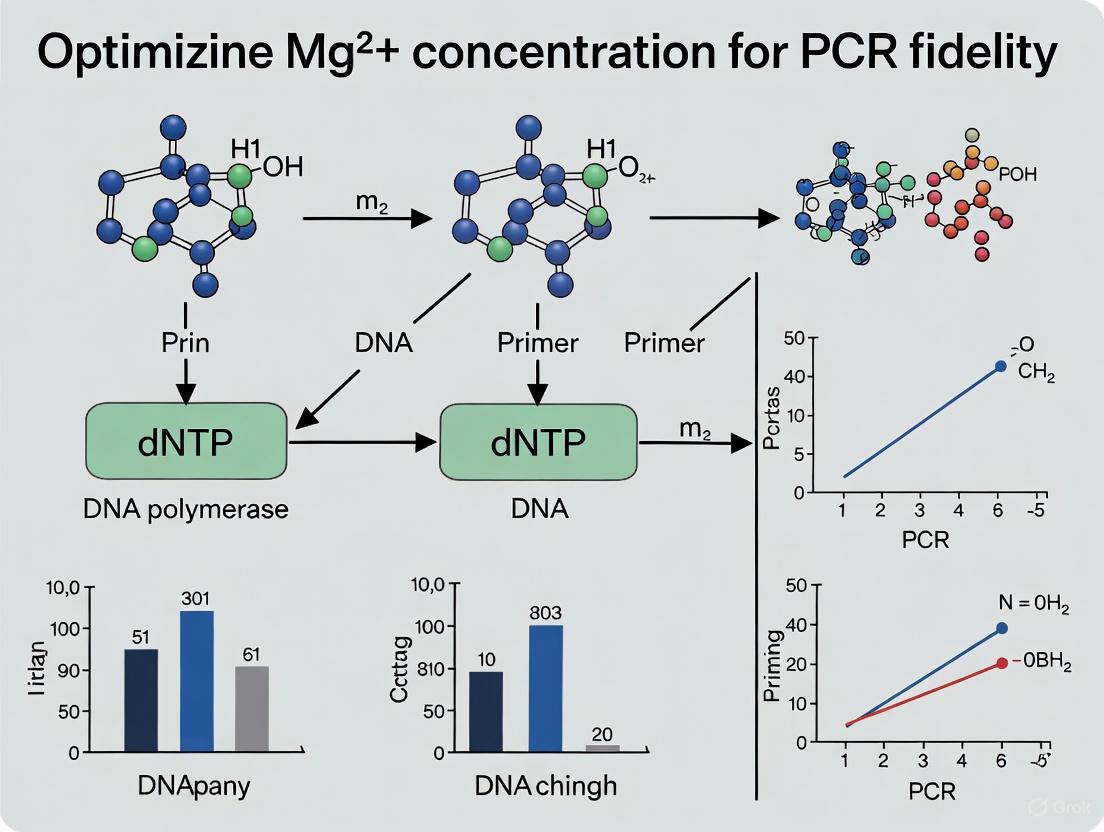
This article provides a comprehensive guide for researchers and drug development professionals on optimizing magnesium ion (Mg2+) concentration to maximize Polymerase Chain Reaction (PCR) fidelity.
Optimizing Mg2+ Concentration for PCR Fidelity: A Strategic Guide for Researchers and Drug Development
Abstract
This article provides a comprehensive guide for researchers and drug development professionals on optimizing magnesium ion (Mg2+) concentration to maximize Polymerase Chain Reaction (PCR) fidelity. It covers the foundational role of Mg2+ as an essential DNA polymerase cofactor, establishes evidence-based optimal concentration ranges (1.5–3.0 mM), and details systematic titration protocols. The content addresses common troubleshooting scenarios for non-specific amplification and failed reactions and offers comparative analysis of Mg2+ requirements across different DNA polymerases and template types. By synthesizing current research and meta-analyses, this guide delivers a strategic framework for achieving highly specific, efficient, and reproducible PCR amplification critical for sensitive downstream applications in biomedical and clinical research.
The Fundamental Role of Mg2+ in PCR Fidelity and Efficiency
In polymerase chain reaction (PCR), the divalent magnesium ion (Mg2+) is far more than a simple buffer component; it is a fundamental catalytic cofactor whose concentration directly governs the efficiency and accuracy of DNA amplification. As an essential cofactor for DNA polymerase enzymes, Mg2+ plays a critical role in catalyzing the formation of phosphodiester bonds, the backbone of newly synthesized DNA strands. Optimizing Mg2+ concentration is therefore not merely a step in reaction setup, but a central research focus for ensuring high fidelity in applications where sequence integrity is paramount, such as cloning, next-generation sequencing, and mutational analysis. This guide details the molecular mechanisms, troubleshooting, and optimization strategies for leveraging Mg2+ to achieve the highest PCR fidelity.
The Molecular Mechanism of Mg2+ in Catalysis
The catalytic core of DNA polymerases relies on a two-metal-ion mechanism that is conserved across polymerase families [1]. Structural studies, particularly on enzymes like the Klenow fragment of DNA polymerase I, reveal that two invariant aspartate residues (Asp705 and Asp882 in Klenow fragment) coordinate two Mg2+ ions at the active site [1].
Catalytic Role of the Two Metal Ions:
- Metal A (Catalytic Metal): This Mg2+ ion primarily facilitates the nucleophilic attack. It coordinates the 3'-OH group of the primer strand, lowering its pKa and activating it for attack on the alpha-phosphate of the incoming deoxynucleoside triphosphate (dNTP) [1].
- Metal B (Productive Metal): This Mg2+ ion enters the active site coordinated with the incoming dNTP. It stabilizes the structure of the triphosphate moiety of the dNTP and assists in the departure of the pyrophosphate leaving group after phosphodiester bond formation [1].
Beyond the chemical catalysis, Mg2+ also plays a crucial role in stabilizing the double-stranded structure of the primer-template complex. It neutralizes the negative charges on the phosphate backbone of DNA, reducing electrostatic repulsion and facilitating proper annealing [2]. This dual function—in both the chemical reaction and the structural stability—makes Mg2+ concentration a master regulator of PCR performance.
Diagram: The Two-Metal-Ion Mechanism for Phosphodiester Bond Formation. This catalytic process, coordinated by invariant aspartate residues in the polymerase active site, is directly dependent on Mg2+ availability [1].
Mg2+ Concentration Optimization and Troubleshooting
Optimizing Mg2+ concentration is a critical step in PCR protocol development, as it profoundly affects specificity, efficiency, and fidelity. The optimal concentration must be determined empirically for each primer-template system.
Troubleshooting Common Mg2+-Related PCR Issues
| Problem | Possible Mg2+-Related Cause | Proposed Solution |
|---|---|---|
| No/Low Amplification [3] [4] | Mg2+ concentration too low. This inactivates DNA polymerase and prevents primer annealing [5] [2]. | Titrate MgCl2 upward from a starting point of 1.0-1.5 mM in 0.5 mM increments up to 5 mM [6] [7]. |
| Non-Specific Bands/Background Smearing [3] | Mg2+ concentration too high. This reduces reaction stringency, promoting non-specific primer binding and spurious amplification [5] [2]. | Titrate MgCl2 downward from a starting point of 2.0 mM in 0.5 mM increments. Combine with an increase in annealing temperature [6] [4]. |
| Primer-Dimer Formation [3] | Excessively high Mg2+ concentration can stabilize transient, non-specific interactions between primers themselves [2]. | Decrease MgCl2 concentration. Ensure primer design minimizes 3'-end complementarity. Use a hot-start polymerase [3] [5]. |
| Sequence Errors (Low Fidelity) [4] | Suboptimal Mg2+ concentration (typically too high) can reduce the polymerase's base selection discrimination, increasing misincorporation rates [5]. | Precisely optimize Mg2+ and use balanced dNTP concentrations. Switch to a high-fidelity polymerase with proofreading activity [8] [5]. |
Quantitative Guide to Mg2+ Concentration Effects
The table below summarizes the quantitative relationships between Mg2+ concentration, PCR outcomes, and recommended corrective actions.
Table 1: Effects of Mg2+ Concentration on PCR Parameters and Fidelity
| Mg2+ Concentration | Polymerase Activity | Reaction Specificity | Fidelity (Accuracy) | Typical Artifacts | Recommended Action |
|---|---|---|---|---|---|
| Too Low (<1.0-1.5 mM) | Significantly reduced [5] [2] | N/A (No product) | N/A (No product) | No band, or very faint target band [2]. | Increase concentration incrementally [6]. |
| Optimal (1.5 - 2.5 mM) | Maximal [6] [9] | High | High (for the given polymerase) [5] | Single, clear band of the expected size. | Maintain optimized concentration. |
| Too High (>3.0 - 4.0 mM) | Maintained or enhanced | Drastically reduced [5] | Reduced; increased error rate [5] [4] | Multiple bands, smearing, primer-dimers [2]. | Decrease concentration incrementally [6]. |
Key Considerations for Optimization:
- dNTP Interaction: Mg2+ binds to dNTPs in the reaction. The effective free Mg2+ concentration is the total amount not chelated by dNTPs. Therefore, any change in dNTP concentration necessitates re-optimization of Mg2+ [9]. A general rule is that the Mg2+ concentration should be 0.5-2.0 mM higher than the total dNTP concentration [6].
- Template Complexity: GC-rich templates or those with complex secondary structures may require higher Mg2+ concentrations (up to 4-5 mM) for efficient amplification [5].
- Presence of Inhibitors: If the DNA template contains carryover inhibitors like EDTA (a potent Mg2+ chelator), higher Mg2+ concentrations may be needed to compensate [5].
Diagram: A Systematic Workflow for Optimizing Mg2+ Concentration via Titration. This iterative process is essential for establishing robust and reproducible PCR conditions [6] [7].
Experimental Protocol: Mg2+ Titration for Fidelity Research
This protocol provides a detailed method for empirically determining the optimal Mg2+ concentration for your specific PCR application, with an emphasis on achieving high fidelity.
Objective: To identify the MgCl2 concentration that yields the highest specificity and yield for a given primer-template pair and DNA polymerase.
Materials:
- DNA template (e.g., genomic DNA, plasmid)
- Forward and reverse primers
- High-fidelity DNA polymerase (e.g., Q5, Pfu) with corresponding 10X reaction buffer
- MgCl2 stock solution (e.g., 25 mM)
- dNTP mix
- Nuclease-free water
- Thermal cycler
- Gel electrophoresis equipment
Procedure:
- Master Mix Preparation: Calculate the reagents for enough master mix for n+1 reactions, where n is the number of Mg2+ conditions to be tested. Combine all components except the MgCl2 stock and the DNA template in a sterile tube. A typical 50 µL reaction contains [7]:
- 1X PCR Buffer (supplied with polymerase)
- 200 µM of each dNTP
- 20-50 pmol of each primer
- 0.5-2.5 units of DNA Polymerase
- Nuclease-free water to a final volume of 50 µL (accounting for MgCl2 and template to be added).
Aliquot and Add MgCl2: Aliquot equal volumes of the master mix into n PCR tubes. Add MgCl2 from the stock solution to each tube to create a concentration gradient. A standard range is 1.0 mM, 1.5 mM, 2.0 mM, 2.5 mM, 3.0 mM, and 4.0 mM [6] [7].
Add Template and Initiate PCR: Add an identical, optimized amount of DNA template to each tube (e.g., 10-100 ng genomic DNA). Mix gently and briefly centrifuge. Place tubes in a thermal cycler and run the standard cycling program for your primers and polymerase.
Analysis: Analyze the PCR products using agarose gel electrophoresis. Identify the Mg2+ concentration that produces a single, intense band of the correct size with minimal to no background smearing or non-specific bands. This is your optimal concentration.
Interpreting Results for Fidelity:
- The concentration that gives the cleanest, most specific product is likely to provide the best fidelity, as it minimizes mispriming and reduces stress on the polymerase that can lead to errors [5].
- For the ultimate fidelity assessment, products amplified at different Mg2+ concentrations can be cloned and sequenced or analyzed by next-generation sequencing to directly quantify error rates [8].
The Scientist's Toolkit: Research Reagent Solutions
Table 2: Essential Reagents for Mg2+ and PCR Fidelity Research
| Reagent | Function in Research | Key Considerations for Mg2+ Optimization |
|---|---|---|
| Magnesium Chloride (MgCl2) | Source of Mg2+ ions. A standardized, high-purity stock solution is crucial. | Use a fresh, vortexed stock to ensure consistent concentration, as salts can precipitate. Concentration is typically titrated from 0.5 to 5.0 mM [6] [7]. |
| High-Fidelity DNA Polymerase | Enzymes with proofreading (3'→5' exonuclease) activity to correct misincorporated nucleotides. | Polymerases like Q5, Pfu, and Vent offer error rates 50-300 times lower than non-proofreading enzymes like Taq [8] [5]. Their optimal Mg2+ range may differ. |
| Ultrapure dNTPs | Building blocks for DNA synthesis. Quality and balance are critical for fidelity. | Unbalanced or degraded dNTPs increase error rates. dNTPs chelate Mg2+; therefore, the Mg2+ concentration must exceed the total dNTP concentration [6] [9]. |
| PCR Additives (e.g., DMSO, Betaine) | Assist in amplifying difficult templates (e.g., GC-rich) by reducing secondary structures. | Additives can affect the apparent Tm of primers and the requirement for Mg2+. Re-optimization of Mg2+ is often necessary when adding these reagents [5] [7]. |
| Template DNA (Purified) | The target DNA to be amplified. Purity is essential to prevent inhibition. | Contaminants like EDTA chelate Mg2+, rendering it unavailable for the polymerase. Ensure template is pure and in a low-EDTA or EDTA-free buffer [5]. |
Frequently Asked Questions (FAQs)
Q1: Why is Mg2+ absolutely essential for PCR? Mg2+ is a non-protein cofactor required for the catalytic activity of DNA polymerase. It is directly involved in the phosphodiester bond formation mechanism by activating the 3'-OH nucleophile and stabilizing the leaving group [1] [2]. Without Mg2+, the polymerase enzyme is functionally inactive.
Q2: How does Mg2+ concentration directly impact PCR fidelity? Suboptimal Mg2+ concentrations can drastically increase error rates. Excessively high Mg2+ reduces the enzyme's ability to discriminate against incorrect nucleotides during base selection, leading to misincorporation [5] [4]. It also promotes non-specific priming, generating unwanted products. Precise optimization is therefore critical for high-fidelity applications.
Q3: My PCR has no product. Should I immediately increase Mg2+? While low Mg2+ is a common cause of amplification failure, it is not the only one. A systematic troubleshooting approach is best. First, confirm all reagents were added and the thermal cycler program is correct [4]. If these are confirmed, then performing an Mg2+ titration (e.g., from 1.0 to 4.0 mM) is a highly recommended next step [6].
Q4: How do dNTPs interact with Mg2+ in the reaction? dNTPs bind Mg2+ to form a productive substrate complex for the polymerase. The free Mg2+ concentration in the reaction is the total Mg2+ not bound to dNTPs. This is why the optimal Mg2+ concentration is always higher than the total dNTP concentration, and why changes in dNTP concentration often require re-optimization of Mg2+ [6] [9].
Q5: For high-fidelity applications, should I use a lower Mg2+ concentration? While lowering Mg2+ can increase stringency and reduce non-specific products, it must be balanced against the risk of insufficient polymerase activity. The goal is to find the lowest effective concentration that provides strong, specific amplification. This optimized concentration, combined with a proofreading polymerase, will deliver the best fidelity [5]. Always refer to the manufacturer's recommendations for your specific high-fidelity enzyme, as their optimal Mg2+ range may differ from that of standard Taq polymerase.
Magnesium ions (Mg²⁺) are fundamental to the integrity and function of nucleic acids. While their role as an essential cofactor for polymerase enzymes is well-documented in catalytic processes, their function in stabilizing the structure of primer-template hybrids and overall DNA duplex stability is equally critical for experimental success. This structural stabilization is paramount in techniques such as PCR, cDNA synthesis, and sequencing, where the fidelity and yield of the reaction are directly influenced by the ionic environment. Mg²⁺ cations act as a molecular "glue," shielding the negatively charged phosphate backbones of DNA and RNA strands. This shielding reduces the electrostatic repulsion between strands, allowing them to form stable, hybridized duplexes essential for accurate polymerase recognition and initiation. Understanding this non-catalytic role is a prerequisite for optimizing any molecular biology protocol involving nucleic acid hybridization. The following sections provide a detailed technical guide for researchers troubleshooting issues related to Mg²⁺ concentration and its impact on experimental outcomes.
FAQs and Troubleshooting Guides
How does Mg²⁺ concentration specifically affect primer-template duplex stability?
Mg²⁺ stabilizes the primer-template hybrid primarily by electrostatically shielding the negatively charged phosphate backbones of the DNA strands. The repulsion between these backbones is a significant barrier to duplex formation. Mg²⁺, being a divalent cation, is highly efficient at neutralizing this negative charge, allowing the two strands to come into closer proximity and form a stable hybrid [10]. Higher concentrations of Mg²⁺ will generally lead to a more stable duplex.
However, the effect is nuanced. While monovalent ions like Na⁺ also provide shielding, Mg²⁺ is far more efficient due to its higher charge density. Theoretical models, such as the tightly bound ion (TBI) model, demonstrate that Mg²⁺ can strongly influence RNA helix stability in mixed Na⁺/Mg²⁺ solutions by accounting for ion correlation and fluctuation effects, which mean-field theories like Poisson-Boltzmann underestimate [11]. This makes Mg²⁺ critical for stabilizing complex secondary structures.
What are the symptoms of suboptimal Mg²⁺ concentration in PCR?
The table below summarizes the common experimental observations resulting from incorrect Mg²⁺ concentrations.
Table: Symptoms and Consequences of Suboptimal Mg²⁺ Concentration in PCR
| Observation | Possible Cause | Underlying Reason |
|---|---|---|
| No PCR product [12] [13] | Mg²⁺ concentration too low | Insufficient Mg²⁺ fails to activate the DNA polymerase or stabilize the primer-template hybrid, preventing polymerization. |
| Multiple bands or smeared products [12] [13] [14] | Mg²⁺ concentration too high | Excess Mg²⁺ stabilizes non-specific primer-template interactions, leading to mis-priming and amplification of off-target sequences. |
| Low reaction yield [5] | Mg²⁺ concentration too low or too high | Low [Mg²⁺] reduces enzyme activity; high [Mg²⁺] promotes non-specific amplification, both reducing the target product yield. |
| High error rate (low fidelity) [15] [16] | Mg²⁺ concentration too high | Elevated Mg²⁺ can reduce the fidelity of DNA polymerases by promoting misincorporation of nucleotides [15]. |
How does Mg²⁺ interact with other reaction components?
Mg²⁺ concentration does not act in isolation; its effective concentration is influenced by other components in the reaction mix. Key interactions include:
- dNTPs: dNTPs chelate Mg²⁺ ions. The typical concentration of each dNTP is 200 µM, and the Mg²⁺ concentration must be in excess of the total dNTP concentration to ensure a pool of free Mg²⁺ is available for the polymerase [13] [14].
- Chelators: Reagents like EDTA, which is often present in purified DNA templates or storage buffers, can potently chelate Mg²⁺ and render it unavailable for the polymerase. It is crucial to use high-purity templates and avoid EDTA carryover [5] [16].
- Template Complexity: GC-rich templates, which form stable secondary structures, often require optimized Mg²⁺ levels and sometimes specialized buffers with additives to achieve efficient amplification [17].
The following diagram illustrates the logical workflow for diagnosing and resolving Mg²⁺-related issues in PCR experiments.
What is the relationship between physiological Mg²⁺ concentrations and in vitro optima?
There is a critical distinction between total and free cellular Mg²⁺ that must be considered for biologically relevant research. While the total Mg²⁺ concentration in cells is high (typically ~10 mM or more), the free Mg²⁺ concentration is only about 0.5 mM because most Mg²⁺ is sequestered by nucleotides and other complex anions [15]. This is significantly lower than the Mg²⁺ concentrations (e.g., 5-10 mM) often used in optimized in vitro reverse transcription or PCR assays.
This difference has functional consequences. For instance, the fidelity of HIV-1 Reverse Transcriptase is higher at physiologically low Mg²⁺ concentrations (0.5 mM) than at standard high in vitro concentrations (6 mM) [15]. Therefore, researchers studying viral replication or drug mechanisms should consider adjusting Mg²⁺ levels to mimic the physiological environment for more accurate results.
Quantitative Data and Optimization Tables
Recommended Mg²⁺ Concentration Ranges for Different Applications
The optimal Mg²⁺ concentration varies by application and enzyme. The following table provides general guidelines and the impact of deviation from the optimum.
Table: Mg²⁺ Optimization Guide for Molecular Biology Applications
| Application / Enzyme | Typical Optimal [Mg²⁺] | Effect of Low [Mg²⁺] | Effect of High [Mg²⁺] |
|---|---|---|---|
| Standard PCR (Taq Polymerase) | 1.5 - 2.0 mM [13] | No amplification; weak yield [12] [13] | Non-specific products; multiple bands [12] [13] |
| High-Fidelity PCR (e.g., Q5) | As per buffer system; may require titration | Reduced yield, especially for complex templates | Increased misincorporation, reduced fidelity [12] |
| Reverse Transcription (HIV-1 RT) | Physiological: 0.5 mM [15]In vitro optimized: ~6 mM [15] | Lower overall activity but higher fidelity [15] | Higher activity but significantly lower fidelity [15] |
| General Primer-Template Annealing | Higher concentrations increase stability [10] | Reduced duplex stability and hybridization efficiency | Potential stabilization of non-specific hybrids |
Protocol: Optimizing Mg²⁺ Concentration for a Novel PCR Assay
This is a generalized protocol for determining the ideal Mg²⁺ concentration when establishing a new PCR assay or troubleshooting an existing one.
Materials:
- Template DNA (high-quality, minimal EDTA)
- Forward and Reverse Primers
- 10X Reaction Buffer (without MgCl₂)
- MgCl₂ stock solution (e.g., 25 mM or 50 mM)
- dNTP Mix
- DNA Polymerase
- Nuclease-free Water
- Thermocycler
Method:
- Prepare a Master Mix containing all components except the MgCl₂ and template DNA. Calculate for n+1 reactions, where n is the number of Mg²⁺ conditions to be tested.
- Aliquot the master mix into n thin-walled PCR tubes.
- Spike each tube with a different volume of MgCl₂ stock solution to create a concentration gradient. A recommended starting range is 1.0 mM to 4.0 mM in increments of 0.5 mM [13] [17].
- Add template DNA to each tube and mix gently.
- Run the PCR using cycling conditions that include an annealing temperature gradient if primer specificity is also a concern.
- Analyze the results by resolving the PCR products on an agarose gel. The optimal condition is the one that produces the strongest, single band of the correct size with the least background smearing.
The Scientist's Toolkit: Essential Research Reagents
Table: Key Reagents for Studying Mg²⁺ Effects in Nucleic Acid Experiments
| Reagent / Material | Function / Rationale |
|---|---|
| MgCl₂ or MgSO₄ Stock Solutions | High-purity, nuclease-free stocks are essential for accurate and reproducible concentration titration. MgSO₄ is preferred for some polymerases (e.g., Pfu) [16]. |
| 10X PCR Buffer (without Mg²⁺) | A Mg²⁺-free buffer is necessary for performing a clean titration without a variable background of the ion. |
| High-Fidelity DNA Polymerase (e.g., Q5, Pfu) | These enzymes possess proofreading (3'→5' exonuclease) activity and inherently higher fidelity, making them ideal for studies where minimizing mutation rates is critical [12] [5]. |
| PCR Additives (DMSO, Betaine, GC Enhancer) | These reagents help denature GC-rich secondary structures that can be overly stabilized by Mg²⁺, allowing for better primer access and more accurate determination of Mg²⁺ effects on difficult templates [17] [14]. |
| dNTP Mix | A balanced, high-quality dNTP mix is crucial. Unbalanced nucleotides can exacerbate error rates, and impurities can chelate Mg²⁺, altering its effective concentration [16]. |
| EDTA-containing and EDTA-free TE Buffers | Used for template storage and purification. It is critical to use EDTA-free buffers or ensure complete removal of EDTA prior to reactions to avoid chelation of Mg²⁺ [16]. |
Quantitative Foundations: The Mg2+-Tm Relationship
The relationship between magnesium ion (Mg2+) concentration and DNA melting temperature (Tm) is a cornerstone of efficient PCR optimization. A recent meta-analysis of 61 peer-reviewed studies established a precise logarithmic relationship between MgCl2 concentration and DNA melting temperature [18] [19].
The table below summarizes the core quantitative findings for the established optimal MgCl2 range of 1.5–3.0 mM [18]:
| Parameter | Value | Experimental Basis |
|---|---|---|
| Optimal MgCl2 Range | 1.5 – 3.0 mM | Meta-analysis of 61 studies [18] |
| Tm Increase per 0.5 mM MgCl2 | +1.2 °C | Systematic review within optimal range [18] |
| Primary Model Predictive Power (R²) | 0.9942 | Multivariate Taylor series expansion model [20] |
| Tm Model Predictive Power (R²) | 0.9600 | Thermodynamic hybridization temperature model [20] |
This relationship means that Mg2+ concentration directly influences PCR stringency. Higher concentrations stabilize the DNA duplex by screening the negative charges on the phosphate backbone, requiring a higher temperature (Tm) for the strands to separate [18]. This stabilization must be carefully balanced, as it affects both primer annealing efficiency and DNA polymerase activity [5].
Template complexity significantly influences optimal Mg2+ requirements. Genomic DNA templates, with their high complexity, generally require concentrations at the higher end of the optimal range, while simpler templates (like plasmid DNA) can often be amplified efficiently at the lower end [18].
Predictive Modeling for Precision Optimization
Advanced mathematical modeling provides a framework for predicting optimal MgCl2 concentration based on multiple reaction parameters. The resulting predictive equation demonstrates the influence of various factors [20]:
(MgCl2) ≈ 1.5625 + (-0.0073 × Tm) + (-0.0629 × GC) + (0.0273 × L) + (0.0013 × dNTP) + (-0.0120 × Primers) + (0.0007 × Polymerase) + (0.0012 × log(L)) + (0.0016 × Tm_GC) + (0.0639 × dNTP_Primers) + (0.0056 × pH_Polymerase)
Analysis of variable importance in this model reveals that the interaction between dNTP and primer concentrations is the most critical factor (28.5% relative importance), followed by GC content (22.1%) and amplicon length (15.7%) [20].
Troubleshooting Guide: FAQs on Mg2+ Optimization
How does Mg2+ concentration specifically affect PCR fidelity?
Mg2+ is an essential cofactor for DNA polymerase activity, but its concentration must be precisely controlled to maintain high fidelity (low error rate) [5].
| Problem | Root Cause | Solution |
|---|---|---|
| High Error Rate (Low Fidelity) | Excess Mg2+ concentration reduces enzyme specificity, promoting misincorporation of nucleotides [21]. | - Titrate Mg2+ downward in 0.2-1.0 mM increments [21].- Use a high-fidelity polymerase with proofreading capability (e.g., Pfu, Q5) [5].- Ensure balanced dNTP concentrations [21]. |
| No Amplification | Insufficient Mg2+ concentration, leading to poor DNA polymerase activity [16]. | - Add Mg2+ if not present in the buffer [7].- Optimize Mg2+ concentration, especially if chelators (e.g., EDTA) are present [16].- Check for PCR inhibitors in the template [22]. |
| Non-Specific Bands/Smearing | Excessive Mg2+ concentration stabilizes non-specific primer-template interactions, reducing reaction stringency [16] [21]. | - Decrease Mg2+ concentration [21].- Increase annealing temperature [16] [22].- Use a hot-start DNA polymerase [16] [21]. |
| Low Yield | Suboptimal Mg2+ level, negatively impacting polymerase efficiency [3]. | - Optimize Mg2+ concentration across a range (e.g., 0.5-5.0 mM) [3] [7].- Increase the number of PCR cycles (up to 40) [22].- Verify template quality and quantity [16]. |
What is the optimal strategy for titrating Mg2+ in a new PCR assay?
A systematic approach is crucial. Begin with a standard concentration, such as 1.5 mM, and test a range from 1.0 mM to 5.0 mM in 0.5 mM increments [18] [7]. For higher precision, use a master mix to ensure reaction uniformity and include both positive and negative controls to distinguish between specific and non-specific amplification [7] [23].
Why do GC-rich templates require special consideration regarding Mg2+?
GC-rich sequences form more stable duplexes due to triple hydrogen bonds between G and C bases. While Mg2+ stabilizes DNA, excessive stabilization can make GC-rich templates difficult to denature completely. For these challenging templates, consider using additives like DMSO (1-10%), formamide (1.25-10%), or betaine (0.5-2.5 M) alongside Mg2+ optimization. These co-solvents help denature stable secondary structures and homogenize base stability [7] [5].
Experimental Protocol: Mg2+ Concentration Titration
This protocol provides a detailed methodology for empirically determining the optimal MgCl2 concentration for a specific PCR assay.
Materials and Reagents
| Item | Function in Experiment |
|---|---|
| Template DNA | The DNA containing the target sequence to be amplified (e.g., genomic DNA, plasmid). |
| Sequence-Specific Primers | Oligonucleotides designed to flank the target sequence. |
| MgCl2 Stock Solution (25 mM) | The source of Mg2+ ions for titration. |
| 10X PCR Buffer (without MgCl2) | Provides the optimal salt and pH environment for the polymerase. |
| DNA Polymerase | The enzyme that catalyzes DNA synthesis (e.g., Taq, Pfu). |
| dNTP Mix | The building blocks (dATP, dCTP, dGTP, dTTP) for new DNA strands. |
| Nuclease-Free Water | Solvent to bring the reaction to the final volume. |
Procedure
Prepare Master Mix: Calculate the required reactions (number of Mg2+ points + one negative control). Create a master mix in a 1.8 ml microcentrifuge tube on ice containing all common components per reaction [7]:
- 5.0 µl of 10X PCR Buffer (without MgCl2)
- 1.0 µl of 10 mM dNTP Mix
- 1.0 µl of Forward Primer (20 µM)
- 1.0 µl of Reverse Primer (20 µM)
- 0.5 µl of DNA Polymerase (e.g., 0.5-2.5 U/reaction)
- X µl of Nuclease-Free Water (volume depends on Mg2+ and template addition)
- 1.0 µl of Template DNA (e.g., 10-100 ng genomic DNA)
Aliquot and Add MgCl2: Pipette the appropriate volume of the master mix into each PCR tube. Then, add MgCl2 from a 25 mM stock solution to achieve the desired final concentrations. A recommended range is 0.5 mM, 1.0 mM, 1.5 mM, 2.0 mM, 2.5 mM, 3.0 mM, 3.5 mM, 4.0 mM, and 5.0 mM [7]. For a 50 µl reaction, the volume of 25 mM MgCl2 stock to add is calculated as: (Desired mM × 50 µl) / 25 mM.
Run Thermal Cycler: Place the tubes in a thermal cycler and run the appropriate program, which typically includes [7]:
- Initial Denaturation: 94-95°C for 2-5 minutes.
- Amplification Cycles (25-35 cycles):
- Denature: 94-95°C for 30 seconds.
- Anneal: Temperature 3-5°C below the primer Tm for 30 seconds.
- Extend: 72°C for 1 minute per kb of amplicon.
- Final Extension: 72°C for 5-10 minutes.
Analyze Results: Separate the PCR products by agarose gel electrophoresis. Identify the Mg2+ concentration that produces the strongest specific band with the least or no non-specific background.
Essential Research Reagent Solutions
The following table details key materials and their functions for research focused on Mg2+ optimization and PCR fidelity.
| Reagent / Solution | Critical Function in Optimization |
|---|---|
| MgCl2 Stock Solution (25-50 mM) | High-purity source of Mg2+ ions for precise titration; concentration must be accurately known [7]. |
| PCR Buffer (Mg-free) | Provides optimal pH, ionic strength (e.g., K+), and stabilizers without confounding Mg2+ levels [7]. |
| High-Fidelity DNA Polymerase | Enzyme with 3'→5' exonuclease (proofreading) activity for low error rates in fidelity research (e.g., Pfu, Q5) [21] [5]. |
| dNTP Mix (Balanced) | Equimolar mixture of all four dNTPs; unbalanced concentrations increase misincorporation rates [21]. |
| PCR Additives (DMSO, Betaine) | Co-solvents to aid in amplifying complex templates (e.g., GC-rich), used alongside Mg2+ optimization [7] [5]. |
| Standardized Template DNA | Well-characterized DNA (e.g., control plasmid) to ensure amplification variability stems from reaction conditions, not template quality [16]. |
Technical FAQs: Addressing Core Experimental Challenges
What is the fundamental role of Mg²⁺ in PCR fidelity?
Magnesium ions (Mg²⁺) are an essential cofactor for all DNA polymerases. They are directly involved in the catalytic nucleotidyl transferase reaction that adds nucleotides to the growing DNA chain [24]. The fidelity of this process—meaning the accuracy of nucleotide incorporation—is highly sensitive to the concentration of free Mg²⁺. While adequate Mg²⁺ is required for any amplification to occur, excess Mg²⁺ reduces enzyme fidelity and can increase nonspecific amplification [25]. This happens because elevated Mg²⁺ concentrations can stabilize the binding of incorrect nucleotides (misincorporation) and primers to non-target sites, leading to errors and spurious products [16] [26].
How does Mg²⁺ concentration specifically lead to nucleotide misincorporation?
Structurally, the active site of DNA polymerases contains acidic residues that coordinate at least two metal ions (often Mg²⁺) to facilitate the catalysis of DNA synthesis [27]. The precise geometric arrangement of these ions, the DNA template, and the incoming nucleotide is critical for accurate base pairing and incorporation. A suboptimal Mg²⁺ concentration can disrupt this precise arrangement. Excess Mg²⁺ is known to favor misincorporation by the DNA polymerase, meaning the enzyme is more likely to add a nucleotide that does not correctly Watson-Crick base-pair with the template [26]. This directly increases the rate of single-base substitutions in the amplified DNA product.
What is the empirically determined optimal Mg²⁺ concentration range for high-fidelity PCR?
A comprehensive meta-analysis of PCR optimization studies has identified an optimal MgCl₂ range of 1.5 to 3.0 mM for efficient PCR performance [18]. Within this range, the Mg²⁺ concentration has a quantifiable effect on DNA thermodynamics; every 0.5 mM increase in MgCl₂ raises the DNA melting temperature by approximately 1.2 °C [18]. It is crucial to note that the presence of EDTA (a chelator) or high concentrations of dNTPs, which also bind Mg²⁺, can reduce the amount of free Mg²⁺ available for the polymerase. Therefore, the Mg²⁺ concentration must often be optimized for each specific primer-template system [16].
How do I troubleshoot a PCR reaction that is producing multiple non-specific bands?
The presence of multiple or smeared bands on a gel often indicates low reaction specificity, which can be linked to excessive Mg²⁺. Your troubleshooting should include:
- Optimize Mg²⁺: Decrease the Mg²⁺ concentration in 0.2–1.0 mM increments [26].
- Increase Annealing Temperature: Raise the temperature in 1–2°C increments to enhance stringency [16].
- Use a Hot-Start Polymerase: This prevents activity at room temperature, reducing primer-dimer formation and non-specific priming before the thermal cycling begins [16] [3].
- Verify Primer Design: Ensure primers are specific and do not have complementary regions, especially at their 3' ends [16] [7].
My PCR has no yield. Could Mg²⁺ be the problem?
Yes. Insufficient Mg²⁺ concentration is a common cause of PCR failure, as the DNA polymerase has absolutely no activity without this cofactor [25]. If you observe no amplification, you should:
- Increase Mg²⁺ Concentration: Titrate Mg²⁺ upward in 0.2–1.0 mM increments from your starting point [26].
- Check for Chelators: If your DNA template contains EDTA from the purification process, it will chelate Mg²⁺. You may need to repurify your template or increase the Mg²⁺ concentration to compensate [16].
- Review Template Quality and Quantity: Ensure you have added an adequate amount of intact, pure DNA template [16].
Table 1: The Effect of Mg²⁺ Concentration on Key PCR Parameters
| Parameter | Effect of Low Mg²⁺ | Effect of High Mg²⁺ | Optimal Range |
|---|---|---|---|
| Polymerase Activity | Greatly reduced or absent; no or poor yield [25] | Normal or slightly enhanced [16] | 1.5 – 3.0 mM (MgCl₂) [18] |
| Reaction Fidelity | High (but no product is generated) | Reduced; increased misincorporation and error rate [26] | Specific to polymerase & template [25] |
| Specificity | High (but no product is generated) | Reduced; increased non-specific priming & multiple bands [16] [26] | Balanced with annealing temperature |
| DNA Melting Temp (Tm) | Lower than calculated | Increased by ~1.2°C per 0.5 mM MgCl₂ [18] | Must be re-calculated factoring in Mg²⁺ |
Table 2: Mg²⁺ Optimization Guide for Different Template Types
| Template Characteristic | Recommended Mg²⁺ Adjustment | Additional Recommendations |
|---|---|---|
| Standard Templates | Start at 1.5 mM [18] | Optimize in 0.5 mM steps within 1.5-3.0 mM range. |
| Complex Genomic DNA | May require higher concentrations [18] | Ensure high template purity to avoid carrying over inhibitors [16]. |
| GC-Rich Sequences | May require optimization | Use a specialized polymerase and additives like DMSO or betaine [16] [25]. |
| Long Targets (>4 kb) | Follow polymerase guidelines | Use a lower extension temperature (e.g., 68°C) to reduce depurination [25]. |
Experimental Protocols & Workflows
Standard Mg²⁺ Titration Protocol
This protocol provides a methodology to systematically determine the optimal MgCl₂ concentration for any new PCR assay [7].
Materials & Reagents:
- DNA template (e.g., 10-100 ng genomic DNA)
- Forward and Reverse Primers (0.1–1.0 µM each final concentration)
- 10X PCR Buffer (without MgCl₂)
- MgCl₂ solution (e.g., 25 mM stock)
- dNTP Mix (e.g., 10 mM total)
- Thermostable DNA Polymerase (e.g., Taq, Q5, etc.)
- Nuclease-free Water
Procedure:
- Prepare a Master Mix for all common components to ensure consistency across tubes. Calculate for n+1 reactions.
- Nuclease-free Water (Q.S. to final volume)
- 10X PCR Buffer (without MgCl₂)
- dNTP Mix
- Forward Primer
- Reverse Primer
- DNA Polymerase
- Aliquot the Master Mix into thin-walled 0.2 ml PCR tubes.
- Add MgCl₂ to each tube to create a concentration gradient. A typical range is 0.5 mM to 5.0 mM in 0.5 mM increments.
- Example: For a 50 µL reaction, add 0, 1, 2, 3, 4, ... µL of a 25 mM MgCl₂ stock solution.
- Add DNA template to each reaction tube. Include a negative control (no template) for one Mg²⁺ concentration.
- Gently mix the reactions by pipetting and briefly centrifuge to collect all liquid.
- Place tubes in a thermal cycler and run the appropriate cycling program.
- Analyze the results using agarose gel electrophoresis. The optimal condition is the lowest Mg²⁺ concentration that produces a strong, specific band with minimal background.
Workflow for Evaluating PCR Fidelity
This workflow outlines the process for investigating how a specific factor, like Mg²⁺ concentration, impacts the error rate of a PCR reaction.
The Scientist's Toolkit: Essential Reagents & Materials
Table 3: Key Research Reagent Solutions for PCR Fidelity Studies
| Reagent / Material | Critical Function in Fidelity Research | Example & Notes |
|---|---|---|
| High-Fidelity DNA Polymerase | Polymerases with proofreading (3'→5' exonuclease) activity inherently have lower error rates. | Q5 High-Fidelity, Phusion, Pfu. Essential for high-accuracy applications like cloning [26]. |
| MgCl₂ Stock Solution | The variable of interest; precise concentration is critical for reproducible fidelity results. | Use a high-purity, sterile stock. Concentration must be verified as it directly impacts free Mg²⁺ [18] [7]. |
| Ultra-pure dNTPs | Unbalanced dNTP concentrations increase misincorporation by the polymerase. | Use equimolar mixtures of all four dNTPs. Prepare fresh aliquots to avoid freeze-thaw degradation [26]. |
| PCR Additives | Can help denature difficult templates (e.g., GC-rich), reducing stalling and potential errors. | DMSO, Betaine, Formamide. Use at the lowest effective concentration as they can also inhibit polymerization [16] [25]. |
| Cloning & Sequencing Kit | Required for the "gold standard" method of quantifying fidelity via sequencing cloned products. | Traditional cloning or TA/Blunt-end cloning kits followed by Sanger sequencing of multiple clones [28]. |
Evidence-Based Protocols for Mg2+ Titration and Optimization
What is the established evidence-based optimal range for MgCl2 in PCR? A comprehensive meta-analysis of 61 peer-reviewed studies has identified 1.5–3.0 mM as the optimal range for magnesium chloride (MgCl2) concentration in standard Polymerase Chain Reaction (PCR) protocols [18] [19]. This range supports efficient DNA amplification while maintaining template specificity. The precise concentration within this window is not universal; it is significantly influenced by template DNA characteristics and other reaction components. Adhering to this evidence-based baseline minimizes reaction failure and is the recommended starting point for optimization.
The Role of Magnesium in PCR
Why is MgCl2 an absolute requirement for PCR? Magnesium ions (Mg²⁺) are an essential cofactor for DNA polymerase enzyme activity [29]. They play a dual critical role in the reaction mechanics:
- Enzymatic Cofactor: Mg²⁺ ions are directly involved in the catalytic core of the DNA polymerase. They facilitate the nucleophilic attack by the primer's 3'-OH group on the alpha-phosphate of the incoming dNTP, enabling the formation of the phosphodiester bond that extends the DNA chain [1] [9].
- Template Stabilization: The positively charged Mg²⁺ ions help stabilize the negatively charged backbone of the DNA template and the incoming dNTPs [9]. This stabilization is crucial for the proper formation of the primer-template complex during the annealing step.
The following diagram illustrates the coordinated role of Mg²⁺ ions in the DNA polymerase active site:
Quantitative Effects & Template-Specific Optimization
How does MgCl2 concentration quantitatively affect my PCR? The meta-analysis revealed a direct and quantitative relationship between MgCl2 concentration and PCR thermodynamics. The most significant effect was observed on the DNA melting temperature (Tm) [18].
Table 1: Quantitative Effects of MgCl2 Concentration on PCR Parameters
| PCR Parameter | Effect of Increasing MgCl2 | Quantitative Relationship | Notes |
|---|---|---|---|
| DNA Melting Temperature (Tm) | Increase | +1.2 °C per 0.5 mM increase within 1.5-3.0 mM range [18] | Stabilizes DNA duplex; lowers strand separation efficiency. |
| Reaction Efficiency | Bell-shaped curve | Optimal between 1.5-3.0 mM; declines outside this range [18] | Low [Mg²⁺]: insufficient polymerase activity. High [Mg²⁺]: increased error rate and nonspecific binding [29]. |
| Template Specificity | Critical impact | Lower [Mg²⁺] favors higher specificity [18] | High [Mg²⁺] reduces stringency, leading to nonspecific primer annealing and spurious amplification. |
How do I adjust MgCl2 for different template types? Template complexity is a major determinant of the optimal MgCl2 concentration. The meta-analysis showed that genomic DNA (gDNA), with its high complexity and secondary structures, generally requires a concentration at the higher end of the optimal range (e.g., 2.5-3.0 mM) [18]. In contrast, simpler templates like plasmid DNA or cDNA may perform optimally at the lower end (e.g., 1.5-2.0 mM) [18] [9]. The following workflow provides a strategic guide for this optimization process:
Detailed Experimental Protocol for MgCl2 Optimization
What is a detailed protocol for optimizing MgCl2 concentration? This protocol outlines a standard MgCl2 titration experiment, which is considered a best practice for establishing optimal conditions for a new PCR assay [7].
Objective: To empirically determine the optimal MgCl2 concentration for a specific PCR assay by testing a range of concentrations and evaluating amplification efficiency and specificity.
Materials & Reagents:
- DNA template (e.g., gDNA, plasmid)
- Forward and Reverse Primers
- 10X PCR Buffer (without MgCl2)
- MgCl2 stock solution (e.g., 25 mM)
- dNTP Mix
- DNA Polymerase (e.g., Taq polymerase)
- Nuclease-free Water
- PCR Tubes & Thermal Cycler
- Agarose Gel Electrophoresis System
Procedure:
- Prepare Master Mix: Calculate the required volumes for all components common to all reactions (water, buffer, dNTPs, primers, DNA template, polymerase). Combine these in a single tube to minimize pipetting error and ensure consistency. Gently mix by pipetting up and down [7].
- Aliquot Master Mix: Dispense equal volumes of the Master Mix into each PCR tube.
- Add MgCl2: Add MgCl2 stock solution to each tube to create the desired final concentrations. A typical titration series is shown in the table below.
- Run PCR: Place the tubes in a thermal cycler and start the optimized cycling program.
- Analyze Results: Separate the PCR products using agarose gel electrophoresis. Visualize the gel under UV light to assess the yield and specificity of the amplification.
Table 2: Example Setup for a 50 µL MgCl2 Optimization PCR
| Reagent | Stock Conc. | Final Conc. | Volume per Rx (µL) | xN for Master Mix |
|---|---|---|---|---|
| Nuclease-free Water | - | - | Variable* | Variable* |
| 10X PCR Buffer | 10X | 1X | 5.0 | (N x 5.0) |
| dNTP Mix | 10 mM | 200 µM | 1.0 | (N x 1.0) |
| Forward Primer | 20 µM | 0.5 µM | 1.25 | (N x 1.25) |
| Reverse Primer | 20 µM | 0.5 µM | 1.25 | (N x 1.25) |
| DNA Template | e.g., 50 ng/µL | e.g., 50 ng | 1.0 | (N x 1.0) |
| DNA Polymerase | 5 U/µL | 1.25 U | 0.25 | (N x 0.25) |
| MgCl2 | 25 mM | See below | Variable | Add individually |
| Final Volume | 50 µL |
MgCl2 Titration Series:
- Tube 1: 1.0 mM → Add 2.0 µL of 25 mM MgCl2
- Tube 2: 1.5 mM → Add 3.0 µL of 25 mM MgCl2
- Tube 3: 2.0 mM → Add 4.0 µL of 25 mM MgCl2
- Tube 4: 2.5 mM → Add 5.0 µL of 25 mM MgCl2
- Tube 5: 3.0 mM → Add 6.0 µL of 25 mM MgCl2
- Tube 6: 4.0 mM → Add 8.0 µL of 25 mM MgCl2 *Tube 7 (Negative Control): 0 mM → Add 0 µL of MgCl2 *The volume of water is adjusted to bring the final volume to 50 µL in all tubes.
Advanced Considerations & Troubleshooting
What are advanced considerations for MgCl2 optimization in complex scenarios?
- GC-Rich Templates: Templates with high GC content form stable secondary structures that are difficult to denature. Slightly increasing MgCl2 concentration (e.g., towards 3.0-4.0 mM) can help by stabilizing the DNA duplex against partial denaturation, but this must be balanced against potential loss of specificity. The use of PCR enhancers like DMSO or betaine is often more effective and should be considered in conjunction with Mg²⁺ optimization [18] [7].
- Inhibition by Metal Ions: Be aware that metal ions other than Mg²⁺ can co-purify with your DNA template and act as potent PCR inhibitors. Ions like Ca²⁺ can compete with Mg²⁺ for binding sites on the DNA polymerase, effectively reducing its activity [30]. If inhibition from metals like calcium is suspected, the use of a chelating agent like EGTA can be tested to reverse the inhibition [30].
- Interplay with dNTPs: dNTPs chelate Mg²⁺ ions. Therefore, the concentration of "free" Mg²⁺ available for the polymerase is the total Mg²⁺ minus the amount bound to dNTPs. If you significantly increase the dNTP concentration in your reaction, you may need to proportionally increase the MgCl2 concentration to maintain an adequate level of free cofactor [9].
The Scientist's Toolkit: Key Reagents for PCR Optimization
Table 3: Essential Research Reagent Solutions for PCR Fidelity Studies
| Reagent / Kit | Function / Role | Key Consideration for Optimization |
|---|---|---|
| MgCl2 Solution | Source of Mg²⁺ cofactor. | Supplied separately from buffer for flexible optimization. Standard stock is 25 mM [7]. |
| PCR Buffer (Mg-free) | Provides optimal salt and pH environment. | Allows for precise, customized Mg²⁺ titration without a background of pre-added Mg²⁺ [29]. |
| High-Fidelity DNA Polymerase | Engineered enzymes with proofreading (3'→5' exonuclease) activity. | Crucial for PCR fidelity research. Often requires specific, lower Mg²⁺ concentrations (e.g., ~1 mM) for maximum fidelity [29]. |
| dNTP Mix | Building blocks for new DNA synthesis. | Final concentration of each dNTP is typically 200 µM. Excess dNTPs chelate Mg²⁺, reducing free [Mg²⁺] available for polymerase [9]. |
| PCR Enhancers (DMSO, Betaine) | Additives to assist with difficult templates (GC-rich, secondary structure). | Can alter the effective stringency of the reaction and may require re-optimization of the MgCl2 concentration [7]. |
In polymerase chain reaction (PCR) experiments, magnesium ion (Mg²⁺) concentration is a pivotal cofactor that directly influences enzymatic efficiency, amplification fidelity, and product specificity. This guide provides a detailed methodology for systematically titrating Mg²⁺ concentrations to optimize PCR conditions, particularly for challenging templates such as GC-rich sequences or low-copy-number targets. Implementing this gradient approach is essential for researchers and drug development professionals seeking to maximize PCR reliability for downstream applications including cloning, sequencing, and diagnostic assay development.
Experimental Protocol: Mg²⁺ Concentration Gradient Setup
Background and Principle
Magnesium ions (Mg²⁺) serve as an essential cofactor for all thermostable DNA polymerases [31] [5]. They are required for polymerase activity by facilitating the formation of a complex with dNTPs, enabling the catalysis of phosphodiester bonds during DNA strand elongation [32] [5]. The optimal Mg²⁺ concentration must be determined empirically, as it is influenced by template DNA, primers, dNTP concentration, and buffer composition [33] [5]. A concentration that is too low reduces polymerase activity, leading to weak or non-specific amplification, while a concentration that is too high promotes non-specific binding and can reduce fidelity [31] [34].
Materials and Reagents
Table 1: Essential Reagents for Mg²⁺ Titration Experiment
| Reagent | Function | Notes for Titration |
|---|---|---|
| DNA Polymerase | Catalyzes DNA synthesis | Choice affects Mg²⁺ optimum; standard Taq vs. high-fidelity enzymes may have different requirements [32] [5]. |
| 10X Reaction Buffer (without Mg²⁺) | Provides optimal pH and salt conditions | Critical: Use a Mg²⁺-free buffer to allow precise control over Mg²⁺ concentration [34]. |
| MgCl₂ or MgSO₄ Stock Solution | Source of Mg²⁺ ions | Typically a 25 mM stock. MgSO₄ is sometimes preferred for GC-rich templates [35]. |
| Template DNA | Target sequence for amplification | Quality and quantity significantly impact the optimal Mg²⁺ concentration; use a consistent amount [33] [5]. |
| Primers | Define the target amplicon | Design to avoid secondary structures; final concentration typically 0.1-0.5 μM [7] [33]. |
| dNTP Mix | Building blocks for new DNA strands | Chelate Mg²⁺; keep concentration constant (typically 200 μM each) [7] [33]. |
| Sterile Water | Brings reaction to final volume | Nuclease-free to prevent degradation of reagents. |
Step-by-Step Procedure
Prepare a Master Mix: Combine all common reaction components in a sterile microcentrifuge tube to minimize pipetting errors and ensure consistency across reactions. For a 50 μL final reaction volume, calculate the total volumes needed for N reactions (the number of Mg²⁺ concentrations in your gradient, plus controls).
Aliquot the Master Mix: Dispense equal volumes of the Master Mix into each PCR tube in your experiment.
Add MgCl₂ Stock Solution: Add varying volumes of the MgCl₂ stock solution (e.g., 25 mM) to each tube to create the desired concentration gradient. Bring the volume in each tube to equality by adding the appropriate amount of sterile water.
Table 2: Example Mg²⁺ Gradient Setup for a 50 μL Reaction
Tube Final [Mg²⁺] (mM) Volume of 25 mM MgCl₂ (μL) Volume of Sterile Water (μL) 1 0.5 1.0 32 2 1.0 2.0 31 3 1.5 3.0 30 4 2.0 4.0 29 5 2.5 5.0 28 6 3.0 6.0 27 7 3.5 7.0 26 8 4.0 8.0 25 Add Template DNA: Add a consistent, pre-optimized amount of template DNA to each reaction tube. Include a negative control (no template DNA) to check for contamination.
Run the PCR: Place the tubes in a thermal cycler and initiate the PCR protocol. A standard protocol may include:
- Initial Denaturation: 95°C for 2-5 minutes.
- Amplification Cycles (25-35 cycles):
- Denaturation: 95°C for 15-30 seconds.
- Annealing: Temperature optimized for your primers (e.g., 50-60°C) for 15-30 seconds [33].
- Extension: 68-72°C for 1 minute per kb of product.
- Final Extension: 72°C for 5-10 minutes.
Analyze the Results: Use agarose gel electrophoresis to separate the PCR products. Include a DNA molecular weight ladder. Analyze the gel for:
Mg²⁺ Titration Experimental Workflow
Troubleshooting Guide
Table 3: Common Problems and Solutions in Mg²⁺ Optimization
| Problem | Possible Cause | Solution |
|---|---|---|
| No Amplification or Low Yield | Mg²⁺ concentration is too low [31] [34]. | Increase Mg²⁺ concentration in 0.5 mM increments. Verify polymerase and dNTP concentrations [3] [35]. |
| Non-Specific Bands or Smearing | Mg²⁺ concentration is too high, reducing specificity [31] [5]. | Decrease Mg²⁺ concentration. Increase the annealing temperature [3] [35]. Use a hot-start polymerase [3] [5]. |
| Primer-Dimer Formation | High Mg²⁺ levels can promote primer-dimer formation [31]. | Reduce Mg²⁺ concentration. Lower primer concentration. Check primer design for 3'-end complementarity [7] [3]. |
Frequently Asked Questions (FAQs)
Q1: Why is Mg²⁺ concentration so critical for PCR success? Mg²⁺ is an indispensable cofactor for DNA polymerase activity. It facilitates the binding of the enzyme to the DNA template and stabilizes the interaction between primers and the template. Furthermore, it is directly involved in the catalytic step of nucleotide incorporation [31] [5]. An incorrect concentration directly impacts yield, specificity, and fidelity.
Q2: What is the typical range of Mg²⁺ concentrations I should test? A standard titration range is between 1.0 mM and 4.0 mM, in 0.5 mM increments [31] [34]. Most conventional PCR reactions with Taq polymerase perform optimally between 1.5 and 2.0 mM [33] [31], but this must be confirmed empirically.
Q3: How does dNTP concentration affect Mg²⁺ optimization? dNTPs chelate Mg²⁺ ions. Therefore, the concentration of Mg²⁺ must always be in excess of the total dNTP concentration [33]. If you alter the dNTP concentration in your protocol, you will need to re-optimize the Mg²⁺ concentration.
Q4: My template is GC-rich (>60%). Should I adjust my Mg²⁺ strategy? Yes. GC-rich templates are prone to forming stable secondary structures that can hinder polymerase progression. While sometimes a higher Mg²⁺ concentration can help, these templates often benefit more from the use of specialized buffers containing additives like DMSO, betaine, or commercial GC enhancers, which can be used in conjunction with Mg²⁺ optimization [32] [35].
Q5: What should I do if my Mg²⁺ titration does not resolve my PCR issues? Consider optimizing other parameters sequentially. The annealing temperature is the next most critical parameter to adjust. After that, investigate primer design, template quality and quantity, and the choice of DNA polymerase [7] [3] [5].
Frequently Asked Questions (FAQs)
1. What is the fundamental role of Mg²⁺ in a PCR reaction? Magnesium ion (Mg²⁺) is an essential cofactor for DNA polymerase activity [29] [9]. It facilitates the formation of phosphodiester bonds between nucleotides during DNA synthesis and helps stabilize the interaction between primers and the DNA template by neutralizing the negative charges on their phosphate backbones [9]. Without adequate free Mg²⁺, DNA polymerases are inactive; however, excess Mg²⁺ can reduce enzyme fidelity and promote non-specific amplification [29].
2. What is a common starting point for MgCl₂ concentration in standard PCR? For many standard PCR applications, a MgCl₂ concentration of 1.5 mM to 2.0 mM is often optimal and serves as a good starting point for optimization [36] [37]. A comprehensive meta-analysis confirmed this range as effective for efficient PCR performance across many template types [37].
3. How does the type of DNA template influence the optimal Mg²⁺ concentration? Template complexity significantly influences Mg²⁺ requirements. Genomic DNA, with its high complexity, often requires higher Mg²⁺ concentrations compared to simpler templates like plasmid DNA [37]. Furthermore, GC-rich templates present a unique challenge due to their stable secondary structures and may require both elevated Mg²⁺ and specialized additives for successful amplification [38] [39].
4. What are the symptoms of suboptimal Mg²⁺ concentration?
- Too low: Reduced or absent PCR product due to diminished DNA polymerase activity [36].
- Too high: Appearance of non-specific amplification products (e.g., multiple bands on a gel, smearing) and reduced enzyme fidelity [36] [29].
Troubleshooting Guide: Symptoms and Solutions
| Symptom | Potential Cause | Recommended Action |
|---|---|---|
| No PCR product | Mg²⁺ concentration too low; polymerase inactive [36] [29] | Increase MgCl₂ concentration in 0.5 mM increments, testing up to 4 mM [36]. |
| Multiple bands or smearing | Mg²⁺ concentration too high; causing non-specific primer binding [36] [38] | Decrease MgCl₂ concentration. Use a gradient to test between 1.0 and 2.0 mM [38]. |
| Poor yield from GC-rich templates | Polymerase stalling at stable secondary structures; insufficient denaturation [38] | Increase Mg²⁺ and incorporate additives like DMSO, betaine, or a commercial GC enhancer [38] [39]. |
| Inconsistent results with genomic DNA | Mg²⁺ concentration not optimized for complex template [37] | Titrate MgCl₂ starting from 1.5 mM, using higher concentrations (e.g., 2.0-3.0 mM) as suggested for complex DNA [37]. |
Optimal Mg²⁺ Ranges by Template Type
The following table summarizes evidence-based Mg²⁺ concentrations for different templates, synthesizing data from manufacturer guidelines and scientific literature.
| Template Type | Recommended MgCl₂ Range | Key Considerations & Notes |
|---|---|---|
| Plasmid DNA | 1.5 - 2.0 mM [36] | Less complex template; lower DNA concentrations (1 pg–10 ng) are typically sufficient, reducing Mg²⁺ chelation [36]. |
| Genomic DNA | 1.5 - 3.0 mM [37] | Higher complexity and DNA concentration (1 ng–1 µg) require more Mg²⁺. Optimal range is broader [36] [37]. |
| GC-Rich Templates | 1.5 - 2.5 mM [39] | Often requires combination with PCR enhancers (e.g., 5% DMSO, betaine, or commercial GC enhancers) to lower melting temperature and disrupt secondary structures [38] [39]. |
Detailed Experimental Optimization Protocols
Standard MgCl₂ Titration Protocol
This general method is applicable for initial optimization of any template.
- Reaction Setup: Prepare a master mix containing all standard PCR components except MgCl₂ and the DNA polymerase.
- Aliquot: Dispense equal volumes of the master mix into multiple PCR tubes.
- MgCl₂ Gradient: Add MgCl₂ to each tube to create a final concentration gradient. A typical range is 1.0 mM, 1.5 mM, 2.0 mM, 2.5 mM, and 3.0 mM [36] [38].
- Complete Reaction: Add the DNA polymerase to each tube last.
- Thermocycling: Run the PCR using standard or template-appropriate cycling conditions.
- Analysis: Analyze the results using agarose gel electrophoresis. The condition that provides the strongest specific band with the least background should be selected as optimal.
Optimized Protocol for GC-Rich Templates
This protocol is adapted from a study that successfully amplified an EGFR promoter sequence with ~75% GC content [39].
- Template: Genomic DNA (at least 2 µg/mL) [39].
- Primers: Designed with calculated Tm; however, the optimal annealing temperature was determined to be 7°C higher than the calculated value [39].
- Critical Additive: 5% DMSO was necessary for successful amplification [39].
- MgCl₂ Optimization: The optimal MgCl₂ concentration was determined to be 1.5 mM via titration from 0.5 to 2.5 mM [39].
- Thermocycling Conditions:
- Initial Denaturation: 94°C for 3 minutes
- 45 Cycles:
- Denaturation: 94°C for 30 seconds
- Annealing: 63°C for 20 seconds (optimized via gradient PCR)
- Extension: 72°C for 60 seconds
- Final Extension: 72°C for 7 minutes [39].
Optimization Workflow and Interrelationships
The diagram below outlines the logical decision-making process for template-specific Mg²⁺ optimization.
The Scientist's Toolkit: Essential Research Reagents
| Reagent / Solution | Function in Mg²⁺/PCR Optimization |
|---|---|
| MgCl₂ Stock Solution | A separate, standardized solution (e.g., 25 mM) allows for precise titration and optimization of the final Mg²⁺ concentration in the reaction [29]. |
| High-Fidelity DNA Polymerases (e.g., Q5) | Engineered for superior performance on difficult templates like GC-rich regions. Often supplied with proprietary GC Enhancers that contain optimized additive mixtures [38]. |
| PCR Enhancers (DMSO, Betaine) | Chemical additives that destabilize DNA secondary structures, effectively lowering the melting temperature of GC-rich templates and facilitating polymerase progression [38] [39]. |
| Hot Start Taq DNA Polymerase | Reduces non-specific amplification during reaction setup by inhibiting polymerase activity until the first high-temperature denaturation step, complementing Mg²⁺ optimization efforts [36]. |
| Gradient Thermocycler | Instrumentation critical for empirically determining the optimal annealing temperature, which is a key parameter that interacts with Mg²⁺ concentration to define reaction specificity [38] [39]. |
FAQs: Core Concepts and Troubleshooting
1. Why is balancing Mg²⁺, dNTP, and primer concentrations critical for PCR success? These three components are deeply interconnected. Mg²⁺ is an essential cofactor for DNA polymerase activity, but it can be chelated by dNTPs, primers, and the DNA template. An imbalance often results in reaction failure. If the Mg²⁺ concentration is too low, the enzyme lacks sufficient cofactor and no product is formed. If it is too high, non-specific binding increases, leading to spurious amplification products [40] [16]. Furthermore, high Mg²⁺ concentrations can reduce the proofreading activity of high-fidelity enzymes and increase base misincorporation, compromising fidelity [41].
2. I see no PCR product. How should I adjust Mg²⁺ in relation to my dNTPs? The absence of a product can indicate insufficient free Mg²⁺. A foundational rule is to ensure the Mg²⁺ concentration is higher than the total dNTP concentration [41]. For initial optimization, try supplementing the Mg²⁺ concentration in 0.5 mM increments up to 4 mM [40]. Also, verify your dNTP levels; a typical starting concentration is 200 µM for each dNTP [40] [42].
3. My reaction has non-specific bands or a smeared appearance. What is the likely cause and solution? This is frequently caused by excessive Mg²⁺ concentration, which reduces reaction stringency and promotes primer binding to incorrect sites [40] [3]. Other contributing factors include high primer concentrations and low annealing temperatures. To resolve this:
- Lower Mg²⁺: Titrate down the Mg²⁺ concentration in 0.5 mM steps [40] [3].
- Optimize Primers: Reduce primer concentration (typically to 0.1-0.5 µM) and ensure they do not have complementary sequences at their 3' ends [40] [35].
- Increase Annealing Temperature: Raise the temperature in 2-5°C increments to improve specificity [16] [35].
4. How do primer design and concentration interact with Mg²⁺? Primer concentration directly influences the demand for Mg²⁺, as primers themselves chelate Mg²⁺ ions. High primer concentrations (e.g., >1 µM) can lead to primer-dimer formation and non-specific amplification, problems that are exacerbated by high Mg²⁺ levels [40] [3]. To prevent this, use primers at a final concentration of 0.05-1.0 µM, and ensure they are well-designed with similar melting temperatures (within 5°C of each other) and minimal self-complementarity [40] [42].
5. How does the type of DNA template influence Mg²⁺ requirements? Template complexity significantly affects the optimal Mg²⁺ concentration. A recent meta-analysis found that genomic DNA templates, which are more complex, generally require higher Mg²⁺ concentrations compared to simpler templates like plasmids [18]. Furthermore, GC-rich templates, which form stronger secondary structures, may also require adjustments, potentially including slightly higher Mg²⁺ and the use of specialized polymerase blends or additives [16] [42].
Troubleshooting Guides
Table 1: Common PCR Problems and Integrated Solutions
| Problem | Primary Cause | Integrated Solution |
|---|---|---|
| No Amplification | Insufficient free Mg²⁺ (chelated by dNTPs); low template quality/quantity [16] | Ensure Mg²⁺ > total dNTP conc. Increase Mg²⁺ in 0.5 mM increments. Verify template integrity and use 104-106 copies [40] [35]. |
| Non-specific Bands/Smearing | Excessive Mg²⁺; low annealing temperature; high primer concentration [40] [16] | Lower Mg²⁺. Increase annealing temperature 2-5°C. Reduce primer concentration (aim for 0.1-0.5 µM) [35]. |
| Primer-Dimer Formation | High primer concentration; primers with 3'-end complementarity; excess Mg²⁺ [3] | Redesign primers. Lower primer and Mg²⁺ concentrations. Increase annealing temperature [16] [35]. |
| Low Fidelity/Errors | High Mg²⁺; unbalanced dNTP concentrations; overcycling [16] [41] | Use high-fidelity polymerase. Lower Mg²⁺. Use equimolar dNTPs (200 µM each). Reduce cycle number [41]. |
Table 2: Quantitative Guidelines for Component Balancing
| Parameter | Standard / Optimal Range | Optimization Notes & Interactions |
|---|---|---|
| Mg²⁺ Concentration | 1.5 - 2.0 mM (Taq) [40] | - Must be higher than total dNTP concentration [41].- Every 0.5 mM increase raises DNA melting temp by ~1.2°C [18].- Genomic DNA often requires higher concentrations than plasmid DNA [18]. |
| dNTP Concentration | 200 µM of each dNTP [40] [42] | - Higher concentrations can increase yield but reduce fidelity and chelate more Mg²⁺ [40].- Unbalanced concentrations increase PCR error rate [16]. |
| Primer Concentration | 0.05 - 1.0 µM (each primer) [40] [42] | - Typical working range is 0.1 - 0.5 µM [40].- High concentrations promote non-specific binding and primer-dimers, especially with high Mg²⁺ [40] [3]. |
Experimental Protocols for Systematic Optimization
Protocol 1: Mg²⁺ and dNTP Titration
Objective: To empirically determine the optimal Mg²⁺ concentration for a specific primer-template system, accounting for dNTP chelation.
- Prepare Master Mix: Create a master mix containing 1X PCR buffer, 0.2 µM of each primer, DNA template, and DNA polymerase. Omit Mg²⁺ and dNTPs.
- Set Up Titration Series: Aliquot the master mix into multiple tubes. Prepare a dNTP stock to achieve a final concentration of 200 µM of each dNTP in all tubes.
- Supplement Mg²⁺: Add MgCl₂ or MgSO₄ to the tubes to create a final concentration series (e.g., 1.0, 1.5, 2.0, 2.5, 3.0, 3.5, 4.0 mM).
- Amplify and Analyze: Run the PCR and analyze the products by agarose gel electrophoresis. Identify the Mg²⁺ concentration that yields the strongest specific product with the least background [40] [16].
Protocol 2: Annealing Temperature Gradient with Fixed Mg²⁺
Objective: To find the optimal annealing temperature for a primer pair at a pre-determined Mg²⁺ concentration.
- Prepare Reaction Mix: Prepare a single reaction mix with optimized concentrations of Mg²⁺, dNTPs, primers, template, and polymerase.
- Set Up Gradient: Use a thermal cycler with a gradient function. Program the annealing step to run a temperature gradient across the block (e.g., from 5°C below the lowest primer Tm to 5°C above it).
- Amplify and Analyze: Run the PCR and analyze the results by gel electrophoresis. The optimal temperature provides a strong specific band and minimal non-specific products [16] [35].
Research Reagent Solutions
Table 3: Essential Materials for PCR Optimization
| Reagent / Material | Function in Optimization |
|---|---|
| Taq DNA Polymerase | Standard enzyme for routine PCR; a benchmark for establishing baseline conditions [40]. |
| High-Fidelity DNA Polymerase | Enzyme with 3'→5' proofreading exonuclease activity for applications requiring low error rates, such as cloning [42] [41]. |
| Hot-Start DNA Polymerase | Enzyme engineered to be inactive at room temperature, preventing non-specific amplification and primer-dimer formation during reaction setup [16] [3]. |
| MgCl₂ or MgSO₄ Solution | Source of Mg²⁺ ions; the type of salt can affect performance of some polymerases (e.g., Pfu works better with MgSO₄) [16] [42]. |
| PCR Buffer Systems | Provide the ionic environment and pH stability; often supplied with Mg²⁺ or as a separate component for optimization [16]. |
| dNTP Mix | The building blocks for DNA synthesis; available as pre-mixed equimolar solutions to ensure balanced concentrations [40]. |
| BSA (Bovine Serum Albumin) | Additive that can bind inhibitors often found in complex DNA templates, improving polymerase performance [16] [35]. |
| Betaine or GC Enhancer | Additive used to destabilize secondary structures in GC-rich templates, facilitating amplification of difficult targets [16] [35]. |
Workflow Diagram: PCR Optimization Strategy
The following diagram outlines a logical workflow for troubleshooting and optimizing Mg²⁺, dNTP, and primer levels in PCR.
The Critical Role of Mg2+ in PCR Fidelity and Yield
Magnesium ions (Mg²⁺) are an essential cofactor for all thermostable DNA polymerases, acting as a catalytic cofactor that stabilizes the negative charges on the DNA backbone and dNTP triphosphates to mediate the polymerization reaction [5] [43]. In high-throughput screening and diagnostic applications, achieving optimal Mg²⁺ concentration is crucial for balancing reaction efficiency with amplification fidelity.
The Mg²⁺ concentration directly influences three vital aspects of the PCR:
- Enzyme Activity: Mg²⁺ is necessary for the polymerase to incorporate dNTPs effectively [5].
- Primer-Template Annealing: Mg²⁺ stabilizes the double-stranded primer-template hybrid by shielding negative charges on the phosphate backbone [43].
- Reaction Fidelity: The concentration dictates the polymerase's specificity for correct base pairing [5].
There exists an inherent tradeoff where conditions maximizing yield (higher Mg²⁺) often reduce fidelity by increasing misincorporation and non-specific products [43]. For high-throughput workflows using master mixes, systematic Mg²⁺ optimization is therefore non-negotiable for generating reproducible, reliable data across thousands of parallel reactions.
Troubleshooting Guide: Common Mg2+-Related PCR Issues
| Problem | Possible Mg2+-Related Cause | Recommended Solution |
|---|---|---|
| No/Low Yield [3] | Mg²⁺ concentration too low, rendering DNA polymerase inactive [5] [16] | Increase Mg²⁺ concentration in 0.2-0.5 mM increments [43] [16]. Verify no chelators (EDTA) are present [5]. |
| Non-Specific Amplification [3] | Mg²⁺ concentration too high, stabilizing mismatched primer binding [5] [43] [16] | Decrease Mg²⁺ concentration to increase stringency [16]. Combine with increased annealing temperature [5]. |
| Poor Fidelity (High Error Rate) [16] | Excess Mg²⁺ favors nucleotide misincorporation by DNA polymerase [43] [16] | Reduce Mg²⁺ concentration and use a proofreading high-fidelity polymerase [5] [16]. Ensure balanced dNTP concentrations [16]. |
| Inconsistent Results Across Plates | Inaccurate master mix formulation leading to well-to-well Mg²⁺ variation | Pre-test Mg²⁺ titration in final master mix format. Use liquid handling robots for consistent dispensing. |
Step-by-Step Mg2+ Optimization Protocol for Master Mixes
A. Initial Mg2+ Titration Setup
- Baseline Concentration: Begin with the manufacturer's recommended Mg²⁺ baseline, typically 1.5-2.0 mM for most commercial buffers [43].
- Titration Series: Prepare a master mix containing all standard PCR components except Mg²⁺. Aliquot this master mix and spike with MgCl₂ to create a titration series (e.g., 1.0, 1.5, 2.0, 2.5, 3.0 mM final concentration) [43].
- Template and Primers: Use a well-characterized control template and primer set known to produce a specific amplicon. This provides a benchmark for assessing both yield and specificity [7].
B. Analysis and Selection
- Amplification Assessment: Run the titration series under standard cycling conditions and analyze results via gel electrophoresis or capillary electrophoresis.
- Optimal Concentration Identification: Identify the Mg²⁺ concentration that produces the highest yield of the correct product with minimal to no non-specific bands or primer-dimers [43].
- Robustness Verification: Test the selected Mg²⁺ concentration with varying template concentrations (e.g., 10 ng-100 ng) and under different annealing temperatures (± 2°C) to ensure robust performance under minor, inevitable workflow variations [43].
C. High-Throughput Implementation
- Master Mix Formulation: Once the optimal Mg²⁺ concentration is determined, incorporate it into the large-scale master mix formulation.
- Quality Control: Perform QC checks on multiple production lots by comparing amplification efficiency and specificity against the established control.
Research Reagent Solutions for Mg2+ Optimization
| Reagent | Function in Mg2+ Optimization | Considerations for High-Throughput |
|---|---|---|
| MgCl₂ or MgSO₄ Stock Solutions | Provides the essential Mg²⁺ cofactor; concentration is the primary variable being optimized. | Use high-purity, standardized solutions for lot-to-lot consistency. MgSO₄ is preferred for some high-fidelity polymerases like Pfu [16]. |
| Hot-Start DNA Polymerase | Prevents non-specific amplification at low temperatures, providing a cleaner baseline for assessing Mg²⁺ effects [44] [16]. | Essential for high-throughput to minimize plate-to-plate variation and pre-amplification artifacts [3]. |
| Standardized Control Template & Primers | Provides a consistent benchmark for evaluating the performance of different Mg²⁺ concentrations. | Aliquot and store at -20°C for long-term stability; use to QC each new master mix lot [7]. |
| PCR Additives (e.g., DMSO, Betaine) | Can modify template stability and primer binding, which may shift the optimal Mg²⁺ window [5] [44]. | If used, their concentration must be fixed before Mg²⁺ optimization begins to avoid confounding variables [5]. |
| dNTP Mix | Building blocks for DNA synthesis; dNTPs chelate Mg²⁺, reducing the free [Mg²⁺] available to the polymerase [43]. | Use consistent, high-quality dNTPs at balanced concentrations (typically 200 µM each). Higher dNTP levels require higher total Mg²⁺ [43] [16]. |
Frequently Asked Questions (FAQs)
Q1: Why is Mg2+ optimization more critical in a high-throughput master mix compared to individual reactions? In high-throughput settings, minor inconsistencies are magnified across hundreds or thousands of reactions. A suboptimal Mg²⁺ concentration in the master mix can lead to systematic failures, wasting significant resources and time. Precise optimization ensures uniform performance across all wells and plates, which is fundamental for reliable, reproducible screening data [43].
Q2: How do dNTP concentrations affect the required Mg2+ level in the master mix? dNTPs act as chelators of Mg²⁺ ions. The total Mg²⁺ concentration must be higher than that sequestered by dNTPs to ensure sufficient "free" Mg²⁺ is available for the polymerase [43]. A general rule is that the Mg²⁺ concentration should be 0.5-1.0 mM higher than the total dNTP concentration. If you increase dNTP concentrations, you must correspondingly increase the total Mg²⁺ in your optimization matrix [43] [16].
Q3: We use a commercial "optimized" buffer. Do we still need to titrate Mg2+? While commercial buffers are a good starting point, they represent a compromise for generic templates and primers. For applications demanding high fidelity, such as cloning or sequencing, or when working with complex templates (e.g., high GC content), fine-tuning Mg²⁺ around the manufacturer's recommended range in 0.2 mM increments is strongly advised to achieve the best possible specificity and yield for your specific assay [43].
Q4: What is the most efficient way to troubleshoot a master mix that suddenly starts producing non-specific products? First, verify that the Mg²⁺ stock solution has not been contaminated or misformulated. Then, run a rapid Mg²⁺ titration (e.g., 1.0, 1.5, 2.0 mM) using your standard QC assay. A sudden shift in the optimal Mg²⁺ concentration often indicates a change in another reagent lot (especially polymerase, dNTPs, or primers). Systematic troubleshooting by testing reagents individually is key to identifying the root cause [3] [16].
Troubleshooting Common PCR Pitfalls Through Mg2+ Management
In polymerase chain reaction (PCR), achieving absolute specificity is a cornerstone of reliable data. Non-specific amplification, evidenced by unwanted bands or smearing on an agarose gel, is a common challenge that can compromise experimental results. Within the broader context of optimizing Mg2+ concentration for PCR fidelity research, it is well-established that the concentration of magnesium ions (Mg2+) is a critical factor. This guide provides a detailed troubleshooting framework to diagnose and resolve non-specific amplification, with a particular focus on the role of Mg2+.
The Critical Role of Mg2+ in PCR
Magnesium chloride (MgCl2) is an indispensable cofactor for thermostable DNA polymerases. Its functions are twofold [2]:
- Enzymatic Cofactor: The Mg2+ ion is essential for the catalytic activity of DNA polymerase. It facilitates the formation of phosphodiester bonds by binding to dNTPs and enabling the nucleophilic attack by the 3'-OH group of the primer terminus [2].
- Nucleic Acid Stability: Mg2+ stabilizes the double-stranded DNA structure by binding to the negatively charged phosphate backbone, thereby reducing electrostatic repulsion between strands. This binding directly influences the melting temperature (Tm) of the DNA, affecting primer annealing efficiency and specificity [18] [2].
The concept of "free" Mg2+ is crucial. The ion can be bound by various reaction components, including dNTPs, EDTA, and the DNA template itself. It is the concentration of unbound, free Mg2+ that directly governs polymerase activity [29].
Quantitative Evidence: Mg2+ Concentration and PCR Performance
A recent comprehensive meta-analysis of 61 studies provides quantitative evidence for Mg2+ optimization, establishing clear relationships between MgCl2 concentration and PCR performance [18] [19].
Table 1: Effects of MgCl2 Concentration on PCR Parameters
| MgCl2 Concentration | Impact on DNA Melting Temperature (Tm) | Effect on PCR Fidelity | Typical Observation |
|---|---|---|---|
| Below Optimal (<1.5 mM) | Tm is lowered | N/A (Low yield) | Significantly reduced or no amplification [16] [2]. |
| Optimal Range (1.5 - 3.0 mM) | Tm increases by ~1.2°C per 0.5 mM increase [18] [19] | High fidelity with balanced dNTPs [16] [45] | Specific, efficient amplification of the target band. |
| Above Optimal (>3.0 mM) | Tm is elevated excessively | Decreased fidelity, increased misincorporation [16] [45] [29] | Non-specific bands, smearing, and primer-dimer formation [16] [2]. |
Table 2: Template-Dependent Mg2+ Requirements
| Template Type | Recommended Starting Mg2+ Concentration | Rationale & Notes |
|---|---|---|
| Standard Templates | 1.5 - 2.0 mM | Suitable for simple plasmids, cDNA, or genomic DNA with balanced GC content. |
| Complex Templates (Genomic DNA) | Higher end of optimal range (e.g., 2.0 - 3.0 mM) | Increased complexity and potential for inhibitors require more cofactor [18] [19]. |
| GC-Rich Templates | May require >2.0 mM | Often benefited by specialized buffers (e.g., with MgSO4) or PCR enhancers [16] [35]. |
Troubleshooting FAQs: Resolving Non-Specific Amplification
Q1: My agarose gel shows multiple bands and smearing. How do I confirm that Mg2+ is the problem?
A: A Mg2+ titration experiment is the most direct diagnostic method.
- Protocol:
- Set up a series of identical 50 µL PCR reactions.
- Vary the MgCl2 concentration across the tubes. A standard test range is 0.5 mM, 1.0 mM, 1.5 mM, 2.0 mM, 2.5 mM, 3.0 mM, 4.0 mM, and 5.0 mM [16] [45].
- Run all reactions simultaneously using the same thermal cycler.
- Analyze the products on an agarose gel.
- Interpretation: You will likely observe a "sweet spot" concentration where the desired band is strong and background is clean. Concentrations below this will show weak target bands, while concentrations above will exhibit increased non-specific products and smearing [16] [2].
Q2: Besides adjusting Mg2+, what other strategies can I employ to increase specificity?
A: Mg2+ optimization should be performed in conjunction with other parameters. A multi-pronged approach is often most effective.
- Increase Annealing Temperature: The annealing temperature is critical for specificity. Start by increasing it in 2–5°C increments. Using a gradient thermal cycler is highly recommended to empirically determine the optimal temperature [16] [35] [45].
- Use Hot-Start DNA Polymerases: These enzymes are inactive until a high-temperature activation step, preventing primer-dimer formation and mispriming during reaction setup [16] [45] [3].
- Optimize Primer Design and Concentration:
- Reduce Template Amount: Excessive template DNA can lead to non-specific amplification. For genomic DNA, use 1 ng–1 µg per 50 µL reaction; for plasmid DNA, 1 pg–10 ng is often sufficient [45] [9].
Q3: My Mg2+ titration did not resolve the smearing. What could be the issue?
A: Persistent smearing can indicate other underlying problems.
- PCR Inhibitors: Contaminants like phenol, EDTA, or heparin can co-purify with your DNA template. These can inhibit the polymerase or chelate Mg2+ ions, making them unavailable. Consider purifying your template again via ethanol precipitation or using a commercial cleanup kit [16] [45].
- Primer Degradation or Quality: Old or poorly synthesized primers can cause smearing. Resuspend fresh primer aliquots and ensure they have been purified appropriately, especially for demanding applications [16] [35].
- Excessive Cycle Number: Too many PCR cycles can lead to the accumulation of non-specific products and artifacts. Reduce the number of cycles (25–35 is typical) [16] [45].
The Scientist's Toolkit: Research Reagent Solutions
Table 3: Essential Reagents for PCR Optimization and Fidelity Research
| Reagent / Kit | Function | Considerations for Mg2+ Optimization |
|---|---|---|
| MgCl2 or MgSO4 Solution | Provides the essential Mg2+ cofactor. | Supplied separately from the buffer for fine-tuning. MgSO4 may be preferred for some proofreading polymerases or GC-rich targets [16] [45]. |
| Hot-Start DNA Polymerase | Reduces non-specific amplification during reaction setup. | Critical for maintaining specificity when optimizing Mg2+, as it prevents premature activity [16] [45]. |
| dNTP Mix | Provides nucleotides for new DNA synthesis. | Use equimolar concentrations. Excess dNTPs can chelate Mg2+, reducing free Mg2+ availability and necessitating higher total Mg2+ [16] [9]. |
| PCR Additives (e.g., Betaine, DMSO) | Assist in denaturing difficult templates (e.g., GC-rich regions). | Can affect primer Tm and stringency, which may require re-optimization of Mg2+ concentration [16] [35]. |
| PCR Optimization Kits | Pre-formulated mixes with varying buffers and Mg2+ levels. | Enable rapid, systematic screening of optimal conditions without manual reagent titrations. |
| DNA Cleanup Kits | Remove salts, enzymes, and other impurities from PCR products or templates. | Essential for eliminating PCR inhibitors that can sequester Mg2+ or inhibit the polymerase directly [16] [45]. |
What is the fundamental role of Mg2+ in the PCR reaction?
Magnesium ions (Mg2+) are an essential cofactor for all DNA polymerases used in PCR. They are not merely a passive buffer component but are critically involved in the catalytic heart of the polymerization reaction. The Mg2+ ion facilitates the formation of a functional complex between the DNA polymerase enzyme and the DNA template by interacting with the dNTPs. Specifically, Mg2+ acts as a bridge, coordinating the interaction between the negatively charged phosphate groups of the incoming dNTPs and the active site of the enzyme. This is a prerequisite for the formation of the phosphodiester bond that extends the DNA chain. Without sufficient Mg2+, the polymerase activity is drastically reduced or ceases entirely, leading to PCR failure [34] [46].
How does Mg2+ concentration directly affect PCR thermodynamics?
The Mg2+ concentration directly influences the melting temperature (Tm) of DNA, which is a critical parameter for primer annealing and overall reaction efficiency. A recent comprehensive meta-analysis quantified this relationship, establishing a strong logarithmic dependence. The study found that within the optimal concentration range of 1.5 to 3.0 mM, every 0.5 mM increase in MgCl2 raises the DNA melting temperature by approximately 1.2°C [18] [19]. This demonstrates that Mg2+ is not only an enzymatic cofactor but also a key modulator of the hybridization and strand separation dynamics that underpin the PCR process.
Table 1: Quantitative Effects of Mg2+ Concentration on PCR Parameters
| Mg2+ Concentration | DNA Polymerase Activity | DNA Melting Temperature (Tm) | Expected Gel Result |
|---|---|---|---|
| Too Low (<1.5 mM) | Severely reduced; catalytic core inefficient | Lower than calculated | No product, weak bands, or a smear [34] |
| Optimal (1.5 - 3.0 mM) | Fully active; high processivity | Matches calculated expectations; increases by ~1.2°C per 0.5 mM | Clear, specific band with high yield [47] |
| Too High (>3.0 - 4.0 mM) | High but error-prone; loss of fidelity | Higher than calculated; non-specific binding | Multiple non-specific bands or primer-dimers [16] |
Troubleshooting Guide: Diagnosing and Solving Low Yield from Insufficient Mg2+
What are the definitive experimental symptoms of insufficient Mg2+?
The primary symptom of a Mg2+-deficient PCR is a complete absence of amplification product or a significantly low yield, visible as a faint or non-existent band on an agarose gel. In cases of severe limitation, the gel may show a smear of DNA instead of a discrete band. This smearing occurs because the polymerase, lacking its essential cofactor, cannot processively synthesize full-length products. This results in a population of incomplete, truncated DNA fragments of various sizes [34]. It is crucial to distinguish this from other issues; for instance, template DNA contamination typically produces extra, non-specific bands, not a continuous smear [34].
How do I systematically optimize Mg2+ concentration in my experiments?
A structured, empirical approach is the most reliable method for Mg2+ optimization, as the ideal concentration can vary with the specific template, primers, and buffer system.
- Start with a Standard Concentration: Begin with 1.5 mM Mg2+, which is the standard starting point for many DNA polymerases like Taq [47].
- Perform a Titration Experiment: Set up a series of parallel reactions where the MgCl2 concentration is varied. A recommended range is from 1.0 mM to 4.0 mM in increments of 0.5 mM [47] [16].
- Analyze and Interpret Results: Resolve the PCR products on an agarose gel. The optimal condition is the concentration that produces a single, intense band of the expected size with minimal background or non-specific products.
The following workflow outlines this systematic optimization process:
Advanced Research Context & FAQs
Within a thesis on PCR fidelity, why is Mg2+ optimization critical?
For research focused on PCR fidelity—the accuracy of nucleotide incorporation—optimizing Mg2+ is not just about yield but is fundamentally about controlling error rates. Excessive Mg2+ concentrations are a known source of decreased fidelity. High Mg2+ levels can reduce the enzyme's ability to discriminate against incorrect nucleotides, leading to an increased rate of misincorporation. This is detrimental for downstream applications like cloning, sequencing, and functional gene expression, where sequence accuracy is paramount. Therefore, the goal is to identify the lowest effective concentration of Mg2+ that provides robust yield while maximizing accuracy, a key consideration outlined in manufacturer troubleshooting guides [16].
Could other factors mimic the symptoms of low Mg2+?
Yes, several other issues can cause low or no yield, making controlled experimentation essential. The table below helps differentiate between these factors and provides targeted solutions.
Table 2: Differentiating Causes of PCR Failure Beyond Mg2+
| Problem | Symptoms Similar to Low Mg2+? | Distinguishing Features / Solutions |
|---|---|---|
| Poor Template Quality | Yes (Low yield) | Check DNA integrity via gel electrophoresis. Re-purify template to remove inhibitors like phenol or EDTA [16]. |
| Suboptimal Annealing Temp. | Yes (Low yield) | Causes weak or non-specific bands, not typically a smear. Optimize using a gradient thermal cycler [6] [16]. |
| Insufficient Polymerase | Yes (Low yield) | Increase units of polymerase per reaction, but avoid excess to prevent non-specific products [16]. |
| PCR Inhibitors | Yes (No yield) | Inhibitors copurified with template DNA can chelate Mg2+. Use polymerases with high inhibitor tolerance or add PCR enhancers like BSA [16] [46]. |
The Scientist's Toolkit: Essential Reagents for Mg2+ and PCR Optimization
Table 3: Key Research Reagents for PCR Fidelity Studies
| Reagent / Material | Critical Function | Thesis Research Context |
|---|---|---|
| MgCl2 or MgSO4 Solution | Source of free Mg2+ ions. Required for DNA polymerase activity and stabilizing nucleic acids. | The primary variable for optimization. MgSO4 is often preferred for high-fidelity, proof-reading polymerases [16]. |
| Mg2+-Free Reaction Buffer | Provides pH stability and salt conditions without pre-defining Mg2+ levels. | Essential for performing a controlled Mg2+ titration experiment, allowing precise concentration control [34]. |
| High-Fidelity DNA Polymerase | Enzyme with proof-reading (3'→5' exonuclease) activity to correct misincorporated nucleotides. | The polymerase of choice for fidelity research, as it provides a lower intrinsic error rate than standard Taq [16]. |
| Gradient Thermal Cycler | Allows a single experiment to test a range of annealing temperatures across different reaction blocks. | Crucial for co-optimizing annealing temperature and Mg2+ concentration, as these parameters interact [16]. |
| PCR Enhancers (e.g., DMSO, Betaine) | Additives that reduce secondary structure in GC-rich templates and alter DNA melting dynamics. | Used to tackle difficult templates. Their mechanism can interact with Mg2+, requiring re-optimization [46]. |
Systematic Optimization Protocol for Challenging PCR
Amplifying difficult templates, such as those with high GC content (>60%), requires a structured approach to overcome challenges like strong hydrogen bonding, secondary structure formation, and polymerase stalling [48] [49]. The synergistic optimization of magnesium concentration and specialized additives provides a powerful strategy to rescue these challenging amplifications.
Workflow for Combined Mg2+ and Additive Optimization
The following diagram outlines the systematic, iterative process for optimizing these parameters to achieve specific amplification of difficult targets.
Step-by-Step Experimental Methodology
- Establish a Baseline: Begin with a standard PCR protocol using your challenging template and primers designed with a melting temperature (Tm) between 55°C and 65°C [5].
- Iterative Mg2+ Titration: Prepare a series of reactions testing MgCl₂ or MgSO₄ concentrations across a range from 1.0 mM to 4.0 mM, in increments of 0.5 mM [49] [18]. Analyze results by gel electrophoresis.
- Additive Screening: If Mg2+ optimization alone is insufficient, introduce a single additive:
- Re-optimize Annealing Temperature: Using a thermal cycler with a gradient function, re-determine the optimal annealing temperature in the presence of the chosen additive(s). Increase temperature to improve specificity [49].
- Additive Combination: Based on single-additive results, empirically test combinations (e.g., DMSO with Betaine) [48].
- Final Protocol Validation: Run the final optimized protocol (polymerase, [Mg2+], additives, Ta) in triplicate to confirm robustness and specificity.
Quantitative Data for Reaction Optimization
Table 1: Mg2+ and Additive Concentration Ranges and Effects
| Parameter | Optimal / Starting Range | Effect on Reaction | Quantitative Impact & Notes |
|---|---|---|---|
| Mg2+ Concentration | 1.5 - 3.0 mM (general) [18] | Essential polymerase cofactor; stabilizes primer-template binding [6] [5]. | Every 0.5 mM increase raises DNA melting temperature by ~1.2 °C [18]. |
| DMSO | 2 - 10% (v/v) [5] | Disrupts secondary structure by reducing DNA Tm; aids denaturation of GC-rich templates [49]. | Higher concentrations (>10%) can inhibit polymerase. Requires Ta re-optimization [16]. |
| Betaine | 1.0 - 2.0 M [5] | Homogenizes base-pair stability; equalizes Tm of GC-rich and AT-rich regions [5]. | Enables amplification of templates with GC content up to 80%+ when combined with specialized buffers [49]. |
| Annealing Temperature (Ta) | 3 - 5°C below primer Tm [16] [5] | Governs primer-binding stringency. | Increase Ta to reduce non-specific bands; decrease Ta if no product is observed [49]. |
The Scientist's Toolkit: Essential Research Reagents
Table 2: Key Reagents for Rescuing Challenging PCRs
| Reagent Category | Specific Examples | Function & Application |
|---|---|---|
| DNA Polymerases | Q5 High-Fidelity, OneTaq, Pfu, Platinum Taq [6] [49] | High-fidelity enzymes reduce misincorporation; specialized versions are engineered for high GC content, often with proprietary enhancers. |
| Mg2+ Salts | MgCl₂, MgSO₄ [16] | Source of essential Mg2+ cofactor. The type of salt can affect polymerase performance (e.g., Pfu works better with MgSO₄) [16]. |
| PCR Additives | DMSO, Betaine, Formamide, 7-deaza-dGTP [49] | Act as chemical helpers to denature stable templates (DMSO, Betaine) or increase primer stringency (Formamide). |
| Commercial Enhancer Systems | OneTaq GC Enhancer, Q5 High GC Enhancer [49] | Proprietary, pre-optimized blends of additives designed to work synergistically with their respective polymerases for difficult amplicons. |
| Template Preparation Kits | Qiagen DNA Mini Kit, Inhibitor-resistant purification systems [16] [50] | Ensure high-quality, contaminant-free template DNA. Critical for removing salts, heparin, or phenols that chelate Mg2+ or inhibit polymerase [16] [5]. |
Troubleshooting Guides and FAQs
Frequently Asked Questions (FAQs)
Q1: Why is Mg2+ concentration so critical, and why does its optimal range vary between templates? Mg2+ is an essential cofactor for DNA polymerase activity, stabilizing the enzyme's active structure and the primer-template complex [6] [51]. The variation arises because template complexity (GC content, length, secondary structures) directly influences DNA melting kinetics and the enzyme's progress. Genomic DNA templates often require higher Mg2+ concentrations than simple plasmids due to their complexity [18]. Furthermore, the presence of chelators like EDTA in sample prep can sequester Mg2+, effectively lowering its available concentration [16] [5].
Q2: I am seeing multiple non-specific bands even after adjusting Mg2+. What should I do next? This indicates a lack of reaction stringency. Follow this checklist:
- Increase Annealing Temperature: Raise the temperature in 1-2°C increments. A higher Ta favors only the perfect primer-template matches [16] [5].
- Use a Hot-Start Polymerase: This prevents enzyme activity at room temperature, preventing primer-dimer formation and non-specific extension during reaction setup [16] [3].
- Consider Additives that Increase Specificity: Additives like formamide can increase primer stringency [49].
- Verify Primer Design: Re-analyze your primers for specificity and the potential for hairpin or dimer formation [16] [5].
Q3: Can I use DMSO and Betaine together? Yes, a multipronged approach using multiple organic additives is often highly effective for extremely challenging targets, as demonstrated in the amplification of GC-rich nicotinic acetylcholine receptor subunits [48]. However, it is best practice to first identify the effective concentration of each additive individually before combining them. Be aware that combining additives may have synergistic or inhibitory effects and will almost certainly require a final re-optimization of the annealing temperature [49].
Q4: My PCR worked perfectly with a pure plasmid template but fails with genomic DNA. Is this a Mg2+/additive issue? Very likely. Genomic DNA is more complex and often contains co-purified inhibitors (e.g., heparin, phenol, salts) that can chelate Mg2+ or inhibit the polymerase directly [16] [5]. To troubleshoot:
- Dilute your template: This can reduce the concentration of inhibitors while retaining enough target molecules.
- Increase Mg2+ concentration: To compensate for potential chelation.
- Add BSA (0.1-0.8 μg/μL): Bovine Serum Albumin can bind to inhibitors and prevent them from inactivating the polymerase [3].
- Re-purify your genomic DNA: Ensure no residual contaminants are present [16].
The Critical Mg²⁺-dNTP Relationship in PCR
Why Magnesium is a Required Cofactor
Magnesium ions (Mg²⁺) are an essential cofactor for thermostable DNA polymerases, and without adequate free Mg²⁺, these enzymes are not active [29]. Mg²⁺ facilitates the binding of the polymerase to the DNA template and is crucial for the enzymatic catalysis of nucleotide addition to the growing DNA chain [29].
How dNTPs Interfere with Magnesium Availability
The fundamental challenge in PCR optimization is that dNTPs can sequester Mg²⁺ ions [52]. Each dNTP molecule can bind a magnesium ion, effectively reducing the concentration of free Mg²⁺ available for the DNA polymerase. If the total dNTP concentration is too high relative to Mg²⁺, the resulting insufficient free Mg²⁺ can cause complete PCR failure [52]. Conversely, excess free Mg²⁺ reduces enzyme fidelity and increases nonspecific amplification [29] [52].
Core Concept: Calculating and Maintaining the Molar Excess
The Fundamental Principle
The key to correcting for dNTP interference is to always maintain a molar excess of Mg²⁺ over the total dNTP concentration in the reaction. This ensures that after all dNTPs have bound to Mg²⁺, there remains a sufficient concentration of free Mg²⁺ to activate the DNA polymerase.
Quantitative Guide to Mg²⁺ and dNTP Concentrations
The table below summarizes the typical concentration ranges for these critical components and their functional impacts.
Table 1: Standard Concentration Ranges and Their Effects on PCR
| Component | Typical Concentration Range | Effect of Low Concentration | Effect of High Concentration |
|---|---|---|---|
| Total dNTPs | 40–200 µM each dNTP [53] or 50–100 µM for high fidelity [54] | Reduces PCR yield [54] | Can reduce fidelity [54]; sequesters more Mg²⁺ [52] |
| Mg²⁺ | 1.0–4.0 mM [52], with 1.5–2.0 mM being optimal for many polymerases [54] | No PCR product [54] [52] | Reduced fidelity, nonspecific amplification [29] [52] |
Practical Calculation Example
To maintain the necessary excess, the Mg²⁺ concentration must be adjusted in response to changes in the dNTP concentration. The following example illustrates this relationship:
Table 2: Adjusting Mg²⁺ for Different dNTP Concentrations
| Total dNTP Concentration | Recommended Mg²⁺ Range | Rationale |
|---|---|---|
| 200 µM of each dNTP (800 µM total) | 1.5 – 2.0 mM | A standard starting point that provides a clear molar excess of Mg²⁺ over the total dNTP pool. |
| 50 µM of each dNTP (200 µM total) | Can use lower end of range (e.g., 1.0 – 1.5 mM) | The lower dNTP concentration sequesters less Mg²⁺, so a lower total Mg²⁺ concentration can be sufficient to maintain fidelity [54]. |
Diagram 1: Mg²⁺ Optimization Workflow
Troubleshooting Guide: Common Mg²⁺-Related PCR Issues
FAQ: How do I know if my Mg²⁺ concentration is incorrect?
Table 3: Troubleshooting Mg²⁺-Related PCR Problems
| Observed Problem | Likely Cause | Recommended Solution |
|---|---|---|
| No PCR product | Insufficient free Mg²⁺ due to high dNTP concentration or incorrect Mg²⁺ setup [54] [55]. | Optimize Mg²⁺ concentration by testing increments of 0.5 mM up to 4 mM [54]. Ensure the reaction buffer and Mg²⁺ solution are thoroughly mixed [55]. |
| Multiple or nonspecific bands | Excess free Mg²⁺ reduces enzyme fidelity and promotes mispriming [16] [29] [52]. | Decrease Mg²⁺ concentration in 0.2–1.0 mM increments [55]. Use a hot-start polymerase to prevent nonspecific amplification at lower temperatures [16] [3]. |
| Sequence errors in the final product | Excess Mg²⁺ reduces the fidelity of the DNA polymerase, increasing misincorporation rates [16] [29]. | Use a high-fidelity polymerase blend. Decrease Mg²⁺ concentration and the number of PCR cycles. Use balanced dNTP concentrations [16] [55]. |
FAQ: My dNTP concentration is fixed. How do I optimize Mg²⁺?
When working with a pre-mixed dNTP solution, follow this empirical optimization protocol:
- Prepare a Master Mix: Create a master mix containing all standard PCR components—buffer, template, primers, polymerase, and your fixed concentration of dNTPs.
- Set Up a Mg²⁺ Gradient: Aliquot the master mix into several tubes. Supplement each tube with MgCl₂ or MgSO₄ (check polymerase preference [16]) to create a concentration gradient across a range of 0.5 mM to 4 mM, for example, 0.5, 1.0, 1.5, 2.0, 2.5, 3.0, and 3.5 mM.
- Run PCR and Analyze: Perform amplification and analyze the results by gel electrophoresis. Identify the Mg²⁺ concentration that produces the highest yield of the specific desired product with minimal background [54] [55].
Advanced Research Considerations
Polymerase-Specific Recommendations
Different DNA polymerases have unique properties that influence Mg²⁺ requirements:
- Taq DNA Polymerase: Typically performs best with 1.5–2.0 mM Mg²⁺ in standard conditions [54].
- High-Fidelity Polymerases (e.g., Q5, Phusion): These enzymes are often engineered for greater accuracy and may have specific optimal Mg²⁺ concentrations. For instance, some high-fidelity polymerases are supplied with buffers containing a set, optimal Mg²⁺ concentration to maximize fidelity [56] [29] [55].
The Scientist's Toolkit: Essential Reagents
Table 4: Key Reagents for Investigating Mg²⁺ in PCR Fidelity
| Reagent / Tool | Function in Mg²⁺/dNTP Optimization |
|---|---|
| MgCl₂ or MgSO₄ Solution | The source of Mg²⁺ ions. The type of salt (Cl⁻ vs. SO₄²⁻) can impact the activity of some DNA polymerases and should be selected based on manufacturer guidelines [16]. |
| dNTP Mix (Individual or Pre-mixed) | Provides the nucleotide substrates. Using a high-quality mix with equimolar concentrations of dATP, dCTP, dGTP, and dTTP is critical to prevent unbalanced nucleotide concentrations that increase error rates [16] [55]. |
| High-Fidelity DNA Polymerase | Engineered enzymes with proofreading (3'→5' exonuclease) activity that drastically lower error rates. Essential for applications like cloning and sequencing where sequence accuracy is paramount [56] [55]. |
| Gradient Thermal Cycler | Allows for the empirical optimization of annealing temperature and, by extension, the testing of a Mg²⁺ concentration gradient across multiple samples simultaneously [16] [55]. |
| PCR Additives (e.g., DMSO, BSA) | Additives like DMSO can help denature tough templates (e.g., GC-rich sequences) but may affect primer binding and polymerase activity. Their use may require re-optimization of the Mg²⁺ concentration [16] [57]. |
Magnesium ion (Mg²⁺) concentration is a critical factor in polymerase chain reaction (PCR) optimization, directly influencing enzyme fidelity, primer annealing, and overall amplification success. This guide provides a systematic approach to troubleshooting Mg²⁺-related issues by correlating specific gel electrophoresis band patterns with underlying causes and solutions. Proper Mg²⁺ concentration balancing is essential for researchers aiming to maximize PCR yield and fidelity in drug development applications.
Troubleshooting Guide: Gel Patterns and Mg²⁺ Correlation
Faint or Absent Bands
Gel Pattern Description: Bands appear fuzzy, unclear, or completely absent despite proper loading controls [58].
Potential Mg²⁺ Linkage: Overly low Mg²⁺ concentration chelates dNTPs, rendering DNA polymerase inactive [5] [59].
Systematic Diagnosis:
- Check Mg²⁺ concentration relative to dNTP concentrations (each has chelation potential) [59]
- Verify polymerase activity with positive control reaction
- Confirm template DNA quality and concentration (104-107 molecules typically required) [7] [59]
Mg²⁺ Optimization Protocol:
- Supplement Mg²⁺ concentration in 0.5 mM increments up to 4 mM [59]
- Maintain 1.5-2.0 mM as optimal starting point for Taq DNA Polymerase [59]
- Ensure Mg²⁺ concentration exceeds total dNTP concentration by 0.5-2.5 mM
Smeared Bands
Gel Pattern Description: Bands appear diffuse, blurry, and poorly resolved with trailing appearance [58].
Potential Mg²⁺ Linkage: Excessively high Mg²⁺ concentration promotes non-specific binding and reduces enzyme fidelity [5].
Systematic Diagnosis:
- Evaluate annealing temperature stringency (inadequate temperature exacerbates Mg²⁺ issues) [6]
- Check primer design for secondary structures and dimerization potential [7]
- Assess template quality for degradation indicators [58]
Mg²⁺ Optimization Protocol:
- Titrate Mg²⁺ downward from 2.0 mM in 0.5 mM decrements [59]
- Implement "hot start" technique to improve specificity [5]
- Combine Mg²⁺ reduction with incremental annealing temperature increases
Non-Specific Amplification
Gel Pattern Description: Multiple extraneous bands appear in addition to or instead of target band [6].
Potential Mg²⁺ Linkage: Elevated Mg²⁺ concentrations stabilize imperfect primer-template interactions [5].
Systematic Diagnosis:
- Verify primer specificity using NCBI Primer-BLAST [7]
- Check primer concentrations (0.05-1.0 μM optimal, typically 0.1-0.5 μM) [59]
- Assess template complexity and potential homologous regions
Mg²⁺ Optimization Protocol:
- Reduce Mg²⁺ concentration while increasing annealing temperature [5]
- Consider buffer additives like DMSO (1-10%) or betaine (0.5-2.5 M) for difficult templates [7] [5]
- Implement touchdown PCR to increase specificity
Primer-Dimer Formation
Gel Pattern Description: Fast-migrating low molecular weight bands (~50-100 bp) appear near gel front [60].
Potential Mg²⁺ Linkage: Insufficient Mg²⁺ promotes primer self-annealing over template-directed amplification.
Systematic Diagnosis:
- Analyze primer 3'-end complementarity [7]
- Verify primer concentrations not in excess
- Check thermal cycler temperature calibration
Mg²⁺ Optimization Protocol:
- Increase Mg²⁺ concentration incrementally to stabilize legitimate primer-template duplexes
- Optimize primer concentrations (recent studies suggest 0.2-1μM for reduced non-specific products) [6]
- Redesign primers with unstable 3'-ends if problem persists
Experimental Optimization Workflow
Figure 1: Systematic Mg²⁺ Troubleshooting Workflow for PCR Optimization
Quantitative Mg²⁺ Optimization Data
Table 1: Mg²⁺ Concentration Effects on PCR Parameters
| Mg²⁺ Concentration | Band Pattern Observed | Effect on Fidelity | Effect on Yield | Recommended Action |
|---|---|---|---|---|
| <1.0 mM | Faint/absent bands | High (but minimal yield) | Severely reduced | Increase by 0.5 mM increments [59] |
| 1.5-2.0 mM | Sharp, specific bands | Balanced optimization | Optimal | Maintain for standard applications [59] |
| 2.5-3.5 mM | Smeared/multiple bands | Reduced significantly | Increased (non-specific) | Decrease by 0.5 mM decrements [59] |
| >4.0 mM | Heavy smearing, artifacts | Severely compromised | Variable, often poor | Reduce significantly and re-optimize [59] |
Table 2: Mg²⁺ Interaction with Other PCR Components
| PCR Component | Interaction with Mg²⁺ | Optimization Consideration |
|---|---|---|
| dNTPs | Chelation effect [59] | Maintain Mg²⁺ in 0.5-2.5 mM excess over total dNTPs |
| Template DNA | Affects polymerase processivity | Higher fidelity templates require precise Mg²⁺ optimization |
| Buffer System | Ionic strength modifiers | Adjust Mg²⁺ according to buffer composition |
| Polymerase Type | Cofactor requirement variation | Taq: 1.5-2.0 mM; High-fidelity enzymes may differ [5] [59] |
Frequently Asked Questions
Q1: What is the optimal starting point for Mg²⁺ concentration in PCR? A: For Taq DNA Polymerase, begin with 1.5-2.0 mM Mg²⁺ as this provides the optimal balance between fidelity and yield for most applications. However, specific template-primer systems may require fine-tuning within the 0.5-5.0 mM range [59].
Q2: How does Mg²⁺ concentration affect PCR fidelity specifically? A: Mg²⁺ concentration directly influences polymerase error rates through its role in stabilizing the primer-template complex and modulating enzymatic activity. At suboptimal concentrations (particularly elevated levels), fidelity decreases significantly due to reduced discrimination against mismatched base pairs [5].
Q3: Why is Mg²⁺ titration necessary when changing primer sets? A: Different primer sequences exhibit varying binding stability and specificity. Mg²⁺ concentration affects the stringency of primer annealing, so re-optimization ensures maximum specificity for each new primer set, particularly when primer Tms differ significantly [7] [5].
Q4: How do I distinguish between Mg²⁺-related issues and other PCR problems? A: Systematic troubleshooting using controlled reactions is essential. Include a positive control with previously optimized conditions and a negative control without template. If banding patterns differ specifically with Mg²⁺ concentration variations while other parameters remain constant, the issues are likely Mg²⁺-related [58] [61].
Q5: Can buffer additives reduce Mg²⁺ sensitivity in difficult PCRs? A: Yes, additives including DMSO (1-10%), formamide (1.25-10%), and betaine (0.5-2.5 M) can modulate template secondary structure and primer annealing characteristics, potentially broadening the effective Mg²⁺ concentration range for challenging templates [7] [5].
Research Reagent Solutions
Table 3: Essential Reagents for Mg²⁺ Optimization Studies
| Reagent | Function in Mg²⁺ Optimization | Usage Notes |
|---|---|---|
| MgCl₂ solution (25 mM) | Primary optimization reagent | Titrate in 0.5 mM increments; prepare fresh stock solutions [59] |
| Mg-free PCR buffer | Baseline for optimization | Enables precise Mg²⁺ concentration control without background interference |
| dNTP mix (10 mM each) | Substrate for polymerization | Concentration affects free Mg²⁺ availability due to chelation [59] |
| High-fidelity DNA polymerase | Alternative enzyme option | Proofreading enzymes may have different Mg²⁺ optima than Taq [5] |
| DNA ladder (100 bp) | Gel electrophoresis size standard | Essential for quantifying amplification efficiency and product size [61] |
| Gradient thermal cycler | Annealing temperature optimization | Enables simultaneous testing of multiple Ta values with Mg²⁺ variants [5] |
Systematic correlation between gel electrophoresis patterns and Mg²⁺ concentration enables researchers to efficiently troubleshoot PCR fidelity issues. The checklist approach outlined here provides a methodical framework for diagnosing and resolving common amplification problems, ultimately enhancing reproducibility and reliability in PCR-based research and diagnostic applications. Regular optimization and validation of Mg²⁺ concentrations should be incorporated into standard PCR protocols, particularly when working with novel templates or primer systems.
Validation and Comparative Analysis of Mg2+ Requirements Across Systems
Magnesium ions (Mg²⁺) are an essential cofactor for thermostable DNA polymerases, and their concentration is a critical variable in polymerase chain reaction (PCR) optimization. Mg²⁺ facilitates the binding of the polymerase to the DNA template and is directly involved in the catalytic mechanism of nucleotide incorporation. The precise concentration required for optimal activity varies between different polymerases, and this requirement is intrinsically linked to the enzyme's fidelity—its accuracy in copying the DNA template. Insufficient Mg²⁺ renders the polymerase inactive, while excess Mg²⁺ can reduce fidelity and promote non-specific amplification [29]. This guide provides detailed protocols and troubleshooting advice for researchers profiling the Mg²⁺ dependencies of Taq DNA polymerase against high-fidelity enzymes, a key step in experiments where sequence accuracy is paramount, such as in cloning, next-generation sequencing, and functional gene analysis.
Technical FAQs: Magnesium and Polymerase Performance
Q1: What is the fundamental role of Mg²⁺ in the PCR reaction? Mg²⁺ is a required cofactor for thermostable DNA polymerases. It facilitates the formation of a functional complex between the enzyme and the DNA template and is crucial for the catalytic activity of nucleotide incorporation. Without adequate free Mg²⁺, DNA polymerases are inactive. Conversely, an excess of free Mg²⁺ reduces enzyme fidelity and can increase non-specific amplification [29].
Q2: How does Mg²⁺ concentration typically affect Taq versus high-fidelity polymerases? While both types of enzymes require Mg²⁺, their optimal concentrations and the consequences of deviation can differ. Taq DNA Polymerase typically has an optimal Mg²⁺ concentration range of 1.5-2.0 mM [62]. Many high-fidelity polymerases, which often possess 3'→5' exonuclease (proofreading) activity, may have different optimal ranges. For instance, PrimeSTAR GXL DNA Polymerase is recommended to be used with 1 mM Mg²⁺ to increase its fidelity [29]. High-fidelity enzymes are generally more sensitive to Mg²⁺ fluctuations, with excess Mg²⁺ being a common cause of reduced accuracy.
Q3: I am getting no PCR product. Could Mg²⁺ be the issue? Yes. If the Mg²⁺ concentration is too low, no PCR product will be observed because the DNA polymerase lacks the necessary cofactor to function. You should optimize the reaction by supplementing the magnesium concentration in 0.5 mM increments up to 4 mM to find the optimal range for your specific reaction conditions [62].
Q4: My PCR produces multiple non-specific bands. Is Mg²⁺ involved? Yes, this is a common symptom of excessive Mg²⁺ concentration. High Mg²⁺ levels can reduce reaction stringency, leading to primers annealing to incorrect sites on the template DNA. To resolve this, try systematically lowering the Mg²⁺ concentration. Additionally, increasing the annealing temperature can work synergistically to improve specificity [3] [63].
Q5: How do other reaction components affect free Mg²⁺ concentration? The amount of free Mg²⁺ available to the polymerase is not solely determined by what you add to the reaction. Several components can chelate, or bind, Mg²⁺, effectively reducing its free concentration. Key chelators include:
- dNTPs: High concentrations of dNTPs can chelate a significant amount of Mg²⁺.
- Template DNA: EDTA, which is commonly used in DNA storage buffers, is a potent chelator.
- Buffers: Some buffer components may also interact with Mg²⁺. Therefore, any change in dNTP or template concentration necessitates re-evaluation of the optimal Mg²⁺ concentration [62] [29].
Troubleshooting Guide: Common Mg²⁺-Related Problems
| Problem | Possible Cause | Recommended Solution |
|---|---|---|
| No Amplification | Mg²⁺ concentration too low | Increase Mg²⁺ concentration in 0.5 mM increments [62] [3]. |
| Non-specific Bands/Smearing | Mg²⁺ concentration too high; low specificity | Decrease Mg²⁺ concentration. Increase annealing temperature [3] [63]. |
| Low Yield | Suboptimal Mg²⁺ concentration | Titrate Mg²⁺ to find the optimum for your enzyme and template [62] [6]. |
| Reduced Fidelity | Excess free Mg²⁺ | Use the minimum Mg²⁺ concentration that gives robust yield [29]. |
Experimental Protocol: Mg²⁺ Titration for Fidelity Research
This protocol is designed to systematically determine the optimal Mg²⁺ concentration for your specific polymerase and template, with a focus on assessing fidelity.
4.1 Materials and Reagents
- DNA Polymerases: Taq DNA Polymerase and selected high-fidelity polymerase (e.g., Q5, Pfu, PrimeSTAR GXL).
- 10X Reaction Buffers: Use the buffers supplied with each enzyme. Note that some buffers already contain Mg²⁺.
- MgCl₂ Solution: A separate, sterile 25 mM MgCl₂ solution for titration.
- Template DNA: High-quality, purified DNA (e.g., 1-10 ng of plasmid or 1 ng-1 µg of genomic DNA) [62].
- Primers: Optimized primers, typically 0.1-0.5 µM each in the final reaction [62].
- dNTP Mix: 200 µM of each dNTP in the final reaction [62].
- Nuclease-free Water.
4.2 Procedure
- Prepare Master Mixes: Create two separate master mixes for each polymerase to be tested. This minimizes pipetting errors and ensures reaction consistency. Combine all common components except the template, Mg²⁺, and polymerase.
- Nuclease-free Water
- 10X Reaction Buffer (without Mg²⁺ if possible)
- dNTP Mix
- Forward and Reverse Primers
- Aliquot and Supplement Mg²⁺: Aliquot the master mix into a series of PCR tubes. To each tube, add a different volume of the 25 mM MgCl₂ stock solution to create a final Mg²⁺ concentration gradient. A typical range is 0.5 mM to 4.0 mM in 0.5 mM increments [62].
- Add Template and Polymerase: Add the DNA template and the DNA polymerase to each tube. Include a negative control (no template) for each Mg²⁺ concentration.
- Thermal Cycling: Run the PCR using standard cycling conditions for your template and primers.
- Analysis: Analyze the PCR products by agarose gel electrophoresis. Assess for yield, specificity, and the presence of a single band of the expected size.
4.3 Assessing Fidelity To directly compare fidelity, the PCR products from the optimal Mg²⁺ concentration for each enzyme should be sequenced. Next-generation sequencing (NGS) methods, such as the PacBio SMRT sequencing assay or the MagNIFi assay, provide the high-throughput and accuracy needed to quantify error rates and identify error subtypes (e.g., substitutions, indels) [64] [65] [66]. The error rate can be calculated and expressed as errors per base per doubling.
The Scientist's Toolkit: Essential Reagents for Profiling
| Item | Function in Experiment | Consideration for Mg²⁺ Profiling |
|---|---|---|
| MgCl₂ Solution | Source of Mg²⁺ cofactor for the polymerase. | Use a high-purity, sterile stock solution. Accurate pipetting is critical for creating precise concentration gradients. |
| Polymerase-Specific Buffer | Provides optimal pH, ionic strength, and stability for the enzyme. | Note whether the supplied buffer already contains Mg²⁺; this will determine if you need to use a Mg²⁺-free version for a true titration [29]. |
| dNTPs | Building blocks for DNA synthesis. | Concentration is critical as dNTPs chelate Mg²⁺. Keep dNTP concentration constant (typically 200 µM each) across all titrations to ensure the free Mg²⁺ is what you calculate [62] [29]. |
| Purified Template DNA | The DNA sequence to be amplified. | Ensure the template is clean and free of chelators like EDTA, which can sequester Mg²⁺ and invalidate your titration [6]. |
| Agarose Gel Electrophoresis System | For initial analysis of PCR product yield and specificity. | The first step in identifying the Mg²⁺ "sweet spot" for each enzyme before proceeding to more costly fidelity sequencing. |
Workflow: Optimizing Magnesium for PCR Fidelity
The following diagram illustrates the logical workflow for optimizing magnesium concentration in PCR fidelity research.
FAQs on Amplicon Analysis and Mg²⁺ Optimization
Q1: How reliable is agarose gel electrophoresis for quantifying my PCR product yield?
A1: Agarose gel electrophoresis is a precise method for assessing the relative quantity of amplicons. Studies comparing band brightness with techniques like spectrophotometry, fluorometry, and qPCR have confirmed that it is sufficiently precise for post-PCR analysis steps, even those requiring PCR product concentrations within a specific range to function properly [67]. While it is excellent for relative quantification and assessing specificity, for absolute quantification, techniques like fluorometry or qPCR might be preferred.
Q2: My gel shows a smeared band instead of a sharp one. Could this be related to my Mg²⁺ concentration?
A2: Yes, suboptimal Mg²⁺ concentration is a common cause of smeared bands. However, it is not the only cause. The table below outlines the potential causes and solutions related to this issue [16] [68] [3].
| Possible Cause | Recommended Solution |
|---|---|
| Mg²⁺ concentration too high or too low | Optimize Mg²⁺ concentration in 0.2-1.0 mM increments [68]. |
| Annealing temperature is too low | Increase the annealing temperature stepwise in 1–2°C increments to improve specificity [16]. |
| Excess DNA template or primers | Lower the amount of input DNA and optimize primer concentrations (usually 0.1–1 µM) [16]. |
| Contamination with amplifiable DNA | Use a new set of primers with different sequences, and separate pre- and post-PCR workspaces [3]. |
| Poor template DNA quality | Re-purify the template DNA to remove contaminants or degradation products [16] [3]. |
Q3: What are the definitive signs on a gel that my Mg²⁺ concentration is optimized?
A3: An optimal Mg²⁺ concentration results in a single, sharp, and bright band of the expected size on the agarose gel. The yield should be sufficient for downstream applications. The absence of primer-dimers (a low molecular weight smear near the gel front) and the lack of multiple or non-specific bands (higher or lower molecular weight bands) also indicate good specificity achieved through proper Mg²⁺ levels and other cycling conditions [16] [68] [3].
Troubleshooting Guide: Common Gel Analysis Problems and Solutions
This guide helps diagnose and resolve common issues encountered when validating PCR success on an agarose gel.
Problem: No Amplification (No visible band)
| Possible Cause | Solution |
|---|---|
| Insufficient Mg²⁺ concentration | Increase Mg²⁺ concentration; it is a critical cofactor for DNA polymerase activity [16] [3]. |
| Incorrect annealing temperature | Recalculate primer Tm and test a temperature gradient [68]. |
| Poor template quality or quantity | Assess DNA integrity by gel electrophoresis and check concentration/purity [16]. |
| Missing reaction component | Systematically check and add all necessary reagents, including polymerase and dNTPs [68]. |
Problem: Multiple or Non-Specific Bands
| Possible Cause | Solution |
|---|---|
| Mg²⁺ concentration is too high | Lower Mg²⁺ concentration, as excess Mg²⁺ reduces fidelity and promotes mispriming [16] [68]. |
| Annealing temperature is too low | Increase the annealing temperature to enhance primer specificity [16] [68]. |
| Poor primer design | Verify primer specificity and avoid complementarity, especially at the 3' ends [16]. |
| Excess DNA polymerase or primers | Reduce the amount of enzyme and optimize primer concentration [16]. |
Problem: Faint Band or Low Yield
| Possible Cause | Solution |
|---|---|
| Mg²⁺ concentration is suboptimal | Fine-tune Mg²⁺ concentration for maximum polymerase efficiency [3]. |
| Insufficient number of cycles | Increase the number of PCR cycles, typically to 35-40 for low-copy templates [16]. |
| Insufficient extension time | Prolong the extension time according to the amplicon length [16]. |
| dNTPs degraded or concentration too low | Use fresh, balanced dNTP stocks [68] [69]. |
Quantitative Data for Mg²⁺ Optimization
Table 1: Optimal MgCl₂ Ranges for Different PCR Templates
The following table summarizes evidence-based MgCl₂ concentration ranges for various template types, crucial for achieving high specificity and yield [19].
| Template Type | Recommended MgCl₂ Range (mM) | Notes |
|---|---|---|
| Standard PCR (plasmid, lambda) | 1.5 - 3.0 | A good starting point for most routine amplifications [19]. |
| Genomic DNA | Higher end of the optimal range | Increased complexity requires higher Mg²⁺ for stability [19]. |
| GC-Rich Targets | May require optimization up to 4.0 mM | Higher Mg²⁺ helps destabilize secondary structures [16]. |
Table 2: DNA Polymerase Fidelity Comparison
The fidelity of the DNA polymerase is a key factor in PCR-based research. Error rates were determined using a forward mutation assay [69].
| DNA Polymerase | Error Rate (mutation/bp/duplication) | Relative Fidelity |
|---|---|---|
| Pfu | 1.3 x 10⁻⁶ | Highest |
| Deep Vent | 2.7 x 10⁻⁶ | High |
| Vent | 2.8 x 10⁻⁶ | High |
| Taq | 8.0 x 10⁻⁶ | Moderate |
| exo- Pfu | ~5.0 x 10⁻⁵ | Low |
Experimental Protocol: Validating Mg²⁺ Concentration via Agarose Gel
This protocol provides a method for empirically determining the optimal Mg²⁺ concentration for a specific PCR reaction.
Objective: To identify the Mg²⁺ concentration that produces the highest yield of a specific amplicon with minimal non-specific products.
Materials:
- Template DNA
- Primer pairs
- Thermostable DNA polymerase and its recommended buffer (without Mg²⁺)
- MgCl₂ stock solution (e.g., 25 mM or 50 mM)
- dNTP mix
- Nuclease-free water
- PCR tubes and thermal cycler
- Agarose gel electrophoresis equipment
Methodology:
- Prepare Reaction Master Mixes: Set up a series of PCR reactions with identical components except for Mg²⁺. A typical gradient might range from 0.5 mM to 4.0 mM in 0.5 mM increments.
- Amplify: Run the PCR using previously optimized or standard thermal cycling conditions.
- Analyze Amplicons: Separate the PCR products on an agarose gel stained with an intercalating dye.
- Visualize and Document: Image the gel under UV light and compare the bands across the Mg²⁺ gradient.
Interpretation of Results: The optimal Mg²⁺ concentration is identified as the one that yields a single, intense band of the correct size with the least background smearing or non-specific bands. This concentration should be used for all subsequent experiments.
Workflow Diagram for Mg²⁺ Optimization
The diagram below outlines the logical workflow for troubleshooting and optimizing Mg²⁺ concentration to achieve a specific amplicon.
The Scientist's Toolkit: Key Research Reagents
Table 3: Essential Reagents for PCR Fidelity and Mg²⁺ Optimization Research
| Reagent / Material | Function / Rationale |
|---|---|
| High-Fidelity DNA Polymerase (e.g., Pfu) | Essential for high-accuracy amplification due to low intrinsic error rates and 3'→5' exonuclease (proofreading) activity [69]. |
| MgCl₂ Stock Solution | The critical divalent cation being optimized; acts as a cofactor for polymerase activity and influences primer annealing and DNA duplex stability [16] [19]. |
| Agarose | For gel electrophoresis, enabling visualization of amplicon specificity, yield, and size to assess reaction success [67]. |
| dNTP Mix (Balanced) | Unbalanced dNTP concentrations can increase PCR error rates; using a fresh, equimolar mix is vital for fidelity [68] [69]. |
| Hot-Start DNA Polymerase | Reduces non-specific amplification and primer-dimer formation by inhibiting polymerase activity at room temperature, improving specificity before thermal cycling [16] [3]. |
For researchers in drug development and molecular biology, the fidelity of a polymerase chain reaction (PCR)—defined as the error rate of the DNA polymerase during DNA synthesis—is a critical parameter. Accurate amplification is paramount for applications like cloning, sequencing, and mutagenesis studies, where unintended mutations can compromise experimental results. A key, modifiable factor influencing this error rate is the concentration of magnesium ions (Mg²⁺) in the reaction buffer. This article provides a technical framework for quantifying PCR fidelity, offering troubleshooting guides and experimental protocols to help scientists measure and optimize error rates, with a specific focus on the role of Mg²⁺ concentration.
Core Concepts and Key Reagents
What is PCR Fidelity and Why Does it Matter?
PCR fidelity refers to the accuracy of the DNA polymerase enzyme in incorporating the correct nucleotide opposite the template strand during amplification. Error rates are typically expressed as the number of errors (misincorporated bases) per base pair per duplication event. Even high-fidelity enzymes can introduce mutations, making quantification essential for sensitive downstream applications [70]. The concentration of Mg²⁺ is a primary determinant of fidelity; suboptimal concentrations can drastically increase error rates by reducing the enzyme's specificity for correct base pairing [71] [5].
Research Reagent Solutions Toolkit
The following table details essential reagents and their functions in fidelity research:
| Item | Function in Fidelity Research |
|---|---|
| High-Fidelity DNA Polymerase | Enzymes with proofreading activity (e.g., Pfu, Phusion, Q5) are essential for high-accuracy applications. They possess 3'→5' exonuclease activity to correct misincorporated nucleotides [70] [5]. |
| Magnesium Salt Solutions (MgCl₂/MgSO₄) | The essential cofactor for DNA polymerases. Its concentration must be meticulously optimized, as excess Mg²⁺ reduces fidelity and increases non-specific amplification [71] [72] [5]. |
| Balanced dNTP Mix | A premixed solution of equimolar concentrations of dATP, dCTP, dGTP, and dTTP. Unbalanced dNTP concentrations increase the overall error rate of the PCR [73]. |
| Purified Plasmid DNA Template | A high-quality, well-characterized template is required for fidelity assays to distinguish between pre-existing and PCR-generated mutations [71] [70]. |
| Competent E. coli Cells | Used in cloning-based fidelity assays to propagate individual PCR products for sequencing, allowing for the identification and counting of mutations [70]. |
Quantitative Data on Polymerase Fidelity
Experiment: Direct Comparison of DNA Polymerase Error Rates
A foundational study directly sequenced clones from 94 different plasmid templates to compare the error rates of six common DNA polymerases. This method interrogates a large DNA sequence space, providing a robust comparison. The table below summarizes the quantitative findings [70].
Table 1: Experimentally Determined Error Rates of DNA Polymerases
| DNA Polymerase | Proofreading Activity | Error Rate (Errors/bp/duplication) | Fidelity Relative to Taq |
|---|---|---|---|
| Taq | No | 3.0 × 10⁻⁵ to 5.6 × 10⁻⁵ | 1x |
| AccuPrime-Taq HF | Yes | ~1.0 × 10⁻⁵ | ~3-6x better |
| KOD Hot Start | Yes | ~4x better (Literature Values) | >10x better |
| Pfu | Yes | ~1-2 × 10⁻⁶ | >10x better |
| Phusion Hot Start | Yes | ~4 × 10⁻⁷ (HF buffer) | >50x better |
| Pwo | Yes | >10x better | >10x better |
Key Conclusion: The study found that proofreading polymerases like Pfu, Phusion, and Pwo have error rates more than ten times lower than standard Taq polymerase. This underscores the importance of enzyme selection for high-fidelity applications [70].
The Impact of Reaction Conditions on Fidelity
Beyond the enzyme itself, reaction components and cycling parameters significantly impact the observed error rate. The following table synthesizes the effects of key variables, particularly Mg²⁺.
Table 2: Effect of Reaction Conditions on PCR Fidelity
| Parameter | Effect on Fidelity | Recommended Optimization Strategy |
|---|---|---|
| Mg²⁺ Concentration | Critical. Excess Mg²⁺ reduces fidelity and promotes non-specific binding [71] [5]. | Titrate in 0.2 - 0.5 mM increments from a starting point of 1.5 mM. Use the lowest concentration that yields robust product [71] [73]. |
| dNTP Concentration & Balance | High/unbalanced dNTPs increase error rate and can chelate Mg²⁺ [71] [73]. | Use 50-200 µM of each dNTP in an equimolar ratio. Lower concentrations can enhance fidelity [71]. |
| Cycle Number | Higher cycle numbers increase the cumulative probability of errors. | Use the minimum number of cycles necessary for sufficient product yield (typically 25-35) [73] [74]. |
| Template Quality | Damaged template can lead to erroneous sequencing results. | Use high-quality, purified DNA. For damaged samples, consider a repair mix [16] [73]. |
Experimental Protocols for Measuring Fidelity
LacZ-Based Forward Mutation Assay
This classic method uses a functional reporter gene to screen for mutations.
Workflow: LacZ Forward Mutation Assay
Methodology:
- Amplification: The lacZ gene (or another reporter) is amplified using the DNA polymerase and reaction conditions under investigation [70].
- Cloning: The PCR products are cloned into a suitable plasmid vector.
- Transformation: The plasmid is transformed into an appropriate E. coli host strain.
- Screening: Cells are plated on media containing X-Gal and IPTG. A functional lacZ gene produces blue colonies. Mutations that disrupt the gene's function result in white colonies.
- Calculation: The error rate is calculated based on the ratio of white (mutant) to total colonies.
- Analysis: The white colonies are sequenced to determine the spectrum and types of mutations (e.g., transitions vs. transversions) [70].
Direct Sequencing of Cloned PCR Products
With lower sequencing costs, direct sequencing has become a powerful and straightforward method.
Workflow: Direct Sequencing Assay
Methodology:
- Amplification: A target gene (or multiple genes) is amplified. Using a set of different templates, as in the study above, provides a broader view of sequence-specific errors [70].
- Cloning: The PCR product is cloned, and multiple individual bacterial colonies are picked.
- Sequencing: Plasmids from these colonies are Sanger sequenced.
- Analysis: The sequences are aligned to the original, known template sequence. Any discrepancies are identified as PCR-induced mutations.
- Calculation: The error rate is calculated using the formula that considers the total number of bases sequenced and the number of mutations observed, normalized by the number of template doublings during PCR [70].
Troubleshooting Guides and FAQs
Frequently Asked Questions (FAQs)
Q1: My PCR has a high error rate even with a high-fidelity enzyme. What is the most likely cause? A: The most common cause is suboptimal Mg²⁺ concentration, particularly excess Mg²⁺. Other culprits include unbalanced dNTP concentrations, an excessive number of PCR cycles, or using a polymerase that lacks proofreading activity for applications that require high accuracy [73] [5].
Q2: How does Mg²⁺ concentration specifically affect polymerase fidelity? A: Mg²⁺ is an essential cofactor for polymerase activity. However, when the concentration is too high, it stabilizes the binding of incorrectly paired nucleotides (mismatches), reducing the enzyme's ability to discriminate against wrong bases during incorporation. This directly increases the misincorporation rate [5].
Q3: What is the first step in troubleshooting a fidelity issue? A: Begin by titrating the Mg²⁺ concentration. Set up a series of reactions where you vary the Mg²⁺ concentration in small increments (e.g., 0.5 mM) above and below the recommended concentration. Analyze the results for both yield (to ensure efficiency) and then use a fidelity assay to check for accuracy [71] [73].
Q4: Are there any additives that can help improve fidelity? A: While additives like DMSO or betaine are excellent for amplifying difficult templates (e.g., GC-rich), they do not directly improve fidelity. The primary path to high fidelity is selecting a proofreading polymerase and meticulously optimizing the Mg²⁺ and dNTP concentrations [72] [5].
Troubleshooting Guide for Common Scenarios
| Observation | Possible Causes Related to Fidelity | Recommended Solutions |
|---|---|---|
| High Error Rate (Sequencing Results) | • Excess Mg²⁺ concentration [73] [5]• Unbalanced dNTPs [73]• Too many cycles [73]• Low-fidelity polymerase [70] | • Titrate Mg²⁺ down in 0.2-0.5 mM steps [71] [73].• Use fresh, equimolar dNTP mix.• Reduce the number of cycles.• Switch to a high-fidelity, proofreading enzyme [70] [5]. |
| No PCR Product | • Mg²⁺ concentration too low [71]• Poor template quality | • Titrate Mg²⁺ up from 1.5 mM [71].• Check template integrity and purity [16]. |
| Multiple Bands or Smearing | • Excess Mg²⁺ reducing specificity [5]• Annealing temperature too low | • Reduce Mg²⁺ concentration.• Increase annealing temperature incrementally [16] [73]. |
Magnesium ion (Mg²⁺) concentration is a critical determinant for the success of the Polymerase Chain Reaction (PCR), directly influencing enzyme fidelity, amplification efficiency, and reaction specificity. This guide provides application-specific benchmarks and troubleshooting advice for researchers aiming to optimize Mg²⁺ concentrations for cloning, sequencing, and diagnostic PCR protocols. Precise modulation of MgCl₂, tailored to specific template characteristics and application goals, can significantly improve both the efficiency and specificity of PCR, providing a robust framework for developing reliable molecular biology protocols [18].
Optimal Mg²⁺ Ranges by Application
The optimal concentration of Mg²⁺ varies significantly based on the specific PCR application. The following table summarizes evidence-based recommendations for different experimental goals.
| Application | Recommended Mg²⁺ Range | Key Considerations & Rationale |
|---|---|---|
| General / Routine PCR | 1.5 - 2.0 mM [75] | Standard range for Taq DNA polymerase; balance of yield and specificity. |
| High-Fidelity PCR (e.g., Cloning, Sequencing) | 1.5 - 3.0 mM [18] | Higher fidelity polymerases (e.g., Pfu, KOD) often perform best in this range. Titrate within this range as high Mg²⁺ can reduce fidelity [5]. |
| Diagnostic PCR | 1.5 - 3.0 mM [18] | Optimal for specificity and efficiency. Requires stringent optimization to avoid false positives/negatives. Template complexity (e.g., genomic DNA) often necessitates higher concentrations [18]. |
| GC-Rich or Complex Templates | May require > 3.0 mM [18] | Genomic DNA and templates with high secondary structure require higher Mg²⁺. Titration is essential [18] [75]. |
Experimental Protocol: Mg²⁺ Titration
A systematic titration is the most reliable method for finding the optimal Mg²⁺ concentration for a specific reaction.
- Preparation of Stock Solutions: Prepare a set of PCR master mixes that are identical in all components except Mg²⁺. Start with a Mg²⁺-free reaction buffer and supplement it with a MgCl₂ stock solution (e.g., 25 mM or 50 mM).
- Titration Series: Create a series of reactions where the final MgCl₂ concentration increases in 0.5 mM increments. A standard range to test is from 1.0 mM to 4.0 mM [5] [75].
- Controls: Always include a positive control (a template known to amplify well) and a negative control (no template) to monitor for contamination and reagent quality.
- PCR Amplification: Run the reactions using your standard thermal cycling protocol.
- Analysis: Analyze the PCR products using agarose gel electrophoresis. Assess for:
- Maximum yield of the desired product.
- Absence of non-specific bands or primer-dimers.
- Clean background.
The diagram below illustrates the decision-making process for Mg²⁺ optimization based on experimental observations.
Troubleshooting FAQs
What is the most common symptom of incorrect Mg²⁺ concentration and how is it resolved?
- Low or no yield often indicates Mg²⁺ concentration is too low, as Mg²⁺ is an essential cofactor for DNA polymerase activity [5]. Resolution: Increase MgCl₂ concentration in 0.5 mM increments [75].
- Non-specific amplification (multiple bands or smearing) suggests Mg²⁺ concentration is too high, which reduces enzyme specificity and stabilizes non-specific primer-template binding [5] [75]. Resolution: Decrease MgCl₂ concentration in 0.5 mM increments.
How does Mg²⁺ concentration interact with my DNA template? Template complexity significantly influences optimal Mg²⁺ requirements [18]. Simple plasmids or viral DNA may work well at the lower end of the optimal range (e.g., 1.5 mM), while more complex genomic DNA templates often require higher concentrations (e.g., 2.0 - 3.0 mM) [18]. Furthermore, Mg²⁺ concentration has a direct, quantifiable impact on DNA melting temperature (Tm). Every 0.5 mM increase in MgCl₂ raises the DNA melting temperature by approximately 1.2°C [18] [19]. This thermodynamic effect means that your optimal annealing temperature may shift if you significantly alter the Mg²⁺ concentration.
What should I do if my PCR is inhibited by other metal ions? In forensic or diagnostic settings, samples from metal surfaces (e.g., bullets, wires) or bone (calcium) can co-purify with inhibitory metal ions like Zn²⁺, Sn²⁺, Fe²⁺, or Cu²⁺ [30]. If calcium-induced inhibition is suspected, adding the calcium chelator EGTA can be an effective and non-destructive method to reverse the inhibition [30]. Additionally, some high-fidelity DNA polymerases like KOD polymerase have been shown to be more resistant to metal inhibition compared to standard Taq polymerase [30].
Why is Mg²⁺ concentration so critical for PCR fidelity? Mg²⁺ is directly involved in the catalytic core of the DNA polymerase, facilitating the nucleotidyl transfer reaction. Suboptimal levels, particularly high Mg²⁺, can reduce the enzyme's fidelity by decreasing its specificity for correct base pairing, leading to higher error rates and misincorporation [5]. For high-fidelity applications like cloning and sequencing, fine-tuning Mg²⁺ to the lowest concentration that gives robust yield is key to maximizing accuracy.
The Scientist's Toolkit: Research Reagent Solutions
| Reagent / Material | Function in PCR | Application Notes |
|---|---|---|
| Magnesium Chloride (MgCl₂) | Essential cofactor for DNA polymerase; stabilizes primer-template binding; affects DNA melting temperature [18] [5]. | Typically supplied with polymerase as a separate solution (e.g., 25 mM stock) for precise optimization. |
| High-Fidelity DNA Polymerase (e.g., Pfu, KOD) | Possesses 3'→5' exonuclease (proofreading) activity for high-fidelity amplification, essential for cloning and sequencing [5]. | KOD polymerase is also noted for being more resistant to inhibition by metal contaminants [30]. |
| dNTP Mix | The building blocks (dATP, dCTP, dGTP, dTTP) for DNA synthesis [75]. | Concentration can affect fidelity; dNTPs chelate Mg²⁺, so their concentration must be balanced with MgCl₂ [5] [75]. |
| DMSO | Additive that disrupts DNA secondary structure, particularly beneficial for amplifying GC-rich templates [5]. | Used at 2-10%; lowers the effective Tm of the template, which can work synergistically with Mg²⁺ optimization [5]. |
| EGTA | A specific calcium chelator [30]. | Useful for reversing PCR inhibition caused by calcium ions in samples like bone or those contaminated with plaster [30]. |
| Gradient Thermocycler | A thermal cycler that allows a temperature gradient across the block during the annealing step. | Crucial for simultaneously testing a range of annealing temperatures, which must be optimized in conjunction with Mg²⁺ concentration [5]. |
For researchers focused on optimizing PCR fidelity, the divalent magnesium ion (Mg2+) is more than a simple buffer component; it is a critical cofactor whose concentration directly dictates the success and reproducibility of experiments. Mg2+ enhances the enzymatic activity of DNA polymerase and stabilizes the interaction between primers and template DNA, with its concentration being a key determinant of amplification specificity and yield [2] [9]. This guide provides detailed strategies and troubleshooting advice to ensure consistent preparation and storage of Mg2+ solutions, thereby safeguarding the integrity of your PCR fidelity research.
Troubleshooting Guide: Common Mg2+-Related PCR Issues
| Problem | Possible Cause Related to Mg2+ | Solution |
|---|---|---|
| No or low amplification [3] | - Insufficient free Mg2+ concentration.- Mg2+ chelated by EDTA or dNTPs. | - Optimize Mg2+ concentration (e.g., test 0.5-5.0 mM range) [7].- Ensure adequate Mg2+ to compensate for dNTP chelation [9]. |
| Non-specific products or smeared bands [3] | - Excess free Mg2+ reduces enzyme fidelity and promotes mispriming [2] [76]. | - Titrate Mg2+ concentration downward.- Use a hot-start DNA polymerase to prevent activity at low temperatures [3]. |
| Primer-dimer formation [2] | - High Mg2+ concentration can facilitate primer-dimer formation. | - Lower Mg2+ concentration.- Optimize primer design and concentration [3]. |
Frequently Asked Questions (FAQs)
What is the fundamental role of Mg2+ in a PCR reaction?
Mg2+ serves two essential functions:
- Enzymatic Cofactor: It acts as a cofactor for thermostable DNA polymerases. The Mg2+ ion is essential for catalytic activity, enabling the enzyme to incorporate dNTPs and form phosphodiester bonds during the extension phase [2] [9].
- Nucleic Acid Stabilizer: It stabilizes the double-stranded DNA structure by neutralizing the negative charges on the phosphate backbones of DNA strands. This reduces electrostatic repulsion, facilitating proper primer annealing to the template DNA [2] [9].
What is the typical working concentration range for MgCl2 in PCR?
For standard PCR reactions, the final concentration of MgCl2 is typically between 1 mM and 5 mM [2] [7]. A concentration of 2 mM is most commonly used as a starting point for optimization [2]. However, the optimal concentration must be determined empirically for each specific primer-template system [76].
How does Mg2+ concentration affect PCR fidelity?
The concentration of Mg2+ is inversely related to the fidelity of DNA polymerases. Insufficient Mg2+ results in low or no amplification, as the polymerase is not fully active. Conversely, excess Mg2+ reduces fidelity by increasing the rate of misincorporation of nucleotides and promoting non-specific primer binding, leading to erroneous amplification [76]. For high-fidelity enzymes, a lower Mg2+ concentration (e.g., 1 mM) is often specified to maximize accuracy [76].
What factors can affect the free Mg2+ concentration in a master mix?
The availability of free Mg2+ ions can be influenced by several components in the reaction:
- dNTPs: dNTPs bind Mg2+ ions. The recommended concentration of each dNTP is generally 0.2 mM, and higher dNTP levels may require increased Mg2+ to ensure an adequate supply of free ions for the polymerase [9].
- Chelating Agents: Template DNA purified with EDTA or other samples containing chelators can bind and sequester Mg2+, making it unavailable for the reaction [76].
- Template DNA Concentration: High concentrations of DNA can also reduce the amount of free Mg2+ [76].
What are the best practices for preparing and storing Mg2+ stock solutions?
- Preparation: Use high-purity MgCl2 and sterile, nuclease-free water. Dissolve the powder completely to ensure a homogenous solution.
- Storage: Aliquot the stock solution (e.g., 25 mM) into small, single-use volumes to minimize freeze-thaw cycles and prevent repeated exposure to contaminants [7].
- Handling: Always use sterile techniques and clean pipettes to prevent contamination.
Experimental Protocol: Optimizing Mg2+ Concentration
A standard methodology for determining the optimal Mg2+ concentration for a new PCR assay is outlined below.
Materials and Reagents
| Component | Typical Stock Concentration | Function in the Experiment |
|---|---|---|
| MgCl2 Solution | 25 mM | To provide the Mg2+ cofactor at varying concentrations. |
| 10X PCR Buffer (Mg2+-free) | 10X | To provide the basic reaction environment (e.g., Tris-HCl, KCl). |
| DNA Polymerase | e.g., 5 U/µL | The enzyme that catalyzes DNA synthesis. |
| dNTP Mix | 10 mM (each) | The building blocks for new DNA strands. |
| Forward & Reverse Primers | 20 µM each | Bind to the template to define the region to be amplified. |
| Template DNA | e.g., 10-100 ng/µL | The DNA containing the target sequence. |
| Nuclease-free Water | - | To bring the reaction to the final volume. |
Step-by-Step Procedure
- Design a Reagent Table: Create a table for a 50 µL reaction volume. Calculate the volumes needed for all components except MgCl2 and water, which will vary [7].
- Prepare the Master Mix: In a 1.8 ml microcentrifuge tube, combine all common reagents for the number of reactions you are testing (one negative control + several Mg2+ concentrations). This includes nuclease-free water, 10X buffer, dNTPs, primers, template DNA, and DNA polymerase. Mix gently by pipetting up and down [7].
- Aliquot the Master Mix: Dispense equal volumes of the Master Mix into individual 0.2 ml PCR tubes.
- Add MgCl2: Add a different, calculated volume of the 25 mM MgCl2 stock to each tube to create a concentration gradient (e.g., 0.5, 1.0, 1.5, 2.0, 2.5, 3.0, 4.0, 5.0 mM final concentration). Adjust the volume in each tube to 50 µL with nuclease-free water [7].
- Run the PCR: Place the tubes in a thermal cycler and start the appropriate amplification program.
- Analyze Results: Use agarose gel electrophoresis to analyze the PCR products. The optimal Mg2+ concentration will produce a strong, specific band of the expected size with minimal to no non-specific products or primer-dimer.
Research Reagent Solutions
The following table lists key materials essential for experiments involving Mg2+ and PCR fidelity.
| Item | Function in Mg2+ and PCR Research |
|---|---|
| MgCl2, High-Purity | Source of Mg2+ ions; requires high purity for reproducible results. |
| Mg2+-Free PCR Buffer | Allows for precise, user-defined control over Mg2+ concentration. |
| Thermostable DNA Polymerase | Enzyme whose activity and fidelity are directly influenced by Mg2+. |
| Molecular Grade Water | Ensures the absence of nucleases and contaminants in stock solutions. |
| Agarose Gel Electrophoresis System | Standard method for visualizing PCR amplification success and specificity. |
Workflow and Relationship Diagrams
Mg2+ Concentration Optimization Workflow
Effects of Mg2+ Concentration on PCR
Conclusion
Optimizing Mg2+ concentration is a cornerstone of achieving high-fidelity PCR, directly impacting the specificity, efficiency, and reliability of amplification. This synthesis of current evidence confirms that a targeted concentration between 1.5 and 3.0 mM, meticulously balanced with other reaction components and tailored to the specific template and polymerase, is paramount. Moving beyond empirical one-size-fits-all approaches to a more quantitative, template-aware optimization strategy is crucial. For the future of biomedical and clinical research, particularly in sensitive applications like mutation detection, NGS library prep, and diagnostic assay development, mastering Mg2+ optimization is not merely a technical step but a fundamental requirement for ensuring data integrity and reproducibility. Future directions will likely involve the development of more sophisticated, pre-optimized buffer systems and computational tools that can predict optimal conditions based on primer and template sequence, further streamlining this critical process for drug discovery and clinical diagnostics.
References
- 1. Distinct Roles of the Active-site Mg2+ Ligands, Asp882 and ... [https://pmc.ncbi.nlm.nih.gov/articles/PMC3030377/]
- 2. What Is the Role of MgCl2 in PCR Amplification Reactions? [https://www.excedr.com/resources/what-is-the-role-of-mgcl2-in-pcr]
- 3. PCR Troubleshooting: Common Problems and Solutions [https://www.mybiosource.com/learn/pcr-troubleshooting-common-problems-and-solutions/]
- 4. PCR Basic Troubleshooting Guide [https://www.creative-biogene.com/blog/pcr-basic-troubleshooting-guide]
- 5. Optimizing PCR Reaction Conditions for High Fidelity and ... [https://www.labx.com/resources/optimizing-pcr-reaction-conditions-for-high-fidelity-and-yield/5579]
- 6. PCR Optimization: Factors Affecting Reaction Specificity ... [https://www.mybiosource.com/learn/pcr-optimization-factors-affecting-reaction-specificity-and-efficien/]
- 7. Polymerase Chain Reaction: Basic Protocol Plus ... [https://pmc.ncbi.nlm.nih.gov/articles/PMC4846334/]
- 8. What does DNA polymerase fidelity mean? [https://www.neb.com/en-us/tools-and-resources/feature-articles/polymerase-fidelity-what-is-it-and-what-does-it-mean-for-your-pcr?srsltid=AfmBOor2piqQvIcN2DLvRUMQUOLLOxWocQ_YeLod8mzVbRTdlhP6uEah]
- 9. PCR Setup—Six Critical Components to Consider [https://www.thermofisher.com/us/en/home/life-science/cloning/cloning-learning-center/invitrogen-school-of-molecular-biology/pcr-education/pcr-reagents-enzymes/pcr-component-considerations.html]
- 10. How do Na+ and Mg2+ concentrations affect annealing of ... [https://www.idtdna.com/pages/support/faqs/how-do-na-and-mg-concentrations-effect-the-annealing-of-oligos-]
- 11. RNA Helix Stability in Mixed Na+/Mg2+ Solution - PMC [https://pmc.ncbi.nlm.nih.gov/articles/PMC1853146/]
- 12. PCR Troubleshooting Guide [https://www.neb.com/en-us/tools-and-resources/troubleshooting-guides/pcr-troubleshooting-guide?srsltid=AfmBOors28SA7DQfEYPg6qJGO1ewRcjj-KemztlCBlVb9qjmbSqddx2E]
- 13. Guidelines for PCR Optimization with Taq DNA Polymerase [https://www.neb.com/en-us/tools-and-resources/usage-guidelines/guidelines-for-pcr-optimization-with-taq-dna-polymerase?srsltid=AfmBOoph2YDj6J0I6fUthtpuxPMHayaUC5XVIRqdolhePGYHAcqiD_id]
- 14. PCR conditions | Primer annealing specificity | PCR buffers [https://www.qiagen.com/us/knowledge-and-support/knowledge-hub/bench-guide/pcr/introduction/pcr-conditions]
- 15. Physiological magnesium concentrations increase fidelity ... [https://pmc.ncbi.nlm.nih.gov/articles/PMC10019084/]
- 16. PCR Troubleshooting Guide | Thermo Fisher Scientific - US [https://www.thermofisher.com/us/en/home/life-science/cloning/cloning-learning-center/invitrogen-school-of-molecular-biology/pcr-education/pcr-reagents-enzymes/pcr-troubleshooting.html]
- 17. Four tips for PCR amplification of GC-rich sequences [https://www.neb.com/en-us/nebinspired-blog/four-tips-for-pcr-amplification-of-gc-rich-sequences?srsltid=AfmBOorHbuOaKto_TLE5gR8zGpds3AjKmOTNpjYnskK0qqiMQIh6rfHS]
- 18. Investigating concentration effects on reaction efficiency ... [https://www.sciencedirect.com/science/article/abs/pii/S0003269725001472]
- 19. Comprehensive review and meta-analysis of magnesium ... [https://pubmed.ncbi.nlm.nih.gov/40436087/]
- 20. Mathematical Modeling and Thermodynamic Integration for ... [https://pmc.ncbi.nlm.nih.gov/articles/PMC12620865/]
- 21. PCR Troubleshooting Guide [https://www.neb.com/en-us/tools-and-resources/troubleshooting-guides/pcr-troubleshooting-guide?srsltid=AfmBOor33F6imxakNkv2uBf2f5dA3rgGMWGEcP2UP-l5EHaeUaq-9O0u]
- 22. Troubleshooting your PCR [https://www.takarabio.com/learning-centers/pcr/faq/troubleshooting?srsltid=AfmBOopZ1S7GbyM8qeM-CdnEj_ZSN4caLu3LnzwaYxHn1SMqpH3Z4GQY]
- 23. PCR Troubleshooting Tips [https://www.sigmaaldrich.com/US/en/technical-documents/technical-article/genomics/pcr/pcr-troubleshooting-tips?srsltid=AfmBOor_bHJy28xn_G4KlNwUFCHOpCu5tePwP5iRG7PstTo7c0WHheEE]
- 24. Magnesium Induced Assembly of a Complete DNA ... [https://pmc.ncbi.nlm.nih.gov/articles/PMC1868394/]
- 25. Optimizing your PCR [https://www.takarabio.com/learning-centers/pcr/faq/optimization?srsltid=AfmBOooFNCIf4pREd7SK8bznj1HoHWZCgMtfbx2HM4Pu9DCmQRjUUDaP]
- 26. PCR Troubleshooting Guide [https://www.neb.com/en-us/tools-and-resources/troubleshooting-guides/pcr-troubleshooting-guide?srsltid=AfmBOooh2qs5UwW8R25uGWoVZ2OZZlelteybnmm8FQZkBH1UfyFlysvx]
- 27. How Metal Ions Impact Error-prone DNA Replication [https://azurebiosystems.com/blog/how-metal-ions-impact-error-prone-dna-replication/]
- 28. Factors affecting fidelity of DNA synthesis during PCR ... [https://pmc.ncbi.nlm.nih.gov/articles/PMC145946/]
- 29. What is the role of magnesium in PCR, and what ... [https://help.takarabio.com/36168/kb/article/110034/what-is-the-role-of-magnesium-in-pcr-and-what-is-the-optimal-concentration]
- 30. Impact of metal ions on PCR inhibition and RT- ... [https://pmc.ncbi.nlm.nih.gov/articles/PMC7782418/]
- 31. How does magnesium concentration affect PCR? [https://www.aatbio.com/resources/faq-frequently-asked-questions/how-does-magnesium-concentration-affect-pcr]
- 32. Four tips for PCR amplification of GC-rich sequences [https://www.neb.com/en-us/nebinspired-blog/four-tips-for-pcr-amplification-of-gc-rich-sequences?srsltid=AfmBOopvMJFwI1WZQ9OD4IUsKAFdlh1yiUGN8aUPYbKj2rxHaf3zE_42]
- 33. Optimization of Annealing Temperature and other PCR ... [https://www.genaxxon.com/shop/en/blog/optimization-of-annealing-temperature-and-other-pcr-parameters]
- 34. Smearing in PCR Amplification | NTA NET LIFE SCIENCE [https://www.letstalkacademy.com/smearing-in-pcr-amplification-due-to-low-mg-ions-concentration/]
- 35. End-point PCR and PCR Primers Support - Troubleshooting [https://www.thermofisher.com/us/en/home/technical-resources/technical-reference-library/pcr-cdna-synthesis-support-center/end-point-pcr-primers-support/end-point-pcr-primers-support-troubleshooting.html]
- 36. Guidelines for PCR Optimization with Taq DNA Polymerase [https://www.neb.com/en-us/tools-and-resources/usage-guidelines/guidelines-for-pcr-optimization-with-taq-dna-polymerase?srsltid=AfmBOorlHXmk0pKa1oWORQ8nw3Img9yY1UNo7W7_yed1FjWfSC6fCnGj]
- 37. Investigating concentration effects on reaction efficiency ... [https://www.sciencedirect.com/science/article/pii/S0003269725001472]
- 38. Four tips for PCR amplification of GC-rich sequences [https://www.neb.com/en-us/nebinspired-blog/four-tips-for-pcr-amplification-of-gc-rich-sequences?srsltid=AfmBOooK8WDR-TJzxY5ibZvS3kR1LLa4If-CKdzbaO81pj8QGFL76Ypd]
- 39. Optimization of PCR Conditions for Amplification of GC‐ ... [https://pmc.ncbi.nlm.nih.gov/articles/PMC6807403/]
- 40. Guidelines for PCR Optimization with Taq DNA Polymerase [https://www.neb.com/en-us/tools-and-resources/usage-guidelines/guidelines-for-pcr-optimization-with-taq-dna-polymerase?srsltid=AfmBOooJezh0J841fzvIl3wgBPCLKWccc2R7qVN_d5tZHRmfxASP-ixZ]
- 41. What can I do if the PCR generates errors? [https://help.takarabio.com/36168/kb/article/110042/what-can-i-do-if-the-pcr-generates-errors]
- 42. Guidelines for PCR Optimization with Thermophilic DNA ... [https://www.neb.com/en/tools-and-resources/usage-guidelines/guidelines-for-pcr-optimization-with-thermophilic-dna-polymerases?srsltid=AfmBOoqRy6qD6ZW6bICohsV6lxf0akQx4lqEg4BuBN2RBOxDsDavRRNL]
- 43. Buffer and MgCl ₂ in Hot Start Optimization : Balancing PCR ... Fidelity [http://www.isvee13.org/buffer-and-mgcl%E2%82%82-optimization-in-hot-start-pcr-balancing-fidelity-and-yield/]
- 44. : Proven Tips and Troubleshooting Tricks | The Scientist Optimizing PCR [https://www.the-scientist.com/optimizing-pcr-proven-tips-and-troubleshooting-tricks-71660]
- 45. PCR Troubleshooting Guide [https://www.neb.com/en-us/tools-and-resources/troubleshooting-guides/pcr-troubleshooting-guide?srsltid=AfmBOoq7x3yruTTROGKh8oRdU6w_HBdCkdtUyC6GxNtLDmuud_-N6WAJ]
- 46. Types, mechanisms, and applications in long-range PCR [https://www.sciencedirect.com/science/article/abs/pii/S0300908422000499]
- 47. Guidelines for PCR Optimization with Taq DNA Polymerase [https://www.neb.com/en-us/tools-and-resources/usage-guidelines/guidelines-for-pcr-optimization-with-taq-dna-polymerase?srsltid=AfmBOoq91cNfmq5H4z7py1P_wWdbbGdX8qWRIDYS9gyal9ErzYe_jHn1]
- 48. Optimizing PCR amplification of GC-rich nicotinic ... [https://pubmed.ncbi.nlm.nih.gov/40486497/]
- 49. Four tips for PCR amplification of GC-rich sequences [https://www.neb.com/en-us/nebinspired-blog/four-tips-for-pcr-amplification-of-gc-rich-sequences?srsltid=AfmBOopGeiF7L8yyVxM__wLQ6Hn5UaoibBu3nnH47EaPjlUkmvzlykjw]
- 50. Optimization of the real-time PCR platform method using ... [https://www.nature.com/articles/s41598-025-16972-9]
- 51. Comparison of Magnesium and Manganese Ions on the ... [https://pmc.ncbi.nlm.nih.gov/articles/PMC12269790/]
- 52. Magnesium Concentration [https://www.caister.com/highveld/pcr/magnesium-concentration.html]
- 53. Some Optimizing Strategies for PCR Amplification Success [https://www.creative-biogene.com/blog/some-optimizing-strategies-for-pcr-amplification-success]
- 54. Guidelines for PCR Optimization with Taq DNA Polymerase [https://www.neb.com/en-us/tools-and-resources/usage-guidelines/guidelines-for-pcr-optimization-with-taq-dna-polymerase?srsltid=AfmBOoreEIduJuy_QdA1TtUBgG_2g759lzFFkQmZC0DKIJyoCNwnfWSz]
- 55. PCR Troubleshooting Guide [https://www.neb.com/en-us/tools-and-resources/troubleshooting-guides/pcr-troubleshooting-guide?srsltid=AfmBOopP3I5VfUtgyjoqWx4XHOvoO1s0VHyN-biJbSogVu72-q4kr2I0]
- 56. High-Fidelity PCR [https://www.neb.com/en-us/applications/dna-amplification-pcr-and-qpcr/pcr/high-fidelity-pcr?srsltid=AfmBOooutJbkFx4mmDhya1lkD9zpzoNNmtfBJnhVQ-9i4PSuvrd6hjl3]
- 57. PCR Methods - Top Ten Strategies [https://www.thermofisher.com/us/en/home/life-science/cloning/cloning-learning-center/invitrogen-school-of-molecular-biology/pcr-education/pcr-reagents-enzymes/pcr-methods.html]
- 58. Nucleic Acid Gel Electrophoresis Troubleshooting [https://www.thermofisher.com/us/en/home/life-science/cloning/cloning-learning-center/invitrogen-school-of-molecular-biology/na-electrophoresis-education/na-electrophoresis-troubleshooting.html]
- 59. Guidelines for PCR Optimization with Taq DNA Polymerase [https://www.neb.com/en-us/tools-and-resources/usage-guidelines/guidelines-for-pcr-optimization-with-taq-dna-polymerase?srsltid=AfmBOor0czEM_waa_he7FNfTveo209WxAKRUoemCZKlayseB4E_6x75s]
- 60. How to Interpret DNA Gel Electrophoresis Results [https://www.goldbio.com/blogs/articles/interpreting-gel-electrophoresis-results?srsltid=AfmBOorYoDHAGS6UNwFsCS3ww-7-fY5gydqTz_7T7NEfMDcv_hmFiOp3]
- 61. Interpreting Electrophoresis Gels [https://bento.bio/resources/bento-lab-advice/interpreting-electrophoresis-gels-with-bento-lab/]
- 62. Guidelines for PCR Optimization with Taq DNA Polymerase [https://www.neb.com/en-us/tools-and-resources/usage-guidelines/guidelines-for-pcr-optimization-with-taq-dna-polymerase?srsltid=AfmBOoqegQu-zCZPJbBlap0Pn_WE7f9J96JpQdReqVU8sYaSZmNQ1Nxa]
- 63. Platinum™ Taq DNA Polymerase, High Fidelity, 100 ... [https://www.thermofisher.com/order/catalog/product/11304011/faqs]
- 64. What does DNA polymerase fidelity mean? [https://www.neb.com/en-us/tools-and-resources/feature-articles/polymerase-fidelity-what-is-it-and-what-does-it-mean-for-your-pcr?srsltid=AfmBOornuyyhMQRFd-ui63A9o4x4dUuk6nZawjQpi0Pft3CCTH2J8R7r]
- 65. An Innovative Method for Measuring DNA Polymerase ... [https://www.pasteur.fr/en/innovative-method-measuring-dna-polymerase-fidelity]
- 66. High-resolution mapping of DNA polymerase fidelity using ... [https://pmc.ncbi.nlm.nih.gov/articles/PMC6061839/]
- 67. Agarose gel electrophoresis to assess PCR product yield [https://pubmed.ncbi.nlm.nih.gov/35311378/]
- 68. PCR Troubleshooting Guide [https://www.neb.com/en-us/tools-and-resources/troubleshooting-guides/pcr-troubleshooting-guide?srsltid=AfmBOooQpPyFo21WnPdzSwenODpkxXZmDmN01zRDbtoJgv9qrNpjf9_z]
- 69. PCR fidelity of pfu DNA polymerase and other ... [https://pubmed.ncbi.nlm.nih.gov/8836181/]
- 70. Error Rate Comparison during Polymerase Chain Reaction ... [https://pmc.ncbi.nlm.nih.gov/articles/PMC4150459/]
- 71. Guidelines for PCR Optimization with Taq DNA Polymerase [https://www.neb.com/en-us/tools-and-resources/usage-guidelines/guidelines-for-pcr-optimization-with-taq-dna-polymerase?srsltid=AfmBOoolfHSHzeWe26I6SVgtYvk9kS5DHHqjFS9mKV535hhWKnvFcGmJ]
- 72. Optimizing your PCR [https://www.takarabio.com/learning-centers/pcr/faq/optimization?srsltid=AfmBOorX6MvWMisP2iv74DJsMPXOB8tvYCMJ3DbxmRBU8ncd6ZbZzspP]
- 73. PCR Troubleshooting Guide [https://www.neb.com/en-us/tools-and-resources/troubleshooting-guides/pcr-troubleshooting-guide?srsltid=AfmBOooQfDuAVDiaz1xWPDclWZaeyu2nLrwWYQAQ5fDaO82ofjj1Ftwm]
- 74. Free Guide: Top 5 PCR Optimization Tips - Yeasen [https://www.yeasenbio.com/blogs/molecular-biology/free-guide-top-5-pcr-optimization-tips]
- 75. Guidelines for PCR Optimization with Taq DNA Polymerase [https://www.neb.com/en-us/tools-and-resources/usage-guidelines/guidelines-for-pcr-optimization-with-taq-dna-polymerase?srsltid=AfmBOorD8cepKab-hJJQtQQ_q_NVpMvhNuTTlrDYgk1G-aDZsEp4JHDi]
- 76. Optimizing your PCR [https://www.takarabio.com/learning-centers/pcr/faq/optimization?srsltid=AfmBOorxb6K6yDrFzH9OowDfjk96dn9tvpuinAlEadpYQ7lW1q3iwCPi]