From Basics to Biomarkers: The Evolution of PCR Technology in Modern Biomedicine
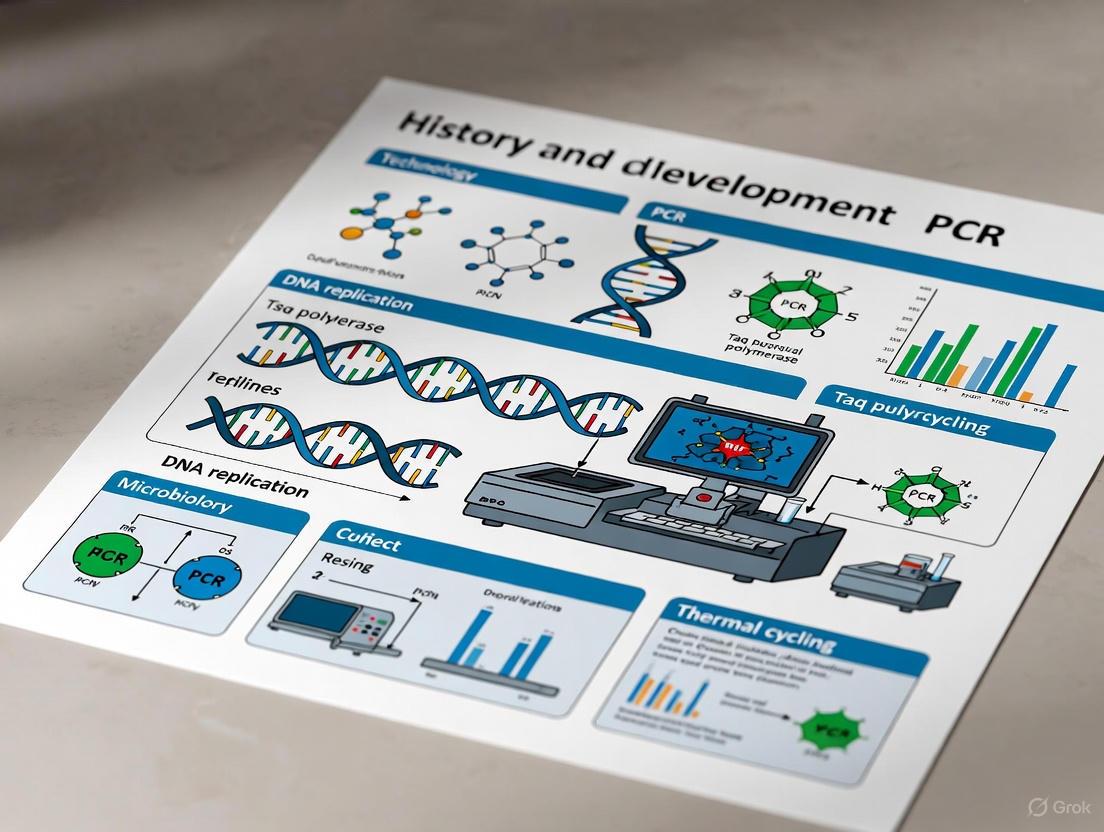
This article traces the revolutionary journey of Polymerase Chain Reaction (PCR) technology from its inception to its current status as a cornerstone of molecular biology and clinical diagnostics.
From Basics to Biomarkers: The Evolution of PCR Technology in Modern Biomedicine
Abstract
This article traces the revolutionary journey of Polymerase Chain Reaction (PCR) technology from its inception to its current status as a cornerstone of molecular biology and clinical diagnostics. Tailored for researchers, scientists, and drug development professionals, it explores the foundational milestones that transformed PCR from a manual process to automated, high-throughput systems. The review delves into advanced methodological innovations like digital PCR and multiplex assays, highlighting their critical applications in oncology, infectious disease detection, and liquid biopsies. A practical troubleshooting guide addresses common optimization challenges, while a comparative analysis validates the performance of different platforms. By synthesizing historical context with cutting-edge applications and future trends, this article provides a comprehensive resource for leveraging PCR technology in advanced research and therapeutic development.
The PCR Revolution: Tracing the Milestones from Concept to Essential Tool
The invention of the Polymerase Chain Reaction (PCR) by Kary B. Mullis in 1983 represents a pivotal moment in the history of molecular biology, a paradigm shift that fundamentally altered the landscape of genetic research, diagnostics, and therapeutic development [1]. This technique, which allows for the exponential amplification of specific DNA sequences from minute quantities of genetic material, solved the persistent problem of DNA scarcity [2]. This article traces the genesis of Mullis's idea, details the initial methodological challenges and their solutions, and places the invention within the broader thesis of PCR technology research, highlighting its indispensable role for today's scientists and drug development professionals.
Historical and Conceptual Background
The conceptual foundation for PCR was built upon decades of prior scientific discovery. The elucidation of the DNA double helix structure by Watson and Crick in 1953 was followed by Arthur Kornberg's isolation of DNA polymerase in 1956 [1] [3]. A critical precursor to PCR was published in 1971 by Kjell Kleppe and his mentor H. Gobind Khorana [1] [3]. They described a process using one primer and DNA polymerase to repair a synthetic DNA duplex, theoretically suggesting that a second primer and repeated cycles could lead to replication of the template [1]. However, the immense practical difficulties of manually synthesizing primers and the lack of a thermostable enzyme prevented the widespread adoption of this method at the time [1] [3].
Kary Mullis, a biochemist working at the Cetus Corporation, was tasked with synthesizing oligonucleotides [1]. It was during a nocturnal drive in 1983 that he envisioned the core principle of PCR: using two primers facing each other to bracket a target DNA sequence and repeatedly copying it through cycles of denaturation, annealing, and extension [4] [1]. He reportedly realized that this process could generate "as much of a DNA sequence as I wanted" in an exponential fashion, fundamentally solving the problems of abundance and distinction in DNA analysis [1]. For this insight, which he initially feared was "too easy" to be novel, Mullis was awarded the Nobel Prize in Chemistry in 1993 [2] [1].
The Breakthrough: Overcoming Technical Hurdles
The initial realization of the PCR concept faced significant practical obstacles. The first successful experiments, aimed at detecting mutations in the HBB gene responsible for sickle cell anemia, were tedious and inefficient [5] [3].
The Core Technical Challenge and Solution
- The Problem of Thermolabile Polymerase: The initial DNA polymerase used was the Klenow fragment of E. coli DNA polymerase I. This enzyme was heat-sensitive and denatured during the high-temperature (95°C) step required to separate the DNA strands at the start of each cycle [3]. Consequently, fresh enzyme had to be manually added after every denaturation step, making the process slow, labor-intensive, and impractical for widespread use [6] [5].
- The Revolutionary Solution: Taq Polymerase: A critical breakthrough came with the introduction of Taq DNA polymerase, isolated from the thermophilic bacterium Thermus aquaticus found in Yellowstone National Park hot springs [6] [3]. This enzyme is thermostable, capable of withstanding the repeated high-temperature denaturation cycles without significant loss of activity [6]. This eliminated the need for adding fresh enzyme and opened the door for the automation of PCR using thermal cyclers [6] [5].
Evolution of Early PCR Methods
The table below summarizes the key stages in the development of the initial PCR methodology.
Table 1: Evolution of Early PCR Methodology
| Development Phase | Polymerase Used | Key Characteristics | Major Limitations |
|---|---|---|---|
| Initial Concept (1983-1985) | Klenow fragment (E. coli) | Manual process, required fresh polymerase each cycle [5] [3]. | Tedious, low yield, not automated, prone to error. |
| First Automation | Klenow fragment | "Baby Blue" automated system; polymerase still degraded [5]. | Inefficient due to need for repeated reagent addition. |
| Commercial Breakthrough (1988+) | Taq Polymerase (Thermus aquaticus) | Thermostable; survived denaturation step enabling full automation [6] [3]. | Higher error rate than modern enzymes, difficulty with complex templates [6]. |
The Conventional PCR Methodology
The standard PCR protocol involves a cyclic series of temperature changes to achieve exponential amplification of a target DNA sequence.
Standard PCR Protocol and Reagents
A typical reaction requires a master mix containing several key components, each with a critical function [7].
Table 2: Essential Research Reagent Solutions for Conventional PCR
| Reagent | Function | Typical Concentration |
|---|---|---|
| Template DNA | The DNA sample containing the target sequence to be amplified. | 1 ng–1 µg [7] |
| Primers | Short, single-stranded DNA sequences that define the start and end of the target region. | 0.1–1 µM each [7] |
| Taq DNA Polymerase | Thermostable enzyme that synthesizes new DNA strands by adding nucleotides. | 1.25–2.5 units per 50 µL reaction [7] |
| Deoxynucleotides (dNTPs) | The building blocks (dATP, dCTP, dGTP, dTTP) for the new DNA strands. | 200 µM each [7] |
| Reaction Buffer | Provides optimal ionic conditions and pH (often containing MgCl₂) for enzyme activity. | 1X concentration [7] |
| Magnesium Chloride (MgCl₂) | A cofactor essential for Taq polymerase activity; concentration is often optimized. | 1.5–2.5 mM [7] |
The PCR Cycle: A Detailed Workflow
The PCR process consists of three core steps repeated for 25-40 cycles [8] [7]:
- Denaturation: The reaction mixture is heated to 94–95°C for 20–30 seconds, causing the double-stranded DNA template to separate into two single strands [8] [7].
- Annealing: The temperature is lowered to 50–65°C for 20–40 seconds, allowing the primers to bind (anneal) to their complementary sequences on the single-stranded template DNA [8] [7].
- Extension: The temperature is raised to 72°C (the optimal temperature for Taq polymerase), at which the enzyme synthesizes a new DNA strand by adding dNTPs to the 3' end of each primer, creating a double-stranded DNA molecule [8] [7].
The following diagram illustrates this cyclical workflow and the exponential amplification of DNA that results.
Impact and Evolution in a Broader Research Context
The invention of conventional PCR by Mullis was not an endpoint but a powerful beginning. Its core principle spawned an entire field of technological innovation and became the foundation for the broader history of PCR technology research.
Key Technological Evolutions
- Enzyme Engineering: The limitations of native Taq polymerase (error-proneness, difficulty with GC-rich templates) drove the development of superior enzymes like Pfu polymerase (with proofreading capability) and later, engineered high-fidelity polymerases like Phusion [6].
- Quantification and Digital PCR: The advent of real-time PCR (qPCR) allowed for the quantification of amplified DNA during the reaction, while digital PCR (dPCR) enabled absolute quantification by partitioning samples [5] [9].
- Miniaturization and Point-of-Care Testing: PCR technology has been integrated into microfluidic platforms, leading to portable, chip-based systems for rapid, point-of-care diagnostics [5].
- Isothermal Amplification: Techniques like LAMP (Loop-Mediated Isothermal Amplification) were developed as alternatives that amplify DNA at a constant temperature, simplifying instrumentation [5] [3].
Applications Shaping Modern Science and Medicine
The impact of PCR extends across numerous fields, making it an indispensable tool for researchers and drug development professionals.
- Drug Development and Therapy: PCR is crucial in supporting small molecule drugs by measuring gene expression changes and identifying biomarkers for efficacy and toxicity [8]. It is also fundamental to advanced therapies, enabling biodistribution studies for AAV-based gene therapies and confirming successful gene edits in CRISPR research [8].
- Diagnostics and Personalized Medicine: PCR enables the rapid identification of genetic mutations linked to cancer and inherited disorders like cystic fibrosis, facilitating early detection and personalized treatment strategies [8] [5] [9]. It also serves as the gold standard for infectious disease diagnosis, as demonstrated during the COVID-19 pandemic [5].
- Forensic Science and Molecular Paleontology: PCR allows DNA fingerprinting from trace evidence like blood or hair [2] [4] and enables the analysis of DNA from fossilized specimens, revolutionizing our understanding of evolution [1].
The birth of the PCR idea in the mind of Kary Mullis was a seminal event that unleashed a technological revolution. From its conceptually simple yet practically challenging beginnings, PCR has evolved into a sophisticated family of techniques that underpin modern bioscience. Its journey from a manual, laborious process to an automated, high-fidelity, and increasingly portable technology illustrates a continuous cycle of innovation. For researchers and drug developers, PCR is more than a method; it is a fundamental language for interrogating genetics, a testament to how a single, powerful idea can redefine the boundaries of scientific possibility and continue to drive progress for decades.
The advent of the Polymerase Chain Reaction (PCR) in 1983 by Kary Mullis marked a revolutionary turning point in molecular biology, enabling the exponential amplification of specific DNA sequences from minimal starting material [10] [11]. However, the initial incarnation of PCR shared a fundamental limitation with other nucleic acid analysis techniques like gel electrophoresis: it was inherently qualitative or semi-quantitative at best. Traditional PCR provides a final amplified product that must be analyzed post-reaction, typically using gel electrophoresis, a technique that separates DNA fragments by size as they migrate through a gel matrix under an electrical field [12]. While gel electrophoresis is effective for determining the presence or size of a DNA fragment, it offers poor quantification, requires considerable time, and involves post-amplification handling that increases the risk of contamination [10].
The critical breakthrough came with the development of real-time quantitative PCR (qPCR) in the 1990s, a technology that fundamentally transformed PCR from a mere amplifying workhorse into a precise, quantitative tool [10] [11]. This "quantum leap" allowed researchers to simultaneously amplify a target sequence and monitor its progress in real-time within a closed-tube system. This guide explores the technical journey from endpoint detection methods to real-time quantification, detailing the principles, methodologies, and applications that make qPCR an indispensable technology in modern research and diagnostics, framed within the broader context of PCR's historical development.
The Foundation: Limitations of Endpoint Detection
Gel Electrophoresis as the Initial Standard
Before qPCR, gel electrophoresis was the standard method for analyzing PCR products. This technique relies on the principle that nucleic acids, bearing a uniform negative charge per nucleotide due to their phosphate backbone, migrate through a porous gel matrix when subjected to an electric field [12]. The gel acts as a molecular sieve, allowing smaller DNA fragments to travel faster and farther than larger ones. After separation, DNA fragments are visualized using intercalating fluorescent dyes like ethidium bromide or safer alternatives like SYBR Green, allowing researchers to infer the size and presence of the amplified product [12].
The workflow involved running the completed PCR reaction on a gel, a process that could take from 25 minutes to several hours depending on the system [12]. The resulting data was purely qualitative—confirming whether amplification had occurred—or at best semi-quantitative, with band intensity providing a crude estimate of DNA amount. This endpoint analysis was incapable of capturing the kinetics of the amplification reaction itself.
Inherent Drawbacks of the Post-Amplification Workflow
The reliance on gel electrophoresis for product analysis presented several significant limitations for quantitative science:
- Poor Quantification: Band intensity on a gel is a non-linear and imprecise measure of initial DNA concentration, affected by saturation effects and staining variability [10].
- Low Sensitivity and Dynamic Range: Detection limits were typically in the nanogram range, and the dynamic range for quantifying concentration differences was very narrow [12].
- High Contamination Risk: The need to open reaction tubes after amplification to load gels created a substantial risk of amplicon contamination in subsequent experiments [10].
- Time-Consuming and Low-Throughput: The process was manual, requiring post-amplification steps that delayed results and limited the number of samples that could be processed efficiently [10].
- Inability to Distinguish Specific from Non-Specific Products: Without real-time monitoring, non-specific amplification products could be misinterpreted as the target without additional confirmation steps [10].
The Paradigm Shift: Principles of Real-Time qPCR
Core Technological Advancements
The transition to qPCR was enabled by two interconnected innovations: the ability to monitor the amplification reaction in real-time and the development of robust fluorescent detection chemistries.
The fundamental principle of qPCR is the direct correlation between the amount of amplified product and the fluorescence signal measured at each cycle [13]. As the target sequence is amplified, the accumulating DNA is tracked by a fluorescent reporter. The cycle at which the fluorescence crosses a predefined threshold (the Cq value - Quantification Cycle) is inversely proportional to the log of the initial amount of target nucleic acid [13]. A sample with a high starting copy number will show fluorescence earlier (lower Cq) than one with a low starting copy number (higher Cq).
The second key advancement was the development of reliable detection methods. The initial approach used fluorescent DNA-binding dyes like SYBR Green I, which intercalate into double-stranded DNA and emit fluorescence upon binding [10]. While cost-effective and simple, these dyes bind to any double-stranded DNA, including non-specific products and primer-dimers, which can lead to overestimation of the target concentration [10].
The true breakthrough in specificity came with probe-based systems, most notably the TaqMan probe, introduced in 1996 [10] [11]. This technology utilizes a target-specific oligonucleotide probe labeled with a fluorescent reporter at one end and a quencher molecule at the other. When intact, the quencher suppresses the reporter's fluorescence due to its proximity. During PCR, the Taq polymerase's 5' to 3' exonuclease activity degrades the probe as it extends the DNA strand, separating the reporter from the quencher and resulting in a measurable increase in fluorescence that is proportional to the amount of amplicon generated [10]. This mechanism requires the probe to bind specifically to the target sequence, dramatically reducing false positives from non-specific amplification.
Visualizing the Workflow Leap
The fundamental difference between the traditional and qPCR workflows is illustrated below. The closed-tube, real-time nature of qPCR eliminates several manual, error-prone steps.
Quantitative Comparison of PCR Methodologies
The evolution from traditional PCR to qPCR and later to digital PCR (dPCR) represents a continuous improvement in quantification capability, sensitivity, and application scope as summarized in the table below.
Table 1: Comparative Analysis of PCR Technology Generations
| Feature | Traditional PCR + Gel | Real-Time qPCR | Digital PCR (dPCR) |
|---|---|---|---|
| Quantification Basis | Endpoint band intensity | Cq value relative to standard | Absolute count of positive partitions |
| Detection Method | Gel electrophoresis & staining | Fluorescence in real-time | Endpoint fluorescence per partition |
| Dynamic Range | ~2 logs (semi-quantitative) | 7-8 logs [14] | 5 logs [5] |
| Sensitivity | Low (nanogram) | High (picogram) [14] | Very High (single molecule) [15] |
| Throughput | Low (manual processing) | High (automated plates) | Medium to High |
| Key Application | Presence/Absence, sizing | Gene expression, viral load [10] | Rare allele detection, liquid biopsy [15] |
| Primary Limitation | Poor quantification, contamination risk | Requires standard curves | Limited dynamic range, higher cost [15] |
The Scientist's Toolkit: Essential Reagents and Materials
Successful qPCR experiments rely on a suite of optimized reagents and consumables. The selection of these components directly impacts the assay's sensitivity, specificity, and reproducibility.
Table 2: Key Research Reagent Solutions for qPCR
| Item | Function | Key Considerations |
|---|---|---|
| Thermostable DNA Polymerase | Enzymatically synthesizes new DNA strands during amplification. | Taq polymerase is standard; high-fidelity enzymes available for cloning [11]. |
| Fluorescent Detection System | Reports accumulation of amplified product in real-time. | Choice between DNA-binding dyes (e.g., SYBR Green) for simplicity or probe-based systems (e.g., TaqMan) for specificity [10] [13]. |
| Primers | Short, single-stranded DNA sequences that define the target region to be amplified. | Specificity and optimization are critical; design tools and pre-validated assays are available. |
| dNTPs | Deoxynucleoside triphosphates (dATP, dCTP, dGTP, dTTP); the building blocks of DNA. | Quality and concentration affect efficiency and fidelity. |
| Buffer Components | Provides optimal chemical environment (pH, ions) for polymerase activity. | Often includes MgCl₂, a essential cofactor for polymerase function. |
| Reverse Transcriptase | For RT-qPCR; synthesizes complementary DNA (cDNA) from an RNA template. | Essential for gene expression studies or RNA virus detection [11]. |
| Nuclease-Free Water & Tubes/Plates | Reaction setup without contaminants. | Consumables must be optically clear for fluorescence detection in cyclers. |
Detailed qPCR Experimental Protocol
Adherence to a standardized protocol is crucial for generating reliable and reproducible qPCR data. The following section outlines a generalized workflow for a probe-based qPCR assay.
Pre-Assay Planning and Design
- Assay Design: Design primers and probe(s) specific to the target sequence. The probe is typically labeled with a reporter dye (e.g., FAM) at the 5' end and a quencher (e.g., TAMRA) at the 3' end. Alternatively, use a pre-validated commercial assay.
- RNA Extraction (for RT-qPCR): Isolate high-quality, intact RNA from cells or tissue using a guanidinium thiocyanate-phenol-based method or commercial kits. Assess RNA integrity and concentration using spectrophotometry (A260/A280 ratio ~2.0) and/or microfluidic electrophoresis.
- Reverse Transcription: Synthesize cDNA from total RNA using a reverse transcriptase enzyme. The reaction typically includes:
- RNA template (e.g., 1 µg)
- Random hexamers and/or oligo-dT primers
- Reverse transcriptase enzyme
- dNTP mix
- RNase inhibitor
- Incubate at 42-50°C for 30-60 minutes, followed by enzyme inactivation at 85°C.
qPCR Reaction Setup and Thermal Cycling
- Prepare Master Mix: Create a homogeneous master mix for all reactions to minimize pipetting error. A single reaction (20-25 µL) typically contains:
- 1X TaqMan Master Mix (contains Taq polymerase, dNTPs, MgCl₂, and buffer)
- 900 nM forward primer
- 900 nM reverse primer
- 250 nM TaqMan probe
- Nuclease-free water
- Add Template and Plate: Aliquot the master mix into the reaction wells of a optically clear plate or strips. Add the cDNA or DNA template (typically 1-5 µL per reaction) to respective wells. Include no-template controls (NTCs) containing water instead of template to check for contamination. Seal the plate with an optical adhesive film.
- Run Thermal Cycling Protocol: Place the plate in the real-time PCR instrument and run the following standard protocol:
- UNG Incubation (Optional): 50°C for 2 minutes (degrades potential carryover contamination).
- Polymerase Activation/Initial Denaturation: 95°C for 10-20 minutes.
- Amplification (40-50 cycles):
- Denature: 95°C for 15 seconds.
- Anneal/Extend: 60°C for 60 seconds (acquire fluorescence at this step).
- The instrument's software will collect the fluorescence data for the reporter dye at the end of each annealing/extension step.
Data Analysis and Interpretation
- Threshold and Cq Determination: The analysis software plots fluorescence (ΔRn) versus cycle number. Set the fluorescence threshold above the background noise but within the exponential phase of all plots. The software will automatically assign a Cq value for each reaction.
- Relative Quantification (ΔΔCq Method): For gene expression analysis, this is the most common method.
- Normalize the Cq of the target gene to the Cq of one or more endogenous control genes (e.g., GAPDH, β-actin) in the same sample: ΔCq = Cq(target) - Cq(reference).
- Normalize the ΔCq of the test sample to the ΔCq of a calibrator sample (e.g., control group): ΔΔCq = ΔCq(test) - ΔΔCq(calibrator).
- Calculate the relative expression ratio: Fold Change = 2^(-ΔΔCq).
- Standard Curve for Absolute Quantification: If absolute copy number is required, run a dilution series of a standard with known concentration/copy number in parallel. Plot the log of the initial quantity against the Cq value to generate a standard curve, which can be used to interpolate the quantity of unknown samples.
Current Landscape and Future Perspectives
The qPCR market continues to evolve, driven by technological innovation and expanding applications. The global PCR technologies market, valued at USD 15.78 billion in 2024, is projected to reach USD 31.39 billion by 2034, growing at a CAGR of 7.12% [15]. Key trends shaping the future of qPCR include:
- Automation and High-Throughput Screening: Automated platforms are reducing human error, increasing reproducibility, and saving time, which is crucial for processing hundreds or thousands of samples simultaneously [14].
- Multiplexing: The ability to analyze multiple targets in a single reaction by using probes labeled with different fluorescent dyes saves time, reduces costs, and increases information yield per sample [14].
- Integration with Other Technologies: qPCR is increasingly used alongside Next-Generation Sequencing (NGS) for validation of sequencing results and providing precise quantification [14]. The synergy between these technologies offers a comprehensive view of genetic analysis.
- Point-of-Care and Miniaturization: The rapid shift toward decentralized diagnostics is accelerating the development of portable, user-friendly qPCR devices for use in resource-limited settings [15] [5]. Microfluidic technologies are key to this miniaturization, enabling faster reaction times and reduced reagent volumes [5].
- Digital PCR Integration: Digital PCR (dPCR), which provides absolute quantification without a standard curve by partitioning a sample into thousands of individual reactions, is emerging as a complementary technology to qPCR, particularly for detecting rare mutations and subtle gene expression changes [14] [15].
- Quality and Standardization: The publication of the MIQE (Minimum Information for Publication of Quantitative Real-Time PCR Experiments) guidelines has been a major contribution to improving the trustworthiness, consistency, and transparency of qPCR results [16].
The transition from gel-based analysis to real-time quantitative PCR represents one of the most significant technical evolutions in molecular biology. This quantum leap transformed PCR from a qualitative tool into a precise, quantitative platform that underpins modern genomics, diagnostics, and drug development. By enabling researchers to monitor amplification kinetics in real-time within a closed system, qPCR overcame the critical limitations of sensitivity, throughput, and quantification inherent in endpoint methods. The ongoing innovations in automation, multiplexing, and miniaturization ensure that qPCR will remain a cornerstone technology, continuing its pivotal role in scientific discovery and clinical application for the foreseeable future.
The development of Polymerase Chain Reaction (PCR) technology represents a cornerstone of molecular biology, with each evolutionary leap addressing limitations of its predecessors. The first generation of PCR, invented by Kary Mullis in 1983, was a revolutionary biochemical technique that allowed scientists to replicate and amplify nucleic acid sequences in millions to billions of copies, yet it relied on gel electrophoresis for end-point analysis, making it largely qualitative or semi-quantitative at best [17] [18] [19]. The second generation, real-time quantitative PCR (qPCR), described in 1996, introduced the ability to monitor amplification in real-time using fluorescent probes, enabling relative quantification but remaining dependent on standard curves and reference genes, with its accuracy susceptible to PCR inhibitors and variable amplification efficiency [20] [17] [21].
Digital PCR (dPCR), the third generation of PCR technology, represents a paradigm shift from analog measurement to digital quantification. Its core innovation lies in massive sample partitioning, transforming a single reaction into thousands of individual data points for absolute nucleic acid quantification without requiring standard curves [17] [18] [21]. Although the fundamental principles were established in the early 1990s through "limiting dilution PCR" [20], dPCR has experienced a renaissance in recent years due to advances in microfluidics and instrumentation, cementing its role in the ongoing evolution of PCR technology research [20] [17] [19].
Historical Emergence and Development
The conceptual foundation for digital PCR was laid through independent developments across multiple research fields, initially under different nomenclature. The timeline below charts the key milestones in its emergence:
In 1988, Saiki et al. demonstrated that single β-globin molecules could be amplified and detected, representing the first use of PCR to isolate and analyse a single molecule, though they had not yet conceptualized its use for quantification [20]. The critical transition to quantification occurred in 1990 when Simmonds et al. developed "limiting dilution PCR" for HIV provirus quantification, recognizing that the frequency of positive amplifications followed the Poisson distribution and could calculate original target numbers [20]. Concurrently, Jeffreys et al. and Ruano et al. published on using single molecule PCR for minisatellite evolution and haplotyping respectively [20].
In 1992, Sykes et al. published a definitive study of the method, using it to quantify leukaemic cells in patients via rearranged immunoglobulin heavy chain genes [20] [17]. Their work culminated in a 1994 Lancet paper demonstrating that outcome in childhood acute lymphoblastic leukaemia could be predicted by leukaemia level after one month of therapy—a finding that eventually entered routine clinical management [20].
The term "digital PCR" was formally coined in 1999 by Vogelstein and Kinzler, who measured K-RAS mutations by partitioning samples across 384-well plates [20] [17]. Despite this apt terminology capturing both the reaction's nature and the digital spirit of the times, the method's labor-intensive nature prevented widespread adoption, particularly with the concurrent rise of real-time PCR [20].
The modern dPCR renaissance began with technological breakthroughs in the 2000s. In 2003, Liu et al. introduced microfluidic elements to dPCR, improving partitioning accuracy [17]. The watershed moment arrived in 2011 with the commercialization of droplet digital PCR (ddPCR) based on water-oil emulsion droplet technology, which enabled high-throughput, automated partitioning at reduced cost [17]. This innovation propelled dPCR from a specialized technique into a mainstream tool, with applications expanding rapidly across clinical diagnostics and research [20] [17].
Core Principles and Methodologies
Fundamental Working Principle
Digital PCR operates on a simple yet powerful principle: sample partitioning followed by binary endpoint detection and Poisson statistical analysis. The methodology transforms analog molecular quantification into discrete digital measurements through several critical steps [17] [18] [19]:
- Sample Partitioning: A conventional PCR reaction mixture—containing template DNA, primers, probes, DNA polymerase, dNTPs, and buffers—is partitioned into thousands of nanoliter-sized compartments. This can be achieved through microfluidic chips (cdPCR) or water-in-oil emulsion droplets (ddPCR) [17] [18] [21].
- Amplification: Each partition undergoes independent PCR amplification. Partitions containing at least one target molecule will amplify it, while those without will not [18] [19].
- Endpoint Detection: Following amplification, each partition is analyzed for fluorescence. Partitions with amplified target generate fluorescence ("positive" or "1"), while those without remain non-fluorescent ("negative" or "0") [17] [18].
- Poisson Statistical Analysis: The ratio of positive to negative partitions is analyzed using Poisson statistics to determine the absolute concentration of the target molecule in the original sample, correcting for the probability of multiple targets occupying a single partition [17] [18] [21].
The mathematical foundation of dPCR relies on the Poisson distribution to compensate for the random distribution of molecules across partitions. The fundamental equation is:
[ C = -\ln(1 - p) / V ]
Where:
- ( C ) = concentration of target molecules (copies/μL)
- ( p ) = proportion of positive partitions
- ( V ) = volume of each partition (μL)
This calculation becomes necessary because at higher target concentrations, multiple molecules may co-localize in single partitions. The Poisson correction provides the statistical framework for accurate absolute quantification [17] [18] [21].
Comparative Analysis of PCR Generations
Table 1: Comparison of key characteristics across PCR technology generations
| Parameter | Conventional PCR | Real-Time Quantitative PCR (qPCR) | Digital PCR (dPCR) |
|---|---|---|---|
| Quantification Method | Semi-quantitative (gel electrophoresis) | Relative quantification (standard curves required) | Absolute quantification (no standard curves) [17] [18] [19] |
| Detection Principle | End-point detection by gel visualization | Real-time fluorescence monitoring during amplification | End-point fluorescence after amplification [17] [21] |
| Signal Output | Band intensity on gel | Cycle threshold (Ct) values | Binary (0/1) for each partition [17] [19] |
| Sensitivity | Low sensitivity for rare targets | ~1% mutant in wild-type background | 0.1%-0.001% for rare alleles [17] [21] |
| Tolerance to Inhibitors | Low tolerance | Moderate tolerance | High tolerance [17] [21] |
| Precision | Low precision | Moderate precision | High precision (small-fold change detection) [17] [21] |
| Dynamic Range | Narrow | Wide | Narrower than qPCR [17] |
| Cost and Throughput | Low cost, low throughput | Moderate cost and throughput | Higher cost, variable throughput [17] |
Technical Implementation Platforms
Table 2: Major technological platforms for digital PCR implementation
| Platform Type | Partitioning Method | Typical Partition Number | Key Features | Example Systems |
|---|---|---|---|---|
| Chip-based dPCR (cdPCR) | Microfluidic chambers/capillaries | 1,000 - 40,000 | Even partition volume, minimal evaporation | BioMark (10,000-40,000 chambers), QuantStudio3D (20,000 chambers) [17] |
| Droplet dPCR (ddPCR) | Water-in-oil emulsion | 20,000 - 10,000,000 | High partition count, cost-effective | QX100/200 (20,000 droplets), RainDrop (1-10 million droplets) [17] [18] |
The experimental workflow for ddPCR, the most common implementation, follows a standardized process as illustrated below:
Essential Research Reagents and Materials
Table 3: Key research reagent solutions for digital PCR experiments
| Reagent/Material | Function | Technical Considerations |
|---|---|---|
| Template Nucleic Acid | Target molecule for quantification (DNA, cDNA, or RNA) | Should be properly extracted, non-degraded; inhibitors should be removed or diluted [18] |
| dPCR Supermix | Optimized reaction mixture containing DNA polymerase, dNTPs, MgCl₂, and reaction buffers | Formulated specifically for partitioning; often contains stabilizers for emulsion systems [18] |
| Sequence-Specific Primers | Amplification of target sequence | Must be designed for high specificity and efficiency; location critical for rare allele detection [22] |
| Fluorescent Probes | Detection of amplified targets (e.g., hydrolysis probes, EvaGreen) | Hydrolysis probes increase specificity and signal-to-noise ratio; multiple colors enable multiplexing [18] |
| Droplet Generation Oil | Creates water-in-oil emulsion for partitioning | Contains surfactants for droplet stability; formulation critical for uniform droplet generation [17] [18] |
| Microfluidic Chips/Cartridges | Physical partitioning of reactions | Chip design determines partition number and volume; material (e.g., PDMS) affects performance [17] |
Applications and Methodological Guidelines
Key Research and Clinical Applications
Digital PCR has established particular utility in applications requiring high sensitivity, precision, and absolute quantification. The technology's partitioning principle creates an artificial enrichment of low-abundance sequences, enabling breakthroughs in several key areas [17] [19] [21]:
Rare Mutation Detection and Liquid Biopsy: dPCR can detect mutant DNA in a 200,000-fold excess of wild-type background, making it invaluable for cancer monitoring through circulating tumor DNA (ctDNA) in liquid biopsies. This application leverages dPCR's ability to identify single nucleotide variants (SNVs) at frequencies as low as 0.001% [17] [21].
Copy Number Variation (CNV) Analysis: dPCR resolves small differences in copy number with superior accuracy compared to qPCR or microarrays. It has been used to study germline and somatic variation in gene copy number, including HER2 (ERBB2) amplification in breast cancer, with the ability to detect differences as small as one copy [17] [21].
Absolute Viral Load Quantification: dPCR enables precise pathogen quantification without standard curves, improving monitoring of HIV, HCV, and other viral infections. Its high tolerance to inhibitors makes it particularly suitable for direct measurement in complex biological samples [20] [21].
Non-Invasive Prenatal Testing (NIPT): dPCR precisely quantifies cell-free fetal DNA (cffDNA) in maternal plasma, which constitutes only 10-20% of total cell-free DNA. This enables non-invasive detection of fetal genetic abnormalities, including trisomy 21 (Down syndrome) and sickle cell disease [17] [21].
Next-Generation Sequencing (NGS) Support: dPCR serves as an orthogonal validation method for NGS-detected rare mutations and provides quality control for NGS libraries, including quantification of adaptors and junction fragments [17] [21].
Methodological Standards: dMIQE Guidelines
To ensure reproducibility and reliability in dPCR experiments, the dMIQE (Minimum Information for Publication of Quantitative Digital PCR Experiments) guidelines provide a critical framework for experimental design and reporting [22]. Key requirements include:
- Partition Characteristics: Report partition number, volume, and volume variance/SD [22].
- Nucleic Acid Quality: Detail extraction methods, quantification, and quality assessment [22].
- Assay Validation: Provide specificity information and multiplex validation data [22].
- Data Analysis: Specify statistical methods, Poisson correction, normalization approach, and software [22].
- Experimental Replication: Report technical and biological replicates, outlier management [22].
Adherence to dMIQE guidelines standardizes nomenclature and experimental reporting, enabling more reliable data comparison and replication across the scientific community [22].
Digital PCR represents a fundamental shift in nucleic acid quantification, transitioning from analog inference to digital counting. Its emergence from the historical context of "limiting dilution PCR" to modern automated platforms illustrates how complementary technological advances enable the full realization of a scientific principle [20] [19]. While real-time PCR remains the workhorse for many quantitative applications, dPCR has carved essential niches where its attributes of absolute quantification, exceptional sensitivity, and precision provide unique capabilities [17] [21].
The ongoing evolution of dPCR technology continues to address initial limitations of cost, throughput, and dynamic range. Future developments will likely focus on increased partition densities, enhanced multiplexing capabilities through expanded color palettes, and further integration with microfluidic automation [20] [19]. As the technology matures, dPCR is poised to expand its role in clinical diagnostics, particularly in liquid biopsy applications, pathogen detection, and non-invasive prenatal testing [17] [21].
Within the broader thesis of PCR technology development, dPCR exemplifies how fundamental principles can be rediscovered and enhanced through technological innovation. Its journey from specialized technique to mainstream tool mirrors the ongoing maturation of molecular diagnostics, where digital precision increasingly supplants analog approximation to meet the demanding requirements of modern precision medicine and fundamental biological research [20] [19] [21].
The evolution of Polymerase Chain Reaction (PCR) technology from a manual, cumbersome process to a refined, quantitative, and digital methodology represents one of the most significant advancements in modern molecular biology. While Kary Mullis's foundational invention in 1983 provided the core principle of enzymatic DNA amplification, the subsequent contributions of key innovators have been instrumental in transforming PCR into an indispensable tool for research and clinical diagnostics [5] [23] [24]. This whitepaper examines the pivotal roles of Russell Higuchi, who enabled real-time quantitative monitoring, and Bert Vogelstein, who formalized and named digital PCR. Their work, embedded in a broader history of scientific problem-solving, paved the path from theoretical concepts to robust commercial platforms that now underpin sensitive diagnostics in oncology, infectious disease, and genetic research [25] [26].
Historical Prelude and the PCR Foundation
The development of PCR was preceded by decades of research on DNA replication and enzymatic manipulation. The groundwork was laid by the discovery of the DNA double helix structure by Watson and Crick in 1953, the identification of DNA polymerase by Arthur Kornberg, and Har Gobind Khorana's pioneering work with synthetic oligonucleotides [23]. By the early 1970s, researchers in Khorana's lab had described a process resembling "repair synthesis," but the concept of exponential amplification using two primers was not fully realized or experimentally demonstrated until Kary Mullis's work at Cetus Corporation in 1983 [23] [24].
Mullis's key insight was using a thermostable DNA polymerase and repeated temperature cycles to achieve exponential amplification of a target DNA sequence [25]. The first PCR experiments used the Klenow fragment of E. coli DNA Polymerase I, which was heat-labile and had to be replenished after each denaturation step, making the process tedious and poorly suited for automation [5] [23]. The subsequent introduction of Taq polymerase from Thermus aquaticus in the mid-1980s was a revolutionary improvement, as it could withstand the high denaturation temperatures, enabling the development of automated, high-throughput thermal cyclers [5] [23]. Despite this, early PCR remained largely a qualitative or semi-quantitative technique, as analysis was typically performed post-amplification via gel electrophoresis [25] [24]. The need for accurate quantification and more sensitive detection set the stage for the next wave of innovation.
Key Innovator I: Russell Higuchi and the Advent of Real-Time PCR
The Innovation and Seminal Work
In the early 1990s, Russell Higuchi made the critical leap that transformed PCR from an endpoint assay to a dynamic, quantitative process. His innovation was to perform PCR in the presence of a fluorescent DNA-binding dye, allowing the accumulation of amplified DNA to be monitored in "real-time" with each thermal cycle [25] [24]. This method, now known as Quantitative Real-Time PCR (qPCR) or simply real-time PCR, meant that the entire process could be completed in a sealed tube, reducing contamination risk and, most importantly, enabling precise quantification of the initial nucleic acid template.
The fundamental principle of qPCR is that the fluorescence intensity increases proportionally with the amount of amplified DNA. The cycle at which the fluorescence signal crosses a predefined threshold (the Ct value - Cycle threshold) is inversely proportional to the logarithm of the initial target concentration [25]. A sample with a high starting copy number will show an earlier Ct value, while a sample with a low copy number will have a later Ct. By comparing the Ct values of unknown samples to those of a standard curve with known concentrations, researchers can achieve relative quantification [25] [26].
Experimental Protocol and Methodology
The core methodology established in Higuchi's early work involves the following steps, which remain the basis of modern qPCR:
- Reaction Setup: The PCR mixture is prepared containing the DNA template, forward and reverse primers, heat-stable DNA polymerase (typically Taq), dNTPs, and a fluorescent reporter. This reporter can be a DNA-intercalating dye like SYBR Green or a sequence-specific fluorescent probe (e.g., TaqMan probes) [25].
- Thermal Cycling with Fluorescence Monitoring: The reaction is placed in a specialized thermal cycler equipped with a fluorescence detection system. The instrument runs the standard PCR temperature cycles (denaturation, annealing, extension) and measures the fluorescence in each well at the end of every cycle.
- Data Analysis and Quantification: The instrument software plots fluorescence versus cycle number, generating an amplification curve for each sample. The Ct value for each reaction is determined, and the quantity of the target in unknown samples is interpolated from a standard curve run concurrently [25].
Research Reagent Solutions for qPCR
Table 1: Essential reagents for Quantitative Real-Time PCR (qPCR).
| Reagent | Function in the Protocol |
|---|---|
| Thermostable DNA Polymerase (e.g., Taq) | Enzyme that catalyzes the template-dependent synthesis of new DNA strands during the extension phase of each cycle. |
| Sequence-Specific Primers | Short oligonucleotides that define the start and end points of the DNA segment to be amplified, providing specificity. |
| Fluorescent Reporter (Dye or Probe) | The signal-generating component. Intercalating dyes bind double-stranded DNA non-specifically, while hydrolysis probes (e.g., TaqMan) provide target-specific fluorescence. |
| Deoxynucleotide Triphosphates (dNTPs) | The individual building blocks (dATP, dCTP, dGTP, dTTP) used by the polymerase to synthesize new DNA strands. |
| Reaction Buffer | Provides the optimal chemical environment (pH, ionic strength) and co-factors (like Mg²⁺) for efficient polymerase activity. |
Impact and Path to Commercialization
Higuchi's qPCR method quickly became the gold standard for nucleic acid quantification due to its wide dynamic range, excellent sensitivity, and high reproducibility [25]. Its value was starkly demonstrated during the 2009 H1N1 "Swine Flu" pandemic, where qPCR was the only test recommended by the CDC to reliably differentiate the pandemic virus from seasonal influenza [25]. The technology was rapidly commercialized, with early diagnostic systems like Roche's COBAS AmpliPrep/COBAS TaqMan and Abbott's m2000 RealTime System leading the way in automation for high-throughput clinical labs [25]. The initial market was dominated by a few large companies, but the subsequent expiration of key patents led to a proliferation of open qPCR platforms and kits, making the technology more accessible and fueling its widespread adoption in research and diagnostics [25].
Key Innovator II: Bert Vogelstein and the Digital PCR Revolution
The Innovation and Seminal Work
While qPCR offered massive improvements, it still relied on relative quantification against a standard curve, which could introduce variability. The concept of absolute quantification without a standard was pioneered through limiting dilution PCR in the early 1990s [26]. However, it was Bert Vogelstein and his team at Johns Hopkins University who, in a seminal 1999 paper, formally named and defined the principles of digital PCR (dPCR) [26]. Their work provided a robust framework for single-molecule counting, enabling unparalleled precision and sensitivity.
The foundational principle of dPCR is sample partitioning. A PCR reaction mixture is divided into a large number of separate, parallel reactions, such that each partition contains either zero, one, or a few molecules of the nucleic acid target according to a Poisson distribution [27] [26]. Following end-point PCR amplification, each partition is analyzed for fluorescence. Partitions that contained at least one target molecule will be fluorescently positive ("1"), while those without a target will be negative ("0"). By counting the fraction of positive partitions and applying Poisson statistics, the absolute concentration of the target in the original sample can be calculated directly, without reference to a standard curve [27] [26].
Experimental Protocol and Methodology
The core dPCR workflow, as established by Vogelstein and refined commercially, involves four key steps:
- Partitioning: The sample is partitioned into thousands to millions of individual reactions. Vogelstein's original method used 96-well plates at a limiting dilution, but modern systems use microfluidic technologies to create nanoliter-to-picoliter volume droplets or microchambers [5] [26].
- Amplification: The partitioned sample is subjected to a standard PCR thermal cycling protocol to endpoint. Unlike qPCR, fluorescence is not monitored in real-time.
- Enumeration: After amplification, each partition is read for fluorescence. In droplet-based systems (ddPCR), this is often done by flowing droplets single-file past a detector; in chip-based systems (cdPCR), the entire array is imaged using a fluorescence microscope or scanner [5] [26].
- Quantification: The absolute concentration of the target, expressed as copies per microliter, is calculated using the formula derived from Poisson statistics: Concentration = -ln(1 - p) / V, where 'p' is the fraction of positive partitions and 'V' is the volume of each partition [27] [26].
Research Reagent Solutions for dPCR
Table 2: Essential reagents for Digital PCR (dPCR).
| Reagent | Function in the Protocol |
|---|---|
| Partitioning Oil & Surfactant | Creates a stable water-in-oil emulsion for droplet-based dPCR (ddPCR), preventing droplet coalescence during thermal cycling. |
| dPCR Supermix | A specialized buffer containing DNA polymerase, dNTPs, and optimized salts, formulated for efficient amplification within partitions. |
| Fluorescent Probes (FAM, HEX/VIC) | Hydrolysis or hybridization probes with different fluorescent dyes are used for multiplexed detection of multiple targets in a single reaction. |
| Microfluidic Chip or Cartridge | The consumable device (silicon, glass, or polymer) that physically defines the partitions, either as wells or through droplet generators. |
Impact and Path to Commercialization
Vogelstein's 1999 paper demonstrated dPCR's power by detecting K-ras mutations in the stool of colorectal cancer patients, highlighting its ability to find rare mutations in a high background of wild-type DNA [26]. This "rare event detection" capability is the cornerstone of dPCR's clinical value, particularly in liquid biopsy applications for oncology, where it can monitor tumor DNA in blood to track treatment response [26]. It also has significant applications in prenatal diagnosis and infectious disease quantification [26].
The path to commercialization was accelerated by advances in microfluidics. Early systems were cumbersome, but the mid-2000s saw the launch of the first commercial platforms. Fluidigm released a nanofluidic dPCR system in 2006, followed by Bio-Rad's QX100 ddPCR system in 2011 [5] [26]. The market has since expanded significantly, with major players like Thermo Fisher Scientific (QuantStudio Absolute Q), Qiagen (QIAcuity), and Roche (Digital LightCycler) introducing integrated, automated systems that have made dPCR more accessible and reliable for clinical and research laboratories [28] [26].
Comparative Analysis of PCR Technologies
The evolution from conventional PCR to qPCR and dPCR represents a progression in quantification ability, sensitivity, and precision. The table below summarizes the key characteristics of these three generations of PCR technology.
Table 3: Comparison of conventional PCR, quantitative real-time PCR (qPCR), and digital PCR (dPCR).
| Feature | Conventional PCR | Quantitative Real-Time PCR (qPCR) | Digital PCR (dPCR) |
|---|---|---|---|
| Quantification | Semi-quantitative (end-point) | Relative quantification (requires standard curve) | Absolute quantification (standard-free) |
| Detection Method | Gel electrophoresis, post-PCR | Fluorescence monitoring in real-time | End-point fluorescence of partitions |
| Sensitivity & Precision | Low precision, moderate sensitivity | High sensitivity, good precision | Ultra-high sensitivity & precision for rare targets |
| Tolerance to Inhibitors | Moderate | Moderate to low | High (due to sample partitioning) |
| Multiplexing Capability | Limited | Good (with multiple probes) | Good (with multiple probes) |
| Primary Application | Target detection, cloning | Gene expression, viral load quantification | Liquid biopsy, rare mutation detection, copy number variation |
The journey of PCR technology from a simple concept of enzymatic amplification to the highly refined, quantitative, and digital assays of today is a testament to the power of iterative scientific innovation. While Kary Mullis provided the spark, the work of Russell Higuchi and Bert Vogelstein was critical in unlocking the full quantitative potential of the technique. Higuchi's real-time PCR brought dynamic monitoring and relative quantification to the mainstream, establishing a gold standard for decades. Vogelstein's digital PCR pushed the boundaries further, introducing a paradigm of absolute quantification through single-molecule counting that is inherently more precise and resistant to inhibitors.
The close interplay between academic research and commercial development has been essential to this story. Foundational academic papers defined the principles, and the subsequent path to commercialization—driven by companies like Roche, Bio-Rad, Thermo Fisher, and Qiagen—transformed these principles into robust, user-friendly platforms accessible to researchers and clinicians worldwide [29] [25] [26]. Today, these technologies are at the forefront of molecular diagnostics, from monitoring viral loads and detecting drug-resistant pathogens to enabling non-invasive cancer monitoring via liquid biopsy. As dPCR platforms continue to evolve, becoming faster, more multiplexed, and integrated with sample preparation, their role in personalized medicine and targeted drug development is poised to expand even further, solidifying the legacy of these key innovators for years to come.
The history of Polymerase Chain Reaction (PCR) technology is a narrative of continuous innovation aimed at achieving greater precision, speed, and efficiency. From its inception in the 1980s, PCR has evolved from a manual, cumbersome process to a highly refined tool central to modern molecular biology [30] [11]. This evolution has been fundamentally intertwined with two parallel technological revolutions: microfluidics, the science of manipulating small fluid volumes in micrometer-scale channels, and miniaturization, the systematic scaling down of reaction volumes and instrumentation [31] [32]. These fields have synergistically transformed PCR from a bulk, tube-based technique into a high-throughput, partition-based technology, enabling applications such as digital PCR (dPCR) and rapid, point-of-care diagnostics [33] [34]. By framing this progress within the broader thesis of PCR's development, this guide explores how microfluidics and miniaturization have overcome the limitations of conventional methods, paving the way for unprecedented precision in nucleic acid quantification and analysis.
The journey began with Kary Mullis's foundational invention in 1983, which involved repeated thermal cycling using a DNA polymerase that required manual replenishment after each cycle due to heat denaturation [11]. A critical milestone was reached with the introduction of the thermostable Taq polymerase, which enabled automated thermal cycling [30] [11]. Subsequent decades introduced quantitative real-time PCR (qPCR), allowing for the monitoring of amplification in real time, and eventually, digital PCR (dPCR), which provided absolute quantification by partitioning samples into thousands of individual reactions [34] [11]. Throughout this history, the challenges of reducing reagent costs, increasing processing speed, and improving data quality have been persistent drivers. The integration of microfluidic principles and miniaturization technologies represents the latest, and perhaps most transformative, chapter in this ongoing story, directly addressing these challenges by leveraging the unique physics of fluid behavior at the microscale [31] [32].
Historical Timeline and Technological Evolution
The development of PCR and its convergence with miniaturization technologies can be visualized through key milestones that highlight the paradigm shifts in capability and application.
Table 1: Major Milestones in PCR Technology and Miniaturization
| Year | Milestone | Key Innovation | Impact on Miniaturization & Throughput |
|---|---|---|---|
| 1983 | Invention of PCR [11] | Kary Mullis conceptualizes cyclic DNA amplification. | Established the core process that would later be miniaturized. |
| 1988 | Introduction of Taq Polymerase [11] | Use of a thermostable enzyme from Thermus aquaticus. | Enabled automation of thermal cycling, a prerequisite for miniaturized systems. |
| 1996 | Invention of Real-Time PCR (qPCR) [11] | Fluorescence-based real-time monitoring of amplification. | Allowed for quantification in micro-volumes via integrated optics. |
| 2001 | Conceptualization of Digital PCR (dPCR) [11] | Absolute quantification by sample partitioning and Poisson statistics. | Introduced the core principle of partitioning that microfluidics would later enable. |
| 2005-Present | Proliferation of Microfluidic PCR [33] [35] | Development of stationary, continuous-flow, and droplet-based micro-chips. | Dramatically reduced reaction volumes (nL-μL) and cycle times (seconds). |
| 2011 | Commercialization of dPCR [11] | First commercial dPCR instruments entered the market. | Made high-precision, partition-based quantification accessible to labs. |
| 2020s | Integration and Automation [31] [36] | AI-driven data analysis, lab-on-a-chip systems, and high-throughput automation. | Enabled fully integrated workflows from sample-in to answer-out, supporting high-throughput screening. |
The recent era, from the mid-2000s to the present, has been characterized by the maturation of microfluidic implementations. Early PCR chips, often fabricated in silicon or glass, demonstrated the profound advantages of reducing thermal mass for faster ramping between temperatures [35]. The adoption of polymers like PDMS (polydimethylsiloxane), polycarbonate (PC), and PMMA (poly(methyl methacrylate)) further advanced the field by reducing costs, improving optical properties for detection, and enabling more complex device architectures with integrated valves and pumps [31] [35]. The current trend is toward fully integrated and automated systems. These "lab-on-a-chip" platforms combine sample preparation, nucleic acid amplification, and product detection onto a single device, a feat made possible by microfluidics [31] [33]. This integration is critical for applications like point-of-care diagnostics and large-scale genomic studies, where speed, portability, and reproducibility are paramount.
Fundamental Principles of Microfluidics and Miniaturization
Core Physics of Microfluidics
At the microscale, fluid behavior diverges significantly from macroscopic flows, governed by a unique set of physical principles [31]:
- Laminar Flow: With low Reynolds numbers, fluids flow in parallel streams without turbulence. This allows for precise fluid control and enables operations like precise gradient generation and cell patterning.
- Diffusion-Based Mixing: In the absence of turbulence, mixing occurs primarily through molecular diffusion. This can be a limitation for rapid mixing but can be harnessed for controlled chemical reactions.
- Capillarity and Surface Tension: Surface forces dominate over gravitational forces, allowing for pump-less fluid transport in paper-based microfluidics and other capillary-driven systems.
- Electrokinetics: The application of voltage can drive fluid flow (electroosmosis) or manipulate charged particles (electrophoresis), providing a powerful mechanism for controlling and separating analytes without moving parts.
The Drive for Miniaturization
The systematic scaling down of reaction volumes, known as miniaturization, is motivated by several compelling benefits that directly address the needs of modern life science research [32] [37]:
- Dramatic Cost Reduction: Miniaturization slashes reagent and sample consumption by up to 10-fold, leading to cost savings of 75% or more, which is crucial for expensive reagents and high-throughput workflows [32] [37].
- Enhanced Speed and Throughput: Smaller volumes have lower thermal mass, enabling ultrafast thermal cycling for PCR. Furthermore, miniaturized assays are easily parallelized, allowing thousands of reactions to be performed simultaneously in a small footprint [33].
- Improved Data Quality and Sensitivity: Automated liquid handling for miniaturized protocols reduces human error and variability. In some protein assays, the increased relative surface area and concentration effects can improve sensitivity by a factor of 2-10 [37].
- Sustainability: Reduced consumption of plastic tips and reagents directly translates to less laboratory waste, addressing a significant environmental challenge [32].
Microfluidic Device Fabrication and Design
Materials and Fabrication Methods
The choice of material is critical for microfluidic device performance, biocompatibility, and cost. The landscape of materials has expanded significantly from initial silicon and glass substrates to a diverse range of polymers.
Table 2: Common Materials for Microfluidic Device Fabrication
| Material | Key Properties | Advantages | Disadvantages | Common Fabrication Methods |
|---|---|---|---|---|
| Silicon [35] | High thermal conductivity, opaque. | Excellent for rapid thermal cycling; precise fabrication. | Expensive; can inhibit PCR; not disposable. | Micromachining, etching. |
| Glass [35] | Chemically inert, transparent, generates electroosmotic flow. | Optically clear for detection; suitable for electrophoresis. | Relatively high cost; fragile. | Etching, bonding. |
| PDMS [31] [35] | Elastomeric, transparent, gas-permeable. | Low cost; rapid prototyping; suitable for integrated valves. | Hydrophobic; can absorb small molecules; not suitable for all solvents. | Soft lithography, replica molding. |
| PMMA [35] | Rigid polymer, transparent, low autofluorescence. | Low cost; good optical clarity; biocompatible. | Low glass transition temperature (~105°C). | Laser ablation, hot embossing. |
| Polycarbonate (PC) [35] | Rigid polymer, high glass transition temperature (~150°C). | Withstands high PCR temperatures; good for high-pressure applications. | Can autofluoresce. | Hot embossing, injection molding. |
| Cyclic Olefin Copolymer (COC) [35] | High rigidity, low moisture absorption, very transparent. | Excellent optical properties; high chemical resistance. | Can be more expensive than other plastics. | Hot embossing, injection molding. |
Modern fabrication has been revolutionized by "cleanroom-free" methods, making microfluidics accessible to a broader range of academic and industrial labs. These include 3D printing for rapid prototyping of custom geometries, hot embossing for industrial-scale replication of plastic devices, and the use of novel materials like Flexdym, which is biocompatible and thermoplastic [31].
Overcoming Surface Interactions
A significant challenge in microfluidics is the high surface-to-volume ratio, which can lead to the adsorption of biomolecules like enzymes and DNA to the channel walls, inhibiting reactions like PCR [35]. This is mitigated through surface treatments:
- Static Coatings: Applied during chip fabrication. Common agents include silicon dioxide (SiO₂), bovine serum albumin (BSA), and silane compounds (e.g., Sigmacote), which passivate the surface and reduce binding [35].
- Dynamic Coatings: Added directly to the PCR solution. Agents like BSA or polyethylene glycol (PVP) compete with the reaction components for adsorption sites, thereby preserving the activity of the DNA polymerase [35].
Partition-Based Technologies: Digital PCR and Beyond
Digital PCR (dPCR) is a premier example of a partition-based technology enabled by microfluidics. It works by dividing a sample into a large number (hundreds to millions) of nanoliter- or picoliter-scale partitions, such that each contains zero, one, or a few target molecules [34]. Following end-point PCR amplification, partitions are scored as positive or negative for fluorescence, and the absolute concentration of the target is calculated using Poisson statistics [38] [34]. This method provides a direct, calibration-free quantification that is highly resistant to PCR inhibitors and is exceptionally precise for detecting rare genetic events [34].
dPCR Data Analysis and Clustering
The analysis of multiplex dPCR experiments, where more than one target is quantified, relies on accurate classification of partitions based on their multi-dimensional fluorescence intensities. This clustering is a critical step, as misclassification can lead to biased concentration estimates [38]. A 2024 benchmarking study evaluated numerous clustering methods, from general-purpose algorithms to those designed for dPCR and flow cytometry [38].
- General-Purpose Methods:
k-meansandc-meansare partitioning-based algorithms that are effective when cluster shapes are well-defined and well-separated. - Density-Based Methods:
DBSCANandflowPeakscan handle irregular cluster shapes and identify outliers ("rain"), which are partitions with intermediate fluorescence that do not clearly belong to a specific cluster. - Model-Based Methods:
flowClustuses t-mixture models and can automatically determine the number of clusters, making it robust for complex data. - Guidelines: The study recommends choosing a method based on data characteristics. For well-resolved clusters,
k-meansis sufficient. For data with significant rain or irregular shapes, density-based or model-based methods likeflowPeaksorflowClustare more appropriate [38].
dPCR Workflow: Diagram of the digital PCR process from sample partitioning to absolute quantification.
Experimental Protocols for Miniaturized Workflows
Protocol: Miniaturizing a NGS Library Preparation
Next-Generation Sequencing (NGS) library prep is an ideal candidate for miniaturization due to its high reagent costs and multi-step workflow. The following protocol can be adapted for many commercial NGS kits.
Objective: To perform NGS library preparation at 1/10th the manufacturer's recommended volume, reducing costs by >75% while maintaining library complexity and success rate [32] [37].
Materials:
- Automated Liquid Handler: Equipped with positive displacement tips for accurate nanoliter dispensing of viscous reagents [32].
- Reagents: Miniaturized NGS kit reagents or bulk enzymes and buffers.
- Magnetic Beads: For size selection and clean-up steps [32].
- Low-Dead Volume Plates: 384-well or 1536-well plates.
Procedure:
- System Calibration: Calibrate the liquid handler using the specific reagents to be dispensed, particularly for viscous solutions like PEG. Verify dispense accuracy and precision in the nL-μL range [32].
- Reagent Dispensing: Program the liquid handler to dispense all reagents into the microplate. For a typical fragmentation reaction, this may involve dispensing 0.5 μL of enzyme mix and 4.5 μL of sample instead of 5 μL and 45 μL, respectively.
- Homogenization: Seal the plate and centrifuge briefly. In miniaturized volumes, turbulent mixing during dispensing and diffusion are often sufficient for homogenization, eliminating the need for physical pipette mixing [32].
- Thermal Cycling: Perform fragmentation and adapter ligation incubations on a thermal cycler with a specialized block for low-volume plates.
- Magnetic Bead Clean-up: Add a scaled-down volume of magnetic beads to the reaction. Use the liquid handler or a magnetic plate stand to separate beads from the supernatant, wash, and elute the purified library in a miniaturized elution volume (e.g., 5-10 μL) [32].
- Library QC: Quantify the final library using a fluorescence-based method suitable for low concentrations.
Troubleshooting:
- High Variance: Ensure liquid handler calibration and use positive displacement tips to avoid air pressure and viscosity issues [32].
- Low Yield: Verify that magnetic bead volumes are scaled correctly and that elution is efficient.
The Scientist's Toolkit: Essential Reagents for Miniaturization
Table 3: Key Research Reagent Solutions for Miniaturized Workflows
| Reagent/Material | Function | Key Considerations for Miniaturization |
|---|---|---|
| Surface Passivants (BSA, PVP) [35] | Coats surfaces to prevent adsorption of enzymes and DNA. | Critical for maintaining reaction efficiency in high surface-area-to-volume microchannels. |
| Magnetic Beads [32] | Solid-phase purification for nucleic acid clean-up and size selection. | Replace centrifugation; essential for automation in miniaturized protocols. |
| High-Fidelity DNA Polymerases [11] | Catalyzes DNA synthesis with high accuracy. | Must remain efficient and specific at potentially higher relative concentrations in low volumes. |
| Concentrated Enzyme Mixes | Provides necessary enzymes in a small volume. | Allows for a larger proportion of the total reaction volume to be sample. |
| Automation-Compatible Dyes & Probes | Enable real-time detection or end-point reading. | Must be compatible with miniaturized detection systems and not interact with surface coatings. |
Quantitative Data and Market Trends
The impact of microfluidics and miniaturization is reflected not only in laboratory performance but also in substantial market growth and quantitative operational benefits.
Table 4: Quantitative Benefits and Market Outlook of Miniaturized Technologies
| Parameter | Standard Protocol | Miniaturized/Microfluidic Protocol | Performance Improvement & Impact |
|---|---|---|---|
| Reaction Volume [32] [33] | 20-50 μL | 2-10 μL (up to nL for some dPCR) | 75-90% reduction in reagent cost and sample consumption [32] [37]. |
| Thermal Cycling Time [33] | 1-2 hours | < 20 minutes (down to ~3.7s/cycle [33]) | 5-10x faster analysis; critical for point-of-care testing. |
| dPCR Partition Count [34] | N/A | 20,000 to 1,000,000+ | Enables absolute quantification and rare allele detection (<0.1% MAF). |
| NGS Library Prep Cost [37] | 100% (Baseline) | ~14% of original cost | 86% cost saving while maintaining accuracy and reproducibility [37]. |
| Market Size (dPCR) [36] | - | $2.5B (2024) | Projected to reach $5B by 2030, driven by demand in precision diagnostics. |
Miniaturization Logic: The logical relationship between the core goal of efficient research and the enabling strategies, methods, and outcomes of miniaturization.
Microfluidics and miniaturization have irrevocably shaped the modern landscape of PCR technology and molecular biology. By transitioning reactions from the macro- to the microscale, these fields have delivered on the promise of faster, cheaper, and more precise analyses. The historical progression from conventional PCR to qPCR and now to partition-based dPCR represents a logical evolution toward greater quantification accuracy, an evolution made possible almost entirely by microfluidic engineering [34] [11].
Looking forward, several trends are poised to define the next chapter. The integration of artificial intelligence (AI) and machine learning will enhance data analysis from complex dPCR and high-throughput screening data, improving automated clustering and providing deeper biological insights [36]. The push for point-of-care (POC) diagnostics will continue to drive the development of portable, user-friendly, and fully integrated lab-on-a-chip devices that combine sample preparation, amplification, and detection [31] [33]. Furthermore, the growing emphasis on sustainability will favor technologies that minimize plastic waste and reagent consumption, core advantages of miniaturization [32]. Finally, the exploration of novel materials, including biodegradable polymers, will address environmental concerns and potentially open up new form factors and applications [31]. In conclusion, the synergy between microfluidics, miniaturization, and PCR exemplifies how technological convergence can overcome fundamental limitations, unlocking new possibilities in biological research, clinical diagnostics, and drug development.
Advanced PCR Methodologies and Their Transformative Applications in Research and Clinics
The polymerase chain reaction (PCR) has undergone remarkable evolution since its invention by Kary Mullis in 1983, transforming from a method for amplifying single DNA sequences into sophisticated multiplex platforms capable of detecting dozens of pathogens simultaneously [5] [39] [40]. This progression represents a fundamental shift in diagnostic philosophy, moving from single-pathogen testing toward comprehensive syndromic approaches that address the clinical reality of overlapping symptoms in infectious diseases [41]. Syndromic testing using multiplex PCR represents the culmination of decades of technological refinement, enabling clinicians to rapidly test for multiple potential pathogens from a single sample, thereby revolutionizing diagnostic workflows in clinical microbiology [42].
The historical development of PCR technology reveals a steady trajectory toward multiplexing. Early PCR was limited to single-target amplification, but researchers soon recognized that adding multiple primer pairs could enable simultaneous detection of several targets [5] [43]. This multiplex PCR principle formed the foundation for modern syndromic panels, which have expanded to detect extensive arrays of viruses, bacteria, and parasites associated with specific clinical syndromes such as respiratory infections, gastroenteritis, and meningitis [42]. The adoption of microfluidic technologies and automated systems has further accelerated this evolution, making syndromic testing increasingly accessible and efficient for routine clinical use [5].
Technical Foundations of Multiplex PCR
Core Principles and Historical Development
Multiplex PCR operates on the same fundamental principles as conventional PCR but incorporates multiple primer sets to amplify different target sequences simultaneously in a single reaction tube [43]. The key advancement lies in the careful design and optimization of these primer sets to work harmoniously without compromising sensitivity or specificity. This approach conserves valuable sample material, reduces reagent costs, and significantly decreases turnaround time compared to sequential singleplex testing [43].
The development of multiplex PCR faced substantial technical challenges in its early implementations. Researchers encountered issues with preferential amplification of certain targets, formation of primer dimers, and generally lower sensitivity compared to singleplex reactions [43]. The discovery of Thermus aquaticus DNA polymerase (Taq polymerase) represented a pivotal advancement, as its thermostability eliminated the need to add fresh enzyme after each denaturation cycle, thereby enabling automation and more reliable multiplex amplification [5] [39]. Subsequent innovations, including hot-start PCR and improved buffer formulations, further enhanced multiplex PCR reliability by reducing nonspecific amplification during reaction setup [43].
Primer Design and Reaction Optimization
Effective primer design constitutes the most critical factor in successful multiplex PCR development. Ideal primers in a multiplex reaction should have similar length (typically 18-30 bp) and GC content (35-60%) to ensure comparable annealing temperatures and amplification efficiencies across all targets [43]. Primers must be meticulously checked for complementarity to prevent dimer formation and for specificity to avoid cross-hybridization with non-target sequences [43].
Table 1: Key Optimization Parameters for Multiplex PCR Assays
| Parameter | Optimal Characteristics | Impact on Performance |
|---|---|---|
| Primer Design | Length: 18-30 bp; GC content: 35-60%; Similar Tm values (±2°C) | Ensures balanced amplification of all targets; minimizes primer-dimer formation |
| Primer Concentration | Typically 0.1-0.5 μM each; may require empirical adjustment | Preferential amplification; insufficient primer concentration reduces sensitivity |
| MgCl₂ Concentration | Often 1.5-4.0 mM; may require increase over singleplex PCR | Cofactor for DNA polymerase; significantly impacts specificity and yield |
| dNTP Concentration | 200-400 μM each | Balanced dNTPs prevent misincorporation and early reaction plateau |
| DNA Polymerase | 2-5× increase over singleplex PCR; hot-start formulations preferred | Ensures sufficient enzyme for multiple simultaneous amplifications |
| Thermal Cycling | Extended annealing/extension times; potentially reduced ramp rates | Accommodates multiple primer-template interactions and longer amplicons |
| Additives | DMSO, glycerol, betaine, BSA (concentration-dependent) | Reduces secondary structure; stabilizes enzymes; enhances specificity |
Beyond primer design, numerous reaction components require optimization for multiplex applications. Taq DNA polymerase concentration often needs increasing—sometimes four to five times greater than singleplex PCR—to accommodate multiple simultaneous amplification events [43]. Magnesium chloride concentration, a critical cofactor for polymerase activity, frequently requires empirical optimization, as does the balance of deoxynucleoside triphosphates (dNTPs) [43]. PCR additives including dimethyl sulfoxide (DMSO), glycerol, bovine serum albumin (BSA), or betaine can improve multiplex performance by preventing polymerase stalling, especially with GC-rich templates [43].
Syndromic Testing Applications and Clinical Performance
Respiratory Infection Panels
Respiratory infections represent an ideal application for syndromic testing due to the extensive overlap in clinical presentation among various viral and bacterial pathogens. Recent studies demonstrate the exceptional performance of multiplex PCR panels for comprehensive respiratory pathogen detection. A 2025 multicenter evaluation of a respiratory multiplex PCR kit analyzing 728 bronchoalveolar lavage specimens detected one or more pathogens in 86.3% of samples, significantly outperforming culture methods which detected pathogens in only 14.15% of specimens [44]. The assay demonstrated 84.6% positive percentage agreement and 96.5% negative percentage agreement compared to conventional culture methods [44].
Another 2025 study comparing a pneumonia panel with bacterial culture in 354 Japanese patients found the multiplex PCR panel achieved a significantly higher positivity rate (60.3%) compared to conventional culture (52.8%), with substantial concordance (77.2%) between methods [45]. The panel additionally identified viral co-infections that would have been missed by culture-based approaches alone [45]. A novel fluorescence melting curve analysis-based multiplex PCR developed for six respiratory pathogens (SARS-CoV-2, influenza A/B, RSV, adenovirus, and Mycoplasma pneumoniae) demonstrated impressive clinical performance, with 98.81% agreement with reference RT-qPCR methods across 1,005 patient samples [46]. The assay identified pathogens in 51.54% of samples, including 6.07% co-infections, with a rapid turnaround time of 1.5 hours and cost of only $5 per sample [46].
Gastrointestinal and Central Nervous System Panels
Syndromic testing panels have been successfully developed for numerous other clinical syndromes beyond respiratory infections. Comprehensive gastrointestinal panels can simultaneously detect a broad spectrum of bacterial, viral, and parasitic pathogens from stool samples, including Salmonella, Campylobacter, Shiga toxin-producing E. coli, norovirus, rotavirus, Giardia, and Cryptosporidium [42]. Similarly, central nervous system panels target the most common infectious causes of meningitis and encephalitis, including herpes simplex virus, varicella-zoster virus, enteroviruses, and Streptococcus pneumoniae [42].
A 2025 evaluation of four novel multiplex real-time PCR assays for different specimen types demonstrated robust performance across syndromes, with relative sensitivity and specificity of 94% and 98% for gastrointestinal panels, 96% and 97% for CSF panels, and 97% and 96% for respiratory panels, respectively [42]. These panels enable direct molecular analysis of 10 samples from four clinical syndromes in a single run within 3 hours, dramatically accelerating time to diagnosis compared to conventional methods [42].
Table 2: Clinical Performance of Syndromic Multiplex PCR Panels Across Specimen Types
| Syndromic Panel | Representative Targets | Sensitivity | Specificity | Key Advantages |
|---|---|---|---|---|
| Respiratory Panel | Influenza A/B, RSV, SARS-CoV-2, Adenovirus, Mycoplasma pneumoniae | 97% [42] | 96% [42] | Rapid identification of viral vs. bacterial etiology; detects uncultivable pathogens |
| Gastrointestinal Panel | Salmonella, Campylobacter, Shiga toxin-producing E. coli, Norovirus, Giardia | 94% [42] | 98% [42] | Comprehensive detection across pathogen types; identifies diarrheagenic E. coli pathotypes |
| Bloodstream Panel | Gram-positive and Gram-negative bacteria, Candida species | 82% [42] | 94% [42] | Faster time-to-result than blood culture; direct identification from blood |
| CNS Panel | Herpes simplex virus, Enterovirus, Streptococcus pneumoniae, Neisseria meningitidis | 96% [42] | 97% [42] | Crucial for early meningitis/encephalitis diagnosis; impacts antimicrobial selection |
Detection of Co-infections and Antimicrobial Resistance
A significant advantage of syndromic testing approaches is their ability to detect pathogen co-infections, which occur more frequently than previously recognized and can significantly impact disease severity and management. The respiratory pathogen study utilizing multiplex PCR found multiple pathogens in 19.8% of samples (144/728), with most cases (15.8%) involving two pathogens and some (1.1%) revealing up to four simultaneous infections [44]. In contrast, conventional culture methods detected multiple pathogens in only 0.5% of samples [44]. This dramatic difference highlights how syndromic testing can reveal complex infection patterns that would remain undetected with traditional testing algorithms.
Modern syndromic panels are increasingly incorporating antimicrobial resistance genes to guide appropriate therapy. The pneumonia panel study noted that Staphylococcus aureus isolates harboring resistance genes exhibited significantly higher culture positivity rates, demonstrating how molecular detection of resistance markers can correlate with microbiological characteristics [45]. This integration of resistance detection within comprehensive pathogen panels represents a powerful tool for antimicrobial stewardship, enabling more targeted therapy and potentially improving patient outcomes.
Experimental Design and Methodological Protocols
Workflow for Syndromic Multiplex PCR Testing
The experimental workflow for syndromic multiplex PCR testing follows a standardized process from sample collection to result interpretation. The following diagram illustrates the key steps in this process:
Detailed Nucleic Acid Extraction Protocol
Proper nucleic acid extraction is critical for successful syndromic testing. The following protocol is adapted from recent studies evaluating syndromic panels [42] [46]:
Sample Preparation: For nasopharyngeal swabs, samples are collected in viral transport media. For stool samples, approximately 30 mg is homogenized in 500 μL molecular grade water. For respiratory specimens like sputum or bronchoalveolar lavage fluid, samples may be processed directly or with preliminary centrifugation steps to remove debris [42] [46].
Automated Extraction: Samples are loaded into nucleic acid extraction cartridges for automated processing using systems such as the RINA M14 robotic platform. The extraction typically employs a 75-minute protocol incorporating lysis, binding, washing, and elution steps [42].
Quality Assessment: The inclusion of an internal control targeting human DNA or RNA assesses both extraction efficiency and PCR inhibition. Failure of the internal control indicates potential issues with sample quality or extraction failure [42] [46].
Multiplex PCR Amplification and Detection
The amplification and detection phase varies depending on the specific technological approach:
Reaction Setup: For each PCR reaction, 5 μL of nucleic acid extract is combined with 15 μL of target-specific multiplex PCR mixture containing primers, probes, dNTPs, buffer, and thermostable DNA polymerase [42] [46]. Pre-formulated master mixes reduce pipetting steps and potential contamination.
Thermal Cycling Conditions: A typical protocol includes: reverse transcription at 50°C for 5 minutes (if detecting RNA targets), initial denaturation at 95°C for 30 seconds, followed by 45 cycles of denaturation at 95°C for 5 seconds and combined annealing/extension at 60°C for 13-30 seconds [46]. Some protocols employ asymmetric PCR with unequal primer concentrations to favor production of single-stranded DNA for more efficient probe hybridization during melting curve analysis [46].
Detection Methods:
- Real-time fluorescence detection: Monitors amplification throughout cycling using target-specific probes labeled with different fluorophores (FAM, HEX, ROX, Cy5) [42].
- Melting curve analysis: Measures the specific melting temperatures (Tm) of probe-target hybrids after amplification, enabling differentiation of multiple targets based on their characteristic Tm values [46].
Essential Research Reagents and Materials
Successful implementation of syndromic multiplex PCR testing requires carefully selected reagents and instrumentation. The following table details key components and their functions in the experimental workflow:
Table 3: Essential Research Reagents for Syndromic Multiplex PCR
| Reagent Category | Specific Examples | Function in Assay |
|---|---|---|
| Nucleic Acid Extraction | RNA/DNA extraction kits (e.g., MPN-16C), robotic systems (RINA-M14) | Isolates and purifies nucleic acids from clinical specimens; removes PCR inhibitors |
| Enzyme Systems | Hot-start Taq polymerase, reverse transcriptase | Catalyzes DNA amplification; reverse transcriptase converts RNA to cDNA for RNA virus detection |
| Primers & Probes | Target-specific oligonucleotides, fluorescence-labeled probes (FAM, HEX, ROX, Cy5) | Specifically hybridize to pathogen targets; fluorescent probes enable detection and quantification |
| Amplification Master Mix | dNTPs, MgCl₂, reaction buffers, stabilizers | Provides essential components for efficient amplification; optimized for multiplex reactions |
| Internal Controls | Human RNase P, synthetic external controls | Monitors extraction efficiency and detects PCR inhibition; ensures result validity |
| Calibration Standards | Quantitative standards, plasmid controls | Enables quantification of pathogen load; validates assay performance |
Technological Innovations and Future Directions
Microfluidic Platforms and Automation
The miniaturization of PCR systems through microfluidic technologies represents a major advancement in syndromic testing [5]. These systems can be broadly categorized into droplet-based, chip-based, and hybrid platforms. Droplet-based systems partition samples into thousands of nanoliter-scale droplets, effectively creating numerous independent reactions that enable digital PCR quantification [5]. Chip-based systems fabricate networks of microchannels and chambers in materials like silicon or polymers, allowing for precise fluid control and extremely rapid thermal cycling [5]. One chip-based system demonstrated PCR with 0.4 seconds per cycle, completing amplification in less than 15 seconds total [5]. Hybrid systems utilize virtual reaction chambers created by dispensing PCR master mix onto specialized surfaces covered with oil, integrated with microheaters and optical detection systems [5]. These miniaturized approaches reduce reagent consumption, decrease turnaround times, and enable point-of-care applications.
Digital PCR and Isothermal Amplification
Digital PCR (dPCR) represents a significant evolution in nucleic acid detection technology, providing absolute quantification without standard curves by partitioning samples into thousands of individual reactions [5]. Two main dPCR platforms have emerged: droplet-based digital PCR (ddPCR), which encapsulates samples in oil-emulsion droplets, and chip-based digital PCR (cdPCR), which distributes samples into microfabricated wells [5]. Both approaches enable precise quantification of nucleic acids and detection of rare variants, with applications in monitoring minimal residual disease and analyzing complex microbial communities.
Isothermal amplification techniques such as loop-mediated isothermal amplification (LAMP) and recombinase polymerase amplification (RPA) offer alternatives to PCR that do not require thermal cycling [5]. These methods maintain constant temperature during amplification, significantly simplifying instrument design and reducing power requirements [5]. LAMP achieves high specificity through the use of four to six primers recognizing distinct regions of the target sequence [5]. These isothermal approaches are particularly valuable in resource-limited settings and for point-of-care testing applications.
Emerging Applications and Global Health Initiatives
Syndromic PCR testing is expanding into new clinical areas through initiatives like Seegene's Open Innovation Program, which aims to develop syndromic tests for conditions including sexually transmitted infections, tropical diseases, and antimicrobial resistance [41]. One funded project focuses on developing a PCR assay for 14 sexually transmitted infections targeting pregnant women in Africa, where asymptomatic infections contribute significantly to adverse pregnancy outcomes [41]. Another project addresses the diagnostic challenges of vaginitis, where empirical diagnosis fails approximately half the time, leading to unnecessary antimicrobial use and patient suffering [41].
The integration of artificial intelligence and cloud computing with syndromic testing platforms promises to further enhance their capabilities. Partnerships between diagnostic companies and technology firms are exploring how AI can accelerate assay development and improve result interpretation [41]. These collaborations aim to create more accessible, cost-effective testing solutions that can be deployed globally, particularly in low-resource settings where conventional laboratory infrastructure is limited.
Syndromic testing using multiplex PCR represents a paradigm shift in diagnostic microbiology, moving from hypothesis-driven single-pathogen testing to comprehensive analysis of clinical syndromes [41]. This approach has demonstrated superior detection rates compared to conventional culture methods, with the additional advantage of identifying co-infections and antimicrobial resistance genes [45] [44]. The ongoing miniaturization, automation, and integration of these platforms with artificial intelligence promise to further expand their capabilities and accessibility [5] [41]. As these technologies continue to evolve, syndromic PCR testing is poised to become an increasingly indispensable tool for clinical diagnosis, outbreak management, and global public health surveillance.
The invention of the polymerase chain reaction (PCR) in 1983 by Kary Mullis marked a pivotal turning point in molecular biology, providing a method to exponentially amplify specific DNA sequences from minimal starting material [5]. This foundational technology revolutionized genetic research, diagnostics, and forensic science. The subsequent development of quantitative real-time PCR (qPCR) in the 1990s enabled researchers to not only amplify but also quantify DNA in real-time, further expanding its applications into gene expression analysis and pathogen detection [10]. The natural progression of this technological evolution led to digital PCR (dPCR), a method that provides absolute quantification of nucleic acids without the need for standard curves by partitioning a sample into thousands of individual reactions [5].
Concurrently, the field of oncology witnessed the emergence of liquid biopsy, a minimally invasive approach for detecting and monitoring cancer through the analysis of tumor-derived biomarkers in biofluids such as blood [47]. Among these biomarkers, circulating tumor DNA (ctDNA)—fragments of DNA released into the bloodstream by tumor cells through cell death or active secretion—has shown immense clinical potential [48]. The analysis of ctDNA enables real-time monitoring of tumor dynamics, treatment response, and the emergence of drug resistance, addressing critical limitations of traditional tissue biopsies, including their invasive nature and inability to fully capture tumor heterogeneity [49].
The convergence of these two fields was inevitable. The need for ultrasensitive detection of ctDNA, which can constitute as little as 0.01% of the total cell-free DNA (cfDNA) in a patient's blood, demanded a technological solution beyond conventional PCR [48]. dPCR emerged as this solution, offering the precision and sensitivity required to detect and quantify these rare, tumor-specific genetic alterations, thereby cementing its role as a cornerstone technology in modern liquid biopsy applications [49].
Technical Principles: dPCR in the Liquid Biopsy Workflow
Fundamental Concepts: ctDNA and the Digital PCR Paradigm
Circulating tumor DNA (ctDNA) is a component of total cell-free DNA (cfDNA) and carries tumor-specific markers, such as somatic mutations, copy number alterations, or methylation patterns [48]. Key characteristics that make ctDNA a suitable biomarker for dPCR analysis include:
- Short Half-Life: Ranging from 16 minutes to 2.5 hours, allowing for real-time monitoring of tumor burden [48].
- Fragment Size: ctDNA fragments are typically shorter than non-tumor cfDNA, often around 166-200 base pairs, corresponding to DNA wrapped around nucleosomes [48].
- Low Abundance: In early-stage cancers, the mutant allele fraction can be below 0.1%, necessitating highly sensitive detection methods [49].
Digital PCR (dPCR) fundamentally differs from qPCR by employing a limiting dilution approach. The sample is partitioned into thousands of nanoliter-scale reactions, such that each partition contains either zero, one, or a few target DNA molecules. Following end-point PCR amplification, each partition is analyzed for fluorescence. Partitions containing the target sequence (positive) are counted versus those without (negative). The absolute concentration of the target molecule in the original sample is then calculated using Poisson statistics, providing a highly sensitive and precise quantification without the need for a standard curve [5].
dPCR Methodologies: Droplet-based and Chip-based Systems
Two primary platforms implement the dPCR principle, both suitable for ctDNA analysis:
Droplet Digital PCR (ddPCR): The sample is partitioned into tens of thousands of water-in-oil droplets using a microfluidic chip [5]. The emulsion is collected in a vial, PCR is performed, and the droplets are subsequently analyzed in a flow cytometer or imaged to count the positive and negative reactions. ddPCR offers advantages in higher throughput and partition numbers.
Chip-based Digital PCR (cdPCR): The sample is loaded into a silicon chip containing thousands of individual wells fabricated by micromachining [5]. Thermal cycling is performed on the chip, which is then imaged by fluorescence microscopy to determine the number of positive wells. cdPCR can offer more uniform partition volumes.
Table 1: Comparison of dPCR Platforms for ctDNA Analysis
| Feature | Droplet Digital PCR (ddPCR) | Chip-based Digital PCR (cdPCR) |
|---|---|---|
| Partition Mechanism | Microfluidics-generated droplets | Micromachined silicon wells |
| Typical Partition Count | Tens of thousands | Thousands |
| Throughput | High | Moderate |
| Volume Uniformity | Variable | Highly uniform |
| Multiplexing Capability | Probe-based with different fluorescent dyes [5] | Probe-based with different fluorescent dyes [5] |
| Primary Readout | Flow cytometry or fluorescent imaging [5] | Fluorescence microscopy [5] |
Figure 1: The Core Workflow for dPCR-based ctDNA Analysis. VAF: Variant Allele Frequency.
Current Applications and Clinical Validation in Oncology
dPCR's ultra-sensitivity makes it particularly valuable for specific clinical applications in oncology where tracking known mutations is critical.
Minimal Residual Disease (MRD) and Relapse Monitoring
The most prominent application of dPCR in liquid biopsy is the detection of MRD—the presence of a small number of cancer cells that remain after treatment and can lead to relapse. Studies demonstrate that ctDNA detection often precedes radiographic recurrence by months.
The VICTORI study in colorectal cancer used a tumor-informed, ultrasensitive NGS assay (not dPCR, but serving as a benchmark) and found that 87% of recurrences were preceded by ctDNA positivity, with half of these recurrences detected at least six months prior to imaging [50]. A phase II study presented at AACR 2025 on dMMR solid cancers showed that ctDNA-guided immunotherapy with pembrolizumab after surgery resulted in 86.4% of patients clearing their disease and remaining recurrence-free at two years, highlighting the clinical utility of ctDNA monitoring for intercepting relapse [51].
In the TOMBOLA trial for bladder cancer, researchers directly compared ddPCR and whole-genome sequencing (WGS) for ctDNA detection in 1,282 plasma samples. The study found an 82.9% overall concordance between the two methods, with ddPCR showing higher sensitivity in samples with a low tumor fraction [50]. This underscores ddPCR's utility in MRD settings where ctDNA levels are minimal.
Predicting and Monitoring Treatment Response
dPCR is increasingly used to monitor molecular response during treatment and to identify the emergence of resistance.
In metastatic colorectal cancer, tracking KRAS mutations in ctDNA via dPCR can provide early evidence of resistance to EGFR-targeted therapies [49]. Similarly, in breast cancer, the emergence of ESR1 mutations in ctDNA is a known mechanism of resistance to aromatase inhibitors, and dPCR provides a sensitive method for its detection [49]. Studies in non-small cell lung cancer (NSCLC) have established that the baseline level of EGFR mutations in plasma is prognostic, and that changes in this level correlate with response to tyrosine kinase inhibitors [50] [49].
Table 2: Key Clinical Applications and Supporting Evidence for dPCR in ctDNA Analysis
| Clinical Application | Example Cancer Type | Key Genetic Target(s) | Reported Performance / Findings |
|---|---|---|---|
| MRD & Relapse Monitoring | Colorectal Cancer | Patient-specific mutations (e.g., APC, KRAS, TP53) [50] | ctDNA detection preceded imaging recurrence by >6 months in 50% of cases [51] |
| MRD & Relapse Monitoring | Bladder Cancer | Patient-specific mutations | 82.9% concordance between ddPCR and WGS; ddPCR more sensitive in low-tumor fraction samples [50] |
| Predicting Treatment Response | NSCLC | EGFR mutations | Baseline detection in plasma prognostic for shorter PFS and OS [50] |
| Monitoring Therapy Resistance | Breast Cancer | ESR1 mutations | Detection in ctDNA indicates resistance to aromatase inhibitors [49] |
| Monitoring Therapy Resistance | Colorectal Cancer | KRAS mutations | Emergence in ctDNA signals resistance to anti-EGFR therapy [49] |
Experimental Protocols and Research Reagents
A typical protocol for detecting a known point mutation (e.g., a KRAS G12D mutation) in plasma ctDNA using ddPCR involves several key stages.
Detailed Protocol:KRASG12D Mutation Detection via ddPCR
1. Sample Collection and Processing:
- Collect peripheral blood (typically 10-20 mL) into blood collection tubes containing EDTA or specialized cell-stabilizing agents.
- Process within 2-6 hours of draw to prevent lysis of white blood cells and contamination of plasma with genomic DNA.
- Centrifuge blood at low speed (e.g., 800-1600 x g for 10-20 minutes) to separate plasma from cellular components.
- Transfer the supernatant (plasma) to a new tube and perform a high-speed centrifugation (e.g., 16,000 x g for 10 minutes) to remove any remaining cells and debris.
- Aliquot and store plasma at -80°C if not used immediately.
2. Cell-free DNA Extraction:
- Use magnetic bead-based extraction methods (e.g., kits from Qiagen, Circulating Nucleic Acid Kit) due to their higher efficiency in recovering short cfDNA fragments (∼170 bp) compared to silica-column methods [48].
- Elute the purified cfDNA in a low-volume elution buffer (e.g., 20-50 µL). Quantify the total cfDNA yield using a fluorescence-based assay sensitive to low DNA concentrations.
3. Droplet Digital PCR Assay Setup:
- Design and validate two probe-based assays:
- A FAM-labeled probe specific for the mutant KRAS G12D allele.
- A HEX- or VIC-labeled probe specific for the wild-type KRAS sequence.
- Prepare the ddPCR reaction mix containing:
- Extracted cfDNA template (up to 10 µL of eluate)
- ddPCR Supermix for Probes (Bio-Rad)
- FAM-labeled mutant assay
- HEX-labeled wild-type assay
- Nuclease-free water
- Load the reaction mix into a droplet generator cartridge along with droplet generation oil. The instrument will create ∼20,000 nanoliter-sized droplets.
4. PCR Amplification and Analysis:
- Transfer the emulsified droplets to a 96-well PCR plate.
- Perform endpoint PCR on a thermal cycler with optimized cycling conditions for the KRAS assays.
- After PCR, load the plate into a droplet reader. The reader flows droplets single-file past a two-color optical detection system.
- Analyze the data using the manufacturer's software. The software plots each droplet based on its fluorescence, creating clusters for:
- FAM-positive/Mutant-only
- HEX-positive/Wild-type-only
- Double-positive (typically rare)
- Double-negative
- The software calculates the absolute concentration (copies/µL) of mutant and wild-type DNA and the variant allele frequency (VAF).
The Scientist's Toolkit: Essential Research Reagents
Table 3: Key Reagent Solutions for dPCR-based ctDNA Experiments
| Reagent / Solution | Function / Purpose | Example Products / Notes |
|---|---|---|
| cfDNA Extraction Kits | Isolation of short, fragmented cfDNA from plasma with high recovery and purity. | Magnetic bead-based kits (e.g., Qiagen Circulating Nucleic Acid Kit) [48]. |
| ddPCR Supermix for Probes | Optimized buffer, dNTPs, and polymerase for probe-based ddPCR reactions. | Bio-Rad ddPCR Supermix for Probes. Must include a hot-start, high-fidelity DNA polymerase. |
| Mutation-Specific Assays | TaqMan-based assays (primers and probes) for specific mutant and wild-type alleles. | Custom-designed or commercially available assays (e.g., Bio-Rad ddPCR Mutation Assays). |
| Droplet Generation Oil | An immiscible oil used to partition the aqueous PCR reaction into nanoliter droplets. | Bio-Rad Droplet Generation Oil for Probes. |
| Unique Molecular Identifiers (UMIs) | Short random nucleotide sequences used to tag individual DNA molecules before amplification to correct for PCR errors and duplicates. | Integrated into advanced NGS-based ctDNA assays to improve sensitivity [49]. |
Figure 2: Advanced Workflow Incorporating UMIs for Error Correction.
Comparative Analysis and Future Directions
dPCR versus Other ctDNA Detection Methodologies
While dPCR is powerful, it is one of several technologies used in liquid biopsy. The choice of platform depends on the clinical or research question.
- qPCR (Real-Time PCR): Less sensitive than dPCR, typically detecting VAFs down to ~1-5%. Its utility is limited for MRD detection but can be suitable for monitoring abundant mutations in advanced disease [49].
- Next-Generation Sequencing (NGS): Offers a broad, untargeted approach. Targeted NGS panels can Interrogate dozens to hundreds of genes simultaneously, which is useful for initial biomarker discovery or when the mutation is unknown [50] [49]. However, for detecting a single, known mutation at ultra-low VAFs, dPCR often provides superior sensitivity, lower cost, and a faster turnaround time.
Table 4: Comparison of Key ctDNA Detection Technologies
| Parameter | Digital PCR (dPCR) | Quantitative PCR (qPCR) | Next-Generation Sequencing (NGS) |
|---|---|---|---|
| Detection Sensitivity | Very High (∼0.001%-0.01%) [49] | Moderate (∼1-5%) | High (∼0.1% for large panels; lower with error-correction) [50] |
| Quantification | Absolute (without standard curve) | Relative (requires standard curve) | Relative (based on read depth) |
| Multiplexing | Low (2-4 plex with probes) | Low | Very High (hundreds of targets) |
| Throughput | Medium | High | Medium to High |
| Cost per Sample | Low (for single gene) | Low | High |
| Primary Application | Tracking known mutations for MRD/response | Monitoring high VAF mutations in advanced disease | Profiling, discovery, untargeted MRD |
Emerging Trends and Future Outlook
The field of liquid biopsy is rapidly evolving beyond simple mutation detection. Future directions that will coexist with and complement dPCR include:
- Fragmentomics: Analyzing the size, distribution, and end-motifs of cfDNA fragments. Tumors produce ctDNA with characteristic fragmentation patterns that can be used for cancer detection and origin prediction without relying on mutations, potentially using very low amounts of input DNA [50] [51].
- Multi-omic Liquid Biopsies: Integrating the analysis of ctDNA with other biomarkers like circulating tumor cells (CTCs), extracellular vesicles (EVs), and cell-free RNA (cfRNA) to gain a more comprehensive view of the tumor [50] [49].
- Novel Enzymatic and Sequencing Methods: Techniques like MUTE-Seq use engineered advanced-fidelity Cas9 to selectively eliminate wild-type DNA, thereby enriching for mutant alleles and further pushing the boundaries of detection sensitivity for MRD [50].
In conclusion, dPCR represents a critical technological milestone in the historical arc of PCR development, providing the sensitivity and precision required to harness the potential of ctDNA as a transformative biomarker in oncology. Its role in ultrasensitive applications like MRD monitoring and therapy response assessment ensures it will remain an essential tool in the precision oncology arsenal, even as newer technologies continue to emerge.
The Polymerase Chain Reaction (PCR) represents one of the most transformative methodological innovations in modern bioscience since its inception in the 1980s [5] [52]. While originally developed for DNA amplification, PCR technology has evolved beyond its initial applications to become an indispensable tool in epigenetic research, particularly in the analysis of DNA methylation in cancer [5] [53]. This technical guide explores how PCR-based methodologies have revolutionized our ability to detect, quantify, and understand epigenetic alterations, with a specific focus on CDH13 promoter methylation in breast cancer as a paradigmatic example. The journey from PCR's origins to its current applications in epigenetics mirrors the broader trajectory of molecular biology toward increasingly precise and quantitative analysis of the molecular mechanisms underlying human disease [11].
The invention of PCR by Kary Mullis in 1983 addressed a fundamental challenge in molecular biology: how to exponentially amplify specific DNA sequences from minimal starting material [11] [52]. This breakthrough, facilitated by the subsequent introduction of heat-stable DNA polymerases (e.g., Taq polymerase), enabled the automation of thermal cycling and paved the way for sophisticated molecular diagnostics [11]. The subsequent development of real-time quantitative PCR (qPCR) and later digital PCR (dPCR) platforms further transformed the field by introducing precise quantification capabilities, setting the stage for their application in methylation analysis [5].
In cancer biology, epigenetic modifications—particularly DNA methylation—have emerged as crucial regulatory mechanisms that control gene expression without altering the underlying DNA sequence [54] [55]. The analysis of these modifications requires specialized techniques capable of distinguishing methylated from unmethylated DNA, often at single-base resolution. PCR-based methods have proven uniquely suited to this task, especially when coupled with bisulfite conversion of DNA, which converts unmethylated cytosines to uracils while leaving methylated cytosines unchanged [56]. This technical foundation has enabled researchers to identify CDH13 (Cadherin 13) as a frequently methylated tumor suppressor gene in breast cancer, providing a compelling biomarker for diagnostic and prognostic applications [57] [58].
Historical Development of PCR Technology
The evolution of PCR technology from a conceptual breakthrough to a refined tool for epigenetic analysis represents a remarkable scientific journey characterized by continuous innovation and refinement. Understanding this historical context is essential for appreciating the technical capabilities of contemporary PCR platforms in methylation research.
Table 1: Major Milestones in PCR Technology Development
| Year | Milestone | Key Innovation | Impact on Epigenetics |
|---|---|---|---|
| 1983 | Invention of PCR | Kary Mullis develops concept of thermal cycling for DNA amplification [52] | Foundation for all subsequent PCR-based epigenetic analyses |
| 1988 | Introduction of Taq polymerase | Heat-stable polymerase enables automated thermal cycling [11] | Increased reliability and throughput of methylation-specific PCR |
| 1996 | Real-time quantitative PCR (qPCR) | Fluorescence-based detection enables real-time monitoring of amplification [11] | Quantitative analysis of methylation patterns becomes feasible |
| 2000 | Isothermal amplification | Loop-mediated isothermal amplification (LAMP) enables constant-temperature amplification [5] | Simplified methylation detection for point-of-care applications |
| 2001 | Digital PCR (dPCR) concept | Sample partitioning enables absolute quantification of nucleic acids [11] | Precise methylation quantification without standard curves |
| 2011 | Commercial dPCR systems | First commercial dPCR instruments become available [11] | Widespread adoption of dPCR for sensitive methylation detection |
The initial development of PCR at Cetus Corporation addressed the fundamental challenge of amplifying specific DNA sequences from complex genomic backgrounds [52]. The critical insight—using repeated cycles of denaturation, primer annealing, and extension to exponentially amplify target sequences—revolutionized molecular biology but faced practical limitations due to the heat-labile polymerases initially employed [59]. The introduction of Taq polymerase from Thermus aquaticus in 1988 represented a watershed moment, enabling automation and significantly improving reliability and yield [11].
The subsequent development of qPCR in the mid-1990s introduced fluorescence-based detection systems that allowed researchers to monitor amplification in real-time, transforming PCR from a qualitative to a quantitative tool [5]. This advancement was particularly relevant for methylation studies, as it enabled the determination of methylation ratios rather than simple presence/absence detection. The subsequent emergence of dPCR in the early 2000s further advanced quantification precision by employing a limiting dilution approach that partitions samples into thousands of individual reactions, allowing absolute quantification without reference standards [5] [56].
The convergence of PCR technology with epigenetic analysis occurred naturally, as the bisulfite conversion process—the gold standard for distinguishing methylated from unmethylated cytosines—creates sequence polymorphisms that can be distinguished through targeted amplification [56]. This synergy has enabled the development of highly sensitive and specific assays for detecting aberrant methylation events in cancer, including the frequently methylated CDH13 gene in breast cancer [57] [58].
CDH13 Methylation in Breast Cancer: A Key Epigenetic Biomarker
CDH13 (also known as T-cadherin or H-cadherin) is a unique member of the cadherin superfamily of cell adhesion molecules that is anchored to the cell membrane via a glycosylphosphatidylinositol (GPI) moiety rather than a transmembrane domain [58]. This tumor suppressor gene maps to chromosome 16q24 and plays critical roles in cell-cell adhesion, signal transduction, and the negative regulation of cell proliferation [58]. In breast cancer, promoter hypermethylation of CDH13 leads to transcriptional silencing and loss of its tumor suppressive functions, contributing to uncontrolled proliferation, increased invasiveness, and metastatic potential [57] [58].
Evidence from multiple studies has established CDH13 as one of the most frequently methylated genes in breast cancer, with significant associations with specific molecular subtypes and clinicopathological features. Research by Baranová et al. identified CDH13 as the most frequently methylated tumor suppressor gene in a cohort of Slovak patients diagnosed with invasive ductal carcinoma (IDC) [57]. Their findings revealed distinct methylation patterns across molecular subtypes, with significant differences observed between Luminal A versus HER2-positive (P = 0.0116) and HER2-positive versus triple-negative breast cancer (TNBC) (P = 0.0234) [57]. Additionally, HER2-positive tumors demonstrated significantly higher CDH13 methylation levels compared to HER2-negative cases (P = 0.0004), suggesting a potential role for CDH13 silencing in HER2-driven tumorigenesis [57].
A comprehensive meta-analysis published in 2016 that integrated data from 13 independent studies further substantiated the strong association between CDH13 promoter methylation and breast cancer risk [58]. The analysis, which included 726 breast tumor samples and 422 controls, demonstrated a robust association with an aggregated odds ratio of 13.73 (95% CI: 8.09-23.31, p<0.0001) using a fixed-effect model [58]. This finding indicates that patients with CDH13 promoter methylation have approximately 14-fold increased odds of developing breast cancer compared to those without methylation, highlighting the potential value of CDH13 methylation status as a diagnostic biomarker.
While the diagnostic significance of CDH13 methylation is well-established, its prognostic value remains less clear. The same meta-analysis found no statistically significant association between CDH13 promoter methylation and overall survival (HR = 0.77, 95% CI: 0.27-2.21, p = 0.622) or disease-free survival (HR = 0.38, 95% CI: 0.09-1.69, p = 0.20) [58]. This suggests that while CDH13 methylation is strongly associated with breast cancer development, it may have limited utility for predicting clinical outcomes once cancer is established.
Table 2: CDH13 Methylation Associations in Breast Cancer
| Association Type | Specific Findings | Statistical Significance | Clinical Implication |
|---|---|---|---|
| Molecular Subtypes | Significant difference between Luminal A vs. HER2 | P = 0.0116 [57] | Potential subtype-specific therapeutic targeting |
| HER2 Status | Higher methylation in HER2+ vs. HER2- tumors | P = 0.0004 [57] | Possible role in HER2 signaling pathway dysregulation |
| PR Status | Higher methylation in PR- vs. PR+ tumors | P = 0.0421 [57] | Association with hormone receptor signaling |
| Breast Cancer Risk | Increased odds with CDH13 methylation | OR = 13.73, 95% CI: 8.09-23.31 [58] | Potential for early detection and risk assessment |
| Overall Survival | No significant association with mortality | HR = 0.77, 95% CI: 0.27-2.21 [58] | Limited prognostic utility for outcome prediction |
PCR-Based Methodologies for Methylation Analysis
The analysis of DNA methylation patterns relies on the ability to distinguish methylated from unmethylated cytosines in genomic DNA. Several PCR-based methodologies have been developed for this purpose, each with distinct technical considerations, advantages, and limitations.
Bisulfite Conversion: The Critical First Step
Virtually all PCR-based methylation analysis methods depend on sodium bisulfite conversion as an initial processing step. This chemical treatment selectively deaminates unmethylated cytosines to uracils, while methylated cytosines remain unchanged [56]. Following PCR amplification, uracils are amplified as thymines, creating sequence polymorphisms that can be detected through various downstream analysis methods. The bisulfite conversion process thus creates sequence differences between originally methylated and unmethylated templates, enabling their distinction through targeted amplification [56].
It is important to note that bisulfite treatment presents several technical challenges, including DNA fragmentation and incomplete conversion, which can affect downstream analysis [56]. Optimal protocol optimization requires careful control of reaction conditions, including temperature, pH, and incubation time, to maximize conversion efficiency while minimizing DNA degradation.
Digital PCR Platforms for Methylation Quantification
Digital PCR represents the most technologically advanced approach for methylation quantification, offering absolute quantification without the need for standard curves and increased robustness to variations in PCR efficiency [56]. Two main dPCR platforms have been developed and compared for methylation analysis:
Droplet Digital PCR (ddPCR): This platform partitions samples into approximately 20,000 nanoliter-sized droplets using a water-oil emulsion system [5] [56]. Each droplet functions as an individual PCR reactor, with fluorescence detection used to determine the ratio of methylated to unmethylated templates [56].
Nanoplate-based dPCR (QIAcuity): This system partitions samples into regularly arranged nanowell chambers (approximately 8,500 partitions per well) on a microfluidic chip [56]. The structured nature of the partitions facilitates imaging and analysis while providing highly reproducible partitioning.
A recent comparative study analyzed CDH13 methylation in 141 FFPE breast cancer tissue samples using both platforms, demonstrating strong correlation between the methods (r = 0.954) [56]. The study reported slightly different performance characteristics, with ddPCR achieving 100% specificity and 98.03% sensitivity, compared to 99.62% specificity and 99.08% sensitivity for nanoplate-based dPCR [56]. The choice between platforms often depends on practical considerations such as workflow time, instrument requirements, and the possibility for reanalysis.
Experimental Protocol: CDH13 Methylation Analysis Using ddPCR
The following detailed protocol outlines the methodology for CDH13 promoter methylation analysis using droplet digital PCR, as adapted from recent publications [57] [56]:
DNA Extraction and Bisulfite Modification
- DNA Isolation: Extract genomic DNA from formalin-fixed paraffin-embedded (FFPE) breast tissue sections using commercial kits (e.g., DNeasy Blood and Tissue Kit, Qiagen). Deparaffinize sections with xylene prior to extraction.
- DNA Quantification: Determine DNA concentration using fluorometric methods (e.g., Qubit dsDNA BR Assay) to ensure accurate input amounts.
- Bisulfite Conversion: Treat 1 μg of isolated DNA with sodium bisulfite using commercial conversion kits (e.g., EpiTect Bisulfite Kit, Qiagen) according to manufacturer protocols. This conversion deaminates unmethylated cytosines to uracils while leaving methylated cytosines unchanged.
ddPCR Reaction Setup
Prepare Reaction Mix:
- 10 μL of Supermix for Probes (No dUTP)
- 0.45 μL each of forward and reverse primers (10 μM stock)
- 0.45 μL each of FAM-labeled methylated probe and HEX-labeled unmethylated probe
- 2.5 μL of bisulfite-converted DNA template
- Nuclease-free water to final volume of 20 μL
Primer and Probe Sequences:
- Forward Primer: 5'-AAAGAAGTAAATGGGATGTTATTTTC-3'
- Reverse Primer: 5'-ACCAAAACCAATAACTTTACAAAAC-3'
- M-Probe (FAM): 5'-TCGCGAGGTGTTTATTTCGT-3'
- UnM-Probe (HEX): 5'-TTTTGTGAGGTGTTTATTTTGTATTTGT-3' [56]
Droplet Generation:
- Transfer reaction mixture to DG8 cartridge
- Add 70 μL of Droplet Generation Oil for Probes
- Generate approximately 20,000 droplets using QX200 Droplet Generator
PCR Amplification and Analysis
Thermal Cycling Conditions:
- Initial denaturation: 95°C for 10 minutes
- 40 cycles of:
- Denaturation: 94°C for 30 seconds
- Annealing/Extension: 57°C for 60 seconds
- Final extension: 98°C for 10 minutes
- Hold at 4°C
Droplet Reading and Analysis:
- Read droplets using QX200 Droplet Reader
- Analyze fluorescence data using QuantaSoft software
- Calculate methylation percentage as: [FAM-positive droplets / (FAM-positive + HEX-positive droplets)] × 100
The Scientist's Toolkit: Essential Reagents and Materials
Table 3: Essential Research Reagents for CDH13 Methylation Analysis
| Reagent/Material | Specific Example | Function in Workflow |
|---|---|---|
| DNA Extraction Kit | DNeasy Blood & Tissue Kit (Qiagen) | Isolation of high-quality genomic DNA from FFPE tissue specimens [56] |
| Bisulfite Conversion Kit | EpiTect Bisulfite Kit (Qiagen) | Chemical conversion of unmethylated cytosines to uracils for methylation detection [56] |
| Digital PCR System | QX200 Droplet Digital PCR (Bio-Rad) | Partitioning of samples for absolute quantification of methylated alleles [56] |
| PCR Master Mix | Supermix for Probes (No dUTP) | Optimized reaction components for efficient amplification in droplet emulsion [56] |
| Fluorogenic Probes | FAM-labeled M-probe, HEX-labeled UnM-probe | Sequence-specific detection of methylated and unmethylated alleles [56] |
| DNA Quantification System | Qubit Fluorometer with dsDNA BR Assay | Accurate quantification of input DNA prior to bisulfite conversion [56] |
The integration of advanced PCR methodologies into epigenetic research has fundamentally transformed our understanding of CDH13 methylation in breast cancer pathogenesis. The evolution from basic PCR to sophisticated digital platforms has enabled increasingly precise quantification of methylation patterns, supporting the development of clinically applicable biomarkers for early detection and risk stratification [57] [58] [56]. As the field continues to advance, several emerging trends are likely to shape future research directions.
The ongoing miniaturization and automation of dPCR systems will further enhance throughput and accessibility, potentially enabling routine methylation analysis in clinical diagnostic laboratories [5] [56]. Additionally, the integration of multiplexing capabilities will allow simultaneous assessment of multiple methylation markers, potentially increasing diagnostic sensitivity and specificity through panel-based approaches [5]. The growing interest in liquid biopsy applications highlights another promising direction, as PCR-based methylation analysis of cell-free DNA in blood and other bodily fluids could enable non-invasive cancer detection and monitoring [53].
While technical challenges remain—including standardization of analytical approaches and interpretation criteria—the remarkable journey of PCR technology from its origins in basic molecular biology to its current applications in epigenetic analysis demonstrates how methodological innovations continue to drive scientific discovery. The application of PCR-based methylation analysis to CDH13 and other tumor suppressor genes will undoubtedly continue to yield critical insights into breast cancer biology and potentially unlock new avenues for early detection and targeted intervention.
The polymerase chain reaction (PCR) is one of the most significant technical innovations in modern molecular biology, revolutionizing everything from basic research to medical diagnostics and forensic science [1]. Since its invention by Kary Mullis in 1983, PCR has evolved through several generations of methodology, each overcoming limitations of its predecessors [40]. Quantitative analysis of nucleic acids represents a fundamental requirement across these applications, yet traditional quantitative PCR (qPCR) approaches suffer from a critical dependency on external calibration that introduces significant measurement uncertainty [60]. This technical limitation has driven the development of digital PCR (dPCR), which provides absolute quantification of DNA targets without requiring standard curves, representing a paradigm shift in molecular quantification methodologies [61].
The evolution of PCR technology has been closely tied to advancements in DNA polymerase enzymes. The original PCR techniques utilized DNA polymerases that were heat-labile, requiring fresh enzyme addition after each denaturation cycle—a tedious and inefficient process [6]. The discovery of Taq DNA polymerase from Thermus aquaticus represented a major breakthrough, enabling automation of the thermal cycling process [40]. Subsequent developments included Pfu polymerase from Pyrococcus furiosus with proofreading capabilities, and eventually engineered enzymes like Phusion DNA Polymerase that combined high fidelity with improved performance characteristics [6]. This polymerase evolution has been instrumental in enabling the precise and reliable amplification required for advanced quantification methods like dPCR.
The Fundamental Limitations of Quantitative PCR (qPCR)
The Calibration Dependency of qPCR
Traditional quantitative PCR (qPCR) operates on the principle of detecting fluorescence signals during amplification cycles, with the cycle threshold (Cp or Cq) at which fluorescence exceeds a detection threshold being inversely proportional to the initial target concentration [60]. The fundamental limitation of this approach is its dependence on reference standards—the sample of unknown concentration must be compared against a calibration curve constructed from samples with known concentrations [60]. This introduces multiple potential sources of error:
- Reference material quality: Variations in the accuracy of reference standards propagate through to sample quantification [60]
- Reaction efficiency variations: Differences in amplification efficiency between calibration and sample reactions introduce quantification errors [60]
- Environmental sensitivity: Subtle changes in reaction conditions, polymerase activity, primer specificity, or thermal cycler performance can significantly impact results [60]
Despite these limitations, qPCR remains the "golden standard" in many applications due to its relatively simple liquid handling protocols and well-established mathematical analysis frameworks [60].
The Historical Development of Digital Assays
The conceptual foundation for digital assays dates back to 1915 when McCrady introduced the limiting-dilution assay and the "most probable number" method for quantifying bacterial cells [60]. The application of this principle to PCR-based quantification was first proposed in 1992 by Sykes et al., using multiple compartments with different dilution factors [60]. The modern conceptualization of dPCR was further refined in 1999 by Vogelstein and Kinzler, who established the framework of partitioning samples into numerous identical volumes that are scored simply as positive or negative based on target detection [60].
Digital PCR: Principles and Absolute Quantification
The Partitioning Principle
Digital PCR operates through a fundamentally different approach than qPCR. The core methodology involves:
- Sample partitioning: Dividing the reaction mixture into hundreds to thousands of individual compartments such that each contains either zero, one, or a few target molecules [60]
- Endpoint amplification: Performing PCR amplification on all partitions simultaneously [60]
- Binary detection: Scoring each partition as positive or negative based on target detection after amplification [60]
- Poisson statistical analysis: Applying statistical models to account for the random distribution of molecules and calculate the original concentration [60]
This approach transforms the analog measurement problem of qPCR into a digital counting exercise, where quantification is achieved by counting the positive reactions rather than measuring kinetic parameters [61].
The Mathematical Foundation of Absolute Quantification
The absolute quantification capability of dPCR arises from the application of Poisson statistics to the distribution of target molecules across partitions. The relationship between the fraction of positive partitions and the initial target concentration is described by:
- Probability of a partition being negative: P(0) = e^(-λ)
- Probability of a partition being positive: P(≥1) = 1 - e^(-λ)
- Fraction of positive partitions: F = 1 - e^(-λ) where λ is the average number of molecules per partition
Since λ = C × V, where C is the initial concentration and V is the partition volume, the initial concentration can be calculated as:
C = [-ln(1 - F)] / V
This mathematical framework provides the foundation for calibration-free quantification, as the concentration calculation depends only on the measured fraction of positive partitions and the known partition volume, requiring no reference standards [60].
Table 1: Comparison of qPCR and Digital PCR Approaches
| Parameter | Quantitative PCR (qPCR) | Digital PCR (dPCR) |
|---|---|---|
| Quantification Basis | Cycle threshold (Cq) relative to standards | Fraction of positive partitions |
| Calibration Requirement | Essential (standard curves) | Not required |
| Measurement Type | Relative quantification | Absolute quantification |
| Precision | Moderate (dependent on calibration quality) | High (counting statistics) |
| Dynamic Range | Wide (with multiple dilutions) | Limited by partition count |
| Sample Requirement | Typically micrograms | Nanograms to picograms |
| Susceptibility to Inhibition | Moderate to high | Reduced (due to partitioning) |
Experimental Implementation of Digital PCR
Core Workflow and Protocol
The implementation of dPCR follows a systematic workflow that can be divided into three main phases:
Phase 1: Sample Preparation and Partitioning
- Prepare reaction mixture containing DNA template, primers, probes, dNTPs, and DNA polymerase in appropriate buffer [40]
- Distribute reaction mixture into partitions using:
- Microfluidic chips with predefined wells
- Droplet generators creating water-in-oil emulsions
- Array-based systems with physical compartments
- Ensure optimal partition density to maximize the dynamic range of quantification [60]
Phase 2: Thermal Cycling
- Perform PCR amplification using standard thermal cycling parameters:
- Maintain consistent thermal conditions across all partitions
Phase 3: Signal Detection and Analysis
- Detect fluorescence in each partition using endpoint measurement
- Classify partitions as positive or negative based on fluorescence threshold
- Apply Poisson correction to calculate initial concentration [60]
- Report absolute concentration with confidence intervals based on binomial statistics
The Scientist's Toolkit: Essential Research Reagents
Table 2: Key Research Reagents for Digital PCR
| Reagent/Material | Function | Technical Considerations |
|---|---|---|
| DNA Polymerase | Enzymatic amplification of target sequences | Thermostable (Taq, Pfu); hot-start variants reduce non-specific amplification [6] |
| Primers | Sequence-specific targeting | 18-25 bp; designed for target-specific annealing (Tm ~60°C) [40] |
| Fluorescent Probes | Target detection (TaqMan, etc.) | Sequence-specific binding with reporter/quencher systems |
| dNTPs | Building blocks for DNA synthesis | Balanced solution (dATP, dCTP, dGTP, dTTP) at optimal concentration [40] |
| Buffer Components | Optimal enzymatic environment | Mg²⁺ concentration critical (typically 1.5-2.5 mM); stabilizers, salts [40] |
| Partitioning Matrix | Physical separation (oil, chips, etc.) | Creates isolated reaction environments; compatibility with detection system |
Advanced Applications and Synergistic Approaches
Enabling Next-Generation Sequencing
Digital PCR has proven particularly valuable for next-generation sequencing (NGS) library quantification, addressing a critical bottleneck in sequencing workflows. Traditional methods for NGS library quantification require large amounts of input DNA (typically micrograms) and often necessitate titration runs on the sequencer itself, increasing costs and reducing throughput [61]. dPCR enables:
- Absolute quantification of sequencing libraries with coefficients of variation close to 10% [61]
- Library preparation from nanogram quantities of input material, reducing sample requirements by more than 1000-fold [61]
- Elimination of titration runs, significantly reducing sequencing costs and increasing throughput [61]
- Precise molecule counting enabling optimal cluster density on sequencing platforms [61]
This application demonstrates how dPCR's absolute quantification capability can transform established workflows in molecular biology.
Synergistic Digital-Analogue PCR Methods
Recent advancements have explored hybrid approaches that combine advantages of both digital and analogue PCR. These synergistic assays leverage the absolute quantification power of dPCR while utilizing the real-time kinetic information from qPCR [60]. This approach:
- Can be implemented on standard real-time PCR instruments without requiring specialized dPCR equipment [60]
- Uses simplified partitioning schemes that fit within standard well plate formats [60]
- Combines digital binary signals with analogue amplification curves for enhanced precision [60]
- Provides calibration-free assessment while maintaining the wide dynamic range of qPCR [60]
The development of these hybrid methods represents an important direction in PCR technology, potentially making absolute quantification more accessible to laboratories with standard equipment.
Digital PCR represents a fundamental shift in nucleic acid quantification methodology, moving from relative measurements dependent on external calibration to absolute counting of molecules. The calibration-free advantage of dPCR addresses critical limitations of traditional qPCR, providing enhanced precision and removing uncertainties associated with reference materials and reaction efficiency variations [60]. This capability has enabled breakthroughs in applications ranging from rare mutation detection to NGS library preparation, where accurate absolute quantification is essential [61].
As PCR technology continues to evolve, the integration of digital and analogue approaches promises to further enhance the capabilities available to researchers [60]. The ongoing development of novel partitioning schemes, improved detection methodologies, and enhanced statistical models will likely expand the applications of absolute quantification while making these techniques more accessible. For researchers and drug development professionals, understanding and leveraging the calibration-free advantage of digital PCR provides a powerful tool for advancing scientific discovery and diagnostic innovation.
The development of Polymerase Chain Reaction (PCR) technology represents a cornerstone of molecular diagnostics, enabling exponential amplification of specific DNA sequences. From its invention in 1986 by Kary Mullis to the subsequent development of quantitative real-time PCR (qPCR), this technology has fundamentally transformed biological research and clinical diagnostics [62]. The third-generation PCR technology, digital PCR (dPCR), has emerged as a particularly powerful advancement, based on the partitioning of a PCR mixture into thousands of individual reactions so that each compartment contains either zero, one, or a few nucleic acid targets [62]. This partitioning enables absolute quantification of target sequences without the need for standard curves, leveraging Poisson statistics to calculate precise target concentrations from the ratio of positive to negative partitions [62].
The historical progression of PCR technology provides a critical framework for understanding the future trajectory of diagnostic applications. As we move toward increasingly decentralized healthcare models, three interconnected technological domains are converging to reshape diagnostic capabilities: point-of-care (POC) devices, wearable sensors, and artificial intelligence. This whitepaper examines how these technologies are building upon the PCR foundation to create next-generation diagnostic systems that offer unprecedented capabilities for researchers, scientists, and drug development professionals. The integration of these technologies is poised to overcome traditional limitations in laboratory-based testing, enabling real-time monitoring, rapid diagnosis, and personalized therapeutic interventions.
Technical Foundations: From Digital PCR to Point-of-Care Revolution
Fundamental Principles of Digital PCR
Digital PCR represents a significant methodological shift from conventional PCR approaches through its implementation of sample partitioning. The fundamental dPCR workflow consists of four critical steps: (1) partitioning the PCR mixture containing the sample into thousands to millions of discrete compartments; (2) amplifying individual target molecules within each partition through endpoint PCR; (3) performing fluorescence detection to identify partitions containing amplified targets; and (4) applying Poisson statistics to calculate absolute target concentration based on the ratio of positive to negative partitions [62].
Two primary partitioning methodologies have emerged as dominant in dPCR platforms:
- Droplet Digital PCR (ddPCR): The sample is dispersed into nanoliter-sized water-in-oil droplets using microfluidic systems. This approach offers high scalability and cost-effectiveness but requires careful stabilization to prevent droplet coalescence during thermal cycling [62].
- Microchamber-based dPCR: Utilizes fixed arrays of microscopic wells or chambers embedded in a solid chip. This method provides higher reproducibility and ease of automation but is limited by the fixed number of partitions and typically higher costs [62].
The partitioning principle enables dPCR to achieve exceptional sensitivity in detecting rare genetic mutations—as low as 2 mutant sequences in 160,000 wild-type sequences—a capability that was demonstrated in early applications detecting mutated IgH rearranged heavy chain genes in leukemia patients [62]. This sensitivity foundation has direct relevance for the development of advanced point-of-care devices and wearable sensors requiring robust detection of low-abundance biomarkers.
Market Evolution and Current Landscape
The dPCR market has experienced substantial growth and transformation, with key players driving innovation through strategic acquisitions and technological advancements. The market is projected to reach approximately USD 0.85 billion in 2025 with a compound annual growth rate (CAGR) of 13.5% worldwide [63].
Table 1: Key Players in the Digital PCR Market and Their Strategic Focus (2025)
| Company | Strategic Focus & Recent Developments |
|---|---|
| Bio-Rad Laboratories, Inc. | Leader in ddPCR; Expanding oncology-focused assays for ctDNA and rare mutation detection; Acquisition of Stilla Technologies (2025) |
| Thermo Fisher Scientific Inc. | Major market player; Acquired Combinati (2024) adding high-resolution counting technology; Launched AI-powered software for workflow automation |
| QIAGEN N.V. | Expanding capabilities of QIAcuity digital PCR system; Increased multiplexing targets (2025); Strengthened infectious disease testing applications |
| Stilla Technologies | Crystal Digital PCR platform; Closed USD 26.5M Series C (2024); U.S. distribution partnership with Avantor; Oncology diagnostics & multiplexing innovation |
The commercial landscape reflects a broader trend toward miniaturization, automation, and integration of diagnostic technologies—characteristics that are essential for the development of effective point-of-care and wearable diagnostic systems. Emerging startups are focusing on cost-effective, compact platforms suitable for hospital laboratories and emerging markets, further driving the decentralization of advanced diagnostic capabilities [63].
Point-of-Care Devices: Technological Advances and Implementation Frameworks
Evolution of Point-of-Care Testing Capabilities
Point-of-care testing has evolved significantly from basic strip-based assays to sophisticated integrated diagnostic systems. Historically confined to simple, single-analyte tests such as glucose monitoring or lateral flow assays, modern POC platforms now provide quantitative results within minutes, often with direct connectivity to cloud databases and electronic medical records [64]. The global COVID-19 pandemic served as a critical catalyst for widespread POC implementation, emphasizing their importance in mitigating healthcare burdens, particularly in remote and resource-limited settings [65]. This acceleration has expanded POC applications beyond infectious diseases to include management of chronic conditions including kidney disease, cancer, diabetes, and cardiovascular conditions [65].
The core technological drivers advancing POC capabilities include:
- Miniaturization: Advances in microfluidics and lab-on-chip technologies enable complex biochemical processes on compact platforms, requiring smaller sample volumes and offering greater portability [64].
- Connectivity: Integration with mobile, AI, and cloud-based platforms enables clinicians to monitor patients remotely and in real-time, receiving instant alerts and analyzing aggregated population data [64].
- Multi-analyte detection: Modern POC devices increasingly support simultaneous detection of multiple biomarkers, supporting more comprehensive diagnostic profiles and tailored treatment strategies [64].
Essential Characteristics of Ideal POC Devices
Comprehensive surveys of healthcare professionals have identified consistently prioritized characteristics for POC technologies across clinical specialties. Analysis of survey data collected between 2021-2024 reveals that accuracy, ease of use, and availability remain the highest priorities among clinicians, with these factors consistently ranked above other considerations [65]. However, the same surveys indicate a shift in provider attitudes toward a more neutral standpoint regarding POC benefits, potentially reflecting heightened expectations and greater scrutiny as these technologies become commonplace [65].
Table 2: Clinician-Prioritized Characteristics for Point-of-Care Technologies
| Characteristic | Importance Ranking | Performance Expectations | Clinical Impact Priority |
|---|---|---|---|
| Analytical Accuracy | Highest Priority | Sensitivity: 90-99%; Specificity: 99% | Reduces diagnostic uncertainty and follow-up testing |
| Ease of Use | High Priority | Minimal training requirements; intuitive operation | Enables wider adoption across clinical settings |
| Result Turnaround Time | Medium-High Priority | Target: < 15-30 minutes | Facilitates immediate clinical decision-making |
| Cost-Effectiveness | Medium Priority | Target: < $20-50 per test | Impacts reimbursement models and accessibility |
Research surveying sexually transmitted infection (STI) experts revealed that high sensitivity (90-99%) is the top priority for POC devices, followed closely by high specificity (99%), low cost (approximately $20), and rapid turnaround time (5 minutes or less) [66]. Interestingly, participants demonstrated willingness to trade moderate reductions in sensitivity for significant improvements in cost and turnaround time, highlighting the practical trade-offs that clinicians consider when implementing POC technologies in real-world settings [66].
Experimental Protocol Framework for POC Device Validation
Robust validation of POC devices requires comprehensive experimental protocols that assess both analytical and clinical performance. The following framework provides a structured approach for validating POC diagnostic systems:
Protocol: Multi-phase Validation of POC Diagnostic Devices
Phase 1: Analytical Performance Assessment
- Sample Preparation: Spike target analytes at known concentrations into appropriate biological matrices (serum, whole blood, saliva) across the anticipated clinical range, including low-end concentrations near the detection limit.
- Precision Testing: Perform 20 replicates each of high, medium, and low concentration samples across 5 different days using 3 separate device lots. Calculate within-run, between-run, and total coefficients of variation.
- Limit of Detection (LOD) Determination: Test 24 replicates of samples with decreasing analyte concentrations. The LOD is the lowest concentration where ≥95% of replicates test positive.
- Interference Testing: Assess potential interferents including hemoglobin (hemolysis), lipids (lipemia), bilirubin (icterus), and common medications following CLSI guideline EP07.
Phase 2: Clinical Performance Evaluation
- Study Population: Enroll minimum 150 subjects representing the intended-use population, including relevant pathological conditions and demographics.
- Sample Collection: Collect paired samples for POC device testing and reference method comparison, maintaining proper sample handling conditions.
- Method Comparison: Perform statistical analysis comparing POC results to reference laboratory methods using Passing-Bablok regression, Bland-Altman plots, and correlation coefficients.
Phase 3: Usability Testing
- User Cohort: Include operators with varying technical backgrounds (laboratory technicians, nurses, patients) reflecting real-world usage scenarios.
- Training Protocol: Provide only the manufacturer's intended instructions for use without additional specialized training.
- Success Metrics: Measure procedure success rate, result interpretation accuracy, and subjective feedback on device operation.
This validation framework ensures that POC devices meet the rigorous standards required for clinical implementation while addressing the practical operational requirements of non-laboratory settings.
Diagram 1: Digital PCR workflow enabling precise quantification, forming the technological foundation for advanced point-of-care diagnostics.
Wearable Sensors: Technological Platforms and Research Applications
Current and Emerging Wearable Sensor Technologies
Wearable sensors represent a paradigm shift from episodic testing to continuous physiological monitoring, creating unprecedented opportunities for early disease detection and personalized therapeutic interventions. The wearable sensors market is forecast to reach USD 7.2 billion by 2035, with a combined CAGR of 5% for key wearable sensor technologies between 2025-2035 [67]. This growth is fueled by innovations across multiple sensor modalities:
Inertial Measurement Units (IMUs)
- Applications: Step counting, activity recognition, fall detection, gait analysis
- Technical Composition: Typically include accelerometers, gyroscopes, and magnetometers
- Research Advancements: Movement disorder monitoring (Parkinson's disease), athletic performance optimization, rehabilitation progress tracking
Optical Sensors
- Current Applications: Heart rate monitoring, blood oxygen saturation (SpO₂) via photoplethysmography (PPG)
- Emerging Capabilities: Continuous blood pressure monitoring, advanced sleep staging analysis, VO₂ max estimation
- Research Frontiers: Non-invasive glucose monitoring, hemoglobin measurement, circulating biomarker detection
Electrochemical Sensors
- Established Applications: Continuous glucose monitoring (CGM) for diabetes management
- Technical Approaches: Wet electrodes, dry electrodes, microneedle arrays, electronic skin platforms
- Expanding Biomarkers: Lactate, alcohol, cortisol, electrolytes, inflammatory markers
Advanced Sensing Modalities
- Flexible Acoustic Sensors: Seven-channel flexible piezoelectric acoustic sensors capable of speaker recognition using machine learning algorithms, achieving classification accuracy of approximately 99.58% [68]
- Triboelectric Nanogenerators (TENG): Self-powered sensors that harvest mechanical energy from body movements, enabling zero-power consumption sensing capabilities [68]
- Quantum Sensors: Emerging technology offering enhanced sensitivity for magnetic field detection with potential applications in neurological monitoring
Table 3: Wearable Sensor Technologies: Characteristics and Research Applications
| Sensor Type | Key Measurands | Advantages | Research Applications | Technology Readiness |
|---|---|---|---|---|
| Optical (PPG) | Heart rate, SpO₂, HRV | Non-invasive, continuous | Cardiovascular risk assessment, sleep disorders | High (Commercial devices) |
| Electrochemical | Glucose, lactate, electrolytes | Direct biomarker measurement | Metabolic disorder management, athletic performance | Medium-High |
| IMU | Acceleration, orientation, position | Well-established, low power | Movement disorders, rehabilitation monitoring | High (Commercial devices) |
| Flexible Pressure | Tactile information, pulse wave | Conformable to skin, high sensitivity | Vascular aging, hypertension management | Medium |
| Bioimpedance | Body composition, fluid status | Multi-parameter capability | Hydration status, nutritional assessment | Medium |
Material Innovations Enabling Advanced Wearables
The development of high-performance wearable sensors is intrinsically linked to advancements in flexible electronic materials. Key material classes driving innovation include:
Conductive Polymers
- Examples: PEDOT:PSS, polyaniline, polypyrrole
- Properties: Intrinsic flexibility, tunable conductivity, biocompatibility
- Applications: Electrode interfaces, stretchable conductors, electrochemical sensors
Two-Dimensional Materials
- Graphene: Exceptional electrical conductivity, mechanical strength, and flexibility
- MXenes: High conductivity, hydrophilicity, and tunable surface chemistry
- Transition Metal Dichalcogenides: Semiconductor characteristics suitable for flexible transistors
Flexible Hybrid Materials
- Composite Formulations: Combining conductive nanomaterials with elastomeric polymers
- Nanomaterial-Polymer Blends: Balancing electrical and mechanical properties
- Stretchable Conductors: Maintaining conductivity under mechanical deformation
These material innovations enable the development of sensors that can withstand typical strains associated with wearability (15-30% strain) while maintaining stable electrical performance, addressing one of the fundamental challenges in wearable technology development [68].
Experimental Protocol for Wearable Sensor Validation
Validating wearable sensor performance requires specialized protocols that address both technical performance and real-world usability:
Protocol: Multi-dimensional Validation of Wearable Sensors
Technical Performance Assessment
- Benchmark Testing: Compare sensor outputs against gold-standard reference instruments in controlled laboratory settings. For optical heart rate sensors, use medical-grade ECG as reference; for activity sensors, use motion capture systems.
- Dynamic Range Evaluation: Test sensor performance across the full physiological range of the target parameter, including extreme values that may be encountered in clinical populations.
- Motion Artifact Characterization: Subject sensors to standardized movement protocols (walking, running, arm movements) while simultaneously recording reference measurements to quantify motion-induced errors.
- Environmental Testing: Assess performance under varying environmental conditions (temperature: 15-35°C, humidity: 20-80% RH) that reflect typical usage scenarios.
Clinical Validation Framework
- Controlled Clinical Studies: Recruit participants representing target population demographics and clinical conditions. Collect simultaneous data from wearable sensors and reference clinical instruments.
- Free-Living Validation: Deploy sensors in real-world settings for extended periods (7-30 days) with periodic ground truth measurements to assess ecological validity.
- User Experience Evaluation: Collect subjective feedback on device comfort, usability, and form factor through structured questionnaires and interviews.
Data Analytics Validation
- Algorithm Performance: Validate signal processing and machine learning algorithms using hold-out datasets not used during algorithm development.
- Cross-Validation: Implement rigorous k-fold cross-validation or leave-one-subject-out validation to assess generalizability across diverse populations.
This comprehensive validation approach ensures that wearable sensors meet the rigorous requirements for both research and clinical applications, providing reliable data for scientific discovery and healthcare decision-making.
AI Integration: Enhancing Diagnostic Capabilities and Enabling Predictive Analytics
Machine Learning Applications in Sensor Data Analysis
The integration of artificial intelligence with diagnostic technologies represents a fundamental shift from simple data collection to intelligent interpretation and predictive analytics. Machine learning algorithms enhance wearable sensors and POC devices through multiple mechanisms:
Signal Processing and Enhancement
- Noise Reduction: ML algorithms effectively separate physiological signals from motion artifacts and environmental noise, significantly improving signal quality from wearable sensors [68].
- Feature Extraction: Automated identification of clinically relevant features from complex sensor data streams, including heart rate variability metrics, sleep architecture patterns, and activity signatures.
- Sensor Fusion: Intelligent combination of data from multiple sensor modalities to create more robust and accurate physiological assessments than possible from individual sensors.
Classification and Diagnostic Support
- Pattern Recognition: Identification of disease-specific patterns in sensor data for conditions such as cardiac arrhythmias, sleep disorders, and neurological conditions.
- Early Warning Systems: Detection of subtle physiological changes that precede clinical events, enabling proactive interventions.
- Personalized Baselines: Establishment of individual-specific normal ranges that account for inter-person variability in physiological parameters.
Predictive Analytics
- Risk Stratification: Development of multivariate risk scores based on continuous sensor data combined with clinical information.
- Trend Analysis: Identification of longitudinal patterns indicative of disease progression or treatment response.
- Adaptive Algorithms: Systems that continuously refine their performance based on new data inputs and user feedback.
Experimental Framework for AI Algorithm Validation
Rigorous validation of AI algorithms integrated with diagnostic technologies requires specialized methodological approaches:
Protocol: Validation of AI-Enhanced Diagnostic Systems
Data Collection and Preparation
- Multi-site Data Acquisition: Collect sensor data from diverse populations across multiple clinical sites to ensure representative training datasets.
- Reference Standard Annotation: Ensure precise temporal alignment between sensor data and clinical reference standards (e.g., physician diagnoses, laboratory results).
- Data Preprocessing: Implement standardized signal preprocessing pipelines including filtering, normalization, and segmentation.
Algorithm Development and Training
- Feature Engineering: Extract comprehensive feature sets including time-domain, frequency-domain, and non-linear characteristics from sensor data.
- Model Selection: Evaluate multiple algorithm architectures (convolutional neural networks, recurrent neural networks, gradient boosting machines) to identify optimal approaches for specific applications.
- Regularization Techniques: Implement appropriate regularization (L1/L2 regularization, dropout, early stopping) to prevent overfitting, particularly important with limited clinical datasets.
Validation Methodologies
- Temporal Validation: Train algorithms on data collected during an initial time period and validate on subsequently collected data to assess temporal stability.
- External Validation: Test algorithm performance on completely independent datasets from different institutions or populations to evaluate generalizability.
- Clinical Impact Assessment: Evaluate how algorithm outputs influence clinical decision-making and patient outcomes through randomized controlled trials or observational studies.
This validation framework ensures that AI-enhanced diagnostic systems provide reliable, clinically actionable insights while mitigating risks associated with algorithmic bias and overfitting.
Diagram 2: Integrated diagnostic system architecture combining multiple data sources with machine learning analytics to support clinical decision-making.
Integrated Systems: Convergence of POC Devices, Wearable Sensors, and AI
Implementation Framework for Integrated Diagnostic Systems
The convergence of POC devices, wearable sensors, and AI technologies enables comprehensive health monitoring systems that span acute diagnostic needs to chronic condition management. Implementing these integrated systems requires structured architectural frameworks:
Technical Architecture Components
- Edge Processing: On-device algorithms for real-time signal processing, anomaly detection, and immediate alert generation for time-critical conditions.
- Cloud Analytics: Centralized platforms for longitudinal trend analysis, population health analytics, and algorithm refinement through continuous learning.
- Interoperability Standards: Implementation of FHIR (Fast Healthcare Interoperability Resources) and other healthcare data standards to ensure seamless integration with electronic health record systems.
- Security Protocols: End-to-end encryption, blockchain-based data integrity verification, and privacy-preserving analytics techniques to protect sensitive health information.
Clinical Workflow Integration
- Tiered Alerting Systems: Multi-level notification frameworks that distinguish between immediate clinical emergencies, routine trend notifications, and preventive health recommendations.
- Clinical Decision Support: Integration of sensor data with clinical context to provide actionable recommendations at point-of-care.
- Closed-Loop Systems: Automated therapeutic interventions based on sensor data, particularly relevant for diabetes management (automated insulin delivery) and cardiovascular conditions.
The Scientist's Toolkit: Essential Research Reagent Solutions
Table 4: Essential Research Reagents and Materials for Advanced Diagnostic Development
| Reagent/Material Category | Specific Examples | Research Applications | Technical Considerations |
|---|---|---|---|
| dPCR Reagents | ddPCR Supermix, EvaGreen dye, TaqMan assays | Absolute quantification of nucleic acids, rare mutation detection | Partitioning efficiency, amplification specificity, fluorescence signal strength |
| Wearable Sensor Materials | PDMS, graphene inks, conductive polymers, MXenes | Flexible electrode fabrication, stretchable circuits | Biocompatibility, stability under mechanical stress, electrical performance |
| Surface Functionalization | Thiolated DNA, PEG spacers, biotin-streptavidin | Biosensor development, biomarker capture | Binding density, orientation control, non-specific binding reduction |
| Signal Amplification | Enzyme-polymer conjugates, metallic nanoparticles, quantum dots | Enhancing detection sensitivity | Amplification factor, background signal, compatibility with detection platform |
| Microfluidic Components | Photoresists (SU-8), PDMS curing agents, surface modifiers | Lab-on-chip device fabrication | Channel geometry, surface properties, fluidic resistance |
Future Directions and Research Opportunities
The integration of POC devices, wearable sensors, and AI technologies continues to evolve, with several promising research directions emerging:
Technical Research Frontiers
- Multi-omics Integration: Combining data from genomic, proteomic, and metabolomic analyses with continuous physiological monitoring from wearable sensors to create comprehensive health status assessments.
- Next-generation Form Factors: Development of minimally invasive and implantable sensors for continuous monitoring of previously inaccessible biomarkers, including neurotransmitters, hormones, and immune markers.
- Swarm Sensing Systems: Networks of coordinated wearable sensors that provide spatially distributed physiological measurements for more comprehensive physiological assessment.
Clinical Translation Challenges
- Regulatory Science: Developing appropriate regulatory frameworks for continuously adaptive AI algorithms and complex multi-parameter diagnostic systems.
- Clinical Evidence Generation: Designing validation studies that adequately capture the clinical utility of integrated diagnostic systems across diverse populations and care settings.
- Reimbursement Models: Creating sustainable economic models for continuous monitoring technologies that demonstrate improved outcomes and reduced healthcare costs.
Implementation Science
- Health Equity: Ensuring that advanced diagnostic technologies are accessible and effective across diverse socioeconomic, ethnic, and geographic populations.
- Workflow Integration: Developing implementation strategies that seamlessly incorporate continuous monitoring data into clinical workflows without increasing provider burden.
- Behavioral Informatics: Understanding how patients interact with continuous monitoring technologies and how these interactions influence adherence and outcomes.
The future trajectory of diagnostic technologies will build upon the foundation established by PCR and its subsequent evolution into dPCR, creating increasingly sophisticated, connected, and intelligent systems that transform reactive healthcare into proactive health management. For researchers, scientists, and drug development professionals, these integrated technologies offer unprecedented opportunities to understand disease mechanisms, develop targeted therapeutics, and personalize treatment approaches based on continuous, multi-dimensional health data.
PCR Troubleshooting and Optimization: A Practical Guide for Robust Results
The Polymerase Chain Reaction (PCR) is a cornerstone technique in molecular biology, whose development by Kary Mullis in 1985 fundamentally reshaped biomedical research and diagnostic paradigms [69]. This method for amplifying specific DNA sequences provides the sensitivity required for everything from early disease detection to forensic analysis. However, the technique's exquisite sensitivity also makes it susceptible to specific failure modes that can compromise experimental integrity and diagnostic accuracy. Within drug development and clinical research, failures such as no amplification, low yield, or non-specific products can delay critical projects and lead to misinterpretation of scientific data.
This technical guide addresses these common PCR challenges within the historical context of PCR's evolution, providing evidence-based troubleshooting methodologies tailored for research scientists and drug development professionals. We present systematic approaches to identify failure root causes, implement corrective protocols, and restore experimental reliability, thereby supporting the advancement of PCR-dependent research and diagnostic applications.
Defining Common PCR Failures
No Amplification and Low Yield
The complete absence of PCR product or insufficient product yield represents a fundamental failure to amplify the target sequence. This problem directly impacts downstream applications, including cloning, sequencing, and diagnostic detection. In quantitative contexts, low yield compromises the accuracy of gene expression analysis or microbial load quantification, potentially leading to false negative conclusions in diagnostic assays [70].
Non-Specific Amplification
Non-specific amplification occurs when primers bind to unintended regions of the template DNA, resulting in multiple unwanted products beyond the target amplicon [71]. This lack of specificity is particularly problematic in multiplex PCR assays and can lead to false positive results in diagnostic screens or inaccurate quantification in research applications. Unnoticed amplification of non-specific products has been shown to result in false positive results and questions the interpretation of dilution series in quantitative experiments [72].
Systematic Troubleshooting and Optimization
No Amplification or Low Yield: Causes and Solutions
This issue often stems from problems with core reaction components or cycling parameters. A methodical approach to identifying the cause is essential.
Table 1: Troubleshooting No Amplification or Low Yield
| Cause | Detection Method | Solution |
|---|---|---|
| Template DNA Issues (degradation, low concentration, inhibitors) | Spectrophotometry (A260/280), fluorometry, gel electrophoresis [71] | Purify template, optimize concentration (1pg-1μg depending on source) [73], dilute to reduce inhibitors [74] |
| Suboptimal PCR Conditions (annealing temperature, Mg²⁺ concentration) | Gradient PCR, titration experiments [74] | Optimize annealing temperature via gradient PCR, titrate MgCl₂ (1.5-5.0 mM) [71] [75] |
| Insufficient or Compromised Reagents (enzyme, dNTPs, primers) | Check expiration dates, run positive control | Use fresh aliquots, increase enzyme/dNTPs concentrations, verify primer concentration (0.1-1μM) [71] [75] |
| Inadequate Cycling Parameters | Review protocol against polymerase specifications | Increase cycle number (e.g., to 34 for low copy number), ensure sufficient extension time (1min/kb) [75] |
The following workflow provides a systematic diagnostic approach for this failure mode:
Non-Specific Products: Causes and Solutions
Non-specific amplification typically manifests as multiple bands or smearing on an agarose gel. The primary causes relate to reaction stringency and primer design.
Table 2: Troubleshooting Non-Specific Products
| Cause | Detection Method | Solution |
|---|---|---|
| Low Annealing Stringency (temperature too low) | Gel electrophoresis (multiple bands) | Increase annealing temperature incrementally (3-5°C) [73]; use Touchdown PCR [76] |
| Poor Primer Design (secondary structures, complementarity) | Software analysis (OligoAnalyzer, Primer-Blast) [72] | Redesign primers with optimal parameters: length 18-24bp, Tm 55-65°C, GC 40-60% [74] |
| Excessive Primer Concentration | Review reaction setup | Titrate primer concentration (0.05-1 μM) to find minimum effective level [73] |
| Polymerase Activity at Low Temp | Observe primer-dimer formation | Use hot-start polymerase [71] [76]; prepare reactions on ice [73] |
| Contamination | Include negative controls (NTC) | Use dedicated pre-PCR area, fresh reagents, UV irradiation [71] [69] |
Key Experimental Protocols for Optimization
Gradient PCR for Annealing Temperature Optimization
The annealing temperature (Ta) is perhaps the most critical thermal parameter controlling primer-template binding stringency [74]. This protocol determines the optimal Ta for any primer-template pair.
- Reaction Setup: Prepare a master mix containing all standard PCR components: template DNA, primers, dNTPs, MgCl₂, buffer, and DNA polymerase.
- Thermal Cycler Programming: Program the thermal cycler with a gradient across the block during the annealing step. Set the range to span approximately 5°C below to 5°C above the calculated average Tm of the primers.
- Analysis: Run the PCR and analyze products by agarose gel electrophoresis. The well with the strongest specific band and absence of non-specific products indicates the optimal Ta.
Magnesium Titration for Reaction Efficiency
Magnesium ion (Mg²⁺) concentration is a critical cofactor for all thermostable DNA polymerases, affecting enzyme activity, primer-template annealing, and fidelity [74]. The typical optimal Mg²⁺ concentration ranges from 1.5 to 5.0 mM.
- Reaction Setup: Prepare a series of identical master mixes, varying only the concentration of MgCl₂. A standard titration series includes 0.5, 1.0, 1.5, 2.0, 3.0, 4.0, and 5.0 mM final concentration.
- PCR Amplification: Run the reactions using a standardized cycling protocol.
- Analysis: Identify the Mg²⁺ concentration that yields the highest quantity of specific product with the least background.
Hot-Start PCR for Enhanced Specificity
Hot-start methods employ an enzyme modifier to inhibit DNA polymerase activity at room temperature, preventing nonspecific amplification and primer-dimer formation during reaction setup [76].
- Polymerase Selection: Choose a hot-start DNA polymerase, which can be based on antibody, affibody, aptamer, or chemical modification [76].
- Reaction Assembly: Assemble all reaction components at room temperature. The polymerase remains inactive.
- Initial Activation: Program the thermal cycler with an initial extended denaturation step (e.g., 2-5 minutes at 95°C). The high temperature releases the modifier, activating the polymerase only after the reaction mix has reached a temperature that prevents non-specific priming.
The Scientist's Toolkit: Essential Research Reagents
Table 3: Key Reagents for PCR Troubleshooting and Optimization
| Reagent | Function | Application Notes |
|---|---|---|
| Hot-Start DNA Polymerase | Inhibits enzyme activity until initial denaturation step, reducing primer-dimer and non-specific product formation [71] [76]. | Essential for multiplex PCR and when setting up reactions at room temperature. |
| dNTP Mix | Provides the nucleoside triphosphate building blocks for DNA synthesis. | Use balanced concentrations (20-200μM each); aliquot to prevent degradation from freeze-thaw cycles [75]. |
| MgCl₂ Solution | Essential cofactor for DNA polymerase activity; stabilizes primer-template hybrids [74]. | Requires precise optimization (0.5-5.0 mM); significantly impacts specificity and yield. |
| DMSO (Dimethyl Sulfoxide) | Additive that disrupts base pairing, helping to denature GC-rich secondary structures [74] [75]. | Use at 2-10% for GC-rich templates (>65%); lowers effective Tm of primers. |
| BSA (Bovine Serum Albumin) | Protein additive that binds to inhibitors present in the sample, shielding the polymerase [71]. | Effective at counteracting inhibitors in blood, plant, or fecal samples (~400ng/μL) [75]. |
| Betaine | Homogenizes the thermodynamic stability of DNA, equalizing the melting temperature of GC- and AT-rich regions [74]. | Useful for long-range PCR and amplifying difficult templates (1-2 M final concentration). |
The historical development of PCR from a foundational concept to an indispensable tool in research and diagnostics has been marked by continuous refinement of its precision and reliability. The common challenges of no amplification, low yield, and non-specific products, while persistent, can be systematically addressed through rigorous optimization of reaction components and conditions. The methodologies detailed in this guide—from gradient PCR and magnesium titration to the strategic implementation of hot-start enzymes and specialized additives—provide a robust framework for troubleshooting. As PCR technologies continue to evolve, embracing these rigorous optimization practices ensures that researchers and drug developers can maximize the technique's powerful potential, thereby generating reliable data, advancing scientific discovery, and improving diagnostic accuracy.
The polymerase chain reaction (PCR) stands as a foundational technology in modern molecular biology, enabling advancements from genetic research to clinical diagnostics. Central to its success is the meticulous design of oligonucleotide primers and the precise calibration of the annealing temperature (Ta), which together dictate the specificity and efficiency of DNA amplification. This whitepaper provides an in-depth technical guide for researchers on optimizing these critical parameters. It details established design rules, empirical optimization protocols, and advanced strategies, contextualized within the historical development of PCR. Furthermore, it introduces contemporary deep-learning approaches for predicting sequence-specific amplification biases, equipping scientists with the knowledge to design robust and reliable PCR assays for critical applications in drug development and biomedical research.
The invention of PCR in 1983 by Kary Mullis at Cetus Corporation marked a revolutionary turning point in molecular biology [11] [77]. The technique's core principle—the exponential, in vitro amplification of a specific DNA sequence using a thermostable DNA polymerase and two flanking primers—transformed genetic analysis. However, the earliest PCR protocols were laborious, requiring manual addition of fresh, heat-labile DNA polymerase after each denaturation cycle [78]. A watershed moment arrived with the introduction of Taq polymerase, a heat-stable enzyme isolated from the thermophilic bacterium Thermus aquaticus discovered by Thomas Brock [11] [52]. This innovation enabled the automation of PCR in thermal cyclers, dramatically accelerating its adoption and application [11] [77].
The history of PCR is not merely one of invention but of continuous refinement. The original concept of replicating a specific DNA sequence was prefigured by the work of Gobind Khorana, who in the early 1970s described principles of "repair replication" using primers and DNA polymerase [52] [77]. The technique's evolution from a conceptual idea to a ubiquitous tool relied on solving critical biochemical challenges, primarily centered on the precise interaction between the primer and its template. This guide focuses on the culmination of these efforts: the refined art and science of primer design and thermal cycling optimization to achieve the critical balance between amplification specificity and efficiency.
Foundational Principles of Primer Design
The quality of the oligonucleotide primers is the most significant determinant of PCR success, directly influencing reaction specificity, efficiency, and yield [74]. Poorly designed primers lead to non-specific amplification, primer-dimer formation, and low yields of the desired product. Adherence to established thermodynamic and structural rules during the design phase is therefore non-negotiable for robust PCR.
Critical Design Parameters
Effective primer design minimizes off-target binding and ensures stable annealing. The following parameters must be carefully considered and are summarized in Table 1.
Table 1: Key Parameters for Optimal Primer Design
| Parameter | Optimal Range | Rationale & Impact |
|---|---|---|
| Primer Length | 18 - 24 nucleotides [74] [79] | Balances specificity (longer) with hybridization rate and annealing efficiency (shorter). |
| Melting Temperature (Tm) | 55°C - 65°C [74] | The temperature at which 50% of the primer-DNA duplex dissociates. Critical for determining Ta. |
| Tm Difference (Forward vs. Reverse) | ≤ 2°C [79] | Ensures both primers anneal to their respective templates synchronously and with similar efficiency. |
| GC Content | 40% - 60% [74] [79] | Provides a balance between binding stability (3 H-bonds for GC vs. 2 for AT) and prevention of non-specific binding. |
| GC Clamp | Presence of G or C bases in the last 5 bases at the 3' end. Avoid >3 G/C in the last 5 bases [74] [79]. | Promotes stable binding at the critical point where polymerase extension initiates, but excess can cause non-specific binding. |
Avoiding Secondary Structures
Computational analysis of potential secondary structures is a prerequisite for successful primer design. Specific structures can sequester the primer or template, preventing productive annealing.
- Primer Dimers: The formation of self-dimers (primer-to-itself) or cross-dimers (forward-to-reverse primer) occurs when primers have complementary regions, especially at the 3' end [74]. These structures are amplified preferentially, consuming reagents and significantly lowering the desired target yield.
- Hairpins: Intramolecular folding within a primer, typically involving three or more complementary nucleotides, can render the primer sequence unavailable for binding to the template [79]. Hairpins can lead to non-specific amplicons or amplification failure.
The parameters "self-complementarity" and "self 3'-complementarity" in primer design software should be kept as low as possible to avoid these issues [79].
Figure 1: A systematic workflow for designing effective PCR primers, integrating core parameter checks and secondary structure analysis.
The Central Role of Annealing Temperature
The annealing temperature (Ta) is perhaps the most critical thermal parameter in a PCR protocol, directly controlling the stringency of primer-template binding [74]. Proper Ta calibration is the primary tool for minimizing non-specific binding and maximizing the yield of the target amplicon.
The Relationship Between Tmand Ta
The optimal annealing temperature is typically determined empirically, but a standard starting point is 3–5°C below the calculated Tm of the primers [79]. The effects of deviating from the optimal Ta are significant:
- Ta Too High: If the Ta is set too high, the primers cannot anneal efficiently to the template, even at the specific target site. This leads to a stark reduction in amplification efficiency or complete PCR failure [80] [74].
- Ta Too Low: If the Ta is set too low, the primers can bind imperfectly to similar, off-target sequences across the template DNA. This results in the amplification of non-specific products, which appears as multiple bands or a "smear" on an agarose gel, compromising the purity and yield of the desired product [80] [74].
Empirical Optimization via Gradient PCR
The most reliable method for determining the optimal Ta is to perform a gradient PCR [80] [74]. This protocol uses a thermal cycler capable of creating a temperature gradient across the block, allowing for the simultaneous testing of a range of annealing temperatures in a single experiment.
Detailed Protocol: Gradient PCR for Ta Optimization
- Reaction Setup:
- Prepare a master mix containing all standard PCR components: buffer, dNTPs, MgCl₂, DNA polymerase, template, and forward/reverse primers.
- Aliquot equal volumes of the master mix into multiple PCR tubes or a multi-well plate.
- Thermal Cycling with Gradient:
- Program the thermal cycler with a standard denaturation and extension profile.
- Set the annealing step to run with a temperature gradient that spans a relevant range (e.g., 5°C above to 5°C below the calculated average Tm of the primer pair).
- Product Analysis:
- After amplification, analyze the products using agarose gel electrophoresis.
- Identify the well(s) that produce a single, intense band of the expected size.
- The highest temperature within this range that still yields a strong, specific product is considered the optimal Ta for subsequent assays, as it provides the highest stringency.
Advanced Considerations and Modern Approaches
Buffer Composition and Additives
The reaction buffer is not an inert medium; its components profoundly influence primer annealing and polymerase fidelity. Key components include:
- Magnesium Ions (Mg2+): As an essential cofactor for DNA polymerase, Mg2+ concentration affects enzyme activity, primer-template annealing stability, and reaction fidelity [81] [74]. The typical optimal concentration ranges from 1.5 to 2.0 mM, but titration is often necessary. Low Mg2+ reduces enzyme activity, while high Mg2+ promotes non-specific amplification and increases error rates [74].
- Additives for Challenging Templates:
- DMSO (Dimethyl Sulfoxide): Used at 2–10%, DMSO helps resolve strong secondary structures in GC-rich templates (>65% GC) by lowering the DNA's melting temperature [74].
- Betaine: Used at 1–2 M, betaine homogenizes the thermodynamic stability of GC- and AT-rich regions, improving the amplification of long or complex templates [74].
Predicting Efficiency with Deep Learning
Recent advancements have moved beyond traditional design rules. As highlighted in a 2025 Nature Communications study, non-homogeneous amplification in multi-template PCR (a common challenge in NGS library prep) is often due to sequence-specific efficiencies, independent of factors like GC content [82]. Researchers now employ one-dimensional convolutional neural networks (1D-CNNs) trained on synthetic DNA pools to predict a sequence's amplification efficiency based solely on its sequence, achieving high predictive performance (AUROC: 0.88) [82]. Interpretation frameworks like CluMo can then identify specific motifs near priming sites that cause poor amplification, such as those facilitating adapter-mediated self-priming [82]. This deep-learning approach enables the design of inherently homogeneous amplicon libraries, reducing required sequencing depth and opening new avenues for improving PCR in genomics and diagnostics.
The Scientist's Toolkit: Essential Reagents for PCR Optimization
Table 2: Key Research Reagent Solutions for PCR Optimization
| Reagent / Solution | Function & Application |
|---|---|
| High-Fidelity DNA Polymerase (e.g., Pfu, KOD) | Possesses 3'→5' proofreading exonuclease activity, resulting in significantly lower error rates than standard Taq. Essential for cloning and sequencing applications [74]. |
| Hot Start Taq Polymerase | Remains inactive until a high-temperature activation step, preventing non-specific priming and primer-dimer formation during reaction setup at lower temperatures. Improves specificity and yield in most PCR types [74]. |
| MgCl2 Solution | A titratable source of the essential Mg2+ cofactor. Optimization is critical for balancing specificity, efficiency, and fidelity [81] [74]. |
| PCR Optimizer Kits / Additives (DMSO, Betaine) | Used to enhance amplification efficiency and specificity for challenging templates, such as those with high GC content or complex secondary structures [74]. |
| dNTP Mix | The building blocks (dATP, dCTP, dGTP, dTTP) for DNA synthesis. Consistent quality and accurate concentration are vital for high-fidelity amplification [81]. |
| Nuclease-Free Water | The solvent for all reactions. Must be nuclease-free to prevent degradation of primers, template, and PCR products. |
The journey from the foundational discovery of PCR to its current state-of-the-art applications has been characterized by a relentless pursuit of precision and reliability. At the heart of this endeavor lies the intricate balance between primer design and annealing temperature. While established principles for length, Tm, GC content, and secondary structures provide a critical foundation for specific amplification, the gold standard remains empirical optimization through techniques like gradient PCR. Today, the field is being advanced further by deep learning models that can predict and mitigate sequence-specific biases, pushing the boundaries of quantitative accuracy in applications like next-generation sequencing and diagnostic assay development. For the research scientist, a rigorous, systematic approach to designing and optimizing this critical first step of primer annealing remains the surest path to robust, reproducible, and meaningful experimental results.
The history of Polymerase Chain Reaction (PCR) technology is a narrative of continuous innovation aimed at overcoming analytical limitations. From its inception in 1986 by Kary Mullis, through the development of real-time quantitative PCR (qPCR) in 1992, to the emergence of digital PCR (dPCR) in 1999, each generational advance has enhanced our ability to analyze challenging samples [62]. The third-generation dPCR, pioneered by Bert Vogelstein, was particularly transformative, enabling absolute quantification of nucleic acids without calibration by partitioning samples into thousands of individual reactions [62]. This capability proved especially valuable for complex samples where inhibitors or poor template quality compromised traditional PCR.
Among the most prevalent yet challenging sample types are formalin-fixed, paraffin-embedded (FFPE) tissues, which represent a vast resource in clinical research and diagnostics. While FFPE samples provide morphological preservation and long-term stability, the fixation and embedding process introduces significant analytical hurdles. Formalin induces DNA-protein cross-links, fragmentation, and chemical modifications that severely compromise nucleic acid integrity [83] [84]. These challenges are compounded in modern applications such as cancer genomics, liquid biopsy, and infectious disease diagnostics, where sample quantity and quality are often limiting factors. This technical guide examines contemporary, evidence-based strategies for managing inhibitors and template quality in FFPE and other complex samples, contextualized within the broader evolution of PCR technology.
Understanding Sample-Derived Challenges
Mechanisms of DNA Degradation in FFPE Samples
The FFPE process preserves tissue architecture at the expense of molecular integrity. Formalin fixation creates methylene bridges between proteins and nucleic acids, leading to extensive cross-linking that hinders extraction and amplification [83]. Subsequent paraffin embedding subjects samples to heat and dehydration, further fragmenting DNA. The cumulative effect includes:
- Fragmentation: DNA fragment sizes typically range from 100-300 bp in unbuffered formalin to ~1 kb in optimally buffered formalin [83].
- Chemical modifications: Cytosine deamination to uracil introduces C>T artifactual mutations during amplification [84].
- Oxidative damage: Reactive oxygen species cause base modifications and strand breaks [85].
The degree of damage correlates strongly with pre-analytical factors including fixation time, formalin pH, and storage duration. Studies demonstrate that FFPE samples stored for over 7 years frequently fail quality thresholds for reliable genomic analysis [84]. Material from small regional hospitals using unbuffered formalin consistently yields inferior results compared to samples from centers using neutral-buffered formalin [83].
Beyond template damage, complex samples often contain substances that inhibit polymerase activity through various mechanisms:
- Cross-linking agents: Residual formalin modifies nucleic acids and proteins, creating amplification barriers [83].
- Paraffin residues: Incomplete deparaffinization leaves hydrophobic compounds that interfere with enzymatic reactions [83].
- Hemoglobin and heme (from blood-rich tissues): Bind to polymerase and interfere with its activity [85].
- EDTA and other chelating agents: Deplete magnesium ions essential for polymerase function [85].
- Calcium ions (from bone samples): Compete with magnesium cofactors [85].
The impact of these inhibitors manifests as reduced amplification efficiency, complete reaction failure, or inaccurate quantification—problems particularly consequential for low-abundance targets and rare mutation detection.
Strategic Framework for Quality Assessment
Comprehensive Quality Control (QC) Framework
Implementing a robust QC framework is essential before committing valuable samples to downstream applications. A nanoscale quality control framework integrating multiple assessment methods provides the most reliable prediction of PCR performance [84].
Table 1: Quality Control Methods for FFPE DNA
| Method | Parameters Measured | Quality Thresholds | Application Guidance |
|---|---|---|---|
| Fluorometric Quantitation (Qubit) | DNA concentration | Varies by extraction yield | Assesses amplifiable DNA mass; superior to spectrophotometry for FFPE |
| Gel Electrophoresis | Fragment size distribution | Smear >200 bp acceptable | Visual assessment of degradation level |
| qPCR Amplification Efficiency | ΔCq between long and short amplicons | ΔCq < 3-5 cycles | Functional assessment of template quality |
| DV200 Analysis (RNA) | % RNA fragments >200 nucleotides | DV200 > 30% for RNA-seq | Critical for transcriptomic studies [86] |
This multi-tiered approach enables effective sample stratification. High-integrity samples can be directed toward applications requiring long DNA fragments (whole-exome sequencing, gene fusion detection), while severely degraded samples are better suited to targeted short-amplicon assays [84].
QC Workflow Visualization
The following diagram illustrates the decision-making pathway for quality assessment and sample direction:
Optimized Extraction and Repair Protocols
Enhanced DNA Extraction Methods
Effective extraction from FFPE tissues requires reversing cross-links while minimizing further damage. Optimized protocols incorporate both chemical and mechanical disruption strategies:
- Extended proteinase K digestion (up to 24 hours at 65°C) to reverse protein-DNA cross-links [87].
- Specialized binding buffers with optimized pH conditions to support enzyme activity and prevent DNA degradation [85].
- Strategic use of mechanical homogenization with instruments like the Bead Ruptor Elite, which provides precise control over homogenization parameters to efficiently lyse cells while minimizing DNA shearing [85].
The Maxwell RSC Xcelerate DNA FFPE Kit has demonstrated efficacy in recovering DNA with consistently low degradation indices, though even successful extraction doesn't guarantee complete STR profiles due to persistent fragmentation [83]. Temperature management during extraction emerges as a critical factor, with an optimal range of 55°C to 72°C selected based on sample conditions and extraction goals [85].
Enzymatic Repair Techniques
Enzymatic repair represents a powerful approach to resuscitate damaged templates. Commercial repair kits such as PreCR Repair Mix address multiple damage types:
- Excision of deaminated cytosines preventing C>T artifacts
- Repair of oxidized guanine lesions
- Gap filling and ligation of nicks
Comparative whole-exome sequencing analyses demonstrate that enzymatic repair significantly reduces base substitution artifacts while improving amplification efficiency at previously underrepresented genomic sites [84]. After repair, samples show substantially increased library yields and more uniform sequencing coverage.
Table 2: DNA Repair Enzymes and Their Functions
| Enzyme Type | Specific Function | Impact on FFPE DNA |
|---|---|---|
| Uracil-DNA Glycosylase | Removes uracil residues from DNA backbone | Reduces C>T artifactual mutations from cytosine deamination |
| Endonuclease IV | Cleaves apurinic/apyrimidinic (AP) sites | Repairs sites of base loss (depurination) |
| DNA Ligase | Seals single-strand nicks in DNA backbone | Rejoins fragmented DNA molecules |
| DNA Polymerase | Fills gaps with correct nucleotides | Completes DNA integrity after damage excision |
Advanced PCR Technologies for Challenging Samples
Digital PCR for Rare Targets and Absolute Quantification
Digital PCR (dPCR) provides significant advantages for analyzing complex samples by partitioning reactions into thousands of nanoliter-scale compartments. This approach:
- Enables absolute quantification without calibration curves [62]
- Enhances resistance to inhibitors by effectively diluting them across partitions [62]
- Allows detection of rare mutations within a background of wild-type sequences [62]
dPCR's partitioning principle, combined with end-point detection and Poisson statistics, makes it particularly suitable for FFPE samples where amplification efficiency varies substantially between samples [62]. The technology has proven especially valuable in oncology applications, enabling liquid biopsy and monitoring of treatment response through rare mutation detection [62].
Adaptive PCR Systems
Recent innovations in instrumentation address sample variability through real-time reaction monitoring. The iconPCR system with AutoNorm technology represents a significant advancement through:
- Per-well cycle control based on fluorescence thresholds rather than predefined cycle numbers [88]
- Dynamic adjustment of amplification parameters for each individual reaction
- Simultaneous processing of samples with different DNA integrities and input ranges [88]
This adaptive approach eliminates the guesswork inherent to fixed-cycle PCR, ensuring optimal amplification for each sample regardless of input quality. In validation studies, iconPCR produced 40-60% reduction in hands-on time and significantly reduced reagent waste and failed libraries compared to conventional systems [88].
The Scientist's Toolkit: Essential Research Reagents and Materials
Table 3: Research Reagent Solutions for FFPE Sample Processing
| Reagent/Kit | Manufacturer | Primary Function | Application Notes |
|---|---|---|---|
| QIAamp DNA FFPE Tissue Kit | Qiagen | DNA extraction from FFPE tissues | Effective for genomic analyses; used in established QC frameworks [84] |
| Maxwell RSC Xcelerate DNA FFPE Kit | Promega | Automated DNA extraction | Recovers high DNA yields with low degradation indices [83] |
| PreCR Repair Mix | New England Biolabs | Enzymatic repair of damaged DNA | Reduces sequencing artifacts and improves amplification [84] |
| SMARTer Stranded Total RNA-Seq Kit v2 | TaKaRa | RNA-seq library preparation | Requires 20-fold less RNA input; ideal for limited samples [86] |
| Stranded Total RNA Prep Ligation with Ribo-Zero Plus | Illumina | RNA-seq library preparation | More effective rRNA depletion; better alignment performance [86] |
| Phusion High-Fidelity DNA Polymerase | New England Biolabs | PCR amplification | High fidelity amplification from challenging templates [87] |
Integrated Experimental Workflows
Complete FFPE Processing Pipeline
The following diagram illustrates a comprehensive workflow from sample preparation to analysis, integrating the strategies discussed in this guide:
Case Study: Cutaneous Leishmaniasis Detection from FFPE Skin Biopsies
A recent pilot study from Colombia demonstrates the practical application of these principles for diagnosing cutaneous leishmaniasis from FFPE skin biopsies with inconclusive histopathology [87]. Researchers implemented a protocol featuring:
- Extended proteinase K digestion (24 hours at 65°C) to reverse cross-links [87]
- PCR targeting multiple genomic regions (ITS1 and miniexon) to maximize detection sensitivity
- Phusion High-Fidelity DNA Polymerase for robust amplification from compromised templates [87]
This approach successfully amplified Leishmania DNA in 50% of histopathologically inconclusive cases, enabling species-level identification and appropriate treatment [87]. The study underscores how optimized molecular methods can extract critical diagnostic information from suboptimal specimens.
Managing inhibitors and template quality in complex samples remains a formidable challenge in molecular diagnostics and research. The strategies outlined in this guide—comprehensive quality assessment, optimized extraction protocols, enzymatic repair, and advanced PCR technologies—collectively enhance the utility of valuable but compromised samples like FFPE tissues. As PCR technology continues evolving from its origins in basic DNA amplification to increasingly sophisticated applications in precision medicine, the ability to reliably analyze challenging samples will remain crucial for unlocking the full potential of molecular analysis in both research and clinical contexts. The integration of artificial intelligence for sample assessment and the ongoing development of microfluidic digital PCR platforms promise to further advance this field, ultimately expanding the boundaries of what can be reliably amplified and analyzed from limited and degraded starting materials [89].
The polymerase chain reaction (PCR) has fundamentally transformed molecular biology since its conceptualization and development, marking a groundbreaking milestone in genetic analysis and diagnostic testing [90] [6]. The initial description of the technique's underlying principles appeared in 1971, but it was Kary Mullis's work at Cetus Corporation in 1985 that translated the concept into a practical laboratory method, for which he was later awarded the Nobel Prize [1]. This breakthrough enabled the exponential amplification of specific DNA sequences, a capability once considered a "divine power" [1]. However, early PCR protocols faced significant challenges in efficiency and specificity, driving the need for systematic optimization of reaction components.
The evolution of PCR technology is intrinsically linked to the development and refinement of its core components. The isolation of Taq DNA polymerase from Thermus aquaticus revolutionized the technique by providing a thermostable enzyme that eliminated the need to add fresh polymerase after each denaturation cycle [6]. Subsequent innovations, including the introduction of Pfu polymerase with its proofreading activity in 1991 and the engineering of next-generation enzymes like Phusion DNA Polymerase in 2003, further expanded PCR's capabilities [6]. Throughout this evolution, optimizing magnesium ions (Mg²⁺), deoxynucleoside triphosphates (dNTPs), and polymerase selection has remained fundamental to achieving specific, efficient amplification across diverse applications from basic research to drug development. This guide provides a comprehensive technical framework for optimizing these critical components, contextualized within the historical development of PCR technology.
The Critical Role of Magnesium Ions (Mg²⁺)
Biochemical Functions and Mechanisms
Magnesium ions serve as an essential cofactor for DNA polymerases, fulfilling multiple indispensable biochemical roles. Primarily, Mg²⁺ enables the catalytic activity of DNA polymerases by facilitating the incorporation of dNTPs during polymerization. The ion binds to the dNTP at its α-phosphate group, allowing the removal of the β and gamma phosphates and helping catalyze the phosphodiester bond between the remaining dNMP and the 3' OH of the adjacent nucleotide [91]. Additionally, Mg²⁺ stabilizes the interaction between primers and DNA templates by binding to negatively charged phosphate groups in their backbones, thereby reducing electrostatic repulsion between the two DNA strands and facilitating proper annealing [92] [91].
The following diagram illustrates these key mechanistic roles of Mg²⁺ in PCR:
Concentration Optimization and Effects
Optimizing Mg²⁺ concentration is crucial for PCR success, as both deficiency and excess cause significant issues. Insufficient Mg²⁺ reduces polymerase activity, resulting in weak or no amplification, while excessive Mg²⁺ promotes non-specific primer binding and spurious amplification products [93] [91]. A comprehensive meta-analysis of 61 studies established an optimal MgCl₂ range of 1.5–3.0 mM for efficient PCR performance, noting a logarithmic relationship between MgCl₂ concentration and DNA melting temperature [90]. This analysis quantified that every 0.5 mM increase in MgCl₂ within this range raises the DNA melting temperature by approximately 1.2°C [90].
Template characteristics significantly influence optimal Mg²⁺ requirements. Genomic DNA templates, with their greater complexity, typically require higher Mg²⁺ concentrations than simpler templates like plasmid DNA or synthetic oligonucleotides [90]. The presence of potential chelating agents in the reaction, particularly EDTA from DNA purification or citrate from sample preparation, must also be considered as they reduce free Mg²⁺ availability [93].
Table 1: Effects of Mg²⁺ Concentration on PCR Performance
| Mg²⁺ Concentration | Impact on Polymerase Activity | Impact on Specificity | Observed Results |
|---|---|---|---|
| Too Low (<1.5 mM) | Greatly reduced enzymatic activity | N/A | Weak or no amplification [93] [91] |
| Optimal (1.5–3.0 mM) | Efficient nucleotide incorporation | Specific primer binding | Robust, specific amplification [90] |
| Too High (>3.0 mM) | Unaffected or slightly enhanced | Reduced, increased mispriming | Multiple non-specific bands, smearing [93] [91] |
Experimental Optimization Protocol
To systematically optimize Mg²⁺ concentration for a specific PCR application, follow this detailed methodology:
Prepare a Master Mix containing all reaction components except MgCl₂ and template DNA. Include buffer, dNTPs, primers, polymerase, and water [94].
Create a MgCl₂ dilution series covering a range of 1.0–4.0 mM in 0.5 mM increments. For example, if using a 25 mM MgCl₂ stock solution, add 2.0 μL to achieve 1.0 mM, 3.0 μL for 1.5 mM, up to 8.0 μL for 4.0 mM final concentration in 50 μL reactions [95] [94].
Aliquot the master mix into individual PCR tubes, then add the varying MgCl₂ concentrations and template DNA to respective tubes.
Include appropriate controls: a negative control without template DNA, and if available, a positive control with known working conditions [94].
Run the PCR using standardized cycling parameters appropriate for your template and primers.
Analyze results by agarose gel electrophoresis. Identify the Mg²⁺ concentration that produces the strongest specific band with minimal background or non-specific amplification [91].
For challenging templates such as GC-rich sequences, extend the optimization range up to 4.0 mM and consider finer increments (0.25 mM) around promising concentrations [91].
Deoxynucleoside Triphosphates (dNTPs): Balancing Yield and Fidelity
Biochemical Role and Concentration Effects
Deoxynucleoside triphosphates (dNTPs) serve as the fundamental building blocks for DNA synthesis, providing both the nucleotides for chain elongation and the energy required for polymerization through their high-energy phosphate bonds. Typically, the four dNTPs (dATP, dCTP, dGTP, and dTTP) are added to PCR reactions in equimolar concentrations to ensure balanced incorporation and prevent premature termination [92].
The concentration of dNTPs significantly impacts both amplification yield and fidelity. Standard concentrations of 200 μM of each dNTP generally support robust amplification [95]. However, reducing dNTP concentrations to 50–100 μM can enhance fidelity by promoting more selective nucleotide incorporation, though this often comes at the cost of reduced yield [95]. Conversely, higher dNTP concentrations may increase yields in long PCR applications but typically reduce fidelity [95]. It is crucial to maintain dNTP concentrations above the estimated Km of DNA polymerase (10–15 μM) to ensure efficient incorporation and prevent reaction failure [92].
Interaction with Magnesium Ions
The interaction between dNTPs and Mg²⁺ represents a critical relationship in PCR optimization. Mg²⁺ binds to dNTPs at their phosphate groups, and this binding reduces the availability of free Mg²⁺ for polymerase function [92]. Consequently, higher dNTP concentrations necessitate increased Mg²⁺ concentrations to maintain adequate free Mg²⁺ for enzymatic activity. This interdependence means that changes to dNTP concentrations should prompt re-optimization of Mg²⁺ levels.
Table 2: dNTP Concentration Guidelines for Different PCR Applications
| Application | Recommended Concentration (each dNTP) | Rationale | Additional Considerations |
|---|---|---|---|
| Standard PCR | 200 μM | Balanced yield and specificity | Suitable for most routine applications [95] |
| High-Fidelity PCR | 50–100 μM | Enhanced fidelity through more selective incorporation | May require increased cycle numbers for sufficient yield [95] |
| Long PCR (>5 kb) | 200–250 μM (each) | Ensures sufficient substrates for extensive synthesis | Requires proportional Mg²⁺ adjustment [92] |
| Random Mutagenesis | Unbalanced concentrations (e.g., higher dATP, dTTP) | Promotes misincorporation by non-proofreading polymerases | Used with Taq or other non-proofreading enzymes [92] |
Specialized dNTP Applications
Beyond conventional amplification, modified dNTPs enable specialized PCR applications. Substitution of dTTP with deoxyuridine triphosphate (dUTP), combined with uracil DNA glycosylase (UDG) pre-treatment, provides an effective strategy to prevent carryover contamination from previous PCR reactions [92]. UDG cleaves uracil-containing DNA from prior amplifications, while newly synthesized products incorporating dUTP remain protected during their amplification. Other modified dNTPs (e.g., aminoallyl-dUTP, fluorescein-12-dUTP, biotin-11-dUTP) facilitate labeling for downstream detection and analysis applications [92].
DNA Polymerase Selection: Matching Enzyme to Application
Historical Evolution and Polymerase Characteristics
The development of DNA polymerases for PCR represents a remarkable trajectory of biochemical innovation. The initial PCR protocols utilized the Klenow fragment of E. coli DNA polymerase I, which required replenishment after each denaturation cycle due to heat sensitivity [6]. The isolation of Taq DNA polymerase from Thermus aquaticus in 1988 marked a revolutionary advance, providing thermostability with a half-life of approximately 40 minutes at 95°C [6] [92]. This innovation enabled automation and widespread PCR adoption. In 1991, the introduction of Pfu polymerase from Pyrococcus furiosus further advanced the field by providing 3'→5' exonuclease proofreading activity, significantly increasing replication fidelity [6]. Continuous refinement has yielded engineered enzymes like Phusion DNA Polymerase (2003), which combines high fidelity with superior performance on challenging templates [6].
The selection of an appropriate DNA polymerase depends on understanding key enzyme characteristics:
- Processivity: The average number of nucleotides incorporated per binding event [92]
- Fidelity: The accuracy of nucleotide incorporation, typically expressed relative to Taq polymerase [6]
- Thermostability: Half-life at elevated temperatures [92]
- Proofreading activity: 3'→5' exonuclease capability for error correction [6]
- Extension rate: Nucleotides incorporated per second at optimal temperature [92]
Polymerase Selection Guide
Table 3: DNA Polymerase Characteristics and Application Guidelines
| Polymerase Type | Fidelity (Relative to Taq) | Proofreading Activity | Optimal Applications | Key Limitations |
|---|---|---|---|---|
| Taq Polymerase | 1× (baseline) | No | Routine amplification, SNP genotyping [95] [92] | Lower fidelity, cannot amplify GC-rich templates effectively [6] |
| Hot Start Taq | 1× | No | High-specificity applications, multiplex PCR [6] | Requires initial activation step (95°C) |
| OneTaq Polymerase | ~2× Taq [91] | No | GC-rich templates (up to 80% GC with enhancer) [91] | Not suitable for cloning without additional sequencing |
| Pfu Polymerase | >5× Taq | Yes | Cloning, mutagenesis, applications requiring high fidelity [6] | Slower extension rate than Taq |
| Q5 High-Fidelity | >280× Taq [91] | Yes | Long amplicons, GC-rich templates, next-generation sequencing library prep [91] | Higher cost, may require optimization for difficult templates |
Polymerase Concentration and Hot-Start Methods
Typical PCR reactions utilize 0.5–2.5 units of DNA polymerase per 50 μL reaction, with most protocols recommending 1.25 units for balanced performance [95] [94]. Higher enzyme concentrations (up to 2.5 units) may improve yields with challenging templates or in the presence of inhibitors but can increase non-specific amplification [92]. Lower concentrations (0.5 units) may enhance specificity for simple templates but risk insufficient product yield [92].
Hot-start techniques represent a significant methodological advance for improving amplification specificity. These approaches employ antibody-based inhibition, aptamers, or chemical modifications to suppress polymerase activity at room temperature, preventing non-specific priming during reaction setup [6]. The inhibitory modifier is released during the initial denaturation step, activating the polymerase only at elevated temperatures where primer binding is more specific [6].
Integrated Optimization Strategies
Component Interdependencies and Optimization Workflow
The critical PCR components—Mg²⁺, dNTPs, and DNA polymerase—function in an integrated system with significant interdependencies. Mg²⁺ concentration affects polymerase activity and primer annealing but is partially chelated by dNTPs [92]. dNTP concentrations influence both polymerization efficiency and Mg²⁺ availability [92]. Polymerase characteristics determine fidelity and template compatibility, while enzyme concentration impacts both yield and specificity [92]. This interconnectedness necessitates a systematic approach to optimization rather than adjusting parameters in isolation.
The following workflow diagram provides a strategic framework for troubleshooting and optimizing PCR reactions:
Special Considerations for Challenging Templates
GC-rich templates (≥60% GC content) present particular challenges due to their propensity to form stable secondary structures and higher melting temperatures. These templates often require specialized optimization strategies:
Polymerase Selection: Use polymerases specifically engineered for GC-rich amplification, such as OneTaq or Q5 High-Fidelity DNA Polymerase, often supplied with GC enhancers [91].
Additives: Incorporate DMSO (1-10%), glycerol, betaine (0.5-2.5 M), or formamide (1.25-10%) to reduce secondary structure formation and increase primer stringency [94] [91].
Modified Cycling Parameters: Implement a touchdown PCR approach with progressively decreasing annealing temperatures or use a higher initial annealing temperature for the first few cycles to enhance specificity [91].
Mg²⁺ Adjustment: GC-rich templates often require elevated Mg²⁺ concentrations (2.5-4.0 mM) to stabilize the DNA template against incomplete denaturation [91].
The Scientist's Toolkit: Essential Research Reagents
Table 4: Key Research Reagents for PCR Optimization
| Reagent Category | Specific Examples | Function | Application Notes |
|---|---|---|---|
| Magnesium Salts | MgCl₂ (1.5-4.0 mM) | DNA polymerase cofactor, stabilizes nucleic acid interactions | Concentration must be optimized for each template [90] [95] |
| dNTP Mixtures | Equimolar dATP, dCTP, dGTP, dTTP (50-200 µM each) | DNA synthesis substrates | Lower concentrations enhance fidelity; higher concentrations improve long PCR yields [95] [92] |
| Standard Polymerases | Taq DNA Polymerase | Thermostable amplification | Suitable for routine applications; 0.5-2.5 units/50 µL reaction [95] [92] |
| High-Fidelity Polymerases | Q5, Pfu, Phusion | Applications requiring high accuracy | Feature 3'→5' exonuclease proofreading activity [6] [91] |
| Specialized Polymerases | OneTaq with GC Buffer, Q5 with GC Enhancer | Challenging templates (GC-rich, long amplicons) | Include proprietary additives for difficult sequences [91] |
| PCR Additives | DMSO, betaine, formamide, glycerol | Modify nucleic acid thermodynamics | Reduce secondary structure in GC-rich templates [94] [91] |
| Hot-Start Modifiers | Antibodies, aptamers, chemical inhibitors | Suppress activity during setup | Reduce non-specific amplification at room temperature [6] |
The optimization of Mg²⁺, dNTPs, and DNA polymerase represents a cornerstone of successful PCR that has evolved alongside the technique itself. From the initial discovery of Taq polymerase to the contemporary engineered enzymes, the refinement of these core components has dramatically expanded PCR's applications across research, diagnostics, and drug development. The quantitative relationships established through systematic meta-analyses, particularly regarding Mg²⁺ concentration and its effects on melting temperature, provide an evidence-based framework for optimization that transcends empirical approaches [90].
The continued advancement of PCR technology remains inextricably linked to our understanding of these fundamental reaction components. As new challenges emerge in molecular biology—including the amplification of increasingly complex templates, single-cell analysis, and point-of-care diagnostics—further refinement of these core elements will undoubtedly follow. By applying the systematic optimization strategies outlined in this technical guide, researchers can harness the full potential of PCR technology, advancing scientific discovery and therapeutic development through precise genetic analysis.
Primer-dimer formation represents a significant challenge in polymerase chain reaction (PCR) efficiency, particularly in quantitative applications and multiplex assays where reaction specificity is paramount. This technical guide explores the mechanisms and applications of hot-start polymerases and reaction additives as primary strategies for suppressing nonspecific amplification. Framed within the historical development of PCR technology, this review provides researchers and drug development professionals with detailed methodologies and quantitative data to optimize assay performance, enhance detection sensitivity, and ensure reproducible results in molecular diagnostics and research applications.
The polymerase chain reaction has revolutionized molecular biology since its inception, yet the persistent challenge of nonspecific amplification has driven continuous innovation in reaction biochemistry. Primer-dimers are small, unintended DNA fragments that form when primers anneal to each other rather than to the target template, creating free 3' ends that DNA polymerase can extend [96]. These artifacts compete for reaction components, reduce target yield, and can generate false-positive signals in detection methods, particularly in quantitative PCR (qPCR) [97] [96].
The historical development of PCR reveals an ongoing pursuit of reaction specificity. Early PCR protocols required manual addition of fresh DNA polymerase after each denaturation cycle due to heat lability of enzymes available at the time [5]. The isolation of Thermus aquaticus (Taq) DNA polymerase represented a breakthrough, enabling reaction automation through its thermostability [5] [98]. However, Taq polymerase exhibits residual activity at room temperature, facilitating primer-dimer formation during reaction setup [98]. This limitation spurred the development of hot-start technologies, which intentionally inhibit polymerase activity during reaction assembly [97].
Understanding Primer-Dimer Formation
Mechanisms of Primer-Dimerization
Primer-dimers form through two primary mechanisms during PCR setup and initial thermal cycles:
- Self-dimerization: Occurs when a single primer contains regions complementary to itself, enabling hairpin structures that provide free 3' ends for extension [96].
- Cross-dimerization: Takes place when forward and reverse primers feature complementary regions, allowing them to hybridize to each other instead of the target template [96].
These unintended structures are typically short (often below 100 bp) and appear as fuzzy smears rather than well-defined bands in gel electrophoresis [96]. In qPCR applications, primer-dimers generate false-positive fluorescence signals that compromise quantification accuracy, particularly when using intercalating dyes like SYBR Green that bind nonspecifically to any double-stranded DNA [99].
Historical Context of Specificity Challenges
The specificity limitations of early PCR methodologies became increasingly problematic as applications expanded into clinical diagnostics and quantitative analysis. Before hot-start modifications, technicians prepared reactions on ice to minimize nonspecific amplification at lower temperatures, though this approach offered incomplete protection [97]. The development of antibody-based inhibition systems in the late 1980s marked the birth of commercial hot-start technology, representing a significant milestone in PCR evolution that addressed fundamental biochemical constraints [98].
Hot-Start Technology: Mechanisms and Implementation
Principles of Hot-Start PCR
Hot-start PCR employs biochemical modifications to DNA polymerase that maintain enzyme inactivity during reaction setup at room temperature [97]. This inhibition prevents extension of misprimed sequences and primer-dimers before thermal cycling commences [97] [98]. Activation occurs during the initial denaturation step (typically 94-95°C), where the inhibitory modifier is released or degraded, restoring full polymerase activity for subsequent amplification cycles [97]. This controlled activation offers multiple advantages:
- Prevents extension of primers binding to template sequences with low homology [97]
- Blocks primer-dimer formation during reaction setup [97]
- Increases sensitivity and yield of target fragments [97]
- Enables PCR setup at room temperature, facilitating automation in high-throughput systems [97] [98]
Comparative Analysis of Hot-Start Technologies
Table 1: Commercial Hot-Start Polymerase Systems and Their Characteristics
| Technology Type | Mechanism of Inhibition | Activation Requirements | Key Advantages | Notable Examples |
|---|---|---|---|---|
| Antibody-based | Antibody binds active site, blocking substrate access | Brief initial denaturation (94°C, 2-5 min) | Short activation time; full enzyme activity restored; similar performance to non-hot-start version | DreamTaq Hot Start DNA Polymerase, Platinum II Taq [97] |
| Chemical Modification | Covalent linkage of chemical groups to block activity | Extended activation (10-15 min at 95°C) | Stringent inhibition; free of animal-origin components | AmpliTaq Gold DNA Polymerase [97] |
| Affibody-based | Alpha-helical peptide binds active site | Brief initial denaturation | Short activation time; less exogenous protein; animal-origin free | Phire Hot Start II DNA Polymerase, Phusion Plus [97] |
| Aptamer-based | Oligonucleotide binder blocks active site | Brief initial denaturation | Short activation time; animal-origin free | Various specialized systems [97] |
Table 2: Performance Characteristics of Hot-Start Technologies
| Parameter | Antibody-based | Chemical Modification | Affibody-based | Aptamer-based |
|---|---|---|---|---|
| Inhibition Stringency | High | Very High | Moderate | Moderate to Low |
| Activation Time | Short (2-5 min) | Long (10-15 min) | Short | Short |
| Room Temperature Stability | High | High | Moderate | Low |
| Impact on Enzyme Fidelity | None | Potential modification | Minimal | Minimal |
| Suitability for Long Amplicons | Excellent | Reduced | Good | Good |
Experimental Implementation of Hot-Start PCR
Protocol: Standard Hot-Start PCR Setup
- Reaction Assembly: Combine all components on ice or at room temperature, including hot-start polymerase, according to manufacturer recommendations [94].
- Master Mix Preparation: For multiple reactions, prepare a master mix containing water, buffer, dNTPs, and hot-start polymerase. Add template DNA separately to individual tubes [94].
- Thermal Cycling Parameters:
- Initial denaturation/activation: 94-95°C for 2-15 minutes (duration depends on hot-start mechanism) [97]
- 25-40 cycles of:
- Denaturation: 94-95°C for 15-60 seconds
- Annealing: Temperature optimized for primer set for 15-60 seconds
- Extension: 72°C for 1 minute per kb of amplicon
- Final extension: 72°C for 5-10 minutes [94]
Critical Considerations for Hot-Start Optimization:
- Follow manufacturer-specified activation times; chemical modifications require longer activation than antibody-based systems [97]
- Include appropriate controls: no-template control (NTC) to identify primer-dimer formation and positive control to verify reaction efficiency [96]
- For high-throughput applications, validated hot-start polymerases allow room temperature setup without compromising specificity [97] [98]
Complementary Strategies: Primer Design and Reaction Additives
Optimized Primer Design Principles
While hot-start technology provides crucial protection during reaction setup, proper primer design remains fundamental to minimizing primer-dimer potential:
- Primer Length: Maintain 15-30 nucleotides for optimal specificity [94]
- GC Content: Target 40-60% GC composition for balanced melting temperature [94]
- 3'-End Stability: Include G or C at the 3' terminus to prevent "breathing" (fraying of ends), enhancing priming efficiency [94]
- 3'-Complementarity Avoidance: Ensure 3' ends of primer pairs lack complementarity to prevent cross-dimerization [94] [96]
- Melting Temperature (Tm): Design primers with Tm between 52-65°C, with forward and reverse primers differing by no more than 5°C [94]
- Sequence Complexity: Avoid di-nucleotide repeats or single-base runs that promote mispriming [94]
Validation Protocol: Utilize tools like NCBI Primer-BLAST to verify target specificity and screen for potential cross-homology with pseudogenes or related sequences [94].
Reaction Additives and Buffer Optimization
Strategic use of reaction enhancers can further suppress nonspecific amplification while improving target yield:
Table 3: PCR Additives for Suppressing Primer-Dimer Formation
| Additive | Recommended Concentration | Mechanism of Action | Considerations |
|---|---|---|---|
| Dimethylsulfoxide (DMSO) | 1-10% | Disrupts base pairing, reduces secondary structure | Higher concentrations may inhibit polymerase |
| Formamide | 1.25-10% | Denaturant, raises effective annealing temperature | Can reduce overall reaction efficiency |
| Betaine | 0.5 M to 2.5 M | Equalizes DNA melting temperatures, reduces secondary structure | Particularly useful for GC-rich templates |
| Magnesium Chloride (Mg²⁺) | 1.5-4.0 mM | Cofactor for polymerase; optimal concentration critical | Excess Mg²⁺ promotes nonspecific binding |
| Bovine Serum Albumin (BSA) | 10-100 μg/ml | Binds inhibitors, stabilizes enzymes | Helpful with problematic templates |
Optimization Protocol for Magnesium Titration:
- Prepare master mix containing all components except Mg²⁺
- Aliquot reactions and supplement with MgCl₂ to final concentrations of 0.5, 1.0, 1.5, 2.0, 2.5, 3.0, 3.5, 4.0, and 4.5 mM
- Perform amplification with standardized thermal profile
- Analyze products by gel electrophoresis for specificity and yield
- Select lowest Mg²⁺ concentration providing robust specific amplification without primer-dimer [94]
Thermal Cycling Parameters
Optimized thermal profiles complement biochemical approaches to primer-dimer suppression:
- Increased Denaturation Time: Extended denaturation at 94-95°C helps disrupt primer-dimers formed during previous cycles [96]
- Temperature Gradients: Empirical determination of optimal annealing temperature using thermal gradient PCR identifies conditions maximizing specific amplification while minimizing artifacts [94]
- Touchdown PCR: Progressive decrease in annealing temperature during initial cycles enriches specific targets before lower-stringency cycles [94]
Advanced Applications and Troubleshooting
Specialized Applications
Multiplex PCR: Hot-start polymerases are essential for multiplex applications where multiple primer pairs increase dimerization potential. The stringency of antibody-based or chemically modified systems prevents cross-reactions between primer sets [97] [5].
Quantitative PCR (qPCR): In real-time PCR, primer-dimers generate false-positive fluorescence, particularly with SYBR Green chemistry. Hot-start activation ensures fluorescence signals derive only from specific amplification [99].
High-Throughput and Automated Systems: Robotic liquid handling platforms benefit from hot-start technology's tolerance to room temperature assembly, enabling extended setup times without specificity compromise [97] [98].
Troubleshooting Primer-Dimer Formation
Table 4: Troubleshooting Guide for Persistent Primer-Dimer
| Problem | Potential Solutions | Experimental Approach |
|---|---|---|
| Persistent primer-dimer in all reactions | Redesign primers with focus on 3' complementarity; implement hot-start polymerase; lower primer concentration (10-50 pmol per reaction) | Use primer design software (NCBI Primer-BLAST); titrate primers from 0.1-0.5 μM final concentration |
| Primer-dimer in no-template control but not test samples | Increase template amount; maintain hot-start polymerase; generally acceptable if test samples show specific amplification | Verify template quality and concentration; ensure NTC contains all components except template |
| Dimer formation despite hot-start | Increase annealing temperature; optimize Mg²⁺ concentration; include DMSO or formamide | Perform thermal gradient PCR; titrate Mg²⁺; test additives systematically |
| Dimer interference in qPCR | Switch to probe-based detection (TaqMan); use high-stringency hot-start polymerase; redesign primers | Design dual-labeled probes with 5' reporter and 3' quencher; validate with standard curve |
Diagnostic Protocol: No-Template Control (NTC) Implementation
- Prepare test reaction alongside identical NTC containing all components except template DNA [96]
- Substitute nuclease-free water for template volume in NTC
- Amplify alongside test samples using identical thermal profile
- Analyze results: Primer-dimer in NTC alone indicates acceptable performance; dimer in both test and NTC requires optimization [96]
Table 5: Research Reagent Solutions for Primer-Dimer Prevention
| Reagent/Category | Specific Function | Example Products | Application Notes |
|---|---|---|---|
| Antibody-Based Hot-Start Polymerases | Inhibits polymerase activity until initial denaturation | DreamTaq Hot Start DNA Polymerase, Platinum II Taq | Ideal for standard PCR; short activation time [97] |
| Chemical Modified Hot-Start Polymerases | Covalent modification blocks activity until extended heating | AmpliTaq Gold DNA Polymerase | High stringency; requires longer activation [97] |
| High-Fidelity Hot-Start Systems | Combines hot-start with proofreading activity | Phusion Hot Start II DNA Polymerase | Essential for cloning applications [98] |
| PCR Additives | Modifies nucleic acid thermodynamics to favor specific priming | DMSO, Betaine, Formamide | Concentration-dependent effects; require optimization [94] |
| Primer Design Tools | In silico prediction of dimerization potential | NCBI Primer-BLAST, Primer3 | Critical first step in assay development [94] |
| qPCR Detection Chemistries | Target-specific fluorescence minimizes false positives | TaqMan probes, Molecular Beacons | Prefer over SYBR Green for problematic assays [99] |
The strategic implementation of hot-start polymerases, complemented by optimized primer design and reaction additives, provides researchers with a powerful systematic approach to suppress primer-dimer formation. These advanced techniques, developed through decades of PCR evolution, enable the high levels of reaction specificity required by contemporary applications in molecular diagnostics, drug development, and research. As PCR technology continues to advance, with emerging methods like color cycle multiplex amplification pushing multiplexing boundaries further [100], the fundamental principles of specificity control through hot-start biochemistry remain essential to reliable, reproducible molecular analysis.
Validation and Platform Comparison: Evaluating PCR Performance in the Lab
The rapid and accurate identification of pathogens in bloodstream infections (BSI) is a critical determinant of patient outcomes, particularly in septic patients where mortality rates can reach up to 50% [101]. For decades, blood culture (BC) has remained the gold standard for pathogen detection and antimicrobial susceptibility testing in bacteremia [102]. However, the limitations of BC – notably its prolonged turnaround time and suboptimal sensitivity – have prompted the development of molecular diagnostic alternatives [103]. Among these, digital PCR (dPCR) has emerged as a promising third-generation PCR technology capable of absolute quantification of pathogen nucleic acids with exceptional sensitivity and rapid processing times [101] [5]. This technical analysis provides a comprehensive comparison between dPCR and conventional BC methodologies, focusing on their relative performance characteristics in sensitivity and turnaround time for bacteremia detection, contextualized within the historical development of PCR technology.
The Evolution of PCR Technology: From Basic Research to dPCR
The polymerase chain reaction represents one of the most transformative technical innovations in modern bioscience, enabling exponential amplification of specific DNA sequences from minimal starting material [5]. The scientific origins of PCR trace back to foundational discoveries in molecular biology, including Watson and Crick's elucidation of DNA's double-helix structure in 1953 and Arthur Kornberg's discovery of DNA polymerase in Escherichia coli [52]. These basic research discoveries culminated in Kary Mullis's conceptualization of PCR in 1983, which he described as a method to amplify targeted DNA sequences through repeated cycles of denaturation, annealing, and extension using DNA polymerase [52].
The initial PCR methodology was laborious, requiring fresh enzyme addition after each denaturation cycle until the discovery of Thermus aquaticus (Taq) DNA polymerase, a heat-stable enzyme derived from thermophilic bacteria discovered in Yellowstone National Park's thermal springs [52]. This breakthrough enabled automation and widespread adoption of PCR technology [5]. Subsequent innovations led to the development of real-time quantitative PCR (qPCR), which allowed for monitoring of amplification kinetics and relative quantification of target sequences [5].
Digital PCR represents the third generation of PCR technology, building upon these earlier innovations through the incorporation of microfluidic partitioning [5] [104]. The fundamental principle of dPCR involves partitioning a single PCR reaction into thousands of individual nanoliter-scale reactions, effectively "digitizing" the sample [5]. This partitioning enables absolute quantification of nucleic acid copies without requiring standard curves, with two main implementation platforms: droplet-based digital PCR (ddPCR) and chip-based digital PCR (cdPCR) [5]. The technology's development has created new possibilities for precise molecular detection, particularly in applications requiring high sensitivity and accuracy, such as pathogen detection in bacteremia [102].
Comparative Methodologies: dPCR versus Blood Culture
Blood Culture Protocol
Conventional BC remains the established reference method for bacteremia detection [102]. The standard protocol involves:
- Sample Collection: Two sets of blood samples (10-20 mL each) are collected aseptically from the patient and inoculated into aerobic and anaerobic culture bottles [101] [102].
- Incubation: The bottles are incubated at 37°C in automated continuous-monitoring systems (e.g., BacT/ALERT 3D system) for up to 5 days [101] [102].
- Detection and Identification: Positive cultures signaled by the automated system undergo Gram staining, followed by subculture on solid media (18-24 hours). Isolated colonies are identified using matrix-assisted laser desorption ionization-time of flight mass spectrometry (MALDI-TOF MS) [102].
- Antimicrobial Susceptibility Testing (AST): Subsequent AST using systems like VITEK2 requires an additional 24-48 hours [102].
The total turnaround time for BC from sample collection to final AST results typically ranges from 48-72 hours for common pathogens, with initial positive signals requiring a mean of 15-24 hours [105].
Digital PCR Protocol
dPCR protocols for direct pathogen detection from blood samples offer significantly streamlined workflows:
- Sample Collection and Processing: Whole blood samples (3-5 mL) are collected in EDTA tubes. Plasma is separated via centrifugation (1,600 × g for 10-15 minutes) [101] [102].
- Nucleic Acid Extraction: Plasma DNA is extracted using commercial nucleic acid extraction kits (e.g., Pilot Gene Technologies) on automated systems (e.g., Auto-Pure Nucleic Acid Purification System) [103] [101].
- dPCR Reaction Setup: The reaction mixture includes template DNA, ddPCR Supermix, and target-specific primers/fluorescent probes [106].
- Droplet Generation and Amplification: The reaction mixture is partitioned into thousands of nanoliter-sized droplets using microfluidic systems (e.g., DG32 Droplet Generator). emulsion PCR is performed with thermal cycling conditions specific to the target pathogens [103] [102].
- Fluorescence Reading and Analysis: Post-amplification, droplets are analyzed using chip scanners (e.g., CS7 biochip analyzer). The software counts positive and negative droplets to provide absolute quantification of target DNA [103].
The complete dPCR workflow requires approximately 2.5-6 hours from sample collection to result reporting, with the core amplification and detection completed within 2.5 hours in optimized systems [102].
Table 1: Comparative Methodological Features of dPCR and Blood Culture
| Parameter | Digital PCR | Blood Culture |
|---|---|---|
| Sample Type | Whole blood/Plasma | Whole blood |
| Sample Volume | 3-5 mL | 20-40 mL (across multiple bottles) |
| Key Processing Steps | Plasma separation, DNA extraction, droplet generation, PCR amplification, fluorescence detection | Incubation, automated monitoring, subculture, colony identification, AST |
| Detection Principle | Nucleic acid amplification and detection | Microbial growth |
| Time to Result | 2.5-6 hours | 48-72 hours (complete identification and AST) |
| Automation Level | High (integrated systems available) | Moderate (requires manual subculture steps) |
Performance Comparison: Sensitivity and Detection Rates
Recent clinical studies demonstrate consistently superior sensitivity and detection rates for dPCR compared to conventional BC across diverse patient populations.
A retrospective study involving 355 episodes from 280 elderly patients with suspected BSI found that dPCR demonstrated significantly higher detection rates compared to BC (59.33% versus 20.57%) [103]. The combination of both methods increased detection to 65.07%, suggesting complementary value [103]. In a study of 149 patients with suspected infections, BC showed only six positive specimens with six pathogenic strains, while dPCR detected 42 positive specimens with 63 pathogenic strains, representing a seven-fold increase in pathogen detection [101] [107].
For specific pathogens, a prospective study focusing on Escherichia coli BSI reported ddPCR sensitivity of 82.7% with specificity of 100% compared to BC [106]. The same study established a significant inverse correlation between bacterial DNA load measured by ddPCR and time-to-positivity (TTP) of BC, with higher DNA loads associated with shorter TTP values [106].
In critical care settings, a prospective validation study of 438 suspected BSI episodes in ICU patients found that while BC was positive for targeted bacteria in only 40 cases (9.1%), ddPCR detected pathogens in 180 cases (41.1%) [102]. Importantly, when clinically diagnosed BSI was used as the reference standard, the sensitivity and specificity of ddPCR increased to 84.9% and 92.5%, respectively, indicating that many ddPCR-positive/BC-negative results represented true infections [102].
Table 2: Comparative Detection Performance of dPCR versus Blood Culture
| Study | Patient Population | Sample Size | dPCR Detection Rate | BC Detection Rate | Key Findings |
|---|---|---|---|---|---|
| Zhao et al. (2025) [101] [107] | Suspected infections | 149 patients | 42/149 (28.2%) | 6/149 (4.0%) | dPCR detected 63 pathogen strains vs. 6 with BC |
| ICU Study (2022) [102] | ICU patients with suspected BSI | 438 episodes | 180/438 (41.1%) | 40/438 (9.1%) | 87.1% of ddPCR+/BC- cases associated with clinical infection |
| E. coli BSI Study (2025) [106] | Confirmed E. coli BSI | 81 patients | 67/81 (82.7%) | Reference | Sensitivity 82.7%, specificity 100% |
| Elderly BSI Study (2025) [103] | Elderly patients with suspected BSI | 355 episodes | 211/355 (59.3%) | 73/355 (20.6%) | Combined detection: 65.07% |
Turnaround Time Analysis
Turnaround time (TAT) represents a critical differentiator between dPCR and BC, with significant implications for clinical management decisions in bacteremia.
dPCR systems consistently demonstrate rapid TAT, with one study reporting an average detection time of 4.8 ± 1.3 hours for dPCR compared to 94.7 ± 23.5 hours for BC [101]. Advanced multiplex ddPCR panels optimized for ICU practice can generate results within 2.5 hours from sample collection [102]. This expedited detection includes all processing steps: plasma separation (40 minutes), droplet generation (20 minutes), PCR amplification (60 minutes), and data analysis (30 minutes) [102].
In contrast, BC requires substantially longer timeframes. The initial positive signal in automated BC systems, known as time-to-positivity (TTP), varies by pathogen but generally ranges from 8.8 to 30.97 hours depending on the microbial species and initial bacterial load [105] [106]. After the initial positive signal, subsequent identification and AST require additional 24-48 hours, resulting in total TAT of 48-72 hours for complete pathogen characterization [102].
The dramatically reduced TAT of dPCR enables earlier targeted antimicrobial therapy, which is particularly crucial in septic patients where each hour of delay in appropriate antibiotic administration increases mortality [103] [102].
Additional Advantages and Implementation Considerations
Quantitative Monitoring and Prognostic Value
dPCR provides absolute quantification of pathogen DNA load, offering potential applications beyond mere detection. Studies demonstrate that serial monitoring of pathogen DNA load via dPCR can inform prognostic assessment [103]. Patients with poor outcomes show progressive increases in both the number of microbial species and DNA copy numbers, while those with favorable outcomes demonstrate decreasing trends [103]. Furthermore, the establishment of threshold values for specific pathogens (e.g., 132.55 copies/mL for Streptococcus, 182.70/262.24 copies/mL for coagulase-negative Staphylococci) helps differentiate true infections from contamination or transient bacteremia [103].
Polymicrobial Detection and Resistance Gene Identification
dPCR panels facilitate simultaneous detection of multiple pathogens, with studies reporting significant rates of polymicrobial infections (10 double infections, 2 triple infections, and cases of quadruple and quintuple infections) that might be missed by BC [101]. Additionally, dPCR enables direct detection of antimicrobial resistance genes (e.g., blaKPC, blaNDM, mecA) from blood samples, providing early guidance on resistance patterns before AST results are available [102]. One ICU study detected 40 blaKPC and 38 mecA genes, with 90.5% concordance with subsequent phenotypic confirmation [102].
Technical Considerations and Limitations
Despite its advantages, dPCR has limitations. The technology is restricted to predefined targets within its detection panels and cannot identify unexpected or novel pathogens [103] [101]. Additionally, the clinical significance of positive dPCR results in the absence of BC confirmation requires careful interpretation, particularly for common contaminants [103]. Proper threshold establishment and clinical correlation are essential to minimize false positives [103].
Experimental Workflow and Research Reagents
Diagram 1: Digital PCR Workflow for Pathogen Detection. The complete process from sample collection to quantitative result generation typically requires 2.5-6 hours.
Table 3: Essential Research Reagents and Materials for dPCR-based Bacteremia Detection
| Reagent/Material | Specification/Example | Function | Application Notes |
|---|---|---|---|
| Blood Collection Tubes | EDTA anticoagulant tubes | Prevents coagulation and preserves nucleic acids | 3-5 mL volume sufficient for detection |
| Nucleic Acid Extraction Kit | Pilot Gene Technologies kits | Isolates pathogen DNA from plasma | Automated systems (Auto-Pure) reduce processing time |
| dPCR Supermix | ddPCR Supermix for probes (no dUTP) | Provides optimized buffer for amplification | Contains DNA polymerase, nucleotides, stabilizers |
| Pathogen-Specific Primers/Probes | Custom-designed panels | Targets specific pathogen sequences | Multiplex panels available for common BSI pathogens |
| Droplet Generation Oil | DG32 Droplet Generation Oil | Creates water-in-oil emulsion | Forms nanoliter-sized reaction compartments |
| Microfluidic Chips | DG32 Cartridge | Partitions reaction into droplets | Enables absolute quantification |
| Positive Controls | Synthetic DNA fragments | Validates assay performance | Quality control for each run |
| Reference Standards | Quantified pathogen DNA | Calibration and validation | Establishes detection limits |
Digital PCR represents a significant advancement in the diagnostic paradigm for bacteremia, offering substantially improved sensitivity and dramatically reduced turnaround times compared to conventional blood culture. The technology's capacity for absolute quantification, multiplex pathogen detection, and resistance gene identification provides clinicians with critical information hours to days earlier than traditional methods. While BC retains importance for antimicrobial susceptibility testing and broad-spectrum pathogen detection, dPCR serves as a powerful complementary tool that enhances early diagnosis and informs therapeutic decisions. As PCR technology continues to evolve from its basic research origins to increasingly refined clinical applications, dPCR stands poised to play an expanding role in the management of bloodstream infections, particularly in critical care settings where rapid pathogen identification directly impacts patient outcomes. Future developments will likely focus on expanding detection panels, further reducing processing times, and establishing standardized interpretation criteria for quantitative results.
The development of Polymerase Chain Reaction (PCR) technology represents a cornerstone of molecular biology, evolving from conventional methods to real-time quantitative PCR (qPCR) and culminating in the emergence of digital PCR (dPCR) as a third-generation technology. The conceptual foundation for dPCR was laid as early as 1988, with the first quantification of single DNA molecules using a limiting dilution method followed by Poisson statistical analysis [20] [26]. The term "digital PCR" was formally coined in 1999 by Vogelstein and Kinzler, who described quantifying nucleic acids by partitioning samples across a 384-well plate [20]. This breakthrough established the core principle of dPCR: splitting a reaction into thousands of partitions so that each contains zero, one, or a few target molecules, performing end-point PCR amplification, and using the binary (digital) readout of positive and negative partitions to achieve absolute quantification without standard curves [108].
The true flourishing of dPCR required technological advancements in microfluidics that enabled practical and efficient partitioning [26]. Two dominant platforms have since emerged: Droplet Digital PCR (ddPCR), which uses a water-in-oil emulsion to generate thousands of nanoliter-sized droplets, and Nanoplate-based dPCR, which distributes the reaction across a fixed array of microscopic wells on a chip [109]. This review provides a technical comparison of these two platforms, evaluating their performance, workflows, and applications within the broader context of PCR technology development.
Fundamental Principles and Technological Differences
Despite sharing a common principle, droplet-based and nanoplate-based systems differ significantly in their partitioning mechanisms, which directly influences their workflow and operational characteristics.
- Droplet Digital PCR (ddPCR): This method relies on microfluidic cartridge-based generation of a water-in-oil emulsion. The sample partition mix is combined with oil to create thousands to millions of uniform, nanoliter-sized droplets, effectively acting as independent micro-reactors [110]. After end-point thermocycling, the droplets are streamed in a single file past a fluorescence detector to determine the fraction that is positive [26].
- Nanoplate-Based Digital PCR: This system uses pre-structured nanoplates containing a fixed number of microscopic chambers. The PCR mix is loaded into the wells of the nanoplate, and the instrument uses a combination of pressure and capillary action to distribute the liquid into the underlying nanoscale partitions [111]. Thermocycling and imaging are then performed on the same integrated instrument [111].
The following diagram illustrates the core workflows of these two technologies.
Direct Performance Comparison: Sensitivity, Precision, and Accuracy
Recent comparative studies provide quantitative data on the performance of these two platforms. A 2025 study directly compared the Bio-Rad QX200 ddPCR system and the QIAGEN QIAcuity One ndPCR system using synthetic oligonucleotides and DNA from the ciliate Paramecium tetraurelia [112] [113].
Limits of Detection and Quantification
The study determined the Limit of Detection (LOD) and Limit of Quantification (LOQ) for both platforms, revealing comparable but distinct sensitivities [112].
- Limit of Detection (LOD): The ndPCR system had an LOD of approximately 0.39 copies/µL input, while the ddPCR system was slightly more sensitive at 0.17 copies/µL input [112].
- Limit of Quantification (LOQ): Conversely, the LOQ for ndPCR was determined to be 1.35 copies/µL input, which was lower than the 4.26 copies/µL input for ddPCR, suggesting ndPCR may achieve reliable quantification at slightly lower concentrations [112].
Precision and the Impact of Restriction Enzymes
The precision of both platforms was high, but results indicated that the choice of restriction enzyme used in sample preparation can significantly impact performance, particularly for ddPCR. When quantifying DNA from P. tetraurelia, precision was measured using the Coefficient of Variation (%CV) [112].
Table 1: Precision Comparison (%CV) Using Different Restriction Enzymes
| Number of Cells | ndPCR with EcoRI (%CV) | ndPCR with HaeIII (%CV) | ddPCR with EcoRI (%CV) | ddPCR with HaeIII (%CV) |
|---|---|---|---|---|
| 10 | 27.7% | 14.6% | 62.1% | <5% |
| 50 | 11.4% | N/A | 16.3% | <5% |
| 100 | 0.6% | 1.6% | 2.5% | <5% |
Data adapted from Gross et al., 2025 [112].
The data shows a "general tendency of higher precision using the HaeIII restriction enzyme instead of EcoRI, especially for the QX200 [ddPCR] system" [112]. For ddPCR, CVs with EcoRI varied widely (2.5% to 62.1%) but were consistently below 5% with HaeIII. The ndPCR system showed less variability between enzymes but also benefited from improved precision with HaeIII [112].
Accuracy and Dynamic Range
Both platforms demonstrated high accuracy when quantifying synthetic oligonucleotides across a dynamic range, with measured gene copy numbers showing excellent correlation with expected values (adjusted R² of 0.98 for ndPCR and 0.99 for ddPCR) [112]. Both platforms showed a tendency to slightly underestimate the absolute copy number, an effect more pronounced at the extremes of the dynamic range [112].
Another study in GMO quantification found that both platforms performed equivalently in a duplex assay, meeting all validation parameter criteria for precision, linearity, and accuracy [114].
Workflow and Practical Implementation
Beyond pure performance metrics, the two technologies differ substantially in their practical workflow, which can influence platform selection for specific laboratory environments.
Table 2: Workflow and Practical Feature Comparison
| Parameter | Droplet Digital PCR (ddPCR) | Nanoplate-Based Digital PCR (ndPCR) |
|---|---|---|
| Partitioning Mechanism | Water-oil emulsion droplets [110] | Fixed microplate array [111] |
| Workflow Integration | Multiple instruments (generator, thermocycler, reader) [109] | Single, fully integrated instrument [111] |
| Hands-on Time | Higher (multiple transfer steps) [115] | Lower ("sample-in, results-out") [109] |
| Assay Time | ~6-8 hours [109] | ~2 hours for first plate [111] |
| Risk of Contamination | Higher (open system, multiple steps) [115] | Lower (closed system once sealed) [111] |
| Multiplexing Capability | Limited in standard models [109] | Available for 4-12 targets [109] |
| Ideal Environment | Research and development labs [109] | Quality Control (QC) and clinical diagnostics [109] |
The integrated, streamlined workflow of nanoplate-based systems offers distinct advantages for routine testing and regulated environments like quality control labs, reducing hands-on time and potential for user error [109]. The droplet-based workflow, while potentially more cumbersome, provides great flexibility for research and development applications [109].
Essential Reagents and Research Solutions
A successful dPCR experiment, regardless of platform, relies on a set of core reagents and materials. The following table details the key components of a typical dPCR assay.
Table 3: The Scientist's Toolkit: Key Reagents for Digital PCR
| Reagent / Material | Function in the dPCR Workflow | Technical Considerations |
|---|---|---|
| dPCR Master Mix | Contains DNA polymerase, dNTPs, buffer, and optimized additives for efficient amplification in partitions. | Specific mixes are often optimized for the platform (e.g., probe-based vs. EvaGreen) [111]. |
| Primers & Probes | Sequence-specific oligonucleotides for target amplification and detection. | Hydrolysis probes (e.g., TaqMan) are common for multiplexing; design impacts efficiency and specificity [115]. |
| Restriction Enzymes | Used to digest genomic DNA, breaking up complex strands to improve access to the target and ensure unbiased partitioning. | Enzyme choice (e.g., HaeIII vs. EcoRI) can critically impact precision, especially in ddPCR [112]. |
| Nanoplates or Droplet Generation Cartridges | Platform-specific consumables for creating the partitions. | Nanoplates have a fixed number of partitions; droplet cartridges generate a variable number of droplets [115] [111]. |
| Sealing Foils | Prevents evaporation and cross-contamination of samples during thermocycling. | Essential for both platforms; must be compatible with the thermal cycling conditions. |
| Standard & Controls | Positive and negative controls to validate assay performance and instrument function. | Critical for ensuring quantification accuracy and troubleshooting [114]. |
Application Case Studies in Research and Diagnostics
The comparative performance of ddPCR and ndPCR makes them suitable for a range of demanding applications.
Environmental Microbiology and Protist Quantification: The direct comparison study [112] successfully used both platforms to quantify gene copy numbers in the ciliate Paramecium tetraurelia, demonstrating a linear response with increasing cell numbers. This highlights dPCR's power for monitoring microbial dynamics in ecosystems, where organisms often have highly variable gene copy numbers [112].
Food Authentication and Safety: A 2025 study developed a duplex nanoplate-based dPCR assay for the simultaneous detection of pork and chicken in processed meat products [115]. The assay demonstrated a limit of detection (LOD) of 0.1% (w/w), which was ten times more sensitive than real-time PCR. The study noted the nanoplate-based workflow offered a faster, simpler procedure with a lower risk of droplet shearing or cross-contamination compared to ddPCR [115].
Genetically Modified Organism (GMO) Quantification: Both platforms have been validated for precise GMO quantification, a requirement for regulatory compliance in the food and feed industry. A study showed that duplex dPCR methods for detecting two GM soybean lines performed equivalently on both the QX200 (ddPCR) and QIAcuity (ndPCR) platforms, meeting all accepted criteria for specificity, dynamic range, and accuracy [114].
Cell and Gene Therapy Manufacturing: In a Good Manufacturing Practice (GMP) environment, dPCR is used for critical quality attribute tests like vector copy number (VCN) and residual DNA quantification. Here, the fully integrated, automated nature and GMP-ready software of nanoplate-based systems make them particularly suited for QC release assays due to their streamlined workflow and reduced contamination risk [109].
The evolution from conventional PCR to digital PCR represents a paradigm shift towards absolute quantification of nucleic acids. Both droplet-based and nanoplate-based dPCR systems offer superior sensitivity, precision, and robustness compared to qPCR for specific applications. Direct comparative studies show that their fundamental performance in terms of detection limits, quantification, and accuracy is highly similar [112] [114].
The choice between the two often hinges on practical considerations related to workflow and application context. Droplet Digital PCR remains a powerful and flexible tool for research and development, with a proven track record. Nanoplate-based Digital PCR, as a more recent innovation, offers a highly integrated and automated workflow that minimizes hands-on time and error, making it particularly advantageous for clinical diagnostics, routine quality control, and environments where reproducibility and compliance are paramount [115] [109]. As the technology continues to advance, both platforms will undoubtedly continue to expand the frontiers of molecular quantification.
The development of the Polymerase Chain Reaction (PCR) has constituted a revolutionary advancement in molecular biology, enabling the exponential amplification of specific DNA sequences from minimal starting material. Since its inception by Kary Mullis in 1983, PCR technology has evolved through several generations—from conventional end-point PCR to quantitative real-time PCR (qPCR) and most recently to digital PCR (dPCR)—each bringing enhanced capabilities for nucleic acid detection and quantification [5] [40]. This technological progression has been paralleled by an increasing need for robust performance assessment to ensure data reliability across diverse applications from basic research to clinical diagnostics.
The historical trajectory of PCR reveals a consistent drive toward greater precision and reliability. The initial adoption of Taq polymerase from Thermus aquaticus represented a pivotal milestone, replacing heat-labile enzymes that required manual addition after each denaturation cycle [6] [40]. Subsequent innovations included hot-start techniques to reduce nonspecific amplification, proofreading enzymes like Pfu polymerase for enhanced fidelity, and engineered polymerases such as Phusion DNA polymerase that combined high processivity with improved accuracy [6]. These developments collectively addressed critical limitations in PCR performance, setting the stage for contemporary platforms that offer unprecedented sensitivity and reproducibility.
Within this context of technological advancement, three key metrics have emerged as fundamental for evaluating and comparing PCR platforms: sensitivity (the minimum target quantity reliably detected), specificity (the ability to distinguish target from non-target sequences), and reproducibility (consistency of results across repeated measurements) [116]. This technical guide examines these critical performance parameters across contemporary PCR platforms, providing researchers with a framework for platform selection, assay validation, and experimental design within the broader landscape of PCR technology development.
Defining the Core Performance Metrics
Sensitivity: Limits of Detection and Quantification
Sensitivity in PCR analysis encompasses two distinct but related concepts: the Limit of Detection (LOD) and Limit of Quantification (LOQ). The LOD represents the lowest amount of analyte that can be detected with stated probability, though not necessarily quantified as an exact value. In practice, this translates to the minimal target concentration that produces a measurable amplification signal distinguishable from background noise [116]. The more stringent LOQ refers to the lowest target quantity that can be quantitatively determined with acceptable precision and accuracy under stated experimental conditions [112] [116]. The LOQ effectively defines the lower boundary of the assay's linear dynamic range, the concentration range where the relationship between input template and output signal remains linear [116].
Determining these parameters follows established experimental approaches. For LOD establishment, researchers typically perform replicate measurements (often 20 replicates) of serially diluted samples to identify the concentration where 95% of replicates produce detectable amplification [117]. LOQ determination employs similar dilution series but assesses the point at which quantification maintains acceptable precision, typically measured by coefficient of variation (CV), while retaining linearity with input concentration [112] [116]. This empirical approach ensures that reported sensitivity metrics reflect actual assay performance under experimental conditions.
Specificity: Discrimination and Selectivity
Specificity refers to a PCR assay's ability to exclusively detect and amplify the intended target sequence while avoiding amplification of non-target sequences, including closely related genetic variants, pseudogenes, or contaminating nucleic acids [117]. This metric is particularly crucial in applications requiring discrimination between highly similar sequences, such as single-nucleotide polymorphisms (SNPs), splice variants, or closely related pathogen strains.
Multiple molecular mechanisms contribute to assay specificity. Primer design represents the foundational element, with careful selection of target-specific sequences that minimize homology to non-target regions [117]. Reaction conditions, particularly annealing temperature and buffer composition, further enhance specificity by enforcing stringent hybridization requirements [40]. Detection chemistries including hydrolysis probes, molecular beacons, or intercalating dyes with melt curve analysis provide additional specificity layers through sequence-specific hybridization or product characterization [117]. For multiplex assays, specificity must be maintained across all primer-probe sets simultaneously, requiring careful optimization to prevent cross-reactivity or primer-dimer formation [117].
Reproducibility: Precision Across Variables
Reproducibility encompasses the consistency of measurement results under varying conditions, typically divided into repeatability (intra-assay precision) and reproducibility (inter-assay precision) [116]. Repeatability refers to the variation observed when the same operator assays the same samples multiple times within a single run, using the same instruments and reagents. Reproducibility assesses variation across different runs, operators, days, or instruments, providing a more comprehensive assessment of method robustness [118] [116].
The coefficient of variation (CV), calculated as the standard deviation divided by the mean and expressed as a percentage, serves as the primary statistical measure for precision [112] [118]. Lower CV values indicate higher precision, with acceptable ranges depending on the application and concentration level. Other relevant statistical measures include standard deviation (describing population distribution) and standard error (measuring sampling error) [118]. For qPCR assays, precision is optimally assessed using template concentrations rather than cycle threshold (Ct) values, particularly for inter-assay comparisons, as Ct values demonstrate greater run-to-run variability [116].
Comparative Performance Across PCR Platforms
Contemporary PCR technologies encompass three principal formats: conventional end-point PCR, quantitative real-time PCR (qPCR), and digital PCR (dPCR). Each employs distinct methodological approaches that fundamentally impact performance characteristics.
qPCR monitors amplification in real-time using fluorescent detection, enabling quantification based on the cycle threshold (Ct) at which fluorescence exceeds background levels. Quantification relies on comparison to standard curves of known concentrations, introducing potential variability [5] [119]. dPCR represents the third generation of PCR technology, employing massive sample partitioning into thousands of individual reactions followed by end-point amplification and binary detection (positive/negative partitions) [112] [62]. This approach enables absolute quantification without standard curves by applying Poisson statistics to count positive partitions [119] [62]. Partitioning methodologies include droplet-based systems (ddPCR) that create water-in-oil emulsions and chip-based systems (cdPCR) employing nanoscale wells [112] [62].
Quantitative Performance Comparison
Substantial empirical evidence demonstrates distinct performance profiles across PCR platforms, with selection dependent on application requirements and methodological priorities.
Table 1: Comparative Sensitivity Across PCR Platforms
| Platform | Limit of Detection | Limit of Quantification | Key Applications |
|---|---|---|---|
| qPCR | Varies by assay; typically 10-100 copies/reaction | Varies by assay; typically higher than LOD | Gene expression, viral load monitoring [119] |
| ddPCR (QX200) | 0.17 copies/µL input (3.31 copies/reaction) | 4.26 copies/µL input (85.2 copies/reaction) | Rare variant detection, copy number variation [112] |
| ndPCR (QIAcuity) | 0.39 copies/µL input (15.60 copies/reaction) | 1.35 copies/µL input (54 copies/reaction) | Liquid biopsy, pathogen detection [112] |
Table 2: Comparative Specificity and Reproducibility Across Platforms
| Platform | Specificity Mechanism | Reproducibility (CV) | Notable Advantages |
|---|---|---|---|
| qPCR with melt curve | Tm discrimination (e.g., ±0.29°C SD for Plasmodium detection) | Intra-assay CV: 0.13-0.44% [117] | Multiplexing capability, cost-effective [117] |
| Small RNA-seq | Sequence alignment; AUC: 0.99 | CV: 8.2% for technical replicates [120] | Highest accuracy for miRNA profiling [120] |
| EdgeSeq | Probe-based hybridization; AUC: 0.97 | CV: 6.9% for technical replicates [120] | Highest reproducibility for miRNA profiling [120] |
| ddPCR | Partitional isolation + probe-based detection | CV: 6-13% across dilution series [112] | Absolute quantification, resistant to inhibitors [119] |
| ndPCR | Partitional isolation + probe-based detection | CV: 7-11% across dilution series [112] | High throughput, automated workflow [112] |
Recent comparisons in clinical virology highlight these performance differences. A 2025 study comparing dPCR and real-time RT-PCR for respiratory virus detection found dPCR demonstrated superior accuracy, particularly for high viral loads of influenza A, influenza B, and SARS-CoV-2, and for medium loads of RSV [119]. dPCR showed greater consistency and precision than real-time RT-PCR, especially in quantifying intermediate viral levels, attributed to its resistance to amplification efficiency variations and elimination of standard curve dependencies [119].
Experimental Protocols for Platform Assessment
Determining Limits of Detection and Quantification
Establishing sensitivity parameters follows standardized experimental designs employing serial dilution series. The following protocol outlines the comprehensive assessment of LOD and LOQ:
Standard Preparation: Create a dilution series from a reference material of known concentration (e.g., synthetic oligonucleotides or quantified plasmid DNA). Use 10-fold dilutions spanning the expected detection range, followed by finer 2-3 fold dilutions near the anticipated limit [112] [116].
Replicate Testing: Analyze each dilution level with a minimum of 10-20 technical replicates to establish statistical confidence in detection and quantification events [117].
LOD Determination: Identify the lowest concentration where ≥95% of replicates produce detectable amplification signals distinguishable from negative controls. For dPCR platforms, this represents the concentration where positive partitions consistently exceed background partition counts [112].
LOQ Determination: Calculate the concentration where quantification maintains acceptable precision (typically CV <25% for low concentration targets). For qPCR, this represents the point where Ct values maintain linear correlation with log input concentration. For dPCR, this is the concentration where CV stabilizes within acceptable ranges [112] [116].
Data Analysis: Apply appropriate statistical models (e.g., third-degree polynomial regression for dPCR platforms) to characterize the relationship between input concentration and measurement precision [112].
Evaluating Assay Specificity
Specificity validation employs both computational and experimental approaches to confirm exclusive target detection:
In Silico Analysis: Perform comprehensive sequence alignment (BLAST) of all primer and probe sequences against relevant genomic databases to identify potential cross-reactive homologs [117].
Analytical Specificity Testing: Test amplification performance against panels of closely related non-target sequences, including genetic variants, near-neighbor species, and common contaminating nucleic acids [117].
Melt Curve Analysis (for SYBR Green assays): Establish specific melting temperature (Tm) profiles for target amplicons, with clear separation from potential non-specific products. Document Tm consistency (e.g., standard deviation ≤0.29°C) across replicates and runs [117].
Multiplex Assay Optimization: For multiplex applications, verify absence of cross-reactivity between primer-probe sets and ensure distinct detection channels (wavelengths) for each target [117].
Assessing Precision and Reproducibility
Comprehensive precision evaluation encompasses both intra-assay and inter-assay variability:
Sample Selection: Include samples representing low, medium, and high target concentrations to assess precision across the dynamic range [112] [118].
Intra-Assay Precision (Repeatability):
- Analyze each sample with a minimum of 3-5 technical replicates within the same run
- Calculate mean, standard deviation, and CV for quantification values (copies/μL for dPCR, concentration estimates for qPCR)
- Document acceptable intra-assay CV based on application requirements (typically <10% for most research applications) [118]
Inter-Assay Precision (Reproducibility):
- Repeat the assay across different runs, operators, days, and instrument lots if applicable
- Maintain identical sample preparation and analysis protocols across runs
- Calculate CV across means from different runs to assess inter-assay variability [116]
Environmental Testing: For platforms intended for diverse settings, assess performance under varying environmental conditions (temperature, humidity) if relevant to intended use [118].
Advanced Considerations for Platform Selection
Application-Specific Platform Recommendations
Platform selection requires careful consideration of experimental goals, with different technologies offering distinct advantages for specific applications:
Rare Variant Detection: dPCR platforms demonstrate superior performance for detecting low-frequency mutations (<1%) due to massive partitioning enabling enrichment of rare alleles [119] [62]. Applications include liquid biopsy for cancer monitoring, detection of residual disease, and identification of emerging antiviral resistance variants [62].
Gene Expression Analysis: qPCR remains the established method for most gene expression applications, particularly when analyzing large sample sets or numerous targets, benefiting from established workflows and lower per-assay costs [118].
Pathogen Detection and Quantification: Both qPCR and dPCR offer excellent performance, with dPCR providing advantages for absolute quantification without standards, detecting low viral loads, and analyzing inhibitory samples [119]. Recent studies demonstrate dPCR's superior accuracy for respiratory viruses including influenza A/B, RSV, and SARS-CoV-2 [119].
Multiplex Applications: qPCR with probe-based detection or melt curve analysis enables simultaneous detection of multiple targets, with demonstrated applications discriminating simian Plasmodium species (P. knowlesi, P. cynomolgi, P. inui) through distinct Tm profiles [117].
The Scientist's Toolkit: Essential Research Reagents and Materials
Table 3: Essential Research Reagents for PCR Platform Assessment
| Reagent/Material | Function | Platform Compatibility | Performance Considerations |
|---|---|---|---|
| Standard Reference Materials | Quantification calibration; assay validation | All platforms | Certified reference materials ensure accuracy traceability [112] |
| Hot-Start DNA Polymerases | Reduce non-specific amplification; improve specificity | qPCR, dPCR | Inhibits polymerase activity during setup; activated at high temperatures [6] |
| Proofreading Polymerases (e.g., Pfu) | Enhance fidelity; reduce incorporation errors | Conventional PCR, qPCR | 3' to 5' exonuclease activity; lower error rates [6] |
| Engineered Polymerases (e.g., Phusion) | Combine high processivity with high fidelity | qPCR, dPCR | Fused domains enhance performance with challenging templates [6] |
| Passive Reference Dyes | Normalize fluorescence signals; correct for volume variations | qPCR | Improves well-to-well precision; corrects for optical anomalies [118] |
| Restriction Enzymes (e.g., HaeIII) | Enhance DNA accessibility; disrupt secondary structures | dPCR | Improves precision in GC-rich targets and complex templates [112] |
| Stabilized Surfactants | Maintain droplet integrity; prevent coalescence | ddPCR | Critical for droplet stability during thermal cycling [62] |
Methodological Limitations and Troubleshooting
Each platform presents unique limitations requiring methodological consideration:
qPCR Limitations: Quantification dependence on standard curves introduces potential variability; sensitivity to PCR inhibitors in complex matrices; relatively limited dynamic range compared to dPCR [119].
dPCR Limitations: Higher per-sample costs; limited multiplexing capability compared to qPCR; upper quantification limit constrained by partition number; potential inaccuracies from Poisson distribution assumptions at extreme concentrations [112] [62].
Troubleshooting Common Issues:
- Poor Precision: Verify pipette calibration; implement rigorous technical replicates; ensure homogeneous reaction mixtures; check instrument performance [118].
- Reduced Sensitivity: Assess reagent stability; verify reaction efficiency; check degradation of low-concentration standards; evaluate inhibition in sample matrices [116].
- Inadequate Specificity: Optimize annealing temperature; redesign primers with stricter specificity parameters; implement hot-start protocols; add cosolvents to enhance stringency [117].
The evaluation of sensitivity, specificity, and reproducibility across PCR platforms reveals a sophisticated technological landscape where platform selection requires careful consideration of application requirements and performance priorities. The historical development of PCR technology demonstrates a consistent trajectory toward enhanced precision, sensitivity, and reliability, with current platforms offering unprecedented capabilities for nucleic acid analysis.
Each platform demonstrates distinct strengths: qPCR offers established workflows, cost-effectiveness, and robust multiplexing capabilities; dPCR provides absolute quantification, superior precision, and enhanced resistance to inhibitors; conventional PCR remains valuable for qualitative applications. Recent evidence indicates dPCR's growing importance in clinical diagnostics, particularly for viral load monitoring and liquid biopsy applications, though cost and throughput considerations continue to favor qPCR for many research applications [119] [62].
Future developments will likely focus on increased automation, enhanced multiplexing capabilities, reduced costs, and integration with complementary technologies such as next-generation sequencing. Microfluidic advancements continue to drive miniaturization and throughput improvements, particularly for dPCR platforms [5] [62]. As PCR technologies evolve, rigorous assessment of sensitivity, specificity, and reproducibility will remain fundamental to ensuring data reliability across diverse research and diagnostic applications.
The Polymerase Chain Reaction (PCR) has revolutionized molecular biology since its invention by Kary B. Mullis in 1985, allowing scientists to amplify specific DNA sequences millions of times for analysis [59]. The original manual PCR technique was slow and labor-intensive, requiring scientists to add fresh DNA polymerase enzyme after each heating cycle—a process that felt like "a great use of time" according to early practitioners [6]. The subsequent development of thermostable enzymes like Taq DNA polymerase and automated thermocyclers marked the first major step toward improving PCR workflow efficiency [6] [5]. This evolution from manual processes to automated, high-throughput systems represents a critical trajectory in molecular diagnostics, particularly in clinical environments where speed, accuracy, and reproducibility directly impact patient care. Today, PCR workflows continue to evolve through increased automation, integration, and user-centric design, enabling their widespread adoption in diverse clinical settings from large reference laboratories to point-of-care testing facilities.
Historical Workflow Challenges in Early PCR Technology
The initial implementation of PCR technology presented significant workflow challenges that limited its utility in clinical settings. Early PCR required meticulous manual operation, with technicians spending entire afternoons moving samples between water baths set at different temperatures to achieve the necessary denaturation, annealing, and extension steps [6]. The DNA polymerase initially used was destroyed during each high-temperature denaturation step, requiring the tedious addition of fresh enzyme after every cycle—a problem solved initially by the development of the first thermocycling machine, "Mr. Cycle," at Cetus Corporation [59]. Beyond the amplification process itself, post-amplification analysis required additional laborious steps such as gel electrophoresis, Southern blotting, or radioactive hybridization, further extending turnaround times and introducing potential sources of error [5].
These technical challenges were compounded by practical issues that particularly affected clinical implementation:
- Contamination Risks: Aerosol generation and amplicon contamination threatened result accuracy, requiring strict separation of pre- and post-PCR workspaces [121].
- Operator Dependency: Results varied significantly based on technician skill and consistency, problematic for clinical applications requiring standardization [121].
- Low Throughput: Manual processing limited sample numbers, restricting clinical utility for large-scale testing [6] [5].
- Time-Intensive Protocols: Multi-step processes created bottlenecks in clinical decision-making [5] [59].
The introduction of the Taq DNA polymerase in 1988, commercialized by Cetus Corporation, along with the development of automated thermal cyclers, addressed some fundamental workflow inefficiencies by eliminating the need for enzyme replenishment [6]. However, these solutions only partially alleviated workflow challenges, setting the stage for continued innovation in PCR technology focused on automation, standardization, and integration.
Modern PCR Workflow Components and Considerations
Contemporary PCR workflows in clinical environments integrate three interconnected components—throughput, automation, and ease-of-use—each with specific considerations for implementation and optimization.
Throughput Considerations
Throughput in clinical PCR refers to the number of samples processed within a given timeframe, directly impacting testing capacity and result turnaround times. Modern systems are categorized by their throughput capabilities:
Table 1: PCR Throughput Categories and Clinical Applications
| Throughput Category | Sample Processing Capacity | Common Clinical Applications | Example Systems |
|---|---|---|---|
| Low Throughput | 1-48 samples per run | Low-volume testing, specialized assays, rare genetic disorders | Conventional benchtop thermal cyclers |
| Medium Throughput | 48-96 samples per run | Routine diagnostic testing, small batch analysis | Standard 96-well plate systems |
| High Throughput | 96-384+ samples per run | Large-scale screening, population health studies, pandemic response | PTC Tempo 384, CFX Opus 384-well systems [122] |
Clinical laboratories must balance throughput requirements with available resources, space constraints, and testing volumes. High-throughput systems typically involve greater initial investment but offer lower per-test costs and faster turnaround times for large sample batches—critical factors during infectious disease outbreaks or for large-scale genetic screening programs.
Automation Technologies
Automation has transformed PCR workflows by integrating robotic systems, liquid handlers, and software solutions that minimize manual intervention while enhancing reproducibility. Automated PCR systems deliver significant benefits to clinical operations:
- Error Reduction: Automated liquid handling systems ensure precise reagent dispensing, minimizing volumetric errors that compromise result accuracy [122] [121].
- Labor Efficiency: Automation frees technical staff from repetitive tasks, allowing reallocation to result interpretation and quality control [122].
- Standardized Protocols: Automated workflow systems ensure consistent execution of testing procedures across operators and shifts [121].
- Regulatory Compliance: Integrated data tracking and audit trails support compliance with clinical regulations such as FDA 21 CFR Part 11 [122].
Modern automated PCR platforms such as Bio-Rad's CFX Opus Real-Time PCR System and PTC Tempo Thermal Cycler feature application programming interfaces (APIs) for seamless integration with liquid handling robotics, automated lid functions, and data networking capabilities through cloud platforms like BR.io [122]. These systems enable complete workflow automation—from sample preparation and reaction setup through amplification, data analysis, and transfer to laboratory information management systems (LIMS).
Ease-of-Use and Interface Design
Ease-of-use implementation in clinical PCR systems encompasses intuitive software interfaces, simplified protocols, and minimal manual processing steps. Key elements include:
- Pre-configured Assays: Commercial assays with optimized reagent mixtures reduce setup complexity and variability [122].
- Integrated Software Solutions: Platforms like CFX Maestro Software provide guided setup, automated data analysis, and direct LIMS integration [122].
- Remote Monitoring: Cloud-based connectivity enables real-time run monitoring and result access from outside the laboratory environment [122] [123].
- Minimal Training Requirements: Streamlined workflows reduce training time for clinical staff and decrease operator-dependent variability [121].
These user-centered design principles extend to physical components as well, such as Hard-Shell PCR Plates designed for robotic handling and room-temperature-stable reagent master mixes that simplify reaction setup and enhance stability in automated dispensing systems [122].
Diagram: Manual versus automated PCR workflows in clinical settings. Automated systems create seamless integration that reduces manual intervention points and decreases error risk.
Quantitative Analysis of PCR Workflow Efficiency
The transition from manual to automated PCR workflows delivers measurable improvements in operational efficiency, error reduction, and cost-effectiveness. The following table synthesizes key quantitative metrics that demonstrate these advantages:
Table 2: Workflow Efficiency Metrics in Manual vs. Automated PCR Systems
| Performance Metric | Manual PCR Workflows | Automated PCR Workflows | Improvement Factor |
|---|---|---|---|
| Sample Processing Time | 4-5 hours for 40 cycles (historical) [6] | <2 hours for 40 cycles | 50-60% reduction |
| Hands-On Time per 96 Samples | 60-90 minutes | 15-20 minutes | 70-80% reduction |
| Error Rate | 5-10% (manual pipetting) [121] | <1% (automated systems) [122] | 5-10x improvement |
| Throughput Capacity | 48-96 samples per technologist per day | 384-1536 samples per system per day [122] | 4-16x increase |
| Result Turnaround Time | 6-8 hours (from sample to result) | 2-4 hours (integrated systems) | 50-70% reduction |
Beyond these operational metrics, economic considerations further justify automation in clinical settings. While automated systems require significant capital investment ($50,000-$300,000 depending on configuration), they generate substantial savings through:
- Labor Cost Reduction: Automated systems reduce hands-on technician time by 70-80%, allowing staff reallocation to higher-value tasks [122] [121].
- Reagent Optimization: Precision liquid handling minimizes reagent consumption and waste by 15-25% through accurate dispensing [122].
- Error Reduction: Decreased repeat testing due to improved process consistency directly lowers reagent costs and labor requirements [121].
The quantitative PCR (qPCR) equipment market reflects this trend, projected to grow with a CAGR of 12-14.3% from 2025 to 2033, reaching approximately USD 15,000 million by 2033, driven largely by demand for automated, high-throughput systems in clinical diagnostics [124] [123].
Case Study: Advanced Multiplexing with Color Cycle Technology
Recent innovations in PCR technology continue to address workflow challenges, particularly the balance between multiplexing capability and detection simplicity. Color Cycle Multiplex Amplification (CCMA) represents a significant advancement that dramatically increases multiplexing capacity while maintaining workflow efficiency [100]. This novel approach enables detection of up to 21 different bacterial targets in a single reaction tube—far exceeding the 4-6 target limit of conventional multiplex qPCR [100].
CCMA Methodology and Implementation
The CCMA methodology employs a sophisticated primer and blocker system that creates target-specific fluorescence patterns rather than relying on distinct fluorescent channels for each target:
- Primer and Blocker Design: Target-specific primers are paired with rationally designed oligonucleotide blockers that competitively inhibit reverse primer binding [100].
- Thermodynamic Control: Varying blocker binding strengths creates programmable delays in amplification, generating distinct cycle threshold (Ct) differences between signals [100].
- Fluorescence Permutation: Each target produces a unique sequence of fluorescence increases across multiple channels (e.g., FAM→Cy5.5→ROX) with >3 cycle intervals between signals [100].
- Pattern Recognition: Software algorithms identify targets based on their specific fluorescence permutation patterns rather than single-channel signals [100].
In clinical validation studies targeting sepsis-related pathogens, the CCMA assay demonstrated 89% clinical sensitivity and 100% clinical specificity when testing clinical samples from blood, sputum, pleural effusion, and bronchoalveolar lavage fluid [100].
Workflow Advantages of CCMA Technology
The CCMA approach delivers significant workflow benefits for clinical laboratories:
- Reduced Reagent Consumption: Comprehensive pathogen screening in a single reaction reduces master mix, enzyme, and plasticware requirements [100].
- Simplified Panel Design: The theoretical capacity to distinguish 136 targets with 4 fluorescence channels eliminates the need for complex panel splitting [100].
- Standard Equipment Compatibility: CCMA functions on conventional qPCR instruments without hardware modifications, leveraging existing laboratory infrastructure [100].
- Syndromic Testing Efficiency: Enables comprehensive pathogen detection from nonspecific symptoms in a single assay, accelerating appropriate treatment decisions [100].
Diagram: Comparison of standard multiplex PCR versus color cycle multiplex amplification. CCMA uses temporal signal separation to dramatically increase multiplexing capacity without requiring additional fluorescence channels.
Essential Reagents and Materials for Optimized Clinical PCR Workflows
Modern clinical PCR workflows depend on specialized reagents and consumables designed specifically for automated, high-throughput environments. The selection of appropriate materials significantly impacts assay performance, reproducibility, and operational efficiency.
Table 3: Essential Research Reagent Solutions for Clinical PCR Workflows
| Reagent Category | Specific Examples | Function in Workflow | Automation Compatibility |
|---|---|---|---|
| DNA Polymerases | Hot-Start Taq, Pfu, Phusion Plus DNA Polymerase [6] | Catalyzes DNA synthesis with enhanced specificity | Stable at room temperature during robotic dispensing |
| Master Mixes | Reliance One-Step Multiplex Supermix [122] | Pre-mixed optimized reagents for amplification | Room temperature stable for 24 hours; compatible with automated dispensers |
| dNTPs | dNTP Mixes in bulk formats [122] | Building blocks for DNA synthesis | Available in bulk packaging for automated systems |
| PCR Plates | Hard-Shell PCR Plates [122] | Reaction vessel for amplification | Rigid construction prevents warping in robotic handlers |
| Plate Seals | Adhesive and heat seals [122] | Prevents cross-contamination and evaporation | Compatible with automated plate sealers |
| Detection Chemistries | TaqMan Probes, SYBR Green [100] [8] | Enables real-time detection of amplification | Standardized formulations for consistent results |
The evolution of polymerase enzymes exemplifies how reagent development has addressed workflow challenges. Early Taq polymerase suffered from error-proneness, instability at high temperatures, and difficulty amplifying GC-rich templates [6]. Subsequent innovations led to hot-start polymerases that remain inactive until the initial denaturation step, reducing nonspecific amplification, and high-fidelity enzymes like Pfu and Phusion with proofreading capabilities that significantly improve amplification accuracy [6]. These specialized reagents integrate seamlessly with automated platforms through features like room-temperature stability, standardized concentrations, and bulk packaging optimized for high-throughput clinical environments [122].
Future Directions in Clinical PCR Workflows
The trajectory of PCR workflow evolution points toward increasingly integrated, automated, and accessible testing platforms. Several emerging trends are poised to further transform clinical PCR implementation:
- Point-of-Care PCR Systems: Miniaturized, portable PCR devices using microfluidic technologies enable rapid testing in decentralized settings, with applications in clinics, pharmacies, and remote locations [5] [123].
- Artificial Intelligence Integration: AI-powered analysis enhances data interpretation, automatically flagging abnormal amplification curves and identifying contamination patterns [121] [123].
- Fully Integrated Systems: "Sample-to-answer" platforms combine nucleic acid extraction, amplification, and detection in single, closed systems that minimize manual processing [5].
- Digital PCR Adoption: While currently limited to specialized applications, digital PCR provides absolute quantification without standard curves and enhanced detection of rare targets, with workflow improvements focusing on making this technology more accessible to clinical laboratories [5] [8].
These advancements continue the historical trend of addressing key workflow constraints—first through automation of individual process steps, and increasingly through complete system integration and simplification. The convergence of PCR with other technologies, such as next-generation sequencing for confirmatory testing and cloud computing for data management, further enhances the utility and accessibility of molecular diagnostics in clinical care [124] [123].
Workflow considerations have been fundamental to the evolution of PCR technology from its origins as a laborious manual technique to its current status as an automated, high-throughput clinical tool. The interplay between throughput requirements, automation capabilities, and ease-of-use demands continues to drive innovation in instrument design, reagent formulation, and protocol development. Modern clinical PCR platforms successfully balance these factors through integrated systems that minimize manual intervention while maximizing processing capacity and reliability. As PCR technology continues to evolve, workflow optimization remains central to expanding the clinical utility of this transformative technology, enabling broader adoption, faster turnaround times, and ultimately improved patient care through rapid, accurate molecular diagnostics.
The development of the Polymerase Chain Reaction (PCR) in 1986 revolutionized molecular biology by enabling exponential amplification of specific DNA sequences [26]. This first-generation technology provided semi-quantitative information based on band intensity analysis via gel electrophoresis. The subsequent advent of quantitative PCR (qPCR) in 1992 represented a significant methodological leap forward, allowing researchers to monitor amplification reactions in real-time using fluorescent detection systems [26]. This technological evolution fundamentally transformed PCR from a qualitative tool to a precise quantitative instrument capable of detecting even low-abundance transcripts in complex biological samples [125].
The historical progression of PCR technology has been characterized by an increasing emphasis on quantification accuracy and analytical sensitivity. The third-generation digital PCR (dPCR), formally coined in 1999, introduced partitioning of PCR reactions into thousands of individual compartments, enabling absolute quantification of nucleic acids without standard curves [26]. Despite these technological advances, the noticeable lack of technical standardization has remained a significant obstacle in translating qPCR-based tests from research applications to clinical practice [126]. The reproducibility crisis in PCR-based biomarker studies—exemplified by contradictory results for specific miRNAs like miR-21 in coronary artery disease—highlighted the urgent need for consensus guidelines on assay validation [126]. This guide addresses these challenges by providing detailed methodologies for establishing robust thresholds and validating assays to ensure reliable, reproducible results in both research and clinical contexts.
Establishing Accurate Thresholds in qPCR Analysis
Fundamental Concepts of qPCR Data Analysis
In qPCR analysis, the threshold and Cq value (quantification cycle, also known as Ct or Cp) are interdependent parameters fundamental to accurate quantification [127]. The Cq is defined as the PCR cycle at which the sample's amplification curve intersects the threshold line, providing a relative measure of the target concentration in the reaction [128]. Proper establishment of these parameters requires understanding several key elements of the amplification plot [127]:
- Baseline: The background fluorescence level during initial cycles (typically 5-15) before significant amplification occurs
- Exponential phase: The stage where exact doubling of product occurs every cycle (assuming 100% efficiency)
- Linear phase: The period where reaction kinetics slow due to reagent consumption
- Plateau phase: The endpoint where reaction stops and no more products are made
qPCR focuses on the exponential phase for quantification because reaction efficiency is highest and most consistent during this period, providing the most precise and accurate data [125].
Baseline Correction: Foundation for Accurate Thresholding
Proper baseline correction is essential for reliable Cq determination. Background fluorescence may arise from multiple sources including plasticware, unquenched probe fluorescence, light leakage into sample wells, and optical variations between wells [127]. The baseline represents the constant linear component of this background fluorescence, typically calculated from early cycles (e.g., cycles 5-15) [127].
Critical considerations for baseline correction:
- Avoid using the first few cycles (1-5) for baseline definition due to reaction stabilization artifacts
- More cycles used for baseline definition increases potential accuracy of detecting linear baseline components
- Incorrect baseline settings significantly affect Cq values and amplification curve shape [127]
Table 1: Impact of Baseline Correction on Cq Values
| Baseline Setting | Description | Cq Value | Data Quality |
|---|---|---|---|
| Incorrect (cycles 5-31) | Includes amplification cycles in baseline | 28.80 | Poor (curve falls below zero baseline) |
| Correct (cycles 5-22) | Uses only pre-amplification cycles | 26.12 | High (proper baseline correction) |
Threshold Setting Methodologies
The threshold represents the fluorescence level above which a significant signal increase is detected beyond baseline [128]. Proper threshold positioning follows these key principles [127]:
- Set sufficiently above background fluorescence to avoid premature threshold crossing
- Position within the amplification curve's logarithmic phase, unaffected by plateau effects
- Place where all amplification plots in the analysis are parallel
- Maintain at a fixed intensity for all samples of a given target
Visual determination method:
- View amplification plots with Y-axis in logarithmic scale to expand the logarithmic phase visualization
- Identify the region where amplification curves display parallel linear trajectories
- Set threshold at the highest fluorescence intensity within this parallel region
- Return to linear view to verify appropriate positioning [127]
Table 2: Threshold Setting Guidelines and Implications
| Threshold Position | Advantages | Limitations | Impact on ΔCq |
|---|---|---|---|
| Lower logarithmic phase | Increased sensitivity | Potential background interference | Affected if curves non-parallel |
| Upper logarithmic phase | Reduced background risk | Potential proximity to plateau | Affected if curves non-parallel |
| Mid logarithmic phase | Optimal balance | Requires visual verification | Minimal if curves parallel |
When amplification curves are parallel in the logarithmic phase, the ∆Cq between samples remains consistent regardless of threshold positioning. However, with non-parallel curves—often occurring at higher Cq values due to efficiency variations—∆Cq becomes highly dependent on threshold placement [127].
qPCR Assay Validation: From Research to Clinical Applications
The Validation Framework: Fit-for-Purpose Approach
Assay validation should follow a fit-for-purpose approach, defined as "a conclusion that the level of validation associated with a medical product development tool is sufficient to support its context of use" [126]. The context of use (COU) framework includes [126]:
- What aspect of the biomarker is measured and in what form
- The clinical purpose of the measurements
- The interpretation and decision/action based on the measurements
The validation process bridges different application levels, from Research Use Only (RUO) to In Vitro Diagnostics (IVD), with Clinical Research (CR) assays occupying an intermediate position that requires more rigorous validation than basic research assays but not the full certification of IVD tests [126].
Key Performance Parameters for Assay Validation
Analytical performance validation encompasses several critical parameters [126]:
- Analytical trueness (accuracy): Closeness of measured value to true value
- Analytical precision: Closeness of repeated measurements to each other (includes repeatability and reproducibility)
- Analytical sensitivity: Minimum detectable concentration (limit of detection)
- Analytical specificity: Ability to distinguish target from non-target analytes
Clinical performance validation includes [126]:
- Diagnostic sensitivity: True positive rate (correct identification of diseased subjects)
- Diagnostic specificity: True negative rate (correct identification of healthy subjects)
- Positive predictive value (PPV): Ability to identify disease in positive-testing individuals
- Negative predictive value (NPV): Ability to identify absence of disease in negative-testing individuals
Table 3: Validation Parameters for qPCR Assays
| Performance Category | Parameter | Definition | Acceptance Criteria |
|---|---|---|---|
| Analytical Performance | Precision | Closeness of repeated measurements | CV < 5-10% depending on context |
| Sensitivity | Minimum detectable concentration | LOD suitable for intended use | |
| Specificity | Discrimination from non-targets | No cross-reactivity with similar sequences | |
| Dynamic Range | Linear quantification range | 5-6 orders of magnitude | |
| PCR Efficiency | Efficiency | Amplification performance | 90-110% (ideally 90-105%) |
| R² | Standard curve linearity | >0.985 (ideally >0.990) | |
| Slope | Standard curve characteristics | -3.6 to -3.1 (ideal -3.32) |
Experimental Protocol for PCR Efficiency Validation
PCR efficiency critically impacts Cq values and subsequent conclusions drawn from qPCR data. Efficiency between 85-110% is generally acceptable, with 90-100% considered optimal [128]. The following protocol validates PCR efficiency using serial dilutions:
Reagents and Materials:
- DNA template of known concentration
- qPCR master mix (containing DNA polymerase, dNTPs, buffer)
- Target-specific primers
- Appropriate qPCR instrument
- Sterile water for dilutions
Step-by-Step Procedure:
- Prepare a stock solution of DNA template with known concentration
- Create a serial dilution series (typically 1:10 dilutions) covering 4-5 orders of magnitude
- Include three technical replicates for each dilution point
- Run qPCR amplification using standardized cycling conditions
- Record Cq values for each replicate at each dilution point
Data Analysis and Calculations:
- Calculate average Cq values for each dilution point
- Determine log₁₀ of dilution factors
- Plot average Cq values against log₁₀(dilution factor)
- Perform linear regression to obtain slope and R² values
- Calculate PCR efficiency using the formula: Efficiency (%) = (10^(-1/slope) - 1) × 100 [128]
Interpretation:
- Ideal efficiency: 100% (corresponding to slope of -3.32)
- Acceptable range: 90-110% (slope between -3.6 and -3.1)
- R² value should exceed >0.985, ideally >0.990
- Efficiency >110% suggests PCR inhibition or too much template
- Efficiency <85% indicates poor reaction optimization [128]
The Scientist's Toolkit: Essential Reagents and Materials
Table 4: Essential Research Reagent Solutions for qPCR
| Reagent/Material | Function | Technical Considerations |
|---|---|---|
| DNA Polymerase | Enzyme that catalyzes DNA synthesis | Thermostable; different polymerases have varying fidelity and processivity |
| Primers | Target-specific oligonucleotides that define amplification region | 18-30 bp; 50% GC content; Tm 55-65°C; avoid dimers and secondary structures [129] |
| dNTPs | Deoxyribonucleotide triphosphates (dATP, dCTP, dGTP, dTTP) | Building blocks for DNA synthesis; quality affects efficiency |
| Fluorescent Dyes/Probes | Detection systems for monitoring amplification | SYBR Green (intercalating dye) or TaqMan probes (sequence-specific) |
| Reverse Transcriptase | Converts RNA to cDNA for RT-qPCR | Critical for RNA quantification; different enzymes have varying temperature optima |
| RNase Inhibitor | Protects RNA from degradation during cDNA synthesis | Essential for accurate RNA quantification |
| Reference Genes | Normalization controls for relative quantification | Stable expression across experimental conditions (e.g., GAPDH, ACTB) [129] |
Quantitative Strategies and Data Interpretation
Quantitative Approaches in qPCR
Absolute quantification determines the exact copy number of a target sequence by comparing Cq values to a standard curve of known concentrations. This method is essential for applications such as viral load testing and gene copy number determination [128].
Relative quantification compares expression levels of a target gene between different samples relative to a reference sample. This approach, more commonly used in gene expression studies, requires normalization to one or more reference genes [128] [125]. The two primary methods for relative quantification are:
- Livak Method (ΔΔCq): Assumes optimal and approximately equal PCR efficiencies (90-100%) for both target and reference genes [128]
- Pfaffl Method: Incorporates actual PCR efficiencies for both target and reference genes, providing more accurate results when efficiencies differ [127]
Experimental Workflow for Gene Expression Analysis
The following workflow diagram illustrates a complete RT-qPCR gene expression analysis protocol:
Diagram 1: RT-qPCR Gene Expression Workflow
Quality Control and Troubleshooting
Pre-analytical considerations significantly impact qPCR results. Key factors include [126]:
- Sample acquisition, processing and storage conditions
- RNA purification method and quality
- Reverse transcription efficiency and consistency
- Target selection and assay design specifics
Troubleshooting common issues:
- High variation between replicates: Check pipetting accuracy, template quality, and reaction mix homogeneity
- Abnormal amplification curves: Verify primer specificity, template quality, and inhibitor presence
- Efficiency outside acceptable range: Optimize primer concentrations, annealing temperature, and template quality
- No amplification: Confirm template integrity, primer specificity, and reaction component viability
Advanced Applications and Future Directions
The evolution of PCR technologies continues with digital PCR (dPCR) emerging as a third-generation technology that provides absolute quantification without standard curves by partitioning samples into thousands of individual reactions [26]. dPCR offers enhanced sensitivity for rare allele detection and precise quantification, particularly valuable in liquid biopsy applications for oncology [26].
The field is moving toward increased automation, miniaturization, and integration with complementary technologies. Multiplex qPCR applications now enable simultaneous detection of multiple targets, improving throughput and efficiency [130]. The global qPCR systems market is projected to grow from USD 6.3 billion in 2025 to USD 13.7 billion by 2035, reflecting continued technological adoption and innovation [130].
Future developments will likely focus on standardizing validation protocols across platforms, implementing artificial intelligence for data analysis, and creating integrated systems that combine sample preparation, amplification, and analysis in automated workflows. These advances will further solidify PCR's role as a cornerstone technology in molecular diagnostics and life sciences research.
Conclusion
The evolution of PCR from a simple DNA amplification technique to a sophisticated quantitative and digital tool has fundamentally reshaped biomedical research and clinical diagnostics. The journey, chronicled through its foundational breakthroughs, has yielded methodologies of exceptional sensitivity and specificity, enabling non-invasive liquid biopsies, rapid syndromic testing, and precise epigenetic analysis. While troubleshooting remains essential for data integrity, the comparative validation of modern platforms ensures that researchers can select optimal tools for their specific needs. Looking ahead, the convergence of PCR with microfluidics, artificial intelligence, and point-of-care device engineering promises a new era of decentralized, accessible, and highly multiplexed molecular testing. These advancements will continue to drive personalized medicine, enhance global disease surveillance, and unlock deeper insights into human health and disease for researchers and drug developers alike.
References
- 1. The Discovery of PCR: ProCuRement of Divine Power - PMC [https://pmc.ncbi.nlm.nih.gov/articles/PMC4501591/]
- 2. Kary B. Mullis – Facts - NobelPrize.org [https://www.nobelprize.org/prizes/chemistry/1993/mullis/facts/]
- 3. PCR | Summary [https://www.whatisbiotechnology.org/index.php/science/summary/pcr/polymerase-chain-reaction-makes-billions-of-dna-copies]
- 4. Kary Mullis | Nobel Prize Winning Biochemist & Inventor of ... [https://www.britannica.com/biography/Kary-Mullis]
- 5. PCR past, present and future - PMC - PubMed Central [https://pmc.ncbi.nlm.nih.gov/articles/PMC7439763/]
- 6. The History of PCR [https://www.thermofisher.com/us/en/home/brands/thermo-scientific/molecular-biology/molecular-biology-learning-center/molecular-biology-resource-library/spotlight-articles/history-pcr.html]
- 7. Standard PCR Protocol [https://www.sigmaaldrich.com/US/en/technical-documents/protocol/genomics/pcr/standard-pcr?srsltid=AfmBOoqZO9vfGFNlbXaqpmpVIOWsPYWiYjanHfIYIOlid-sTVA175d58]
- 8. Applications of PCR in Drug Development [https://kcasbio.com/blogs/pcr-applications-drug-development/]
- 9. Integrating biotechnology into diagnostic labs: Innovations ... [https://www.sciencedirect.com/science/article/pii/S2590262825000565]
- 10. The History of qPCR: A Revolution in Molecular Biology [https://krakensense.com/blog/the-history-of-qpcr-a-revolution-in-molecular-biology]
- 11. Major Milestones in PCR Technology [https://www.thermofisher.com/us/en/home/brands/thermo-scientific/molecular-biology/molecular-biology-learning-center/molecular-biology-resource-library/spotlight-articles/pcr-landmark-publications.html]
- 12. Nucleic Acid Gel Electrophoresis—Overview and History [https://www.thermofisher.com/de/de/home/life-science/cloning/cloning-learning-center/invitrogen-school-of-molecular-biology/na-electrophoresis-education/na-separation-overview.html]
- 13. Quantitative Real-Time PCR: Recent Advances [https://pubmed.ncbi.nlm.nih.gov/26843055/]
- 14. Innovations in qPCR Technology: What Researchers Need ... [https://www.thermofisher.com/blog/behindthebench/innovations-in-qpcr-technology/]
- 15. PCR Technologies Market Size to Hit USD 31.39 Billion ... [https://www.precedenceresearch.com/pcr-technologies-market]
- 16. Improving the quality of quantitative polymerase chain ... [https://www.sciencedirect.com/science/article/pii/S0098299724000086]
- 17. Principles of digital PCR and its applications in current ... [https://pmc.ncbi.nlm.nih.gov/articles/PMC6943456/]
- 18. How does ddPCR work? [https://mogene.com/how-does-ddpcr-work/]
- 19. Digital PCR Principle, techniques and applications [https://www.stillatechnologies.com/digital-pcr/principle/]
- 20. Digital PCR: A brief history - PMC [https://pmc.ncbi.nlm.nih.gov/articles/PMC5129430/]
- 21. Digital polymerase chain reaction [https://en.wikipedia.org/wiki/Digital_polymerase_chain_reaction]
- 22. MIQE Guidelines for Digital PCR [https://bitesizebio.com/20356/miqe-guidelines-for-digital-pcr/]
- 23. History of polymerase chain reaction [https://en.wikipedia.org/wiki/History_of_polymerase_chain_reaction]
- 24. Revolutionizing Molecular Biology: The Evolution of PCR ... [https://newbioworld.org/HTMLPaper.aspx?Journal=NewBioWorld;PID=2020-2-1-3]
- 25. Real-Time PCR - Where we are and where are we heading [https://www.ddw-online.com/real-time-pcr-where-we-are-and-where-are-we-heading-1588-201004/]
- 26. Digital PCR: from early developments to its future application ... [https://pmc.ncbi.nlm.nih.gov/articles/PMC12278255/]
- 27. US9921154B2 - Multiplexed digital assays [https://patents.google.com/patent/US9921154B2/en]
- 28. PCR (qPCR, dPCR, Singleplex, Multiplex) Markets ... [https://www.businesswire.com/news/home/20250616322572/en/PCR-qPCR-dPCR-Singleplex-Multiplex-Markets-Forecasts-2025-2030---Revolutionizing-Diagnostics-with-Cutting-Edge-Precision-Fueling-Opportunities---ResearchAndMarkets.com]
- 29. Polymerase Chain Reaction (PCR) Technologies [https://www.openpr.com/news/4277664/global-polymerase-chain-reaction-pcr-technologies-industry]
- 30. Introduction & Historical Timelines [https://www.sigmaaldrich.com/US/en/technical-documents/technical-article/genomics/pcr/pcr-introduction-and-historical-timelines?srsltid=AfmBOoovzucA-zrWpUqqW1KB_ssLkoK9chSF9iUMn16qtA6FkNzJHL0g]
- 31. Microfluidics in 2025: Applications, Trends & How It Work [https://eden-microfluidics.com/news-events/microfluidics-overview/]
- 32. Miniaturization in Genomics, NGS and PCR [In-Depth Guide] [https://www.sptlabtech.com/miniaturization-genomics-ngs-pcr-complete-guide]
- 33. Rapid PCR powered by microfluidics: A quick review under ... [https://pmc.ncbi.nlm.nih.gov/articles/PMC8223007/]
- 34. Digital Assays Part I: Partitioning Statistics and Digital PCR [https://www.sciencedirect.com/science/article/pii/S2472630322013334]
- 35. Miniaturized PCR chips for nucleic acid amplification and ... [https://pmc.ncbi.nlm.nih.gov/articles/PMC1934988/]
- 36. Microfluidic Technology (Digital PCR Field) 2025-2033 ... [https://www.marketreportanalytics.com/reports/microfluidic-technology-digital-pcr-field-23251]
- 37. Miniaturization in Life Sciences [https://dispendix.com/blog/miniaturization-in-life-sciences]
- 38. Benchmarking digital PCR partition classification methods ... [https://pmc.ncbi.nlm.nih.gov/articles/PMC10981767/]
- 39. The History of PCR and importance for genomic research [https://www.idtdna.com/page/support-and-education/decoded-plus/pcr-its-history-and-importance-for-genomic-research/]
- 40. Polymerase chain reaction [https://en.wikipedia.org/wiki/Polymerase_chain_reaction]
- 41. Taking syndromic PCR testing to the world [https://www.nature.com/articles/d42473-024-00317-7]
- 42. Syndromic Testing—The Evaluation of Four Novel Multiplex ... [https://pmc.ncbi.nlm.nih.gov/articles/PMC12109757/]
- 43. Multiplex PCR: Optimization and Application in Diagnostic ... [https://pmc.ncbi.nlm.nih.gov/articles/PMC88949/]
- 44. Multicenter evaluation of fast multiplex PCR for detection ... [https://www.frontiersin.org/journals/cellular-and-infection-microbiology/articles/10.3389/fcimb.2025.1643991/full]
- 45. Pathogen detection by multiplex PCR: A comparative study ... [https://www.sciencedirect.com/science/article/pii/S2212534525001212]
- 46. Development and clinical validation of a novel multiplex ... [https://www.nature.com/articles/s41598-025-16434-2]
- 47. Liquid biopsy in cancer: current status, challenges and ... [https://www.nature.com/articles/s41392-024-02021-w]
- 48. Techniques of using circulating tumor DNA as a liquid ... [https://pmc.ncbi.nlm.nih.gov/articles/PMC6197739/]
- 49. Circulating tumor DNA to monitor treatment response in ... [https://www.nature.com/articles/s41698-025-00876-y]
- 50. Cancer in a Drop: Liquid biopsy insights from AACR 2025 [https://pmc.ncbi.nlm.nih.gov/articles/PMC12223554/]
- 51. Leveraging Liquid Biopsy to Improve Cancer Care | Blog [https://www.aacr.org/blog/2025/05/21/breakthroughs-in-the-blood-leveraging-liquid-biopsy-to-improve-cancer-care/]
- 52. Exponentially Important: The Scientific Origins of PCR [https://www.simonsfoundation.org/2021/07/28/exponentially-important-the-scientific-origins-of-pcr/]
- 53. Methylation biomarkers for early cancer detection and ... [https://www.sciencedirect.com/science/article/pii/S0959804922013089]
- 54. Recent advances on gene-related DNA methylation in cancer ... [https://clinicalepigeneticsjournal.biomedcentral.com/articles/10.1186/s13148-025-01884-2]
- 55. Implications for breast cancer detection, prognosis and treatment [https://pmc.ncbi.nlm.nih.gov/articles/PMC2734184/]
- 56. Comparative Analysis of Two Digital PCR Platforms for ... [https://pmc.ncbi.nlm.nih.gov/articles/PMC12361875/]
- 57. Droplet digital PCR analysis of CDH13 methylation status ... [https://pubmed.ncbi.nlm.nih.gov/38926485/]
- 58. A Systematic Analysis of the Relationship of CDH13 Promoter ... [https://pmc.ncbi.nlm.nih.gov/articles/PMC4859545/]
- 59. History of the Polymerase Chain Reaction Videohistory ... [https://siarchives.si.edu/collections/siris_arc_217745]
- 60. - Calibration assays on standard real-time free devices | Scientific... PCR [https://www.nature.com/articles/srep44854?error=cookies_not_supported&code=39ac25e4-5310-4547-bb29-916c8de0b29f]
- 61. provides sensitive and Digital for high... PCR absolute calibration [https://pubmed.ncbi.nlm.nih.gov/19298667/]
- 62. Digital PCR: from early developments to its future application ... [https://pubs.rsc.org/en/content/articlehtml/2025/lc/d5lc00055f]
- 63. Top Companies Shaping the Digital PCR dPCR Industry ... [https://www.intellectualmarketinsights.com/blogs/top-companies-shaping-the-digital-pcr-dpcr-industry-in-2025]
- 64. What is the Future of Point of Care Testing? [https://www.bdk.uk.com/2025/10/what-is-the-future-of-point-of-care-testing/]
- 65. Results from a nationwide survey of healthcare professionals [https://pmc.ncbi.nlm.nih.gov/articles/PMC12485566/]
- 66. Point-of-care testing: a critical analysis of the market and ... [https://www.frontiersin.org/journals/lab-on-a-chip-technologies/articles/10.3389/frlct.2024.1394752/full]
- 67. Wearable Sensors Market 2025-2035: Technologies, ... [https://www.idtechex.com/en/research-report/wearable-sensors-market-2025/1051]
- 68. Recent advancements in wearable sensors: integration with ... [https://pubs.rsc.org/en/content/articlehtml/2025/ra/d5ra00167f]
- 69. Polymerase Chain Reaction (PCR) - StatPearls - NCBI - NIH [https://www.ncbi.nlm.nih.gov/books/NBK589663/]
- 70. Comparison of Analytic Methods for Quantitative Real-Time ... [https://pmc.ncbi.nlm.nih.gov/articles/PMC4642823/]
- 71. PCR Troubleshooting: Common Problems and Solutions [https://www.mybiosource.com/learn/pcr-troubleshooting-common-problems-and-solutions/]
- 72. Amplification of nonspecific products in quantitative ... [https://pmc.ncbi.nlm.nih.gov/articles/PMC5727009/]
- 73. PCR Basic Troubleshooting Guide [https://www.creative-biogene.com/blog/pcr-basic-troubleshooting-guide]
- 74. Optimizing PCR Reaction Conditions for High Fidelity and ... [https://www.labx.com/resources/optimizing-pcr-reaction-conditions-for-high-fidelity-and-yield/5579]
- 75. Optimizing PCR: Proven Tips and Troubleshooting Tricks [https://www.the-scientist.com/optimizing-pcr-proven-tips-and-troubleshooting-tricks-71660]
- 76. PCR Methods - Top Ten Strategies [https://www.thermofisher.com/us/en/home/life-science/cloning/cloning-learning-center/invitrogen-school-of-molecular-biology/pcr-education/pcr-reagents-enzymes/pcr-methods.html]
- 77. History of Polymerase Chain Reaction (PCR) [https://www.news-medical.net/life-sciences/History-of-Polymerase-Chain-Reaction-(PCR).aspx]
- 78. The History of PCR [https://bitesizebio.com/19728/the-history-of-pcr/]
- 79. Primer design guide - 5 tips for best PCR results [https://the-dna-universe.com/2022/09/05/primer-design-guide-the-top-5-factors-to-consider-for-optimum-performance/]
- 80. FAQ: How should I determine the appropriate annealing ... [https://www.neb.com/en-us/faqs/2023/07/27/how-should-i-determine-the-appropriate-annealing-temperature-for-my-reaction?srsltid=AfmBOophqXJnyXsGG5UPDVGzO7dqeBRT56MHoQD3yrLEy6fUVIto12yw]
- 81. PCR Optimization: Factors Affecting Reaction Specificity ... [https://www.mybiosource.com/learn/pcr-optimization-factors-affecting-reaction-specificity-and-efficien/]
- 82. Predicting sequence-specific amplification efficiency in ... [https://www.nature.com/articles/s41467-025-64221-4]
- 83. Forensic DNA Recovery from FFPE Tissue Using the ... [https://pmc.ncbi.nlm.nih.gov/articles/PMC12469798/]
- 84. A nanoscale quality control framework for assessing FFPE ... [https://pubs.rsc.org/en/content/articlehtml/2025/nh/d5nh00176e]
- 85. How to Work with Challenging or Limited Genomic ... [https://blog.omni-inc.com/blog/how-to-work-with-challenging-or-limited-genomic-samples-updated-for-2025]
- 86. Comparative analysis of library preparation approaches for ... [https://www.nature.com/articles/s41598-025-12992-7]
- 87. The Diagnostic Utility of PCR in FFPE Skin Biopsies with ... [https://www.mdpi.com/2414-6366/10/8/232]
- 88. Achieving superior FFPE workflows [https://www.news-medical.net/whitepaper/20250924/Achieving-superior-FFPE-workflows.aspx]
- 89. FFPE Tissue Samples for Genomics Study and Analysis ... [https://www.precedenceresearch.com/ffpe-tissue-samples-for-genomics-study-and-analysis-market]
- 90. Investigating concentration effects on reaction efficiency ... [https://www.sciencedirect.com/science/article/abs/pii/S0003269725001472]
- 91. Four tips for PCR amplification of GC-rich sequences [https://www.neb.com/en-us/nebinspired-blog/four-tips-for-pcr-amplification-of-gc-rich-sequences?srsltid=AfmBOopcts1UEkh99Zz5Ent2p81QZanJUn_qMJm2UphZxeU_xrhrSf8j]
- 92. PCR Setup—Six Critical Components to Consider [https://www.thermofisher.com/us/en/home/life-science/cloning/cloning-learning-center/invitrogen-school-of-molecular-biology/pcr-education/pcr-reagents-enzymes/pcr-component-considerations.html]
- 93. What is the role of magnesium in PCR, and what ... [https://help.takarabio.com/36168/kb/article/110034/what-is-the-role-of-magnesium-in-pcr-and-what-is-the-optimal-concentration]
- 94. Polymerase Chain Reaction: Basic Protocol Plus ... [https://pmc.ncbi.nlm.nih.gov/articles/PMC4846334/]
- 95. Guidelines for PCR Optimization with Taq DNA Polymerase [https://www.neb.com/en-us/tools-and-resources/usage-guidelines/guidelines-for-pcr-optimization-with-taq-dna-polymerase?srsltid=AfmBOopAhajiV_hH0dWT7839tQShBXygWOC0C2Bz33EGB6XU0-hv9ljG]
- 96. Troubleshooting primer dimer in PCR [https://www.minipcr.com/primer-dimer-pcr/]
- 97. How is Hot-Start Technology Beneficial For Your PCR [https://www.thermofisher.com/us/en/home/brands/thermo-scientific/molecular-biology/molecular-biology-learning-center/molecular-biology-resource-library/spotlight-articles/hot-start-technology-benefits-PCR.html]
- 98. The History of PCR [https://www.thermofisher.com/br/en/home/brands/thermo-scientific/molecular-biology/molecular-biology-learning-center/molecular-biology-resource-library/spotlight-articles/history-pcr.html]
- 99. Introduction to Quantitative PCR (qPCR) Gene Expression ... [https://www.thermofisher.com/sa/en/home/life-science/pcr/real-time-pcr/real-time-pcr-learning-center/gene-expression-analysis-real-time-pcr-information/introduction-gene-expression.html]
- 100. Advancing quantitative PCR with color cycle multiplex ... [https://pmc.ncbi.nlm.nih.gov/articles/PMC11417387/]
- 101. Comparative analysis between digital PCR and blood ... [https://www.frontiersin.org/journals/medicine/articles/10.3389/fmed.2025.1615409/full]
- 102. Clinical validation of a multiplex droplet digital PCR for diagnosing suspected bloodstream infections in ICU practice: a promising diagnostic tool | Critical Care | Full Text [https://ccforum.biomedcentral.com/articles/10.1186/s13054-022-04116-8]
- 103. Frontiers | ddPCR Enhances early diagnosis, treatment, prognosis, and pathogen verification in elderly BSI [https://www.frontiersin.org/journals/cellular-and-infection-microbiology/articles/10.3389/fcimb.2025.1605795/full]
- 104. Review Article Digital PCR: A brief history [https://www.sciencedirect.com/science/article/pii/S2214753514000023]
- 105. The Clinical Utility and Stewardship Challenges of Time to ... [https://pmc.ncbi.nlm.nih.gov/articles/PMC12391036/]
- 106. Clinical diagnostic performance of droplet digital PCR for pathogen detection in patients with Escherichia coli bloodstream infection: a prospective observational study | BMC Infectious Diseases | Full Text [https://bmcinfectdis.biomedcentral.com/articles/10.1186/s12879-024-10396-y]
- 107. Comparative analysis between digital PCR and blood ... [https://pmc.ncbi.nlm.nih.gov/articles/PMC12515817/]
- 108. Fundamentals of digital PCR [https://www.qiagen.com/us/knowledge-and-support/knowledge-hub/bench-guide/pcr/digital-pcr/what-is-digital-pcr]
- 109. dPCR vs. ddPCR: Why Precision Matters in Cell and Gene ... [https://www.roslinct.com/insights/dpcr-vs-ddpcr/]
- 110. Droplet Digital PCR: Advantages and Applications in ... [https://www.labx.com/resources/droplet-digital-pcr-advantages-and-applications-in-molecular-diagnostics/5581]
- 111. QIAcuityDx Digital PCR System [https://www.qiagen.com/us/products/instruments-and-automation/pcr-instruments/qiacuity-dx-mdx]
- 112. Comparing the precision of two digital PCR applications for ... [https://www.nature.com/articles/s41598-025-13143-8]
- 113. Comparing the precision of two digital PCR applications for ... [https://pubmed.ncbi.nlm.nih.gov/40715338/]
- 114. Comparison of two digital PCR platforms for quantification ... [https://pmc.ncbi.nlm.nih.gov/articles/PMC12622311/]
- 115. Duplex nanoplate-based digital PCR assay for ... [https://www.sciencedirect.com/science/article/abs/pii/S0889157525000602]
- 116. Quantitative PCR validation for research scientists: Part 2 of 2 [https://virologyresearchservices.com/2023/01/13/quantitative-pcr-validation-for-research-scientists-part-2-of-2/]
- 117. Development and validation of a multiplex PCR assay with ... [https://www.nature.com/articles/s41598-025-07337-3]
- 118. Quantitative PCR (qPCR) Data Analysis [https://www.thermofisher.com/us/en/home/life-science/pcr/real-time-pcr/real-time-pcr-learning-center/gene-expression-analysis-real-time-pcr-information/precision-qpcr.html]
- 119. Comparative Performance of Digital PCR and Real-Time RT ... [https://pmc.ncbi.nlm.nih.gov/articles/PMC12474457/]
- 120. Comparison of Reproducibility, Accuracy, Sensitivity, and ... [https://www.sciencedirect.com/science/article/pii/S2211124719315694]
- 121. Optimizing PCR Workflows: 4 Strategies for Lab Managers [https://www.labmanager.com/optimizing-pcr-workflows-4-strategies-for-lab-managers-33688]
- 122. Automated PCR and qPCR Solutions [https://www.bioradiations.com/automated-pcr-and-qpcr-solutions-225/]
- 123. The Quantitative PCR Equipment Market Analysis: Insights ... [https://www.linkedin.com/pulse/quantitative-pcr-equipment-market-analysis-insights-d9rce]
- 124. Comprehensive Analysis and Forecasts 2025-2033 [https://www.datainsightsmarket.com/reports/quantitative-pcr-1215800]
- 125. Introduction to Quantitative PCR (qPCR) Gene Expression ... [https://www.thermofisher.com/us/en/home/life-science/pcr/real-time-pcr/real-time-pcr-learning-center/gene-expression-analysis-real-time-pcr-information/introduction-gene-expression.html]
- 126. Consensus guidelines for the validation of qRT-PCR ... [https://pmc.ncbi.nlm.nih.gov/articles/PMC8792405/]
- 127. PCR/qPCR Data Analysis [https://www.sigmaaldrich.com/US/en/technical-documents/technical-article/genomics/qpcr/data-analysis?srsltid=AfmBOoqpn7YFyXKZ3FMKSoYk9Z0c2MI388kEGzqNBdj2fBpJganmZRwm]
- 128. How To Interpret RT-qPCR Results [https://www.goldbio.com/blogs/articles/how-to-interpret-rt-qpcr-results?srsltid=AfmBOoooDe9ypUx0FaPEa6_J4R02c0LlRBzpjueqD4C7sHCTGdnFjxfr]
- 129. PCR Protocols & Primer Design Guide | Boster Bio [https://www.bosterbio.com/protocol-and-troubleshooting/pcr-protocol?srsltid=AfmBOorBUOzLeBxM5hrNuqqgDSU5WuBzc4-_9jYJdeQdGl_hN91BZa_d]
- 130. Real-Time PCR Systems Market Size & Outlook 2025–2035 [https://www.futuremarketinsights.com/reports/real-time-pcr-systems-market]