Comprehensive Strategies to Eliminate Primer-Dimer Formation in PCR: From Foundational Concepts to Advanced Solutions
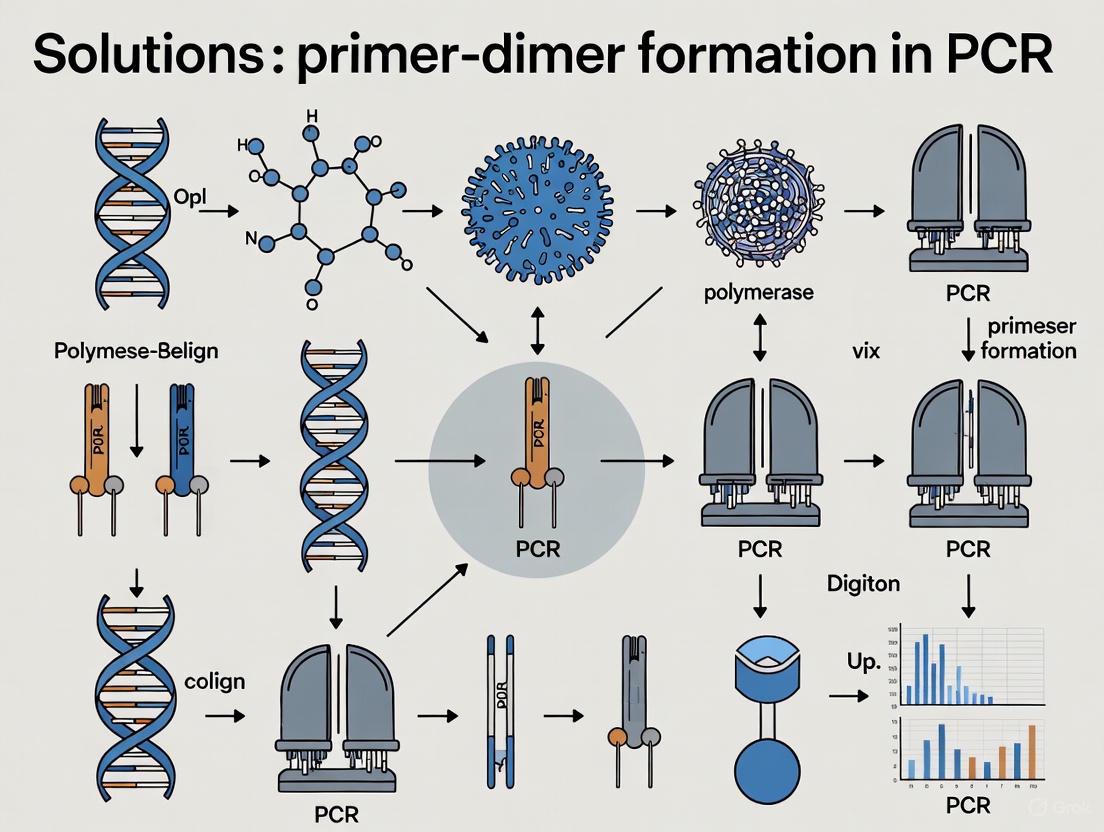
This article provides a systematic guide for researchers, scientists, and drug development professionals confronting the pervasive challenge of primer-dimer formation in PCR.
Comprehensive Strategies to Eliminate Primer-Dimer Formation in PCR: From Foundational Concepts to Advanced Solutions
Abstract
This article provides a systematic guide for researchers, scientists, and drug development professionals confronting the pervasive challenge of primer-dimer formation in PCR. It covers the fundamental mechanisms of primer-dimer artifacts, explores advanced primer design methodologies and computational prediction tools, details practical laboratory optimization and troubleshooting protocols, and validates these approaches through comparative analysis of modern techniques. By integrating foundational knowledge with actionable application strategies, this resource aims to enhance PCR specificity, efficiency, and reliability in both research and diagnostic settings, ultimately supporting robust molecular assay development.
Understanding Primer-Dimer Artifacts: Mechanisms, Impacts, and Detection in Molecular Assays
What are primer-dimers and how do they form?
Primer-dimers are short, unintended DNA fragments that can form during a Polymerase Chain Reaction (PCR) when primers anneal to each other instead of binding to the intended target DNA template [1] [2]. This nonspecific amplification consumes reaction resources (primers, polymerase, and dNTPs) and can reduce the efficiency and accuracy of your PCR [3] [4].
The dimerization process can be initiated during reaction preparation at room temperature, as some DNA polymerase enzymes retain partial activity under these conditions [1]. Once formed, these primer-primer duplexes are amplified in subsequent PCR cycles, generating unwanted products that are typically short in length (often between 20-100 base pairs) [2].
What is the fundamental difference between a self-dimer and a cross-dimer?
The key distinction lies in whether the dimer forms between two identical primers or between the forward and reverse primers in a pair. The table below summarizes the core differences.
Table 1: Key Differences Between Self-Dimers and Cross-Dimers
| Feature | Self-Dimer (Homodimer) | Cross-Dimer (Heterodimer) |
|---|---|---|
| Definition | Formed when two identical primers (e.g., two forward or two reverse primers) bind to each other [1]. | Formed when the forward and reverse primers bind to each other [1] [2]. |
| Primary Cause | Self-complementarity: The primer sequence contains regions that are complementary to itself [2] [5]. | Inter-primer complementarity: The forward and reverse primers share complementary regions, often at their 3' ends [2] [6]. |
| Impact on PCR | One type of primer becomes unavailable, directly interfering with target amplification. Can lead to PCR failure with no target product [1]. | Reduces the amount of both primers available for amplification, leading to faint or failed target amplification [1]. |
The following diagram illustrates the logical relationship between primer-dimer types and their primary causes.
How can I identify primer-dimers in my experiments?
In Conventional PCR (Gel Electrophoresis)
In agarose gel electrophoresis, primer-dimers have distinct characteristics [1] [2]:
- Location: They appear as a fuzzy smear or diffuse band at the very low end of the gel, typically in the 20-100 bp range, below your target amplicon and the smallest band of your DNA ladder.
- Appearance: Bands are often smeary and unsharp because they are nonspecific and diffuse quickly through the gel.
In qPCR (Real-Time PCR)
Identification in qPCR involves two methods [1]:
- Amplification Plot: Primer-dimers amplify very efficiently due to their short length. They often appear earlier than the main target (have a lower Cq value) but typically produce a plot with a lower overall fluorescence and a shallower curve.
- Melting Curve Analysis: This is a critical validation step. After amplification, a melting curve will show a distinct, lower temperature peak for the primer-dimer product compared to the higher, sharper peak of your specific amplicon.
In DNA Sequencing
When a primer involved in dimerization is used for Sanger sequencing, the resulting chromatogram often shows a short, intense region of overlapping sequence at the beginning, followed by a rapid decay in data quality and readability [7].
What are the most effective strategies to prevent primer-dimer formation?
Primary Prevention: Optimal Primer Design
The most effective solution is to prevent dimers at the design stage. The following table outlines key parameters for optimal primer design.
Table 2: Primer Design Guidelines to Minimize Dimer Formation
| Design Parameter | Optimal Value / Guideline | Rationale |
|---|---|---|
| Length | 18–30 nucleotides [8] [6] | Ensures sufficient specificity for the target. |
| Melting Temperature (Tm) | 55–72°C; primers in a pair should be within 2–5°C of each other [8] [6] | Allows a single, specific annealing temperature (Ta) to be used for both primers. |
| GC Content | 40–60% [8] [5] | Balances binding strength; too high can promote mismatching. |
| 3'-End Complementarity | Avoid ≥ 2 complementary bases at the 3' ends of a primer pair [9] [6] | The 3' end is critical for elongation; complementarity here greatly promotes dimer extension. |
| Self-Complementarity | Minimize hairpins and internal repeats (e.g., runs of a single base > 4) [8] [6] | Reduces the chance of a primer folding on itself or annealing to its partner. |
Essential Tools: Use reliable primer design software (e.g., Primer3, NCBI Primer-BLAST) to check for self-complementarity and cross-complementarity before ordering primers [8] [6].
Optimization of PCR Conditions
If dimers persist with well-designed primers, optimize your reaction protocol:
- Use a Hot-Start DNA Polymerase: These enzymes are inactive until a high-temperature activation step, preventing polymerase activity during reaction setup at lower temperatures where primer-dimer formation is most likely to begin [2] [3].
- Optimize Primer Concentration: High primer concentration increases the chance of primers encountering each other. Perform a titration to find the lowest concentration that still gives robust amplification of your target [2] [9].
- Increase Annealing Temperature: Using a higher, more stringent annealing temperature can prevent the weak binding between primers that leads to dimer formation [2] [4].
- Include a No-Template Control (NTC): This control contains all reaction components except the DNA template. If amplification occurs in the NTC, it is due to primer-dimer or contamination, providing a critical diagnostic for your experiment [2].
A step-by-step protocol to troubleshoot a reaction with primer-dimers
This protocol provides a systematic workflow to diagnose and resolve primer-dimer issues.
Materials and Reagents
Table 3: Research Reagent Solutions for Troubleshooting
| Reagent / Material | Function in Troubleshooting |
|---|---|
| Hot-Start DNA Polymerase | Standard reagent to minimize nonspecific amplification during reaction setup [2]. |
| dNTP Mix | Building blocks for DNA synthesis. |
| 10X PCR Buffer (with/without MgCl₂) | Provides optimal chemical environment for the polymerase. |
| MgCl₂ Solution | Cofactor for DNA polymerase; its concentration can be optimized to enhance specificity [6]. |
| Molecular Biology Grade Water | Nuclease-free water to make up reaction volume. |
| Primer Pairs (designed with software) | The primers under investigation. |
| Validated Template DNA | Positive control template. |
| Agarose Gel Electrophoresis System | To visualize PCR products and identify primer-dimer smears. |
Experimental Procedure
Step 1: Run a No-Template Control (NTC) Prepare your standard PCR master mix and aliquot it into two tubes. Add template DNA to one (the test reaction) and an equivalent volume of sterile water to the other (the NTC). Run both tubes in the thermal cycler using your standard PCR protocol [2].
Step 2: Analyze Results by Gel Electrophoresis Run the products from both reactions on an agarose gel.
- If a band/smear appears in the NTC lane at ~20-100 bp, this confirms the amplification is due to primer-dimer formation and is not template-dependent [2].
- If no band appears in the NTC, the nonspecific products in your test reaction may be due to other issues like non-specific priming on the template.
Step 3: Check Primer Design Using Software Analyze your primer sequences using tools like Oligo Analyzer or Primer3. Pay close attention to:
- Self-Dimerization: Check for complementarity within a single primer sequence.
- Cross-Dimerization: Check for complementarity between the forward and reverse primer sequences, especially at the 3' ends [5] [6]. A low "self-complementarity" score is desired.
Step 4: Optimize Reaction Conditions If primer design appears sound, proceed with wet-lab optimization.
- Implement a Hot-Start Protocol: If you are not already using one, switch to a hot-start DNA polymerase [2].
- Perform a Primer Titration: Test a range of primer concentrations (e.g., from 0.1 µM to 0.5 µM) to find the lowest concentration that provides specific amplification [9].
- Perform a Temperature Gradient PCR: Use your thermal cycler's gradient function to test a range of annealing temperatures (e.g., from 55°C to 65°C). Often, a increase of just a few degrees can eliminate dimer formation without affecting target yield [2] [4].
Step 5: Re-design and Order New Primers If optimization fails, the most reliable solution is to design a new set of primers following the stringent guidelines in Table 2 [1]. Consider advanced solutions like incorporating modified bases (e.g., SAMRS) if the problem persists in a difficult target region [3].
FAQ: What are the specific, sequential steps in primer-dimer formation?
Primer-dimer (PD) formation is a specific, unintended side reaction during the Polymerase Chain Reaction (PCR) that proceeds through three distinct biochemical steps. This process consumes reagents and can inhibit the amplification of the desired DNA target [10].
The complete formation and amplification mechanism is summarized in the following workflow:
The three-step process is as follows:
- Initial Annealing (Step I): Two primers anneal to each other via complementary bases in their sequences, rather than to the intended target DNA template. This is most likely to occur at low temperatures (e.g., during reaction setup) and is highly favored if the 3' ends contain complementary sequences [2] [10].
- Polymerase Extension (Step II): If the double-stranded structure formed in Step I is stable enough, the DNA polymerase enzyme binds and extends the primers. The polymerase uses the 3' end of each primer as a starting point to synthesize new DNA, effectively creating a short, double-stranded DNA fragment that connects the two primers [2] [10].
- Amplification (Step III): In subsequent PCR cycles, the short double-stranded product from Step II is denatured. The resulting single strands then serve as templates for other free primers in the reaction mix. These primers anneal to the new templates and are extended, leading to the exponential amplification of the primer-dimer product itself, which competes with the target amplicon for PCR reagents [10].
FAQ: What experimental data defines the stability requirements for the initial primer-dimer complex?
The initial annealing step (Step I) requires a sufficiently stable hybridized complex for the DNA polymerase to bind and initiate extension. Quantitative experimental studies using techniques like free-solution conjugate electrophoresis (FSCE) have precisely defined the base-pairing requirements for this stability [11].
The key quantitative findings from these experimental studies are summarized in the table below.
Table 1: Experimental Parameters for Stable Primer-Dimer Formation
| Parameter | Experimental Finding | Experimental Method |
|---|---|---|
| Minimum Consecutive Base Pairs | Stable dimerization occurred when more than 15 consecutive base pairs formed between primers [11]. | Free-solution conjugate electrophoresis (FSCE) with drag-tagged DNA [11]. |
| Effect of Non-consecutive Base Pairs | Even with 20 out of 30 possible base pairs bonded, non-consecutive base pairs did not create stable dimers, highlighting the critical importance of a contiguous complementary region [11]. | Free-solution conjugate electrophoresis (FSCE) with drag-tagged DNA [11]. |
| Stability vs. Temperature | For partially complementary primers (less than 30 out of 30 base pairs), dimerization was inversely correlated with temperature, with more stable dimers forming at lower temperatures [11]. | Electrophoresis separations conducted at a temperature gradient (18°C, 25°C, 40°C, 55°C, 62°C) [11]. |
| Critical Factor for Extension | A high GC-content at the 3' ends significantly contributes to construct stability, as GC base pairs form three hydrogen bonds, compared to two for AT pairs [10] [5]. | Biochemical and thermodynamic analysis of DNA hybridization [10]. |
Experimental Protocol: Quantifying Primer-Dimer Formation via FSCE
This protocol is adapted from a study that used a unique free-solution conjugate electrophoresis (FSCE) approach to quantify dimerization risk between primer-barcode pairs [11].
- 1. Principle: An electrically neutral "drag-tag" (e.g., a synthetic poly-N-methoxyethylglycine) is conjugated to one oligonucleotide primer. This tag alters the primer's electrophoretic mobility, allowing for clear separation and quantification of single-stranded primers versus double-stranded primer-dimers during capillary electrophoresis without a sieving matrix [11].
- 2. Sample Preparation:
- Oligonucleotides: Design two 30-mer primers with defined complementary regions. One primer is conjugated at its 5'-end to a drag-tag and labeled with a fluorophore (e.g., ROX). The other primer is labeled with a different fluorophore (e.g., FAM) [11].
- Annealing: Mix the drag-tagged and non-drag-tagged DNA primers. Heat-denature the mixture at 95 °C for 5 minutes, then anneal at 62 °C for 10 minutes before cooling to 25 °C [11].
- 3. Capillary Electrophoresis:
- Instrument: ABI 3100 capillary electrophoresis system or equivalent.
- Conditions: Load samples and electrophorese under free-solution conditions (no polymer sieving matrix) at a high voltage (e.g., 15 kV, 320 V/cm).
- Temperature Gradient: Perform separations at a range of temperatures (e.g., 18°C, 25°C, 40°C, 55°C, 62°C) to assess the thermal stability of the primer-dimers [11].
- 4. Data Analysis: The proportion of primer-dimer formed is quantified based on the peak areas corresponding to the shifted dimer bands compared to the single-stranded primer bands in the electropherogram [11].
The Scientist's Toolkit: Research Reagent Solutions
Table 2: Essential Reagents for Studying and Preventing Primer-Dimer Formation
| Reagent / Material | Function in Context of Primer-Dimer Research |
|---|---|
| Hot-Start DNA Polymerase | A chemically modified or antibody-inhibited enzyme that is inactive at room temperature. It prevents the polymerase from extending primed dimers during reaction setup, a key vulnerability point. Activity is restored only after a high-temperature activation step (e.g., 95°C) [2] [10] [12]. |
| NMEG (N-methoxyethylglycine) Drag-Tags | Synthetic, water-soluble polyamide polymers used in FSCE experiments. They are covalently linked to primers to alter their hydrodynamic drag, enabling the separation and quantification of primer-dimer complexes from single-stranded primers [11]. |
| Magnesium Salts (MgCl₂, MgSO₄) | A co-factor essential for DNA polymerase activity. Its concentration is critical to optimize; excess Mg²⁺ can stabilize nonspecific base-pairing and promote primer-dimer formation, while insufficient Mg²⁺ can lead to low yield of the desired product [6] [12]. |
| DMSO (Dimethyl Sulfoxide) | A PCR additive or co-solvent that helps denature DNA templates with high GC-content or secondary structure. While it can aid in specific amplification, it can also weaken primer binding; its use must be optimized as it can sometimes exacerbate primer-dimer issues [12] [13]. |
| HPLC-Purified Primers | High-quality primers ensure that the oligonucleotide population is full-length and devoid of truncated sequences, which are more prone to nonspecific annealing and can increase the risk of primer-dimer formation [13] [14]. |
In polymerase chain reaction (PCR) research, two significant challenges that directly impact experimental efficiency are resource depletion and false positives. Resource depletion occurs when reaction components are consumed in non-productive side reactions, primarily through the formation of primer-dimers. These are short, artifactual DNA fragments that form when primers anneal to each other instead of binding to the target DNA template [2]. This unnecessary consumption of primers, nucleotides, and enzyme activity diminishes the availability of these critical resources for amplifying the desired target, ultimately reducing amplification yield and sensitivity [4].
Simultaneously, the presence of primer-dimers can lead to false positive signals, particularly in quantitative PCR (qPCR) and when analyzing results via gel electrophoresis. These artifacts can be misinterpreted as specific amplification products, compromising data accuracy and leading to erroneous experimental conclusions [4] [2]. This technical guide, framed within our broader thesis on solving primer-dimer formation, provides targeted troubleshooting strategies to help researchers identify, mitigate, and resolve these critical issues.
Frequently Asked Questions (FAQs)
FAQ 1: What exactly is a primer-dimer and how does it affect my PCR results? A primer-dimer is a small, unintended DNA fragment, typically below 100 base pairs, that forms when PCR primers anneal to each other via complementary regions and are extended by the DNA polymerase [2]. This affects your results in two primary ways:
- Resource Depletion: The formation of primer-dimers consumes primers, dNTPs, and polymerase activity. This depletes the reagents available for amplifying your target DNA, which can lead to reduced yield or even complete amplification failure of your desired product [4].
- False Positives: In gel electrophoresis, primer-dimers appear as a fuzzy smear or band at low molecular weights. In qPCR, they generate a fluorescent signal that can be misinterpreted as a specific target, leading to inaccurate quantification [2].
FAQ 2: Why do my reactions produce primer-dimers even when my primer design seems correct? While proper primer design is crucial, several experimental factors can promote primer-dimer formation [15] [2]:
- Low Annealing Temperatures: Temperatures that are too low permit primers to anneal to each other, even with limited complementarity.
- High Primer Concentrations: Excess primers increase the probability of primers encountering and binding to each other.
- Low Template Quality or Quantity: When the intended target is scarce or degraded, primers are more likely to interact with each other instead of the template.
- Active Polymerase at Room Temperature: If a non-hot-start polymerase is used, it can extend primed complexes while the reaction is being set up on the bench, facilitating dimer formation.
FAQ 3: What is the most reliable way to confirm that a band in my gel is a primer-dimer? The most definitive method is to include a No-Template Control (NTC) in your PCR run. The NTC contains all reaction components except the DNA template. If the same low molecular weight, smeary band appears in the NTC lane, it is a primer-dimer and not a specific product, as its formation is template-independent [2].
FAQ 4: Are primer-dimers a sign of a failed experiment? Not necessarily. The presence of a faint primer-dimer band may be acceptable if the yield and specificity of your desired amplicon are high. However, intense primer-dimer bands indicate a problem that is likely depleting reagents and compromising the efficiency of your reaction, which requires troubleshooting [2].
Troubleshooting Guides
Guide to Preventing Primer-Dimer Formation
Primer-dimer formation is best prevented through a combination of optimized primer design and refined reaction conditions.
Experimental Protocol for Primer Design Optimization
- Check for Complementarity: Use primer design software to analyze primers for self-complementarity (hairpins) and 3'-end complementarity between primer pairs. Avoid stretches of 3 or more complementary bases at the 3' ends [15].
- Design Nested Primers: For sequencing or subsequent amplification rounds, design new primers that bind internally (nested) to the original amplicon. This avoids reusing the external primers that may be prone to dimerization [16].
- Consider Advanced Primers: Explore primers with modified bases, such as Locked Nucleic Acids (LNAs), which can enhance binding specificity to the target and reduce off-target binding [4].
Experimental Protocol for Reaction Condition Optimization
- Optimize Annealing Temperature: Perform a gradient PCR to test a range of annealing temperatures. Start at 3–5°C below the lowest primer Tm and increase stepwise. The optimal temperature maximizes specific product yield while minimizing dimers [15].
- Titrate Primer Concentration: Test primer concentrations in the range of 0.1–1.0 µM. High concentrations promote dimerization; finding the lowest effective concentration can suppress this [15] [2].
- Use a Hot-Start Polymerase: Always employ a hot-start DNA polymerase. These enzymes remain inactive until a high-temperature activation step, preventing enzymatic activity during reaction setup and the pre-PCR stages where primer-dimer formation is most likely to initiate [15] [2].
- Increase Denaturation Time: Slightly increasing the denaturation time can help ensure primers that have formed dimers are fully melted and separated in each cycle [2].
The following workflow summarizes the logical relationship between causes, consequences, and solutions for primer-dimer formation:
Guide to Mitigating False Positive Results in PCR
False positives in PCR can arise from multiple sources, including primer-dimers and more significantly, amplicon or reagent contamination.
Experimental Protocol for Contamination Control
- Physically Separate Pre- and Post-PCR Areas: Use separate rooms, equipment, and dedicated lab coats for reagent preparation, sample handling, and PCR product analysis.
- Use Aerosol-Barrier Tips: Always use filter tips for all pipetting steps to prevent cross-contamination between samples and from pipettors.
- Decontaminate Work Surfaces and Equipment: Regularly clean workstations, pipettors, and equipment with a 10% bleach solution or DNA-degrading solutions like DNA-Zap.
- Include Negative Controls: Always run multiple Negative Template Controls (NTCs) with your experiment. A positive signal in the NTC indicates contamination.
Experimental Protocol for Verifying Questionable Positive Results
- Re-test the Sample: If a positive result is unexpected (e.g., in an asymptomatic screened individual in a low-prevalence setting), obtain a new sample and re-test [17].
- Re-run the Original Sample: If a new sample is unavailable, the original sample should be re-extracted and re-amplified, preferably on a different PCR platform [17].
- Analyze the Amplification Plot (for qPCR): Check the Cycle threshold (Ct) value. Very high Ct values (indicating low viral load/starting template) are more likely to be associated with false positives or indeterminate results, especially in a low-prevalence setting [17].
The table below summarizes the primary causes and recommended solutions for different types of false positives.
Table 1: Troubleshooting False Positive PCR Results
| Cause of False Positive | Manifestation | Recommended Solution |
|---|---|---|
| Primer-Dimer Formation [2] | Smear below 100 bp on gel; signal in NTC in qPCR. | Optimize primer design and concentration; use hot-start polymerase; increase annealing temperature. |
| Amplicon Contamination [17] | Signal in multiple samples and NTCs. | Implement strict physical separation of pre- and post-PCR areas; use UV decontamination; use uracil-N-glycosylase (UNG) treatment. |
| Reagent Contamination [17] [18] | Signal across an entire plate or kit lot. | Aliquot all reagents; use new, certified clean reagents; use positive control with caution. |
| Sample Cross-Contamination [17] | Isolated, unexpected positives. | Use aerosol-barrier tips; change gloves frequently; carefully load samples on gel. |
The Scientist's Toolkit: Essential Research Reagent Solutions
Selecting the right reagents is a critical step in preventing primer-dimer formation and ensuring PCR efficiency. The following table details key solutions and their specific functions.
Table 2: Key Reagent Solutions for Preventing Resource Depletion and False Positives
| Reagent / Material | Function & Rationale |
|---|---|
| Hot-Start DNA Polymerase | Remains inactive at room temperature, preventing extension of nonspecifically annealed primers during reaction setup. This is the first-line defense against primer-dimer formation [15] [2]. |
| PCR Additives (e.g., GC Enhancer, DMSO, Betaine) | Helps denature GC-rich templates and sequences with secondary structures, improving primer binding to the intended target and reducing off-target annealing [15]. |
| Magnesium Chloride (MgCl₂) / MgSO₄ | Cofactor for DNA polymerase. Concentration must be optimized, as excess Mg²⁺ can promote nonspecific amplification and primer-dimer formation by stabilizing any primer-template interaction [15]. |
| High-Purity, Quality-Checked Primers | Primers synthesized with purification (e.g., HPLC) to remove truncated oligos. This ensures a high percentage of full-length primers, which is critical for specificity and reduces mispriming events [15]. |
| Uracil-N-Glycosylase (UNG) | An enzymatic system to prevent carryover contamination from previous PCR products. It degrades uracil-containing DNA, allowing you to use dUTP in place of dTTP in PCR mixes, rendering new amplicons susceptible to UNG degradation in future setups before amplification [17]. |
Primer-dimers are short, double-stranded DNA artifacts that form when PCR primers anneal to each other instead of binding to the target DNA template. This occurs due to complementary regions within the primers themselves, leading to self-annealing and nonspecific amplification. Primer-dimers typically range from 20-60 base pairs in length and can significantly reduce PCR efficiency by competing with the desired target for reagents, ultimately leading to inaccurate quantification and misinterpretation of experimental results. [4] [19]
Troubleshooting Guide: Identifying Primer-Dimers
Gel Electrophoresis Analysis
Agarose gel electrophoresis is a fundamental technique for visualizing PCR products and identifying primer-dimer formation.
- Recognizing Primer-Dimers on a Gel: Primer-dimers appear as a bright band at the bottom of the gel, typically between 20-60 bp, which is well below the expected size of your target amplicon. This band should be distinguished from a hazy, diffuse band of similar low molecular weight, which represents unincorporated residual primers. [19]
- Other Non-Specific Amplification Artefacts: In addition to simple primer-dimers, you may observe:
- Primer Multimers: These form when primer-dimers join with other dimers, creating a ladder-like pattern of bands at ~100 bp, 200 bp, and larger. [19]
- Smears: A continuous smear of DNA on the gel indicates random, nonspecific amplification, often caused by highly fragmented template DNA or degraded primers. [19]
The table below summarizes common gel electrophoresis observations and their interpretations.
Table 1: Troubleshooting PCR Results via Gel Electrophoresis
| Observation on Gel | Appearance | Potential Cause | Solution |
|---|---|---|---|
| Primer-Dimer Band | A single, bright band at the very bottom of the gel (20-60 bp). [19] | Primers annealing to each other instead of the template. [19] | Optimize primer design, increase annealing temperature, or use a hot-start polymerase. [4] [15] |
| Primer Multimers | A ladder of bands at ~100 bp, 200 bp, etc. [19] | Primer-dimers joining together to form larger, amplifiable complexes. [19] | Reduce primer concentration, set up reactions on ice, or redesign primers. [19] |
| Smear | A continuous, fuzzy spread of DNA from high to low molecular weights. [19] | Random nonspecific amplification; can be from fragmented DNA, low annealing temperature, or contaminated template. [19] | Dilute or re-purify DNA template, replace primers, or increase annealing temperature. [15] [19] |
| DNA Stuck in Well | DNA fails to enter the gel and remains in the well. [19] | Overloading of PCR product, carryover of impurities from DNA extraction, or malformed wells. [19] | Dilute DNA template 10-100x, improve DNA extraction, or recast the gel. [19] |
Melting Curve Analysis in qPCR
In SYBR Green-based qPCR, melt curve analysis is a crucial quality control step to verify amplification specificity. The dye binds to any double-stranded DNA, making it essential to distinguish the specific product from primer-dimers. [20]
- The Principle: After amplification, the temperature is gradually increased from about 60°C to 95°C. As the DNA denatures (melts), the SYBR Green dye is released, causing a drop in fluorescence. The resulting data is often plotted as the negative derivative of fluorescence over temperature (-dF/dT), producing distinct peaks. Each DNA species, based on its length, GC content, and sequence, has a characteristic melting temperature (Tm). [21] [20]
- Interpreting the Curves: A single, sharp peak typically indicates amplification of a single, specific product. Abnormal curve shapes reveal issues with the reaction. [21] [20]
The table below outlines common melt curve patterns and their troubleshooting strategies.
Table 2: Troubleshooting qPCR Melt Curves
| Melt Curve Observation | Description | Potential Cause | Solution |
|---|---|---|---|
| Single Peak, but Tm < 80°C | A single peak with a low melting temperature. [21] | Amplification is likely only primer-dimer, with no true target product. [21] | Redesign primers. If the target is <100 bp, a low Tm may be expected. [21] |
| Double Peaks, Minor Peak < 80°C | Two distinct peaks, with the smaller one at a lower temperature. [21] | Primer-dimer formation alongside the target amplicon. [21] | Lower primer concentration, increase annealing temperature, or increase template concentration. [21] |
| Double Peaks, Minor Peak > 80°C | Two peaks, with the smaller one at a high temperature. [21] | Nonspecific amplification of an unwanted product. [21] | Raise the annealing temperature or check for and remove genomic DNA contamination. [21] |
| Single Peak, But Not Sharp | A single, broad peak. [21] | Could be related to instrument sensitivity or minor non-specific products of similar size. [21] | If the temperature span is ≤ 7°C, the result is often still usable. Confirm with gel electrophoresis. [21] |
| Irregular or Noisy Peaks | A messy, multi-peaked, or wavy baseline. [21] | Contaminated template or issues with instrument calibration/reagents. [21] | Prepare fresh template, perform instrument maintenance, or use compatible consumables. [21] |
Experimental Protocols for Identification
Protocol: Confirming Primer-Dimers by Gel Electrophoresis
This protocol allows for physical separation and visualization of PCR products.
- Prepare an Agarose Gel: Create a 2-3% agarose gel in 1X TAE or TBE buffer, adding a DNA-intercalating dye.
- Load Samples: Mix 5-10 µL of your PCR reaction with DNA loading dye and load into the gel wells. Include an appropriate DNA ladder.
- Run Gel Electrophoresis: Run the gel at 5-10 V/cm until the dye front has migrated sufficiently.
- Visualize: Image the gel under UV light. Primer-dimers will be visible as a bright band near the dye front (20-60 bp). [19]
Protocol: Analyzing Specificity by Melt Curve
This is a standard step in most SYBR Green qPCR protocols.
- Complete qPCR Amplification: Run your qPCR program as usual.
- Program the Melt Curve Step: Set the melt curve acquisition on your qPCR instrument. A typical program is:
- Analyze Data: Use the instrument's software to plot the negative derivative of the melt curve. Look for a single, sharp peak to confirm specific amplification. [20]
Visual Guide to Identification Workflows
The following diagrams illustrate the logical process for identifying primer-dimers using the two core methods.
Diagram 1: Gel Electrophoresis Analysis Workflow
Diagram 2: Melt Curve Analysis Workflow
Research Reagent Solutions
The table below lists key reagents and tools that are essential for preventing and identifying primer-dimers.
Table 3: Research Reagent Solutions for Primer-Dimer Challenges
| Reagent / Tool | Function & Role in Primer-Dimer Mitigation |
|---|---|
| Hot-Start DNA Polymerase | A modified enzyme inactive at room temperature, preventing primer-dimer formation during reaction setup. Activated only at high temperatures, dramatically improving specificity. [4] [15] [22] |
| SYBR Green qPCR Master Mix | A pre-mixed, optimized solution containing dyes, buffers, and often a hot-start polymerase. Using a reliable master mix ensures consistent reaction conditions for accurate melt curve analysis. [21] [20] |
| PCR Additives (e.g., DMSO, BSA) | Additives like DMSO help denature templates with complex secondary structures (e.g., high GC content), promoting specific primer binding and reducing mis-priming that leads to dimers. [15] [22] |
| Primer Design Software | Bioinformatics tools are critical for designing primers with optimal length (18-24 nt), GC content (40-60%), and Tm, while checking for self-complementarity to avoid dimer formation. [4] [5] |
| Modified Primers (e.g., SAMRS) | Self-Avoiding Molecular Recognition Systems (SAMRS) are specialized base analogs incorporated into primers. They enhance binding to the target while discouraging primer-primer interactions. [23] |
FAQs on Primer-Dimers
Q1: My melt curve shows a single peak, but my gel shows a primer-dimer band. Which result should I trust? Trust the gel. A melt curve can sometimes fail to resolve a small amount of primer-dimer if it is co-amplified with a dominant specific product. The gel provides physical evidence of the dimer's presence. [19] [20]
Q2: Can primer-dimers affect my qPCR quantification (Ct values)? Yes, significantly. Primer-dimers compete with the target for primers, nucleotides, and polymerase, leading to reduced amplification efficiency and higher (delayed) Ct values. This results in an underestimation of the target's initial concentration. [4]
Q3: What is the most critical step in preventing primer-dimers? Robust primer design is the most critical preventive measure. Ensure primers are 18-24 bases long, have a Tm of 54-65°C, a GC content of 40-60%, and lack complementary sequences at the 3' ends. [15] [5]
Q4: I've optimized my primers, but I still get primer-dimers. What should I do next? Further wet-lab optimization is needed. Systematically:
- Increase annealing temperature in 1-2°C increments.
- Lower primer concentration (e.g., from 1 µM to 0.3 µM).
- Use a hot-start polymerase if you aren't already.
- Ensure you are setting up reactions on ice. [4] [15]
Troubleshooting Guides
Guide 1: Diagnosing Amplification in Your No-Template Control (NTC)
Problem: You observe amplification in your No-Template Control (NTC) during a qPCR run. The NTC, which contains all reaction reagents except the template DNA, is a critical control. Its purpose is to be blank; any amplification signals a problem that must be addressed before experimental data can be trusted [24].
Diagnostic Steps:
- Check the Amplification Plot and Melt Curve: The pattern of amplification and the results of a melt curve analysis (if using SYBR Green chemistry) are the first clues to distinguish between contamination and primer dimers [25] [26].
- Run Gel Electrophoresis (for endpoint PCR): If you are performing conventional PCR, run the products on an agarose gel. The appearance of the band can help identify the issue [2] [24].
The table below outlines how to interpret these results to diagnose the root cause.
Table 1: Diagnostic Guide for NTC Amplification
| Observation | Likely Cause | Supporting Evidence |
|---|---|---|
| The NTC amplification curve is exponential and the melt curve shows a single, sharp peak at the same temperature as your positive samples. | DNA Contamination [24] | The amplicon is the correct, specific size. On a gel, the band will be sharp and at the expected molecular weight for your target [24]. |
| The NTC amplification curve has a late CT (e.g., >30-35) and the melt curve shows a broad peak at a lower temperature than the target amplicon. | Primer Dimer Formation [25] [26] | Primer dimers are short, nonspecific products. On a gel, they typically appear as a fuzzy smear or band below 100 bp [2]. |
| The NTC amplification occurs at varying CT values across replicates. | Random Contamination during plate setup [25] | Inconsistent amplification patterns suggest sporadic introduction of contaminants, often from pipetting errors or aerosol contamination [25]. |
| The NTC amplification is consistent across all replicates. | Systematic Reagent Contamination [25] | A uniform CT value in all NTCs points to a contaminated reagent (e.g., water, primers, or master mix) [25]. |
Guide 2: Resolving Primer Dimer Formation
If you have diagnosed your NTC amplification as primer dimer, use the following systematic approach to resolve the issue.
1. Optimize Reaction Components and Conditions Begin with wet-lab optimization strategies that are often quick to implement.
Table 2: Wet-Lab Optimization Strategies for Primer Dimers
| Method | Action | Rationale |
|---|---|---|
| Primer Design | Redesign primers using software to minimize self-complementarity, especially at the 3' ends [2]. | Prevents the primers from annealing to each other in the first place. This is the most robust long-term solution [2]. |
| Thermal Cycling | Increase the annealing temperature [2]. | Promotes more specific binding between the primer and its intended template, making it harder for primers to bind to each other. |
| Use a "hot-start" DNA polymerase [2] [3]. | Inactivates the polymerase until the high-temperature denaturation step, preventing nonspecific extension during reaction setup. | |
| Reagent Concentration | Lower primer concentration (e.g., 50-200 nM each) [25] [2]. | Reduces the chance of primer-primer interactions by giving primers fewer opportunities to find each other. |
2. Implement Advanced Molecular Solutions For persistent primer dimer problems, particularly in demanding applications like SNP detection or multiplex PCR, consider advanced biochemical solutions.
- Self-Avoiding Molecular Recognition Systems (SAMRS): SAMRS are synthetically modified nucleotides that pair normally with natural DNA but do not pair with other SAMRS nucleotides [3]. Incorporating SAMRS components into your primers strategically reduces primer-primer interactions while maintaining efficient amplification of the target [3]. The general design rule is to limit the number of SAMRS modifications and place them at positions where primer-dimer initiation is most likely [3].
The following workflow diagram summarizes the experimental protocol for troubleshooting primer dimers:
Troubleshooting Primer Dimer in NTCs
Guide 3: Eradicating DNA Contamination
If you have diagnosed your NTC amplification as DNA contamination, immediate and thorough action is required.
1. Establish Rigorous Laboratory Practices Contamination control requires consistent discipline and spatial organization [24] [27].
- Physical Separation: Maintain strictly separate pre-PCR and post-PCR areas. The pre-PCR area for master mix preparation should be a dedicated "clean" space, ideally a laminar flow hood with a UV light. No template DNA or amplified PCR products should ever enter this area [24] [27].
- Dedicated Equipment: Use dedicated pipettes, tip boxes, lab coats, and other equipment for the pre-PCR area. Never use these for post-PCR analysis [24].
- Use Filter Tips: Always use sterile filter tips to prevent aerosols from contaminating your pipettes [24] [27].
- Decontaminate Surfaces: Clean your workspace and equipment with a 10% bleach solution or a commercial DNA decontaminant like DNA-Away before and after each use [24] [28].
2. Manage Reagents Meticulously
- Aliquot Everything: Upon receipt, aliquot all reagents (polymerase, primers, dNTPs, water) into small, single-use volumes. This prevents the entire stock from becoming contaminated and reduces freeze-thaw cycles [24] [27].
- Use a No-Uracil System: Incorporate dUTP and Uracil-N-Glycosylase (UNG) into your master mix. UNG enzymatically degrades any PCR carryover contamination from previous reactions (which contain dUTP) before the amplification cycle begins, preventing re-amplification [25] [27].
- Verify Water and Reagents: Use autoclaved, filtered, nuclease-free water dedicated for PCR. Open a new bottle if contamination is suspected [24] [27].
Frequently Asked Questions (FAQs)
Q1: What does it mean if my NTC has a band or shows amplification? A band or amplification curve in your NTC invalidates the experiment [24]. It means that your PCR reagents or setup have been compromised, most likely by either (a) contamination with template DNA or (b) the formation of primer dimers. You must stop and troubleshoot the issue before trusting any of your experimental data [24].
Q2: How can I definitively tell the difference between contamination and primer dimer in my NTC? The most reliable method is to perform a melt curve analysis after a SYBR Green qPCR run [25]. A single, sharp peak at the same melting temperature (Tm) as your positive sample indicates contamination with the specific target amplicon. A broad peak at a lower Tm indicates primer dimers [25] [26]. In conventional PCR, running the products on a gel will show a sharp band at the expected size for contamination, versus a smeary band below 100 bp for primer dimers [2] [24].
Q3: My lab doesn't have separate rooms for pre- and post-PCR work. What is the minimum I can do to prevent contamination? At a minimum, designate separate benches or work areas that are as far apart as possible. Use a dedicated bench or a dead-air box for setting up PCR reactions. Have a set of pipettes and supplies that are used only for PCR setup and are never taken to the gel electrophoresis or post-PCR analysis area [24]. Always use filter tips and clean your workspace thoroughly with 10% bleach before starting [24] [27].
Q4: I've tried all standard optimizations, but I still get primer dimers. What are my options? For persistent primer dimers, especially in advanced applications like multiplex PCR or highly sensitive SNP detection, consider using primers designed with Self-Avoiding Molecular Recognition Systems (SAMRS) [3]. SAMRS are modified nucleotides that bind to natural DNA but not to each other, which can dramatically reduce primer-primer interactions [3].
Q5: Is a small amount of primer dimer acceptable in my results? While a small amount may be unavoidable, it is not desirable. Primer dimers compete for reaction resources (primers, polymerase, dNTPs), which can reduce the efficiency and sensitivity of your target amplification [3]. In quantitative PCR, this can lead to inaccurate quantification. It is best practice to optimize your assay to minimize primer dimer formation as much as possible [25] [2].
Research Reagent Solutions
The following table details key reagents and their functions in preventing and diagnosing issues identified by the NTC.
Table 3: Essential Reagents for NTC Troubleshooting and Primer Dimer Prevention
| Reagent / Material | Function / Application | Key Consideration |
|---|---|---|
| Hot-Start DNA Polymerase | Remains inactive until high-temperature activation, preventing nonspecific priming and primer dimer formation during reaction setup [2] [3]. | Essential for robust and specific PCR. Choose based on activation method and compatibility with your buffer system. |
| SYBR Green Master Mix | Fluorescent dye that binds double-stranded DNA, allowing for real-time quantification and subsequent melt curve analysis [25]. | The melt curve is critical for diagnosing primer dimers versus specific contamination in the NTC [25]. |
| UNG (Uracil-N-Glycosylase) | Enzyme used with dUTP-containing master mixes to degrade PCR products from previous reactions, preventing carryover contamination [25] [27]. | A key defense against one of the most common sources of contamination. |
| SAMRS-Modified Primers | Primers incorporating SAMRS nucleotides to minimize primer-primer interactions while maintaining binding to the natural DNA template [3]. | An advanced solution for challenging applications like high-level multiplexing or when standard primer redesign fails [3]. |
| Nuclease-Free Water | Sterile, DNA/RNAse-free water used to prepare all reaction mixes and controls [27]. | A common source of contamination; always aliquot and use fresh, certified nuclease-free water. |
| Filter Pipette Tips | Tips with an internal barrier to prevent aerosol contaminants from entering and contaminating the pipette shaft [24] [27]. | Non-negotiable for PCR setup to prevent cross-contamination between samples. |
Experimental Protocol: Shortened Thermal Profile to Circumvent Persistent Contamination
In quantitative PCR where the range of quantification is more critical than the absolute limit of detection, a modified thermal cycling protocol can be used to bypass the effects of low-level, persistent contamination that cannot be eradicated [29].
Principle: Shortening the duration of each thermal cycling step (denaturation, annealing, extension) disproportionately reduces the amplification efficiency of the very low quantity of contaminating DNA in the NTC, while having a minimal impact on the amplification of the abundant specific target in sample wells [29]. This shifts the CT value of the NTC to a very late cycle, effectively negating its impact on data analysis.
Methodology:
- Standard Protocol: Begin with your standard qPCR protocol. For example: Denaturation: 20 sec, Annealing: 20 sec, Extension: 20 sec for 45 cycles.
- Shortened Protocol: Modify the protocol by significantly reducing the time for each step. For example: Denaturation: 10 sec, Annealing: 10 sec, Extension: 10 sec for 40 cycles [29].
- Comparison: Run the same samples and NTCs using both protocols. The shortened profile should result in a significant upward shift (e.g., 7-10 cycles) in the CT value for the NTC, while the CT values for the positive samples remain largely unaffected [29].
Note: This is a bypass, not a cure, for contamination and is not recommended for diagnostic applications where maximum sensitivity is required. However, it can be invaluable for research-based qPCR to salvage data when contamination is persistent [29].
The logical relationship of this protocol is summarized below:
Bypassing Contamination with Shortened Cycles
What are the primary root causes of primer-dimer formation related to primer complementarity?
Primer-dimer formation is primarily driven by unintended complementarity between primers. This occurs when regions within a single primer or between forward and reverse primers are complementary, allowing them to anneal to each other instead of the target DNA template [2] [13].
The table below summarizes the key root causes and their mechanisms:
| Root Cause | Mechanism | Consequence |
|---|---|---|
| 3'-End Complementarity [12] [13] | Complementary bases, especially G or C, at the 3' ends of two primers allow stable annealing. | Provides a free 3'-OH group for DNA polymerase to initiate synthesis, forming short, unintended amplicons [2]. |
| Self-Dimerization [2] | A single primer contains regions that are self-complementary. | Forms hairpin loops or secondary structures that can be extended by DNA polymerase. |
| Cross-Primer Dimerization [2] | Two primers (forward/forward, reverse/reverse, or forward/reverse) have complementary regions. | Primers anneal to each other, creating a short, amplifiable duplex. |
| High GC Content at 3' End [5] | Three or more consecutive G or C bases at the 3' end. | Strong hydrogen bonding (3 bonds for G:C vs. 2 for A:T) leads to overly stable non-specific binding [5]. |
How do reaction conditions contribute to primer-dimer formation?
Suboptimal reaction conditions can facilitate primer-dimer formation even with well-designed primers by promoting non-specific interactions [13] [19]. The following table outlines the critical parameters:
| Reaction Condition | Problematic Range | Mechanism & Impact |
|---|---|---|
| Annealing Temperature | Too low (e.g., < 3-5°C below primer Tm) [12] | Allows primers to anneal to each other via weak, partial complementarity that would be disrupted at higher, more specific temperatures [2] [13]. |
| Primer Concentration | Too high (> 1 µM) [12] [30] | Increases the probability of primer-primer collisions and interactions over primer-template binding, favoring dimer formation [4] [13]. |
| PCR Setup Temperature | Room Temperature [13] | Taq DNA polymerase has residual activity at low temperatures. During reaction setup, primers can anneal nonspecifically and be extended before cycling begins [2]. |
| Number of PCR Cycles | Too high (>35 cycles) [13] | In later cycles, as reagents are depleted, primers are more likely to form dimers that are efficiently amplified due to their short length [19]. |
| Magnesium Ion (Mg²⁺) Concentration | Excessively high [12] | Mg²⁺ is a cofactor for DNA polymerase and stabilizes DNA duplexes. High concentrations can stabilize nonspecific primer-duplexes [12]. |
What is a systematic experimental protocol to troubleshoot and identify the root cause?
A step-by-step diagnostic approach is recommended to isolate whether complementarity or reaction conditions are the primary issue.
Systematic Troubleshooting Workflow
Detailed Experimental Protocol
Step 1: No-Template Control (NTC) Test This critical control determines if the issue is inherent to the primers themselves.
- Methodology: Prepare a PCR reaction identical to your test reactions but replace the DNA template with sterile nuclease-free water [2].
- Interpretation: If primer dimers are visible in the NTC lane on an agarose gel, it confirms that the dimers form independently of the template, pointing to primer complementarity as the root cause [2].
Step 2: In Silico Primer Analysis
- Methodology: Use primer analysis software (e.g., NCBI Primer-BLAST, Primer3) [6] [5] or manually inspect sequences.
- Parameters to Check:
- 3'-End Complementarity: Ensure the last 5 nucleotides, especially the last 3, of the forward and reverse primers are not complementary to each other [13] [5].
- Self-Complementarity and Hairpins: Check for regions within a single primer that can anneal to itself. The software provides scores for "self-complementarity" and "self 3'-complementarity" – lower values are better [5].
- Melting Temperature (Tm) Consistency: The Tm for both primers should be similar (difference ≤ 5°C) [6] [22].
Step 3: Reaction Condition Optimization If in silico analysis shows no major issues, systematically optimize conditions.
- Annealing Temperature Gradient:
- Primer Concentration Titration:
What key reagent solutions can help mitigate primer-dimer formation?
The following "toolkit" of reagents is essential for preventing and troubleshooting primer-dimers.
Research Reagent Solutions
| Reagent / Material | Function & Rationale |
|---|---|
| Hot-Start DNA Polymerase [2] [12] | Enzyme is inactive until a high-temperature activation step (e.g., 95°C). Prevents enzymatic extension of primerdimers formed during reaction setup at room temperature [2]. |
| High-Purity (HPLC Purified) Primers [13] | Ensures primers are full-length and free of truncated synthesis products that can promote nonspecific amplification and dimer formation. |
| PCR Additives (DMSO, BSA, Betaine) [6] [22] | Additives like DMSO can help denature GC-rich secondary structures in primers, improving specificity and reducing chances of mispriming. |
| Gradient Thermal Cycler | Essential for empirically determining the optimal annealing temperature for a specific primer set, which is the most effective way to suppress dimer formation driven by reaction conditions [12] [13]. |
| In Silico Primer Design Tools (e.g., NCBI Primer-BLAST, Primer3) [6] [5] | Software identifies potential self-complementarity, hairpins, and primer-primer interactions before synthesis, addressing the root cause of complementarity. |
Advanced Primer Design Strategies and Reaction Engineering to Prevent Dimerization
Primer-dimer formation is a prevalent challenge in polymerase chain reaction (PCR) experiments, often leading to reduced amplification efficiency, inaccurate quantification, and compromised experimental results. Computational primer design has emerged as a powerful solution, leveraging advanced algorithms to enhance primer specificity and minimize nonspecific interactions. This technical support center provides troubleshooting guides and FAQs to help researchers, scientists, and drug development professionals address specific issues encountered during their experiments, with a focus on overcoming primer-dimer formation through computational approaches.
Frequently Asked Questions (FAQs)
1. What are the fundamental design parameters for preventing primer-dimers computationally?
Computational tools assess several key parameters during primer design to prevent dimerization. The optimal length for primers is generally 18 to 24 nucleotides [5]. The GC content should be maintained between 40% and 60%, and the presence of a GC clamp—one or two G or C bases within the last five nucleotides at the 3' end—promotes specific binding [5]. Most critically, algorithms evaluate self-complementarity and 3'-complementarity to ensure the ΔG (delta G) of any predicted secondary structures is weaker (more positive) than -9.0 kcal/mol [31]. Tools like IDT's OligoAnalyzer can be used to check these parameters [31].
2. Which computational tools are available for large-scale, specific primer design?
Several specialized tools have been developed for robust primer design. CREPE (CREate Primers and Evaluate) is a recently developed software that fuses the functionality of Primer3 with In-Silico PCR (ISPCR) for large-scale primer design and specificity analysis, reporting a successful experimental amplification rate of over 90% for primers deemed acceptable by its pipeline [32]. PRISE2 is another robust tool that considers all subsequences of potential primer pairs to increase the coverage rate of targeted fragments and uses a flexible mechanism to formulate positional bias when estimating binding affinity [33]. For tuberculosis genomic studies, TOAST (Targeted Amplicon Sequencing Tool) is a novel tool designed to create an optimized set of primers for high-throughput sequencing [34].
3. What are "Co-Primers" and how do they prevent primer-dimer propagation?
Co-Primers represent a novel class of primer technology that uses a unique architectural approach to prevent primer-dimers. In this system, the traditional PCR primer is divided into two segments—a capture sequence and a priming sequence—separated by a PEG linker [35]. For amplification to occur, both segments must cooperate to bind the DNA target. This design prevents the propagation of primer-dimers because the primers cannot hybridize to the capture region of another primer. This technology is particularly beneficial for multiplex PCR reactions, where the probability of primer-dimer formation is higher due to the large number of primers present [35].
4. How does the binding affinity at the 3' end of a primer influence specificity?
The nucleic acids at the 3' end of a primer contribute more significantly to its binding affinity than those at the 5' end [33]. Many existing algorithms oversimplify this by ignoring primers with high binding affinity or including those with low affinity. Advanced tools like PRISE2 address this by incorporating a flexible mechanism to account for this positional bias when estimating the overall binding affinity of a primer, thereby improving the selection of highly specific primers [33].
Troubleshooting Guide: Primer-Dimer Formation
The table below outlines common experimental issues related to primer-dimers, their potential causes, and computational and practical solutions.
| Problem | Potential Cause | Computational & Experimental Solution |
|---|---|---|
| Nonspecific Amplification | Primers with complementary regions, especially at the 3' ends [4]. | Computational: Use design tools to avoid 3' complementarity [31]. Experimental: Use hot-start DNA polymerases to prevent activity at low temperatures [12] [22]. |
| Low Target Yield | Primer-dimers consume reaction reagents, outcompeting the target amplicon [4]. | Computational: Verify that self-complementarity parameters are low [5]. Experimental: Optimize primer concentrations (typically 0.1–1 µM) to avoid excess [12]. |
| Smear or Multiple Bands | Low annealing temperature promotes nonspecific binding and dimerization [12]. | Computational: Design primers with a Tm of 54°C or higher [5]. Experimental: Use a gradient thermal cycler to optimize the annealing temperature, typically 3–5°C below the primer Tm [12] [22]. |
| Failed Multiplex PCR | High number of primers increases chance of inter-primer complementarity [35]. | Computational: Employ tools like CREPE for multiplexed design [32] or consider Co-Primers technology [35]. Experimental: Use high-fidelity polymerases with proofreading activity [22]. |
Experimental Protocol: In-silico Primer Design and Validation
The following workflow, implemented by tools like CREPE [32], provides a robust methodology for designing and validating primers computationally before experimental use.
Research Reagent Solutions
The table below lists essential reagents and their functions for optimizing PCR and minimizing primer-dimer formation, as discussed in the search results.
| Reagent | Function in PCR Optimization |
|---|---|
| Hot-Start DNA Polymerase | Remains inactive at room temperature, preventing nonspecific priming and primer-dimer formation before the initial denaturation step [12] [22]. |
| Magnesium Chloride (MgCl₂) | Essential cofactor for DNA polymerase; concentration must be optimized (typically 1.5-2.5 mM) as excess can promote nonspecific amplification and primer-dimers [12] [22]. |
| DMSO | Additive that helps denature GC-rich templates and can increase primer specificity, reducing mishybridization [22]. |
| Betaine | Additive that can help amplify GC-rich targets and improve specificity by reducing the formation of secondary structures [12]. |
| dNTPs | Building blocks for new DNA strands; should be used at balanced concentrations (typically 20-200 µM each) to maintain polymerase fidelity [22]. |
FAQ: Understanding the Core Problem
What is 3' end complementarity and why is it a problem? 3' end complementarity refers to complementary nucleotide sequences at the 3' ends of PCR primers (the ends where DNA synthesis begins). When these ends are complementary, especially over two or more nucleotides, the primers can anneal to each other instead of to the target DNA template. This creates a short, amplifiable double-stranded DNA fragment known as a primer dimer [10] [36]. The formation of primer dimers competes with the amplification of your desired target, consuming reaction reagents and reducing PCR efficiency and yield [4]. In quantitative PCR (qPCR), this can lead to inaccurate quantification [10].
How many complementary bases at the 3' end can lead to significant primer dimer formation? Research indicates that the presence of more than two overlapping nucleotides at the 3' ends of primers causes a considerable accumulation of primer dimers [36]. Even a small region of complementarity, particularly if it involves stable G/C base pairs (which form three hydrogen bonds instead of the two formed by A/T pairs), can provide enough stability for the DNA polymerase to begin extension [5].
Troubleshooting Guide: Strategies and Protocols
Primer Design and In Silico Analysis
The most effective way to prevent primer dimer formation is through careful primer design.
Detailed Protocol:
- Check for Self-Complementarity: Use primer design software to analyze your primer sequences. The software will calculate parameters for "self-complementarity" (a primer binding to itself) and "cross-complementarity" (the forward and reverse primers binding to each other) [4] [5].
- Avoid 3' End Complementarity: Ensure that the 3' ends of your primers (especially the last 5-10 bases) have no significant complementarity to each other. Pay close attention to G/C residues, as they form stronger bonds [9] [5].
- Follow General Design Rules:
Summary of Primer Design Specifications:
| Parameter | Optimal Range | Rationale |
|---|---|---|
| Primer Length | 18 - 24 nucleotides | Balances specificity with efficient hybridization [5]. |
| GC Content | 40% - 60% | Prevents overly strong (high GC) or weak (low GC) binding [5]. |
| Melting Temperature (Tm) | 54°C - 65°C; pair Tm within 2°C | Ensures both primers anneal efficiently at the same temperature [5]. |
| 3' End Complementarity | Avoid > 2 complementary bases | Minimizes the risk of primer-dimer initiation [36]. |
| GC Clamp | 1-2 G/C bases in last 5 nt | Stabilizes correct primer-template binding without promoting mispriming [5]. |
Experimental Optimization of PCR Conditions
If primer dimers persist even with well-designed primers, wet-lab optimization is required.
Detailed Protocol:
- Optimize Primer Concentration:
- Increase Annealing Temperature:
- Employ a Hot-Start DNA Polymerase:
Advanced Techniques and Validation
Using Touchdown PCR: This method starts with an annealing temperature higher than the primer's Tm and gradually decreases it in subsequent cycles. The initial high-stringency cycles selectively amplify only the specific target, which then outcompetes any primer dimers in later cycles [37].
Run a No-Template Control (NTC): This is a critical validation step. Include a control reaction that contains all PCR components except the DNA template. If amplification occurs in the NTC, it is almost certainly due to primer-dimer formation or contamination, confirming that your primers are the source of the problem [2].
Research Reagent Solutions
The following table lists key reagents that are essential for implementing the strategies discussed above.
| Research Reagent | Function in Avoiding Primer Dimers |
|---|---|
| Hot-Start DNA Polymerase | Inhibits polymerase activity at low temperatures during reaction setup, preventing pre-PCR mis-priming and dimer extension. Activated by high initial denaturation temperature [2] [37]. |
| In Silico Primer Design Tools | Software algorithms check for primer self-complementarity, cross-dimerization, secondary structures, and optimal GC content before synthesis [4] [10] [5]. |
| Gradient Thermal Cycler | Allows empirical optimization of the annealing temperature across a range in a single run, helping to find the highest temperature that permits specific amplification without dimers [12]. |
| qPCR Probes (e.g., TaqMan) | Fluorescent probes that bind specifically to the target amplicon. They prevent signal acquisition from non-specific products like primer dimers in quantitative assays [10]. |
Experimental Workflow for Troubleshooting
The following diagram provides a logical pathway for diagnosing and resolving primer dimer issues.
Optimizing Primer Length (18-30 bp) and GC Content (40-60%)
Primer-dimer formation is a prevalent challenge in polymerase chain reaction (PCR) that can significantly reduce assay efficiency, lead to false positives or negatives, and deplete reagents necessary for amplifying the desired target sequence [2] [4]. This non-specific amplification occurs when primers anneal to each other via complementary regions instead of binding to the template DNA [2]. Optimizing two key parameters—primer length and GC content—is a fundamental strategy to enhance primer specificity and minimize dimer formation. This guide provides targeted troubleshooting advice and FAQs to help researchers resolve these specific experimental issues.
Primer Design Fundamentals
Adhering to established design rules is the first and most crucial step in preventing primer-dimers. The following table summarizes the core quantitative parameters for optimal primer design [38] [5] [39].
| Parameter | Optimal Range | Key Considerations |
|---|---|---|
| Primer Length | 18–30 bases [38] [40] [39] | Shorter primers (18-24 bp) anneal more efficiently; longer primers (up to 30 bp) offer higher specificity [5] [41]. |
| GC Content | 40–60% [38] [5] [39] | Aim for 50% as an ideal target [39]. GC bonds are stronger than AT bonds, influencing primer stability and melting temperature [5] [41]. |
| GC Clamp | 2-3 G/C bases at the 3' end [38] [5] | Promotes specific binding. Avoid more than 3 G/C residues at the 3' end, as this can cause non-specific binding [5]. |
| Melting Temp (Tm) | 60–75°C [38] [39] [41] | The Tm of the forward and reverse primers should be within 5°C of each other [38] [39] [41]. |
| Annealing Temp (Ta) | Typically 5°C below primer Tm [39] | Must be determined empirically via gradient PCR [41]. |
Frequently Asked Questions (FAQs)
1. How do suboptimal length and GC content lead to primer-dimer formation? Primers that are too short or have low complexity (e.g., repetitive sequences) are less specific and have a higher chance of containing complementary regions with other primers in the reaction. This inter-primer homology allows them to anneal to each other, creating a free 3' end that DNA polymerase can extend, forming a primer-dimer product [2] [38] [5].
2. What should I do if my target sequence has a very high GC content, making it hard to design primers within the 40-60% GC range? For GC-rich templates (>65%), standard primers may form stable secondary structures. One strategy is codon-based primer redesign, where you substitute bases at the wobble position of a codon with a degenerate base or a base that still codes for the same amino acid but lowers the local GC content [42]. Additionally, using PCR additives like DMSO or glycerol can help break down secondary structures and facilitate amplification [42].
3. I see a fuzzy band around 50-100 bp on my gel. Is this a primer-dimer, and how can I confirm it? Yes, a smeary band or fuzzy band below 100 bp is a classic sign of primer-dimer [2]. To confirm, run a No-Template Control (NTC) reaction. If the same band appears in the NTC (which lacks the target DNA), it confirms the amplification is primer-derived and not a specific product [2].
4. Are there advanced primer technologies to prevent dimers in complex multiplex assays? Yes, innovative technologies like Co-Primers have been developed to tackle this. These are complex oligonucleotides with two target recognition sequences linked together. This design requires both sequences to bind in close proximity for amplification to occur, vastly reducing the chance for primer-dimers to form and is particularly beneficial for multiplexed PCR assays [43].
Experimental Protocols for Troubleshooting
Protocol 1: Empirical Determination of Optimal Annealing Temperature
Even well-designed primers can form dimers if the annealing temperature is too low. This protocol is essential for optimizing any new primer set.
- Calculate Theoretical Ta: Use the formula:
T<sub>a</sub> = 0.3 x T<sub>m</sub>(primer) + 0.7 x T<sub>m</sub>(product) – 14.9, where Tm(primer) is the lower melting temperature of the primer pair [41]. - Set Up a Gradient PCR: Using your thermocycler's gradient function, set a temperature range from about 5°C below to 5°C above the calculated Ta [41].
- Analyze Results: Run the PCR products on a gel. The condition that produces the brightest, most specific target band with the least smearing (primer-dimer) is the optimal annealing temperature [41].
Protocol 2: Using a Hot-Start Polymerase to Reduce Pre-Amplification Dimers
A significant amount of primer-dimer forms during the initial reaction setup before the PCR begins, when the tubes are at room temperature. Hot-start polymerases are inactive at these temperatures.
- Select a Hot-Start DNA Polymerase: Choose a commercially available hot-start enzyme [2].
- Setup on Ice: Keep the reaction mix on ice during setup to further minimize enzyme activity.
- Initial Denaturation: The polymerase is activated only during the first denaturation step (typically 94–95°C), preventing non-specific extension during setup [2].
The Scientist's Toolkit: Research Reagent Solutions
The following reagents are essential for implementing the troubleshooting strategies discussed above.
| Reagent | Function in Optimization |
|---|---|
| Hot-Start DNA Polymerase | Remains inactive until a high-temperature activation step, minimizing primer-dimer formation during reaction setup [2]. |
| DMSO (Dimethyl Sulfoxide) | A PCR additive that helps denature DNA secondary structures, particularly useful for amplifying GC-rich templates [42]. |
| Gradient Thermocycler | Instrument that allows a single PCR run to test a range of annealing temperatures, enabling rapid empirical optimization of Ta [41]. |
| BHQ Probes / Double-Quenched Probes | Used in qPCR assays with advanced primer designs (e.g., Co-Primers) to provide lower background and higher signal-to-noise ratios [43]. |
Primer Design and Optimization Workflow
The following diagram illustrates the logical workflow for designing and optimizing primers to prevent dimer formation.
This workflow provides a systematic approach to designing primers and troubleshooting primer-dimer issues. Begin with careful in silico design, validate experimentally with controls, and iterate with optimization steps until specific amplification is achieved.
How Hot-Start Technology Prevents Primer-Dimer Formation
Primer-dimer formation is a common cause of PCR failure, resulting in short, nonspecific DNA fragments that compete with the desired target amplification [2]. These artifacts form when primers anneal to each other via complementary regions, especially during reaction setup at room temperature, creating free 3' ends that DNA polymerase can extend [2] [44].
Hot-start polymerase chain reaction (PCR) addresses this by incorporating a reversible modification that blocks DNA polymerase activity during reaction setup and initial heating phases [45] [46]. The enzyme remains inactive until a high-temperature activation step (usually 95°C for 5-15 minutes) occurs, preventing extension of misprimed sequences and primer-primer interactions before thermal cycling begins [45] [46]. This fundamental mechanism significantly reduces primer-dimer formation and other nonspecific amplification products [45].
Comparative Mechanisms of Hot-Start Technologies
Different hot-start methods achieve polymerase inhibition through distinct mechanisms, each with specific performance characteristics [45]. The table below summarizes the four primary technologies:
Table: Comparison of Hot-Start Polymerase Activation Methods
| Technology Type | Mechanism of Inhibition | Activation Requirements | Key Benefits | Key Limitations |
|---|---|---|---|---|
| Chemical Modification [45] | Covalent attachment of chemical groups blocks the active site. | High-temperature incubation (often >10 minutes); gradual activation. | Stringent inhibition; animal-origin component free. | Longer activation time required; full enzyme activity not always achieved. |
| Antibody-Based [45] | Antibody binds to the polymerase active site. | Initial denaturation step (94-95°C) dissociates the antibody. | Short activation time; full enzyme activity restored. | Animal-origin antibodies possible; higher level of exogenous proteins. |
| Affibody-Based [45] | Engineered alpha-helical peptide binds the active site. | Initial denaturation step dissociates the Affibody molecule. | Short activation time; less exogenous protein than antibody methods. | Potentially less stringent than antibody-based methods. |
| Aptamer-Based [45] | Oligonucleotide aptamer binds to the polymerase. | Initial denaturation step dissociates the aptamer. | Short activation time; animal-origin component free. | Potentially less stringent; reversible activation can be problematic. |
Hot-Start PCR Experimental Protocol
Materials and Reagents
- Template DNA: 1–1000 ng genomic DNA [6]
- Hot-Start DNA Polymerase: 0.5–2.5 units per 50 µL reaction [6]
- Primers: 20–50 pmol each primer [6]
- dNTPs: 200 µM (50 µM of each dATP, dCTP, dGTP, dTTP) [6]
- PCR Buffer: 1X concentration (usually supplied with enzyme) [6]
- Mg²⁺: 1.5–4.0 mM (optimize for specific primer/template) [6]
- Sterile Distilled Water: Q.S. to final volume [6]
Procedure
- Reaction Setup: Thaw all reagents completely and keep on ice throughout setup [6]. Wear gloves to prevent contamination.
- Master Mix Preparation: In a sterile 1.8 mL microcentrifuge tube, combine reagents in the following order [6]:
- Sterile water
- 10X PCR buffer
- dNTP mix
- MgCl₂ (if not in buffer)
- Forward and reverse primers
- Hot-start DNA polymerase (add last)
- Mix Components: Gently mix the master mix by pipetting up and down at least 20 times to ensure complete dispersal of the polymerase [6].
- Aliquot and Add Template: Dispense the master mix into individual 0.2 mL thin-walled PCR tubes. Then add template DNA to each experimental tube [6].
- Include Controls:
- Thermal Cycling: Place tubes in a thermal cycler and initiate the following program:
- Initial Activation/Denaturation: 94–95°C for 5–15 minutes (activates hot-start polymerase) [45] [46]
- Amplification Cycles (25–35 cycles) [12]:
- Denaturation: 94–95°C for 20–30 seconds
- Annealing: 45–65°C for 20–40 seconds (optimize temperature) [6]
- Extension: 68–72°C for 1 minute per kb of amplicon
- Final Extension: 68–72°C for 5–10 minutes [12]
- Hold: 4°C indefinitely
Workflow of Hot-Start PCR Activation
The following diagram illustrates the sequential activation mechanism of hot-start polymerases and how this prevents pre-PCR artifacts:
Research Reagent Solutions for Primer-Dimer Suppression
Table: Essential Reagents for Optimizing PCR Specificity
| Reagent Category | Specific Examples | Function & Role in Preventing Artifacts |
|---|---|---|
| Hot-Start DNA Polymerases | Antibody-based: Platinum Taq, DreamTaq Hot Start [45] | Inhibits polymerase activity during setup; prevents primer-dimer extension at low temperatures |
| Chemical modification: AmpliTaq Gold [45] | Covalent modification provides stringent inhibition until high-temperature activation | |
| Affibody-based: Phire Hot Start II [45] | Peptide inhibitor blocks active site; short activation time with minimal exogenous protein | |
| Specialized Primers | Heat-activatable (OXP-modified) [47] | Thermolabile phosphotriester modifications block 3' extension until converted to natural form at high temperatures |
| Optimized design [5] | Proper length (18-24 nt), GC content (40-60%), and minimal self-complementarity reduce primer-dimer potential | |
| PCR Additives & Enhancers | DMSO (1-10%) [6] | Destabilizes DNA secondary structures; improves specificity in difficult amplifications |
| Betaine (0.5-2.5 M) [6] | Reduces base composition bias; helps amplify GC-rich targets that may promote mispriming | |
| BSA (10-100 μg/mL) [6] | Binds contaminants that may inhibit polymerase, allowing lower primer concentrations |
Frequently Asked Questions (FAQs)
Q1: My no-template control still shows primer-dimer even with hot-start polymerase. What should I check? Primer-dimer in a no-template control indicates that primers are still annealing to each other during thermal cycling, not during setup [2]. First, verify that your thermal cycler reached the correct activation temperature (94-95°C). Then, optimize your primer concentration (0.1-1 µM is typical) - high concentrations promote dimerization [12]. Finally, increase your annealing temperature by 2-3°C increments or use a gradient cycler to find the optimal temperature that promotes specific binding [12].
Q2: Can I use hot-start polymerases for one-step RT-PCR? Yes, hot-start polymerases are particularly beneficial for one-step reverse transcription PCR. The OXP-modified primers have demonstrated significant improvement in specificity and efficiency for one-step RT-PCR by preventing false priming on complex RNA templates [47]. Ensure your hot-start polymerase is compatible with your reverse transcriptase enzyme's buffer requirements.
Q3: How does hot-start technology specifically benefit high-throughput PCR setups? Hot-start polymerases remain inactive at room temperature, making reaction mixtures stable on automated liquid-handling platforms without compromising specificity [45]. This allows for extended setup times without the risk of pre-PCR artifacts forming, which is crucial for large-scale screening applications in drug development.
Q4: What is the key difference between manual hot-start and commercial hot-start polymerases? Manual hot-start methods involve physical separation of components or addition of magnesium after heating, requiring precise timing [44]. Commercial hot-start polymerases incorporate engineered inhibitors (antibodies, aptamers, or chemical modifications) that provide more consistent, automated, and reliable inhibition without requiring manual intervention during setup [45].
Q5: How do I transition my existing PCR protocol to use hot-start polymerase? When switching from a standard polymerase, you must add an initial activation step of 5-15 minutes at 94-95°C before cycling begins [45] [46]. Other cycling parameters can typically remain unchanged, though you may find you can use higher annealing temperatures due to increased specificity, potentially further reducing primer-dimer formation [12].
Troubleshooting Guides
How does annealing temperature affect primer-dimer formation?
The annealing temperature is a critical parameter in PCR that directly controls the specificity of primer binding to the target DNA sequence. If the temperature is too low, primers can anneal non-specifically to each other or to incorrect sites on the template, leading to the formation of primer-dimers and other spurious products. A higher annealing temperature promotes stricter binding conditions, forcing primers to bind only to their perfect complementary sequences, thereby reducing primer-dimer formation [2] [12] [48].
What is the recommended method for determining the optimal annealing temperature?
The most effective method for determining the optimal annealing temperature is to perform an annealing temperature gradient experiment [12]. This involves running the same PCR reaction across a range of annealing temperatures in a single thermal cycler run. The optimal temperature is identified as the highest temperature that yields a strong, specific amplification band and the lowest intensity of primer-dimer bands on an agarose gel. It is generally recommended to set the annealing temperature at 3–5°C below the calculated melting temperature (Tm) of the primers [12] [6]. For primers with similar Tm values, a gradient from 55°C to 65°C is a common starting point.
Table 1: Quantitative Parameters for Annealing Temperature Optimization
| Parameter | Recommended Starting Range | Adjustment for Optimization |
|---|---|---|
| Annealing Temperature | 55–65°C [48] | Adjust in 1–2°C increments [12] |
| Relationship to Primer Tm | 3–5°C below the lowest primer Tm [12] [6] | Increase temperature to enhance specificity |
| Primer Tm Target | 52–58°C (can be expanded to 45–65°C) [6] | Ensure both primers have Tms within 5°C of each other [6] |
| Gradient Range | Varies based on primer Tm | Test a span of at least 8–10°C to identify the "sweet spot" |
What other cycling conditions can I adjust to minimize primer dimers?
Besides annealing temperature, several other cycling parameters can be fine-tuned to suppress primer-dimer formation:
- Increase Denaturation Temperature/Time: A complete and rapid denaturation step ensures the DNA template is single-stranded and available for primer binding. Increasing the denaturation time can help disrupt weak, non-specific interactions [2] [12].
- Use a Steep Temperature Ramp Rate: A fast transition from the denaturation temperature to the annealing temperature can reduce the time primers spend at intermediate temperatures where mispriming is more likely to occur.
- Reduce Cycle Number: Performing the minimum number of cycles necessary for sufficient product yield can prevent the accumulation of primer-dimers, which often form in later cycles when reagent concentrations become limiting [12] [49].
- Hot-Start Activation: Using a hot-start DNA polymerase, which is inactive until a high-temperature activation step (e.g., 95°C for 5-10 minutes), is highly effective. This prevents polymerase activity during reaction setup and the initial heating phase, where primer-dimer formation is most prevalent [2] [12] [10].
The following workflow outlines a systematic approach to troubleshooting primer-dimer formation through temperature and cycling optimization:
Frequently Asked Questions (FAQs)
My target band is weak at higher annealing temperatures. What should I do?
A weak target band at high stringency suggests that the primers are losing binding efficiency. First, verify the accuracy of the primer Tm calculations. You can try a touchdown PCR approach, which starts with a higher annealing temperature to promote high specificity in the early cycles and gradually decreases the temperature in subsequent cycles to boost yield [12]. Alternatively, re-evaluate your primer design, as the primers might not be optimal for the template.
I've optimized the temperature, but primer dimers persist. What are my next steps?
If temperature optimization alone is insufficient, consider a multi-faceted approach:
- Re-optimize Primer Concentration: High primer concentration is a major driver of primer-dimer formation. Test a concentration gradient from 0.1 to 0.5 µM to find the lowest concentration that still provides robust amplification [12] [49] [9].
- Switch Polymerase Types: Use a hot-start DNA polymerase if you are not already. Hot-start enzymes are chemically modified or antibody-bound to remain inactive until a high-temperature activation step, virtually eliminating primer-dimer formation during reaction setup [2] [12] [10].
- Check Primer Design: Use software to analyze primers for self-complementarity and 3'-end complementarity, which are primary causes of dimerization [5] [10]. Redesigning the primers may be the most effective long-term solution.
What is the role of Mg2+ concentration in this context?
Mg2+ is a essential cofactor for DNA polymerase activity and stabilizes DNA duplexes, including primer-template hybrids and primer-dimers. Excessive Mg2+ concentration can reduce reaction specificity and promote non-specific priming and primer-dimer formation [12] [48]. If you have optimized annealing temperature and primer concentration without success, titrating Mg2+ concentration (e.g., from 1.5 to 3.0 mM in 0.5 mM increments) may help. The optimal concentration depends on the specific buffer and polymerase system.
Experimental Protocol: Running an Annealing Temperature Gradient
Objective: To empirically determine the annealing temperature that provides the strongest specific amplification with the least primer-dimer formation.
Materials:
- Template DNA
- Forward and Reverse Primers
- Hot-Start PCR Master Mix (includes buffer, dNTPs, Mg2+, and polymerase)
- Nuclease-free water
- Thermal cycler with gradient functionality
Procedure:
- Prepare Master Mix: Calculate and combine all common reagents for (number of gradient points + 1) reactions to account for pipetting error. Gently mix.
- Example for a 50 µL reaction [6]:
- Nuclease-free water: Q.S. to 50 µL
- 10X PCR Buffer: 5 µL
- dNTP Mix (10 mM): 1 µL
- Forward Primer (10 µM): 1-2 µL (Final conc. 0.2-0.4 µM)
- Reverse Primer (10 µM): 1-2 µL (Final conc. 0.2-0.4 µM)
- Template DNA: 1-2 µL (e.g., 10-100 ng genomic DNA)
- Hot-Start DNA Polymerase: 0.5-1.25 µL (follow mfr. instructions)
- Example for a 50 µL reaction [6]:
- Aliquot: Dispense equal volumes of the master mix into individual PCR tubes or wells.
- Program Thermal Cycler: Set up a PCR protocol with a gradient in the annealing step. For primers with a calculated Tm of ~60°C, a gradient from 55°C to 65°C is appropriate.
- Initial Denaturation: 95°C for 5 min (activates hot-start polymerase)
- Denaturation: 95°C for 30 sec
- Annealing: [Gradient: 55°C - 65°C] for 30 sec → Cycles: 30-35
- Extension: 72°C for 1 min/kb
- Final Extension: 72°C for 5-10 min
- Hold: 4°C
- Analyze Results: Run the PCR products on an agarose gel. Identify the lane with the most intense correct product band and the faintest primer-dimer smear. The corresponding temperature is your optimal annealing temperature.
The Scientist's Toolkit: Research Reagent Solutions
Table 2: Essential Reagents for Minimizing Primer-Dimer Formation
| Reagent / Material | Function & Role in Primer-Dimer Prevention |
|---|---|
| Hot-Start DNA Polymerase | Essential enzyme that remains inactive during reaction setup until a high-temperature activation step, preventing non-specific extension and primer-dimer formation at low temperatures [2] [12] [10]. |
| Gradient Thermal Cycler | Instrument that allows a single PCR run to test a range of annealing temperatures, enabling rapid and precise empirical determination of the optimal temperature for specificity [12]. |
| Primer Design Software | Tools (e.g., NCBI Primer-BLAST) that analyze sequences for self-complementarity, hairpins, and Tm calculation, helping to design primers with low inherent dimerization potential [5] [10] [6]. |
| dNTPs | Deoxynucleoside triphosphates (dATP, dCTP, dGTP, dTTP) are the building blocks for DNA synthesis. Unbalanced concentrations can increase error rates but are less directly linked to primer-dimer [12]. |
| Magnesium Chloride (MgCl2) | A critical cofactor for DNA polymerase. Its concentration must be optimized, as excess Mg2+ can stabilize primer-dimer duplexes and reduce reaction specificity [12] [48] [6]. |
FAQ: Primer Concentration and Primer-Dimer Formation
What is a primer dimer and why is it a problem? A primer dimer is a small, unintended DNA fragment that forms when PCR primers anneal to each other instead of to the intended target DNA template. This occurs through self-dimerization (a single primer with complementary regions) or cross-dimerization (two primers with complementary regions binding to each other). Primer dimers consume reaction resources (primers, polymerase, dNTPs), reduce amplification efficiency of the desired target, and can lead to false positives or misinterpreted results, especially in quantitative and diagnostic applications [2] [13] [3].
How does primer concentration specifically lead to dimer formation? High primer concentration is a primary cause of primer-dimer formation [13] [12]. When the concentration is too high, an excess of unused primers remains in the reaction. This increases the probability that primers will encounter and anneal to each other rather than to the template DNA, especially during the initial PCR cycles when the template concentration is very low [13] [9]. The ideal primer concentration is typically between 0.1–1 µM, and reducing it to the lowest effective amount is a key strategy to minimize dimers [12] [9] [50].
What are the telltale signs of primer dimers in my results? In gel electrophoresis, primer dimers have distinct characteristics [2]:
- Short Length: They typically appear as fragments below 100 bp.
- Smeary Appearance: They often look like a fuzzy smear rather than a sharp, well-defined band. Running a No-Template Control (NTC) is a crucial diagnostic step. Since primer dimers can form without any target DNA, their presence as the sole product in an NTC confirms their identity and rules out template-specific issues [2].
Troubleshooting Guide: Optimizing Primer Concentration
Understanding the Optimization Parameters
The goal of primer concentration titration is to find the concentration that provides a strong, specific target amplicon signal with minimal primer-dimer formation. The following table summarizes the key parameters to balance.
Table 1: Key Parameters in Primer Concentration Titration
| Parameter | Effect of Low Concentration | Effect of High Concentration | Optimal Starting Range |
|---|---|---|---|
| Primer Concentration | Reduced PCR yield and sensitivity due to insufficient primers for amplification [12]. | Increased primer-dimer formation and non-specific amplification [13] [12] [50]. | 0.1 - 1.0 µM [12] [50] |
| Annealing Temperature | Poor primer binding and low yield [12]. | Non-specific binding and primer-dimer formation [2] [13]. | 3 - 5°C below the primer Tm [12] [50] |
| Mg2+ Concentration | Reduced polymerase activity and PCR yield [12]. | Decreased specificity, promoting non-specific products and primer dimers [12]. | 1.5 - 2.0 mM (for Taq polymerase) [50] |
Experimental Protocol: Primer Concentration Titration
This protocol provides a systematic method for determining the optimal primer concentration for your PCR assay.
1. Objective To identify the primer concentration that maximizes specific target amplification while minimizing or eliminating primer-dimer formation.
2. Background Systematically varying the primer concentration alters the primer-to-template ratio. Finding the optimal balance ensures primers bind efficiently to the target without having excess primers available for off-target interactions [13] [51].
3. Materials and Equipment
- Standard PCR reagents: DNA polymerase (preferably hot-start [2] [12]), 10X PCR buffer, MgCl2 (if not in buffer), dNTP mix, nuclease-free water.
- Template DNA (e.g., 10-40 ng cDNA or up to 1 µg genomic DNA [50]).
- Forward and reverse primers, resuspended to a known concentration (e.g., 100 µM).
- Thermocycler, preferably with a gradient function [13] [12].
- Gel electrophoresis system.
4. Procedure Step 1: Prepare Primer Dilutions Create a working stock of your primer pair (e.g., 10 µM each). Then, prepare a series of PCR reactions where the final concentration of each primer is varied independently or together. A standard matrix is shown below.
Step 2: Assemble PCR Reactions Assemble a series of reactions on ice. A sample setup for a combined forward/reverse primer titration is shown in the table below. Always include a No-Template Control (NTC) for each primer concentration tested to identify primer-dimer artifacts [2].
Table 2: Example PCR Reaction Setup for Primer Titration
| Reaction Component | Tube 1 | Tube 2 | Tube 3 | Tube 4 | Tube 5 |
|---|---|---|---|---|---|
| 10X PCR Buffer | 2.5 µL | 2.5 µL | 2.5 µL | 2.5 µL | 2.5 µL |
| MgCl2 (25 mM) | 1.5 µL | 1.5 µL | 1.5 µL | 1.5 µL | 1.5 µL |
| dNTP Mix (10 mM) | 0.5 µL | 0.5 µL | 0.5 µL | 0.5 µL | 0.5 µL |
| Primer Mix (varying conc.) | X µL | X µL | X µL | X µL | X µL |
| DNA Template | 1 µL | 1 µL | 1 µL | 1 µL | 1 µL |
| DNA Polymerase | 0.2 µL | 0.2 µL | 0.2 µL | 0.2 µL | 0.2 µL |
| Nuclease-free H2O | to 25 µL | to 25 µL | to 25 µL | to 25 µL | to 25 µL |
| Final Primer Conc. | 0.1 µM | 0.25 µM | 0.5 µM | 0.75 µM | 1.0 µM |
Step 3: Perform PCR Amplification Use the following cycling conditions as a starting point, adjusting the annealing temperature based on your primer's Tm and using a gradient if available [13] [12]:
- Initial Denaturation: 95°C for 2-5 min (activate hot-start polymerase here).
- Amplification (30-35 cycles):
- Denature: 95°C for 20-30 sec.
- Anneal: 50-65°C for 20-30 sec (optimize this temperature).
- Extend: 72°C for 30-60 sec/kb.
- Final Extension: 72°C for 5-10 min.
Step 4: Analyze Results Analyze the PCR products using gel electrophoresis. Compare the intensity of the specific band against the presence and intensity of the low molecular weight primer-dimer smear across the different primer concentrations [2].
5. Data Interpretation
- Ideal Outcome: A concentration that yields a strong, specific band with no visible primer dimer in the sample and a clean NTC.
- High Primer-Dimer: If dimers are present across all concentrations, the issue may also be related to primer design (complementarity at the 3' ends) or annealing temperature being too low [13] [12]. Further optimization is required.
- Weak Specific Band: If the specific product is weak even at higher primer concentrations, consider verifying template quality and quantity, or re-designing primers [12].
Integrated Optimization Workflow
Primer concentration is one part of a larger optimization picture. The diagram below illustrates the logical relationship between the major factors contributing to primer-dimer formation and the corresponding troubleshooting strategies.
The Scientist's Toolkit: Research Reagent Solutions
Table 3: Essential Reagents for PCR Optimization and Primer-Dimer Prevention
| Reagent / Material | Function & Importance in Preventing Primer-Dimer |
|---|---|
| Hot-Start DNA Polymerase | Crucial for suppressing primer-dimer formation during reaction setup. It remains inactive until the high-temperature initial denaturation step, preventing polymerase activity at room temperature where primers can anneal nonspecifically [2] [12]. |
| High-Purity (HPLC) Primers | Ensures primers are full-length and lack truncated sequences, which can promote nonspecific annealing and dimer formation. High quality is foundational for specific amplification [13]. |
| Gradient Thermocycler | Allows simultaneous testing of a range of annealing temperatures in a single run, drastically speeding up the process of finding the optimal temperature for specific primer binding [13] [12] [50]. |
| Primer Design Software | Software tools (e.g., Primer3) are essential for designing primers with low self-complementarity and low 3'-end complementarity, which are key to preventing dimerization from the outset [13] [4]. |
| MgCl2 Solution | A critical co-factor for DNA polymerase. Its concentration must be optimized, as excess Mg2+ can decrease specificity and promote non-specific products and primer dimers [12] [50]. |
Primer dimer formation is a common challenge, but it can be systematically addressed through careful primer concentration titration and integrated optimization of reaction conditions. By following the structured protocols and utilizing the recommended reagents outlined in this guide, researchers can effectively balance the sensitivity and specificity of their PCR assays, leading to more robust and reliable results in their research and diagnostic endeavors.
Troubleshooting Guides
FAQ: How can innovative primer chemistries reduce primer-dimer formation in multiplex PCR?
Question: My multiplex PCR assays are plagued by nonspecific amplification and primer-dimers, especially when using multiple primer sets. What primer technologies can help?
Answer: Primer-dimer formation in multiplex PCR is primarily caused by intermolecular interactions between the many primers in the reaction mixture [52]. Advanced primer chemistries address this by fundamentally changing how primers interact:
SAMRS (Self-avoiding Molecular Recognition Systems): These synthetic nucleobase analogs are designed to bind strongly to natural DNA but not to other SAMRS bases [52] [53]. By incorporating SAMRS bases (A, T, G, C) into your primers, you create primers that recognize the target DNA but "ignore" each other, dramatically reducing primer-primer interactions [53].
DNA-RNA Chimeric Primers: These primers incorporate specific RNA bases at strategic positions, particularly at the 5' nearest neighbor to suspected primer-dimer initiation sites [54]. The chimeric primers have lower melting temperatures when binding to each other compared to when binding to the all-DNA target, allowing you to set an annealing temperature where target binding occurs but primer-dimer formation is minimized [54] [10].
Blocked-Cleavable Primers (rhPCR): These primers are chemically blocked at their 3'-end to prevent extension and contain a single ribonucleotide residue [55]. They're only activated when the primer binds perfectly to its target and an RNase H2 enzyme cleaves at the ribonucleotide site [55] [10]. This requirement for specific hybridization eliminates template-independent primer-dimer formation [55].
FAQ: What specific experimental protocols should I follow when implementing these technologies?
Question: I want to implement SAMRS, chimeric, or blocked-cleavable primers in my qPCR assays. What are the specific experimental protocols and optimization steps?
Answer: Each technology requires specific implementation protocols:
DNA-RNA Chimeric Primers Protocol:
- Primer Design: Use software like Genaphora's Singleplexer to identify positions for RNA base incorporation [54]. Place RNA bases at the 5' nearest neighbor to suspected primer-dimer initiation sites, avoiding stretches of consecutive RNA bases [54].
- Synthesis: Order chimeric primers from specialized suppliers (e.g., Integrated DNA Technologies) with RNA bases indicated by lowercase "r" preceding the base [54].
- Reaction Setup: Prepare 25μL reactions containing 12.5μL of 2× SYBR green mix, 400nM of each chimeric primer, and 1-5μL of DNA sample [54].
- Thermocycling: Use a protocol with a 7-minute hold at 95°C, followed by 40 cycles of 93°C for 10s, 61°C for 30s (data acquisition), and 72°C for 1s [54].
- Optimization: Fine-tune annealing temperatures using gradient PCR (typically 55-70°C range) for optimal specificity [54].
rhPCR (Blocked-Cleavable Primers) Protocol:
- Primer Design: Design primers with a single ribonucleotide residue positioned for optimal mismatch discrimination, ideally where the SNP or mismatch detection is required [55].
- Chemical Blocking: Ensure primers are synthesized with 3'-end modifications (e.g., C3-spacer) that prevent polymerase extension [55].
- Reaction Setup: Include 0.3-1.0 mU/μL of Pyrococcus abyssi RNase H2 in your master mix along with standard PCR components [55].
- Enzyme Properties: Note that P.a. RNase H2 has minimal activity at room temperature but is highly active at PCR temperatures, providing inherent hot-start capability [55].
- Thermocycling: Use standard PCR cycling conditions without special modifications [55].
SAMRS Implementation Protocol:
- Base Selection: Incorporate SAMRS nucleobase analogs (2-aminopurine-2'-deoxyriboside for A, 2'-deoxy-2-thiothymidine for T, 2'-deoxyinosine for G, N4-ethyl-2'-deoxycytidine for C) during primer synthesis [53].
- Primer Design: Replace natural bases with SAMRS analogs throughout the primer sequence to maximize the self-avoiding property [52].
- Validation: Perform thermal melting studies to confirm SAMRS primers form more stable base pairs with natural complements than with other SAMRS complements [53].
Table 1: Performance Comparison of Advanced Primer Chemistries
| Technology | Mechanism of Action | Best Applications | Reported Improvement | Key Limitations |
|---|---|---|---|---|
| SAMRS | Nucleobase analogs that bind natural DNA but not other SAMRS | Multiplex PCR, SNP detection | Eliminates primer-primer interactions in multiplex reactions [52] | Specialized nucleobase analogs required |
| DNA-RNA Chimeric | RNA bases alter Tm preferences for target vs primer-primer binding | SYBR Green qPCR, multiplex assays | 10-fold increase in sensitivity, reduced primer-dimer formation [54] | Requires careful placement of RNA bases |
| rhPCR (Blocked-Cleavable) | RNase H2 cleavage activates primers only upon target binding | SNP detection, rare allele detection, multiplex qPCR | Superior SNP discrimination vs allele-specific PCR [55] | Requires thermostable RNase H2 enzyme |
FAQ: How do I choose between these technologies for my specific application?
Question: With multiple advanced primer technologies available, how do I select the right one for my specific research needs in drug development or diagnostic assay development?
Answer: The choice depends on your specific application requirements and experimental constraints:
For High-Plex Multiplex PCR: SAMRS technology provides the most systematic solution for eliminating cross-talk between numerous primers in a single reaction [52]. This is particularly valuable in diagnostic panels screening for multiple pathogens or genetic variants simultaneously.
For Sensitive qPCR with Intercalating Dyes: DNA-RNA chimeric primers offer significant advantages in SYBR Green-based assays where primer-dimer formation can generate false-positive signals [54]. The technology is particularly effective when you need to maintain assay sensitivity while using nonspecific detection chemistry.
For Superior SNP Discrimination: rhPCR with blocked-cleavable primers provides exceptional specificity for single-nucleotide variant detection [55]. The requirement for perfect complementarity at the RNase H2 cleavage site provides an additional layer of specificity beyond traditional allele-specific PCR.
For Rare Allele Detection: The combination of eliminated primer-dimer formation and enhanced mismatch discrimination makes rhPCR particularly suitable for detecting rare mutants in a wild-type background [55].
When Cost is a Primary Concern: DNA-RNA chimeric primers may represent the most cost-effective option as they don't require specialized enzymes beyond standard polymerase [54].
Table 2: Application-Based Technology Selection Guide
| Research Goal | Recommended Technology | Key Considerations | Implementation Timeline |
|---|---|---|---|
| High-plex multiplexing (10+ targets) | SAMRS | Most systematic solution for eliminating primer cross-talk [52] | Medium (requires specialized nucleobases) |
| SNP genotyping with high specificity | rhPCR | Best mismatch discrimination, especially with mismatch at RNA base [55] | Medium (requires RNase H2 enzyme) |
| SYBR Green qPCR with low template | DNA-RNA Chimeric | Reduces false positives from primer-dimers in dye-based assays [54] | Fastest (works with standard polymerase) |
| Rare allele detection | rhPCR | Superior discrimination against dominant wild-type sequences [55] | Medium (requires RNase H2 enzyme) |
| Routine multiplex (2-5 targets) | DNA-RNA Chimeric | Good balance of performance and simplicity [54] | Fast |
The Scientist's Toolkit: Research Reagent Solutions
Table 3: Essential Reagents for Advanced Primer Technologies
| Reagent/Component | Function | Example Suppliers/Sources | Technical Notes |
|---|---|---|---|
| SAMRS Nucleobases | A, T, G, C analogs that avoid self-binding | Custom synthesis specialists | 2-aminopurine-2'-deoxyriboside (A), 2'-deoxy-2-thiothymidine (T) [53] |
| RNA Phosphoramidites | For incorporating RNA bases in chimeric primers | Integrated DNA Technologies, Sigma-Genosys | Used in automated oligonucleotide synthesis [54] |
| P.a. RNase H2 Enzyme | Cleaves blocked primers in rhPCR upon target binding | Specialty enzyme suppliers | Pyrococcus abyssi source; thermostable [55] |
| Blocked-Cleavable Primers | 3'-blocked primers with single ribonucleotide | Integrated DNA Technologies | Contains C3-spacer or similar 3'-blocking group [55] |
| Hot-Start DNA Polymerase | Reduces non-specific amplification at low temperatures | Multiple commercial suppliers | Compatible with all advanced primer technologies [2] |
| SYBR Green Master Mix | For dye-based qPCR detection | Finnzymes (Flash F415), others | Optimal for chimeric primer applications [54] |
FAQ: What are the limitations and troubleshooting considerations for these advanced primer technologies?
Question: What are the common pitfalls and limitations I should anticipate when implementing these advanced primer chemistries in my research?
Answer: While powerful, each technology has specific considerations:
SAMRS Limitations:
- Requires complete replacement of natural bases with SAMRS analogs for full effect [52]
- Synthesis costs may be higher than conventional primers
- Limited commercial availability compared to standard primers
DNA-RNA Chimeric Primer Considerations:
- RNA base placement is critical—poor positioning can reduce efficiency [54]
- Avoid stretches of consecutive RNA bases
- May require empirical testing to identify optimal RNA base positions
- RNA bases are more susceptible to degradation if not handled properly
rhPCR Implementation Challenges:
- Requires optimization of RNase H2 concentration (typically 0.3-1.0 mU/μL) [55]
- Enzyme adds additional cost to reactions
- Ribonucleotide position affects mismatch discrimination—best when mismatch is at RNA:DNA base pair [55]
- Requires careful primer design with single ribonucleotide incorporation
General Troubleshooting Tips:
- Always include appropriate controls: no-template controls for primer-dimer assessment and positive controls for amplification efficiency [2]
- For multiplex applications, validate each primer set individually before combining
- Use melting curve analysis to distinguish specific products from non-specific amplification [54]
- Optimize annealing temperatures systematically using gradient PCR
- Consider primer concentration titration (typically 200-400nM) to minimize dimer formation while maintaining sensitivity [54] [2]
These advanced primer technologies represent significant innovations in molecular assay design, offering powerful solutions to the persistent challenge of primer-dimer formation. By selecting the appropriate technology for your specific application and following optimized protocols, you can achieve levels of specificity and multiplexing capability difficult to obtain with conventional primer chemistry.
Practical Laboratory Protocols for Troubleshooting and Optimizing PCR Specificity
FAQs: Magnesium and Additives in PCR
How does magnesium concentration affect PCR and primer-dimer formation? Magnesium ion (Mg²⁺) is an essential cofactor for DNA polymerase activity. It stabilizes the primer-template complex and catalyzes phosphodiester bond formation [56]. However, its concentration must be carefully optimized:
- High Mg²⁺ (>2.0-4.5 mM, depending on the system) creates ideal conditions for non-specific binding and increases the risk of primer-dimer formation [57] [58].
- Low Mg²⁺ (<1.5 mM) can lead to reduced enzyme activity, resulting in weak or failed amplification [59] [57].
The optimal concentration range is typically 1.5 to 2.0 mM for Taq DNA polymerase, but it must be titrated for each reaction as dNTPs and template DNA can chelate Mg²⁺, reducing its free concentration [59] [58].
What is the role of PCR additives like DMSO and Betaine? Additives are used to modify reaction conditions to overcome challenges such as high GC content or complex secondary structures that promote nonspecific amplification [58] [22].
- DMSO (Dimethyl Sulfoxide): Helps denature DNA secondary structures by lowering the melting temperature (Tm). It is typically used at 2-10% concentration for amplifying GC-rich templates (>65% GC) [58] [22].
- Betaine: Homogenizes the thermodynamic stability of DNA by equalizing the contribution of GC and AT base pairs. It is used at a final concentration of 1 M to 2 M to improve the yield and specificity of difficult amplifications, including long-range PCR [58].
When should I consider using a hot-start polymerase? Hot-start DNA polymerases are recommended for minimizing primer-dimer formation, especially in multiplex PCR or when amplifying low-copy-number targets [4] [58]. They remain inactive until a high-temperature activation step (e.g., 95°C), which prevents enzyme activity during reaction setup at room temperature when primers are most likely to anneal to each other nonspecifically [2] [13].
Troubleshooting Guide: Optimizing Reaction Components
Problem: Persistent primer-dimer formation despite correct primer design.
Step 1: Optimize Magnesium Concentration
Systematically titrate Mg²⁺ to find the lowest concentration that supports robust amplification of your specific target without allowing nonspecific products.
Protocol: Magnesium Titration
- Prepare a master mix containing all standard PCR components except MgCl₂.
- Aliquot the master mix into separate tubes.
- Supplement each tube with MgCl₂ to create a concentration series (e.g., 1.0 mM, 1.5 mM, 2.0 mM, 2.5 mM, 3.0 mM, 3.5 mM, 4.0 mM) [59] [58].
- Run the PCR using your standard cycling conditions.
- Analyze the results by gel electrophoresis. The optimal condition is the Mg²⁺ concentration that yields the strongest desired band with the faintest or no primer-dimer smear.
Step 2: Incorporate Additives
If primer dimers persist after Mg²⁺ optimization, introduce additives to increase stringency.
Protocol: Testing Additives
- For GC-rich templates or templates with strong secondary structure:
- Prepare two separate master mixes. One is a standard control, and the other contains an additive.
- For DMSO, add to a final concentration of 2-10% [22] [58].
- For Betaine, add to a final concentration of 1.0-1.5 M [58].
- Run the PCR and compare the results. The additive should reduce primer-dimer formation and may enhance the specific product yield.
Step 3: Adjust Thermal Cycler Conditions
- Increase Annealing Temperature: Use a thermal gradient to determine the highest possible annealing temperature that still allows for specific amplification. A higher temperature increases stringency and discourages primer-dimer formation [2] [13].
- Use a Hot-Start Protocol: Either use a commercial hot-start polymerase or manually employ a "hot-start" technique by adding the polymerase only after the reaction mix has reached the denaturation temperature (e.g., 95°C) in the thermocycler [2] [13].
Table 1: Optimal Concentration Ranges for PCR Components
| Component | Typical Optimal Concentration / Range | Effect of Low Concentration | Effect of High Concentration |
|---|---|---|---|
| Mg²⁺ | 1.5 - 2.0 mM [59] | No or weak amplification [57] [59] | Non-specific amplification, primer dimers [57] [58] |
| dNTPs | 200 µM of each dNTP [59] [56] | Reduced yield [59] | Can inhibit PCR; reduces fidelity [59] |
| Primers | 0.1 - 0.5 µM each [59] [56] | Low or no amplification [56] | Mispriming, nonspecific products, primer dimers [56] [13] |
| DMSO | 2% - 10% [58] [22] | - | Can inhibit PCR |
| Betaine | 1.0 M - 2.0 M [58] | - | Can inhibit PCR |
Table 2: Guide to Common PCR Additives
| Additive | Primary Function | Recommended Use Case |
|---|---|---|
| DMSO | Disrupts secondary structure, lowers Tm [58] [22] | GC-rich templates (>65%) [58] |
| Betaine | Equalizes DNA stability; reduces secondary structure [58] | GC-rich templates, long-range PCR [58] |
| Formamide | Weakens base pairing; increases primer specificity [22] | GC-rich templates [22] |
| BSA (Bovine Serum Albumin) | Binds to inhibitors; stabilizes enzymes [22] | Reactions with known inhibitors (e.g., from fecal samples) [22] |
Experimental Workflow for Systematic Optimization
The following diagram outlines a logical, step-by-step workflow for troubleshooting primer-dimers through magnesium and additive adjustments.
The Scientist's Toolkit: Research Reagent Solutions
Table 3: Essential Reagents for PCR Optimization
| Reagent | Function / Rationale | Key Considerations |
|---|---|---|
| Hot-Start DNA Polymerase | Prevents enzymatic activity during reaction setup, minimizing primer-dimer formation before cycling begins [4] [2]. | Choose based on application needs (e.g., high-fidelity for cloning, standard for screening) [58]. |
| MgCl₂ Stock Solution (25 mM) | Essential cofactor for DNA polymerase. Requires optimization for each primer-template system [59] [56]. | Concentration is critical; affected by dNTP and template concentration [58] [59]. |
| PCR-Grade dNTP Mix | Building blocks for new DNA strands. Quality and concentration affect yield and fidelity [59] [56]. | Use balanced concentrations (typically 200 µM each). Higher concentrations can reduce fidelity [59]. |
| Ultra-Pure Water | Serves as the reaction solvent. Impurities can inhibit the PCR reaction [22]. | Always use nuclease-free water to prevent degradation of primers and template. |
| DMSO | Additive that helps denature GC-rich secondary structures, improving specificity and yield [58] [22]. | Use at optimized concentrations (2-10%); high levels can inhibit Taq polymerase [22]. |
| Betaine | Additive that reduces the dependence of DNA stability on base composition, aiding in uniform amplification [58]. | Effective for GC-rich templates and long amplicons at 1.0-2.0 M concentration [58]. |
Solutions for primer-dimer formation in PCR research
Primer-dimer formation is a pervasive challenge in polymerase chain reaction (PCR) experiments, often leading to reduced amplification efficiency, consumption of critical reagents, and compromised assay accuracy. This technical support center provides targeted troubleshooting guides and FAQs to help researchers overcome these obstacles through the strategic implementation of Touchdown PCR and optimized thermal cycler programming, enabling more reliable and reproducible results in drug development and diagnostic applications.
FAQs & Troubleshooting Guides
What is Touchdown PCR and how does it improve specificity?
Answer: Touchdown PCR is a modified PCR technique designed to enhance amplification specificity and reduce non-specific products like primer-dimers. It works by initiating the amplification process with an annealing temperature set higher than the calculated melting temperature (Tm) of the primers. Over subsequent cycles, this annealing temperature is gradually reduced in a stepwise manner—like an airplane landing—until it reaches the optimal, calculated Tm [60].
This method improves specificity because the initial high-temperature annealing steps are too stringent for primers to bind to non-target sequences or to each other. Only the most perfectly matched primer-target duplexes form. As the temperature decreases in later cycles, these specifically amplified products now outcompete any non-specific targets for primer binding, thereby suppressing primer-dimer formation and mispriming [60].
My PCR results show a smeary band below 100 bp. Is this a primer-dimer?
Answer: Yes, a fuzzy or smeary band below 100 base pairs is a classic indicator of primer-dimer formation in gel electrophoresis [2]. Primer-dimers are short, unintended DNA fragments that form when primers anneal to each other via complementary regions instead of binding to the target DNA template. To confirm this, you should:
- Run a No-Template Control (NTC): In an NTC reaction, where no DNA template is added, primer-dimers will still appear as they do not require a template for formation. The desired amplicon band will be absent [2].
- Run the gel longer: Allowing the gel to run longer will help separate these small fragments from your desired PCR product, which is typically larger [2].
How do I program my thermal cycler for a basic Touchdown PCR protocol?
Answer: A robust Touchdown PCR protocol, as detailed in Nature Protocols [60], involves two main phases. The example below is based on a primer Tm of 57°C.
Table: Example Touchdown PCR Protocol
| Stage | Number of Cycles | Step | Temperature | Time |
|---|---|---|---|---|
| Stage 1: Touchdown | 10 cycles | 1. Denature2. Anneal3. Extend | 95°C67°C (Tm +10°C)72°C | 3:00 min (initial)0:30 min0:45 min |
| Stage 2: Amplification | 15-20 cycles | 1. Denature2. Anneal3. Extend | 95°C57°C (Final Tm)72°C | 0:30 min0:45 min0:45 min |
| Final Extension | 1 cycle | Extend | 72°C | 5:00 min |
Key Programming Details:
- During the Touchdown Phase (Stage 1), the annealing temperature is reduced by 1°C per cycle. Starting from 67°C, it will decrease to 58°C over 10 cycles.
- The Amplification Phase (Stage 2) then continues for 15-20 cycles using the final, optimal annealing temperature reached at the end of the touchdown phase (e.g., 57°C) [60].
- The rate of temperature decrease can be adjusted (e.g., 1-3 cycles per 1-3°C drop) based on the level of optimization required [60].
The following workflow diagram illustrates the logical relationship between the stages and how they work to favor specific amplification:
Besides Touchdown PCR, what other strategies can I use to minimize primer-dimer?
Answer: A multi-faceted approach is often most effective. Here are key strategies:
- Optimize Primer Design: This is the first line of defense. Use design tools (e.g., NCBI Primer-BLAST) to create primers that lack complementary sequences at their 3' ends, both within a single primer and between the primer pair. Avoid long runs of a single base and ensure primers have a G-C content of 40-60% [6] [12].
- Lower Primer Concentration: High primer concentrations promote primer-dimer formation. Test a concentration gradient, typically between 0.1–1 µM, to find the lowest concentration that still allows efficient target amplification [12] [9].
- Use Hot-Start DNA Polymerases: These enzymes are inactive at room temperature, preventing enzymatic activity during reaction setup when primers are most likely to anneal to each other. They are activated only after the initial high-temperature denaturation step, drastically reducing non-specific amplification [12] [2] [61].
- Increase Annealing Temperature: If standard PCR is used, simply increasing the annealing temperature can improve stringency and reduce primer-dimer formation [2] [61].
- Keep Reactions on Ice: During setup, keep all reagents and the reaction mixture on ice to minimize non-specific primer interactions before thermal cycling begins [60].
What are the common pitfalls when setting up a Touchdown PCR?
Answer: Even with a sound protocol, these common errors can lead to failure:
- Excessive Number of Cycles: Running too many total cycles (e.g., >35) can lead to the emergence of non-specific products, even after a specific start. Keep the total number of cycles, including the touchdown phase, below 35 [60].
- Incorrect Temperature Ramp Rates: Modern thermal cyclers must accurately and steadily control temperature. Inconsistent block temperatures or slow ramping between steps can compromise the stringency of the protocol. Ensure your instrument is well-calibrated [62].
- Omitting Critical Controls: Always include a No-Template Control (NTC) to detect contamination or primer-dimer formation that is independent of your sample DNA [2] [63].
- Not Using a Hot-Start Polymerase: For maximum specificity, a hot-start setup is strongly recommended in conjunction with Touchdown PCR to prevent non-specific activity during the initial setup phase [60].
Advanced Techniques & Reagents
Multiple Touchdown PCR (MT-PCR)
For multiplexing applications where several DNA targets are amplified in a single reaction, Multiple Touchdown PCR (MT-PCR) offers superior precision. MT-PCR combines the principles of multiplex PCR and Touchdown PCR. The annealing temperature is systematically reduced by 0.5–1.0°C per cycle from a high starting point. This high initial stringency is crucial for preventing cross-amplification between multiple primer sets in the same tube, thereby reducing false positives and ensuring specific detection of all intended targets [62]. This technique has proven effective in clinical diagnostics, such as simultaneously identifying multiple bacterial antibiotic resistance genes [62].
Research Reagent Solutions
The following table details key reagents and their roles in optimizing PCR and minimizing artifacts like primer-dimers.
Table: Essential Reagents for PCR Optimization
| Reagent / Material | Function / Application | Considerations for Use |
|---|---|---|
| Hot-Start DNA Polymerase | Reduces non-specific amplification & primer-dimer formation by remaining inactive until a high-temperature activation step [12] [2]. | Choose enzymes with high processivity for difficult templates (e.g., GC-rich, long amplicons) [12]. |
| PCR Additives (e.g., DMSO, Betaine) | Help denature complex DNA secondary structures, improve amplification efficiency of GC-rich targets, and can enhance specificity [12] [60]. | Use the lowest effective concentration. High concentrations can inhibit polymerase, requiring enzyme amount adjustment [12]. |
| Magnesium Ions (Mg²⁺) | Cofactor for DNA polymerase. Concentration critically affects primer annealing, enzyme fidelity, and yield [12] [61]. | Optimize concentration (0.5-5.0 mM). Excess Mg²⁺ promotes non-specific binding; too little reduces yield [12] [6]. |
| dNTP Mix | Building blocks for new DNA strands. | Use balanced, equimolar concentrations of dATP, dCTP, dGTP, and dTTP. Unbalanced mixes increase error rate [12]. |
| High-Fidelity Polymerase (e.g., Q5, Phusion) | Provides superior accuracy for cloning and sequencing by possessing proofreading (3'→5' exonuclease) activity [61]. | Often requires longer extension times and specific buffer conditions as per manufacturer's instructions [61]. |
FAQs on Primer Quality Control
What are the consequences of using primers with low purity in PCR? Using primers with low purity, particularly those without purification to remove failure sequences, can lead to several issues in PCR. These truncated sequences can be a source of nonspecific amplification, reduce the overall yield of the desired product, and increase the formation of primer-dimers. For demanding applications like cloning or when restriction sites are incorporated, these failure sequences can compromise the experiment by producing incorrect products [64].
How can I tell if my PCR issues are caused by poor primer quality? Several symptoms in your PCR results can point to poor primer quality:
- Presence of multiple bands or smearing on an agarose gel, indicating nonspecific amplification.
- A prominent primer-dimer band, typically around 20-100 bp, which appears as a fuzzy smear near the bottom of the gel [2].
- Low or no yield of the target amplicon, as functional primers are unavailable for correct amplification.
- Inconsistent results between different aliquots of the same primer batch. A definitive test is to run a No-Template Control (NTC); if amplification occurs in the NTC, it is likely due to primer-dimer formation or contamination from poorly functioning primers [2].
What is the best way to store primers to ensure long-term integrity? Proper storage is critical for maintaining primer integrity:
- Resuspension: Lyophilized primers should be dissolved in a low-salt buffer, such as TE buffer (pH 8.0), not in water, to ensure stability and prevent degradation [64] [65].
- Aliquoting: After resuspension, primers should be aliquoted into smaller working stocks to avoid repeated freeze-thaw cycles [12] [65].
- Storage Conditions: Aliquots should be stored at -20°C. Under these conditions, primers are stable for at least a year, and fluorescently labeled probes for 6-9 months [65].
My primer sequence is correct, but PCR fails. Could the primer quality be the issue? Yes. Even with a perfectly designed sequence, the primer's physical quality can be the limiting factor. The oligonucleotide synthesis process generates a population of molecules, and without proper purification, a significant proportion may be truncated sequences missing bases at the 5' end. These shorter fragments can fail to bind to the intended target or bind incorrectly, leading to PCR failure [64]. Always specify an appropriate purification method from your supplier.
Troubleshooting Guides
Problem: Persistent Primer-Dimer Formation
Primer-dimers are short, unintended amplification products formed when primers anneal to each other instead of the template DNA. They appear as a smeared band around 20-100 bp on an agarose gel [2].
| Possible Cause | Troubleshooting Recommendations |
|---|---|
| Poor Primer Design | Check for 3'-end complementarity between primers. Redesign primers using software to ensure specificity and minimize self- or cross-complementarity [12] [13]. |
| Low Primer Purity | Use HPLC-purified primers. Desalted primers contain failure sequences that can exacerbate dimer formation [64] [13]. |
| High Primer Concentration | Optimize primer concentration in the reaction, typically between 0.1–1 μM. Lowering the concentration can reduce dimer formation [12] [13] [2]. |
| Suboptimal Annealing Temperature | Increase the annealing temperature stepwise (in 1–2°C increments) to enhance specificity. Use a gradient PCR cycler for optimization [12] [13]. |
| Enzyme Addition & Setup | Use a hot-start DNA polymerase to prevent activity during reaction setup. Prepare reactions on ice and add the polymerase last [12] [13] [44]. |
Problem: No or Low PCR Product Yield
| Possible Cause | Troubleshooting Recommendations |
|---|---|
| Poor Primer Integrity | Reconstitute a fresh primer aliquot. Old or improperly stored primers may have degraded, losing their ability to prime [12]. |
| Insufficient Primer Quantity | Verify primer concentration spectrophotometrically. Ensure an adequate amount is being added to the reaction [12] [66]. |
| Incorrect Primer Design | Verify primer specificity using tools like NCBI Primer-BLAST. Ensure primers have similar melting temperatures (Tm) and lack secondary structures [6] [5]. |
| Poor Template Quality | Assess template DNA integrity and purity. Re-purify template if necessary to remove contaminants like salts, EDTA, or proteins that can inhibit polymerase activity [12] [44]. |
Primer Assessment Methods and Specifications
Table 1: Methods for Assessing Primer Integrity and Purity
| Method | Application | Key Outputs | Interpretation |
|---|---|---|---|
| Polyacrylamide Gel Electrophoresis (PAGE) | High-resolution analysis of primer purity. | Gel image showing distinct bands. | A single, sharp band indicates high purity and full-length product. Multiple bands or a smear suggest the presence of truncated failure sequences [64]. |
| Spectrophotometry (A260/A280 & A260/A230) | Assessing concentration and chemical purity. | A260/A280 and A260/A230 ratios. | A260/A280 ~1.8-2.0 indicates pure DNA. Significantly lower ratios suggest protein contamination. A260/A230 ~2.0-2.2 indicates removal of salts and organic compounds. Lower ratios suggest residual contaminants [44] [66]. |
| Mass Spectrometry (MS) | Confirm the exact molecular weight of the primer. | Mass/Charge (m/z) spectrum. | The observed mass should match the calculated mass of the full-length primer. This is the gold standard for verifying sequence identity and purity. |
Table 2: Primer Purification Methods and Their Applications
| Purification Method | Recommended For | Key Advantage |
|---|---|---|
| Desalting | Standard diagnostic PCR, sequencing, or microarrays where utmost purity is not critical. | Cost-effective; removes small synthesis impurities. |
| HPLC / PAGE Purification | Cloning, site-directed mutagenesis, quantitative PCR (qPCR), and any application requiring high specificity and efficiency. | Removes failure sequences (truncated oligos); ensures a high percentage of full-length primers [64]. |
Experimental Protocols
Protocol 1: Quick Check for Primer-Dimer Potential Using a No-Template Control (NTC)
- Prepare the PCR Reaction: Set up your standard PCR master mix, including all reagents—buffer, dNTPs, polymerase, and primers.
- Set Up the NTC Tube: Aliquot the required master mix into a separate PCR tube. Instead of template DNA, add an equivalent volume of sterile, nuclease-free water.
- Run the PCR: Place the NTC tube and your experimental tubes in the thermal cycler and start the PCR program.
- Analyze the Results: After amplification, run the NTC and experimental reactions on an agarose gel.
- Interpretation: A clean NTC with no visible bands indicates that your primers are specific and not forming dimers. A visible band or smear in the NTC lane (typically at a low molecular weight) confirms that your primers are forming dimers or self-amplifying, indicating a need for re-optimization or new primers [2].
Protocol 2: Assessing Primer Purity by Denaturing PAGE
This protocol provides a high-resolution assessment of primer integrity.
- Materials: Polyacrylamide gel (15-20%, containing 7-8 M Urea), TBE buffer, heating block, gel electrophoresis apparatus, and staining solution (e.g., SYBR Gold).
- Procedure:
- Prepare Primer: Dilute a small amount of primer (e.g., 2-5 µL of a 100 µM stock) in a formamide-based loading dye.
- Denature: Heat the mixture at 95°C for 3-5 minutes to denature any secondary structures, then immediately place on ice.
- Prepare Gel: Set up a denaturing PAGE apparatus and pre-run the gel to reach a consistent temperature.
- Load and Run: Load the denatured primer sample onto the gel. Run the gel at sufficient voltage to separate oligonucleotides by size.
- Visualize: After electrophoresis, stain the gel with an appropriate DNA stain and image it.
- Expected Outcome: A high-quality, full-length primer will appear as a single, sharp band. Any additional lower molecular weight bands represent synthesis failures or degraded products [64].
Primer Quality Control Workflow
The following diagram outlines a logical workflow for primer quality control, integrating various assessment and troubleshooting steps:
The Scientist's Toolkit
Table 3: Essential Reagents and Kits for Primer QC and Troubleshooting
| Item | Function | Brief Explanation |
|---|---|---|
| TE Buffer (pH 8.0) | Primer Resuspension Storage | Provides a stable, slightly basic environment to prevent degradation of primers by nucleases during long-term storage [64] [65]. |
| Hot-Start DNA Polymerase | PCR Enzyme | Remains inactive until a high-temperature activation step, preventing nonspecific amplification and primer-dimer formation during reaction setup [12] [44]. |
| HPLC- or PAGE-Purified Primers | High-Purity Primers | Undergo a purification step to remove truncated failure sequences, ensuring a homogeneous population of full-length primers for specific amplification [64] [13]. |
| Bovine Serum Albumin (BSA) | PCR Additive | Acts as a stabilizer, helping to neutralize the effects of common PCR inhibitors that may be present in template DNA or reagents, thereby improving robustness [64] [44]. |
| Betaine & DMSO | PCR Enhancers | Additives used to amplify difficult templates (e.g., GC-rich sequences) by reducing secondary structures and lowering the melting temperature, which can help improve primer binding specificity [64] [6]. |
Within the broader context of developing solutions for primer-dimer formation in PCR, the quality and quantity of the DNA template are often overlooked critical factors. Primer dimers are unintended amplification artifacts that consume reaction reagents and can lead to false-positive signals, particularly in qPCR [2] [67]. While primer design and cycling conditions are frequently optimized to prevent them, a suboptimal template can be a root cause. Inefficient amplification of the desired target, due to degraded or inhibited template, creates an environment where primers are more likely to anneal to each other, leading to dimer formation [68]. This guide addresses how to troubleshoot and ensure template integrity to support specific amplification and minimize primer-dimer artifacts.
Frequently Asked Questions (FAQs)
Q1: How does template quality relate to primer-dimer formation? Template quality is indirectly but critically linked to primer-dimer formation. Degraded template DNA or DNA contaminated with inhibitors reduces the efficiency of specific target amplification [12]. When the polymerase cannot efficiently extend from primers bound to the intended target, the primers remain available for longer periods and are more likely to find and anneal to each other or to nonspecific sites, thereby increasing the risk of primer-dimer formation [68].
Q2: What are the most common sources of PCR inhibitors? Common PCR inhibitors vary by sample source and can include:
- Phenolic compounds from plant tissues.
- Hemoglobin from blood samples.
- Ionic detergents like SDS, and metal ions from laboratory procedures.
- Urea and other components from fecal samples.
- EDTA and other chelators from DNA storage buffers that sequester essential Mg²⁺ ions [12].
- Proteins or lipids that co-purify with the DNA [12].
Q3: My template is of low concentration. How can I amplify it without increasing primer dimers? While increasing the number of PCR cycles can help detect low-copy-number targets, it also increases the opportunity for primer-dimer accumulation, which is typically amplified with low efficiency in later cycles [68] [22]. A better strategy is to:
- Use a DNA polymerase with high sensitivity, which is optimized for low-template reactions [12].
- Ensure your primer design is optimal to maximize specific amplification efficiency [5].
- Re-assess your DNA extraction and concentration protocol to improve yield.
- If increasing cycles is necessary, use a hot-start polymerase to suppress primer-dimer formation during reaction setup and initial cycles [2] [12].
Troubleshooting Guide: Template-Related Issues
The following table outlines common problems, their causes, and recommended solutions related to DNA template.
| Problem | Possible Causes | Recommended Solutions |
|---|---|---|
| Low / No Amplification | Insufficient template quantity [12] | Increase amount of input DNA; use a polymerase with high sensitivity [12]. |
| Template degraded (poor integrity) [12] | Minimize shearing during isolation; run gel to check integrity; store in nuclease-free water or TE buffer [12]. | |
| PCR inhibitors present (low purity) [12] | Re-purify DNA; use silica-column-based kits; precipitate with 70% ethanol to remove salts; use polymerases with high inhibitor tolerance [12]. | |
| Nonspecific Bands / High Background | Excess template DNA [12] | Lower the quantity of input DNA. |
| Degraded template [12] | Assess template integrity by gel electrophoresis; use a fresh, high-quality sample. | |
| Presence of inhibitors [12] | Re-purify the DNA template to remove contaminants. | |
| Primer-Dimer Formation | Inefficient target amplification [68] | Check template quality and quantity to ensure robust specific amplification. |
| High primer-to-template ratio [2] | Lower primer concentration and/or increase template concentration. |
Experimental Protocols for Assessment
Assessing Template DNA Integrity by Gel Electrophoresis
This standard protocol evaluates whether your genomic DNA is intact or degraded.
- Materials Required: Agarose, electrophoresis unit, TAE or TBE buffer, DNA loading dye, DNA molecular weight ladder (e.g., 1 kb ladder), gel imager.
- Methodology:
- Prepare a 0.8% - 1% agarose gel in 1X TAE or TBE buffer with a safe DNA intercalating dye.
- Mix 100-200 ng of your DNA sample with 6X loading dye.
- Load the sample and an appropriate DNA ladder onto the gel.
- Run the gel at 5-8 V/cm until the dye front has migrated sufficiently.
- Visualize the gel under UV light.
- Interpretation: High-quality, intact genomic DNA will appear as a single, tight high-molecular-weight band. Degraded DNA will appear as a smear extending downward from the well [12].
Quantifying Template Purity via Spectrophotometry
This protocol uses UV absorbance to determine DNA concentration and assess common contaminants.
- Materials Required: Nanodrop spectrophotometer or equivalent, nuclease-free water.
- Methodology:
- Blank the instrument with the same buffer used to suspend your DNA (e.g., nuclease-free water or TE).
- Apply 1-2 µL of your DNA sample to the measurement pedestal.
- Record the absorbance values at 260 nm, 280 nm, and 230 nm.
- Interpretation:
- Pure DNA: A260/A280 ratio of ~1.8. A significantly lower ratio suggests protein contamination.
- Salt/EDTA Contamination: A260/A230 ratio should be greater than 2.0. A lower ratio indicates contamination by salts, EDTA, or carbohydrates [12].
The Scientist's Toolkit: Essential Reagents for Template Quality Control
The following reagents are essential for preparing, quantifying, and analyzing DNA templates for PCR.
| Research Reagent | Function |
|---|---|
| TE Buffer (pH 8.0) | A stable, slightly basic buffer for long-term DNA storage, preventing degradation by nucleases [12]. |
| Silica-column Kits | Standardized kits for purifying DNA from various sample types, effectively removing common inhibitors like salts and proteins [12]. |
| Hot-Start DNA Polymerase | A modified polymerase inactive at room temperature, preventing nonspecific priming and primer-dimer formation during reaction setup [2] [12]. |
| Bovine Serum Albumin (BSA) | An additive that can bind to and neutralize common PCR inhibitors found in complex biological samples [22]. |
| DNA Molecular Weight Ladder | A mixture of DNA fragments of known sizes, used in gel electrophoresis to assess the size and integrity of the template DNA [12]. |
Template Quality Impact on Primer-Dimer Formation
The diagram below illustrates the logical relationship between template quality, amplification efficiency, and the risk of primer-dimer formation.
This guide provides targeted troubleshooting for common PCR challenges—smearing, multiple bands, and low yield—within the critical context of managing primer-dimer formation. For researchers in drug development, these issues can compromise data integrity and experimental efficiency. The following FAQs integrate conventional solutions with specific strategies to minimize primer-dimer interference, a common obstacle in quantitative and diagnostic PCR applications.
Frequently Asked Questions
What are the primary causes of smearing or a ladder-like pattern in my gel?
Smearing on an agarose gel indicates the presence of DNA fragments of many different sizes. This is often the result of non-specific amplification, where primers bind to unintended sites on the template DNA.
- Causes and Solutions:
- Suboptimal Annealing Temperature: A low annealing temperature is a frequent cause. Solution: Increase the annealing temperature in 2°C increments to enhance specificity [12] [69].
- Excess Template or Primers: Too much template DNA or a high primer concentration can promote non-specific binding and primer-dimer formation, which can contribute to smearing [12] [69]. Solution: Reduce the amount of template DNA by 2–5 fold and optimize primer concentration (typically 0.1–1 µM) [12].
- Contaminated Reagents: The gradual accumulation of "amplifiable DNA contaminants" specific to your primers can cause smearing [44]. Solution: Use a new set of primers with different sequences that do not interact with the accumulated contaminants. Strictly separate pre-PCR and post-PCR work areas [44] [69].
- Poor Template Quality: Degraded DNA can appear as a smear. Solution: Re-evaluate template integrity by gel electrophoresis and re-purify if necessary [12].
Why am I seeing multiple bands instead of a single, specific product?
The appearance of multiple discrete bands suggests amplification of several specific, but unintended, DNA sequences.
- Causes and Solutions:
- Repetitive DNA Sequences: The target sequence may contain repetitive elements (e.g., Alu, SINEs, LINEs), causing primers to bind at multiple sites and generate bands of regular, smaller sizes [70].
- Non-Specific Primer Binding: Primers may have homology to other regions in the template. Solution: Verify primer specificity using BLAST alignment and redesign primers if necessary [12] [69].
- Insufficient Reaction Stringency: The PCR conditions may be too permissive. Solution: Use a hot-start DNA polymerase to prevent activity at room temperature and improve specificity [12] [37]. Increase the annealing temperature and use touchdown PCR, where the annealing temperature is gradually lowered from a high starting point [69] [37].
My PCR has a very low yield. How can I increase product amount?
Low yield can stem from problems with reaction components, cycling conditions, or enzyme efficiency.
- Causes and Solutions:
- Insufficient Template or Poor Quality: Solution: Check template quantity, integrity, and purity. Re-purify to remove inhibitors like phenol, EDTA, or salts [12].
- Suboptimal Cycling Parameters: Solution: Increase the number of cycles up to 40-45 [12] [71]. Ensure denaturation and extension times are sufficient, especially for longer targets [12].
- Inefficient Polymerase or Low dNTPs: Solution: Choose a DNA polymerase with high sensitivity and processivity. Ensure adequate dNTP concentrations [12] [44].
- Primer-Related Issues: Poor primer design or low concentration can reduce yield. Solution: Optimize primer concentration and ensure they are designed for your specific template [71].
How can I differentiate primer-dimer from my target band on a gel?
Primer-dimer is a common byproduct that can compete with your target amplification and must be correctly identified.
- Identification:
- Size: Primer-dimers are typically short, appearing as a fuzzy band or smear below 100 bp [2].
- Appearance: They often look like a diffuse, smeary band compared to the sharp, defined band of a specific amplicon [19] [2].
- Confirmation with Controls: Always run a no-template control (NTC). If the same smeary low-weight band appears in the NTC, it is almost certainly primer-dimer, as it forms without a DNA template [2].
What specific steps reduce primer-dimer formation?
Primer-dimer formation occurs when primers anneal to each other instead of the template. The strategies below aim to reduce this opportunity.
- Proactive and Reactive Solutions:
- Optimize Primer Design: This is the most effective method. Design primers with minimal self-complementarity and especially avoid 3'-end complementarity between forward and reverse primers. Use reliable primer design software [12] [13].
- Use Hot-Start Polymerase: This enzyme is inactive until a high-temperature activation step, preventing non-specific extension during reaction setup [37] [2].
- Optimize Reaction Setup: Solution: Prepare reactions on ice and add the polymerase last. Immediately transfer the tubes to a pre-heated thermal cycler [13].
- Adjust Thermal Cycling Conditions: Solution: Increase the annealing temperature and reduce the number of cycles to prevent accumulation in later stages [13] [69].
Troubleshooting Table: Common PCR Problems and Solutions
| Problem | Primary Cause | Recommended Solution | Special Consideration for Primer-Dimer |
|---|---|---|---|
| Smearing | Low annealing temperature [44] [69] | Increase annealing temperature in 2°C increments [12] [69] | High primer concentration can exacerbate smearing from primer-dimers; optimize concentration [12] [13] |
| Contaminated reagents [44] | Use new primer sets; separate pre- and post-PCR areas [44] [69] | Primer-dimers themselves are a source of smearing and must be ruled out [19] | |
| Multiple Bands | Repetitive DNA in template [70] | Redesign primers outside repetitive regions [70] | Primer complementarity can cause both multiple bands and primer-dimer; check for inter-primer homology [13] |
| Non-specific primer binding [12] | Use hot-start polymerase; increase annealing temperature [12] [37] | Hot-start polymerase is critical to prevent non-specific extension during setup [37] | |
| Low Yield | Insufficient template quantity/quality [12] | Check concentration/purity; re-purify template [12] | Primer-dimer formation consumes reagents, directly reducing yield for the desired product [13] |
| Suboptimal cycling conditions [12] | Increase cycle number; adjust denaturation/extension times [12] [71] | Excess cycles can increase primer-dimer; find a balance between yield and specificity [13] | |
| Primer-Dimer | Primer self-/cross-complementarity [13] [2] | Redesign primers with software to avoid 3' complementarity [13] | This is the most fundamental solution for persistent primer-dimer issues [13] |
| Low annealing temperature [13] | Increase annealing temperature; use a gradient to optimize [13] | A higher temperature reduces chance of primer-primer annealing [13] [2] | |
| High primer concentration [12] [13] | Lower primer concentration (e.g., 0.1-0.5 µM) [12] [71] | Reducing concentration directly lowers the chance of primers encountering each other [13] |
The Scientist's Toolkit: Research Reagent Solutions
The following reagents are essential for troubleshooting and optimizing PCR experiments.
| Reagent | Function in PCR | Troubleshooting Utility |
|---|---|---|
| Hot-Start DNA Polymerase | Enzyme inactive at room temperature, activated by heat [37] | Crucial for preventing non-specific amplification and primer-dimer formation during reaction setup [12] [2] |
| PCR Additives (e.g., DMSO, BSA, Betaine) | DMSO helps denature GC-rich templates; BSA can bind inhibitors [12] [44] | Overcoming amplification of complex templates (GC-rich, secondary structures) and mitigating PCR inhibition from sample impurities [12] [37] |
| MgCl₂ or MgSO₄ | Cofactor essential for DNA polymerase activity [12] | Concentration must be optimized; too little reduces yield, too much promotes non-specific binding and errors [12] |
| High-Fidelity DNA Polymerase Blends | Mixtures of polymerases with proofreading (3'→5' exonuclease) activity [12] | Essential for cloning and sequencing applications to reduce mutation rates in the amplified product [12] |
| GC Enhancer / Specialized Buffers | Specially formulated co-solvents to reduce DNA secondary structure [12] [37] | Enables amplification of difficult templates like high-GC content sequences [12] [37] |
Experimental Protocols for Resolution
Protocol 1: Touchdown PCR to Enhance Specificity
Touchdown PCR is highly effective for reducing multiple bands and smearing by starting with high-specificity conditions [37].
- Primer Design: Calculate the Tm of both primers.
- Initial Cycles: Set the initial annealing temperature 5–10°C above the calculated Tm.
- Temperature Decrease: Over the next 10–15 cycles, decrease the annealing temperature by 0.5–1.0°C per cycle.
- Final Cycles: Once the temperature reaches 3–5°C below the Tm, continue for another 10–15 cycles at this stable, optimal temperature.
- Example Parameters: For primers with a Tm of 60°C: Start annealing at 68°C for 1 cycle, then lower by 0.5°C per cycle for 16 cycles (down to 60°C), then run 15 cycles at 60°C.
Protocol 2: Primer and Annealing Temperature Optimization
A systematic approach to optimize primer binding and prevent primer-dimer.
- Gradient PCR: Use a thermal cycler with a gradient function.
- Setup: Set up identical PCR reactions and run with an annealing temperature gradient spanning at least 10°C (e.g., from 50°C to 65°C).
- Analysis: Run the products on a gel. Identify the temperature that gives the strongest target band with the least smearing, multiple bands, or primer-dimer.
- Primer Concentration Titration: At the optimal temperature, test a range of primer concentrations (e.g., from 0.1 µM to 0.5 µM) to find the lowest concentration that provides strong yield without primer-dimer [71].
Protocol 3: Nested PCR for Low Abundance or Problematic Targets
This two-round protocol is used when the target is scarce or prone to amplification of non-specific products [37].
- First Round PCR (Outer Primers): Perform PCR with a primer pair that flanks the region outside your target of interest.
- Dilution: Dilute the first-round PCR product 1:100 to 1:1000.
- Second Round PCR (Nested Primers): Use a new primer set that binds within the first PCR product to amplify the final target. This dramatically increases specificity, as it is unlikely that non-specific products from the first round would be amplified by the second, internal primer set.
The following diagram illustrates the logical decision process for diagnosing and addressing these common PCR issues.
Successful PCR optimization requires a systematic approach to diagnosing problems. Smearing, multiple bands, low yield, and primer-dimer formation are often interconnected, frequently stemming from primer design, reaction stringency, or template quality. Integrating the strategies outlined—judicious primer design, the use of hot-start enzymes, temperature optimization, and specialized protocols like touchdown PCR—will significantly enhance assay robustness. For researchers focused on drug development, where reproducibility is paramount, mastering these troubleshooting techniques is essential for generating reliable, high-quality data.
FAQs and Troubleshooting Guide
General HRM Concepts
What is HRM analysis and how can it help distinguish specific PCR products from artifacts like primer dimers?
High-Resolution Melting (HRM) analysis is a powerful post-PCR technique that characterizes nucleic acid samples based on their disassociation behavior [72]. It leverages the principle that the thermal stability of double-stranded DNA (dsDNA) is influenced by its length, base composition, GC content, and sequence [73]. By detecting small sequence differences in PCR-amplified products, HRM can effectively discriminate specific target amplification from nonspecific artifacts like primer dimers [4].
Primer dimers are short, unintended DNA fragments that form when primers anneal to each other instead of the target DNA template [2]. In HRM analysis, the specific target amplicon and primer dimer products will have different melting properties due to their distinct sequences and lengths. The specific PCR product, typically longer and with a unique sequence, will melt at a characteristic, higher temperature. In contrast, primer dimers, being very short (often below 100 bp) and of a different sequence composition, will melt at a significantly lower and broader temperature range, allowing clear differentiation [4] [2].
What are the key advantages of using HRM for artifact discrimination in diagnostic and research applications?
HRM technology offers several significant advantages for quality control and authentication in experiments:
- Efficiency and Speed: The analysis is performed immediately after amplification in a closed-tube system, preventing contamination and streamlining the workflow [73].
- Cost-Effectiveness: It eliminates the need for more expensive and time-consuming post-PCR procedures like gel electrophoresis or sequencing for initial screening [73].
- High-Throughput Capability: The technique is particularly suitable for medium to high-throughput amplification and analysis [73].
- High Sensitivity: HRM can detect minor sequence variations, including single nucleotide polymorphisms, making it extremely sensitive for distinguishing closely related species or specific products from artifacts [72] [73].
Technical Setup and Optimization
What are the critical steps for a successful HRM experiment to ensure clear discrimination?
A successful HRM experiment relies on careful setup and optimization. The workflow below outlines the key stages from sample preparation to data analysis.
How do I perform instrument calibration for HRM, and why is it necessary?
Proper instrument calibration is fundamental for obtaining reliable and reproducible HRM results. The instrument must be calibrated for each specific HRM dye used [74]. The process is a multi-step procedure involving a dedicated calibration plate. For some instrument software, this process has been streamlined into a single step [74].
- Calibration Plate Creation: A PCR reaction is performed to generate a plate containing the HRM dye, DNA template, and primers [74].
- Dye Calibration: The instrument uses the PCR plate from the first step to perform a dye calibration [74].
- Melt Curve Run: A melt curve is generated using the same plate to complete the calibration process [74].
Calibration ensures uniformity and accuracy across all wells of the reaction plate, which is critical for detecting the subtle melting curve differences between specific amplicons and artifacts. It is also important to note that you cannot omit any wells on the HRM calibration plate during this process [74].
Troubleshooting Common HRM Problems
What should I do if my HRM curves show poor separation between the target product and primer dimers?
Poor separation often indicates that the experimental conditions need optimization. The following table summarizes the primary causes and solutions for this issue.
| Problem | Possible Cause | Troubleshooting Solution |
|---|---|---|
| Poor curve separation | Non-specific amplification & primer dimers [4] | Optimize primer design and use hot-start PCR [4] [37] |
| Poor curve separation | Suboptimal PCR specificity | Increase annealing temperature; use touchdown PCR [37] |
| Poor curve separation | Low fluorescence signal | Check primer and template quality/quantity; ensure dye is suitable [74] |
| Inconsistent replicates | Instrument calibration error | Calibrate instrument with the correct dye and a full plate [74] |
| Inconsistent replicates | Pipetting inaccuracies | Use master mixes and verify pipette calibration [6] |
| Failed analysis | Defective calibration file | Re-run calibration; ensure ramp rate is set to 1% [74] |
My HRM software fails to analyze the data properly. What could be wrong?
Software-related issues can often be traced to version incompatibility or problems with the calibration file.
- Software Version: Ensure you are using the correct HRM Software version for your real-time PCR system's software. For example, for a 7500 Fast Real-Time PCR System with software below v2.0.4, the compatible HRM Software is v2.0.1 [74].
- Calibration File: If the software cannot open the calibration file, the file may be defective. This could be due to a bad calibration plate or an instrument uniformity issue [74]. Also, verify that the run method used matches the recommended HRM protocol, including a ramp rate of 1% for the dissociation stage [74].
Experimental Protocol: HRM for Discriminating Artemisia Species
This protocol, adapted from a peer-reviewed study, details how HRM was successfully used to discriminate five closely related Artemisia species, demonstrating the method's power to distinguish specific targets (species) from non-specific background [73].
1. Objective To authenticate five commonly used Artemisia species (A. argyi, A. annua, A. lavandulaefolia, A. indica, and A. atrovirens) and their commercial products using HRM analysis of the ITS2 DNA barcode region [73].
2. Research Reagent Solutions
The following table lists the key reagents and materials essential for setting up an HRM experiment.
| Reagent/Material | Function in the Experiment |
|---|---|
| Genomic DNA | Template for PCR amplification; extracted from plant samples or commercial products [73]. |
| ITS2 Primer Pairs | Specific primers to amplify the Internal Transcribed Spacer 2 region, used as a DNA barcode [73]. |
| HRM-Compatible Saturation Dye | A DNA-binding fluorescent dye that saturates the amplicon and monitors its disassociation during melting [73]. |
| Hot-Start DNA Polymerase | Enzyme that remains inactive until a high temperature is reached, minimizing primer-dimer formation and non-specific amplification at room temperature [4] [37]. |
| PCR Buffer (with Mg²⁺) | Provides optimal chemical conditions (pH, salt concentration) and magnesium (Mg²⁺), an essential cofactor for the DNA polymerase [22] [6]. |
| Deoxynucleotides (dNTPs) | The building blocks (dATP, dCTP, dGTP, dTTP) used by the polymerase to synthesize new DNA strands [22]. |
3. Methodology
- DNA Extraction: Extract genomic DNA from fresh plant leaves and from commercial powdered products. Quantify DNA, ensuring concentrations are sufficient for PCR (e.g., >50 ng/μL) [73].
- PCR-HRM Reaction Setup:
- Prepare a reaction mix containing: DNA template, forward and reverse ITS2 primers, HRM PCR master mix (which includes the hot-start DNA polymerase, dNTPs, reaction buffer with Mg²⁺, and the HRM saturation dye) [73].
- Include a no-template control (NTC) to check for contamination.
- Thermal Cycling and Melting:
- Amplification: Run a standard real-time PCR protocol to amplify the ITS2 region.
- HRM Analysis: Immediately after amplification, run the HRM protocol. The instrument heats the amplicons from a low temperature (e.g., 60°C) to a high temperature (e.g., 95°C) with very small temperature increments, while continuously monitoring the fluorescence [73].
- Data Analysis:
- Normalization: Use the instrument's software to normalize the raw melting curve data, setting pre- and post-melt regions to 100% double-stranded and 0% double-stranded, respectively. This allows for direct comparison of curve shapes [73].
- Difference Plot: To enhance visualization of small differences, select one sample (e.g., A. atrovirens) as a reference baseline. The software will then generate a difference plot by subtracting all other curves from this baseline, making it easier to distinguish the species [73].
4. Expected Results and Interpretation The normalized melting profiles of the ITS2 amplicons from the five species will be clearly separated, allowing for visual differentiation [73]. Species with very similar curves (e.g., A. atrovirens and A. indica) can be clearly separated using the difference plot and by calculating Genotype Confidence Percentage (GCP) values, with a cut-off of 90% used to assign a genotype [73]. The workflow below illustrates the conceptual process of differentiating a specific product from primer dimers using their distinct melting properties.
Proactive Measures: Minimizing Primer Dimers in HRM-PCR
Since the presence of significant primer dimers can complicate HRM analysis, proactive measures in PCR setup are critical.
- Primer Design: Use software to design primers with minimal self-complementarity or 3'-end complementarity. The 3' ends of primers should not be complementary to each other, and optimal melting temperatures (Tm) for primers should be between 52-65°C, differing by no more than 5°C [22] [6].
- Hot-Start PCR: This technique is highly recommended. It employs a modified DNA polymerase that is inactive until a high-temperature initial denaturation step, preventing nonspecific amplification and primer-dimer formation during reaction setup at room temperature [4] [37].
- Optimize Reaction Conditions: Lower primer concentrations, increase annealing temperature, and use additives like DMSO or BSA if dealing with complex templates can enhance specificity [2] [22] [13]. Preparing reactions on ice and adding the polymerase last also help [13] [6].
Troubleshooting Guides
Frequently Asked Questions (FAQs)
Q1: What are primer dimers and why are they especially problematic in multiplex PCR? Primer dimers are short, unintended DNA fragments that form when PCR primers anneal to each other instead of to the intended target DNA template [2]. In multiplex PCR, the risk increases exponentially because the number of potential primer dimer interactions grows quadratically with the number of primers [75]. For example, a 96-plex PCR with 192 primers has over 18,000 possible primer pair interactions, making dimer formation a major challenge that can consume reagents and reduce amplification efficiency [75].
Q2: What are the visual characteristics of primer dimers in gel electrophoresis? Primer dimers typically appear as a fuzzy smear or a poorly defined band below 100 bp on an agarose gel, which is below the last band of a standard DNA ladder [2]. They can be distinguished from specific amplicons by their small size and smeary appearance rather than a sharp, well-defined band [2].
Q3: How can I confirm that unexpected bands in my multiplex PCR are primer dimers? Run a no-template control (NTC) reaction. Since primer dimers can form without template DNA, they will be the only amplification product present in the NTC lane if they are indeed primer dimers [2]. This helps distinguish them from nonspecific amplification products that require template DNA.
Q4: What is the simplest adjustment to reduce primer dimer formation? Increasing the annealing temperature is one of the simplest adjustments. Higher annealing temperatures help avoid nonspecific interactions between primers, including primer dimer formation [2]. Even an increase of 2-5°C can significantly improve specificity.
Q5: When should I consider completely redesigning my primers? If optimization of reaction conditions (temperature, concentration, additives) fails to resolve significant primer dimer problems, particularly in highly multiplexed reactions, primer redesign is recommended [75]. Computational tools can help design primers with minimal complementarity [75].
Primer Design Optimization Parameters
Table 1: Key parameters for optimal multiplex PCR primer design
| Parameter | Recommended Range | Rationale |
|---|---|---|
| Primer Length | 18-30 nucleotides [76] [22] | Balances specificity and binding efficiency |
| GC Content | 40-60% [76] [22] | Prevents overly stable or unstable hybridization |
| Melting Temperature (Tm) | 52-68°C [77] [22] | All primers should have similar Tm (within 5°C) |
| 3' End Sequence | Avoid complementary ends [22] | Prevents cross-dimer formation between primers |
| Self-Complementarity | Minimal internal hairpins [76] | Reduces self-dimerization potential |
Experimental Optimization Strategies
Table 2: Troubleshooting approaches for primer dimer reduction
| Method | Specific Implementation | Mechanism of Action |
|---|---|---|
| Primer Concentration | Lower primer concentration (0.1-1μM) or implement primer limitation [2] [77] [22] | Reduces primer:primer encounter frequency |
| Thermal Cycling | Increase annealing temperature; use hot-start polymerase [2] [76] | Prevents nonspecific annealing and extension |
| Reaction Composition | Adjust Mg²⁺ concentration (1.5-2.5mM); Add DMSO (1-10%) or BSA [76] [22] | Optimizes enzyme fidelity and reduces secondary structures |
| Enzyme Selection | Use hot-start DNA polymerases [2] [76] | Prevents enzymatic activity during reaction setup |
| Advanced Primers | Implement SAMRS technology or Co-Primers [3] [43] | Uses modified bases that avoid primer-primer interactions |
Advanced Methodologies for Primer Dimer Elimination
Self-Avoiding Molecular Recognition Systems (SAMRS) SAMRS technology incorporates modified nucleobases that pair efficiently with natural DNA but have significantly reduced affinity for other SAMRS nucleotides [3]. This approach allows primers to recognize their target sequences while avoiding primer-primer interactions. Strategic placement of 3-5 SAMRS components near the 3' end of primers can dramatically reduce dimer formation while maintaining amplification efficiency [3].
Co-Primers Technology Co-Primers utilize a dual-sequence structure where a short primer sequence is linked to a longer capture sequence [43]. The capture sequence tightly binds near the primer's target, anchoring it in place and enabling specific amplification while preventing nonspecific dimer formation. This technology has demonstrated a 2.5-fold increase in fluorescent signal compared to conventional hydrolysis probes due to improved probe efficiency [43].
Research Reagent Solutions
Table 3: Essential reagents for multiplex PCR optimization
| Reagent/Category | Function in Multiplex PCR | Specific Examples |
|---|---|---|
| Hot-Start DNA Polymerase | Prevents enzymatic activity during reaction setup; reduces pre-cycling dimers [2] [76] | Antibody-inactivated or chemically modified thermostable polymerases |
| PCR Additives | Reduces secondary structures; stabilizes reaction components [76] [22] | DMSO (1-10%), BSA (400ng/μL), Betaine, Formamide (1.25-10%) |
| dNTP Mixture | Building blocks for DNA synthesis [22] | Balanced dNTPs (20-200μM each) in high-purity formulations |
| Magnesium Salts | Essential cofactor for DNA polymerase activity [22] | MgCl₂ (1.5-2.5mM optimal for most systems) |
| Modified Primers | Specialized chemistries to prevent dimer formation [3] [43] | SAMRS-containing primers, Co-Primers with polyethylene glycol linkers |
| Multiplex Master Mix | Optimized buffer system for competitive amplification [77] | Commercial mixes with balanced salt concentrations and stabilizers |
Workflow Diagram for Multiplex PCR Optimization
Multiplex PCR Optimization Workflow
Validation Protocol for Optimized Multiplex PCR
After implementing optimization strategies, validate your assay using this systematic approach:
- Run singleplex reactions for each target to confirm individual amplification efficiency [77]
- Perform no-template controls with all primers to identify primer-derived artifacts [2]
- Compare Ct values between singleplex and multiplex reactions - they should be similar [77]
- Assess amplification efficiency for each target in the multiplex context [77]
- Verify specificity through melt curve analysis or sequencing of products [78]
Carry out each validation step in triplicate to ensure statistical significance of your results [77].
Validation Frameworks and Comparative Analysis of Primer-Dimer Prediction Tools
FAQs: Understanding Performance Metrics
FAQ 1: What is the practical difference between sensitivity and specificity?
Sensitivity and specificity are core metrics for evaluating binary classification tests, such as determining the presence or absence of a pathogen or the success of a PCR assay.
- Sensitivity (also called Recall or True Positive Rate) answers the question: "Out of all the actual positive samples, how many did the test correctly identify?" A high sensitivity means the test is good at finding what it is looking for and misses few true positives. It is calculated as:
Sensitivity = True Positives / (True Positives + False Negatives)[79]. - Specificity answers the question: "Out of all the actual negative samples, how many did the test correctly rule out?" A high specificity means the test has a low rate of false positives. It is calculated as:
Specificity = True Negatives / (True Negatives + False Positives)[79].
In a PCR context, a test with high sensitivity will correctly identify most true amplification events, while a test with high specificity will correctly dismiss most non-specific signals like primer-dimer.
FAQ 2: When should I use precision-recall instead of sensitivity-specificity?
The choice between these metric pairs depends on the balance of your dataset.
- Use Sensitivity and Specificity when your dataset is relatively balanced between positive and negative classes, and when the costs of false positives and false negatives are roughly equal [79]. This is common in medical diagnostics where both true positives and true negatives are critical.
- Use Precision and Recall when your dataset is imbalanced, meaning one class (usually the negative class) vastly outnumbers the other [79]. This is typical in bioinformatics, such as in variant calling, where the number of true variant sites is very low compared to the total genome size.
Precision answers: "Out of all the positive calls the test made, how many were truly positive?" [79]. Focusing on precision and recall in imbalanced scenarios prevents a misleadingly high performance assessment based on specificity alone.
FAQ 3: How do these metrics apply to troubleshooting primer-dimer formation in PCR?
Primer-dimer formation is a key failure mode in PCR that can be framed as a classification problem where the algorithm must distinguish between specific amplification (true positive) and non-specific primer-dimer (false positive).
- A high-specificity experimental setup is one that minimizes primer-dimer formation (false positives). This is achieved through optimal primer design and reaction conditions.
- A high-sensitivity experimental setup is one that maximizes the detection of the true target amplicon (true positives), even at low template concentrations. The goal is to optimize both, though a trade-off often exists. Improving specificity (e.g., by raising annealing temperature) can sometimes reduce sensitivity, and vice-versa [79].
Troubleshooting Guide: Minimizing Primer-Dimer Formation
Problem: Non-specific amplification and primer-dimer artifacts are observed on an agarose gel, competing with the desired PCR product.
Primer-dimers are short, unintended DNA fragments that form when primers anneal to each other instead of the target DNA template. They are identified on a gel as a fuzzy smear or band below 100 bp [2]. Their formation consumes reaction resources and can lead to failed reactions or inaccurate data interpretation [3].
Investigation and Solution Protocol
The following workflow outlines a systematic, tiered approach to troubleshoot and resolve primer-dimer formation. Begin with Tier 1 before proceeding to more advanced solutions.
Tier 1: Basic Optimization Steps
- Optimize Primer Concentration: High primer concentration is a common cause. Titrate primer concentrations downward, typically into the range of 0.1 to 0.5 µM, to find the lowest concentration that allows efficient amplification of the target [12] [80].
- Increase Annealing Temperature: A low annealing temperature promotes non-specific binding. Use a gradient thermal cycler to increase the temperature in 1-2°C increments. The optimal annealing temperature is usually 3-5°C below the primer Tm [2] [12].
- Employ a Hot-Start DNA Polymerase: Hot-start polymerases remain inactive until a high-temperature activation step, preventing enzymatic activity during reaction setup at lower temperatures where primer-dimer formation is most likely [2] [12].
- Verify Primer Design: Inspect primers for obvious complementarity, especially at the 3' ends. Primers should have a GC content between 40-60% and should not contain long self-complementary regions or consecutive G or C nucleotides at the 3' end [12] [5].
Tier 2: Advanced Primer Re-Design and Novel Chemistry
If basic optimization fails, the primer sequences themselves may be the issue.
- Re-Design Primers Using Bioinformatics Tools: Use dedicated software (e.g., NCBI Primer-BLAST, Primer3) to design new primers. These tools help ensure specificity to the target and minimize self-complementarity and inter-primer homology [5] [6].
- Utilize Advanced Primer Technologies:
- SAMRS (Self-Avoiding Molecular Recognition Systems): SAMRS nucleobases (e.g., a, t, g, c) pair with their natural complements (A, T, G, C) but not with each other. Incorporating SAMRS components into primers strategically reduces primer-primer interactions, thereby suppressing dimer formation [3].
- Co-Primers: This technology uses a primer with two linked sequences: a short primer and a longer capture sequence. The capture sequence anchors the primer near the target, allowing the short primer to bind efficiently. This design requires both sequences to bind for amplification, vastly reducing non-specific interactions [43].
Key Research Reagent Solutions
The following reagents are essential for implementing the troubleshooting protocols above.
| Reagent | Function in Troubleshooting | Key Specification |
|---|---|---|
| Hot-Start DNA Polymerase | Reduces non-specific amplification and primer-dimer formation by being inactive until a high-temperature activation step [2] [12]. | Enzyme remains inactive at room temperature. |
| Gradient Thermal Cycler | Allows empirical determination of the optimal annealing temperature by running a single experiment with a temperature gradient across the block [12] [80]. | Programmable temperature gradient function. |
| SAMRS-Modified Primers | Chemically modified primers that resist self-annealing and primer-dimer formation while maintaining binding to the DNA template [3]. | Contains SAMRS nucleobases (a, t, g, c). |
| Bioinformatics Software | Tools for in-silico primer design and validation to minimize self-complementarity and ensure target specificity before synthesis [5] [6]. | e.g., NCBI Primer-BLAST, Primer3. |
Performance Metrics Table for Benchmarking
When comparing different PCR optimization strategies or benchmarking a new assay, the following performance metrics should be calculated.
| Metric | Definition | Calculation Formula | Ideal Outcome for PCR |
|---|---|---|---|
| Sensitivity (Recall) | Proportion of true positive amplification events correctly identified. | TP / (TP + FN) [79] |
High (Maximize target amplicon detection) |
| Specificity | Proportion of true negative results (no amplification) correctly identified, i.e., absence of primer-dimer. | TN / (TN + FP) [79] |
High (Minimize primer-dimer formation) |
| Precision | Proportion of positive test results (bands on a gel) that are true target amplicons. | TP / (TP + FP) [79] |
High (Most bands are the desired product) |
| F1-Score | Harmonic mean of precision and recall, providing a single metric for balanced assessment. | 2 * (Precision * Recall) / (Precision + Recall) [79] |
High (Balances target detection and specificity) |
Frequently Asked Questions (FAQs)
Q1: What is PrimerROC and how does it differ from other primer-dimer prediction tools?
PrimerROC is a novel online tool that uses epidemiologically-based Receiver Operating Characteristic (ROC) curves to assess dimer prediction accuracy. Its key innovation is that it determines a ΔG-based dimer-free threshold without requiring additional information such as salt concentration or annealing temperature, making it an assay and condition-independent prediction tool. This contrasts with other tools whose calculations are often dependent on specific PCR conditions [81] [82].
Q2: What level of accuracy can be achieved with PrimerROC?
In systematic assessments using a dataset of over 300 primer pairs, the PrimerROC/PrimerDimer software consistently outperformed other publicly available tools, achieving predictive accuracies greater than 92% [81] [82].
Q3: How does the ΔG (Gibbs free energy) threshold work in PrimerROC?
PrimerROC integrates with PrimerDimer software to calculate a ΔG-based dimer-free threshold. Primer dimers are more likely to form when the interaction between two primers has a favorable (more negative) ΔG value. PrimerROC establishes a specific ΔG cut-off score; primer pairs with dimer scores more positive than this minimum are predicted to be unlikely to form dimers [83] [84].
Q4: Can PrimerROC be used for large, complex assays?
Yes. The method has been successfully used in multiplex PCR design to generate four resequencing assays containing up to 126 primers with no observable primer-primer amplification artefacts, demonstrating its utility for highly complex experimental setups [81] [82].
Q5: What are the practical consequences of primer-dimer formation in PCR?
Primer dimers are short, unintended DNA fragments that can form when primers anneal to each other instead of the target DNA. This can:
- Reduce the efficiency of your desired amplification by consuming reagents [2].
- Lead to false positives in quantitative PCR (qPCR) and conventional PCR [2] [13].
- Appear as smeary bands below 100 bp in gel electrophoresis, potentially obscuring your results [2].
Troubleshooting Guide: Addressing Primer-Dimer Formation
Computational Design Phase
Issue: Primers with high potential for dimerization.
- Solution: Use tools like PrimerROC or the Thermo Fisher Multiple Primer Analyzer during the design process to screen for potential self-dimers and cross-dimers [85] [83].
- Protocol: When using PrimerSuite software, check the "Dimer Score" (dS) in the output. A lower (more negative) score indicates a more stable, and therefore more likely, dimer interaction. Select primer pairs with a dS more positive than the recommended cut-off [83].
Issue: Complementation between primers, especially at the 3' ends.
- Solution: Manually analyze your primer set or use software to check for complementarity. Avoid using primers that have more than 3 complementary nucleotides at their 3' ends, as this is a primary cause of dimer formation [13].
Wet Lab Optimization Phase
Issue: Primer dimers appear in gel electrophoresis.
- Solution: Optimize thermal cycling conditions.
- Increase Annealing Temperature: The optimal annealing temperature is usually 3–5°C below the lowest primer Tm. Increase it stepwise in 1–2°C increments to improve specificity [12].
- Use a Hot-Start DNA Polymerase: This prevents the polymerase from being active until the first high-temperature denaturation step, minimizing nonspecific amplification and primer-dimer formation that can occur while the reaction mixture is being prepared [2] [12].
- Protocol: Set up a gradient PCR to test a range of annealing temperatures simultaneously. Include a no-template control (NTC) to confirm that the bands are primer-dimers, which will appear even in the absence of template DNA [2].
Issue: Excessive primer concentration.
- Solution: Lower the primer concentration.
- Protocol: Perform a primer titration experiment, testing concentrations from 0.1 μM to 0.5 μM. This reduces the primer-to-template ratio, giving primers fewer opportunities to anneal to each other [2].
Performance Data of Dimer Prediction Tools
The following table summarizes the key performance and characteristics of PrimerROC as identified in the literature.
Table 1: Performance Characteristics of PrimerROC
| Feature | Description |
|---|---|
| Prediction Accuracy | >92% [81] [82] |
| Core Calculation Method | Gibbs free energy (ΔG) [81] |
| Key Innovation | Condition-independent prediction (does not require salt concentration or annealing temperature) [82] |
| Validation Dataset | Over 300 primer pairs [81] |
| Proven Multiplexing Scale | Up to 126 primers in a single assay [82] |
Experimental Protocol: Utilizing PrimerROC for Primer Design
This protocol outlines the steps for using the PrimerROC/PrimerDimer tool suite to design primers with minimal dimer potential.
1. Access the Tool:
- Navigate to the PrimerSuite website at
www.primer-dimer.com[83].
2. Input Sequence and Parameters:
- Input your DNA sequence(s) of interest in FASTA format.
- Select "Genomic" primer design for standard PCR.
- Adjust key parameters as needed:
3. Analyze Output:
- The tool will return a list of candidate primers.
- Examine the "Dimer Score" column. Select primers with a dS more positive than the recommended threshold.
- The "Dimer Structure" column will indicate if the dimer is a homodimer (same primers) or heterodimer (forward and reverse primer) [83].
4. Experimental Validation:
- Always validate computational predictions with a wet-lab experiment.
- Run the PCR reaction and include a No-Template Control (NTC). The appearance of amplification products only in the NTC confirms primer-dimer formation [2].
Workflow Diagram: The PrimerROC Assessment Process
The diagram below illustrates the logical workflow of the PrimerROC tool for assessing primer-dimer risk.
Research Reagent Solutions
The following table lists key reagents and materials referenced in the search results that are essential for troubleshooting and preventing primer-dimer formation.
Table 2: Essential Reagents for Managing Primer-Dimer Formation
| Reagent/Material | Function in Preventing Primer-Dimers |
|---|---|
| Hot-Start DNA Polymerase | Remains inactive until the initial denaturation step, preventing enzymatic activity during reaction setup and reducing non-specific amplification and dimer formation [2] [12]. |
| High-Purity (e.g., HPLC-purified) Primers | Reduces the presence of truncated oligonucleotides that can contribute to non-specific amplification and dimer artifacts [13]. |
| Gradient PCR Thermal Cycler | Allows for empirical optimization of the annealing temperature across a range within a single run, helping to identify the temperature that maximizes specific product yield while minimizing dimers [12] [13]. |
| MgCl2 or MgSO4 Solution | A critical co-factor for DNA polymerase. Its concentration must be optimized, as excessive amounts can promote non-specific binding and primer-dimer formation [12]. |
In polymerase chain reaction (PCR) research, primer-dimer formation represents a significant challenge to data accuracy and experimental efficiency. These short, artifactual DNA fragments arise when primers anneal to each other instead of the target DNA template, consuming precious reaction resources and generating false-positive signals [2] [3]. This technical support document examines two critical validation methodologies—gel electrophoresis and qPCR melt curve analysis—for identifying and troubleshooting primer-dimer formation. For molecular biologists, pharmaceutical researchers, and drug development professionals, selecting the appropriate detection method is crucial for ensuring the specificity and reliability of PCR results, particularly in applications requiring high sensitivity such as diagnostic assay development, SNP detection, and gene expression analysis [3] [86]. The following sections provide detailed troubleshooting guides, comparative analyses, and experimental protocols to empower researchers in optimizing their PCR workflows.
Understanding Primer-Dimers and Their Impact
What Are Primer-Dimers?
Primer-dimers are short, unintended double-stranded DNA fragments that form during PCR amplification when primers anneal to each other rather than to the intended template DNA [2]. This phenomenon occurs through two primary mechanisms:
- Self-dimerization: A single primer contains regions complementary to itself, creating a free 3' end that DNA polymerase can extend.
- Cross-dimerization: Forward and reverse primers feature complementary regions that facilitate binding between them, again creating extendable ends [2].
These artifacts typically appear below 100 base pairs in size and present as fuzzy, smeared bands in gel electrophoresis [2]. In qPCR, they generate characteristic melt curve peaks at lower temperatures (generally below 80°C) [21].
Experimental Consequences
The formation of primer-dimers has several detrimental effects on PCR experiments:
- Resource consumption: Primer-dimers compete for essential reaction components including primers, dNTPs, and DNA polymerase, reducing amplification efficiency of the desired target [3].
- Quantification inaccuracy: In qPCR, nonspecific fluorescence from primer-dimers leads to erroneous cycle threshold (Ct) values, compromising precise quantification [20].
- Assay sensitivity limitations: As target molecules become scarcer, primer-primer interactions increasingly dominate the reaction, potentially eliminating target amplification entirely [3].
- Downstream complications: Primer-dimer contamination can interfere with subsequent applications such as sequencing or cloning, consuming additional resources and time [3].
Detection Methodologies: A Comparative Analysis
Gel Electrophoresis for Primer-Dimer Detection
Gel electrophoresis provides a classical, post-amplification method for visualizing PCR products and identifying primer-dimers based on size separation [2].
Characteristic identification features:
- Short length: Primer-dimers typically migrate rapidly and appear below 100 bp, often as the fastest-moving band [2].
- Smeary appearance: Unlike specific amplicons, primer-dimers usually present as fuzzy, diffuse bands rather than sharp, well-defined ones [2].
- Presence in negative controls: Primer-dimers will appear in no-template controls (NTCs) since they form independently of the target DNA [2].
Common troubleshooting challenges with gel electrophoresis:
- Faint bands: May result from low sample quantity, sample degradation, or low stain sensitivity [87].
- Smearing: Can be caused by sample overloading, well damage during loading, or suboptimal voltage settings [87].
- Poor resolution: Often occurs with incorrect gel percentage, sample overloading, or incompatible running buffers [87].
qPCR Melt Curve Analysis for Primer-Dimer Identification
Melt curve analysis serves as an inherent quality control step in SYBR Green-based qPCR experiments, enabling real-time assessment of amplification specificity without additional post-processing [20].
Principle of operation: SYBR Green dye fluoresces when bound to double-stranded DNA. As temperature increases in a controlled manner (typically from 60°C to 95°C), DNA products denature at characteristic temperatures based on their length, GC content, and sequence complementarity. The resulting fluorescence decrease is monitored and converted to a melt peak, with the temperature at the peak maximum representing the melting temperature (Tm) [20] [21].
Characteristic identification features:
- Low-temperature peaks: Primer-dimers typically generate peaks below 80°C due to their short length and lower stability [21].
- Multiple peaks: The presence of a minor peak below 80°C alongside a higher-Tm target peak indicates primer-dimer formation alongside specific amplification [21].
- Peak shape abnormalities: While specific products generate sharp, symmetrical peaks, primer-dimers may produce broader or irregular peak shapes [20].
Method Comparison Table
| Parameter | Gel Electrophoresis | qPCR Melt Curve Analysis |
|---|---|---|
| Detection Basis | Size separation | Thermal denaturation profile |
| Throughput | Lower (requires post-processing) | Higher (integrated with amplification) |
| Sensitivity | Moderate | High |
| Quantification Capability | No | Yes |
| Primer-Dimer Characteristics | Short length (≤100 bp), smeary appearance [2] | Low Tm (≤80°C), secondary peaks [21] |
| Key Limitations | Cannot distinguish products of similar size; requires additional staining/visualization | Buffer composition affects Tm; may miss minor products [21] |
| Best Applications | Endpoint analysis, size verification, protocol development | Reaction specificity verification, high-throughput screening |
Diagram: Experimental workflow for primer-dimer detection and troubleshooting.
Troubleshooting Guide: FAQs on Detection Methods
Gel Electrophoresis FAQs
Q1: Why do I see only very faint bands in my gel, making it difficult to confirm primer-dimer presence?
- Possible Cause: Low sample quantity or concentration below the detection threshold [87].
- Solution: Load a minimum of 0.1-0.2 μg of DNA per millimeter of gel well width. Use deep, narrow wells to concentrate the sample band. Verify sample integrity and use molecular biology-grade reagents to prevent nuclease degradation [87].
Q2: My gel shows smeared bands rather than distinct primer-dimer bands. How can I improve resolution?
- Possible Cause: Sample overloading, well damage during loading, or inappropriate voltage conditions [87].
- Solution: Avoid overloading wells (maintain 0.1-0.2 μg DNA/mm well width). Use appropriate pipetting technique to prevent well damage. Apply optimal voltage based on nucleic acid size and buffer system—extremely low or high voltage can cause poor resolution [87].
Q3: How can I definitively distinguish primer-dimers from specific small amplicons in gel electrophoresis?
- Strategy 1: Include a no-template control (NTC) – primer-dimers will appear in this lane while specific amplicons will not [2].
- Strategy 2: Extend electrophoresis run time to ensure small primer-dimers migrate well past larger specific products [2].
- Strategy 3: Use higher percentage gels (2-3% agarose) for improved separation of small fragments [87].
qPCR Melt Curve Analysis FAQs
Q1: My melt curve shows double peaks—a minor peak below 80°C and a major peak at higher temperature. What does this indicate?
- Interpretation: The minor low-temperature peak strongly suggests primer-dimer formation alongside your specific product [21].
- Solution: Lower primer concentration or increase annealing temperature. Redesign primers if optimization fails. Increasing template concentration may also help favor specific amplification [21].
Q2: I observe a single peak but with a Tm below 80°C. Is this indicative of a problem?
- Interpretation: A single peak with Tm <80°C typically indicates that only primer-dimers have amplified, with no specific target product detected [21].
- Solution: Redesign primers with improved specificity. Verify template quality and concentration. Consider optimizing Mg²⁺ concentration and using hot-start polymerase [20] [21].
Q3: Why does my melt curve show irregular, noisy, or wide peaks rather than sharp, defined peaks?
- Possible Causes: Template contamination, instrument calibration issues, or incompatible consumables [21].
- Solution: Check template purity and prepare fresh dilutions if necessary. Perform routine instrument maintenance and calibration. Ensure use of compatible consumables with appropriate optical properties [21].
Advanced Troubleshooting Scenarios
Persistent primer-dimer formation despite optimization attempts:
- Advanced Solution 1: Implement hot-start PCR using polymerases that remain inactive until a high-temperature activation step, minimizing primer-dimer formation during reaction setup [2].
- Advanced Solution 2: Consider primer redesign using specialized modifications such as Self-Avoiding Molecular Recognition Systems (SAMRS). These nucleobases pair with natural complements but not with other SAMRS components, significantly reducing primer-primer interactions [3].
- Advanced Solution 3: Evaluate alternative buffer systems, as ionic strength and pH can significantly impact primer specificity and melting behavior [21].
Preventive Strategies and Experimental Optimization
Primer Design Best Practices
Effective primer design represents the most crucial factor in preventing primer-dimer formation:
- Minimize 3' complementarity: Ensure primers lack significant complementarity, particularly at the 3' ends, which are most prone to dimerization [2].
- Utilize design tools: Leverage bioinformatics software to screen for self-complementarity and cross-dimerization potential during primer design [4].
- Strategic modification: Consider incorporating modified bases such as locked nucleic acids (LNAs) or SAMRS components at critical positions to enhance specificity while reducing intermolecular interactions [3] [4].
Reaction Condition Optimization
Optimal PCR conditions significantly reduce primer-dimer potential:
- Temperature management: Implement touchdown PCR or higher annealing temperatures to favor specific binding over primer-dimer formation [2].
- Component balancing: Optimize primer concentration (typically 50-900 nM) to achieve a favorable primer-to-template ratio, reducing opportunity for primer-primer interactions [2].
- Magnesium concentration: Titrate Mg²⁺ levels, as excessive magnesium can promote nonspecific amplification and primer-dimer formation [20].
Research Reagent Solutions
| Reagent Category | Specific Examples | Function in Primer-Dimer Prevention |
|---|---|---|
| Hot-Start Polymerases | Applied Biosystems Taq, JumpStart Taq | Remain inactive until high-temperature activation, preventing primer-dimer formation during reaction setup [2] |
| Specialized Dyes | SYBR Green, EvaGreen | Enable real-time monitoring and melt curve analysis for specificity verification [20] [86] |
| Modified Nucleotides | SAMRS components (a, t, g, c) | Reduce primer-primer interactions while maintaining binding to natural DNA targets [3] |
| Optimized Buffers | High-specificity buffer systems | Provide appropriate ionic strength and pH to favor specific primer-template binding [21] |
Gel electrophoresis and qPCR melt curve analysis offer complementary approaches for detecting and troubleshooting primer-dimer formation in PCR experiments. While gel electrophoresis provides visual confirmation of product size and purity, melt curve analysis enables real-time specificity assessment without additional processing [20] [2]. For researchers in drug development and pharmaceutical applications, where assay reliability directly impacts diagnostic accuracy and therapeutic outcomes, implementing rigorous validation protocols is paramount. By combining careful experimental design with appropriate detection methodologies and systematic troubleshooting, scientists can significantly reduce primer-dimer artifacts, thereby enhancing PCR specificity, sensitivity, and overall data quality. The integration of these approaches, supplemented with advanced techniques such as SAMRS-modified primers and optimized reaction conditions, provides a comprehensive framework for addressing the persistent challenge of primer-dimer formation in molecular research.
This section provides a detailed comparison of three primer design software tools—Oligo 7, PerlPrimer, and modern alternatives representing the "PrimerDimer" software category—to assist researchers in selecting the appropriate tool for their specific experimental needs.
Table 1: Comprehensive Software Comparison
| Feature | Oligo 7 | PerlPrimer | Modern Alternative Tools (e.g., Ultiplex, PrimerScore2) |
|---|---|---|---|
| Licensing/ Cost | Commercial software [88] | Free, Open Source [89] | Varies (Ultiplex: Free web-based; PrimerScore2: Free [90] [91]) |
| Primary Use Case | Standard & Complex PCR (qPCR, multiplex, mutagenesis) [88] [92] | Standard PCR, Bisulphite PCR, qPCR, Sequencing [89] | High-throughput & Multiplex PCR (e.g., 100-plex+) [90] [91] |
| Multiplex PCR Support | Yes, automated selection [88] | No evidence of native multiplex clustering | Specialized core function [90] [91] |
| Specificity Checking | Internal homology/false priming analysis [88] | BLAST search against NCBI or local server [89] | Whole-genome BLAST with mutual false alignment exclusion [90] [91] |
| Key Strength | Comprehensive functionality for diverse applications [88] | Cost-effective, cross-platform, user-friendly [89] [93] | High multiplicity, automation, robust scoring to avoid design failure [90] [91] |
| Tm Calculation | Nearest-neighbor thermodynamic data [88] | Nearest-neighbor parameters (SantaLucia) [89] | Varies (e.g., Primer3 core, piecewise logistic scoring) [90] [91] |
Frequently Asked Questions (FAQs) and Troubleshooting
This section addresses common challenges in PCR experiment setup and primer design, providing specific solutions and guidance on when to utilize different software features.
FAQ 1: Why is there no amplification or a very faint band in my gel?
- Possible Causes & Solutions:
- Poor Primer Design: Verify primer specificity using the BLAST function in PerlPrimer or the homology check in Oligo 7 to ensure they are complementary to your target [89] [12]. Re-design primers if necessary, ensuring they do not form strong secondary structures.
- Suboptimal Annealing Temperature: The optimal annealing temperature is typically 3–5°C below the calculated Tm of the primers [12]. Use a gradient thermal cycler to optimize empirically. Ensure the Tm calculation is accurate; both Oligo 7 and PerlPrimer use reputable nearest-neighbor thermodynamic parameters [88] [89].
- Insufficient Template Quality/Quantity: Evaluate template DNA integrity by gel electrophoresis. Re-purify the template if necessary to remove inhibitors like phenol, EDTA, or excess salts [12] [94]. Increase the amount of input DNA or the number of PCR cycles if the template is limited [12].
FAQ 2: How can I prevent non-specific bands and primer-dimer formation?
- Possible Causes & Solutions:
- Low Annealing Temperature: This is a common cause. Increase the annealing temperature in 1-2°C increments to enhance specificity [12] [94].
- Problematic Primer Design: Avoid primers with complementary sequences, especially at their 3' ends. Use software like Oligo 7 or online tools to analyze primers for self-dimers and hairpins [88] [12]. Consider using PrimerScore2, which scores primers to minimize such issues [91].
- High Primer Concentration: Optimize primer concentrations, typically between 0.1–1.0 µM. High concentrations promote primer-dimer formation [12] [94].
- Enzyme Choice: Use a hot-start DNA polymerase to prevent enzyme activity during reaction setup at lower temperatures, which can cause non-specific priming and primer-dimers [12] [94].
FAQ 3: I need to design primers for a multiplex assay with over 50 targets. What is the best approach?
- Solution: Standard primer design tools are not optimized for this. Use a specialized high-throughput multiplex tool like Ultiplex or PrimerScore2 [90] [91].
- These tools automatically perform compatibility checking to exclude mutual secondary structures and nonspecific alignments across all primers in the pool [90].
- They cluster primer pairs based on unified Tm and product length, which is crucial for balanced amplification in a single reaction [90].
- PrimerScore2 uses a scoring system to select optimal primers, avoiding the iterative and often frustrating process of loosening parameters after design failure [91].
Experimental Protocols for Validation
Protocol: In Silico Primer Validation and Multiplex Clustering
Objective: To design and validate a set of primers for a multiplex PCR assay using web-based software. Materials: Ultiplex web tool , target genomic coordinates in BED format, desired primer parameters (e.g., Tm range, product length) [90].
Methodology:
- Input Preparation: Compile a list of all target genomic regions in a standard format (e.g., BED format) acceptable by the software.
- Parameter Setting: Input your desired parameters into Ultiplex, including product length, primer Tm (optimal and range), and GC content [90].
- Design and Filtration: Run the design module. The software will:
- Specificity Check: The "singleblastfilter" function aligns primers to the whole genome to predict and eliminate pairs that generate off-target amplicons [90].
- Multiplex Clustering: The "Multiplex" function tests all remaining primer pairs for mutual compatibility (dimers, false alignments) and clusters them into a single group based on unified Tm (ΔTm < 5°C) and product length (Δlength < 150 bp) [90].
Protocol: Experimental Validation of Primer Efficiency
Objective: To empirically test primer pairs designed by software and correlate results with predicted efficiency scores. Materials: Designed primers, target DNA template, high-fidelity DNA polymerase, dNTPs, thermal cycler, agarose gel electrophoresis equipment, and if available, next-generation sequencing (NGS) for quantitative analysis [91].
Methodology:
- PCR Setup: Prepare PCR reactions according to your polymerase's protocol. Include a negative control (no template).
- Gradient PCR: Perform amplification using a gradient thermal cycler to fine-tune the annealing temperature.
- Product Analysis: Analyze PCR products on an agarose gel. A single, sharp band of the expected size indicates specific amplification.
- Quantitative Validation (Advanced): For a rigorous validation, construct an NGS library from the multiplex PCR products. The read depth for each amplicon can be quantitatively measured. As demonstrated with PrimerScore2, the depth ratios of products should show a strong linear correlation (R² > 0.9) with the software's predicted primer efficiency scores [91].
Workflow Visualization
Research Reagent Solutions
Table 2: Essential Reagents for PCR Optimization and Troubleshooting
| Reagent | Function | Application Note |
|---|---|---|
| Hot-Start DNA Polymerase | Remains inactive at room temperature, preventing non-specific amplification and primer-dimer formation during reaction setup [12] [94]. | Essential for improving specificity in complex multiplex PCR or when using templates with high secondary structure. |
| Mg2+ Solution (MgCl2/MgSO4) | Cofactor for DNA polymerase; concentration critically affects primer annealing, specificity, and yield [12] [94]. | Requires optimization (0.2-1 mM increments). Check polymerase preference (e.g., Pfu works better with MgSO4) [12]. |
| PCR Additives/ Co-solvents | (e.g., DMSO, GC Enhancer, Formamide) Assist in denaturing GC-rich templates and resolving secondary structures [12]. | Use the lowest effective concentration. High concentrations can inhibit polymerase; may require increasing enzyme amount [12]. |
| dNTP Mix | Nucleotide building blocks for DNA synthesis [94]. | Use balanced, equimolar concentrations. Unbalanced dNTPs increase error rate and can inhibit PCR [12] [94]. |
| Template DNA | The target sequence to be amplified. | Purity and integrity are critical. Avoid contaminants and degradation. Store in TE buffer or molecular-grade water [12]. |
FAQs: Understanding and Preventing Primer-Dimer Formation
1. What is a primer-dimer and how does it form? A primer-dimer is a small, unintended DNA fragment that can form during a polymerase chain reaction (PCR). It occurs when PCR primers anneal to each other via complementary base-pairing regions, instead of binding to their intended target in the template DNA. This can happen either as a "self-dimer" (a single primer binding to itself) or a "cross-dimer" (two different primers binding to each other). The DNA polymerase can then extend these bound primers, consuming reaction resources [2] [95] [96].
2. Why are primer-dimers particularly problematic in multiplex PCR and SNP genotyping assays? In multiplex PCR, where multiple primer pairs are used simultaneously in a single tube, the high concentration of primers significantly increases the chances of primer-primer interactions [95] [37]. For Single Nucleotide Polymorphism (SNP) detection, which often relies on precise primer binding to the 3' end for allele discrimination, primer-dimers can cause false negatives by consuming reagents and false positives by being amplified efficiently instead of the target [3] [97]. The waste of polymerase, primers, and dNTPs can severely reduce the sensitivity and accuracy of the assay [3].
3. What are the first steps to take if I suspect primer-dimer formation in my assay? First, run a no-template control (NTC). Since primer-dimers form without a DNA template, their presence in the NTC confirms the issue [2]. Next, analyze your products by gel electrophoresis. Primer-dimers typically appear as a fuzzy smear or a broad band below 100 base pairs [2]. For qPCR assays, observe the amplification plot; primer-dimers often cause amplification in the NTC with a late Ct (cycle threshold) value and produce a characteristic melt curve distinct from the specific product [95].
4. Beyond primer design, what are the most effective wet-lab strategies to prevent primer-dimers? Utilizing a hot-start DNA polymerase is one of the most effective strategies. These polymerases are inactive at room temperature, preventing extension of primer-dimers during reaction setup, and are only activated by a high-temperature denaturation step at the start of PCR [2] [37]. Furthermore, you can optimize thermal cycling conditions by increasing the annealing temperature and using touchdown PCR, which starts with a high annealing temperature to promote specific binding, then gradually lowers it [2] [37]. Finally, ensure you are using the lowest primer concentration that still allows efficient amplification, as high primer concentrations increase dimerization risk [2] [13].
Troubleshooting Guides
Guide 1: Troubleshooting Primer-Dimers in Endpoint Multiplex PCR
Multiplex PCR is highly susceptible to primer-dimer formation due to the presence of many primers. This guide outlines a systematic approach to identification and resolution.
Step 1: Confirm the Problem
- Action: Run the multiplex reaction and a no-template control (NTC) on a high-resolution gel.
- Expected Observation: Primer-dimers will appear as a smeary band or bands well below your expected amplicon sizes, typically under 100 bp. This will be present in both the test reaction and the NTC [2].
Step 2: Optimize Reaction Components
- Action: Titrate primer concentrations. Start by reducing the concentration of each primer set by 50-100 nM increments.
- Rationale: High primer concentration is a major driver of dimer formation. Finding the minimum concentration required for robust amplification minimizes this risk [2] [13].
- Action: Use a specialized multiplex PCR master mix.
- Rationale: These mixes often contain optimized salt concentrations and advanced hot-start polymerases designed to handle complex primer mixtures [37] [98].
Step 3: Optimize Thermal Cycling Parameters
- Action: Increase the annealing temperature in 2°C increments. If the specific product yield decreases, switch to a touchdown protocol.
- Protocol (Example Touchdown PCR):
- Initial Denaturation: 95°C for 2-5 minutes.
- 10 Cycles: Denature at 95°C for 30s, anneal at 65°C for 30s (decrease by 0.5°C per cycle to 60°C), extend at 72°C for 1 min/kb.
- 25 Cycles: Denature at 95°C for 30s, anneal at 60°C for 30s, extend at 72°C for 1 min/kb.
- Final Extension: 72°C for 5-10 minutes [37].
- Rationale: A higher initial annealing temperature stringently prevents nonspecific primer binding and dimer extension [37].
The following diagram illustrates the logical workflow for this troubleshooting process:
Guide 2: Troubleshooting Primer-Dimers in SNP Genotyping Assays (e.g., Allele-Specific PCR)
SNP genotyping assays are highly sensitive to primer-dimers due to their reliance on precise 3' end binding for allele discrimination.
Step 1: Diagnose Impact on Genotyping
- Action: In a qPCR-based genotyping assay (like TaqMan or SYBR Green), observe the no-template control (NTC) well. Also, compare the Ct values and cluster separation in your allelic discrimination plot.
- Expected Observation: Primer-dimers will cause amplification in the NTC, potentially leading to false-positive calls. They can also increase the Ct value for true targets and reduce the separation between genotype clusters, leading to lower call accuracy [95] [97].
Step 2: Investigate Advanced Primer Chemistries
- Action: Redesign primers using advanced nucleotide chemistry.
- Rationale: Technologies like Self-Avoiding Molecular Recognition Systems (SAMRS) incorporate modified bases that pair with natural DNA but not with other SAMRS bases, drastically reducing primer-primer interactions [3].
- Action: Use RNase H2-dependent primer systems (e.g., rhAmp SNP Assays).
- Rationale: In these systems, primers contain a single RNA base and are 3'-blocked. They are only activated when the RNase H2 enzyme cleaves the primer upon perfect binding to the target DNA. This physically prevents the extension of primer-dimers [99].
Step 3: Validate with Controls and Optimize
- Action: Use synthetic control templates (e.g., gBlocks) for each genotype to confirm that the assay itself is specific and that any issues are due to sample or reaction conditions, not the primer design [99].
- Action: Ensure you are using a robust hot-start master mix formulated for genotyping to maximize specificity and signal-to-noise ratio [97] [98].
Experimental Protocols for Validation
Protocol 1: No-Template Control (NTC) and Gel Analysis for Primer-Dimer Detection
This is a fundamental protocol to confirm that amplification is due to specific product and not primer-dimer artifacts.
- 1. Objective: To distinguish specific PCR amplification from non-specific primer-dimer amplification.
- 2. Principle: Primer-dimers are template-independent. Their formation and amplification will occur even in the complete absence of a DNA template. By running a parallel reaction without template, any amplification product observed must be a primer-derived artifact [2].
- 3. Materials:
- Identical PCR reagents used in your main assay (master mix, primers, water).
- DNA template (for positive control).
- Thermocycler.
- Gel electrophoresis system (agarose, buffer, DNA stain, ladder, visualization equipment).
- 4. Procedure:
- Prepare your main PCR reaction mix with the DNA template.
- Prepare an identical NTC reaction mix, but replace the DNA template with nuclease-free water.
- Run both reactions simultaneously in the thermocycler using the same program.
- Prepare a 2-3% agarose gel (suitable for resolving small fragments).
- Load the DNA ladder, the main reaction product, and the NTC product into separate wells.
- Run the gel at a constant voltage (e.g., 100-120V) until the dye front has migrated sufficiently. Note: Running the gel longer helps separate small primer-dimers from the desired products [2].
- Visualize the gel under UV or blue light.
- 5. Interpretation:
- A clean NTC lane indicates no significant primer-dimer formation.
- A smeary band or a sharp band below 100 bp in the NTC lane confirms primer-dimer formation. If the same band is present in your test sample, it is likely an artifact [2].
Protocol 2: Evaluating Primer-Dimer Tendency Using SYBR Green qPCR
This protocol is essential for the development and optimization of any qPCR assay, especially before moving to more expensive probe-based chemistries.
- 1. Objective: To quantitatively assess the tendency of a primer set to form primer-dimers by observing amplification in a no-template control.
- 2. Principle: The SYBR Green dye binds to any double-stranded DNA, including specific amplicons and primer-dimer products. By comparing the amplification curve of a no-template control to that of a positive control, the dimer-forming tendency of the primers can be evaluated [95].
- 3. Materials:
- SYBR Green qPCR Master Mix (with hot-start polymerase).
- Primer set to be evaluated.
- Nuclease-free water.
- Positive control template DNA.
- Real-time PCR instrument.
- 4. Procedure:
- Prepare two qPCR reactions:
- Test Reaction: Contains master mix, primers, and positive control template.
- NTC Reaction: Contains master mix, primers, and nuclease-free water instead of template.
- Run the reactions on the real-time PCR instrument using your standard cycling conditions.
- Include a melt curve analysis step at the end of the cycling program.
- Prepare two qPCR reactions:
- 5. Data Analysis and Interpretation:
- Amplification Plot: The NTC should ideally show no amplification. A late-amplifying curve (high Ct value) in the NTC indicates primer-dimer formation [95].
- Melt Curve: The specific amplicon and the primer-dimer will have different melting temperatures (Tm) due to their different sizes and sequences. The melt curve for the NTC will show a peak distinct from the peak of the test reaction. The presence of a peak in the NTC melt curve confirms primer-dimer formation [95].
The workflow for this validation protocol is outlined below:
Research Reagent Solutions for Primer-Dimer Prevention
The following table details key reagents and technologies specifically designed to mitigate primer-dimer formation in complex assays.
| Reagent / Technology | Primary Function | Key Mechanism for Preventing Primer-Dimer |
|---|---|---|
| Hot-Start DNA Polymerase [2] [37] [98] | PCR enzyme for DNA amplification | Inactive at room temperature during reaction setup; activated only at high temperature (>90°C), preventing extension of primed dimers formed during tube preparation. |
| SAMRS-Containing Primers [3] | Specialized primer chemistry | Modified nucleobases (e.g., 'a', 't', 'g', 'c') pair with natural DNA but not with other SAMRS bases, drastically reducing primer-primer interactions. |
| RNase H2-Activated Primers (e.g., rhAmp) [99] | Specialized primer chemistry for SNP genotyping | Primers are 3'-blocked and contain an RNA base. RNase H2 cleaves and activates the primer only upon perfect match to the target, physically blocking dimer extension. |
| Multiplex PCR Master Mix [37] [98] | Optimized buffer/enzyme mix for multiplexing | Contains specially formulated buffer salts and highly stringent hot-start enzymes to manage multiple primer pairs and suppress nonspecific amplification. |
| UDG/UNG Carryover Prevention [98] | Enzyme system to prevent contamination | Uses Uracil-DNA Glycosylase (UDG/UNG) to degrade PCR products from previous reactions (containing dUTP), preventing false positives but also removing a potential source of template for dimer formation. |
The table below consolidates performance data from studies on technologies effective against primer-dimers.
| Technology / Assay | Key Performance Metric | Result / Quantitative Benefit |
|---|---|---|
| rhAmp SNP Genotyping [99] | Call Accuracy | >99.5% call accuracy in >90% of assays tested. |
| rhAmp SNP Genotyping [99] | Signal-to-Noise | 2.5-fold higher average cluster-to-NTC distance than standard 5' nuclease assays. |
| SAMRS-Modified Primers [3] | Specificity | Enabled specific SNP discrimination with the benefit of avoiding primer-dimer artifacts. |
| Hot-Start Polymerase [2] [37] | Specificity | Effectively minimized nonspecific amplification products when compared to standard polymerases. |
Frequently Asked Questions (FAQs)
1. What does a CT value represent in a qPCR experiment? The CT value (Threshold Cycle) is the cycle number at which the amplification curve of a target sequence crosses a set fluorescence threshold. It is a single data point derived from the exponential phase of amplification and indicates the starting quantity of the target nucleic acid; a lower CT value corresponds to a higher initial amount of target [100].
2. What is amplification efficiency and why is it critical? Amplification efficiency (E) refers to the percentage of target template that is duplicated in each cycle of the qPCR reaction. An efficiency of 100% (E=2) means the target quantity doubles every cycle. It is a critical parameter because it directly impacts the accuracy of quantitative results. Inefficient reactions (significantly below 100%) or those with suspected over-efficiency (above 110%) can lead to substantial errors in calculating gene expression levels [101] [102] [103].
3. How are primer dimers formed and what is their impact on qPCR data? Primer dimers are short, unintended DNA fragments that form when PCR primers anneal to each other via complementary regions instead of to the intended template DNA. This can happen through self-dimerization or cross-dimerization between forward and reverse primers. Primer dimers compete with the desired amplification for reagents, reduce overall reaction efficiency, and can lead to false-positive signals or inaccurate quantification, especially when using intercalating dyes [2] [103].
4. How can I tell if my qPCR assay has been affected by primer dimers? In gel electrophoresis, primer dimers typically appear as a fuzzy smear or broad band below 100 base pairs. In qPCR analysis, assays affected by primer dimers may show amplification in the no-template control (NTC), multiple peaks in the melt curve (if using SYBR Green), or a significant reduction in amplification efficiency. A No-Template Control is essential for identifying primer dimer formation [2].
5. My amplification efficiency is above 110%. Is this possible and what does it mean? While the theoretical maximum efficiency is 100%, calculated values can exceed this. A common cause is the presence of PCR inhibitors in more concentrated samples, which flatten the standard curve slope. As the inhibitor is diluted out in subsequent dilutions, the efficiency returns to normal. Other reasons include pipetting errors, inaccurate dilution series, or the presence of unspecific products [103].
Troubleshooting Guide
Problem 1: Low Amplification Efficiency (E < 90%)
Possible Causes and Solutions:
- Cause: Problematic Primer Design. Primers with strong secondary structures (hairpins), self-complementarity, or low specificity can lead to inefficient amplification [39].
- Solution: Redesign primers using specialized software tools. Aim for primers 18-30 bases long with a Tm of 60-64°C, GC content of 35-65%, and minimal complementarity (ΔG > -9 kcal/mol) [39].
- Cause: Suboptimal Reaction Conditions. Inappropriate concentrations of Mg2+, dNTPs, or the presence of PCR inhibitors can reduce enzyme activity [15] [103].
- Cause: Poor Template Quality. Degraded or contaminated template DNA/RNA can prevent efficient amplification.
- Solution: Assess template integrity by gel electrophoresis and re-isolate using a validated purification kit to remove nucleases and contaminants [15].
Problem 2: High Variation in Replicate CT Values
Possible Causes and Solutions:
- Cause: Pipetting Inaccuracy. Small volumes are prone to error, leading to inconsistent reaction mixtures.
- Solution: Use calibrated pipettes and perform careful pipetting. For high-throughput setups, consider using a pipetting aid to improve precision [103].
- Cause: Non-homogeneous Reagents. Reagents can form density gradients during storage.
- Solution: Thoroughly mix all reagent stocks and the prepared master mix before aliquoting to ensure uniformity [15].
- Cause: Low Template Concentration. At very low copy numbers, stochastic effects can cause significant CT variation.
- Solution: Increase the amount of input template or use a DNA polymerase with high sensitivity if possible [15].
Problem 3: Amplification in No-Template Control (NTC)
Possible Causes and Solutions:
- Cause: Primer Dimer Formation. This is the most common cause of NTC amplification [2].
- Cause: Contamination. Amplification products or target nucleic acids from previous experiments can contaminate reagents or plasticware.
- Solution: Use dedicated pre- and post-PCR areas. Use UV irradiation and bleach-based decontamination. Employ uracil-N-glycosylase (UNG) in the master mix to carryover contamination [15].
Problem 4: Discrepancy Between Expected and Observed CT Value Shifts in Dilution Series
Expected vs. Observed CT Shifts (10-fold Dilutions)
| Amplification Efficiency | Expected ΔCT per 10-fold Dilution | Indication |
|---|---|---|
| 100% | ~3.32 | Ideal reaction conditions [103] |
| 90% | ~3.59 | Slight inefficiency; check primer design [101] |
| 110% | ~3.10 | Possible inhibition in concentrated samples [103] |
Possible Causes and Solutions:
- Cause: PCR Inhibition. As outlined in FAQ #5, inhibitors in the sample can cause a smaller ΔCT than expected, leading to a calculated efficiency >100% [103].
- Solution: Dilute the template to reduce inhibitor concentration. Use a master mix designed to be inhibitor-tolerant. Purify the sample again [103].
- Cause: Inaccurate Dilution Series. Errors in serial dilution preparation distort the standard curve.
- Solution: Prepare fresh dilutions meticulously, using calibrated pipettes and large volumes to minimize relative error.
Experimental Protocols
Protocol 1: Determining Amplification Efficiency via Standard Curve
This is the most common method for determining PCR efficiency [101] [102].
- Prepare a Dilution Series: Create a minimum 5-point, 10-fold serial dilution of your target DNA or cDNA. Use a sample with a known high concentration.
- Run qPCR: Amplify each dilution in duplicate or triplicate using your optimized qPCR protocol.
- Generate Standard Curve: Plot the mean CT value for each dilution against the logarithm of its initial concentration (or relative dilution factor).
- Calculate Slope and Efficiency: Perform linear regression to determine the slope of the standard curve. Apply the formula:
- Efficiency (E) = 10(-1/Slope) - 1 [101]
- Efficiency is often expressed as a percentage: % Efficiency = (E - 1) * 100%
Protocol 2: Validating Assays for the ΔΔCT Method
Before using the ΔΔCT method for relative quantification, you must validate that your target and reference genes amplify with similar and near-100% efficiency [101] [104].
- Follow Protocol 1 to determine the amplification efficiency for both the target gene and the endogenous reference (housekeeping) gene.
- Compare Efficiencies: The amplification efficiencies of the two genes must be approximately equal (typically within 5%) [104].
- Validation Test: As recommended by the User Bulletin #2 method, prepare a dilution series for a reference sample and generate standard curves for both genes. Plot the ΔCT (CTtarget - CTreference) against the log of the template amount. If the slope of this plot is less than 0.1, the efficiencies are considered comparable, and the ΔΔCT method can be used [101].
Workflow and Relationship Diagrams
qPCR Efficiency Analysis Workflow
Primer-Dimer Impact on qPCR
The Scientist's Toolkit: Research Reagent Solutions
| Item | Function/Benefit |
|---|---|
| Hot-Start DNA Polymerase | Remains inactive at room temperature, preventing nonspecific amplification and primer-dimer formation during reaction setup. Crucial for improving specificity and yield [2] [15]. |
| PCR Additives/Co-solvents | Additives like DMSO, betaine, or GC enhancers help denature GC-rich templates and resolve secondary structures, facilitating the amplification of difficult targets [15]. |
| PCR Purification Kits | Used to clean up PCR products or template DNA to remove contaminants, excess salts, primers, and enzymes that could inhibit downstream reactions or qPCR efficiency [15]. |
| Double-Quenched Probes | qPCR probes (e.g., TaqMan) with an internal quencher provide lower background fluorescence and higher signal-to-noise ratios compared to single-quenched probes, leading to more precise CT values [39]. |
| Inhibitor-Tolerant Master Mix | Specialized buffer formulations designed to withstand common PCR inhibitors found in complex biological samples (e.g., from blood, plants, soil), helping to maintain robust amplification efficiency [103]. |
| Nuclease-Free Water | The solvent for all reagents and templates, ensuring the reaction is free of contaminating nucleases that could degrade primers, probes, and templates. |
This guide addresses common primer-dimer challenges in high-multiplex PCR, a key step in next-generation sequencing (NGS) library preparation for targeted resequencing.
### Frequently Asked Questions (FAQs)
1. What is primer dimer and why is it a critical problem in high-multiplex resequencing? Primer dimer is a short, unintended DNA fragment formed when PCR primers anneal to each other instead of the target DNA template [4] [2]. In high-multiplex assays, which can contain hundreds to thousands of primers in a single tube, the problem is exponentially worse. The number of potential primer dimer interactions grows quadratically with the number of primers [75]. This leads to reduced sequencing reads on target, increased sequencing costs, and can compromise assay sensitivity, especially for low-abundance targets [44] [75].
2. Can I use standard primer design software for a highly multiplexed assay? Standard primer design tools are often insufficient for high-level multiplexing (e.g., beyond 50-plex) because they do not systematically evaluate the immense number of potential inter-primer interactions [75]. For these applications, specialized algorithms like SADDLE (Simulated Annealing Design using Dimer Likelihood Estimation) have been developed. These algorithms use stochastic optimization to select primer combinations that minimize collective primer-dimer potential across the entire set [75].
3. My multiplex assay worked at low plexity but fails with more primers. What should I do? This is a classic sign of primer-dimer accumulation. Contaminants that build up over time can also interact with primers to cause smearing [44]. The most effective solution is often a complete re-design of the primer set using a high-multiplex optimized algorithm [44] [75]. Additionally, you can integrate enzymatic and size-selection cleanup steps to physically remove short dimer products post-amplification [75].
4. Are there novel primer technologies to help prevent dimer formation? Yes, new technologies like Co-Primers use a novel primer architecture where the primer is divided into two segments separated by a linker. Both segments must cooperate to bind the target, preventing primer dimer propagation because the short priming sequences cannot hybridize to the capture region on other primers [35]. This can be particularly beneficial for multiplex diagnostic tests.
### Troubleshooting Guide: Primer-Dimer Formation
Pre-Experimental Design and Primer Selection
The most effective strategy is to prevent primer dimers during the design phase.
- Implement Advanced Computational Design: For highly multiplexed panels, use specialized design tools. One study demonstrated that an optimized 96-plex primer set (192 primers) reduced the fraction of primer dimers from 90.7% in a naive design to 4.9% [75]. The SADDLE algorithm is an example that scales effectively, maintaining low dimer formation even in a 384-plex (768 primers) setting [75].
- Adhere to General Primer Design Rules: Even for multiplexing, follow foundational rules [39]:
- Length: 18–30 bases.
- Tm: 60–64°C, with forward and reverse primers within 2°C of each other.
- GC Content: 35–65%, ideally 50%.
- Avoid Self-Complementarity: Ensure the ΔG of any self-dimers or hairpins is weaker (more positive) than –9.0 kcal/mol [39].
Optimization of Reaction Conditions
If dimers persist with a pre-designed set, fine-tune the reaction parameters.
- Use Hot-Start Polymerases: This is critical. Hot-start enzymes remain inactive until a high temperature is reached, preventing polymerase activity during reaction setup and minimizing non-specific extension and dimer formation at low temperatures [4] [2] [44].
- Optimize Primer Concentration: High primer concentrations increase the chance of primers interacting. Reduce the primer concentration or increase the template amount to achieve a lower primer-to-template ratio [2] [13].
- Increase Annealing Temperature: Perform a temperature gradient PCR. A higher annealing temperature promotes specific primer-template binding and discourages loose primer-primer interactions [4] [2] [13].
Post-Amplification Strategies
When prevention is not fully successful, these methods can clean up the final product.
- Implement Size Selection: Use bead-based clean-up (e.g., with AMPure XP beads) to remove short fragments like primer dimers (e.g., <500 bp) before sequencing library pooling [105] [75].
- Run a No-Template Control (NTC): Always include an NTC in your run. Since primer dimers form without a template, their presence in the NTC confirms their identity and helps distinguish them from your desired amplicons [2].
The table below summarizes the most common causes of primer dimer and their respective solutions.
| Problem Cause | Solution | Key Experimental Takeaway |
|---|---|---|
| Non-optimized primer set design [75] | Use advanced algorithms (e.g., SADDLE) for multiplex design. | 96-plex design reduced dimer formation from 90.7% to 4.9% [75]. |
| Low annealing temperature [2] [13] | Increase annealing temperature in a gradient (ideal range 53–68°C) [13]. | Promotes specific binding; discourages primer-primer annealing [4]. |
| High primer concentration [2] [13] | Lower primer concentration (10 pM is a good start) [13]. | Reduces primer-to-template ratio, limiting unused primers [2]. |
| Polymerase activity during setup [2] [44] | Use a hot-start DNA polymerase. | Inactivated at room temperature; activated only at high denaturation temperatures [4]. |
| Persistent short products [105] [75] | Post-PCR clean-up with bead-based size selection. | Removes short, dimer-sized fragments from the final library [105]. |
### Experimental Protocol: Optimized Workflow for Influenza A Virus Whole-Genome Resequencing
The following protocol, optimized for multiplexed whole-genome sequencing of Influenza A Virus (IAV), exemplifies how strategic optimization of RT and PCR conditions can enhance performance across all genomic segments, even from low viral load samples [105].
Sample and RNA Preparation
- Sample Type: Use viral RNA extracted from avian, swine, or human IAV-positive clinical samples (e.g., nasal swabs).
- RNA Extraction: Extract viral RNA from 140-200 µL of sample using a commercial kit (e.g., NucleoMag VET kit) on an automated platform like the KingFisher Apex [105].
Reverse Transcription (RT) for cDNA Synthesis
This protocol uses a different RT enzyme and conditions for improved sensitivity [105].
- Kit: LunaScript RT Master Mix Kit (Primer-free).
- Primers: Use universal primers MBTuni-12 and MBTuni-12.4 in a 1:4 ratio at a final concentration of 0.5 µM [105].
- RNA Input: 7.5 µL of RNA eluate.
- RT Cycling Conditions:
- 2 min at 25°C
- 30 min at 55°C
- 1 min at 95°C (enzyme heat-inactivation) [105].
Multisegment PCR Amplification
This step uses a high-fidelity polymerase and optimized cycling to evenly amplify all eight IAV segments.
- Template: 2.5 µL of cDNA.
- PCR Reaction Mix:
- Polymerase: 0.02 U/µL Q5 Hot Start High-Fidelity DNA Polymerase.
- Primers: 0.5 µM each of MBTuni-13 and MBTuni-12.4R (or barcoded versions for multiplexing).
- dNTPs: 200 µM [105].
- PCR Cycling Protocol:
- Initial Denaturation: 30 s at 98°C.
- 35 Cycles:
- Denaturation: 10 s at 98°C.
- Annealing: 20 s at 64°C.
- Elongation: 105 s at 72°C.
- Final Elongation: 5 min at 72°C [105].
Post-PCR Clean-up and Sequencing
- Size Selection: Perform a 0.5x ratio AMPure XP bead clean-up to remove primer dimers and other fragments shorter than 500 bp [105].
- Library Preparation: Proceed with standard library prep and sequencing on your platform of choice (e.g., Oxford Nanopore with a dual-barcoding approach for high-throughput multiplexing) [105].
The workflow for this optimized protocol is summarized in the following diagram:
### The Scientist's Toolkit: Key Research Reagent Solutions
The following reagents and tools are essential for implementing a successful high-multiplex resequencing assay.
| Item | Function in the Protocol |
|---|---|
| Hot-Start High-Fidelity DNA Polymerase (e.g., Q5) [105] | Reduces non-specific amplification and primer-dimer formation during reaction setup by requiring heat activation. Essential for complex multiplexing. |
| Specialized Primer Design Algorithm (e.g., SADDLE) [75] | Computationally selects primer sequences from a vast possibility space to minimize potential dimer interactions across the entire multiplex set. |
| Bead-based Size Selection Reagents (e.g., AMPure XP) [105] [75] | Physically removes short, unwanted primer-dimer products from the final amplification library before sequencing. |
| Universal Primers (e.g., MBTuni series) [105] | Allows for the simultaneous amplification of all genomic segments of a segmented virus (like Influenza) in a single reaction. |
| Novel Primer Technologies (e.g., Co-Primers) [35] | Employs a split-primer architecture with a PEG linker to prevent primer-dimer propagation by requiring cooperative binding for amplification. |
Conclusion
Effective management of primer-dimer formation requires an integrated approach spanning sophisticated in silico design, meticulous reaction optimization, and robust experimental validation. The evolution of prediction tools like PrimerROC, combined with advanced primer chemistries such as SAMRS and hot-start polymerases, provides powerful solutions for enhancing PCR specificity, particularly in demanding applications like multiplex assays and SNP detection. As molecular diagnostics and biomedical research increasingly rely on highly sensitive and specific PCR-based methods, mastering these strategies becomes essential. Future directions will likely focus on AI-enhanced primer design, novel nucleotide analogs with improved specificity, and integrated platforms that seamlessly combine prediction, optimization, and validation workflows to further minimize artifacts and maximize assay reliability in both research and clinical environments.
References
- 1. What are Primer Dimers? - A Beginner's Guide [https://geneticeducation.co.in/what-are-primer-dimers-a-beginners-guide/]
- 2. Troubleshooting primer dimer in PCR [https://www.minipcr.com/primer-dimer-pcr/]
- 3. Eliminating primer dimers and improving SNP detection ... [https://pmc.ncbi.nlm.nih.gov/articles/PMC7200914/]
- 4. PCR Optimization: Strategies To Minimize Primer Dimer [https://genemod.net/blog/pcr-optimization]
- 5. Primer design guide - 5 tips for best PCR results [https://the-dna-universe.com/2022/09/05/primer-design-guide-the-top-5-factors-to-consider-for-optimum-performance/]
- 6. Polymerase Chain Reaction: Basic Protocol Plus ... [https://pmc.ncbi.nlm.nih.gov/articles/PMC4846334/]
- 7. Primer Dimer [https://mugenomicscore.missouri.edu/primerdimer.html]
- 8. Primer Dimer - an overview [https://www.sciencedirect.com/topics/neuroscience/primer-dimer]
- 9. How can I avoid primer-dimer formation during PCR ... [https://www.qiagen.com/us/resources/faq/544]
- 10. Primer dimer [https://en.wikipedia.org/wiki/Primer_dimer]
- 11. Quantitative Experimental Determination of Primer-Dimer ... [https://pmc.ncbi.nlm.nih.gov/articles/PMC3416024/]
- 12. PCR Troubleshooting Guide | Thermo Fisher Scientific - US [https://www.thermofisher.com/us/en/home/life-science/cloning/cloning-learning-center/invitrogen-school-of-molecular-biology/pcr-education/pcr-reagents-enzymes/pcr-troubleshooting.html]
- 13. PCR Troubleshooting 103: How to Address Primer-Dimers [https://geneticeducation.co.in/pcr-troubleshooting-103-how-to-address-primer-dimers/]
- 14. How to Design Primers for DNA Sequencing | Practical Lab ... [https://www.cd-genomics.com/resource-how-to-design-primers-for-dna-sequencing.html]
- 15. | Thermo Fisher Scientific - ZA PCR Troubleshooting Guide [https://www.thermofisher.com/za/en/home/life-science/cloning/cloning-learning-center/invitrogen-school-of-molecular-biology/pcr-education/pcr-reagents-enzymes/pcr-troubleshooting.html]
- 16. Sequencing Primer Dimer Formation [https://www.nucleics.com/DNA_sequencing_support/DNA-sequencing-primer-dimer.html]
- 17. False Positive Results With SARS-CoV-2 RT-PCR Tests ... [https://pmc.ncbi.nlm.nih.gov/articles/PMC7934325/]
- 18. Earliest CDC PCR Tests Had Flaws That Led to False Positives [https://respiratory-therapy.com/disorders-diseases/infectious-diseases/coronavirus/earliest-cdc-pcr-tests-had-flaws-that-led-to-false-positives/]
- 19. Troubleshooting Non-Specific Amplification [https://bento.bio/resources/bento-lab-advice/troubleshooting-non-specific-amplification-with-bento-lab/]
- 20. Trust your SYBR Green qPCR Data [https://www.thermofisher.com/blog/behindthebench/trust-your-sybr-green-qpcr-data/]
- 21. Why Does Your Melt Curve Look So Strange? - Yeasen [https://www.yeasenbio.com/blogs/molecular-biology/why-does-your-melt-curve-look-so-strange]
- 22. Optimizing PCR: Proven Tips and Troubleshooting Tricks [https://www.the-scientist.com/optimizing-pcr-proven-tips-and-troubleshooting-tricks-71660]
- 23. Application Note Polymerase Chain Reaction (PCR) ... [https://www.glenresearch.com/reports/gr36-23]
- 24. Why Your Negative Control Has a Band (And How to Fix It) [https://www.clyte.tech/post/troubleshooting-pcr-why-your-negative-control-has-a-band-and-how-to-fix-it?srsltid=AfmBOorRxfj6eBJRxwv14dmwIZcE6xlsHkS7-01--wOqAI89aYkFp4IT]
- 25. Amplification of the No Template Control (NTC) | Thermo Fisher Scientific - US [https://www.thermofisher.com/us/en/home/life-science/pcr/real-time-pcr/real-time-pcr-learning-center/real-time-pcr-basics/real-time-pcr-troubleshooting-tool/gene-expression-quantitation-troubleshooting/amplification-no-template-control.html]
- 26. Troubleshooting qPCR: Interpreting Amplification Curves [https://blog.biosearchtech.com/thebiosearchtechblog/bid/63622/qpcr-troubleshooting]
- 27. Tips for successful PCR and Troubleshooting PCR-qPCR [https://info.abmgood.com/polymerase-chain-reaction-pcr-qpcr-troubleshooting]
- 28. qPCR Troubleshooting Guide [https://azurebiosystems.com/qpcr-resources/troubleshooting/]
- 29. A simple modification of PCR thermal profile applied to evade persisting contamination - PMC [https://pmc.ncbi.nlm.nih.gov/articles/PMC4963435/]
- 30. Four Tips for Optimizing Your PCR Amplification [https://www.genscript.com/synthetic-biology-news/four-tips-for-optimizing-your-pcr-amplification.html]
- 31. How to check PCR primers for primer design issues [https://eu.idtdna.com/pages/support/faqs/how-can-i-check-my-pcr-primers-using-the-oligoanalyzer-program-to-ensure-there-are-no-significant-primer-design-issues-]
- 32. CREPE (CREate Primers and Evaluate): A Computational Tool for Large-Scale Primer Design and Specificity Analysis - PubMed [https://pubmed.ncbi.nlm.nih.gov/41010007/]
- 33. Algorithms and Software for PCR Primer Design [https://escholarship.org/uc/item/6cc775b3]
- 34. TOAST: Precision Primer Design for Tuberculosis Sequencing [https://bioengineer.org/toast-precision-primer-design-for-tuberculosis-sequencing/]
- 35. Co-Primers [https://co-dx.com/co-primers/]
- 36. The influence of quality of primers on the formation ... [https://pubmed.ncbi.nlm.nih.gov/32799617/]
- 37. PCR Methods - Top Ten Strategies [https://www.thermofisher.com/us/en/home/life-science/cloning/cloning-learning-center/invitrogen-school-of-molecular-biology/pcr-education/pcr-reagents-enzymes/pcr-methods.html]
- 38. PCR Primer Design Tips - Behind the Bench [https://www.thermofisher.com/blog/behindthebench/pcr-primer-design-tips/]
- 39. Rules and Tips for PCR & qPCR Primer Design | IDT [https://www.idtdna.com/page/support-and-education/decoded-plus/how-to-design-primers-and-probes-for-pcr-and-qpcr/]
- 40. What is the optimal length of a primer? | IDT [https://www.idtdna.com/pages/support/faqs/what-is-the-optimal-length-of-a-primer-]
- 41. How to design primers for PCR - INTEGRA Biosciences [https://www.integra-biosciences.com/united-states/en/blog/article/how-design-primers-pcr]
- 42. Primer Based Approach for PCR Amplification of High GC ... [https://pmc.ncbi.nlm.nih.gov/articles/PMC3982478/]
- 43. Overcoming the challenge of primer-dimers in multiplexed ... [https://blog.biosearchtech.com/overcoming-the-challenge-of-primer-dimers-in-multiplexed-pcr-assays]
- 44. PCR Troubleshooting: Common Problems and Solutions [https://www.mybiosource.com/learn/pcr-troubleshooting-common-problems-and-solutions/]
- 45. How is Hot-Start Technology Beneficial For Your PCR [https://www.thermofisher.com/us/en/home/brands/thermo-scientific/molecular-biology/molecular-biology-learning-center/molecular-biology-resource-library/spotlight-articles/hot-start-technology-benefits-PCR.html]
- 46. What is Hot Start PCR? [https://www.sigmaaldrich.com/US/en/technical-documents/technical-article/genomics/pcr/what-is-hot-start-pcr?srsltid=AfmBOoomWFEege-7w7Y_EpLrgBQQjc4F3wA4ZIdZ0_nkB6fOqPYPDOZT]
- 47. Hot Start PCR with heat-activatable primers [https://pmc.ncbi.nlm.nih.gov/articles/PMC2582603/]
- 48. PCR Optimization: Factors Affecting Reaction Specificity ... [https://www.mybiosource.com/learn/pcr-optimization-factors-affecting-reaction-specificity-and-efficien/]
- 49. Free Guide: Top 5 PCR Optimization Tips - Yeasen [https://www.yeasenbio.com/blogs/molecular-biology/free-guide-top-5-pcr-optimization-tips]
- 50. Faster PCR Optimization [https://bitesizebio.com/31937/optimizing-your-pcr-faster/]
- 51. Optimizing Primer and Probe Concentrations for Use in ... [https://pubmed.ncbi.nlm.nih.gov/30275074/]
- 52. Self-avoiding Molecular Recognition Systems (SAMRS TM ) [https://www.firebirdbio.com/FirebirdProducts.aspx?fbp=4]
- 53. Self-Avoiding Molecular Recognition Systems (SAMRS) [https://pubmed.ncbi.nlm.nih.gov/18776287/]
- 54. Use of Chimeric DNA-RNA Primers in Quantitative PCR for ... [https://pmc.ncbi.nlm.nih.gov/articles/PMC2753072/]
- 55. RNase H-dependent PCR (rhPCR): improved specificity and ... [https://pmc.ncbi.nlm.nih.gov/articles/PMC3224242/]
- 56. PCR Setup—Six Critical Components to Consider [https://www.thermofisher.com/us/en/home/life-science/cloning/cloning-learning-center/invitrogen-school-of-molecular-biology/pcr-education/pcr-reagents-enzymes/pcr-component-considerations.html]
- 57. How does magnesium concentration affect PCR? [https://www.aatbio.com/resources/faq-frequently-asked-questions/how-does-magnesium-concentration-affect-pcr]
- 58. Optimizing PCR Reaction Conditions for High Fidelity and ... [https://www.labx.com/resources/optimizing-pcr-reaction-conditions-for-high-fidelity-and-yield/5579]
- 59. Guidelines for PCR Optimization with Taq DNA Polymerase [https://www.neb.com/en-us/tools-and-resources/usage-guidelines/guidelines-for-pcr-optimization-with-taq-dna-polymerase?srsltid=AfmBOop7SSk-C-HTar_lYkIOxL5Np0QROafdXU-cEktEOwGqhQwDkeTj]
- 60. Touchdown PCR: Easy Intro Plus 5 Expert Tips [https://bitesizebio.com/2203/touchdown-pcr-a-primer-and-some-tips/]
- 61. PCR Troubleshooting Guide [https://www.neb.com/en-us/tools-and-resources/troubleshooting-guides/pcr-troubleshooting-guide?srsltid=AfmBOoot_TkgP46yaitZb3zbggMDhK8qPdRYtY7y38c0NfI6GHsfjRxU]
- 62. Multiple Touchdown PCR (MT-PCR): A New Application of ... [https://www.blue-raybio.com/en/blog/Multiple-Touchdown-PCR-MT-PCR-A-New-Application-of-PCR-for-Better-Precision-and-Stability]
- 63. Correction of RT–qPCR data for genomic DNA-derived ... [https://pmc.ncbi.nlm.nih.gov/articles/PMC3326333/]
- 64. End-point PCR and PCR Primers Support - Troubleshooting [https://www.thermofisher.com/us/en/home/technical-resources/technical-reference-library/pcr-cdna-synthesis-support-center/end-point-pcr-primers-support/end-point-pcr-primers-support-troubleshooting.html]
- 65. dPCR assay development | Digital PCR troubleshooting [https://www.qiagen.com/us/applications/digital-pcr/beginners/dpcr-guide/setup-and-troubleshooting]
- 66. PCR Basic Troubleshooting Guide [https://www.creative-biogene.com/blog/pcr-basic-troubleshooting-guide]
- 67. Primer Dimer Testing - Ensure Assay Specificity [https://tataa.com/tataa-blog/primer-dimer-test/]
- 68. Primer Dimer Artifacts Are Due to Dimerization myth [https://www.dnasoftware.com/resources/news/primer-dimer-artifacts-are-due-to-dimerization-myth/]
- 69. Troubleshooting your PCR [https://www.takarabio.com/learning-centers/pcr/faq/troubleshooting?srsltid=AfmBOopg9jNzeV1uERXbT5gRRclmRor0ecaaGCb_OgS3Mtqnm-bBJWov]
- 70. Reason for Multiple Bands in PCR Amplification [https://www.letstalkacademy.com/pcr-multiple-bands-repetitive-dna/]
- 71. FAQ: Why do I have a low yield of PCR product? [https://www.neb.com/en-us/faqs/2012/01/02/why-do-i-have-a-low-yield-of-pcr-product1?srsltid=AfmBOoonhWtW3HkTLvgDxoAkLfdDlr_7B49SAMGMiZDoPiFPY4C3hetI]
- 72. Establishment of a simple prediction method for DNA melting ... [https://journals.plos.org/plosone/article?id=10.1371/journal.pone.0321885]
- 73. Applying high-resolution melting (HRM) technology to ... [https://www.nature.com/articles/srep34133]
- 74. High Resolution Melt (HRM) Support—Troubleshooting [https://www.thermofisher.com/us/en/home/technical-resources/technical-reference-library/real-time-digital-PCR-applications-support-center/high-resolution-melt-support/high-resolution-melt-support-troubleshooting.html]
- 75. Designing highly multiplex PCR primer sets with Simulated ... [https://www.nature.com/articles/s41467-022-29500-4]
- 76. Multiplex PCR: Optimization and Application in Diagnostic ... [https://pmc.ncbi.nlm.nih.gov/articles/PMC88949/]
- 77. What is multiplex qPCR? [https://www.thermofisher.com/us/en/home/life-science/pcr/real-time-pcr/real-time-pcr-learning-center/real-time-pcr-basics/what-is-multiplex-qpcr.html]
- 78. Evolution of Multiplex PCR: Benefits, Challenges & Key ... [https://www.eurogentec.com/en/news/111_evolution-of-multiplex-pcr-benefits-challenges-key-applications]
- 79. Benchmarking performance with sensitivity, specificity, ... [https://epi2me.nanoporetech.com/benchmarking-performance/]
- 80. PCR Troubleshooting Guide [https://www.neb.com/en-us/tools-and-resources/troubleshooting-guides/pcr-troubleshooting-guide?srsltid=AfmBOoo4IIolgHSf_4pOYBWD-AvzqhttySEWh6RKArosMUcTIR8H7HUY]
- 81. PrimerROC: accurate condition-independent dimer ... [https://ngdc.cncb.ac.cn/openlb/publication/OLB-PM-30659212]
- 82. accurate condition-independent dimer prediction using ... [https://pubmed.ncbi.nlm.nih.gov/30659212/]
- 83. PrimerSuite | HELP [http://www.primer-dimer.com/help/]
- 84. primerroc-accurate-condition-independent-dimer ... [https://www.bohrium.com/paper-details/primerroc-accurate-condition-independent-dimer-prediction-using-roc-analysis/812811161266290688-9354]
- 85. Multiple Primer Analyzer | Thermo Fisher Scientific - US [https://www.thermofisher.com/us/en/home/brands/thermo-scientific/molecular-biology/molecular-biology-learning-center/molecular-biology-resource-library/thermo-scientific-web-tools/multiple-primer-analyzer.html]
- 86. Quantitative PCR Coupled with Melt Curve Analysis for ... [https://pmc.ncbi.nlm.nih.gov/articles/PMC3067299/]
- 87. Nucleic Acid Gel Electrophoresis Troubleshooting [https://www.thermofisher.com/us/en/home/life-science/cloning/cloning-learning-center/invitrogen-school-of-molecular-biology/na-electrophoresis-education/na-electrophoresis-troubleshooting.html]
- 88. Primer Design with Oligo Primer Analysis Software v. 7 [https://www.oligo.net/]
- 89. owenjm/perlprimer: Primer design for standard PCR ... [https://github.com/owenjm/perlprimer]
- 90. The web-based multiplex PCR primer design software Ultiplex ... [https://bmcgenomics.biomedcentral.com/articles/10.1186/s12864-021-08149-1]
- 91. High-throughput primer design by scoring in piecewise ... [https://www.nature.com/articles/s41598-022-25561-z]
- 92. OLIGO 7 primer analysis software [https://pubmed.ncbi.nlm.nih.gov/17951789/]
- 93. PerlPrimer - Download [https://perlprimer.updatestar.com/]
- 94. PCR Troubleshooting Guide [https://www.neb.com/en-us/tools-and-resources/troubleshooting-guides/pcr-troubleshooting-guide?srsltid=AfmBOopNMiL0lVvkL9hLU1gf-xdSIUy27zWsKvo7BxCicL53GYozd-lb]
- 95. The Pain of Primer Dimer | Kilobaser [https://kilobaser.com/post/the-pain-of-primer-dimer]
- 96. Primer Dimer - an overview [https://www.sciencedirect.com/topics/biochemistry-genetics-and-molecular-biology/primer-dimer]
- 97. Efficient SNP Genotyping Assays with PACE® for PCR ... [https://3crbio.com/blog/snp-genotyping-assays/]
- 98. Solutions for Common Challenges in Developing PCR ... [https://www.fortislife.com/resources/diagnostics-resources/solutions-for-common-challenges-in-developing-pcr-based-diagnostic-assays]
- 99. SNP Assays | IDT [https://www.idtdna.com/pages/products/qpcr-and-pcr/genotyping/rhamp-snp-genotyping/rhamp-snp-assays]
- 100. Understanding Ct Values in Real-Time PCR [https://www.thermofisher.com/blog/behindthebench/understanding-ct-values/]
- 101. PCR efficiency | Determining amplification efficiencies [https://www.qiagen.com/us/knowledge-and-support/knowledge-hub/bench-guide/pcr/pcr-quantification/determining-amplification-efficiencies]
- 102. Efficiency of Real-Time PCR [https://www.thermofisher.com/us/en/home/life-science/pcr/real-time-pcr/real-time-pcr-learning-center/real-time-pcr-basics/efficiency-real-time-pcr-qpcr.html]
- 103. Understanding qPCR Efficiency and Why It Exceeds 100% [https://biosistemika.com/blog/qpcr-efficiency-over-100/]
- 104. qPCR Double Delta Ct Analysis in 4 Easy Steps [https://bitesizebio.com/24894/4-easy-steps-to-analyze-your-qpcr-data-using-double-delta-ct-analysis/]
- 105. Optimized high-throughput whole-genome sequencing ... [https://pmc.ncbi.nlm.nih.gov/articles/PMC12465963/]