ANI vs dDDH: A Genomic Era Guide for Accurate Microbial Taxonomy and Strain Typing
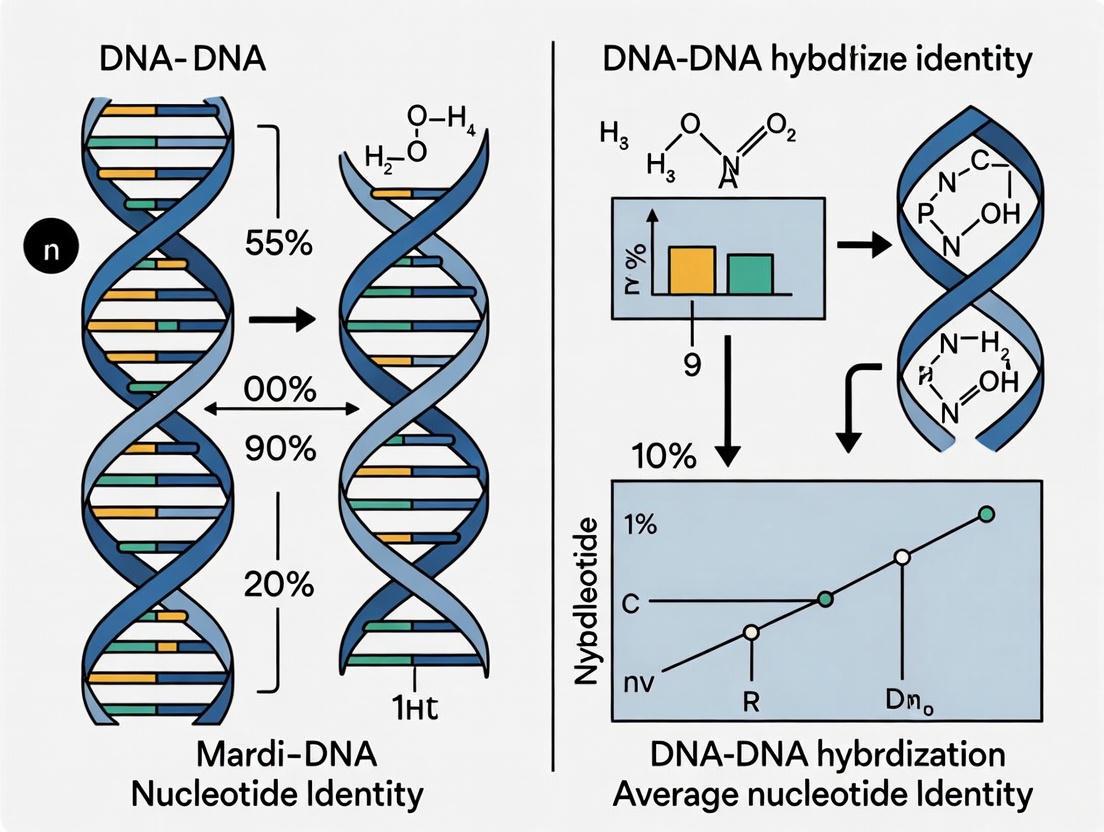
This article provides a comprehensive analysis of Average Nucleotide Identity (ANI) and digital DNA-DNA Hybridization (dDDH), two cornerstone genomic methods that have revolutionized prokaryotic species delineation and strain typing.
ANI vs dDDH: A Genomic Era Guide for Accurate Microbial Taxonomy and Strain Typing
Abstract
This article provides a comprehensive analysis of Average Nucleotide Identity (ANI) and digital DNA-DNA Hybridization (dDDH), two cornerstone genomic methods that have revolutionized prokaryotic species delineation and strain typing. Tailored for researchers and drug development professionals, we explore the foundational principles of these in-silico techniques, detail their calculation methodologies and applications in clinical and environmental microbiology, address critical troubleshooting aspects like threshold discrepancies and quality control, and present a comparative validation against traditional methods like MLST and phenotypic assays. By synthesizing the most current research, this guide aims to equip scientists with the knowledge to implement robust, genome-based taxonomic frameworks in their work, ultimately enhancing pathogen tracking, antibiotic resistance prediction, and microbial diversity studies.
Decoding the Genomic Alphabet: Foundational Principles of ANI and dDDH
For nearly 50 years, DNA-DNA hybridization (DDH) served as the cornerstone technique for microbial species delineation, providing the pragmatic basis for the prokaryotic species concept [1] [2]. This wet-lab method measured the overall similarity between two microbial genomes through nucleic acid reassociation kinetics, with a established threshold of 70% similarity justifying the classification of strains as separate species [2]. Despite its foundational role, traditional DDH suffered from significant limitations: it was tedious, error-prone, difficult to reproduce across laboratories, and incapable of building cumulative comparative databases [3] [1] [2]. The advent of affordable whole-genome sequencing created an urgent need for computational methods that could replicate DDH measurements, leading to the development of digital DNA-DNA hybridization (dDDH) and Average Nucleotide Identity (ANI) as transformative solutions [1] [2]. This evolution from wet lab to in-silico represents a paradigm shift in microbial taxonomy, offering unprecedented precision, reproducibility, and data reuse potential while maintaining continuity with established taxonomic standards.
Wet-Lab DDH: The Traditional Foundation
The traditional DDH protocol involved experimental measurement of DNA reassociation kinetics between closely related strains. The hydroxyapatite method, the most common among several variants, involved fragmenting DNA, denaturing double strands, and allowing complementary strands to reassociate [1]. The percentage of cross-hybridization between strains provided the similarity value, with the 70% threshold becoming universally accepted for species boundaries based on the work of an Ad Hoc Committee on Reconciliation of Approaches to Bacterial Systematics [1]. While this method enabled substantial standardization in prokaryotic taxonomy, its technical execution remained challenging. The procedure required significant DNA quantities, was sensitive to experimental conditions, produced results that varied between laboratories, and each data point represented a terminal measurement that couldn't be repurposed for future comparisons [2]. These inherent limitations created a bottleneck in microbial classification just as sequencing technologies began making genomic data increasingly accessible.
In-Silico Replacement: Digital DDH and ANI
Digital DNA-DNA Hybridization (dDDH)
The Genome-to-Genome Distance Calculator (GGDC) emerged as the leading implementation for dDDH calculation, using high-scoring segment pairs (HSPs) or maximally unique matches (MUMs) to infer intergenomic distances [4] [2]. This method employs well-established similarity search tools like BLAST, BLAT, or MUMmer to identify homologous sequences between genomes, applies mathematical formulas to calculate distances from these matches, and finally converts these distances to percentage similarities analogous to traditional DDH values [2]. The GGDC approach demonstrates excellent correlation with wet-lab DDH while avoiding its inherent pitfalls, with some distance formulas showing remarkable robustness against incomplete genome sequences [4] [2]. The web server provides user-friendly access to this methodology, offering multiple distance formulas optimized for different scenarios, with Formula 2 recommended for its balanced error ratios at the critical 70% threshold [2].
Average Nucleotide Identity (ANI)
The Average Nucleotide Identity method provides an alternative genome-based similarity measure by calculating the average nucleotide identity of orthologous genes shared between two genomes [5]. Initially, the 95-96% ANI threshold was established as equivalent to the 70% DDH standard for species demarcation [5] [6]. However, accumulating evidence from taxonomic studies across diverse bacterial genera indicates this relationship requires refinement. Research on Corynebacterium and Amycolatopsis has revealed that the corresponding ANI value for 70% dDDH may be approximately 96.67% OrthoANI for Corynebacterium and 96.6% ANIm for Amycolatopsis, suggesting genus-specific variations in these critical thresholds [6] [7]. This precision adjustment demonstrates how digital methods are refining rather than merely replacing traditional taxonomic boundaries.
Comparative Analysis: dDDH vs. ANI
Table 1: Comparison of Digital Methods for Microbial Taxonomy
| Feature | Digital DDH (GGDC) | Average Nucleotide Identity |
|---|---|---|
| Primary Input | Genome sequences | Genome sequences |
| Calculation Basis | High-scoring segment pairs (HSPs) or maximally unique matches (MUMs) | Orthologous nucleotide sequences |
| Standard Threshold | 70% for species delineation | 95-96% (with genus-specific variations) |
| Key Advantages | Higher correlation with wet-lab DDH; robust to incomplete genomes | Intuitive interpretation; direct evolutionary signal |
| Common Tools | GGDC web server | JSpeciesWS, OrthoANI |
| Typical Use Case | Official species description | Preliminary screening and species confirmation |
Both dDDH and ANI offer significant advantages over traditional methods, including objectivity, reproducibility, and incremental database building [1] [2]. While dDDH shows superior correlation with historical DDH data, ANI provides a more intuitive measure of genetic relatedness. In practice, modern microbial taxonomy often employs both methods complementarily to ensure robust species classification, as their orthogonal approaches provide mutual validation [6] [7].
Experimental Data and Threshold Refinements
Clinical Microbiology Applications
The transition to genome-based taxonomy has proven particularly valuable in clinical microbiology, where rapid and accurate pathogen identification is critical. A 2024 study evaluating Escherichia coli clinical isolates demonstrated that dDDH and ANI provided superior discriminative resolution compared to traditional multi-locus sequence typing (MLST) [5]. The research established optimized thresholds of 99.3% for ANI and 94.1% for dDDH for strain-level resolution in clinical isolates, notably higher than the standard species demarcation values [5]. This refinement highlights how application-specific thresholds can optimize the discriminatory power of these methods beyond basic species classification.
Genus-Specific Threshold Variations
Recent taxonomic investigations have revealed that the relationship between dDDH and ANI is not universal across bacterial genera, necessitating genus-specific threshold determinations:
Table 2: Genus-Specific Threshold Variations in Bacterial Taxonomy
| Bacterial Genus | Recommended ANI Threshold | Corresponding dDDH | Study Context |
|---|---|---|---|
| Corynebacterium | 96.67% (OrthoANI) | 70% | Uterine isolates from camels [6] |
| Amycolatopsis | 96.6% (ANIm) | 70% | Rhizosphere soil isolates [7] |
| General/Historical | 95-96% | 70% | Early established correlation [5] [6] |
In the Corynebacterium study, researchers discovered that four uterine isolates from camels could not be reliably classified using the standard 95-96% ANI threshold, prompting a comprehensive re-evaluation that established the more appropriate 96.67% OrthoANI value for this genus [6]. Similarly, analysis of 29 pairs of Amycolatopsis type strains revealed that 70% dDDH corresponded to approximately 96.6% ANIm rather than the traditionally accepted 95-96% range [7]. These findings underscore the importance of genus-specific validation in microbial taxonomy and demonstrate how digital methods enable such precise calibrations through large-scale genomic comparisons.
Experimental Protocols and Methodologies
Standard Operating Procedure for dDDH Calculation
The GGDC methodology follows a standardized three-step process for calculating genome-to-genome distances [2]:
Similarity Search: Homologous regions between query and reference genomes are identified using nucleotide similarity search tools (BLAST, MUMmer, etc.). For optimal results with BLAST-based methods, "soft filtering" that applies filters only during the initial seed phase is recommended to prevent HSP fragmentation. Parameters should permit up to 100,000 HSPs to ensure comprehensive matching.
Distance Calculation: The identified HSPs or MUMs are processed using the Genome Blast Distance Phylogeny (GBDP) approach with specific distance formulas. Formula 2 (d5) is generally recommended for its balance of accuracy and robustness, particularly with incomplete genomes [2]. This formula must be used when working with draft genomes or incomplete sequences.
Conversion to Percentage Similarity: Calculated distances are converted to percentage similarities using the linear equation (s(d) = m \cdot d + c), where values for the slope (m) and intercept (c) are derived from robust linear fitting against reference DDH datasets [2].
ANI Calculation Workflow
ANI analysis typically follows this standardized protocol [6] [7]:
Genome Quality Assessment: Ensure all genomes meet quality thresholds (>95% completeness, <5% contamination) to guarantee reliable results.
Orthologous Identification: Identify orthologous regions between genomes using either BLAST-based (ANIb) or MUMmer-based (ANIm) approaches. ANIm is generally preferred when ANI values exceed 90% [7].
Identity Calculation: Calculate average nucleotide identity across all orthologous fragments, typically using tools like JSpeciesWS or the OrthoANI calculator.
Threshold Application: Apply appropriate genus-specific thresholds for species demarcation, using both dDDH and ANI complementarily for robust classification [6].
Diagram: The workflow from traditional DDH to modern genome-based classification methods, highlighting the parallel paths of dDDH and ANI calculation converging on taxonomic decisions.
Table 3: Essential Research Tools and Resources for Genome-Based Taxonomy
| Tool/Resource | Type | Primary Function | Access |
|---|---|---|---|
| GGDC (Genome-to-Genome Distance Calculator) | Web server | dDDH calculation using multiple formulas | https://ggdc.dsmz.de [4] [2] |
| TYGS (Type Strain Genome Server) | Web server | Genome-based prokaryote taxonomy with phylogenetic placement | https://ggdc.dsmz.de [4] |
| JSpeciesWS | Web service | ANI calculation using both BLAST and MUMmer approaches | Online service [7] |
| OrthoANI | Algorithm | ANI calculation based on orthologous gene identification | Implemented in various tools |
| NCBI Prokaryotic Genome Annotation Pipeline | Bioinformatics tool | Automated genome annotation for feature identification | NCBI resources [7] |
| antiSMASH | Bioinformatics tool | Secondary metabolite biosynthetic gene cluster identification | Web server [7] |
| MUMmer | Software package | Rapid genome alignment and ANI calculation | Open source [2] [7] |
This toolkit enables researchers to implement complete genome-based taxonomic workflows, from initial genome sequencing and annotation through comparative analysis and final species designation. The integration of these resources has democratized microbial taxonomy, making sophisticated genomic comparisons accessible to non-specialist laboratories while maintaining rigorous standards [4] [2] [7].
The evolution from wet-lab DDH to in-silico dDDH and ANI represents more than mere methodological convenience—it constitutes a fundamental transformation in how we conceptualize and deline microbial diversity. These digital approaches provide the foundation for a cumulative, reproducible, and data-rich taxonomic framework where every classification contributes to an expanding comparative database [2]. The discovery of genus-specific thresholds for ANI and dDDH correlations demonstrates how these methods are refining rather than merely replacing traditional taxonomic concepts [6] [7]. As sequencing technologies continue to advance and genomic databases expand, digital taxonomy will likely extend beyond species delineation to address broader questions about microbial evolution, functional adaptation, and ecosystem dynamics. The integration of these genomic metrics with phenotypic data through polyphasic approaches ensures that the rich history of microbial taxonomy will inform its genomic future, creating a more precise and comprehensive understanding of the microbial world.
Average Nucleotide Identity (ANI) represents a fundamental genomic metric for quantifying similarity between two bacterial or archaeal genomes at the nucleotide level. As an overall genome relatedness index (OGRI), ANI provides a robust, computational alternative to traditional wet-lab methods for prokaryotic species delineation and identification. The calculation of ANI yields values typically expressed as percentages, which reflect the proportion of nucleotide sequences in aligned genomic regions shared between two organisms. Research has established that approximately 95% ANI values correspond to the traditional 70% DNA-DNA hybridization (DDH) threshold widely used for species demarcation in prokaryotic taxonomy [8]. This correlation has positioned ANI as a superior measure of genomic relatedness compared to data from individual genes, such as the 16S rRNA gene, because it incorporates information from hundreds to thousands of orthologous protein-coding genes distributed across the entire genome [8] [9].
The adoption of ANI has revolutionized microbial taxonomy by providing a standardized, reproducible approach that eliminates the technical variability associated with conventional DDH experiments. Unlike traditional methods that relied on laboratory hybridization measurements, ANI calculations can be performed computationally on sequenced genomes, enabling rapid, high-throughput classification of microorganisms. This transition to genome-based taxonomy has been particularly valuable for distinguishing closely related species that exhibit high similarity in 16S rRNA gene sequences but substantial genomic divergence [8] [10]. As whole-genome sequencing becomes increasingly accessible, ANI continues to solidify its role as an essential tool in modern bacteriology and microbiology research, with applications spanning clinical diagnostics, environmental monitoring, and biotechnological development [8] [11].
Calculation Principles of ANI
The fundamental principle underlying ANI calculation involves comprehensive comparison of all shared genomic regions between two organisms and computation of the percentage of identical nucleotides relative to the total aligned nucleotides. This process typically employs either Whole Genome Alignment methods or more efficient programmed alignment algorithms to ensure both accuracy and computational efficiency. The standard ANI calculation workflow comprises four key stages: fragmentation, segment alignment, identity calculation, and average computation [8].
Core Calculation Workflow
The ANI calculation process begins with genome fragmentation, where both query genomes are divided into smaller fragments of specific length. For ANIb-based approaches, this typically involves creating 1,020-basepair fragments of the query genome, which are then compared to a reference genome using BLAST-based alignment [10]. Alternative methods like ANIm utilize the MUMmer alignment tool to compare entire contigs or genome sequences without prior fragmentation [10] [7]. Following fragmentation, the segment alignment phase identifies homologous regions between the two genomes through sophisticated sequence alignment algorithms.
The identity calculation step determines the similarity score for each aligned fragment pair by computing the percentage of identical nucleotides in the alignment. Finally, during average calculation, the individual similarity scores from all compared fragments are aggregated to produce a comprehensive ANI value. This value represents the mean nucleotide identity across all orthologous regions shared between the two genomes, providing a robust measure of overall genomic similarity [8].
Table: Key Steps in ANI Calculation
| Step | Process | Implementation Examples |
|---|---|---|
| Fragmentation | Division of genomes into smaller fragments | 1,020 bp fragments (ANIb), contigs (ANIm) |
| Segment Alignment | Identification of homologous regions | BLAST (ANIb), MUMmer (ANIm), USEARCH (OrthoANIu) |
| Identity Calculation | Determination of similarity for each aligned pair | Percentage of identical nucleotides in alignments |
| Average Calculation | Aggregation of individual similarity scores | Mean of all fragment identities |
Orthology Considerations
A significant advancement in ANI methodology came with the introduction of orthology-aware algorithms that specifically address the evolutionary relationships between compared genes. The original ANI implementation utilized BLAST to identify best hits of shared gene content between genomes, without explicitly considering orthology. This approach, known as ANIb, requires gene prediction on the assembly before ANI calculation can be performed [10]. The improved OrthoANI algorithm was developed specifically to accommodate the concept of orthology, potentially providing more biologically meaningful comparisons by focusing on genes with common evolutionary origins [12].
Core ANI Algorithms and Their Comparative Performance
Several computational algorithms have been developed to calculate ANI, each with distinct methodological approaches, performance characteristics, and applications in microbial taxonomy. The most widely used implementations include ANIb, ANIm, OrthoANIb, and OrthoANIu, which employ different alignment strategies and orthology considerations.
Algorithm Methodologies
ANIb represents the original BLAST-based ANI algorithm that fragments the query genome and uses BLAST to identify homologous regions in the reference genome. This method requires gene prediction before analysis and has been considered a benchmark in the field despite its computational intensity [12] [10]. ANIm utilizes the MUMmer ultra-rapid aligning tool to perform whole-genome comparisons without prior fragmentation or gene prediction, offering significant speed advantages while maintaining accuracy [10] [7].
OrthoANIb constitutes an enhanced version that incorporates orthology considerations while retaining BLAST as its search engine, potentially providing more biologically relevant comparisons. OrthoANIu represents a further optimization that employs the USEARCH program instead of BLAST, dramatically improving computational efficiency while preserving accuracy through orthology-aware comparisons [12]. A large-scale evaluation of these algorithms demonstrated that OrthoANIb and OrthoANIu exhibited excellent correlation with the standard ANIb across the entire range of ANI values, while ANIm showed poorer correlation particularly at ANI values below 90% [12].
Performance Comparison
Comparative studies have revealed substantial differences in computational efficiency among ANI algorithms. When analyzing genomes larger than 7 Mbp, both ANIm and OrthoANIu demonstrated dramatically faster run-times than ANIb—by 53-fold and 22-fold, respectively [12]. This performance advantage makes these algorithms particularly valuable for large-scale genomic studies involving hundreds or thousands of genome comparisons.
Table: Comparison of Major ANI Calculation Algorithms
| Algorithm | Alignment Method | Orthology Consideration | Speed | Accuracy Correlation |
|---|---|---|---|---|
| ANIb | BLAST | No | Slow (Reference) | Reference standard |
| ANIm | MUMmer | No | Very Fast (53× faster) | Poor below 90% ANI |
| OrthoANIb | BLAST | Yes | Slow | Excellent |
| OrthoANIu | USEARCH | Yes | Fast (22× faster) | Excellent |
The selection of an appropriate ANI algorithm depends on the specific research context. For routine taxonomic classification where computational efficiency is prioritized, OrthoANIu and ANIm offer compelling advantages. However, for precise species delineation near threshold values, particularly when analyzing genomes with ANI values below 90%, OrthoANIb or ANIb may provide more reliable results despite their computational demands [12].
Experimental Protocols for ANI Analysis
Implementing robust ANI analysis requires careful attention to experimental design, genome quality assessment, and computational procedures. The following protocols outline standardized approaches for conducting ANI comparisons in taxonomic studies.
Genome Quality Requirements
High-quality genome assemblies are prerequisite for reliable ANI calculations. Experimental protocols should enforce strict quality control metrics, including minimum sequencing coverage (typically 20-40× depending on the organism), Q score thresholds (minimum of 30), and assembly completeness assessments [10]. For taxonomic studies, genomes should demonstrate >95% completeness and <5% contamination based on tools like CheckM2 to ensure analytical reliability [13] [7]. DNA extraction methods must yield sufficient quantity and quality, with fragment size analysis confirming appropriate molecular weight for downstream analyses [11].
Computational Workflow
A standardized ANI computational workflow begins with genome preprocessing, including adapter trimming and quality filtering using tools like Fastp. Subsequent genome assembly can be performed using SPAdes for Illumina data or HGAP for PacBio data, followed by quality assessment [10]. For ANI calculation, the OrthoANIu algorithm implemented through the EZBiocloud web service (http://www.ezbiocloud.net/tools/ani) provides a user-friendly option with high accuracy and speed [12] [9]. Alternatively, researchers can implement standalone versions of various ANI algorithms for large-scale batch processing or integration into bioinformatics pipelines.
Workflow for ANI Analysis
ANI Thresholds for Species Delineation
The application of ANI in taxonomic classification relies on established threshold values that correlate with traditional species boundaries. While the widely accepted 95% ANI threshold corresponds to the conventional 70% DDH species demarcation line, recent evidence indicates that this relationship may vary across taxonomic groups and requires careful consideration in specific applications.
Standard and Group-Specific Thresholds
The conventional 95% ANI threshold for species delineation has been validated across numerous prokaryotic groups, providing a general standard for taxonomic classification [8]. However, studies of specific bacterial genera have revealed meaningful variations in optimal thresholds. Research on enteric bacteria demonstrated that while ≥95% ANI effectively classified Escherichia/Shigella and Vibrio species, lower thresholds of ≥93% for Salmonella and ≥92% for Campylobacter and Listeria provided more accurate species identification when using the ANIm method [10]. These findings highlight the importance of establishing group-specific thresholds, particularly for clinical identification where precision is critical.
Recent investigations in the genus Amycolatopsis have further challenged the universality of the 95% ANI threshold. Comparative genomic analysis of 29 pairs of Amycolatopsis type strains revealed that the 70% dDDH value corresponded to approximately 96.6% ANIm rather than the expected 95-96% [7]. This deviation underscores the necessity of considering genus-specific correlations between ANI and dDDH when describing novel taxa, as applying inappropriate thresholds could lead to either oversplitting or lumping of species.
Strain-Level Discrimination
Beyond species delineation, ANI has demonstrated utility for strain-level discrimination with appropriate threshold adjustments. A study evaluating E. coli clinical isolates established ANI and dDDH cut-offs of 99.3% and 94.1%, respectively, for discriminative strain resolution, potentially offering higher resolution than traditional multi-locus sequence typing (MLST) [11]. Similarly, research on Nonomuraea species and subspecies proposed dDDH values between 70% and 79% as indicative of different subspecies within the same species, while values above 79% suggest the same subspecies [14]. These refined thresholds enable precise strain typing valuable for epidemiological investigations and outbreak tracking.
Table: ANI and dDDH Thresholds for Different Taxonomic Levels
| Taxonomic Level | ANI Threshold | dDDH Threshold | Application Context |
|---|---|---|---|
| Same Species | ≥95% | ≥70% | General standard [8] |
| Same Species (Amycolatopsis) | ≥96.6% | ≥70% | Genus-specific threshold [7] |
| Same Subspecies | ~99% | ≥79% | Strain-level resolution [11] [14] |
| Different Subspecies | 95-99% | 70-79% | Infraspecific classification [14] |
Relationship Between ANI and Digital DNA-DNA Hybridization
The correlation between ANI and digital DDH (dDDH) represents a cornerstone of modern prokaryotic taxonomy, enabling the transition from experimental hybridization methods to computational genome-based classification. Understanding this relationship is essential for proper interpretation of genomic data and accurate species delineation.
Theoretical Basis and Correlation
The theoretical foundation linking ANI and DDH stems from their shared objective of quantifying overall genomic similarity. Traditional DDH measures the extent of DNA reassociation between two organisms under controlled laboratory conditions, while ANI computationally determines the percentage of identical nucleotides in aligned genomic regions. Extensive comparative analyses have established that the widely accepted 70% DDH threshold for species demarcation corresponds to approximately 95% ANI [8] [10]. This correlation has been validated across diverse bacterial groups, providing a robust framework for taxonomic classification.
The mathematical relationship between ANI and dDDH is generally linear in the critical range near species boundaries, but demonstrates variation across different taxonomic groups. As demonstrated in the Amycolatopsis study, the correlation between ANIm and dDDH values revealed that 70% dDDH corresponded to approximately 96.6% ANIm rather than the expected 95-96% [7]. Similarly, research on enteric bacteria showed that the ANI thresholds corresponding to 70% dDDH varied from 92% to 95% depending on the bacterial group [10]. These variations highlight the importance of considering taxonomic context when interpreting ANI-dDDH correlations.
Comparative Advantages in Taxonomic Studies
Both ANI and dDDH offer distinct advantages and limitations for taxonomic classification. The dDDH approach, implemented through the Genome-to-Genome Distance Calculator (GGDC), provides direct comparability with historical DDH data and incorporates differences in genomic G+C content, which cannot exceed 1% within the same species [4] [7]. However, ANI methods generally offer superior computational efficiency, particularly with algorithms like OrthoANIu and ANIm, which can be orders of magnitude faster than dDDH calculation for large genomic datasets [12].
For contemporary taxonomy, a polyphasic approach incorporating both ANI and dDDH provides the most robust framework for species delineation. This integrated methodology leverages the computational efficiency of ANI for initial screening and the established taxonomic framework of dDDH for final classification decisions. Additionally, incorporating alternative genetic markers such as gyrB and recN genetic distances can provide supporting evidence for taxonomic decisions, particularly when genomic data is incomplete or unavailable [15].
Evolution of Genomic Relatedness Assessment Methods
Essential Research Reagents and Computational Tools
Implementing ANI analysis requires both laboratory reagents for genome preparation and computational tools for data analysis. The following resources represent essential components for conducting robust ANI studies.
Laboratory Reagents and Kits
High-quality genomic DNA extraction forms the foundation for reliable ANI analysis. The High Pure PCR Template Preparation Kit (Roche Applied Science) provides a standardized method for obtaining sequencing-quality DNA from bacterial cultures [11]. For strains resistant to standard lysis protocols, supplementary reagents including lysozyme for Gram-positive bacteria, tissue lysis buffer, and proteinase K may be required for efficient cell disruption [11]. Quality assessment tools such as the Fragment Analyzer system enable verification of DNA fragment size and integrity prior to sequencing, ensuring library preparation compatibility [11].
Culture media selection depends on the target organisms, with specialized media such as chitin agar with antibiotics (nystatin, novobiocin, nalidixic acid) proving effective for isolating rare actinomycetes from environmental samples [13]. For routine cultivation, standard media including International Streptomyces Project 2 (ISP2) agar, tryptone soy agar (TSA), Luria-Bertani agar (LB), and Reasoner's 2A agar (R2A) support growth of diverse bacterial taxa [13] [7].
Several web services and standalone software packages provide accessible ANI calculation capabilities for researchers with varying bioinformatics expertise. The EZBiocloud ANI calculator (http://www.ezbiocloud.net/tools/ani) offers a user-friendly web interface for OrthoANIu computation, ideal for individual genome comparisons [12] [9]. For large-scale analyses or pipeline integration, standalone JAVA programs implementing OrthoANIu are available for download from the same platform [12].
The JSpeciesWS online service provides ANIm calculation capabilities and is particularly valuable when analyzing genomes with ANI values exceeding 90%, where ANIm demonstrates strong correlation with reference methods [7]. For dDDH calculations complementary to ANI analysis, the Genome-to-Genome Distance Calculator (GGDC) available through the Leibniz Institute DSMZ (https://ggdc.dsmz.de/) implements state-of-the-art methods with high correlation to wet-lab DDH results [4] [7].
Table: Essential Research Tools for ANI Analysis
| Tool Category | Specific Resource | Application Context |
|---|---|---|
| DNA Extraction | High Pure PCR Template Preparation Kit | Standardized DNA extraction [11] |
| Quality Assessment | Fragment Analyzer | DNA size and quality verification [11] |
| Specialized Media | Chitin agar with antibiotics | Isolation of rare actinomycetes [13] |
| Web Service | EZBiocloud ANI calculator | User-friendly OrthoANIu calculation [12] [9] |
| Standalone Software | OrthoANIu JAVA program | Large-scale batch processing [12] |
| Complementary Tool | GGDC (dDDH calculator) | Digital DDH calculation [4] [7] |
For decades, DNA-DNA hybridization (DDH) served as the gold-standard technique for microbial species delineation, using the degree of genetic similarity between DNA sequences to determine the genetic distance between two organisms [16]. A 70% DDH value became the universally accepted threshold for defining a prokaryotic species [17] [18]. However, traditional DDH is a labor-intensive, time-consuming method fraught with technical challenges and reproducibility issues, making it unsuitable for building cumulative, comparable databases [17]. The advent of widespread whole-genome sequencing has catalyzed a paradigm shift, replacing this experimental mainstay with in-silico computational methods. Among these, digital DNA-DNA hybridization (dDDH) has emerged as a robust, reproducible, and accurate successor, overcoming the limitations of its wet-lab predecessor while providing a reliable genomic foundation for modern microbial taxonomy [17] [16].
dDDH and ANI: A Comparative Analysis of Genomic Metrics
While dDDH directly emulates the principles of laboratory DDH, Average Nucleotide Identity (ANI) has developed in parallel as another powerful genome-based metric. ANI measures the average nucleotide identity of orthologous genes shared between two genomes [18]. Although both are used for species delineation, they offer different advantages and are often used in concert for robust taxonomic conclusions.
Table 1: Comparison of Key Genomic Delineation Methods
| Feature | Traditional DDH | Digital DDH (dDDH) | Average Nucleotide Identity (ANI) |
|---|---|---|---|
| Principle | DNA re-association and melting temperature [16] | Genome-to-genome sequence comparison using GBDP [17] | Mean identity of orthologous genomic regions [18] |
| Species Threshold | 70% [17] | 70% [17] | 95-96% [5] [18] |
| Data Output | Single similarity value | Single similarity value | Single identity value |
| Key Advantage | Established historical gold standard | High correlation with DDH; solves paralogy issues [16] | Intuitive interpretation; high correlation with DDH [18] |
| Primary Limitation | Tedious, low reproducibility, not cumulative [17] | Requires complete or draft genome sequences | Different algorithms (OrthoANI, FastANI) can yield varying results [19] |
The relationship between dDDH and ANI is well-established, with a 70% dDDH value corresponding to approximately 95-96% ANI [18]. However, this correlation can vary between taxonomic groups. A 2024 study on Amycolatopsis found that a 70% dDDH value corresponded more closely to an ANI of 96.6%, suggesting that genus-specific validation can be important for precise delineation [7].
Experimental Protocols: How dDDH and ANI are Calculated
The dDDH Methodology
The Genome-to-Genome Distance Calculator (GGDC), available as a web service, is a state-of-the-art platform for calculating dDDH values [4] [17]. Its core is the Genome BLAST Distance Phylogeny (GBDP) method, which carefully filters out matches from paralogous sequences to ensure results reflect true genomic relatedness [16]. The general workflow involves:
- Whole-Genome Sequencing: Obtain high-quality genome sequences for the strains under investigation. A minimal sequencing coverage of 12x has been recommended to maintain essential genomic features and typing accuracy [5].
- Genome Preparation: Although complete genomes are ideal, draft genomes comprising distinct contigs can also be used successfully [17]. The GGDC method has been shown to be robust against partially incomplete genomic information [17].
- Digital Comparison via GBDP: The genome sequences are compared using a modified BLAST algorithm to identify High-Scoring Segment Pairs (HSPs) or alternatively, using MUMmer to find Maximally Unique Matches (MUMs) [17].
- Distance Calculation: The identities and lengths of the HSPs or MUMs are processed through a specific distance formula to compute the final dDDH value, which is a percentage mimicking the traditional DDH value [17].
The ANI Methodology
ANI calculation has several implementations, primarily differing in the alignment algorithm used:
- ANIb (BLAST-based): This method, implemented in the JSpecies software, fragments the query genome into consecutive 1020-nucleotide fragments to emulate the shearing of DNA in wet-lab DDH. These fragments are then aligned against the whole subject genome using BLASTN, and the average identity of all alignments is calculated [18].
- ANIm (MUMmer-based): This approach uses the MUMmer software package, which employs suffix trees to find anchors for alignment, offering faster computation speeds compared to BLAST-based methods [18].
- OrthoANI: An improved algorithm that incorporates the concept of orthology. It fragments both genomes and considers only orthologous fragment pairs for calculating nucleotide identities, ensuring symmetry in reciprocal comparisons and providing a more robust calculation for taxonomy [19].
Table 2: Key Research Reagent Solutions for In-Silico Taxonomy
| Tool / Resource | Type | Primary Function in Genomic Taxonomy |
|---|---|---|
| GGDC / TYGS | Web Server | High-throughput platform for calculating dDDH values and prokaryote taxonomy [4]. |
| JSpecies | Software Package | User-friendly tool for calculating ANI (both ANIb and ANIm) and comparing species boundaries [18]. |
| FastANI | Algorithm | Alignment-free tool for rapid ANI calculation, originally for bacteria but also applied to yeasts [20]. |
| OrthoANI | Algorithm & Software | Calculates ANI based on orthologous fragments, overcoming reciprocity issues [19]. |
| NCBI Genome Database | Data Repository | Source for downloading genome assemblies for reference and query strains [20]. |
The following diagram illustrates the integrated workflow for using whole-genome sequencing and in-silico analyses for microbial species delineation, highlighting the roles of both dDDH and ANI:
Digital DDH has firmly established itself as the legitimate and superior successor to traditional DDH, providing a reproducible, high-resolution method for microbial species delineation in the genomic era. Its synergy with ANI calculations offers taxonomists a powerful, dual-faceted approach to classifying organisms. As sequencing technologies continue to advance and become more accessible, these in-silico methods will form the cornerstone of a more precise, scalable, and data-driven taxonomic framework. The transition from wet-lab gold standard to digital precision marks an irreversible and necessary evolution, enabling the construction of a cumulative and universally comparable understanding of microbial diversity.
The classification of prokaryotes has been fundamentally transformed by genome sequencing, moving from laborious laboratory procedures to precise computational methods. For decades, DNA-DNA hybridization (DDH) served as the gold standard for species delineation, with a 70% similarity threshold widely accepted for defining a species [21]. However, this method was tedious, prone to experimental variation, and did not generate reusable data [21]. The advent of whole-genome sequencing enabled the development of digital alternatives, primarily Average Nucleotide Identity (ANI) and digital DDH (dDDH), which offer superior reproducibility and the ability to create cumulative databases [21] [22]. The 95% ANI threshold has become broadly correlated with the traditional 70% DDH value, establishing itself as a fundamental boundary in microbial taxonomy [22]. Nevertheless, recent research reveals that this relationship is not always precise, with significant implications for accurately classifying microorganisms in research and clinical settings.
Understanding the Core Metrics: ANI and dDDH
Average Nucleotide Identity (ANI)
Average Nucleotide Identity is a bioinformatics metric that calculates the average nucleotide-level similarity between homologous regions of two genomes. It was developed as a robust, sequence-based alternative to wet-lab DDH [21]. Different algorithms can be used for its calculation:
- ANIm: Uses the MuMmer ultra-rapid aligning tool and is considered particularly reliable when comparing highly similar genomes (ANI >90%) [7] [23].
- ANIb: Based on the BLAST algorithm [23].
- OrthoANI: An improved method that may offer more accurate comparisons [6].
The 95-96% ANI range is widely recognized as the species boundary, meaning that two genomes sharing ≥95% ANI are likely members of the same species [24] [22].
Digital DNA-DNA Hybridization (dDDH)
Digital DNA-DNA Hybridization is a computational method designed to mimic the results of wet-lab DDH. The Genome Blast Distance Phylogeny (GBDP) approach is a highly reliable method for inferring genome-to-genome distances and calculating dDDH values [21]. This method uses local alignments between two genomes (high-scoring segment pairs) and transforms this information into a single distance value using specific distance formulas [21]. The well-established 70% dDDH threshold corresponds to the traditional DDH species boundary, allowing for consistent classification across methods [21] [22].
Table 1: Key Metrics for Prokaryotic Species Delineation
| Metric | Species Threshold | Calculation Method | Primary Application |
|---|---|---|---|
| Average Nucleotide Identity (ANI) | 95-96% | Bioinformatics comparison of homologous genome regions (e.g., ANIm, ANIb, OrthoANI) | Primary species delineation [22] |
| digital DNA-DNA Hybridization (dDDH) | 70% | Genome-to-genome distance calculation (e.g., GBDP) | Replication of wet-lab DDH standard [21] |
| 16S rRNA Gene Identity | 98.7% | Sequencing and alignment of the 16S rRNA gene | Preliminary screening [22] |
The Threshold Debate: A Universal Standard or a Genus-Specific Guideline?
While the 95% ANI and 70% dDDH correlation is a foundational concept in modern taxonomy, a growing body of evidence suggests that this relationship is not universal and requires refinement.
Evidence for a Universal Boundary
Large-scale genomic surveys consistently reveal that prokaryotic diversity is predominantly organized into sequence-discrete units. Analyses of thousands of genomes show a clear bimodal distribution of ANI values: a scarcity of genome pairs sharing 85-95% ANI, contrasted with abundant pairs showing >95% or <85% ANI [24] [25]. This "discontinuity" or "ANI gap" strongly suggests a natural genetic boundary between species [25]. Metagenomic studies of natural environments (marine, soil, human gut) further support this, showing that co-existing populations typically share >95% ANI within a population and <90% ANI between distinct populations [24] [25]. These sequence-discrete populations appear to be fundamental, persistent units of microbial communities [25].
Challenges and Refinements to the Universal Threshold
Despite the overarching pattern, significant exceptions and refinements exist:
Genus-Specific Threshold Variations: Recent studies have found that the 70% dDDH value does not always correspond precisely to 95-96% ANI. In the genus Amycolatopsis, a 70% dDDH value corresponds to approximately 96.6% ANIm [7]. Similarly, in Streptomyces, the equivalent ANI threshold is approximately 96.7% [23], and for Corynebacterium, 96.67% OrthoANI is proposed to better align with the 70% dDDH cutoff [6].
The Intra-Species ANI Gap: A groundbreaking study of 18,123 complete bacterial genomes revealed another discontinuity within species, between 99.2% and 99.8% ANI (midpoint 99.5%) [24]. This finer-scale gap provides a potential standard for defining intra-species units like clonal complexes with ~20% higher accuracy than previous methods [24]. Consequently, the proposal is that strains should be defined at ANI values >99.99% [24].
Technical and Ecological Considerations: The debate also involves technical considerations. Some argue that the observed ANI gap could be influenced by isolation biases, as available genome databases may over-represent closely related organisms [25]. However, the persistence of the pattern in metagenomic data, which is isolation-free, supports its biological reality, though rare intermediate genotypes do exist and may be ecologically significant [25].
Table 2: Refined ANI/dDDH Thresholds Across Bacterial Genera
| Bacterial Genus | Proposed Refined ANI Threshold | Equivalent dDDH Threshold | Research Context |
|---|---|---|---|
| Amycolatopsis | 96.6% (ANIm) | 70% | Comparative genomic analysis of type strains [7] |
| Streptomyces | 96.7% (ANIm) | 70% | Correlation analysis of 80 species pairs [23] |
| Corynebacterium | 96.67% (OrthoANI) | 70% | Classification of uterine isolates from camels [6] |
| General (Intra-species) | 99.5% ANI | N/A | Delineation of sequence types/clonal complexes [24] |
Experimental Protocols for ANI and dDDH Analysis
Standard Workflow for Genome-Based Species Delineation
The following workflow outlines the key steps for researchers performing species classification using ANI and dDDH.
Detailed Methodological Considerations
1. Genome Sequencing and Assembly:
- DNA Extraction: Use standardized kits (e.g., High Pure PCR Template Preparation Kit [5] or Wizard Genomic DNA Purification Kit [6]) to obtain high-quality, high-molecular-weight DNA.
- Sequencing Platforms: Both Illumina (e.g., MiSeq, NovaSeq) [5] [6] and Oxford Nanopore Technologies (e.g., GridION, PromethION) [5] [7] platforms are widely used. For Nanopore sequencing, a minimum coverage of 12x is recommended to maintain typing accuracy [5].
- Assembly: Use assemblers like SPAdes [6] for de novo assembly. Assess assembly quality using metrics such as N50 and contig number, and validate with tools like GFinisher [26].
2. Calculation of ANI Values:
- Tools: The JSpeciesWS online service is a commonly used platform for calculating both ANIm and ANIb values [7] [23]. Alternatively, the OrthoANI calculator can be used [6].
- Protocol: Input the assembled genome (contigs or complete sequence) of the query strain and the genome sequence of the type strain(s) for comparison. The tool will output an ANI percentage. A value ≥95-96% typically indicates the same species, though genus-specific refinements should be considered [7] [23] [6].
3. Calculation of dDDH Values:
- Tools: The Genome-to-Genome Distance Calculator (GGDC) is the standard tool, available online at http://ggdc.dsmz.de [5] [21].
- Protocol: Upload the genomes of the two organisms to be compared. The GGDC uses the GBDP method under the hood. It is crucial to use Formula 2 for the calculation, as it is optimized for species delineation and provides the closest correlation with wet-lab DDH values [7] [23] [21]. The result is a dDDH percentage, with values ≥70% supporting classification within the same species.
Table 3: Key Reagents, Tools, and Databases for Genomic Taxonomy
| Item Name | Category | Function in Research |
|---|---|---|
| High Pure PCR Template Kit | Laboratory Reagent | Extraction of pure genomic DNA from bacterial cultures for sequencing [5]. |
| SPAdes Assembler | Bioinformatics Tool | De novo genome assembly from sequencing reads to reconstruct the complete genome [6]. |
| JSpeciesWS | Web Service | Calculation of Average Nucleotide Identity (ANI) values between two genomes [7] [23]. |
| GGDC (Genome-to-Genome Distance Calculator) | Web Service | Calculation of digital DNA-DNA Hybridization (dDDH) values using the GBDP method [21]. |
| FastQC | Bioinformatics Tool | Quality control assessment of raw sequencing data to ensure data integrity [6]. |
| Type Strain Genomes | Reference Data | Genomic sequences of nomenclatural types from databases like GenBank; essential as references for comparison [7] [22]. |
The establishment of the 95% ANI and 70% dDDH thresholds has provided the scientific community with powerful, reproducible standards for prokaryotic species delineation, moving beyond the limitations of traditional DDH. However, as genomic databases expand and analytical methods improve, it is evident that a single, universal genetic boundary is an oversimplification. The ongoing "Species Boundary Debate" is driving a more nuanced understanding, where genus-specific refinements to these thresholds and the discovery of finer-scale intra-species gaps are enhancing the resolution and accuracy of microbial classification. For researchers and drug development professionals, this evolving landscape underscores the importance of using a polyphasic approach—combining ANI, dDDH, and phylogenetic data—to make robust and reliable taxonomic determinations that are critical for tracking outbreaks, discovering new taxa, and understanding microbial function in clinical and environmental settings.
The Critical Role of Type Strains and Reference Genomes in Reliable Taxonomy
The accurate classification of microorganisms is a cornerstone of microbiology, with profound implications for clinical diagnostics, drug development, and ecological studies. For decades, microbial taxonomy relied heavily on labor-intensive techniques such as DNA-DNA hybridization (DDH) to establish species boundaries. The advent of whole-genome sequencing has revolutionized this field, introducing digital methods like Average Nucleotide Identity (ANI) and digital DNA-DNA Hybridization (dDDH) that provide superior reproducibility and resolution. These genomic tools, however, depend critically on the availability and quality of type strains and reference genomes to serve as standardized reference points for the entire taxonomic framework. Type strains—the permanently preserved reference specimens for a species name—provide the essential foundation upon which reliable and reproducible species delineation is built. This article examines the critical importance of these reference materials within the ongoing research discourse comparing dDDH and ANI methodologies, providing experimental data and analytical frameworks to guide researchers in selecting appropriate taxonomic demarcation criteria.
Understanding the Genomic Tools: ANI and dDDH
Average Nucleotide Identity (ANI) is a computational method that measures the average nucleotide-level similarity between homologous regions of two genomes. It typically provides a single percentage value reflecting genomic relatedness. Digital DNA-DNA Hybridization (dDDH) is an in silico emulation of the wet-lab DDH procedure, estimating the potential for DNA strands from two organisms to hybridize. The Genome-to-Genome Distance Calculator (GGDC) is a widely used method for calculating dDDH values, often using BLAST+ alignments and genomic distance calculations that are then converted to estimated DDH values [27] [28].
These methods have largely replaced traditional DDH due to their reproducibility and the ability to build cumulative databases. However, their accuracy is fundamentally tied to the quality of the reference genomes used for comparison, underscoring the indispensable role of properly curated type strain genomes.
Table 1: Key Characteristics of ANI and dDDH
| Feature | Average Nucleotide Identity (ANI) | Digital DNA-DNA Hybridization (dDDH) |
|---|---|---|
| Core Principle | Calculates average nucleotide identity of aligned genomic regions | Computes in silico estimate of wet-lab DNA hybridization |
| Primary Output | Percentage value (0-100%) | Percentage value (0-100%) |
| Standard Species Threshold | 95-96% [7] [6] | 70% [7] [6] |
| Computational Basis | MUMmer or BLAST-based alignments [7] | Genome-to-Genome Distance Calculator (GGDC) [27] [28] |
| Key Advantage | Intuitive interpretation as sequence similarity | Direct correlation with established wet-lab method |
Experimental Data: Comparative Performance of ANI and dDDH
Recent studies have generated substantial quantitative data comparing ANI and dDDH for species delineation, frequently revealing that the classical threshold correspondence requires refinement.
Threshold Variability Across Genera
A 2024 study on Corynebacterium isolates from camel uteri revealed that the conventional 95-96% ANI threshold did not correspond well with the 70% dDDH boundary. Through analysis of 150 type strain genomes, researchers proposed a refined OrthoANI cutoff of 96.67% to match the 70% dDDH value, highlighting genus-specific variations in threshold applicability [6] [29].
Similarly, research on Amycolatopsis species demonstrated that a 70% dDDH value corresponded to approximately 96.6% ANIm (ANI based on MUMmer), not the traditionally accepted 95-96% range. This finding emerged from comparative genomic analysis of 29 pairs of Amycolatopsis type strains and led to the identification of a novel species, Amycolatopsis cynarae sp. nov. [7].
High-Resolution Strain Typing
A 2024 study utilizing PromethION nanopore sequencing for Escherichia coli clinical isolates found that ANI and dDDH could achieve superior discriminative resolution compared to traditional Multi-Locus Sequence Typing (MLST). The study established strain-level cutoffs of 99.3% for ANI and 94.1% for dDDH, which correlated well with MLST classifications while potentially offering higher resolution [11] [5] [30].
Table 2: Experimental ANI and dDDH Cutoffs from Recent Studies
| Study Organism | Research Context | Proposed ANI Cutoff | Proposed dDDH Cutoff | Correspondence to Standard |
|---|---|---|---|---|
| Corynebacterium spp. [6] [29] | Species delineation of uterine isolates | 96.67% (OrthoANI) | 70% | Revised upward from 95-96% |
| Amycolatopsis spp. [7] | Novel species description | 96.6% (ANIm) | 70% | Revised upward from 95-96% |
| Escherichia coli [11] [5] | Strain-level typing | 99.3% | 94.1% | Far exceeds species thresholds |
The Essential Reference Framework: Type Strains and Reference Genomes
Type strains and their associated reference genomes provide the standardized, fixed reference points that enable the ANI and dDDH values discussed above to have taxonomic meaning.
The Problem of Incomplete Reference Databases
Despite their critical importance, reference databases suffer from significant gaps. A 2022 study reported that two-thirds of all species-level taxa in their analysis lacked a reference genome, with the representation gap being most pronounced in environmental samples such as soil (43-63% unrepresented) and animal-associated microbiomes (60-80% unrepresented) [31].
This substantial coverage gap means that a significant proportion of microbial diversity remains "invisible" to reference-dependent taxonomic profiling methods, potentially biasing abundance estimates of detected taxa [31].
Impact on Taxonomic Resolution
The limitations of single-gene approaches like 16S rRNA sequencing have become increasingly apparent. A comprehensive analysis of >1,000 Bacteroidetes type strain genomes demonstrated that classifications based heavily on 16S rRNA gene trees often resulted in non-monophyletic taxa requiring revision. The study revealed that phylogenomic approaches using whole-genome data provided significantly improved resolution and reliability for taxonomic decisions [32].
Experimental Protocols for Genomic Taxonomy
Protocol 1: dDDH Calculation Using GGDC
The Genome-to-Genome Distance Calculator (GGDC) is a standardized method for dDDH calculation [27] [28]:
- Data Preparation: Obtain complete or draft genome sequences for both the query strain and the type strain(s) of closely related species.
- Sequence Comparison: Calculate genomic distances using BLAST+ local alignments. The GGDC method uses identities/HSP length (Formula 2) as the distance metric.
- Distance Conversion: Convert distance values to estimated DDH values and their associated confidence intervals using a generalized linear model.
- Interpretation: Compare the resulting dDDH value to the 70% species threshold. Values below 70% suggest the query represents a distinct species from the reference type strain.
Protocol 2: ANI Calculation Using MUMmer (ANIm)
For taxonomic studies, ANI based on MUMmer (ANIm) often provides more credible results than BLAST-based ANI when similarity exceeds 90% [7]:
- Genome Submission: Upload genome sequences in FASTA format to the JSpeciesWS online service or use standalone MUMmer tools.
- Alignment: The MUMmer algorithm identifies Maximally Unique Matches (MUMs) between the two genomes as alignment anchors.
- Identity Calculation: Calculate nucleotide identity across all aligned regions, generating an average identity value (ANIm).
- Threshold Application: Compare the ANIm value to appropriate taxonomic thresholds, noting that genus-specific variations may apply (e.g., 96.6% for Amycolatopsis versus 95-96% as a general guideline).
Table 3: Essential Research Reagents and Computational Tools for Genomic Taxonomy
| Resource Type | Specific Tool/Resource | Primary Function | Application in Taxonomy |
|---|---|---|---|
| Reference Databases | DSMZ Type Strain Database | Provides authenticated type strain sequences | Essential reference points for species demarcation |
| NCBI RefSeq | Curated collection of reference genomes | Source of high-quality genome sequences for comparison | |
| Bioinformatics Tools | Genome-to-Genome Distance Calculator (GGDC) [27] [28] | Calculates dDDH values from genome sequences | Standardized species delineation against type strains |
| JSpeciesWS [7] | Computes ANI values through web interface | User-friendly ANI calculation for taxonomic studies | |
| MUMmer [7] | Genome alignment and ANIm calculation | High-performance whole-genome comparison | |
| Sequencing Technologies | Nanopore PromethION [11] [7] | Long-read whole genome sequencing | Enables complete genome assembly for reference quality |
| Illumina NovaSeq [6] | Short-read high-throughput sequencing | Provides cost-effective draft genomes for comparison |
The integration of ANI and dDDH analyses represents a significant advancement in microbial taxonomy, offering unprecedented resolution for species delineation. However, the reliability of these genomic tools is fundamentally dependent on the quality and comprehensiveness of type strains and reference genomes. Experimental evidence consistently shows that while general thresholds provide useful guidelines, taxon-specific considerations are essential for accurate classification. The research community must therefore prioritize the expansion of reference genome databases, particularly for underrepresented environmental and animal-associated microbiomes, to fully realize the potential of genomic taxonomy. For researchers and drug development professionals, this emphasizes the critical importance of selecting appropriate reference strains and validated thresholds when establishing taxonomic relationships for novel isolates.
From Theory to Bench: Methodological Workflows and Diverse Applications
The pragmatic species concept for Bacteria and Archaea has historically relied on DNA-DNA hybridization (DDH), a wet-lab technique that estimates overall genomic similarity between strains but is notoriously tedious, error-prone, and difficult to standardize across laboratories [17]. The advent of accessible whole-genome sequencing (WGS) has catalyzed a shift toward in-silico methods, primarily Average Nucleotide Identity (ANI) and digital DNA-DNA Hybridization (dDDH), which provide reproducible, absolute genomic comparisons that do not require repeated physical experiments with reference strains [17] [33]. ANI calculates the average nucleotide identity of orthologous genomic regions shared between two organisms, while dDDH uses genome-to-genome sequence comparison to mimic the legacy DDH technique [17] [5]. These methods have become the genomic gold standard for prokaryotic species delineation and are increasingly applied for high-resolution typing below the species level [5]. This guide provides a comprehensive workflow from sequencing to analysis, objectively comparing the performance of leading bioinformatics tools for ANI and dDDH calculation.
Core Computational Concepts: ANI and dDDH
Average Nucleotide Identity (ANI)
ANI is a computational measure of nucleotide-level genomic similarity. Initially developed to emulate DDH, its definition has evolved and is often tied to specific software implementations [34]. Key methodological variations exist:
- Alignment-based ANI: Originally, ANI was calculated using BLAST to compare either protein-coding genes or 1,020-base fragments of one genome against another, averaging identity across aligned regions [34]. This fragment size corresponds to DNA fragments used in wet-lab DDH experiments.
- Whole-Genome Alignment (WGA): Methods like those in JSpecies use NUCmer (from the MUMmer package) to perform whole-genome alignment, with ANI computed as the fraction of matching bases in aligned regions [34].
- K-mer-based Approaches: To improve computational efficiency, tools like FastANI use k-mer sketching to estimate ANI, sacrificing some accuracy for dramatic speed improvements, especially with large datasets [34] [35].
A 95% ANI threshold is widely accepted as corresponding to the traditional 70% DDH species boundary [33]. However, for higher-resolution strain typing within a species, studies have proposed a 99.3% ANI cut-off [5].
Digital DNA-DNA Hybridization (dDDH)
The Genome-to-Genome Distance Calculator (GGDC) implements dDDH as a state-of-the-art in-silico replacement for wet-lab DDH [17] [4]. Instead of mimicking the DDH procedure, GGDC calculates intergenomic distances using the Genome BLAST Distance Phylogeny (GBDP) approach, which are then converted into DDH-like values [17] [4]. The method is designed to cope with challenges like genomic repeats and heavily reduced genomes [17]. The established dDDH threshold for species demarcation is 70%, though for intra-species strain discrimination, a threshold of 94.1% has been proposed [5].
Step-by-Step Workflow from Sequencing to Results
Wet-Lab Phase: Genome Sequencing
The initial phase involves obtaining high-quality genomic data. While any sequencing technology can be used, the workflow must ensure sufficient DNA quality and coverage.
- DNA Extraction: Use a standardized kit (e.g., High Pure PCR Template Preparation Kit) to obtain high-molecular-weight DNA. Assess DNA concentration using a fluorometer (e.g., Qubit) and evaluate fragmentation with a Fragment Analyzer system [5].
- Library Preparation & Sequencing: For prokaryotic whole-genome sequencing, optimized protocols exist for platforms like Oxford Nanopore's PromethION, which is suitable for multiplexing multiple bacterial genomes [5]. For viral genomes, targeted amplification—such as the optimized multisegment RT-PCR for Influenza A Virus—may be necessary before sequencing [36].
- Quality Control & Assembly: Process raw reads through quality filtering and error correction, then assemble into contigs or complete genomes. A minimum sequencing coverage of 12x has been shown to maintain essential genomic features and typing accuracy for downstream ANI/dDDH analysis [5].
Bioinformatics Phase: ANI/dDDH Calculation
The following diagram illustrates the core bioinformatics workflow for calculating ANI and dDDH, from raw genome sequences to final species classification.
Tool Selection and Execution
Researchers must select appropriate computational tools based on their accuracy and efficiency needs. The following table compares the primary tool categories.
Table 1: Comparison of ANI and dDDH Calculation Tools
| Tool Category | Example Tools | Methodology | Strengths | Limitations |
|---|---|---|---|---|
| Alignment-Based ANI | ANIb, OrthoANI, JSpecies [34] | Uses BLAST or MUMmer for whole-genome alignment. | High accuracy, considered a gold standard [34]. | Computationally expensive and slow for large datasets [34]. |
| K-mer-Based ANI | FastANI, Mash [34] [35] | Uses k-mer sketching for genome comparison. | Extremely fast, efficient for large-scale analyses [34] [35]. | Lower accuracy than alignment-based methods, especially for distant genomes [35]. |
| Hybrid & New Tools | Vclust (LZ-ANI) [35] | Combines k-mer pre-filtering with Lempel-Ziv parsing for alignment. | Superior accuracy and efficiency; ideal for large datasets like viromics [35]. | Performance may decrease with highly similar, large datasets [35]. |
| Digital DDH | GGDC [17] [4] | Uses Genome BLAST Distance Phylogeny (GBDP). | Highest correlation with wet-lab DDH, robust to incomplete genomes [17] [4]. | Web service may have limitations for very high-throughput private analyses. |
To execute an analysis, researchers can use web servers or command-line tools. For instance, the GGDC web server provides a user-friendly interface for dDDH calculation, while tools like PyANI (for ANIb, ANIm, etc.) or Vclust are run locally, often requiring familiarity with a command-line environment [34] [4].
Performance Benchmarking and Experimental Data
Accuracy in Species Delineation
Studies have rigorously benchmarked in-silico methods against traditional techniques. A pivotal study established that a 70% wet-lab DDH threshold corresponds to approximately 95% ANI and 85% conserved genes [33]. In a clinical study on Escherichia coli, ANI and dDDH demonstrated excellent correlation with Multi-Locus Sequence Typing (MLST) and offered potentially higher discriminative resolution at cut-offs of 99.3% (ANI) and 94.1% (dDDH) for strain-level typing [5].
Benchmarking studies using standardized frameworks like EvANI have systematically evaluated ANI estimation algorithms. Results indicate that ANIb (BLAST-based) best captures evolutionary tree distance but is the least computationally efficient. K-mer-based approaches like Mash offer a favorable trade-off, being "extremely efficient" while maintaining "consistently strong accuracy" [34].
Computational Efficiency and Scalability
Efficiency is critical for large datasets. A 2025 benchmark of viral genome clustering tools revealed dramatic performance differences [35].
Table 2: Benchmarking of Genome Clustering Tools on Viral Genomes
| Tool | Methodology | Mean Absolute Error (MAE) | Relative Processing Speed | Key Finding |
|---|---|---|---|---|
| Vclust (LZ-ANI) | Alignment-based (Lempel-Ziv) | 0.3% | >40,000x faster than VIRIDIC | Prime tool for phage classification; balanced speed/accuracy [35]. |
| VIRIDIC | Alignment-based (BLAST) | 0.7% | 1x (Baseline) | High accuracy but impractically slow for large datasets [35]. |
| FastANI | K-mer sketching | 6.8% | >6x slower than Vclust | Fast but less accurate, lower agreement with official taxonomy [35]. |
| skani | Sparse approximate alignment | 21.2% | ~7x faster than Vclust (fastest mode) | Fastest in some modes, but substantially less accurate [35]. |
Vclust processed ~123 trillion contig pairs from the IMG/VR database (over 15 million sequences), demonstrating its capability for metagenomic-scale projects [35]. For bacterial genomes, the GGDC has also been shown to be robust, producing reliable distances even with draft genomes containing gaps [17].
Essential Research Reagent Solutions
The following table details key materials and tools required to implement this workflow.
Table 3: Research Reagent Solutions for WGS to ANI/dDDH Workflow
| Item | Function/Role | Specific Examples / Notes |
|---|---|---|
| DNA Extraction Kit | To obtain high-quality, high-molecular-weight genomic DNA from bacterial cultures. | High Pure PCR Template Preparation Kit (Roche) [5]. |
| Quantification Instrument | To accurately measure DNA concentration for library preparation. | Qubit Fluorometer with broad-range dsDNA assay (Thermo Fisher) [5]. |
| Sequencing Platform | To generate long-read sequence data for genome assembly. | Oxford Nanopore PromethION, suitable for prokaryotic WGS [5]. |
| ANI Calculation Software | To compute Average Nucleotide Identity between genomes. | PyANI (wrapper for ANIb/ANIm), FastANI, Vclust, JSpecies [34] [35]. |
| dDDH Calculation Service | To compute digital DNA-DNA Hybridization values. | GGDC (GBDP) web server [17] [4]. |
| Clustering Algorithm | To group genomes into species or strains based on ANI/dDDH matrices. | Integrated in Vclust (Clusty) or other tools [35]. |
The workflow from whole-genome sequencing to ANI and dDDH calculation represents a fundamental modernization of microbial taxonomy and typing. The experimental data clearly shows that in-silico methods are not merely replacements for but are improvements upon traditional techniques, offering superior reproducibility, resolution, and scalability [17] [5] [33]. While alignment-based methods like ANIb and GGDC currently offer the highest accuracy and correlation with established standards, newer tools like Vclust demonstrate that novel algorithms can dramatically increase computational speed without sacrificing precision, making large-scale pangenomic and viromic studies feasible [34] [35].
As sequencing costs continue to fall and datasets grow, the optimization of bioinformatics workflows will become increasingly critical for managing computational time and cost [37]. The future of this field lies in the development of even more efficient and accurate methods, potentially combining alignment and k-mer strategies, and extending these principles to amino-acid-based comparisons for functional evolutionary insights [35]. For now, ANI and dDDH stand as robust, genome-informed pillars for species delineation and strain typing in both research and clinical diagnostics.
Whole-genome sequencing (WGS) has revolutionized clinical microbiology, moving beyond traditional species identification to enable high-resolution strain typing essential for outbreak detection and antimicrobial resistance surveillance. This guide compares the performance of two central genomic metrics—Average Nucleotide Identity (ANI) and digital DNA-DNA Hybridization (dDDH)—for distinguishing bacterial strains. We objectively evaluate their protocols, discriminatory power, and applicability in clinical and public health settings, providing a structured framework for researchers and laboratory professionals to implement these methods effectively.
The pragmatic species concept for Bacteria and Archaea has historically been based on wet-lab DNA-DNA hybridization (DDH), with values ≤70% indicating different species [17]. In the genomic era, this gold standard has been digitally replicated by dDDH, while ANI has emerged as a powerful, sequence-based alternative. While both metrics are firmly established for species delineation at accepted thresholds (95-96% for ANI and 70% for dDDH) [17] [7], their application for high-resolution strain typing within a species represents a paradigm shift in molecular epidemiology.
Strain-level analysis is critical as bacterial strains under the same species can exhibit different biological properties, including virulence, antibiotic resistance, and host adaptation [38]. Traditional typing methods like Multi-Locus Sequence Typing (MLST) rely on a small number of conserved housekeeping genes, offering limited resolution compared to whole-genome approaches [5] [39]. Advances in sequencing technologies, particularly long-read platforms like Oxford Nanopore's PromethION, have made WGS-based strain typing increasingly accessible for clinical laboratories [5]. This guide systematically evaluates ANI and dDDH as superior alternatives for outbreak investigation where distinguishing closely related strains is paramount.
Experimental Protocols for ANI and dDDH Analysis
Wet-Lab Workflow: From Bacterial Culture to Sequence Data
The initial stages of the protocol are critical for generating high-quality data:
- Culture Conditions: Clinical isolates are typically cultured for 24 hours on appropriate solid media such as tryptic soy agar plates with 5% sheep blood under aerobic conditions at 37°C [5].
- DNA Extraction: Use commercial kits like the High Pure PCR Template Preparation Kit (Roche) with modifications for optimal bacterial lysis. This may include using tissue lysis buffer and proteinase K with stationary incubation at 55°C for 1 hour [5].
- DNA Quality Control: Assess DNA fragmentation using systems like the Fragment Analyzer (Advanced Analytical). Determine concentration using spectrophotometry (e.g., DeNovix DS-11+) and fluorometry (e.g., Qubit 4.0) [5].
- Whole-Genome Sequencing: Utilize either short-read (Illumina) or long-read (Oxford Nanopore PromethION or GridION) platforms. For nanopore sequencing, a minimal sequencing coverage of 12× is required to maintain essential genomic features and typing accuracy [5].
Table 1: Essential Research Reagent Solutions for ANI/dDDH Workflows
| Item | Function | Example Products/Methods |
|---|---|---|
| DNA Extraction Kit | Isolation of high-quality genomic DNA | High Pure PCR Template Preparation Kit (Roche) |
| Culture Media | Optimal growth of bacterial isolates | Tryptic soy agar +5% sheep blood |
| Sequencing Platform | Whole-genome sequence generation | Illumina NovaSeq (short-read); Oxford Nanopore PromethION/GridION (long-read) |
| Quality Control Instruments | Assess DNA fragmentation and concentration | Fragment Analyzer System; DeNovix DS-11+; Qubit 4.0 Fluorometer |
| Bioinformatic Tools | Calculate ANI and dDDH values | JSpeciesWS; Genome-to-Genome Distance Calculator (GGDC) |
Bioinformatic Analysis: Calculating ANI and dDDH
Following sequencing and genome assembly, the following analytical steps are performed:
- ANI Calculation: Use the JSpeciesWS online service or similar tools. ANI can be calculated using the MuMmer ultra-rapid aligning tool (ANIm) or the BLAST algorithm (ANIb). ANIm is considered more credible when ANI values exceed 90% [7].
- dDDH Calculation: Utilize the Genome-to-Genome Distance Calculator (GGDC), typically using Formula 2, which is optimized for incomplete genomes [7].
Performance Comparison: ANI vs. dDDH vs. Traditional Methods
Discriminatory Power in Strain Typing
Recent studies have established refined cutoffs for strain-level discrimination that are markedly higher than species-level boundaries.
Table 2: Established and Proposed Cutoff Values for Species and Strain Delineation
| Classification Level | ANI Cutoff (%) | dDDH Cutoff (%) | Application Context |
|---|---|---|---|
| Species Delineation | 95-96 [7] [6] | 70 [17] [6] | Differentiating species within a genus |
| Strain Typing (E. coli) | 99.3 [5] | 94.1 [5] | High-resolution outbreak strain discrimination |
| Genomovar Definition (S. ruber) | 99.2-99.8 (Gap) [40] | - | Identifying sub-species populations in natural environments |
A 2024 study on Escherichia coli clinical isolates demonstrated that ANI and dDDH cutoffs of 99.3% and 94.1%, respectively, correlated well with MLST classifications and showed potentially higher discriminative resolution than MLST [5]. This superior resolution is critical during outbreaks, where minute genetic differences between closely related strains must be detected.
Furthermore, analysis of natural bacterial populations has revealed a bimodal distribution of ANI values, with a notably lower occurrence of values between 99.2% and 99.8%—creating a natural "gap" in the sequence space within a species [40]. This finding provides a potential statistical basis for defining sub-species clusters, or "genomovars," in epidemiological investigations.
Comparison with Multi-Locus Sequence Typing (MLST)
MLST has been a workhorse for bacterial typing but suffers from inherent limitations. As it relies on only 7-10 housekeeping genes, which are more conserved than the rest of the genome, the overall similarity of genomes classified under the same Sequence Type (ST) can be misleading [5]. In contrast, ANI and dDDH assess genomic relatedness across the entire genome, capturing variation in both core and accessory genomes that MLST misses. This comprehensive view often provides epidemiologically meaningful insights that would otherwise go undetected.
Table 3: Method Comparison for Bacterial Strain Typing
| Method | Genetic Basis | Resolution | Speed & Cost | Key Limitation |
|---|---|---|---|---|
| MLST | 7-10 housekeeping genes | Lower (relies on conserved genes) | Moderate (requires PCR & sequencing) | Does not reflect overall genome similarity [5] |
| PFGE | Whole-genome restriction patterns | Low to Moderate | Slow, labor-intensive | Poor reproducibility and portability [39] |
| ANI | Whole-genome alignment | High (uses entire genome) | Fast once WGS is obtained | Requires robust bioinformatic pipeline [5] |
| dDDH | In-silico genome-to-genome comparison | High (uses entire genome) | Fast once WGS is obtained | Dependent on algorithm and formula choice [17] |
Application in Outbreak Settings and Current Challenges
Integrating Strain Typing with Antibiotic Resistance Prediction
WGS-based strain typing protocols show promise for integrated antibiotic resistance prediction. For E. coli, resistance prediction based on WGS data showed high categorical agreement (≥93%) with Minimum Inhibitory Concentration (MIC) assays for antibiotics like amoxicillin, ceftazidime, amikacin, tobramycin, and trimethoprim-sulfamethoxazole [5]. However, performance was suboptimal (68.8–81.3%) for other antibiotics including amoxicillin-clavulanic acid and ciprofloxacin [5]. This underscores both the potential and current limitations of using WGS for comprehensive resistance profiling in outbreak management.
Taxonomic Considerations and Genus-Specific Variations
A significant challenge in applying fixed ANI/dDDH thresholds is that the precise relationship between these values can vary across bacterial genera. For instance:
- In the genus Amycolatopsis, a 70% dDDH value corresponds to approximately a 96.6% ANIm value, not the typical 95-96% [7].
- A study on Corynebacterium proposed using a 96.67% OrthoANI value to equate to a 70% dDDH value for reliable taxonomy [6].
These genus-specific variations highlight the importance of validating standard thresholds for specific pathogens of interest, particularly when tracking outbreaks involving less common bacterial species.
Overcoming Technical and Analytical Hurdles
Successful implementation requires overcoming several challenges:
- Sequencing Coverage: A minimal sequencing coverage of 12× is required on nanopore platforms to maintain typing accuracy [5].
- Variant Calling: Advanced variant callers like Clair3 and DeepVariant used with long-read data (ONT R10.4.1+ flowcells) can now outperform Illumina short-read variant calling, making long-read-only workflows viable for high-resolution typing [39].
- Database and Resolution: Strain-level identification tools must balance resolution with computational complexity. Novel indexing methods, such as the hierarchical k-mer structure used by StrainScan, can improve the F1 score in identifying multiple strains by 20% compared to earlier tools [38].
ANI and dDDH represent powerful, genome-wide alternatives to traditional typing methods like MLST, offering superior resolution for investigating bacterial outbreaks. Wet-lab protocols centered on high-quality WGS, followed by bioinformatic analysis using established cutoffs (99.3% ANI, 94.1% dDDH for E. coli), provide a robust pathway for precise strain discrimination. While challenges remain—including genus-specific threshold variations and the need for standardized bioinformatic pipelines—the integration of these methods into public health and clinical microbiology workflows marks a new era in our ability to track and contain infectious disease outbreaks. Future work should focus on refining genus-specific thresholds and further validating the integration of resistance prediction with strain typing for a comprehensive public health response.
The integration of genomic data into clinical microbiology represents a paradigm shift in how laboratories approach pathogen surveillance and antibiotic resistance prediction. Central to this transition are established genomic benchmarks for species delineation, primarily Average Nucleotide Identity (ANI) and digital DNA-DNA Hybridization (dDDH). Historically, a 70% dDDH value has been considered the gold standard for prokaryotic species boundaries, often equated with a 95-96% ANI threshold [41]. However, emerging research indicates that this correspondence can vary between bacterial genera, necessitating genus-specific validation for accurate clinical implementation [7]. This comparison guide evaluates the performance of these genomic typing methods alongside emerging machine learning (ML) approaches, assessing their integration into clinical workflows for antibiotic resistance prediction and pathogen surveillance.
Performance Comparison of Genotyping Methods
Clinical bacteriology requires typing methods that provide both accuracy and discriminatory power. The following table summarizes the performance characteristics of key genomic typing methods based on recent comparative studies.
Table 1: Performance Comparison of Bacterial Typing Methods for Clinical Integration
| Typing Method | Typical Resolution | Clinical Turnaround Time | Key Strengths | Primary Limitations |
|---|---|---|---|---|
| MLST | Sequence Type (ST) level | 1-2 days (after sequencing) | Standardized, portable nomenclature | Limited discrimination due to conserved housekeeping genes [5] |
| ANI | Species/subspecies level | ~1 day (after sequencing) | Whole-genome based, highly reproducible | Species-specific cut-offs may be necessary [7] [5] |
| dDDH | Species/subspecies level | ~1 day (after sequencing) | Correlates with wet-lab DDH gold standard | Multiple calculation formulas yield different values [5] [41] |
| cgMLST/wgMLST | Clone/outbreak strain level | 1-2 days (after sequencing) | Higher resolution than MLST | Requires specialized schema and database [5] |
Establishing Method-Specific Thresholds for Clinical Use
Recent research has yielded important insights into optimal thresholds for these methods when applied in clinical settings:
ANI and dDDH Correlation: A 2024 diagnostic evaluation using Escherichia coli clinical isolates demonstrated that ANI and dDDH cut-offs of 99.3% and 94.1%, respectively, correlated well with MLST classifications and potentially offered higher discriminative resolution than conventional MLST [5]. These thresholds are notably higher than the traditional species delineation boundaries, reflecting the need for stricter thresholds when tracking transmission pathways in clinical settings.
Genus-Specific Variations: Research on the genus Amycolatopsis revealed that a 70% dDDH value corresponded to approximately 96.6% ANI rather than the conventionally accepted 95-96%, highlighting the importance of establishing genus-specific, or even species-specific, thresholds for clinical applications [7].
Benchmarking Antibiotic Resistance Prediction Modalities
Accurate prediction of antibiotic resistance is crucial for timely clinical decision-making. The following table compares the performance of different technological approaches to antibiotic resistance prediction.
Table 2: Performance Comparison of Antibiotic Resistance Prediction Methods
| Prediction Method | Key Principles | Reported Accuracy Metrics | Implementation Challenges |
|---|---|---|---|
| Traditional Phenotypic Testing | Culture-based MIC measurements or disc diffusion | Reference standard | Time-intensive (1-2 days after culture) [5] |
| Genotype-based Prediction (AMR Gene Detection) | Detection of known resistance genes/mutations | Varies by pathogen and antibiotic | Cannot detect novel resistance mechanisms [42] |
| Machine Learning (Phenotype-Only Features) | ML models using patient demographics and prior AST results | XGBoost: AUC 0.96 [43] | Requires extensive, high-quality historical data [43] |
| Machine Learning (Phenotype + Genotype Features) | Integration of demographic and genomic features | XGBoost: AUC 0.95 [43] | Data imbalance and missing genetic data [43] |
| WGS-based Prediction (Nanopore Sequencing) | Comprehensive genome analysis with resistance profiling | Categorical agreement: 68.8-100% (varies by antibiotic) [5] | Suboptimal for some antibiotic classes (e.g., fluoroquinolones) [5] |
Performance Variations Across Antibiotic Classes
A 2024 diagnostic study evaluating WGS-based antibiotic resistance prediction for E. coli revealed substantial variation in performance across different antibiotic classes [5]:
- High categorical agreement (≥93%) was observed for amoxicillin, ceftazidime, amikacin, tobramycin, and trimethoprim-sulfamethoxazole.
- Suboptimal performance (68.8-81.3%) was noted for amoxicillin-clavulanic acid, cefepime, aztreonam, and ciprofloxacin.
- The study identified that a minimal sequencing coverage of 12× was necessary to maintain essential genomic features and typing accuracy when using Nanopore sequencing technologies [5].
Experimental Protocols for Method Validation
Protocol: Establishing ANI and dDDH Thresholds for Clinical Typing
This protocol is adapted from methodologies used in recent studies to establish genus-specific ANI/dDDH thresholds [7] [5]:
Bacterial Isolate Selection: Curate a diverse collection of clinical isolates representing both closely-related and distantly-related strains within the target pathogen group. Include type strains where available.
Whole Genome Sequencing: Extract high-quality genomic DNA using validated kits (e.g., High Pure PCR Template Preparation Kit). Sequence using either Illumina or Nanopore platforms, ensuring minimum coverage of 20x for Illumina or 12x for Nanopore [5] [42].
Genome Assembly and Quality Control: Assemble reads using appropriate assemblers (e.g., SPAdes v3.15.3 for Illumina data). Assess assembly quality using metrics of contiguity, contamination, and correctness. Verify species identification using tools like Speciator [42].
Multi-Locus Sequence Typing: Perform in silico MLST using PubMLST schemes or pathogen-specific typing schemes (e.g., GenoTyphi for Salmonella Typhi) [42].
ANI Calculation: Calculate ANI values using the JSpeciesWS online service or local implementation of the MuMmer ultra-rapid aligning tool (ANIm) for closely-related genomes (>90% ANI) [7].
dDDH Calculation: Determine dDDH values using the Genome-to-Genome Distance Calculator (GGDC) with Formula 2, which is recommended for incomplete draft genomes [7] [41].
Threshold Determination: Perform coherence analysis between ANI, dDDH, and MLST classifications to establish optimal clinical thresholds for strain discrimination [7].
Protocol: Machine Learning for Antibiotic Resistance Prediction
This protocol summarizes the approach used in recent studies predicting antibiotic resistance from surveillance data [43]:
Data Collection and Curation: Obtain comprehensive datasets such as the Pfizer ATLAS Antibiotics dataset, which includes patient demographics, sample collection details, antibiotic susceptibility test results, and resistance phenotypes.
Data Preprocessing: Divide data into two subsets: Phenotype-Only (demographic and AST history) and Phenotype + Genotype (including genetic markers). Handle missing data through appropriate imputation techniques, noting potential clinical limitations of imputation.
Exploratory Data Analysis: Perform temporal and geographic analysis of resistance patterns. Assess data balance across resistance categories (susceptible, intermediate, resistant).
Model Training and Validation: Train multiple ML models including XGBoost, Random Forest, and logistic regression. Employ k-fold cross-validation and separate hold-out test sets.
Hyperparameter Tuning and Optimization: Use techniques like grid search or Bayesian optimization to refine model parameters. Apply data balancing techniques (e.g., SMOTE) to address class imbalance.
Model Interpretation: Conduct feature importance analysis and SHAP (SHapley Additive exPlanations) analysis to identify influential features and enhance model interpretability for clinical use.
Visualization of Integrated Clinical Genomic Workflows
Clinical Pathogen Genomic Analysis Workflow
Figure 1: Integrated Clinical Pathogen Genomic Analysis Workflow. This workflow illustrates the comprehensive process from specimen collection to clinical reporting, incorporating both traditional genotyping and modern machine learning approaches.
Table 3: Essential Research Reagent Solutions for Genomic Surveillance Studies
| Reagent/Resource | Specifications | Primary Function | Example Application |
|---|---|---|---|
| DNA Extraction Kit | High Pure PCR Template Preparation Kit or equivalent | High-quality genomic DNA extraction | Preparing sequencing-grade DNA from bacterial cultures [5] |
| Sequencing Platform | Illumina, Nanopore PromethION/GridION | Whole genome sequencing | Generating high-quality sequence data for typing and resistance detection [5] [42] |
| Assembly Software | SPAdes v3.15.3 | De novo genome assembly | Constructing contiguous genomes from sequence reads [42] |
| Species Verification Tool | Speciator v4.0.0 | Species identification confirmation | Validating pathogen species before analysis [42] |
| AMR Detection Database | AMRFinderPlus, CARD | Identification of resistance mechanisms | Detecting known AMR genes and mutations [43] [42] |
| MLST Scheme | PubMLST-based schemes | Standardized strain typing | Assigning sequence types for epidemiological tracking [42] |
| ANI/dDDH Calculation | JSpeciesWS, GGDC | Genomic similarity assessment | Determining strain relatedness and species boundaries [7] [41] |
Discussion: Implementation Challenges and Future Directions
The integration of genomic typing and resistance prediction into clinical workflows faces several significant challenges that must be addressed for widespread adoption.
Global Surveillance Disparities
Substantial disparities exist in genomic surveillance capabilities across different regions. In the East African Community (EAC), approximately 97% of publicly available high-quality bacterial genome assemblies were processed and analyzed by external organizations, primarily in Europe and North America [44]. This heavy reliance on third-party organizations for bacterial NGS highlights critical gaps in local sequencing infrastructure, bioinformatics expertise, and computational resources that must be addressed through targeted capacity-building initiatives.
Platform Interoperability and Data Standards
The emergence of platforms like amr.watch, which incorporated data from over 620,700 pathogen genomes with geotemporal information as of March 2025, demonstrates the potential of collaborative data sharing [42]. However, inconsistent metadata standards and variable sequencing quality present significant challenges for comparative analyses. Future developments should focus on harmonizing data standards and improving metadata completeness to enhance the utility of shared genomic data.
Interpretable Machine Learning for Clinical Translation
While machine learning approaches show excellent predictive performance (AUC up to 0.96), their translation to clinical settings requires enhanced interpretability [43] [45]. The development of interpretable ML models that integrate phenotype-genotype synergy represents a promising direction for providing clinically actionable insights while maintaining biological relevance [45]. Feature importance analyses consistently identify the specific antibiotic used as the most influential predictor of resistance outcomes, highlighting the drug-specific nature of resistance mechanisms [43].
The integration of genomic typing methods and antibiotic resistance prediction into clinical workflows offers transformative potential for modern microbiology laboratories. ANI and dDDH provide robust, whole-genome alternatives to traditional MLST with potentially higher discriminative resolution, though genus-specific thresholds must be established for optimal clinical utility. Machine learning approaches demonstrate excellent predictive performance but require careful attention to data quality, model interpretability, and clinical validation. As sequencing technologies continue to evolve and become more accessible, the ongoing standardization of methods, expansion of global surveillance networks, and development of clinically validated interpretation guidelines will be crucial for realizing the full potential of genomic approaches in routine clinical practice.
The delineation of species boundaries is a fundamental task in microbiology, crucial for understanding ecology, evolution, and for applications in biotechnology and drug development. For prokaryotes, Average Nucleotide Identity (ANI) and digital DNA-DNA Hybridization (dDDH) have become established standards for genome-based species classification, with widely accepted thresholds of 95-96% and 70%, respectively [5] [7]. However, the application of these methods to eukaryotic microorganisms, including yeasts and filamentous fungi, has historically been less standardized.
This guide explores the expanding horizon of ANI application beyond prokaryotes, objectively comparing its performance with alternative methods and established dDDH approaches for the delineation of eukaryotic microbes. We present supporting experimental data and standardized protocols to equip researchers with practical tools for implementing these genomic techniques.
ANI Methodologies and Computational Tools for Eukaryotes
Several computational approaches have been developed to calculate ANI, each with distinct advantages for eukaryotic genome analysis.
Table 1: Computational Tools for ANI Calculation in Eukaryotic Microbes
| Tool Name | Underlying Algorithm | Primary Application | Key Features |
|---|---|---|---|
| FungANI [46] | BLAST-based alignment | Fungal genome comparison | Customizable parameters; provides spatial distribution of specific genomic regions |
| FastANI [47] | Alignment-free (k-mer based) | Rapid comparison of large datasets | High speed; originally designed for bacteria but validated for yeasts |
| OrthoANI [46] | Bidirectional Best Hits (BBH) | Prokaryotes & potentially eukaryotes | Uses BLAST+; may not accommodate large fungal genomes |
| ANIm [7] | MUMmer alignment | Accurate nucleotide comparison | Part of JSpeciesWS; suitable for closely related eukaryotes |
For eukaryotic microbes, FungANI represents a specialized tool developed specifically to address the challenges of fungal genome comparison. This BLAST-based program enables easy fungal species delimitation by calculating ANI between two fungal genomes and providing interpretable results for researchers with limited bioinformatics support [46]. The program allows customization of key parameters including window size, overlap, and similarity threshold, with default values set at 1000 bp fragments with 500 bp overlap for optimal performance with fungal genomes.
Meanwhile, FastANI, though originally designed for bacterial species identification, has been effectively validated for yeast species delineation. Studies have demonstrated its reliability in distinguishing between strains belonging to different yeast species, defining clear boundaries at a cutoff of 94-96% [47]. The alignment-free workflow provides significantly improved analysis speed compared to alignment-based methods.
Experimental Data: Performance Comparison of Delineation Methods
ANI Thresholds for Yeast Species Delineation
Comprehensive evaluation of ANI for yeast taxonomy has demonstrated its robust discriminatory power. A 2024 study analyzing 644 assemblies from 12 yeast genera found FastANI highly effective in distinguishing between strains belonging to different species, defining clear boundaries at cutoffs of 94-96% [47]. The analysis showed high consistency between results obtained with FastANI and multiple alignments of orthologous genes (MAOG), though FastANI proved more discriminating than both MAOG and the traditional D1/D2 region alignment of LSU rRNA.
For the oleaginous yeast Yarrowia lipolytica, a species of significant biotechnological importance, ANI analysis has successfully differentiated between closely related strains and confirmed species boundaries [48] [47]. Similar applications have been validated for other non-conventional yeasts including Komagataella phaffii (formerly Pichia pastoris) and Kluyveromyces marxianus, both important industrial hosts for protein production and metabolite synthesis [48].
Correlation Between ANI and dDDH in Eukaryotic Microbes
The relationship between ANI and dDDH values in eukaryotic microbes appears to follow similar trends as prokaryotes but with potentially different threshold correspondences.
Table 2: ANI-dDDH Correlation Across Microbial Groups
| Organism Group | Equivalent dDDH Threshold | Corresponding ANI Threshold | Notes |
|---|---|---|---|
| Prokaryotes [49] | 70% | 95-96% | Well-established standard |
| Genus Amycolatopsis [7] | 70% | ~96.6% (ANIm) | Based on 29 type strain comparisons |
| Yeasts [47] | - | 94-96% (FastANI) | Effective for species discrimination |
In the genus Amycolatopsis (actinobacteria), comparative genomic analysis of 29 type strains revealed that a 70% dDDH value corresponded approximately to a 96.6% ANIm value, rather than the typical 95-96% ANI observed for prokaryotes [7]. This suggests that taxon-specific validation of thresholds may be necessary when applying ANI to eukaryotic microbes.
Comparative Performance Against Traditional Methods
When compared to traditional ribosomal marker gene approaches, ANI demonstrates superior resolution for closely related eukaryotic species:
- D1/D2 LSU rRNA: Limited discriminatory power for closely related species [47]
- Multi-locus Sequence Analysis: Better resolution than single markers but requires careful selection of loci [47]
- Whole-Genome ANI: Highest discrimination for strain-level classification; clearly defines species boundaries [47]
For hybrid genomes, such as those found in Saccharomyces hybrids, ANI approaches can identify and quantify parental contributions, though interpretation requires careful consideration of the heterogeneous nature of these genomes [47].
Detailed Experimental Protocols
Standard ANI Calculation Protocol for Eukaryotic Microbes
The following protocol provides a standardized approach for ANI calculation suitable for eukaryotic microorganisms, based on methodologies from recent publications [7] [47] [49]:
Genome Quality Assessment:
ANI Calculation:
- For fungal genomes: Utilize FungANI with default parameters (1000 bp fragments, 500 bp overlap) [46]
- For yeast genomes: Apply FastANI with fragment length of 3000, kmer size of 16, and minimum fraction of shorter genome coverage of 50% [47]
- For actinobacteria and related eukaryotes: Use ANIm via JSpeciesWS online service [7]
Threshold Application:
Validation:
- Compare with phylogenetic analysis of orthologous genes
- Correlate with phenotypic data when available
Integrated ANI-dDDH Analysis Protocol
For comprehensive species delineation, an integrated approach combining ANI and dDDH is recommended:
Digital DDH Calculation:
ANI Calculation:
- Perform parallel analysis using appropriate ANI tool for the target organisms
Threshold Correlation:
- Establish correlation between ANI and dDDH values for the specific taxonomic group
- Use clustering algorithms (e.g., OTPSIL with F value of 0.5) for species affiliation estimates [49]
Data Integration:
- Resolve discordant results through additional genomic or phenotypic characterization
- For yeasts, supplement with analysis of D1/D2 LSU rRNA regions for traditional comparison [47]
Table 3: Key Research Reagent Solutions for Eukaryotic ANI Analysis
| Tool/Resource | Function | Application Context | Access Information |
|---|---|---|---|
| FungANI [46] | BLAST-based ANI calculation for fungi | Fungal species delimitation | https://github.com/podo-gec/fungani |
| FastANI [47] | Rapid k-mer based ANI calculation | Yeast and eukaryotic species delineation | https://github.com/ParBLiSS/FastANI |
| GGDC 2.1 [49] | Digital DDH calculation | Correlation with ANI values | http://ggdc.dsmz.de |
| BUSCO [50] | Genome completeness assessment | Quality control of eukaryotic assemblies | https://busco.ezlab.org/ |
| JSpeciesWS [7] | ANIm and other similarity indices | Web-based analysis for comparative genomics | http://jspecies.ribohost.com/jspeciesws/ |
| EukDetect [50] | Eukaryotic detection in metagenomes | Identification of eukaryotes in shotgun sequencing | https://github.com/allind/EukDetect |
Discussion and Future Perspectives
The application of ANI for yeast and eukaryotic microbe delineation represents a significant advancement in microbial taxonomy. The growing availability of eukaryotic genomes enables more robust validation of ANI thresholds across diverse taxonomic groups. Future developments will likely focus on:
- Expansion of taxon-specific thresholds for different eukaryotic groups
- Integration with pan-genome analysis to account for gene content variation
- Standardization of methods for hybrid genomes and complex eukaryotic populations
- Development of specialized tools for microeukaryotes in metagenomic samples using approaches like EukDetect, which employs conserved marker genes for identification [50]
As synthetic biology advances the engineering of non-conventional yeasts for biotechnology [48], precise species delineation becomes increasingly important for strain protection, regulatory compliance, and scientific communication. ANI provides a robust, genome-wide method that complements traditional approaches and offers greater resolution for closely related taxa.
The relationship between ANI and dDDH continues to be refined for eukaryotic microbes, with evidence suggesting that the standard 95-96% ANI/70% dDDH correlation may require adjustment for certain taxonomic groups [7]. This highlights the importance of using integrated approaches rather than relying on a single metric for species boundary determination.
The classification of prokaryotes has been revolutionized by whole-genome sequencing, moving beyond traditional phenotypic methods to precise genomic calculations. Two key metrics have emerged as gold standards: Average Nucleotide Identity (ANI), which measures the average nucleotide-level similarity between two genomes, and digital DNA-DNA hybridization (dDDH), which computationally estimates the classical DDH value used for species delineation [5]. Historically, a 95-96% ANI value has been considered equivalent to the 70% dDDH threshold for bacterial species demarcation [51] [29] [52]. However, recent evidence indicates this relationship may vary significantly across bacterial genera, potentially affecting taxonomic accuracy.
This case study examines how refined ANI/dDDH thresholds have enabled precise species classification in two genera of biomedical importance: Corynebacterium, which includes significant human and animal pathogens, and Amycolatopsis, known for producing commercially valuable antibiotics like vancomycin and rifamycin [53]. We analyze comparative genomic studies that recalibrated the ANI-dDDH relationship for these genera, leading to the discovery of novel species and resolution of previous taxonomic inconsistencies.
Comparative Analysis of Revised Species Delineation Thresholds
Genus-Specific Variations in ANI-dDDH Correlations
Table 1: Updated ANI-dDDH Thresholds for Species Delineation in Different Genera
| Bacterial Genus | Standard Threshold (ANI) | Revised Threshold (ANI) | Equivalent dDDH Value | Key Research Findings |
|---|---|---|---|---|
| Corynebacterium | 95-96% [29] [52] | 96.67% (OrthoANI) [29] [52] | 70% [29] [52] | Based on analysis of 150 type species genomes; resolved classification conflicts |
| Amycolatopsis | 95-96% [51] [7] | 96.6% (ANIm) [51] [7] [54] | 70% [51] [7] [54] | Determined from 29 type strain comparisons; enabled novel species discovery |
The studies revealed that the conventional 95-96% ANI threshold did not consistently correspond to the 70% dDDH benchmark in these genera. For Corynebacterium, comprehensive analysis of 150 type species genomes established that a 96.67% OrthoANI value accurately corresponds to the 70% dDDH threshold [29] [52]. Similarly, investigation of 29 Amycolatopsis type strains demonstrated that a 96.6% ANIm value corresponds to 70% dDDH, rather than the traditionally accepted 95-96% range [51] [7] [54]. These findings highlight that genus-specific variations in the ANI-dDDH relationship exist, potentially due to differences in genomic structure, evolutionary history, or nucleotide composition.
Application in Novel Species Discovery and Classification
Table 2: Novel Species Identification Using Revised ANI/dDDH Thresholds
| Bacterial Strain | Closest Relative | ANI Value (%) | dDDH Value (%) | Taxonomic Outcome | Reference |
|---|---|---|---|---|---|
| Corynebacterium 2569A | C. urogenitale | 96.58% | 69.4% | Classified as C. urogenitale using revised threshold | [29] [52] |
| Corynebacterium 335C | Various Corynebacterium spp. | 77.12% | 21.3% | Novel species (below threshold) | [29] [52] |
| Amycolatopsis HUAS 11-8T | A. rhizosphaerae JCM 32589T | 96.3% | 68.5% | Novel species: Amycolatopsis cynarae sp. nov. | [51] [7] [54] |
The application of these refined thresholds directly impacted species classification outcomes. For example, Corynebacterium strain 2569A would have been misclassified as a novel species using the traditional 95-96% ANI threshold, but with the refined 96.67% OrthoANI threshold, it was correctly identified as C. urogenitale [29] [52]. Conversely, Amycolatopsis strain HUAS 11-8T exhibited ANIm and dDDH values of 96.3% and 68.5% respectively against its closest relative, A. rhizosphaerae JCM 32589T - values that fall below the revised 96.6% ANIm and 70% dDDH thresholds - confirming its status as the novel species Amycolatopsis cynarae sp. nov. [51] [7] [54].
Experimental Protocols for ANI/dDDH Analysis
Standardized Workflow for Genomic Taxonomy
The following diagram illustrates the core decision pathway for bacterial species classification using ANI and dDDH values:
Detailed Methodological Approaches
Genome Sequencing and Quality Control
Both studies employed rigorous genome sequencing protocols. For the Corynebacterium research, genomic DNA was extracted using the Wizard Genomic DNA Purification Kit, with libraries prepared with TruSeq Nano DNA Library Preparation Kits and sequencing performed on Illumina's NovaSeq platform to generate 2×151 bp paired-end reads [52] [6]. Sequence quality was assessed using FastQC, with low-quality bases trimmed using fastp software, followed by de novo assembly using SPAdes 3.15.4 [52] [6]. Only scaffolds with coverage >10× and length >500 bp were retained for analysis, ensuring high-quality genomic data for subsequent comparisons [52] [6].
The Amycolatopsis study utilized a Nanopore PromethION sequencing system for whole-genome sequencing [7] [54]. Genome completeness and contamination were assessed, with only genomes meeting >95% completeness and <5% contamination criteria included in analyses [51] [7]. This stringent quality control ensured the reliability of subsequent ANI and dDDH calculations.
ANI and dDDH Calculation Methods
For Amycolatopsis, the ANIm (ANI based on the MuMmer ultra-rapid aligning tool) was selected over ANIb (BLAST-based ANI) as it provides more credible results when ANI values exceed 90% [7] [54]. ANIm values were calculated using the JSpeciesWS online service, while dDDH values were determined using the Genome-to-Genome Distance Calculator (GGDC) with Formula 2 [7] [54]. This formula is recommended for incomplete genomes and provides the most conservative DDH estimate [7].
The Corynebacterium study employed OrthoANI (Orthologous Average Nucleotide Identity) for ANI calculations, which identifies orthologous regions between genomes before calculating identity [29]. Digital DDH values were similarly calculated using the GGDC platform. Both approaches represent state-of-the-art methods for these genomic comparisons, with the choice of tool potentially influencing the precise threshold values obtained.
Table 3: Key Research Reagents and Computational Tools for ANI/dDDH Studies
| Category | Tool/Reagent | Specific Application | Reference |
|---|---|---|---|
| Wet Lab | High Pure PCR Template Preparation Kit | Genomic DNA extraction | [5] |
| TruSeq Nano DNA Library Prep Kits | Illumina library preparation | [52] [6] | |
| Nanopore PromethION System | Long-read whole genome sequencing | [7] [54] | |
| Bioinformatics | SPAdes | De novo genome assembly | [52] [6] |
| JSpeciesWS | ANI value calculation | [7] [54] | |
| Genome-to-Genome Distance Calculator (GGDC) | dDDH value calculation | [7] [54] | |
| OrthoANI | Orthology-based ANI calculation | [29] [52] | |
| FastQC & fastp | Sequence quality control & processing | [52] [6] | |
| Database | EzBioCloud | 16S rRNA gene sequence comparison | [7] [54] |
| GenBank/NCBI | Genome sequence repository | [7] [54] |
Implications for Biomedical Research and Drug Development
The refined ANI/dDDH thresholds have significant implications for accurate bacterial identification in clinical and industrial settings. For human and animal health, precise classification of Corynebacterium species enables better understanding of pathogen distribution and disease associations [29] [52] [6]. In drug discovery, correct identification of Amycolatopsis strains is crucial for intellectual property protection, quality control in antibiotic production, and exploration of novel secondary metabolites [53].
The genus-specific nature of ANI-dDDH relationships highlighted in these studies suggests that similar refinements may be necessary for other bacterial genera, particularly those with unusual genomic characteristics or GC content. Future taxonomic studies should consider establishing genus-specific thresholds rather than relying exclusively on universal cutoffs, potentially improving classification accuracy across diverse bacterial taxa.
These findings also demonstrate the power of whole-genome sequencing over traditional methods like multi-locus sequence typing (MLST), which relies on a limited set of housekeeping genes and may not reflect overall genomic similarity [5]. As sequencing costs continue to decrease, genome-based taxonomy is likely to become the standard approach for prokaryotic systematics, providing greater resolution and reproducibility than previous techniques.
Navigating Challenges and Optimizing ANI/dDDH Analyses for Reliable Results
For years, the relationship between Average Nucleotide Identity (ANI) and digital DNA-DNA Hybridization (dDDH) has been a cornerstone of prokaryotic taxonomy. The scientific community has widely accepted that a 95-96% ANI value corresponds to the traditional 70% dDDH species delineation threshold [29] [7]. This correlation has provided a crucial bridge between modern genomic techniques and established taxonomic practices, enabling researchers to delineate bacterial species without performing laborious laboratory hybridization experiments.
However, this seemingly stable relationship is now revealing significant complexities. Mounting evidence demonstrates that the 95% ANI to 70% dDDH equivalence is not universal across microbial taxa [29] [7]. This variability presents a substantial challenge for microbial taxonomists, clinical microbiologists, and researchers relying on accurate species identification for diagnostic and drug development purposes. The threshold variability problem necessitates a deeper understanding of the genomic, methodological, and biological factors underlying these discrepancies to ensure accurate taxonomic classification across the Tree of Life.
Empirical Evidence: Documented Cases of Threshold Discrepancy
Evidence from Corynebacterium and Amycolatopsis
Recent studies on specific bacterial genera have quantitatively demonstrated significant deviations from the expected ANI-dDDH relationship. In the genus Corynebacterium, thorough genomic analysis revealed that a 70% dDDH value actually corresponded to a 96.67% OrthoANI value, not the traditionally accepted 95-96% range [29]. This finding emerged during the characterization of novel Corynebacterium strains isolated from camel uteri, where standard thresholds failed to provide consistent species demarcation.
Similarly, investigations in the genus Amycolatopsis uncovered comparable discrepancies. Analysis of 29 pairs of Amycolatopsis type strains showed that a 70% dDDH value corresponded to approximately 96.6% ANIm (Average Nucleotide Identity based on MuMmer), significantly higher than the conventional threshold [7]. This discovery occurred during the taxonomic characterization of strain HUAS 11-8T isolated from rhizosphere soil, which showed ANIm and dDDH values of 96.3% and 68.5%, respectively, against its closest relative - values that fell below the newly established genus-specific thresholds for species delineation [7].
Table 1: Documented ANI-dDDH Threshold Variations Across Bacterial Genera
| Bacterial Genus | Traditional ANI Threshold | Observed ANI Threshold | Corresponding dDDH | Reference |
|---|---|---|---|---|
| Corynebacterium | 95-96% | 96.67% | 70% | [29] |
| Amycolatopsis | 95-96% | 96.6% | 70% | [7] |
| General Reference | 95-96% | 95-96% | 70% | [5] [11] |
Implications for Novel Species Identification
These threshold variations have direct practical consequences for species identification and classification. In the Corynebacterium study, researchers identified four novel Corynebacterium species based on ANI values ranging from 77.12% to 94.26% and dDDH values from 21.3% to 54.9% against known type strains [29]. Without recognizing the genus-specific threshold of 96.67% ANI, accurate classification would have been compromised, potentially leading to misidentification.
The Amycolatopsis study similarly concluded that strain HUAS 11-8T represented a novel species based on the 96.6% ANIm threshold for this genus, highlighting how taxon-specific thresholds are essential for correct species demarcation in taxonomic studies [7]. These cases demonstrate that the one-size-fits-all approach to ANI-dDDH thresholds can result in inconsistent taxonomic classification across different bacterial groups.
Underlying Mechanisms: Biological and Computational Factors
Genomic Features Driving Threshold Variability
Multiple biological and methodological factors contribute to the observed variations in ANI-dDDH relationships. Horizontal Gene Transfer (HGT) represents a significant confounding factor, as the movement of genetic material between organisms that are not direct descendants can artificially inflate or deflate genomic similarity measures [34]. When analysis includes recently transferred genomic regions, it may distort the true evolutionary relationships between organisms.
The presence of genomic islands and prophages also contributes to threshold variability. Research on Corynebacterium revealed that gene gain predominates as a source of variation in the gene repertoire, with most acquired genes arriving via horizontal transfer mechanisms driven by genomic islands and prophages [29]. These mobile genetic elements can introduce significant genomic content that differs from the core genome, thereby affecting overall similarity calculations.
Additionally, the definition of "alignable regions" presents conceptual challenges. ANI calculations often exclude portions of one genome that fail to align to a counterpart in another genome, which means these regions are excluded from both the numerator and denominator of the identity fraction [34]. For distant genomes, this approach can result in ANI estimates of zero or near-zero, complicating distance measurements. The arbitrary thresholds used to define "alignable" regions (e.g., 70% coverage) further compound this issue.
Methodological Considerations in ANI Calculation
Differences in algorithmic approaches to ANI calculation significantly impact results. ANI can be computed using different methods including ANIb (BLAST-based), ANIm (MUMmer-based), and other sketch-based approaches [34] [7]. Each method employs different heuristics and assumptions that can yield varying results, particularly when analyzing genomes with different structural features or evolutionary distances.
The choice of k-mer length in alignment-free methods introduces another source of variation. Research has shown that some clades have inter-sequence distances best computed using multiple values of k (e.g., k = 10 and k = 19 for Chlamydiales) [34]. Over-reliance on a single k-mer length may provide incomplete information about genomic relationships, particularly for certain bacterial groups with distinctive genomic compositions.
Table 2: Computational Methods for ANI Estimation and Their Characteristics
| Method Type | Examples | Key Features | Performance Considerations |
|---|---|---|---|
| Alignment-based | ANIb, ANIm, OrthoANI | Computationally intensive; considers genome structure; more accurate for distant genomes | ANIb best captures tree distance but is least efficient [34] |
| K-mer based | Mash, Jaccard | Extremely efficient; uses fixed k-mer lengths; sketch-based approximations | Consistently strong accuracy but may over-rely on single k-mer length [34] |
| Maximal Exact Matches | - | Intermediate computational efficiency | Avoids over-reliance on single fixed k-mer length [34] |
Experimental Approaches and Validation Frameworks
Standardized Evaluation with EvANI
To address the challenges in ANI estimation, researchers have developed EvANI, a benchmarking framework that uses simulated and real datasets together with a rank-correlation-based metric to study how algorithmic assumptions and heuristics impact distance estimates [34]. This evaluation system provides standardized assessment of different ANI calculation approaches, enabling researchers to select appropriate methods for specific applications and taxonomic groups.
The EvANI framework has demonstrated that while k-mer based approaches offer exceptional computational efficiency with consistently strong accuracy, alignment-based methods like ANIb best capture tree distance despite their computational demands [34]. This suggests that the choice of ANI calculation method should be tailored to the specific research context, balancing accuracy requirements with computational resources.
Validation Through Genotype-Phenotype Correlation
Robust validation of ANI and dDDH thresholds requires correlation with phenotypic data. Studies have successfully employed antibiotic resistance profiling to validate genomic classifications, with one investigation reporting 98.4% consistency between resistance genotypes predicted from genome sequences and phenotypic susceptibility tests across 6,242 isolates [55]. This high concordance demonstrates the practical utility of genomic thresholds when properly validated.
Additional validation approaches include comparing ANI/dDDH-based classifications with established typing methods like Multi-Locus Sequence Typing (MLST). Research on Escherichia coli clinical isolates found that ANI and dDDH cutoffs of 99.3% and 94.1%, respectively, correlated well with MLST classifications and demonstrated potentially higher discriminative resolution [5] [11]. These findings highlight how ANI and dDDH can provide superior strain differentiation when appropriate genus-specific thresholds are applied.
Diagram 1: Relationship between the threshold variability problem, its contributing factors, and potential solution approaches. The diagram illustrates how biological and methodological factors contribute to deviations from the traditional ANI-dDDH relationship and how standardized frameworks can address these challenges.
Research Reagent Solutions and Computational Tools
Table 3: Essential Research Tools for ANI and dDDH Analysis
| Tool/Resource | Function | Application Context |
|---|---|---|
| EvANI | Benchmarking framework for ANI estimation algorithms | Evaluates how algorithmic assumptions impact distance estimates [34] |
| JSpeciesWS | Online service for ANIm calculation | Calculates Average Nucleotide Identity using MUMmer aligner [7] |
| GGDC | Genome-to-Genome Distance Calculator | Computes digital DDH values using formula 2 [29] [7] |
| OrthoANI | Algorithm for ANI calculation using BLAST | Provides orthologous average nucleotide identity [29] |
| MUMmer | Ultra-rapid genome alignment system | Underlying aligner for ANIm calculation [7] |
| AMRFinder | Antimicrobial resistance gene detection | Validates genotype-phenotype correlations [55] |
Best Practices and Future Directions
Recommendations for Accurate Taxonomic Delineation
Based on the documented variability in ANI-dDDH relationships, researchers should adopt several best practices. First, establish genus-specific thresholds when working with multiple isolates from the same taxonomic group. The studies on Corynebacterium and Amycolatopsis demonstrate that developing group-specific criteria significantly improves classification accuracy [29] [7].
Second, employ multiple calculation methods to cross-validate results. Combining alignment-based approaches (ANIb, ANIm) with k-mer based methods provides a more comprehensive view of genomic relationships and helps identify potential methodological artifacts [34]. The EvANI framework can guide appropriate method selection based on the specific research context and genomic characteristics.
Third, correlate genomic findings with phenotypic data whenever possible. The high consistency (98.4%) between resistance genotypes and phenotypes demonstrates the value of phenotypic validation for genomic classifications [55]. This approach is particularly important when proposing novel species or reclassifying existing taxa.
Emerging Trends and Research Needs
Future research should focus on expanding threshold determinations across diverse microbial taxa to create a comprehensive database of genus-specific ANI-dDDH relationships. This would provide researchers with reference values for a wider range of microorganisms, improving classification consistency across studies.
There is also a need to develop standardized reporting guidelines for ANI and dDDH methodologies in taxonomic publications. Clear documentation of calculation methods, parameters, and quality thresholds would enhance reproducibility and facilitate cross-study comparisons [34] [7].
Finally, integration of machine learning approaches may help predict optimal thresholds for understudied taxonomic groups based on genomic features. By identifying correlations between genomic characteristics and threshold behavior, these models could guide researchers working with microbial groups that lack established reference values.
Diagram 2: Recommended workflow for ANI and dDDH analysis in taxonomic studies. The diagram outlines the process from genome assembly through method selection, threshold calculation, and validation, highlighting decision points for identifying potential novel taxa.
The relationship between ANI and dDDH represents a dynamic area of research with significant implications for microbial taxonomy and genomics. While the 95% ANI to 70% dDDH correlation provides a useful general guideline, evidence from Corynebacterium, Amycolatopsis, and other genera demonstrates that this relationship exhibits substantial taxonomic variability. Understanding the biological and methodological factors underlying these discrepancies - including horizontal gene transfer, genomic islands, algorithmic differences, and k-mer selection - is essential for accurate species delineation.
By adopting standardized evaluation frameworks like EvANI, employing genus-specific thresholds, validating genomic findings with phenotypic data, and following best practices for methodology selection and reporting, researchers can navigate the complexities of ANI-dDDH relationships more effectively. As genomic sequencing continues to transform microbial taxonomy, refined approaches to species demarcation will enhance our understanding of microbial diversity and evolution across the Tree of Life.
Impact of Genome Assembly Quality and Sequencing Depth on Result Accuracy
In the field of genomics, the accuracy of biological interpretations is fundamentally dependent on the quality of the underlying genome assembly and the sequencing depth achieved. This relationship is particularly critical in precise taxonomic applications, such as those employing digital DNA-DNA Hybridization (dDDH) and Average Nucleotide Identity (ANI), where the goal is to delineate species and strains with high confidence [11] [5]. The quality of a genome assembly is a multi-faceted concept, measured across three key dimensions: contiguity, completeness, and correctness [56]. Simultaneously, sequencing depth (or coverage) directly influences the reliability of the variant calls and the overall assembly structure [57]. This guide objectively compares the performance of different sequencing technologies and depth choices, providing researchers and drug development professionals with data-driven insights to inform their experimental designs.
The choice of sequencing platform and assembly algorithm significantly impacts the final output, with a clear trade-off existing between read length, accuracy, and cost.
Second-Generation Sequencing (SGS) platforms, such as Illumina NovaSeq 6000 and MGI DNBSEQ-T7, generate highly accurate short reads (up to 99.5% accuracy) [58]. However, their short read length makes them susceptible to biases in regions with high or low GC content and often leads to fragmented assemblies in repetitive genomic regions [58].
Third-Generation Sequencing (TGS) platforms, including PacBio Single-Molecule Real-Time (SMRT) sequencing and Oxford Nanopore Technologies (ONT), overcome these limitations by producing long reads that can span repetitive elements. While ONT sequencing, such as on the PromethION platform, is applied in clinical bacteriology for whole-genome sequencing and typing [11] [5], it has historically been associated with a higher error rate (primarily indels) compared to SGS [58]. PacBio sequencing is noted for being less sensitive to GC content [58].
The performance of these platforms is further modulated by the assembly algorithm used. A comparison of assemblers for a yeast genome demonstrated that the optimal pipeline depends on the data source [58].
Table 1: Comparison of Sequencing Platform Performance in De Novo Assembly
| Platform | Read Type | Key Advantage | Key Disadvantage | Suitable Assemblers |
|---|---|---|---|---|
| Illumina NovaSeq 6000 | Short Read | High base accuracy (~99.5%) | Fragmentation in repetitive regions [58] | SPAdes, ABySS [58] |
| MGI DNBSEQ-T7 | Short Read | Cost-effective; accurate reads [58] | Similar limitations as Illumina for complex regions [58] | SPAdes, ABySS [58] |
| PacBio Sequel | Long Read | Less sensitive to GC bias [58] | Higher raw error rate than SGS [58] | Falcon, Canu, WTDBG2 [58] |
| ONT (MinION/PromethION) | Long Read | Very long reads; real-time analysis [11] [58] | Higher error rate, mainly indels [58] | Flye, Canu, MaSuRCA (hybrid) [58] |
Table 2: Assembly Algorithm Comparison for a Repetitive Yeast Genome
| Assembler | Algorithm Type | Key Characteristic | Best For | Performance Insight |
|---|---|---|---|---|
| Flye | TGS-only | Graph-based repeat resolution; fast [58] | ONT/PacBio long reads | Can produce good assemblies even at low depth (<20x) [59] |
| Canu | TGS-only | Multiple error correction rounds; accurate [58] | Applications requiring high accuracy | More computationally intensive [58] |
| WTDBG2 | TGS-only | Homopolymer-compressed units; fastest [58] | Extremely fast assembly | Speed prioritized over fine-scale accuracy [58] |
| MaSuRCA | Hybrid | Creates "super-reads" from SGS, uses TGS for linking [58] | Hybrid SGS/TGS datasets | Mitigates TGS errors with SGS accuracy [58] |
| SPAdes | SGS or Hybrid | Multi-sized de Bruijn graph [58] | Illumina/MGI short reads | Improved contiguity for short-read-only data [58] |
The Impact of Sequencing Depth on Assembly Quality
Sequencing depth, or the average number of times a nucleotide is read, is a critical determinant of assembly quality. Insufficient depth leads to gaps and fragmentation, while excessive depth may not yield proportional benefits and increases computational costs.
Research on the complex maize genome established clear depth thresholds for achieving quality assemblies. The data showed that assemblies with ≤30x depth were highly fragmented, with even low-copy genic regions degrading at 20x depth [60]. A dramatic improvement in contiguity (contig N50) and completeness (BUSCO scores) was observed as depth increased from 20x to 50x [60]. Beyond 50x, the rate of improvement diminished, suggesting a point of saturation for this specific genome and technology [60].
For bacterial typing using nanopore sequencing, one study found that a minimum sequencing coverage of 12x was required to maintain essential genomic features and typing accuracy for methods like ANI and dDDH [11]. A benchmarking study on bacterial assemblies with ONT data and the Flye assembler demonstrated that base-level accuracy improves with depth up to approximately 100x, after which additional reads provide minimal benefit and can even slightly reduce accuracy [59]. For the most accurate results, the author recommends sequencing to a depth of 200x or more when using a consensus-based approach like Trycycler [59].
Table 3: Effect of Sequencing Depth on Assembly Metrics for a Maize Genome (PacBio)
| Subread Coverage | Subread N50 (kb) | Contig N50 (Mb) | BUSCO Completeness | LTR Assembly Index (LAI) | Assembly Gaps |
|---|---|---|---|---|---|
| 20x | 21.2 | 0.18 | 68.0% | 12.2 | 24.50% |
| 30x | 21.2 | 1.82 | 95.5% | 19.8 | 0.90% |
| 50x | 21.2 | 16.27 | 96.4% | 20.2 | 0.34% |
| 75x | 21.2 | 24.54 | 96.3% | 20.6 | 0.31% |
Data adapted from [60]
Experimental Protocols for Genomic Comparisons
Protocol 1: Bacterial Strain Typing Using ANI and dDDH
This protocol is used for high-resolution strain typing in clinical bacteriology, comparing newer genomic methods against traditional Multi-Locus Sequence Typing (MLST) [11] [5].
- DNA Extraction & Quality Control: Extract genomic DNA from bacterial isolates using a kit such as the High Pure PCR Template Preparation Kit. Assess DNA concentration using a fluorometer (e.g., Qubit) and analyze fragmentation with a system like the Fragment Analyzer [5].
- Whole-Genome Sequencing: Sequence the DNA using a long-read platform, such as the Oxford Nanopore PromethION. The study achieved typing accuracy with a minimum of 12x coverage [11].
- Genome Assembly: Assemble the raw sequencing reads into a draft genome. Tools like Flye or Canu are commonly used for long-read data [58].
- Calculate Genomic Similarity:
- Average Nucleotide Identity (ANI): Calculate using tools like OrthoANI or the MUMmer-based ANIm. A cut-off of 99.3% ANI has been proposed for discriminative strain resolution, correlating well with MLST types [11].
- Digital DNA-DNA Hybridization (dDDH): Calculate using the Genome-to-Genome Distance Calculator (GGDC) with Formula 2. A cut-off of 94.1% dDDH was found to be equivalent to the 99.3% ANI threshold for strain-level discrimination [11].
- Validation: Compare the ANI and dDDH classifications with the results from the reference typing method, MLST [11] [5].
Workflow for Bacterial Strain Typing
Protocol 2: Evaluating Assembly Correctness with k-mers
When a reference genome is unavailable, k-mer-based methods provide a powerful approach to evaluate the completeness and correctness of an assembly using short-read data from the same sample [56].
- Generate Short-Read Data: Sequence the same individual's genome using an accurate short-read technology (e.g., Illumina) to high depth.
- Create k-mer Spectra: Use a tool like
merquryoryakto count all distinct k-mers present in the short-read dataset. This serves as a trusted "truth set" [56]. - Compare Assembly to k-mers: The same tool compares the assembled genome's k-mers to the truth set.
- Calculate Quality Metrics:
- Completeness: The percentage of trusted k-mers from the short reads that are found in the assembly. A high value indicates a complete assembly.
- Correctness (QV): A quality value score that estimates the base-level accuracy of the assembly, derived from the proportion of k-mers in the assembly that are not found in the trusted set (suggesting errors) [56].
- Spectra-CN Plot: Visualizes k-mer copy number distributions to help identify assembly errors and regions of heterozygosity [56].
The Scientist's Toolkit: Essential Reagents and Materials
Table 4: Key Research Reagents and Solutions for Genomic Studies
| Item | Function/Description | Example Use Case |
|---|---|---|
| High Pure PCR Template Preparation Kit | For extraction of high-quality, purified genomic DNA from bacterial cultures [5]. | Preparing template DNA for long-read WGS [5]. |
| Sensititre Custom Plates | Broth microdilution plates for performing Minimum Inhibitory Concentration (MIC) assays [5]. | Phenotypic antibiotic susceptibility testing to validate WGS-based resistance predictions [5]. |
| Qubit Fluorometer & dsDNA Assay Kits | Accurate quantification of double-stranded DNA concentration using fluorescent dyes, superior to spectrophotometry for sequencing prep [5]. | Quantifying DNA input for library preparation [5]. |
| Fragment Analyzer System | Automated capillary electrophoresis for sizing and quantifying DNA fragments, critical for assessing library quality [5]. | Evaluating DNA fragmentation and ensuring optimal insert size for sequencing [5]. |
| Trycycler Software | A consensus-based tool that uses multiple independent assemblies from a single deep read set to produce a highly accurate final sequence [59]. | Generating optimized bacterial genome assemblies from deep (>200x) ONT data [59]. |
merqury Software |
A k-mer-based tool for evaluating assembly quality and completeness without a reference genome [56]. | Assessing the correctness and completeness of a de novo assembly using Illumina reads from the same sample [56]. |
The pursuit of accurate genomic results, especially for sensitive applications like dDDH and ANI analysis, requires careful consideration of both sequencing strategy and assembly methodology. The data clearly show that long-read technologies are essential for assembling contiguous genomes, particularly for complex or repetitive DNA. The choice of assembler can further optimize for speed versus accuracy.
Crucially, sequencing depth is not a case of "more is always better." While a minimum depth of 30-50x is often necessary to avoid fragmentation, there are diminishing returns beyond 50-100x for standard assemblies, with optimal depth depending on the specific technology and desired application. Researchers should align their sequencing and analysis pipelines with the specific quality thresholds required for their biological questions, using the experimental protocols and tools outlined here to validate their results.
In the genomic era, Average Nucleotide Identity (ANI) has become a cornerstone for microbial species delineation, effectively replacing wet-lab DNA-DNA hybridization (DDH) methods with a digital, reproducible standard [61]. The calculation of ANI, however, can be approached through different algorithmic strategies, creating a landscape of tools that must be navigated with care. This guide provides an objective comparison of four principal ANI calculation methods—ANIb, ANIm, FastANI, and OrthoANI—framed within the critical context of digital DDH (dDDH) equivalence. We summarize their core algorithms, performance metrics, and ideal applications to help researchers select the most appropriate tool for their specific needs, whether for high-precision taxonomy or large-scale genomic surveys.
Average Nucleotide Identity quantifies the average nucleotide-level similarity between homologous regions of two genomes. Its adoption as a standard for prokaryotic species delineation is rooted in its strong correlation with the historical DDH threshold. A widely accepted ANI value of 95-96% is considered equivalent to the 70% DDH value used to define a species [7] [6].
However, this relationship is not always a perfect 1:1 correlation and can vary between genera. Recent studies suggest that for some taxonomic groups, such as Amycolatopsis and Corynebacterium, the dDDH threshold of 70% may correspond more closely to an ANI value of approximately 96.6% rather than 95% [7] [6]. This highlights the importance of understanding that while ANI and dDDH are foundational metrics, the precise cutoff for species boundaries can be lineage-dependent.
The core challenge in ANI computation lies in its definition, which aims to capture the identity over orthologous regions—genomic sequences descended from a common ancestor [34]. Non-orthologous sequences, such as those from horizontal gene transfer, should ideally be excluded from the calculation to better reflect the evolutionary distance related to the species tree. The four tools discussed herein—ANIb, ANIm, FastANI, and OrthoANI—employ different strategies to solve this problem, leading to variations in speed, accuracy, and resource requirements.
Core Algorithms and Workflows
The fundamental difference between ANI tools lies in their underlying algorithms for identifying homologous regions and calculating nucleotide identity. The following diagram illustrates the core workflows of the four main methods.
Detailed Methodological Breakdown
ANIb: This original alignment-based method fragments one genome into 1020-base pieces and uses BLASTN to search against the other genome [34]. Matches are filtered based on identity and coverage thresholds (e.g., >30% identity over >70% of the fragment length), and ANI is calculated as the average identity of all BLAST alignments that pass these filters [34]. While considered a benchmark for accuracy, this process is computationally intensive.
ANIm: This method utilizes the MUMmer package to perform a whole-genome alignment using its NUCmer component [34] [10]. It identifies Maximal Unique Matches (MUMs) between the two genomes and calculates ANI as the total number of matching bases in aligned regions divided by the total length of all aligned regions [10]. It is generally faster than ANIb but can be less accurate for more divergent genomes (ANI < 90%) [12].
OrthoANI: This method was developed to more explicitly incorporate the concept of orthology. It identifies genes shared between two genomes using reciprocal best BLAST hits (OrthoANIb) or the faster USEARCH tool (OrthoANIu) as a proxy for orthologous regions [34] [12]. The ANI is then calculated from these orthologous coding sequences, which may provide a better reflection of evolutionary relatedness by excluding horizontally transferred genes.
FastANI: Designed for scale, FastANI uses an alignment-free approach based on the MinHash algorithm [61] [62]. It uses Mashmap as its mapping engine to quickly find homologous regions between genomes without performing base-by-base alignments for the entire sequence [62]. This method focuses on reciprocal fragment mappings and is optimized for the 80-100% ANI range, making it ideal for large-scale species classification [61].
Comparative Performance Data
The choice of tool often involves a trade-off between computational speed and analytical accuracy. The following table synthesizes experimental data from large-scale evaluations to illustrate these critical differences.
| Tool | Underlying Algorithm | Relative Speed | Correlation with ANIb | Key Strength | Key Limitation |
|---|---|---|---|---|---|
| ANIb | BLASTN + Fragmentation | 1x (Baseline) | 1.00 (Benchmark) | High accuracy, considered a "gold standard" | Extremely slow, computationally expensive [34] |
| ANIm | MUMmer (NUCmer) | ~53x faster than ANIb [12] | Poor for ANI < 90% [12] | Faster than ANIb, whole-genome alignment | Lower accuracy for divergent genomes [12] |
| OrthoANIu | USEARCH | ~22x faster than ANIb [12] | Good correlation across all ANI values [12] | Good speed/accuracy balance, uses orthology | — |
| FastANI | MinHash + Mashmap | >1000x faster than ANIb [61] | Near-perfect linear correlation (R~1.0) [61] | Extremely fast, ideal for large databases | Slightly less accurate for very fragmented genomes [63] |
Experimental Validation and Performance Insights
The data in the table above is supported by several key studies:
A large-scale evaluation of over 100,000 genome pairs found that OrthoANIb and OrthoANIu maintained excellent correlation with ANIb across the entire ANI value spectrum, while ANIm's correlation deteriorated significantly for genomes with less than 90% ANI [12]. This study also confirmed the substantial speed advantage of ANIm and OrthoANIu over the baseline ANIb method [12].
The development of FastANI demonstrated its capability to achieve "near perfect linear correlation" with ANIb on datasets of both complete and draft genomes while being three orders of magnitude faster than alignment-based approaches [61]. This makes it feasible to analyze massive datasets, such as comparing a query against all 90,000 prokaryotic genomes in the NCBI database.
It is important to note that performance can be impacted by genome assembly quality. Tools like FastANI can show reduced accuracy with highly fragmented, low-quality draft genomes (N50 < 10,000 bp), though they are still more robust than pure sketching methods like Mash [61] [63]. For such noisy data, the newer tool skani has been shown to provide more robust ANI estimates, though it was not a primary subject of this comparison [63].
Essential Research Reagents and Tools
To replicate standard ANI comparison experiments, the following computational tools and resources are essential.
Table: Key Research Reagents and Computational Tools for ANI Analysis
| Item Name | Function in ANI Analysis | Example Use Case |
|---|---|---|
| BLAST+ Suite | Executes local BLAST searches for ANIb and OrthoANIb. | Identifying homologous fragments/genes for alignment. |
| MUMmer | Performs ultra-rapid whole-genome alignment for ANIm. | Whole-genome alignment and calculation of nucleotide identity [10]. |
| USEARCH | Fast sequence search and clustering used for OrthoANIu. | Accelerating orthology search in the OrthoANI workflow [12]. |
| FastANI Software | Alignment-free ANI estimation via MinHash and Mashmap. | Rapid all-against-all comparison of thousands of genomes [62]. |
| Reference Genome Database | A curated set of high-quality genomes for species classification. | Used as a reference for classifying novel query genomes [10]. |
| JSpeciesWS | Web service for calculating ANIm and other metrics. | User-friendly ANI calculation without local installation [7]. |
Selecting the right ANI tool is a critical decision that balances experimental goals with computational constraints. Based on the comparative data:
- For establishing a high-confidence benchmark or validating results from faster methods, ANIb remains the reference standard, despite its slow speed.
- For a balanced combination of speed and accuracy in standard taxonomic studies, OrthoANIu is an excellent choice, as it leverages the concept of orthology and shows strong correlation with ANIb.
- For large-scale genomic surveys, database searches, or analyzing thousands of genome pairs, FastANI is the superior tool, offering unparalleled speed with minimal sacrifice in accuracy for most species-level applications.
- Researchers should be mindful of genome quality, as draft assemblies with high fragmentation and incompleteness can impact the accuracy of all methods, particularly FastANI and sketching-based tools. In such cases, ensuring a minimum N50 (e.g., ≥10 Kbp) or using more robust tools like skani is advisable.
The integration of ANI and dDDH continues to form the bedrock of modern prokaryotic taxonomy. By understanding the strengths and limitations of each computational tool, researchers can effectively leverage these digital standards to draw robust biological conclusions, from delineating novel species to understanding microbial population structures on a global scale.
In the field of microbial taxonomy and identification, scientists and drug development professionals often rely on a multi-method approach, primarily using 16S ribosomal RNA (rRNA) gene sequencing, Multi-Locus Sequence Typing (MLST), and whole-genome sequence (WGS) based measures like Average Nucleotide Identity (ANI) and digital DNA-DNA Hybridization (dDDH). Each method operates at a different resolution level and possesses inherent strengths and limitations. While 16S rRNA offers a rapid and cost-effective identification tool, its high conservation can mask true diversity at the species and strain level [64]. MLST provides higher resolution than 16S but focuses on a limited set of housekeeping genes, which may not represent the entire genome's evolutionary history [5]. Genomic similarity methods like ANI and dDDH are considered the gold standard for species delineation but require WGS, which is more resource-intensive [65] [5].
Discrepancies arise when the taxonomic classification of a bacterial isolate differs depending on the method used. These conflicts are a significant concern in clinical microbiology, epidemiology, and drug development, where accurate pathogen identification is crucial for diagnosis, treatment, and tracing outbreaks. This guide objectively compares these methodologies, presents supporting experimental data, and provides a framework for resolving such conflicts, all within the broader research context of using dDDH and ANI as definitive arbiters.
Methodological Foundations and Quantitative Comparison
Principles of Each Technique
16S rRNA Gene Sequencing: This method exploits the evolutionary characteristics of the 16S rRNA gene, which contains both highly conserved and variable regions. Identification is achieved by comparing the sequence of a query strain against extensive reference databases. Its primary limitation is resolution, as the high sequence conservation often prevents reliable distinction between closely related species [66] [67]. Furthermore, the presence of multiple, sometimes heterogeneous, copies of the 16S gene within a single genome can complicate analysis [66] [67].
Multi-Locus Sequence Typing (MLST): MLST characterizes isolates based on the sequences of a small set (typically 7-10) of core "housekeeping" genes distributed around the chromosome. It classifies isolates into sequence types (STs) and is highly useful for epidemiological studies and tracking bacterial clones. However, because it relies on a limited number of conserved genes, its resolution for distinguishing closely related strains is lower than whole-genome methods [5]. The overall genomic similarity of strains sharing an ST can be questionable, as MLST does not account for the accessory genome [5].
Genomic Similarity Methods (ANI & dDDH): These are the current gold standards for prokaryotic species delineation. ANI is the computational approximation of wet-lab DNA-DNA hybridization and calculates the average nucleotide identity of all shared genes between two genomes [65] [5]. dDDH is an in silico simulation of the wet-lab DDH process [5]. These methods leverage the entire genomic content, providing the highest possible resolution for taxonomic classification.
Performance Data and Resolution Limits
The following tables summarize the established and empirically determined thresholds for species and strain delineation for each method.
Table 1: Established Cut-off Values for Species Delineation
| Method | Typical Species Cut-off | Basis |
|---|---|---|
| 16S rRNA Gene Similarity | 98.65% - 99.0% [65] [68] | Correlation with dDDH and ANI thresholds [65] |
| ANI | 95% - 96% (general) [65] [5] | Equivalent to ~70% DDH [65] |
| dDDH | 70% [5] | Traditional species boundary from wet-lab DDH |
Table 2: Quantitative Comparison of Methodological Resolution
| Method | Genetic Locus/Sample | Effective Resolution | Key Limitation |
|---|---|---|---|
| Full-Length 16S rRNA | ~1500 bp of 16S rRNA gene | Species-level (with limitations) [66] | High gene conservation; underestimates diversity by ~12% on average vs. ANI [64] |
| Partial 16S (e.g., V4 region) | ~250 bp of a single variable region | Genus-level [66] | Fails to classify >56% of sequences to correct species [66] |
| MLST | ~4500 bp from 7 housekeeping genes | Strain-level (clonal complexes) [5] | Limited gene set; lower resolution than wgMLST/cgMLST [5] |
| ANI/dDDH | Whole Genome (millions of bp) | Species- and strain-level [5] [7] | Requires high-quality genome sequences [5] |
It is critical to note that the 95-96% ANI threshold is a general guideline. Recent studies have shown that for specific genera, the equivalent ANI value for a 70% dDDH can be different, such as ~96.6% in the genus Amycolatopsis [7] and 96.67% in the genus Corynebacterium [6]. This highlights the importance of genus-specific validation when high precision is required.
Experimental Protocols for Method Comparison and Validation
To systematically address conflicts between identification methods, the following experimental workflows can be employed.
Protocol 1: Validating 16S rRNA-Based Identification with Genomic Standards
Objective: To determine whether bacterial isolates showing high 16S rRNA similarity to a known species belong to the same genomic species.
- DNA Extraction: Extract high-quality genomic DNA using a validated kit (e.g., High Pure PCR Template Preparation Kit, Roche) [5]. Assess DNA purity and fragmentation.
- 16S rRNA Gene Sequencing and Analysis: Amplify the near-full-length 16S rRNA gene using universal primers (27F and 1492R) [7]. Sequence the amplicons and compare the resulting sequence to a dedicated database (e.g., EzBioCloud) to identify the closest type strains [7].
- Whole-Genome Sequencing (WGS): Prepare a sequencing library (e.g., with TruSeq Nano DNA Library Prep Kit) and sequence the genome on an appropriate platform (e.g., Illumina NovaSeq for short-reads or Oxford Nanopore PromethION for long-reads) [5] [7]. Assemble reads de novo using a tool like SPAdes or Unicycler [67].
- Genomic Similarity Calculation:
- Interpretation: Compare the calculated ANI and dDDH values against the standard thresholds (95-96% ANI and 70% dDDH) and any known genus-specific adjustments. If the values are above the thresholds, the 16S-based identification is confirmed. If below, the isolate likely represents a novel species, and the genomic data should take precedence.
Protocol 2: Resolving MLST and Genomic Similarity Discrepancies
Objective: To investigate cases where strains with identical or related MLST profiles show significant genomic divergence.
- WGS and Core Genome Analysis: Sequence and assemble genomes as in Protocol 1. Ensure high genome completeness (>95%) and low contamination (<5%) [7].
- Core Genome Phylogeny: Extract the core genome single nucleotide polymorphisms (SNPs) from the aligned genomes of the query strain and related references using a tool like Snippy [67]. Construct a phylogenetic tree from the core SNP alignment to visualize the true evolutionary relationships.
- High-Resolution Typing: Perform core genome MLST (cgMLST) or whole genome MLST (wgMLST) to achieve higher resolution than traditional 7-gene MLST [5].
- Calculate ANI/dDDH: Determine the precise genomic similarity between the strains in question using ANI and dDDH as in Protocol 1.
- Interpretation: Strains with an ANI value ≥99.3% and a dDDH value ≥94.1% have been proposed as a cutoff for discriminative strain resolution, potentially offering higher discrimination than MLST [5]. Use these genomic similarity measures to confirm or refute the relatedness suggested by MLST.
Visualization of Taxonomic Conflict Resolution Workflow
The following diagram illustrates a logical pathway for resolving taxonomic conflicts using the methods discussed.
Diagram 1: A logical workflow for resolving taxonomic conflicts, positioning genomic similarity methods (ANI/dDDH) as the definitive step for confirmation.
The Scientist's Toolkit: Essential Research Reagents and Solutions
Table 3: Key Reagents and Computational Tools for Method Comparison Studies
| Item Name | Function/Application | Specific Example / Citation |
|---|---|---|
| High Pure PCR Template Preparation Kit | Extraction of high-quality genomic DNA from bacterial cultures. | Used in WGS protocol for 48 E. coli isolates [5]. |
| Universal 16S rRNA Primers (27F / 1492R) | Amplification of the near-full-length 16S rRNA gene for Sanger or NGS sequencing. | Used for initial phylogenetic analysis of strain HUAS 11-8T [7]. |
| SPAdes / Unicycler Assembler | De novo assembly of sequencing reads into contiguous sequences (contigs). | Used for assembling draft genomes of Yersinia and Corynebacterium strains [67] [6]. |
| JSpeciesWS / OrthoANI | Web service for calculating Average Nucleotide Identity (ANI) between genomes. | Used to determine genomic relatedness in Amycolatopsis and Corynebacterium studies [7] [6]. |
| Genome-to-Genome Distance Calculator (GGDC) | In silico calculation of digital DNA-DNA hybridization (dDDH) values. | Applied with Formula 2 for species delineation in multiple studies [5] [7]. |
| Type (Strain) Genome Server (TYGS) | Free online service for robust prokaryotic taxonomy based on whole genomes. | Used for reconstructing phylogenomic trees [7]. |
The integration of 16S rRNA, MLST, and genomic similarity methods provides a powerful, multi-tiered framework for bacterial identification. When conflicts arise, the evidence overwhelmingly supports the supremacy of whole-genome-derived metrics (ANI and dDDH) as the definitive standard for species demarcation. The experimental protocols and decision workflow outlined in this guide provide a clear, evidence-based path for researchers to validate identifications and resolve discrepancies. As the field continues to evolve, the relationship between 16S rRNA, MLST, and genomic taxonomy will be further refined, but the principle remains: genomic data provides the ultimate resolution for the complex landscape of microbial diversity.
In the evolving landscape of genomic research, maintaining data integrity from initial DNA extraction through final analysis is paramount for generating reliable, reproducible results. Quality control (QC) protocols form the foundation of this process, ensuring that downstream applications—from basic research to clinical diagnostics—are built upon accurate, high-quality genetic data. Within the specific context of genomic taxonomy and comparative genomics, rigorous QC becomes particularly crucial for methodologies like digital DNA-DNA hybridization (dDDH) and average nucleotide identity (ANI), where precise species delineation depends on the integrity of the underlying genomic data [5] [6]. This guide examines best practices and compares relevant methodologies to ensure data integrity throughout the genomic analysis workflow.
Phase 1: Pre-Analytical QC - From Sample to Nucleic Acid
The first and often most critical phase of QC occurs before sequencing or hybridization begins, focusing on the extracted DNA itself.
DNA Quality Control (DNA QC)
This process evaluates the quantity, purity, and intactness of genomic DNA [69].
- Quantity and Purity Assessment: DNA concentration should be measured using fluorescent dye-based methods (e.g., Qubit Fluorometer), which are more accurate for double-stranded DNA quantification than spectrophotometry (e.g., NanoDrop) which can be skewed by contaminants [5] [69]. Purity is assessed via absorbance ratios (A260/A280 and A260/A230), with deviations indicating contamination from proteins, organic solvents, or other impurities [69].
- Intactness Verification: Gel electrophoresis or automated electrophoresis systems (e.g., Fragment Analyzer, Bioanalyzer) are used to confirm DNA integrity. High-quality, high-molecular-weight DNA should appear as a tight, high-intensity band, while smearing indicates fragmentation [5] [69]. This is crucial because pre-fragmented DNA will be degraded further during library preparation, leading to poor results [69].
Special Considerations for Sample Types
QC thresholds must be adjusted based on sample origin. Formalin-fixed, paraffin-embedded (FFPE) tissue and plasma cell-free DNA samples are inherently fragmented and require specialized extraction and analysis protocols [70] [71]. For challenging samples, real-time PCR can be used to assess amplifiability and quantify only usable DNA [71].
Phase 2: Library Preparation and Enrichment QC
Following DNA extraction, the construction of sequencing libraries requires its own stringent QC checkpoints.
Library Quality Control (Library QC)
This process verifies that intact genomic DNA has been properly converted into a sequence-ready library [69].
- Fragment Size and Quantity: Automated electrophoresis is used post-fragmentation to confirm that DNA fragments fall within the size range recognized by the sequencer (e.g., 350-430 bp) [69]. After adapter ligation and PCR amplification, the library is checked again for precise size distribution and concentration.
- Enrichment Efficiency: For targeted sequencing approaches like hybridization capture, performance varies significantly between probe types. A 2025 systematic comparison of DNA and RNA probes for mitochondrial DNA capture revealed distinct performance characteristics ideal for different applications [70].
Table 1: Performance Comparison of DNA vs. RNA Probes in Hybridization Capture
| Parameter | DNA Probes | RNA Probes |
|---|---|---|
| Optimal Probe Quantity | 16 ng (tissue), 10 ng (plasma) / 500 ng library [70] | 5 ng (tissue), 6 ng (plasma) / 500 ng library [70] |
| Optimal Hybridization Temperature | 60°C (tissue), 55°C (plasma) [70] | 55°C (tissue), 60°C (plasma) [70] |
| mtDNA Enrichment Efficiency | Lower (e.g., 61.79% mapping rate in tissue) [70] | Higher (e.g., 92.55% mapping rate in tissue) [70] |
| Strength in Mutation Detection | More effective at reducing NUMT artifacts [70] | Superior fragment size distribution capture [70] |
| Best Suited For | Applications requiring high mutation-calling accuracy [70] | Applications requiring maximum sensitivity and fragmentomic analysis [70] |
Experimental Protocol: Hybridization Capture Optimization
The comparative study by [70] provides a robust methodology:
- Library Construction: Extract genomic DNA from fresh frozen tissue and plasma samples. Construct whole-genome sequencing libraries after sonicating DNA to 300-500 bp fragments.
- Probe Hybridization: Use custom-designed double-stranded DNA and RNA probe sets (e.g., 554 biotinylated oligonucleotides, 120 nt each) that tiled across the entire mitochondrial genome. Hybridize using the optimized temperatures and quantities detailed in Table 1.
- Post-Capture Processing: Sequence the enriched libraries and analyze metrics including mtDNA mapping rate, average mtDNA depth, and duplication rate to assess enrichment efficacy and specificity [70].
Phase 3: Analytical QC - Sequencing and Bioinformatics
Once sequencing is complete, QC shifts to assessing the quality of the generated data and the robustness of the bioinformatic analysis.
Sequencing Quality Metrics
- Coverage and Depth: For whole-genome sequencing, a minimum sequencing coverage of 12x has been shown to maintain essential genomic features and typing accuracy for bacterial genomes, though higher depths are required for variant calling in eukaryotic genomes [5].
- Base Calling Quality: The Phred quality score (Q-score) is a fundamental metric, with Q30 (99.9% accuracy) being a standard benchmark for high-quality data.
QC for Taxonomic and Strain Classification Using ANI and dDDH
For taxonomic classification, ANI and dDDH have become gold standards, but their reliability is entirely dependent on the quality of the genome assemblies from which they are calculated.
Table 2: ANI and dDDH Thresholds for Species Delineation in Different Genera
| Bacterial Genus | Typical ANI Threshold | Equivalent dDDH Threshold | Refined ANI Threshold from Recent Studies |
|---|---|---|---|
| General Prokaryotes | 95-96% [7] [5] [6] | 70% [7] [5] [6] | Not Applicable |
| Amycolatopsis | 95-96% [7] | 70% [7] | ~96.6% ANIm [7] |
| Corynebacterium | 95-96% [6] | 70% [6] | 96.67% OrthoANI [6] |
| Escherichia coli | 95-96% [5] | 70% [5] | 99.3% for strain-level resolution [5] |
The data in Table 2 demonstrates that while a 95-96% ANI threshold (equivalent to 70% dDDH) is a widely accepted standard for species demarcation, this relationship is not universal. Recent studies advocate for genus-specific refinements to avoid misclassification [7] [6]. For higher-resolution strain typing, significantly higher ANI thresholds (e.g., 99.3% for E. coli) are required [5].
Experimental Protocol: ANI/dDDH Analysis for Species Delineation
- Genome Assembly and Quality Filtering: After sequencing, perform de novo assembly using tools like SPAdes. Filter scaffolds by coverage (e.g., >10x) and length (e.g., >500 bp) to ensure assembly quality [6].
- Calculate ANI: Use tools like JSpeciesWS or OrthoANIu to compute the Average Nucleotide Identity between the query and reference genomes [7] [6].
- Calculate dDDH: Utilize the Genome-to-Genome Distance Calculator (GGDC) with Formula 2 to determine the digital DNA-DNA hybridization value [7].
- Apply Correct Thresholds: Compare the calculated ANI and dDDH values against the refined, genus-specific thresholds established in recent literature to make a accurate classification [7] [6].
The Scientist's Toolkit: Essential Research Reagents and Materials
The following table details key reagents and materials essential for implementing the QC workflows described above.
Table 3: Essential Research Reagent Solutions for DNA Analysis QC
| Item | Function/Application |
|---|---|
| High Pure PCR Template Preparation Kit | DNA extraction from bacterial cultures and human samples [5]. |
| TruSeq Nano DNA Library Prep Kits | Preparation of Illumina sequencing libraries from input DNA [6]. |
| Qubit dsDNA BR Assay Kit | Accurate fluorometric quantification of double-stranded DNA concentration [5]. |
| Sensititre MIC Assay Plates | Phenotypic antibiotic susceptibility testing for validating WGS-based resistance predictions [5]. |
| Custom DNA/RNA Probe Sets | For target enrichment via hybridization capture; e.g., 120 nt biotinylated oligonucleotides [70]. |
| NovaSeq/PromethION Sequencing Systems | High-throughput platforms for whole-genome sequencing [5] [6]. |
Workflow Visualization
The following diagram synthesizes the key stages of the end-to-end quality control process into a single, coherent workflow.
Ensuring data integrity from DNA extraction to final analysis is not a single step but a continuous process embedded in every stage of the genomic workflow. As this guide illustrates, the choice of methods and reagents—from the selection of DNA versus RNA probes for enrichment to the application of genus-specific ANI/dDDH thresholds—has a direct and measurable impact on results. By adhering to these structured best practices, which emphasize rigorous, phase-appropriate QC checks, researchers can confidently generate high-quality genomic data. This reliability is the bedrock upon which robust taxonomic classification, accurate mutation detection, and trustworthy clinical diagnostics are built.
Validation, Comparison, and Future Directions in Genomic Taxonomy
In the field of clinical microbiology and prokaryotic systematics, accurate strain typing and species delineation are fundamental for tracking outbreaks, understanding pathogenesis, and guiding treatment. For decades, multi-locus sequence typing (MLST) and phenotypic methods like Minimum Inhibitory Concentration (MIC) assays served as reference standards. However, the advent of whole-genome sequencing (WGS) has introduced genome-wide approaches, primarily Average Nucleotide Identity (ANI) and digital DNA-DNA Hybridization (dDDH). This guide provides an objective comparison of these methodologies, evaluating their performance, resolution, and applicability in modern research and diagnostic settings, framed within the ongoing evolution of genomic taxonomy.
Performance Comparison: ANI/dDDH vs. Traditional Methods
The table below summarizes the key performance metrics of ANI/dDDH in comparison to traditional MLST and phenotypic methods, based on recent experimental studies.
Table 1: Comparative Performance of Bacterial Typing and Antibiotic Resistance Profiling Methods
| Method Category | Specific Method | Typing Resolution / Accuracy | Agreement with Reference Method | Key Advantages | Key Limitations |
|---|---|---|---|---|---|
| Genomic Typing | ANI/dDDH | Potentially higher discriminative resolution than MLST [30] [5]. Cut-offs for strain resolution: ANI=99.3%, dDDH=94.1% for E. coli [30]. | Correlates well with MLST classifications [30]. | Genome-wide comparison, high reproducibility, creates cumulative databases [18]. | Requires whole-genome sequencing and bioinformatics expertise [5]. |
| Genomic Typing | MLST (Whole-Genome Based) | Classifies genomes into Sequence Types (STs) based on 7-10 housekeeping genes [5]. | The reference method for typing [5]. | Standardized, portable, and well-established scheme. | Limited resolution due to reliance on conserved core genes [5]. |
| Phenotypic Profiling | WGS-based Antibiotic Resistance Prediction | Varies by antibiotic class [30]. | Categorical agreement with MIC assays: ≥93% for amoxicillin, ceftazidime, amikacin; 68.8–81.3% for amoxicillin-clavulanic acid, ciprofloxacin [30]. | Speed, potential to test a wide variety of antibiotics simultaneously [5]. | Does not detect novel resistance mechanisms not present in databases; performance is antibiotic-dependent [30]. |
| Phenotypic Profiling | Minimum Inhibitory Concentration (MIC) Assays | The reference standard for phenotypic antibiotic susceptibility testing [30] [5]. | N/A (Reference Method) | Measures actual phenotypic response. | Requires culturing, takes at least 1-2 days [5]. |
Experimental Protocols and Data
Protocol: Benchmarking ANI/dDDH Against MLST for Bacterial Typing
This protocol is adapted from a study sequencing 48 Escherichia coli clinical isolates to evaluate a nanopore-based WGS workflow [30] [5].
Wet-Lab Workflow
- DNA Extraction: Use a commercial kit (e.g., High Pure PCR Template Preparation Kit) to extract genomic DNA from cultured bacterial isolates. Assess DNA concentration and fragmentation using a fluorometer and fragment analyzer [5].
- Whole-Genome Sequencing: Sequence the DNA using a platform such as the PromethION (Oxford Nanopore Technologies). The study found a minimum sequencing coverage of 12x was required to maintain typing accuracy [30].
Bioinformatic Analysis
- Genome Assembly: Perform de novo assembly of the sequenced reads using an assembler like SPAdes [47].
- Multi-Locus Sequence Typing (MLST): Use an in silico MLST tool on the assembled genomes to determine the Sequence Type (ST) of each isolate. This serves as the reference typing method [30].
- Average Nucleotide Identity (ANI) Calculation: Calculate pairwise ANI values between all isolates using a tool like FastANI. The study established a strain-specific cut-off of 99.3% for discriminative resolution [30] [47].
- digital DNA-DNA Hybridization (dDDH): Calculate pairwise dDDH values using a web-based tool like the Genome-to-Genome Distance Calculator (GGDC). The corresponding strain-specific cut-off was 94.1% [30] [23].
Data Interpretation
- Compare the clustering of isolates based on ANI/dDDH values against their MLST-based classifications to assess correlation and resolution [30].
Protocol: Benchmarking WGS-Based Resistance Prediction Against MIC Assays
This protocol outlines the comparison between genotypic prediction and phenotypic confirmation of antibiotic resistance [30] [5].
Phenotypic Testing (Reference Method)
- Minimum Inhibitory Concentration (MIC) Assays: Perform MIC tests using a standardized method like broth microdilution (e.g., Sensititre Custom Plates) for a panel of antibiotics. Classify isolates as susceptible, intermediate, or resistant using established clinical breakpoints (e.g., EUCAST guidelines) [5].
Genotypic Prediction (WGS-Based)
- Resistance Gene Detection: Analyze the assembled genomes using a bioinformatics pipeline to identify known antibiotic resistance genes by comparing against curated databases.
- Mutation Analysis: For certain antibiotics (e.g., ciprofloxacin), analyze the sequence of target genes (e.g., gyrA, parC) for known resistance-conferring mutations.
Data Analysis
- Calculate the categorical agreement between the WGS-based prediction and the MIC assay results for each antibiotic. The table in Section 1 provides examples of the varying levels of agreement found for different antibiotics [30].
Workflow Visualization: From Sample to Species Identification
The following diagram illustrates the logical workflow for prokaryotic species identification and typing, integrating both traditional and modern genomic methods.
Table 2: Key Research Reagent Solutions for Genomic Taxonomy Studies
| Item Name | Function/Application | Specific Examples / Notes |
|---|---|---|
| DNA Extraction Kit | Isolation of high-quality genomic DNA from bacterial cultures. | High Pure PCR Template Preparation Kit (Roche) [5]. The mean DNA fragmentation size should be assessed for optimal sequencing library prep [5]. |
| Sequencing Platform | Performing Whole-Genome Sequencing to generate raw sequence data. | PromethION (Oxford Nanopore Technologies) for high-capacity sequencing [30]; Illumina's NovaSeq platform for short-read sequencing [6]. |
| Bioinformatics Software | De novo genome assembly from raw sequencing reads. | SPAdes assembler [47] [6]. |
| Bioinformatics Software | Calculating Average Nucleotide Identity for genome comparison. | FastANI (alignment-free, rapid analysis) [47]. JSpeciesWS (online service for ANIm/ANIb calculations) [23] [18]. |
| Bioinformatics Software | Calculating digital DNA-DNA Hybridization values. | Genome-to-Genome Distance Calculator (GGDC) [23]. |
| Bioinformatics Software | Performing in silico Multi-Locus Sequence Typing. | Tools that extract and compare the sequences of designated housekeeping genes from WGS data [30]. |
| Antibiotic Susceptibility Testing System | Reference phenotypic method for validating WGS-based resistance predictions. | Sensititre Custom Plates for broth microdilution MIC assays [5]. |
The experimental data demonstrate that ANI and dDDH are robust and accurate alternative typing methods that correlate well with traditional MLST and can offer superior discriminative resolution for strain differentiation [30]. Furthermore, WGS-based resistance prediction shows high categorical agreement with MIC assays for specific antibiotic classes, holding promise for faster diagnostics [30].
A critical consideration is that the widely accepted species boundary of 95-96% ANI (equivalent to 70% dDDH) can vary between genera. Studies on Corynebacterium and Streptomyces suggest revised thresholds of approximately 96.67% OrthoANI and 96.7% ANIm, respectively [6] [23]. This highlights the importance of genus-specific validation when applying these methods for precise taxonomic identification.
In conclusion, while traditional methods like MLST and phenotypic assays remain important benchmarks, the integration of ANI and dDDH into the microbiologist's toolkit provides a powerful, high-resolution, and genome-based standard for prokaryotic typing and taxonomy.
In the field of microbial genomics, accurate strain typing is fundamental for outbreak investigation, tracking transmission pathways, and understanding bacterial taxonomy. For decades, methods like multi-locus sequence typing (MLST) served as the reference standard for bacterial classification, relying on sequencing a small number (typically 7-10) of conserved housekeeping genes [11] [5]. However, the limitations of these traditional techniques have become increasingly apparent. MLST's reliance on more conserved core genes means the overall similarity of genomes classified under the same sequence type (ST) can be questionable, potentially masking significant genetic variation [11] [5]. This has created an pressing need for higher-resolution methods that can exploit the full power of whole-genome sequencing (WGS) to provide more accurate and discriminatory strain differentiation.
Two genomic metrics have emerged at the forefront of this technological shift: Average Nucleotide Identity (ANI) and digital DNA-DNA Hybridization (dDDH). ANI measures the average nucleotide sequence identity between two genomes, while dDDH computationally estimates the DNA-DNA hybridization value that was historically used as the gold standard for defining bacterial species [11] [5]. As WGS becomes more accessible, these in silico methods are revolutionizing clinical bacteriology by offering a powerful alternative to traditional techniques with inherent limitations [11] [5]. This guide provides a comprehensive comparison of these genomic metrics, objectively evaluating their performance against established methods and presenting experimental data that demonstrates their superior resolution for modern microbial genomics.
Comparative Analysis of Genomic Typing Methods
Methodologies and Principles
Multi-locus Sequence Typing (MLST) classifies a genome into a specific sequence type based on identical sequences across a small number of designated gene loci (typically 7-10 housekeeping genes) distributed throughout the genome [11] [5]. While MLST has been the reference technique for typing, its inherent limitation lies in these housekeeping genes being more conserved (core genes) compared to the rest of the genome; therefore, the overall similarity of genomes in the same ST is questionable [11] [5]. To increase resolution, variations to MLST were introduced including whole genome MLST (wgMLST) and core genome MLST (cgMLST). The difference between these two is that wgMLST captures the entire genome sequence of an organism, encompassing both core and accessory genes, while cgMLST focuses solely on a defined set of core genes shared among closely related strains [11] [5].
Average Nucleotide Identity (ANI) calculates the average nucleotide identity of all orthologous genes shared between two genomes. It is typically used to delineate species using a cut-off of 95%, which was known to be equivalent to a 70% dDDH value [11] [5] [29]. However, recent research has revealed that this correspondence may vary across bacterial genera, requiring refined, genus-specific thresholds for accurate classification [29] [6].
Digital DNA-DNA Hybridization (dDDH) is an in silico method that estimates the conventional DDH value—historically considered the gold standard for bacterial species delineation—based on genome sequences. The generally accepted species boundary for dDDH is 70% [11] [5] [29]. The Genome-to-Genome Distance Calculator (GGDC) is commonly used to compute dDDH values, often employing Formula 2 for optimal results [7].
Table 1: Key Characteristics of Genomic Typing Methods
| Method | Genetic Basis | Resolution Level | Standard Cut-off | Primary Application |
|---|---|---|---|---|
| MLST | 7-10 housekeeping genes | Low (clonal complex/species) | Identical alleles at all loci | Strain typing and global epidemiology |
| cgMLST | Hundreds to thousands of core genes | Medium (strain level) | Cluster analysis (0-XX allelic differences) | Outbreak detection and strain differentiation |
| wgMLST | Core + accessory genes | High (strain to sub-strain) | Cluster analysis (0-XX allelic differences) | High-resolution outbreak investigation |
| ANI | All orthologous genes shared between genomes | Species to strain | 95% (species), ~99.3% (strain) [11] [5] | Species delineation and strain relatedness |
| dDDH | Genome-wide comparison using multiple parameters | Species to strain | 70% (species), ~94.1% (strain) [11] [5] | Species delineation with phylogenetic validation |
Direct Performance Comparison
Recent studies have directly compared the discriminatory power of these genomic metrics, providing quantitative data on their relative performance:
Table 2: Experimental Performance Data of Genomic Typing Methods
| Study & Organism | Methods Compared | Key Findings | Discriminatory Power Assessment |
|---|---|---|---|
| Escherichia coli (48 clinical isolates) [11] [5] | MLST vs. ANI vs. dDDH | ANI and dDDH cut-offs of 99.3% and 94.1% correlated well with MLST but demonstrated potentially higher discriminative resolution | Superior for ANI/dDDH at strain level |
| Corynebacterium (150 type species) [29] [6] | ANI vs. dDDH | 96.67% OrthoANI equivalent to 70% dDDH (vs. conventional 95-96%); refined cutoff enabled accurate classification of uterine camel isolates | Genus-specific thresholds required for optimal resolution |
| Amycolatopsis (29 type strains) [7] | ANIm vs. dDDH | 70% dDDH corresponded to ~96.6% ANIm, not 95-96%; this relationship enabled identification of novel species Amycolatopsis cynarae | Revised thresholds provide more accurate species delineation |
| Foodborne Pathogens (Listeria, Salmonella, E. coli, Campylobacter) [72] | cgMLST vs. wgMLST vs. SNP-based | Allele-based pipelines (cg/wgMLST) showed general concordance for all species except C. jejuni, where different resolution power of schemas led to discrepancies | Variable by species and schema design |
| Salmonella subtyping methods [73] | Serotyping vs. PFGE vs. MLST vs. WGS | WGS showed superior discriminatory power for source tracking and root cause elimination in food safety incidents | Superior for WGS-based methods |
Experimental Protocols for Genomic Metric Analysis
Whole Genome Sequencing Workflow
The foundation for reliable ANI and dDDH analysis is high-quality whole genome sequencing. Recent studies have optimized wet-lab and bioinformatic workflows specifically for genomic metrics:
DNA Extraction Protocol: DNA extracts are prepared from cultured isolates using commercial kits such as the High Pure PCR Template Preparation Kit (Roche Applied Science) with modifications to enhance yield. For bacterial isolates, cells are collected from culture plates and suspended in PBS. Tissue lysis buffer and proteinase K are added to each PBS suspension, followed by stationary incubation for 1 hour at 55°C. After incubation, binding buffer is added followed by 10-minute incubation at 70°C before proceeding with the manufacturer's protocol [11] [5].
DNA Quality Assessment: The fragmentation of DNA extracts is evaluated using the Fragment Analyzer System (Advanced Analytical Technologies GmbH). DNA concentrations are determined using both spectrophotometry (DeNovix DS-11+) and fluorometry (Qubit 4.0 Fluorometer) to ensure accurate quantification [11] [5].
Sequencing Platforms: Both Illumina and Oxford Nanopore Technologies (ONT) platforms have been successfully used. For ONT, the PromethION sequencing system has been optimized for prokaryotic genomes, with studies demonstrating that a minimal sequencing coverage of 12× is required to maintain essential genomic features and typing accuracy [11] [5]. Recent advances in ONT sequencing, particularly the R10.4 pore with super high-accuracy (sup) basecalling, have achieved median read identities of 99.93%, making nanopore sequencing highly competitive for variant calling and genomic analyses [74].
Genome Assembly: Following sequencing, quality control of reads is performed using FastQC, and low-quality bases are trimmed using fastp software. Sequence reads are de novo assembled using SPAdes. Only scaffolds with a coverage value above 10% and length exceeding 500 base pairs are maintained for downstream analysis [6].
Computational Analysis Protocols
ANI Calculation Protocol: ANI values can be calculated using the JSpeciesWS online service or standalone tools. Two main algorithms are used: ANIb based on BLAST algorithm and ANIm based on the MuMmer ultra-rapid aligning tool. When the ANI value between two genomes is more than 90%, ANIm can provide more credible results compared to ANIb [7]. For genera with high genetic similarity, such as Amycolatopsis, studies have shown that a 70% dDDH value corresponds to approximately 96.6% ANIm value, rather than the conventionally accepted 95-96% [7].
dDDH Calculation Protocol: Digital DDH values are calculated using the Genome-to-Genome Distance Calculator (GGDC), with Formula 2 being recommended for optimal results [7]. The GGDC estimates DDH values based on genomic comparisons using multiple parameters including identity, coverage, and length of aligning regions.
Variant Calling for High-Resolution Analysis: For superior SNP and indel detection, recent benchmarking studies recommend deep learning-based tools such as Clair3 and DeepVariant, which have been shown to outperform traditional methods when applied to ONT data [74]. These tools achieve F1 scores of 99.99% for SNPs and up to 99.61% for indels with super high-accuracy basecalling [74].
Table 3: Essential Research Reagents and Computational Tools for Genomic Metrics Analysis
| Category | Item | Specification/Version | Application & Function |
|---|---|---|---|
| Wet Lab Materials | High Pure PCR Template Preparation Kit | Roche Applied Science | High-quality genomic DNA extraction from bacterial isolates |
| Tryptic Soy Agar +5% sheep blood | Becton Dickinson | Culture medium for clinical bacterial isolates | |
| Sensititre Custom Plates | Thermo Fisher Scientific | Minimum Inhibitory Concentration (MIC) assays for antibiotic susceptibility testing | |
| TruSeq Nano DNA Library Preparation Kits | Illumina | Library preparation for Illumina sequencing | |
| Ligation Sequencing Kits | Oxford Nanopore Technologies | Library preparation for nanopore sequencing | |
| Sequencing Platforms | NovaSeq Platform | Illumina | Short-read sequencing for high-accuracy basecalling |
| PromethION/GridION | Oxford Nanopore Technologies | Long-read sequencing for real-time data generation | |
| Bioinformatics Tools | JSpeciesWS | Online service | ANI calculation between genome pairs |
| Genome-to-Genome Distance Calculator | GGDC 2.1 | dDDH value calculation using multiple formulas | |
| SPAdes | v3.15.4 | De novo genome assembly from sequencing reads | |
| Prokka | v1.14.6 | Rapid annotation of prokaryotic genomes | |
| Clair3 | v1.0.5 | Deep learning-based variant caller for SNP/indel detection | |
| FastQC | v0.11.8 | Quality control of sequencing reads | |
| Database Resources | EzBioCloud Database | Online service | 16S rRNA gene comparison and taxonomic identification |
| CARD | Comprehensive Antibiotic Resistance Database | Antibiotic resistance gene identification | |
| VFDB | Virulence Factor Database | Bacterial virulence factor identification |
The comprehensive comparison of genomic metrics presented in this guide demonstrates the superior discriminatory power of ANI and dDDH over traditional typing methods like MLST. The experimental data reveals that these genome-wide approaches not only correlate well with conventional techniques but offer enhanced resolution for strain differentiation, provided that genus-specific thresholds are applied. The optimized thresholds of 99.3% for ANI and 94.1% for dDDH for Escherichia coli strain-level discrimination, along with the revised genus-specific thresholds for Corynebacterium (96.67% OrthoANI) and Amycolatopsis (96.6% ANIm), highlight the critical importance of calibrated metrics for accurate bacterial classification.
The advancement of sequencing technologies, particularly the improved accuracy of Oxford Nanopore platforms and the development of sophisticated deep learning-based bioinformatic tools, has further enhanced the reliability and accessibility of these genomic metrics. As the field continues to evolve, the integration of ANI and dDDH analyses into standard microbial genomics workflows promises to revolutionize bacterial typing, outbreak investigation, and taxonomic classification, offering unprecedented resolution for public health and clinical applications.
Antimicrobial resistance (AMR) represents one of the most urgent threats to global public health, with antibiotic-resistant infections potentially causing up to 10 million deaths annually by 2050 [75]. The accuracy of Antimicrobial Susceptibility Testing (AST) is therefore paramount for effective patient treatment and antimicrobial stewardship. As clinical microbiology laboratories increasingly adopt new technologies and implement revised testing standards, rigorous verification and validation studies become essential to ensure reliable performance [76] [77].
The terms "verification" and "validation" represent distinct processes in clinical microbiology. Verification is a one-time study demonstrating that a previously validated test performs as expected in a specific laboratory setting, applicable to unmodified FDA-cleared or approved tests. In contrast, validation establishes the performance characteristics of a new test method, such as laboratory-developed tests or modified FDA-approved tests [78] [77]. Both processes are critical for ensuring that AST methods provide accurate, clinically actionable results.
This review examines the experimental approaches for conducting concordance studies between different AST methods, with particular attention to the evolving role of genomic techniques like digital DNA-DNA hybridization (dDDH) and average nucleotide identity (ANI) in bacterial classification and resistance profiling.
Regulatory Framework and Standards
Clinical laboratories must adhere to regulatory requirements when implementing new testing methods. The Clinical Laboratory Improvement Amendments (CLIA) mandate that laboratories verify performance specifications for unmodified FDA-cleared or approved test systems before reporting patient results [78] [77]. For AST systems, this typically includes assessments of:
- Accuracy: Agreement between the new method and a comparative method
- Precision: Within-run, between-run, and operator variance
- Reportable Range: Upper and lower limits of the test system
- Reference Range: Expected results for the tested patient population [78]
International standards such as ISO 15189:2022 and the European Commission's In Vitro Diagnostic Regulation (IVDR) have further refined requirements for validation and verification procedures in clinical laboratories [76].
Table 1: Key Regulatory Standards for AST Validation and Verification
| Standard/Guideline | Scope | Key Requirements |
|---|---|---|
| CLIA Regulations | All clinical laboratory testing in the US | Verify performance specifications for FDA-cleared tests; establish performance for laboratory-developed tests |
| ISO 15189:2022 | Quality management in medical laboratories | Validation of examination processes; verification of performance specifications |
| EU IVDR 2017/746 | In vitro diagnostic devices in European market | More stringent requirements for performance evaluation and post-market surveillance |
| CLSI M52 | Verification of commercial microbial identification and AST systems | Specific guidance for AST system verification |
Experimental Design for AST Concordance Studies
Reference Method Selection
A fundamental requirement for AST concordance studies is the selection of an appropriate reference method. The Clinical and Laboratory Standards Institute (CLSI) reference methods—broth microdilution (BMD) or agar dilution—serve as the gold standard for determining minimum inhibitory concentrations (MICs) [75]. These dilution methods directly measure the lowest antimicrobial concentration that inhibits visible bacterial growth, providing quantitative results that form the basis for assessing susceptibility category agreements [75].
For commercial AST systems, comparison studies should include the FDA-cleared interpretation of the system as one comparator when evaluating the implementation of revised breakpoints [77]. This approach helps resolve discrepancies that may arise between different interpretive criteria.
Isolate Selection and Sample Size
Proper isolate selection is crucial for meaningful verification studies. Laboratories should test a minimum of 20-30 clinically relevant bacterial isolates for each organism group, strategically selected to include susceptible and resistant strains near critical breakpoints [78] [77]. Isolate collections should encompass:
- Strains with known resistance mechanisms
- Quality control reference strains
- Fresh clinical isolates representing the laboratory's patient population
- Isolates with MICs at the sensitive/resistant breakpoints
This composition ensures adequate evaluation across the reportable range and challenges the system with clinically relevant scenarios [77].
Data Analysis and Acceptance Criteria
The fundamental statistical comparison in AST concordance studies is the categorical agreement, which classifies results as Susceptible (S), Intermediate (I), or Resistant (R) [77]. Additional analytical parameters include:
- Essential Agreement: The proportion of MIC results within ±1 doubling dilution of the reference method
- Major Errors (ME): False-resistant results (reference method: S, test method: R)
- Very Major Errors (VME): False-susceptible results (reference method: R, test method: S)
- Minor Errors (mE): Discrepancies involving the intermediate category
Acceptance criteria generally target ≤3% very major errors, ≤7% major errors, and ≥90% categorical agreement, though specific thresholds may vary by organism-drug combination [77].
AST Validation Workflow: This diagram illustrates the key stages in antimicrobial susceptibility testing method validation, from study design to acceptance criteria.
Advanced Methodologies in AST Validation
Genomic Techniques: dDDH and ANI
Whole-genome sequencing (WGS) is increasingly revolutionizing clinical bacteriology, with genomic relatedness assessed through Average Nucleotide Identity (ANI) and digital DNA-DNA Hybridization (dDDH) [5]. These methods provide robust frameworks for bacterial species delineation, with traditional thresholds set at 95-96% for ANI and 70% for dDDH [7] [6].
Recent evidence suggests these thresholds may require genus-specific refinement. Studies on Amycolatopsis revealed that a 70% dDDH value corresponded to approximately 96.6% ANIm (ANI based on the MuMmer ultra-rapid aligning tool) rather than the conventional 95-96% [7]. Similarly, research on Corynebacterium species proposed updating the OrthoANI cutoff to 96.67% to match the 70% dDDH threshold [6]. These findings highlight the importance of genus-specific validation when implementing genomic classification methods.
Table 2: Performance Comparison of AST Methodologies
| Method Type | Technology | Time to Result | Key Advantages | Limitations |
|---|---|---|---|---|
| Conventional Phenotypic | Broth microdilution, Disk diffusion | 18-24 hours after isolation | Reference method, well-established | Time-consuming, labor-intensive |
| Automated Systems | Vitek 2, Phoenix, MicroScan | 6-24 hours after isolation | Standardized, automated | Fixed antimicrobial panels |
| Rapid Phenotypic | Novel technologies reviewed by Nature Communications | 2-8 hours from positive culture | Faster results, potential for direct specimen testing | Extensive validation required |
| Genotypic | dPCR, mNGS, WGS | 4 hours to 2 days | Rapid, comprehensive resistance profiling | May not detect novel resistance mechanisms |
Emerging Technologies
Innovative approaches are addressing the need for more rapid AST. Digital PCR (dPCR) demonstrates significantly higher sensitivity (83.3% positivity vs. 16.7% for blood culture) and reduced turnaround time (~4 hours vs. ~95 hours for culture) in detecting bloodstream pathogens [79]. This technology enables absolute quantification of pathogen DNA without standard curves and can simultaneously detect multiple pathogens and antimicrobial resistance genes [79] [80].
Metagenomic next-generation sequencing (mNGS) provides hypothesis-free detection of entire microbial communities but requires longer turnaround times (~2 days) and more complex bioinformatics analysis [80]. A head-to-head comparison showed dPCR detected more pathogens within its target range (88 vs. 53), while mNGS identified a broader range of pathogens (126 including viruses) [80].
AST Method Classification: This diagram categorizes antimicrobial susceptibility testing methodologies into phenotypic and genotypic approaches, highlighting the relationship between different technologies.
Implementation of Revised Breakpoints
A significant challenge in AST validation involves implementing revised breakpoints on FDA-cleared systems. When CLSI revises breakpoints to improve resistance detection accuracy, laboratories must perform in-house verification studies before implementing these changes on FDA-approved systems [77]. This process requires:
- Comparative Testing: Testing isolates with both old and new breakpoints
- Error Rate Calculation: Determining very major and major error rates
- Resolution of Discrepancies: Investigating discordant results through reference methods
- Documentation: Comprehensive recording of validation procedures and outcomes
The resource-intensive nature of these verification studies presents significant challenges for clinical laboratories, particularly those with limited resources [77].
The Scientist's Toolkit: Essential Research Reagents and Materials
Table 3: Essential Research Reagents and Materials for AST Validation Studies
| Reagent/Material | Function/Application | Examples/Specifications |
|---|---|---|
| Reference bacterial strains | Quality control, method verification | ATCC strains: S. aureus ATCC 25923, E. coli ATCC 25922 |
| Broth microdilution panels | Reference MIC determination | CLSI-approved panels, custom panels with targeted antimicrobials |
| Agar dilution materials | Reference MIC determination | Mueller-Hinton agar, antimicrobial stock solutions |
| DNA extraction kits | Nucleic acid purification for molecular methods | High Pure PCR Template Preparation Kit, Magnetic Serum/Plasma DNA Kit |
| dPCR/mNGS reagents | Pathogen detection and resistance gene identification | Probe-based dPCR assays, library preparation kits for sequencing |
| Quality control organisms | Ongoing test performance monitoring | S. aureus ATCC 29213, E. faecalis ATCC 29212 |
- Antimicrobial Powder Standards: Pure antimicrobial substances for preparing custom dilution panels [77]
- Automated AST System Consumables: Manufacturer-specific panels and accessories for systems like Vitek 2, Phoenix, or MicroScan [77]
- Bioinformatics Tools: Software for genome assembly, ANI calculation (JSpeciesWS), and dDDH determination (GGDC) [7] [5]
Validation of antimicrobial susceptibility testing methods through rigorous concordance studies remains fundamental to clinical microbiology. As technological advancements introduce increasingly rapid phenotypic and genotypic methods, the principles of thorough verification and validation become ever more critical. The integration of genomic approaches like ANI and dDDH enhances bacterial classification and resistance profiling but requires careful consideration of genus-specific thresholds.
Future directions point toward accelerated testing methodologies that combine the comprehensive profiling of phenotypic methods with the speed of molecular techniques. However, these innovations must be grounded in robust validation frameworks that ensure reliability and accuracy for clinical decision-making. By adhering to structured experimental designs, appropriate statistical analyses, and regulatory standards, clinical laboratories can successfully implement novel AST methods that improve patient care and combat the escalating threat of antimicrobial resistance.
In silico methods, a term derived from "silicon" in computer chips, represent a transformative approach in biomedical research and drug development. These computational techniques leverage sophisticated algorithms to simulate and analyze complex biological systems, offering a powerful alternative to traditional in vivo (within living organisms) and in vitro (in artificial environments) methods [81]. The journey of scientific experimentation has progressively evolved from in vivo methods, which were often slow, expensive, and ethically challenging, to in vitro techniques that reduced some ethical concerns but maintained limitations in cost and scalability. The progression to in silico methods has now revolutionized the field by offering a faster, more cost-effective, and ethical alternative [81]. This paradigm shift is gaining significant momentum, as evidenced by regulatory bodies like the U.S. Food and Drug Administration (FDA) increasingly endorsing Model-Informed Drug Development (MIDD) and even phasing out mandatory animal testing for many drug types—a landmark decision that signals a fundamental change in regulatory science [82].
The core premise of in silico technologies involves using computer-based algorithms to replicate and study biological systems, enabling researchers to predict the behavior of drugs, diseases, and biological entities under various conditions without the immediate need for physical experiments [81]. These methodologies span a diverse range of applications, from molecular docking and quantitative structure-activity relationship (QSAR) modeling to physiological-based pharmacokinetics and virtual clinical trials [83]. The integration of artificial intelligence (AI) and machine learning (ML) has further enhanced these capabilities, providing unprecedented predictive power and accelerating the discovery and development of new therapies [81] [83]. As the pharmaceutical industry grapples with rising development costs and high failure rates, in silico methods emerge as a critical solution for enhancing efficiency, reducing expenses, and ultimately delivering better treatments to patients faster.
Comparative Framework: In-Silico vs. Traditional Methods
A comprehensive understanding of in silico methods requires a clear comparison with traditional research approaches. The advantages of computational techniques become particularly evident when examining operational metrics, ethical considerations, and strategic flexibility.
Table 1: Key Advantages of In-Silico Methods Over Traditional Approaches
| Aspect | Traditional Methods | In-Silico Methods | Practical Implication |
|---|---|---|---|
| Time Efficiency | Drug development typically takes 7-15 years [83] | Can reduce development time by several years [81] | Faster patient access to novel treatments |
| Cost Considerations | Ranges from $314 million to $4.46 billion per drug [82] | Significant cost savings; one case reported $10M saved [81] | More efficient resource allocation and R&D budgeting |
| Ethical Compliance | Relies heavily on animal and human testing [82] | Limits animal use and reduces human subject risk [84] [81] | Aligns with modern ethical standards and FDA Modernization Act 2.0 |
| Operational Scalability | Limited by patient recruitment, accrual rates, and operational complexity [85] | Highly scalable; can simulate thousands of virtual patients [82] | Enables study of rare diseases and complex scenarios impractical physically |
| Methodological Flexibility | Typically designed with narrow scope due to cost and logistical constraints [85] | Can be designed to answer a rich variety of questions with minimal resource increase [85] | Supports exploratory research and hypothesis generation |
The transformative impact of in silico approaches extends beyond these operational advantages to deliver tangible business and clinical value. Case studies from industry implementations demonstrate remarkable outcomes: one medical device company achieved market dominance two years earlier than projected, saved $10 million in development costs, and treated 10,000 patients in the first two years of market dominance by leveraging in silico methods [81]. Furthermore, these approaches enabled a substantial reduction in clinical trial requirements—256 fewer patients were needed in the cited case—highlighting the efficiency gains possible through computational methodologies [81].
Beyond the advantages outlined in Table 1, in silico methods offer unique strategic benefits that extend throughout the drug development value chain. In the discovery phase, they predict target engagement and pharmacokinetics based on chemical structure, enabling researchers to optimize and design novel treatments, prioritize pipelines, and enhance portfolio strategies [81]. During pre-clinical development, they provide a sustainable alternative to animal testing by utilizing digital twins—virtual representations of human biology that can simulate individual patient responses to drugs or treatments [81]. In clinical trials, in silico methods maximize success probability through simulation-based design optimization and expedite study recruitment by augmenting real-world patient data with virtual patient data [81]. This comprehensive integration across the development lifecycle represents a fundamental shift in how medical research is conducted and how therapeutic interventions are brought to market.
Experimental Data and Case Studies
Quantitative Evidence of Efficacy
The theoretical advantages of in silico methods are substantiated by compelling experimental data and real-world case studies across multiple domains. The VICTRE (Virtual Imaging Clinical Trial for Regulatory Evaluation) study represents a landmark achievement in the field, being the first all-in silico clinical imaging trial for regulatory evaluation [85]. This pioneering study compared digital breast tomosynthesis (DBT) against digital mammography (DM) by creating 2,986 synthetic patients with breast sizes and radiographic densities representative of a screening population. The in silico trial demonstrated a mean change in area under the curve (AUC) of 0.0587 in favor of DBT, a finding consistent with previous human clinical trials that had double-exposed more than 400 women to both modalities [85]. The consistency of results between the virtual and physical trials validated the soundness of the model assumptions and demonstrated that in silico methods could lead to similar regulatory decisions as traditional trials, but at a fraction of the cost and time and without exposing human subjects to radiation.
In drug discovery and development, in silico methods have demonstrated remarkable success in identifying promising therapeutic candidates. For Hepatitis B Virus (HBV) treatment, computational techniques including molecular docking, virtual screening, pharmacophore modeling, and molecular dynamic simulations have successfully identified natural compounds with strong inhibition potentials against essential HBV proteins [86]. Notably, bioactive compounds such as hesperidin, quercetin, kaempferol, myricetin, and various flavonoids have shown strong binding energies for the hepatitis B surface antigen (HBsAg), revealing previously overlooked viral targets and facilitating the creation of specific inhibitors [86]. These findings highlight how in silico approaches can accelerate the identification of potential therapeutics while providing mechanistic insights that might be difficult to obtain through traditional methods alone.
Table 2: Representative Case Studies Demonstrating In-Silico Advantages
| Application Area | Study/Project Name | Key Findings | Comparative Advantage |
|---|---|---|---|
| Medical Imaging | VICTRE Trial [85] | Mean change in AUC of 0.0587 in favor of DBT, consistent with human trials | Achieved equivalent results without exposing patients to radiation; faster and cheaper |
| Neurodegenerative Disease | ALS Peptide Development [81] | Optimized dose regimen for Phase 2; identified synthetic control arm | Reduced need for larger control group; derisked development plan |
| Infectious Disease | HBV Drug Discovery [86] | Identified natural compounds (hesperidin, quercetin) with strong binding to HBsAg | Revealed overlooked viral targets; accelerated candidate identification |
| Medical Devices | Medtronic Case Study [81] | Market entry accelerated by 2 years; $10M saved; 256 fewer patients enrolled | Demonstrated concrete economic and operational benefits |
Experimental Protocols and Methodologies
The successful implementation of in silico methods relies on robust experimental protocols and methodologies that ensure reliability and validity. In computational drug discovery for HBV, researchers have employed a comprehensive workflow that begins with structure-based drug design (SBDD) [86]. This process initiates with retrieving three-dimensional (3-D) structures of target proteins from the Research Collaboratory for Structural Bioinformatics Protein Data Bank (RCSB-PDB), followed by exploring compound databases such as ChemSpider, PubChem, and ChEMBL for data collection [86]. Subsequent steps include virtual screening and optimization using software suites like Schrodinger, followed by molecular docking and molecular dynamic simulations using maestro Glide and Desmond, respectively [86]. This methodical approach ensures that drug compounds developed using SBDD interact effectively with target proteins while potentially reducing side effects and improving therapeutic efficacy.
For genomic applications, particularly in prokaryotic taxonomy and typing, established protocols involve whole-genome sequencing followed by computational analysis using average nucleotide identity (ANI) and digital DNA-DNA hybridization (dDDH) [11]. The standard methodology begins with bacterial culture under appropriate conditions, followed by DNA extraction using kits such as the High Pure PCR Template Preparation Kit [11]. After assessing DNA fragmentation and concentration, whole-genome sequencing is performed using platforms like PromethION nanopore technology [11]. Bioinformatics analysis then calculates ANI using the MuMmer ultra-rapid aligning tool (ANIm) and dDDH values, with established cut-offs (typically 95-96% for ANI and 70% for dDDH) used for species delineation [87] [11]. This protocol allows for accurate prokaryotic typing and has demonstrated potentially higher discriminative resolution than traditional multi-locus sequence typing (MLST) methods [11].
The Scientist's Toolkit: Essential Research Reagents and Solutions
The successful implementation of in silico methods relies on a diverse array of computational tools, databases, and software platforms that constitute the modern researcher's toolkit. These resources enable the sophisticated simulations and analyses that drive computational discovery and development.
Table 3: Essential Research Reagent Solutions for In-Silico Research
| Tool Category | Specific Tools/Platforms | Primary Function | Field of Application |
|---|---|---|---|
| Molecular Databases | RCSB Protein Data Bank, PubChem, ChemSpider, ChEMBL [86] | Provide 3D structures of target proteins and compound libraries | Structure-based drug design, virtual screening |
| Specialized Compound Databases | Dictionary of Natural Products, Super Natural II, UNPD, ZINC [86] | Offer specialized collections of natural and commercially available compounds | Natural product discovery, compound sourcing |
| Simulation Software | Schrodinger Suite, Maestro Glide, Desmond [86] | Perform molecular docking, dynamics simulations, and binding affinity calculations | Drug candidate optimization, binding mechanism studies |
| Toxicity Prediction Platforms | DeepTox, ProTox-3.0, ADMETlab [82] | Predict drug toxicity, absorption, distribution, metabolism, excretion | Early-stage safety profiling, lead compound prioritization |
| Genomic Analysis Tools | MuMmer (ANIm), Genome-to-Genome Distance Calculator [87] [11] | Calculate ANI and dDDH values for genomic comparison | Prokaryotic taxonomy, species delineation, strain typing |
| Clinical Trial Simulation | Virtual Physiological Human framework [84] | Create virtual patient populations for clinical trial simulation | Regulatory evaluation, trial design optimization |
The selection of appropriate tools depends heavily on the specific research objectives and domain requirements. In drug discovery, platforms like the Schrodinger suite provide integrated environments for structure-based drug design, combining molecular docking with dynamics simulations to predict both the binding mode and affinity of small molecules to target receptors [86]. For toxicity assessment, specialized platforms such as ADMETlab offer scalable alternatives to animal-based toxicology studies by predicting key pharmacokinetic parameters including absorption, distribution, metabolism, excretion, and potential off-target effects [82]. In genomic applications, tools for calculating average nucleotide identity (ANI) and digital DNA-DNA hybridization (dDDH) values have become essential for prokaryotic species delineation, with studies demonstrating that these methods may offer superior resolution compared to traditional multi-locus sequence typing (MLST) approaches [11]. The continuous refinement and validation of these computational tools remain crucial for maintaining scientific rigor and ensuring the reliability of in silico predictions.
Limitations and Implementation Challenges
Despite their considerable advantages, in silico methods face important limitations and implementation challenges that researchers must acknowledge and address. One significant constraint involves model approximations and potential oversimplification of biological complexity. The VICTRE study, while groundbreaking, acknowledged several limitations in its modeling approach: the synthetic patient population did not fully capture the wide range of patient characteristics seen in actual clinical trials, lesions were inserted after breast compression models were generated (ignoring distortions introduced by lesions in surrounding tissue), and patient motion was not considered despite its potential differential impact on imaging modalities [85]. Additionally, the modeling of medical decision-making represented a simplified version of radiologists' actual interpretive tasks, as it did not incorporate searching patterns across full image sets—a known factor affecting diagnostic performance in three-dimensional image stacks [85].
Technical and methodological challenges also present significant hurdles for widespread in silico adoption. In pharmacokinetics, accurately predicting oral absorption and bioavailability using in silico methods remains challenging despite recent advancements [83]. There persists a notable gap in correlating in vivo, in vitro, and in silico absorption, distribution, metabolism, and excretion (ADME) parameters, limiting the seamless integration of computational predictions with experimental data [83]. Furthermore, issues of transparency and validation pose concerns, as some in silico software platforms lack disclosure of underlying algorithms used for predictions, making independent verification difficult [83]. The European Chemicals Agency (ECHA) has established systematic procedures for evaluating the reliability of in silico methods, emphasizing that applicability—the ability to make accurate predictions about physicochemical properties and biological activity—must be rigorously demonstrated through mathematical and statistical analysis with predetermined accuracy levels [83]. These validation requirements highlight the ongoing need for standardized frameworks and quality control measures in computational research.
The comprehensive cost-benefit analysis of in silico methods reveals a compelling value proposition for biomedical research and drug development. These computational approaches offer substantial advantages in time efficiency, cost reduction, ethical compliance, operational scalability, and methodological flexibility [84] [81] [83]. The economic implications are particularly significant, with traditional drug development requiring $314 million to $4.46 billion and 7-15 years per approved drug, while in silico methods can reduce both timeline and expense—in one documented case saving $10 million and accelerating market entry by two years [81] [82] [83]. Beyond these quantitative benefits, in silico methods enable research questions that would be impractical or unethical to address through traditional means, such as simulating thousands of virtual patients or creating digital twins of human physiology [81] [82].
Looking forward, the trajectory of in silico methodologies points toward increasingly sophisticated applications and broader adoption. Future trends indicate continued expansion with advances in artificial intelligence and machine learning expected to enhance predictive accuracy [81]. The integration of big data and real-world evidence into in silico models will further refine their capability to simulate complex biological systems and therapeutic interventions [81]. Personalized medicine represents another promising frontier, where treatments tailored to individual genetic profiles may be optimized through computational simulations before clinical implementation [81] [82]. The regulatory landscape is also evolving, with agencies like the FDA increasingly accepting in silico data as primary evidence in select cases, particularly for model-informed drug development programs and virtual bioequivalence studies [82]. This shifting paradigm suggests that within the coming decade, failure to employ in silico methods may be viewed not merely as outdated but potentially as indefensible practice, given their demonstrated capacity to enhance safety, efficiency, and therapeutic precision [82]. As these computational approaches continue to mature and validate against real-world outcomes, they are poised to become not just complementary tools but fundamental components of a transformed biomedical research ecosystem.
The field of clinical bacteriology is undergoing a profound transformation, driven by the widespread adoption of whole-genome sequencing (WGS) [11] [5]. This technological shift is moving microbial identification beyond traditional phenotypic methods toward precise, sequence-based characterization that offers unprecedented insights into bacterial pathogens. At the heart of this revolution lies the critical need for accurate bacterial typing, which enables outbreak detection, transmission tracking, and targeted treatment strategies [11]. While techniques like matrix-assisted laser desorption ionization-time of flight mass spectrometry (MALDI-TOF MS) provide rapid identification, they lack the resolution needed for strain-level discrimination, creating a significant gap in clinical microbiology workflows [11] [5].
The emerging frontier in this domain centers on two powerful genomic comparison methods: digital DNA-DNA hybridization (dDDH) and average nucleotide identity (ANI). These computational approaches have increasingly become the gold standard for prokaryotic taxonomy and strain typing, offering a robust alternative to traditional methods like multi-locus sequence typing (MLST) [11] [5]. While MLST classifies genomes based on a small set of housekeeping genes, ANI and dDDH assess genomic relatedness across the entire genome, potentially offering superior discriminative resolution [11]. As the biomedical community moves toward standardized global frameworks, understanding the comparative performance, applications, and limitations of these methods becomes essential for researchers, scientists, and drug development professionals working at the intersection of genomics and clinical practice.
Digital DNA-DNA Hybridization vs. Average Nucleotide Identity: A Technical Comparison
Fundamental Principles and Methodologies
Digital DNA-DNA Hybridization (dDDH) is a computational adaptation of the wet-lab DDH technique, historically considered the gold standard for prokaryotic species delineation. The method is typically implemented through the Genome-to-Genome Distance Calculator (GGDC), which models the process of laboratory DNA hybridization in silico using genome sequences [7] [88]. dDDH calculates the similarity between two genomes based on the concept of genome-to-genome distances, providing values that correlate with traditional DDH results but with enhanced reproducibility and scalability [7].
Average Nucleotide Identity (ANI) measures the average nucleotide-level similarity between homologous regions of two genomes, providing a direct quantitative assessment of genomic relatedness [88]. Different algorithmic implementations exist, including ANIm (based on the MUMmer aligner) and ANIb (based on BLAST algorithms), with ANIm generally providing more credible results when ANI values exceed 90% [7]. The method works by fragmenting one genome and aligning these fragments against the other genome, then calculating the percentage of identical nucleotides in aligned regions [88].
Table 1: Core Methodological Differences Between dDDH and ANI
| Parameter | Digital DNA-DNA Hybridization (dDDH) | Average Nucleotide Identity (ANI) |
|---|---|---|
| Fundamental Principle | Models wet-lab DNA hybridization in silico | Calculates average nucleotide identity of aligned regions |
| Primary Implementation | Genome-to-Genome Distance Calculator (GGDC) | JSpeciesWS, OrthoANI calculator |
| Key Output Metrics | DDH percentage similarity (0-100%) | ANI percentage (0-100%) |
| Species Delineation Threshold | 70% [88] | 95-96% [88] |
| Strain Typing Threshold | 94.1% (for higher resolution) [11] | 99.3% (for higher resolution) [11] |
| Algorithm Basis | Genome distance modeling | Sequence alignment-based |
Established Thresholds and Genus-Specific Variations
The conventional taxonomic thresholds for species delineation are 70% for dDDH and 95-96% for ANI [11] [88]. However, recent evidence indicates that these universal thresholds may require genus-specific refinement for optimal discriminatory power. For instance, in the genus Amycolatopsis, a 70% dDDH value corresponds approximately to a 96.6% ANIm value rather than the conventional 95-96% range [7]. Similarly, studies on Corynebacterium have proposed a refined OrthoANI cutoff of 96.67% to equivalent to the 70% dDDH threshold [6].
For strain-level typing, even higher thresholds are necessary. Research on Escherichia coli clinical isolates demonstrated that ANI and dDDH cutoffs of 99.3% and 94.1%, respectively, correlated well with MLST classifications while potentially offering superior discriminative resolution [11]. This highlights the context-dependent nature of these thresholds and the importance of validating standards for specific applications and taxonomic groups.
Experimental Performance Comparison: dDDH vs ANI in Bacterial Typing
Experimental Design and Protocol
A comprehensive study evaluating the performance of dDDH versus ANI for bacterial typing utilized 48 Escherichia coli clinical isolates with diverse sequence types (STs) alongside one Pseudescherichia vulneris and one Klebsiella pneumoniae isolate [11] [5]. The experimental workflow followed a standardized protocol:
Bacterial Culture and DNA Extraction: Isolates were cultured for 24 hours on tryptic soy agar plates with 5% sheep blood under aerobic conditions at 37°C. Genomic DNA was extracted using the High Pure PCR Template Preparation Kit (Roche) with modifications to the initial lysis step, incorporating tissue lysis buffer and proteinase K incubation [11] [5].
Whole-Genome Sequencing: Libraries were prepared using the GridION nanopore sequencing protocol adapted for the PromethION platform. A minimum sequencing coverage of 12× was established as essential for maintaining genomic features and typing accuracy [11].
Bioinformatic Analysis: Multi-locus sequence typing (MLST) served as the reference typing method. Genomic relatedness was assessed using both ANI (calculated via JSpeciesWS or similar tools) and dDDH (calculated using the Genome-to-Genome Distance Calculator) [11] [5] [7].
Antibiotic Resistance Correlation: WGS-based antibiotic resistance predictions were compared to reference Minimum Inhibitory Concentration (MIC) assays to assess clinical utility [11] [5].
Figure 1: Experimental workflow for comparative evaluation of dDDH and ANI in bacterial typing
Comparative Performance Data
The experimental results demonstrated that both ANI and dDDH effectively delineated bacterial strains, with specific cutoffs providing optimal resolution:
Table 2: Performance Comparison of Bacterial Typing Methods for E. coli Isolates
| Method | Optimal Strain Cutoff | Correlation with MLST | Discriminatory Power | Species Delineation Threshold |
|---|---|---|---|---|
| ANI | 99.3% [11] | Strong correlation [11] | Potentially higher than MLST [11] | 95-96% [88] |
| dDDH | 94.1% [11] | Strong correlation [11] | Potentially higher than MLST [11] | 70% [88] |
| MLST (Reference) | N/A | Reference standard | Limited to housekeeping genes [11] | Not applicable |
The study revealed that ANI and dDDH cutoffs of 99.3% and 94.1%, respectively, correlated well with MLST classifications while demonstrating potentially higher discriminative resolution than MLST [11]. This enhanced resolution stems from the whole-genome approach of ANI and dDDH compared to MLST's focus on a limited set of housekeeping genes [11].
Genus-Specific Application Data
Further investigations across different bacterial genera have revealed important variations in optimal thresholds:
Table 3: Genus-Specific Variations in ANI-dDDH Correlation
| Bacterial Genus | Equivalent ANI Value for 70% dDDH | Research Context | Implications |
|---|---|---|---|
| Amycolatopsis | 96.6% (ANIm) [7] | Novel species discovery [7] | Supports reclassification of taxonomic relationships |
| Corynebacterium | 96.67% (OrthoANI) [6] | Uterine isolates from camels [6] | Enables accurate diagnosis and classification |
| General Prokaryotes | 95-96% [88] | Broad taxonomic application | Traditional standard for species delineation |
These genus-specific variations highlight the importance of context in applying these genomic tools. For example, in the genus Amycolatopsis, the discovery that a 70% dDDH value corresponds to approximately 96.6% ANIm led to the correct classification of strain HUAS 11-8T as a novel species, Amycolatopsis cynarae sp. nov. [7]. Similarly, in Corynebacterium, the refined OrthoANI cutoff of 96.67% facilitated the identification of four novel species from camel uterine isolates [6].
Implementing dDDH and ANI analyses requires specific computational tools and resources. The following essential resources represent the core components of a modern genomic analysis workflow:
Table 4: Essential Research Reagent Solutions for Genomic Comparison Studies
| Resource Name | Type | Primary Function | Application Context |
|---|---|---|---|
| Genome-to-Genome Distance Calculator (GGDC) | Web Service/Software | Calculates dDDH values [7] [88] | Species delineation and strain typing |
| JSpeciesWS | Web Service | Calculates ANI values [7] | Genomic similarity assessment |
| OrthoANI Calculator | Web Service/Algorithm | Calculates ANI using orthologous genes [6] | Improved ANI calculation for taxonomy |
| PromethION/GridION | Sequencing Platform | Whole-genome sequencing [11] [7] | High-throughput genome data generation |
| SPAdes | Software | Genome assembly [13] | De novo assembly of sequencing reads |
| Prokka | Software | Genome annotation [13] | Rapid annotation of prokaryotic genomes |
| CheckM2 | Software | Genome quality assessment [13] | Evaluation of assembly completeness and contamination |
Emerging Trends and Future Directions in Genomic Standardization
Integration with Global Genomic Standards
The field of genomic research is moving toward increasingly standardized frameworks to ensure interoperability and reproducibility. The Genomic Standards Consortium (GSC) has been instrumental in advancing genomic data standards for over two decades, fostering international collaboration and developing critical frameworks like the Minimum Information about any (x) Sequence (MixS) specifications [89]. Similarly, the Global Alliance for Genomics and Health (GA4GH) is developing technical standards to enable secure and responsible genomic data sharing, including the Genomic Knowledge Standards (GKS) Work Stream that focuses on standardizing variant representation and annotation [90].
These initiatives are crucial for creating the standardized global frameworks needed to compare genomic data across institutions and borders. As noted in recent discussions, "The global reach of genomic standardisation was exemplified by presentations on India's evolving data archives and sharing initiatives, and standardised genomics for African microbiome research" [89]. This highlights the expanding global commitment to genomic standardization.
Artificial Intelligence and Cloud-Based Solutions
The integration of artificial intelligence (AI) and machine learning with genomic analysis represents one of the most significant emerging trends. AI tools like Google's DeepVariant are demonstrating superior accuracy in variant calling compared to traditional methods [91]. Furthermore, AI models are increasingly being applied to analyze polygenic risk scores for disease prediction and to streamline drug discovery processes [91].
Cloud computing has become essential for handling the massive data volumes generated by modern genomic studies. Platforms like Amazon Web Services (AWS) and Google Cloud Genomics provide the scalable infrastructure needed to store, process, and analyze terabyte-scale genomic datasets [91]. These platforms offer not only computational power but also robust security features compliant with regulatory frameworks like HIPAA and GDPR, addressing critical concerns around genomic data privacy [91].
Multi-Omics Integration and Single-Cell Approaches
The future of genomic analysis lies in multi-omics integration, which combines genomic data with other molecular layers including transcriptomics, proteomics, metabolomics, and epigenomics [91]. This comprehensive approach provides a systems-level view of biological processes, particularly valuable in complex areas like cancer research where it helps dissect the tumor microenvironment [91].
Single-cell genomics and spatial transcriptomics are also emerging as transformative technologies, enabling researchers to examine cellular heterogeneity and map gene expression within tissue context [91]. These approaches are generating unprecedented insights into developmental biology, neurological diseases, and tumor heterogeneity, though they also introduce new computational challenges for data integration and analysis.
The comparative analysis of digital DNA-DNA hybridization and average nucleotide identity reveals two robust, complementary approaches for bacterial taxonomy and strain typing. While both methods demonstrate strong correlation with traditional techniques like MLST, they offer potentially superior resolution through their whole-genome perspective [11]. The experimental evidence indicates that optimal thresholds for strain discrimination (99.3% for ANI and 94.1% for dDDH) are significantly higher than those for species delineation, highlighting the importance of context-specific standards [11].
The emerging trends in genomic research—including AI integration, cloud computing, multi-omics approaches, and global standardization efforts—point toward a future where genomic analysis becomes increasingly precise, accessible, and interoperable. However, challenges remain in managing massive datasets, ensuring equitable access to genomic services, and harmonizing ethical standards across global communities [91]. The continuing work of organizations like the Genomic Standards Consortium and Global Alliance for Genomics and Health will be crucial in addressing these challenges and realizing the full potential of genomic medicine and research.
As these technologies and standards evolve, the research community moves closer to a future where genomic insights can be seamlessly shared and applied across institutions and borders, ultimately accelerating scientific discovery and improving human health worldwide. The path forward requires continued investment in technology development, policy-making, and international collaboration to build the standardized global frameworks that will support the next era of genomic innovation.
Conclusion
The adoption of ANI and dDDH marks a paradigm shift in microbial taxonomy, moving from traditional, often subjective methods toward a robust, sequence-based, and data-driven framework. The evidence confirms that these genomic tools offer superior resolution for species delineation and strain typing, with direct applications in clinical diagnostics, outbreak investigation, and antibiotic stewardship. However, this review also highlights that the relationship between ANI and dDDH is not always a fixed 95%/70% correlation and can vary between genera like Corynebacterium and Amycolatopsis, necessitating genus-specific validation and careful interpretation. Future directions will involve the continued refinement of standardized thresholds, the integration of these methods into automated analysis pipelines for real-time pathogen genomics, and their expanded validation across the entire tree of microbial life. For researchers and drug development professionals, mastering ANI and dDDH is no longer optional but essential for leveraging the full power of whole-genome sequencing to advance biomedical and clinical research.
References
- 1. Digital DNA-DNA hybridization for microbial species ... [https://pubmed.ncbi.nlm.nih.gov/21304684/]
- 2. Standard operating procedure for calculating genome-to ... [https://environmentalmicrobiome.biomedcentral.com/articles/10.4056/sigs.541628]
- 3. In Silico Genome-Genome Hybridization Values Accurately ... [https://arxiv.org/abs/1202.5211]
- 4. GGDC - Leibniz Institute DSMZ [https://ggdc.dsmz.de/]
- 5. Average Nucleotide Identity and Digital DNA ... [https://pmc.ncbi.nlm.nih.gov/articles/PMC11353866/]
- 6. Updating the Relationship Between the Threshold Value of ... [https://www.mdpi.com/2306-7381/11/12/661]
- 7. New insights into the relationship between the average ... [https://www.frontiersin.org/journals/microbiology/articles/10.3389/fmicb.2024.1359021/full]
- 8. In-depth Analysis of Average Nucleotide Identity (ANI) [https://www.bocsci.com/resources/in-depth-analysis-of-average-nucleotide-identity-ani.html?srsltid=AfmBOoqwxkPWwBkyBFDGKvigocJyHpwXDFmXZnEwDezd7RTs4b6xNEHU]
- 9. Average Nucleotide Identity [https://kb.ezbiocloud.net/home/science-blogs/basics/average-nucleotide-identity]
- 10. Rapid identification of enteric bacteria from whole genome ... [https://www.frontiersin.org/journals/microbiology/articles/10.3389/fmicb.2023.1225207/full]
- 11. Average Nucleotide Identity and Digital DNA ... [https://www.mdpi.com/2075-4418/14/16/1800]
- 12. A large-scale evaluation of algorithms to calculate average ... [https://pubmed.ncbi.nlm.nih.gov/28204908/]
- 13. proposal of three novel species (Gordonia. altitudinis sp. nov ... [https://bmcmicrobiol.biomedcentral.com/articles/10.1186/s12866-025-04362-0]
- 14. Pairwise comparison of digital DNA-DNA hybridization (dDDH ... [https://plos.figshare.com/articles/figure/Pairwise_comparison_of_digital_DNA-DNA_hybridization_dDDH_scores_among_selected_i_Nonomuraea_i_species_and_subspecies_/29450059]
- 15. The corresponding relationship between gyrB genetic ... [https://pubmed.ncbi.nlm.nih.gov/41259099/]
- 16. DNA–DNA hybridization [https://en.wikipedia.org/wiki/DNA%E2%80%93DNA_hybridization]
- 17. Digital DNA-DNA hybridization for microbial species ... [https://pmc.ncbi.nlm.nih.gov/articles/PMC3035253/]
- 18. Whole-Genome Analyses: Average Nucleotide Identity [https://www.sciencedirect.com/science/article/abs/pii/S0580951714000087]
- 19. OrthoANI: An improved algorithm and software for ... [https://pubmed.ncbi.nlm.nih.gov/26585518/]
- 20. Evaluating the Genome-Based Average Nucleotide Identity ... [https://pmc.ncbi.nlm.nih.gov/articles/PMC11433037/]
- 21. Genome sequence-based species delimitation with ... [https://bmcbioinformatics.biomedcentral.com/articles/10.1186/1471-2105-14-60]
- 22. Species Identification in Plant-Associated Prokaryotes and ... [https://pmc.ncbi.nlm.nih.gov/articles/PMC8903201/]
- 23. New Insights Into the Threshold Values of Multi-Locus ... [https://www.frontiersin.org/journals/microbiology/articles/10.3389/fmicb.2022.910277/full]
- 24. An ANI gap within bacterial species that advances the ... [https://pmc.ncbi.nlm.nih.gov/articles/PMC10790751/]
- 25. Reply to: “Re-evaluating the evidence for a universal ... [https://www.nature.com/articles/s41467-021-24129-1]
- 26. Genome sequencing, average nucleotide identity, and ... [https://bio-protocol.org/exchange/minidetail?id=6652841&type=30]
- 27. DNA–DNA Hybridization and Average Nucleotide Identity ... [https://bio-protocol.org/exchange/minidetail?id=10900638&type=30]
- 28. Digital DNA-DNA hybridization for microbial species ... [https://environmentalmicrobiome.biomedcentral.com/articles/10.4056/sigs.531120]
- 29. Updating the Relationship Between the Threshold Value of ... [https://pubmed.ncbi.nlm.nih.gov/39729001/]
- 30. Average Nucleotide Identity and Digital DNA ... [https://pubmed.ncbi.nlm.nih.gov/39202288/]
- 31. Cultivation-independent genomes greatly expand taxonomic ... [https://microbiomejournal.biomedcentral.com/articles/10.1186/s40168-022-01410-z]
- 32. Analysis of 1000 Type-Strain Genomes Improves ... [https://pmc.ncbi.nlm.nih.gov/articles/PMC6767994/]
- 33. DNA-DNA hybridization values and their relationship to whole-genome sequence similarities - PubMed [https://pubmed.ncbi.nlm.nih.gov/17220447/]
- 34. EvANI benchmarking workflow for evolutionary distance ... [https://pmc.ncbi.nlm.nih.gov/articles/PMC11870633/]
- 35. Ultrafast and accurate sequence alignment and clustering ... [https://www.nature.com/articles/s41592-025-02701-7]
- 36. Optimized high-throughput whole-genome sequencing ... [https://pmc.ncbi.nlm.nih.gov/articles/PMC12465963/]
- 37. Optimizing Bioinformatics Workflows: Why It Matters & ... [https://ardigen.com/optimizing-bioinformatics-workflows-why-it-matters-and-when-to-start-thinking-about-it/]
- 38. High-resolution strain-level microbiome composition analysis ... [https://microbiomejournal.biomedcentral.com/articles/10.1186/s40168-023-01615-w]
- 39. Genome-wide approaches to bacterial strain typing [https://pmc.ncbi.nlm.nih.gov/articles/PMC12237114/]
- 40. Towards estimating the number of strains that make up a ... [https://www.nature.com/articles/s41467-023-44622-z]
- 41. DNA DNA Hybridization - an overview [https://www.sciencedirect.com/topics/immunology-and-microbiology/dna-dna-hybridization]
- 42. Monitoring antimicrobial resistance trends from global ... [https://pmc.ncbi.nlm.nih.gov/articles/PMC12643278/]
- 43. Prediction of antibiotic resistance from ... [https://pmc.ncbi.nlm.nih.gov/articles/PMC12368220/]
- 44. Assessment of the pathogen genomics landscape highlights ... [https://bmcpublichealth.biomedcentral.com/articles/10.1186/s12889-024-18990-0]
- 45. Towards an interpretable machine learning model for ... [https://www.sciencedirect.com/science/article/pii/S221371652500195X]
- 46. FungANI, a BLAST-based program for analyzing average ... [https://www.sciencedirect.com/science/article/abs/pii/S1087184525000106]
- 47. Evaluating the Genome-Based Average Nucleotide Identity ... [https://www.mdpi.com/2309-608X/10/9/646]
- 48. Transforming non-conventional yeasts into key players in ... [https://www.frontiersin.org/journals/microbiology/articles/10.3389/fmicb.2025.1600187/full]
- 49. Average nucleotide identity (ANI) and digital DNA ... [https://bio-protocol.org/exchange/minidetail?id=6106725&type=30]
- 50. Accurate and sensitive detection of microbial eukaryotes from ... [https://microbiomejournal.biomedcentral.com/articles/10.1186/s40168-021-01015-y]
- 51. New insights into the relationship between the average ... [https://pubmed.ncbi.nlm.nih.gov/38686110]
- 52. Updating the Relationship Between the Threshold Value of ... [https://pmc.ncbi.nlm.nih.gov/articles/PMC11680202/]
- 53. Revisiting the Taxonomic Status of the Biomedically and ... [https://pmc.ncbi.nlm.nih.gov/articles/PMC6171478/]
- 54. PMC - NIH [https://pmc.ncbi.nlm.nih.gov/articles/PMC11056570/]
- 55. Validating the AMRFinder Tool and Resistance Gene ... [https://pmc.ncbi.nlm.nih.gov/articles/PMC6811410/]
- 56. assessing the quality of genome assemblies with the 3 Cs [https://www.pacb.com/blog/beyond-contiguity/]
- 57. Sequencing Depth vs. Coverage: Key Metrics in NGS ... [https://3billion.io/blog/sequencing-depth-vs-coverage]
- 58. A practical comparison of the next-generation sequencing ... [https://pmc.ncbi.nlm.nih.gov/articles/PMC9902641/]
- 59. ONT accuracy vs depth update | Ryan Wick's bioinformatics blog [https://rrwick.github.io/2023/11/06/accuracy-vs-depth-update.html]
- 60. Effect of sequence depth and length in long-read assembly of ... [https://pmc.ncbi.nlm.nih.gov/articles/PMC7211024/]
- 61. High throughput ANI analysis of 90K prokaryotic genomes ... [https://www.nature.com/articles/s41467-018-07641-9]
- 62. GitHub - ParBLiSS/ FastANI : Fast Whole-Genome Similarity... [https://github.com/ParBLiSS/FastANI]
- 63. Fast and robust metagenomic sequence comparison ... [https://www.nature.com/articles/s41592-023-02018-3]
- 64. 16S vs ANI – LM Rodriguez-R [https://rodriguez-r.com/publication/16s-ani/]
- 65. Towards a taxonomic coherence between average ... [https://pubmed.ncbi.nlm.nih.gov/24505072/]
- 66. Evaluation of 16S rRNA gene sequencing for species and ... [https://www.nature.com/articles/s41467-019-13036-1]
- 67. Evaluation of 16S rRNA genes sequences and genome ... [https://www.frontiersin.org/journals/microbiology/articles/10.3389/fmicb.2024.1519733/full]
- 68. Creating unity: linking 16S rRNA gene sequence ... [https://pmc.ncbi.nlm.nih.gov/articles/PMC12570451/]
- 69. Why quality control (QC) is performed for NGS testing [https://3billion.io/blog/why-quality-control-qc-is-performed-for-ngs-testing]
- 70. evaluation of Comparative and RNA probes for capture-based... DNA [https://bmcbiol.biomedcentral.com/articles/10.1186/s12915-025-02365-x]
- 71. DNA / RNA Extraction & Quality Control [https://eurofinsgenomics.eu/en/genotyping-gene-expression/applied-genomics-services/dna-rna-extraction/]
- 72. Multi-country and intersectoral assessment of cluster ... [https://www.nature.com/articles/s41467-025-59246-8]
- 73. Assessment and Comparison of Molecular Subtyping ... [https://www.frontiersin.org/journals/microbiology/articles/10.3389/fmicb.2019.01591/full]
- 74. Benchmarking reveals superiority of deep learning variant ... [https://elifesciences.org/reviewed-preprints/98300v1/pdf]
- 75. Antimicrobial Susceptibility Testing: A Comprehensive Review ... [https://pmc.ncbi.nlm.nih.gov/articles/PMC9024665/]
- 76. How to verify and validate a clinical microbiology test ... [https://pubmed.ncbi.nlm.nih.gov/38977077/]
- 77. Verification of Antimicrobial Susceptibility Testing Methods [https://www.sciencedirect.com/science/article/abs/pii/S0196439913000251]
- 78. Planning a Method Verification Study in Clinical ... [https://asm.org/articles/2022/january/planning-a-method-verification-study-in-clinical-m]
- 79. Comparative analysis between digital PCR and blood ... [https://pmc.ncbi.nlm.nih.gov/articles/PMC12515817/]
- 80. A Comparison of Blood Pathogen Detection Among ... [https://www.frontiersin.org/journals/microbiology/articles/10.3389/fmicb.2021.641202/full]
- 81. In Silico Technologies: Leading the Future of Drug ... [https://globalforum.diaglobal.org/issue/october-2024/in-silico-technologies-leading-the-future-of-drug-development-breakthroughs/]
- 82. In Silico Research Is Rewriting the Rules of Drug Development [https://pmc.ncbi.nlm.nih.gov/articles/PMC12070237/]
- 83. In silico approaches which are used in pharmacy [https://japsonline.com/abstract.php?article_id=4213&sts=2]
- 84. Limitations of In Silico Methods [https://proventainternational.com/a-critical-evaluation-of-the-advantages-and-limitations-of-in-silico-methods-in-clinical-research/]
- 85. In silico imaging clinical trials: cheaper, faster, better, safer ... [https://trialsjournal.biomedcentral.com/articles/10.1186/s13063-020-05002-w]
- 86. Potential Benefits of In Silico Methods: A Promising ... [https://www.mdpi.com/1424-8247/18/3/419]
- 87. New insights into the relationship between the average ... nucleotide [https://pubmed.ncbi.nlm.nih.gov/38686110/]
- 88. Genome Comparison [https://bio-protocol.org/exchange/minidetail?id=7282858&type=30]
- 89. GSC25: Celebrating 20 Years of Genomic Standards and 30 ... [https://gigasciencejournal.com/blog/gsc25-celebrating-20-years-of-genomic-standards-and-30-years-of-genome-sequences/]
- 90. Genomic Knowledge Standards (GKS) Work Stream [https://www.ga4gh.org/work_stream/genomic-knowledge-standards/]
- 91. 2025 and Beyond: The Future of Genomic Data Analysis ... [https://blog.crownbio.com/2025-and-beyond-the-future-of-genomic-data-analysis-and-innovations-in-genomics-services]