A Complete Protocol for PCR Amplification from Plasmid DNA: From Basics to Advanced Applications
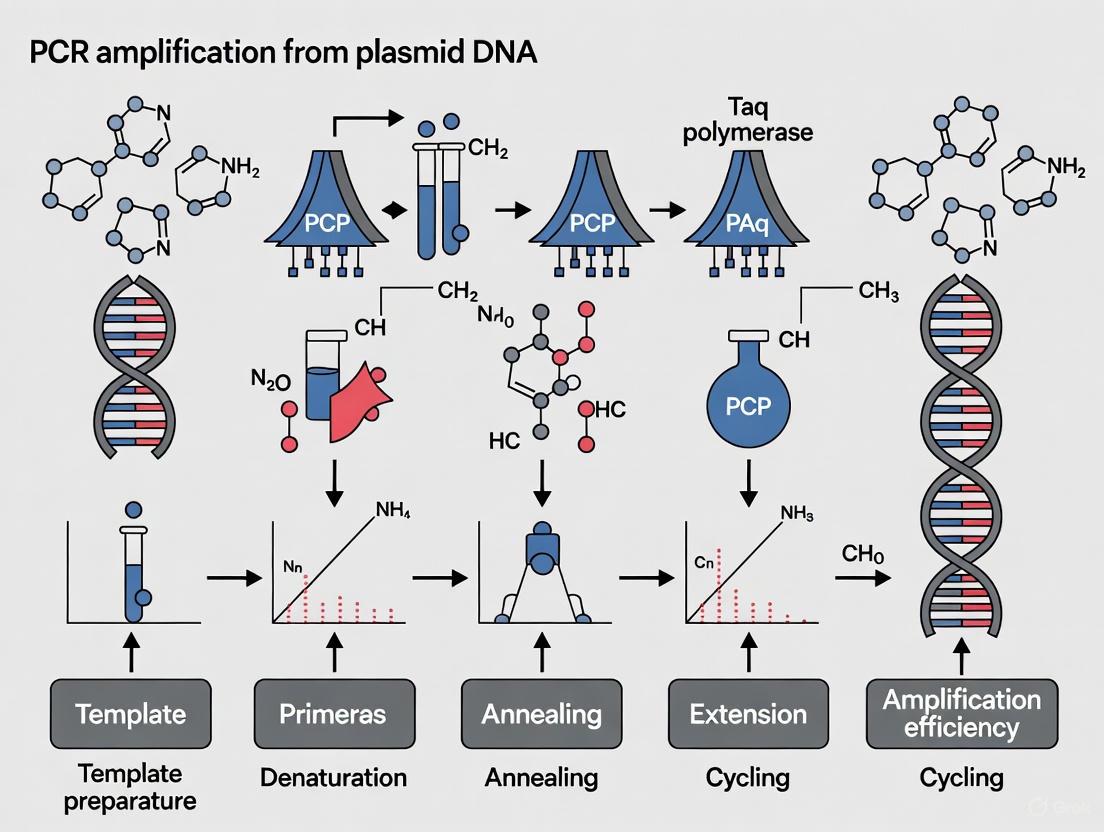
This article provides a comprehensive guide for researchers and drug development professionals on PCR amplification from plasmid DNA.
A Complete Protocol for PCR Amplification from Plasmid DNA: From Basics to Advanced Applications
Abstract
This article provides a comprehensive guide for researchers and drug development professionals on PCR amplification from plasmid DNA. It covers foundational principles, detailed step-by-step protocols for applications like cloning, and advanced troubleshooting for common challenges. The content also explores rigorous validation techniques and compares different polymerase systems to ensure high-fidelity results suitable for sensitive downstream applications in biomedical and clinical research.
Understanding the Fundamentals of Plasmid DNA PCR
Polymerase chain reaction (PCR)-based cloning is a fundamental technique in molecular biology that allows researchers to amplify and precisely insert DNA fragments into vector backbones. This method has largely transformed traditional cloning approaches by providing a rapid, versatile, and efficient means of gene manipulation [1]. Over recent decades, molecular cloning has profoundly impacted various scientific areas including basic research, clinical applications, pharmaceutical development, and environmental fields, successfully entering the realm of cellular engineering [1]. The emergence of novel high-fidelity PCR reagents, sophisticated cloning kits, and powerful software tools has further enhanced the utility and accessibility of PCR cloning, making it an indispensable tool for modern biological research [1]. This application note explores the principles, methodologies, and extensive applications of PCR-based cloning, providing researchers with detailed protocols and practical considerations for implementing this powerful technique in their experimental workflows.
Principles and Methodological Approaches
PCR cloning encompasses several distinct methodological approaches, each with specific mechanisms and applications. The core principle involves using PCR to amplify a target DNA sequence, which is then inserted into a compatible vector system for propagation and analysis [2].
Restriction-Based PCR Cloning
This approach involves designing PCR primers that incorporate restriction enzyme sites at their 5' ends, enabling seamless cloning into plasmid vectors [3]. The process requires careful selection of restriction enzymes that do not cut within the insert sequence but are present in the multiple cloning site of the recipient vector [1]. A critical consideration is that most restriction enzymes require 3-5 flanking nucleotides for efficient cleavage, necessitating the addition of short leader sequences outside the restriction sites in the primer design [3] [4]. This method offers flexibility in vector choice and insert orientation control, though it requires multiple enzymatic steps including restriction digestion and ligation.
TA Cloning
TA cloning represents a simplified approach that leverages the terminal transferase activity of certain DNA polymerases, particularly Taq polymerase, which preferentially adds a single deoxyadenosine (A) residue to the 3' ends of PCR products [2]. These "A-tailed" products are then ligated to complementary T-tailed vectors using T4 DNA ligase, followed by transformation [2]. This method eliminates the need for restriction enzymes and is ideal for high-throughput applications, though it offers limited control over insert orientation and requires specialized T-vectors.
TOPO Cloning
TOPO cloning utilizes the DNA-relaxing activity of topoisomerase I, which is pre-bound to linearized cloning vectors [4]. This enzyme functions both as a restriction enzyme and ligase, capable of cleaving and rejoining DNA strands simultaneously [4]. The topoisomerase/vector complex remains poised for immediate ligation when a suitable PCR product is provided, resulting in exceptionally fast cloning reactions that can be completed in just 5 minutes [4]. This method offers high efficiency with minimal background, with variations available for blunt-ended fragments or directional cloning.
Table 1: Comparison of PCR Cloning Methods
| Method | Key Feature | Efficiency | Time Required | Vector Flexibility | Directional Control |
|---|---|---|---|---|---|
| Restriction-Based | Adds restriction sites via primers | Moderate | 1-2 days | High | Yes |
| TA Cloning | Utilizes A-overhangs from Taq polymerase | High | Several hours | Limited | No |
| TOPO Cloning | Uses topoisomerase for ligation | Very High | 5 minutes | Limited | Available with specific kits |
Detailed Experimental Protocols
Primer Design for Restriction-Based Cloning
Effective primer design is crucial for successful PCR cloning. Primers must include three distinct components: a 5' leader sequence (3-6 bp) to facilitate restriction enzyme cleavage, the restriction enzyme site itself (6-8 bp), and the hybridization sequence (18-21 bp) that binds specifically to the target template [3]. When designing primers:
- Select appropriate restriction enzymes that do not cut within your insert and are available in the multiple cloning site of your recipient plasmid [1]. Ideally, choose enzymes that function in the same buffer system to streamline the digestion process [3].
- Ensure proper orientation by fusing the upstream restriction site to the forward primer and the downstream restriction site to the reverse primer [3].
- Add necessary flanking bases - include 3-6 extra nucleotides upstream of the restriction site to improve enzyme cutting efficiency [3].
- Generate reverse complements - for the reverse primer, use reverse-complement software to ensure proper binding orientation [3].
- Verify primer specificity - ensure primers have melting temperatures (Tm) of 55-70°C, with both primers within 5°C of each other, and GC content of 40-60% with uniform distribution [5].
Table 2: Standard 50 μL PCR Reaction Components
| Component | Final Concentration/Amount | Function |
|---|---|---|
| Template DNA | 0.1-1 ng (plasmid) or 5-50 ng (gDNA) | Provides source sequence for amplification |
| Forward Primer | 0.1-1 μM | Binds to antisense strand for 5'→3' extension |
| Reverse Primer | 0.1-1 μM | Binds to sense strand for 5'→3' extension |
| dNTPs | 0.2 mM each | Building blocks for new DNA synthesis |
| Mg²⁺ | 1.5-2.5 mM | Cofactor for DNA polymerase activity |
| DNA Polymerase | 1-2 units | Catalyzes DNA synthesis |
| Reaction Buffer | 1X | Provides optimal salt and pH conditions |
PCR Amplification and Product Purification
Perform PCR amplification using high-fidelity DNA polymerases to minimize mutations during amplification [3]. Standard Taq polymerase introduces an error approximately once every 10,000 base pairs, meaning that after 30 amplification rounds, the probability of obtaining an unmutated product is less than 1 in 10 [4]. High-fidelity polymerases can improve error rates by 20-fold or more [4]. Set annealing temperatures based on the Tm of the hybridization region only, not the entire primer including restriction sites [3]. Following amplification, purify PCR products using PCR clean-up columns or gel extraction to remove enzymes, salts, remaining dNTPs, and primers [4]. Gel purification is particularly recommended as it allows visualization of PCR product size and quantity while removing nonspecific amplification products [3].
Restriction Digestion and Ligation
Digest both the purified PCR product and the recipient plasmid with the selected restriction enzymes. Use approximately 1μg of plasmid DNA and the entire PCR product, incubating for at least 4 hours or overnight to ensure complete digestion [3]. For single enzyme digests or enzymes producing compatible ends, treat the vector with phosphatase (CIP or SAP) to prevent self-ligation [3]. Following digestion, isolate the insert and vector fragments by gel purification and quantify DNA concentration. For ligation, use approximately 100ng of total DNA with a vector:insert molar ratio of 1:3 [3]. Include negative controls without insert to assess background from uncut or self-ligated vector.
Transformation and Verification
Transform the ligation reaction into competent E. coli cells such as DH5α or TOP10, using 1-2μl of the ligation mixture [3]. For large plasmids (>10kb) or when using minimal DNA, consider electrocompetent cells for higher efficiency [3]. Following transformation, pick 3-10 colonies for analysis, growing overnight cultures for plasmid purification. Screen clones by diagnostic restriction digest of 100-300ng purified DNA, which should produce two bands corresponding to the vector and insert [3]. Finally, sequence the entire cloned insert to verify sequence integrity, as PCR introduces a risk of mutation regardless of polymerase fidelity [3] [4].
Applications and Technical Considerations
Versatile Applications in Molecular Biology
PCR-based cloning serves as a foundational technique with diverse applications across molecular biology and related fields:
- Gene Expression Studies: PCR cloning facilitates the insertion of coding sequences into expression vectors, enabling functional analysis of genes in various biological systems [6].
- Site-Directed Mutagenesis: Primers can be designed to incorporate specific base substitutions, deletions, or insertions, allowing precise manipulation of gene sequences for structure-function studies [6].
- Cellular Engineering: The power of PCR cloning has successfully been applied to cellular engineering projects, including the development of engineered cell lines for therapeutic applications [1].
- Library Construction: PCR cloning enables high-throughput generation of DNA libraries for screening and selection experiments, making it amenable to projects requiring scale [2].
- Hybrid Approaches: PCR products can serve as starting materials for more complex cloning techniques such as Gibson Assembly, enabling creation of exceptionally large molecular clones [4].
Critical Technical Considerations
Successful implementation of PCR cloning requires attention to several critical factors:
- Polymerase Fidelity: Standard Taq polymerase is sufficient for many applications, but high-fidelity enzymes are essential when sequence accuracy is paramount [4]. Polymerases with proofreading capability (3'→5' exonuclease activity) significantly reduce error rates.
- Template Quality: Template purity significantly impacts PCR success. Inhibitors present in DNA samples can reduce amplification efficiency, potentially necessitating increased polymerase concentrations or additional purification steps [5].
- Cycle Number: Minimize PCR cycles (generally below 30) to reduce the accumulation of mutations during amplification [4].
- Vector Selection: Choose vectors appropriate for your downstream applications, considering factors such as promoter systems, selection markers, and compatibility with expression hosts [4].
- Sequence Verification: Always sequence the entire cloned PCR product, as even high-fidelity polymerases can introduce mutations [3]. Plan for complete coverage by ordering sequencing primers spaced approximately every 500 base pairs [4].
Table 3: Troubleshooting Common PCR Cloning Issues
| Problem | Potential Causes | Solutions |
|---|---|---|
| No PCR Product | Poor primer design, insufficient template, incorrect annealing temperature | Redesign primers, optimize template amount, perform temperature gradient PCR |
| No Colonies After Transformation | Inefficient ligation, overdigestion with restriction enzymes, incompetent cells | Include ligation controls, reduce digestion time, use fresh competent cells |
| High Background (Empty Vectors) | Incomplete restriction digestion, insufficient phosphatase treatment | Extend digestion time, optimize phosphatase treatment, gel purify fragments |
| Unexpected Insert Size | Non-specific amplification, primer dimer incorporation, mutation | Optimize annealing temperature, touchdown PCR, use hot start polymerase |
Essential Research Reagent Solutions
The following table outlines key reagents and materials essential for successful PCR cloning experiments:
Table 4: Essential Research Reagents for PCR Cloning
| Reagent/Material | Function | Application Notes |
|---|---|---|
| High-Fidelity DNA Polymerase | Amplifies target sequence with minimal errors | Essential for cloning applications; provides 20x or greater fidelity than standard Taq [4] |
| Restriction Enzymes | Cleaves PCR products and vectors for assembly | Select enzymes with compatible buffers; avoid methylation-sensitive enzymes [1] |
| T4 DNA Ligase | Joins vector and insert fragments | Critical for restriction-based cloning; requires ATP cofactor |
| Competent E. coli Cells | Propagation of recombinant plasmids | DH5α, TOP10 for standard cloning; specialized strains for large plasmids [3] |
| Plasmid Vectors | Backbone for insert propagation | Choose with appropriate MCS, selection markers, and compatibility with downstream applications [4] |
| Gel Extraction Kit | Purification of DNA fragments from agarose gels | Essential for isolating digested fragments; improves ligation efficiency [3] |
| PCR Purification Kit | Removal of enzymes, salts, dNTPs after amplification | Rapid cleanup (5 minutes); may not remove all primers or incorrect fragments [4] |
| DNA Quantification System | Measuring DNA concentration | Spectrophotometry or fluorometry; essential for proper ligation ratios |
PCR-based cloning represents a versatile and powerful approach for molecular cloning that continues to evolve with advancements in enzyme technology and vector systems. Its ability to seamlessly amplify and integrate DNA fragments into suitable vectors has made it an indispensable tool in modern molecular biology. The methodology's flexibility allows researchers to choose from multiple approaches - restriction-based, TA cloning, or TOPO cloning - depending on their specific needs for speed, efficiency, and directional control. By following optimized protocols for primer design, PCR amplification, restriction digestion, and ligation, researchers can reliably generate recombinant constructs for diverse applications ranging from basic gene characterization to sophisticated cellular engineering projects. As molecular biology continues to advance, PCR cloning remains a fundamental technique that enables researchers to manipulate genetic material with precision and efficiency, driving discoveries across biological sciences and therapeutic development.
The polymerase chain reaction (PCR) is a foundational in vitro technique for amplifying specific DNA fragments, serving as a cornerstone in molecular biology, clinical diagnostics, and drug development research. [7] [8] This application note details a standardized protocol for the reliable amplification of a DNA insert from a plasmid template, a routine yet critical procedure in molecular cloning and gene expression studies. The precise optimization of five essential components—Template DNA, DNA Polymerase, Primers, Deoxynucleoside Triphosphates (dNTPs), and Magnesium ions (Mg2+)—is paramount to the success and fidelity of the reaction. [5] [9] The following sections provide detailed methodologies, quantitative guidelines, and troubleshooting insights to ensure robust amplification for downstream research applications.
The Five Critical Components of PCR
A successful PCR reaction hinges on the quality, concentration, and interaction of its core components. The table below summarizes the function and optimal concentration range for each critical element.
Table 1: Critical Components of a Standard PCR Reaction
| Component | Function | Final Concentration / Amount |
|---|---|---|
| Template DNA (Plasmid) | The DNA sequence to be amplified. [5] | 0.1–1 ng per 50 µL reaction. [5] |
| DNA Polymerase (e.g., Taq) | Enzyme that synthesizes new DNA strands. [7] [10] | 1–2.5 units per 50-100 µL reaction. [11] [5] [9] |
| Primers (Forward & Reverse) | Short, single-stranded DNA sequences that define the start and end of the amplification target. [7] | 0.1–1 µM each. [5] |
| dNTPs (dATP, dCTP, dGTP, dTTP) | The building blocks (nucleotides) for new DNA synthesis. [7] [5] | 50–200 µM of each dNTP (0.2 mM recommended). [5] [9] |
| Magnesium Ions (Mg2+) | Essential cofactor for DNA polymerase activity; stabilizes DNA and primer-template interactions. [5] [9] | 1.5–2.5 mM (often supplied with buffer; requires optimization). [11] [5] |
Component-Specific Protocols and Considerations
Template DNA: Plasmid Preparation and Quantification
The purity and quantity of the plasmid DNA template are critical. Contaminants like phenol, EDTA, or proteins can inhibit DNA polymerase. [8] [9]
- Purification Protocol: Use a commercial plasmid miniprep kit for routine preparation. For higher purity, traditional methods involving SDS and proteinase K for cell lysis, followed by phenol-chloroform extraction and ethanol precipitation, are effective. [9]
- Quantification: Quantify plasmid DNA using a spectrophotometer (NanoDrop). Ensure the A260/A280 ratio is ~1.8 and A260/A230 is ~2.0 for high purity. [5]
- Optimal Input: For plasmid DNA, 0.1–1 ng in a 50 µL reaction is typically sufficient. Excess template can lead to nonspecific amplification, while too little will yield low product. [5] The required amount is less than that for genomic DNA (5–50 ng) due to lower complexity and higher target copy number. [5]
DNA Polymerase: Selection and Handling
DNA polymerases are heat-stable enzymes that catalyze DNA synthesis. Taq DNA polymerase, isolated from Thermus aquaticus, is the most commonly used enzyme due to its thermostability. [7] [10]
- Enzyme Activity: One unit of enzyme is typically defined as the amount that will incorporate 10 nmol of dNTPs into acid-precipitable material in 30 minutes at 74°C. [11]
- Handling: Always store enzymes at -20°C and keep reactions on ice during setup to prevent non-specific activity. [11]
- Limitations & Advancements: Standard Taq polymerase lacks 3'→5' proofreading (exonuclease) activity, making it prone to incorporation errors (~1 x 10⁻⁴ errors per base pair). [10] For applications requiring high fidelity (e.g., cloning), consider using proofreading enzymes like Pfu polymerase. [7]
Primer Design and Preparation
Primers are short, synthetic oligonucleotides designed to be complementary to the sequences flanking the target region.
- Design Rules:
- Length: 15–30 nucleotides. [5]
- Melting Temperature (Tm): 55–70°C for both primers, with Tm within 5°C of each other. [5]
- GC Content: 40–60%, with uniform distribution. Avoid runs of identical nucleotides. [5]
- 3' End: Must end with a C or G base (GC clamp) to enhance priming efficiency, but avoid more than three G or C bases at the 3' end to prevent nonspecific binding. [5]
- Specificity: Check for self-complementarity (hairpins), primer-dimer formation, and repeat sequences. [5]
- Storage: Resuspend primers in sterile TE buffer or nuclease-free water to a high concentration (e.g., 100 µM) as a stock solution, and dilute to a working concentration (e.g., 10 µM). [5]
dNTPs: Preparation and Quality Control
dNTPs are the foundational nucleotides for DNA synthesis.
- Solution Preparation: Purchase or prepare a neutralized (pH 7.0-7.5) dNTP mixture containing equimolar amounts of dATP, dCTP, dGTP, and dTTP. [9] A common stock concentration is 10 mM of each dNTP.
- Storage: Aliquot and store dNTPs at -20°C to avoid repeated freeze-thaw cycles, which can lead to degradation. [9]
- Concentration Optimization: The recommended final concentration of 0.2 mM for each dNTP provides a balance between yield and fidelity. [5] Lower concentrations (0.01–0.05 mM) can improve fidelity with non-proofreading polymerases, while higher concentrations may be inhibitory. [5] [9]
Magnesium Ion (Mg2+) Optimization
Mg2+ is an essential cofactor for DNA polymerase activity and influences primer annealing and strand separation. [5] [9]
- Role: Mg2+ catalyzes phosphodiester bond formation and stabilizes the interaction between the primer, template, and enzyme by neutralizing negative charges on the DNA backbone. [5]
- Optimization Protocol: Since dNTPs bind Mg2+, the optimal concentration is dependent on the dNTP concentration. [5] A titration experiment is strongly recommended.
- Prepare a master reaction mix excluding Mg2+.
- Aliquot the master mix into separate tubes.
- Add MgCl₂ to each tube to create a series of final concentrations (e.g., 0.5, 1.0, 1.5, 2.0, 2.5, 3.0, 4.0 mM).
- Run the PCR and analyze the results by gel electrophoresis to identify the concentration that yields the strongest specific product with the least background.
Experimental Protocol: PCR Amplification from Plasmid DNA
The following diagram illustrates the complete workflow for the standard PCR protocol, from setup to analysis.
Step-by-Step Procedure
Table 2: Standard PCR Reaction Setup
| Component | Final Concentration / Amount | Volume for 50 µL Reaction* |
|---|---|---|
| Nuclease-free Water | - | To 50 µL |
| 10X PCR Buffer (with MgCl₂) | 1X | 5 µL |
| dNTP Mix (10 mM each) | 0.2 mM each | 1 µL |
| Forward Primer (10 µM) | 0.5 µM | 2.5 µL |
| Reverse Primer (10 µM) | 0.5 µM | 2.5 µL |
| Template Plasmid DNA | 0.1-1 ng | X µL (variable) |
| Taq DNA Polymerase | 1.25 units | 0.25 µL (if 5 U/µL) |
| Total Volume | 50 µL |
*If using a pre-mixed "Readymix" solution, follow the manufacturer's instructions, typically adding only primers, template, and water. [11]
- Prepare Reaction Mix: Thaw all reagents (except the enzyme) on ice. Briefly centrifuge tubes to collect contents. In a sterile, nuclease-free PCR tube, combine the components in the order listed in Table 2. It is best practice to prepare a master mix of all common components for multiple reactions to minimize pipetting error and contamination. [11]
- Add Template: Add the calculated volume of template plasmid DNA to the individual reaction tubes.
- Thermal Cycling: Place the tubes in a thermal cycler and run the following program, which can be modified based on primer Tm and product length: [11] [8]
- Initial Denaturation: 95°C for 2–5 minutes to fully denature the template.
- Amplification (25–35 cycles):
- Denaturation: 95°C for 20–30 seconds.
- Annealing: 55–72°C for 20–30 seconds. The temperature must be optimized based on the primer Tm.
- Extension: 72°C for 1 minute per 1000 base pairs of the amplicon.
- Final Extension: 72°C for 5–10 minutes to ensure all amplicons are full-length.
- Hold: 4°C indefinitely.
- Product Analysis: Analyze the PCR product by loading 5–10 µL of the reaction onto an ethidium bromide-stained agarose gel alongside a DNA ladder. Visualize under UV light; a single, sharp band of the expected size indicates a successful amplification. [11] [12]
The Scientist's Toolkit: Research Reagent Solutions
Table 3: Essential Reagents for Plasmid DNA PCR
| Reagent / Kit | Function | Key Considerations |
|---|---|---|
| Plasmid Miniprep Kit | Rapid isolation of pure plasmid DNA from bacterial cultures. | Essential for removing contaminants like endotoxins, proteins, and salts that inhibit PCR. [9] |
| Thermostable DNA Polymerase | Catalyzes DNA synthesis at high temperatures. | Taq is standard; choose proofreading enzymes (e.g., Pfu) for high-fidelity applications. [7] [10] |
| Ultra-Pure dNTP Set | Provides high-quality nucleotides for efficient and accurate DNA synthesis. | Equimolar, neutral-pH solutions ensure balanced incorporation and reaction stability. [5] [9] |
| Oligonucleotide Synthesis Service | Custom synthesis of desalted or HPLC-purified primers. | Critical for obtaining primers with correct sequence and high purity for specific binding. [5] [9] |
| 10X PCR Buffer (with MgCl₂) | Provides optimal pH, ionic strength, and cofactors for the reaction. | The included MgCl₂ concentration is a starting point; optimization may be required. [11] [5] |
| Agarose Gel Electrophoresis System | Separates and visualizes DNA fragments by size to confirm amplification success. | Post-PCR analysis is mandatory to verify product size, specificity, and yield. [11] [12] |
The robust amplification of DNA from a plasmid template is a fundamental technique in molecular biology. The consistent success of this protocol relies on a meticulous approach to the five critical components: using high-quality template DNA, a reliable DNA polymerase, meticulously designed primers, a balanced dNTP mixture, and an optimized concentration of Mg2+. By adhering to the detailed protocols, optimization strategies, and reagent guidelines outlined in this application note, researchers and drug development professionals can ensure reliable and reproducible results, forming a solid foundation for their downstream scientific investigations.
In the context of polymerase chain reaction (PCR) amplification from plasmid DNA, the quality, quantity, and complexity of the template DNA are fundamental determinants of experimental success. These parameters directly influence the sensitivity, efficiency, and specificity of amplification reactions, thereby impacting the reliability of results in research and drug development applications. Optimal template DNA characteristics ensure efficient primer binding and polymerase activity while minimizing nonspecific amplification and artifacts. This application note provides a comprehensive framework for the preparation and quantification of plasmid DNA templates, establishing guidelines that support reproducible and robust PCR outcomes in molecular biology workflows. Understanding these principles is essential for researchers designing protocols for gene cloning, mutagenesis, and expression vector construction where plasmid DNA serves as the primary template material.
Template DNA Quality Assessment
The integrity and purity of template DNA significantly impact PCR performance. High-quality DNA is essential for consistent amplification, particularly for long or complex targets.
Quality Indicators and Assessment Methods
For plasmid DNA, the topological state serves as a key quality indicator. High-quality plasmid preparations typically contain >80% supercoiled DNA, which indicates minimal nicking or degradation [13]. This assessment is conventionally performed using agarose gel electrophoresis, though capillary electrophoresis (CE) or high-performance liquid chromatography (HPLC) provides superior resolution for detecting impurities or damage [13].
PCR inhibitors present in nucleic acid preparations—such as salts, proteins, or organic compounds—can profoundly reduce amplification efficiency. These contaminants are effectively removed through purification using specialized kits designed for PCR applications [14]. Additionally, DNA damage occurring during isolation or through depurination at elevated temperatures and low pH conditions results in truncated amplification products and decreased overall yield [15]. To maintain DNA integrity, templates should be resuspended in buffered solutions at pH 7-8 rather than water, as DNA is most stable under these conditions [15].
Impact of DNA Quality on Downstream Applications
The relationship between DNA quality and subsequent application success is particularly evident in techniques like in vitro transcription (IVT), where template quality directly correlates with mRNA yield and integrity [13]. Unlike cellular systems that possess DNA repair mechanisms, enzyme-based systems like PCR lack adaptive capabilities, making them more susceptible to quality deficiencies in template DNA [13]. This underscores the necessity for rigorous quality assessment, especially when templates are linearized before use in enzymatic reactions.
Template DNA Quantity Optimization
Determining the appropriate amount of template DNA represents a critical balancing act in PCR optimization. Insufficient template reduces amplification efficiency, while excess template promotes nonspecific binding and increases the likelihood of spurious products [14] [16].
Quantitative Guidelines for Different DNA Types
The optimal quantity of template DNA varies significantly based on its complexity and source. The following table summarizes recommended template quantities for various DNA types:
Table 1: Template Quantity Guidelines for PCR Amplification
| Template Type | Recommended Quantity | Copy Number Guidance | Additional Considerations |
|---|---|---|---|
| Plasmid DNA | 0.1–10 ng [16] [5] | Approximately 104 copies required to detect product in 25-30 cycles [16] | Higher concentrations may decrease specificity [16] |
| Genomic DNA | 1 ng–1 μg [16] | 30–100 ng sufficient for most applications [15] | High-copy targets (e.g., housekeeping genes) may require only 10 ng [15] |
| E. coli Genomic DNA | 100 pg–1 ng [15] | 1 μg contains ~2 × 10⁸ molecules [15] | Lower complexity than mammalian genomic DNA |
| Lambda DNA | As little as 100 pg [15] | 1 μg contains ~1.9 × 10¹⁰ molecules [15] | Minimal template requirements due to low complexity |
| cDNA | 10 pg RNA equivalent [15] | Depends on transcript abundance | Input should reflect target abundance |
For plasmid DNA specifically, most PCR reactions perform optimally with 0.1-1 ng of template, though this range may require adjustment based on target size and copy number [5]. As a general rule, reactions should contain approximately 104 copies of the target DNA sequence to ensure detectable amplification within 25-30 cycles [16] [15].
Molar Conversions for DNA Templates
For experimental designs requiring precise copy number calculation, the following molar conversion values facilitate accurate template quantification:
Table 2: Molar Conversions for Nucleic Acid Templates
| Nucleic Acid | Size | pmol/μg | Molecules/μg |
|---|---|---|---|
| 1 kb DNA | 1,000 bp | 1.52 | 9.1 × 10¹¹ |
| pUC19 DNA | 2,686 bp | 0.57 | 3.4 × 10¹¹ |
| Lambda DNA | 48,502 bp | 0.03 | 1.8 × 10¹⁰ |
| Genomic DNA (Human) | 3.3 × 10⁹ bp | 4.7 × 10⁻⁷ | 2.8 × 10⁵ |
These conversion factors enable researchers to calculate template copy numbers using the formula: Copy number = Avogadro's constant (L) × (total mass/molar mass) [5]. This calculation is particularly valuable when working with limited template quantities or when standardizing reactions across multiple samples.
Template Complexity Considerations
Template complexity encompasses factors beyond simple quantity or purity, including structural characteristics, sequence composition, and topological state, all of which influence PCR efficiency.
Structural and Sequence-Based Complexities
GC-rich templates (>65% GC content) present particular challenges due to their propensity to form stable secondary structures that resist complete denaturation [15]. These regions, often concentrated in regulatory sequences, can hinder polymerase progression and result in truncated amplification products. Conversely, AT-rich templates may require lower extension temperatures (65-60°C) to facilitate reliable amplification [15].
Template damage, including nicking or fragmentation introduced during isolation procedures, represents another significant complexity factor. While conventional agarose gel electrophoresis may not detect nicking, such damage can substantially impact mRNA yield and quality in downstream applications like IVT [13]. Emerging evidence suggests that next-generation sequencing methods can detect these subtle forms of DNA damage, offering improved quality assessment capabilities [13].
Impact of Template Source and Preparation
The method of template DNA generation introduces additional complexity considerations. Plasmid DNA purified from cellular sources exists in multiple isoforms (supercoiled, open circular, linear), with the supercoiled fraction typically considered highest quality [13]. In contrast, synthetic DNA templates do not supercoil, requiring alternative quality assessment methods [13]. Variability in purification processes—including alkaline lysis conditions, chromatography methods, and physical shear forces—can introduce batch-to-batch differences that impact PCR performance, even when standard quality metrics appear equivalent [13].
Diagram 1: Factors influencing template DNA complexity. Structural, sequence, and source-related factors collectively determine template performance in PCR.
Experimental Protocols
Standard PCR Protocol for Plasmid DNA Templates
The following protocol provides a robust starting point for PCR amplification from plasmid DNA templates, with optimization guidelines for specific applications:
Reaction Setup:
- Assemble all reaction components on ice [16]
- Final reaction volume: 25-50 μL
- Template DNA: 0.1-10 ng plasmid DNA [16] [5]
- Primers: 0.1-0.5 μM each [16] [5]
- dNTPs: 200 μM each [16] [5]
- Magnesium chloride: 1.5-2.0 mM (optimize if necessary) [16]
- DNA polymerase: 0.5-2.0 units per 50 μL reaction [16]
- Reaction buffer: as supplied with polymerase
Thermal Cycling Conditions:
- Initial denaturation: 95°C for 2 minutes [16]
- 25-35 cycles of:
- Final extension: 68°C for 5 minutes [16]
- Hold: 4-10°C [16]
Critical Steps:
- Add polymerase last, immediately transfer to preheated thermocycler [16]
- Keep denaturation times minimal to reduce depurination risk [15]
- For GC-rich targets, increase denaturation temperature to 98°C [15]
- For long targets (>4 kb), use extension temperature of 68°C [15]
Specialized Protocol for GC-Rich Templates
Amplification of GC-rich regions requires modifications to standard protocols to overcome secondary structure formation:
Reaction Modifications:
- Increase denaturation temperature to 98°C [15]
- Use shorter annealing times (5-15 seconds) [15]
- Design primers with Tm >68°C [15]
- Consider adding DMSO to 2.5-5% final concentration [15]
- Use polymerases specifically engineered for GC-rich templates [15]
Thermal Cycling Adjustments:
- Initial denaturation: 98°C for 2 minutes
- Cycles: 30-35 cycles of:
- Denaturation: 98°C for 10-15 seconds
- Annealing: Higher temperature (up to 72°C) for 5-15 seconds
- Extension: 68°C with extended time (1.5 minutes per kb)
The Scientist's Toolkit: Essential Reagents and Materials
Successful PCR amplification requires careful selection of reagents and materials optimized for specific template characteristics and application requirements.
Table 3: Essential Research Reagents for PCR with Plasmid DNA Templates
| Reagent/Material | Function | Optimization Considerations |
|---|---|---|
| High-Fidelity DNA Polymerase | Catalyzes DNA synthesis with minimal error rates | Essential for cloning applications; provides superior accuracy [5] |
| MgCl2 Solution | Cofactor for polymerase activity; stabilizes primer-template binding | Concentration typically 1.5-2.0 mM; requires optimization in 0.5 mM increments [16] [15] |
| dNTP Mix | Building blocks for new DNA strands | Typical concentration 200 μM each; lower concentrations (50-100 μM) enhance fidelity [16] |
| Sequence-Specific Primers | Target sequence recognition and initiation point for synthesis | 20-30 nucleotides; Tm 55-70°C; GC content 40-60%; avoid 3' end complementarity [16] [5] |
| PCR Buffers with Additives | Maintain optimal pH and reaction environment | May include stabilizers; DMSO (2.5-5%) improves GC-rich amplification [15] |
| Nucleic Acid Purification Kits | Remove contaminants and inhibitors from template preparations | Essential for consistent results; completely remove PCR inhibitors [14] |
| Thermostable Block Cycler | Precise temperature cycling for denaturation, annealing, extension | Must maintain accurate temperatures across all wells; rapid transition between steps |
Diagram 2: PCR optimization workflow from template preparation to product analysis, highlighting critical quality assessment and optimization steps.
The establishment of rigorous template DNA guidelines encompassing quality, quantity, and complexity parameters provides an essential foundation for successful PCR amplification from plasmid DNA templates. By adhering to the quantitative recommendations, quality standards, and experimental protocols outlined in this document, researchers can achieve consistent, reproducible results across diverse applications. Particular attention should be paid to template-specific optimization, recognizing that requirements differ significantly between plasmid, genomic, and specialized templates. Implementation of these guidelines will enhance experimental reliability in molecular biology research, drug development workflows, and diagnostic applications where PCR serves as a fundamental analytical tool.
Primer Design Principles for Specificity and Efficiency
Within molecular biology research, particularly in studies involving PCR amplification from plasmid DNA, the design of oligonucleotide primers is a fundamental step that directly determines the success and reliability of experimental outcomes. Proper primer design is the cornerstone for achieving high specificity and amplification efficiency, which is especially critical in applications such as gene cloning, mutagenesis, and recombinant protein expression where plasmid templates are routinely utilized [17] [18]. This application note details the core principles and methodologies for designing primers that ensure robust and accurate amplification, framed within the context of plasmid-based research. The guidelines provided herein are designed to help researchers, scientists, and drug development professionals establish reliable PCR protocols, thereby enhancing the consistency and reproducibility of their experimental data.
Core Primer Design Principles
The following principles outline the key parameters that must be considered during the primer design process to ensure they bind specifically to the intended target sequence and facilitate optimal polymerase activity.
Sequence Length and Composition
- Primer Length: Optimal primer length generally falls within the 18–30 base range [17] [19] [20]. This length provides a sufficient sequence for specific binding while allowing for efficient annealing.
- GC Content: The guanine-cytosine (GC) content should ideally be between 40–60% [17] [19] [20]. This balance promotes stable binding through GC base pairs, which form three hydrogen bonds, while avoiding sequences that are excessively stable and prone to non-specific binding.
- GC Clamp: Including a G or C base at the 3'-end of the primer, known as a GC clamp, strengthens primer-template binding due to the stronger hydrogen bonding of these bases, thereby promoting successful initiation of DNA synthesis [17] [5].
- Sequence Repeats: Avoid runs of four or more identical bases in a row (e.g., ACCCC) or dinucleotide repeats (e.g., ATATAT), as these can misprime or form secondary structures [17] [19].
Melting and Annealing Temperatures
- Melting Temperature (Tm): The Tm is the temperature at which half of the primer-DNA duplexes dissociate. For standard PCR, aim for a primer Tm between 55–70°C [19] [5]. For qPCR applications, an optimal Tm of 60–64°C is recommended [19]. The two primers in a pair should have Tm values within 2–5°C of each other to ensure both bind to the template simultaneously during the annealing step [17] [19] [20].
- Annealing Temperature (Ta): The optimal annealing temperature is typically set 5°C below the calculated Tm of the primer with the lower melting temperature [19] [20]. A Ta that is too low can lead to non-specific amplification, while a Ta that is too high can reduce reaction efficiency and yield.
Table 1: Optimal Primer Design Parameters for Standard PCR
| Parameter | Recommended Value | Rationale |
|---|---|---|
| Length | 18–30 nucleotides [17] [20] | Balances specificity with efficient annealing. |
| GC Content | 40–60% [17] [19] | Ensures stable yet non-stringent binding. |
| Tm | 55–70°C [19] [5] | Compatible with standard cycling conditions. |
| Tm Difference | ≤ 5°C between primers [17] | Enables simultaneous primer binding. |
| 3'-End Sequence | Avoid 3+ G/C; Prefer G or C clamp [17] [5] | Prevents mispriming and stabilizes binding. |
Specificity and Secondary Structures
To ensure primers amplify only the intended target, the following must be avoided:
- Self-Complementarity: Primers should not contain complementary sequences, especially at their 3' ends, that allow them to form hairpins or self-dimers [5].
- Inter-Primer Complementarity: The forward and reverse primers should not have complementary sequences, particularly at their 3' ends, to prevent the formation of primer-dimers, which compete with target amplification and reduce yield [17] [5].
- Sequence Uniqueness: Primer sequences must be unique to the target region to prevent off-target binding and amplification. This can be verified using tools like NCBI BLAST [19].
- Template Secondary Structures: Avoid designing primers that bind to regions of the template DNA with strong secondary structures, as this can impede primer annealing [17].
Experimental Protocols for Primer Evaluation
Once primers are designed in silico, their performance must be validated experimentally. The following protocols are essential for confirming primer specificity and efficiency.
Protocol 1: Determining qPCR Primer Efficiency
For quantitative applications, calculating primer efficiency is a critical step to ensure accurate data interpretation [21]. The following protocol outlines the standard curve method.
- Step 1: Template Preparation: Begin with a high-quality plasmid template containing the target gene. Precisely quantify the DNA and serially dilute it over at least 5 orders of magnitude (e.g., 1:10 dilutions). Include a no-template control (water alone) to detect contamination [21].
- Step 2: Reaction Setup: Prepare the qPCR master mix according to the manufacturer's instructions. A typical 20 µL reaction contains: 1X master mix (including polymerase, dNTPs, Mg2+, and buffer), 0.1–0.5 µM of each primer, and a defined volume of template DNA from each dilution [22] [21]. Run each dilution in duplicate or triplicate to ensure technical reproducibility.
- Step 3: qPCR Cycling: Run the plate on a real-time PCR instrument using the following cycling conditions, adjusted for your specific instrument and chemistry:
- Initial Denaturation: 95°C for 2 minutes
- 40 Cycles of:
- Denaturation: 95°C for 15 seconds
- Annealing: 60°C for 30 seconds (optimize based on primer Tm)
- Extension: 68°C for 30 seconds (adjust for amplicon length)
- Step 4: Data Analysis: The instrument software will generate a standard curve by plotting the log of the template concentration against the quantification cycle (Cq) value for each dilution. The slope of this curve is used to calculate efficiency (E) using the formula: E = 10(-1/slope) [23]. An ideal reaction with 100% efficiency, where the product doubles every cycle, will have a slope of -3.32 [23]. Efficiency between 90–110% (slope of -3.6 to -3.1) is generally considered acceptable.
Protocol 2: Primer Specificity Check via Melt Curve Analysis
This protocol is essential when using intercalating dyes like SYBR Green I and should follow the qPCR run from Protocol 1.
- Step 1: Post-Amplification Melting: Immediately after the final PCR cycle, the instrument heats the amplicons from 60°C to 95°C while continuously monitoring fluorescence.
- Step 2: Data Interpretation: A specific, single PCR product will produce a single, sharp peak on the melt curve plot. The presence of multiple peaks or a broad peak indicates non-specific amplification or primer-dimer formation, necessitating a redesign of the primers or optimization of the reaction conditions [21].
Workflow and Reagent Solutions
Primer Design and Validation Workflow
The following diagram illustrates the complete workflow from initial primer design to experimental validation, a critical pathway for any PCR-based experiment involving plasmid DNA.
Research Reagent Solutions
The table below lists essential materials and their functions for setting up and optimizing PCRs with plasmid DNA.
Table 2: Essential Reagents for PCR with Plasmid DNA Templates
| Reagent / Material | Function / Role | Example / Notes |
|---|---|---|
| DNA Polymerase | Enzyme that synthesizes new DNA strands. | Taq DNA Polymerase for routine PCR; high-fidelity enzymes for cloning [22]. |
| dNTPs | Building blocks (A, dT, G, C) for new DNA strands. | Use balanced 200 µM of each dNTP; lower concentrations (50-100 µM) can enhance fidelity [22]. |
| Primers | Synthetic oligonucleotides that define the start and end of the amplicon. | 0.1–1.0 µM final concentration; cartridge purified for cloning [17] [5] [20]. |
| Magnesium Ions (Mg²⁺) | Essential cofactor for DNA polymerase activity. | Typically 1.5–2.0 mM; concentration must be optimized as it affects specificity [22]. |
| Reaction Buffer | Provides optimal pH and salt conditions for the enzyme. | Often supplied with the polymerase; contains KCl and Tris-HCl [19]. |
| Plasmid DNA Template | The DNA molecule containing the target sequence to be amplified. | Use 1 pg–10 ng of high-quality, purified plasmid DNA [22] [5]. |
Application in Plasmid DNA Research
In the context of plasmid DNA research, adhering to these primer design principles is paramount. For instance, in recombinant protein production, where plasmid copy number can influence yield, qPCR is used for precise quantification. A study determining plasmid copy number successfully designed primers targeting a single-copy chromosomal gene and the plasmid origin of replication, achieving primer efficiencies of 1.95 and 1.97, close to the ideal value of 2.0 [24]. This high efficiency was critical for accurate calculation of plasmid copy numbers, demonstrating how rigorous primer design directly supports reliable research outcomes.
Furthermore, when designing primers for cloning applications, it is common practice to include non-complementary sequences at the 5' end, such as restriction enzyme sites or recombination sequences. To ensure efficient enzymatic cutting, 3–4 extra nucleotides should be added 5' to the restriction site [17] [22]. By integrating these application-specific requirements with the core design principles outlined in this document, researchers can develop robust, reproducible PCR-based methods for their plasmid research.
In the realm of molecular biology, the polymerase chain reaction (PCR) stands as a transformative technology that has catalyzed advancements across life sciences research and diagnostic development. At the heart of every PCR experiment lies DNA polymerase, the enzymatic workhorse responsible for catalyzing the template-directed synthesis of DNA. The selection of an appropriate DNA polymerase represents one of the most critical factors determining the success of PCR amplification, particularly in sensitive downstream applications such as cloning, sequencing, and functional analysis of plasmid DNA.
The evolution from standard Taq polymerase to specialized high-fidelity enzymes has fundamentally expanded the capabilities of PCR-based research. While Taq DNA polymerase revolutionized molecular biology by providing a thermostable enzyme suitable for automated thermal cycling, its lack of proofreading functionality limits its utility for applications requiring high accuracy. The emergence of high-fidelity DNA polymerases with 3'→5' exonuclease (proofreading) activity has dramatically reduced error frequencies, enabling accurate amplification of longer fragments and complex templates—essential characteristics for plasmid DNA research and drug development workflows.
This application note provides a comprehensive comparison of DNA polymerase classes, detailed experimental protocols for plasmid DNA amplification, and practical guidance for enzyme selection to optimize outcomes in molecular cloning and genetic engineering projects.
DNA Polymerase Classes and Characteristics
DNA polymerases utilized in PCR can be broadly categorized into two main classes based on their intrinsic fidelity mechanisms: standard polymerases lacking proofreading activity and high-fidelity enzymes possessing 3'→5' exonuclease activity. The biochemical properties of these enzymes directly influence their error rates, processivity, and suitability for specific applications.
Standard Non-Proofreading DNA Polymerases
Taq DNA polymerase, isolated from Thermus aquaticus, serves as the benchmark for standard PCR enzymes. This polymerase lacks 3'→5' exonuclease activity, resulting in a relatively high error rate ranging from 1.0-20.0 × 10⁻⁵ errors per base pair per duplication [25]. Despite this limitation, Taq polymerase remains widely used for routine applications such as genotyping, colony screening, and diagnostic assays where absolute sequence fidelity is not critical. Taq polymerase demonstrates several advantageous characteristics including high processivity, rapid elongation rates (~1 kb in 30-60 seconds), and the ability to add a single deoxyadenosine (A) to the 3' end of PCR products, facilitating TA cloning strategies [26] [27].
High-Fidelity Proofreading DNA Polymerases
High-fidelity DNA polymerases incorporate proofreading capability through 3'→5' exonuclease activity, enabling the detection and excision of misincorporated nucleotides during DNA synthesis. This molecular correction mechanism reduces error rates by approximately 10-100-fold compared to standard Taq polymerase [25]. Representative enzymes in this category include Pfu polymerase (from Pyrococcus furiosus), Phusion DNA polymerase, and Q5 High-Fidelity DNA Polymerase. These enzymes typically demonstrate error rates in the range of 1.0-4.0 × 10⁻⁶ errors per base pair per duplication, making them indispensable for applications requiring high sequence accuracy [28] [25].
Table 1: Comparative Analysis of DNA Polymerase Enzymes
| Polymerase | Proofreading Activity | Error Rate (errors/bp/duplication) | Fidelity Relative to Taq | Recommended Applications |
|---|---|---|---|---|
| Taq | No | 3.0-5.6 × 10⁻⁵ [25] | 1x | Routine PCR, colony screening, genotyping |
| AccuPrime-Taq HF | No | ~1.0 × 10⁻⁵ [25] | ~3-5x better | Standard PCR with improved yield |
| Pfu | Yes | 1.0-2.0 × 10⁻⁶ [25] | 6-10x better | Cloning, mutagenesis studies |
| Phusion Hot Start | Yes | 4.0-9.5 × 10⁻⁷ [25] | >50x better (HF buffer) [25] | High-throughput cloning, long PCR |
| Q5 High-Fidelity | Yes | ~2.8 × 10⁻⁷ (vendor data) | >100x better | Gene construction, NGS library prep |
The significant fidelity improvement offered by proofreading enzymes comes with notable biochemical differences. These enzymes often exhibit slower elongation rates compared to Taq polymerase and may generate blunt-ended PCR products rather than 3'A-overhangs, necessitating modified cloning strategies. Additionally, many high-fidelity polymerases demonstrate enhanced processivity—the ability to incorporate more nucleotides per binding event—making them particularly suitable for amplifying long targets (>5 kb) and GC-rich sequences that challenge standard Taq polymerase [29] [26].
Experimental Protocols for Plasmid DNA Amplification
The following section provides detailed methodologies for PCR amplification of plasmid DNA templates, incorporating both basic protocols and advanced optimization strategies to address common experimental challenges.
Basic PCR Protocol for Plasmid DNA Amplification
The standard PCR workflow for plasmid amplification involves careful preparation of reaction components, precise thermal cycling conditions, and post-amplification analysis to verify product specificity and yield.
Diagram 1: Standard PCR workflow for plasmid DNA amplification
Reaction Setup:
- Prepare Master Mix: In a sterile 1.5 mL microcentrifuge tube, combine the following components in order to minimize reagent degradation [27]:
- Sterile distilled water (QS to 50 µL final volume)
- 5 µL of 10X PCR buffer (supplemented with Mg²⁺ if necessary)
- 1 µL of 10 mM dNTP mix (final concentration 200 µM each)
- 1-2 µL of each primer (20 µM stock, final concentration 0.4-0.5 µM) [30]
- 0.5-2.5 units of DNA polymerase
- 1-100 ng plasmid DNA template (typically 0.5-2 µL)
Mix Components: Gently mix the reaction by pipetting up and down 20 times to ensure homogeneous distribution of components. Avoid introducing air bubbles.
Thermal Cycling: Program thermal cycler with the following parameters [27]:
- Initial denaturation: 95°C for 2 minutes
- Amplification cycles (25-35 cycles):
- Denature: 95°C for 30 seconds
- Anneal: 55-65°C (primer-specific) for 30 seconds
- Extend: 72°C for 1 minute per kilobase of expected product
- Final extension: 72°C for 5-10 minutes
- Hold: 4°C indefinitely
Product Analysis: Analyze 5-10 µL of PCR product by agarose gel electrophoresis alongside appropriate molecular weight standards to verify amplification specificity and product size.
Optimization Strategies for Challenging Templates
Successful amplification of complex plasmid templates often requires optimization beyond standard protocols. The following strategies address common challenges encountered in plasmid DNA amplification:
GC-Rich Templates:
- Additives: Incorporate DMSO (2-10%), formamide (1.25-10%), or betaine (0.5-2.5 M) to disrupt secondary structures and reduce melting temperature [26] [27].
- Modified Cycling Conditions: Implement a touchdown PCR protocol or increase denaturation temperature to 98°C to ensure complete strand separation.
- Enzyme Selection: Utilize high-fidelity polymerases with demonstrated performance on GC-rich templates, such as Q5 or Phusion polymerases with GC enhancers [28].
Long Amplicon Amplification:
- Extension Time: Increase extension time to 2-4 minutes per kilobase for products >5 kb.
- Template Quality: Use high-quality, supercoiled plasmid DNA to minimize nicked or linearized templates.
- Enzyme Blends: Consider polymerase blends optimized for long-range PCR that combine high processivity with proofreading capability.
High-Fidelity Requirements:
- Minimize Cycle Number: Use the minimum number of cycles necessary for adequate product yield (typically 25-30 cycles) to reduce mutation accumulation [26].
- dNTP Quality: Use fresh, high-quality dNTPs at balanced concentrations (200 µM each) to prevent misincorporation [28].
- Mg²⁺ Optimization: Precisely titrate Mg²⁺ concentration (typically 1.5-2.5 mM) as excessive Mg²⁺ can reduce fidelity [26].
Table 2: Troubleshooting Common PCR Amplification Issues
| Problem | Potential Causes | Recommended Solutions |
|---|---|---|
| No Product | Suboptimal annealing temperature, insufficient template, missing components | Gradient PCR to optimize Ta, increase template concentration (1-100 ng), verify reagent addition [29] [28] |
| Non-Specific Bands | Low annealing temperature, excess primers, excessive Mg²⁺ concentration | Increase Ta by 2-5°C, reduce primer concentration (0.1-0.5 µM), titrate Mg²⁺ in 0.2 mM increments [29] [26] |
| Low Yield | Insufficient cycles, poor template quality, suboptimal extension time | Increase to 30-35 cycles, repurify template DNA, extend elongation time (1-2 min/kb) [30] [29] |
| Sequence Errors | Low-fidelity polymerase, unbalanced dNTPs, excessive cycling | Switch to high-fidelity enzyme, use fresh dNTPs, reduce cycle number [28] [25] |
The Scientist's Toolkit: Research Reagent Solutions
Successful PCR amplification requires careful selection and quality control of molecular biology reagents. The following essential materials represent foundational components for robust plasmid DNA amplification.
Table 3: Essential Research Reagents for PCR Amplification
| Reagent | Function | Optimal Concentration | Technical Notes |
|---|---|---|---|
| High-Fidelity DNA Polymerase | Catalyzes DNA synthesis with proofreading | 0.5-2.5 units/50 µL reaction | Select based on application: Q5 or Phusion for cloning, Taq for routine PCR [26] [25] |
| 10X Reaction Buffer | Provides optimal pH, salt conditions, cofactors | 1X final concentration | Mg²⁺ may be included (typically 1.5-2.5 mM final) or added separately [27] |
| dNTP Mix | Building blocks for DNA synthesis | 200 µM each dNTP | Use balanced equimolar concentrations to minimize misincorporation [28] |
| Primers | Sequence-specific amplification | 0.1-0.5 µM each primer | Design with Tm 55-65°C, 40-60% GC content, avoid 3' complementarity [26] [27] |
| MgCl₂/MgSO₄ | Essential polymerase cofactor | 1.0-4.0 mM (enzyme dependent) | Titrate for optimal results; excess Mg²⁺ reduces fidelity [26] |
| PCR Additives | Enhance specificity and yield | Varies by additive | DMSO (2-10%) for GC-rich templates, betaine for long amplicons [26] |
Enzyme Selection Guide for Specific Applications
Choosing the appropriate DNA polymerase requires careful consideration of experimental goals, template characteristics, and downstream applications. The following decision framework provides guidance for selecting optimal enzymes for common research scenarios.
Diagram 2: DNA polymerase selection guide for specific research applications
Molecular Cloning and Plasmid Construction: For applications requiring high sequence accuracy such as plasmid construction and gene cloning, high-fidelity DNA polymerases with proofreading activity are essential. Enzymes such as Q5 High-Fidelity DNA Polymerase and Phusion Hot Start DNA Polymerase provide error rates up to 100-fold lower than Taq polymerase, significantly reducing the need for sequence verification of cloned inserts [28] [25]. These enzymes typically generate blunt-ended PCR products, necessitating blunt-end cloning strategies or incorporation of specific overhangs via primer design.
Routine Plasmid Analysis: For routine applications including colony screening, restriction site verification, and diagnostic PCR, standard Taq DNA polymerase or Hot Start variants provide sufficient accuracy with the benefits of rapid amplification and lower cost. Hot Start enzymes remain inactive until heated, preventing non-specific amplification during reaction setup and improving overall specificity [29] [26].
Complex Template Amplification: Challenging templates including GC-rich sequences (>65% GC), long amplicons (>5 kb), and targets with secondary structures often require specialized enzyme formulations. Polymerase blends combining high processivity with proofreading activity, supplemented with specific enhancers such as DMSO or betaine, typically yield superior results for these difficult templates [26] [28].
Quantitative and Digital PCR Applications: While beyond the scope of standard plasmid amplification, quantitative real-time PCR (qPCR) and digital PCR (dPCR) applications require optimized enzyme formulations with consistent performance characteristics. dPCR methodologies have demonstrated superior sensitivity and precision for absolute quantification of target sequences, particularly at low template concentrations [31].
The strategic selection of DNA polymerase represents a fundamental decision point in experimental design for plasmid DNA research. The expanding repertoire of available enzymes—from standard Taq to advanced high-fidelity formulations—provides researchers with tailored solutions for diverse application requirements. Standard Taq polymerase remains suitable for routine applications where ultimate fidelity is not critical, while high-fidelity enzymes with proofreading capability are indispensable for cloning, protein expression studies, and any downstream application requiring precise sequence integrity.
As PCR technologies continue to evolve, ongoing innovations in enzyme engineering are further enhancing fidelity, processivity, and tolerance to inhibitors. The integration of bioinformatics tools for primer design and reaction optimization, coupled with robust experimental protocols as outlined in this application note, enables researchers to maximize amplification success across diverse experimental scenarios. By aligning enzyme characteristics with specific research objectives, scientists can ensure efficient, accurate plasmid amplification to support advancing drug development and genetic research initiatives.
A Step-by-Step Protocol for PCR and Cloning from Plasmid DNA
Within the broader framework of thesis research on PCR amplification from plasmid DNA, the precision of primer design is a critical determinant of success. Polymerase Chain Reaction (PCR) cloning is an incredibly versatile technique that allows researchers to amplify and insert nearly any DNA fragment into a chosen backbone vector. This process hinges on the design of oligonucleotide primers that not only faithfully replicate the target sequence but also incorporate the necessary elements for subsequent cloning steps. The core principle involves designing primers that add restriction enzyme sites and additional leader sequences to the ends of the amplified DNA fragment, enabling its efficient ligation into a plasmid vector [3]. This application note provides a detailed protocol for designing and implementing these specialized primers, ensuring a streamlined workflow for molecular cloning.
Core Concepts and Primer Structure
The Three-Part Primer Architecture
Primers for restriction enzyme-based cloning are sophisticated constructs composed of three distinct functional segments [3] [32]:
- 5' Leader Sequence: Extra base pairs (usually 3–6) at the 5' end that assist with restriction enzyme digestion. These bases are essential because most restriction enzymes cleave inefficiently at the very end of a linear DNA molecule [3].
- Restriction Site: The specific recognition sequence (usually 6–8 bp) for the chosen restriction enzyme(s). This site allows for the directional cloning of the PCR product.
- Hybridization Sequence: The region (typically 18–25 bp) at the 3' end of the primer that binds specifically to the template DNA sequence to be amplified. For an open reading frame (ORF), this usually begins with the start codon (ATG) for the forward primer and encompasses the sequence including the stop codon for the reverse primer [3].
Table 1: Functional Components of a Cloning Primer
| Primer Segment | Length | Function | Design Considerations |
|---|---|---|---|
| 5' Leader Sequence | 3–6 bases | Ensures efficient restriction enzyme cleavage [3]. | Often Gs or Cs; avoid sequences creating secondary structures [32]. |
| Restriction Site | 6–8 bases | Enables directional insertion into the vector [3]. | Must not be present within the gene of interest [3]. |
| Hybridization Sequence | 18–25 bases | Specifies amplification of the target DNA [3] [33]. | Tm of 58–65°C; GC content 40–60%; avoid 3' complementarity [33] [5]. |
Selecting Restriction Enzymes
The choice of restriction enzymes is a critical strategic decision. Ideal enzymes should [3]:
- Not cut within your insert: Verify the complete sequence of your gene of interest to ensure the restriction sites are unique to the ends you are adding.
- Be available in the multiple cloning site (MCS) of your recipient plasmid.
- Not cut elsewhere in the recipient plasmid backbone.
- Function in the same buffer, which simplifies the digestion process and saves time.
Detailed Experimental Protocol
Primer Design Workflow
The following workflow outlines the key steps for designing primers for restriction enzyme cloning, from initial selection of enzymes to final verification.
Primer Design Workflow
Designing the Forward Primer
- Identify Hybridization Sequence: Select 18–21 nucleotides from the 5' end of the target gene, beginning with the start codon (ATG). Example:
ATGTGGCATATCTCGAAGTAC[3]. - Add Restriction Site: Add the chosen restriction site (e.g.,
GAATTCfor EcoRI) to the 5' end of the hybridization sequence. Result:GAATTCATGTGGCATATCTCGAAGTAC[3]. - Add Leader Sequence: Add 3–6 extra bases (e.g.,
TAAGCA) to the 5' end to facilitate efficient enzyme digestion. Final Forward Primer:TAAGCAGAATTCATGTGGCATATCTCGAAGTAC[3].
Designing the Reverse Primer
- Identify Hybridization Sequence: Select 18–21 nucleotides from the 3' end of the target gene, including the stop codon. Example:
TGGCATATCTCGAAGTACTGA[3]. - Add Restriction Site and Leader: Add the second restriction site (e.g.,
GCGGCCGCfor NotI) and the same leader sequence (TAAGCA) to the 5' end. Result:TGGCATATCTCGAAGTACTGAGCGGCCGCTAAGCA[3]. - Take the Reverse Complement: Generate the reverse-complement of the entire sequence to ensure it binds to the template strand. Final Reverse Primer:
TGCTTAGCGGCCGCTCAGTACTTCGAGATATGCCA[3].
Melting Temperature (Tm) and Quality Control
- Calculate the Tm based only on the gene-specific hybridization sequence, not the entire primer [33]. Use online tools like the IDT OligoAnalyzer [32].
- The Tms for the forward and reverse primers should be within 4°C of each other for efficient amplification [33].
- Avoid runs of identical nucleotides, self-complementarity (hairpins), and complementarity between primer pairs (primer-dimers), especially at the 3' ends [33] [5].
- For primers longer than 45 nucleotides, specify PAGE purification during synthesis to ensure a high proportion of full-length product [33].
Wet-Lab Protocol: From PCR to Colony Analysis
PCR Amplification
- Polymerase: Use a high-fidelity DNA polymerase (e.g., CloneAmp HiFi, PrimeSTAR Max, Vent, or Pfx), not standard Taq, to minimize introduction of mutations during amplification [3] [33] [34].
- Template: 0.1–1 ng of plasmid DNA is typically sufficient [5].
- Primer Concentration: Use 0.1–1 μM of each primer in the reaction [5].
- Annealing Temperature: Set based on the Tm of the gene-specific portion of the primers [3]. A standard program includes: initial denaturation (95°C for 2–5 min); 30–35 cycles of denaturation (95°C for 15–30 sec), annealing (Tm-5°C to Tm for 30 sec), and extension (68–74°C for 1 min/kb); and a final extension (68–74°C for 5–10 min) [34] [5].
- Purification: After PCR, purify the product using a commercial PCR purification kit [3].
Restriction Digestion and Ligation
- Digestion: Set up restriction digests for the purified PCR product and 1 μg of the recipient plasmid. Use the recommended buffers and incubate for at least 4 hours or overnight to ensure complete digestion [3].
- Gel Purification: Run the digested DNA on an agarose gel. Excise the bands corresponding to the linearized vector and the insert, and purify the DNA from the gel slices. This step is crucial for removing uncut DNA and verifying the size of the fragments [3] [34].
- Ligation: Ligate the insert and vector using a molar ratio of approximately 1:3 (vector to insert). Use 100 ng of total DNA in a standard ligation reaction. Include a negative control (vector alone) to assess background from uncut or self-ligated plasmid [3].
Transformation and Verification
- Transformation: Transform 1–2 μl of the ligation reaction into competent E. coli cells (e.g., DH5α). For large plasmids (>10kb) or low DNA amounts, consider using electrocompetent cells [3].
- Screening: Pick 3–10 colonies and grow overnight cultures for plasmid purification.
- Diagnostic Digest: Perform a restriction digest of 100–300 ng of the purified plasmid with the enzymes used for cloning. Analyze the digest on an agarose gel; you should observe two bands corresponding to the vector and the insert [3].
- Sequencing: Always sequence the entire cloned insert. PCR-based cloning carries a higher risk of mutation than traditional cloning, making sequence verification essential [3].
The Scientist's Toolkit
Table 2: Essential Reagents for PCR Cloning
| Reagent / Material | Function / Role | Recommendation |
|---|---|---|
| High-Fidelity DNA Polymerase | Amplifies target DNA with minimal errors [3] [33]. | CloneAmp HiFi, PrimeSTAR Max, Vent, Pfx [3] [33] [34]. |
| Restriction Endonucleases | Cut PCR product and vector for directional cloning [3]. | EcoRI, NotI, etc. Choose enzymes that work in the same buffer [3]. |
| DNA Ligase | Joins the digested insert and vector [3]. | T4 DNA Ligase is standard. |
| PCR Purification Kit | Removes enzymes, primers, and salts after PCR [3]. | QIAquick PCR Purification Kit or equivalent. |
| Gel Extraction Kit | Purifies digested DNA fragments from agarose gels [3] [34]. | QIAquick Gel Extraction Kit or equivalent. |
| Competent E. coli Cells | For plasmid propagation after ligation [3]. | Chemically competent DH5α or TOP10. |
Data Presentation and Analysis
Critical Parameters for Primer Design
Table 3: Quantitative Design Specifications for Cloning Primers
| Parameter | Optimal Range | Rationale |
|---|---|---|
| Total Primer Length | ~25–45 nucleotides | Accommodates all three functional segments [3]. |
| Hybridization Sequence Length | 18–25 bases | Ensures specificity and efficient binding [3] [33]. |
| GC Content (Gene-Specific Part) | 40–60% | Provides stable priming; avoids extreme Tm [33] [5]. |
| Melting Temperature (Tm) | 58–65°C | Ensures efficient annealing; primers in a pair should be within 4°C [33]. |
| Bases at 3' End | Avoid >3 G/C | Minimizes mispriming at non-specific sites [33] [5]. |
| 5' Leader Length | 3–6 bases | Essential for efficient restriction enzyme digestion [3]. |
Optimizing the PCR Reaction Mix and Thermocycling Conditions
Within molecular biology research, particularly in drug development, the polymerase chain reaction (PCR) is a foundational technique for cloning, gene expression analysis, and construct verification. Achieving specific, efficient, and high-fidelity amplification from plasmid DNA is a critical step in these workflows. This application note provides a detailed, optimized protocol for PCR amplification from plasmid DNA, framed within the broader context of ensuring reproducible and reliable results for downstream applications. The guidelines and data presented herein synthesize current best practices and key optimization parameters to assist researchers in systematically developing robust PCR assays.
Optimizing the PCR Reaction Mix
The composition of the reaction mix is a primary determinant of PCR success, influencing specificity, yield, and fidelity. The following sections detail the critical components and their optimization.
Core Reaction Components
The table below summarizes the recommended concentrations and considerations for each key component in a standard PCR reaction mix.
Table 1: Optimization of Core PCR Reaction Components
| Component | Recommended Concentration/Amount | Optimization Considerations |
|---|---|---|
| DNA Template | Plasmid: 1–10 pg [35] [36]Genomic: 10–100 ng [35] [37] | Higher concentrations can decrease specificity. Use high-quality, purified DNA [35] [26]. |
| Primers | 0.1–1.0 µM each [35] [36] | Start with 0.5 µM. Higher concentrations may promote nonspecific amplification; lower concentrations reduce yield [35] [38]. |
| Mg2+ | 1.5–2.0 mM (for standard polymerases) [35] [36] | A critical cofactor. Concentration must be optimized; too low causes no product, too high increases nonspecific bands [35] [26] [39]. |
| dNTPs | 200 µM each [35] [36] | Excess dNTPs can chelate Mg2+ and reduce specificity. Balance with Mg2+ concentration is crucial [35] [26]. |
| DNA Polymerase | 0.5–2.5 U/50 µL reaction | Follow manufacturer's instructions. "Hot-start" enzymes are recommended to minimize nonspecific amplification [35] [26]. |
| Buffer | 1X concentration | Use the buffer supplied with the enzyme. It provides the optimal pH and salt (e.g., KCl) conditions for polymerase activity [37] [36]. |
Polymerase Selection for High Fidelity
The choice of DNA polymerase is crucial, especially for applications like cloning that require error-free amplification.
Table 2: Selecting a DNA Polymerase Based on Application Requirements
| Polymerase Type | Key Feature | Error Rate (approx.) | Primary Application |
|---|---|---|---|
| Standard Taq | No proofreading; fast | ~1 x 10⁻⁴ [26] | Routine screening, genotyping |
| High-Fidelity (e.g., Q5, Pfu) | 3'→5' Proofreading exonuclease | ~1 x 10⁻⁶ [26] | Cloning, sequencing, mutant analysis |
| Blend Enzymes (e.g., OneTaq) | Mix of Taq and proofreading | Intermediate | General-purpose amplification |
Advanced Optimization: Buffer Additives
For challenging templates, such as those with high GC content (>65%), the addition of enhancers can be transformative [37] [26].
- DMSO (Dimethyl Sulfoxide): Used at 2–10% to help denature stable secondary structures by lowering the DNA melting temperature [37] [26].
- Betaine: Used at 0.5–1.5 M to homogenize the thermodynamic stability of GC- and AT-rich regions, promoting efficient amplification of GC-rich targets [26].
Optimizing Thermocycling Conditions
Thermal cycling parameters must be calibrated to the specific primer-template system and polymerase in use. The following protocol and workflow provide a framework for optimization.
Standard Three-Step PCR Protocol
The table below outlines a standard three-step cycling protocol suitable for most amplifications, with specific notes for optimization.
Table 3: Standard Three-Step Thermocycling Protocol
| Step | Temperature | Time | Optimization Notes |
|---|---|---|---|
| Initial Denaturation | 94–98°C | 1–3 min | Essential for complete strand separation and polymerase activation (for hot-start enzymes) [40] [37]. |
| Cycling (25–35x) | |||
| ∙ Denaturation | 94–98°C | 15–30 sec | Longer times can depurinate DNA and inactivate some polymerases [40] [35]. |
| ∙ Annealing | Calculated Tm ± 5°C | 15–60 sec | The most critical parameter for specificity. See section 3.2 for calculation [40] [38]. |
| ∙ Extension | 68–72°C | 15–60 sec/kb | Depends on polymerase speed. "Fast" enzymes may require only 15 sec/kb [40] [35] [37]. |
| Final Extension | 68–72°C | 5–10 min | Ensures all amplicons are fully synthesized. Critical for TA cloning if using Taq polymerase [40] [35]. |
| Hold | 4–10°C | ∞ | [35] |
Determining Annealing Temperature (Ta)
The annealing temperature is typically calculated based on the primer melting temperature (Tm). The simplest formula for a preliminary Tm is:
Tm = 4(G + C) + 2(A + T) [36]
A more accurate calculation, which accounts for salt concentration, uses the formula:
Tm = 81.5 + 16.6(log[Na+]) + 0.41(%GC) – 675/primer length [40]
- Starting Point: Begin with an annealing temperature 3–5°C below the calculated Tm of the less stable primer [40] [36].
- Optimization: If nonspecific products form, increase Ta in 2–3°C increments. If yield is low, decrease Ta [40] [38].
- Gradient PCR: Use a thermal cycler with a gradient function to empirically determine the optimal Ta in a single experiment [40] [38].
Workflow for PCR Optimization
The diagram below outlines a logical workflow for troubleshooting and optimizing a PCR reaction.
Detailed Experimental Protocol: Plasmid Cloning by PCR
This protocol is adapted for cloning a gene of interest from a plasmid template into a new vector via PCR with added restriction sites [3].
Primer Design for PCR Cloning
- Hybridization Sequence: The 3' end (usually 18–21 nucleotides) must be perfectly complementary to the template sequence. Exclude the start and stop codons if adding new ones [3].
- Restriction Site: Add the chosen restriction enzyme site (e.g.,
GAATTCfor EcoRI) 5' to the hybridization sequence. Ensure the site does not cut within your gene [3]. - Leader Sequence: Add 3–6 extra nucleotides (e.g.,
TAAGCA) 5' to the restriction site to ensure efficient enzyme binding and cleavage [3]. - Final Primer Example: A forward primer would have the structure: 5'-
[Leader][Restriction Site][Hybridization Sequence]-3' (e.g., 5'-TAAGCAGAATTCATGTGGCATATCTCGAAGTAC-3') [3].
Step-by-Step Procedure
Run PCR and Purify Product:
Digest DNA:
- Set up restriction digests for the entire purified PCR product and 1 µg of the recipient plasmid. Use both restriction enzymes simultaneously if possible.
- Incubate at the recommended temperature for 4 hours to overnight to ensure complete digestion [3].
Isolate Insert and Vector:
- Resolve the digested DNA on an agarose gel.
- Excise the bands corresponding to your PCR insert and the linearized plasmid vector.
- Purify the DNA from the gel slices using a gel extraction kit and quantify the DNA [3].
Ligate Insert into Vector:
- Set up a ligation reaction with a 1:3 molar ratio of vector to insert. A typical reaction uses ~100 ng of total DNA.
- Incubate with T4 DNA Ligase at 16°C for several hours or overnight [3].
Transform and Verify:
- Transform competent E. coli cells (e.g., DH5α) with 1–2 µL of the ligation mixture.
- Plate on selective media and incubate overnight.
- The following day, pick several colonies, culture them, and purify the plasmid.
- Verify successful cloning by diagnostic restriction digest and Sanger sequencing, as PCR can introduce mutations [3].
The Scientist's Toolkit: Research Reagent Solutions
Table 4: Essential Reagents for PCR Setup and Cloning
| Reagent / Kit | Function / Application | Example Use Case |
|---|---|---|
| High-Fidelity DNA Polymerase | Amplification with low error rate for cloning. | Q5 Hot Start Polymerase, Phusion DNA Polymerase [35]. |
| Hot-Start Polymerase | Reduces nonspecific amplification by requiring heat activation. | Platinum II Taq Hot-Start DNA Polymerase [40]. |
| PCR Purification Kit | Removes salts, enzymes, and dNTPs after amplification. | QIAquick PCR Purification Kit [3]. |
| Gel Extraction Kit | Isolates DNA fragments from an agarose gel. | QIAquick Gel Extraction Kit [3]. |
| Rapid DNA Ligation Kit | Efficiently joins vector and insert DNA. | T4 DNA Ligase-based systems. |
| Competent Cells | For plasmid transformation after ligation. | DH5α, TOP10 [3]. |
| PCR Enhancers | Improve amplification of difficult templates (GC-rich). | DMSO, Betaine [37] [26]. |
Running and Purifying the PCR Product
Within the context of plasmid DNA research, the polymerase chain reaction (PCR) is an indispensable technique for amplifying specific DNA sequences. However, the success of downstream applications—such as sequencing, cloning, and transfection—is critically dependent on the purity and yield of the amplified product post-amplification. The initial PCR mixture contains various components, including residual primers, nucleotides, enzymes, and salts, which can inhibit subsequent enzymatic reactions. Effective purification is therefore essential to remove these contaminants and isolate the DNA fragment of interest. This application note provides a detailed guide to executing PCR amplification from a plasmid DNA template and subsequently purifying the product using several common techniques, complete with structured protocols to ensure optimal results for researchers and scientists in drug development.
PCR Amplification from Plasmid DNA
The first phase involves setting up and running the PCR amplification itself. A plasmid DNA template is an excellent starting point due to its simplicity and high copy number.
Reaction Setup
A standard PCR reaction mixture includes the following components, which must be combined with care to ensure specificity and yield. Table 1 outlines the components and their standard concentrations for a 50 µL reaction.
Table 1: Standard Components for a 50 µL PCR Reaction
| Component | Final Concentration/Amount | Function & Notes |
|---|---|---|
| Template DNA (Plasmid) | 0.1–1 ng | Optimal amount for plasmid DNA; higher amounts can increase nonspecific amplification [5]. |
| Forward & Reverse Primers | 0.1–1 µM each (typically 0.4–0.5 µM) | Primers should have matched melting temperatures (within 1–2°C) and a GC content of 40–60% [26] [5] [30]. |
| dNTP Mix | 0.2 mM of each dNTP | Provides the building blocks for new DNA strands [5]. |
| DNA Polymerase | 1–2 units | Selection (e.g., standard Taq vs. high-fidelity) depends on application needs [5] [41]. |
| Reaction Buffer | 1X | Supplied with the polymerase; often contains MgCl₂. |
| MgCl₂ | 1.5–2.5 mM (if not in buffer) | Essential cofactor for polymerase activity; concentration requires optimization [26] [5]. |
| Nuclease-free Water | To volume | - |
Cycling Conditions
The thermal cycling protocol consists of repeating three fundamental steps. The exact temperatures and times may require optimization based on the primer characteristics, polymerase, and amplicon length.
Figure 1: Standard PCR Thermal Cycling Workflow. The process begins with an initial denaturation, followed by 25-40 cycles of denaturation, annealing, and extension, concluding with a final extension and hold step.
Analysis and Verification
Following amplification, analyze a small aliquot (e.g., 5 µL) of the PCR product using agarose gel electrophoresis. A single, sharp band of the expected size should be visible upon UV transillumination. The presence of a smear or multiple bands indicates non-specific amplification, which may require optimization of the annealing temperature or Mg²⁺ concentration [26] [41].
PCR Product Purification Techniques
Once a successful amplification is confirmed, the next critical step is purification. Several methods are available, each with distinct advantages and limitations. The choice of method depends on the required purity, downstream application, sample throughput, and available resources [42].
Comparison of Purification Methods
Table 2 provides a comparative overview of the most commonly used PCR product purification techniques.
Table 2: Comparison of Common PCR Product Purification Techniques
| Purification Method | Principle | Best For | Key Advantages | Key Limitations |
|---|---|---|---|---|
| Spin Column [42] | DNA binding to silica membrane in presence of chaotropic salts. | Routine purification; applications requiring good yield and purity. | Simplicity, speed (15-30 min), good yield and purity, commercial kit availability. | Higher cost per sample; inefficient for fragments <50 bp; generates plastic waste. |
| Magnetic Beads [42] | DNA binding to coated magnetic beads. | High-throughput labs; automation; sensitive applications (NGS). | Easily scalable, automation-friendly, high yield and purity. | Higher initial setup cost; procedure can be complex to optimize. |
| Enzymatic Clean-Up [42] | Enzymatic degradation of primers (Exonuclease I) and dNTPs (Shrimp Alkaline Phosphatase). | High-throughput settings where absolute purity is not critical. | Rapid, simple, cost-effective. | Incomplete contaminant removal; residual enzymes may need inactivation. |
| microCLEAN [42] | Proprietary buffer precipitates DNA onto tube wall. | Labs seeking a balance of cost-effectiveness, efficiency, and low waste. | Fast (<20 min), low plastic waste, cost-effective, no hazardous solvents. | Not as scalable as magnetic beads for very high-throughput automation. |
| Phenol-Chloroform [42] | Liquid-liquid extraction and phase separation. | Applications demanding the highest DNA purity; labs equipped for chemical handling. | High purity, effective protein removal, versatile. | Use of hazardous chemicals; time-consuming; labor-intensive. |
Decision Workflow for Purification Method Selection
The following workflow diagram aids in selecting the most appropriate purification method based on experimental requirements.
Figure 2: Purification Method Selection Workflow. This chart guides the selection of a purification technique based on key experimental parameters such as throughput, required purity, and cost.
Detailed Purification Protocols
Protocol A: Spin Column Purification
This is one of the most widely used methods due to its convenience and reliability [42] [43].
- Bind: Combine the PCR reaction with 3-5 volumes of the provided binding buffer (e.g., Monarch Buffer BZ) and mix thoroughly. Transfer the entire volume to a spin column and centrifuge (e.g., ≥10,000 × g for 1 minute). The DNA binds to the silica membrane while contaminants pass through [43].
- Wash: Add 200-700 µL of a wash buffer (e.g., Monarch Buffer WZ, often containing ethanol) to the column. Centrifuge to remove the flow-through. Repeat this step as per the kit's instructions. A second, brief "dry" spin is recommended to ensure all residual ethanol is removed [43].
- Elute: Transfer the column to a clean microcentrifuge tube. Apply 5–20 µL of a low-salt elution buffer (e.g., 10 mM Tris-HCl, pH 8.5) or nuclease-free water (pH-adjusted to 7–8.5) directly to the center of the membrane. Allow it to incubate at room temperature for 1-5 minutes to maximize elution efficiency. Centrifuge to recover the purified DNA [42] [43].
Protocol B: Magnetic Bead-Based Purification
This protocol is ideal for processing multiple samples and can be automated [42].
- Bind: In a clean tube, combine the PCR reaction with a prepared binding buffer and magnetic beads. The mixture is incubated to allow DNA to bind to the beads. The tube is then placed on a magnetic rack until the solution clears. The supernatant, containing impurities, is carefully removed and discarded.
- Wash: While the tube is still on the magnet, add an ethanol-containing wash buffer to the pellet of beads without disturbing it. After a brief incubation, remove and discard the wash supernatant. This step is typically performed twice to ensure complete removal of salts and other contaminants.
- Elute: After ensuring all ethanol has evaporated, take the tube off the magnet. Resuspend the dried beads in a suitable elution buffer (e.g., Tris-EDTA buffer or nuclease-free water) and incubate to release the purified DNA. Return the tube to the magnetic rack and transfer the eluate containing the purified DNA to a new tube.
The Scientist's Toolkit: Essential Reagents and Materials
Table 3 lists key reagents and materials essential for performing PCR amplification and purification.
Table 3: Essential Research Reagent Solutions for PCR and Purification
| Item | Function/Application | Example & Notes |
|---|---|---|
| High-Fidelity DNA Polymerase | Amplification with low error rate; critical for cloning and sequencing. | Enzymes like Pfu or KOD; possess 3'→5' proofreading activity for high fidelity [26] [41]. |
| Hot Start DNA Polymerase | Reduces non-specific amplification and primer-dimer formation. | Enzyme activated only at high temperatures (e.g., GoTaq G2 Hot Start) [41]. |
| dNTP Mix | Nucleotide building blocks for DNA synthesis during PCR. | Typically a mixture of dATP, dCTP, dGTP, and dTTP at balanced concentrations [5]. |
| Spin Column Purification Kit | For rapid and efficient cleanup of PCR products. | Kits such as Monarch Spin PCR & DNA Cleanup Kit (NEB #T1130) [43]. |
| Magnetic Bead Purification Kit | For high-throughput or automated PCR cleanup. | Kits such as MAGneat PCR Clean Up Beads [42]. |
| Nuclease-Free Water | Diluent and elution solvent for molecular biology reactions. | Essential to prevent degradation of nucleic acids by nucleases. |
| Binding & Wash Buffers | Facilitate DNA binding to silica matrices and remove impurities. | Often contain chaotropic salts and alcohol; specific to the purification kit used [42] [43]. |
| Elution Buffer | Releases purified DNA from the purification matrix. | Low-ionic-strength solution like TE buffer or Tris-HCl, pH 8.5, for stable DNA storage [43]. |
The journey from a plasmid DNA template to a purified PCR product is a foundational multi-step process in molecular biology. Successful amplification hinges on careful optimization of reaction components and cycling conditions. Following amplification, the critical step of purification, whether by spin column, magnetic beads, or other methods, ensures that the DNA is of sufficient quality for demanding downstream applications. By following the detailed protocols and guidelines provided in this application note, researchers can reliably produce high-quality purified DNA, thereby ensuring the integrity and success of their subsequent experiments in plasmid DNA research and drug development.
Restriction Digest and Gel Purification of Insert and Vector
In the broader context of a thesis on PCR amplification from plasmid DNA, the steps of restriction digest and gel purification are critical downstream procedures. Following the PCR amplification of a gene of interest, researchers often need to clone the resulting amplicon into a suitable expression or storage vector. This process relies on the precise cleavage of both the insert (PCR product) and the backbone (vector) DNA with restriction enzymes to create compatible ends, followed by their purification from agarose gels to isolate the correct fragments from the reaction mixture. This application note provides a detailed protocol for these essential steps, enabling the preparation of pure, compatible DNA fragments for efficient ligation and subsequent molecular cloning.
Experimental Protocols
Protocol 1: Restriction Enzyme Digestion
Restriction enzyme digestion uses naturally occurring enzymes to cleave DNA at specific sequences, a process fundamental to molecular cloning techniques like restriction cloning [44]. The following protocol is adapted for digesting both a PCR-amplified insert and a recipient plasmid vector.
Equipment:
- Microcentrifuge tubes (1.5 mL)
- Pipettes and tips
- Water bath or thermal block
- Ice bucket
Reagents:
- DNA (PCR product or plasmid)
- Appropriate Restriction Enzyme(s)
- 10x Restriction Digest Buffer
- 10x BSA (if recommended by the manufacturer)
- Nuclease-free dH₂O
Procedure:
- Select Restriction Enzymes: Choose enzymes that do not cut within your insert and are in the multiple cloning site (MCS) of your recipient plasmid [3]. For a double digest (two enzymes), verify they are compatible and function in the same buffer.
- Prepare Reaction Mix: In a 1.5 mL tube, combine the components as detailed in Table 1. Gently mix by pipetting.
- Incubate: Incubate the reaction tube at the appropriate temperature (usually 37 °C) for 1 hour. For digests with >1 µg of DNA intended for cloning, incubate for at least 4 hours to ensure complete digestion [44].
- Enzyme Inactivation (Optional): If the digested DNA will be used in another enzymatic application without gel purification, inactivate the enzyme(s) by incubating at 70 °C for 15 mins or purify the DNA using a cleanup kit.
Table 1: Restriction Digest Reaction Setup
| Component | Diagnostic Digest | Cloning Digest (for a 50 µL reaction) |
|---|---|---|
| DNA | ~500 ng [44] | 1 µg [44] |
| Each Restriction Enzyme | 1 µL | 1 µL |
| 10x Buffer | 5 µL (1x final) | 5 µL (1x final) |
| 10x BSA (if required) | 5 µL (1x final) | 5 µL (1x final) |
| Nuclease-free dH₂O | To 50 µL | To 50 µL |
Protocol 2: Agarose Gel Electrophoresis and Purification
Gel electrophoresis separates DNA fragments by size, allowing for the visual confirmation of successful digestion and the physical isolation of the desired vector and insert fragments via gel purification.
Equipment:
- Agarose gel electrophoresis system
- UV transilluminator or gel imager
- Scalpel or razor blade
- Microcentrifuge tubes
Reagents:
- Agarose
- Electrophoresis buffer (e.g., 1x TAE or TBE)
- DNA ladder (molecular weight standard)
- Gel loading dye
- DNA gel stain (e.g., ethidium bromide or SYBR Safe)
- Gel DNA recovery kit
Procedure:
- Prepare and Run Gel: Cast an agarose gel at an appropriate concentration (e.g., 1%) for resolving your expected fragment sizes. Mix digested DNA with loading dye, load onto the gel alongside a DNA ladder, and run the gel at a low voltage for better separation [3].
- Visualize DNA: Under UV light, visualize the DNA bands. You should see a clear band for your linearized vector and another for your insert. This confirms the digest was successful and allows you to verify the fragments are the expected sizes [3].
- Excise and Purify Bands: Use a clean scalpel to excise the gel slices containing the DNA fragments of interest (vector and insert) with minimal excess gel. Purify the DNA from the gel slices using a commercial gel extraction kit, following the manufacturer's instructions. Elute the DNA in nuclease-free water or the provided elution buffer.
- Quantify DNA: Determine the concentration of the purified DNA using a spectrophotometer.
The Scientist's Toolkit: Research Reagent Solutions
Table 2: Essential Reagents for Restriction Digest and Gel Purification
| Reagent/Material | Function in the Protocol |
|---|---|
| Restriction Enzymes | Endonucleases that recognize and cleave DNA at specific palindromic sequences, generating defined ends for cloning [44]. |
| 10x Restriction Buffer | Provides optimal conditions (pH, salt concentration) for maximum restriction enzyme activity [44]. |
| Shrimp Alkaline Phosphatase (SAP) | Removes 5' phosphate groups from linearized vectors to prevent re-circularization without an insert, reducing background during transformation [3] [44]. |
| Agarose | A polysaccharide polymer that, when dissolved and solidified, forms a porous matrix for separating DNA fragments by size via electrophoresis. |
| DNA Gel Recovery Kit | Utilizes a silica membrane to bind DNA extracted from melted agarose gel slices, allowing for the removal of gel impurities and elution of pure DNA. |
| DNA Ladder (Molecular Weight Standard) | A mixture of DNA fragments of known sizes run alongside samples on a gel to estimate the size of unknown DNA fragments. |
Experimental Workflow Visualization
The following diagram outlines the logical sequence of steps from the initial PCR amplification through to the purified DNA fragments, ready for ligation.
Diagram 1: Workflow for Preparing Insert and Vector DNA. This diagram outlines the parallel processes for preparing the insert (from PCR) and the vector plasmid DNA via restriction digest and gel purification.
Critical Data and Parameters
Table 3: Key Quantitative Parameters for Restriction Digest
| Parameter | Typical Value or Consideration |
|---|---|
| DNA Amount (Diagnostic) | ~500 ng [44] |
| DNA Amount (Cloning) | 1 µg or more [44] |
| Incubation Temperature | Usually 37°C (enzyme-dependent) [44] |
| Incubation Time (Diagnostic) | 1-2 hours [44] |
| Incubation Time (Cloning) | 4 hours to overnight [44] |
| Total Reaction Volume | 10-50 µL [44] |
Concluding Remarks
The successful execution of restriction digest and gel purification is a cornerstone of molecular cloning following PCR amplification. Adherence to the detailed protocols and parameters outlined here ensures the generation of high-quality, compatible vector and insert DNA, which is a prerequisite for efficient ligation and transformation. This, in turn, lays a solid foundation for downstream applications in gene analysis, protein expression, and therapeutic development, forming a critical chapter in a thesis dedicated to PCR-based plasmid DNA research.
Ligation, Transformation, and Screening of Recombinant Clones
Within the broader context of a thesis on PCR amplification from plasmid DNA research, the steps of ligation, transformation, and screening are fundamental. They form the bridge between the in vitro creation of a recombinant DNA molecule and its in vivo amplification and verification, ultimately providing the pure plasmid DNA template essential for downstream applications. This document provides detailed application notes and protocols to efficiently execute and troubleshoot these critical procedures.
Experimental Protocols
DNA Ligation Protocol
Ligation is the process of joining insert DNA fragments with a vector using DNA ligase to form a recombinant plasmid [45].
Detailed Methodology:
- Reaction Setup: Assemble the following components in a nuclease-free microcentrifuge tube on ice:
- Vector DNA: 10-100 ng of digested and purified vector.
- Insert DNA: Use a molar ratio of insert:vector between 3:1 and 10:1. The optimal ratio should be determined empirically and is contingent upon the downstream application [45].
- 10X Ligation Buffer: 2 µL (typically containing ATP).
- DNA Ligase: 1 µL (e.g., T4 DNA Ligase).
- Nuclease-free water: to a final volume of 20 µL.
- Incubation: Mix the reaction gently and incubate at the appropriate temperature. A common condition is 16°C for 16 hours (overnight) or 22°C for 1-2 hours. For blunt-ended or single-base overhang ligations, optimized reaction conditions are required, which may include higher enzyme concentrations and longer incubation times [45].
- Enzyme Inactivation: Heat-inactivate the ligase at 65°C for 10 minutes (if recommended for the specific ligase used).
- Storage: The ligation mixture can be stored at -20°C or used directly in the transformation reaction (typically 1-5 µL is sufficient without purification) [46].
Bacterial Transformation Protocol
Transformation introduces the ligated recombinant DNA into competent bacterial cells for propagation [46]. Two primary methods are heat shock and electroporation.
Heat Shock Transformation
Detailed Methodology:
- Thawing Competent Cells: Thaw 50-100 µL of chemically competent E. coli cells on ice.
- Adding DNA: Gently add 1-10 ng of plasmid DNA or 1-5 µL of the ligation mixture to the competent cells. Mix by tapping gently; avoid vortexing.
- Incubation on Ice: Incubate the mixture on ice for 20-30 minutes.
- Heat Shock: Transfer the tube to a preheated 42°C water bath for exactly 30 seconds. Do not shake.
- Recovery on Ice: Immediately place the tube on ice for 2-5 minutes.
- Outgrowth: Add 250-500 µL of pre-warmed SOC medium to the cells.
- Recovery Incubation: Incubate the tube at 37°C with shaking at 225 rpm for 45-60 minutes. This recovery step allows expression of the antibiotic resistance gene from the plasmid [46].
Electroporation Transformation
Detailed Methodology:
- Cell Preparation: Use electrocompetent cells, which have been washed in ice-cold deionized water or 10% glycerol to remove salts [46].
- Adding DNA: Mix 1-2 µL of DNA (50-100 ng) with 20-80 µL of electrocompetent cells.
- Electroporation: Transfer the mixture to a pre-chilled 0.1 cm electroporation cuvette. Avoid air bubbles. Apply a single electrical pulse using an electroporator with settings of 1.8-2.0 kV, 100-200 Ohms, and 25 µF.
- Immediate Recovery: Immediately add 1 mL of pre-warmed SOC medium to the cuvette.
- Recovery Incubation: Transfer the cells to a culture tube and incubate at 37°C with shaking at 225 rpm for 45-60 minutes [46].
Screening of Recombinant Clones
After transformation, cells are plated on LB agar containing a selective antibiotic. Successful transformants must be screened for the correct insert.
Detailed Methodology:
- Plating: Spread 100-200 µL of the recovered cell culture onto pre-warmed selective LB agar plates. For blue-white screening, include X-Gal and IPTG in the agar.
- Incubation: Incubate plates at 37°C overnight (12-16 hours).
- Colony Selection: The next day, examine plates for colony formation. Isolate individual, well-separated colonies.
- Colony PCR:
- Pick a portion of a colony with a sterile pipette tip and resuspend in a PCR mix containing primers that flank the cloning site.
- Run the PCR. Colonies with an insert will produce a larger amplicon than those with an empty vector.
- Restriction Analysis (Miniprep):
- Inoculate a single colony into a small culture (1-5 mL) of LB broth with antibiotic.
- Incubate overnight at 37°C with shaking.
- Isolate the plasmid DNA using a commercial miniprep kit.
- Digest the purified plasmid with appropriate restriction enzymes. Analyze the fragment sizes by gel electrophoresis to confirm the presence and orientation of the insert [46].
- Sequence Verification: Send the purified plasmid DNA for Sanger sequencing using vector-specific or insert-specific primers for final confirmation of the DNA sequence.
Data Presentation
Transformation Efficiency Comparison
The choice between heat shock and electroporation depends on the desired transformation efficiency and available resources [46].
Table 1: Comparison of Bacterial Transformation Methods.
| Feature | Heat Shock (Chemical Transformation) | Electroporation |
|---|---|---|
| Principle | Chemical cations (e.g., CaCl₂) and brief 42°C heat shock make cell membrane permeable [46] | A high-voltage pulse creates transient pores in the cell membrane [46] |
| Typical Efficiency | ~1 x 10⁶ – 1 x 10⁹ CFU/µg | ~1 x 10⁹ – 3 x 10¹⁰ CFU/µg |
| Key Reagents | Chemically competent cells, CaCl₂, SOC medium [46] | Electrocompetent cells, 10% glycerol, SOC medium [46] |
| DNA Purity | Tolerant of ligation mixtures | Requires DNA in low-salt buffer to prevent arcing [46] |
| Best For | Routine cloning, ligation mixtures | Applications requiring highest efficiency (e.g., library construction) |
Research Reagent Solutions
The following reagents are essential for the successful ligation, transformation, and screening of recombinant clones.
Table 2: Essential Reagents for Cloning Workflow.
| Reagent | Function / Description |
|---|---|
| DNA Ligase | Enzyme that catalyzes the formation of a phosphodiester bond between adjacent 3'-OH and 5'-phosphate ends in DNA, sealing the insert into the vector [45]. |
| Competent Cells | Genetically engineered E. coli cells with enhanced ability to uptake foreign DNA. Available as chemical- or electro-competent formats [46]. |
| SOC Medium | A rich recovery medium containing glucose and MgCl₂, shown to increase the formation of transformed colonies by 2- to 3-fold compared to standard LB broth [46]. |
| Selective Agar Plates | LB agar supplemented with antibiotics to select for bacteria that have taken up the plasmid. May include X-Gal/IPTG for blue-white screening. |
| Restriction Enzymes | Endonucleases that cleave DNA at specific sequences, used for vector linearization and diagnostic digestion of miniprepped DNA to confirm the insert. |
Workflow Visualization
The following diagrams outline the logical relationships and key steps in the overall process.
Recombinant Clone Creation Workflow
Bacterial Transformation Pathways
Post-Transformation Screening Logic
Solving Common Problems in Plasmid DNA PCR
Within molecular biology and drug development, the Polymerase Chain Reaction (PCR) is a foundational technique for amplifying specific DNA sequences. When working with plasmid DNA templates, researchers often encounter three common issues: complete amplification failure (no product), weak signal (low yield), or the appearance of multiple incorrect bands (non-specific products). This application note provides a systematic framework for diagnosing and resolving these challenges, ensuring reliable results for downstream applications such as cloning, sequencing, and functional analysis.
The following workflow outlines a strategic approach to PCR troubleshooting, guiding you from problem identification to solution.
Core PCR Components: Quantitative Guidelines
Successful PCR optimization requires precise adjustment of reaction components. The following table summarizes evidence-based concentration ranges for key parameters when amplifying from plasmid DNA templates.
Table 1: Optimization Guidelines for PCR Components with Plasmid DNA Templates [47] [5]
| Component | Recommended Concentration | Special Considerations |
|---|---|---|
| Plasmid DNA Template | 1 pg – 10 ng per 50 µL reaction [47] | Higher concentrations can reduce specificity; dilute if necessary [48]. |
| Primers | 0.1 – 0.5 µM each [47] | Higher concentrations may cause spurious bands; ensure Tm values are within 5°C [47] [5]. |
| MgCl2 | 1.5 – 2.0 mM (optimal for Taq) [47] | Essential cofactor; optimize in 0.5 mM increments from 0.5-4 mM if needed [47] [49]. |
| dNTPs | 200 µM each [47] | Higher concentrations can reduce fidelity; 50-100 µM may enhance fidelity but lower yield [47]. |
| Taq DNA Polymerase | 1.25 units per 50 µL reaction [47] | Range of 0.5-2.0 units; increase if inhibitors are suspected [5]. |
Problem-Specific Diagnostic and Resolution Protocols
No Amplification Product
Diagnostic Protocol:
- Verify Component Integrity: Use a checklist to ensure all reaction components (water, buffer, dNTPs, MgCl2, primers, polymerase, template) were added [48]. Prepare fresh aliquots to avoid freeze-thaw degradation [48].
- Assess Template Quality: Check plasmid DNA purity by spectrophotometry (A260/A280 ratio ~1.8) and gel electrophoresis to confirm integrity and absence of inhibitors [49].
- Check Thermocycler Programming: Confirm the initial denaturation step (typically 95°C for 2 minutes) and cycling parameters are correct [47].
Resolution Protocol:
- Systematic Optimization:
- Annealing Temperature: Perform a temperature gradient PCR starting 5°C below the calculated primer Tm [49].
- Magnesium Concentration: Set up a MgCl2 titration series, testing concentrations from 1.0 mM to 4.0 mM in 0.5 mM increments [47] [50].
- Cycle Number: Increase the number of PCR cycles (e.g., from 25 to 35), especially when template concentration is very low [48].
- Use of Additives: For difficult templates (e.g., high GC content), include additives such as 5-10% DMSO or up to 0.8 mg/mL BSA in the reaction mix [48].
Weak or Faint Bands
Diagnostic Protocol:
- Quantitate Template Accurately: Re-measure plasmid concentration fluorometrically for higher accuracy than spectrophotometry alone.
- Inspect Primer Quality: Check for primer degradation on a denaturing polyacrylamide gel or use new primer aliquots [48].
Resolution Protocol:
- Increase Critical Components:
- Modify Cycling Conditions: Extend the extension time, particularly for amplicons >1 kb, using a rule of thumb of 1 minute per 1000 bp [47].
Non-Specific Bands or Smearing
Diagnostic Protocol:
- Analyze Primer Specificity: Use bioinformatics tools to verify primer sequences bind uniquely to the target region in the plasmid and lack self-complementarity or dimerization potential [49] [5].
- Review Reaction Setup: Ensure reactions are assembled on ice to prevent non-specific primer extension before thermal cycling [47].
Resolution Protocol:
- Enhance Specificity:
- Hot-Start Polymerase: Use a hot-start enzyme to prevent polymerase activity before the initial denaturation step [49].
- Annealing Temperature: Increase the annealing temperature in 2-5°C increments [48] [49].
- Touchdown PCR: Implement a protocol where the annealing temperature is gradually decreased over successive cycles.
- Optimize Reaction Chemistry:
The Scientist's Toolkit: Essential Research Reagents
Table 2: Key Reagent Solutions for PCR Troubleshooting
| Reagent / Material | Function / Application | Protocol Notes |
|---|---|---|
| High-Fidelity DNA Polymerases (e.g., Q5) | High-accuracy amplification for cloning; handling of complex templates (GC-rich, long) [49]. | Preferred for applications requiring high fidelity and robust performance. |
| Hot-Start Taq Polymerase | Suppresses non-specific amplification by requiring thermal activation [49]. | Critical for improving specificity and yield; standard for diagnostic assays. |
| PCR Enhancers (DMSO, BSA) | DMSO reduces secondary structure in high-GC templates; BSA neutralizes common inhibitors [48]. | Use 5-10% DMSO; BSA up to 0.8 mg/mL. Optimize concentration for each template. |
| Restriction Enzymes (e.g., HaeIII) | Digest plasmid template to linearize; can improve accuracy and precision in downstream digital PCR [51]. | Incubate template prior to PCR setup. Enzyme choice can impact results [51]. |
| dNTP Mix, Molecular Biology Grade | Provides balanced, high-purity nucleotide substrates for elongation. | Use 200 µM of each dNTP as a starting point. Unbalanced mixes can reduce fidelity [49]. |
| MgCl2 Solution, Molecular Grade | Essential cofactor for DNA polymerase activity. | Concentration is critical; requires precise optimization for each new primer/template system [47] [5]. |
Advanced Applications: Digital PCR for Absolute Quantification
Digital PCR (dPCR) represents a advanced application for absolute quantification of plasmid DNA copy number without standard curves, offering high precision and sensitivity for critical assays in drug development [51] [52] [53].
Experimental Protocol: Plasmid DNA Quantification via dPCR [54]
- Sample Preparation: Linearize the plasmid DNA using an appropriate restriction enzyme (e.g., XhoI) for 2 hours at 37°C, followed by heat inactivation at 65°C for 20 minutes.
- Gravimetric Dilution: Perform serial dilutions of the plasmid DNA gravimetrically to ensure high accuracy, targeting a concentration suitable for the dPCR platform's dynamic range.
- dPCR Reaction Setup:
- Prepare a master mix containing 1X ddPCR Supermix, 1 µM primers, and 250 nM probe.
- Combine 2 µL of the diluted plasmid DNA with the master mix.
- Load the reaction mixture into an automated droplet generator.
- Thermal Cycling: Amplify using the following conditions: initial denaturation at 95°C for 10 minutes; 40-70 cycles of 94°C for 30 seconds, 60°C for 1 minute; final enzyme deactivation at 98°C for 10 minutes. Use a ramp rate of 2°C/s.
- Data Analysis: Read the plate and analyze using the system's software. Apply Poisson statistics to determine the absolute copy number concentration (copies/µL) in the original sample [53].
Table 3: Comparison of dPCR Performance Characteristics [51] [52] [53]
| Platform Type | Key Characteristics | Sensitivity / Precision |
|---|---|---|
| Droplet-based (ddPCR, e.g., QX200) | Partitions sample into ~20,000 nanodroplets; uses probe-based detection [51] [53]. | High sensitivity; precision can be influenced by restriction enzyme choice [51]. |
| Nanoplate-based (ndPCR, e.g., QIAcuity) | Partitions sample into nanoscale wells in a plate; uses imaging for signal detection [51]. | Demonstrated high precision across a wide concentration range [51]. |
| Microfluidic-chip (e.g., BioMark) | Uses integrated fluidic circuits for partitioning; lower partition count but highly consistent [53]. | Shows high accuracy and low measurement uncertainty for certified reference materials [53]. |
Within the context of plasmid DNA research, the polymerase chain reaction (PCR) is a foundational technique for cloning, mutagenesis, and gene expression analysis. However, the amplification of templates with high guanine-cytosine (GC) content, often encountered in promoter regions of housekeeping and tumor suppressor genes, presents a significant challenge [55]. GC-rich sequences (typically defined as ≥60% GC content) exhibit greater thermostability due to the three hydrogen bonds in G-C base pairs compared to the two in A-T pairs [55]. This inherent stability leads to two primary complications: incomplete DNA denaturation at standard temperatures and the formation of stable, complex secondary structures, such as hairpins, which can cause polymerases to stall [55] [56]. Consequently, researchers are often faced with failed amplification, non-specific products, or a complete absence of product on an agarose gel. This application note provides a detailed, systematic framework for optimizing PCR protocols to successfully amplify these difficult GC-rich targets from plasmid DNA, ensuring robust and reliable results for downstream applications in drug development and basic research.
Understanding the Challenge
The fundamental challenges of amplifying GC-rich sequences stem from their unique physical and chemical properties. The strong hydrogen bonding in GC-rich regions results in a higher melting temperature (Tm), meaning that standard PCR denaturation temperatures (e.g., 95°C) may be insufficient to fully separate the DNA strands [55]. This incomplete denaturation prevents primers from accessing their binding sites.
Furthermore, single-stranded GC-rich DNA is prone to forming intra-strand secondary structures, most notably hairpin loops. These structures are exceptionally stable and can physically block the progression of the DNA polymerase during the extension phase of PCR, leading to truncated, incomplete amplicons [55] [56]. The problem is often compounded by the primers themselves, which, if also GC-rich, can form self-dimers or cross-dimers, further reducing amplification efficiency and specificity [57] [58].
The following diagram illustrates the core challenges and the corresponding optimization strategies discussed in this note.
Optimization Strategies
A multifaceted approach is required to overcome the challenges of GC-rich PCR. Optimization should focus on reagent selection, buffer composition, and thermal cycling parameters.
Polymerase and Buffer Selection
The choice of DNA polymerase is perhaps the most critical factor. While standard Taq DNA polymerase can be used, polymerases specifically engineered for robust amplification of complex templates are highly recommended [55]. These enzymes are often derived from hyperthermophilic organisms and possess superior processivity, allowing them to unwind and replicate through stubborn secondary structures.
Table 1: Polymerase Options for GC-Rich Amplification
| Polymerase | Key Features | Fidelity Relative to Taq | Recommended Use |
|---|---|---|---|
| OneTaq DNA Polymerase (NEB) | Supplied with standard and GC buffers; compatible with OneTaq High GC Enhancer [55]. | 2x | Ideal for routine or GC-rich PCR up to 80% GC content [55]. |
| Q5 High-Fidelity DNA Polymerase (NEB) | Exceptional fidelity; ideal for long or difficult amplicons; can be used with Q5 High GC Enhancer [55]. | >280x | Best for applications requiring high accuracy, such as cloning [55]. |
| AccuPrime GC-Rich DNA Polymerase (ThermoFisher) | Originates from Pyrococcus furiosus; highly stable at elevated temperatures [56]. | N/A | Suitable for extremely GC-rich targets and prolonged high-temperature denaturation [56]. |
Many manufacturers offer specialized buffers or companion "GC Enhancer" solutions. These are proprietary formulations that often contain a combination of additives like DMSO, glycerol, and betaine, which work synergistically to reduce secondary structure formation and increase primer stringency [55]. Using a master mix pre-formulated for GC-rich targets can simplify optimization and improve reproducibility.
Buffer Additives
Chemical additives can dramatically improve the amplification of GC-rich sequences by altering the DNA's melting behavior and stability. They function primarily by reducing the formation of secondary structures and by lowering the overall melting temperature of the DNA, facilitating denaturation [55] [59].
Table 2: Common PCR Additives for GC-Rich Templates
| Additive | Common Final Concentration | Mechanism of Action | Considerations |
|---|---|---|---|
| DMSO (Dimethyl Sulfoxide) | 1 - 10% [27] | Disrupts base pairing, reducing secondary structure formation and lowering Tm [55]. | Can inhibit polymerase activity at higher concentrations; concentration must be optimized. |
| Betaine | 0.5 M - 2.5 M [27] | Equalizes the stability of AT and GC base pairs, preventing pausing of the polymerase [55] [59]. | Also known as trimethylglycine. Often used in combination with DMSO. |
| Formamide | 1.25 - 10% [27] | Denaturant that increases primer annealing stringency, improving specificity [55]. | Like DMSO, can be inhibitory at high concentrations. |
| 7-deaza-dGTP | (Partial substitution for dGTP) | dGTP analog that incorporates into DNA and reduces hydrogen bonding, lowering Tm and disrupting secondary structures [55] [56]. | Does not stain well with ethidium bromide; requires adjustment of dNTP mix [55]. |
Magnesium Concentration and Thermal Cycling
Magnesium ions (Mg²⁺) are an essential cofactor for DNA polymerase activity. The optimal concentration is often higher for GC-rich templates. While a standard concentration is 1.5-2.0 mM, GC-rich PCR may require optimization in 0.5 mM increments up to 4 mM [55] [60]. Too little Mg²⁺ reduces polymerase activity, while too much can lead to non-specific amplification [55].
Thermal cycling parameters must also be adjusted:
- Denaturation Temperature and Time: A higher denaturation temperature (e.g., 98°C) can be used, but be mindful of polymerase half-life [56]. Alternatively, extending the denaturation time in the initial cycles (e.g., 2-3 minutes) can help fully melt the template.
- Annealing Temperature: If non-specific bands are observed, a higher annealing temperature can increase stringency. Use a temperature gradient to determine the optimal Ta [55] [17].
- Extension Temperature and Rate: A higher extension temperature (e.g., 68-72°C) can help prevent the re-formation of secondary structures during synthesis. Slower ramp rates between annealing and extension steps ("slow-down PCR") can also improve yields for some difficult targets [56].
Step-by-Step Experimental Protocol
Primer Design for GC-Rich Templates
Proper primer design is the first and most crucial step in ensuring a successful PCR.
- Length: Design primers 18-30 nucleotides in length [57] [17] [60].
- Melting Temperature (Tm): Aim for a Tm between 65°C and 75°C for both primers, with the pair differing by no more than 5°C [17] [60]. Use a calculator that employs the nearest-neighbor method for accuracy [58].
- GC Content: Keep GC content between 40-60% [57] [17] [60].
- GC Clamp: Include a G or C base at the 3'-end of the primer to enhance specificity, but avoid more than 3 G/Cs in the last 5 bases [57] [17].
- Secondary Structures: Use design software to avoid primer-dimer formation, hairpins, and long runs of a single base ( >4) [17] [58] [27].
Optimized Reaction Setup
This protocol assumes a 50 µL reaction volume and uses a specialized polymerase as a starting point. Components may need scaling for different formats.
Research Reagent Solutions
| Item | Function | Example Product(s) |
|---|---|---|
| High-GC Polymerase | Enzyme with high processivity for unwinding stable structures. | OneTaq DNA Polymerase (NEB), Q5 High-Fidelity DNA Polymerase (NEB) [55]. |
| GC Enhancer Buffer | Proprietary buffer to inhibit secondary structure and increase yield. | OneTaq GC Buffer, Q5 High GC Enhancer [55]. |
| Betaine Solution | Additive to equalize base-pair stability. | Mol Bio Grade Betaine [59]. |
| DMSO | Additive to disrupt base pairing and lower Tm. | Molecular Biology Grade DMSO [55]. |
| dNTP Mix | Nucleotides for DNA synthesis. | PCR Grade dNTPs. |
| Nuclease-free Water | Solvent for the reaction. | Not DEPC-treated. |
- Thaw all reagents on ice and mix thoroughly by gentle vortexing. Centrifuge briefly to collect contents at the bottom of the tube.
- Assemble the reaction on ice in a thin-walled 0.2 mL PCR tube in the following order to a final volume of 50 µL:
- Nuclease-free water (Q.S. to 50 µL)
- 10X GC Buffer or 5X Master Mix: 5 µL (if using standalone polymerase)
- GC Enhancer (if required): 5-10 µL (follow manufacturer's instructions) [55]
- DMSO: 1.25-2.5 µL (2.5-5% final concentration) [27]
- Betaine (5M stock): 5 µL (0.5 M final concentration) [27]
- dNTP Mix (10 mM total): 1 µL (200 µM each dNTP final) [60] [27]
- Forward Primer (10 µM): 2 µL (0.4 µM final)
- Reverse Primer (10 µM): 2 µL (0.4 µM final)
- Plasmid DNA Template: 1-100 ng (e.g., 1 µL of a 10 ng/µL stock)
- DNA Polymerase: 0.5-1.25 units (e.g., 0.5 µL)
- Mix the reaction gently by pipetting up and down. Do not vortex after adding the enzyme.
- Transfer the tubes to a pre-heated thermal cycler and begin the cycling program.
Thermal Cycling Conditions
The following program is a robust starting point for a 0.5-1 kb GC-rich amplicon. Adjust times for longer products.
| Cycle Step | Temperature | Time | Notes |
|---|---|---|---|
| Initial Denaturation | 98°C | 2-3 minutes | Critical for full denaturation of GC-rich template. |
| Amplification (35 cycles) | |||
| ∙ Denaturation | 98°C | 15-30 seconds | |
| ∙ Annealing | Tm + 5°C | 15-30 seconds | Use a gradient to optimize. |
| ∙ Extension | 68-72°C | 45-60 sec/kb | Use the upper end of the range. |
| Final Extension | 72°C | 5 minutes | To complete all nascent strands. |
| Hold | 4-10°C | ∞ |
Troubleshooting Guide
Despite optimization, challenges may persist. The following workflow helps diagnose and address common issues.
Amplifying GC-rich sequences from plasmid DNA requires a deliberate and systematic approach to protocol optimization. By understanding the underlying challenges of DNA stability and secondary structure, researchers can effectively leverage a combination of specialized polymerases, strategic buffer additives, and refined thermal cycling conditions. The protocols and guidelines provided here offer a comprehensive pathway to overcome these common hurdles, enabling reliable amplification of even the most complex templates for critical applications in molecular biology and drug development. Success hinges on methodical troubleshooting and the willingness to empirically determine the optimal conditions for each unique GC-rich target.
Addressing Primer-Dimers and Spurious Amplification
In the context of plasmid DNA research, the integrity of polymerase chain reaction (PCR) results is paramount for downstream applications such as cloning, mutagenesis, and gene expression analysis. Primer-dimers and spurious amplification products represent two prevalent challenges that can compromise data quality, leading to reduced yield of the desired amplicon, inaccurate quantitative results in real-time PCR, and failed cloning experiments. Primer-dimers are short, artifactual amplification products formed when primers anneal to each other via complementary sequences, rather than to the intended template. Spurious amplification involves the generation of non-specific PCR products when primers bind to unintended, partially homologous sequences on the template DNA. Within plasmid research, where precision is critical, these artifacts can obscure results, necessitate costly reagent repeats, and significantly delay project timelines. This application note details the underlying causes and provides robust, optimized protocols to prevent and mitigate these issues, ensuring the generation of specific and reliable amplification products from plasmid templates.
Understanding the Causes and Prevention Strategies
Root Causes of Artifact Formation
The formation of primer-dimers and spurious bands is primarily thermodynamic, driven by the behavior of oligonucleotides in solution before and during the early stages of PCR. Primer-dimer formation is often facilitated by complementarity between the 3'-ends of two primers, allowing a DNA polymerase to extend one primer using the other as a template. This is particularly favored at low temperatures, such as those encountered during reaction setup before the initial denaturation step. Spurious amplification occurs when primers bind to off-target sites with partial complementarity, often due to suboptimal annealing temperatures or mispriming. For complex templates like genomic DNA, the risk is higher; however, with plasmid DNA, the primary concerns are often primer self-complementarity and the homogeneity of the template itself [61].
Foundational Prevention through Primer Design
The most effective strategy to combat PCR artifacts is meticulous primer design. Adhering to the following guidelines during the in silico design phase will significantly enhance assay specificity [61] [19] [5].
- Melting Temperature (Tm): The forward and reverse primers should have Tms within 2–5°C of each other to ensure both anneal efficiently at the same temperature. The optimal Tm range is 60–72°C for standard PCR [61] [19].
- Primer Length: Design primers between 18 and 30 nucleotides. This length provides an optimal balance between specificity and binding efficiency [61] [19].
- GC Content: Aim for a GC content of 40–60%. This avoids overly stable or unstable primer-template interactions [61] [19].
- 3'-End Stability: Avoid stretches of three or more G or C bases at the 3' terminus, as this can promote mispriming. A single G or C residue at the 3'-end (a "GC clamp") is beneficial for stabilizing the primer-template complex and promoting initiation of extension [57] [5].
- Secondary Structures: Screen primers for self-complementarity (hairpins) and inter-primer complementarity (self-dimers and cross-dimers). The free energy (ΔG) for any such structures should be weaker (more positive) than –9.0 kcal/mol. Tools like the IDT OligoAnalyzer are indispensable for this analysis [19].
- Specificity Verification: Always perform a BLAST analysis to ensure the primer sequences are unique to your plasmid target and will not amplify unintended regions, especially if the plasmid is to be introduced into a host cell for propagation [19].
Table 1: Optimal Primer Design Parameters to Minimize Artifacts
| Parameter | Recommended Value | Rationale |
|---|---|---|
| Length | 18–30 nucleotides | Balances specificity with efficient annealing [61] [5] |
| Melting Temp (Tm) | 60–72°C; primers within 5°C of each other | Ensures simultaneous and efficient binding of both primers [61] [19] |
| GC Content | 40–60% | Prevents overly stable or unstable primer binding [61] [19] |
| 3'-End Sequence | Avoid >3 consecutive G/C; prefer a single G/C clamp | Prevents mispriming while ensuring efficient extension initiation [57] [5] |
| Self-Complementarity | ΔG > –9.0 kcal/mol | Minimizes hairpin formation and primer-dimer artifacts [19] |
Experimental Approaches for Enhanced Specificity
Even with well-designed primers, experimental conditions must be optimized to suppress artifacts.
- Hot-Start PCR: This is a critical technique wherein the DNA polymerase is kept in an inactive state until the first high-temperature denaturation step. This prevents enzymatic activity during reaction setup at room temperature, where primer-dimer formation is most likely to occur. Activation is achieved through antibody-mediated inhibition, aptamer binding, or chemical modification, which is reversed at high temperature [62].
- Touchdown PCR: This cycling strategy begins with an annealing temperature several degrees above the calculated Tm of the primers. This high stringency ensures that only the most specific primer-template hybrids form. The annealing temperature is then gradually decreased (e.g., by 1°C per cycle) over a series of cycles until the optimal Tm is reached. This enriches for the desired amplicon early in the reaction, giving it a competitive advantage over non-specific products [61] [62].
- Optimized Reaction Components:
- Primer Concentration: Use the lowest effective primer concentration, typically 0.1–0.5 µM. High primer concentrations increase the likelihood of primer-dimer formation and mispriming [61] [5].
- Magnesium Concentration: Mg²⁺ is a essential cofactor for polymerase activity. However, excessive Mg²⁺ can stabilize non-specific primer-template interactions and reduce fidelity. Titrate Mg²⁺ concentration (typically 1.5–4.0 mM) for each new primer set [5].
- Template Quality and Quantity: For plasmid DNA, 0.1–1 ng is typically sufficient. High template concentrations can lead to non-specific amplification, while degraded or impure template can cause amplification failure or spurious bands [5].
Diagram 1: A workflow illustrating the relationship between key prevention strategies and their outcomes in minimizing PCR artifacts.
Protocols for Mitigation and Troubleshooting
Protocol 1: Establishing a Standardized Hot-Start PCR with Plasmid DNA
This protocol is designed as a robust starting point for amplifying inserts from plasmid DNA using a hot-start enzyme, minimizing the risk of artifacts.
Research Reagent Solutions & Materials:
- Template: Supercoiled or linearized plasmid DNA (0.1–1 ng/µL in sterile TE buffer or nuclease-free water).
- Primers: Desalted or HPLC-purified forward and reverse primers, resuspended to a stock concentration of 10 µM.
- Hot-Start DNA Polymerase: A commercial master mix or separate enzyme with a proven hot-start mechanism (e.g., antibody-based).
- Nuclease-Free Water: Certified free of nucleases and contaminants.
- Thin-Walled PCR Tubes/Plates: Compatible with your thermal cycler.
- Thermal Cycler.
Procedure:
- Prepare Master Mix: On ice, combine the following components in a sterile tube for a single 25 µL reaction. For multiple reactions, prepare a master mix to minimize pipetting error and variability.
- Nuclease-free water: to 25 µL final volume
- 2X Hot-Start Master Mix: 12.5 µL
- Forward Primer (10 µM): 0.5 µL
- Reverse Primer (10 µM): 0.5 µL
- Add Template: Aliquot the master mix into individual PCR tubes. Add 1 µL of your plasmid DNA template to each reaction. Include a negative control (no-template control, NTC) by adding 1 µL of nuclease-free water instead of plasmid.
- Run PCR: Place tubes in the thermal cycler and initiate the following program:
- Initial Denaturation/Activation: 95°C for 2 minutes (activates hot-start enzyme).
- Amplification (35 cycles):
- Denature: 95°C for 15–30 seconds.
- Anneal: 60°C* for 15–30 seconds. *Optimize this temperature based on primer Tm.
- Extend: 72°C for 1 minute per kb of amplicon.
- Final Extension: 72°C for 5 minutes.
- Hold: 4°C ∞.
- Analysis: Analyze 5–10 µL of the PCR product by agarose gel electrophoresis alongside a DNA ladder and the NTC. The NTC is critical for identifying primer-dimer formation in the absence of template.
Protocol 2: Touchdown PCR for Enhanced Specificity
Use this protocol when amplifying difficult targets or when primer-dimer persistence is an issue.
Procedure:
- Setup: Follow Protocol 1 for reaction setup.
- Run Touchdown PCR Program:
- Initial Denaturation/Activation: 95°C for 2 minutes.
- Touchdown Phase (10 cycles):
- Denature: 95°C for 15–30 seconds.
- Anneal: Start at 70°C* for 15–30 seconds, decreasing by 1°C per cycle.
- Extend: 72°C for 1 minute/kb.
- Standard Amplification (25 cycles):
- Denature: 95°C for 15–30 seconds.
- Anneal: 60°C* for 15–30 seconds.
- Extend: 72°C for 1 minute/kb.
- Final Extension: 72°C for 5 minutes.
- Hold: 4°C ∞. Note: The starting annealing temperature (e.g., 70°C) should be 5–10°C above the calculated Tm of the primers.
Systematic Troubleshooting Guide
If artifacts persist, use this guide to identify and correct the issue.
Table 2: Troubleshooting Guide for Primer-Dimers and Spurious Amplification
| Observation | Potential Cause | Recommended Solution |
|---|---|---|
| Primer-dimer in all samples, including NTC | Primer 3'-end complementarity; non-hot-start enzyme; low annealing temp. | Redesign primers with low 3'-complementarity; switch to a reliable hot-start polymerase; increase annealing temperature [61] [19] [62]. |
| Primer-dimer only in NTC | Normal occurrence; primers are functional but excess. | Proceed if target band is strong. To eliminate, further reduce primer concentration (e.g., to 0.1–0.2 µM) [5]. |
| Spurious bands alongside target | Annealing temperature too low; excess Mg²⁺; high primer concentration. | Perform a temperature gradient PCR to optimize Ta; titrate Mg²⁺ concentration downward; reduce primer concentration [62] [5]. |
| No product or weak target band | Annealing temperature too high; insufficient template; inefficient primers. | Lower annealing temperature; check template quality and concentration; verify primer specificity and design [61] [5]. |
| Smear of non-specific products | Excessive cycle number; enzyme concentration too high. | Reduce the number of PCR cycles; decrease the amount of DNA polymerase used [5]. |
The Scientist's Toolkit
A selection of key reagents and tools is essential for implementing these protocols successfully.
Table 3: Research Reagent Solutions for PCR Optimization
| Reagent / Tool | Function / Purpose | Example / Note |
|---|---|---|
| Hot-Start DNA Polymerase | Inhibits polymerase activity at low temps, preventing mispriming and primer-dimer formation during setup [62]. | Antibody-mediated, aptamer-based, or chemically modified enzymes. |
| Primer Design & Analysis Software | Calculates Tm, GC%; screens for secondary structures, self-dimers, and specificity [19]. | IDT OligoAnalyzer, PrimerQuest; NCBI BLAST. |
| dNTP Mix | Building blocks for new DNA strand synthesis. | Use balanced, high-purity solutions at recommended concentrations (typically 0.2 mM each) [5]. |
| MgCl₂ Solution | Essential cofactor for polymerase activity; concentration critically affects specificity and yield [5]. | Often supplied with polymerase buffer; requires optimization via titration. |
| Thermal Cycler with Gradient Function | Allows empirical determination of the optimal annealing temperature across a range of temperatures in a single run. | Critical for assay development and troubleshooting. |
| Post-PCR Clean-up Kits | Purify final amplicons from excess primers, dNTPs, and enzymes, which is crucial for downstream applications like sequencing or cloning [63]. | Silica membrane columns or magnetic beads. |
Addressing the challenges of primer-dimers and spurious amplification in plasmid DNA research requires a holistic strategy that integrates meticulous in silico primer design with optimized laboratory protocols. The combination of rigorous primer screening, the mandatory use of hot-start polymerase, and techniques like touchdown PCR creates a powerful framework for achieving specific and clean amplification. The protocols and troubleshooting guide provided herein offer a systematic path for researchers to diagnose and resolve these common issues, thereby enhancing the efficiency, reliability, and success of their molecular biology workflows in drug development and basic research.
In the context of plasmid DNA research, the fidelity of polymerase chain reaction (PCR) amplification is paramount. Polymerase fidelity is defined as the accuracy with which a DNA polymerase copies a template sequence, a critical factor for applications such as cloning, functional gene analysis, and the preparation of sequencing libraries where an intact DNA sequence is essential [64]. Errors introduced during amplification can lead to erroneous results, necessitating rigorous screening and compromising experimental reproducibility. This Application Note details the mechanisms underlying PCR-derived errors and provides a validated, high-fidelity protocol for the amplification of plasmid DNA to ensure the highest sequence integrity in downstream applications.
The accuracy of DNA replication is maintained by the inherent properties of DNA polymerases. High-fidelity amplification is achieved through two primary mechanisms: initial nucleotide selection, where the polymerase's active site ensures correct Watson-Crick base pairing, and proofreading, a corrective function performed by a dedicated 3´→5´ exonuclease domain present in some polymerases [64]. This domain excises misincorporated nucleotides from the growing 3' end of the DNA strand before the error becomes permanent. The combination of these mechanisms significantly reduces the error rate, making the choice of polymerase the most critical factor in high-fidelity PCR.
Mechanisms of Fidelity and Error Measurement
Biochemical Basis of Polymerase Fidelity
DNA polymerase fidelity is not a single event but a multi-step process. The geometry of the polymerase active site is crucial for selecting the correct incoming nucleoside triphosphate and aligning it for efficient incorporation. When an incorrect nucleotide binds, it creates a sub-optimal architecture in the active site, slowing the incorporation rate. This delay provides an opportunity for the incorrect nucleotide to dissociate, allowing a correct nucleotide to bind instead [64]. For polymerases equipped with a proofreading domain, an additional layer of protection exists. The structural perturbation caused by a mispaired base triggers the translocation of the 3' end of the growing DNA chain into the exonuclease domain, where the misincorporated nucleotide is excised. The chain is then moved back to the polymerase active site to continue synthesis with the correct nucleotide [64].
Quantifying Fidelity in PCR
Polymerase fidelity can be quantified absolutely, as errors per base per doubling, or relatively, compared to a standard such as Taq DNA polymerase. Modern measurement techniques employ advanced sequencing technologies to provide statistically robust error rates. For instance, Single-Molecule Real-Time (SMRT) sequencing can achieve a background error rate as low as 9.6 × 10⁻⁸ errors per base, making it suitable for quantifying the ultra-high fidelity of proofreading enzymes [64]. The following table summarizes the error rates of various DNA polymerases as determined by SMRT sequencing, providing a quantitative basis for enzyme selection.
Table 1: Fidelity Measurements of Common DNA Polymerases by SMRT Sequencing
| DNA Polymerase | Substitution Rate (per base per doubling) | Accuracy (1/Substitution Rate) | Fidelity Relative to Taq |
|---|---|---|---|
| Q5 High-Fidelity | 5.3 × 10⁻⁷ | 1,870,763 | 280X |
| Phusion | 3.9 × 10⁻⁶ | 255,118 | 39X |
| Deep Vent | 4.0 × 10⁻⁶ | 251,129 | 44X |
| Pfu | 5.1 × 10⁻⁶ | 195,275 | 30X |
| PrimeSTAR GXL | 8.4 × 10⁻⁶ | 118,467 | 18X |
| KOD | 1.2 × 10⁻⁵ | 82,303 | 12X |
| Taq | 1.5 × 10⁻⁴ | 6,456 | 1X |
| Deep Vent (exo-) | 5.0 × 10⁻⁴ | 2,020 | 0.3X |
Data adapted from [64]. Accuracy represents the number of bases synthesized before one error is expected.
High-Fidelity PCR Protocol for Plasmid DNA Amplification
Reagent Solutions and Experimental Workflow
This protocol is optimized for the amplification of a 1-3 kb insert from a plasmid template using a proofreading polymerase. The following toolkit lists the essential reagents required.
Table 2: Research Reagent Toolkit for High-Fidelity PCR
| Reagent | Function/Description | Recommended Example |
|---|---|---|
| High-Fidelity DNA Polymerase | Enzyme with 3'→5' proofreading exonuclease activity for low error rate. | Q5 High-Fidelity DNA Polymerase |
| 10X Reaction Buffer | Provides optimal pH, ionic strength, and cofactors (e.g., Mg²⁺) for polymerase activity. | Supplied with enzyme |
| dNTP Mix | Building blocks (dATP, dCTP, dGTP, dTTP) for DNA synthesis. Use balanced, high-quality solutions. | 10 mM each dNTP |
| Template Plasmid DNA | High-quality, supercoiled or linearized plasmid. | 0.1-1 ng for plasmid DNA |
| Forward & Reverse Primers | Specific oligonucleotides designed with appropriate melting temperatures (Tm). | 0.1-1 µM each primer |
| Nuclease-Free Water | Solvent to bring reaction to volume, free of nucleases that could degrade components. | - |
The workflow for performing and validating a high-fidelity PCR experiment is outlined in the following diagram.
Step-by-Step Procedure
Reaction Setup (on ice):
- Prepare a 50 µL reaction mixture containing:
- Nuclease-free water: to 50 µL
- 10X Reaction Buffer: 5 µL
- 10 mM dNTPs: 1 µL (final 0.2 mM each dNTP)
- 10 µM Forward Primer: 2.5 µL (final 0.5 µM)
- 10 µM Reverse Primer: 2.5 µL (final 0.5 µM)
- Template Plasmid DNA: 1 µL (0.1-1 ng)
- High-Fidelity DNA Polymerase: 0.5-1 unit
- Gently mix and briefly centrifuge to collect the contents at the bottom of the tube.
- Prepare a 50 µL reaction mixture containing:
Thermal Cycling:
- Place the tube in a thermal cycler and run the following program:
- Initial Denaturation: 98°C for 30 seconds.
- Amplification (25-35 cycles):
- Denature: 98°C for 5-10 seconds.
- Anneal: 55-72°C (5°C below primer Tm) for 10-30 seconds.
- Extend: 72°C for 15-30 seconds per kb.
- Final Extension: 72°C for 2 minutes.
- Hold: 4°C.
- Place the tube in a thermal cycler and run the following program:
Post-Amplification Analysis:
- Analyze 5-10 µL of the PCR product by agarose gel electrophoresis to confirm the presence, size, and yield of the amplicon.
- Purify the remaining product using a PCR clean-up kit according to the manufacturer's instructions to remove primers, enzymes, and salts before downstream applications [5].
Critical Parameters for Optimization
- Template Quality and Quantity: For plasmid DNA, 0.1-1 ng is typically sufficient. Higher amounts can increase the risk of nonspecific amplification [5].
- Magnesium Concentration: Mg²⁺ is an essential cofactor. The concentration should be optimized as it is critical for fidelity; it should not be in large excess over the total dNTP concentration [65]. Use the buffer provided with the high-fidelity enzyme, as it is optimized for that specific polymerase.
- dNTP Concentration: Use a final concentration of 0.2 mM of each dNTP. Higher concentrations can inhibit PCR and reduce fidelity, while lower concentrations (0.01-0.05 mM) can improve fidelity for non-proofreading polymerases [5] [65].
- Primer Design: Primers should be 15-30 nucleotides long with a Tm of 55-70°C and GC content of 40-60%. Avoid 3' end complementarity to prevent primer-dimer formation [5].
- Cycle Number: Minimize the number of amplification cycles to reduce the accumulation of errors, as errors in early cycles are propagated.
Advanced Strategies for Error Reduction
For applications requiring the highest possible sensitivity, such as the detection of rare alleles in circulating tumor DNA, traditional high-fidelity PCR may not be sufficient. Methods that incorporate Unique Identifiers (UIDs) can distinguish true mutations from polymerase errors. One advanced method, SPIDER-seq, uses a peer-to-peer network strategy to track the lineage of amplified molecules even when UIDs are overwritten during PCR cycles [66]. This allows for the generation of consensus sequences that effectively remove sporadic sequencing errors, enabling the detection of mutations at frequencies as low as 0.125% [66].
Furthermore, for site-directed mutagenesis on difficult templates such as plasmids containing highly repetitive sequences, PCR-free methods are emerging. The DANDA system uses DNA-cleaving DNAzymes with assisting single-stranded DNA to nick superhelical plasmids at specific sites, facilitating mutagenesis without the error-prone amplification step [67].
Achieving high-fidelity PCR is a cornerstone of reliable plasmid DNA research. The selection of an appropriate proofreading DNA polymerase is the most significant factor, with enzymes like Q5 offering error rates up to 280-fold lower than Taq polymerase. By adhering to the optimized protocol outlined in this application note—paying close attention to enzyme choice, reagent concentrations, and cycling conditions—researchers can significantly reduce mutation rates in PCR products. This ensures the integrity of amplified sequences for critical downstream applications in cloning, sequencing, and drug development.
In the context of plasmid DNA research, achieving high specificity and yield in polymerase chain reaction (PCR) amplification is paramount. Standard PCR protocols often face challenges such as non-specific amplification and primer-dimer formation, which can compromise the integrity of results, especially when working with complex cloning projects or high-throughput genetic constructions. To address these challenges, advanced techniques like Hot-Start PCR and Touchdown PCR have been developed. These methods provide refined mechanisms to enhance amplification fidelity, making them indispensable tools for researchers, scientists, and drug development professionals engaged in precise genetic manipulation. This application note details the principles, protocols, and practical integration of these two techniques to establish a robust framework for PCR amplification from plasmid DNA.
Principles of Hot-Start and Touchdown PCR
Hot-Start PCR
Hot-Start PCR is a modification of conventional PCR designed to suppress non-specific amplification and primer-dimer formation during reaction setup. In standard PCR, the DNA polymerase possesses some activity at room temperature, leading to mispriming events while reagents are being assembled. Hot-Start PCR employs an inhibitor that reversibly inactivates the DNA polymerase until a high-temperature initial denaturation step is reached. The most prevalent methods for achieving this hot-start effect include:
- Antibody-Based Inhibition: A monoclonal antibody binds to and inhibits the DNA polymerase (e.g., Taq polymerase) at lower temperatures. The antibody denatures and releases the active polymerase during the initial high-temperature incubation [62] [68].
- Aptamer-Based Inhibition: A short, single-stranded DNA or RNA oligonucleotide (aptamer) binds to the polymerase at low temperatures, preventing its activity. The aptamer dissociates at higher temperatures, restoring polymerase function [68] [69].
- Chemical Modification: The polymerase itself is chemically modified to render it inactive until heat activation [62].
- Physical Separation: Using wax barriers or controlled addition of essential cofactors like magnesium to separate reaction components until the first denaturation step [68].
This technique ensures that the polymerase only becomes active after the reaction mixture has reached a stringent temperature, thereby drastically reducing off-target amplification and increasing the yield of the desired product [62] [68] [69].
Touchdown PCR
Touchdown PCR is a cycling strategy that enhances amplification specificity by progressively lowering the annealing temperature during the initial cycles of the PCR. The process begins with an annealing temperature set several degrees above the calculated melting temperature (( Tm )) of the primers. This high stringency favors only the most perfectly matched primer-template hybrids. The annealing temperature is then systematically decreased by 0.5–1°C per cycle until it reaches a temperature a few degrees below the primer ( Tm ), which is then maintained for the remaining cycles [62] [70] [71].
This stepwise reduction ensures that specific amplification is initiated and preferentially enriched during the early, high-stringency cycles. By the time the reaction reaches more permissive annealing temperatures, the desired amplicon has a significant quantitative advantage and outcompetes any non-specific products for reagents, thereby maximizing specificity and yield [62] [36] [71].
The following diagram illustrates the logical workflow and temperature profile of a Touchdown PCR protocol.
Comparative Analysis and Research Reagent Solutions
The selection of appropriate reagents is critical for the success of advanced PCR techniques. The table below summarizes key reagent solutions and their specific functions in Hot-Start and Touchdown PCR protocols for plasmid DNA research.
Table 1: Research Reagent Solutions for Advanced PCR
| Reagent Category | Specific Examples | Function in Hot-Start/Touchdown PCR |
|---|---|---|
| Hot-Start DNA Polymerase | Platinum II Taq Hot-Start, OneTaq Hot Start [62] [69] | Provides antibody- or aptamer-mediated inhibition to prevent pre-extension activity, crucial for multiplex and high-specificity applications. |
| High-Processivity Polymerase | Q5 DNA Polymerase, PrimeSTAR GXL [72] [73] | Enhances amplification efficiency of long, complex, or GC-rich targets from plasmid DNA; often paired with high-fidelity properties. |
| GC-Rich Enhancers | DMSO, Betaine, Commercial GC Enhancers [62] [73] [59] | Disrupts secondary structures and stabilizes DNA, facilitating the amplification of GC-rich plasmid inserts (>65% GC). |
| Optimized Buffer Systems | Multiplex PCR Master Mix, MgCl₂-supplemented buffers [62] [73] | Provides optimal salt (KCl) and magnesium concentrations to support stringent annealing and efficient extension. |
| dNTP Mix | CleanAmp Hot Start dNTPs [68] [69] | Chemically modified dNTPs can provide a hot-start effect; standard dNTPs are used at 50-200 µM for balance of yield and specificity [36]. |
The quantitative parameters for Hot-Start and Touchdown PCR protocols vary significantly from standard PCR. The following table provides a direct comparison of core cycling parameters to guide experimental design.
Table 2: Quantitative Comparison of Standard, Hot-Start, and Touchdown PCR Parameters
| Parameter | Standard PCR | Hot-Start PCR | Touchdown PCR |
|---|---|---|---|
| Initial Denaturation | 94–95°C for 2–5 min [74] | 94–98°C for 2–5 min (for polymerase activation) [62] | Same as Standard or Hot-Start |
| Annealing Temperature | Static, 3–5°C below primer ( T_m ) [36] | Static, 3–5°C below primer ( T_m ) | Starts 5–10°C above ( Tm ), decreases 0.5–1°C/cycle to a final optimal ( Ta ) [62] [70] |
| Annealing Time | 30–60 sec [73] [74] | 30–60 sec | 30–60 sec per step |
| Number of Cycles | 25–40 [74] | 25–40 | 25–40 total (includes 10–20 touchdown cycles) |
| Typical Application | Routine amplification of simple templates | Multiplex PCR, low-copy targets, reactions prone to primer-dimer [62] [68] | Difficult templates (GC-rich, complex), primers with suboptimal matches, or when empirical optimization is needed [70] [72] |
Experimental Protocols
Protocol 1: Combined Hot-Start Touchdown PCR for Plasmid DNA
This integrated protocol is designed for high-fidelity amplification of specific inserts from plasmid DNA, ideal for downstream cloning applications.
Reagent Setup (50 µL Reaction)
- Hot-Start DNA Polymerase: 1.25 units (e.g., Platinum II Taq, OneTaq)
- PCR Buffer (10X): 5 µL (provided with enzyme)
- MgCl₂ (25 mM): 3 µL (final conc. 1.5 mM; optimize if needed) [36] [73]
- dNTP Mix (10 mM each): 1 µL (final conc. 200 µM each)
- Forward Primer (10 µM): 2 µL (final conc. 0.4 µM)
- Reverse Primer (10 µM): 2 µL (final conc. 0.4 µM)
- Plasmid DNA Template: 1–10 ng (typically 1 µL of a 1:100 dilution of a miniprep)
- PCR-Grade Water: to 50 µL
Thermal Cycling Conditions
- Initial Denaturation & Hot-Start Activation: 98°C for 2 minutes [62] [73]
- Touchdown Cycling (Cycles 1–10):
- Standard Amplification (Cycles 11–35):
- Denaturation: 98°C for 10–30 seconds
- Annealing: Use the final touchdown temperature (e.g., 62°C). Hold for 30 seconds.
- Extension: 72°C for 15–60 seconds/kb
- Final Extension: 72°C for 5–10 minutes [74]
- Hold: 4–10°C
Protocol 2: Fast Hot-Start PCR for High-Throughput Screening
This protocol is optimized for speed and is suitable for applications like colony PCR or genotyping, where rapid results are needed.
Reagent Setup (25 µL Reaction)
- Fast Hot-Start DNA Polymerase: Use according to manufacturer's instructions (e.g., SpeedSTAR HS, SapphireAmp Fast) [73]
- Fast PCR Buffer (2X): 12.5 µL
- dNTP Mix (10 mM each): 0.5 µL (final conc. 200 µM)
- Primers (10 µM each): 1 µL each (final conc. 0.4 µM)
- Template: 1 µL of bacterial colony lysate or 1–10 ng plasmid DNA
- PCR-Grade Water: to 25 µL
Thermal Cycling Conditions
- Initial Denaturation & Activation: 98°C for 2 minutes
- 35–40 Cycles of:
- Final Extension: 72°C for 1 minute
Protocol 3: Amplification of GC-Rich Plasmid Inserts
GC-rich sequences (>65%) present a common challenge in plasmid research. This protocol combines Hot-Start and Touchdown principles with specialized reagents.
Reagent Setup (50 µL Reaction)
- High-Processivity Hot-Start Polymerase: 1.25 units (e.g., Q5, PrimeSTAR GXL) [72] [73]
- GC Buffer (if provided): 5 µL
- dNTPs (10 mM each): 1 µL
- Primers (10 µM each): 2 µL each
- Additives:
- Plasmid DNA Template: 1–10 ng
- PCR-Grade Water: to 50 µL
Thermal Cycling Conditions
- Initial Denaturation: 98°C for 2–5 minutes [73]
- Touchdown Cycling (Cycles 1–15):
- Standard Amplification (Cycles 16–35): As in Protocol 1, but with a high denaturation temperature.
- Final Extension and Hold: As in Protocol 1.
The diagram below visualizes the experimental workflow for optimizing PCR protocols, from problem identification to final analysis.
The strategic implementation of Hot-Start and Touchdown PCR techniques provides a powerful approach to overcome the common limitations of standard PCR in plasmid DNA research. Hot-Start PCR ensures reaction fidelity by preventing premature polymerase activity, while Touchdown PCR empirically enriches for the correct amplicon through a gradient of increasing stringency. When combined, these methods offer a robust and versatile framework for demanding applications such as the amplification of complex, GC-rich inserts, the construction of fusion genes via overlap extension PCR [72], and high-throughput screening. Integrating these optimized protocols into a plasmid DNA research workflow significantly enhances reliability, specificity, and overall experimental success.
Validating Your PCR Product and Comparing Methodologies
Within the broader scope of developing a robust protocol for polymerase chain reaction (PCR) amplification from plasmid deoxyribonucleic acid (DNA), the confirmation of amplicon identity and size is a critical downstream step. The synthesis of a specific DNA fragment via PCR is only the first part of the analytical process; confirming that the amplified product is the correct, intended target is paramount for the integrity of any subsequent research or development application, such as cloning, sequencing, or diagnostic assay development [25] [75]. While agarose gel electrophoresis provides a preliminary assessment of amplicon size and reaction specificity, it cannot confirm the sequence identity of the product. Diagnostic restriction digest, followed by precise sizing analysis, provides a direct and reliable method for this essential verification, ensuring that the plasmid DNA research underpinning a thesis or drug development project is built upon a solid, validated foundation. This application note details the integrated methodology for PCR amplification from a plasmid template and the subsequent confirmatory analysis via diagnostic digest.
Materials and Methods
Research Reagent Solutions
The following table catalogs the essential reagents and materials required for the experiments described in this protocol.
Table 1: Essential Research Reagents and Materials
| Item | Function/Description |
|---|---|
| High-Fidelity DNA Polymerase | Enzyme for PCR amplification with high accuracy (e.g., Pfu, Phusion). Essential for minimizing errors in the amplicon for downstream applications [25] [41]. |
| Plasmid DNA Template | Vector containing the target DNA sequence to be amplified. Requires high purity and integrity [76] [77]. |
| Sequence-Specific Primers | Oligonucleotides designed to flank the target region. Proper design (length, Tm, GC content) is critical for specificity and yield [27] [77]. |
| Restriction Endonucleases | Enzymes that cleave DNA at specific recognition sequences within the PCR amplicon. Selected based on the known plasmid sequence [75]. |
| Agarose | Matrix for gel electrophoresis, used to separate DNA fragments by size for both initial PCR check and post-digest confirmation [27]. |
| DNA Molecular Weight Standard | A ladder of DNA fragments of known sizes, run alongside samples on a gel to estimate the size of unknown amplicons and digest fragments [27]. |
Workflow for PCR Amplification and Confirmatory Analysis
The diagram below illustrates the comprehensive workflow from PCR setup to final confirmation of the amplicon.
Experimental Protocols
Protocol A: PCR Amplification from Plasmid DNA
This protocol describes the optimized setup for amplifying a target sequence from a plasmid DNA template.
Materials:
- Template DNA: Purified plasmid DNA (1–10 ng for a plasmid template) [77].
- Primers: Forward and reverse primers, resuspended and diluted to a working concentration (typically 0.1–0.5 µM each) [77].
- PCR Master Mix: Includes high-fidelity DNA polymerase, reaction buffer, Mg²⁺ (if not in buffer), and deoxynucleotide triphosphates (dNTPs).
- Nuclease-Free Water
Method:
- Reaction Assembly: Thaw all PCR components on ice and prepare a master mix for the number of reactions plus ~10% excess to account for pipetting error. A typical 50 µL reaction is assembled as follows [27]:
- Nuclease-Free Water: Q.S. to 50 µL
- 10X PCR Buffer: 5 µL
- dNTP Mix (200 µM each): 1 µL
- Forward Primer (10 µM): 1.5 µL
- Reverse Primer (10 µM): 1.5 µL
- Template Plasmid DNA (1 ng/µL): 0.5 µL
- DNA Polymerase (e.g., 1.25 units): 0.5 µL
- Thermal Cycling: Gently mix the reactions and transfer them to a thermal cycler preheated to the initial denaturation temperature. Use cycling conditions optimized for your primer pair and amplicon length. The following is a typical profile for a 500 bp amplicon [77]:
- Initial Denaturation: 95°C for 2 minutes (1 cycle).
- Amplification: 95°C for 15 seconds, 55–60°C for 15 seconds, 68°C for 45 seconds (25–35 cycles).
- Final Extension: 68°C for 5 minutes (1 cycle).
- Hold: 4–10°C indefinitely.
Troubleshooting: Common issues and their solutions are summarized in the table below.
Table 2: PCR Troubleshooting Guide
| Problem | Possible Cause | Recommended Solution |
|---|---|---|
| No Product | Insufficient template DNA/ poor integrity [76] | Increase amount of template; check DNA quality by gel [76]. |
| Suboptimal Mg²⁺ concentration [76] | Optimize Mg²⁺ concentration in 0.5 mM increments [77]. | |
| Annealing temperature too high [76] | Lower annealing temperature in 1–2°C increments [76]. | |
| Non-specific Bands/Smearing | Annealing temperature too low [76] | Increase annealing temperature; use a gradient cycler [76]. |
| Excess primers or template DNA [76] | Optimize primer concentration (0.1–1 µM); lower DNA input [76] [77]. | |
| Enzyme activity at low temp [41] | Use a hot-start DNA polymerase [76] [41]. | |
| Low Fidelity (Errors) | Low-fidelity polymerase [25] | Use a high-fidelity polymerase (e.g., Pfu, Phusion) [25]. |
| Unbalanced dNTP concentrations [76] | Use equimolar dNTP concentrations [76]. | |
| Excess number of cycles [76] | Reduce the number of cycles; increase input DNA [76]. |
Protocol B: Diagnostic Restriction Digest and Sizing Analysis
This protocol verifies the identity of the PCR amplicon by exploiting its known sequence.
Materials:
- Purified PCR amplicon.
- Appropriate restriction endonucleases (2–3 enzymes recommended).
- Compatible restriction enzyme buffer (10X).
- Nuclease-Free Water.
Method:
- Amplicon Purification: Purify the PCR product using a commercial PCR purification kit to remove primers, dNTPs, and salts that may interfere with the restriction digest.
- Digest Assembly: Set up the diagnostic digest reaction. A typical 20 µL reaction is:
- Purified PCR Amplicon: ~100–200 ng (up to 17 µL)
- 10X Restriction Buffer: 2 µL
- Restriction Enzyme(s): 0.5–1 µL of each
- Nuclease-Free Water: to 20 µL
- Incubation: Incubate the reaction at the temperature specified for the restriction enzyme(s) (typically 37°C) for 1–2 hours.
- Sizing Analysis:
- Prepare a 1–2% agarose gel with an appropriate DNA stain.
- Mix the digested and undigested control (a portion of the purified amplicon) with a DNA loading dye.
- Load the samples alongside a DNA molecular weight standard.
- Run the gel at a constant voltage (e.g., 100 V) until adequate separation is achieved.
- Visualize the DNA bands under UV light.
Data Interpretation: Compare the fragment sizes from the digested sample against the predicted fragment sizes based on the known plasmid sequence. A successful confirmatory digest will show that the undigested amplicon is a single band, and the digested sample produces a pattern of bands that matches the in silico prediction.
Results and Data Presentation
Quantitative Analysis of DNA Polymerase Performance
The choice of DNA polymerase is critical for obtaining a high-quality, accurate amplicon for downstream analysis. The following table summarizes the error rates of commonly used PCR enzymes, a key performance metric [25].
Table 3: DNA Polymerase Fidelity Comparison
| DNA Polymerase | Published Error Rate (errors/bp/duplication) | Fidelity Relative to Taq |
|---|---|---|
| Taq | 1–20 × 10⁻⁵ | 1x |
| AccuPrime-Taq HF | N/A | ~9x better |
| KOD Hot Start | ~1.1 × 10⁻⁶ | ~50x better |
| Pfu | 1–2 × 10⁻⁶ | 6–10x better |
| Phusion Hot Start | 4.0 × 10⁻⁷ (HF buffer) | >50x better |
Expected Outcomes from Diagnostic Digest
The figure below illustrates the expected results from the diagnostic digest and sizing analysis workflow.
A successful experiment will show a single band for the undigested amplicon, confirming a specific PCR. The digested sample will show a distinct banding pattern where the sum of the fragment sizes equals the size of the original amplicon, confirming the internal sequence and thus the identity of the product.
Discussion
The integrated protocol for PCR amplification and confirmatory analysis outlined here provides a robust framework for ensuring data integrity in plasmid DNA research. The diagnostic restriction digest is a classic, cost-effective, and highly accessible technique that offers a higher level of confidence than sizing alone. By comparing the observed restriction fragment pattern against the pattern predicted from the known sequence, researchers can unequivocally confirm the identity of their PCR product, guarding against the propagation of errors that could arise from amplifying off-target sequences or contaminated templates [75].
For applications requiring the absolute highest confidence, such as in the cloning of genes for therapeutic protein expression, the confirmed amplicon can be further validated by Sanger sequencing. This step identifies any potential point mutations that may have been introduced during PCR amplification, a known phenomenon influenced by polymerase fidelity and cycling conditions [25] [78]. The selection of a high-fidelity DNA polymerase, as detailed in Table 3, is therefore a critical consideration in the initial experimental design to minimize this risk [25].
In conclusion, the "Confirming Success" phase of a PCR experiment is non-negotiable. The methodology described—combining the power of PCR with the specificity of restriction enzyme analysis—forms a cornerstone of rigorous molecular biology practice, ensuring that subsequent conclusions and applications in both academic theses and industrial drug development are built upon a verified foundation.
The Critical Role of Sequencing in Verification
In plasmid DNA research, the integrity of the genetic construct is paramount. Sequencing provides the definitive verification step, confirming that the plasmid sequence—including the insert, promoter, and other regulatory elements—is accurate and error-free. This application note details established protocols and solutions for the verification of plasmids, with a particular focus on ensuring fidelity prior to and following PCR amplification. As the foundation for downstream applications in drug development and basic research, a robust verification strategy is critical for data integrity and experimental success.
Quantitative Comparison of Sequencing Technologies
The choice of sequencing technology is a primary consideration in any verification pipeline. The table below summarizes the key characteristics of the most commonly employed methods.
Table 1: Comparison of Sequencing Technologies for Plasmid Verification
| Technology | Read Length | Key Strengths | Key Limitations | Ideal Use Case in Verification |
|---|---|---|---|---|
| Sanger Sequencing [79] | Short (< 1,000 bp) | Very high accuracy; low error rate | Low throughput; higher cost per base | Targeted validation of specific regions (e.g., cloning site, SNV). |
| Next-Generation Sequencing (NGS) - Hybrid Capture [80] | Variable | Can tolerate mismatches; avoids allele dropout [80] | Complex library preparation | Detecting a wide range of variants (SNVs, indels, CNAs) in complex panels. |
| Oxford Nanopore Technology (ONT) [79] | Long (≥ 10,000 bp) | Full-length plasmid sequencing; real-time data | Higher error rate, especially in homopolymeric regions [79] | Determining overall plasmid structure, large rearrangements, de novo assembly. |
| Single-Molecule Counting [81] | N/A | PCR-independent; provides absolute, mole-traceable quantification [81] | Specialized instrumentation | Quantifying intact, sequence-specific plasmid DNA for calibration. |
Detailed Experimental Protocols for Verification
Protocol: Full Plasmid Verification using Oxford Nanopore Technology
This protocol is designed for the comprehensive validation of an entire plasmid construct, providing a complete sequence map [79].
Key Reagents:
- Plasmid DNA: Minimum concentration of 50 ng/μL to prevent fragmentation and ensure sufficient reads [79].
- ONT Library Prep Kit: Such as the Ligation Sequencing Kit, which is noted for producing long reads with low noise [82].
Procedure:
- DNA Extraction: Isolate high-quality plasmid DNA using a standard plasmid extraction kit.
- Library Preparation: Perform amplification-free library preparation as per the ONT kit instructions. The ligation-based (LIG) strategy is recommended for its superior output in terms of read length, low noise, and low artifactual tandem content compared to tagmentation or PCR-based methods [82].
- Sequencing: Load the library onto a MinION flow cell and initiate sequencing. The run can be stopped once sufficient coverage is achieved.
- Data Analysis: Basecalling and demultiplexing (if multiple samples are pooled) will generate FASTQ files. These reads are then assembled into a consensus sequence for comparison against the expected plasmid map.
Deliverables: The final output includes the raw FASTQ files, a quality report, the consensus plasmid assembly, and annotation files [79].
Protocol: Site-Directed Mutagenesis Verification
This protocol uses a highly efficient method to verify introduced mutations in plasmids of various sizes [83].
Key Reagents:
- Primers: Two primers designed with the desired mutation.
- Enzymes: A proofreading DNA polymerase and DpnI restriction enzyme [83].
Procedure:
- First PCR: Set up a PCR reaction using a single primer or a pair of primers containing the mutation to amplify the plasmid template.
- Primer Removal: Treat the PCR product to easily remove the oligonucleotide primers. This is a critical step that differentiates this method and contributes to its high efficiency.
- Second Reaction: The product is then processed in a second reaction to generate and isolate the final mutated plasmid DNA.
- Transformation: Transform the DpnI-treated product into competent E. coli cells to eliminate the original template.
- Verification: Isolate plasmids from resulting colonies and verify the mutation by Sanger sequencing, which is well-suited for this targeted confirmation due to its high accuracy [79] [83].
Protocol: Absolute Quantification by Digital PCR
This protocol is used to precisely quantify the copy number of a specific plasmid construct, essential for applications like viral vector development [84].
Key Reagents:
- Assay-specific Probes/Primers: Designed for the target sequence (e.g., WPRE) and a reference gene (e.g., RPP30).
- Reference Standard: A hybrid amplicon containing both target and reference amplicons can be used as a control for assay qualification [84].
- ddPCR Supermix: For droplet generation and PCR.
Procedure:
- Sample Preparation: Gravimetrically dilute the plasmid DNA sample. For a typical ddPCR reaction, 2 μL of a dilution containing approximately 1300 copies/μL can be added to the PCR mixture [81].
- Reaction Setup: Prepare a duplex PCR mixture containing 1 μM primers, 250 nM probes, and 1X ddPCR Supermix.
- Droplet Generation: Use an automated droplet generator to partition the reaction into thousands of nanodroplets.
- Amplification: Perform PCR on the droplet emulsion. The cycling conditions can follow an established protocol: 10 min at 95°C, followed by 70 cycles of 30 s at 94°C and 1 min at 60°C, with a final step of 10 min at 98°C [81].
- Analysis: Read the plate on a droplet reader to count the positive and negative droplets for each target. The copy number concentration is then calculated using Poisson statistics.
Integrated Workflow for Plasmid Verification
The following diagram illustrates a logical workflow for the comprehensive verification of a plasmid, integrating the protocols described above.
The Scientist's Toolkit: Key Research Reagents
A successful verification strategy relies on high-quality reagents and standards. The following table lists essential materials for the featured experiments.
Table 2: Essential Research Reagents for Plasmid Verification
| Reagent / Solution | Function / Description | Example Use Case |
|---|---|---|
| Certified Reference Materials (CRMs) [81] | Plasmid DNA standards certified for copy number via methods like single-molecule counting; provide metrological traceability. | Calibrating qPCR/ddPCR instruments and validating DNA quantification assays. |
| Hybrid Amplicon Standards [84] | Synthetic DNA fragments containing connected amplicons for target and reference genes. | Qualifying and validating duplex ddPCR assays (e.g., for viral copy number determination). |
| TaqMan Probes [85] | Hydrolysis probes labeled with a 5' fluorophore and 3' quencher; provide high specificity in qPCR/ddPCR. | Sequence-specific detection and quantification of a plasmid-borne gene of interest. |
| Restriction Enzyme (e.g., XhoI) [81] | Enzymes that cut DNA at specific recognition sequences. | Linearizing plasmid DNA before quantification or other downstream applications. |
| Proofreading DNA Polymerase [83] | High-fidelity PCR enzyme with 3'→5' exonuclease activity for error correction. | Used in site-directed mutagenesis protocols to minimize the introduction of unwanted mutations. |
| DpnI Enzyme [83] | Restriction enzyme that cleaves dam-methylated DNA. | Selective digestion of the original, methylated plasmid template after PCR-based mutagenesis. |
Within the molecular toolkit for plasmid DNA research, the selection of an appropriate DNA polymerase is a critical determinant of experimental success. The Polymerase Chain Reaction (PCR) serves as a foundational technique for amplifying specific DNA sequences from plasmid templates, enabling a wide array of downstream applications in cloning, gene expression analysis, and mutagenesis. Among the available enzymes, Taq, Vent, and Pfx DNA polymerases represent distinct classes with characteristic properties that dictate their performance in amplification fidelity, yield, and suitability for specialized applications. This application note provides a detailed comparative analysis of these three polymerase systems, presenting structured quantitative data and optimized protocols to guide researchers in selecting and implementing the most appropriate enzyme for their specific experimental needs in plasmid DNA research.
Polymerase Characteristics and Comparative Analysis
The fundamental differences between Taq, Vent, and Pfx DNA polymerases stem from their biological origins and resultant enzymatic properties. Taq polymerase is derived from Thermus aquaticus and lacks proofreading activity, making it error-prone but suitable for routine amplification. In contrast, Vent polymerase (from Thermococcus litoralis) and Pfx polymerase (a recombinant enzyme from Pyrococcus species) both possess 3'→5' exonuclease (proofreading) activity, enabling them to correct misincorporated nucleotides during amplification and achieve significantly higher fidelity [86]. These structural differences translate directly to performance variations in error rates, amplification speed, and downstream compatibility.
Table 1: Fundamental Properties of Taq, Vent, and Pfx DNA Polymerases
| Property | Taq | Vent | Pfx |
|---|---|---|---|
| Biological Source | Thermus aquaticus | Thermococcus litoralis | Recombinant Pyrococcus species |
| 3'→5' Exonuclease (Proofreading) | No | Yes [86] | Yes [87] |
| Resulting Ends | 3'-A Overhangs [86] | Blunt Ends [86] | Blunt Ends |
| dUTP Tolerance | Yes [5] | Information Missing | No [87] |
Table 2: Performance Comparison in PCR Amplification
| Performance Metric | Taq | Vent | Pfx |
|---|---|---|---|
| Fidelity (Error Rate) | 1.3-5.6 × 10⁻⁵ [25] | Information Missing | ~1 × 10⁻⁶ [87] |
| Fidelity Relative to Taq | 1x | Information Missing | ~10x higher [87] |
| Optimal Extension Temperature | 68-72°C [88] | Information Missing | 68-75°C [87] |
| Extension Rate | ~60 bases/sec [5] | Information Missing | Information Missing |
| Recommended [Mg²⁺] Final | 1.5-2.0 mM [88] | Information Missing | Information Missing |
Experimental Protocols for Plasmid DNA Amplification
Universal PCR Setup Procedure
The following workflow outlines the core steps for setting up PCR reactions with any of the polymerase systems discussed in this note. Specific component concentrations and cycling parameters are provided in subsequent sections.
Taq DNA Polymerase Protocol
Master Mix Composition (50 µL Reaction):
- 5 µL 10X Thermopol Reaction Buffer (contains Mg²⁺) [88]
- 1 µL 10 mM dNTP Mix (200 µM of each dNTP final) [88] [27]
- 1 µL Forward Primer (20 µM stock, 0.1-1 µM final) [5]
- 1 µL Reverse Primer (20 µM stock, 0.1-1 µM final) [5]
- 0.5-2.5 Units Taq DNA Polymerase (typically 0.5-1.25 µL) [88] [27]
- 1-1000 ng Plasmid DNA Template (typically 0.1-10 ng) [88] [5]
- Sterile Water to 50 µL final volume
Thermal Cycling Parameters:
- Initial Denaturation: 95°C for 2 minutes [88]
- 25-35 Cycles:
- Final Extension: 68°C for 5 minutes [88]
- Hold: 4-10°C indefinitely
Platinum Pfx DNA Polymerase Protocol
Master Mix Composition (50 µL Reaction):
- 5 µL 10X Pfx Amplification Buffer [87]
- 1 µL 10 mM dNTP Mix (200 µM of each dNTP final)
- 1-2.5 µL 50 mM MgSO₄ (1-2.5 mM final; optimize if needed) [87]
- 1 µL Forward Primer (20 µM stock, 0.1-1 µM final)
- 1 µL Reverse Primer (20 µM stock, 0.1-1 µM final)
- 1-2.5 Units Platinum Pfx DNA Polymerase
- 1-1000 ng Plasmid DNA Template
- Sterile Water to 50 µL final volume
Thermal Cycling Parameters:
- Initial Denaturation/Activation: 95°C for 2-5 minutes
- 25-35 Cycles:
- Denaturation: 94-95°C for 15-30 seconds
- Annealing: 55-65°C (based on primer Tm) for 30-60 seconds
- Extension: 68°C for 1-2 minutes per kb [87]
- Final Extension: 68°C for 5-10 minutes
- Hold: 4°C indefinitely
Note: For amplicons >2 kb, use 2.5 units of enzyme and increase extension time to 1 minute/kb [87].
Vent DNA Polymerase Protocol
Master Mix Composition (50 µL Reaction):
- 5 µL 10X Thermopol or Vent Reaction Buffer (Mg²⁺ may need separate optimization)
- 1 µL 10 mM dNTP Mix (200 µM of each dNTP final)
- Variable MgSO₄ or MgCl₂ (concentration requires optimization)
- 1 µL Forward Primer (20 µM stock, 0.1-1 µM final)
- 1 µL Reverse Primer (20 µM stock, 0.1-1 µM final)
- 1-2.5 Units Vent DNA Polymerase [86]
- 1-1000 ng Plasmid DNA Template
- Sterile Water to 50 µL final volume
Thermal Cycling Parameters:
- Initial Denaturation: 95-98°C for 2 minutes
- 25-35 Cycles:
- Denaturation: 95-98°C for 15-30 seconds
- Annealing: 55-70°C (based on primer Tm) for 30-60 seconds
- Extension: 72-75°C for 1-2 minutes per kb
- Final Extension: 72°C for 5-10 minutes
- Hold: 4°C indefinitely
The Scientist's Toolkit: Essential Research Reagents
Table 3: Key Research Reagents for PCR Amplification from Plasmid DNA
| Reagent | Function | Considerations for Plasmid DNA Research |
|---|---|---|
| DNA Polymerase | Enzymatically synthesizes new DNA strands from the template. | Choice depends on required fidelity, yield, and downstream application [25] [86]. |
| 10X Reaction Buffer | Provides optimal pH, ionic strength, and cofactors for polymerase activity. | Buffer composition is enzyme-specific; may contain Mg²⁺ or require separate optimization [88]. |
| dNTP Mix | Building blocks (dATP, dCTP, dGTP, dTTP) for DNA synthesis. | Use 200 µM of each dNTP for balance between yield and fidelity; lower concentrations may enhance fidelity [88] [5]. |
| Primers | Short oligonucleotides that define the start and end points of amplification. | Design with Tm 55-70°C, length 15-30 bases, and GC content 40-60%; avoid secondary structures [5] [27]. |
| Mg²⁺ Solution | Essential cofactor for polymerase activity; stabilizes primer-template complexes. | Concentration critically affects specificity and yield (typically 1.5-2.0 mM for Taq); requires optimization [89] [88]. |
| Plasmid DNA Template | Contains the target sequence to be amplified. | Use 1 pg–10 ng of purified plasmid DNA; higher amounts can increase nonspecific amplification [88] [5]. |
Decision Framework for Polymerase Selection
The choice between Taq, Vent, and Pfx polymerases should be guided by the specific requirements of the experimental workflow and downstream applications. The following diagram illustrates the key decision-making pathway for selecting the optimal polymerase system.
Application-Specific Recommendations:
Choose Taq Polymerase For:
- Routine colony PCR and genotyping
- Applications requiring maximum speed and simplicity
- TA cloning without post-processing steps [87]
- Situations where yield prioritizes over fidelity
Choose Pfx Polymerase For:
Choose Vent Polymerase For:
- Applications demanding highest fidelity
- Blunt-end cloning strategies
- Technical replicates requiring minimal sequence variation
Troubleshooting Common Amplification Issues
Low or No Yield:
- Cause: Suboptimal Mg²⁺ concentration, insufficient template, or incorrect annealing temperature.
- Solution: Titrate Mg²⁺ in 0.5 mM increments (0.5-4 mM range) [88]. Verify template quality and quantity. Optimize annealing temperature using a gradient thermal cycler, testing ±5°C from calculated Tm [40].
Nonspecific Amplification:
- Cause: Excessive enzyme, primers, or template; low annealing temperature.
- Solution: Reduce enzyme amount, decrease primer concentration (0.1-0.5 µM), use hot-start enzymes, or implement touchdown PCR [89] [5]. Increase annealing temperature in 2-3°C increments [40].
Poor Fidelity (Unwanted Mutations):
- Cause: Polymerase with intrinsic low fidelity or suboptimal reaction conditions.
- Solution: Switch to proofreading enzyme (Pfx or Vent). For Taq, reduce dNTP concentration to 50-100 µM, use minimal enzyme amount, and decrease extension times [88] [5].
Difficulty Amplifying GC-Rich Templates:
- Cause: Strong secondary structures preventing complete denaturation.
- Solution: Use Pfx with GC buffer or additives like DMSO (2.5-5%), formamide (1.25-10%), or betaine (0.5-2.5 M) [89]. Increase denaturation temperature to 98°C and reduce denaturation time [40] [89].
Digital PCR (dPCR) is a third-generation polymerase chain reaction technology that enables absolute quantification of nucleic acid targets without the need for standard curves. This method provides a calibration-free approach to measure the absolute number of DNA or RNA molecules in a sample with high precision and sensitivity [90] [91]. The core principle involves partitioning a PCR reaction into thousands of individual reactions, each acting as a separate amplification vessel where target molecules are either present (positive) or absent (negative). After end-point PCR amplification, the fraction of positive partitions is analyzed using Poisson statistics to calculate the absolute target concentration [90] [91].
The historical development of dPCR began with limiting dilution approaches in the early 1990s, with the term "digital PCR" formally coined by Bert Vogelstein and colleagues in 1999 for detecting cancer mutations [90]. Modern dPCR technologies have evolved significantly, offering two primary partitioning methods: water-in-oil droplet emulsification (ddPCR) and microchamber-based systems (dPCR) [90] [92]. This technology has demonstrated particular value for applications requiring high precision, including detection of rare mutations, copy number variation analysis, pathogen detection, and quality control in therapeutic development [93] [92].
Technology Comparison and Performance Characteristics
dPCR versus Traditional qPCR
Unlike quantitative PCR (qPCR), which relies on relative quantification against standard curves and measures amplification in real-time, dPCR uses end-point analysis of partitioned reactions to provide absolute quantification [91]. This fundamental difference offers dPCR several advantages: elimination of calibration curve dependencies, reduced effects of amplification efficiency variations, and enhanced resistance to PCR inhibitors [52] [91]. Comparative studies have demonstrated that dPCR exhibits higher sensitivity and precision for viral quantification, though qPCR may maintain a wider dynamic quantification range [52].
Platform Technologies and Performance Metrics
Different dPCR platforms demonstrate varying performance characteristics, as evidenced by comparative studies. Recent research comparing the QX200 droplet digital PCR (ddPCR) system with the QIAcuity One nanoplate-based dPCR system revealed both platforms provide high precision and similar limits of detection for gene copy number analysis [94].
Table 1: Comparative Performance of dPCR Platforms
| Performance Parameter | QX200 ddPCR System | QIAcuity ndPCR System |
|---|---|---|
| Limit of Detection (LOD) | 0.17 copies/µL input | 0.39 copies/µL input |
| Limit of Quantification (LOQ) | 4.26 copies/µL input | 1.35 copies/µL input |
| Dynamic Range | Interpretable results across 6 orders of magnitude | Interpretable results across 6 orders of magnitude |
| Precision (CV) with optimal restriction enzyme | <5% | <14.6% |
| Reaction Volume | 20µL | 40µL |
Both platforms showed high correlation between expected and measured gene copy numbers (R²adj > 0.98), though consistent slight underestimation was observed across dilution series [94]. The study also highlighted that restriction enzyme selection significantly impacts precision, with HaeIII demonstrating superior performance over EcoRI, particularly for the ddPCR system [94].
Partitioning Technologies: ddPCR versus Chip-Based dPCR
The key distinction between dPCR platforms lies in their partitioning mechanisms. Droplet Digital PCR (ddPCR) utilizes water-oil emulsion to create thousands of nanoliter-sized droplets (approximately 20,000), while Chip-Based dPCR distributes samples across fixed micro-wells or nanoplates [90] [92]. Each approach offers distinct advantages: ddPCR provides greater scalability, while chip-based systems typically offer streamlined workflows with reduced manual handling, making them particularly suitable for quality control environments [92].
Table 2: Digital PCR Platform Comparison for Laboratory Applications
| Parameter | dPCR (Chip-Based) | ddPCR (Droplet-Based) |
|---|---|---|
| Partitioning Mechanism | Fixed array or nanoplate | Emulsion droplets |
| Time to Results | <90 minutes | 6-8 hours |
| Multiplexing Capability | Available for 4-12 targets | Limited, though newer models detect up to 12 targets |
| Ease of Use | Integrated automated system | Multiple steps and instruments |
| Ideal Application Environment | QC and clinical settings | Research and development labs |
Experimental Protocols
General dPCR Workflow for Absolute Quantification
The following workflow diagram illustrates the core dPCR process from sample preparation through data analysis:
Detailed Protocol: Absolute Quantification of Plasmid DNA Using MAP16 Format
This protocol adapts established methodologies for plasmid DNA quantification using the QuantStudio Absolute Q system with MAP16 plates [95].
Materials and Reagents
Table 3: Essential Research Reagent Solutions
| Item | Supplier | Catalog Number | Function |
|---|---|---|---|
| QuantStudio Absolute Q MAP16 Plate Kit | Thermo Fisher Scientific | A53301 | Microfluidic array plate for partitioning |
| Absolute Q DNA Digital PCR Master Mix (5X) | Thermo Fisher Scientific | A52490 | Optimized reaction mix for dPCR |
| Nuclease-free Water | Thermo Fisher Scientific | R0582 | Reaction preparation and dilutions |
| Restriction Enzyme (HaeIII or HindIII) | NEB | - | Genome fragmentation for improved accuracy |
| Target-specific Probes (20X) | Various | - | Sequence-specific detection |
Pre-Assay Preparation
DNA Template Preparation: Extract plasmid DNA using column-based methods. Assess DNA concentration using fluorometric methods (e.g., Qubit Flex). For optimal results, digest 1 µg plasmid DNA with an appropriate restriction enzyme (e.g., 10 units HindIII) at 37°C for 1 hour to linearize the plasmid and ensure proper distribution during partitioning [96].
Probe Preparation: If using concentrated probe stocks (60X), dilute to 20X working concentration in 1× TE buffer (20 µL probe + 40 µL TE) [95].
Reaction Setup
Prepare the master mix for each reaction in a sterile, nuclease-free environment:
| Component | Volume per Reaction | Final Concentration |
|---|---|---|
| Absolute Q DNA Digital PCR Master Mix (5X) | 2 µL | 1X |
| 20X Forward/Reverse Primer Mix | 0.5 µL | 1X |
| 20X Probe Mix | 0.5 µL | 1X |
| Nuclease-free Water | Variable | - |
| DNA Template | 1.1-5 µL | <75 ng total |
| Total Volume | 10 µL |
Critical Considerations:
- Prepare sufficient master mix for all samples plus one extra reaction to account for pipetting error
- Vortex master mix thoroughly before aliquoting
- Keep reactions on ice until loading into the MAP16 plate
- For plasmid standards, use known concentrations to validate assay performance
Plate Loading and Run Parameters
MAP16 Plate Loading:
- Transfer 9 µL of each prepared sample to individual wells of the MAP16 plate
- Add 15 µL isolation buffer to each well
- Pipette at a 45° angle to avoid damaging well bottoms
- Apply gasket strips after loading each column
- Seal any unused columns to prevent evaporation
Thermal Cycling Conditions:
- Pre-heat: 96°C for 10 minutes
- 40 cycles of:
- Denaturation: 96°C for 5 seconds
- Annealing/Extension: 60°C for 30 seconds
- Hold: 4°C until ready for imaging
Instrument Operation:
- Clean instrument surface with 70% ethanol before use
- Load prepared MAP16 plate, ensuring proper orientation
- Start run through the Absolute Q software interface
Data Analysis and Interpretation
Following amplification, the instrument automatically collects fluorescence data from each partition. The analysis process involves classifying partitions as positive or negative, then applying Poisson statistics to determine the absolute target concentration.
The Poisson distribution accounts for the random distribution of target molecules and calculates the absolute concentration using the formula:
λ = -ln(1 - p)
Where λ represents the average number of target DNA molecules per partition and p is the fraction of positive partitions [91].
Critical Analysis Considerations:
- For multiplex assays, ensure clear separation between fluorescence channels
- Validate cluster identification using appropriate controls
- Implement quality thresholds to exclude partitions with ambiguous signals
- Calculate confidence intervals based on partition count and positive fraction
Applications in Plasmid DNA Research
dPCR provides exceptional utility throughout plasmid DNA research and development workflows, particularly for applications requiring high precision and absolute quantification.
Vector Copy Number Quantification
dPCR enables precise determination of plasmid copy number in transformed cells, essential for optimizing expression systems in therapeutic development [92]. The technology can distinguish small copy number differences (e.g., 10 vs. 11 copies) with high confidence when sufficient partitions (>8,000) are analyzed [91].
Quality Control and Standardization
dPCR serves as a robust method for quantifying reference materials and generating standards for downstream applications. Recent studies have demonstrated the development of multiplexed dPCR assays measuring five reference genes simultaneously, significantly improving quantification accuracy and reducing measurement uncertainty compared to single-target approaches [96]. This application is particularly valuable for standardizing plasmid preparations used in clinical applications.
Residual Plasmid DNA Detection
In cell and gene therapy manufacturing, dPCR provides sensitive detection of residual plasmid DNA following transfection, critical for product safety profiling [92]. The technology's ability to detect rare targets within complex backgrounds makes it ideal for this application.
Assay Validation and Optimization
The high precision of dPCR makes it valuable for validating other quantification methods and optimizing plasmid-based assays. Comparative studies have demonstrated that dPCR exhibits higher sensitivity than qPCR, with one study reporting a 100-fold improvement in detection limits for pathogen targets [97].
In molecular biology research, particularly in studies involving plasmid DNA, the polymerase chain reaction (PCR) is an indispensable tool. The evolution of PCR technology from conventional methods to quantitative real-time PCR (qPCR) and digital PCR (dPCR) has significantly expanded our ability to not only amplify but also precisely quantify genetic material. For researchers and drug development professionals working with plasmid DNA, selecting the appropriate PCR method is crucial for obtaining reliable, reproducible, and meaningful data. Each technology offers distinct advantages and limitations, making them suited for different experimental contexts within the plasmid research workflow.
The fundamental differences between these techniques lie in their detection methods and quantification capabilities. While standard PCR provides endpoint detection of amplified DNA, qPCR enables real-time monitoring of the amplification process, and dPCR offers absolute quantification by partitioning samples into thousands of individual reactions. Understanding these core principles is essential for selecting the optimal approach for specific applications in plasmid cloning, quality control, gene expression analysis, and validation of genetic constructs.
Plasmid DNA Preparation: A Critical First Step
The quality of PCR results is profoundly influenced by the quality of the starting plasmid DNA template. An optimized plasmid preparation protocol ensures high purity and yield, which is fundamental for all downstream PCR applications.
Core Plasmid DNA Preparation Protocol
The following protocol outlines the key steps for preparing high-quality plasmid DNA from bacterial cultures [98] [99]:
- Bacterial Culture: Inoculate a single colony into LB broth containing the appropriate antibiotic and incubate overnight (12-16 hours) at 37°C with vigorous shaking (200-300 rpm) [98] [99].
- Harvesting: Transfer the culture to centrifuge tubes and pellet bacterial cells by centrifugation at 6,000-8,000 × g for 10 minutes. Discard the supernatant completely [98] [99].
- Resuspension: Resuspend the bacterial pellet completely in Resuspension Buffer (e.g., Buffer P1: 50 mM Tris-HCl, pH 8.0, 10 mM EDTA, 100 µg/mL RNase A). Ensure no cell clumps remain [98] [99].
- Lysis: Add Lysis Buffer (e.g., Buffer P2: 200 mM NaOH, 1% SDS) and mix gently by inverting the tube 4-6 times. Do not vortex, as this can shear genomic DNA. Incubate at room temperature for 5 minutes until the solution becomes clear and viscous [98] [99].
- Neutralization: Add Neutralization Buffer (e.g., Buffer P3: 3.0 M potassium acetate, pH 5.5) and mix immediately by inverting gently. A white precipitate (containing proteins, genomic DNA, and SDS) will form. Incubate on ice for 5-10 minutes [98] [99].
- Clearing Lysate: Centrifuge at ≥12,000 × g for 10 minutes to pellet the precipitate. Carefully transfer the clear supernatant containing the plasmid DNA to a new tube [98] [99].
- Purification: Pass the cleared lysate through a silica membrane column. Centrifuge, then wash the membrane with a Wash Buffer (e.g., 10 mM Tris-HCl, pH 8.0, 80% ethanol) to remove impurities [98] [99].
- Elution: Elute the purified plasmid DNA from the membrane using Elution Buffer (e.g., 10 mM Tris-HCl, pH 8.5) or nuclease-free water [98] [99].
- Quality Control: Measure DNA concentration and purity using a spectrophotometer (A260/A280 ratio of ~1.8 and A260/A230 ratio of 2.0-2.2 indicate pure DNA). Verify integrity and supercoiled state by agarose gel electrophoresis [98] [99].
The following diagram illustrates this multi-step workflow for obtaining purified plasmid DNA.
The Scientist's Toolkit: Essential Reagents for Plasmid DNA Prep
Table 1: Key reagents and materials for plasmid DNA preparation protocols [98] [99].
| Item | Function | Key Considerations |
|---|---|---|
| Resuspension Buffer (P1) | Resuspends bacterial pellet; RNase A degrades RNA. | Keep on ice; ensure complete resuspension with no clumps. |
| Lysis Buffer (P2) | Alkaline lysis breaks open cells and denatures DNA. | Use fresh; do not vortex to avoid genomic DNA shearing. |
| Neutralization Buffer (P3) | Precipitates proteins, genomic DNA, and SDS. | Mix immediately and gently after addition. |
| Wash Buffer | Removes salts and other impurities from bound DNA. | Typically contains ethanol; ensure complete removal. |
| Silica Membrane Column | Binds plasmid DNA specifically after lysis. | Select scale (mini, midi, maxi) based on culture volume. |
| Elution Buffer | Elutes purified plasmid DNA from the membrane. | Low salt buffer or nuclease-free water; pre-warm can increase yield. |
| Spectrophotometer | Measures DNA concentration (A260) and purity (A260/A280). | Ideal A260/A280: 1.8-2.0; Ideal A260/A230: 2.0-2.2. |
Comparative Analysis of PCR Technologies
The core principle of all PCR methods is the enzymatic amplification of specific DNA sequences. However, how they detect and quantify the amplified products differs significantly.
- Standard PCR is a foundational technique that exponentially amplifies a specific DNA target through repeated heating and cooling cycles. It provides qualitative or semi-quantitative endpoint analysis typically visualized by agarose gel electrophoresis [100].
- Quantitative PCR (qPCR), also known as real-time PCR, monitors the amplification of DNA in real-time using fluorescent dyes or probes. The cycle threshold (Cq) at which fluorescence crosses a background level is proportional to the starting quantity of the target, allowing for quantification relative to a standard curve [101] [100].
- Digital PCR (dPCR) takes a different approach by partitioning a PCR reaction into thousands of individual nanoreactions. After endpoint PCR, each partition is analyzed as positive or negative for the target. Absolute quantification of the target DNA is achieved by applying Poisson statistics to the count of positive and negative partitions, without the need for a standard curve [101] [102] [100].
The decision-making process for selecting the most appropriate PCR method is summarized below.
Technical Comparison and Application Suitability
The choice between standard PCR, qPCR, and dPCR depends on a balance of technical requirements and practical considerations. The following table provides a detailed comparison to guide this decision.
Table 2: Comprehensive comparison of standard PCR, qPCR, and dPCR technologies [101] [103] [100].
| Parameter | Standard PCR | Quantitative PCR (qPCR) | Digital PCR (dPCR) |
|---|---|---|---|
| Quantification | Qualitative/Semi-Quantitative (Endpoint) | Relative (via Cq & standard curves) | Absolute (via Poisson statistics) |
| Detection Method | Gel Electrophoresis | Fluorescence in real-time | Endpoint fluorescence per partition |
| Key Strength | Low cost, simplicity, amplification for cloning/sequencing | High-throughput, broad dynamic range, well-established | High precision & accuracy, no standard curve needed |
| Primary Limitation | Low throughput, poor quantification, post-PCR processing | Susceptible to PCR inhibitors, requires standards/curves | Lower throughput, higher cost per sample, limited dynamic range |
| Sensitivity | Low | Good (can detect down to ~2-fold changes) | Excellent (can detect <2-fold and rare mutations) |
| Precision | Low | Good for mid/high abundance targets | Higher, especially for low-abundance targets [94] [104] |
| Multiplexing | Challenging, post-PCR analysis | Possible with optimization and validation | Simplified multiplexing without efficiency optimization [104] |
| Tolerance to Inhibitors | Low | Susceptible, requires optimization | More resilient due to endpoint detection [102] [103] [104] |
| Best for Plasmid DNA Research | Colony screening, cloning verification, construct building | Gene expression studies, viral vector titer estimation, quality control | Rare variant detection, absolute copy number validation, liquid biopsy analysis [101] |
Application Notes and Protocols for Plasmid-Based PCR
Recommended Protocols for Each Method
Standard PCR Protocol for Colony Screening
- Reaction Setup: Prepare a master mix containing Taq DNA polymerase, dNTPs, reaction buffer, MgCl₂, and sequence-specific primers. Aliquot into PCR tubes and add a small aliquot of a single bacterial colony or purified plasmid as template.
- Thermal Cycling: Initial denaturation: 95°C for 3 min; followed by 30-35 cycles of: Denaturation: 95°C for 30 sec, Annealing: (Primer-specific Tm -5°C) for 30 sec, Extension: 72°C for 1 min/kb; Final extension: 72°C for 5 min.
- Analysis: Analyze 5-10 µL of the PCR product by agarose gel electrophoresis alongside a DNA ladder to confirm the presence and size of the expected amplicon.
qPCR Protocol for Plasmid Copy Number Determination
- Reaction Setup: Prepare a master mix containing a qPCR-compatible DNA polymerase, dNTPs, buffer, primers specific to the plasmid target, and a fluorescent probe (e.g., TaqMan) or DNA-binding dye (e.g., SYBR Green). Include a dilution series of a standard plasmid of known concentration for generating the standard curve.
- Thermal Cycling and Detection: Program the real-time PCR instrument for an initial denaturation (e.g., 95°C for 2 min), followed by 40 cycles of denaturation (e.g., 95°C for 15 sec) and combined annealing/extension (e.g., 60°C for 1 min), with fluorescence acquisition at the end of each annealing/extension step.
- Analysis: Use the instrument's software to generate a standard curve from the known standards and interpolate the concentration of unknown samples. Normalize results if necessary.
dPCR Protocol for Absolute Quantification of Plasmid DNA
- Reaction Setup: Prepare a PCR master mix similar to qPCR, containing primers and a fluorescent probe. The reaction mix is then loaded into a specialized cartridge or plate for partitioning [102].
- Partitioning and Thermal Cycling: The instrument partitions the reaction mix into thousands of individual nanoliter-sized droplets or nanowells. Endpoint PCR is then performed on the partitioned sample [102] [104].
- Analysis: After cycling, the instrument reads each partition as positive or negative for the fluorescent signal. Software calculates the absolute concentration of the target in copies per microliter of the original reaction mix using Poisson statistics [102].
The Scientist's Toolkit: Essential PCR Reagents and Kits
Table 3: Key reagent solutions for PCR workflows in plasmid DNA research.
| Item | Function | Technology |
|---|---|---|
| Heat-stable DNA Polymerase | Enzymatically amplifies the target DNA sequence. | All |
| dNTP Mix | Building blocks (A, T, C, G) for new DNA strands. | All |
| Primers | Sequence-specific oligonucleotides that define the target region to be amplified. | All |
| SYBR Green dye | Intercalating dye that fluoresces when bound to double-stranded DNA. | qPCR |
| Hydrolysis Probes (TaqMan) | Sequence-specific probes that provide higher specificity through FRET. | qPCR, dPCR |
| dPCR Partitioning Plates/Oil | Creates thousands of individual reaction chambers for absolute quantification. | dPCR (Platform-specific) |
| Standard/Reference Plasmid | Known concentration of target used to generate standard curves for relative quantification. | qPCR |
The selection of an appropriate PCR method is a critical strategic decision in plasmid DNA research. Standard PCR remains a robust, cost-effective tool for basic amplification and verification. Quantitative PCR offers powerful relative quantification for high-throughput applications like gene expression analysis and routine quality control. Digital PCR provides the highest level of precision and absolute quantification, making it ideal for detecting rare events, validating copy numbers without standards, and working with challenging samples. By aligning project goals—whether for cloning, quantification, or ultra-sensitive detection—with the specific strengths of each technology, researchers can optimize their workflows to generate the most reliable and impactful data for drug development and scientific discovery.
Conclusion
Mastering PCR amplification from plasmid DNA is a cornerstone technique for modern molecular biology and drug development. A successful outcome hinges on a solid understanding of foundational principles, a meticulous methodological approach, proactive troubleshooting, and rigorous final validation. As biomedical research advances, the integration of more precise quantification methods like digital PCR and the continued development of high-fidelity enzymes will further enhance the reliability and applications of this essential technique, paving the way for more accurate genetic engineering and clinical diagnostics.
References
- 1. Molecular cloning using polymerase chain reaction, an ... [https://pmc.ncbi.nlm.nih.gov/articles/PMC4350901/]
- 2. PCR Cloning Method [https://www.neb.com/en-us/applications/cloning-and-synthetic-biology/pcr-cloning?srsltid=AfmBOopjx1NTTNgfs05O6eMwZq9tc2tGRjC4hHDJL_Muy7tcBeKaq_YO]
- 3. Plasmid Cloning by PCR (with Protocols) [https://www.addgene.org/protocols/pcr-cloning/]
- 4. Explore Cloning PCR Products [https://www.snapgene.com/guides/cloning-pcr-products]
- 5. PCR Setup—Six Critical Components to Consider [https://www.thermofisher.com/us/en/home/life-science/cloning/cloning-learning-center/invitrogen-school-of-molecular-biology/pcr-education/pcr-reagents-enzymes/pcr-component-considerations.html]
- 6. PCR Applications—Top Seven Categories [https://www.thermofisher.com/us/en/home/life-science/cloning/cloning-learning-center/invitrogen-school-of-molecular-biology/pcr-education/pcr-reagents-enzymes/pcr-applications.html]
- 7. Polymerase Chain Reaction (PCR) - NCBI - NIH [https://www.ncbi.nlm.nih.gov/probe/docs/techpcr/]
- 8. Polymerase Chain Reaction (PCR) - StatPearls - NCBI - NIH [https://www.ncbi.nlm.nih.gov/books/NBK589663/]
- 9. Five Essential Elements of PCR [https://www.bocsci.com/resources/five-essential-elements-of-pcr.html?srsltid=AfmBOop1Mvai1MFFH859YKmoGzOvg0FXvha7_hTx9HNGqLlDQVtvboRa]
- 10. PCR Basics | Thermo Fisher Scientific - US [https://www.thermofisher.com/us/en/home/life-science/cloning/cloning-learning-center/invitrogen-school-of-molecular-biology/pcr-education/pcr-reagents-enzymes/pcr-basics.html]
- 11. Standard PCR Protocol [https://www.sigmaaldrich.com/US/en/technical-documents/protocol/genomics/pcr/standard-pcr?srsltid=AfmBOoo7RSZQSyDl-uRa33IQx8m2AwDqv8rGerblHyO-iqraKySNmdO-]
- 12. dPCR vs qPCR vs end-point PCR [https://www.qiagen.com/us/knowledge-and-support/knowledge-hub/bench-guide/pcr/digital-pcr/digital-pcr-vs-quantitative-pcr-vs-end-point-pcr]
- 13. What Do We (Really) Know About DNA Quality For In Vitro ... [https://www.advancingrna.com/doc/what-do-we-really-know-about-dna-quality-for-in-vitro-transcription-0001]
- 14. What should the starting template DNA quality and quantity ... [https://www.qiagen.com/us/resources/faq/74]
- 15. Optimizing your PCR [https://www.takarabio.com/learning-centers/pcr/faq/optimization?srsltid=AfmBOopUuG0tR_X9Nt2hWrIapstmj-PSBS4oyfqD8ToRVtCKFlmM4CQC]
- 16. Guidelines for PCR Optimization with Taq DNA Polymerase [https://www.neb.com/en-us/tools-and-resources/usage-guidelines/guidelines-for-pcr-optimization-with-taq-dna-polymerase?srsltid=AfmBOooG2StBV1dS7o0LVEpYw_oesgm-C4xWU6-opYrlllslYaj2E2Ff]
- 17. PCR Primer Design Tips - Behind the Bench [https://www.thermofisher.com/blog/behindthebench/pcr-primer-design-tips/]
- 18. qPCR primer design revisited [https://www.sciencedirect.com/science/article/pii/S221475351730181X]
- 19. Rules and Tips for PCR & qPCR Primer Design | IDT [https://www.idtdna.com/page/support-and-education/decoded-plus/how-to-design-primers-and-probes-for-pcr-and-qpcr/]
- 20. PCR primer design [https://www.qiagen.com/us/knowledge-and-support/knowledge-hub/bench-guide/pcr/introduction/pcr-primer-design]
- 21. Important Considerations for Determining qPCR Efficiency [https://bitesizebio.com/3177/determining-qpcr-efficiency/]
- 22. Guidelines for PCR Optimization with Taq DNA Polymerase [https://www.neb.com/en-us/tools-and-resources/usage-guidelines/guidelines-for-pcr-optimization-with-taq-dna-polymerase?srsltid=AfmBOoot1PRIiQyRdJCz0L8-ZhjyOh5L5H3U0Ts_Q_GBJfnptOG0w9zx]
- 23. Efficiency of Real-Time PCR [https://www.thermofisher.com/us/en/home/life-science/pcr/real-time-pcr/real-time-pcr-learning-center/real-time-pcr-basics/efficiency-real-time-pcr-qpcr.html]
- 24. Plasmid Copy Number Determination by Quantitative ... [https://pmc.ncbi.nlm.nih.gov/articles/PMC4839616/]
- 25. Error Rate Comparison during Polymerase Chain Reaction ... [https://pmc.ncbi.nlm.nih.gov/articles/PMC4150459/]
- 26. Optimizing PCR Reaction Conditions for High Fidelity and ... [https://www.labx.com/resources/optimizing-pcr-reaction-conditions-for-high-fidelity-and-yield/5579]
- 27. Polymerase Chain Reaction: Basic Protocol Plus ... [https://pmc.ncbi.nlm.nih.gov/articles/PMC4846334/]
- 28. PCR Troubleshooting Guide [https://www.neb.com/en/tools-and-resources/troubleshooting-guides/pcr-troubleshooting-guide?srsltid=AfmBOooQMs51pO8yX4FiSdJj199TMvOcDD9CvvagWXdstqn3QgioRUmS]
- 29. PCR Troubleshooting Guide | Thermo Fisher Scientific - US [https://www.thermofisher.com/us/en/home/life-science/cloning/cloning-learning-center/invitrogen-school-of-molecular-biology/pcr-education/pcr-reagents-enzymes/pcr-troubleshooting.html]
- 30. Free Guide: Top 5 PCR Optimization Tips - Yeasen [https://www.yeasenbio.com/blogs/molecular-biology/free-guide-top-5-pcr-optimization-tips]
- 31. Digital PCR outperforms quantitative real-time PCR for the ... [https://pmc.ncbi.nlm.nih.gov/articles/PMC12288185/]
- 32. Designing PCR Primers Painlessly - PMC [https://pmc.ncbi.nlm.nih.gov/articles/PMC4004736/]
- 33. Primer design tips for seamless PCR cloning [https://www.takarabio.com/learning-centers/cloning/primer-design-and-other-tools/seamless-cloning-primer-design?srsltid=AfmBOoppsQ2ugOWzP-k1Neuu2mUtnJfHyHFAyolC_218RO__5s28c-GB]
- 34. PCR amplification of genomic or plasmid DNA [https://cafgroup.lbl.gov/protocols/general-molecular-biology/pcr-amplification-of-genomic-or-plasmid-dna]
- 35. Guidelines for PCR Optimization with Thermophilic DNA ... [https://www.neb.com/en-us/tools-and-resources/usage-guidelines/guidelines-for-pcr-optimization-with-thermophilic-dna-polymerases?srsltid=AfmBOopM2IRfDKYHZUkplpdZ2b91WpVWHDKS8zkh5rXM4toC2O8aUl1D]
- 36. Faster PCR Optimization [https://bitesizebio.com/31937/optimizing-your-pcr-faster/]
- 37. Optimizing your PCR [https://www.takarabio.com/learning-centers/pcr/faq/optimization?srsltid=AfmBOooObqYom4AAyUQe8x5vqTmLApO4Pzwlz5q-IfCZGphFAL_xKtsT]
- 38. PCR Assay Optimization and Validation [https://www.sigmaaldrich.com/US/en/technical-documents/technical-article/genomics/pcr/assay-optimization-and-validation?srsltid=AfmBOorRaIJ22XlS3Tw2z8C1AshswAd7Z1LrGECU-rYnjrNn8RZmcVsJ]
- 39. Investigating concentration effects on reaction efficiency ... [https://www.sciencedirect.com/science/article/abs/pii/S0003269725001472]
- 40. PCR Cycling Parameters—Six Key Considerations for ... [https://www.thermofisher.com/us/en/home/life-science/cloning/cloning-learning-center/invitrogen-school-of-molecular-biology/pcr-education/pcr-reagents-enzymes/pcr-cycling-considerations.html]
- 41. PCR Amplification | An Introduction to PCR Methods [https://www.promega.com/resources/guides/nucleic-acid-analysis/pcr-amplification/]
- 42. PCR Product Purification Techniques: Complete Guide [https://microzone.co.uk/complete-guide-pcr-product-purification-techniques/]
- 43. Essential Tips for PCR & DNA Cleanup: Maximize Your ... [https://www.neb.com/en/nebinspired-blog/essential-tips-for-pcr-and-dna-cleanup-maximize-your-dna-purity-and-yield?srsltid=AfmBOopjjCTl9t1VS5-eJV5Lkq6JOCdWBsiW57TSHGrAT4EHPAN_Ljsf]
- 44. Protocols Restriction Digest of Plasmid DNA [https://www.addgene.org/protocols/restriction-digest/]
- 45. Cloning Ligation [https://www.neb.com/en-us/applications/cloning-and-synthetic-biology/dna-ligation/cloning-ligation?srsltid=AfmBOorNN-MYW85i1KF-dbPYRq71UlLQdhfJwiiLvpCbuS7HU2FTezwf]
- 46. Bacterial Transformation Workflow [https://www.thermofisher.com/us/en/home/life-science/cloning/cloning-learning-center/invitrogen-school-of-molecular-biology/molecular-cloning/transformation/bacterial-transformation-workflow.html]
- 47. Guidelines for PCR Optimization with Taq DNA Polymerase [https://www.neb.com/en-us/tools-and-resources/usage-guidelines/guidelines-for-pcr-optimization-with-taq-dna-polymerase?srsltid=AfmBOoqoUM1c8IiPnmrxXOkK7K5Y35jaHVa6j9BuyJMGfQ-Mpy955now]
- 48. Getting No Bands in your PCR Result - Tips to Help [https://www.goldbio.com/blogs/articles/troubleshooting-pcr-part-two-what-to-do-when-you-are-not-getting-bands?srsltid=AfmBOoovg1Xk4Gy54YtiyCPgM534RLRcBYZvv38CXFYyG0mwr0_iUQBs]
- 49. PCR Troubleshooting Guide [https://www.neb.com/en-us/tools-and-resources/troubleshooting-guides/pcr-troubleshooting-guide?srsltid=AfmBOoqe83mExAjKFhkUqdzWIfoY2SNAPwag0mkY0EkzXp9wEEjoMBtP]
- 50. Optimization of PCR amplification [https://bio-protocol.org/exchange/minidetail?id=2962464&type=30]
- 51. Comparing the precision of two digital PCR applications for ... [https://pmc.ncbi.nlm.nih.gov/articles/PMC12297429/]
- 52. Comparison of quantitative PCR and digital PCR assays ... [https://www.sciencedirect.com/science/article/pii/S0166093423001842]
- 53. Comparison of four digital PCR platforms for accurate ... [https://www.nature.com/articles/srep13174]
- 54. Development of gene-in-plasmid DNA reference materials ... [https://link.springer.com/article/10.1007/s00216-024-05675-1]
- 55. Four tips for PCR amplification of GC-rich sequences [https://www.neb.com/en-us/nebinspired-blog/four-tips-for-pcr-amplification-of-gc-rich-sequences?srsltid=AfmBOopwsKuKqrFlcLwUwQlO6b_pYR029xscTo2twWmNXebKA93FHKwP]
- 56. 5 easy tips to address problems amplifying GC-rich regions [https://bitesizebio.com/24002/problems-amplifying-gc-rich-regions-problem-solved/]
- 57. Primer design guide - 5 tips for best PCR results [https://the-dna-universe.com/2022/09/05/primer-design-guide-the-top-5-factors-to-consider-for-optimum-performance/]
- 58. PCR Primer Design Guidelines [http://www.premierbiosoft.com/tech_notes/PCR_Primer_Design.html]
- 59. Optimizing PCR amplification of GC-rich nicotinic ... [https://www.sciencedirect.com/science/article/pii/S2405580825001396]
- 60. Guidelines for PCR Optimization with Taq DNA Polymerase [https://www.neb.com/en-us/tools-and-resources/usage-guidelines/guidelines-for-pcr-optimization-with-taq-dna-polymerase?srsltid=AfmBOooBIhUPppkBgSQztrDkCoy407UmtR8asXl8Ynt8imzyEfeth3vw]
- 61. Proven tips for PCR primer design [https://www.neb.com/en-us/nebinspired-blog/proven-tips-for-pcr-primer-design?srsltid=AfmBOorWDSrhcPONKYAYB9eiGQwasTXR9X-44uwTqfOp6E4HJR1PTdfn]
- 62. PCR Methods - Top Ten Strategies [https://www.thermofisher.com/us/en/home/life-science/cloning/cloning-learning-center/invitrogen-school-of-molecular-biology/pcr-education/pcr-reagents-enzymes/pcr-methods.html]
- 63. Enhancing trace DNA profile recovery in forensic casework ... [https://www.nature.com/articles/s41598-025-88164-4]
- 64. What does DNA polymerase fidelity mean? [https://www.neb.com/en-us/tools-and-resources/feature-articles/polymerase-fidelity-what-is-it-and-what-does-it-mean-for-your-pcr?srsltid=AfmBOopLmsv9ZMb6BbGi3XrvDb4JLPsx4VjzXDT4pNdt0l6T1uZKaZoP]
- 65. DNA polymerase fidelity and the polymerase chain reaction [https://pubmed.ncbi.nlm.nih.gov/1842916/]
- 66. Correcting errors in PCR-derived libraries for rare allele ... [https://www.nature.com/articles/s42003-025-08537-3]
- 67. PCR‐Free Site‐Directed Mutagenesis on Repetitive ... [https://pmc.ncbi.nlm.nih.gov/articles/PMC12416466/]
- 68. Hot start PCR [https://en.wikipedia.org/wiki/Hot_start_PCR]
- 69. Hot Start PCR - an overview [https://www.sciencedirect.com/topics/biochemistry-genetics-and-molecular-biology/hot-start-pcr]
- 70. Standard vs. Touchdown PCR [https://www.aatbio.com/resources/application-notes/standard-vs-touchdown-pcr]
- 71. Touchdown and Stepdown PCR [https://bento.bio/resources/thoughts-notes-and-ideas/touchdown-and-stepdown-pcr/]
- 72. Optimization of overlap extension PCR for efficient ... [https://www.sciencedirect.com/science/article/pii/S2215016119303358]
- 73. Optimizing your PCR [https://www.takarabio.com/learning-centers/pcr/faq/optimization?srsltid=AfmBOortNEJTbyCEpD015OYDTOJrNL8xjaXN7Ad-DTO-0dzTiOYuJ5Nf]
- 74. How does PCR work and what are its 3 steps? | INTEGRA [https://www.integra-biosciences.com/united-states/en/blog/article/how-does-pcr-work]
- 75. Development of a novel strategy to reduce diagnostic ... [https://www.nature.com/articles/s41598-024-78654-2]
- 76. PCR Troubleshooting Guide | Thermo Fisher Scientific - BR [https://www.thermofisher.com/br/en/home/life-science/cloning/cloning-learning-center/invitrogen-school-of-molecular-biology/pcr-education/pcr-reagents-enzymes/pcr-troubleshooting.html]
- 77. Guidelines for PCR Optimization with Taq DNA Polymerase [https://www.neb.com/en-us/tools-and-resources/usage-guidelines/guidelines-for-pcr-optimization-with-taq-dna-polymerase?srsltid=AfmBOoqDdhqILr85R77QuKsOi6dTrqymn-O3TygEYxcv8qCVyithmwbs]
- 78. A QUANTITATIVE MODEL OF ERROR ACCUMULATION ... [https://pmc.ncbi.nlm.nih.gov/articles/PMC1544370/]
- 79. Complete Plasmid Validation with Oxford Nanopore ... [https://blog.genewiz.com/complete-plasmid-validation-with-oxford-nanopore-sequencing]
- 80. Guidelines for Validation of Next-Generation Sequencing– ... [https://pmc.ncbi.nlm.nih.gov/articles/PMC6941185/]
- 81. Development of gene-in-plasmid DNA reference materials ... [https://pmc.ncbi.nlm.nih.gov/articles/PMC12003533/]
- 82. A comparison of Oxford nanopore library strategies for ... [https://pmc.ncbi.nlm.nih.gov/articles/PMC10589936/]
- 83. Highly efficient and simple SSPER and rrPCR approaches ... [https://www.sciencedirect.com/science/article/pii/S1871678422000486]
- 84. A method to validate viral copy-number assay involving a ... [https://www.sciencedirect.com/science/article/pii/S2329050125000786]
- 85. A TaqMan qPCR for precise detection and quantification of ... [https://www.nature.com/articles/s41598-025-96960-1]
- 86. DNA Polymerase Selection Chart [https://www.neb.com/en-us/tools-and-resources/selection-charts/dna-polymerase-selection-chart?srsltid=AfmBOorgeufMhOchVYO8_esEXkiCvBLm5cFigIWHe4YTatjSXnJliOYD]
- 87. Platinum™ Pfx DNA Polymerase - FAQs [https://www.thermofisher.com/store/v3/products/faqs/11708013]
- 88. Guidelines for PCR Optimization with Taq DNA Polymerase [https://www.neb.com/en-us/tools-and-resources/usage-guidelines/guidelines-for-pcr-optimization-with-taq-dna-polymerase?srsltid=AfmBOopDWfweNFSPOa1ztKP4mMWpy58suUXs6BPnYZ4O-uyXCU3l5D1C]
- 89. Optimizing your PCR [https://www.takarabio.com/learning-centers/pcr/faq/optimization?srsltid=AfmBOor6_g1fIp1OXNjgQpLXhHhBrMx7AVmn7RO_sKcohvLDHx2Zg0-m]
- 90. Digital PCR: from early developments to its future application ... [https://pubs.rsc.org/en/content/articlehtml/2025/lc/d5lc00055f]
- 91. Entering the Digital Age for Quantitative PCR Analysis [https://bitesizebio.com/27227/entering-the-digital-age-for-quantitative-pcr-analysis-digital-pcr/]
- 92. dPCR vs. ddPCR: Why Precision Matters in Cell and Gene ... [https://www.roslinct.com/insights/dpcr-vs-ddpcr/]
- 93. Digital PCR | Thermo Fisher Scientific - US [https://www.thermofisher.com/us/en/home/life-science/pcr/digital-pcr.html]
- 94. Comparing the precision of two digital PCR applications for ... [https://www.nature.com/articles/s41598-025-13143-8]
- 95. Digital PCR Analysis for Mitochondrial DNA Integrity and ... [https://www.protocols.io/view/digital-pcr-analysis-for-mitochondrial-dna-integri-hdvvb2667.html]
- 96. Multiplexed Digital PCR Reference Gene Measurement for ... [https://pmc.ncbi.nlm.nih.gov/articles/PMC12523864/]
- 97. Development of Duplex Crystal Digital PCR (dPCR) Assay ... [https://www.sciencedirect.com/science/article/pii/S2451943X25000742]
- 98. Plasmid Prep Protocols: Guide to Key Steps & Materials [https://www.thermofisher.com/blog/life-in-the-lab/plasmid-prep-protocol-guide-to-key-steps-and-materials/]
- 99. Plasmid DNA Preparation Protocol [https://bioinnovatise.com/articles/plasmid-dna-preparation-protocol/]
- 100. Quantitative or digital PCR? A comparative analysis for ... [https://www.sciencedirect.com/science/article/abs/pii/S0165993624001584]
- 101. Digital PCR (dPCR) vs Real-Time PCR (qPCR) [https://firalismolecularprecision.com/2025/04/09/dpcr-qpcr-differences/]
- 102. Comparison of two digital PCR platforms for quantification ... [https://pmc.ncbi.nlm.nih.gov/articles/PMC12622311/]
- 103. Comparative Performance of Digital PCR and Real-Time RT ... [https://pmc.ncbi.nlm.nih.gov/articles/PMC12474457/]
- 104. qPCR vs. ddPCR: Which Is Best for You? [https://www.bioradiations.com/qpcr-vs-ddpcr-assays-select-the-best-gene-expression-analysis-method-for-your-application1125/]