Reconstructing Prokaryotic Regulons: A Comparative Genomics Guide for Decoding Transcriptional Networks
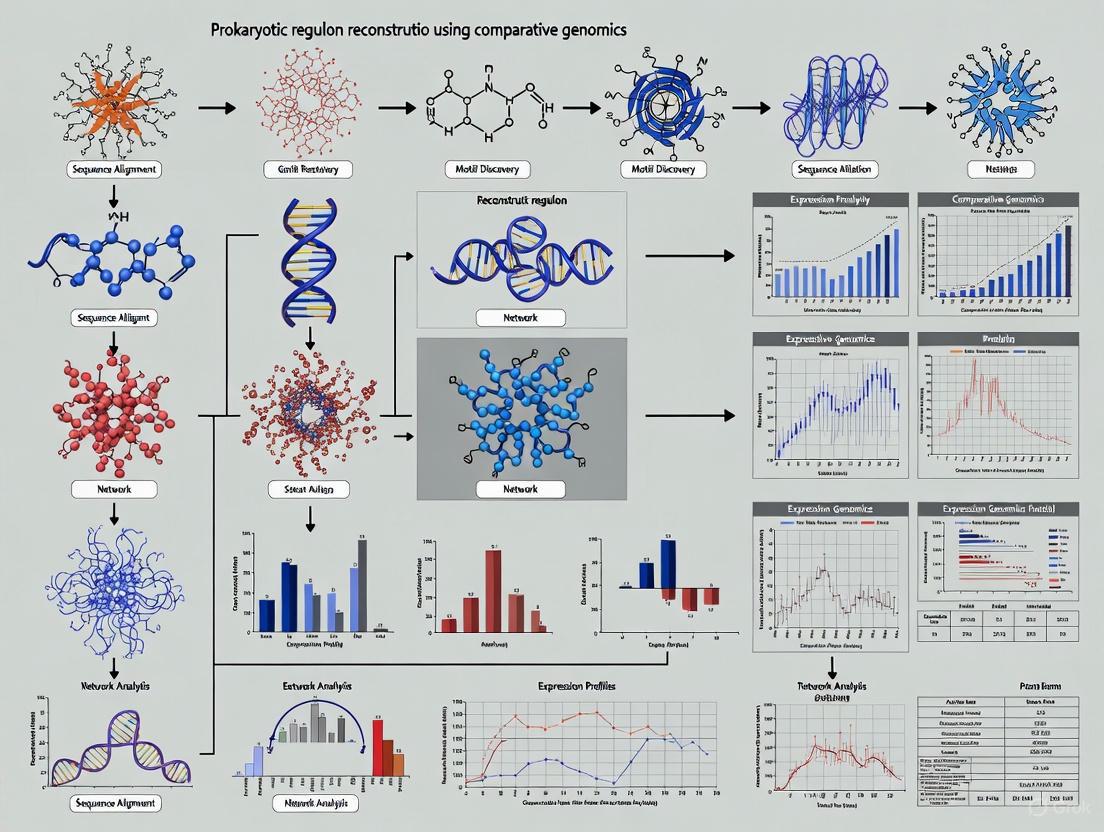
This article provides a comprehensive overview of the computational reconstruction of prokaryotic transcriptional regulatory networks using comparative genomics.
Reconstructing Prokaryotic Regulons: A Comparative Genomics Guide for Decoding Transcriptional Networks
Abstract
This article provides a comprehensive overview of the computational reconstruction of prokaryotic transcriptional regulatory networks using comparative genomics. It covers foundational concepts of transcription factors and regulons, details established and emerging methodologies for regulon prediction, addresses common challenges and optimization strategies, and discusses techniques for experimental validation and evolutionary analysis. Aimed at researchers and scientists in microbiology and drug development, this guide synthesizes current tools and frameworks to enable accurate prediction of gene regulatory interactions across diverse bacterial species, with direct implications for understanding bacterial pathogenesis, metabolism, and designing novel antimicrobial strategies.
Core Principles of Bacterial Transcription Regulation and Regulon Evolution
Defining Regulons, Transcription Factors, and Their Role in Bacterial Adaptation
In bacterial genetics, a regulon is defined as a set of transcription units (operons) controlled by a single regulatory protein—a transcription factor (TF) [1]. This organization allows for the coordinated expression of multiple genes, often involved in related cellular functions, in response to specific environmental or intracellular signals. The activity of most bacterial transcription factors is modulated by environmental signals, enabling bacteria to adapt rapidly to changing conditions [2]. Transcription factors function by recognizing specific DNA sequences at target promoters and subsequently either activating or repressing transcript initiation by RNA polymerase [2].
Table 1: Key Definitions in Bacterial Transcriptional Regulation
| Term | Definition | Key Characteristic |
|---|---|---|
| Regulon | A set of operons transcriptionally co-regulated by the same regulatory protein [3] [1]. | Enables coordinated response across multiple genetic loci. |
| Transcription Factor (TF) | A DNA-binding protein that activates or represses transcript initiation at specific promoters [2]. | Activity is often controlled by a specific environmental or cellular signal. |
| Operon | A polycistronic transcription unit containing multiple co-regulated genes [4]. | Allows for coordinated expression of functionally related genes. |
| Core Regulon | The set of target genes directly related to the TF's primary signal and conserved across species [4]. | Evolves slowly due to direct functional connection to the signal. |
| Extended Regulon | The set of target genes that reflect adaptations to correlated environmental factors [4]. | Evolves rapidly and is often species- or niche-specific. |
Evolution and Genomic Organization of Regulons
Evolutionary Dynamics of Regulatory Networks
Regulons are not static; they evolve rapidly to allow bacterial adaptation. Comparative genomics studies reveal that orthologous transcription factors often regulate distinct sets of genes in related bacterial species [5]. This evolutionary rewiring is driven by two primary mechanisms: the gain or loss of transcription factor binding sites in the promoters of shared genes, and the acquisition of new target genes through horizontal gene transfer [5]. The concept of core and extended regulons helps frame this evolution. The core regulon comprises functions directly related to the signal relayed by the transcription factor (e.g., oxygen availability for FnrL) and is generally conserved across species. In contrast, the extended regulon includes functions adapted to correlated signals specific to an organism's ecological niche, such as pathogenesis functions in the Mg2+-responsive PhoP regulon of some species [4].
Physical Organization in the Genome
The component operons of a regulon are not randomly distributed in the bacterial chromosome. Computational studies of E. coli and B. subtilis have demonstrated that operons belonging to the same regulon tend to form clusters in terms of their genomic locations [3]. These clusters often consist of genes working in the same metabolic pathway. Furthermore, the global arrangement of regulons in a genome appears to follow an organizational principle that minimizes the total distance between the TF and all its target operons, suggesting selective pressure for efficient co-regulation [3]. Interestingly, the genomic locations of transcription factors themselves are under stronger evolutionary constraints than the locations of their target genes [3].
The following diagram illustrates the key concepts of regulon organization and evolution:
Diagram 1: Regulon structure and evolutionary dynamics. TFs control a regulon composed of a conserved core and a variable extended regulon, driving adaptation.
Protocols for Regulon Reconstruction and Analysis
Comparative Genomics Workflow for Regulon Prediction
A standard methodology for reconstructing regulons across multiple bacterial genomes leverages comparative genomics to identify conserved transcription factor binding sites (TFBSs) [6].
Protocol Steps:
- Genome Selection and Ortholog Identification: Select a set of evolutionarily related but non-redundant reference genomes. Identify orthologs of the transcription factor of interest across these genomes using bidirectional best-hit BLAST searches and phylogenetic analysis [6].
- Training Set Construction: Compile an initial training set of known regulon members (operons) from model organisms. The upstream regulatory regions of these operons are used to identify a conserved sequence motif [6].
- Motif Discovery and PWM Building: Extract and align upstream sequences of candidate operons. Use expectation-maximization or Gibbs sampling algorithms to identify a conserved TFBS motif. Convert the aligned sites into a position weight matrix (PWM) [6].
- Genomic Scanning and Regulon Expansion: Use the PWM to scan the upstream regions of all genes in the selected genomes. Predict new TFBSs based on a predefined score threshold. Manually curate predictions by analyzing the metabolic context and conserved gene neighborhoods of candidate operons [6].
- Phylogenetic Profiling of Regulons: Compare the reconstructed regulons across different taxonomic groups to identify core (conserved), taxonomy-specific, and genome-specific members. This reveals the evolutionary history of the regulatory network [6].
Experimental Validation Using Sort-Seq for TFBS Characterization
The sort-seq method is a powerful high-throughput experimental technique for quantitatively mapping the relationship between TFBS sequences and their regulatory output [7].
Protocol Steps:
- Library Construction: Engineer a plasmid-based reporter system where the gene for a fluorescent protein (e.g., GFP) is placed under the control of a promoter containing a randomized TFBS library. For an 8-bp core binding site, this library will contain 65,536 (4^8) unique sequence variants [7].
- Cell Sorting and Binning: Transform the plasmid library into a bacterial strain expressing the transcription factor. In the absence of the inducer, subject the cell population to fluorescence-activated cell sorting (FACS). Sort cells into multiple bins based on their level of fluorescence, which corresponds to the strength of transcriptional repression [7].
- Deep Sequencing and Data Analysis: Isolate plasmids from each bin and deep-sequence the TFBS region. For each sequence variant, the distribution across bins is used to compute a quantitative measure of repression strength, creating a comprehensive genotype-phenotype map [7].
- Landscape Analysis: Analyze the resulting data to determine the ruggedness of the regulatory landscape, identify epistatic interactions between nucleotides, and model the evolutionary accessibility of high-affinity binding sites [7].
The following diagram outlines the core workflow for the comparative genomics approach:
Diagram 2: Comparative genomics workflow for regulon reconstruction.
The Scientist's Toolkit: Research Reagent Solutions
Table 2: Essential Reagents and Resources for Regulon Research
| Reagent/Resource | Function/Application | Example or Source |
|---|---|---|
| Curated Regulon Databases | Provide reference data for known regulatory interactions and operon structures for comparative analysis. | RegulonDB [1], DBTBS [3], RegPrecise [6] |
| Comparative Genomics Tools | Platforms for motif discovery, TFBS prediction, and regulon reconstruction across multiple genomes. | RegPredict [6] |
| Fluorescent Reporter Plasmids | Engineered constructs for measuring promoter activity and TF regulatory function in vivo. | Plasmid systems with GFP/mCherry [7] |
| Mutagenized TFBS Libraries | Comprehensive sequence variant libraries for characterizing TFBS specificity and mapping regulatory landscapes. | Randomized oligo pools for sort-seq [7] |
| Flow Cytometry with Cell Sorting (FACS) | High-throughput measurement and physical separation of cells based on reporter gene expression levels. | Used in sort-seq protocol [7] |
| High-Throughput Sequencing | Identification and quantification of sequence variants from sorted bins in functional genomics screens. | Illumina sequencing [7] |
| R-Impp | R-Impp, MF:C24H27N3O2, MW:389.5 g/mol | Chemical Reagent |
| Risuteganib | Risuteganib, CAS:1307293-62-4, MF:C22H39N9O11S, MW:637.7 g/mol | Chemical Reagent |
Application Note: Predicting Niche-Specific Adaptation inBifidobacterium
Large-scale genomic reconstruction of carbohydrate utilization regulons in Bifidobacterium exemplifies the power of comparative genomics for predicting strain-specific adaptations with direct implications for probiotic development [8]. By analyzing the distribution of 589 curated metabolic gene functions (catabolic enzymes, transporters, and transcriptional regulators) across 3,083 genomes, researchers reconstructed 68 pathways for utilizing dietary glycans [8].
This analysis revealed extensive inter- and intraspecies functional heterogeneity. For instance, a distinct clade within Bifidobacterium longum was identified that possesses the unique ability to metabolize α-glucans, a capability not shared by all conspecifics [8]. Furthermore, isolates from a Bangladeshi population carried unique gene clusters for utilizing xyloglucan (a plant hemicellulose) and human milk oligosaccharides (HMOs), suggesting local genomic adaptation to dietary components [8]. This regulon-based compendium provides a framework for rationally designing probiotic and synbiotic formulations tailored to the specific glycan utilization profiles of strains and the dietary habits of target human populations [8].
In prokaryotes, the regulation of gene expression is a complex process orchestrated by the interplay of transcription factors (TFs), sigma factors, and their cognate DNA binding sites. These components form the foundational circuitry of transcriptional regulatory networks, enabling bacteria to adapt to environmental changes, metabolize diverse nutrients, and coordinate growth. Within the framework of comparative genomics, the systematic identification and characterization of these elements allow for the reconstruction of regulons—sets of genes or operons controlled by a common regulator. This application note details the key molecular components, experimental methodologies, and computational protocols for reconstructing prokaryotic regulons, providing a structured resource for researchers, scientists, and drug development professionals engaged in microbial genomics and systems biology.
Key Molecular Components in Prokaryotic Transcription
The following table summarizes the core components involved in the initiation and regulation of prokaryotic transcription.
Table 1: Core Molecular Components of Prokaryotic Transcription Initiation and Regulation
| Component | Molecular Function | Role in Regulon Reconstruction |
|---|---|---|
| Sigma Factor (σ) | Enables RNA polymerase (RNAP) promoter recognition and binding; facilitates promoter DNA melting [9] [10]. | Serves as a primary regulator of global transcriptional responses; diversity indicates niche specialization. |
| Core RNA Polymerase | Catalyzes DNA-directed RNA synthesis [9]. | A ubiquitous "housekeeping" complex; its interaction with sigma factors is a key regulatory node. |
| Transcription Factor (TF) | Sequence-specific DNA-binding protein that activates or represses transcription initiation [11]. | The defining regulator of a regulon; its binding sites define regulon membership. |
| TF Binding Site (TFBS) | Short, specific DNA sequence (motif) recognized and bound by a TF [11]. | The genomic "signature" used to identify all genes within a regulon. |
| Anti-Sigma Factor | Protein that binds to and inhibits sigma factor activity, preventing transcription initiation [10]. | An additional layer of post-translational regulation for sigma-dependent regulons. |
Quantitative Data and Genomic Analysis
Large-scale genomic studies provide quantitative insights into the distribution and variability of these components across bacterial taxa. The following table summarizes findings from a major genomic analysis of carbohydrate utilization in Bifidobacterium, illustrating the scale of regulon diversity [8].
Table 2: Quantitative Summary of a Large-Scale Genomic Reconstruction of Carbohydrate Utilization Regulons in Bifidobacterium [8]
| Analysis Parameter | Quantitative Result |
|---|---|
| Number of Non-Redundant Genomes Analyzed | 3,083 |
| Number of Curated Metabolic Functional Roles | 589 |
| Number of Reconstructed Catabolic Pathways | 68 |
| Pathways for Mono-/Disaccharides | 18 |
| Pathways for Di-/Oligosaccharides | 39 |
| Pathways for Polysaccharides | 11 |
| Accuracy of Genomics-Based Phenotype Predictions (vs. in vitro growth data) | 94% |
This study highlights extensive inter- and intraspecies functional heterogeneity. For instance, the phenotypic richness (number of utilization pathways) varied significantly even between phylogenetically close subspecies, driven by the presence or absence of pathways for substrates like fucosylated human milk oligosaccharides (HMOs) and plant oligosaccharides [8].
Experimental Protocols
Protocol 1: In Silico Reconstruction of a Transcription Factor Regulon
This protocol outlines the comparative genomics workflow for reconstructing a TF regulon, based on the methodology applied to LacI-family regulators [11].
4.1.1. Materials and Reagents
- Genomic Sequences: A set of complete or draft genomes from the target bacterial lineage(s).
- Bioinformatics Software:
- Genome Annotation Pipeline: (e.g., Prokka) for initial gene calling.
- Ortholog Grouping Tool: Software implementing the bidirectional best-hit criterion (e.g., ProteinOrtho, OrthoFinder).
- Motif Discovery Suite: (e.g., MEME, GLAM2) for identifying conserved DNA motifs.
- Phylogenetic Tree Software: (e.g., RAxML, FastTree) for building maximum-likelihood trees.
4.1.2. Procedure
- TF Identification: Identify all genes encoding TFs of a specific family (e.g., LacI) in your target genomes using homology searches (e.g., BLASTP) and domain prediction (Pfam domains PF00356 for DNA-binding and PF00532 for sugar-binding) [11].
- Define Orthologous Groups: Cluster the identified TFs into orthologous groups using a combination of bidirectional best-hit analysis and phylogenetic tree construction [11].
- Identify Candidate Regulon Members: For each orthologous TF group, select upstream regulatory regions of (i) the TF gene itself and (ii) genes encoding potential target metabolic enzymes (e.g., glycosyl hydrolases, transporters) based on genomic context.
- Discover Conserved Motifs: Use motif discovery software on the collected upstream regions to identify a conserved, palindromic DNA motif (the putative TFBS).
- Reconstruct the Regulon: Scan the upstream regions of all genes in the genome with the identified motif to define the full set of candidate target genes.
- Infer TF Function: Analyze the functional annotations of the target genes to infer the biological role of the TF and its potential effector ligand (e.g., a specific sugar).
Protocol 2: In Vitro Validation of Predicted Carbohydrate Utilization Phenotypes
This protocol describes a method for validating genomics-based predictions of substrate utilization, as used in bifidobacterial studies [8].
4.2.1. Materials and Reagents
- Bacterial Strains: The validated or newly isolated bacterial strains to be tested.
- Growth Media: Chemically defined or semi-defined liquid medium, lacking carbohydrates.
- Carbon Sources: Purified candidate glycans (e.g., HMOs, plant oligosaccharides) to be tested.
- Sterile Culture Ware: Anaerobic chambers or jars for cultivating anaerobic gut bacteria.
- Spectrophotometer: For measuring optical density (OD) to quantify growth.
4.2.2. Procedure
- Preparation: Inoculate strains into a rich medium and incubate under appropriate conditions. Harvest cells in the mid-exponential phase.
- Basal Washes: Wash the cell pellets twice with a carbohydrate-free basal medium to deplete endogenous carbon stores.
- Inoculation: Inoculate the washed cells into the defined growth medium supplemented with a specific test glycan as the sole carbon source. Include a negative control (no carbon source) and positive controls (e.g., glucose, lactose).
- Growth Monitoring: Measure the OD at 600nm (OD600) at regular intervals over a 24-48 hour period.
- Data Analysis: Calculate the maximum OD and growth rate for each strain on each substrate. A strain is confirmed as a "utilizer" if its growth significantly exceeds that of the negative control.
Visualization of Workflows and Mechanisms
Sigma Factor-Core RNA Polymerase Interaction in Transcription Initiation
Comparative Genomics Workflow for Regulon Reconstruction
The Scientist's Toolkit: Research Reagent Solutions
The following table lists key reagents, databases, and software tools essential for prokaryotic regulon reconstruction.
Table 3: Essential Research Reagents and Resources for Regulon Reconstruction
| Item Name | Specifications / Example Sources | Primary Function in Research |
|---|---|---|
| Curated Genomic Compendium | Non-redundant dataset of isolate genomes and high-quality MAGs (completeness ≥97%, contamination ≤3%) [8]. | Provides the foundational data for comparative genomics and pangenome-scale analysis. |
| Functional Role Annotation Set | Manually curated set of gene functions (e.g., 589 roles for glycan metabolism [8]). | Enables accurate pathway reconstruction and phenotype prediction, surpassing automated annotations. |
| RegPrecise Database | Public database (http://regprecise.lbl.gov) for curated collections of reconstructed regulons [11]. | Repository of reference regulons for validation and comparative analysis. |
| dbCAN Database | Database for Carbohydrate-Active Enzyme (CAZyme) annotation [8]. | Critical for annotating glycan catabolic enzymes in metabolic reconstructions. |
| MicrobesOnline Database | Platform for integrated comparative genomics, including phylogenetic trees and gene orthology [11]. | Aids in ortholog identification and evolutionary analysis. |
| Motif Discovery Software (MEME Suite) | Tools for de novo discovery of conserved DNA motifs from upstream sequences [11]. | Identifies the cis-regulatory binding motif for a TF. |
| Random Forest Classifier | Machine learning model trained on reference genomic signatures [8]. | Automates the prediction of metabolic phenotypes (e.g., glycan utilization) from genomic data. |
| RK-287107 | RK-287107, MF:C22H26F2N4O2, MW:416.5 g/mol | Chemical Reagent |
| RL648_81 | RL648_81, MF:C17H17F4N3O2, MW:371.33 g/mol | Chemical Reagent |
The Power of Comparative Genomics for Large-Scale Regulon Prediction
The prediction of regulons—sets of genes or operons controlled by a common transcription factor—is fundamental to understanding genetic regulatory networks. For prokaryotic systems, where experimental data can be sparse, comparative genomics techniques provide a powerful in silico approach for large-scale regulon reconstruction. These methods leverage the evolutionary principle that functional relationships, including coregulation, are often conserved across species. By analyzing patterns of genome organization and evolution across multiple organisms, researchers can accurately predict regulon memberships and their associated cis-regulatory motifs, enabling the reconstruction of entire regulatory networks on a genome-wide scale [12] [13].
This application note details the primary computational protocols for prokaryotic regulon prediction, focusing on methods based on conserved operon structures, protein fusion events, and correlated evolutionary patterns (phylogenetic profiles). We provide step-by-step methodologies, implementation details, and validation techniques to guide researchers in applying these powerful comparative genomics strategies.
Core Methodologies for Regulon Prediction
Three principal comparative genomics methods are optimized for predicting functional interactions and coregulated sets of genes. The following sections provide detailed protocols for each.
Method 1: Predictions Based on Conserved Operons
Principle: If two genes are consistently found within the same operon across multiple genomes, they are likely functionally related and potentially coregulated. Conservation of this arrangement across larger evolutionary distances provides stronger evidence for a functional link [12] [13].
Experimental Protocol:
- Identify Homologs: For each gene in the target genome, perform a BLAST search against a database of other complete genomes (e.g., 23 other bacterial genomes) using an E-value cutoff of 10-5 to identify homologs [12].
- Find Conserved Gene Pairs: Identify all pairs of non-homologous genes (i and j) in the target genome that have homologs located within the same operon in at least two other distinct genomes.
- Score Interactions: Calculate a weighted interaction score (aij) for each gene pair. The score is weighted by the evolutionary distance between the genomes exhibiting the conserved operon structure. Pairs conserved in more distantly related organisms receive higher confidence scores [12].
- Construct Interaction Matrix: Build an N×N interaction matrix for the target genome (where N is the number of genes). Set all diagonal values (homologous links) to zero to prevent clustering of homologous proteins.
- Cluster Genes: Apply a hierarchical clustering algorithm to the interaction matrix using an evolutionary distance cutoff (e.g., 0.1) to group genes into predicted coregulated sets, or regulons [12].
Method 2: Predictions Based on Protein Fusions (Rosetta Stone Method)
Principle: If two separate proteins in one organism are found as a single fused protein in another organism, the two original proteins are likely functionally interacting or participating in the same pathway [12].
Experimental Protocol:
- Search for Fusion Events: For all non-homologous protein pairs in the target genome, search a non-redundant protein database for a single polypeptide chain that contains two non-overlapping BLAST hits (E-value < 10-5) to the respective proteins [12].
- Weight the Evidence: For each linking fusion protein, calculate an interaction score based on the BLAST E-values of the two constituent hits. Use the higher of the two E-values in the calculation:
- Assign a score of 1.0 if the highest E-value is < 10-40.
- For E-values between 10-5 and 10-40, calculate the score as the negative log of the E-value divided by 10 [12].
- Filter Common Domains: To reduce false positives from common domains, exclude any protein that is linked through fusion events to 50 or more other proteins with scores greater than 0.1 [12].
- Populate Interaction Matrix: Add the calculated scores to the corresponding entries in the master N×N interaction matrix.
Method 3: Predictions Based on Correlated Evolution (Phylogenetic Profiles)
Principle: Proteins that function together in a pathway or complex are often preserved or eliminated together throughout evolution. Thus, homologs of functionally linked genes will be present or absent in the same subset of genomes [12].
Experimental Protocol:
- Construct Phylogenetic Profiles: For each gene in the target genome, create a binary presence-absence profile (phylogenetic profile) across all genomes in the comparison set. A '1' indicates the presence of a homolog (BLAST E-value < 10-5), and a '0' indicates its absence [12].
- Identify Correlated Profiles: Compute the correlation between all pairs of phylogenetic profiles. High correlation suggests a functional interaction.
- Score and Matrix Population: Score the interaction based on the correlation metric and add this to the master interaction matrix. The specific correlation and scoring algorithm should be optimized for the dataset, as detailed methodology was truncated in the available source [12].
Integrated Workflow for Regulon Prediction
The following diagram illustrates the logical workflow integrating the three core methodologies for final regulon prediction.
Workflow for Integrated Regulon Prediction
Computational Implementation andCis-Regulatory Motif Discovery
Software and Data Integration
The three methods are implemented to generate individual N×N interaction matrices. These matrices are summed to produce a final integrated matrix of functional interaction predictions [12]. This matrix is then clustered to define the initial set of predicted regulons.
- Software Availability: Software for performing these analyses was available via
http://arep.med.harvard.edu/regulon_pred[12]. - Genome Selection: The original analysis utilized 24 complete genomes, including 22 prokaryotes, Saccharomyces cerevisiae, and Caenorhabditis elegans, though motif discovery was focused on the prokaryotes [12].
Motif Discovery with AlignACE
Objective: To identify shared regulatory motifs within the upstream regions of genes in a predicted regulon, thereby validating and refining the regulon membership [12].
Protocol:
- Extract Upstream Sequences: For all genes within a predicted regulon cluster, extract the DNA sequences upstream of their translation start sites.
- Run AlignACE: Use the motif-discovery program AlignACE on the set of upstream sequences to identify overrepresented DNA motifs [12].
- Filter Homologous Motifs: Exclude any motif where more than one-third of its instances are located upstream of homologous genes. This ensures the discovery of regulatory motifs rather than conserved protein-coding sequences [12].
- Refine Regulons: Use the presence of a significant, shared upstream motif to refine the initial regulon prediction. The final regulon should include only the subset of genes that both cluster together and share the significant regulatory element in their upstream regions [12].
Validation and Application
Benchmarking and Quantitative Measures
Evaluating the performance of regulon prediction methods requires robust quantitative measures. While traditional metrics like gene counts are useful, more sophisticated measures such as Annotation Edit Distance (AED) can quantify the structural changes in gene models and regulatory annotations between database releases, providing a finer-grained view of annotation refinement [14].
Case Study: Expanding the CRP and FNR Regulons
A comparative genomics approach between Escherichia coli and Haemophilus influenzae successfully expanded the known regulons for the global transcription factors CRP (cAMP receptor protein) and FNR (fumarate and nitrate reduction regulatory protein) [13].
Protocol for Application:
- Build Weight Matrices: Create position-specific weight matrices for the transcription factor (e.g., CRP, FNR) by aligning known binding sites from a well-studied organism (e.g., E. coli) using tools like CONSENSUS [13].
- Predict Binding Sites: Scan the upstream regions of all genes in both the target and reference genomes for matches to the weight matrix using a tool like PATSER.
- Integrate Orthology and Operon Data: Combine the predicted binding sites with data on orthologous genes and predicted transcription units (operons) in both genomes.
- Predict Novel Regulon Members: Genes are predicted as novel regulon members if their orthologs in another genome are also predicted to be bound by the same factor, leveraging the principle of regulon conservation [13].
Research Reagent Solutions
The following table catalogues key computational tools and data resources essential for conducting the regulon prediction protocols described herein.
Table 1: Key Research Reagents and Resources for Comparative Regulon Prediction
| Resource Name | Type | Function in Protocol | Example/Reference |
|---|---|---|---|
| BLAST | Software | Identifies homologous genes and proteins across genomes for all three methods [12]. | [12] |
| AlignACE | Software | Discovers overrepresented regulatory DNA motifs in upstream sequences of predicted regulons [12]. | [12] |
| CONSENSUS/PATSER | Software | Builds weight matrices from known sites and scans for new binding sites for specific TFs like CRP/FNR [13]. | [13] |
| Curated Genome Database | Data | Provides essential comparative data; requires multiple complete, annotated genomes (e.g., 24 genomes used in original study) [12]. | WIT database [12] |
| Non-Redundant Protein DB | Data | Used for identifying protein fusion (Rosetta Stone) events [12]. | NCBI nr database |
| Annotation Edit Distance (AED) | Metric | Quantifies changes in gene model structure, useful for tracking annotation refinement and benchmarking [14]. | [14] |
The integrated application of conserved operon, protein fusion, and phylogenetic profile analyses provides a robust, computational framework for the large-scale prediction of regulons in prokaryotic organisms. The power of this comparative genomics approach is significantly enhanced by subsequent motif discovery, which serves to validate and refine the initial predictions. Adherence to the detailed protocols and utilization the specified research reagents will enable researchers to reconstruct and analyze transcriptional regulatory networks in a wide array of bacterial and archaeal species, dramatically accelerating systems-level biological understanding.
A regulon, defined as a set of genes or operons directly co-regulated by a single transcription factor (TF), constitutes a fundamental unit of transcriptional organization in prokaryotes [6] [15]. Understanding the evolutionary dynamics of regulons—how they expand, shrink, and undergo replacement—is critical for deciphering the adaptation of microbial metabolism to diverse environmental conditions [6]. These dynamics are driven by processes including the duplication and loss of transcription factors and their binding sites, leading to observable evolutionary events such as regulon mergers, splits, and the recruitment of non-orthologous regulators [6]. Comparative genomics provides a powerful approach to reconstruct these dynamics across diverse bacterial lineages, revealing the principles governing the evolution of transcriptional regulatory networks [6]. This Application Note details the protocols and conceptual frameworks for analyzing these processes, providing researchers with methodologies to investigate regulon evolution within the broader context of prokaryotic systems biology.
Quantitative Landscape of Regulon Evolution
Large-scale comparative genomic studies have begun to quantify the scale of regulon dynamics. One comprehensive analysis of 33 orthologous groups of transcription factors across 196 reference genomes from 21 taxonomic groups of Proteobacteria predicted over 10,600 TF binding sites and identified more than 15,600 target genes for 1,896 transcription factors [6]. The study demonstrated that regulon composition varies significantly, with core, taxonomy-specific, and genome-specific members classified by their metabolic functions [6].
Table 1: Documentated Cases of Regulon Dynamics in Proteobacteria
| Evolutionary Process | Specific Example | Observed Outcome | Taxonomic Scope |
|---|---|---|---|
| Non-Orthologous Replacement | Methionine metabolism regulation | MetJ/MetR (Gammaproteobacteria) replaced by SahR/SamR or RNA riboswitches in other lineages [6] | Multiple lineages of Proteobacteria |
| Lineage-Specific Expansion | MetR regulon in Gammaproteobacteria | Core includes only metE and metR; extensive lineage-specific target gene additions [6] | Gammaproteobacteria |
| Functional Shift | Branched-chain amino acid, N-acetylglucosamine, and biotin utilization | LiuR/LiuQ, NagC/NagR/NagQ, and BirA/BioR regulons show lineage-specific expansions and substitutions [6] | Various bacterial taxa |
| Novel Regulon Prediction | Aromatic amino acid metabolism in Alteromonadales and Pseudomonadales | Prediction of novel regulators HmgS and HmgQ replacing TyrR/PhrR and HmgR regulons [6] | Alteromonadales and Pseudomonadales |
| Novel Regulon Prediction | NAD metabolism in Betaproteobacteria and Alphaproteobacteria | Prediction of a novel regulator, NadQ [6] | Betaproteobacteria and Alphaproteobacteria |
Experimental and Computational Protocols
Core Workflow for Comparative Genomic Reconstruction of Regulons
The foundational approach for studying regulon evolution involves the comparative genomic reconstruction of regulons across multiple related genomes. The following workflow, implemented in the RegPredict server, provides a standardized protocol for this analysis [15].
Protocol 1: Regulon Reconstruction via Comparative Genomics
Principle: This protocol leverages conservation of TF binding sites across evolutionarily related genomes to identify regulon members and assess their conservation patterns [6] [15].
Step-by-Step Procedure:
- Genome Selection: Select a set of 4-16 taxonomically related prokaryotic genomes from the MicrobesOnline database. Avoid including very closely related strains to prevent skewing the training set [6].
- Workflow Selection:
- Path A (Known Motif): If a Positional Weight Matrix (PWM) for the TF of interest is available from databases like RegPrecise, RegTransBase, or RegulonDB, use the "Regulon inference based on known PWM" workflow [15].
- Path B (De Novo Inference): If no PWM is available, use the "De novo regulon inference workflow." Construct a training set of potentially co-regulated genes based on: a) genes from a functional pathway; b) genes homologous to known regulon members in a model organism; c) genes from conserved operons containing the TF gene; or d) genes with co-expression data [15].
- Motif Identification and CRON Construction:
- For Path A, scan all upstream regions in the target genomes with the known PWM.
- For Path B, identify conserved candidate TFBS motifs in the upstream regions of the training set using a MEME-like iterative algorithm to build a de novo PWM [15].
- The system automatically constructs CRONs (Clusters of co-Regulated Orthologous operons), which group orthologous operons that share candidate TFBSs. This facilitates the assessment of conservation levels [15].
- Manual Curation and Regulon Finalization:
- Manually review each CRON via the RegPredict interactive web interface, which integrates genomic context and functional information.
- Accept CRONs with strong phylogenetic conservation of TFBSs.
- The final regulon model is synthesized from all accepted CRONs [15].
Protocol for Analyzing Regulon Dynamics Using iModulons in Evolved Strains
Adaptive Laboratory Evolution (ALE) coupled with transcriptomic analysis can reveal regulon dynamics in response to specific stresses, even in hypermutator strains where genomic analysis is complex [16].
Protocol 2: iModulon Analysis of Evolved Strains
Principle: Independent Component Analysis (ICA) is applied to large transcriptomic compendia to identify iModulons—independently modulated gene sets that often correspond to regulons. This top-down approach simplifies the analysis of global transcriptomic changes [16].
Step-by-Step Procedure:
- Strain Generation and RNA-seq:
- Perform ALE under a stress condition of interest (e.g., high temperature) to generate evolved strains [16].
- Prepare RNA-seq libraries from the evolved strains and an ancestral control under multiple relevant conditions.
- iModulon Activity Calculation:
- Map the RNA-seq data to a pre-established iModulon structure for the organism (available at iModulonDB.org).
- Calculate the activity level of each iModulon in every sample. This activity represents the strength of the coregulated signal [16].
- Identification of Adaptive Regulatory Changes:
- Compare iModulon activities between evolved and ancestral strains.
- Identify iModulons with consistently altered activities, which indicate selected-for regulatory changes. For example, in heat-evolved E. coli, this might include the downregulation of general stress response iModulons and the upregulation of specific heat shock iModulons [16].
- Integration with Genomic Data:
- Cross-reference the list of iModulons with altered activities with mutation data from the evolved strains, focusing on mutations in known regulatory genes (e.g., transcription factors, sigma factors) that may explain the observed transcriptomic changes [16].
Table 2: Essential Resources for Regulon Evolution Research
| Resource Name | Type | Primary Function in Analysis | Access Information |
|---|---|---|---|
| RegPredict | Web Server | Provides integrated tools for comparative genomic inference of regulons using known PWM or de novo workflows [15]. | http://regpredict.lbl.gov |
| MicrobesOnline | Database | Supplies genomic sequences, precomputed orthologs, and operon predictions essential for comparative analysis [6] [15]. | https://www.microbesonline.org/ |
| RegPrecise | Database | Collection of manually curated, computationally predicted regulons and TF binding sites across diverse prokaryotes, used for reference and PWM extraction [6] [15]. | http://regprecise.lbl.gov |
| MEME Suite | Software Toolkit | Used for de novo discovery of conserved DNA motifs (e.g., TFBSs) in upstream sequences of candidate co-regulated genes [17] [15]. | https://meme-suite.org/ |
| iModulonDB | Database | Provides pre-computed iModulon structures for several organisms, enabling transcriptomic analysis of regulon activities in evolved or perturbed strains [16]. | https://imodulondb.org |
Visualization of Evolutionary Patterns
The evolutionary dynamics of regulons can be conceptualized through specific patterns of change, which can be systematically identified using the protocols outlined above.
Concluding Remarks
The evolutionary dynamics of regulons—expansion, shrinkage, and replacement—are fundamental processes shaping the functional adaptability of prokaryotes. The integration of comparative genomics, using tools like RegPredict, with advanced transcriptomic approaches, such as iModulon analysis, provides a powerful, multi-faceted framework for reconstructing and understanding these dynamics. The protocols and resources detailed in this Application Note equip researchers with standardized methods to investigate how transcriptional regulatory networks evolve in response to environmental challenges and metabolic requirements. This knowledge is essential not only for fundamental microbial ecology and evolution but also for applied fields including metabolic engineering and drug development, where predicting and manipulating regulatory outcomes is crucial.
Methodologies and Tools for Computational Regulon Reconstruction
Reconstructing the full set of genes controlled by a regulator (regulon) in prokaryotes is fundamental to understanding bacterial physiology, metabolism, and adaptation. This process typically follows a defined workflow, beginning with the identification of a regulator's DNA-binding motif and culminating in the inference of a complete regulatory network across multiple genomes. Comparative genomics significantly enhances this process by leveraging evolutionary conservation to distinguish functional regulatory sites from random genomic sequences [15] [6]. This Application Note provides a detailed protocol for prokaryotic regulon reconstruction, framed within a comparative genomics strategy, to guide researchers in systematically moving from motif discovery to network inference.
Workflow Fundamentals and Key Concepts
The foundational unit of transcriptional regulation is the transcription factor binding site (TFBS), a short ( typically 12-30 bp), specific DNA sequence to which a transcription factor (TF) binds [15]. The pattern of nucleotides within a set of known TFBSs can be summarized into a positional weight matrix (PWM) or position-specific scoring matrix (PSSM), which quantifies the probability of each nucleotide at each position and serves as a computational model for identifying additional sites [15] [19].
A regulon is defined as the complete set of operons (and thus genes) directly controlled by a single TF [15] [6]. Comparative genomics approaches for regulon inference are based on the principle that functional TFBSs are often conserved in the upstream regions of orthologous genes across related genomes [15] [6]. The Cluster of co-Regulated Orthologous operons (CRON) is a key concept for managing this comparative analysis, where a regulon is broken down into sub-regulons of orthologous operons that share a common regulatory motif [15].
Detailed Experimental Protocol
Phase I: Motif Discovery
Objective: To identify a de novo DNA-binding motif for a transcription factor of unknown specificity.
Methods:
Training Set Generation: Compile a set of DNA sequences suspected to be co-regulated. Sources include:
- Functional Pathway: Genes encoding enzymes in a defined metabolic pathway (e.g., amino acid biosynthesis) [6].
- Genomic Context: Genes located in conserved chromosomal loci near the TF gene itself [15].
- Expression Data: Genes showing co-expression under specific conditions from transcriptomic studies (e.g., RNA-seq) [15].
- The recommended sequence length is typically from -400 to +50 bp relative the translation start site.
De Novo Motif Finding: Submit the FASTA-formatted sequence set to one or more motif discovery tools.
- MEME: Uses expectation maximization to find widely conserved, ungapped motifs [20].
- Weeder: Performs an exhaustive enumeration to find motifs conserved in a large fraction of input sequences [20].
- ChIPMunk: An iterative greedy algorithm that combines optimization with bootstrapping [20].
- HOMER: A differential discovery algorithm designed for genomic applications, which identifies motifs enriched in one sequence set relative to a background set [21].
Motif Validation and PWM Construction: The significant motifs identified by the above tools must be aligned. Use this multiple sequence alignment of putative TFBSs to build a PWM. Tools like WebLogo can generate a sequence logo for visual validation [6].
Table 1: Common Motif Discovery Tools and Their Characteristics
| Tool | Algorithm Type | Key Feature | Best For |
|---|---|---|---|
| MEME [20] | Expectation-Maximization | Finds broad, conserved motifs | Initial discovery with a confident training set |
| Weeder [20] | Exhaustive Enumeration | Finds motifs conserved in many sequences | Identifying very overrepresented motifs |
| ChIPMunk [20] | Greedy Optimization + Bootstrapping | Fast and efficient | Large sequence sets |
| HOMER [21] | Differential Enrichment (Hypergeometric) | Identifies motifs enriched vs. a background set | ChIP-seq or differentially expressed gene sets |
Phase II: Regulon Inference and Expansion
Objective: To use the PWM to scan genomes and identify all potential regulon members.
Methods:
Genomic Scanning: Use the PWM (converted to a PSSM) to scan the upstream regions of all genes in a target genome. This can be done with custom scripts or integrated platforms.
Comparative Genomics and CRON Construction: To improve prediction accuracy, perform scanning across multiple taxonomically related genomes (e.g., 4-16 genomes) [6].
Probabilistic Framework for Site Assessment: To overcome the limitations of fixed score cut-offs, a Bayesian framework can be employed [19]. This estimates the posterior probability of regulation for a promoter by comparing the distribution of scores in a regulated promoter (a mixture of background and true site distributions) against the background distribution genome-wide [19].
Phase III: Network Inference and Validation
Objective: To reconstruct the complete regulatory network and validate predictions.
Methods:
Regulon Propagation: The refined PWM is used to scan additional genomes within the taxonomic group to propagate the regulon reconstruction [15] [6]. This reveals the core (conserved), taxonomy-specific, and genome-specific members of the regulon [6].
Functional Context Analysis: Analyze the metabolic pathways and biological functions of the predicted regulon members. This step provides biological validation and can reveal the global role of the TF [11].
Experimental Validation: Computational predictions require experimental confirmation. Key techniques include:
- Electrophoretic Mobility Shift Assay (EMSA) to test TF binding to predicted promoter regions.
- Chromatin Immunoprecipitation followed by sequencing (ChIP-seq) to map in vivo binding sites genome-wide.
- RT-qPCR or RNA-seq to measure expression changes of target genes upon TF knockout or overexpression.
Table 2: Key Databases and Software for Regulon Reconstruction
| Category | Name | Function | URL/Access |
|---|---|---|---|
| Integrated Workflows | RegPredict [15] | Web server for comparative reconstruction of microbial regulons. | http://regpredict.lbl.gov |
| CGB [19] | Flexible platform for comparative genomics using a Bayesian framework. | Custom pipeline | |
| Motif Discovery | MEME Suite [20] | Integrated tools for de novo motif discovery and scanning. | http://meme-suite.org |
| HOMER [21] | Software for motif discovery and ChIP-seq analysis. | http://homer.ucsd.edu | |
| Databases | RegPrecise [15] [6] | Manually curated database of reconstructed regulons and PWMs. | http://regprecise.lbl.gov |
| MicrobesOnline [15] [6] | Provides genomic sequences, orthologs, and operon predictions. | http://microbesonline.org | |
| RegTransBase [15] | Literature-based database of experimental regulatory interactions. | http://regtransbase.lbl.gov |
Workflow Visualization
Main Regulon Inference Workflow
CRON Construction Logic
Anticipated Results and Interpretation
A successful regulon reconstruction will yield a set of genes consistently predicted to be under the control of a specific TF across multiple genomes. The results are typically categorized into:
- Core Regulon Members: Genes consistently regulated across most or all genomes in the taxonomic group. These often encode key enzymes in a conserved metabolic pathway [6].
- Lineage-Specific Members: Genes found in the regulon of only a subset of genomes, reflecting adaptive evolution and niche specialization [6].
- Novel Functional Associations: Hypothetical proteins or uncharacterized transporters that are consistently co-regulated with genes of known function, providing strong evidence for their involvement in a specific pathway [6] [11].
The evolutionary analysis of reconstructed regulons can reveal phenomena such as non-orthologous replacement of regulators, where different TFs control equivalent pathways in different lineages, and regulon fusion or fission events [6].
The accurate reconstruction of transcriptional regulatory networks (TRNs) is a fundamental challenge in microbial genomics and systems biology. Regulons, defined as sets of genes or operons co-regulated by a common transcription factor (TF) or RNA regulatory element, form the building blocks of these networks [15] [22]. The emergence of comparative genomics approaches has revolutionized this field by leveraging the principle that functional TF-binding sites (TFBSs) are often evolutionarily conserved across related genomes, whereas false positive sites are randomly scattered [15] [23]. This evolutionary conservation provides a powerful filter for distinguishing true regulatory interactions. Dedicated computational platforms have been developed to automate and standardize the process of regulon inference, enabling researchers to move from genomic sequences to predicted regulatory networks in a systematic manner. These tools have become indispensable for generating hypotheses about gene function, understanding microbial adaptation, and reconstructing genome-scale metabolic models with regulatory constraints [24] [8].
Table 1: Key Computational Platforms for Prokaryotic Regulon Reconstruction
| Platform | Primary Function | Key Methodology | Data Sources | User Interface |
|---|---|---|---|---|
| RegPredict | Regulon inference and analysis | Comparative genomics, CRON construction | MicrobesOnline, RegPrecise, RegTransBase, RegulonDB | Web server [15] |
| CGB | Comparative regulon reconstruction | Bayesian probabilistic framework, gene-centered analysis | User-provided genomes, NCBI accessions | Standalone pipeline [23] [19] |
| RegPrecise | Database of curated regulons | Collection and visualization of inferred regulons | Manually curated regulons from comparative genomics | Web resource [22] [24] |
Platform-Specific Application Notes and Protocols
RegPredict: An Integrated System for Regulon Inference
Application Notes: RegPredict is designed specifically for comparative genomics reconstruction of microbial regulons using two well-established workflows: reconstruction for known regulatory motifs and ab initio inference of novel regulons [15]. A key innovation in RegPredict is the implementation of Clusters of co-Regulated Orthologous operons (CRONs), which address challenges in comparative analysis by grouping orthologous operons with candidate TFBSs and evaluating the conservation level of regulatory interactions [15]. This approach is particularly valuable for analyzing large regulons controlled by global transcription factors, such as CRP in Proteobacteria and CcpA in Firmicutes. The platform integrates genomic sequences, ortholog predictions, and operon structures from the MicrobesOnline database, providing researchers with a unified environment for regulon analysis across multiple genomes [15].
Experimental Protocol: Known PWM-Based Regulon Reconstruction
Input Preparation: Select a group of up to 15 taxonomically related prokaryotic genomes from the MicrobesOnline database available within RegPredict [15].
Motif Selection: Choose a Position Weight Matrix (PWM) from the integrated collections, which include manually curated motifs from RegPrecise, literature-based motifs from RegTransBase, or experimentally characterized motifs from RegulonDB [15].
Genome Scanning: Execute genome-wide scanning using the selected PWM to identify candidate TFBSs in upstream regions of operons. The scoring threshold can be adjusted based on the desired sensitivity [15].
CRON Construction: Allow the system to automatically construct CRONs by:
- Linking orthologous operons with candidate TFBSs
- Extending clusters by adding orthologous operons lacking candidate TFBSs
- Prioritizing CRONs based on conservation level and site scores [15]
Manual Curation: Use the interactive web interface to evaluate each CRON, examining genomic context and functional information from integrated resources before accepting CRONs into the final regulon model [15].
Regulon Generation: Combine all accepted CRONs for the TFBS motif to generate the reconstructed TF regulon for the target genome group [15].
Experimental Protocol: De Novo Regulon Inference
Training Set Definition: Create a set of potentially co-regulated genes using one of four approaches: (i) genes comprising a functional pathway, (ii) genes homologous to regulons from model organisms, (iii) genes from chromosomal loci containing orthologous TF genes, or (iv) genes with similar expression profiles from microarray data [15].
Motif Discovery: Apply the Discover Profile tool (implementing a MEME-like iterative algorithm) to identify candidate TFBS motifs within upstream regions of training set genes [15].
PWM Construction: Build initial PWM profiles from identified motifs, with options for different motif types including palindromes and direct repeats [15].
Iterative Refinement: Perform cycles of genome scanning and profile refinement to expand the regulon beyond the initial training set, maximizing coverage and consistency [15].
CGB: A Flexible Platform for Comparative Genomics
Application Notes: CGB introduces several conceptual advances in comparative genomics of prokaryotic regulons, including a gene-centered framework rather than the traditional operon-centered approach, which accommodates frequent operon reorganization in evolution [23] [19]. The platform employs a novel Bayesian probabilistic framework for estimating posterior probabilities of regulation, providing easily interpretable and comparable scores across species [23] [19]. Unlike other tools that rely on precomputed databases, CGB has minimal external dependencies and can work with both complete and draft genomic data, offering unprecedented flexibility for analyzing newly sequenced bacterial clades [23] [19]. The automated integration of experimental information from multiple sources using phylogenetic weighting further enhances its utility for studying regulatory network evolution [23].
Experimental Protocol: Gene-Centered Regulon Reconstruction
Input Configuration: Prepare a JSON-formatted input file containing:
Orthology Detection: Identify orthologs of reference TFs in each target genome using the provided accessions [23].
Phylogenetic Analysis: Generate a phylogenetic tree of reference and target TF orthologs to estimate evolutionary distances [23] [19].
Species-Specific PWM Generation: Create weighted mixture PWMs for each target species using the inferred phylogenetic distances, following the CLUSTALW weighting approach [23] [19].
Operon Prediction and Promoter Definition: Predict operons in each target species and extract promoter regions based on average intergenic distance (default: 250bp) [23].
Promoter Scoring: Calculate position-specific scoring matrix (PSSM) scores for all positions in promoter regions, combining forward and reverse strand scores using the formula:
( PSSM(si) = \log2(2^{PSSM(si^f)} + 2^{PSSM(si^r)}) ) [23] [19]
Probability Estimation: Compute posterior probabilities of regulation for each promoter using the Bayesian framework:
Ancestral State Reconstruction: Estimate aggregate regulation probabilities for orthologous gene groups across species using ancestral state reconstruction methods [23].
RegPrecise: A Database of Curated Genomic Inferences
Application Notes: RegPrecise serves as a knowledge base for capturing, visualizing, and analyzing predicted transcription factor regulons in prokaryotes that have been reconstructed through comparative genomics and manual curation [22] [24]. The database employs a hierarchical data structure organized at three levels: individual regulons (genes co-regulated in a specific genome), regulogs (orthologous regulons across related genomes), and collections of regulogs grouped by taxonomy, TF family, or biological pathway [22] [24]. This organization enables multiple analytical perspectives, from studying the conservation of specific regulons across bacterial lineages to exploring the entire transcriptional regulatory network of a particular species [22]. RegPrecise 3.0 significantly expanded its content to include over 781 TF regulogs across more than 160 genomes representing 14 taxonomic groups of Bacteria, plus nearly 400 regulogs operated by RNA regulatory elements [24].
Experimental Protocol: Database-Driven Regulon Analysis
Data Access: Navigate to the RegPrecise web portal (http://regprecise.lbl.gov) and select the appropriate data section based on your analysis goals [22] [24].
Taxonomy-Focused Exploration:
Transcription Factor-Focused Exploration:
- Select a TF family or specific TF of interest
- Compare reconstructed regulogs for orthologous TFs across different taxonomic lineages
- Analyze variations in regulon content and TFBS motifs across evolutionary distances [22]
Pathway-Focused Exploration:
Data Integration:
- Use the reference regulons as training sets for novel predictions
- Apply the web services API for programmatic access to regulatory data
- Download regulatory interactions for integration with metabolic models [24]
Table 2: RegPrecise Database Content and Statistics
| Database Section | Number of Regulogs | Number of Genomes | Taxonomic Coverage | Key Features |
|---|---|---|---|---|
| TF Regulatory Collections | 781 | >160 | 14 taxonomic groups | Position weight matrices, regulated genes, TFBS alignments [24] |
| RNA Regulatory Collections | ~400 | 24 bacterial lineages | Multiple bacterial phyla | Riboswitch motifs, RNA regulatory sites [24] |
| TF-Specific Collections | 40 | >30 taxonomic lineages | Cross-phylum comparisons | Evolution of regulons for orthologous TFs [22] [24] |
| Propagated Regulons | >1500 (estimated) | 640 | Broad bacterial coverage | Automatically propagated from reference regulons [24] |
Table 3: Essential Research Reagents and Computational Resources
| Resource Type | Specific Examples | Function in Regulon Analysis | Access Information |
|---|---|---|---|
| Genomic Databases | MicrobesOnline [15] | Provides genomic sequences, ortholog predictions, and operon structures | http://microbesonline.org |
| Regulatory Databases | RegTransBase [15], RegulonDB [15], DBTBS [24] | Source of experimentally validated TF-binding sites and regulatory interactions | http://regtransbase.lbl.gov, http://regulondb.ccg.unam.mx |
| Motif Discovery Tools | MEME [15], SignalX [15] | Identify novel DNA motifs from sets of co-regulated genes | http://meme-suite.org |
| Sequence Analysis Tools | Infernal [24] | Detection of RNA regulatory elements using covariance models | http://eddylab.org/infernal |
| Orthology Resources | EggNOG [8], Protein accession mappings [23] | Identification of orthologous genes across genomes | http://eggnog5.embl.de, http://ncbi.nlm.nih.gov/protein |
| Programming Environments | Python, R | Implementation of custom analysis scripts and Bayesian frameworks | http://python.org, http://r-project.org |
Workflow Integration and Comparative Analysis
The integration of these platforms creates a powerful pipeline for comprehensive regulon reconstruction, beginning with de novo prediction in RegPredict, progressing through probabilistic validation in CGB, and culminating in database curation and visualization in RegPrecise [15] [23] [24]. This integrated approach addresses the complete lifecycle of regulatory network inference, from initial discovery to comparative analysis and knowledge dissemination.
The complementary strengths of these platforms address different aspects of the regulon reconstruction challenge. RegPredict excels in initial motif discovery and comparative analysis across small to medium-sized taxonomic groups [15]. CGB provides sophisticated probabilistic frameworks for cross-species analysis and evolutionary inference, particularly valuable for studying regulatory network evolution [23] [19]. RegPrecise serves as a repository and visualization platform for accumulating and disseminating curated regulatory annotations [22] [24]. Together, they enable researchers to move from genomic sequences to predictive models of transcriptional regulation, supporting advances in microbial ecology, metabolic engineering, and understanding of bacterial pathogenesis.
The continued development and integration of these platforms represents a critical step toward comprehensive genome-scale annotation of regulatory networks across the bacterial domain. As sequencing technologies make microbial genomes increasingly accessible, these computational resources provide the necessary framework for converting sequence data into predictive models of transcriptional regulation that can guide experimental validation and hypothesis generation [24] [8].
Gene-Centered vs. Operon-Centered Approaches in Modern Analysis
Transcriptional regulon reconstruction is a cornerstone of prokaryotic comparative genomics, fundamental to understanding bacterial physiology, host-pathogen interactions, and antimicrobial resistance [25] [19]. A critical methodological consideration is the choice of the fundamental unit of analysis: the individual gene or the multi-gene operon. Gene-centered approaches treat each gene as an independent regulatory unit, while operon-centered methods analyze groups of co-transcribed genes as a single entity [19] [26]. The strategic selection between these frameworks significantly impacts the prediction accuracy, biological interpretability, and evolutionary insights derived from comparative genomic analyses. This Application Note delineates the technical specifications, experimental protocols, and practical applications of both approaches within the context of prokaryotic regulon reconstruction, providing researchers with a structured framework for methodological selection and implementation.
Conceptual and Technical Comparison
Operons, co-transcribed groups of functionally related genes, represent a fundamental organizational principle in prokaryotic genomes, with approximately 50-60% of bacterial genes organized in such structures [27] [26]. This organization ensures coordinated expression but undergoes frequent evolutionary reorganization through operon splitting, fusion, and gene rearrangement [27] [26]. These dynamic evolutionary processes present significant challenges for purely operon-centered comparative approaches.
Table 1: Core Conceptual Differences Between Analytical Approaches
| Feature | Gene-Centered Approach | Operon-Centered Approach |
|---|---|---|
| Fundamental Unit | Individual gene | Multi-gene operon |
| Handling of Operon Rearrangements | Robust; analyzes regulatory conservation despite genomic reorganization | Limited; relies on conserved operon structure across genomes |
| Regulatory Resolution | High; identifies gene-specific regulation within split operons | Low; assumes uniform regulation across all operon genes |
| Evolutionary Analysis | Trajects regulatory evolution of individual genetic units | Tracks conservation and disintegration of co-regulated gene clusters |
| Comparative Genomics Implementation | Bayesian probabilistic frameworks (e.g., CGB platform) [19] | Conservation of regulatory interactions in orthologous operons (e.g., RegPredict) [15] |
Gene-centered frameworks address these limitations by focusing on the regulatory state of individual genes, treating operons as logical—but not absolute—units of regulation [19]. This approach facilitates tracking regulatory conservation even after operon disintegration, where genes from an ancestral operon may maintain co-regulation through independent promoters under the same transcription factor [19]. The CGB platform exemplifies this methodology, employing a Bayesian framework to compute posterior probabilities of regulation for each gene independently, thereby enabling robust cross-species comparisons despite frequent operon rearrangements [19].
Table 2: Quantitative Performance Metrics in Comparative Genomic Studies
| Analysis Metric | Gene-Centered Method | Operon-Centered Method |
|---|---|---|
| Sensitivity in Divergent Genomes | High (maintains regulatory associations post-operon split) | Reduced (depends on operon structure conservation) |
| False Positive Rate in TFBS Prediction | Lower (integrates evolutionary conservation) | Variable (context-dependent) |
| Computational Framework | Bayesian probability integration [19] | Position Weight Matrix (PWM) scoring [15] |
| Handling of Incomplete Genomes | Effective with draft assemblies [19] | Requires well-annotated, complete genomes |
Experimental Protocols and Methodologies
Protocol 1: Gene-Centered Regulon Reconstruction with CGB Platform
Application: Evolution of regulatory networks across taxonomically diverse bacterial species, particularly when analyzing incomplete genome assemblies or genomes with frequent operon rearrangements.
Experimental Workflow:
Input Preparation
- Compile JSON-formatted input file containing:
- NCBI protein accession numbers for reference transcription factor (TF) instances
- Aligned TF-binding sites for each reference TF
- Accession numbers for target genome chromids/contigs
- Configure parameters: promoter region length, phylogenetic weighting method
- Compile JSON-formatted input file containing:
Orthology and Phylogeny Construction
- Identify TF orthologs in target genomes using BLAST-based search
- Construct phylogenetic tree of reference and target TF orthologs
- Generate weighted mixture Position-Specific Weight Matrix (PSWM) for each target species using CLUSTALW-like weighting based on evolutionary distance [19]
Operon Prediction and Promoter Scanning
- Predict operons in each target species using intergenic distance-based algorithm
- Define promoter regions (typically 250bp upstream of translational start sites)
- Scan promoter regions with species-specific PSWM to identify putative TF-binding sites
Bayesian Probability Calculation
- Calculate posterior probability of regulation for each gene using the framework: where R represents regulated promoter, D observed scores, B background distribution [19]
- Estimate background distribution (B) from genome-wide promoter scores
- Model regulated distribution (R) as mixture of background and motif distributions
Comparative Analysis and Ancestral State Reconstruction
- Identify orthologous gene groups across target species
- Estimate aggregate regulation probability using ancestral state reconstruction methods
- Generate hierarchical heatmaps and tree-based visualizations of regulation probabilities
Technical Notes: The gene-centered approach enables analysis of draft genomes and effectively handles horizontal gene transfer events. The Bayesian framework provides intuitively interpretable probabilities of regulation that are directly comparable across species [19].
Protocol 2: Operon-Centered Analysis with RegPredict
Application: High-confidence regulon propagation in well-annotated genomes from closely related species, particularly for pathway-specific regulation analysis.
Experimental Workflow:
Data Integration
- Select target genomes from MicrobesOnline database (up to 15 simultaneously)
- Retrieve pre-computed operon predictions and orthology assignments
- Select Position Weight Matrices (PWMs) from curated databases (RegPrecise, RegTransBase, RegulonDB) [15]
CRON Construction
- Scan upstream regions of all operons with selected PWM
- Identify candidate TF-binding sites above defined score threshold
- Construct Clusters of co-Regulated Orthologous operons (CRONs) by:
- Linking orthologous operons with candidate TF-binding sites
- Evaluating conservation level of regulatory interactions
- Extending clusters to include orthologous operons lacking candidate sites [15]
Comparative Genomics Validation
- Rank CRONs by conservation level (number of genomes with candidate sites)
- Perform functional enrichment analysis of CRON members
- Manually curate regulatory interactions through interactive web interface
Regulon Propagation
- Combine accepted CRONs to reconstruct complete TF regulon
- Export regulatory network in .sif format for visualization
- Annotate regulatory interactions with confidence metrics based on conservation
Technical Notes: The CRON-based approach efficiently handles large regulons for global transcription factors by splitting them into manageable subregulons. The method relies heavily on conservation of operon structure and is most effective in closely related species [15].
Table 3: Computational Tools and Databases for Regulon Reconstruction
| Resource | Type | Primary Application | Key Features |
|---|---|---|---|
| CGB Platform [19] | Analysis Pipeline | Gene-centered regulon reconstruction | Bayesian probability framework, draft genome compatibility, no precomputed database dependency |
| RegPredict [15] | Web Server | Operon-centered regulon inference | CRON construction, precomputed PWMs, integration with MicrobesOnline |
| CoryneRegNet 7 [28] | Specialized Database | Transcriptional regulatory networks for Corynebacterium | 82,268 regulatory interactions, 228 TRNs, genome-scale transfer from model organisms |
| RegPrecise [15] | Curated Database | Collection of validated regulons | ~11,500 TFBSs, ~400 orthologous TF groups, 350+ prokaryotic genomes |
| MicrobesOnline [15] | Genomic Database | Operon and ortholog predictions | High-quality orthologs based on phylogenetic trees, predicted operons |
| SynGenome [29] | AI-Generated Database | Semantic design of novel functional sequences | 120+ billion base pairs of AI-generated sequences, function-guided design |
Application Case Studies
Case Study 1: Evolution of Type III Secretion System Regulation
Challenge: Track the evolutionary conservation of HrpB-regulated genes across divergent Proteobacteria species with significant operon reorganization.
Gene-Centered Implementation:
- Applied CGB pipeline to reconstruct HrpB regulon across 15 pathogenic Proteobacteria
- Used Bayesian framework to calculate posterior probabilities of regulation for each gene independently
- Identified conserved regulation of key effector genes despite operon splitting in Salmonella strains
- Revealed divergent evolution of regulatory networks through ancestral state reconstruction [19]
Outcome: Successful identification of core conserved regulon members and lineage-specific acquisitions, demonstrating the robustness of gene-centered approaches in tracking regulatory evolution despite operon rearrangements.
Case Study 2: SOS Regulon Discovery in Balneolaeota
Challenge: Characterize the novel SOS regulon in the recently sequenced Balneolaeota phylum with limited experimental data.
Methodology:
- Combined gene-centered and operon-centered approaches
- Initially identified recA and lexA orthologs using gene-centered homology search
- Reconstructed potential operons containing DNA repair genes
- Discovered novel TF-binding motif through comparative analysis of upstream regions [19]
Outcome: Identification and validation of complete SOS regulon, including a previously uncharacterized transcription factor binding motif, showcasing the power of integrated approaches for novel regulon discovery in understudied phyla.
Concluding Recommendations
The selection between gene-centered and operon-centered approaches should be guided by specific research objectives and genomic context. Gene-centered methods are particularly advantageous for analyses spanning evolutionarily divergent species, genomes with frequent operon rearrangements, and studies utilizing incomplete draft genomes [19]. The Bayesian probabilistic framework implemented in platforms like CGB provides intuitively interpretable results that directly facilitate cross-species comparisons. Operon-centered approaches remain valuable for high-confidence regulon propagation in closely related, well-annotated genomes and for pathway-specific analyses where guilt-by-association principles apply effectively [15] [26]. For comprehensive regulon characterization in non-model organisms, an integrated strategy leveraging the complementary strengths of both approaches yields the most robust and biologically insightful results.
Comparative genomics serves as a powerful methodology for deciphering transcriptional regulatory networks in bacteria, a process known as regulon reconstruction. A regulon encompasses the complete set of genes and operons directly controlled by a single transcription factor (TF). Understanding these networks is essential for insights into bacterial physiology, metabolism, and adaptation [6]. This application note details a protocol for reconstructing amino acid metabolism regulons in Proteobacteria, a phylum of great scientific and medical importance. The process involves identifying conserved transcription factor binding sites (TFBSs) across multiple genomes to infer regulon membership and function, providing a cost-effective and scalable alternative to purely experimental methods [6] [30].
Key Concepts and Quantitative Findings
Large-scale comparative genomics studies have successfully mapped extensive regulatory networks across Proteobacteria. One seminal analysis of 33 orthologous TFs across 196 reference genomes from 21 taxonomic groups within Proteobacteria predicted over 10,600 TF binding sites and identified more than 15,600 target genes for 1,896 TFs [6]. The table below summarizes the core quantitative outcomes of such studies.
Table 1: Summary of Large-Scale Regulon Reconstruction Studies in Bacteria
| Study Focus | Number of Genomes Analyzed | Number of Regulons/Regulogs Reconstructed | Key Quantitative Findings |
|---|---|---|---|
| Amino Acid Metabolism TFs in Proteobacteria [6] | 196 | 33 orthologous TF groups | >10,600 TFBSs predicted; >15,600 target genes identified |
| Cis-Regulatory RNA Motifs [31] | 255 | 310 regulogs for 43 RNA motif families | ~5,204 RNA sites identified; >12,000 target genes regulated |
| LacI-Family Transcription Factors [11] | 272 | 1,281 regulons | Functional roles and effectors predicted for the majority of studied LacI-TFs |
The evolutionary analysis of reconstructed regulons reveals a common architecture consisting of a core set of target genes conserved across a wide phylogenetic range and an extended set of lineage-specific targets. For instance, the regulon for the methionine metabolism TF MetJ is highly conserved in Gammaproteobacteria, whereas the MetR regulon core is small, with most regulatory interactions being lineage-specific [6]. Similarly, global regulators like FNR-type TFs possess a core regulon for essential functions, which is expanded in different species with genes tailored to their specific ecological niches [32]. This highlights the dynamic nature of regulatory network evolution.
Protocol: Reconstruction of Amino Acid Metabolism Regulons
This protocol outlines the step-by-step process for reconstructing a TF regulon using comparative genomics, based on established methodologies [6] [33] [30].
Stage 1: Data Acquisition and Preprocessing
- Genome Selection: Compile a set of 10-20 genomes from evolutionarily related Proteobacteria (e.g., from the same family or order). To avoid bias, exclude very closely related strains and species. Genomes can be sourced from public databases like GenBank or MicrobesOnline [6] [11].
- Identification of TF Orthologs: Identify orthologs of the amino acid metabolism TF of interest (e.g., ArgR, TyrR, TrpR for arginine, tyrosine, and tryptophan metabolism, respectively) in the selected genomes. This is typically done using protein BLAST searches with the bidirectional best-hit criterion, followed by validation via phylogenetic analysis [6] [11].
- Data Extraction: For each genome, extract the upstream non-coding regions (typically from -400 to +50 relative to the translation start site) of all coding genes. These sequences will be scanned for conserved regulatory motifs.
Stage 2: Motif Discovery and Positional Weight Matrix (PWM) Construction
- Create a Training Set: Compile a initial training set of likely regulated operons. These can be known targets from model organisms (e.g., E. coli) or operons encoding enzymes for a specific amino acid pathway that are co-localized with the TF gene on the chromosome [6] [33].
- Identify Conserved Motif: Use an iterative motif detection algorithm, such as the one implemented in the RegPredict web server, on the upstream sequences of the training set to identify a common, conserved DNA motif [6] [33] [30].
- Build a PWM: Convert the aligned binding sites into a Positional Weight Matrix (PWM), which quantifies the probability of finding each nucleotide at every position in the binding site. The PWM serves as a quantitative model of the TF's binding specificity [6] [30].
Stage 3: Genomic Scanning and Regulon Prediction
- Scan Genomic Sequences: Use the constructed PWM to scan the upstream regions of all genes in the analyzed genomes. Calculate a score for each potential site based on its similarity to the PWM [6] [19].
- Set a Threshold: Define a score threshold for site prediction, often based on the lowest score observed in the initial training set [33] [30].
- Identify Regulon Members: Genes with candidate TFBSs that score above the threshold and are conserved in the upstream regions of orthologous genes in two or more genomes are included in the reconstructed regulon [33].
Stage 4: Functional Annotation and Metabolic Context Analysis
- Annotate Target Genes: Functionally annotate the predicted target genes using databases like SwissProt/UniProt, Pfam, and KEGG [6] [34].
- Analyze Metabolic Pathways: Map the annotated genes to known metabolic pathways (e.g., from KEGG or EcoCyc) to determine the metabolic scope of the regulon (e.g., biosynthetic vs. catabolic pathways for a specific amino acid) [6].
- Predict Effectors: Based on the metabolic functions of the target genes, predict the potential effector ligand for the TF (e.g., the amino acid or its derivative) [11].
The following diagram illustrates the core bioinformatics workflow for regulon reconstruction.
Diagram 1: Bioinformatics workflow for regulon reconstruction.
Successful regulon reconstruction relies on a suite of publicly available bioinformatics databases and software tools.
Table 2: Essential Computational Tools and Databases for Regulon Reconstruction
| Resource Name | Type | Primary Function in Regulon Analysis |
|---|---|---|
| RegPrecise [6] [31] | Database | Repository of manually curated regulons and TFBSs for browsing and downloading known regulatory interactions. |
| RegPredict [6] [31] | Web Server | Implements the comparative genomics workflow for motif discovery, PWM construction, and genomic scanning. |
| MicrobesOnline [6] [30] | Database & Toolkit | Provides integrated data on genomes, operon predictions, phylogenetic trees, and gene homology. |
| SEED/RAST [30] [34] | Annotation Platform | Offers subsystem-based functional annotation of genes, aiding in the metabolic context analysis of regulons. |
| CGB Pipeline [19] | Software Pipeline | A flexible, gene-centered platform for comparative genomics that uses a Bayesian framework for regulon prediction. |
| Infernal [31] | Software Tool | Scans genomic sequences for non-coding RNA motifs (e.g., riboswitches) using covariance models. |
Concluding Remarks
The comparative genomics approach for regulon reconstruction provides a powerful, high-throughput method to map transcriptional regulatory networks for amino acid metabolism and other functional subsystems across diverse bacterial lineages [6]. The resulting models yield testable hypotheses for experimental validation, improve functional gene annotation, and offer profound insights into the evolution of regulatory networks in bacteria [6] [32]. As genomic data continues to expand, these methodologies will become increasingly central to systems biology and the development of novel therapeutic strategies aimed at disrupting bacterial metabolic pathways.
Bifidobacteria are beneficial saccharolytic microbes that predominantly inhabit the gastrointestinal tracts of mammals, including humans [8]. These commensals are widely used as probiotics, yet individual responses to supplementation vary significantly with strain type, microbiota composition, and dietary context [8] [35]. A key to understanding and predicting these differential responses lies in deciphering the intricate transcriptional regulatory networks that govern carbohydrate utilization. This case study details an integrative genomic approach for reconstructing these networks, enabling strain-level prediction of glycan utilization capabilities that can inform the rational design of next-generation probiotics and synbiotics.
Background: Genomic Diversity and Metabolic Adaptation
The genus Bifidobacterium encompasses substantial genomic and functional diversity. Recent analyses of 3,083 non-redundant genomes of human origin revealed extensive inter- and intraspecies functional heterogeneity in carbohydrate metabolism [8]. Geographic and dietary factors profoundly influence this diversity; for instance, Bangladeshi isolates carry unique gene clusters for xyloglucan and human milk oligosaccharide (HMO) utilization, while a distinct clade within Bifidobacterium longum specializes in α-glucan metabolism [8]. This functional variation underscores why comparative genomics approaches are essential for moving beyond species-level generalizations to strain-specific predictions.
Application Notes: Integrative Genomic Reconstruction
Core Methodology and Workflow
We implemented a subsystems-based comparative genomics framework to reconstruct carbohydrate utilization pathways and their associated transcriptional regulons. The integrated workflow (Figure 1) combines curated metabolic reconstruction with machine learning to map functional capabilities across thousands of genomes [8].
dot Case Study: Predicting Carbohydrate Utilization Networks in Bifidobacteria
Figure 1. Workflow for integrative genomic reconstruction of carbohydrate utilization networks in bifidobacteria.
Table 1: Essential Databases for Comparative Genomic Reconstruction
| Database/Resource | Primary Function | Application in Bifidobacteria Study |
|---|---|---|
| RegPredict [15] | Regulon inference using known PWMs | Reconstruction of TF regulons from curated motif collections |
| CGB Platform [19] | Comparative genomics of prokaryotic regulons | Bayesian framework for estimating posterior probabilities of regulation |
| MicrobesOnline [15] | Operon and ortholog predictions | Genomic context analysis for identifying co-regulated gene clusters |
| RegPrecise [15] | Collection of curated regulons | Source of positional weight matrices for known regulatory motifs |
| IMG Database [36] | Integrated microbial genomes | Source of genomic data and functional annotations |
Quantitative Reconstruction Outcomes
The scale of the genomic reconstruction is demonstrated in the following quantitative summary:
Table 2: Scale of Genomic Reconstruction in Bifidobacteria
| Reconstruction Component | Scale | Functional Coverage |
|---|---|---|
| Non-redundant genomes analyzed | 3,083 | Human-origin bifidobacteria |
| Curated metabolic gene functions | 589 roles | Catabolic enzymes, transporters, transcriptional regulators |
| Carbohydrate utilization pathways | 68 pathways | Mono-, di-, oligo-, and polysaccharides |
| Experimentally validated phenotypes | 38 predictions | 30 geographically diverse strains |
| Prediction accuracy | 94% | Compared with in vitro growth data |
The reconstruction successfully captured 82.2% of catabolic carbohydrate-active enzymes (CAZymes) identified by dbCAN and improved 76.6% of annotations over automated tools like Prokka [8].
Protocol: Regulon Reconstruction and Validation
Protocol Part 1: Curated Metabolic Reconstruction
Objective: Reconstruct carbohydrate utilization pathways from genomic data. Duration: 4-6 weeks
Steps:
- Genome Compilation: Collect a non-redundant set of bifidobacterial genomes. The reference set of 263 genomes should include diverse species and strains from varied geographical origins [8].
- Functional Annotation: Manually curate 589 metabolic functional roles (catabolic enzymes, transporters, transcriptional regulators) using a subsystem-based framework. This involves:
- Mining literature to identify experimentally characterized genes
- Using sequence similarity to assign putative functions
- Genomic context analysis for tentative functional predictions [8]
- Pathway Mapping: Distribute annotated genes across 68 catabolic pathways for mono-, di-, oligo-, and polysaccharides.
- Binary Phenotype Matrix (BPM) Generation: Convert pathway variants into binary phenotypes, classifying strains as utilizers ('1') or non-utilizers ('0') for specific carbohydrates [8].
Technical Notes: Manual curation significantly improves annotation quality - 76.6% and 69% over Prokka and EggNOG-mapper, respectively, with over 90% improvement for transporters and transcriptional regulators [8].
Protocol Part 2: Transcriptional Regulon Inference
Objective: Reconstruct transcriptional regulatory networks controlling carbohydrate utilization. Duration: 2-3 weeks
Steps:
- Transcription Factor Identification: Identify putative DNA-binding transcription factors from LacI, ROK, DeoR, AraC, GntR, and TetR families using domain searches (Pfam domains) [37].
- Ortholog Group Definition: Cluster TFs into orthologous groups based on:
- Phylogenetic analysis (PhyML)
- Conserved genomic context
- Similar TF-binding site motifs [37]
- Motif Inference and PWM Construction: Use comparative genomics tools (RegPredict or CGB platform) to:
- Genome Scanning and Regulon Expansion: Scan all genomes containing TF orthologs for additional binding sites using the refined PWM [37].
Visualization of Regulatory Network:
dot Bifidobacterium Carbohydrate Regulon Network
Figure 2. Generalized structure of a carbohydrate utilization regulon in bifidobacteria, showing transcription factor binding to palindromic motifs in response to dietary glycans.
Technical Notes: The CGB platform uses a Bayesian framework to estimate posterior probabilities of regulation, providing easily interpretable scores that account for genome-specific background distributions of PSSM scores [19].
Protocol Part 3: Machine Learning Prediction and Validation
Objective: Automate pathway prediction across large genomic datasets and validate predictions experimentally. Duration: 3-4 weeks
Steps:
- Model Training: Use annotated protein sequences and reference BPM to train a random forest model that predicts the presence of 68 carbohydrate utilization pathways [8].
- Phenotype Prediction: Apply the trained model to predict utilization capabilities for uncharacterized strains.
- In Vitro Validation: Validate computational predictions by measuring growth of 30 geographically diverse strains on 38 different carbohydrates [8].
- Model Refinement: Incorporate validation results to improve prediction accuracy.
The Scientist's Toolkit: Research Reagent Solutions
Table 3: Essential Research Reagents and Computational Tools
| Reagent/Resource | Function/Application | Specific Examples |
|---|---|---|
| Curated Metabolic Roles | Reference set for functional annotation | 589 roles: catabolic enzymes, transporters, transcriptional regulators [8] |
| Position-Specific Weight Matrices (PWMs) | TF-binding site recognition | Collections from RegPrecise, RegTransBase, RegulonDB [15] |
| Binary Phenotype Matrix (BPM) | Summarizes predicted metabolic capabilities | 68 glycans x 3,083 strains matrix [8] |
| Random Forest Model | Automated pathway prediction | Trained on reference genomes to predict 68 pathways [8] |
| Flux Balance Analysis (FBA) | Constraint-based metabolic modeling | Predicts growth phenotypes and SCFA production [38] |
| Rodatristat Ethyl | Rodatristat Ethyl, CAS:1673571-51-1, MF:C29H31ClF3N5O3, MW:590.0 g/mol | Chemical Reagent |
| Repotrectinib | Repotrectinib | Repotrectinib is a potent, next-generation ROS1/TRK/ALK inhibitor for cancer research. This product is for research use only and not for human consumption. |
Discussion and Functional Insights
The integrative genomic approach has revealed remarkable functional heterogeneity in carbohydrate utilization across bifidobacteria. Non-metric multidimensional scaling of phenotypic profiles showed clear separation by species and subspecies, with taxonomy explaining 91% of the variation (PERMANOVA R² = 0.91, P = 0.001) [8]. This functional diversity has direct implications for probiotic development:
- Strain-Specific Adaptations: Unique gene clusters in Bangladeshi isolates for xyloglucan and HMO utilization demonstrate geographic and dietary specialization [8].
- Subspecies Functional Divergence: Bifidobacterium catenulatum subspecies show significant differences in phenotypic richness, particularly for fucosylated HMOs and plant oligosaccharides [8].
- Metabolic Capability Clustering: Constraint-based modeling classifies bifidobacteria into distinct functional groups (B. bifidum, B. animalis, and B. longum) based on nutrient utilization patterns and short-chain fatty acid production [38].
The regulatory network reconstruction identified 64 orthologous groups of transcriptional regulators, including both local regulators controlling specific catabolic pathways and a novel global LacI-family regulator predicted to coordinate central carbohydrate metabolism and arabinose catabolism [37]. This regulatory map provides a systems-level understanding of how bifidobacteria prioritize dietary glycans in the competitive gut environment.
This case study demonstrates that integrative genomic reconstruction, combining curated pathway annotation, regulon inference, and machine learning prediction, provides a powerful framework for deciphering the complex carbohydrate utilization networks in bifidobacteria. The ability to make strain-level predictions of glycan utilization capabilities at 94% accuracy represents a significant advance for developing targeted probiotic and synbiotic formulations tailored to specific human populations and their dietary patterns. Future directions include expanding regulatory network reconstructions to include RNA-mediated regulation and integrating multi-omics data to capture post-transcriptional regulatory layers.
Overcoming Challenges in Accurate Regulon Prediction
Addressing the Degenerate Nature of Transcription Factor Binding Motifs
Transcription factor binding sites (TFBSs) are short, degenerate DNA sequences that transcription factors (TFs) recognize to regulate gene expression. In prokaryotes, this degeneracy—the tolerance for variation in the binding motif sequence—presents a significant challenge for accurate regulon reconstruction. Degenerate motifs are sequences that bear similarity to functional TFBSs but may contain variations at specific positions; they are ubiquitous throughout bacterial genomes and are often clustered around functional sites [39]. While previously considered random noise that compromises efficient target site selection, emerging evidence reveals that these highly degenerate sites are non-randomly distributed and significantly enriched around cognate binding sites, and are evolutionarily conserved beyond random expectation [39]. This arrangement creates a favorable genomic landscape for functional target site selection, but complicates computational prediction efforts due to the high false positive rates that arise from the short and variable nature of these sequences [19]. Addressing this degenerate nature is therefore fundamental to advancing comparative genomics approaches for reconstructing prokaryotic transcriptional regulatory networks.
Quantitative Landscape of TF Binding Motifs
Statistical Properties of Degenerate Motifs
The degenerate nature of TFBSs can be quantified through information content and conservation metrics. Studies analyzing mammalian TFBSs have defined "highly-degenerate" sites using position-specific scoring matrix thresholds. For instance, in an analysis of the REST repressor, high-score RE1 sites were defined with an overall score ≥0.86, while highly-degenerate RE1 sites fell in the score range of 0.67-0.86 [39]. Genome-wide analyses reveal that these highly degenerate sites demonstrate significant conservation across species, with conservation rates (p) defined as the ratio of conserved occurrences to the average of overall occurrences in orthologous promoters [39].
Table 1: Classification of RE1 Binding Sites Based on Degeneracy
| Site Category | Score Range | Core Score Requirement | Conservation Rate | Functional Significance |
|---|---|---|---|---|
| High-score RE1 | ≥0.86 | Strict | High | Primary functional binding |
| Highly-degenerate RE1 | 0.67-0.86 | Relaxed | Significant above background | Putative regulatory landscape |
Performance Evaluation of Prediction Tools
Accurate prediction of degenerate motifs requires specialized tools. A comprehensive 2024 benchmark study evaluated twelve TFBS prediction tools using real, generic, Markov, and negative sequences with implanted TFBSs from the JASPAR database [40]. Performance was assessed using statistical parameters at different overlap percentages between known and predicted binding sites.
Table 2: Performance Evaluation of TFBS Prediction Tools for Degenerate Motifs
| Tool | Overall Performance Rank | Sensitivity at 90% Overlap | Sensitivity at 80% Overlap | Best For |
|---|---|---|---|---|
| MCAST | 1 | High | High | Overall best performance |
| FIMO | 2 | Moderate | Moderate | Balanced sensitivity/specificity |
| MOODS | 3 | Moderate | Moderate | General use |
| MotEvo | - | Highest | - | Maximum sensitivity |
| DWT-toolbox | - | - | Highest | High sensitivity with relaxed thresholds |
The evaluation revealed that no single tool excels across all scenarios, suggesting that researchers should employ multiple complementary tools for comprehensive TFBS identification [40]. For de novo motif discovery without prior knowledge of binding sites, MEME emerged as the best-performing tool [40].
Computational Protocols for Addressing Motif Degeneracy
Comparative Genomics Workflow for Regulon Reconstruction
The following protocol outlines a gene-centered comparative genomics approach for reconstructing prokaryotic regulons while accounting for motif degeneracy, implemented in the CGB platform [19].
Protocol Steps:
Input Prior Knowledge: Collect reference TF instances using NCBI protein accession numbers and gather aligned binding sites for each TF instance from databases such as RegPrecise or JASPAR [6] [19].
Identify Orthologs and Infer Phylogeny: Identify orthologous TFs in target genomes as bidirectional best hits using protein BLAST searches. Construct a phylogenetic tree of reference and target TF orthologs to estimate evolutionary distances [19].
Generate Species-Specific Position-Specific Weight Matrices (PSWMs): Use the inferred phylogenetic distances to create weighted mixture PSWMs in each target species, following the weighting approach of CLUSTALW. This transfers TF-binding motif information accounting for evolutionary divergence [19].
Predict Operons and Extract Promoter Regions: Predict operons in each target species and extract promoter regions (typically -250 to +50 bp relative to transcription start sites) for scanning [19].
Bayesian Scanning for TFBSs: Implement a Bayesian framework to identify putative TFBSs and estimate posterior probabilities of regulation, using the following approach:
- Combine PSSM scores from forward and reverse strands using:
PSSM(s_i) = logâ‚‚(2^PSSM(s_i^f) + 2^PSSM(s_i^r))[19] - Model background score distribution (B) in non-regulated promoters as:
B ~ N(μ_G, σ_G²)[19] - Model score distribution (R) in regulated promoters as mixture:
R ~ αN(μ_M, σ_M²) + (1-α)N(μ_G, σ_G²)[19] - Calculate posterior probability of regulation using Bayes' theorem [19]
- Combine PSSM scores from forward and reverse strands using:
Ortholog Group Analysis and Ancestral Reconstruction: Predict groups of orthologous genes across target species and estimate their aggregate regulation probability using ancestral state reconstruction methods [19].
Specialized Tools for Degenerate Motif Prediction
MotifSeeker Protocol for Highly Degenerate Motifs:
MotifSeeker is specifically designed for identifying degenerate motifs with position-restricted variability, utilizing a non-alignment-based algorithm that reduces exposure to noise [41].
Input Parameters: Define the set of sequences S = {Sâ‚, Sâ‚‚, ..., Sₘ}, motif length l, maximum degenerate positions d, and minimum number of sequences k containing the motif [41].
Motif Generation Phase:
- Extract all l-substrings (sliding windows of length l) from all input sequences
- For each l-substring Wᵢⱼ, compute Hamming distances to all other l-substrings
- Store sets of mismatched positions V(Wᵢⱼ, Wₚ_q) for each pair [41]
Significant Degenerate Motif Identification:
- For each possible set X = {pâ‚, ..., p_d} of degenerate positions
- Collect all l-substrings Wₚq with V(Wᵢⱼ, Wₚq) ⊆ X
- Apply data fusion to combine two significance measures:
- Degree of conservation relative to background sequences
- Copy number relative to expected random string count [41]
Output: Return all degenerate (l, d)-motifs with occurrences in at least k sequences [41].
The Scientist's Toolkit: Research Reagent Solutions
Table 3: Essential Research Reagents and Resources for Degenerate Motif Analysis
| Resource | Type | Function | Application Context |
|---|---|---|---|
| JASPAR Database | Database | Open-access collection of non-redundant TF-binding profiles as position frequency matrices (PFMs) | Source of experimentally validated TFBS motifs for building initial models [40] |
| RegPrecise Database | Database | Curated repository of inferred TFBSs and reconstructed regulons in bacteria | Reference for known regulatory interactions in prokaryotes [6] |
| CGB Platform | Software | Flexible comparative genomics pipeline for prokaryotic regulon reconstruction | Gene-centered regulon analysis with Bayesian probabilistic framework [19] |
| MotifSeeker | Algorithm | Specialized tool for identifying degenerate motifs with position-specific variability | Handling highly degenerate motifs where standard tools fail [41] |
| BoltzNet | Neural Network | Biophysically interpretable CNN that predicts TF binding energy from sequence | Quantitative prediction of binding affinity across degenerate site variants [42] |
| TFinder | Web Tool | User-friendly portal for TFBS identification across multiple species | Rapid analysis without bioinformatics expertise; supports IUPAC codes and JASPAR entries [43] |
| Ruzasvir | Ruzasvir|HCV NS5A Inhibitor|For Research | Ruzasvir is a pan-genotypic HCV NS5A inhibitor for research. It is for Research Use Only (RUO). Not for human or veterinary use. | Bench Chemicals |
| Sisunatovir Hydrochloride | Sisunatovir Hydrochloride | Sisunatovir hydrochloride is an oral RSV fusion inhibitor for research. This product is For Research Use Only (RUO) and not for human use. | Bench Chemicals |
Advanced Biophysical Modeling of Degenerate Binding
Neural Network Approaches to Binding Affinity Prediction
Recent advances in biophysical modeling offer new approaches to address motif degeneracy. The BoltzNet framework represents a novel neural network architecture that directly predicts TF binding energy from DNA sequence based on thermodynamic principles [42].
The probability of binding follows the Boltzmann distribution:
[ P{\text{bound}} = \frac{[TF]{eq}}{KD + [TF]{eq}} \quad \text{where} \quad K_D = e^{\Delta \varepsilon} ]
where (K_D) is the equilibrium dissociation constant and (\Delta \varepsilon) is the binding energy relative to an unbound state [42]. This approach enables quantitative prediction of binding affinity for both exact and degenerate motif variants, providing directly interpretable physical parameters.
Contextual Effects on Degenerate Motif Function
The regulatory activity of degenerate motifs is influenced by genomic context. Massively parallel reporter assays (MPRAs) demonstrate that TFBS orientation and order significantly impact gene regulatory activity [44]. For non-palindromic motifs, orientation relative to transcription direction can alter expression by up to 21% (e.g., PPARA) [44]. Additionally, the copy number of homotypic TFBSs correlates with expression levels for most transcription factors, with six TFs showing negative correlation (e.g., REST activity decreases 44.2% with four copies) while others show positive correlation (e.g., HNF1A increases 25.1%) [44].
Integrated Analysis Framework for Degenerate Motifs
Implementation Guidelines:
Multi-Tool Integration: Employ complementary TFBS prediction tools (MCAST, FIMO, MOODS) to balance sensitivity and specificity for degenerate motif identification [40].
Evolutionary Conservation Filtering: Apply comparative genomics across multiple species to distinguish functional degenerate sites from random occurrences. Sites conserved beyond random expectation (validated by permutation tests) represent putative functional elements [39].
Experimental Validation: Prioritize degenerate sites clustered around known functional sites and conserved across orthologous promoters for experimental validation using ChIP-Seq or MPRA approaches [42] [44].
Contextual Analysis: Consider TFBS orientation, order, spacing, and local genomic context when interpreting the potential regulatory function of degenerate motifs [44].
This integrated framework enables researchers to distinguish functional degenerate motifs from random genomic occurrences, advancing the reconstruction of accurate prokaryotic regulons through comparative genomics.
Strategies for Transferring Motif Information Across Evolutionary Distances
Transferring motif information across evolutionary distances is a cornerstone of modern prokaryotic genomics, enabling the reconstruction of regulons and transcriptional regulatory networks (TRNs) in uncharacterized organisms. This application note details proven bioinformatics strategies and wet-lab protocols for identifying regulatory motifs and inferring their function by leveraging comparative genomics. Framed within the broader objective of prokaryotic regulon reconstruction, we provide a structured guide for researchers to navigate the complexities of cross-species motif analysis, from computational prediction to experimental validation.
In prokaryotes, transcription factors (TFs) regulate gene expression by binding to specific cis-regulatory DNA sequences known as transcription factor binding sites (TFBSs). These binding sites, or motifs, are typically short (12-30 bp) sequences often characterized by inverted or direct repeats with a specific spacing [45]. A collection of operons controlled by a common TF constitutes a regulon, a fundamental functional unit for understanding cellular responses and metabolic pathways [45].
Reconstructing regulons in poorly characterized organisms relies heavily on computational predictions. However, de novo motif discovery from sequence alone is plagued by high false-positive rates due to the short and degenerate nature of TFBSs [46] [47]. Comparative genomics mitigates this by leveraging evolutionary constraint; functional motifs are often retained in the genomes of related species, while non-functional DNA sequences diverge. This principle enables the transfer of motif information across evolutionary distances, a strategy that significantly improves the sensitivity and specificity of regulon prediction [48] [46].
Core Computational Strategies and Data
Several computational approaches have been developed to incorporate evolutionary information into motif discovery and functional annotation. The choice of strategy often depends on the available genomic data and the evolutionary divergence of the species under study.
Key Methodological Frameworks
Table 1: Core Computational Strategies for Cross-Species Motif Analysis
| Strategy | Core Principle | Key Advantage | Representative Tool/Study |
|---|---|---|---|
| Alignment-Free Functional Association | Independently scores motif-GO associations in multiple species and combines evidence. | Avoids inaccuracies from poor sequence alignment; uses only one annotated genome. | Gomo algorithm [48] |
| Multi-Species Conservation Masking | Uses multi-species alignments to restrict motif search to conserved non-coding regions. | Drastically reduces search space and false positives; retains true binding sites. | Weeder modification [46] |
| Phylogenetic Footprinting & Motif Modeling | Identifies motifs conserved in aligned orthologous promoter regions. | Leverages evolutionary pressure to pinpoint functional sites. | PhyloGibbs, PhyME [47] |
| Bag-of-Motifs (BOM) Prediction | Uses count of TF motifs in a sequence to predict regulatory activity across species. | High accuracy, interpretable, applicable to diverse species. | BOM framework [49] |
Quantitative Impact of Comparative Genomics
Integrating multiple species in motif analysis yields substantial quantitative improvements in prediction power.
Table 2: Quantitative Benefits of Multi-Species Integration
| Method | Test System | Single-Species Performance | Multi-Species Performance | Key Metric |
|---|---|---|---|---|
| Gomo | S. cerevisiae | Baseline | 75% increase in significant predictions | Number of significant GO terms [48] |
| Gomo | H. sapiens | Baseline | 200% increase in significant predictions | Number of significant GO terms [48] |
| Conservation Masking (t=3) | Human muscle gene set | Low sensitivity/PPR | Sensitivity: 0.56, PPR: 0.42 | Combined for Myf, SRF, Mef2, NVL motifs [46] |
Detailed Application Protocols
Protocol 1: Multi-Species Conservation Masking for Prokaryotic Motif Discovery
This protocol, adapted from a human study [46], outlines how to identify conserved regulatory motifs in a set of co-regulated prokaryotic genes using upstream sequences from multiple related species.
I. Research Reagent Solutions
- Genomic Data: Assembled genomes for the target organism and at least 3-5 related species.
- Sequence Dataset: Upstream sequences (e.g., 500 bp upstream of Translation Start Site) of putatively co-regulated genes.
- Software Tools: Sequence alignment tool (e.g., BLAST, Multiz); Motif discovery tool (e.g., Weeder, MEME); Custom scripts for masking.
II. Methodology
- Compile Orthologous Promoter Sets: For each gene in the co-regulated set of the target species, identify and extract the orthologous upstream sequences from the related species.
- Generate Multiple Sequence Alignments: Align the orthologous promoter sequences for each gene.
- Apply Conservation Masking:
- Stringent Masking Method (SMM): For the target species' sequence, mask any base (replace with 'N') that is not conserved in at least
tout of thencompared species within the multiple alignment column. - Window-Based Masking Method (WBMM): Assign a conservation score to each base based on a sliding window. Mask bases falling below a defined score threshold. This method is more lenient and can retain more functional sites [46].
- Stringent Masking Method (SMM): For the target species' sequence, mask any base (replace with 'N') that is not conserved in at least
- Note: The parameter
t(conservation threshold) is critical. Start witht = n/2and adjust empirically. Highertvalues reduce search space but risk eliminating true binding sites. - Note: Mask repetitive sequences in the target genome prior to conservation masking to further reduce noise.
- Execute De Novo Motif Discovery: Run the motif discovery algorithm (e.g., Weeder) on the masked upstream sequences of the target species. The algorithm will now search for overrepresented motifs only in the conserved, non-masked regions.
- Validate Predictions: Compare discovered motifs against known motif databases (e.g., RegPrecise, CollecTF). Use the discovered Position Weight Matrix (PWM) to scan genomes for putative regulon members.
Protocol 2: Alignment-Free Functional Role Assignment with Gomo
This protocol describes an alignment-free method to assign Gene Ontology (GO) terms to a DNA regulatory motif (PWM) by combining independent scores from multiple species [48].
I. Research Reagent Solutions
- Input Motif: A Position Weight Matrix (PWM) for the TF of interest.
- Genomic Data: Promoter sequences (e.g., 600 bp upstream of TSS) for the target species and N comparative species.
- Functional Annotations: A GO term annotation map (can be for the target species only).
- Software: Gomo algorithm (integrated with the MEME Suite).
II. Methodology
- Prepare Promoter Sequences: Define and extract promoter sequences for all genes in the target and comparative species.
- Score Genes with PWM: Use the input PWM to score the promoter of every gene in each species, generating a genome-wide affinity profile for each organism.
- Compute Single-Species Association Scores: For each GO term and each species, use the Mann-Whitney U-test (Wilcoxon rank-sum test) to determine if genes associated with the GO term have significantly higher affinity scores. This produces a P-value for every GO term in every species.
- Combine Evidence Across Species: For each GO term, calculate a combined score by taking the geometric mean of the single-species P-values: ( St = \left( \prod{i=1}^{n} P{t,i} \right)^{1/n} ) where ( P{t,i} ) is the P-value for term ( t ) in species ( i ) [48].
- Assign Statistical Significance: Use a permutation test (shuffling gene labels identically across all species) to compute q-values for the combined scores, correcting for multiple testing.
- Interpret Results: The final output is a list of GO terms significantly associated with the TF, providing deep biological insight into its functional role.
The Scientist's Toolkit
Table 3: Essential Research Reagents and Resources
| Item/Category | Function/Description | Example Tools/Databases |
|---|---|---|
| Motif Discovery Software | Identifies overrepresented DNA patterns in sequences. | MEME, Weeder, BioProspector [46] [47] |
| Motif Scanning & Analysis | Scans sequences for matches to a known PWM. | FIMO, HOMER, GimmeMotifs [49] |
| Comparative Genomics Tools | Performs multi-species alignment and conservation analysis. | Multiz, PhyloGibbs, PhyME [46] [47] |
| Functional Annotation Databases | Provides gene-function associations for interpretation. | Gene Ontology (GO), RegPrecise [48] [45] |
| Genomic Data Resources | Source for genome sequences and annotations. | Ensembl, UCSC Genome Browser [50] [46] |
Concluding Remarks
The strategic transfer of motif information across evolutionary distances is a powerful, efficient paradigm for reconstructing prokaryotic regulons. The protocols outlined herein—ranging from multi-species conservation masking to alignment-free functional assignment—provide a concrete roadmap for researchers to move beyond single-genome analysis. By leveraging evolutionary conservation, these methods significantly enhance the accuracy of motif discovery and functional prediction, accelerating the elucidation of transcriptional regulatory networks and opening new avenues for understanding bacterial metabolism and pathogenesis.
Implementing Bayesian Frameworks for Improved Prediction Accuracy
Prokaryotic regulon reconstruction—the process of identifying the full set of operons controlled by a transcription factor—is fundamental for understanding bacterial gene regulation, physiology, and evolution. Traditional computational methods for predicting transcription factor binding sites (TFBS) are hampered by the short, degenerate nature of binding motifs, leading to high false positive rates when scanning genomic sequences [23]. Comparative genomics mitigates this by incorporating evolutionary conservation as a functional constraint; however, many existing implementations lack flexibility and statistical rigor.
The integration of Bayesian statistical frameworks into comparative genomics pipelines addresses these limitations by providing a formal probabilistic methodology for regulon reconstruction. This approach quantifies the uncertainty of predictions, enables the integration of diverse prior knowledge, and produces easily interpretable, gene-centered probabilities of regulation. This Application Note details the implementation of a Bayesian framework for improved prediction accuracy in prokaryotic regulon reconstruction, as exemplified by the Comparative Genomics of Prokaryotic Regulons (CGB) platform [23].
Bayesian Framework for Regulon Prediction
Core Theoretical Principle
In the context of regulon reconstruction, the Bayesian framework is used to calculate the posterior probability of regulation for a target gene or operon, given the observed sequence data in its promoter region and prior knowledge of the transcription factor's binding specificity.
The fundamental formula of Bayes' Theorem is applied as follows [23]: Posterior Probability of Regulation ∠Likelihood of Observed Scores × Prior Probability of Regulation
This calculation determines P(R|D), the posterior probability that a promoter is regulated (R), given the observed sequence score data (D). The framework contrasts the likelihood of the data under the regulated model, P(D|R), against the likelihood under the background, non-regulated model, P(D|B) [23].
Model Components and Parameter Estimation
The accurate computation of the posterior probability depends on defining two key probability distributions for the Position-Specific Scoring Matrix (PSSM) scores within a promoter region:
- Background Score Distribution (B): Models the PSSM scores in promoters not regulated by the TF. It is approximated as a normal distribution parametrized by the genome-wide statistics of PSSM scores: B ~ N(μG, σG²) [23].
- Regulated Promoter Score Distribution (R): Models the PSSM scores in regulated promoters. It is a mixture distribution, combining the background distribution with the distribution of scores from known functional binding sites (M): R ~ α N(μM, σM²) + (1-α) N(μG, σG²) [23].
The critical parameter α is a prior that represents the probability of a functional site being present in an average-length regulated promoter. It can be estimated from experimental data. For a TF binding a single site per promoter with an average promoter length of 250 bp, α = 1/250 = 0.004 [23]. The priors P(R) and P(B) can be estimated from reference collections, where P(R) is the fraction of known regulated operons in a reference genome.
The following diagram illustrates the workflow and logical relationships of this Bayesian framework.
Application Protocol: Bayesian Regulon Reconstruction with CGB
This protocol describes the step-by-step procedure for implementing a Bayesian comparative genomics analysis of a prokaryotic regulon using the principles of the CGB pipeline.
Input Preparation and Requirements
Research Reagent Solutions:
| Item | Function in Protocol |
|---|---|
| CGB Platform [23] | Flexible computational pipeline for comparative genomics of prokaryotic regulons. Core software environment. |
| NCBI Protein Accessions | Identifiers for reference transcription factor (TF) instances. Essential for ortholog detection. |
| Aligned TF-binding Sites | Curated, aligned binding site sequences for reference TFs. Used to build initial Position-Specific Weight Matrix (PSWM). |
| Genomic Sequence Data | Complete or draft genome sequences (chromids/contigs) for target species of interest. |
| JSON Configuration File | Structured input file specifying all parameters, file paths, and analysis options for the CGB run [23]. |
Step 1: Define Reference Transcription Factor and Binding Motif
- Collect NCBI protein accession numbers for one or more experimentally characterized instances of the transcription factor of interest.
- Provide a list of aligned TF-binding sites for each reference TF instance. Alignment can be performed manually or using dedicated tools [23]. The resulting motif must have compatible dimensions for building a PSWM.
Step 2: Specify Target Genomes and Parameters
- Prepare a JSON-formatted input file containing:
- NCBI accession numbers for the chromids or contigs of all target species.
- Configuration parameters, including phylogenetic weighting options and posterior probability calculation settings (e.g., the mixing parameter α).
Computational Execution and Workflow
Step 3: Pipeline Execution
- Execute the CGB pipeline using the prepared JSON file as input.
- The pipeline automates the following stages [23]:
- Ortholog Detection: Identifies orthologs of the reference TF in each target genome and generates a phylogenetic tree of all TF instances.
- Motif Propagation: Uses the phylogenetic tree to generate a weighted, species-specific PSWM for each target organism, transferring and combining motif information from reference species based on evolutionary distance.
- Operon Prediction & Promoter Scanning: Predicts operons in each target genome and scans upstream promoter regions using the species-specific PSWM.
- Probabilistic Scoring: Calculates the posterior probability of regulation for each promoter using the Bayesian framework described in Section 2.
Step 4: Orthology Integration and Ancstral State Reconstruction
- The pipeline predicts groups of orthologous genes across all target species.
- It aggregates the gene-centered posterior probabilities of regulation across these orthologous groups, using ancestral state reconstruction methods to provide an evolutionary perspective on the regulon [23].
Output and Results Interpretation
Step 5: Analysis of Output Data
- CGB generates multiple output files, including:
- CSV files reporting identified binding sites, ortholog groups, derived PSWMs, and posterior probabilities.
- Visualizations such as hierarchical heatmaps and trees depicting ancestral probabilities of regulation.
- Interpreting the posterior probability: A value of P(R|D) = 0.95 for a gene indicates a 95% probability that the gene is truly regulated by the TF, given the genomic evidence. This provides a directly interpretable and comparable metric across different species and genes.
Performance and Validation
The Bayesian framework within CGB has been validated through analyses of complex regulatory systems, demonstrating its ability to infer evolutionary histories and discover novel regulatory interactions with high accuracy.
Table 1: Key Performance Metrics from Validating Studies
| Analysis / Regulon System | Key Finding | Validation Method |
|---|---|---|
| Type III Secretion System (T3SS) Regulation [23] | Reconstructed evolutionary history, revealing instances of convergent and divergent evolution in pathogenic Proteobacteria. | Ancestral state reconstruction and comparative genomics. |
| SOS Regulon in Balneolaeota [23] | Characterized the SOS regulon in a novel bacterial phylum, identifying a new TF-binding motif. | In vitro validation and motif discovery. |
| Large-Scale Genomic Prediction [8] | Achieved 94% accuracy in predicting carbohydrate utilization phenotypes from genomic data in Bifidobacterium. | Comparison with in vitro growth data for 30 diverse strains. |
The gene-centered, probabilistic output is particularly powerful for tracking the evolutionary fate of regulon members following operon splits or fusions, a common event in bacterial genome evolution [23].
Comparative Advantages and Implementation Considerations
Benefits Over Traditional Methods
- Quantifiable Uncertainty: Provides posterior probabilities instead of binary yes/no predictions, allowing researchers to rank targets and set confidence thresholds [23] [51].
- Flexibility and Customization: Avoids reliance on precomputed databases, enabling analysis of newly sequenced genomes and understudied bacterial clades [23].
- Formal Information Integration: Automates the integration of experimental data from multiple sources and species using a principled, phylogenetic approach [23].
- Interpretable Results: Gene-centered probabilities are more intuitive and biologically relevant for analyzing regulons affected by operon reorganization [23].
Practical Considerations for Implementation
- Computational Resources: The Bayesian comparative genomics workflow involves genome sequencing, assembly, annotation, and probabilistic modeling, requiring adequate computational power [52].
- Data Quality: The accuracy of the posterior probability is dependent on the quality of the input motif and the correct identification of orthologous genes.
- Parameter Estimation: While the parameter α can be robustly estimated, users should be aware of its influence on the mixture model for the regulated promoter distribution [23].
The following diagram summarizes the logical decision process and workflow from input preparation to final analysis, integrating both computational and experimental validation steps.
Differentiating Functional Sites from Random Genomic Matches
A fundamental challenge in prokaryotic genomics is the accurate identification of transcription factor (TF) binding sites within the vast non-coding regions of bacterial genomes. The short and degenerate nature of TF-binding motifs, typically between 10-30 base pairs, leads to frequent random matches throughout the genome that far outnumber true functional sites [19]. This high false positive rate severely limits the applicability of genome-wide searches for regulatory elements, necessitating robust computational frameworks to distinguish signal from noise.
Comparative genomics approaches provide a powerful solution by exploiting evolutionary principles. Functional regulatory elements experience selective pressure that preserves them across evolutionary spans, whereas random matches accumulate neutral mutations [19]. The CGB (Comparative Genomics of Bacterial regulons) platform implements a formal probabilistic framework that addresses this challenge through automated integration of experimental information from multiple sources and phylogenetic weighting of binding site evidence [19]. This protocol details the application of CGB and associated methodologies for accurate reconstruction of prokaryotic transcriptional regulatory networks.
Computational Framework and Probability Model
Bayesian Probabilistic Framework
The CGB platform employs a Bayesian framework to estimate posterior probabilities of regulation for each candidate site, providing easily interpretable and comparable values across species [19]. This approach calculates the probability that a promoter is regulated (R) given the observed scores (D) in its sequence:
Core Probability Model:
P(R|D) = [P(D|R) × P(R)] / [P(D|R) × P(R) + P(D|B) × P(B)]
Where the likelihood functions are derived from two distinct distributions:
- Background distribution (B): Represents scores in non-regulated promoters, approximated as
N(μG, σG²)using genome-wide statistics - Regulated distribution (R): Mixture model accounting for both functional sites and background:
αN(μM, σM²) + (1-α)N(μG, σG²)
The mixing parameter α represents the prior probability of a functional site occurring in a regulated promoter, estimated as 1/L where L is the average promoter length (typically 250bp, yielding α = 0.004) [19].
Position-Specific Scoring Implementation
For each position i in a promoter region, forward and reverse strand scores are combined using the function:
PSSM(s_i) = logâ‚‚(2^PSSM(s_i^f) + 2^PSSM(s_i^r))
This scoring accounts for both DNA strands and enables precise detection of TF-binding sites within genomic sequences [19].
Table 1: Key Parameters in the Bayesian Regulation Probability Model
| Parameter | Symbol | Typical Value | Description |
|---|---|---|---|
| Mixing Parameter | α | 0.004 | Prior probability of functional site in regulated promoter |
| Background Mean | μG | Genome-specific | Mean PSSM score from genome-wide promoter scan |
| Background Variance | σG² | Genome-specific | Variance of PSSM scores from genome-wide scan |
| Motif Mean | μM | Motif-specific | Mean PSSM score from known binding sites |
| Motif Variance | σM² | Motif-specific | Variance of PSSM scores from known binding sites |
| Promoter Length | L | 250 bp | Average intergenic distance for α calculation |
Integrated Workflow for Regulon Reconstruction
Complete Computational Pipeline
The following diagram illustrates the integrated workflow for prokaryotic regulon reconstruction, from data input through functional validation:
Species-Specific Motif Weighting
CGB automates the transfer of TF-binding motif information from multiple experimental sources to target species using a phylogenetic weighting approach [19]. The platform:
- Constructs a phylogeny of reference and target TF orthologs
- Calculates evolutionary distances between reference and target species
- Generates weighted mixture PSWM for each target species using CLUSTALW-inspired weighting [19]
- Eliminates manual adjustment of binding site collections for different organisms
This principled approach ensures that experimental data from closely related species contributes more strongly to motif definitions in target organisms, significantly improving prediction accuracy across diverse bacterial taxa.
Experimental Protocol and Validation Methods
Core Computational Protocol
Phase 1: Data Preparation and Input
- Collect NCBI protein accession numbers for reference TF instances
- Compile aligned TF-binding sites for each reference instance (ensure compatible PSWM dimensions)
- Prepare accession numbers for target species chromids/contigs
- Configure parameters in JSON-formatted input file
Phase 2: Ortholog Identification and Phylogenetics
- Identify TF orthologs in each target genome using sequence similarity
- Construct phylogenetic tree of all TF instances (reference + target)
- Calculate evolutionary distances between all TF instances
Phase 3: Motif Definition and Promoter Scanning
- Generate weighted PSWM for each target species using phylogenetic distances
- Predict operons in all target species using standardized algorithms
- Extract promoter regions (typically 250bp upstream of operon start)
- Scan promoter regions with species-specific PSSMs
- Calculate posterior probabilities of regulation for each promoter
Phase 4: Comparative Analysis and Output
- Predict groups of orthologous genes across target species
- Perform ancestral state reconstruction for regulatory states
- Generate output files (CSV format): identified sites, ortholog groups, PSWMs, regulation probabilities
- Create visualization plots: hierarchical heatmaps, tree-based regulation probabilities
Experimental Validation Approaches
In Vitro Binding Validation:
- Electrophoretic Mobility Shift Assays (EMSAs) for TF-DNA interactions
- DNase I Footprinting to precisely map binding sites
- Surface Plasmon Resonance for binding affinity quantification
In Vivo Functional Validation:
- Reporter gene fusions to test promoter regulation
- Chromatin Immunoprecipitation (ChIP) followed by sequencing
- Gene knockout/complementation studies to assess regulon effects
Phenotypic Validation:
- Growth assays with specific carbon sources [8]
- Gene expression analysis (RT-qPCR) under inducing conditions
- Metabolite profiling to assess pathway functionality
Table 2: Research Reagent Solutions for Regulon Reconstruction
| Reagent/Category | Specific Examples | Function/Application |
|---|---|---|
| Comparative Genomics Platforms | CGB Pipeline | Automated regulon reconstruction with Bayesian probability estimation [19] |
| Sequence Analysis Tools | CLUSTALW, BLAST | Multiple sequence alignment, ortholog identification, and motif discovery [19] |
| Genome Browsers | IGV, UCSC Browser, Savant | Visualization of genomic alterations and regulatory elements [53] |
| Heatmap Visualization | Gitools, cBio Portal | Interactive exploration of multidimensional genomics data [53] |
| Metabolic Reconstruction | Subsystem-based Framework | Pathway analysis and phenotype prediction from genomic data [8] |
| Validation Assays | EMSA, ChIP-seq, Reporter Fusions | Experimental confirmation of predicted TF-binding sites |
Data Interpretation and Analysis Guidelines
Probability Thresholds and Confidence Assessment
The posterior probability values generated by CGB require careful interpretation:
High-Confidence Predictions: P(R|D) > 0.95
- Strong candidates for experimental validation
- Typically exhibit strong phylogenetic conservation
- Often located in promoters of functionally coherent genes
Medium-Confidence Predictions: 0.80 < P(R|D) < 0.95
- Require additional contextual evidence (genomic context, functional enrichment)
- May represent recently evolved or taxon-specific regulatory interactions
Low-Confidence Predictions: P(R|D) < 0.80
- Likely include false positives
- Should be interpreted cautiously without additional supporting evidence
Contextual Validation Criteria
Beyond probability scores, these additional criteria strengthen functional site predictions:
Evolutionary Conservation:
- Site preservation across multiple related species
- Conservation in syntenic genomic regions
- Absence from randomly evolving sequences
Genomic Context:
- Location in experimentally accessible promoter regions
- Association with functionally related genes
- Co-occurrence with other regulatory elements
Functional Coherence:
- Predicted target genes share biological functions
- Alignment with known metabolic pathways or stress responses
- Consistency with established regulatory paradigms
Advanced Applications and Case Studies
Specialized Implementation Workflows
For complex regulatory systems, the core protocol can be extended with specialized workflows:
Type III Secretion System Case Study
Application of CGB to HrpB-mediated type III secretion regulation in pathogenic Proteobacteria demonstrated the platform's ability to:
- Identify conserved binding sites across evolutionarily diverse species
- Reveal instances of convergent evolution in regulatory systems
- Predict novel regulon members subsequently validated experimentally [19]
SOS Regulon Discovery in Balneolaeota
Analysis of the SOS response in the previously uncharacterized Balneolaeota phylum led to:
- Discovery of novel TF-binding motif architecture
- Prediction of SOS regulon composition in a bacterial phylum with no prior regulatory characterization
- Experimental validation of key predictions confirming computational accuracy [19]
Technical Considerations and Troubleshooting
Common Implementation Challenges
Poor Phylogenetic Distribution:
- Problem: Limited evolutionary distance between reference and target species reduces comparative power
- Solution: Incorporate more diverse genomic sequences when available; adjust probability thresholds
High Background Noise:
- Problem: Excessive false positives in GC-rich genomes or those with biased nucleotide composition
- Solution: Implement genome-specific background models; adjust PSSM threshold dynamically
Incomplete Genome Sequences:
- Problem: Draft genomes with fragmented promoters hinder accurate site detection
- Solution: Prioritize high-quality genomes; implement partial promoter scanning where necessary
Performance Optimization Strategies
Computational Efficiency:
- Pre-filter promoter regions using less stringent thresholds before full probability calculation
- Implement parallel processing for large-scale genomic analyses
- Utilize cluster computing for phylogenomic calculations
Accuracy Improvement:
- Integrate multiple sources of experimental evidence when available
- Incorporate chromatin accessibility data where applicable
- Use machine learning approaches to refine probability estimates based on known validated sites
This comprehensive protocol provides researchers with a robust framework for distinguishing functional regulatory elements from random genomic matches, enabling accurate reconstruction of prokaryotic transcriptional regulatory networks using comparative genomics approaches. The integration of phylogenetic weighting, Bayesian probability estimation, and experimental validation creates a powerful pipeline for advancing understanding of bacterial gene regulation.
Validating Predictions and Analyzing Cross-Species Regulatory Networks
Linking Genomic Predictions to Phenotypic Growth Assays
In the field of microbial genomics, a significant imbalance exists between the abundance of genomic data and the scarcity of phenotypic data [54]. While genome sequencing has become routine, the functional annotation of many genes remains incomplete, impeding our ability to predict microbial behavior in different environments [54]. This application note details an integrated protocol that links comparative genomics-based regulon prediction with empirical phenotypic growth assays. By combining these approaches, researchers can generate testable hypotheses about gene function and validate the physiological role of predicted regulatory networks in prokaryotes, thereby bridging the gap between genomic potential and observable trait [54].
Computational Prediction of Regulons
Core Concept and Workflow
Regulons are sets of genes or operons co-regulated by a single transcription factor (TF) through specific binding to TF binding sites (TFBSs) in promoter regions [6]. Comparative genomics leverages evolutionary conservation to identify these regulatory elements across multiple genomes, enabling the reconstruction of transcriptional networks [19]. The core bioinformatics workflow is outlined in the diagram below.
Detailed Methodology
2.2.1. Identification of Transcription Factor Orthologs
- Input: A reference TF protein sequence (e.g., from Escherichia coli K-12).
- Tool: Protein BLAST or a precomputed ortholog database like MicrobesOnline [6].
- Method: Perform bidirectional best hit analyses against a set of closely related target genomes to identify putative orthologs. Confirm orthology using phylogenetic trees if necessary [6].
2.2.2. Inference of TF Binding Motif and Genomic Scanning
- Input: A collection of known or predicted TF binding sites for the reference TF.
- Tool: RegPredict or a custom script to build a Position-Specific Weight Matrix (PSWM) [6]. The CGB platform automates the transfer of motif information from multiple reference species to target species using a phylogenetic tree to create weighted mixture PSWMs, forgoing the need for manual adjustment [19].
- Method:
- Align known TF binding sites to create a consensus motif.
- Convert the frequency-based PSWM into a Position-Specific Scoring Matrix (PSSM) for genome scanning.
- Scan the upstream promoter regions (typically -400 to +50 bp relative to the start codon) of all genes in the target genomes to identify putative TFBSs.
- A Bayesian framework can be applied to estimate the posterior probability of regulation for each promoter, providing an easily interpretable and comparable metric across species [19]. This framework contrasts the score distribution of a regulated promoter (a mixture of the motif and background genome scores) with that of a non-regulated promoter (background only) [19].
2.2.3. Regulon Reconstruction and Phenotypic Prediction
- Operon Prediction: Use tools (e.g., Rockhopper, OperonMapper) to define operon structures in your target genomes.
- Regulon Assembly: Aggregate all operons containing a significant putative TFBS for the TF of interest into a putative regulon.
- Functional Annotation: Annotate the genes within the reconstructed regulon using databases like Pfam, KEGG, and EcoCyc to infer the metabolic pathway or biological process under the TF's control [6].
- Growth Prediction: Based on the annotated function, formulate a specific, testable prediction for a phenotypic growth assay. For example, if a regulon is predicted to be involved in citrate utilization, the corresponding mutant strain would be predicted to fail to grow on minimal media with citrate as the sole carbon source.
Experimental Validation via Phenotypic Growth Assays
Workflow for Experimental Validation
The following diagram outlines the key steps for validating computational predictions through laboratory growth experiments.
Protocol: Growth Curve Analysis
This protocol validates a predicted phenotype, such as the ability to utilize a specific carbon source, by comparing the growth of wild-type and gene-knockout mutant strains.
A. Materials and Reagents
- Strains: Wild-type prokaryotic strain and an isogenic mutant with a deletion in a key gene of the predicted regulon.
- Growth Media:
- Rich Medium: LB broth for pre-culture and viable count determination.
- Minimal Salts Medium (MM): A defined medium without carbon sources (e.g., M9 minimal medium).
- Test Substrate: The specific carbon/nitrogen source linked to the predicted regulon (e.g., 0.2% w/v sodium citrate). Add to MM after filter sterilization.
- Control Substrate: A non-specific carbon source (e.g., 0.2% w/v glucose) to ensure general growth capability.
- Equipment: Biosafety cabinet, shaking incubator, spectrophotometer (OD600), microplate reader (optional for high-throughput), serological pipettes, sterile culture tubes or microtiter plates.
B. Procedure
- Pre-culture: Inoculate a single colony of both wild-type and mutant strains into 5 mL of rich LB medium. Incubate overnight at the appropriate temperature with shaking (e.g., 200 rpm).
- Cell Harvest and Washing:
- The next day, pellet the cells by centrifugation (e.g., 3,500 x g for 10 minutes).
- Carefully decant the supernatant and resuspend the cell pellet in 5 mL of pre-warmed, carbon-free MM to remove residual nutrients.
- Repeat the centrifugation and washing step once more.
- Inoculum Standardization: Measure the OD600 of the washed cell suspension. Dilute the cells in carbon-free MM to a standardized OD600 of 0.1 in a final volume of 10 mL. This is the working inoculum.
- Growth Assay Setup:
- For each strain (wild-type and mutant), prepare two sets of media in sterile culture tubes or a 96-well plate:
- Test Condition: MM + specific substrate (e.g., citrate).
- Positive Control: MM + control substrate (e.g., glucose).
- Negative Control: MM only (no carbon source).
- Inoculate each media condition with the standardized inoculum to a starting OD600 of ~0.05. Include uninoculated media blanks for each condition.
- Incubate at the appropriate temperature with shaking. For cultures in tubes, take OD600 measurements every 1-2 hours. For microtiter plates, incubate in a plate reader with continuous shaking and measure OD600 every 15-30 minutes.
- For each strain (wild-type and mutant), prepare two sets of media in sterile culture tubes or a 96-well plate:
C. Data Analysis
- Data Cleaning: Subtract the average OD600 of the uninoculated blank from the readings of its corresponding media condition.
- Growth Curve Plotting: Plot the corrected OD600 against time for each strain and condition.
- Parameter Calculation: Calculate key growth parameters, as summarized in the table below.
Data Integration and Presentation
Quantitative data from growth assays should be synthesized into clearly structured tables. The following table exemplifies the presentation of key growth parameters for easy comparison between strains and conditions [55] [56].
Table 1: Comparative Analysis of Growth Parameters for Wild-Type and Mutant Strains
| Strain | Growth Condition | Maximum OD600 | Growth Rate (µ, hrâ»Â¹) | Lag Phase Duration (hr) |
|---|---|---|---|---|
| Wild-Type | Glucose | 1.25 ± 0.08 | 0.45 ± 0.03 | 1.5 ± 0.2 |
| ΔregulonMutant | Glucose | 1.18 ± 0.09 | 0.43 ± 0.04 | 1.7 ± 0.3 |
| Wild-Type | Citrate | 0.95 ± 0.06 | 0.28 ± 0.02 | 3.0 ± 0.4 |
| ΔregulonMutant | Citrate | 0.15 ± 0.05 | 0.05 ± 0.01 | >12 |
Visualizing Integrated Results
A bar graph is the most appropriate way to visualize the comparison of a key growth parameter, like maximum OD600, across different strains and treatment groups [56]. The graph should have a descriptive caption, labeled axes with units, and ensure sufficient color contrast for accessibility [57] [58] [59]. Strategic use of color (e.g., using a distinct color for the mutant under the test condition) can highlight the key finding [58].
The Scientist's Toolkit: Research Reagent Solutions
Table 2: Essential Materials for Genomic Prediction and Phenotypic Validation
| Item | Function/Application | Example(s) |
|---|---|---|
| RegPrecise Database | Repository of manually curated regulons and TF binding sites for bacteria; used for prior knowledge and benchmarking. | RegPrecise [6] |
| Pfam Database | Provides comprehensive annotation of protein domains and families; used as genomic features for phenotype prediction models. | Pfam [54] |
| BacDive Database | The world's largest database for standardized phenotypic bacterial data; used as a source of high-quality training data. | BacDive [54] |
| CGB Platform | A flexible pipeline for the comparative reconstruction of bacterial regulons using draft or complete genomic data. | CGB [19] |
| M9 Minimal Salts | A defined, minimal growth medium used as a base for testing specific nutritional requirements or metabolic capabilities. | M9 Minimal Medium |
| Membrane Filtration Unit (0.22 µm) | For the sterile filtration of heat-labile compounds like specific sugars or amino acids into growth media. | Stericup Filter Unit |
| Microplate Spectrophotometer | Enables high-throughput, automated growth curve measurements for multiple strains and conditions simultaneously. | BioTek Eon, SpectraMax |
The integrated framework of prokaryotic regulon reconstruction and phenotypic growth assays creates a powerful, closed-loop workflow for functional genomics. Computational predictions provide a focused, hypothesis-driven foundation for designing wet-lab experiments, while empirical growth data delivers rigorous validation and biological context. This synergy is crucial for advancing our understanding of microbial gene function, adaptability, and potential applications in biotechnology and drug development.
Utilizing Regulon Databases for Reconstruction and Benchmarking
The reconstruction of prokaryotic transcriptional regulons—the set of operons controlled by a common transcription factor—is a cornerstone of modern comparative genomics. It enables researchers to infer the structure and evolution of regulatory networks that govern cellular processes, from fundamental metabolism to virulence. Regulon databases serve as critical repositories for curated knowledge about transcription factors, their binding motifs, and target genes. The integration of this information with comparative genomics techniques allows for the accurate prediction of regulons across newly sequenced bacterial genomes, providing insights into their adaptive strategies and potential vulnerabilities. This document provides a detailed protocol for leveraging these databases for robust regulon reconstruction and benchmarking, framed within a research context focused on prokaryotic systems.
The following table summarizes the primary data sources and computational tools that are essential for regulon reconstruction projects. These resources provide the foundational data on transcription factor binding specificities and genomic context.
Table 1: Key Databases and Resources for Prokaryotic Regulon Research
| Resource Name | Primary Function | Key Data or Features | Relevance to Reconstruction |
|---|---|---|---|
| aRpoNDB [60] | Specialized σ54 regulon database | Contains pre-computed σ54-regulated genes and promoters across 1,414 organisms from 16 phyla. | Provides a benchmark for σ54-dependent regulon predictions and promoter models (PSSMs). |
| CGB Platform [19] | Flexible Comparative Genomics Platform | A pipeline for regulon reconstruction using a Bayesian framework; automates transfer of TF-binding motif information across species. | Core methodology for gene-centered, cross-species regulon analysis and posterior probability estimation. |
| DNALONGBENCH [61] | Benchmark Suite for Genomics | Standardized resource for evaluating long-range DNA prediction tasks, including regulatory element interactions. | Enables benchmarking of regulon prediction models, especially for capturing long-range dependencies. |
| CompassDB [62] | Single-Cell Multi-omics Database | Contains processed single-cell data linking chromatin accessibility to gene expression for over 2.8 million cells. | Useful for validating regulon predictions in eukaryotic systems or host-pathogen interactions (Note: Primarily eukaryotic). |
Detailed Protocol for Comparative Regulon Reconstruction
This protocol outlines the primary steps for reconstructing a prokaryotic regulon using the CGB platform and related resources, with a focus on achieving accurate, genomically-informed results.
Step 1: Data Acquisition and Curation of Prior Knowledge
- Input Data Preparation: Assemble a JSON-formatted input file containing:
- Transcription Factor Instances: NCBI protein accession numbers for one or more reference TFs.
- Aligned Binding Sites: A multiple sequence alignment of experimentally verified TF-binding sites for each reference TF. This alignment can be generated manually or with tools like MEME or TOMTOM.
- Target Genomes: Accession numbers for the chromosomal or contig sequences of the target species to be analyzed [19].
- Configuration: Set analysis parameters in the input file, such as the average promoter length for the target organisms (typically ~250 base pairs) and the expected number of binding sites per regulated promoter [19].
Step 2: Phylogenetic Analysis and Motif Weighting
- Ortholog Identification: CGB automatically identifies orthologs of the reference TFs in each target genome.
- Phylogenetic Tree Construction: The platform generates a phylogenetic tree of all reference and target TF orthologs.
- Species-Specific PSSM Generation: CGB uses the phylogenetic distances to create a weighted mixture Position-Specific Scoring Matrix (PSSM) for each target species. This step strategically transfers TF-binding motif information from reference species, giving more weight to evolutionarily closer relatives [19].
Step 3: Genomic Scanning and Probability Estimation
- Operon Prediction & Promoter Extraction: CGB predicts operons in each target species and extracts the corresponding promoter regions.
- Bayesian Scoring: The platform scans the promoter regions with the species-specific PSSM. It then calculates a posterior probability of regulation for each promoter using a formal Bayesian framework. This framework contrasts the likelihood of the observed PSSM scores under a "regulated" model (a mixture of the motif and background genomic score distributions) against a "non-regulated" model (background distribution only) [19]. The formula for the posterior probability is:
P(R|D) = [P(D|R) * P(R)] / [P(D|R) * P(R) + P(D|B) * P(B)]Where:P(R|D)is the posterior probability of regulation given the observed score dataD.P(D|R)andP(D|B)are the likelihoods of the data under the regulated and background models, respectively.P(R)andP(B)are the prior probabilities of a promoter being regulated or not.
Step 4: Cross-Species Integration and Ancestral State Reconstruction
- Ortholog Grouping: CGB predicts groups of orthologous genes across all target species.
- Aggregate Regulation Probability: For each ortholog group, the platform uses ancestral state reconstruction methods on the phylogenetic tree to integrate the gene-centered posterior probabilities of regulation from all species. This generates an aggregate probability that the ortholog group is part of the TF's regulon, providing an easily interpretable and evolutionarily informed result [19].
Workflow Visualization
The following diagram illustrates the logical flow and data integration points of the regulon reconstruction protocol.
Diagram 1: Regulon reconstruction workflow.
Benchmarking and Validation Protocols
Ensuring the accuracy of reconstructed regulons is critical. The following section outlines methods for validation and benchmarking.
Benchmarking Against Gold-Standard Datasets
- Utilize Specialized Databases: Use databases like aRpoNDB as a source of validated positive controls for specific regulons (e.g., σ54). Compare your predictions against the curated list of genes and promoters in these resources [60].
- Leverage Standardized Benchmarks: Employ comprehensive benchmark suites like DNALONGBENCH to evaluate the performance of your prediction models, particularly their ability to capture long-range regulatory interactions, a known challenge in the field [61].
- Performance Metrics: Calculate standard metrics such as Area Under the Receiver Operating Characteristic Curve (AUROC) and Area Under the Precision-Recall Curve (AUPR) to quantitatively assess prediction quality [61].
In Silico and Experimental Validation
- Genomic Signature Validation: For metabolic regulons, compare predictions against experimentally determined growth capabilities (phenotypes) on specific carbon sources. A high correlation between predicted and observed phenotypes supports the reconstruction's accuracy [8].
- Regulon Conservation Analysis: Examine the phylogenetic conservation of the reconstructed regulon. A coherent pattern, where closely related species share a core set of regulated genes, lends credibility to the predictions [19].
- Experimental Verification: Design experiments based on the top predictions. This could include:
- Electrophoretic Mobility Shift Assays (EMSAs) to confirm TF binding to predicted promoter regions.
- Gene Expression Analysis (e.g., RT-qPCR or RNA-seq) to verify transcriptional changes upon TF knockout or overexpression.
Benchmarking Visualization
The diagram below outlines the key steps for designing a rigorous benchmarking study for a newly reconstructed regulon.
Diagram 2: Regulon benchmarking process.
Successful regulon reconstruction requires a combination of data, software, and computational power. The following table lists essential components.
Table 2: Essential Research Reagents and Resources for Regulon Analysis
| Category | Item/Resource | Function and Application in Regulon Research |
|---|---|---|
| Data Resources | aRpoNDB [60] | Provides a pre-computed benchmark for σ54 regulons, essential for validating predictions of this alternative sigma factor. |
| NCBI Sequence Read Archive (SRA) [63] | Primary repository for raw sequencing data, used as input for generating new genome assemblies for analysis. | |
| Software & Platforms | CGB Platform [19] | Core comparative genomics pipeline that performs phylogenetic weighting, Bayesian scoring, and ancestral state reconstruction. |
| DNALONGBENCH [61] | Standardized benchmark for evaluating model performance on long-range genomic interaction tasks. | |
| Computational Infrastructure | High-Performance Computing (HPC) Cluster | Necessary for the intensive CPU hours required for whole-genome scans and multiple sequence alignments across many genomes [63]. |
| Large-Scale Storage (Petabyte-scale) [63] | Required for housing the massive volumes of genomic sequence data, which can reach exabyte scales in large projects. |
Comparative Analysis of Regulatory Networks Across Bacterial Lineages
Understanding the architecture and evolution of transcriptional regulatory networks is fundamental to microbial biology, with significant implications for combating antibiotic resistance and developing novel therapeutic strategies. These networks allow bacteria to rapidly adapt their metabolism to fluctuating nutrient availability and other environmental stresses [6]. A regulon, defined as a set of genes or operons controlled by a single transcription factor (TF), forms the basic functional unit of these networks [6]. Comparative genomics provides a powerful computational approach to reconstruct these regulons across diverse bacterial lineages, enabling researchers to extrapolate from well-studied model organisms to thousands of newly sequenced genomes [6]. This approach combines the identification of conserved TF binding sites (TFBSs) with genomic and metabolic context analysis, resulting in the determination of a regulog—a set of genes co-regulated by orthologous TFs in closely related organisms [6]. This application note details the protocols and reagents for performing such analyses, framed within the context of prokaryotic regulon reconstruction.
Key Concepts and Quantitative Foundations
The comparative analysis of regulatory networks relies on specific genomic data and metrics. The foundational quantitative data from a large-scale study in Proteobacteria is summarized in the table below [6].
Table 1: Quantitative Summary of a Large-Scale Regulon Reconstruction in Proteobacteria [6]
| Analysis Aspect | Taxonomic Scope | Regulator Focus | Predicted TF Binding Sites | Identified Target Genes | Studied Transcription Factors |
|---|---|---|---|---|---|
| Scale | 196 reference genomes from 21 groups | 33 orthologous groups of TFs | >10,600 | >15,600 | 1,896 |
The interpretation of such analyses often involves classifying regulon members into different evolutionary categories:
- Core Regulon Members: Target genes consistently conserved across most lineages for a given TF orthologue, such as the core of the MetJ regulon in Gammaproteobacteria [6].
- Lineage-Specific Expansions: Regulatory interactions that are present only in certain taxonomic groups. For example, while the MetR regulon core includes only metE and metR, many other target genes are lineage-specific [6].
- Non-Orthologous Replacement: The phenomenon where equivalent metabolic pathways or functions are controlled by distinct, non-orthologous TFs in different lineages. Instances include the replacement of MetJ/MetR by SahR/SamR or SAM riboswitches in some Proteobacteria [6].
Protocols for Comparative Regulon Analysis
This section provides a detailed workflow for reconstructing and comparing regulons across bacterial lineages.
Protocol 1: Phylogenomic Dataset Assembly
Objective: To curate a non-redundant set of evolutionarily related genomes for comparative analysis [6] [60].
- Genome Selection: Select reference genomes from public databases (e.g., KEGG, MicrobesOnline). Prefer genomes with high-quality annotation [6] [60].
- Taxonomic Grouping: Subdivide selected genomes into sets of evolutionarily related organisms (e.g., by class or order). Exclude very closely related strains and species to prevent skewing the TFBS training set [6].
- Data Download: Download genome sequences and, if available, precomputed phylogenetic trees and protein trees from resources like MicrobesOnline [6].
Protocol 2: Identification of Orthologous Transcription Factors
Objective: To identify orthologous TFs in the selected genomes [6].
- Orthologue Prediction: For each TF of interest, perform protein BLAST searches against all genomes in the dataset. Identify putative orthologues as bidirectional best hits [6].
- Phylogenetic Confirmation: Confirm orthology by inspecting precomputed protein trees or constructing new phylogenetic trees for the TFs using tools integrated into platforms like MicrobesOnline [6].
- Curation: Manually curate the final list of orthologous TFs for each taxonomic group.
Protocol 3:In SilicoReconstruction of TF Regulons
Objective: To predict TF binding sites and reconstruct regulons for each orthologous TF [6].
- Training Set Definition: For known TFs, compile an initial training set of experimentally validated TFBSs from model organisms (e.g., E. coli) or previous computational reconstructions [6].
- De Novo Motif Discovery (if needed): For novel TFs, use ab initio prediction to identify conserved regulatory motifs from co-regulated genes involved in the same pathway [6].
- Positional Weight Matrix (PWM) Construction: Build a PWM representing the TFBS motif from the aligned training sites. Tools like RegPredict can be used for this step [6].
- Genomic Scanning: Use the PWM to scan the upstream regions of all genes in each genome of the taxonomic group to identify putative TFBSs.
- Regulon Reconstruction: Assign genes with significant upstream TFBS hits to the TF's regulon. Use comparative genomics to filter predictions—true targets are often conserved across multiple genomes in the taxonomic group [6].
Protocol 4: Cross-Lineage Comparative Analysis
Objective: To compare reconstructed regulons across different bacterial lineages to infer evolutionary patterns [6].
- Functional Annotation: Annotate the predicted target genes using databases like SwissProt, UniProt, Pfam, and KEGG to determine their metabolic roles [6].
- Core vs. Accessory Analysis: For each TF, compare the gene content of its regulons across all taxonomic groups to identify the core (conserved) and accessory (lineage-specific) members.
- Metabolic Contextualization: Map the conserved and lineage-specific regulon members onto metabolic pathways to understand the functional evolution of the regulatory network.
- Identification of Regulatory Replacements: Search for instances where an orthologous TF is absent but the metabolic pathway is conserved, which may indicate a non-orthologous replacement by another regulator [6].
The Scientist's Toolkit: Research Reagent Solutions
Table 2: Essential Databases and Software for Comparative Regulon Analysis
| Resource Name | Type | Primary Function in Analysis | Key Features / Application |
|---|---|---|---|
| RegPrecise [6] | Database | Repository for curated TF regulons and binding sites | Reference data for training sets and validation of predictions. |
| KEGG GENOME [60] | Database | Source of annotated genome sequences | Provides genomic data and functional pathway information for analysis. |
| MicrobesOnline [6] | Database / Web Platform | Integrative genomics resource | Used for orthology identification, phylogenetic trees, and comparative genomics. |
| RegPredict [6] | Software / Web Tool | Comparative genomics platform for regulon reconstruction | Implements workflow for TFBS motif construction and genomic scanning. |
| Pfam [6] | Database | Protein family and domain architecture | Functional annotation of putative target genes identified in regulons. |
| UniProt/SwissProt [6] | Database | Protein sequence and functional information | High-quality functional annotation of predicted regulon members. |
| SCENIC [64] [65] | Software Toolbox | Inference of GRNs from gene expression data | Useful for integrating transcriptomic data with comparative genomics insights. |
| GRAND [64] | Database | Catalog of computationally-inferred gene regulatory networks | Allows comparison of network properties and structures. |
Visualizing Workflows and Regulatory Structures
The following diagrams, generated with Graphviz DOT language, illustrate the core workflows and regulatory mechanisms described in this note. The color palette and contrast adhere to the specified guidelines.
Diagram 1: The primary computational workflow for comparative regulon analysis, from data assembly to evolutionary inference.
Diagram 2: The mechanism of σ54-dependent transcription, showing the essential role of enhancer-binding proteins (EBPs) in activating the RNAP-σ54 holoenzyme [60].
Concluding Remarks
The application of comparative genomics for regulon reconstruction provides a powerful, systems-level framework for deciphering the evolutionary dynamics of transcriptional regulation in bacteria. The protocols outlined herein—covering phylogenomic dataset assembly, orthology identification, in silico regulon reconstruction, and cross-lineage comparison—enable researchers to move beyond single-organism studies. This approach reveals conserved regulatory cores, lineage-specific adaptations, and instances of non-orthologous replacement, thereby generating testable hypotheses about gene function and network evolution. The resulting models are invaluable for functional annotation, particularly for uncharacterized transporters and enzymes, and form a critical knowledge base for future experimental validation and therapeutic development [6].
Identifying Core, Accessory, and Lineage-Specific Regulon Components
In molecular genetics, a regulon is defined as a group of genes regulated as a unit, typically controlled by the same regulatory gene that expresses a protein acting as a repressor or activator. Unlike operons where genes are contiguous, regulons consist of genes dispersed at various chromosomal locations that are coordinately controlled in response to cellular signals [66]. In prokaryotes, understanding regulon architecture provides critical insights into stress response mechanisms, virulence, and adaptive evolution. The composition of a regulon can be functionally categorized into core components (directly related to the primary regulatory signal and conserved across species), accessory components (variable genes that may be strain-specific), and lineage-specific components (reflecting adaptations to particular ecological niches) [4].
Comparative genomics studies reveal that regulons evolve rapidly, with transcription factor binding sites undergoing significant changes even among closely related species [4]. This evolutionary plasticity enables bacteria to quickly adapt to new environmental challenges and hosts. For instance, the OmpR protein responds to osmotic stress in E. coli but to acidic environments in Salmonella Typhimurium, demonstrating how conserved regulators can acquire new regulon components in different lineages [66]. The strategic dissection of regulons into core, accessory, and lineage-specific elements provides a powerful framework for understanding bacterial pathogenesis, drug resistance mechanisms, and evolutionary trajectories.
Theoretical Framework and Classification Criteria
Defining Regulon Components
The classification of regulon components relies on comparative genomics analyses across multiple bacterial strains and species. Based on conservation patterns and functional relationships to the regulatory signal, regulon components can be systematically categorized according to three primary classes:
Core Regulon: Contains genes directly required for the primary function of the regulatory system and is conserved across most species. These components typically maintain a direct functional relationship with the regulator's activating signal [4]. For example, the core FnrL regulon in R. sphaeroides includes functions essential for aerobic and anaerobic respiration, directly responding to oxygen availability [4].
Accessory Regulon: Comprises variably present genes that may be strain-specific or carry functions that enhance but are not essential to the core regulon function. These elements often reflect the integration of horizontally acquired genetic material [67].
Lineage-Specific Regulon: Consists of genes that have been incorporated in specific phylogenetic lineages to support adaptation to particular ecological niches or hosts. These components emerge when environmental factors are correlated with the core regulatory signal in certain lineages [4]. In E. coli, the extended RpoE regulon includes pathogenesis functions, indicating that envelope stress serves as an indicator of host interactions [4].
Evolutionary Dynamics of Regulon Components
Regulon evolution is characterized by differential evolutionary rates across component classes. The core regulon typically exhibits greater evolutionary conservation due to the essential functional connection between the regulated genes and the primary signal sensed by the transcription factor. In contrast, the accessory and lineage-specific components demonstrate accelerated evolutionary rates, enabling rapid bacterial adaptation to new environments and hosts [4].
Experimental evolution studies demonstrate that significant changes in regulon composition can occur remarkably quickly. For example, researchers observed substantial alterations in CRP-dependent expression profiles in E. coli after only 20,000 generations of directed evolution [4]. This rapid evolutionary plasticity is facilitated by the modular nature of transcriptional regulation, where transcription factor binding sites can change rapidly through mutation and selection.
Table 1: Characteristics of Regulon Component Classes
| Component Type | Conservation Pattern | Functional Relationship to Signal | Evolutionary Rate | Example Components |
|---|---|---|---|---|
| Core Regulon | Conserved across species | Direct functional relationship | Slow | Essential metabolic functions, primary stress response |
| Accessory Regulon | Variable presence across strains | Indirect or enhancing function | Intermediate | Horizontally acquired genes, niche-specific enhancements |
| Lineage-Specific Regulon | Specific to phylogenetic lineages | Correlated environmental factors | Rapid | Virulence factors, host adaptation genes |
Experimental and Computational Methodologies
Integrated Workflow for Regulon Component Identification
A comprehensive approach combining genomic, transcriptomic, and regulatory element analysis is required to fully resolve regulon architectures. The integrated workflow presented below enables the identification and classification of core, accessory, and lineage-specific regulon components through comparative genomics.
Figure 1: Integrated workflow for identifying regulon components through comparative genomics. The approach combines core genome phylogenetics, pan-genome analysis, and regulatory region examination to classify components. Example data sizes from an E. coli ST131 study [67] illustrate potential dataset scales.
Core Genome Phylogenetic Analysis
Principle: Core genome phylogenetics establishes the evolutionary framework for comparing regulon organization across strains. By analyzing mutations in genes shared across all isolates, this method reconstructs phylogenetic relationships that form the reference for assessing regulon conservation [67].
Protocol:
- Genome Alignment: Perform whole-genome alignment of all strains using reference-based or de novo approaches. For E. coli ST131, researchers aligned 3,749,897 bp of co-linear blocks across 228 genomes [67].
- Variant Identification: Extract single nucleotide polymorphisms (SNPs) from the alignment. The ST131 analysis identified 16,799 SNPs, with 3,985 specific to clade C [67].
- Phylogenetic Reconstruction: Construct a maximum likelihood phylogenetic tree from the core genome alignment to establish strain relationships.
- Clade Definition: Identify major phylogenetic clades that may represent distinct evolutionary lineages with potential regulon specializations.
Data Interpretation: The core phylogeny provides the backbone for mapping accessory genome distributions and regulatory element variations. Clade-specific branching patterns often correlate with functional adaptations reflected in regulon composition.
Pan-Genome and Accessory Component Analysis
Principle: Pan-genome analysis catalogs the entire gene repertoire across strains, differentiating between core genes (shared by all strains) and accessory genes (variably present). This classification directly identifies accessory regulon components [67].
Protocol:
- Gene Clustering: Cluster all coding sequences from all genomes into orthologous groups using tools such as LS-BSR (Large Scale—BLAST Score Ratio) [67].
- Matrix Construction: Create a pan-genome matrix with rows representing genes and columns representing genomes, indicating presence/absence or sequence similarity for each gene in each genome.
- Core-Accessory Partitioning: Identify core genes (present in all isolates) and accessory genes (variably present). In the ST131 study, 2,722 of 11,401 genes were core, while 8,679 were accessory [67].
- Accessory Genome Clustering: Perform Bayesian clustering (e.g., with K-Pax2) on the accessory genome matrix to identify strains with similar accessory gene content [67].
Data Interpretation: Accessory genome clusters often correlate with specific phenotypic traits. For example, in ST131, different accessory genome clusters associate with specific CTX-M gene types, indicating plasmid-mediated resistance gene acquisition [67].
Table 2: Quantitative Framework for Regulon Component Classification
| Analysis Type | Data Input | Analytical Output | Classification Threshold | Bioinformatic Tools |
|---|---|---|---|---|
| Core Genome Analysis | Whole genome sequences | Phylogenetic tree, SNP profiles | Genes present in ≥99% of strains | Roary, Harvest Suite, Snippy |
| Pan-Genome Analysis | Annotated genomes or gene sequences | Gene presence/absence matrix | Core: 100% prevalenceAccessory: <100% prevalence | LS-BSR, Panaroo, OrthoFinder |
| Accessory Genome Clustering | Gene presence/absence matrix | Strain clusters based on gene content | Bayesian clustering probability | K-Pax2, ClustAGE |
| Regulatory Element Analysis | Upstream sequences | Conserved motifs, binding site variants | Orthologs with ≥90% nucleotide identity | PRANK, MEME, HMMER |
Regulatory Region Analysis
Principle: Changes in gene regulatory regions can indicate functional divergence in regulon components without alterations in coding sequences. This analysis identifies lineage-specific regulatory adaptations [67].
Protocol:
- Ortholog Identification: Identify orthologous genes across all strains, filtering for high conservation (e.g., ≥90% nucleotide identity) to exclude paralogs [67].
- Upstream Sequence Extraction: Extract regions immediately upstream of coding sequences (typically 300-500 bp) for all orthologs.
- Multiple Sequence Alignment: Perform multiple alignment of upstream regions for each orthologous group using tools such as PRANK [67].
- Variant Detection: Identify sequence variations in regulatory regions, particularly in known transcription factor binding sites.
- Allelic Switching Identification: Detect regulatory regions exhibiting significant allelic variation that correlates with phylogenetic lineages. The ST131 analysis identified 297 gene regulatory regions showing allelic switching [67].
Data Interpretation: Lineage-specific changes in regulatory regions may indicate compensatory mutations that optimize accessory gene expression or reflect adaptations to different environmental conditions.
Promoter Activity Measurement Using Reporter Systems
Principle: Quantitative measurement of promoter activity dynamics provides kinetic parameters that characterize regulatory relationships and help define core regulon components based on coordinated expression patterns [68].
Protocol:
- Reporter Construction: Clone promoter regions of interest into low-copy reporter plasmids upstream of a promoterless GFP gene [68].
- Culture and Monitoring: Grow cultures in defined medium while continuously monitoring fluorescence and cell density in a multiwell plate fluorimeter [68].
- Induction: Apply specific inducing signals (e.g., UV irradiation for SOS response) during exponential growth [68].
- Data Processing: Calculate promoter activity as X(t) = [dGFP(t)/dt]/OD(t), then smooth the activity signal using polynomial fitting [68].
- Kinetic Parameterization: Determine effective kinetic parameters (β, k) using singular value decomposition and nonlinear least squares fitting to model promoter behavior according to regulatory dynamics [68].
Data Interpretation: This approach can reveal hierarchical expression programs correlated with functional roles. For the SOS system, calculated parameters captured the temporal expression program and enabled reconstruction of repressor dynamics [68].
The Scientist's Toolkit: Research Reagent Solutions
Table 3: Essential Research Reagents and Computational Tools for Regulon Analysis
| Reagent/Tool Category | Specific Examples | Function/Application | Key Features |
|---|---|---|---|
| Reporter Systems | Low-copy GFP reporter plasmids [68] | Real-time monitoring of promoter activity | Enables high temporal resolution of gene expression |
| Sequence Analysis Tools | LS-BSR [67], PRANK [67] | Pan-genome analysis and sequence alignment | Quantifies gene conservation and identifies orthologs |
| Clustering Algorithms | K-Pax2 [67] | Accessory genome clustering | Bayesian approach for identifying strain clusters |
| Phylogenetic Software | RAxML, IQ-TREE | Core genome phylogenetic reconstruction | Maximum likelihood methods for tree building |
| Binding Site Detection | MEME Suite, HMMER | Transcription factor binding site identification | Discovers conserved motifs in regulatory regions |
| Single-Cell Genomics | 10x Chromium scRNA-seq [69], scATAC-seq [69] | Cellular resolution of transcriptional and regulatory states | Captures heterogeneity in cell populations |
Regulatory Logic and Network Modeling
Logic-Incorporated Gene Regulatory Networks
Principle: Gene regulatory networks (GRNs) incorporate both network topology and regulatory logic to determine cell fate decisions and transcriptional responses. Understanding these logic principles helps explain how core, accessory, and lineage-specific components are integrated into functional networks [70].
Key Concepts:
- Network Topology: The arrangement of regulatory interactions between genes, such as cross-inhibition with self-activation (CIS) motifs commonly found in fate decision networks [70].
- Regulatory Logic: The combinatorial rules determining how multiple transcription factor inputs are integrated to control target gene expression. For example, an "AND" logic requires both factors to be present, while "OR" logic responds to either factor [70].
- Driving Modes: GRNs can operate in noise-driven modes (where stochastic expression variations drive fate decisions) or signal-driven modes (where external signals reshape the regulatory landscape) [70].
Application to Regulon Analysis: The regulatory logic underlying transcription factor combinations can distinguish between core and lineage-specific regulon components. Core components typically obey simpler, more conserved logic rules, while lineage-specific components may incorporate more complex combinatorial logic reflecting niche-specific adaptations.
Figure 2: Regulatory logic principles distinguishing regulon component classes. Core components often integrate multiple conserved transcription factors through AND logic, while accessory elements may respond to single factors, and lineage-specific components incorporate lineage-specific transcription factors through OR logic or other combinatorial rules.
The strategic decomposition of regulons into core, accessory, and lineage-specific components provides a powerful framework for understanding bacterial transcriptional regulation across evolutionary timescales. The integrated methodological approach combining comparative genomics, regulatory element analysis, and network modeling enables researchers to decipher the functional and evolutionary drivers shaping regulon organization. This classification scheme has particular relevance for understanding pathogen evolution, as accessory and lineage-specific components often encode virulence factors and host adaptation determinants. The continued refinement of these analytical frameworks will enhance our ability to predict phenotypic traits from genomic data and identify potential targets for therapeutic intervention against bacterial pathogens.
Conclusion
Comparative genomics has revolutionized our ability to reconstruct prokaryotic regulons, transforming our understanding of bacterial transcriptional networks on a genome-wide scale. The integration of sophisticated computational tools, probabilistic models, and large-scale genomic datasets allows for the accurate prediction of regulatory interactions, revealing core conserved circuits and lineage-specific adaptations. These reconstructed networks provide a powerful framework for functional gene annotation, elucidation of metabolic pathways, and understanding the evolutionary dynamics of regulatory systems. For biomedical research, these insights are pivotal for identifying novel drug targets in pathogens, understanding mechanisms of antibiotic resistance, and developing engineered microbes for therapeutic applications. Future directions will involve deeper integration of regulatory predictions with metabolic models, single-cell expression data, and machine learning to achieve more dynamic and condition-specific reconstructions of bacterial regulons.
References
- 1. Regulon - an overview | ScienceDirect Topics [https://www.sciencedirect.com/topics/immunology-and-microbiology/regulon]
- 2. Bacterial Transcription Factors: Regulation by Pick “N†Mix [https://www.sciencedirect.com/science/article/abs/pii/S0022283619302050]
- 3. Genomic Arrangement of Regulons in Bacterial Genomes [https://pmc.ncbi.nlm.nih.gov/articles/PMC3250446/]
- 4. Regulon - an overview | ScienceDirect Topics [https://www.sciencedirect.com/topics/neuroscience/regulon]
- 5. Evolution of transcriptional regulatory circuits in bacteria [https://pmc.ncbi.nlm.nih.gov/articles/PMC2726713/]
- 6. Comparative genomics and evolution of transcriptional ... [https://pmc.ncbi.nlm.nih.gov/articles/PMC5343134/]
- 7. The highly rugged yet navigable regulatory landscape of ... [https://www.nature.com/articles/s41467-024-54723-y]
- 8. Integrative genomic reconstruction reveals heterogeneity in ... [https://www.nature.com/articles/s41564-025-02056-x]
- 9. Role of the sigma factor in transcription initiation ... [https://pubmed.ncbi.nlm.nih.gov/17055433/]
- 10. 7.19D: Regulation of Sigma Factor Activity [https://bio.libretexts.org/Bookshelves/Microbiology/Microbiology_(Boundless)/07%3A_Microbial_Genetics/7.19%3A_RNA-Based_Regulation/7.19D%3A__Regulation_of_Sigma_Factor_Activity]
- 11. Comparative genomics and evolution of regulons ... [https://www.frontiersin.org/journals/microbiology/articles/10.3389/fmicb.2014.00294/full]
- 12. Predicting regulons and their cis-regulatory motifs by ... [https://pmc.ncbi.nlm.nih.gov/articles/PMC113887/]
- 13. A Comparative Genomics Approach to Prediction of New ... [https://pmc.ncbi.nlm.nih.gov/articles/PMC311042/]
- 14. Quantitative measures for the management and comparison of ... [https://bmcbioinformatics.biomedcentral.com/articles/10.1186/1471-2105-10-67]
- 15. RegPredict: an integrated system for regulon inference in ... [https://pmc.ncbi.nlm.nih.gov/articles/PMC2896116/]
- 16. Laboratory Evolution Reveals Transcriptional Mechanisms ... [https://pmc.ncbi.nlm.nih.gov/articles/PMC12492005/]
- 17. Reconstruction and analysis of transcriptome regulatory ... [https://www.sciencedirect.com/science/article/abs/pii/S2452014421004738]
- 18. Expansion of the genomic and functional diversity of global ... [https://www.nature.com/articles/s44298-025-00122-z]
- 19. Flexible comparative genomics of prokaryotic transcriptional ... [https://bmcgenomics.biomedcentral.com/articles/10.1186/s12864-020-06838-x]
- 20. DNA motif discovery platform for transcription factor binding ... [https://pmc.ncbi.nlm.nih.gov/articles/PMC3105477/]
- 21. HOMER Motif Discovery and Analysis [http://homer.ucsd.edu/homer/motif/]
- 22. RegPrecise: a database of curated genomic inferences ... [https://pmc.ncbi.nlm.nih.gov/articles/PMC2808921/]
- 23. Flexible comparative genomics of prokaryotic ... [https://pmc.ncbi.nlm.nih.gov/articles/PMC7739468/]
- 24. RegPrecise 3.0 – A resource for genome-scale exploration of ... [https://bmcgenomics.biomedcentral.com/articles/10.1186/1471-2164-14-745]
- 25. Comparative genomics reveals key adaptive mechanisms ... [https://pmc.ncbi.nlm.nih.gov/articles/PMC12180303/]
- 26. Relationship between operon preference and functional ... [https://bmcgenomics.biomedcentral.com/articles/10.1186/1471-2164-11-71]
- 27. The power of operon rearrangements for predicting ... [https://www.sciencedirect.com/science/article/pii/S200103701500032X]
- 28. CoryneRegNet 7, the reference database and analysis ... [https://pmc.ncbi.nlm.nih.gov/articles/PMC7214426/]
- 29. Semantic design of functional de novo genes from a ... [https://www.nature.com/articles/s41586-025-09749-7]
- 30. A CASE STUDY IN SHEWANELLA ONEIDENSIS - PMC [https://pmc.ncbi.nlm.nih.gov/articles/PMC3195618/]
- 31. Comparative genomics of metabolic capacities of regulons ... [https://bmcgenomics.biomedcentral.com/articles/10.1186/1471-2164-14-597]
- 32. Reconstruction of the Core and Extended Regulons of Global ... [https://journals.plos.org/plosgenetics/article?id=10.1371/journal.pgen.1001027]
- 33. Reconstruction of regulons of EBPs [https://bio-protocol.org/exchange/minidetail?id=4373241&type=30]
- 34. Genomics-Based Reconstruction and Predictive Profiling of ... [https://www.mdpi.com/2076-2607/10/4/740]
- 35. Integrative genomic reconstruction reveals heterogeneity in ... [https://pubmed.ncbi.nlm.nih.gov/40670725/]
- 36. Genome-scale metabolic reconstructions of Bifidobacterium ... [https://bmcsystbiol.biomedcentral.com/articles/10.1186/1752-0509-8-41]
- 37. Transcriptional Regulation of Carbohydrate Utilization ... [https://www.frontiersin.org/journals/microbiology/articles/10.3389/fmicb.2016.00120/full]
- 38. Deciphering the metabolic capabilities of Bifidobacteria using ... [https://pmc.ncbi.nlm.nih.gov/articles/PMC6890778/]
- 39. A clustering property of highly-degenerate transcription factor ... [https://pmc.ncbi.nlm.nih.gov/articles/PMC1456330/]
- 40. The evaluation of transcription factor binding site prediction ... [https://bmcbioinformatics.biomedcentral.com/articles/10.1186/s12859-024-05995-0]
- 41. Identification of degenerate motifs using position restricted ... [https://pmc.ncbi.nlm.nih.gov/articles/PMC1702486/]
- 42. Predictive biophysical neural network modeling of a ... [https://www.nature.com/articles/s41467-025-58862-8]
- 43. TFinder: A Python Web Tool for Predicting Transcription ... [https://www.sciencedirect.com/science/article/pii/S0022283624005515]
- 44. Transcription factor binding site orientation and order are ... [https://www.nature.com/articles/s41467-023-37960-5]
- 45. Comparative Genomic Reconstruction of Transcriptional ... [https://pmc.ncbi.nlm.nih.gov/articles/PMC2643304/]
- 46. Combining comparative genomics with de novo motif ... [https://bmcbioinformatics.biomedcentral.com/articles/10.1186/1471-2105-7-S4-S21]
- 47. Enhancing Motif Refinement by Incorporating Comparative ... [https://link.springer.com/chapter/10.1007/978-3-540-72031-7_30]
- 48. Assigning roles to DNA regulatory motifs using ... [https://pmc.ncbi.nlm.nih.gov/articles/PMC2844991/]
- 49. Motif-based models accurately predict cell type-specific ... [https://www.nature.com/articles/s41467-025-65362-2]
- 50. DED: Database of Evolutionary Distances - PMC [https://pmc.ncbi.nlm.nih.gov/articles/PMC540048/]
- 51. Bayesian Statistics: A Modern Accurate Data Analysis in ... [https://www.linkedin.com/pulse/bayesian-statistics-modern-accurate-data-s2tye]
- 52. Comparative genomics reveals key adaptive mechanisms ... [https://www.frontiersin.org/journals/microbiology/articles/10.3389/fmicb.2025.1543610/full]
- 53. Visualizing multidimensional cancer genomics data [https://genomemedicine.biomedcentral.com/articles/10.1186/gm413]
- 54. bacterial Predicting traits through improved machine... phenotypic [https://pmc.ncbi.nlm.nih.gov/articles/PMC12145430/]
- 55. Presenting data in tables and charts - PMC [https://pmc.ncbi.nlm.nih.gov/articles/PMC4008059/]
- 56. Presenting Data – Graphs and Tables – Principles of Biology [https://openoregon.pressbooks.pub/mhccmajorsbio/chapter/presenting-data/]
- 57. Text has enhanced contrast | ACT Rule | WAI [https://www.w3.org/WAI/standards-guidelines/act/rules/09o5cg/]
- 58. Color Considerations In Graphs [https://www.biorender.com/blog/color-considerations-in-graphs]
- 59. Elements must meet minimum color contrast ratio thresholds [https://dequeuniversity.com/rules/axe/4.8/color-contrast]
- 60. Analysis and comparison of the bacterial σ54 regulon [https://pmc.ncbi.nlm.nih.gov/articles/PMC12316311/]
- 61. a benchmark suite for long-range DNA prediction tasks [https://www.nature.com/articles/s41467-025-65077-4]
- 62. Comparative analysis of gene regulation in single cells ... [https://www.sciencedirect.com/science/article/pii/S2667237525000712]
- 63. Big Data: Astronomical or Genomical? - PMC - PubMed Central [https://pmc.ncbi.nlm.nih.gov/articles/PMC4494865/]
- 64. GRAND: a database of gene regulatory network models ... [https://pmc.ncbi.nlm.nih.gov/articles/PMC8728257/]
- 65. How-to: Infer Gene Regulatory Networks from Omics Data [https://frontlinegenomics.com/how-to-infer-grns/]
- 66. Regulon [https://en.wikipedia.org/wiki/Regulon]
- 67. Combined Analysis of Variation in Core, Accessory and ... [https://pmc.ncbi.nlm.nih.gov/articles/PMC5019451/]
- 68. Parameterizing a gene regulation network by using ... [https://pmc.ncbi.nlm.nih.gov/articles/PMC124972/]
- 69. Distinct gene regulatory dynamics drive skeletogenic cell ... [https://www.nature.com/articles/s41467-025-57480-8]
- 70. A logic-incorporated gene regulatory network deciphers ... [https://elifesciences.org/articles/88742]